
Showing 179680 items in the category Documentation
-
 Whitehorse Historical Society Inc.
Document, City of Nunawading report on municipal offices organisation and administration, 1949
Report prepared by Cr L.J. Sutherland, the Town Clerk (A.R.Charlesworth) and the Engineer (M.C. Black) in 1949.Report prepared by Cr L.J. Sutherland, the Town Clerk (A.R.Charlesworth) and the Engineer (M.C. Black) in 1949. Include holidays, transport, formation of council committees and duties of personnel.Report prepared by Cr L.J. Sutherland, the Town Clerk (A.R.Charlesworth) and the Engineer (M.C. Black) in 1949.city of nunawading, sutherland, l.j., charlesworth, albert roy, black, m.c. -
Ballarat Tramway Museum
Document - Tramcar Record - SEC No. 40, Wal Jack, 1950's
Tramcar record for SEC Ballarat No. 40, builder, system location, short history and work in Ballarat, outlining the history of Ballarat Tramcar No. 40, who built for, date to Ballarat, painting and other changes to the tramcar as compiled by Wal Jack. Part of a series on each SEC Ballarat operated tramcar, except for the ESCo trams. Contained within Reg Item 5507 - Foolscap binder with green covers, black binding edge and metal clips.Yields information about the history of individual tramcars in Ballarat.Handwritten note on foolscap lined sheettrams, tramways, ballarat, tramcars, tramcars of ballarat, tram 40 -
 Ringwood and District Historical Society
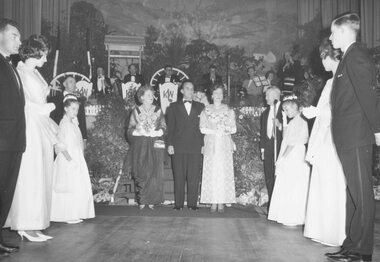
Photograph, Ringwood Mayoral Ball - Cr. Deuter. 1962
Black and white photographStamped on back of photograph- 'Peter Payens of Ringwood Studios.' -
Moorabbin Air Museum
Manual (item) - Flight Mechanics Course Notes - Otto Cycle, Hamilton Counterweight airscrew, Gipsy Major, P&W Wasp, Rolls Royce Merlin
-
 Melbourne Tram Museum
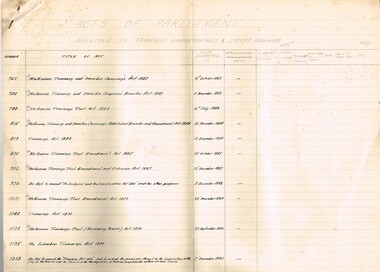
Document - Research Notes, H. S. McComb, "Acts or Parliament Relating to Tramway Undertakings and Street Railways", 1930 to 1955
Set of 10 + 4 unused sheets, hand written double foolscap folio (full foolscap sheet) ruled sheets which detail the various Acts, relating to Tramway Undertakings and Street Railways, that affected the MMTB from 1883 to 1956. Sheets have been pinned in to the top left hand corner. Set of 2 sheets - loose - the detail the Country Roads Act of 1928 and 1936. Set of 3 sheets - hand written notes regarding Acts.trams, tramways, mto co, cable trams, parliament, acts of parliament, order in council, regulations, mmtb, tramways -
 Ithacan Historical Society
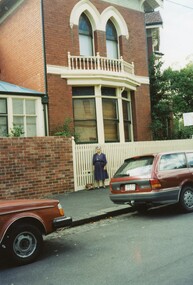
Photograph, Anthi Chilianis - House no. 5, 1994
This is the fifth house that Anthi Chilianis lived in before she was married. It was in Royal Parade, opposite the University of Melbourne. A coloured photograph of a lady standing outside a two story Federation style read brick house, which has a cream picket fence. Two cars are parked in the street in front of the house.chillianis -
 Bendigo Historical Society Inc.
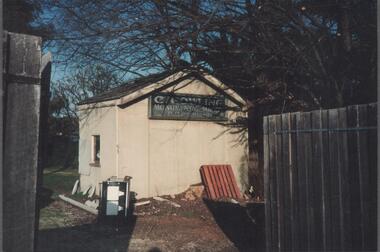
Photograph - BENDIGO BUSINESSES COLLECTION: C. COWLING
Colour photograph showing a small building with a sign: C. Cowling monumental mason. Rubbish around the building. Photo taken in Carpenter Street, July 1993.c. cowling, mason, bendigo businesses -
 International House, The University of Melbourne
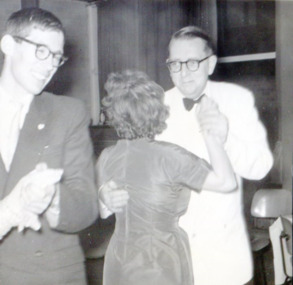
Photograph (Item), Richard Shiell, 'Painful Experience' (GO! MAN, GO!), 1960
Whilst female residents were not permitted at International House until 1972, the House hosted several formal events with invited guests, such as Dinner Dances held in April and July of 1960. Pictured here, Andrew Deacon was an Arts student and the first co-editor of the student magazine, Satadal, in 1959, and initiated International House's 'Waste Paper Basket Club', at which tutors and guests presented papers on global affairs. He went on to tutor English at the House in 1960. Sam Dimmick was Warden at International House from 1960 to 1970. This photograph comes from an 'Album of Student Activities 1960', compiled and presented to International House by Soedjadi Satrosoegito & Richard Shiell.social events, sam dimmick -
 Allan Doney Collection, Bendigo Historical Society Inc.
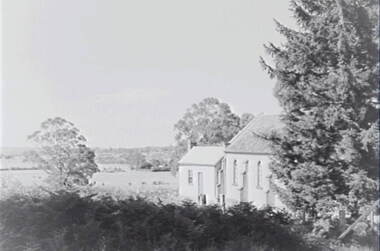
Negative - Glenlyon - Church, Allan Doney, 1950 -1970
In the years of Allan Doney’s photography, landmark buildings succumbed to fire, neglect and redevelopment. He photographed the grey sand hills from Bendigo’s mining past, the streetscapes, poppet heads, miners’ cottages, gracious homes with ornate verandahs, trams and much more. Above all, his photographs show how much of the city has survived from the 19th century – and how much has not. Through two decades of great change, Allan Doney was there to capture ways people interacted with it. Although he travelled to many other places in Northern Victoria and beyond in search of subjects for his art, he seemed to always return to Bendigo for inspiration. -
 Allan Doney Collection, Bendigo Historical Society Inc.
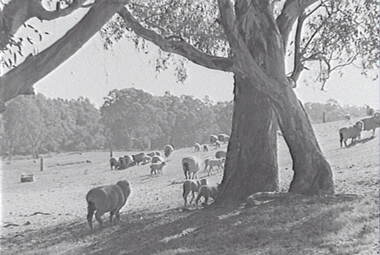
Negative - Laanecoorie - Sheep - Tree, Allan Doney, 1950 -1970
In the years of Allan Doney’s photography, landmark buildings succumbed to fire, neglect and redevelopment. He photographed the grey sand hills from Bendigo’s mining past, the streetscapes, poppet heads, miners’ cottages, gracious homes with ornate verandahs, trams and much more. Above all, his photographs show how much of the city has survived from the 19th century – and how much has not. Through two decades of great change, Allan Doney was there to capture ways people interacted with it. Although he travelled to many other places in Northern Victoria and beyond in search of subjects for his art, he seemed to always return to Bendigo for inspiration. -
 Ringwood and District Historical Society
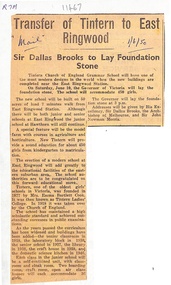
Article, Tintern CEGS Ringwood East - Newspaper Clipping 1/6/1950-Transfer of Tintern to East Ringwood
Article about new school buildings on 50 acres of land at East Ringwood, and the laying of the Foundation Stone. Transfer of Tintern to East Ringwood Sir Dallas Brooks to Lay Foundation Stone -
 Ringwood and District Historical Society
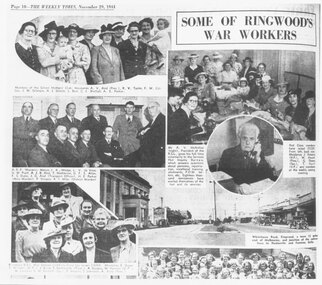
Photograph, Some of Ringwood's War Workers - Weekly Times Article 1944
Black and white copy of page from Weekly Times, November 29, 1944 headlined "Some of Ringwood's War Workers". (2 copies)Article shows images of the following groups: Schools Mothers Club, A.R.P. Wardens, Mr A.V. McArthur President of Ringwood RSL, Red Cross Members, Ringwood RSL War Service Comforts Fund members, with names of members of the individual groups. -
 Uniting Church Archives - Synod of Victoria
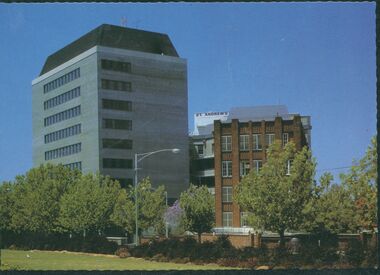
Photograph - Colour photograph, St Andrews Presbyterian Hospital East Melbourne
The land was the site of Scotch College until it moved to Hawthorn between 1914 and 1925. The Presbyterian Church established the St Andrew's Intermediate Hospital in 1934. The hospital is now closed,The photograph shows buildings comprising St Andrew's HospitalAt Andrew's Hospital East Melbourne Nu-Color-Vue postcardst andrew's hospital east melbourne -
 Bendigo Historical Society Inc.
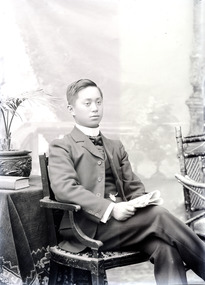
Negative - Photos of Bendigo - Glass Plate Negatives, Early 1900s
Mike Butcher Collection - Six of fourteen half plate glass negatives collected from Bartlett's (Vincent Kelly) studio, Pall Mall, Bendigo by donor. 11072.1p Mr W Kim Ah Hoy, 22/12/02 11072.1q Mr W Kim Ah Hoy, 19/4/1903 11072.1r Mr Ah Gay, re-sit 19/11/1903 11072.1s Mr Ah Gay and one other, 19/1/1903 11072.1t Mr Ah Gay, re-sit 19/11/03 11072.1u Mr Ah Gay, re-sit 19/11/1903photos, bendigo, mike butcher collection, kim ah hoy, mr w kim ah hoy, mr ah gay -
Moorabbin Air Museum
Manual (item) - CAC Collection - North American Aviation Parts Catalogue 6R9-10-1-73 to 8A1-1-63
-
 Sunshine and District Historical Society Incorporated
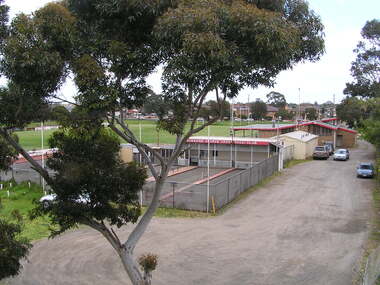
Photograph - Sunshine Photographs 2010, John Alchin, 2010
These photographs provide a visual record of assorted buildings, street views, and notable locations throughout Sunshine in 2026.This collection of photographs preserves a visual record of Sunshine 2010.5607.01 - Anderson Rd Sunshine - Chaplin Reserve 2010.JPG 5607.02 - Derby Rd looking North - West across Hampshire Rd 2010.JPG 5607.03 - Derby Rd looking South - West across Hampshire Rd 2010.JPG 5607.04 - Derby Rd Sunshine - Sunshine Secondary College (Old Girls School) 2010 Photo 01.JPG 5607.05 - Derby Rd Sunshine - Sunshine Secondary College (Old Girls School) 2010 Photo 02.JPG 5607.06 - Derby Rd Sunshine - Sunshine Technical College 2010 (Fromer Trade Wing).JPG 5607.07 - Devonshire Rd 2 Sunshine - H. V. McKay Office Building 2010 Photo 01.JPG 5607.08 - Devonshire Rd 3 Sunshine - Mercy Palliative Care 2010.JPG 5607.09 - H. V. McKay Pedestrian Bridge 2010 Photo 01.JPG 5607.10 - H. V. McKay Pedestrian Bridge 2010 Photo 02.JPG 5607.11 - H.V. McKay Memorial Gardens 2010 Photo 01.JPG 5607.12 - H.V. McKay Memorial Gardens 2010 Photo 02.JPG 5607.13 - Hampshire Rd looking South - West from Bennett Place 2010.JPG 5607.14 - Hampshire Rd Sunshine - Rear of Shops 265 - 277 2010 Photo 02.JPG 5607.15 - Hampshire Rd Sunshine - Sunshine Library 2010 (Now Demolished).JPG 5607.16 - Hampshire Road Sunshine - R. T. Pollard Gardens 2010.JPG 5607.17 - Harvester Rd 80B Sunshine - Visy Care Hub 2010 Photo 03.JPG 5607.18 - Harvester Rd 80B Sunshine - Visy Care Hub 2010 Photo 04.JPG 5607.19 - Presbyterian Church 2010 Photo 01.JPG 5607.20 - Presbyterian Church 2010 Photo 04.JPG 5607.21 - Presbyterian Church 2010 Photo 05.JPG anderson road, derby road, devonshire road, harvester road, chaplin reserve, sunshine secondary college, h. v. mckay office, mercy palliative care, h. v. mckay pedestrian bridge, h.v. mckay memorial gardens, sunshine technical school, sunshine presbyterian church -
 Bendigo Historical Society Inc.
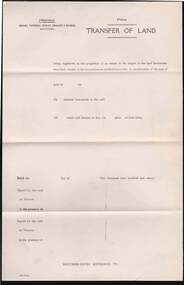
Document - CAMBRIDGE PRESS COLLECTION: TRANSFER OF LAND
Draft Transfer paper for the Transfer of Land. Messrs. Tatchell, Dunlop, Smalley & Balmer, Solicitors. Part printed date of 192-. Cambridge Press, Print, Bendigo.business, printers, cambridge press, cambridge press collection, draft transfer, tatchell dunlop smalley & balmer, transfer of land, cambridge press -
 St Kilda Historical Society
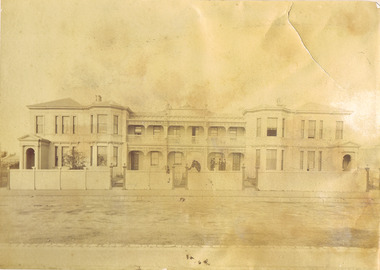
Photograph, J.P. Lind, Marli Terrace, c. 1866
Marli Terrace, The Esplanade, St Kilda; home of Justice Stewart Johnstone in 1860s; unpaved road in front; after major extension, two wings added to original five terraces black and white photograph, mounted, original, poor conditionMarli Terrace; Built by: Johnston; [photographer's stamp] -
 Sunshine and District Historical Society Incorporated
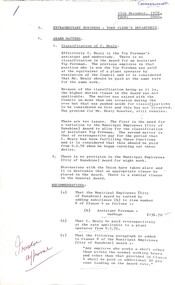
Administrative record - City of Sunshine - Commissioner Mr Alexander Alex George Gillon Collection 1976 - 1982 - Extraordinary Business Town Clerk's Department 15th December 1976, City of Sunshine, 15th December 1976
Extraordinary Business Town Clerk's Department 15th December 1976 Land Use Permit Panel Beating and Spray Painting Central Avenue Land Use Permit 186 - 190 Mitchell Street Maidstone Land Use Permit 79 Mulhall Drive St. Albans Land Use Permit F. Heaviside Ballarat Road Albion Land Use Permit St. Theresa's School Drummartin Street Land Use Permit Mini Mix Concrete Plant Lot 1 Hampstead Road Maidstone Land Use Permit Doctor's Consulting Rooms 17 Ainsworth Street Sunshine West city of sunshine, alexander "alex" george gillon, central avenue, sunshine, mitchell street, maidstone, mulhall drive, st. albans, drummartin street, ballarat road, albion, st. theresa's primary school, ainsworth street, sunshine west -
Glen Eira Historical Society
Document - Noel Jones – Estate Agents
This file contains one item: 1/A typewritten note from R. Landells, dated 26/02/1995, regarding the real estate agency, Noel Jones, in Glenhuntly Road, Elsternwick. Under the management of Mark Tappin, c.1987–1991, they continually asked for ‘house histories’ to be completed.noel jones, real estate agencies, real estate agents, glenhuntly road, elsternwick, landells r., tappin mark, elsternwick post office -
 Williamstown Historical Society Inc
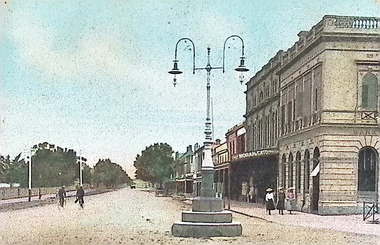
Photograph - Nelson Place, Postcard, c.1907
nelson place, postcard, c.1907 -
 Lakes Entrance Historical Society
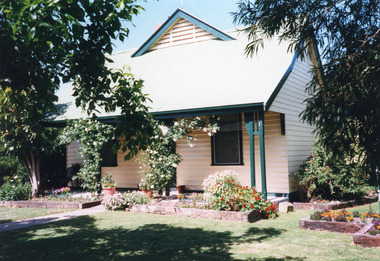
Photograph - Historic House, 14 Bulmer Street, Lakes Entrance Victoria, 2000
Building was residence of State School teacher from 1890's. Typical of Education Department residence for teacher. During 1990's cladding and window frames were altered.Colour photograph of a timber dwelling with high pitched gable roof. Gablet ventilator in centre of roof. Narrow front veranda. Pretty garden beds enclosed with railway sleepers. Situated at 14 Bulmer Street, Lakes Entrance Victoriahouses, fences, heritage study -
 Bendigo Historical Society Inc.
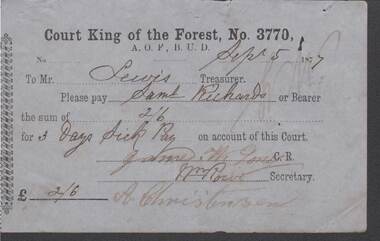
Document - ANCIENT ORDER OF FORESTERS NO. 3770 COLLECTION: TO PAY
Blue paper headed Court King of the Forest, No. 3770 A.O.F, B.U.D., dated August 22 1877. To Mr. Lewis, Treasurer. Please pay Saml Richards or Bearer the sum of 2/6 for 3 Days Sick Pay on account of this Court. Signed by James W. Long, C. R. and Wm. Rowe, Secretary. Also signed by A. Christensen.societies, aof, correspondence, ancient order of foresters no. 3770 collection - to pay, court king of the forest no 3770, mr lewis, saml richards, james w long, wm rowe, a christensen -
 Surrey Hills Historical Society Collection
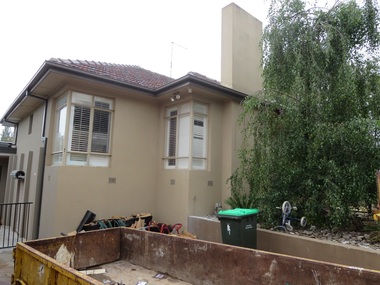
Photograph - 1 Mathilde Road, Surrey Hills, On The Street Where You Live Project
Photos documenting this address as part of a photographic series undertaken by volunteer photographers during 2013 and 2014 for The Street Where You Live Project. This was organised through the Surrey Hills Neighbourhood Centre and covered the postcode 3127 in the cities of Boroondara and Whitehorse.These photos provide a snapshot of real estate in the suburbs of Mont Albert and Surrey Hills during a period of rapid change with many properties on large blocks demolished to create higher density residential development or renewal of single dwellings. At particular risk were properties not covered by heritage overlays, especially interwar housing and post 1950's housing. -
 University of Melbourne, Burnley Campus Archives
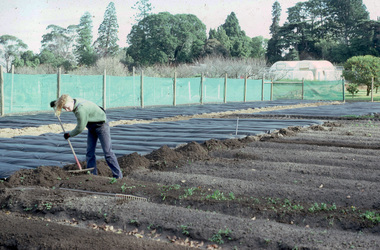
Photograph - 35mm Colour slides, Kodachrome, Miscellaneous Burnley, 1986
9 colour slides: 1 "Feb 86" student working in Orchard. 3, 4. the Crack Willow before pruning. 2.Student spraying in Orchard Jun 86. Others unidentified Sep-Dec 86.students, crack willow, spraying, students working outside, orchard -
 Clunes Museum
Photograph
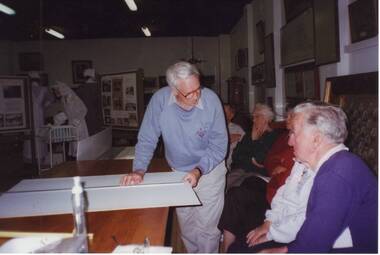
PHOTOGRAPH REFRAMING WORKSHOP AT THE MUSEUM.local history, photography, photographs, workshop, framing -
 Bendigo Historical Society Inc.
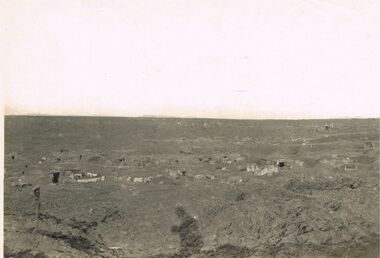
Photograph - ACC LOCK COLLECTION: B&W PHOTO OF A BATTLEGROUND WITH TOWNSHIP IN DISTANCE, PHOTOGRAPH, 1914-1918
Photograph, WW1, B&W photo of a desolate battleground showing gun positions and a township in the far left distance. Handwritten in pencil on the back Gun positions from the duckboards S985 114 114photo, photo, ww1, france, battleground -
 Sunshine and District Historical Society Incorporated
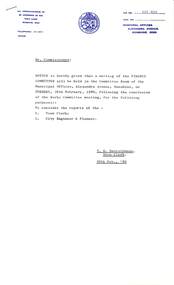
Administrative record - City of Sunshine - Commissioner Mr Alexander Alex George Gillon Collection 1976 - 1982 - Notice of committee meetings 26th February 1980, City of Sunshine, 20th February 1980
Notice of Finance Committee Meeting 26th February 1980 Report of the Town Clerk National Wage Decision Variation to Awards Payment of Increase Capital Works Programme 1978-79 and Schedule for 1980-81Bon Thomas Reserve and Humes Land City of Sunshine Proposed Loan Programme 1979/80 Capital Works Programme 1978-79 and 1980-81Projects Which were Previously Provied on Capital Works Schedules and Previously Considered by Council, for which Neither Loan Money Or Overdraft Monies Have Been Procured Prior to 19th Febraury 1980 Financial Reports for the Period Ended 11th February 1980bon thomas reserve, quinn street, deer park, humes pipes land, van ness avenue, maribyrnong -
Merbein District Historical Society
Document - Enlistment, Rainbow, William Joseph World War One Enlistment, 2 May.1916
world war one, enlistment paper, ww1, first world war -
 Stawell Historical Society Inc
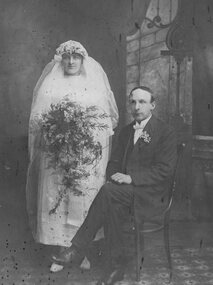
Photograph, Mr George Cox & Miss Georgina Wilson's Wedding
George Cox and Georgina Wilson Bride and Groom Wedding.stawell portrait
