
Showing 131 items matching " leather goods"
-
 Bendigo Historical Society Inc.
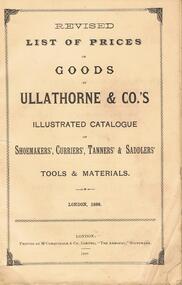
Document - ABBOTT COLLECTION: REVISED LIST OF PRICES, 1888
... They imported all manner of leather goods and tannery supplies by 1866. By 1901 the Melbourne company was named Ullathorne and Hartridge....They imported all manner of leather goods and tannery supplies by 1866. By 1901 the Melbourne company was named Ullathorne and Hartridge. ...Established in London in 1760 as flax dressers and producers of thread for shoemakers, the business was founded by Francis Ullathorne and continued by four of his sons. Eventually they had agencies in Paris, London and Melbourne. They imported all manner of leather goods and tannery supplies by 1866. By 1901 the Melbourne company was named Ullathorne and Hartridge.48 Paper pages with cover missing. Revised List of Prices of goods in Ullathorne & Co's Illustrated Catalogue of Shoemakers' Curriers', Tanners' and Sadlers' Tools and Materials. London 1888 Printed by McCorquodale and Co. 'Armoury' Southwark.abbott, ullathorne & co. -
 Bendigo Historical Society Inc.
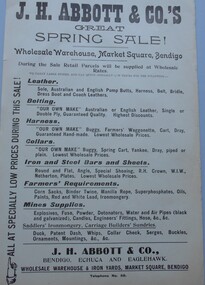
Document - ABBOTT COLLECTION: ADVERTISING PAGES
... Single printed page (38.5 x 25.5 cm) for "JH Abbott & Co Great Spring Sale." Listing leather goods, iron and steel, farmer's requirements and Mines Supplies. ...Abbott Bendigo Businesses Single printed page (38.5 x 25.5 cm) for "JH Abbott & Co Great Spring Sale." Listing leather goods, iron and steel, farmer's requirements and Mines Supplies. ...Single printed page (38.5 x 25.5 cm) for "JH Abbott & Co Great Spring Sale." Listing leather goods, iron and steel, farmer's requirements and Mines Supplies. Sold from their Market Square warehouse. Also, smaller yellow advertising for Anti Friction Grease (36 x 4 cm )abbott, bendigo businesses -
 Bendigo Historical Society Inc.
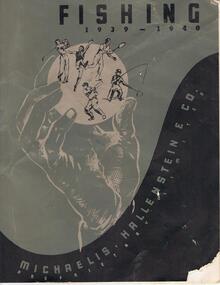
Document - ABBOTT COLLECTION: FISHING CATALOGUE, 1939
... After WW1 and the deaths of the founders, the company moved into a variety of leather goods, including shoes, footballs and golf bags. ...After WW1 and the deaths of the founders, the company moved into a variety of leather goods, including shoes, footballs and golf bags. ...Founded by Moritz Michaelis and Isaac Hallerstein in 1866. Isaac Hallenstein had previously been partnered with Hermann Buttner and they were travelling salesmen in the Goldfields. Eventually they bought Cleghorn's tannery in Melbourne but Buttner sold his part to Moritz, Isaac's uncle. The expanded the leather business until they had branches in most states and New Zealand and London. After WW1 and the deaths of the founders, the company moved into a variety of leather goods, including shoes, footballs and golf bags. They eventually began to sell all types of sporting goods.Michaelis, Hallenstein & Co PTY LTD Fishing 1939 -1940 Catalogue. Grey and Black cover in light cardboard, with 32 paper pages. Small tear on bottom right corner and top of cover and first page. Photographs and illustrations in B&W. Rear cover lists address as 441 Lonsdale Street Melbourneabbott, fishing -
 Bendigo Historical Society Inc.
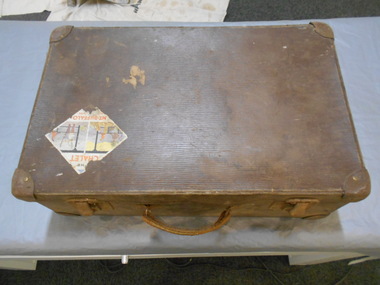
Functional object - Suitcase Made in Bendigo
... HARPER NEW BAG SHOP Leather Goods & Ladies' Hand Bags Travelling Bags & Trunks Saddler & Harness Maker Charing Cross BENDIGO The other is light blue with black writing, QUALITY Guaranteed M.B. ...HARPER NEW BAG SHOP Leather Goods & Ladies' Hand Bags Travelling Bags & Trunks Saddler & Harness Maker Charing Cross BENDIGO The other is light blue with black writing, QUALITY Guaranteed M.B. ...G. Harper was a saddler and harness maker located at Bath Corner, Charring Cross. He advertised in The Bendigo Advertiser in 1892A brown suitcase with two metal clasps which could be locked. There are two travel stickers, ones a Victorian railways luggage Melbourne Albury which is partly missing, the other is The CHALET MT BUFFALO Nation Park. On the inside of the lid there are two labels one is black with gold letters G. HARPER NEW BAG SHOP Leather Goods & Ladies' Hand Bags Travelling Bags & Trunks Saddler & Harness Maker Charing Cross BENDIGO The other is light blue with black writing, QUALITY Guaranteed M.B. Fibre CASE.182 underlined made in bendigo, suitcase, g. harper saddler and harness maker -
 Brighton Historical Society
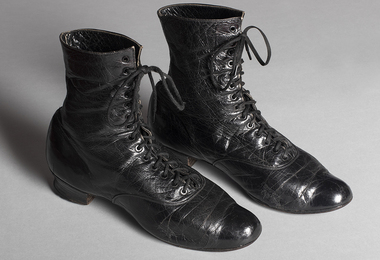
Shoes, circa 1880s - mid 20th century
... Based in Collingwood, from 1883 until the mid-twentieth century they manufactured and sold a large range of goods, including clothing, manchester, leather goods, soft furnishings, furniture, hardware and food....Based in Collingwood, from 1883 until the mid-twentieth century they manufactured and sold a large range of goods, including clothing, manchester, leather goods, soft furnishings, furniture, hardware and food. shoes nuns foy & gibson presentation sisters star of the sea convent Interior label: "COMFORT / FOY & GIBSON PTY LTD / COLLINGWOOD" Pair of black leather women's lace-up shoes with a low heel. ...A pair of shoes worn by a Presentation nun at Star of the Sea Convent, Gardenvale. The history of the shoes is unknown; nuns working in the convent's archive found them stored among convent records, and subsequently donated them to Brighton Historical Society. The Presentation Sisters, a Catholic order originating from Ireland, founded the Star of the Sea Convent in Gardenvale in 1883. Led by Mother Paul Fay and Mother John Byrne, they established a convent and school in a house called Turret Lodge, on the site of the present Star of the Sea College in Martin Street. The order and the school remain active in Brighton today. Foy & Gibson was one of Australia's earliest department store chains. Based in Collingwood, from 1883 until the mid-twentieth century they manufactured and sold a large range of goods, including clothing, manchester, leather goods, soft furnishings, furniture, hardware and food.Pair of black leather women's lace-up shoes with a low heel.Interior label: "COMFORT / FOY & GIBSON PTY LTD / COLLINGWOOD"shoes, nuns, foy & gibson, presentation sisters, star of the sea convent -
 Kew Historical Society Inc
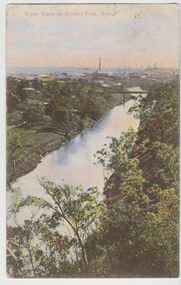
Postcard, River Yarra at Studley Park, Kew, c.1908
... His business at 271 Little Collins Street offered Christmas cards, booklets, calendars, and leather goods as well as postcards and albums....His business at 271 Little Collins Street offered Christmas cards, booklets, calendars, and leather goods as well as postcards and albums. river yarra -- kew (vic.) william thompson pater w.t.p. postcards -- kew postcards -- studley park bridges - yarra river -- kew (vic.) ...Colour-tinted postcard, titled in red upper left: “RIVER YARRA AT STUDLEY PARK, KEW”. On the divided reverse, the card is addressed to “MISS JOLLEY / MELB. TRAM & O[MNIBUS]. CO / BOURKE STREET, MELB”. The sender has dated the card 21.12.08. In the upper right corner, there is a pink Victorian one penny postage stamp; sent from Melbourne on 22DE 08. (The division of the reverse of the postcard, allowing a message to be written on one half and the address on the other, was not permitted in Australia until 1905.) The manufacturer of the postcard is indicated by the initials “W.T.P”, printed in a green floral diamond, printed centre top. This was the trademark of WT Pater, printers & stationers. William Thompson Pater was born in Melbourne in 1861. His business at 271 Little Collins Street offered Christmas cards, booklets, calendars, and leather goods as well as postcards and albums.Hand-tinted postcard of the River Yarra in Studley Park, Kew. The birds-eye view is of a bridge on the Yarra (Johnston Street?) linking Kew and Abbotsford as it appeared in c.1908. On the Abbotsford side of the river, fields lead down to the river, with some remnant trees. The Kew side of the river, in contrast, due to its steep banks, retains its original vegetation. In the distance is industrial development, in what might be Fairfield and Alphington.“RIVER YARRA AT STUDLEY PARK, KEW”river yarra -- kew (vic.), william thompson pater, w.t.p., postcards -- kew, postcards -- studley park, bridges - yarra river -- kew (vic.) -
 Bendigo Historical Society Inc.
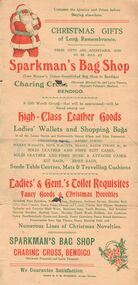
Memorabilia - SPARKMAN'S BAG SHOP CHRISTMAS GIFT BROCHURE
... Sparkans's Bag Shop (Late Harper's Oldest Established Bag Shop in Bendigo) Charing Cross (Between Mitchell St and Lyric Theatre, Opposite Cabmen's Shelter), Bendigo. High = Class Leather Goods. Ladies Wallets and Shopping Bags etc., Table Centres, Mats & Travelling Cushions. ...Sparkans's Bag Shop (Late Harper's Oldest Established Bag Shop in Bendigo) Charing Cross (Between Mitchell St and Lyric Theatre, Opposite Cabmen's Shelter), Bendigo. High = Class Leather Goods. Ladies Wallets and Shopping Bags etc., Table Centres, Mats & Travelling Cushions. ...BHS CollectionSparkman's Bag Shop Christmas Gift Brochure: Cream paper with red and green print with a Santa Clause left hand corner. Printed on the brochure is * Compare the Quality and Prices before Buying elsewhere. Christmas Gifts of Long Remembrance. Sparkans's Bag Shop (Late Harper's Oldest Established Bag Shop in Bendigo) Charing Cross (Between Mitchell St and Lyric Theatre, Opposite Cabmen's Shelter), Bendigo. High = Class Leather Goods. Ladies Wallets and Shopping Bags etc., Table Centres, Mats & Travelling Cushions. Ladies & Gent's Toilet Requisites, Fancy Goods & Christmas Novelties. We Guarantee Satisfaction. Paper torn in two places. Box 625.Printed by F.H. Sparkman, Arcade, Bendigobusiness, retail, advertising -
 Flagstaff Hill Maritime Museum and Village
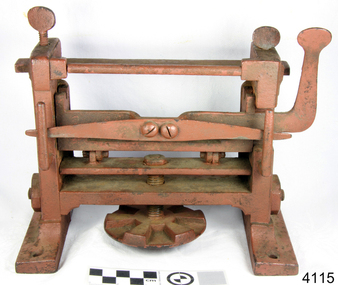
Lap Skiver, J Dixon, 1900s
... The twentieth century saw the rise of light leather goods, such as handbags, cases and gloves. ...The twentieth century saw the rise of light leather goods, such as handbags, cases and gloves. ...Walsall in England was regarded as the world`s greatest centre of the saddlery trade. The town's craftsmen began to specialise in making bits, stirrups and spurs in the Middle Ages, developing into fully-fledged makers of saddlery and harness, by the end of the nineteenth century. As a result, over a hundred firms were exporting their products throughout the British Empire and beyond. The Walsall firms flourished as horses were so vital to everyday life in Victorian Britain and the colonies. The Walsall area emerged as a major supplier of military saddlery and harnesses, with one company supplying an astonishing 100,000 saddles for the British army in the First World War. The twentieth century saw the rise of light leather goods, such as handbags, cases and gloves. With the coming of the motor car, these products became the mainstay of the Walsall leather industry. Many companies supplied this trade and Dixon tools was one, as a commercial and industrial equipment supplier to the trade. The company started in 1843 and has continued to produce tools for the leather industries up and till August 2017 when the company was dissolved.A vintage item used in the leather working industries see additional notes at end of document for clarity on how the item was used and it's importance in making leather goods.Lap Skiver has a roller missing. Painted reddish brown J Dixonflagstaff hill, warrnambool, shipwrecked-coast, flagstaff-hill, flagstaff-hill-maritime-museum, maritime-museum, shipwreck-coast, flagstaff-hill-maritime-village, lap skiver, leather industries, leather making tools, tools, j dixon -
 Warrnambool and District Historical Society Inc.
Artefact, G.W.Scott & Sons, Picnic Case, 1930s
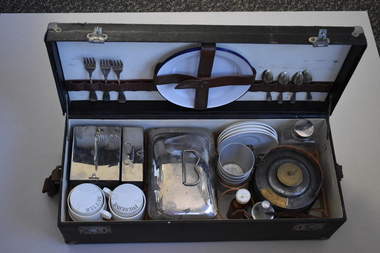
... Scott and Sons who were producers of wickerwork crafts, basketry and luxury leather goods. The business was founded in 1661 and ceased operations in 1967. ...Scott and Sons who were producers of wickerwork crafts, basketry and luxury leather goods. The business was founded in 1661 and ceased operations in 1967. ...This is a car picnic set made by the English firm of G. W. Scott and Sons who were producers of wickerwork crafts, basketry and luxury leather goods. The business was founded in 1661 and ceased operations in 1967. The picnic set belonged to Dr Horace Iles Holmes (1877-1959) who was born and educated in Tasmania and completed a medical degree at Melbourne University. He commenced a practice in Warrnambool in 1906 and was the Honorary Medical Officer at the Warrnambool Hospital and Warrnambool’s Health Officer. His practice was at ‘Ierne’ at the corner of Spence and Kepler Streets. He was an early member of the Royal Australian College of Surgeons and was prominent in Warrnambool community affairs (Foundation President of Warrnmbool Rotary Club, a member of the local Masonic Lodge for over 50 years, Warrnambool Hospital Committee member, long-term Trustee of the Warrnambool Methodist Church and President of the Lyndoch Hostel for the Aged Committee). Dr Holmes also had agricultural interests and enjoyed fishing, golf and bowls. He also had a motor car and this picnic set would have been used for family picnics. This picnic set is of considerable significance because: 1. It is a good example of the luxury picnic sets owned by more affluent people in the 1930s and 40s. 2. It has important local provenance as it belonged to Horace Holmes, a doctor associated with the professional and community life of Warrnambool for over 50 years. This is a rectangular wooden box with a leather covering. It has metal hinges on the corners of the box and two two metal catches on the side with a leather belt and metal buckle on one of these catches with one leather belt missing on the other side. These leather straps were to attach the picnic box to the running board of the car. There are also two metal catches or locks on the front of the box. Inside the box there is a white lining with a plaited wickerwork insert containing spaces for the following: 1. large china container with a silver top 2. smaller metal container with a silver lid 3. small rectangular metal tin with a silver lid. This container still has some loose tea leaves inside 4. four china cups 5. two circular china dishes for jam and butter 6. four china saucers 7. one glass bottle with a silver top 8. one metal phial, silver-coloured 9. one amber-coloured glass bottle (probably not an original) 10. four nickel silver spoons 11. three metal forks 12. three white enamel plates, blue edged Numbers 10,11 and 12 are held in place by leather straps on the inside of the lid of the box 13. two loose metal straps 14. one metal kettle with a handle with cane strapping, a brass lid, a brass spout with an end chain and a metal inscription 15. The kettle is sitting in a metal tray which has a lighting mechanism to heat the water The picnic set has some rusted metal catches on the exterior of the box and the leather is very stained and torn in places. ‘Remove screw before lighting G.W.S. & S ‘ ‘Coracle brand’ antique luxury picnic set, dr horace holmes, history of warrnambool -
 Flagstaff Hill Maritime Museum and Village
Container - Pyott's Paper Shopping Bag, c. early 20th-century
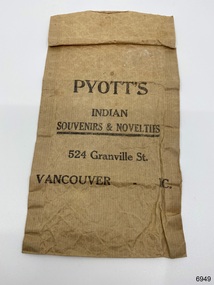
... It reads: 'We carry one of the largest lines of Indian Burnt Leather Goods, Moccasins and Baskets in the city; also Beads, Purses and Hand Bags; View Books, Post Cards and Novelties of all kinds. ...It reads: 'We carry one of the largest lines of Indian Burnt Leather Goods, Moccasins and Baskets in the city; also Beads, Purses and Hand Bags; View Books, Post Cards and Novelties of all kinds. ...Pyott's Ltd., was an merchant and novelty shop in Vancouver, Canada during the early-20th century. An advertisement for the shop was published on February 9, 1922 in the Ubyssey News (issued Weekly by the Publications Board of the University of British Columbia. It reads: 'We carry one of the largest lines of Indian Burnt Leather Goods, Moccasins and Baskets in the city; also Beads, Purses and Hand Bags; View Books, Post Cards and Novelties of all kinds. Your inspection invited, 524 Granville St. Vancouver B.C'. History of shopping bags: Before the late 1800s, shopping bags didn’t exist. Shoppers would either carry their goods home in baskets, or have the merchant deliver them to people's homes, until 1852 when Francis Wolle, a schoolteacher in Pennsylvania, invented a machine to produce paper shopping bags. This invention would allow customers to carry items home in disposable paper bags. Soon after, owners of department stores and retailers began to realise that paper shopping bags could be used to help market their brands, and as such custom shopping bags with printed logos became common place. Carrying a shopping bag from certain shops became a type of status symbol for consumers, providing evidence that one was well-off, had good taste, or both. The paper shopping bag is a rare survival of ephemera related to a retail store that existed in Vancouver, Canada during the early-20th century. The arrival of waves of more than ten million migrants by boat is one of the major themes in Australia’s history. The paper shopping bag is representative of personal items purchased for migrant journeys as markers of domesticity, warmth and making oneself at home in a new land that speaks of the transnational lives embedded in threads of migration. A brown paper shopping bag with a printed logo and store information in black inkPyott's, Indian Souvenirs & Novelies. 524 Granville St, Vancouver- B.C. On the reverse side in handwriting: 'Red + dark red beadsshopping bag, marketing, ephemera, pyott's, vancouver, canada, migration, flagstaff hill, merchant -
 Flagstaff Hill Maritime Museum and Village
Functional object - Suitcase/Trunk
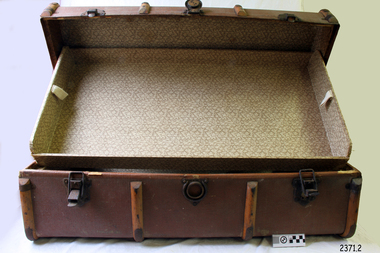
... Suitcases began as an afterthought in the luggage and leather goods business, but they soon became the very symbol of travel. ...Suitcases began as an afterthought in the luggage and leather goods business, but they soon became the very symbol of travel. ...The suitcase didn't catch on until the end of the 19th century, it was quite literally as a case for suits. A typical suitcase came equipped with an inner sleeve for storing shirts, and sometimes a little hatbox on the side. But even in the early 20th century, the "dress-suit case" was only one of countless styles of container travellers could buy, from steamer trunks to club bags. By the late 19th century a significant point was reached in the history of transportation, it was the beginning of mass tourism, rather than travel for travels sake made use of by the wealthy in society. Travel wasn't just for the wealthy any more but everyone. Suitcases began as an afterthought in the luggage and leather goods business, but they soon became the very symbol of travel. An 1897 wholesale price list included the words "suitcase" only twice in a 20-page list of luggage types. In America a 1907 T. Eaton & Co. Catalogue, trunks took up a full page while suitcases share a page with club bags and valises. In a 1911 a United Company catalogue, now displayed around 40 per cent of the advertisements were for suitcases. Early suitcases were lighter and more portable than trunks, but they were still bulky by today's standards. Leather, canvas, wicker or thick rubbery cloth was stretched over a rigid wood or steel frame. Corners were rounded out using brass or leather caps and some had wooden rails running around the case. Until steamship travel declined during the mid-20th century, many of these types of the case were advertised as waterproof with some lightweight models marketed specifically to women. The item gives us a snap-shot as to how people undertook travelling during a time when undertaking a journey for pleasure at the end of the 19th century was mainly only for the wealthy. This time saw the beginnings of change from the wealthy in society being able to travel, to the onset of mass tourism. Along with this change in societal norms saw many innervation's to the design of luggage as it became a fashionable item.Suitcase/trunk with inner tray, brown canvas covered with 2 hinge clamps and a central Eagle lock, four wooden lateral buffer railed slats running around the case, leather handles each end. noneflagstaff hill, warrnambool, shipwrecked-coast, flagstaff-hill, flagstaff-hill-maritime-museum, maritime-museum, shipwreck-coast, flagstaff-hill-maritime-village, suitcase -
 Flagstaff Hill Maritime Museum and Village
Functional object - Suitcase, 1930-1945
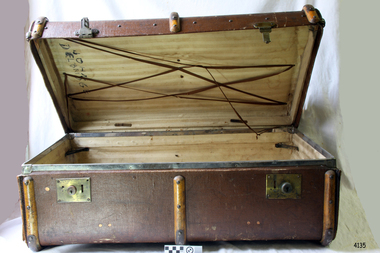
... Suitcases began as an afterthought in the luggage and leather goods business, but they soon became the very symbol of travel. ...Suitcases began as an afterthought in the luggage and leather goods business, but they soon became the very symbol of travel. ...The suitcase didn't catch on until the end of the 19th century, it was quite literally as a case for suits. A typical suitcase came equipped with an inner sleeve for storing shirts, and sometimes a little hat box on the side. But even in the early 20th century, the "dress-suit case" was only one of countless styles of container travellers could buy, from steamer trunks to club bags. By the late 19th century a significant point was reached in the history of transportation, it was the beginning of mass tourism, rather than travel for travels sake made use of by the wealthy in society. Travel wasn't just for the wealthy any more but everyone. Suitcases began as an afterthought in the luggage and leather goods business, but they soon became the very symbol of travel. An 1897 wholesale price list included the words "suitcase" only twice in a 20-page list of luggage types. In America a 1907 T. Eaton & Co. Catalogue, trunks took up a full page while suitcases share a page with club bags and valises. In a 1911 a United Company catalogue, now displayed around 40 per cent of the advertisements were for suitcases. Early suitcases were lighter and more portable than trunks, but they were still bulky by today's standards. Leather, canvas, wicker or thick rubbery cloth was stretched over a rigid wood or steel frame. Corners were rounded out using brass or leather caps and some had wooden rails running around the case. Until steamship travel declined during the mid-20th century, many of these types of the case were advertised as waterproof with some lightweight models marketed specifically to women. The item gives us a snap-shot as to how people undertook travelling during a time when undertaking a journey for pleasure at the end of the 19th century was mainly only for the wealthy. This time saw the beginnings of change from the wealthy in society being able to travel, to the onset of mass tourism. Along with this change in societal norms saw many innervations to the design of luggage as it became a fashionable item.Suitcase, brown canvas with three wooden reinforcing lateral rails running around the case, leather handle each end (one broken), two locks.. Maker Pettigrew & Stephens Ltd Glasgow. "A.T.Cox 354/3 Riversdale Rd Campberwell, Vic Australia" and "W.ON" painted over on each endflagstaff hill, warrnambool, shipwrecked-coast, flagstaff-hill, flagstaff-hill-maritime-museum, maritime-museum, shipwreck-coast, flagstaff-hill-maritime-village, suitcase, -
 Flagstaff Hill Maritime Museum and Village
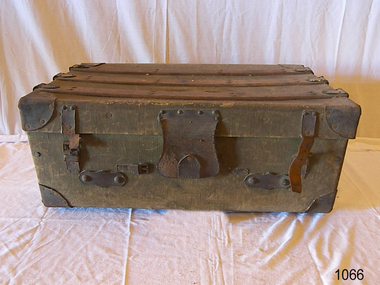
Functional object - Steamer luggage Trunk, First quarter of the 20th century
... Suitcases began as an afterthought in the luggage and leather goods business, but they soon became the very symbol of travel. ...Suitcases began as an afterthought in the luggage and leather goods business, but they soon became the very symbol of travel. ...Item used around the first quarter of the 20th century The suitcase didn't catch on until the end of the 19th century, it was quite literally as a case for suits. A typical suitcase came equipped with an inner sleeve for storing shirts, and sometimes a little hat box on the side. But even in the early 20th century, the "dress-suit case" was only one of countless styles of container travellers could buy, from steamer trunks to club bags. By the late 19th century a significant point was reached in the history of transportation, it was the beginning of mass tourism, rather than travel for travels sake made use of by the wealthy in society. Travel wasn't just for the wealthy any more but everyone. Suitcases began as an afterthought in the luggage and leather goods business, but they soon became the very symbol of travel. An 1897 wholesale price list included the words "suitcase" only twice in a 20-page list of luggage types. In America a 1907 T. Eaton & Co. Catalogue, trunks took up a full page while suitcases share a page with club bags and valises. In a 1911 a United Company catalogue, now displayed around 40 per cent of the advertisements were for suitcases. Early suitcases were lighter and more portable than trunks, but they were still bulky by today's standards. Leather, canvas, wicker or thick rubbery cloth was stretched over a rigid wood or steel frame. Corners were rounded out using brass or leather caps and some had wooden rails running around the case. Until steamship travel declined during the mid-20th century, many of these types of the case were advertised as waterproof with some lightweight models marketed specifically to women. The item gives us a snap-shot as to how people undertook travelling during a time when undertaking a journey for pleasure at the end of the 19th and early 20th century was mainly only for the wealthy. This time saw the beginnings of change from the wealthy in society being able to travel, to the onset of mass tourism. Along with this change in societal norms saw many innervation's to the design of luggage as it became a fashionable item.Suitcase/trunk leather reinforced at corners with wooden slats to strengthen the lid. Leather straps to close lid with metal lock in the middle of the lid. Closing strap missing.Noneflagstaff hill, warrnambool, shipwrecked-coast, flagstaff-hill, flagstaff-hill-maritime-museum, maritime-museum, shipwreck-coast, flagstaff-hill-maritime-village -
 Flagstaff Hill Maritime Museum and Village
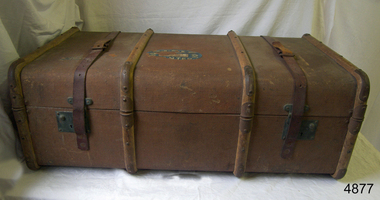
Functional object - Suitcase, 1920-1950
... Suitcases began as an afterthought in the luggage and leather goods business, but they soon became the very symbol of travel. ...Suitcases began as an afterthought in the luggage and leather goods business, but they soon became the very symbol of travel. ...The suitcase didn't catch on until the end of the 19th century, it was quite literally as a case for suits. A typical suitcase came equipped with an inner sleeve for storing shirts, and sometimes a little hat box on the side. But even in the early 20th century, the "dress-suit case" was only one of countless styles of container travellers could buy, from steamer trunks to club bags. By the late 19th century a significant point was reached in the history of transportation, it was the beginning of mass tourism, rather than travel for travels sake made use of by the wealthy in society. Travel wasn't just for the wealthy any more but everyone. Suitcases began as an afterthought in the luggage and leather goods business, but they soon became the very symbol of travel. An 1897 wholesale price list included the words "suitcase" only twice in a 20-page list of luggage types. In America a 1907 T. Eaton & Co. Catalogue, trunks took up a full page while suitcases share a page with club bags and valises. In a 1911 a United Company catalogue, now displayed around 40 per cent of the advertisements were for suitcases. Early suitcases were lighter and more portable than trunks, but they were still bulky by today's standards. Leather, canvas, wicker or thick rubbery cloth was stretched over a rigid wood or steel frame. Corners were rounded out using brass or leather caps and some had wooden rails running around the case. Until steamship travel declined during the mid-20th century, many of these types of the case were advertised as waterproof with some lightweight models marketed specifically to women. The item gives us a snap-shot as to how people undertook travelling during a time when undertaking a journey for pleasure at the end of the 19th century was mainly only for the wealthy. This time saw the beginnings of change from the wealthy in society being able to travel, to the onset of mass tourism. Along with this change in societal norms saw many innervations to the design of luggage as it became a fashionable item.Suitcase wooden with four wood reinforcing ribs, 2 leather straps with buckles & leather handles each end. Has inner shelf.Noneflagstaff hill, warrnambool, shipwrecked-coast, flagstaff-hill, flagstaff-hill-maritime-museum, maritime-museum, shipwreck-coast, flagstaff-hill-maritime-village, suitcase, -
 Bendigo Historical Society Inc.
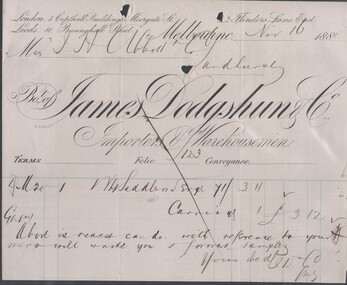
Administrative record - Abbott Collection: Receipts for purchases by J.H. Abbott & Co.in 1881, 1881
... Melbourne; 2403.97q 18 Oct 1881 receipt for purchase of leather goods from J. B. Hayman, Melbourne; 2403.97r multiple 1881 receipts for the purchase/transfer of leather goods from his J. ...Melbourne; 2403.97q 18 Oct 1881 receipt for purchase of leather goods from J. B. Hayman, Melbourne; 2403.97r multiple 1881 receipts for the purchase/transfer of leather goods from his J. ...business records/receiptsAbbotts collection: Receipts for purchases made by J. H. Abbott & Co. in 1881; both for a wide range of goods and from a wide range of, both local and international, companies: 2403.91a 16 Nov 1881bought from James Dodgshun & Co. of one saddle from their Melbourne office; 2403.97b 2 Nov 1881 return of one 64 lbs belt from J. B. Hayman, Melbourne; 2403.97c 27 Jun 1899 five letters of correspondence regarding the purchase of100 cases of "British" gelignite from Reid Bros. & Russell Prop. Ltd., Melbourne; 2403.97d 5 Nov 1881 purchase of tallow oil from Apollo Stearine Candle Company, Melbourne 2403.97e 13 Dec 1881 eight itemised (whips, snaffles and saddle soap, etc)purchases from Guthridge Power & Co Saddlers, Ironmongers and Importers, Sandhurst 2403.97f 8 Dec 1881 purchase of hessians from James Dodgshun & Co., Melbourne; 2403.97g 1 Nov 1881 purchase of 3 Bago Curled Hair nets from E. R. Priestly, Melbourne; 2403.97h 15 Aug 1881 purchase of 3 No. foolscap books from Andrew Jack & Co., wholesale stationers, Melbourne; 2403.97i 13 Oct 1881 purchase of 10 itemised skins from The New Zealand Loan & Mercantile Agency Company Limited, Melbourne; 2403.97j 6 Nov 1881 purchase of one "Bale Heavy Crop" from Gill & Boston, Melbourne; 2403.97k 17 Dec 1881 ten (blue) receipts of a wide range of products from Ullathorne & Co. Importers & Manufacturers of all articles used by Tanners, Curriers, Leather & Grindery Dealers & Boot Manufacturers, Melbourne; 2403.97l 18 Nov 1881three receipts (harnesses, hobbles, etc.) from Monchton D. Synnot Bros. Melbourne 2403.97m 7 Dec 1881 purchase of 2 leather hides from Briscoe & CO. Melbourne; 2403.97n 18 Aug 1881, 3 receipts for purchases of Olive Oil from Dean & Co. Oil & Color Merchants, Melbourne; 2403.97o 30 Dec 1881 of 4 itemised (copper rings) blue receipts from Thomas McPherson, Machinery & Iron Merchants, Melbourne; 2403.97p 10 Aug 1881 6 No. receipts for purchases from Gavin Gibson, Boot Shoe & Leather Importers. Melbourne; 2403.97q 18 Oct 1881 receipt for purchase of leather goods from J. B. Hayman, Melbourne; 2403.97r multiple 1881 receipts for the purchase/transfer of leather goods from his J. H. Abbott Edinburgh Tannery, Sheepwash, to his other businesses 2403.91s 14 Oct 1881 receipt from The Australasian Wool Stores, bought from The Australasian Mortgage & Agency Company Limited and correspondence from multiple Government Departments receipts ordered by abbotts 1881, abbott collection -
 Wodonga & District Historical Society Inc
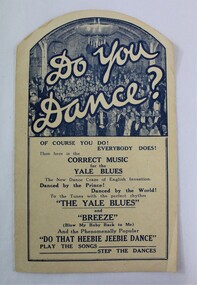
Booklet - Hamilton-Smith Collection Dance Booklet c1928
... Described as ‘enterprising’, his store named Blake’s Busy Book Bazaar, stocked “everything required in books, newspapers, stationery, leather and fancy goods, music, musical instruments etc”. ...Described as ‘enterprising’, his store named Blake’s Busy Book Bazaar, stocked “everything required in books, newspapers, stationery, leather and fancy goods, music, musical instruments etc”. ...The 1920's brought many changes to social life in Australia after the austerity of the war years. This was reflected in many cultural activities including music and dance. In the latter years of the decade ,this was evident in the new dance craze of the "Yale Blues" and the "Heebie Jeebie". Young people were eager to learn the latest music and dance steps. Everything needed to support these new trends could be purchased from "Blake's Busy Bazaar and Music Shop in Dean Street, Albury. Peter Wesley Blake, born in Ontario, Canada in 1860, immigrated to Australia in 1881. He moved to Albury in 1896 after purchasing the news agency and stationery business of Messrs. TF Hughes & Co. Described as ‘enterprising’, his store named Blake’s Busy Book Bazaar, stocked “everything required in books, newspapers, stationery, leather and fancy goods, music, musical instruments etc”. Blake sold the store in 1912 to Arthur Hewish who retained the name of the store. It operated with a variety of different owners until 1941.This item is unique and has well documented provenance and a known owner. It forms part of a significant and representative historical collection which reflects the local history of Wodonga. It contributes to our knowledge of social activities of the post-war period, as well as providing interpretative capacity for themes including local history and social history.A small paper booklet printed featuring a picture of a crowded ball room, and a list of song titles.1920's dance, blake's busy bazaar and music store, social life 1920's -
 Eltham District Historical Society Inc
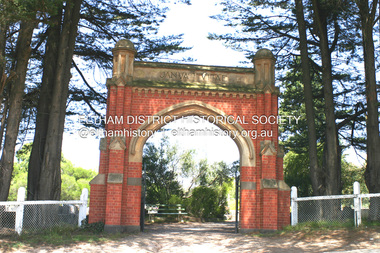
Photograph - Digital Photograph, Alan King, Memorial Arch Gateway, Nillumbik Cemetery, Diamond Creek, 23 January 2008
... He was a Crimean War veteran, mason and leather goods manufacturer in Melbourne, who died in 1915. ...He was a Crimean War veteran, mason and leather goods manufacturer in Melbourne, who died in 1915. ...The Nillumbik Cemetery is of historical, architectural, aesthetic and social significance at a Regional level (North-east Melbourne). The memorial arch is of State significance. Nillumbik Cemetery, which was established in 1867, is of historical and social significance for its association with the early history of Diamond Creek and as a record of the pioneering families of the district. Significant graves include those of the famous writer Alan Marshall, author of 'I Can Jump Puddles', footballer Gordon Coventry, and William Ellis, notable early settler and benefactor. The 1897 Tudor/Gothic revival memorial arch, bequeathed by William Ellis, is a rare design in ornamental gateways and is relatively large for the size of the cemetery. It is unique in Victoria as a cemetery gateway arch. The burial ground has associated structures, such as the hexagonal timber sexton's office, post and wire fence and picket hand gate along Main Street, all probably built in the early twentieth century. Covered under Heritage Overlay, Nillumbik Planning Scheme. National Trust of Australia (Victoria) - Regional significance Published: Nillumbik Now and Then / Marguerite Marshall 2008; photographs Alan King with Marguerite Marshall.; p83 Entering Nillumbik Cemetery through an ornamental gateway and shaded by the Monterey Cypress hedge helps one leave the busy world outside and contemplate yesterday’s Diamond Creek. The gateway, classified by the National Trust of Australia (Victoria), and inscribed with ‘JANVA VITAE’ (gate of life), was a gift from a distinguished pioneer, William Ellis. Ellis, who was an original trustee of the Nillumbik Cemetery representing the Primitive Methodists and a successful farmer, bequeathed £100 to build the red-brick and carved stone gateway in 1887. In 1867 surveyor Edward Bage had set aside two acres (0.8ha) now 35 Main Street, for this cemetery, in what was then called the village of Nillumbik. Several earlier burials on private lands in the district might have been exhumed and re-interred in the new cemetery. The first burials in the cemetery are thought to be of ‘a Chinaman who hanged himself from a tree behind the Church of England’ and ‘another man who was drowned in a water-hole behind the same church’.1 The 1000 or so graves in the cemetery are grouped into five denominational sections: two Anglican and one each for the Methodist (the largest), Catholic and Presbyterian Churches. It is believed that several unmarked graves are of Aborigines and Chinese miners.2 Perhaps the most famous person buried in the cemetery was author Alan Marshall, who died in 1984 and wrote, among other books, I Can Jump Puddles. Surprisingly his grave is particularly modest consisting of only a grassed plot with a tiny boulder and a simple bronze plaque. It lies about halfway down the main path, at the west and third row back. The first European, interred at the cemetery on July 9, 1869, was Hannah, aged 13 years eight months, daughter of local orchardist John Lawrey and wife Honor.3 Each grave has a story which reflects a rich history. Phillip Cummings, who died in 1884, provided the barn for Diamond Creek’s first school, run by the Primitive Methodist Church. The barn stood at the corner of Phipps Crescent and the main road.4 Former Eltham Shire councillor George Stebbings, who died in 1896, built several prominent buildings in the district, including Shillinglaw Cottage in Eltham.5 The grave of miner James Joseph Whyte, who died in 1908, is a reminder of Diamond Creek’s gold mining history. At age 51, Whyte died from a rock fall in the Diamond Mine, Diamond Creek. Diamond Creek’s first butcher, Patrick Ryan, became President of the Shire of Heidelberg and Chairman of the Eltham Hurstbridge Railway Trust. A former gold miner, he was grandfather of local historian Reverend Jock Ryan. He was buried in an unmarked grave halfway down the central path. His son John Lawrence, who is buried elsewhere, had been a Mayor of the City of Heidelberg. George Martin Pizzey gave a hall, for what was to become The St John’s Anglican Church in Diamond Creek. He was a Crimean War veteran, mason and leather goods manufacturer in Melbourne, who died in 1915. The two world wars took a heavy toll of locals with 54 personnel buried here, two thirds of whom served in World War One. A sporting pioneer was Greensborough District Cricket Club founder, Andrew Webb, who was buried in 1971. Politician Roy Mountford Vale (Monte), who died in 1977, was a Member of the Legislative Assembly of Greensborough, and a founding councillor and president of the Diamond Valley Shire. Modern-day residents are also remembered in this cemetery. The tragic Ash Wednesday bushfires took their toll on the district: William Marsden of Panton Hill CFA died, aged 39, fighting bushfires at Upper Beaconsfield in 1983.6 Several graves tell of those who held distinguished positions overseas, including William Constable, who died in 1989. Constable was artistic director of a ballet company, art director of more than 30 films for London-based film productions, and was awarded best Film Art Director at the Moscow Film Festival in 1960.This collection of almost 130 photos about places and people within the Shire of Nillumbik, an urban and rural municipality in Melbourne's north, contributes to an understanding of the history of the Shire. Published in 2008 immediately prior to the Black Saturday bushfires of February 7, 2009, it documents sites that were impacted, and in some cases destroyed by the fires. It includes photographs taken especially for the publication, creating a unique time capsule representing the Shire in the early 21st century. It remains the most recent comprehenesive publication devoted to the Shire's history connecting local residents to the past. nillumbik now and then (marshall-king) collection, diamond creek, memorial arch, gateway, nillumbik cemetery, william ellis -
 City of Melbourne Libraries
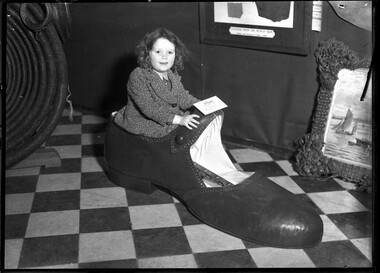
Photograph, Bull, Hugh Jones, 1897-1993, Leather Exhibition, Melbourne Town Hall
... A bewildering variety, of leather goods presses for close and leisured inspection. ...A bewildering variety, of leather goods presses for close and leisured inspection. ...Photographer notations on slide: At the Leather Exhib. at T. Hall Melb 1933 Age Published: Age (Melbourne, Vic.: 1854- ), 1933 THE EXHIBITS. (1933, September 20). The Age (Melbourne, Vic. : 1854 - 1954), p. 16. Retrieved January 25, 2026, from http://nla.gov.au/nla.news-article205109730 Published title: THE EXHIBITS. A COMPREHENSIVE RANGE. Curios, Novelties, Working Displays Published Caption: ONE OF THE NOVELTIES – AN OUTSIZE IN SHOES Research by Project Volunteer, Louise McKenzie: Our photo is dated 20 September 1933, and shows a happy, chubby-faced young girl sitting in a very over-sized girl’s shoe. It is labelled – “Shoe, An Out Size, loaned by Messrs Blackman & Rose”. (1) It is an effective way to capture the attention of the readership and alert them to the Melbourne Leather Show 1933. This show was designed to be a drawcard of extraordinary proportion, and there is no doubt that this leather exhibition was a really big deal for Melbourne. It completely took over the Melbourne Town Hall, and was open from 10.30 am until 10.30 pm. It seemed to contain something for everyone – the military, the man about town, the home handyman, the housewife, the child, the sporting types, the domestic workers, the outdoor enthusiasts, the horseracing fans, car enthusiasts, those wishing to show off the latest fashion – both men and women - and those just intrigued by a lot of fascinating and wide ranging exhibits. One of the most comprehensive descriptions of the Exhibition accompanies the photograph, and is worth quoting in full: “PROMINENT among exhibits which first attract attention in the foyer of the Town Hall is a comprehensive display of leather articles used by the defence forces. A conspicuous legend states that leather plays an important part in national defence, being used for saddlery, tool containers, holdalls, range-finding, surveying and signalling equipment, explosives factories, harness accoutrement, bandsmen's equipment and clothing. Three models of horses and several figures of soldiers wearing leather equipment illustrate the lesson, and a great range of leather goods used in military training and work variegate the display. Nearby are Texas cowboy, buckjumping and breaking-in saddles; whips, a walking stick, made of leather and numerous other curios. The general exhibition occupies the whole floor space of the main Town Hall, and is subdivided by partitions running most of the length of the hall. A bewildering variety, of leather goods presses for close and leisured inspection. Here and there operatives in charge of working machinery give practical demonstrations of factory processes in the production of footwear. Polishing materials are well represented. One attractive exhibit includes two bush huts constructed of leather, with wattle bark for roofing. Opossums, rosellas and a kookaburra add touches of bush realism. Adjacent exhibits include bags, fishing boots, leggings, leather covers in all colours. Factory Processes. One exhibitor has installed an automatic cinema apparatus and screen, which projects various factory processes in making a shoe, the operator being shown at work. Elsewhere an interesting exhibit depicts the five stages in the manufacture of sole leather, and the tanning materials employed. "Very handsome effects are achieved in the interior appointments of motor cars, which are attended by figures of smart chauffeurs in leather coats. Motor-trimming leather is said to be more durable and hygienic than fabric materials, and cheaper. The neat finish of the material, its excellent appearance, certainly make a very favourable impression. It takes the hides of three beasts to cover the cushions, squabs and door panels of a full-sized sedan, while to finish the entire interior, including quarter-panels and head linings would take four or even five. Special Exhibits. Amongst the special sections the display arranged by the handicrafts and home industries- committee of the Country Women's Association of Victoria is a notable one. In all there are about 130 entries which are in four classifications, viz., hand-tooled or embossed leathers, suede, hand-made gloves and undecorated leather. The glove section attracted the most numerous entries, a number being the work of members and craft subscribers of the Country Women's Association. In the leathercraft competition, organised by the Country Women's Association, the judges yesterday awarded the first prize for bookbinding (the only prize given in this division) to Miss M. Alston, of South Yarra. There is also a creditable display of exhibits submitted by boys of the orthopaedic section of the Children's Hospital at Frankston. Amongst the novelties on view in other portions of the exhibition were the following: — Leather coats worn by Sir C. Kingsford Smith on his Atlantic flight. Model Wellington boot, Phar Lap's saddle. Melbourne Cup winner's saddle. Longest whip in world, 108 feet long. (33 metres) [See our photo, to left of Girl in Shoe] Diminutive shoes. Pair of shoes 65 years old. Pair of men's working boots 75 years old. Larwood's, Tate’s and Pataudi’s cricket boots. [Three internationally revered cricketers of the day] (2) Picture frame made of leather bought 63 years ago. [See our photo, to right of Girl in Shoe] Leather frame, powder bowl, &c. Saddle used by world's champion buckjumper in U.S.A. Mexican cowboy outfit. Miniature saddle and bridle. A fireman's helmet made of sole leather. (3) Sample of the leather hat worn by porters at the Billingsgate Fish Market, London. (4) From South Australia there have been obtained sets of harness for donkeys, goats and camels, the equipment being displayed to good advantage on stuffed representations of the animals mentioned. Close to the platform is a glass case containing snow shoes and coats which have been used in Antarctic exploration work. Trade Display. Amongst the trade exhibits may be seen in operation a slipper turn shoe sewing machine, with heeling and channelling facilities, and the various stages in the production of ladies' sandals are shown. There is a wide contrast between sole leather of varying degrees of thickness on view in one stall and the choice samples of ladies' footwear in another — footwear, by the way, which could almost be used as ornaments, so dainty in colour and production are they. Again, there are displays of upholstering leathers of such soft texture that they could he readily mistaken for some of the finest cloth. Those who may be particularly interested in the production of chamois leather may gain an insight into the materials and chemicals used in the "working up” of this variety of leather. Supplies of glace kid (5) are tastefully arranged, and there may also be seen bags of all shapes and sizes, including satchels, suit cases and "sporting" cases, and bags for tennis players and golfers. Further variety is given to the exhibition by the display of antique hides, brightly coloured, with punching balls, boxing gloves and batsman's pads. There are crocodile skins and snake skins so cleverly "Worked up" that one could be almost pardoned for betraying an affection for such unpopular creatures.” “ Another wonderful article on this Exhibition, published the same day in one of the opposition daily newspapers, The Argus, is in the weekly article “Women to Women”, entitled “A Great Victorian Industry: Many Uses for Leather”. This weekly column was penned by Vesta, and she writes, with much purpose: “Yesterday afternoon I paid a hurried visit to the Leather Exhibition now being held in the Melbourne Town Hall and I was disappointed to find that the early visitors to the main exhibition were almost all men. Women, I think, should make a point of seeing every exhibition of our great industries, for women are the buyers of household requisites and goods for their own use and their tastes, and opinion influence also, to a large extent, the purchases of men. So, the welfare of industries is more or less in their hands and it becomes a duty for them to inform themselves fully of the extent and the quality of the manufacturing that is done here. The value of the output of the Australian boot and shoe factories alone was in 1930-31, the latest year for which the figures are given, Stg 3,750,000. Fully two thirds of that amount must have been spent by women on boots and shoes for themselves and their children. In a host of other directions, in the purchase of handbags, travelling bags, belts and straps, cushions, furniture coverings, purses, notebooks, spectacle cases, their annual expenditure must be very high. Their interest, therefore, in this industry is practical, and their support of it should be governed by knowledge of comparable values and qualities of the goods they buy. From the point of view of women, however, the exhibition itself is rather disappointing. There is an amazing collection of good stuff on show, but most of it is not displayed in a fashion that attracts attention. I was surprised, for example, at the range and quality of the leathers displayed, the suppleness of the finer qualities, and the varied range of colours and designs. But they are shown in such a fashion that if one set out deliberately to look for them it would be quite easy to miss most of them.” …It was surprising, too, that no one seemed to have taken advantage of the present fashion of wearing coloured gloves, or the cult of glove making, which the Country Women’s Association has fostered so successfully. Outside the collection of chamois leathers I saw no skins which were suitable to glove making. (6) However, it is perhaps a little unfair to be highly critical of the exhibition, inasmuch as it is the first of its kind. The material is there, undoubtedly, for a splendid show of every phase of this enterprising industry, and I am confident that experience will prove to those concerned that it will be worth while next time to devote a great deal of attention of the method of display.” With further research, it transpires that “Vera” is in fact NZ born Stella May Allen (nee Henderson) (1871-1962), a journalist, the first woman in NZ to begin a law course, in 1890-91). She later worked at a law firm while she completed her degree. Study of the law had always been open to women in NZ, but its practice was still barred to them. Her case “…led to amending legislation in 1896 allowing women to practise as barristers or solicitors. However, on gaining her LL.B. in November 1897 she did not apply for admission to the Bar. Instead, she became the Wellington-based correspondent and leader-writer for the Lyttelton Times. Her appointment, the first for a woman, was not welcomed by the all-male Press Gallery, and special permission had to be obtained from a subcommittee of the House before her presence was accepted. In 1900 she married Edwin Allen, a senior leader-writer for the Wellington Evening Post, and they moved to Australia in 1903 when Edwin Allen took up the post of foreign affairs leader-writer and parliamentary man for the Melbourne Argus. As Patricia Keep notes in her excellent entry of Stella Allan in the Australian Dictionary of Biography: “In 1907 The Argus commissioned her to write a series of articles on the first Australian Women's Work Exhibition held in October. They aroused much interest and next year The Argus invited her to join its full-time staff and begin a weekly section on the particular interests of women. She adopted the nom de plume 'Vesta' and called the column 'Women to Women'. Her work was unique in an Australian daily paper at that time. Her pages extended to cover every aspect of women's affairs, children's interests and community welfare, and 'Vesta' became a household word for authoritative information and advice on such matters. An excellent needlewoman and first-rate cook herself, she thoroughly tutored her staff in the work and needs of women in both country and city, as well as providing the usual training for cadet journalists. She conducted interviews and also visited the country to see at first hand the results of bushfires, mouse plagues, droughts and floods. In 1910 she was one of three women foundation members of the Australian Journalists' Association. “…she found time to become deeply involved in community affairs. She was an original committee-member of the Victorian Association of Crèches and of the Free Kindergarten Union of Victoria, and had much to do with the early days of the Victorian Bush Nursing Association, the Baby Health Centres Association and the Queen Victoria Hospital. She was a member of the National Council of Women, first in New Zealand and then in Melbourne, and of the Country Women's Association from its inception. … in 1924 she was appointed substitute delegate for Australia to the fifth assembly of the League of Nations at Geneva and was a delegate to the second Pan Pacific Women's Conference in Hawaii in 1930. A meeting held in the Melbourne Town Hall in 1938 by representatives of all the main Victorian women's organizations paid special tribute to her work and influence. She retired next year to England where she continued to write for the Argus, contributing articles on the experiences of women and children in wartime.” It is little wonder that “Vesta” was unafraid to take to task both the women of Victoria, and those who created the exhibition! One item which appears to have gone unnoticed, or at least unreported, is a framed article in the background of the photo of the chubby girl in the shoe. The display frame is labelled “Leather from the Human Skin, Tanned and Dressed by French artists.” The exhibition was certainly a cabinet of curiosities! A charming article in The Argus is a nice note on which to end. It gives a quick history and overview of the Australian leather industry and its unprecedented, and possibly unexpected, development and success, and states with pride: “Though Victoria is the largest leather producer in the Commonwealth all tanners in the Commonwealth can look back with pride on the long march of progress.” Footnotes: (1) “Blackman and Rose”. Messrs Blackman and Rose were shoe manufacturers, from 1927 located at 200 Noone Street, Clifton Hill. The Melbourne Circle describes their building as a “fine-looking building in the Federation ‘blood and bandage’ style.” It was built around 1912 for Puttifoot and Bloom, boot manufacturers, and today the building is apartments. (2) These cricketers were household names in the day: Tate: Maurice Tate, “English cricketer of the 1920s and 1930s, and leader of England’s Test bowling attack for a long time during this period. The founder of modern seam bowling. “ Larwood: Harold Larwood, “English right-arm fast bowler and the main exponent of the bowling style known as “bodyline”. Used to considerable effect in the 1932-33 Test series in Australia. Pataudi: Iftikhar A K Pataudi, “an Indian prince who in the 1930s played Test cricket for England, and in the 1940s played Test cricket for India (as Captain) – the only test cricketer to have played for both India and England. (3) “sole” leather “… is the thickest and most resistant material existing in the tanning industry … made from vegetable tanned leathers, usually bovine butts, processed in a special way to make them the hardest type of leather in existence.” (4) The hats worn by porters at Billingsgate Fish Market were also known as a “Bobbin” and look quite squat and rather unsophisticated. They were made of wood and tarred leather, with a “flat, hardened top designed to support large rectangular boxes of fish. The upturned brim protected the porter’s head against fish juice draining from the boxes of fish which would be carried on top of the hat. Some hats featured a small drain hole at the rear to allow this collected juice to drain down the back of the carrier. The hats were made using the ‘cuir bouilli’ technique. The leather was immersed in water which was heated until the leather began to shrink. It was then removed and put on a wooden former. The leather was stitched together to make the hat while still wet, and then held in place until dry.” (See article and photo on the London Museum website) (5) Glace kid – described on the Boston Museum of Fine Arts’ Cameo database as “A smooth glossy leather originally prepared from goat or sheepskin. Early glace kid had a shiny surface that was originally prepared by tawing the skin in a mixture of alum, table salt, flour, and egg yolk. Today, glace kid is prepared from many types of vegetable or chrome tanned leathers. The smooth polished surface is obtained mechanically by shaving, glazing, ironing, and/or rolling the dry leather.” (6) In the 1930s, Melbourne’s glovemaking industry was characterised by local manufacturing, with key producers like Simpson’s Gloves Pty Ltd in Richmond and the Stagg Glove Company in Clifton Hill leading the market. These factories produced high-quality leather gloves, handbags, and specialty gear, often employing a clear gendered division of labour and training young, local women. Museum Victoria holds the Simpson’s Gloves Collection, comprising over 1200 items, and the University of Melbourne Archives holds the company’s business records. References: THE EXHIBITS. (1933, September 20). The Age (Melbourne, Vic. : 1854 - 1954), p. 16. Retrieved January 25, 2026, from http://nla.gov.au/nla.news-article205109730 EXPORT LEATHER. (1929, September 17). The Argus (Melbourne, Vic. : 1848 - 1957), p. 17. Retrieved January 19, 2026, from http://nla.gov.au/nla.news-article4037647 LEATHER EXHIBITION (1933, September 18). The Argus (Melbourne, Vic. : 1848 - 1957), p. 10. Retrieved January 19, 2026, from http://nla.gov.au/nla.news-article11693362 (1933, September 23). The Argus (Melbourne, Vic. : 1848 - 1957), p. 21. Retrieved January 19, 2026, from http://nla.gov.au/nla.news-page522766 WOMEN TO WOMEN (1933, September 20). The Argus (Melbourne, Vic. : 1848 - 1957), p. 13. Retrieved January 19, 2026, from http://nla.gov.au/nla.news-article11694034 Australian Dictionary of Biography, Stella May Allan (1871–1962) https://adb.anu.edu.au/biography/allan-stella-may-4998 WOMEN TO WOMEN (1930, January 22). The Argus (Melbourne, Vic. : 1848 - 1957), p. 13. Retrieved January 19, 2026, from http://nla.gov.au/nla.news-article4063888 Museums Victoria, Simpson’s Gloves, 486-496 Victoria Street, North Richmond, VIC, Australia https://collections.museumsvictoria.com.au/articles/2702 The Argus. (1927, October 31). The Argus (Melbourne, Vic. : 1848 - 1957), p. 20. Retrieved February 7, 2026, from http://nla.gov.au/nla.news-article3888451 Melbourne Circle: stories from the suburbs: “Boots and all in Clifton Hill” https://melbournecircle.net/2015/11/20/bootmakers-of-clifton-hill/ Wikipedia, Maurice Tate, https://en.wikipedia.org/wiki/Maurice_Tate Wikipedia, Harold Larwood, https://en.wikipedia.org/wiki/Harold_Larwood Wikipedia, Iftikhar Ali Khan Pataudi, https://en.wikipedia.org/wiki/Iftikhar_Ali_Khan_Pataudi Buy Leather Online Italy, Sole leather: https://buyleatheronline.com/en/blog/outsole-and-insole-leather-n7 London Museum, Porters hats, https://www.londonmuseum.org.uk/collections/v/object-731122/hat-porters-hat/ Cameo Database, Museum of Fine Arts, Boston, Glace Kid, https://cameo.mfa.org/wiki/Glac%C3%A9_kid VICTORIAN LEATHER HAS WON RENOWN (1937, September 22). The Argus (Melbourne, Vic. : 1848 - 1957), p. 31 (March of Progress Supplement). Retrieved February 7, 2026, from http://nla.gov.au/nla.news-article1108704 Photographer notations on slide: "At the Leather Exhib. at T. Hall Melb 1933 Age B5".displays, melbourne town hall, leather, children, shoes, 1930-1939, industry, hats, gloves -
 Flagstaff Hill Maritime Museum and Village
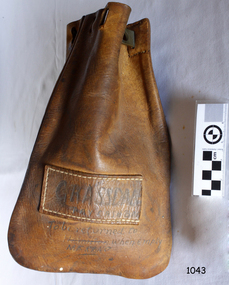
Functional object - Cash Bag, late 1800s to early 1900s
... leather bag is a Pay Cash Bag. It was used to transfer cash between the the railway stations of Grassdale and Merino. This Pay Cash Bag is an example of the connection between people in the remote areas of Victoria. The railway system was used to transfer people, goods ...The leather bag is a Pay Cash Bag. It was used to transfer cash between the the railway stations of Grassdale and Merino.This Pay Cash Bag is an example of the connection between people in the remote areas of Victoria. The railway system was used to transfer people, goods and cash between districts in western Victoria. Pay Cash Bag; a rectangular leather bag with rounded bottom corners, stitched, with brass peg for securing opening. Has stitched leather rectangle nameplate with hand written inscription.Handwritten; “GRASSDALE PAY CASH BAG” “To be returned to MERINO when empty”flagstaff hill, flagstaff hill maritime museum and village, warrnambool, maritime museum, maritime village, great ocean road, shipwreck coast, cash bag, merino railway station, rural banking, finances, grassdale railway station -
 Flagstaff Hill Maritime Museum and Village
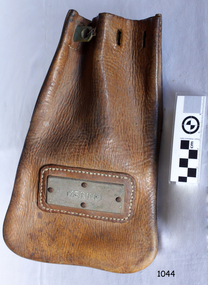
Functional object - Cash Bag, late 1800s to early 1900s
... leather bag is a Railway Cash Bag. It was used to transfer cash between the the railway stations of Merino and Casterton. The Casterton Railway Station was Merino's banking station. This Cash Bag is an example of the connection between people in the remote areas of Victoria. The railway system was used to transfer people, goods ...The leather bag is a Railway Cash Bag. It was used to transfer cash between the the railway stations of Merino and Casterton. The Casterton Railway Station was Merino's banking station. This Cash Bag is an example of the connection between people in the remote areas of Victoria. The railway system was used to transfer people, goods and cash between the districts of western Victoria.Railway Cash Bag; a rectangular leather bag with rounded bottom corners, stitched, with brass peg for securing opening. Has stitched leather rectangle frame and brass nameplate with inscription."MERINO"flagstaff hill, flagstaff hill maritime museum and village, warrnambool, maritime museum, maritime village, great ocean road, shipwreck coast, cash bag, railway cash bag, merino railway station, casterton railway station, banking station, rural banking, finances -
 Flagstaff Hill Maritime Museum and Village
Functional object - Courier Bag, Government of Victoria, Late 19th to mid-20th centuries
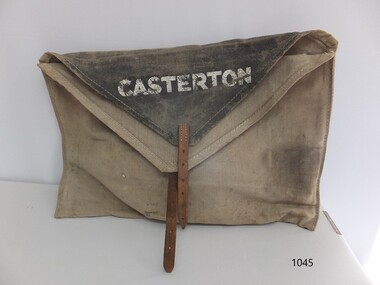
... It was likely used by Victoria's railway system that transported people, goods, documents and cash between the districts of western Victoria. warrnambool shipwreck coast flagstaff hill flagstaff hill maritime museum flagstaff hill maritime village bag pouch document pouch courier bag western district western victoria 19th century 20th century railway rural business rural trade Boronia Casterton Merino sheep farm sheep property canvas bag canvas courier bag government courier bag broad arrow White stencilled paint "CASTERTON" Black stencilled paint "BORONIA" [barely visible] White over-stamped stencilled paint "MERINO" Courier bag; beige canvas rectangular bag with triangular black canvas flaps and a leather strap and buckle closure. ...The courier bag was once government property, as indicated by the broad arrow symbol. The flap has the name 'Boronia' - an area near Melbourne - overstamped with the town name 'Merino', and on the other side of the flap is the town 'Casterton'. Merino and Casterton are renowned for large sheep farming properties in Victoria's western district. Perhaps the courier bag was originally used between Melbourne and Boronia. During the late 19th and early-to-mid 20th centuries, a government-operated railway service was active in in the western district of Victoria. It served remote properties, including a line between Merino and Casterton. The train delivered mail, cash, supplies documents, business records and people between the sheep farm properties and the township of Casterton.This courier bag is an example of the connections and business between people in the remote areas of western Victoria. It was likely used by Victoria's railway system that transported people, goods, documents and cash between the districts of western Victoria.Courier bag; beige canvas rectangular bag with triangular black canvas flaps and a leather strap and buckle closure. The bag has stencilled stamps of three towns - Casterton, Merino and Boronia. It also has the government property symbol of a broad arrow.White stencilled paint "CASTERTON" Black stencilled paint "BORONIA" [barely visible] White over-stamped stencilled paint "MERINO"warrnambool, shipwreck coast, flagstaff hill, flagstaff hill maritime museum, flagstaff hill maritime village, bag, pouch, document pouch, courier bag, western district, western victoria, 19th century, 20th century, railway, rural business, rural trade, boronia, casterton, merino, sheep farm, sheep property, canvas bag, canvas courier bag, government courier bag, broad arrow -
 Flagstaff Hill Maritime Museum and Village
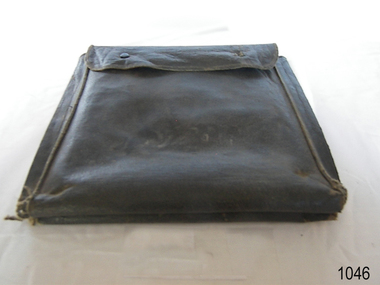
Functional object - Courier Bag, Late 19th to mid 20th centuries
... goods, documents and cash between the districts in western Victoria. Warrnambool Shipwreck Coast Flagstaff Hill Flagstaff Hill Maritime Museum Flagstaff Hill Maritime Village bag pouch imitation leather artificial leather faux leather synthetic leather British Products Pty Ltd document pouch courier bag western district western Victoria 19th century 20th century railway rural business rural trade coastal trader Southwest Victoria "British Products Pty Ltd" Courier bag; black imitation leather pouch, square with wide seams and a flap with sttud closure at the top. ...The black imitation leather or leatherette bag or pouch could have been used by a courier to transfer documents, letters or business records between offices or from business to customer. Imitation leather was invented in the late 1800s and improved as time went on. The manufacture of synthetic leather began around the 1930s. The courier bag may have been used for a s similar purpose as the cash bags in our collection. Those cash bags transported money between the railway stations of Grassdale and Merino in Victoria's western district in the late 19th and early-to-mid 20th centuries. Perhaps the bag was used by the coastal trading vessels that operated in southwest Victoria until around the 1940s.This courier bag is an example of the connections made between people in the remote areas of Victoria. It could have been used by the railway system or the coastal trader vessels that shipped people, goods, documents and cash between the districts in western Victoria.Courier bag; black imitation leather pouch, square with wide seams and a flap with sttud closure at the top. Made by British Products Pty Ltd. "British Products Pty Ltd"warrnambool, shipwreck coast, flagstaff hill, flagstaff hill maritime museum, flagstaff hill maritime village, bag, pouch, imitation leather, artificial leather, faux leather, synthetic leather, british products pty ltd, document pouch, courier bag, western district, western victoria, 19th century, 20th century, railway, rural business, rural trade, coastal trader, southwest victoria -
 Flagstaff Hill Maritime Museum and Village
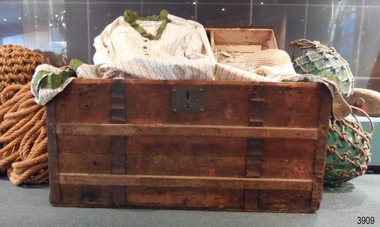
Functional object - Trunk, late-19th to mid-20th century
... This trunk is an example of the typical travel luggage of people migrating to the Colony of Australia in the late 19th century. flagstaff hil Warrnambool flagstaff hill maritime museum maritime museum shipwreck coast flagstaff hill maritime village great ocean road trunk cabin trunk travel trunk cargo storage women's fashion late 19th century fashion travel luggage travel goods Wooden cabin trunk, rectangular, brown in colour. Lid has arched top, front has a strong padlock, sides have leather strap handles. ...Trunk is made strong for long journeys and rough use. Tray compartments would have been fitted inside the lid for storage of smaller items such as hats, umbrellas and underclothing. The illustration pasted inside the lid is similar to those shown in women's fashion journals of the 1880s and 1890s. A similar trunk was found in the catalogue of Anthony Hordern & Sons, a large and famous late 19th to mid 20th century retailer in Sydney,.This trunk is an example of the typical travel luggage of people migrating to the Colony of Australia in the late 19th century.Wooden cabin trunk, rectangular, brown in colour. Lid has arched top, front has a strong padlock, sides have leather strap handles. Corners and edges are reinforced with iron, iron bands and extra wooden slats. Lid is divided into tray compartments. A print of a female in 19th century costume is attached to the inside the lid in one compartment. flagstaff hil, warrnambool, flagstaff hill maritime museum, maritime museum, shipwreck coast, flagstaff hill maritime village, great ocean road, trunk, cabin trunk, travel trunk, cargo, storage, women's fashion, late 19th century fashion, travel luggage, travel goods -
 Flagstaff Hill Maritime Museum and Village
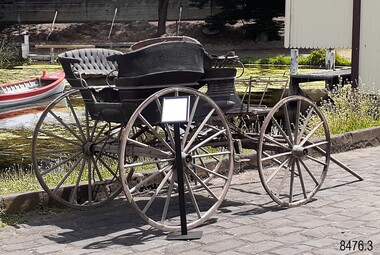
Vehicle - Murweh Carriage, c.1874
... leather or wood covering to prevent water, mud and other particles from splashing onto the passengers. The rear step between the two side-facing bench seats is adjustable to allow for ladies’ long skirts. These rear seats appear to be removable, in which case the carriage could be converted to a wagon to transport goods...leather or wood covering to prevent water, mud and other particles from splashing onto the passengers. The rear step between the two side-facing bench seats is adjustable to allow for ladies’ long skirts. These rear seats appear to be removable, in which case the carriage could be converted to a wagon to transport goods ...This private late-nineteenth-century four-wheeled carriage has been built to transport a family or group of passengers with a coachman in the front seat. It can be pulled by one horse, or by two horses if the T-pole is attached. The button fittings along each side of the carriage indicate that a folding roof or hood was once attached. The frame across the front of the carriagewas likely to have been a ‘dashboard’ with a leather or wood covering to prevent water, mud and other particles from splashing onto the passengers. The rear step between the two side-facing bench seats is adjustable to allow for ladies’ long skirts. These rear seats appear to be removable, in which case the carriage could be converted to a wagon to transport goods and equipment. The carriage could have been illuminated by oil or carbide lamps placed into the lamp holders on the sides. The carriage was kept under cover for many years in an open-front sandstone building that also included living quarters and an area that may have been stable. It was at ‘Murweh’ a Warrnambool property at 203 Liebig Street. The home is now Heritage and National Trust Listed and described as a ‘gentleman’s residence’. It was built by James Wotton Shevill in the 1860s. Shevill was a councillor from 1875 to 1878, serving in 1878 as Mayor of the Borough of Warrnambool. Jeremiah Wade lived at Murweh there from 1879-1880. By 1915 F.B. Whitehead and his family were living there, and by 1930 the address was used by Mr T.J. Rome and his family. Thomas James Rome was still using that address in September 1973 after his 100th birthday. It is believed that one of the property’s owners had been an Obstetrician in Warrnambool. The current owner re-told the story that children used to hide in the back section of the carriage and smoke, hidden from the sight of onlookers. He had heard the story from a previous owner.The well-appointed horse-drawn four-wheeled carriage is likely to have first belonged to a local councillor and past Mayor of the town of Warrnambool, J.W. Shervill, whose 1860s city property was the carriage location for many years. The carriage is a rare local example of a town-based lifestyle befitting a prosperous personality of the late 19th century. It adds to the story of Warrnambool's development as a town influenced by the port, wealth gained from shipping and the home place of prominent local people such as the Councillor and later Mayor. The side-facing rear seating is unusual for a passenger carriage. It has the feature of removable rear bench seats, allowing for the dual purpose of a carriage or wagon.Carriage; the Victorian-era horse-drawn four-wheeled open carriage has a coachman’s bench seat across the front and two side-facing bench seats in the rear. There are steps at the front on each side and a centre adjustable step and the back. It has a hinged shaft, two lamp holders and a separate T-pole. The bench seats have padded backrests upholstered in green leather and each has padded armrests at the ends. A rectangular metal frame, likely to have been a dashboard, is mounted across the front of the carriage. It has two inner vertical bars. The carriage's body is painted dark green with crimson highlights on some of the panelling. Decorative oval panels with hand-painted motifs are mounted along the sides. The side panels of the carriage have metal fastener buttons attached. The iron-rimmed wheels have sixteen wooden spokes and copper cuffs on the outside of the hubs, and the rear wheels are higher than the front wheels. Wooden brake blocks are mounted onto the back wheels and are active by a metal lever at the front right side of the carriage. The undercarriage is fitted with leaf springs on each side, mounted from front to back axles. Included are: (1) The separate T-pole that allows two horses to be harnessed to the carriage (2) Leather horse winkers with metal hardware and oval brass plate on the side of each winkerMotif painted on an oval panel [a musical lyre within a blue floral wreath flanked by scrolls] flagstaff hill maritime museum and village, warrnambool, great ocean road, shipwreck coast, murweh, buggy, cart, carriage, wagon, horse-drawn vehicle, victorian buggy, four-wheeled carriage, coachman’s seat, bench seat, side-facing benches, upholstered seats, victorian decals, heritage vehicle decoration, antique hand painting, hand painted decals, motifs, iron-rimmed wheels, wooden brake blocks, leaf springs, t-pole shaft, rear step, equine carriage, 19th century vehicle, victorian transport, transport, gentleman’s vehicle, james wotton shevill, councillor, mayor, jeremiah wade, f.b. whitehead, thomas james rome, warrnambool obstruction, warrnambool genealogy, warrnambool pioneers, victorian carriage, one horse carriage, two horse carriage, horse drawn carriage -
 Orbost & District Historical Society
bullock yoke
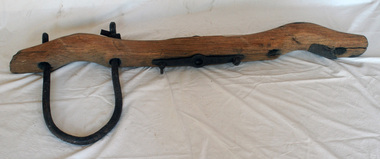
... goods to remote settlements and rural produce to cities and ports over rough unmade roads. The bullocks were yoked together in pairs. Chains joined the yoked pairs. bullock-yokes transport A heavy wooden bullock yoke with only one metal collar. One is missing. The fittings are iron. There is a small leather ...This is a small yoke, made for young calves. It was made by Fred Mundy of Jarrahmond for his children to play at being bullock drivers with their calves. Note: photograph 3354 of Jack and Fred Mundy and their team of 4 calves. Yokes like this one were key components used to control bullock teams. These teams were very important in Australia during the 19th century, hauling heavy loaded wagons of goods to remote settlements and rural produce to cities and ports over rough unmade roads. The bullocks were yoked together in pairs. Chains joined the yoked pairs. A heavy wooden bullock yoke with only one metal collar. One is missing. The fittings are iron. There is a small leather patch tacked on to one end. The yoke is made from a length of wood of roughly rectangular cross-section. It has been shaped to form curved depressions that allow it to rest across the necks of two bullocks and yoke them together. bullock-yokes transport -
 Glenelg Shire Council Cultural Collection
Functional object - Leather Cash Bag, early 1900s
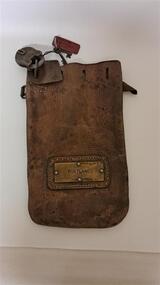
... goods and cash between the districts of western Victoria. Portland Railway Melbourne Railway Trains Banking Orange Tag - 'TRAVELLING CASH BAGS' / 'S.M. PORTLAND' Larger Key - 'HUBBAIL' 'MELBOURNE' ' P37' Smaller Key - 'PANTANT' 'LONDON' Metal Tag - 'PORTLAND' (Worn off) Lock - 'S205' ' PATANT' '120 QUEEN VICTORIA ST LONDON' ' MAKERS HER MAJESTY' '1202998' Front bottom under the plaque hand written 'MELB' Brown Leather oblong shaped cash bag. ...Leather Cash Bags were generally used to transport wages and other cash between two locations. Each would have a brass plate fitted engraved with the home station or a from & to location. Cash would have been transferred from country stations to Melbourne. The lock was self-locking. Duplicate keys to the bags were held in the cashiers office Melbourne.Used at local railway station Portland for transference of cash and cheques back to the Melbourne office. The bag is an example of the how people in the remote areas of Victoria used railways and trains to transfer money, banking and other items. The railway system was used to transfer people, goods and cash between the districts of western Victoria.Brown Leather oblong shaped cash bag. Reinforced leather panel on the front with a brass name plant that has been stamped with the word 'PORTLAND'. Leather buckle at the top with eye holes for threading. Brass lock shaped like teddy bear attached. Brass tag plate. Two keys and a tag attached to a key ring that is hanging and secured with tie wire.Orange Tag - 'TRAVELLING CASH BAGS' / 'S.M. PORTLAND' Larger Key - 'HUBBAIL' 'MELBOURNE' ' P37' Smaller Key - 'PANTANT' 'LONDON' Metal Tag - 'PORTLAND' (Worn off) Lock - 'S205' ' PATANT' '120 QUEEN VICTORIA ST LONDON' ' MAKERS HER MAJESTY' '1202998' Front bottom under the plaque hand written 'MELB'portland railway, melbourne railway, trains, banking -
 Phillip Island and District Historical Society Inc.
Trunk, 1890 approximate
... Over 100 years old. local history personal effects travel goods wooden trunk mrs ollie justice Large bound trunk with domed top. Painted blue. Leather handles each end. ...150 Year Trunk. Bought from Estate Mrs. Ollie Justice 1992. Over 100 years old.Large bound trunk with domed top. Painted blue. Leather handles each end. Binding and top braces with metal studs and edge flanges.local history, personal effects, travel goods, wooden trunk, mrs ollie justice -
 Orbost & District Historical Society
ledger, 1898 - 1957
... Covers are heavy cardboadr coloured green It has a brown leather spine. the bottom right hand corners have been cut off. It contains records of auction sales and lists goods sold on assignment....Covers are heavy cardboadr coloured green It has a brown leather spine. the bottom right hand corners have been cut off. It contains records of auction sales and lists goods sold on assignment. ledger H. ...This ledger was used initially by H. James & Co., Shipping and General Commission agents in Orbost in the late 19th century and early 20th century. Henry James (1860-1932) was a well-known identity in the Orbost district.He was a stock agent and auctioneer. H. James proved a very keen businessman and did well. He eventually formed agencies, conducted an auctioneering business and controlled the bean market. He also helped to establish the seed bean industry in Orbost and was the second secretary of the Snowy River Shipping Co. as well as a shire councillor and prominent member of MUIOOF.Henry James (1860-1932) was a well-known identity in the Orbost district.He was a stock agent and auctioneer who helped to establish the seed bean industry in Orbost. He was the second secretary of the Snowy River Shipping Co. as well as a shire councillor and prominent member of MUIOOF.A heavy ledger. Covers are heavy cardboadr coloured green It has a brown leather spine. the bottom right hand corners have been cut off. It contains records of auction sales and lists goods sold on assignment.on spine : LEDGER On the first 3-4 pages in pencil are O's and 's gamesjames-harry shipping-orbost auctioneer -
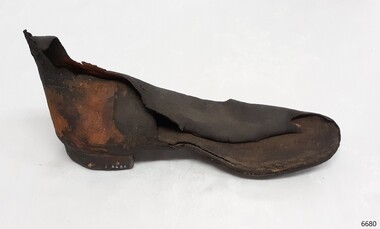 Flagstaff Hill Maritime Museum and Village
Footwear - Rubber Boot, 1900-1908
... goods around the world and represents aspects of Victoria’s shipping industry. Flagstaff hill Warrnambool Flagstaff Hill Maritime Museum and Village Shipwreck Coast Great Ocean Road Russell & Co. rubber boot protective footwear shipwreck artefact Rubber boot, left foot, Boot is ankle height and adult size. The heel appears to be solid rubber and the inner sole resembles leather ...The Falls of Halladale was an iron-hulled, four-masted barque, used as a bulk carrier of general cargo. She left New York in August 1908 bound for Melbourne and Sydney. In her hold was general cargo consisting of roof tiles, barbed wire, stoves, oil, and benzene as well as many other manufactured items. After three months at sea and close to her destination, a navigational error caused the Falls of Halladale to be wrecked on a reef off the Peterborough headland on the 15th of November, 1908. The captain and 29 crew members survived, but her cargo was largely lost, despite two salvage attempts in 1908-09 and 1910. The Court of Marine Inquiry in Melbourne ruled that the foundering of the ship was entirely due to Captain David Wood Thomson's navigational error, not too technical failure of the Clyde-built ship. The Falls of Halladale was built in1886 by Russell & Co., at Greenock shipyards on the River Clyde, Scotland for Wright, Breakenridge & Co of Glasgow. She was one of several designs of the Falls Line of ships named after waterfalls in Scotland. The company had been founded between 1870- 1873 as a partnership between Joseph Russell, Anderson Rodger, and William Todd Lithgow. During the period 1882-92 Russell & Co. standardised designs, which sped up their building process so much that they were able to build 271 ships during that time. The Falls of Halladale had a sturdy construction built to carry maximum cargo and was able to maintain full sail in heavy gales, one of the last of the 'windjammers' that sailed the Trade Route. She and her sister ship, the Falls of Garry, were the first ships in the world to include fore and aft lifting bridges. Previous to this, heavily loaded vessels could have heavy seas break along the full length of the deck, causing serious injury or even death to those on deck. The new raised catwalk-type decking allowed the crew to move above the deck in stormy conditions. This rubber boot is significant for being the only rubber boot in our collection. It is remarkable that it has survived almost seventy years underwater. The Falls of Halladale shipwreck is listed on the Victorian Heritage (No. S255). She was one of the last ships to sail the Trade Routes from Europe and the Americas. Also of significance is that the vessel was one of the first ships to have fore and aft lifting bridges as a significant safety feature still in use on modern vessels today. The subject model is an example of an International Cargo Ship used during the 19th and early 20th centuries to transport goods around the world and represents aspects of Victoria’s shipping industry. Rubber boot, left foot, Boot is ankle height and adult size. The heel appears to be solid rubber and the inner sole resembles leather. The rubber has come away from the outer boot in places, revealing a fabric base. Recovered from the Falls of Halladale. flagstaff hill, warrnambool, flagstaff hill maritime museum and village, shipwreck coast, great ocean road, russell & co., rubber boot, protective footwear, shipwreck artefact -
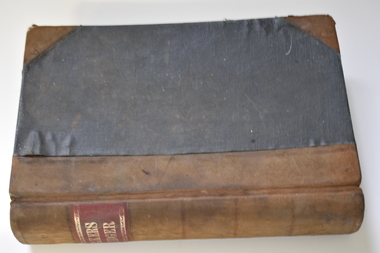 Warrnambool and District Historical Society Inc.
Administrative record - Bakery Ledger, Andrew Jack, Dyson & Co., Melbourne, Baker's Ledger, 1940s
... goods, mostly bread, from 1946 to 1948 and includes the names of the customers, the orders and the moneys owing. The bakery served many nearby areas including Wangoom, Hopkins Point, Cudgee, Mepunga, Naringal and Lake Glllear. This ledger is of interest as it illustrates the size of the Allansford bakery and contains many names of people in the area in the 1940s, making it a valuable research object. Allansford Bakery Greaves Model Bakery Baker's Ledger Andrew Jack, Dyson & Co. Wholesale Stationers This is a ledger with a black cover and leather ...This ledger comes from the Model Bakery business of G.W. Greaves, a baker and pastrycook In Allansford in the first half of the 20th century. Allansford is a township 10 kilometres east of Warrnambool, now incorporated into the City of Warrnambool. The ledger contains details of the Greaves business sales of goods, mostly bread, from 1946 to 1948 and includes the names of the customers, the orders and the moneys owing. The bakery served many nearby areas including Wangoom, Hopkins Point, Cudgee, Mepunga, Naringal and Lake Glllear. This ledger is of interest as it illustrates the size of the Allansford bakery and contains many names of people in the area in the 1940s, making it a valuable research object.This is a ledger with a black cover and leather coverings at the corners and a brown leather spine. The red label on the spine has gold lettering and ornamental edges. The inside of the cover has a red mottled pattern and has tape and string stitching. A maker's label is also inside the front cover. The pages are ruled with red lines and contain handwritten entries. There are some loose invoices. The cover is very faded and stained.Baker's Ledger Andrew Jack, Dyson & Co. Wholesale Stationersallansford bakery, greaves model bakery
