
Showing 48 items matching "commonwealth must not control education"
-
 Anglesea and District Historical Society
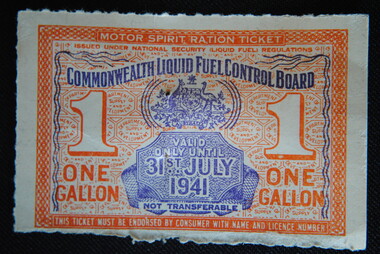
Ration Ticket, Commonwealth Government of Australia, Dept of Supply & Development, Motor Spirit Ration Ticket, Valid to 31 July 1942
... commonwealth liquid fuel control board 1941 ww2 motor spirit ration ticket Front: (orange and blue). MOTOR SPIRIT RATION TICKET / ISSUED UNDER NATIONAL SECURITY (LIQUID FUEL) REGULATIONS / 1 ONE GALLON (on either side of Australian Coat of Arms) - blue / VALID ONLY UNITIL / 31st JULY / 1941 / NOT TRANSFERABLE / THIS TICKET MUST BE ENDORSED BY CONSUMER WITH NAME AND LICENCE NUMBERS / ENDORSED - 22a/8557 / H.C. ...Two small ration tickets printed in orange and blue allowing one gallon of motor spirit to be purchased before 31/7/1941. Both tickets are signed on the back by H.C. Cammeron with his licence number above.Front: (orange and blue). MOTOR SPIRIT RATION TICKET / ISSUED UNDER NATIONAL SECURITY (LIQUID FUEL) REGULATIONS / 1 ONE GALLON (on either side of Australian Coat of Arms) - blue / VALID ONLY UNITIL / 31st JULY / 1941 / NOT TRANSFERABLE / THIS TICKET MUST BE ENDORSED BY CONSUMER WITH NAME AND LICENCE NUMBERS / ENDORSED - 22a/8557 / H.C. CAMMERON.commonwealth liquid fuel control board, 1941, ww2, motor spirit ration ticket -
 Numurkah & District Historical Society
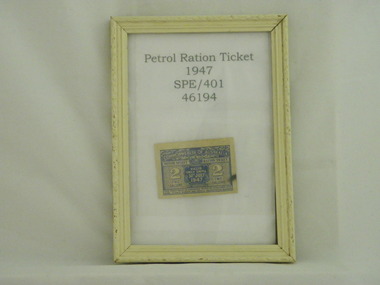
Memorabilia - Petrol Ration Ticket (in Frame)
... Ration books containing coupons were distributed and in the case of petrol entitled the owner to a monthly ration. wwii war rationing coupon transport "Commonwealth of Australia / Motor Spirit Ration Ticket / 2 Gallons / Valid only until 31st July 1947 / This ticket must be endorsed in ink by consumer with name, licence and vehicle registration number" Paper ticket printed in blue Memorabilia Petrol Ration Ticket (in Frame)..."Commonwealth of Australia / Motor Spirit Ration Ticket / 2 Gallons / Valid only until 31st July 1947 / This ticket must be endorsed in ink by consumer with name, licence and vehicle registration number" ...Petrol rationing was introduced in 1940 as Australia, which produced no oil of its own and had inadequate storage facilities, had only three months’ supply at the start of the War and depended on the procurement of stocks from overseas and their safe arrival. Rationing was introduced to ensure fair access by everyone to scarce goods. Ration books containing coupons were distributed and in the case of petrol entitled the owner to a monthly ration.Paper ticket printed in blue "Commonwealth of Australia / Motor Spirit Ration Ticket / 2 Gallons / Valid only until 31st July 1947 / This ticket must be endorsed in ink by consumer with name, licence and vehicle registration number"wwii, war, rationing, coupon, transport -
 National Wool Museum
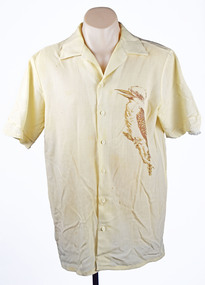
Clothing - 1984 Los Angeles Olympics Men's Opening Ceremony Shirt, c. 1984
... The Commonwealth Games occur midway between each Olympic Games, work on the Olympic uniform commences the week after the Commonwealth Games closing ceremony and MUST be ready by the prescribed day two years hence. ...The Commonwealth Games occur midway between each Olympic Games, work on the Olympic uniform commences the week after the Commonwealth Games closing ceremony and MUST be ready by the prescribed day two years hence. ...On the 1984 Los Angeles Olympic Uniforms donator Doug wrote- During the 1980s the Australian wool industry was at its most prosperous times with record numbers of sheep producing wool receiving ever increasing values due to the success of the Reserve Price Scheme, and the overall guidance of the Australian Wool Corporation (AWC). As a humble technician, my role was a low profile newly created position of “Controller, Technical Marketing” where wool was to be marketed on its technical properties, as distinct from the “Product Marketing Group” which exploited trhe traditional high profile approach of marketing wool;s superior fashion attributes. The Woolmark was the tool central to this approach. When the forthcoming Los Angeles Olympic Games was announced, the Product Marketing Group seized upon the chance to show the world that we could make top fashion garments and display them on our elite athletes on the world stage. A concept was launched using a contemporary top designer, Adel Weiss, with the most exclusive fabrics and knits available, and all with a lot of hype. This launch failed dismally for the following reasons- - The designer did a wonderful job presenting an excellent fashion range on perfect skinny models. The AOC however wanted a uniform which had an obvious Australian appearance when fitted to elite, and frequently muscular, athletes. - The fabrics chosen did not reflect the performance required by travelling athletes, there was no recognition of the need for ‘easy care.’ - There was no recognition given to the problem of measuring, manufacturing and distribution of a range of articles when the selected athlete could be domiciled anywhere in Australia. - There was no appreciation of such historical facts as Fletcher Jones, who had been unofficial suppliers dating back to the 1954 Olympics in Melbourne, and the Fletcher Jones board member, who was also an AWC board member, and was not in favour of the change. The project passed from Product Marketing to Public Relations, a big spending off-shoot of the AWC Chairman David Asimus, and due to the day to day operations of the project was passed to me and PR took care of the financial matters. The first task was to meet with the AOC and find out exactly their requirements. This lead to the production of a design and manufacturing brief, cointaining exact time lines for each event required to ensure an appropriate uniform on every athlete chosen to represent his/her country on the date given for the Opening Ceremony in Los Angeles. Working backwards the timeline becomes- 1. Noted the exact date of the Opening Ceremony. 2. Estimated the date for distributing completed garments to each athlete. 3. Estimated the time span available for measuring each athlete and commence making each component of the ensemble to the individual measurements of each athlete. 4. Decided the date for making the final choice of uniform design concept. 5. Decided the date for distribution of the design brief to selected designers. These five steps were spread out over a two year period. The Commonwealth Games occur midway between each Olympic Games, work on the Olympic uniform commences the week after the Commonwealth Games closing ceremony and MUST be ready by the prescribed day two years hence. The project also had to remain cognisant of trade politics existing within the span of the task, as well as the temperament of designers in general. It is no overstatement to say that in the past every designer in Australia believed they could, and should, be chosen to design the Australian Uniform. The final choice of designer almost always faced criticism from the fashion press and any designer who had been overlooked. However, with the contenders receiving an exacting brief the numbers of serious contenders greatly reduced. The Los Angeles Olympic Uniforms. A further reason for the AWC bid failure to design the LA uniform was that the AOC had already chosen Prue Acton to design it. This was based on her proven performance during previous games as she had a talent for creating good taste Australiana. Her design concepts also considered the effect when they were viewed on a single athlete as well as the impact when viewed on a 400 strong team coming on to the arena. A blazer trouser/skirt uniform in bright gold was chosen for the formal uniform. It was my task to select a pure wool faille fabric from Foster Valley weaving mill and have sufficient woven and ready within the prescribed timeline. The trouser/skirt fabric selected was a 60/40 wool polyester plain weave fabric from Macquarie Worsted. This fabric had a small effect thread of linen that was most attractive when dyed to match some eucalyptus bark Prue had brought back from central Australia. For the Opening Ceremony uniform, Prue designed a series of native fauna, a kookaburra for the men’s shirt and a pleated skirt with a rural scene of kangaroos, hills and plants. This presented an insurmountable printing challenge to the local printing industry as it had an unacceptably large repeat size and the number required (50) was also commercially unacceptable. The solution was a DIY mock up at RMIT and the employment of four student designers. The fabric selected for this garment was a light weight 19 micron, pure wool with a very high twist yarn in alternating S and Z twist, warp and weft. This fabric proved to be the solution to a very difficult problem, finding a wool product which is universally acceptable when worn next to the sin by young athletes competing in the heat of a Los Angeles summer. Modifications to this fabric were developed to exploit its success when facing the same problem in future games. Garment Making- The most exacting garment in the ensemble is the tailored blazer, plus the related trouser/skirt. Unfortunately tailoring athletes that come in various shapes and sizes such as; - Weight lifters develop an enormous chest, arms and neck size. A shirt made to a neck size of 52 would produce a shirt with cuffs extending well beyond the wearer’s hands. - Basketball players are up to 7 feet tall and garments relying ona chest measurement grading would produce a shirt with cuffs extending only to elbow length. - Swimmers develop enormous shoulders and slim hips, cyclists by contrast develop thighs I liken to tree trunks and a uniform featuring tight trousers must be avoided at all cost. Suffice to say many ensembles require specialist ‘one off’ treatment for many athletes. Meanwhile there is a comfortable in between group who can accept regular sizes so you can cater for these by having back up stock with plenty of built in contingencies. Athletes may be domiciled anywhere in Australia, this creates a fundamental problem of taking their measurements. The Fletcher Jones organisation was key to answering this problem due to their presence in every capital city, as well as many provincial towns around Australia. Each athlete on being selected for the Olympic Team was simultaneously requested to visit their nearest Fletcher Jones shop. The standardised measurement data collected was shared with the other manufacturers, e.g. Pelaco Shirts, Holeproof Socks and Knitwear, Maddison Belts, and even Hush Puppy Shoes. As the time for the Games approached the AOC made arrangements for combining meeting of all. Selected available athletes at the Australian Institute of Sport, Canberra, where, among other things, they were fitted and supplied with their uniform. The method evolved as follows.Men’s cream coloured button up, collared shirt. Images of a kookaburra have been printed onto the shirt, a single kookaburra on the left breast and a pair of kookaburras on the reverse of the shirt. The kookaburras are printed in a brown tone to complement the cream colour of the fabric.On tag - FMaustralian wool corporation, 1984 los angeles olympics, olympic uniforms, men's uniforms, sport, athletes -
 Kew Historical Society Inc
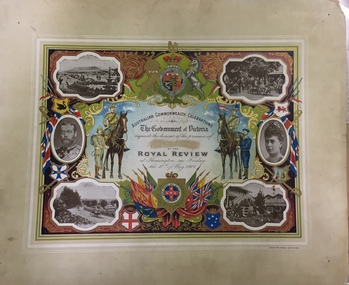
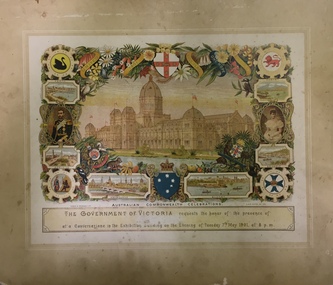
Document - Invitation to a Royal Review at Flemington, Sands & McDougall Ltd, 1901
... must be impressed at the rapidity of their fulfillment. ... The document design has artistic and aesthetic merit. While it is not rare, it is representative of the kinds of formal designs used for the Australian Commonwealth celebrations at the time of Federation, and is in excellent condition. ...The correspondent of The Argus recorded that: "The Parliament of the Commonwealth was opened yesterday by the Duke, of Cornwall and York, under a Commission signed by Queen Victoria and subsequently endorsed by King Edward VII. The ceremony was marked by the splendour and solemn impressiveness which befitted its historic importance. ... To-day the Heir to the Throne will review some 15,000 Australian troops at Flemington. ... It is a function which, on a lesser scale, might have been arranged at any time for many years past; but it could never previously have conveyed the meaning it does now. Soldiering was popularly regarded as a pastime here until South Africa tried the mettle of our men. It is serious business from henceforth. Those who followed the nascent aspirations of the volunteer soldiery in Australia must be impressed at the rapidity of their fulfillment. ... The document design has artistic and aesthetic merit. While it is not rare, it is representative of the kinds of formal designs used for the Australian Commonwealth celebrations at the time of Federation, and is in excellent condition. Such items as this invitation have local, state and national historic significance as mementoes of a key moment in Australia's history. Locally, the invitation is part of a group of Federation-related items owned and displayed at 'Fairyland' by Mrs Grace Tabulo, and a rare survivor of that collection.An invitation, mounted on card to the Royal Review held at Flemington racecourse on Friday 10 May 1901, as part of the Government of Victoria's Australian Commonwealth Celebrations. The border is vividly decorated with flags, shields and a large coat of arms. The photographic images depict various scenes of Flemington in Melbourne, in addition to two separate portraits of the Duke and Duchess of Cornwall and York. Illustrations of military servicemen on foot and horseback flank the central block of text. The invitation was part of the 'Fairyland Collection assembled by Jim and Grace Tabulo. The name on the certificate was expunged.Printed: AUSTRALIAN COMMONWEALTH CELEBRATIONS/ The Government of Victoria/ requests the honour of the presence of/ [name deleted] / AT THE/ ROYAL REVIEW/ at Flemington on Friday/ the 10th of May 1901. Reverse: Mrs G. Tabulo, 57 Malmsbury St.federation events, royal review - 1901, federation -- invitations, grace tabulo -- fairyland -- 57 malmsbury street -- kew (vic.) -
 Kew Historical Society Inc
Document - Invitation to the Opening of the Parliament of the Commonwealth, Sands & McDougall Ltd, 1901
... Commonwealth was opened yesterday by the Duke, of Cornwall and York, under a Commission signed by Queen Victoria and subsequently endorsed by King Edward VII. The ceremony was marked by the splendour and solemn impressiveness which befitted its historic importance. An immense assemblage of spectators, drawn mainly, of course, from this state, but in part also from each of the other federated states, and including representatives of other portions of the British Empire and of foreign powers, thronged the spacious, stately, and joyously decorated edifice. The picture was magnificent. It must...Commonwealth was opened yesterday by the Duke, of Cornwall and York, under a Commission signed by Queen Victoria and subsequently endorsed by King Edward VII. The ceremony was marked by the splendour and solemn impressiveness which befitted its historic importance. An immense assemblage of spectators, drawn mainly, of course, from this state, but in part also from each of the other federated states, and including representatives of other portions of the British Empire and of foreign powers, thronged the spacious, stately, and joyously decorated edifice. The picture was magnificent. It must ...The correspondent of the Argus on 10 May 1901 wrote: "The Parliament of the Commonwealth was opened yesterday by the Duke, of Cornwall and York, under a Commission signed by Queen Victoria and subsequently endorsed by King Edward VII. The ceremony was marked by the splendour and solemn impressiveness which befitted its historic importance. An immense assemblage of spectators, drawn mainly, of course, from this state, but in part also from each of the other federated states, and including representatives of other portions of the British Empire and of foreign powers, thronged the spacious, stately, and joyously decorated edifice. The picture was magnificent. It must have printed itself indelibly on the sensitive minds of the thousands of Australians who were privileged to behold it. We may assume that artists will reproduce it in worthy and imperishable forms, and that from generation to generation it will be familiar in the households of the Commonwealth. Our children's children, we may gladly say to-day, will not be ashamed of the function which inaugurated the self-governing rights of the southern British Nation. Nothing was omitted which could add to the grandeur and significance of the occasion. In a broad sense the proceedings were perfectly intelligible to the vast and sympathetic gathering, though the natural limits of a single human voice had to be accepted. The King's son, with his consort and the Governor-General and Lady Hopetoun by his side, and supported by the Governors of the states and other eminent personages, fulfilled his doubly-attested Commission with a simple dignity and a modest manliness altogether admirable. The ceremony was a brilliant spectacle, and, in its sentiment and suggestiveness, an inspiration to a loyal and patriotic people."The document design has artistic and aesthetic merit. While it is not rare, it is representative of the kinds of formal designs used for the Australian Commonwealth celebrations at the time of Federation, and is in excellent condition. Such items as this invitation have local, state and national historic significance as mementoes of a key moment in Australia's history. Locally, the invitation is part of a group of Federation-related items owned by Mrs Grace Tabulo, and displayed at her home - Fairyland - at 57 Malmsbury Street, KewAn invitation, mounted on card to an evening reception at the Exhibition Building, Melbourne, on 9 May 1901, to meet the Duke and Duchess of Cornwall as part of the celebrations of the opening of the first Federal Parliament. A figure of Britannia, in red dress and mailed vest holding a shield like the Union Jack, is on the left of the invitation; she reaches out her hand towards a younger female figure, representing Australia, who is dressed in blue and holds a shield which is white with a blue cross decorated with stars. The writing is on a scroll in the centre of the certificate, and there is a border of vines and vine leaves. The royal crest is at the base of the certificate. Front, printed. gold ink: "His Majesty's Ministers of State for the Commonwealth of Australia request the honour of the presence of / ****l (handwritten) / In the Exhibition Building, Melbourne, on Thursday, 9th May, 1901, to witness / the Opening of the Parliament of the Commonwealth. / Edmund Barton / Prime Minister." Front, bottom left, printed: "The Young Queen / Her hand was still on her sword hilt - the spur was still on her heel ... (and further text) KIPLING'S COMMONWEALTH ODE." Reverse: Mrs G. Tabulo, 57 Malmsbury Streetaustralia -- federation -- 1901, invitations, parliament -- opening -- 1901, grace tabulo -- fairyland -- 57 malmsbury street -- kew (vic.) -
 Wodonga & District Historical Society Inc
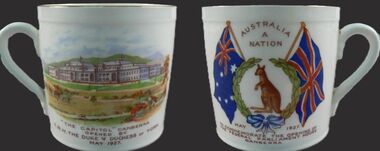
Memorabilia - China Commemorative Cup - Opening of Federal Parliament Canberra, Aynsley England, 1927
... Commonwealth of Australia and the transfer of the federal legislature to Canberra after 27 years in Melbourne. The rivalry between Sydney and Melbourne over which should be Australia's national capital led to the decision to establish a new capital city. Section 125 of the Australian Constitution stated the national capital must...Commonwealth of Australia and the transfer of the federal legislature to Canberra after 27 years in Melbourne. The rivalry between Sydney and Melbourne over which should be Australia's national capital led to the decision to establish a new capital city. Section 125 of the Australian Constitution stated the national capital must ...Colourful souvenir mugs and cups were manufactured in Britain by Aynsley China and carefully transported to Australia for the opening of Parliament House in May 1927. Aynsley China was established in Staffordshire, England in 1775. Parliament House in Canberra was officially opened on 9 May 1927 by the Duke and Duchess of York (later King George VI and Queen Elizabeth). The opening of the Parliament House (now called Old Parliament House) marked the culmination of the Federation process, with the occupation of the new federal capital of the Commonwealth of Australia and the transfer of the federal legislature to Canberra after 27 years in Melbourne. The rivalry between Sydney and Melbourne over which should be Australia's national capital led to the decision to establish a new capital city. Section 125 of the Australian Constitution stated the national capital must be located in New South Wales but not within 100 miles of Sydney. In the meantime, the Australian Parliament met in Melbourne at the Victorian Parliament House. The event was marked by extensive celebrations, and thousands of people gathered to see the Duke of York open the main door with a golden key handed to him by Prime Minister Stanley Melbourne Bruce.This item is significant as a souvenir of an important event in the development of Australian government.An Aynsley porcelain cup manufactured in England around 1927 to commemorate the opening of the Federal Parliament House in Canberra. It features a kangaroo in a cartouche formed of laurel leaves with a blue bow connecting each arm of the cartouche. The cartouche and the kangaroo are flanked by the Australian ensign on the right, and the Union Jack on the left. The reverse design features an image of Parliament House in Canberra with gold text below.Above the kangaroo 'AUSTRALIA A NATION' Beside the ribbon MAY 1927 Beneath the kangaroo - 'TO COMMEMORATE THE OPENING OF THE FEDERAL PARLIAMENT HOUSE CANBERRA' Reverse side below the image "THE CAPITOL" CANBERRA OPENED BY T.R.H. THE DUKE & DUCHESS OF YORK MAY opening of federal parliament, parliament house canberra -
 Kew Historical Society Inc
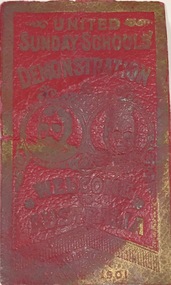
Souvenir, United Sunday schools, Red Leather Bookmark, United Sunday Schools' Demonstration, Melbourne, 6 May 1901, 1901
... (The Age, Tues 7 May 1901, p.6) This tiny battered piece of ephemera recording the United Sunday School Demonstration of 1901 must once have been exceedingly common, however in the context of the growing collection that the Society has relating to the opening of the first Commonwealth Parliament in Melbourne it has historic and social significance. opening of the first commonwealth parliament - 1901 sunday schools - victoria federation events - victoria - 1901 ephemera "United Sunday Schools Demonstration, Melbourne Australia, Melbourne May 6 1901" Embossed red leather bookmark commemorating the 'United Sunday Schools Demonstration' in St Kilda Road in 1901 to welcome the Prince and Princess of Wales to open the first Commonwealth Parliament in the Royal Exhibition Building. ...SUNDAY SCHOOL DEMONSTRATION. With three times three we coo-ee, The Prince we meet again; Our Princess May we welcome, With heart and voice amain. This was the welcome of the children of the Melbourne Sunday schools. The greeting came from over 30,000 youthful voices to the accompaniment of as many waving flags of diminutive size, held by the children. Probably not one of those who sang so lustily had witnessed the previous visit of his Royal Highness; or knew anything of it except as a traditional event, but the sentiment was a good and proper one all the same. The children were massed on the rising ground in the Domain, and apparently the long wait was not at all wearying. It was to most of them a huge picnic. They lunched on the grass, and filled in the intervening lime with games such as the juvenile heart delights in. At intervals something approaching order, was observed, and then songs, which have been in rehearsal for some weeks past, were sung under the baton of Mr. D. R. Davies, musical director, and to the lead of a united brass band of over a hundred instrumentalists under Bandmaster E; T. Code. A solo was also sung by Mr. H. J. Floyd. At all times the scene was an exceedingly animated one. Most of the children were attired in light costumes, and those in whose dress there was some color provided the necessary variety to make up a most picturesque scene. Probably there were nearly 35,000 adults and children at this spot. They occupied the frontage to St. Kilda-road, from Government House gates to the intersecting thoroughfare beyond. As the children were confined to the high ground, there was a green strip in front of them, and the dark green of the fir trees at the top of the slope made a most suitable background. Between these two lines of even coloring the children, with the easy freedom of youth, made perhaps as pretty a feature of the pageant as could be found anywhere in the whole route of the procession." (The Age, Tues 7 May 1901, p.6)This tiny battered piece of ephemera recording the United Sunday School Demonstration of 1901 must once have been exceedingly common, however in the context of the growing collection that the Society has relating to the opening of the first Commonwealth Parliament in Melbourne it has historic and social significance.Embossed red leather bookmark commemorating the 'United Sunday Schools Demonstration' in St Kilda Road in 1901 to welcome the Prince and Princess of Wales to open the first Commonwealth Parliament in the Royal Exhibition Building."United Sunday Schools Demonstration, Melbourne Australia, Melbourne May 6 1901"opening of the first commonwealth parliament - 1901, sunday schools - victoria, federation events - victoria - 1901, ephemera -
 Kew Historical Society Inc
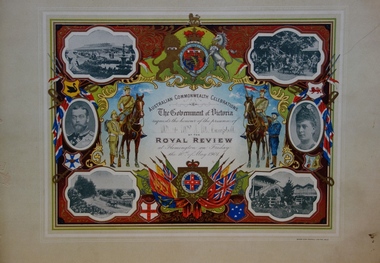
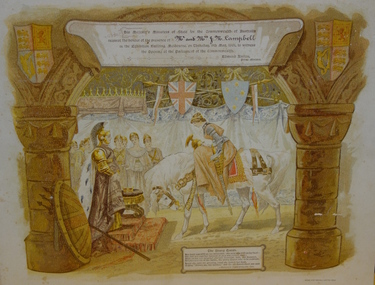
Document - Invitation to a Royal Review at Flemington, 1901
... must be impressed at the rapidity of their fulfillment. ... The document design has artistic and aesthetic merit. While it is not rare, it is representative of the kinds of formal designs used for the Australian Commonwealth celebrations at the time of Federation, and is in excellent condition. ...The correspondent of The Argus recorded that: "The Parliament of the Commonwealth was opened yesterday by the Duke, of Cornwall and York, under a Commission signed by Queen Victoria and subsequently endorsed by King Edward VII. The ceremony was marked by the splendour and solemn impressiveness which befitted its historic importance. ... To-day the Heir to the Throne will review some 15,000 Australian troops at Flemington. ... It is a function which, on a lesser scale, might have been arranged at any time for many years past; but it could never previously have conveyed the meaning it does now. Soldiering was popularly regarded as a pastime here until South Africa tried the mettle of our men. It is serious business from henceforth. Those who followed the nascent aspirations of the volunteer soldiery in Australia must be impressed at the rapidity of their fulfillment. ... The document design has artistic and aesthetic merit. While it is not rare, it is representative of the kinds of formal designs used for the Australian Commonwealth celebrations at the time of Federation, and is in excellent condition. Such items as this invitation have local, state and national historic significance as mementoes of a key moment in Australia's history. Locally, the invitation is part of a group of Federation-related items issued to James Maitland Campbell (and his wife). Campbell was three times mayor of Kew in the second half of the 19th Century and the owner of Ramornie in Pakington Street, one of the significant extant mansions in Kew. An invitation, mounted on card to the Royal Review held at Flemington racecourse on Friday 10 May 1901, as part of the Government of Victoria's Australian Commonwealth Celebrations. The border is vividly decorated with flags, shields and a large coat of arms. The photographic images depict various scenes of Flemington in Melbourne, in addition to two separate portraits of the Duke and Duchess of Cornwall and York. Illustrations of military servicemen on foot and horseback flank the central block of text. The invitation was addressed to Mr & Mrs J. M. Campbell. James Maitland Campbell had been Mayor of Kew in the years 1889-90, 1890-91 and 1892-93.Printed: AUSTRALIAN COMMONWEALTH CELEBRATIONS/ The Government of Victoria/ requests the honour of the presence of/ .../ AT THE/ ROYAL REVIEW/ at Flemington on Friday/ the 10th of May 1901. Handwritten on the dotted line: Mr. & Mrs. J. M. Campbellfederation events, royal review - 1901, james maitland campbell, federation -- invitations -
 Kew Historical Society Inc
Document - Invitation to the Opening of the Parliament of the Commonwealth, 1901
... Commonwealth was opened yesterday by the Duke, of Cornwall and York, under a Commission signed by Queen Victoria and subsequently endorsed by King Edward VII. The ceremony was marked by the splendour and solemn impressiveness which befitted its historic importance. An immense assemblage of spectators, drawn mainly, of course, from this state, but in part also from each of the other federated states, and including representatives of other portions of the British Empire and of foreign powers, thronged the spacious, stately, and joyously decorated edifice. The picture was magnificent. It must...Commonwealth was opened yesterday by the Duke, of Cornwall and York, under a Commission signed by Queen Victoria and subsequently endorsed by King Edward VII. The ceremony was marked by the splendour and solemn impressiveness which befitted its historic importance. An immense assemblage of spectators, drawn mainly, of course, from this state, but in part also from each of the other federated states, and including representatives of other portions of the British Empire and of foreign powers, thronged the spacious, stately, and joyously decorated edifice. The picture was magnificent. It must ...The correspondent of the Argus on 10 May 1901 wrote: "The Parliament of the Commonwealth was opened yesterday by the Duke, of Cornwall and York, under a Commission signed by Queen Victoria and subsequently endorsed by King Edward VII. The ceremony was marked by the splendour and solemn impressiveness which befitted its historic importance. An immense assemblage of spectators, drawn mainly, of course, from this state, but in part also from each of the other federated states, and including representatives of other portions of the British Empire and of foreign powers, thronged the spacious, stately, and joyously decorated edifice. The picture was magnificent. It must have printed itself indelibly on the sensitive minds of the thousands of Australians who were privileged to behold it. We may assume that artists will reproduce it in worthy and imperishable forms, and that from generation to generation it will be familiar in the households of the Commonwealth. Our children's children, we may gladly say to-day, will not be ashamed of the function which inaugurated the self-governing rights of the southern British Nation. Nothing was omitted which could add to the grandeur and significance of the occasion. In a broad sense the proceedings were perfectly intelligible to the vast and sympathetic gathering, though the natural limits of a single human voice had to be accepted. The King's son, with his consort and the Governor-General and Lady Hopetoun by his side, and supported by the Governors of the states and other eminent personages, fulfilled his doubly-attested Commission with a simple dignity and a modest manliness altogether admirable. The ceremony was a brilliant spectacle, and, in its sentiment and suggestiveness, an inspiration to a loyal and patriotic people."The document design has artistic and aesthetic merit. While it is not rare, it is representative of the kinds of formal designs used for the Australian Commonwealth celebrations at the time of Federation, and is in excellent condition. Such items as this invitation have local, state and national historic significance as mementoes of a key moment in Australia's history. Locally, the invitation is part of a group of Federation-related items issued to James Maitland Campbell (and his wife). Campbell was three times mayor of Kew in the second half of the 19th Century and the owner of Ramornie in Pakington Street, one of the significant extant mansions in Kew.An invitation, mounted on card for Mr & Mrs James Maitland Campbell to an evening reception at the Exhibition Building, Melbourne, on 9 May 1901, to meet the Duke and Duchess of Cornwall as part of the celebrations of the opening of the first Federal Parliament. A figure of Britannia, in red dress and mailed vest holding a shield like the Union Jack, is on the left of the invitation; she reaches out her hand towards a younger female figure, representing Australia, who is dressed in blue and holds a shield which is white with a blue cross decorated with stars. The writing is on a scroll in the centre of the certificate, and there is a border of vines and vine leaves. The royal crest is at the base of the certificate. James Maitland Campbell of ‘Ramornie’ in Pakington Street was mayor of Kew on three occasionsFront, printed. gold ink: "His Majesty's Ministers of State for the Commonwealth of Australia request the honour of the presence of / Mr & Mrs J. M. Campbell (handwritten) / In the Exhibition Building, Melbourne, on Thursday, 9th May, 1901, to witness / the Opening of the Parliament of the Commonwealth. / Edmund Barton / Prime Minister." Front, bottom left, printed: "The Young Queen / Her hand was still on her sword hilt - the spur was still on her heel ... (and further text) KIPLING'S COMMONWEALTH ODE."australia -- federation -- 1901, invitations, parliament -- opening -- 1901, james maitland campbell -
 Kew Historical Society Inc
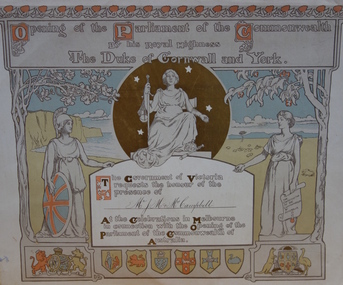
Document - Invitation to the Opening of the Parliament of the Commonwealth by His Royal Highness the Duke of York and Cornwall, Tom Carrington, 1901
... Commonwealth was opened yesterday by the Duke, of Cornwall and York, under a Commission signed by Queen Victoria and subsequently endorsed by King Edward VII. The ceremony was marked by the splendour and solemn impressiveness which befitted its historic importance. An immense assemblage of spectators, drawn mainly, of course, from this state, but in part also from each of the other federated states, and including representatives of other portions of the British Empire and of foreign powers, thronged the spacious, stately, and joyously decorated edifice. The picture was magnificent. It must...Commonwealth was opened yesterday by the Duke, of Cornwall and York, under a Commission signed by Queen Victoria and subsequently endorsed by King Edward VII. The ceremony was marked by the splendour and solemn impressiveness which befitted its historic importance. An immense assemblage of spectators, drawn mainly, of course, from this state, but in part also from each of the other federated states, and including representatives of other portions of the British Empire and of foreign powers, thronged the spacious, stately, and joyously decorated edifice. The picture was magnificent. It must ...The Correspondent for The Argus on 10 May 1901 described the opening on 9 May as: "The Parliament of the Commonwealth was opened yesterday by the Duke, of Cornwall and York, under a Commission signed by Queen Victoria and subsequently endorsed by King Edward VII. The ceremony was marked by the splendour and solemn impressiveness which befitted its historic importance. An immense assemblage of spectators, drawn mainly, of course, from this state, but in part also from each of the other federated states, and including representatives of other portions of the British Empire and of foreign powers, thronged the spacious, stately, and joyously decorated edifice. The picture was magnificent. It must have printed itself indelibly on the sensitive minds of the thousands of Australians who were privileged to behold it. We may assume that artists will reproduce it in worthy and imperishable forms, and that from generation to generation it will be familiar in the households of the Commonwealth. Our children's children, we may gladly say to-day, will not be ashamed of the function which inaugurated the self-governing rights of the southern British Nation. Nothing was omitted which could add to the grandeur and significance of the occasion. In a broad sense the proceedings were perfectly intelligible to the vast and sympathetic gathering, though the natural limits of a single human voice had to be accepted. The King's son, with his consort and the Governor-General and Lady Hopetoun by his side, and supported by the Governors of the states and other eminent personages, fulfilled his doubly-attested Commission with a simple dignity and a modest manliness altogether admirable. The ceremony was a brilliant spectacle, and, in its sentiment and suggestiveness, an inspiration to a loyal and patriotic people."The document design has artistic and aesthetic merit. While it is not rare, it is representative of the kinds of formal designs used for the Australian Commonwealth celebrations at the time of Federation, and is in excellent condition. Such items as this invitation have local, state and national historic significance as mementoes of a key moment in Australia's history. Locally, the invitation is part of a group of Federation-related items issued to James Maitland Campbell (and his wife). Campbell was three times mayor of Kew in the second half of the 19th Century and the owner of Ramornie in Pakington Street, one of the significant extant mansions in Kew.A colour lithograph mounted on card which is an invitation to the Opening of the First Commonwealth Parliament of Australia, 9 May 1901. The invitation was sent to Mr J.M. & Mrs Campbell. John Longstaff and Norman Lindsay’s design for the invitation includes symbolic female figures and coats of arms of the British and Australian Commonwealth. The central figure represents Justice. At her feet a crown and sceptre are laid, ‘to denote that the monarch will always acquiesce in laws passed by Parliament, provided they are just.’ On the left appears a figure of Britannia, above the royal coat of arms and in front of the white cliffs of England; on the right is a female figure representing Australia, with one hand out-stretched and above the Australian Coat of Arms. Behind her is a pastoral scene; she stands beneath a gum tree. At the top is a border of waratahs; on the left is a border of oak. The six states are represented in shields at the bottom of the card.Front, printed. gold ink: "Opening of the Parliament of the Commonwealth By his Royal Highness The Duke of Cornwall and York / The Government of Victoria requests the honour of the presence of / Mr. J . M. and Mrs. Campbell (handwritten / At the Celebrations in Melbourne in connection with the Opening of the Parliament of the Commonwealth of Australia."parliament of australia -- 1901, royal exhibition building -- melbourne (vic), james maitland campbell -
 Linton and District Historical Society Inc
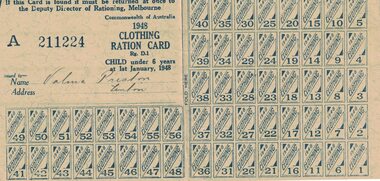
Ration card, Ration Card, Clothing, 1948
... Preston family Ration cards World War 1939-1945 Text: " If this Card is found it must be returned at once to / the Deputy Director of Rationing, Melbourne / Commonwealth of Australia / 1948 / CLOTHING / RATION CARD / CHILD under 6 years / at 1st January, 1948 / Issued to / Name Valma Preston / Address Linton. " 1948 child's clothing ration card, No. ...Text: " If this Card is found it must be returned at once to / the Deputy Director of Rationing, Melbourne / Commonwealth of Australia / 1948 / CLOTHING / RATION CARD / CHILD under 6 years / at 1st January, 1948 / Issued to / Name Valma Preston / Address Linton ...1948 child's clothing ration card, No. A211224 issued by Commonwealth of Australia to Valma Preston of Linton. 56 clothing coupons printed in blue on a cream background.Text: " If this Card is found it must be returned at once to / the Deputy Director of Rationing, Melbourne / Commonwealth of Australia / 1948 / CLOTHING / RATION CARD / CHILD under 6 years / at 1st January, 1948 / Issued to / Name Valma Preston / Address Linton. "preston family, ration cards, world war 1939-1945 -
 Linton and District Historical Society Inc
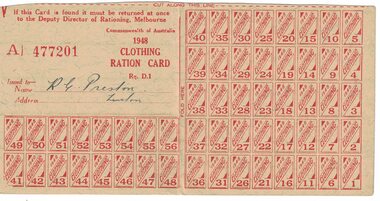
Ration card, Ration Card, Clothing, 1948
... Preston family Ration cards World War 1939-1945 Text: " If this Card is found it must be returned at once to / the Deputy Director of Rationing, Melbourne / Commonwealth of Australia / 1948 / CLOTHING / RATION CARD / Issued to / Name R.G. ...Text: " If this Card is found it must be returned at once to / the Deputy Director of Rationing, Melbourne / Commonwealth of Australia / 1948 / CLOTHING / RATION CARD / Issued to / Name R.G. ...1948 Clothing ration card issued by Commonwealth of Australia to R G Preston, Linton. 56 Clothing coupons printed in red on a cream background. Card No. A477201.Text: " If this Card is found it must be returned at once to / the Deputy Director of Rationing, Melbourne / Commonwealth of Australia / 1948 / CLOTHING / RATION CARD / Issued to / Name R.G. Preston / Address Linton. "preston family, ration cards, world war 1939-1945 -
 Linton and District Historical Society Inc
Ration card, Ration Card, Clothing, 1948
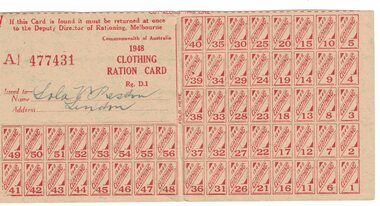
... Preston family Ration cards World War 1939-1945 Text: " If this Card is found it must be returned at once to / the Deputy Director of Rationing, Melbourne / Commonwealth of Australia / 1948 / CLOTHING / RATION CARD / Issued to / Name Lola V. ...Text: " If this Card is found it must be returned at once to / the Deputy Director of Rationing, Melbourne / Commonwealth of Australia / 1948 / CLOTHING / RATION CARD / Issued to / Name Lola V. ...Clothing ration card 1948 No. A477431 issued by Commonwealth of Australia to Lola V Preston, Linton. 56 Clothing coupons printed in red on cream background.Text: " If this Card is found it must be returned at once to / the Deputy Director of Rationing, Melbourne / Commonwealth of Australia / 1948 / CLOTHING / RATION CARD / Issued to / Name Lola V. Preston / Address Linton. "preston family, ration cards, world war 1939-1945 -
 Linton and District Historical Society Inc
Ration card, Victorian Motor Spirit Ration Ticket, circa 1941
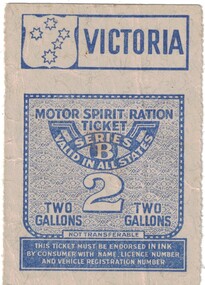
... Commonwealth Bank of Australia. World War 1939-1945 Petrol rationing R.G. Preston Text: " VICTORIA / MOTOR SPIRIT RATION / TICKET. " Two Victorian motor spirit ration tickets, tickets were originally printed on a sheet divided by perforations. Each ticket reads "VICTORIA" / "SERIES B" / "VALID IN ALL STATES" /"TWO 2 TWO GALLONS". Fine print on each tickets reads "THIS TICKET MUST ...Petrol rations tickets were first issued in October 1940 during World War II. Petrol rationing ceased in 1949. The ration tickets were produced by the Note Printing Branch of the Commonwealth Bank of Australia.Two Victorian motor spirit ration tickets, tickets were originally printed on a sheet divided by perforations. Each ticket reads "VICTORIA" / "SERIES B" / "VALID IN ALL STATES" /"TWO 2 TWO GALLONS". Fine print on each tickets reads "THIS TICKET MUST BE ENDORSED IN INK / BY CONSUMER WITH NAME, LICENCE NUMBER / AND VEHICLE REGISTRATION NUMBER". In handwriting on the back of the tickets, the signature "R.G. Preston" and "91/21856" (car registration number?).Text: " VICTORIA / MOTOR SPIRIT RATION / TICKET. "world war 1939-1945, petrol rationing, r.g. preston -
 Rutherglen RSL Sub-Branch
Memorabilia - Meat ration card, Commonwealth of Australia, 1948
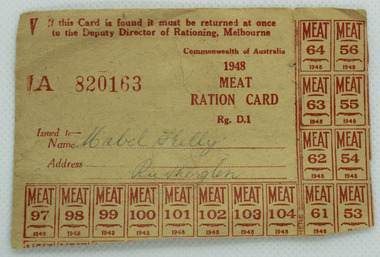
... Issued to individuals as part of the war effort in rationing food post WWII. meat ration card mabel kelly wwii homefront shopping world war two If this Card is found it must be returned at once/ to the Deputy Director of Rationing, Melbourne/ A 820163/ Issued to Mabel Kelly/ Address Rutherglen Printed rectangular piece of paper with red text showing squares for 16 rations. This card issued to a Mabel Kelly of Rutherglen. Memorabilia Meat ration card Commonwealth ...Issued to individuals as part of the war effort in rationing food post WWII.Printed rectangular piece of paper with red text showing squares for 16 rations. This card issued to a Mabel Kelly of Rutherglen.If this Card is found it must be returned at once/ to the Deputy Director of Rationing, Melbourne/ A 820163/ Issued to Mabel Kelly/ Address Rutherglen meat ration card, mabel kelly, wwii, homefront, shopping, world war two -
 Melbourne Legacy
Document - Speech, Commemorative Address - Sir Stanley Savige K.B.E. Federal Conference of Legacy Clubs, Canberra, 10/1954
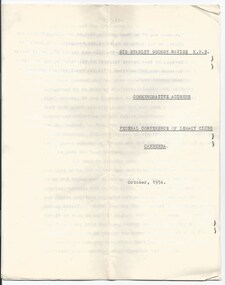
... Commonwealth and abroad. But in those early days the achievements of our Founder in the face of all manner of difficulties and frustrations are worthy of our lasting memory and thankfulness. As the source of every river lies in the hills, so must...Commonwealth and abroad. But in those early days the achievements of our Founder in the face of all manner of difficulties and frustrations are worthy of our lasting memory and thankfulness. As the source of every river lies in the hills, so must ...After the death of Stan Savige this address was given at the Canberra Conference in October 1954. It is tribute to his life. Sir Stanley Savige KBE : Commemorative Address Federal Conference of Legacy Clubs, Canberra : October 1954. On the 15th of May this year Legacy learned to its enduring sorrow of the death of its Founder, Lieut. General Stanley George Savige KBE, CB, CBE, DSO, MC, ED, for more than 30 years affectionately known to us all as Legatee Stan Savige. He was the embodiment of all those things for which Legacy stands, and each one of us who knew him and worked with him feels a great and abiding sense of personal loss. It is proper, therefore, that those of us at this Conference, the first after his passing, representative of Legacy throughout the Commonwealth, and comprising so many who were his friends, so many who knew the depth of his love for Legacy, should acknowledge our debt to our Founder and ensure, so far as we may, that the inspiration of his life and work in this Cause shall not be lost to those who follow after. It was not ordained that Stanley George Savige - should enjoy a long life, but it was to prove a life of outstanding service. Born at Morwell in Victoria some 63 years ago, he received with his brothers and sisters such education as was then available to a lad in a mining district. He had no particular opportunities of advancement, but from his early days he cherished a strong ambition to make a success of his life, and with this in view he lost no opportunity of adding to his knowledge. Always a lover of the open country, a good bushman and a fine shot, he became as a young man, a Scoutmaster with a keen following of boys. Even in those early days he attracted youth and showed undoubted promise of the quality of leadership which later was to make him famous. Opportunity came with the first World War, and he took his place as a private soldier in the original 24th Battalion AIF. Followed Gallipoli and Anzac where his marksmanship and bush craft stood him in good stead. Conscious that his early training was not sufficient to secure the promotion he desired, he set himself to enlarge it. Only a man of fine fibre and rare determination could apply himself to study on that war torn Peninsula, where our men, hitherto untested, suffered every known hardship and no man knew, from hour to hour, whether he would survive. But Savige achieved it. Himself then a Corporal he found another Corporal who was a former Schoolmaster and learned from him all that he had to teach. Savige was on his way. He was commissioned on the Field and allotted the heroic task of leading the last party off that desperate coast during the famous evacuation. In France he became the Adjutant of his Battalion and one of the best known officers in the 6th Brigade. He won the Military Cross and was mentioned in despatches. Early in 1918 he received a signal distinction, He was included in a small but distinguished band of Officers and Non-Commissioned Officers from the British and Dominion Forces most carefully selected for individual courage and proved qualities of leadership, and was sent to Persia, under the command of Major-General Dunsterville, Kipling’s famous Stalky, to assist and mobilise the friendly tribes with a view to protecting the road to India, left wide open by the withdrawal of Russia. The story of the Dunsterforce, its suffering and achievements in the face of incredible hardships and difficulties, was later to be told by Savige in his book “Stalky’s Forlorn Hope”. He emerged, finally, unscathed, despite his active participation in several of the bloodiest battles of all time, with the rank of Captain and a DSO and MC to his credit, to say nothing of three mentions in despatches. In later years, further decorations were to be conferred upon him, but I believe he valued none of these so highly as his awards for outstanding personal bravery won in the Field when he was an Officer of comparatively junior rank. Such was the man who in August 1923, at the instance of his former Commander, Major-General Sir John Gellibrand, gathered around him a handful of men who had fought and laughed with him over four well remembered years. This small band adopted the name of “Legacy”, but its purpose then was, in the main, to assist in safeguarding the interests of ex-servicemen in this country. Worthy although the case undoubtedly was, the conception and ideal which was to distinguish Legacy from all kindred post-war movements did not emerge until two years later. The torch had not been lit. Legacy had not yet found its soul. What has been achieved since then is known to you all. The Legacy ideal, unique in its conception, with no known counterpart elsewhere, is now accepted, welcomed and honoured throughout the Commonwealth and abroad. But in those early days the achievements of our Founder in the face of all manner of difficulties and frustrations are worthy of our lasting memory and thankfulness. As the source of every river lies in the hills, so must the inspiration from which stems a great conceptions of service to one’s fellow men be lofty and above reproach. Savige was the embodiment of this new expression of comradeship, as he was the central figure and driving force of the little group that sponsored it. But for his zeal, his faith and determination, it is likely that the flame, newly kindled, might have flickered and died. The idea of men returned from active service pledging for the sake of their former comradeship, their personal assistance to the widows, and above all, to the children of those who had fought beside them and paid the full price of War, was so completely new and unexpected that it was by no means readily accepted. There were no funds, no precedents to guide the new adventurers, only the clear bright flame of an ideal just envisaged, and the conviction that the Cause was unassailable. Nor were there lacking many who said that the community held no place for Legacy, that it was born of sentiment only, and would quickly pass. The scoffers are gone and one since forgotten, but the torch remains and burns brighter than ever. Down the years of Legacy there are many names deserving of honour, men from all States and all stations of life, but no name stands out in such clear and bold relief as does the name of our Founder. By his works you shall know him. He was, in truth, the Soul of Legacy. He sought no office and preferred to work as one of the team. Six years went by before he accepted the Presidency of Melbourne Club, and then only because his fellows would book no further delay. “The Spirit of Legacy is Service” - so runs the Charter, and that was Savige’s Creed. By virtue of his attainments he was called upon to take a leading part in the administration of Legacy, first within his own club and later, as Chairman of the Co-ordinating Council of Legacy in Australia. But always it was the essentially human character of the work which enthralled and upheld him, and the tasks which gave him most joy were those which brought him into close personal contact with the youngsters and their home life. Like their elders they recognised his goodwill and his leadership and responded to it. It was Savige who made possible the first camps held for the boys and girls by Melbourne Club. These were erected on his own seaside property, and were originally conducted under his personal direction and largely with the aid of funds he had collected. There was hardly an important post in his own Club that Savige did not at some time occupy and adorn. He was happiest in the company of those men with whom he had served in the field, and cherished always the comradeship born of active service which is of the essence of Legacy. He was a man of strong convictions but attentive always to another’s point of view. As a Legatee he played a leading part in bringing hope and encouragement to many a mother on whom the whole responsibility of a young family had been suddenly and tragically laid; in the attainment of the ambitions of many an orphan child, which not so long since had seemed to him or her to be mere dreams, impossible of realisation. Comfort for the bereaved, new hope for the children’s physical and educational welfare, assistance with the home, aid for the sick, money for the needy and a new courage to face a future that hitherto had held no promise, all these facets of Legacy endeavour combine to present a living and enduring memorial to the man we honour as our Founder today. Between the two World Wars in addition to establishing himself successfully in civilian life and answering the constant calls of Legacy on his energy and time, Savige maintained an active association with the Army. He was convinced that a Second AIF would one day be urgently called upon, and as a Battalion Commander he spared no effort to train the Officers under his charge during the uneasy years of peace for the trial that he felt must come. These men have all subsequently had distinguished military careers, their names are well known and many of the serve in Legacy today. When the second crisis came, Savige himself was one of the first to offer, and although his youth was spent, he proudly carried the number VX13 throughout the terrible years that followed. This time he was to command, first the 17th Australian Infantry Brigade in the first action of the Second AIF against the enemy at Barida, and subsequently at Tobruk and Derna - all famous names now. It was his patrols which gave the warning - unheeded at the time - that Rommel’s reinforcements were reaching North Africa far earlier than was expected. Then followed the grim days of Greece and Crete when the fine qualities of his leadership were put to the utmost test. I have been told by those who were closest to him it was typical of Savige that when his convoys were on the move back and were being blasted from the air by the unopposed Luftwaffe, he should sit by the side of the open road, wearing his red banded cap, to steady the morale of men who had then no chance of hitting back at the enemy. Unorthodox no doubt, but here was a man indeed. Throughout the whole campaign and later when he commended the 3rd division in New Guinea and later still when with the rank of Lieutenant-General he became a Corps Commander in New Guinea and Bouganville, it was at all times characteristic of him that he should see for himself the situation in the forward areas. He dealt personally with his subordinate commanders whenever it was possible to do so. No one says his G.S.O. 1. understood better than he did the importance of front line troops seeing their G.O.C. frequently, and knowing that he was aware of and prepared to share their hardships and dangers. He took many risks that he should not have taken, exhausted himself physically and mentally times without number, and considered himself not at all in order to secure the success of his operations. Finally, in Bouganville, he brought his campaign to a victorious conclusion and accepted the personal surrender of the Japanese Commander. Savige is known as one of Australia’s most human military leaders, but let no one believe that he did not ask and receive the utmost of his men. He trained them in a hard school but he was ever conscious of their needs and observant and thoughtful of their welfare. Fearless and untiring under conditions which brought younger men down, he asked nothing that he was not himself prepared to give and do. The close of the Second World War left him with the same brave heart; but a vitality greatly impaired. He was called up again and again to perform important national tasks, notably that of Co-ordinator of Demobilisation and Dispersal. But his interest in Legacy never flagged it was in fact more personal than ever, for under his command many junior legatees, sons of former comrades had proved themselves worthy of their Fathers in war and in peace. In the bearing and achievements of the young men of the Second A.I.F. he took a particular and justifiable pride. He applied himself to the Extension of Legacy to areas where it had not previously been practicable to operate. His record of service and close personal contact with the men of both wars made him a most welcome pioneer and many new Clubs and Groups resulted from his efforts. He founded, and I doubt whether any one else could have done so, the Club in the great Capital of our Empire. His reputation and obvious sincerity surmounted obstacles that might well have daunted lesser man. Legacy’s debt to him visibly increased. But he was ever a simple man, with a great love and understanding of his fellow men and a true Legatee at heart. Much that he did will never be known or recognised, save by those who benefitted. His service in Legacy ranged from the humble kitchen of cottage and farm to our representation in Westminster Abbey itself. A knighthood set the seal upon an outstanding career. None the less when upon the death of Field Marshall Sir Thomas Blamey, Lieut. General Sir Stanley Savige became the Patron of the Melbourne Club, he retained at his own express desire, the title of Legatee Savige, and when on that final day we bade him farewell, when the Flags he had served so well were lowered and the guns which had formed a grim final salute, it was apparent to all who had eyes to see that this great and simple man had won such a place in the hearts and affection of his fellow country men as is given to few men indeed. From the packed Cathedral, escorted by his fellow Generals, followed by men of his own Units, by Legatees and a great company of others who had cause to honour and esteem him, he made his last journey. But that is not the end. His voice and presence are lost to us but his memory and inspiration must ever remain. As he has bequeathed to the National War Memorial yonder his diaries, records and battle plans, so he has bequeathed to us his fellow Legatees his greatest achievement and his trust, Legacy itself. Never was the Torch passed by worthier hands. Now it is ours to hold it high. Whatever material memorial the future many hold for him, Legacy owes its Founder a livelier recompense. It is within our power to implement what I believe to be his greatest wish, that Legacy and its ideal of comradeship and service shall flourish and endure. Let each one of us then resolve that we shall, within our Clubs, in all tasks to which we are assigned, both great and small, keep in our minds the life and spirit of Stanley George Savige, so that we may be proud at all times to say of Legacy to those who follow after - “If you would see his memorial - Look around you”.The tribute to Stanley Savige shows how greatly he was regarded by the Legatees.Off white quarto paper with black type, address given about Stan Savige to the Canberra Conference, x 12 pages.savige, speech, obituary -
 Wodonga & District Historical Society Inc
Album - Ringer's River by Des Martin - Plate 35 - Moves towards Federation
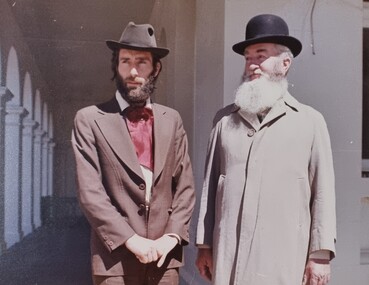
... Commonwealth. This will permit O'Day to come home as a free man. MacLough queries the fine and Deakin says that it must be paid, but he will have it reduced to £200. ...Commonwealth. This will permit O'Day to come home as a free man. MacLough queries the fine and Deakin says that it must be paid, but he will have it reduced to £200. ...With Federation all but a fact Alfred Deakin is again in the Overton area but his meeting has been cancelled. While Montieth is getting some stores he and MacLough observe the drama on the bridge from the nearby Post Office verandah. Coming on top of the deaths of the O'Haras these scenes appal Deakin. In reply to MacLough he says that Federation will do away with the border, and bring free trade between the states of the new Australian Commonwealth. This will permit O'Day to come home as a free man. MacLough queries the fine and Deakin says that it must be paid, but he will have it reduced to £200. On hearing this MacLough declares he will pay the fine himself, and give O'Day a half share partnership in Gooloora as well.The album and images are significant because they document literature written by a prominent member of the Wodonga community. The presentation of this precis was supported by several significant district families and individuals.Ringer's River Album Coloured photo Plate 35des martin, many a mile, ringer's river, northeast victoria stories -
 St Kilda Historical Society
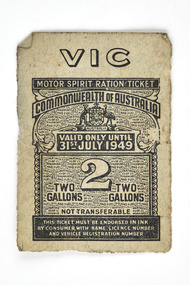
Administrative record - Petrol Voucher, Motor Spirit Ration Ticket, 1940s
... World War II Commonwealth Coat of Arms Background design based on the words DEPARTMENT OF SHIPPING AND FUEL VIC MOTOR SPIRIT RATION TICKET COMMONWEALTH OF AUSTRALIA VALID ONLY UNTIL 31ST JULY 1949 TWO GALLONS 2 TWO GALLONS NOT TRANSFERABLE THIS TICKET MUST BE ENDORSED IN INK BY CONSUMER WITH NAME, LICENCE NUMBER AND VEHICLE REGISTRATION NUMBER Handwritten note on reverse, in black ink: Historical Society of St Kilda. ...Commonwealth Coat of Arms Background design based on the words DEPARTMENT OF SHIPPING AND FUEL VIC MOTOR SPIRIT RATION TICKET COMMONWEALTH OF AUSTRALIA VALID ONLY UNTIL 31ST JULY 1949 TWO GALLONS 2 TWO GALLONS NOT TRANSFERABLE THIS TICKET MUST BE ENDORSED IN INK BY CONSUMER WITH NAME, LICENCE NUMBER AND VEHICLE REGISTRATION NUMBER Handwritten note on reverse, in black ink: Historical Society of St Kilda. ...Clothing, food and other consumer items were rationed during World War II to reduce consumption and limit inflation caused by shortages. Petrol rationing was introduced in June 1940 and remained in place until February 1950 in the face of strong opposition by the motor industry. Drivers had to apply for a petrol licence and were then allocated ration tickets based on their needs. Cream coloured paper ticket, discoloured with age, printed in black on one side.Commonwealth Coat of Arms Background design based on the words DEPARTMENT OF SHIPPING AND FUEL VIC MOTOR SPIRIT RATION TICKET COMMONWEALTH OF AUSTRALIA VALID ONLY UNTIL 31ST JULY 1949 TWO GALLONS 2 TWO GALLONS NOT TRANSFERABLE THIS TICKET MUST BE ENDORSED IN INK BY CONSUMER WITH NAME, LICENCE NUMBER AND VEHICLE REGISTRATION NUMBER Handwritten note on reverse, in black ink: Historical Society of St Kilda. Donated By Mrs N. Kennedy 54 Glenhuntly Rd Elwood 1980world war ii
