
Showing 35 items matching "uniform specialists"
-
 Royal District Nursing Service (now known as Bolton Clarke)
Photograph - Digital image, 1937
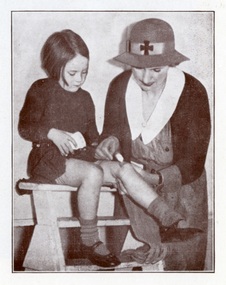
... Specialists who made assessments and provided advice and support to the District Sisters working in the field as needed. The Sisters liaised with the patient’s Doctors and Hospitals to provide information on the progress of patient’s wounds and to receive any change of wound care from the Doctors. mdns uniform melbourne district nursing society rdns royal district nursing service mdns wound care On the left of this black and white digital image is a little girl who is sitting on the top step of a wooden stool which is against a light coloured wall. ...This digital image appeared in the MDNS 1937 Annual Report and depicts one of the aspects of nursing care carried out by the District Sisters of the Melbourne District Nursing Society (MDNS) in a home in the suburbs of Melbourne.The Trained nurses (Nurses) of the Melbourne District Nursing Society (MDNS), from its inception in 1885, provided wound care to their patients who ranged in age from the very young to the elderly. As research developed better products and dressing materials, the methods and medication applied to wounds changed. MDNS received Royal patronage in 1966 and as Royal District Nursing Service (RDNS), the Education department developed wound care programs, such as the Leg Ulcer Management Program to provide their Trained nurses (Sisters) with methods of best quality care. They instructed RDNS Wound Care Specialists who made assessments and provided advice and support to the District Sisters working in the field as needed. The Sisters liaised with the patient’s Doctors and Hospitals to provide information on the progress of patient’s wounds and to receive any change of wound care from the Doctors. On the left of this black and white digital image is a little girl who is sitting on the top step of a wooden stool which is against a light coloured wall. The little girl has short dark straight hair; is wearing a dark jumper and skirt and is holding a light coloured bandage in her right hand. Her long grey socks are pushed down and she is wearing black sandals. Her right leg is bent and her foot is resting on the lower step. Her left leg is extended and she is looking down at a Melbourne District Nursing Society (MDNS) Sister who is on her right, as she is swabbing a wound on the girls left knee. The Sister is wearing her uniform dark cardigan over her grey dress which has a white collar, and her grey brimmed hat, with central Maltese cross on the hatband, is worn over her short hair. She is looking down at the child's wound and in her right hand she has a pair of forceps holding a white swab against the wound on the girl's knee. Her left hand is under, and supporting, the girl's knee.mdns uniform, melbourne district nursing society, rdns, royal district nursing service, mdns wound care -
 Royal District Nursing Service (now known as Bolton Clarke)
Photograph - Photograph, black and white:, 1952
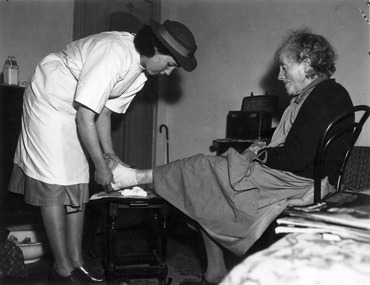
... RDNS introduced a Wound Care Specialist program and these Sisters did assessments and provided advice and support to the District Sisters working in the field. wound care melbourne district nursing society royal district nursing service rdns mdns sister j. faust Name of Sister on rear of photograph. Black and white photograph of Melbourne District Nursing Society (MDNS) visiting Sister J. Faust, who is wearing a white gown and a grey brimmed hat over her dark curled hair. Part of her grey uniform ...Sister J. Faust has dressed a wound on the ladies ankle and is applying a blue-line bandage. The photograph is taken in the lady's home. The MDNS uniform at that time was a grey frock, and stiffened brimmed grey felt hat with a light grey band and a red Maltese cross in the centre of the band. The Trained nurses (Nurses) of the Melbourne District Nursing Society (MDNS), from its inception in 1885, provided wound care to their patients, who ranged in age from the very young to the elderly. As research developed better products and dressing materials the methods and medication applied to wounds changed. MDNS received Royal patronage in 1966 and as Royal District Nursing Service (RDNS), the Education department developed programs, such as the Leg Ulcer Management Program, to provide their Trained nurses (Sisters) with methods of best quality care. The Sisters liaised with the patient’s Doctors and hospitals to provide information on the progress of patient’s wounds and to receive any change of wound care from the Doctors. RDNS introduced a Wound Care Specialist program and these Sisters did assessments and provided advice and support to the District Sisters working in the field. Black and white photograph of Melbourne District Nursing Society (MDNS) visiting Sister J. Faust, who is wearing a white gown and a grey brimmed hat over her dark curled hair. Part of her grey uniform frock is seen below the gown. She is applying a light coloured bandage to the right ankle of an elderly female patient. The lady, who has dark curled hair, and is wearing a grey frock, apron, and black cardigan is seen seated side on, on a wooden chair to the right of the Sister. She has her right leg extended and resting on a small low table, her left leg is bent to the floor.. The Sisters open case is seen on a small table to the rear of the lady and a walking stick is to the left against the door frame. A dark curtain hangs in the doorway. A large white wash bowl is seen in the lower left of the photograph. A glass jar with scissor blades into a liquid can be seen on a cabinet to the left of.Sister Faust. To the right of the photograph a partial white covered bed can be seen with a table over it with papers and a magnifying glass. Name of Sister on rear of photograph.wound care, melbourne district nursing society, royal district nursing service, rdns, mdns, sister j. faust -
 Royal District Nursing Service (now known as Bolton Clarke)
Photograph - Photograph, black and white, c.1980
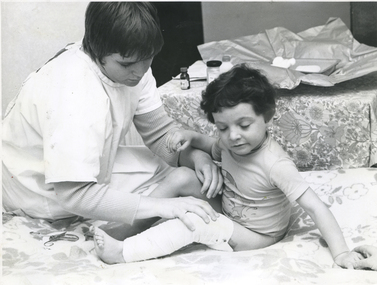
... RDNS introduced Wound Care Specialists who carried out assessments and provided advice and support to the District Sisters working in the field. rdns royal district nursing service mdns melbourne district nursing society rdns wound care Black and white photograph showing a Royal District Nursing Service (RDNS) Sister, who has sort dark hair and is wearing a short sleeved white gown over her uniform; the sleeves of her grey uniform skivvie are seen. ...This photograph shows one of the aspects of nursing care given by Royal District Nursing Service (RDNS), Sisters who worked in the community. The Sister attending had received instructions for care of this toddler's wound from a Doctor. The Sister is using a dressing tray which was sterilized at the RDNS centre. At the time of this photograph many hospitals provided wound dressings for their patients when they returned home. If not attached to a hospital, the family bought their own dressings, though the Sister carried spare dressings in their cases if needed at the time of their visit. The Trained nurses of the Melbourne District Nursing Society (MDNS), from its inception in 1885, provided wound care to their patients, who ranged in age from the very young to the elderly. As research developed better products and dressing materials the methods and medication applied to wounds changed. MDNS received Royal patronage in 1966 and as Royal District Nursing Service (RDNS), the Education department developed programs, such as Wound Care Programs, to provide their Trained nurses (Sisters)) with methods of best quality care. The Sisters liaised with the patient’s Doctors and hospitals to provide information on the progress of patient’s wounds and to receive any change of wound care from the Doctors. RDNS introduced Wound Care Specialists who carried out assessments and provided advice and support to the District Sisters working in the field. Black and white photograph showing a Royal District Nursing Service (RDNS) Sister, who has sort dark hair and is wearing a short sleeved white gown over her uniform; the sleeves of her grey uniform skivvie are seen. She is sitting side-on with her left hand resting on the right leg of a seated dark curly haired toddler; her right hand is on a bandage which is from ankle to thigh on the left leg of the toddler. The toddler is wearing a T-shirt with a pattern on the front, and is sitting on a floral cover in a room in her home. At the rear of the photograph a floral covered table is seen with an open dressing tray on a sterile drape; a small jar and bottle are seen on the table. rdns, royal district nursing service, mdns, melbourne district nursing society, rdns wound care -
 Royal District Nursing Service (now known as Bolton Clarke)
Photograph - Photograph, black and white, Barry Sutton, c.1970
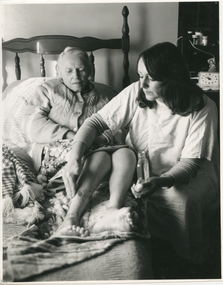
... RDNS introduced Wound Care Specialists who did assessments and provided advice and support to the District Sisters working in the field. royal district nursing service rdns rdns wound care mrs morgan sister cheryl prentice Photographer stamp. Quote No. DN 77 Handwritten information On the right of the black and white photograph is Royal District Nursing Service (RDNS), Sister Cheryl Prentice, who has dark shoulder length hair and is wearing a white gown over her RDNS uniform, the sleeves of which are seen. ...Sister Prentice is visiting Mrs. Morgan in her home and is applying a lotion around the outside of Mrs. Morgan's leg ulcer. Following this application Sr. Prentice dressed the wound with the dressing material as ordered by Mrs. Morgan's Doctor. Under her gown, Sister Prentice is wearing the RDNS winter uniform introduced in 1971, which was a grey/blue skivy under a blue/grey herringbone woollen V neck tunic.From its inception in 1885 as Melbourne District Nursing Society (MDNS), their Trained nurses (Nurses) provided wound care to their patients, who ranged in age from the very young to the elderly. The methods and medication applied to wounds changed as research developed better products. MDNS received Royal patronage in 1966 and as Royal District Nursing Service (RDNS), the Education department developed programs, such as the Leg Ulcer Management Program, to provide their trained nurses (Sisters) with methods of best quality care. The Sisters liaised with the patient’s Doctors and Hospitals to provide information on the progress of patient’s wounds and to receive any change of wound care from the Doctors. RDNS introduced Wound Care Specialists who did assessments and provided advice and support to the District Sisters working in the field. On the right of the black and white photograph is Royal District Nursing Service (RDNS), Sister Cheryl Prentice, who has dark shoulder length hair and is wearing a white gown over her RDNS uniform, the sleeves of which are seen. On her left Mrs. Morgan is sitting propped against a pillow at the top of her bed and has her knees slightly bent with legs extended. Sr. Prentice, who is looking at her right hand, is holding a small open bottle in her left hand and has her right arm extended across Mrs. Morgan's legs, with the fingers of her hand touching the skin on the far side of an open ulcer wound on the right leg of Mrs. Morgan. Mrs. Morgan, who has short light coloured hair, is wearing a cardigan over her floral frock, is looking at the procedure. The bedhead has fine turned wooden slats and the bed coverings are a checked rug and chenile bedspread with a floral towel under Mrs. Morgan's legs.. Photographer stamp. Quote No. DN 77 Handwritten informationroyal district nursing service, rdns, rdns wound care, mrs morgan, sister cheryl prentice -
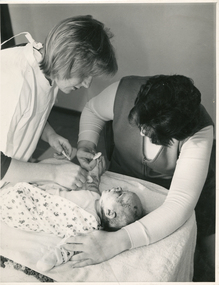 Royal District Nursing Service (now known as Bolton Clarke)
Photograph - Photograph, black and white, Barry Sutton, 22.06.1977
... Specialists who made assessments and provided advice and support to the District Sisters working in the field as needed. The Sisters liaised with the patient’s Doctors and Hospitals to provide information on the progress of patient’s wounds and to receive any change of wound care from the Doctors. royal district nursing service rdns rdns wound care Photographer stamp. Quote No. DO 50 On the left in the black and white photograph is a Royal District Nursing Service (RDNS), Sister, who has short, straight blonde hair, and is wearing a white gown over her uniform ...The RDNS Sister is visiting the mother and babe in their home. She is using sterile equipment and swabs to firstly moisten the tulle gras to enable ease of its removal before redressing the open areas on the babes skin with sterile dressings. With RDNS visiting the home of the mother, the young babes routine can continue to be established at home, rather than them having to regularly visit a Doctor or Hospital department for redressing of the babes lesions. The Trained nurses (Nurses) of the Melbourne District Nursing Society (MDNS), from its inception in 1885, provided wound care to their patients who ranged in age from the very young to the elderly. The patients required their wounds to be dressed following various types of surgery, accidents, burns, skin conditions, cancer, leg ulcers etc. As research developed better products and dressing materials, the methods and medication applied to wounds changed. MDNS received Royal patronage in 1966 and as Royal District Nursing Service (RDNS), the Education department developed wound care programs, such as the Leg Ulcer Management Program to provide their Trained nurses (Sisters) with methods of best quality care. They ran a program for Wound Care Specialists who made assessments and provided advice and support to the District Sisters working in the field as needed. The Sisters liaised with the patient’s Doctors and Hospitals to provide information on the progress of patient’s wounds and to receive any change of wound care from the Doctors. On the left in the black and white photograph is a Royal District Nursing Service (RDNS), Sister, who has short, straight blonde hair, and is wearing a white gown over her uniform is bending over a bassinet as she attends a baby with a skin condition. The Sister has her arms extended with a pair of forceps in her left hand, and in her right hand, another pair of forceps with a cotton wool swab attached is touching tulle gras on one of the wounds on the babes outstretched right arm. The baby is on her covered change table and is wearing a singlet and an opened patterned jumpsuit with her right upper area uncovered. Her mother, who has short dark hair and is wearing a dark sleeveless V neck tunic style frock over a light coloured long sleeve top, is behind and bending over the change table holding her babes right outstretched hand. She is also holding a dummy in that hand. The mother's left extended arm and hand is on the left shoulder of her babe. The baby, who has sparse hair, is looking up at her mother; signs of a skin condition can be seen on areas of the babes face and head.Photographer stamp. Quote No. DO 50royal district nursing service, rdns, rdns wound care
