
Showing 1155 items matching "womens - clothing"
-
 Orbost & District Historical Society
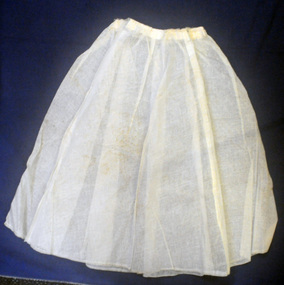
petticoat, 1930's - 1940's
... This item is an example of a home-made item of clothing and reflects the needlework skills of women in the first half of the twentieth century. petticoat women's-clothing Burton-Marjorie A coarse, net, white starched petticoat. ...This article of clothing is specifically an undergarment to be worn under a skirt or a dress. The petticoat is a separate garment hanging from the waist. In the late 1920s, chiffon dresses with several sheer petticoats became fashionable. With the Great Depression in the 1930s, narrow skirts returned and petticoats again were unpopular until the end of the decade when revived for some evening, prom, and wedding gowns. World War II, with its rationing and general shortage of materials, brought an end to petticoats. Petticoats were revived by Christian Dior in his full-skirted "New Look" of 1947 and tiered, ruffled, stiffened petticoats remained extremely popular during the 1950. Most of the petticoats were netlike crinoline, Worn by Marjorie Burton. It may have been worn underneath dresses with full skirts or may have been designed for a short style wedding dress. Marjorie Burton ( nee Whiteman), born 12 June, in Birmingham, England came to Orbost in 1995. In England she did office work – typing, shorthand and secretarial work - in accountants’ offices and also trained as a comptometrist with Burroughs in London. She came from a middle-class, working, church-going family. Her mother was a milliner who mademany of Marjorie’s clothes, hats and outfits. Marjorie was married in 1938 to a salesman who later became a mechanic in the R.A.F. This item is an example of a home-made item of clothing and reflects the needlework skills of women in the first half of the twentieth century.A coarse, net, white starched petticoat. It is short and has no bodice. It is home-made, machine stitched and fastens at the waist with metal hooks and eyes. It has four panelspetticoat women's-clothing burton-marjorie -
 Orbost & District Historical Society
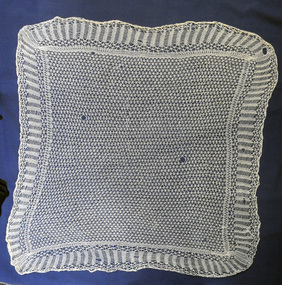
shawl, early 20th century
... This item is an example of a handmade item of clothing and reflects the needlework skills of women in the first half of the twentieth century. crochet handcraft shawl Burton-Marjorie A square crocheted silk shawl with a lacy pattern. ...This shawl may have been used for Marjorie Burton or earlier. It has been passed down fcrom the Whiteman family through the Burton family. Marjorie Burton ( nee Whiteman), born 12 June, in Birmingham, England came to Orbost in 1995. In England she did office work – typing, shorthand and secretarial work - in accountants’ offices and also trained as a comptometrist with Burroughs in London. She came from a middle-class, working, church-going family. Her mother was a milliner who made many of Marjorie’s clothes, hats and outfits. Marjorie was married in 1938 to a salesman who later became a mechanic in the R.A.F. This item is an example of a handmade item of clothing and reflects the needlework skills of women in the first half of the twentieth century.A square crocheted silk shawl with a lacy pattern. It is cream coloured and has rounded corners.crochet handcraft shawl burton-marjorie -
 Orbost & District Historical Society
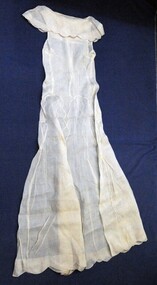
dress, mid 20th century
... This item is an example of a home-made item of clothing and reflects the needlework skills of women in the mid twentieth century. dress women's clothing Burton-Marjorie organza A long, coffee-coloured, organza dress with a plain weave, sheer fabric. ...Marjorie Burton ( nee Whiteman), born 12 June, in Birmingham, England came to Orbost in 1995. In England she did office work – typing, shorthand and secretarial work - in accountants’ offices and also trained as a comptometrist with Burroughs in London. She came from a middle-class, working, church-going family. Her mother was a milliner who made many of Marjorie’s clothes, hats and outfits. Marjorie was married in 1938 to a salesman who later became a mechanic in the R.A.F. This item is an example of a home-made item of clothing and reflects the needlework skills of women in the mid twentieth century.A long, coffee-coloured, organza dress with a plain weave, sheer fabric. It is sleeveless, collared and waisted with a scalloped hemline. It opens on the left side with 5 metal press studs and the inside shoulders have tabs with studs (probably to hold straps in place.)dress women's clothing burton-marjorie organza -
 Orbost & District Historical Society
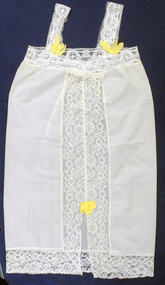
slip, 1950's
... Nylon fabric became important as a synthetic substitute for silk in the manufacture of parachutes when silk became scarce during WWII.This item is an example of one of the first pieces of women's clothing to be made commercially using nylon fabric. women's-clothing underwear nylon Burton-Marjorie Label sewn to inside - Made from 100% B NYLON S 1272 A white nylon slip with lace trim at the hemline, straps and middle front. ...This item was worn by Marjorie Burton. Marjorie Burton ( nee Whiteman), born 12 June, in Birmingham, England came to Orbost in 1995. In England she did office work – typing, shorthand and secretarial work - in accountants’ offices and also trained as a comptometrist with Burroughs in London. She came from a middle-class, working, church-going family. Her mother was a milliner who made manyof Marjorie’s clothes, hats and outfits. Marjorie was married in 1938 to a salesman who later became a mechanic in the R.A.F. during WW11. Nylon is a thermoplastic silky material, first used commercially in a nylon-bristled toothbrush (1938), followed more famously by women's stockings ("nylons"; 1940) after being introduced as a fabric at the 1939 New York World's Fair. It was the world's first totally man-made fibre. Nylon fabric became important as a synthetic substitute for silk in the manufacture of parachutes when silk became scarce during WWII.This item is an example of one of the first pieces of women's clothing to be made commercially using nylon fabric.A white nylon slip with lace trim at the hemline, straps and middle front. It has yellow ribbons wheer straps attach at the front and at the bottom front opening.Label sewn to inside - Made from 100% B NYLON S 1272women's-clothing underwear nylon burton-marjorie -
 Orbost & District Historical Society
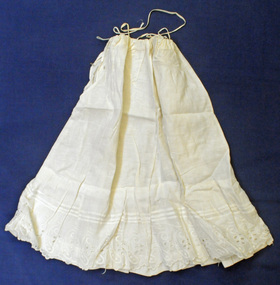
petticoat, 1940's
... This item is an example of a home-made item of clothing and reflects the needlework skills of women in the first half of the twentieth century. petticoat women's-clothing underwear Burton-Marjorie A short white linen petticoat opening at the back with 2 metal hooks and eyes. ...This item was made by Mrs Whiteman and worn by her daughter Marjorie Burton. Marjorie Burton ( nee Whiteman), born 12 June, in Birmingham, England came to Orbost in 1995. In England she did office work – typing, shorthand and secretarial work - in accountants’ offices and also trained as a comptometrist with Burroughs in London. She came from a middle-class, working, church-going family. Her mother was a milliner who made manyof Marjorie’s clothes, hats and outfits. Marjorie was married in 1938 to a salesman who later became a mechanic in the R.A.F. during WW11. This item is an example of a home-made item of clothing and reflects the needlework skills of women in the first half of the twentieth century.A short white linen petticoat opening at the back with 2 metal hooks and eyes. The waist has threaded elastic. Sewn to the top are two long tapes fastened with safety pins - probably for hanging. The bottom panel is double with a scalloped hem.petticoat women's-clothing underwear burton-marjorie -
 Orbost & District Historical Society
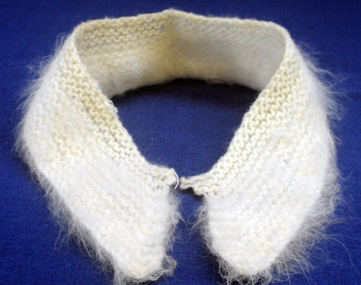
knitted collar, Burton, Marjorie, 1940's
... Clothes rationing ended on 15 March 1949. women's -clothing accessory Burton-Marjorie A narrow, detachable hand-knitted lady's collar. ...This was knitted by Marjorie Burton during WW11 in England. She used to knit while in an air raid shelter escaping the bombing with her young daughter. Marjorie Burton ( nee Whiteman), born 12 June, in Birmingham, England came to Orbost in 1995. In England she did office work – typing, shorthand and secretarial work - in accountants’ offices and also trained as a comptometrist with Burroughs in London. She came from a middle-class, working, church-going family. Her mother was a milliner who mademany of Marjorie’s clothes, hats and outfits. Marjorie married in 1938 to a salesman who later became a mechanic in the R.A.F. during WW11. Her father served in Civil Defence during the war. Marjorie was in Birmingham during the war and remembered sheltering with her young daughter, Anne (Quaadgras) in the air raid shelter during bombing. This item is an example of a handcrafted item and reflects the handcraft skills of women necessary during WW11 when clothing became scarce. Clothes rationing began on June 1, 1941, two years after food rationing started. Clothes rationing ended on 15 March 1949.A narrow, detachable hand-knitted lady's collar. It is hand-knitted in white brushed wool.women's -clothing accessory burton-marjorie -
 Orbost & District Historical Society
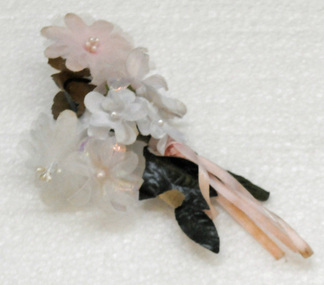
corsage, 1930's -1950's
... Marjorie was married in 1938 to a salesman who later became a mechanic in the R.A.F. during WW11 This item is an example of a typical dress accessory and reflects women's clothing styles of the mid 20th century. corsage accessories burton-marjorie A corsage of pink and white artificial flowers with green leaves and tied with a pink ribbon. ...A corsage is a small bouquet of flowers worn on a woman's dress or worn around her wrist to a formal occasion, traditionally purchased by the woman's date. A corsage originally referred to the bodice of a woman's dress. Since a bouquet of flowers was often worn in the center of the bodice, the flowers took on the name "corsage." This corsage was worn by Marjorie Burton.It was probably pinned on a dress to decorate it and may have been made by Marjorie or her mother. Marjorie Burton ( nee Whiteman), born 12 June, in Birmingham, England came to Orbost in 1995. In England she did office work – typing, shorthand and secretarial work - in accountants’ offices and also trained as a comptometrist with Burroughs in London. She came from a middle-class, working, church-going family. Her mother was a milliner who made many of Marjorie’s clothes, hats and outfits. Marjorie was married in 1938 to a salesman who later became a mechanic in the R.A.F. during WW11This item is an example of a typical dress accessory and reflects women's clothing styles of the mid 20th century.A corsage of pink and white artificial flowers with green leaves and tied with a pink ribbon. The stems are bound with green tape. In the centre of the flowers sre tiny white pearly beads.corsage accessories burton-marjorie -
 Ringwood and District Historical Society
Newspaper Clippings, Folder of 1920s-1950s newspaper clippings and magazine features relating to clothing patterns collected by Mrs. Jessie Hill, Ringwood district resident, 1927 - 1951
... Women's Weekly' from 1951 (mostly covers). On Front: 'New Summer Patterns, Suitings, Trouserings, Vestings, etc.' Mrs Jessie Hill's collection of cuttings in burgundy coloured cardboard covers with navy blue cloth spine and corners.; On Front: 'New Summer Patterns, Suitings, Trouserings, Vestings, etc.' +Additional Keywords: Hill, Mrs Jessie Folder of 1920s-1950s newspaper clippings and magazine features relating to clothing ...Mrs Jessie Hill's collection of cuttings from the 'Leader' from 1927 with photos of special events. Part of copies of the 'Women's Weekly' from 1951 (mostly covers).Mrs Jessie Hill's collection of cuttings in burgundy coloured cardboard covers with navy blue cloth spine and corners.; On Front: 'New Summer Patterns, Suitings, Trouserings, Vestings, etc.' +Additional Keywords: Hill, Mrs JessieOn Front: 'New Summer Patterns, Suitings, Trouserings, Vestings, etc.' -
 Ringwood and District Historical Society
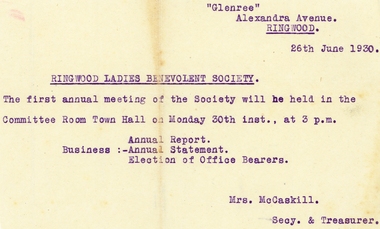
Document, Ringwood Ladies Benevolent Society 1929-1939
... The constitution states that the object of the Society is to relieve the wants of the poor -especially women and children- by suppyling them with clothing ,boots, food, fuel and other necessaries. ...The constitution states that the object of the Society is to relieve the wants of the poor -especially women and children- by suppyling them with clothing ,boots, food, fuel and other necessaries. ...The constitution states that the object of the Society is to relieve the wants of the poor -especially women and children- by suppyling them with clothing ,boots, food, fuel and other necessaries. The members of the Society to be councillors wives and representatives of Religious organisations.The President shall be the Mayoress. the positions of Treasurer and Secretary shall be Honorary. Mrs. McCaskill , whose husband was a Councillor at that time was the first President, a position she held for many years. There were 32 Ladies Benevolent Societies in the metropolitan area at this time. By the early 2000s there only a few left and Ringwood was one of the last to close about 2008 when it was absorbed into the Citizen's Advice Bureau. Various typed and hand written documents relating to the Ringwood Ladies Benevolent Society formed in 1929. 1- Constitution and Rules. 2- First Annual Report dated 1930. 3- Financial report submitted to The Charities Board of Victoria. 4- Receipts and expenditure for year ending 30th June 1930. 5- List of Societies affiliated with the Central Council of Victorian Ladies' Benevolent Societies. 6- Notification of first Annual Meeting of the Society in 1930. 7- Miscellaneous documents and newspaper clipping relating to the Ringwood Ladies Benevolent Society. -
 Orbost & District Historical Society
magazines, Needlework Illustrated; Australian Home Journal, September 1949; May 1963
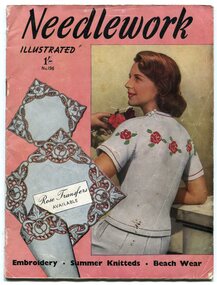
... Patterns and instructions were provided for women to create home articles and clothing. ...In doing so it shows what were the fashionable, but broadly affordable, women's and children's clothing styles of their day. These magazines also reflect women's interests --------------------------------------------------------------------------------------------------------------------------------------------------------- magazine- needlework-illustrated magazine-australian-home-journal Two magazines. 3097.1 contains patterns, instructions, advertisements and photographs. ...Needlework Illustrated is issue 196 and cost 1/-. it was published quarterly. Australian Home Journal is the May 1963 issue. Women’s magazines just after WWII played a “reflecting role,” including topics of readers’ interests as well as containing news items. Women’s employment rate had grown during WWII. However, even though the number of women working outside the home grew rapidly most of them were still engaged entirely in homemaking. Therefore women’s magazines centered mostly home crafts. Articles as well as advertisements presented information on keeping the family healthy with guidelines for thrifty shopping and advice on how to look good through it all. Patterns and instructions were provided for women to create home articles and clothing. The main sources for kntting and needlework designs available to women were in journals, magazines and pattern books. Embroidery was an affordable way to personalise and add aesthetic value to domestic linen and examples of embroidered and crocheted pieces could be found in most Australian homes. These are examples of women's magazines. They give practical advice on needlework / knitting and evidences the widespread interest in contemporary fashion. In doing so it shows what were the fashionable, but broadly affordable, women's and children's clothing styles of their day. These magazines also reflect women's interests --------------------------------------------------------------------------------------------------------------------------------------------------------- Two magazines. 3097.1 contains patterns, instructions, advertisements and photographs. It has a coloured cover - a pink background, black print an drawings of a woman wearing a top embroidered with roses and examples of needlework. 3097.2 contains patterns, advertisements, correspondence, and stories. It has a coloured cover with a photograph of a woman wearing a knitted jumper and three sewing patterns.magazine- needlework-illustrated magazine-australian-home-journal -
 Flagstaff Hill Maritime Museum and Village
Bonnet, late 1800s - early 1900s
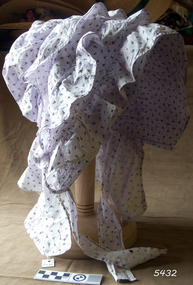
... This style of bonnet was commonly worn outdoors by women in South West Victoria in the late 1800s - early 1900s The bonnet is significant as a typical of women's outdoor headwear in Australia in the late 19th and early 20th century. flagstaff hill warrnambool shipwrecked-coast flagstaff-hill flagstaff-hill-maritime-museum maritime-museum shipwreck-coast flagstaff-hill-maritime-village ladies bonnet outdoor bonnet hat bonnet headwear ladies clothing late 19th century bonnet early 20th century bonnet women's fashion australian fashion australian millinery Ladies outdoor bonnet, white cotton with narrow mauve stripes and small flowers. ...This style of bonnet was commonly worn outdoors by women in South West Victoria in the late 1800s - early 1900sThe bonnet is significant as a typical of women's outdoor headwear in Australia in the late 19th and early 20th century.Ladies outdoor bonnet, white cotton with narrow mauve stripes and small flowers. Bonnet is trimmed with frills and straps to tie under the chin. Dated late 19th to early 20th century.flagstaff hill, warrnambool, shipwrecked-coast, flagstaff-hill, flagstaff-hill-maritime-museum, maritime-museum, shipwreck-coast, flagstaff-hill-maritime-village, ladies bonnet, outdoor bonnet, hat, bonnet, headwear, ladies clothing, late 19th century bonnet, early 20th century bonnet, women's fashion, australian fashion, australian millinery -
 City of Moorabbin Historical Society (Operating the Box Cottage Museum)
Kitchen Equipment, curved sad iron, c1880
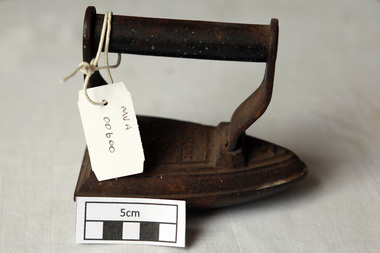
... women had to work with a heavy, hot iron close to the fireplace even in summer. The Curtis family were early settlers in Moorabbin Shire c1880 and used sad irons sad iron kitchen equipment pioneers early settlers market gardeners sewing craftwork clothing moorabbin brighton bentleigh fireplaces stoves SILVESTER'S/ PATENT/ SALTERS / No 3 with the pretzel & a arrow going through the centre A small, curved, flat iron, with attached handle, used for cuffs, collars and frills Kitchen Equipment, curved sad iron Salter Pty Ltd ...Sad-irons or "solid" irons were made by blacksmiths and used to smooth out material by pressing the hot iron over it. A piece of sheet -iron was placed over the kitchen fire and the irons placed on it could be heated whilst remaining clean of ash.. The women used 2 irons - one heating while the other was used. Thick cloth or gloves protected their hands from the hot irons. The handle was removed from the cool iron and re- attached to remove the hot iron from the fire. The cool iron was replaced on the fire or stove to heat again. These irons were cleaned with steel wool to prevent them marking the material. If the iron was too hot the material would scorch. Most homes set aside one day for ironing and some large households had an ironing room with a special stove designed to heat irons. However, most women had to work with a heavy, hot iron close to the fireplace even in summer.The Curtis family were early settlers in Moorabbin Shire c1880 and used sad ironsA small, curved, flat iron, with attached handle, used for cuffs, collars and frillsSILVESTER'S/ PATENT/ SALTERS / No 3 with the pretzel & a arrow going through the centresad iron, kitchen equipment, pioneers, early settlers, market gardeners, sewing, craftwork, clothing, moorabbin, brighton, bentleigh, fireplaces, stoves -
 City of Moorabbin Historical Society (Operating the Box Cottage Museum)
Clothing - Clothing, Lady's black beaded dress, c1900
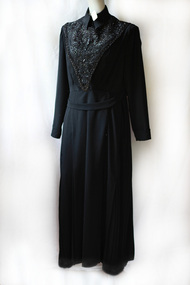
... women for the period of mourning was strictly prescribed and rigidly adhered to. Widows were expected to wear special clothes to indicate that they were in mourning for up to four years after the death, although a widow could choose to wear such attire for the rest of her life. To change the costume earlier was considered disrespectful to the deceased and, if the widow was still young and attractive, suggestive of potential sexual promiscuity. Those subject to the rules were slowly allowed to re-introduce conventional clothing...women for the period of mourning was strictly prescribed and rigidly adhered to. Widows were expected to wear special clothes to indicate that they were in mourning for up to four years after the death, although a widow could choose to wear such attire for the rest of her life. To change the costume earlier was considered disrespectful to the deceased and, if the widow was still young and attractive, suggestive of potential sexual promiscuity. Those subject to the rules were slowly allowed to re-introduce conventional clothing ...During the reign of Queen Victoria, whose long and conspicuous grief over the death of her husband, Prince Albert, appropriate dress for men and women for the period of mourning was strictly prescribed and rigidly adhered to. Widows were expected to wear special clothes to indicate that they were in mourning for up to four years after the death, although a widow could choose to wear such attire for the rest of her life. To change the costume earlier was considered disrespectful to the deceased and, if the widow was still young and attractive, suggestive of potential sexual promiscuity. Those subject to the rules were slowly allowed to re-introduce conventional clothing at specific time periods; such stages were known by such terms as "full mourning", "half mourning", and similar descriptions. For half mourning, muted colours such as lilac, grey and lavender could be introduced.. Special caps and bonnets, usually in black or other dark colours, went with these ensembles. There was special mourning jewellery, often made of jet. By the late 20th century, this no longer applied, and black had been widely adopted by women in cities as a fashionable colour. A lady's full length black fine wool dress with pleated bodice and skirt. A beaded detachable collar sits over the dress forming a V shape back and front and is attached by hooks and eyes on right shoulder . Centre front from neck to point is a row of small black circular sequins. clothing, dressmaking, craftwork, cheltenham, market gardeners, pioneers, early settlers, moorabbin, bentleigh -
 City of Moorabbin Historical Society (Operating the Box Cottage Museum)
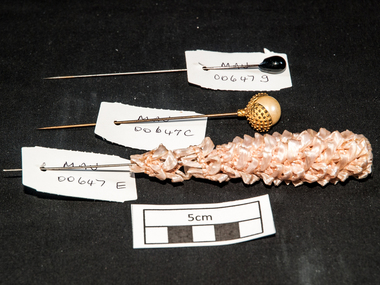
Personal Effects, lady's hat pins various x 14, c1880 - 1950
... women used their craftwork skills to create their own hat pins. This item is a reflection of the fashion mode of the late 19thC and early 20thC when long hair needed to be controlled by hair pins It is also an example of society's mores of tidiness moorabbin brighton early settlers pioneers cheltenham craftwork clothing 14 lady's steel hat pins in various styles numbered A -i A) 6x pearl tear-drop ; B) 1x pink metal beads;C) gold ball in 'oyster shell'; D) gold ball; E) pink plastic weave; F) silver metal ball; g) black bead; h) white ball; i) pale blue glass set in brass Personal Effects, lady's hat pins various x 14 Unrecorded resident ...These hat pins represents women's fashion in the late 19thC and early 20thC. As the material used in the construction is not of a high monetary value it can be assumed it was everyday woman's apparel to keep the hat firmly fastened into the hair. It does indicate that fashion of the time was important and many women used their craftwork skills to create their own hat pins. This item is a reflection of the fashion mode of the late 19thC and early 20thC when long hair needed to be controlled by hair pins It is also an example of society's mores of tidiness 14 lady's steel hat pins in various styles numbered A -i A) 6x pearl tear-drop ; B) 1x pink metal beads;C) gold ball in 'oyster shell'; D) gold ball; E) pink plastic weave; F) silver metal ball; g) black bead; h) white ball; i) pale blue glass set in brassmoorabbin, brighton, early settlers, pioneers, cheltenham, craftwork, clothing -
 City of Moorabbin Historical Society (Operating the Box Cottage Museum)
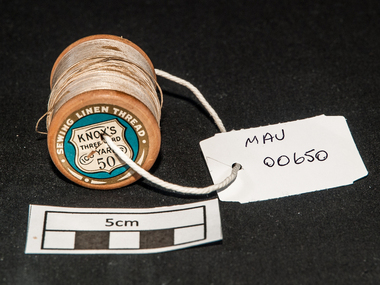
Sewing Equipment, cotton reel 'Knox's', early 20thC
... The early settlers in Moorabbin Shire had to be self reliant and made their own clothing, napery, tools and household goods. The women were skilful dressmakers and craft workers....The early settlers in Moorabbin Shire had to be self reliant and made their own clothing, napery, tools and household goods. The women were skilful dressmakers and craft workers. moorabbin brighton early settlers pioneers cheltenham knox pty. ltd. kilbirnie scotland cotton mills dressmaking W..J.KNOX / KILBIRNIE SCOTLAND/ 50/ 100yds A wooden reel of 'Knox's Three Cord' sewing cotton . 100 yards Sewing Equipment, cotton reel 'Knox's' W.J.Knox Pty Ltd ...W & J Knox Ltd were cotton millers in Kilbernie, Scotland during the time after the Industrial Revolution when Great Brittain exported manufactured cotton products globally. The early settlers in Moorabbin Shire had to be self reliant and made their own clothing, napery, tools and household goods. The women were skilful dressmakers and craft workers.A wooden reel of 'Knox's Three Cord' sewing cotton . 100 yardsW..J.KNOX / KILBIRNIE SCOTLAND/ 50/ 100ydsmoorabbin, brighton, early settlers, pioneers, cheltenham, knox pty. ltd. kilbirnie scotland, cotton mills, dressmaking -
 City of Moorabbin Historical Society (Operating the Box Cottage Museum)
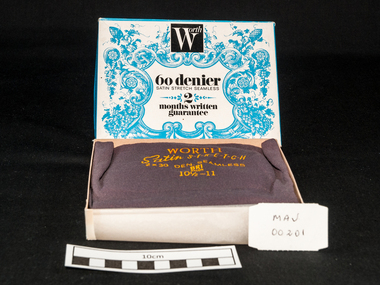
Clothing - Clothing, lady's nylon stockings 'Worth', mid 20thC
... Leon Worth Hosiery Manufacturer Pty Ltd made nylon stockings for women from a factory in Melbourne until the business was sold 1989. clothing stockings hosiery leon worth pty ltd melbourne fashion nylon bri-nylon bentleigh cheltenham moorabbin Inside Lid of box : WORTH / 60 DENIER / SATIN STRETCH DENIER / 2 / months written guarantee. ...Leon Worth Hosiery Manufacturer Pty Ltd made nylon stockings for women from a factory in Melbourne until the business was sold 1989.A pair of unworn lady's brown bri-nylon stockings made by 'Leon Worth Pty Ltd' , in the original box.Inside Lid of box : WORTH / 60 DENIER / SATIN STRETCH DENIER / 2 / months written guarantee. On Stocking top : WORTH / SATIN S-T-R-E-T-C-H / 2 X 30 DENIER SEAMLESS / BRI / Nylon / 10 ½ - 11clothing, stockings, hosiery, leon worth pty ltd melbourne, fashion, nylon, bri-nylon, bentleigh, cheltenham, moorabbin -
 City of Moorabbin Historical Society (Operating the Box Cottage Museum)
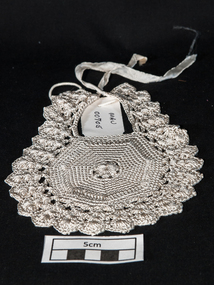
Clothing, baby's crocheted bib, c1900
... This baby’s hand crocheted silk bib is an example of the dressmaking and craftwork skills of the women of the early settlers families in Moorabbin Shire in the early 20th C Early settlers and market gardeners established their families in Moorabbin Shire and this item shows the skill and craftsmanship of the women of these families clothing, brighton, moorabbin, pioneers, dressmaking, craftwork, crochetwork, market gardeners, early settlers, A hand crocheted cream silk baby's bib Clothing, baby's crocheted bib Early settler ...This baby’s hand crocheted silk bib is an example of the dressmaking and craftwork skills of the women of the early settlers families in Moorabbin Shire in the early 20th C Early settlers and market gardeners established their families in Moorabbin Shire and this item shows the skill and craftsmanship of the women of these families A hand crocheted cream silk baby's bibclothing, brighton, moorabbin, pioneers, dressmaking, craftwork, crochetwork, market gardeners, early settlers, -
 City of Moorabbin Historical Society (Operating the Box Cottage Museum)
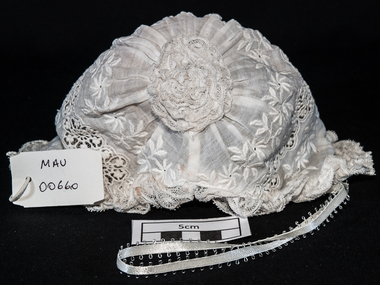
Clothing - Clothing, baby's lace bonnet, c1900
... This baby’s bonnet is an example of the lace making and dressmaking skills of the early settler women in the Shire of Moorabbin dressmaking lacework craftwork lace mooabbin Bentleigh Cheltenham early settlers pioneers market gardeners A hand made lace and net lined baby's bonnet Clothing Clothing, baby's lace bonnet early settler ...This baby’s bonnet is an example of the lace making and dressmaking skills of the early settler women in the Shire of Moorabbin A hand made lace and net lined baby's bonnetdressmaking, lacework, craftwork, lace, mooabbin, bentleigh, cheltenham, early settlers, pioneers, market gardeners -
 City of Moorabbin Historical Society (Operating the Box Cottage Museum)
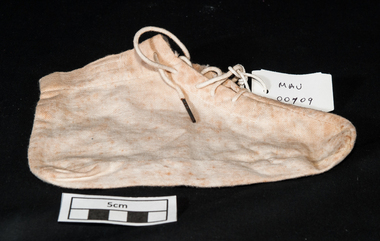
Clothing - Calico infant's bootee, c1900
... This calico baby’s bootee is an example of the dressmaking skills of the women of the early settlers families in Moorabbin Shire in the early 20th C Early settlers and market gardeners established their families in Moorabbin Shire and this item shows the skill and craftsmanship of the women of these families clothing brighton moorabbin pioneers dressmaking market gardeners early settlers craftwork calico cotton linen A calico infants bootee with laces Clothing Calico infant's bootee Early Settler ...This calico baby’s bootee is an example of the dressmaking skills of the women of the early settlers families in Moorabbin Shire in the early 20th C Early settlers and market gardeners established their families in Moorabbin Shire and this item shows the skill and craftsmanship of the women of these families A calico infants bootee with lacesclothing, brighton, moorabbin, pioneers, dressmaking, market gardeners, early settlers, craftwork, calico, cotton, linen -
 City of Moorabbin Historical Society (Operating the Box Cottage Museum)
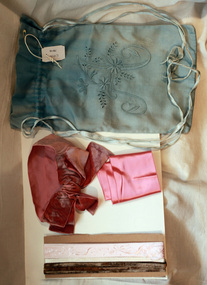
Accessory - Personal Effects, lady's blue silk 'Dilly' bag, c1900
... This evening bag is an example of the skill and craftwork of the early settler women in the Shire of Moorabbin c1900 clothing handbags purses early settlers moorabbin cheltenham bentleigh dressmaking craftwork crochet-work pioneers market gardeners evening wear formal wear silk satin 'A' embroidered on bag A lady's blue silk 'dilly bag' with hand embroidered 'A' and with drawstring ties.c1900 The bag contains assorted ribbons c1960 Accessory Personal Effects, lady's blue silk 'Dilly' bag unrecorded early settler ...This evening bag is an example of the skill and craftwork of the early settler women in the Shire of Moorabbin c1900 A lady's blue silk 'dilly bag' with hand embroidered 'A' and with drawstring ties.c1900 The bag contains assorted ribbons c1960'A' embroidered on bagclothing, handbags, purses, early settlers, moorabbin, cheltenham, bentleigh, dressmaking, craftwork, crochet-work, pioneers, market gardeners, evening wear, formal wear, silk, satin -
 Greensborough Historical Society
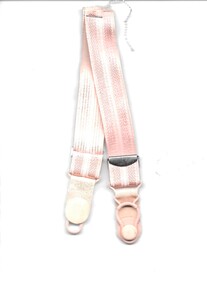
Clothing - Suspenders, 1960s
... Straps used to hold up women's stockings suspenders women's clothing stockings Pair of pink elasticised suspender straps Clothing Suspenders ...Straps used to hold up women's stockingsPair of pink elasticised suspender strapssuspenders, women's clothing, stockings -
 Flagstaff Hill Maritime Museum and Village
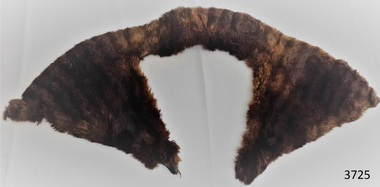
Fur Collar, 1930’S
... women. This fur collar is representative of fashion accessories in Warrnambool and District in the 1930’s. flagstaff hill warrnambool shipwrecked coast flagstaff hill maritime museum maritime museum shipwreck coast flagstaff hill maritime village great ocean road fur collar fur stole fur accessory clothing 1930’s fashion 1930’s fashion accessory rabbit fur Fur collar, 1930’s. ...The donors of this fur collar believe the collar to be between 80-90 years old. It was worn by the donor’s grandmother and mother as an accessory to Warrnambool and district balls and dances. It may have also been worn for warmth! The donors believe the fur would have been purchased in either Melbourne or Toorak. This fur could have been worn by either men or women. This fur collar is representative of fashion accessories in Warrnambool and District in the 1930’s.Fur collar, 1930’s. Rabbit fur collar, wide lapels, very soft fur with dyed pattern of light and dark brown stripes. Collar is lined with a heavy dark green woollen fabric. Between the fur and the lining there is a felt interfacingflagstaff hill, warrnambool, shipwrecked coast, flagstaff hill maritime museum, maritime museum, shipwreck coast, flagstaff hill maritime village, great ocean road, fur collar, fur stole, fur accessory, clothing 1930’s, fashion 1930’s, fashion accessory, rabbit fur -
 Flagstaff Hill Maritime Museum and Village
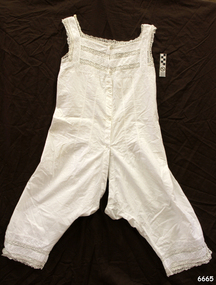
Clothing - Combination Undergarment, Late 1800s
... Combination underwear was popular because the all-in-one design had far fewer gathers and bulk, making the other clothing look much smoother. The collection of women’s late-19th-century undergarments is an example of clothing that women would include in their wardrobes. ...This handmade women’s combination undergarment features hand-worked lace panels and trim, and fine pintucks. It is one of seven handmade items of white cotton underwear, all made with beautiful needlework and embroidery skill. The lingerie once belonged to the donor’s great-grandmother’s family, the Paton family of ‘Trefnant’, Yangery, in southwest Victoria. The design of this combination undergarment, or ‘combination’, includes a chemise attached to a pair of drawers or bloomers. The combination is divided, or bifurcated, from the waist to the crutch for easier urinating. This one-piece type of underwear was worn by females from the 1860s and into the early 1900s. The 19th Century garments had front button closures like this one, and those made in the 1900s more often had back closures. Combination underwear was popular because the all-in-one design had far fewer gathers and bulk, making the other clothing look much smoother. The collection of women’s late-19th-century undergarments is an example of clothing that women would include in their wardrobes. The garments add to the study of the evolution of women's fashions and practicality for the early Australian settlers. The fine linen fabric and the careful needlework in these handmade garments and hand-worked lace trims reflect the maker’s dedication to making even serviceable garments beautiful to look at and wear. Women’s white cotton and lace all-In-one combination undergarment. The handmade underwear is a combined chemise and bloomers. It has a front button closure and is trimmed with hand-worked lace panels on the bodice and lace edging around armholes, the neck, and the bottom of the legs. The left and right sides are divided from the waist to the crutch.flagstaff hill maritime museum and village, maritime museum, maritime village, warrnambool, great ocean road, southwest victoria, victorian era, combination undergarment, all-in-one underwear, combination, ‘combinations’, one-piece underwear, one-piece undergarment, chemise and bloomers, combination chemise and bloomers, divided, bifurcated, split, chemise and drawers, women’s underwear, ladies’ underwear, undergarment, women’s clothing, women’s fashion, lingerie, under-structure, 1900s undergarments, 19th-century undergarment, 20th century, handmade clothing, handmade lace, hand-worked lace, paton family, trefnant, yangery, lady's combinations, ladies combinations -
 Flagstaff Hill Maritime Museum and Village
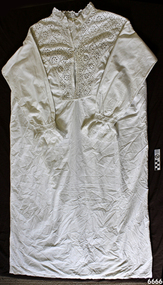
Clothing - Nightgown, Late 19th century
... The collection of women’s late-19th-century undergarments is an example of clothing that women would include in their wardrobes. ...This handmade women’s nightgown features hand-worked Broderie Anglaise yoke and trim. It is one of seven handmade items of white cotton underwear, all made with beautiful needlework and embroidery skill. The lingerie once belonged to the donor’s great-grandmother’s family, the Paton family of ‘Trefnant’, Yangery, in southwest Victoria. This design of nightgown was worn by females in the 19th century and is still worn today.The collection of women’s late-19th-century undergarments is an example of clothing that women would include in their wardrobes. The garments add to the study of the evolution of women's fashions and practicality for the early Australian settlers. The fine linen fabric and the careful needlework in these handmade garments and hand-worked lace trims reflect the maker’s dedication to making even serviceable garments beautiful to look at and wear. Women's long straight nightgown, white cotton, with long sleeves gathered at the cuff, stand-up lace collar, and a small catch closure on the bodice's centre opening. Hand-worked Broderie Anglaise yoke and sleeve tips.flagstaff hill maritime museum and village, maritime museum, maritime village, warrnambool, great ocean road, southwest victoria, victorian era, nightie, nightgown, women’s nightwear, sleepwear, night dress, women’s clothing, women’s fashion, lingerie, 19th century, handmade clothing, broderie anglaise, hand-made broderie anglaise, paton family, trefnant, yangery, nightdress -
 Flagstaff Hill Maritime Museum and Village
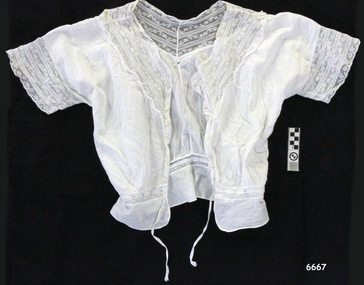
Clothing - Camisole, Late 19th Century
... The collection of women’s late-19th-century undergarments is an example of clothing that women would include in their wardrobes. ...This handmade women’s camisole features hand-worked lace yoke and trim and a drawstring peplum waist. It is one of seven handmade items of white cotton underwear, all made with beautiful needlework and embroidery skill. The lingerie once belonged to the donor’s great-grandmother’s family, the Paton family of ‘Trefnant’, Yangery, in southwest Victoria. The collection of women’s late-19th-century undergarments is an example of clothing that women would include in their wardrobes. The garments add to the study of the evolution of women's fashions and practicality for the early Australian settlers. The fine linen fabric and the careful needlework in these handmade garments and hand-worked lace trims reflect the maker’s dedication to making even serviceable garments beautiful to look at and wear. Women's camisole, short sleeves and peplum waist. Handmade from white cotton fabric, with hand-worked lace sleeve tips, collar, waist trim and yoke. There are five buttons and two ties down the front.flagstaff hill maritime museum and village, maritime museum, maritime village, warrnambool, great ocean road, southwest victoria, victorian era, women’s underwear, ladies’ underwear, undergarment, under-structure, 1900s undergarments, 19th-century undergarment, women’s clothing, women’s fashion, lingerie, 19th century, handmade clothing, handmade lace, hand-worked lace, camisole, paton family, trefnant, yangery -
 Flagstaff Hill Maritime Museum and Village
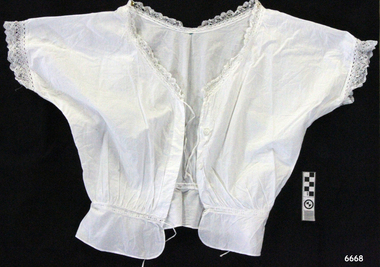
Clothing - Camisole, Late 19th century
... The collection of women’s late-19th-century undergarments is an example of clothing that women would include in their wardrobes. ...This handmade women’s camisole features hand-worked lace yoke and trim and a drawstring peplum waist. It is one of seven handmade items of white cotton underwear, all made with beautiful needlework and embroidery skill. The lingerie once belonged to the donor’s great-grandmother’s family, the Paton family of ‘Trefnant’, Yangery, in southwest Victoria. The collection of women’s late-19th-century undergarments is an example of clothing that women would include in their wardrobes. The garments add to the study of the evolution of women's fashions and practicality for the early Australian settlers. The fine linen fabric and the careful needlework in these handmade garments and hand-worked lace trims reflect the maker’s dedication to making even serviceable garments beautiful to look at and wear. Women's camisole, short sleeves and peplum waist. Handmade from white cotton fabric, with hand-worked lace sleeve tips, neck trim and waist trim. Drawstring, tie and button closure.flagstaff hill maritime museum and village, maritime museum, maritime village, warrnambool, great ocean road, southwest victoria, victorian era, women’s underwear, ladies’ underwear, undergarment, under-structure, 1900s undergarments, 19th-century undergarment, women’s clothing, women’s fashion, lingerie, 19th century, handmade clothing, handmade lace, hand-worked lace, camisole, paton family, trefnant, yangery -
 Flagstaff Hill Maritime Museum and Village
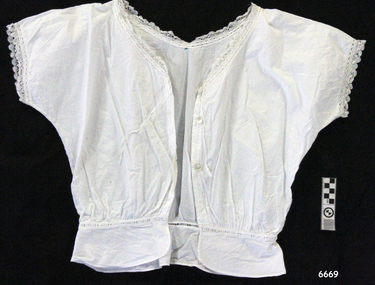
Clothing - Camisole, Late 19th century
... The collection of women’s late-19th-century undergarments is an example of clothing that women would include in their wardrobes. ...This handmade women’s camisole features hand-worked lace yoke and trim and a drawstring peplum waist. It is one of seven handmade items of white cotton underwear, all made with beautiful needlework and embroidery skill. The lingerie once belonged to the donor’s great-grandmother’s family, the Paton family of ‘Trefnant’, Yangery, in southwest Victoria. The collection of women’s late-19th-century undergarments is an example of clothing that women would include in their wardrobes. The garments add to the study of the evolution of women's fashions and practicality for the early Australian settlers. The fine linen fabric and the careful needlework in these handmade garments and hand-worked lace trims reflect the maker’s dedication to making even serviceable garments beautiful to look at and wear. Women's camisole, short sleeves and peplum waist. Handmade from white cotton fabric, with hand-worked lace sleeve tips, collar and waist trim. It has button closures down the front.flagstaff hill maritime museum and village, maritime museum, maritime village, warrnambool, great ocean road, southwest victoria, victorian era, women’s underwear, ladies’ underwear, undergarment, under-structure, 1900s undergarments, 19th-century undergarment, women’s clothing, women’s fashion, lingerie, 19th century, handmade clothing, handmade lace, hand-worked lace, camisole, paton family, trefnant, yangery -
 Flagstaff Hill Maritime Museum and Village
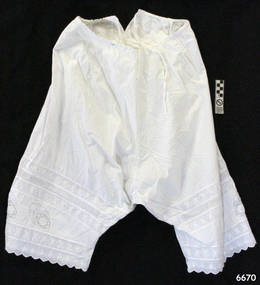
Clothing - Bloomers, Late 19th century
... The collection of women’s late-19th-century undergarments is an example of clothing that women would include in their wardrobes. ...This handmade women’s pair of bloomers, or drawers, features hand-worked Broderie Anglaise and applique trim and a drawstring rear closure at the waist. It is one of seven handmade items of white cotton underwear, all made with beautiful needlework and embroidery skill. The lingerie once belonged to the donor’s great-grandmother’s family, the Paton family of ‘Trefnant’, Yangery, in southwest Victoria. The collection of women’s late-19th-century undergarments is an example of clothing that women would include in their wardrobes. The garments add to the study of the evolution of women's fashions and practicality for the early Australian settlers. The fine linen fabric and the careful needlework in these handmade garments and hand-worked lace trims reflect the maker’s dedication to making even serviceable garments beautiful to look at and wear. Women's bloomers or drawers, handmade from white cotton fabric, with hand-worked Broderie-Anglaise trim around the bottom of legs with applique motifs. Bloomers have a drawstring, back of waist closure.flagstaff hill maritime museum and village, maritime museum, maritime village, warrnambool, great ocean road, southwest victoria, victorian era, women’s underwear, ladies’ underwear, undergarment, under-structure, 1900s undergarments, 19th-century undergarment, women’s clothing, women’s fashion, lingerie, 19th century, handmade clothing, broderie anglaise, hand-made broderie anglaise, paton family, trefnant, yangery, bloomers, drawers, underpants -
 Flagstaff Hill Maritime Museum and Village
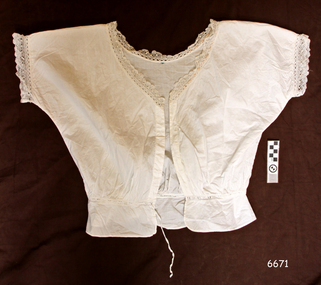
Clothing - Camisole, Late 19th century
... The collection of women’s late-19th-century undergarments is an example of clothing that women would include in their wardrobes. ...This handmade women’s camisole features hand-worked lace yoke and trim and a drawstring peplum waist. It is one of seven handmade items of white cotton underwear, all made with beautiful needlework and embroidery skill. The lingerie once belonged to the donor’s great-grandmother’s family, the Paton family of ‘Trefnant’, Yangery, in southwest Victoria. The collection of women’s late-19th-century undergarments is an example of clothing that women would include in their wardrobes. The garments add to the study of the evolution of women's fashions and practicality for the early Australian settlers. The fine linen fabric and the careful needlework in these handmade garments and hand-worked lace trims reflect the maker’s dedication to making even serviceable garments beautiful to look at and wear. Women's camisole, short sleeves and drawstring peplum waist. Handmade from white cotton fabric, with hand-worked lace sleeve tips, collar and waist trim. Front closure.flagstaff hill maritime museum and village, maritime museum, maritime village, warrnambool, great ocean road, southwest victoria, victorian era, women’s underwear, ladies’ underwear, undergarment, under-structure, 1900s undergarments, 19th-century undergarment, women’s clothing, women’s fashion, lingerie, 19th century, handmade clothing, handmade lace, hand-worked lace, camisole, paton family, trefnant, yangery -
 Flagstaff Hill Maritime Museum and Village
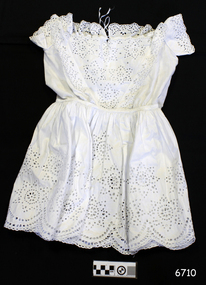
Clothing - Childs Dress
... women's nightwear and underclothing. This child's dress has handcraft and needlework skills that were popular in the 19th and early 20th centuries. The dress also features a homemade button. Flagstaff Hill Warrnambool Maritime Museum Maritime Village Great Ocean Road Shipwreck Coast Child's dress clothing embroidery Broderie anglaise handmade button handmade dress child's fashion dressmaker handcraft needlework lacework Child's dress, white fabric, with short sleeves, gathered waist and scalloped hemline. ...The fabric of this child's dress includes 'Broderie Anglaise, a form of needlework involving patterns of holes that are each stitched to form a finish that will not fray. The dress features a homemade button.. This handcraft dates back to the 1500s. It became popular in the 1800s and early 1900s, particularly for women's nightwear and underclothing.This child's dress has handcraft and needlework skills that were popular in the 19th and early 20th centuries. The dress also features a homemade button.Child's dress, white fabric, with short sleeves, gathered waist and scalloped hemline. The bodice and shirt have Broderie Anglaise embroidery inserts, with the holes formed into a star pattern. The bodice insert is a 'V' shape. The back has a ribbon tie and is finished with a homemade button.flagstaff hill, warrnambool, maritime museum, maritime village, great ocean road, shipwreck coast, child's dress, clothing, embroidery, broderie anglaise, handmade button, handmade dress, child's fashion, dressmaker, handcraft, needlework, lacework
