
Showing 686 items matching "wool mills"
-
 National Wool Museum
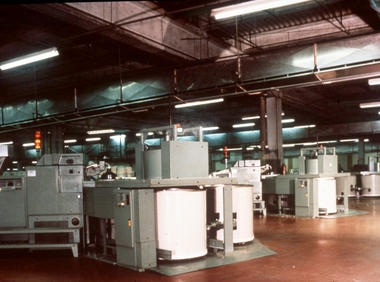
Photograph - Slide, Stuart Ascough, Gill Box Machines, 1990s
... Stuart's career in the wool industry spanned over 43 years from 1960 to 2003 in various roles including Topmaking Plant Manager at Courtaulds Ltd. in Spennymore, U.K., Operations Manager at Port Phillip Mills in Williamstown Victoria, Marketing Executive, Early Stage Wool Processing at the International Wool Secretariat Melbourne, Australia and General Manager of Victoria Wool Processors Pty. ...Stuart's career in the wool industry spanned over 43 years from 1960 to 2003 in various roles including Topmaking Plant Manager at Courtaulds Ltd. in Spennymore, U.K., Operations Manager at Port Phillip Mills in Williamstown Victoria, Marketing Executive, Early Stage Wool Processing at the International Wool Secretariat Melbourne, Australia and General Manager of Victoria Wool Processors Pty. ...This slide is part of a collection of visual resources used by Stuart Ascough while conducting training, seminars, conferences and lectures in China, Australia, India, Russia and Taiwan. This item is part of a collection of books, manuals, photographs, letters and clothing relating to the working life of Stuart Ascough. Stuart's career in the wool industry spanned over 43 years from 1960 to 2003 in various roles including Topmaking Plant Manager at Courtaulds Ltd. in Spennymore, U.K., Operations Manager at Port Phillip Mills in Williamstown Victoria, Marketing Executive, Early Stage Wool Processing at the International Wool Secretariat Melbourne, Australia and General Manager of Victoria Wool Processors Pty. Ltd. in Laverton North, Victoria. Throughout his career Stuart travelled extensively, and in the 1990s worked at many topmaking mills in China on quality improvement projects. He also provided technical advice and training at mills in India, Ukraine, Lithuania, Kyrgyzstan, Russia, Latvia, Byelorussia and other parts of Europe and Asia.35mm colour transparency mounted in plastic slide mount showing factory interior with gill box machinery.wool, industry, australia, australian wool board international wool secretariat, topmaking, carding, factory, training, gill box -
 Stawell Historical Society Inc
Book - Laboratory Reference Book, Wool an Introduction to its properties, Varieties, uses and production, W.J. Onions
... Lab Reference - Norwellan & AUNDE North Western Woollen Mills became Norwellan Textiles then AUNDE Manufacturing John T Bennett, Lyddon Hall Leeds 17/10/1968 Light Brown hardcover with Gold title on spine Wool an Introduction to its properties, Varieties, uses and production, W.J. ...Textbook. Lab Reference - Norwellan & AUNDE North Western Woollen Mills became Norwellan Textiles then AUNDELight Brown hardcover with Gold title on spineJohn T Bennett, Lyddon Hall Leeds 17/10/1968manufacturing -
Stawell Historical Society Inc
Booklet - Laboratory Reference Book, The Chemistry of Wool and Related Fibres, by J.B. Speakman
... Lecture Notes Reprinted from The Journal of the Textile Institute, Lab Reference - Norwellan & AUNDE North Western Woollen Mills became Norwellan Textiles then AUNDE Manufacturing Light Green soft cover booklet with Dark Blue title on cover The Chemistry of Wool and Related Fibres, by J.B. ...Lecture Notes Reprinted from The Journal of the Textile Institute, Lab Reference - Norwellan & AUNDE North Western Woollen Mills became Norwellan Textiles then AUNDELight Green soft cover booklet with Dark Blue title on covermanufacturing -
Stawell Historical Society Inc
Archive - Labratory Books, Wool /Science Review
... North Western Woollen Mills became Norwellan Textiles then AUNDE Stawell Industty Booklets Commercial Print 1 X Brown Cover January 1967 1 X Grey White Dec 1987 64 1 Grey Green December 1988 65 1 Pink white Microscopic Photos April 1991 67 Wool /Science Review Archive Labratory Books ...Dye laboratory Books Aunde / Norwellan Now Closed. North Western Woollen Mills became Norwellan Textiles then AUNDEBooklets Commercial Print 1 X Brown Cover January 1967 1 X Grey White Dec 1987 64 1 Grey Green December 1988 65 1 Pink white Microscopic Photos April 1991 67 stawell industty -
Stawell Historical Society Inc
Book - Labratory Book, CIBA - GEIG 7X 2
... Now Closed North Western Woollen Mills became Norwellan Textiles then AUNDE Wool / Cotton union blends Dyeing Process Blue Card CIBA - GEIG 7X 2 Book Labratory Book ...Dye Laboratory Book. Aunde/ Norwellan. Now Closed North Western Woollen Mills became Norwellan Textiles then AUNDEBlue CardWool / Cotton union blends Dyeing Process -
Stawell Historical Society Inc
Archive - Labratory Book, Textile Titles of the World 1995 & Publications For the Wool Industry 1963-1991
... Labratory Books from Aunde / Norwellan now closed North Western Woollen Mills became Norwellan Textiles then AUNDE Norwellan 5257 Austicks Bookshops In Association with The Testile Industry (Coat of Arms Above Print) Textiles of the World 1995 A Catalogue of Current Literature 5257-1 WRONZ (in rectangle ) Publications for the Wool Industry 1963 - 1991 May 1992 WRONZ ( in rectangle) Wool research Orginisation of New Zealand (inc) Private Bag 4749 Christchurch New Zealand. 5257 - Orange Cardcaover with Blue Print 5257-1 Rec Card Cover With Black Orint Textile Titles of the World 1995 & Publications For the Wool Industry 1963-1991 Archive Labratory Book ...Labratory Books from Aunde / Norwellan now closed North Western Woollen Mills became Norwellan Textiles then AUNDE5257 - Orange Cardcaover with Blue Print 5257-1 Rec Card Cover With Black Orint5257 Austicks Bookshops In Association with The Testile Industry (Coat of Arms Above Print) Textiles of the World 1995 A Catalogue of Current Literature 5257-1 WRONZ (in rectangle ) Publications for the Wool Industry 1963 - 1991 May 1992 WRONZ ( in rectangle) Wool research Orginisation of New Zealand (inc) Private Bag 4749 Christchurch New Zealand. norwellan -
 Sunshine and District Historical Society Incorporated
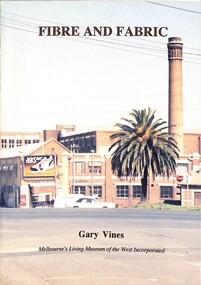
Book - Fibre and Fabric, Melbourne's Living Museum of the West, 1993
... Fibre Fabric work in the west wool cotton and textile industries in Melbourne's west employment The book covers the history of wool, cotton, textile and allied industries in Australia and Melbourne's west Fibre and Fabric - The wool, cotton, textile and allied industries in Melbourne's west Slim A5 book, well-illustrated. The picture on the front cover is the Former Bradford Cotton Mill 'Bradmills'. ...The book covers the history of wool, cotton, textile and allied industries in Australia and Melbourne's westSlim A5 book, well-illustrated. The picture on the front cover is the Former Bradford Cotton Mill 'Bradmills'.non-fictionThe book covers the history of wool, cotton, textile and allied industries in Australia and Melbourne's westfibre, fabric, work in the west, wool, cotton and textile industries in melbourne's west, employment -
 Sunshine and District Historical Society Incorporated
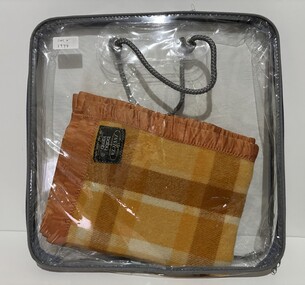
Functional object - Blanket, Invicta Mills, Invicta Mills P/L, Approx 1970s
... Pure new wool with ribbon edging. With an Invicta Mills label....Produced at the Invicta factory where Dudley Carland (Donna Brookes' father) was a storeman Invicta Mills Tottenham Manufacturing Manchester Tan and yellow tartan baby's blanket. Pure new wool with ribbon edging. ...Produced at the Invicta factory where Dudley Carland (Donna Brookes' father) was a storemanTan and yellow tartan baby's blanket. Pure new wool with ribbon edging. With an Invicta Mills label.invicta mills, tottenham, manufacturing, manchester -
 Embroiderers Guild, Victoria
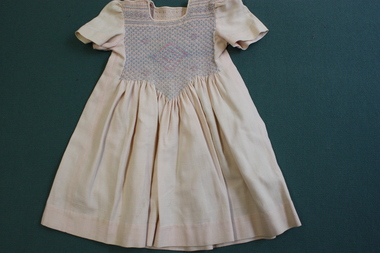
Clothing - Child's Smocked Dress, Mid 20thC
... Clydella is the trademarked name for 81% cotton and 19% wool fabric produced by William Hollins & Co. of England. It was woven in a mill near Glasgow....Clydella is the trademarked name for 81% cotton and 19% wool fabric produced by William Hollins & Co. of England. It was woven in a mill near Glasgow. ...Peach coloured Clydella child's smocked dress. Blue smocked front and back in a diamond pattern with bullion roses (pink). Square neckline and gathered sleeves, bound neck. Clydella is the trademarked name for 81% cotton and 19% wool fabric produced by William Hollins & Co. of England. It was woven in a mill near Glasgow.embroidery, smocking, child's dress, garments -
 National Wool Museum
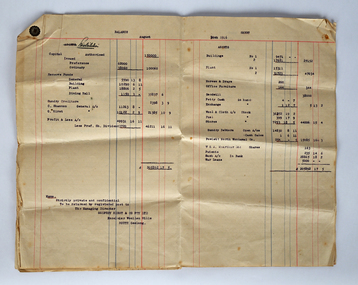
Document - Balance Sheets, Godfrey Hirst and Co. Pty Ltd, 1916-1919
... Mills...Geelong...Wool...Documents Budgets Balance Sheets Company Records The Excelsior Mills Geelong Wool Industry Textile Industry [printed] Memo / Strictly private and confidential / To be returned by registered post to / The Managing Director / GODFREY HIRST & CO PTY LTD / Excelsior Woollen Mills / SOUTH Geelong. ...The Excelsior Woollen and Worsted Mills were controlled by Godfrey Hirst & Co. Pty. Ltd. The Excelsior name originated from the union in the one enterprise of two of the earliest mills established in Victoria, the Old Victorian Mill, and the Old Barwon Mill. Godfrey Hirst combined his expertise with the capital of Charles Shannon to purchase the Barwon Mill in 1890 and the Victorian Mill in 1899. They commenced production of high-quality flannels in readiness for an anticipated lifting of tariff barriers in 1901, the year of federation. These were the first flannels to be produced in Australia rather than imported from England. In April 1912 the No.2 Excelsior Mill burnt down during the installation of electricity and was rebuilt. The No.1 Excelsior Mill was closed in 1930, with most hands moving to the No.2 Mill. In 1966 the firm changed ownership and became a subsidiary of the McKendrick family and commenced manufacturing of tufted carpets. Godfrey Hirst has since emerged as Australia’s leading manufacturer of tufted carpets. It has also expanded into hard flooring, including timber, laminate, and other surfaces. In 2018, the Godfrey Hirst business was acquired by Mohawk Industries, the world’s largest flooring company.Eight sheets of ruled paper, with printed text, fastened in the corner with a metal clip.[printed] Memo / Strictly private and confidential / To be returned by registered post to / The Managing Director / GODFREY HIRST & CO PTY LTD / Excelsior Woollen Mills / SOUTH Geelong. godfrey hirst & co. pty. ltd., documents, budgets, balance sheets, company records, the excelsior mills, geelong, wool industry, textile industry -
 National Wool Museum
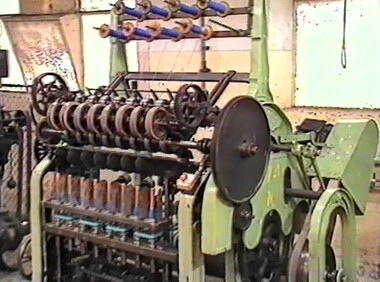
Film - Cap Spinning and Wool Scouring Machine, Sound Design Studios and Digital Arts, Melbourne, 1988
... ...wool processing...factory...mill...Probably used in previous displays at the National Wool Museum. Film wool processing factory mill cap spinning machine wool scouring machine J Dyson & Sons machinery industrial machines Label on tape: VIDEO VISION / VHS / GEELONG WOOL MUSEUM / SPINNING / SCOURING Black VHS tape with white sticker and printed text. ...Tape shows two short films showing the operation of a cap spinning machine and wool scouring machine. Probably used in previous displays at the National Wool Museum.Black VHS tape with white sticker and printed text. Tape is housed in a black plastic case with labels and stickers. Film includes colour footage and audio. 00:05 - cap spinning machine in operation, including close up detail shots 01:12 - end 01:21 - wool scouring machine in operation, including close up detail shots 02:45 - endLabel on tape: VIDEO VISION / VHS / GEELONG WOOL MUSEUM / SPINNING / SCOURINGfilm, wool processing, factory, mill, cap spinning machine, wool scouring machine, j dyson & sons, machinery, industrial machines -
 National Wool Museum
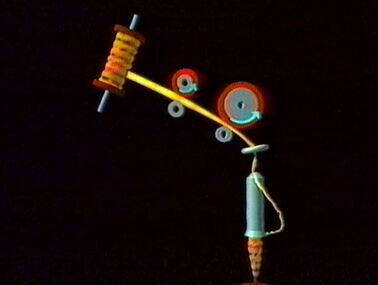
Film - Cap Spinning Machine, Les Gilbert, 1989
... ...wool processing...factory...mill...Probably used in previous displays at the National Wool Museum. Film wool processing factory mill cap spinning machine machinery industrial machines Label on tape: VIDEO VISION / VHS / SPINNING / COMPILE / SOUND / DESIGN / STUDIO / LES GILBERT/DIRECTOR / 9A GARDEN STREET PRAHRAN / VICTORIA 3181 AUSTRALIA / TELEPHONE (03) 529 3086 Black VHS tape with yellow and white stickers and hand written and printed text. ...Tape shows a short film depicting the operation of a cap spinning machine, interspersed with explanatory animated graphics. Probably used in previous displays at the National Wool Museum.Black VHS tape with yellow and white stickers and hand written and printed text. Tape is housed in a black plastic case. Film includes colour footage and audio. 00:04 - animated graphic of cap spinning machine 00:26 - cap spinning machine 06:04 - end Film loops until 01:03:57Label on tape: VIDEO VISION / VHS / SPINNING / COMPILE / SOUND / DESIGN / STUDIO / LES GILBERT/DIRECTOR / 9A GARDEN STREET PRAHRAN / VICTORIA 3181 AUSTRALIA / TELEPHONE (03) 529 3086film, wool processing, factory, mill, cap spinning machine, machinery, industrial machines -
 National Wool Museum
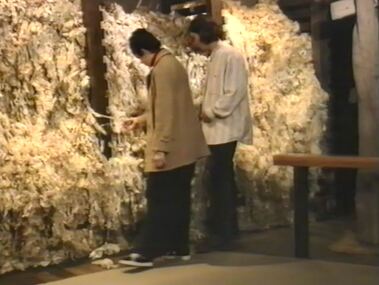
Film - Exhibitions, National Wool Museum, Northern Melbourne Institute of TAFE, 1997
... ...wool processing...factory...mill...Shows two people coming into the museum and exploring the exhibitions, filmed in 1997. Film wool processing factory mill exhibitions museum history national wool museum promotion golden fleece history geelong Black VHS tape with white stickers and hand written text. ...National Wool Museum promotional video. Shows two people coming into the museum and exploring the exhibitions, filmed in 1997.Black VHS tape with white stickers and hand written text. Tape is housed in a clear plastic case. Film includes colour footage and audio. 00:09 - titles "Golden Fleece" 00:14 - exterior view, National Wool Museum 00:20 - two people enter museum 00:25 - two people enter galleries and engage with exhibition displays 04:00 - end credits 00:49 - endfilm, wool processing, factory, mill, exhibitions, museum history, national wool museum, promotion, golden fleece, history, geelong -
 National Wool Museum
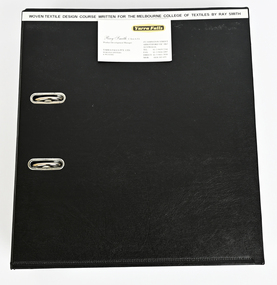
Document - Woven Textile Design Course for Melbourne College of Textiles, Ray Smith, 1996
... After ten years at Albion Woollen Mills, Ray went on to hold fabric design positions at Prestige Fabrics and Yarra Falls, working up to management roles in both the Weaving and Fabric Design Divisions, and then as Product Development Manager at Yarra Falls until 2000. Ray shares some career highlights below: In 1977 and 1978 I won the Wool...After ten years at Albion Woollen Mills, Ray went on to hold fabric design positions at Prestige Fabrics and Yarra Falls, working up to management roles in both the Weaving and Fabric Design Divisions, and then as Product Development Manager at Yarra Falls until 2000. Ray shares some career highlights below: In 1977 and 1978 I won the Wool ...Part of a collection of books, fabric samples and documents from the working life of Ray Smith. Ray began his career at the age of 15, working at the Albion Woollen Mills in Geelong in 1953. Over the next five decades, Ray furthered his education in textile design, weaving design, knitting and later computer aided design, including qualifications from Gordon Textile College, City and Guilds of London Institute, The Textile Institute, Melbourne Institute of Textiles and Royal Melbourne Institute of Technology (RMIT). After ten years at Albion Woollen Mills, Ray went on to hold fabric design positions at Prestige Fabrics and Yarra Falls, working up to management roles in both the Weaving and Fabric Design Divisions, and then as Product Development Manager at Yarra Falls until 2000. Ray shares some career highlights below: In 1977 and 1978 I won the Wool Corporation’s Celsius 30 Awards as Yarra Falls Designer. (See photos attached.) These awards came with study trips to the major Textile Centres and Trade Fairs around the world. This was proven to be beneficial and Yarra Falls sent me overseas every year for the next 22 years. On stopovers in Hong Kong we appointed an agent and took part in Textile Trade Fairs at Interstoff Asia and exhibited designs in 1991, 92, 93, 94. I created a pattern book for a chain of shops called “Kwun KeeTailors” for their customers to select our fabrics to be made up into suits for the tourists. I also had several trips to New York to try to export to America with some success. I was commissioned by the Melbourne College of Textiles to write a Woven Textile Design Course to be taught under the outreach program. This was eventually translated into Spanish to be used by developing textile industries in South America.Black two armed binder folder with over one hundred pages of typed paper in plastic sleeves. Documents contain details of sixty eight topics for Woven Textile Design Course. The folder has a label attached across the top edge, and a business card attached with tape to the front.Front [printed label]: WOVEN TEXTILE DESIGN COURSE WRITTEN FOR THE MELBOURNE COLLEGE OF TEXTILES BY RAY SMITHray smith, yarra falls, mills, textile design, fabric design, product development, wool corporation, textile design course, coursework, melbourne college of textiles, study, students -
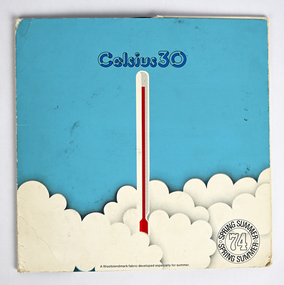 National Wool Museum
Booklet - Celsius 30, Spring Summer Fabric Samples, Australian Wool Corporation, 1974
... After ten years at Albion Woollen Mills, Ray went on to hold fabric design positions at Prestige Fabrics and Yarra Falls, working up to management roles in both the Weaving and Fabric Design Divisions, and then as Product Development Manager at Yarra Falls until 2000. Ray shares some career highlights below: In 1977 and 1978 I won the Wool...Ray Smith Yarra Falls Mills Textile Design Fabric Design Product Development Wool Corporation Fabric Samples 1970s Fashion Front [printed]: Celsius 30 / SPRING SUMMER / 74 / SPRING SUMMER / A Woolblendmark fabric developed especially for summer. ...Part of a collection of books, fabric samples and documents from the working life of Ray Smith. Ray began his career at the age of 15, working at the Albion Woollen Mills in Geelong in 1953. Over the next five decades, Ray furthered his education in textile design, weaving design, knitting and later computer aided design, including qualifications from Gordon Textile College, City and Guilds of London Institute, The Textile Institute, Melbourne Institute of Textiles and Royal Melbourne Institute of Technology (RMIT). After ten years at Albion Woollen Mills, Ray went on to hold fabric design positions at Prestige Fabrics and Yarra Falls, working up to management roles in both the Weaving and Fabric Design Divisions, and then as Product Development Manager at Yarra Falls until 2000. Ray shares some career highlights below: In 1977 and 1978 I won the Wool Corporation’s Celsius 30 Awards as Yarra Falls Designer. (See photos attached.) These awards came with study trips to the major Textile Centres and Trade Fairs around the world. This was proven to be beneficial and Yarra Falls sent me overseas every year for the next 22 years. On stopovers in Hong Kong we appointed an agent and took part in Textile Trade Fairs at Interstoff Asia and exhibited designs in 1991, 92, 93, 94. I created a pattern book for a chain of shops called “Kwun KeeTailors” for their customers to select our fabrics to be made up into suits for the tourists. I also had several trips to New York to try to export to America with some success. I was commissioned by the Melbourne College of Textiles to write a Woven Textile Design Course to be taught under the outreach program. This was eventually translated into Spanish to be used by developing textile industries in South America.Card folder featuring pale blue and white clouds and sky motifs, with a thermometer on the cover. Folder holds eleven circular black cards, eight have wool fabric samples attached.Front [printed]: Celsius 30 / SPRING SUMMER / 74 / SPRING SUMMER / A Woolblendmark fabric developed especially for summer.ray smith, yarra falls, mills, textile design, fabric design, product development, wool corporation, fabric samples, 1970s fashion -
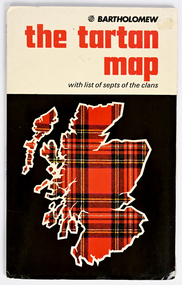 National Wool Museum
Map - The Tartan Map, John Bartholomew & Son Ltd, 1970s
... After ten years at Albion Woollen Mills, Ray went on to hold fabric design positions at Prestige Fabrics and Yarra Falls, working up to management roles in both the Weaving and Fabric Design Divisions, and then as Product Development Manager at Yarra Falls until 2000. Ray shares some career highlights below: In 1977 and 1978 I won the Wool...Ray Smith Yarra Falls Mills Textile Design Fabric Design Product Development Wool Corporation Map Tartan Scotland Front [printed]: BARTHOLOMEW / the tartan map / with list of septs of the clans Folded map attached inside a card folder, featuring a map of Scotland with tartan design and red and black text on the cover. ...Part of a collection of books, fabric samples and documents from the working life of Ray Smith. Ray began his career at the age of 15, working at the Albion Woollen Mills in Geelong in 1953. Over the next five decades, Ray furthered his education in textile design, weaving design, knitting and later computer aided design, including qualifications from Gordon Textile College, City and Guilds of London Institute, The Textile Institute, Melbourne Institute of Textiles and Royal Melbourne Institute of Technology (RMIT). After ten years at Albion Woollen Mills, Ray went on to hold fabric design positions at Prestige Fabrics and Yarra Falls, working up to management roles in both the Weaving and Fabric Design Divisions, and then as Product Development Manager at Yarra Falls until 2000. Ray shares some career highlights below: In 1977 and 1978 I won the Wool Corporation’s Celsius 30 Awards as Yarra Falls Designer. (See photos attached.) These awards came with study trips to the major Textile Centres and Trade Fairs around the world. This was proven to be beneficial and Yarra Falls sent me overseas every year for the next 22 years. On stopovers in Hong Kong we appointed an agent and took part in Textile Trade Fairs at Interstoff Asia and exhibited designs in 1991, 92, 93, 94. I created a pattern book for a chain of shops called “Kwun KeeTailors” for their customers to select our fabrics to be made up into suits for the tourists. I also had several trips to New York to try to export to America with some success. I was commissioned by the Melbourne College of Textiles to write a Woven Textile Design Course to be taught under the outreach program. This was eventually translated into Spanish to be used by developing textile industries in South America.Folded map attached inside a card folder, featuring a map of Scotland with tartan design and red and black text on the cover.Front [printed]: BARTHOLOMEW / the tartan map / with list of septs of the clansray smith, yarra falls, mills, textile design, fabric design, product development, wool corporation, map, tartan, scotland -
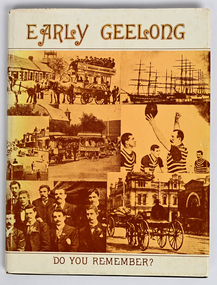 National Wool Museum
Book - Early Geelong, Do You Remember?, Solomons Pty Ltd, 1940s
... After ten years at Albion Woollen Mills, Ray went on to hold fabric design positions at Prestige Fabrics and Yarra Falls, working up to management roles in both the Weaving and Fabric Design Divisions, and then as Product Development Manager at Yarra Falls until 2000. Ray shares some career highlights below: In 1977 and 1978 I won the Wool...After ten years at Albion Woollen Mills, Ray went on to hold fabric design positions at Prestige Fabrics and Yarra Falls, working up to management roles in both the Weaving and Fabric Design Divisions, and then as Product Development Manager at Yarra Falls until 2000. Ray shares some career highlights below: In 1977 and 1978 I won the Wool ...Part of a collection of books, fabric samples and documents from the working life of Ray Smith. Ray began his career at the age of 15, working at the Albion Woollen Mills in Geelong in 1953. Over the next five decades, Ray furthered his education in textile design, weaving design, knitting and later computer aided design, including qualifications from Gordon Textile College, City and Guilds of London Institute, The Textile Institute, Melbourne Institute of Textiles and Royal Melbourne Institute of Technology (RMIT). After ten years at Albion Woollen Mills, Ray went on to hold fabric design positions at Prestige Fabrics and Yarra Falls, working up to management roles in both the Weaving and Fabric Design Divisions, and then as Product Development Manager at Yarra Falls until 2000. Ray shares some career highlights below: In 1977 and 1978 I won the Wool Corporation’s Celsius 30 Awards as Yarra Falls Designer. (See photos attached.) These awards came with study trips to the major Textile Centres and Trade Fairs around the world. This was proven to be beneficial and Yarra Falls sent me overseas every year for the next 22 years. On stopovers in Hong Kong we appointed an agent and took part in Textile Trade Fairs at Interstoff Asia and exhibited designs in 1991, 92, 93, 94. I created a pattern book for a chain of shops called “Kwun KeeTailors” for their customers to select our fabrics to be made up into suits for the tourists. I also had several trips to New York to try to export to America with some success. I was commissioned by the Melbourne College of Textiles to write a Woven Textile Design Course to be taught under the outreach program. This was eventually translated into Spanish to be used by developing textile industries in South America.Fifty two page hard cover book featuring yellow and brown images and text on the front and back cover showing scenes from Geelong. The book features sepia toned printed photographs and brown text.Front [printed]: EARLY GEELONG / DO YOU REMEMBER?ray smith, yarra falls, mills, textile design, fabric design, geelong, geelong advertiser -
 National Wool Museum
Textile - Fabric Samples, Yarra Falls Ltd, 1970s
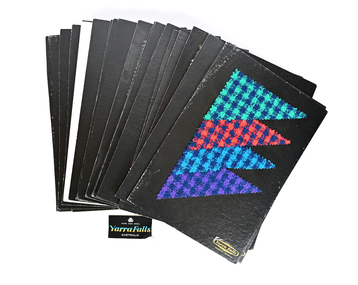
... After ten years at Albion Woollen Mills, Ray went on to hold fabric design positions at Prestige Fabrics and Yarra Falls, working up to management roles in both the Weaving and Fabric Design Divisions, and then as Product Development Manager at Yarra Falls until 2000. Ray shares some career highlights below: In 1977 and 1978 I won the Wool...After ten years at Albion Woollen Mills, Ray went on to hold fabric design positions at Prestige Fabrics and Yarra Falls, working up to management roles in both the Weaving and Fabric Design Divisions, and then as Product Development Manager at Yarra Falls until 2000. Ray shares some career highlights below: In 1977 and 1978 I won the Wool ...Part of a collection of books, fabric samples and documents from the working life of Ray Smith. Ray began his career at the age of 15, working at the Albion Woollen Mills in Geelong in 1953. Over the next five decades, Ray furthered his education in textile design, weaving design, knitting and later computer aided design, including qualifications from Gordon Textile College, City and Guilds of London Institute, The Textile Institute, Melbourne Institute of Textiles and Royal Melbourne Institute of Technology (RMIT). After ten years at Albion Woollen Mills, Ray went on to hold fabric design positions at Prestige Fabrics and Yarra Falls, working up to management roles in both the Weaving and Fabric Design Divisions, and then as Product Development Manager at Yarra Falls until 2000. Ray shares some career highlights below: In 1977 and 1978 I won the Wool Corporation’s Celsius 30 Awards as Yarra Falls Designer. (See photos attached.) These awards came with study trips to the major Textile Centres and Trade Fairs around the world. This was proven to be beneficial and Yarra Falls sent me overseas every year for the next 22 years. On stopovers in Hong Kong we appointed an agent and took part in Textile Trade Fairs at Interstoff Asia and exhibited designs in 1991, 92, 93, 94. I created a pattern book for a chain of shops called “Kwun KeeTailors” for their customers to select our fabrics to be made up into suits for the tourists. I also had several trips to New York to try to export to America with some success. I was commissioned by the Melbourne College of Textiles to write a Woven Textile Design Course to be taught under the outreach program. This was eventually translated into Spanish to be used by developing textile industries in South America.A collection of fabric samples from Yarra Falls, including twenty three sets of woollen fabric samples on black backing card, three sets of woollen fabric samples on white backing card and one Yarra Falls fabric label.PURE NEW WOOL / Yarra Falls / MELBOURNE AUSTRALIAray smith, yarra falls, mills, textile design, fabric design, geelong, geelong advertiser, fabric samples -
 National Wool Museum
Archive - Report: Wool Textile Mission to North America, Commonwealth of Australia, Department of Trade, 1962
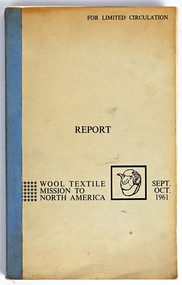
... Mill Pty Ltd...Godfrey Hirst & Co. Pty. Ltd....Wool...wool textiles products in North America. A letter in the front of the report details an invitation to Mr A. M. Collins, Collins Bros, Geelong, to attend a meeting in 1962, as a panellist to discuss the problems of exporting blankets and rugs to North America, following recommendation from the outcomes of the mission. Australian Commonwealth Government Department of Trade Report Textiles North America United States of America Canada Export Blankets Rugs Collins Bros Mill ...Report published by the Commonwealth of Australia in February 1962 detailing the findings and recommendations following the Wool Textile Mission to North America the previous year whose itinerary covered six weeks, including twelve days in Canada and the remaining time in cities in the United States of America. Cedric Hirst, who was then the Managing Director of Godfrey Hirst Pty Ltd Geelong, was among the members of the mission. The mission sought to understand the market prospects for Australian made wool textiles products in North America. A letter in the front of the report details an invitation to Mr A. M. Collins, Collins Bros, Geelong, to attend a meeting in 1962, as a panellist to discuss the problems of exporting blankets and rugs to North America, following recommendation from the outcomes of the mission.One hundred and twenty five page report with appendixes featuring printed black text on cream paper. Book is bound with blue cloth and has printed black text and graphics on the cover. A typed letter addressed to Mr A. M. Collins with a Commonwealth of Australia Department of Trade letterhead is sitting inside the front cover.FOR LIMITED CIRCULATION / REPORT / WOOL TEXTILE / MISSION TO / NORTH AMERICA . SEPT. / OCT. / 1961australian commonwealth government, department of trade, report, textiles, north america, united states of america, canada, export, blankets, rugs, collins bros mill pty ltd, godfrey hirst & co. pty. ltd., wool textile mission -
 National Wool Museum
Clothing - Paisley Shawl, 1800 - 1830
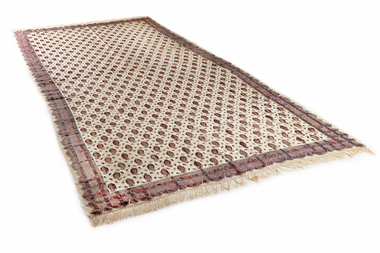
... Jane’s youngest son William (1848-1932) was a spinning master, timekeeper and pay clerk at the Victorian Woollen Mill (later the Godfrey Hirst Excelsior Number Two mill) and together with William Cook owned a wool scour on the Barwon River at Marnockvale. ...Jane’s youngest son William (1848-1932) was a spinning master, timekeeper and pay clerk at the Victorian Woollen Mill (later the Godfrey Hirst Excelsior Number Two mill) and together with William Cook owned a wool scour on the Barwon River at Marnockvale. ...Shawl of Jane Francis (nee Piper) 1809-1891 This fine woven silk and woollen shawl is from Shetland, Scotland and belonged orginally to Jane Francis. Jane was born in Devon near the village of Bradworthy. She married Joseph Francis (1803-1878) in 1830 in the Bradworthy Parish, Devon, England and wore the shawl over her wedding dress on her wedding day. Jane and Joseph came to Geelong in 1853 with their family. Jane’s sister and brother were in Geelong and their eldest daughter Elizabeth had arrived in 1849. They arrived on the ship 'Euphemus' at Point Henry, Geelong, on July 20, 1853 and travelled across the bay in the steamer Duncan Hoyle. Jane was wearing the shawl on her arrival in Geelong. They went to live in Sharp Street Chilwell in a house owned by their son in law, John Price, which they later purchased. Jane became well known as a ‘midwife’ having had 10 children of her own. She is known to have delivered twin girls in Fyans Street; Ada and Myrtle Downie in 1884. Jane’s youngest son William (1848-1932) was a spinning master, timekeeper and pay clerk at the Victorian Woollen Mill (later the Godfrey Hirst Excelsior Number Two mill) and together with William Cook owned a wool scour on the Barwon River at Marnockvale. William’s grandson Arthur (1917-1992) was a wool classer undertaking his course at the Gordon Institute and became a wool valuer at Strachan & Co. For a time he taught part time in the Gordon course. Arthur’s son Robert was also a wool classer and worked at the Australian Wool Testing Authority. The shawl was used as a bed spread at 'Woodstock' by Jane's son William and then by his two children Laura and Eve. After their deaths, Eve in 1947 and Laura in 1963, the shawl was passed to their youngest sister Ethel (Effie) Frier (nee Francis). She had no children and it was passed on to grandniece Pat Norman (nee Hughan). Pat then passed the shawl to cousin Carollyn Williams (nee Francis) who donated the shawl to the National Wool Museum. - Donor, 2026 The Francis family were tenant farmers, and the donor speculated that the shawl could potentially have been a wedding gift from the land owners.Wool and silk fringed cream coloured shawl featuring a paisley pattern in tones of maroon, green, blue, brown and cream.shawl, 19th century, fashion, clothing, design, paisley, migration, geelong, point henry -
 National Wool Museum
Tool - Glasses, c.1950
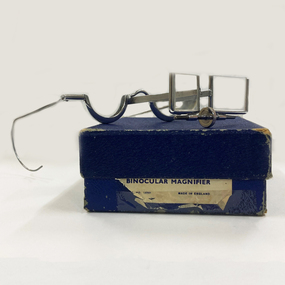
... mills between 1957 & 2003. He travelled the world in search of the latest fashions and techniques and developed timeless designs that were much loved by Australians. These items are on rotational display at the National Wool...mills between 1957 & 2003. He travelled the world in search of the latest fashions and techniques and developed timeless designs that were much loved by Australians. These items are on rotational display at the National Wool ...Nino Corda was a Geelong based textile designer who worked at various textile mills between 1957 & 2003. He travelled the world in search of the latest fashions and techniques and developed timeless designs that were much loved by Australians. These items are on rotational display at the National Wool Museum’s ‘In the Factory’ exhibition. For many years, Nino also worked as part of the Honorary Staff of the National Wool Museum. His passion for the world of textiles provided energy and knowledge to the visitors and staff of the museum. Although Nino has now retired from his honorary position and has hung up his Australian Tartan vest, these items will continue to serve the community in sharing the stories of Australian Textile design. Textile designers used glasses such as these to see how many threads are within a textile sample. It was important to count correctly, otherwise the enlarged final pattern would be out of alignment. These glasses were popular in the 1950s but were replaced by viewing lens, such as item 8040 (in the National Wool Museum's Collection) in the 1960s because of their compact nature.Thin metal wire makes up the frame of the glasses. The metal is a standard metallic silver. The piece to sit on-top of the ear is excessively curved to hook around the ear. This is done to ensure the glasses do not fall off the face while looking down to view thread counts in a textile sample. The glasses are lacking lenses in their usual place. This has been replaced by another thin wire frame which protrudes an extra inch in front of the frame, almost like an additional layer of the glasses. Where this layer / frame ends, two lenses can be found which are square and much smaller than typical glasses lenses. This has been done to allow for powerful magnifying glass which would be ill-suited if it sat too close to the face / eyes. The glasses are also accompanied by their original box. The box is blue and has a large rectangle running through its centre. This rectangle works as a cushion for the glasses and is required as a result of their unusual shape.textile design, textile calculations -
 National Wool Museum
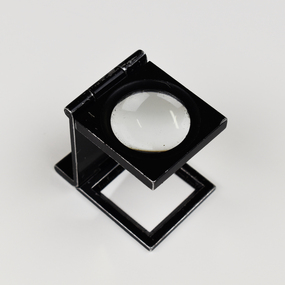
Tool - Lens, c.1960
... mills between 1957 & 2003. He travelled the world in search of the latest fashions and techniques and developed timeless designs that were much loved by Australians. These items are on rotational display at the National Wool...mills between 1957 & 2003. He travelled the world in search of the latest fashions and techniques and developed timeless designs that were much loved by Australians. These items are on rotational display at the National Wool ...Nino Corda was a Geelong based textile designer who worked at various textile mills between 1957 & 2003. He travelled the world in search of the latest fashions and techniques and developed timeless designs that were much loved by Australians. These items are on rotational display at the National Wool Museum’s ‘In the Factory’ exhibition. For many years, Nino also worked as part of the Honorary Staff of the National Wool Museum. His passion for the world of textiles provided energy and knowledge to the visitors and staff of the museum. Although Nino has now retired from his honorary position and has hung up his Australian Tartan vest, these items will continue to serve the community in sharing the stories of Australian Textile design. Textile designers used viewing lenses such as this to see how many threads are within a textile sample. It was important to count correctly, otherwise the enlarged final pattern would be out of alignment. Before compact lenses such as this, specialised glasses were used such as 8039.The viewing lens has a 3 fold design in order to fold up to be compact and easily transportable in a pocket while also working to provide its own stand when unfolded. The lens is black and contains one circular piece of magnifying glass on the top panel.Top panel. Words, scratched. NINOtextile calculations, textile design -
 National Wool Museum
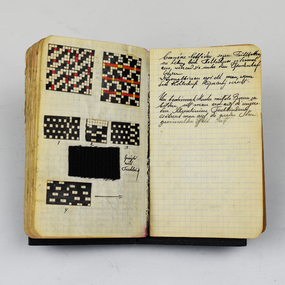
Book - Notebook, c.1920
... mills between 1957 & 2003. He travelled the world in search of the latest fashions and techniques and developed timeless designs that were much loved by Australians. These items are on rotational display at the National Wool...mills between 1957 & 2003. He travelled the world in search of the latest fashions and techniques and developed timeless designs that were much loved by Australians. These items are on rotational display at the National Wool ...Nino Corda was a Geelong based textile designer who worked at various textile mills between 1957 & 2003. He travelled the world in search of the latest fashions and techniques and developed timeless designs that were much loved by Australians. These items are on rotational display at the National Wool Museum’s ‘In the Factory’ exhibition. For many years, Nino also worked as part of the Honorary Staff of the National Wool Museum. His passion for the world of textiles provided energy and knowledge to the visitors and staff of the museum. Although Nino has now retired from his honorary position and has hung up his Australian Tartan vest, these items will continue to serve the community in sharing the stories of Australian Textile design. This notebook contains information on how to calculate and enlarge a small sample pattern into a larger textile. It is a hand-written notebook that was passed from a master to an apprentice. This notebook is written in German and belonged to George Snchabel and was given to Nino Corda, who eventually donated it to the National Wool Museum. Nino only spoke basic German so many of the passages of writing were lost to him, regardless the illustrations and little bits of German he did know made this a useful resource which was often looked upon for inspiration and guidance.The notebook has a black cover on both the front and back with no writing. The spine is in bad condition and is being held together by three strips of tape. Internally, the pages have faded to a pale peach colour with a background blue square pattern. The notebook is completed with black ink used for writing and illustration. Occasional red ink is used for highlighting and illustration.textile calculations, textile design -
 National Wool Museum
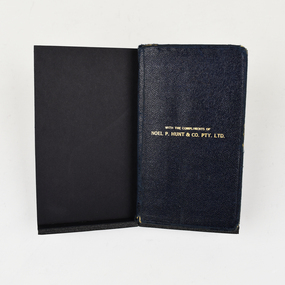
Book - Notebook, Collins Textile Diary - 1958, 1958
... mills between 1957 & 2003. He travelled the world in search of the latest fashions and techniques and developed timeless designs that were much loved by Australians. These items are on rotational display at the National Wool...mills between 1957 & 2003. He travelled the world in search of the latest fashions and techniques and developed timeless designs that were much loved by Australians. These items are on rotational display at the National Wool ...Nino Corda was a Geelong based textile designer who worked at various textile mills between 1957 & 2003. He travelled the world in search of the latest fashions and techniques and developed timeless designs that were much loved by Australians. These items are on rotational display at the National Wool Museum’s ‘In the Factory’ exhibition. For many years, Nino also worked as part of the Honorary Staff of the National Wool Museum. His passion for the world of textiles provided energy and knowledge to the visitors and staff of the museum. Although Nino has now retired from his honorary position and has hung up his Australian Tartan vest, these items will continue to serve the community in sharing the stories of Australian Textile design. This notebook contains information on how to calculate and enlarge a small sample pattern into a larger textile. The equations would provide answers to the required length of thread (often measured in weight as opposed to distance) of a selected textile. The sample and appropriate thread would be needed for mass production at a commercial mill.Blue textured vinyl forms the covers of this notebook. On the front of the inscription is visible in gold text. Internally, small font black writing on yellowing pages forms most of this notebook. Pp.128 published pages with calendar and spare pages for notes forming the second half of this notebook. Front Cover. Words, printed. WITH THE COMPLIMENTS OF / NOEL P. HUNT & CO. PTY. LTD.textile design, textile calculations -
 National Wool Museum
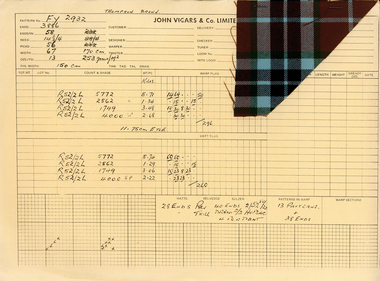
Document - Mastercard, 1970-1975
... mills between 1957 & 2003. He travelled the world in search of the latest fashions and techniques and developed timeless designs that were much loved by Australians. These items are on rotational display at the National Wool...mills between 1957 & 2003. He travelled the world in search of the latest fashions and techniques and developed timeless designs that were much loved by Australians. These items are on rotational display at the National Wool ...Nino Corda was a Geelong based textile designer who worked at various textile mills between 1957 & 2003. He travelled the world in search of the latest fashions and techniques and developed timeless designs that were much loved by Australians. These items are on rotational display at the National Wool Museum’s ‘In the Factory’ exhibition. For many years, Nino also worked as part of the Honorary Staff of the National Wool Museum. His passion for the world of textiles provided energy and knowledge to the visitors and staff of the museum. Although Nino has now retired from his honorary position and has hung up his Australian Tartan vest, these items will continue to serve the community in sharing the stories of Australian Textile design. Once a pattern has been selected for mass production, a master card is produced. A mastercard shows exactly how to replicate the designs and colours depicted on the sample attached. “Ends” is the technical word to describe a vertical band and “picks” describes a horizontal band.Brown card with fabric sample stapled to the top right. Writing is present on the left and bottom of the card detailing the information applicable to the design of attached fabric. 14 individual Masetercards in collectiontextile calculations, textile design -
 National Wool Museum
Textile - Fabric Bolt, c.1970
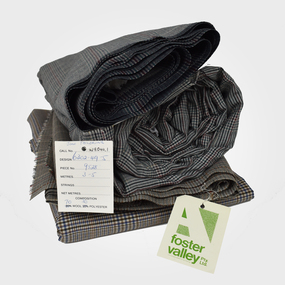
... mills between 1957 & 2003. He travelled the world in search of the latest fashions and techniques and developed timeless designs that were much loved by Australians. These items are on rotational display at the National Wool...mills between 1957 & 2003. He travelled the world in search of the latest fashions and techniques and developed timeless designs that were much loved by Australians. These items are on rotational display at the National Wool ...Nino Corda was a Geelong based textile designer who worked at various textile mills between 1957 & 2003. He travelled the world in search of the latest fashions and techniques and developed timeless designs that were much loved by Australians. These items are on rotational display at the National Wool Museum’s ‘In the Factory’ exhibition. For many years, Nino also worked as part of the Honorary Staff of the National Wool Museum. His passion for the world of textiles provided energy and knowledge to the visitors and staff of the museum. Although Nino has now retired from his honorary position and has hung up his Australian Tartan vest, these items will continue to serve the community in sharing the stories of Australian Textile design. These three bolts of fabric come from the same run of fabric used to tailor Suit Jacket 8045. All fabrics were designed by Nino Corda while he was working at the Foster Valley Mill. The bolts of fabric have an attached swing tag. This swing tag details information such as composition of the fabric, total amount of fabric and the design number.Three bolts of fabric with repeating pattern in 100mm grid. All three bolts have frayed edges, indicative of their need to be sent for finishing. The dominant colour in all three fabrics is grey. 8044.1 has red and green lines running vertically and horizontally and an attached swing tag. 8044.2 has red and orange lines running vertically and horizontally and an attached swing tag. Fabric bolt has yellow label attached to one edge of fabric, depicting the fabric’s number. 8044.3 has orange and blue lines running vertically and horizontally. No swing tag is attached.8044.1. Swing tag. Typed wording. Front. foster / valley / Pty / Ltd. / (Incorporated in Victoria) 8044.1. Swing tag. Typed and handwritten wording. Reverse. JONO TAILORING / CALL NO……………. / DESIGN 6302-49-5 / PIECE NO 9528 / METERS 3.5 STRINGS…………… / NET METERS…………… / COMPOSITION / 70% WOOL 30% POLYESTER 8044.2. Swing tag. Typed wording. Front. foster / valley / Pty / Ltd. / (Incorporated in Victoria) 8044.2. Swing tag. Typed and handwritten wording. Reverse. left over (?unknown handwriting?) / CALL NO…………… / DESIGN 6302-49-2 / PIECE NO…………… / METERS 6.0 STRINGS…………… / NET METERS…………… / COMPOSITION / 70% WOOL 30% POLYESTER.textile design -
 National Wool Museum
Clothing - Suit Jacket, c.1970
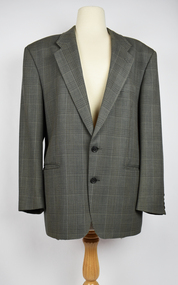
... mills between 1957 & 2003. He travelled the world in search of the latest fashions and techniques and developed timeless designs that were much loved by Australians. These items are on rotational display at the National Wool...mills between 1957 & 2003. He travelled the world in search of the latest fashions and techniques and developed timeless designs that were much loved by Australians. These items are on rotational display at the National Wool ...Nino Corda was a Geelong based textile designer who worked at various textile mills between 1957 & 2003. He travelled the world in search of the latest fashions and techniques and developed timeless designs that were much loved by Australians. These items are on rotational display at the National Wool Museum’s ‘In the Factory’ exhibition. For many years, Nino also worked as part of the Honorary Staff of the National Wool Museum. His passion for the world of textiles provided energy and knowledge to the visitors and staff of the museum. Although Nino has now retired from his honorary position and has hung up his Australian Tartan vest, these items will continue to serve the community in sharing the stories of Australian Textile design. This Suit Jacket was tailored from fabric designed by Nino while he was working at the Foster Valley Mill. Nino developed a Mastercard such as w8043, which was sent to a mill in order to produce bolts of the desired fabrics w8044. These fabrics were then given to tailors where the final product was produced, such as this Suit Jacket.Single breasted suit jack with two buttons and notched lapel. Jacket is predominantly grey with black buttons and a silver silk interior lining. Four darker grey vertical and horizontal lines make up the design of the fabric on the exterior of the suit jacket. suit jacket, weaved, tailored -
 National Wool Museum
Textile - McGregors Yarn, J.L. McGregor Pty Ltd, c.1988
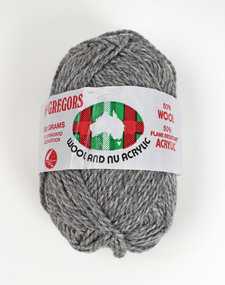
... wool...geelong...geelong woollen mills...The McGregor family still live in the Geelong area. wool j.l. mcgregor pty ltd yarn geelong wool geelong geelong woollen mills On Label: McGregors 50 Grams at standard condition 50% Wool 50% Flame resistant Acrylic Below Logo: Wool and Nu Acrylic A ball of grey yarn, 50% wool and 50% acrylic with a plastic label surrounding the wool with the product details. ...The yarn was made in Geelong in the late 1980's or early 1990's by local woolen manufacturer J.L. McGregor Pty Ltd. The company closed in the early 1990s. The McGregor family still live in the Geelong area.A ball of grey yarn, 50% wool and 50% acrylic with a plastic label surrounding the wool with the product details.On Label: McGregors 50 Grams at standard condition 50% Wool 50% Flame resistant Acrylic Below Logo: Wool and Nu Acrylicwool, j.l. mcgregor pty ltd, yarn, geelong wool, geelong, geelong woollen mills -
 National Wool Museum
Photograph, Yarn Spinning Machine, Unknown
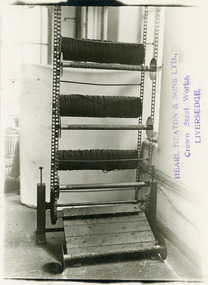
... The company played an important part in Britain’s Industrial Revolution, providing bobbins to the textile mills across the North of England. textile machinery wool manufacture wool spinning 8053.1 - Front right edge - Hearl Heaton & Sons Ltd Crown Steel Works, Liversedge. 8053.2 - Rear middle - No.1 Hearl Heaton & Sons Ltd Crown Steel Works, Liversedge. 8053.3 - Front top edge - Hearl Heaton & Sons Ltd Crown Steel Works, Liversedge. 8053.4 - No. 2 Hearl Heaton & Sons Ltd Crown Steel Works, Liversedge. ...Photographs most likely used for promotional purposes. The photographs are of a yarn spinning machine used to place yarn onto bobbins. The machine was made by Hearl Heaton and Sons Ltd, founded in 1809. The company played an important part in Britain’s Industrial Revolution, providing bobbins to the textile mills across the North of England.Four black and white photographs of a yarn spinning machine. The first two photos show the machine in the lower floor of the building and the last two are on the upper floor. The are connected by the two chains working the machine.8053.1 - Front right edge - Hearl Heaton & Sons Ltd Crown Steel Works, Liversedge. 8053.2 - Rear middle - No.1 Hearl Heaton & Sons Ltd Crown Steel Works, Liversedge. 8053.3 - Front top edge - Hearl Heaton & Sons Ltd Crown Steel Works, Liversedge. 8053.4 - No. 2 Hearl Heaton & Sons Ltd Crown Steel Works, Liversedge.textile machinery, wool manufacture, wool, spinning -
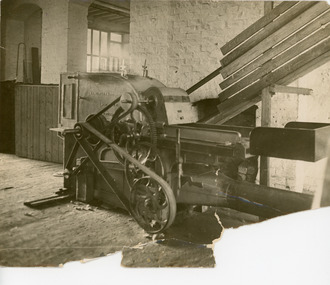 National Wool Museum
Photograph, Carding Machine, Unknown
... wool Timlinsons Rag pulling On machine - Tomlinsons (Roshdale) Limited. Black and white photo of a Rag Puller Machine in landscape format. Location of photo looks to be in a textile mill ...Photographs were most likely used for promotional purposes. The photographed machine was made by Tomlinsons (Roshdale) Limited, was British machine manufacture company based in Rochdale.Black and white photo of a Rag Puller Machine in landscape format. Location of photo looks to be in a textile mill.On machine - Tomlinsons (Roshdale) Limited.textile machinery, wool manufacture, wool, timlinsons, rag pulling
