
Showing 893 items matching "mr brown"
-
 Bendigo Historical Society Inc.
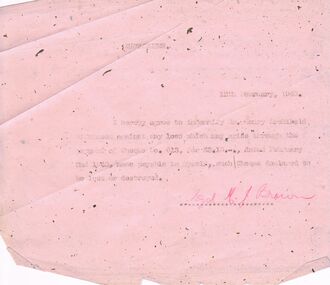
Document - H.A.& S.R. WILKINSON COLLECTION: RECEIPT
... Mr. Henry Archibald Wilkinson against any loss which may arise through the payment of cheque No. 613 for 23 pounds 16 shillings dated February 2nd 1948, made payable to myself, such cheque declared to be lost or destroyed. Signed by someone called Brown...Mr. Henry Archibald Wilkinson against any loss which may arise through the payment of cheque No. 613 for 23 pounds 16 shillings dated February 2nd 1948, made payable to myself, such cheque declared to be lost or destroyed. Signed by someone called Brown ...BHS CollectionA copy of receipt dated 12th February 1948. The receipt reads: I hereby agree to indemnify Mr. Henry Archibald Wilkinson against any loss which may arise through the payment of cheque No. 613 for 23 pounds 16 shillings dated February 2nd 1948, made payable to myself, such cheque declared to be lost or destroyed. Signed by someone called Brown. The receipt is in a manilla folder.organization, business, h.a. & s.r wilkinson real estate, yellow label 594. -
 Bendigo Historical Society Inc.
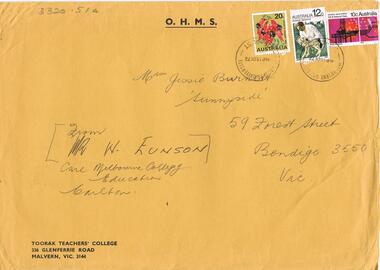
Photograph - LA TROBE UNIVERSITY BENDIGO COLLECTION: TEACHING AIDS
... A brown envelope containing two photographs- (1) Some students using tape recorders with Mr. ...Mr. Gill Physical Education Bendigo education photos photography Bendigo Teachers' College teacher training tertiary education Bendigo Teachers' College students Bendigo Teachers' College staff A brown envelope containing two photographs- (1) Some students using tape recorders with Mr. ...BHS CollectionA brown envelope containing two photographs- (1) Some students using tape recorders with Mr. Gill supervising. (2) A student using a bicycle ergometer with Mr. R. Collis supervising.bendigo, education, bendigo teachers' college history, la trobe university bendigo collection, collection, students, teaching, teaching aids, mr. r. collis, mr. gill, physical education, bendigo, education, photos, photography, bendigo teachers' college, teacher training, tertiary education, bendigo teachers' college students, bendigo teachers' college staff -
 Bendigo Historical Society Inc.
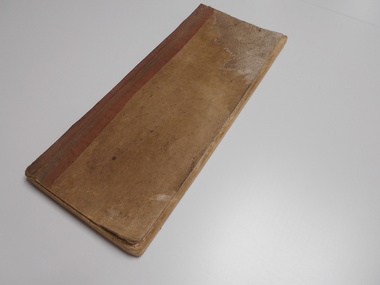
Book - BENDIGO HOTEL COLLECTION: CITY FAMILY HOTEL REGISTER, 1947 - 1948
... Mr J C Hadley. BENDIGO Hotel city family hotel City Family Hotel Register 30.10.1947 - January 1948 Brown hard cocer with tapebinding on spine; 100 pages Book BENDIGO HOTEL COLLECTION: CITY FAMILY HOTEL REGISTER ...The City Family Hotel was built by Mr J B Loridan in 1872. It was designed by architects, Vahland and Getszshmann. It features a 22 room hotel over 3 stories including a large circular stairway, and four retail shops. The first licensee was Mr J C Hadley.City Family Hotel Register 30.10.1947 - January 1948 Brown hard cocer with tapebinding on spine; 100 pagesbendigo, hotel, city family hotel -
 Bendigo Historical Society Inc.
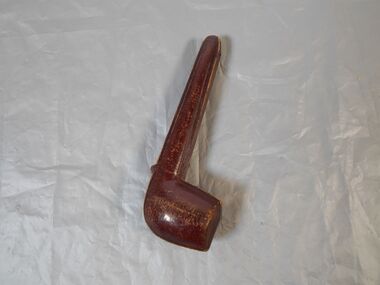
Accessory - Pipe and Pipe cover
... By 1904 Mr E R McMartin was the manager and licensee of the Shamrock Hotel including the Shamrock Tobacconist that had previously been owned and run by Mr Karl Van Damme. Tools smokers acoutrement Dark brown pipe cover in shape of pipe, leather exterior and textured cream fabric interior, with hinge at smoke exit end of pipe and small metal latch at bottom of pipe tube. ...By 1904 Mr E R McMartin was the manager and licensee of the Shamrock Hotel including the Shamrock Tobacconist that had previously been owned and run by Mr Karl Van Damme.Dark brown pipe cover in shape of pipe, leather exterior and textured cream fabric interior, with hinge at smoke exit end of pipe and small metal latch at bottom of pipe tube. Red sticker on inside of cover reads "Shamrock tobacco Store E.R. McMartir Bendigo" in black ink Pipe made of plastic mouthpiece joined halfway along tube to wooden tube and smoke outlet by a fancy metal (Hallmarked as silver in Chester, England 1912)surround. Ash contained in smoke outlet/exit. Top of smoke outlet has an approximately 1.5cm crack.tools, smokers acoutrement -
 Bendigo Historical Society Inc.
Document - Arthur T. Pattinson, 1962
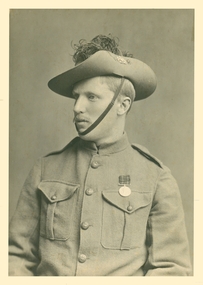
... Mr Arthur T. Pattinson who was a model for the Boer War sculpture. 10570a A black and white photo of Trooper Arthur T. Pattinson restored by BHS Volunteers. 10570b The original photo as sent by Mrs Wilson to Harold Curnow (Bendigo Historical Society) in 1962. The photo is mounted on heavy brown...Mr Arthur T. Pattinson who was a model for the Boer War sculpture. 10570a A black and white photo of Trooper Arthur T. Pattinson restored by BHS Volunteers. 10570b The original photo as sent by Mrs Wilson to Harold Curnow (Bendigo Historical Society) in 1962. The photo is mounted on heavy brown ...10570 South African (Boer) War Memorial Bendigo. The monument commemorates those who died in service or were killed in action while serving in the South African (Boer) War. It is a bronze statue of a soldier on a granite base. Leader (Melbourne), 19 November 1904. “There was a large assemblage on the afternoon of 11th November, when the ceremony of unveiling the soldiers' memorial statue was performed by Brigadier-General Gordon in the presence of a muster of branches of the defence forces. The statue, which is in bronze, is mounted on a massive granite base, on the foot of which is the following inscription: — "Bendigo's tribute to the memory of the Australian soldiers who, in the South African war of 1899 - 1902 gave their lives for Queen and Empire. The statue was modelled by Mr. J. Walker, a young Bendigonian, who has been studying for two or three years under Mr. A. T. Woodward art instructor at the local school of mines.“ Ola Cohn recalled in her autobiography meeting John Walker as a sculpture student at the Bendigo School of Mines and that he had later received the commission for the Boer War Memorial although she neglects to mention its location. John Walker was born in Bendigo and first studied sculpture at the Bendigo School of Art. Walker, then went to England to study at the Royal College of Art London, and in Paris at the Académie Colarossi and Julian Academy. John Walker worked as a sculptor in both Bendigo and West Brunswick before turning to chicken farming in the Bendigo suburb of White Hills. The photo of A. T. Pattinson was taken by George Leake Massingham, a professional photographer, who had seven children, one of whom died at birth. After arriving in Australia from England, he established himself as a travelling photographer, an occupation he continued after his marriage. He travelled throughout country Queensland, Victoria and New South Wales, setting up studios along the way. The family ended up moving with him, travelling to Sydney, Narrandera, Bendigo, Newtown, Geelong and Deniliquin. Correspondence re Boer War Memorial Bendigo Boer War Memorial Bendigo. Letters and photo from and to Mrs Wilson, eldest daughter of Mr Arthur T. Pattinson who was a model for the Boer War sculpture. 10570a A black and white photo of Trooper Arthur T. Pattinson restored by BHS Volunteers. 10570b The original photo as sent by Mrs Wilson to Harold Curnow (Bendigo Historical Society) in 1962. The photo is mounted on heavy brown cardboard and has an old catalogue number of "P680" inscribed on it. The cardboard is torn and held together with sticky tape. On the front in italics is printed G.L. Massingham, Bendigo. 10570c Notes on the rear of the photo from Mrs Wilson state that "the photo is of Arthur T. Pattinson (Rusty), an Australian Light Horse trooper who served in the Boer War. The Boer War Memorial in Pall Mall Bendigo represents a trooper on guard. The sculptor was Jack Walker who used Pattinson as a model, and it is regarded as an excellent likeness." 10570d A letter from Harold Curnow back to Mrs Wilson on Jan 4th, 1963, acknowledging receipt of the photo and a letter received, noting the significance of the historical information. 10570e Handwritten letter 29/11/1962 from Mrs Wilson to Mr Curnow introducing herself as Mr. Pattinson's eldest daughter and answering the letter he wrote to her father. She mentions the bad health of her parents. Arthur modelled for the statue at least two to three times per week in a studio on the top floor of a building in Bull St. He was the original model to the best of her knowledge. Another model possibly Mr P. Handmear may have sat as a model for renovations (*). The rifle was a light horse rifle issued to Pattinson as he was still serving in 1904. Arthur and Handmear were boys together and very close. * Note - the plaster model was repaired prior to casting in metal. 10570f An obituary notice: 18/11/64 "On Nov. 17 at Frankston, Emma, wife of the late A. T. Pattinson (Rusty), late of Bendigo. 10570g Letter Nov. 20th, 1962, from Harold Curnow to Mr Arthur T. Pattinson, Kent St., Mornington, Vic. "Dear Mr Pattinson, Last week your brother, Brit., whom I have known for many years, supplied the Bendigo Advertiser with some interesting information regarding your role as the model for the late Jack Walker when he was making the statue for the Boer War Memorial here. Yesterday however, another claimant to the distinction of being the model was advanced in the Bendigo Advertiser by Mr Richard Marshall, of Moran Street, Bendigo who said that the soldier's model was Phillip Handmear. I understand that your brother has sent the newspaper cuttings on to you. When he called to see me yesterday, he suggested that I write to you for further particulars. Can you recall the discussion you had with Jack Walker when he approached you about acting as the model and do you remember how many times you posed for him, and whether the work was done in the house, in the yard, or in one of the outbuildings at Moran Street? In short, any details at all. At this point in time we are considering an interesting facet in Bendigo's history, so any seemingly unimportant incidents could really be useful if we knew about them. Have you any old newspaper cuttings mentioning your name in connection with the memorial? Do you remember any remarks that passed between you and Jack Walker during the long sessions you must have put in on this work? This could be very important. And do you recall where the rifle came from? Did you or Jack Walker borrow it from the military authorities? Back in 1934 Jack Walker recalled having had to pull the plaster model down and remake it when he discovered it was slightly off-balance and was slowly toppling forward. He told me he had to get his model to pose again. Do you know anything about this? Could it have been that he got Mr. Handmear in for the final stage of the work? That, of course, would apply only if you were not available. Incidentally, I never heard of Mr Handmear until I saw his name in yesterday's "Advertiser". In any case I intended contacting your brother or you to enquire whether any member of your family has an old photograph of you in your Boer War uniform, that is, one taken about the time of or just after the Boer War. I am sure that members of the Bendigo Branch of the Royal Historical Society would be most interested to see it. I hope you will have the time and inclination to consider the many points I have raised in this letter because the subject has aroused a lot of interest in Bendigo. Hoping you are well and quite as active as you wish, I remain, with all good wishes, Yours sincerely, Harold Curnow". john walker, jack walker, boer war memorial bendigo, arthur pattinson, soldiers' memorial bendigo -
 Bendigo Historical Society Inc.
Newspaper - JENNY FOLEY COLLECTION: SCHOOL'S IN
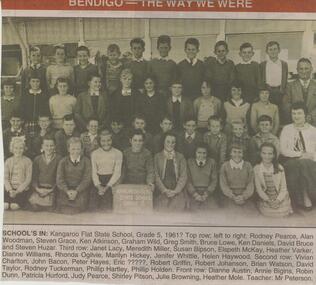
... Front row: Dianne Austin, Annie Bigins, Robin Dunn, Patricia Hurford, Judy Pearce, Shirley Pitson, Julie Browning, Heather Mole. Teacher Mr. Peterson. The clip is in a folder....Front row: Dianne Austin, Annie Bigins, Robin Dunn, Patricia Hurford, Judy Pearce, Shirley Pitson, Julie Browning, Heather Mole. Teacher Mr. Peterson. The clip is in a folder. ...BHS CollectionBendigo Advertiser ''The way we were'' from Monday, July 29, 2002. School's in: Kangaroo Flat State School grade 5, 1961 (?). Top row: left to right: Rodney Pearce, Alan Woodman, Steven Grace, Ken Atkinson, Graham Wild, Greg Smith, Bruce Lowe, Ken Daniels, David Bruce and Steven Huzar. Third row: Janet Lacy, Meredith Miller, Susan Bipson, Elspeth McKay, Heather Varker, Dianne Williams, Rhonda Ogilvie, Marilyn Hickey, Jenifer Whttle, Helen Haywood. Second row: Vivian Charlton, John Bacon, Peter Hayes, Eric (??), Robert Griffin, Robert Johanson, Brian Watson, David Taylor,Rodney Tuckerman, Phillip Hartley, Phillip Holden. Front row: Dianne Austin, Annie Bigins, Robin Dunn, Patricia Hurford, Judy Pearce, Shirley Pitson, Julie Browning, Heather Mole. Teacher Mr. Peterson. The clip is in a folder.newspaper, bendigo advertiser, the way we were -
 Bendigo Historical Society Inc.
Document - CITY OF BENDIGO RATE RECEIPT, 08/06/1917
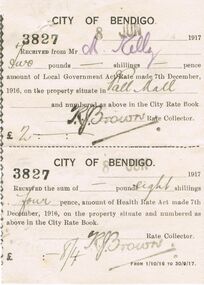
... Mr M. Kelly, two pounds. Amount of Local government Act Rate made 7th December, 1916, on the property situate in Pall Mall and numbered as above in the City Rate book. K.J. Brown...Brown. M Kelly City of Bendigo Rate Receipt: Receipt no 3827 dated 8th June 1917. White paper with black print. Received from Mr ...BHS CollectionCity of Bendigo Rate Receipt: Receipt no 3827 dated 8th June 1917. White paper with black print. Received from Mr M. Kelly, two pounds. Amount of Local government Act Rate made 7th December, 1916, on the property situate in Pall Mall and numbered as above in the City Rate book. K.J. Brown Rate Collector. £2:. City of Bendigo receipt no. 3827 dated 8th June 1917. Received the sum of eight shillings four pence, amount of Health Rate Act made 7th December, 1916, on the property situate and numbered as above in the City Rate Book. K.J. Brown. £ :8:4 pence. From 01/10/16 to 30/09/17. Box 625bendigo, council, city of bendigo. k. j. brown. m kelly -
 Bendigo Historical Society Inc.
Document - CITY OF BENDIGO RATE RECEIPT, 08/06/1917
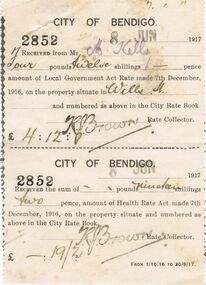
... City of Bendigo. Mr M Kelly R.J. Brown...Received from Mr M Kelly four pounds twelve shillings amount of Local government Act rate made 7th December 1916, on the property situate in Wills St and numbered as above in the City Rate Book. K J. Brown...BHS Collection BENDIGO Council City of Bendigo. Mr M Kelly R.J. Brown City of Bendigo Rate Receipt: Receipt 2852 dated 8th June 1917. ...BHS CollectionCity of Bendigo Rate Receipt: Receipt 2852 dated 8th June 1917. Received from Mr M Kelly four pounds twelve shillings amount of Local government Act rate made 7th December 1916, on the property situate in Wills St and numbered as above in the City Rate Book. K J. Brown Rate Collector. £4:12. City of Bendigo Receipt 2852 for nineteen shillings two pence, amount of Health Rate Act made 7th December, 19616, on the property situate and numbered as above in the City Rate Book. K.J. Brown Rate Collector. £ :19:2 pence. From 01/10/16 to 20/09/17. Box 625bendigo, council, city of bendigo. mr m kelly r.j. brown -
 Bendigo Historical Society Inc.
Document - LA TROBE UNIVERSITY BENDIGO COLLECTION: THE PRESENTATION OF HISTORY 4
... A brown folder titled "The Presentation of History 4". A teaching plan with which to teach the curriculum subject history. From the files of Mr...Mr. L.J. Pryor male individual person Education Resource Centre A brown folder titled "The Presentation of History 4". ...BHS CollectionA brown folder titled "The Presentation of History 4". A teaching plan with which to teach the curriculum subject history. From the files of Mr. L.J. Pryor. Former Principal of Bendigo Teachers' College. Donated to Education Resource Centre for archival use 1992.bendigo, education, bendigo teachers' college, la trobe university bendigo collection, collection, bendigo, education, history, history - study and teaching, teaching, curriculum, stdents, mr. l.j. pryor, male, individual, person, education, resource centre -
 Bendigo Historical Society Inc.
Document - LA TROBE UNIVERSITY BENDIGO COLLECTION: THE HISTORY CURRICULUM 3
... A brown folder titled "The History Curriculum 3". A teaching plan with which to teach the currculum subject history. From the files of Mr...Mr. L.J. Pryor male person individual Education Resource Centre A brown folder titled "The History Curriculum 3". ...BHS CollectionA brown folder titled "The History Curriculum 3". A teaching plan with which to teach the currculum subject history. From the files of Mr. L.J. Pryor. Former Principal of Bendigo Teachers' College. Donated to Education Resource Centre for archival use in 1992.bendigo, education, bendigo teachers' college, la trobe university bendigo collection, collection, bendigo teachers' college, bendigo, education, teaching, history, history - study and teaching, curriculum, mr. l.j. pryor, male, person, individual, education resource centre -
 Bendigo Historical Society Inc.
Document - LA TROBE UNIVERSITY BENDIGO COLLECTION: THE VALUE OF HISTORY 2
... brown folder titled "The Value of History 2". A teaching plan with which to teach the contribution of history to students. From the files of Mr...Mr. L.J. Pryor male individual person Education resource Centre curriculum A brown folder titled "The Value of History 2". ...BHS CollectionA brown folder titled "The Value of History 2". A teaching plan with which to teach the contribution of history to students. From the files of Mr. L.J. Pryor former Principal of Bendigo Teachers' College. Donated to Education resource Centre for archival use in 1992. Also included is a small booklet titled "Record of Lessons" with the name Fred East Past Lecturer, Bendigo Teachers' College.bendigo, education, bendigo teachers' college, la trobe university bendigo collection, collection, bendigo, bendigo teachers' college, teaching, teachers, history, history - study and teaching, mr. l.j. pryor, male, individual, person, education resource centre, curriculum -
 Bendigo Historical Society Inc.
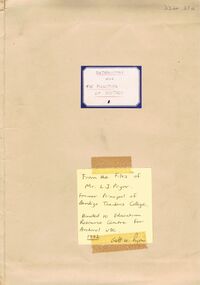
Document - LA TROBE UNIVERSITY BENDIGO COLLECTION: INTRODUCTORY AND FUNCTION OF HISTORY
... A brown manilla folder titled "Introductory and The Function of History 1". A teaching plan with which to teach the curriculum subject History. From the files of Mr...Mr. L.J. Pryor male person individual Bendigo Teachers' College Education Resource Centre curriculum A brown manilla folder titled "Introductory and The Function of History 1". ...BHS CollectionA brown manilla folder titled "Introductory and The Function of History 1". A teaching plan with which to teach the curriculum subject History. From the files of Mr. L.J. Pryor, former Principal of Bendigo Teachers' College. Donated to the Education Resource Centre for Archival use in 1992 by Mr. Geoff W. Pryor.bendigo, education, bendigo teachers' college, la trobe university bendigo collection, collection, bendigo, education, teaching, students, history, history - study and teaching, mr. l.j. pryor, male, person, individual, bendigo teachers' college, education resource centre, curriculum -
 Bendigo Historical Society Inc.
Newspaper - JENNY FOLEY COLLECTION: ALL TOGETHER NOW
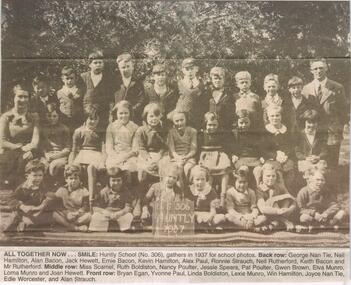
... Mr. Rutherford. Middle row: Miss Scamel, Ruth Boldinston, Nancy Poulter, Jessie Spears, Pat Poulter, Gwen Brown, Elva Munro, Lorna Munro and Joan Hewett. ...Mr. Rutherford. Middle row: Miss Scamel, Ruth Boldinston, Nancy Poulter, Jessie Spears, Pat Poulter, Gwen Brown, Elva Munro, Lorna Munro and Joan Hewett. ...See Item 3301.975Bendigo Advertiser '' The way we were'' from 2002. All together now, smile: Huntly School (No306), gathers in 1937 for school photos. Back row: George Nan, Neil Hamilton, Alan Bacon, Kevin Hamilton, Alex Paul, Ronnie Strauch, Neil Rutherford, Keith Bacon and Mr. Rutherford. Middle row: Miss Scamel, Ruth Boldinston, Nancy Poulter, Jessie Spears, Pat Poulter, Gwen Brown, Elva Munro, Lorna Munro and Joan Hewett. Front row: Bryan Egan, Yvonne Paul, Linda Boldiston, Lexie Munro, Win Hamilton, Joyce Nan Tie, Edie Worcester and Alan Strauch. The clip is in a folder.newspaper, bendigo advertiser, the way we were -
 Bendigo Historical Society Inc.
Document - BENDIGO SALEYARDS COLLECTION: THE BENDIGO SALEYARDS ECONOMIC VIABILITY STUDY
... Brown Wk & L d... Bendigo Sewerage Authority... Bendigo Water Board... ACI Computer Services... Leham Donald... A E Hueffer & Associates... Wolmoke Planners... P Langley... Mr...Kate Millard Loddon Campaspe Planning Authority Street Ryan and Associates Bendigo City Council Strathfieldsaye Shire Council Department of Industry Technology & Resources National Library of Australia Meldrum Burows & Partners Core Wilson Sayer Town Planning Appeals Panel CES Victorian Farmers and Graziers Association Stock Agents Association Department of Agriculture Department of Industry Technology & Resources Department of Conservation Forests and Land Cr Jock Comini RCA Depot Wellsford Rifle Range Bendigo Airport Bendigo Field Naturalists Club Mr David Kennedy Mr John Brumby Mr John Radford Neil O'Keefe Bendigo East Progress Association Bendigo East Traders Trades Hall Council Mr Tom Uren Mr Frank Wilkes Mr Bruce Reid Mr K I M Wright Mr E T Ebery Bendigo Pastoral Council of the VFGA Victorian Meatworks Association Bendigo Stock & Station Agents Association Rutlands Transport Mr Don Pickles Country Abattoirs & Wholesalers Association Association of Victoria Meat and Allied Trade Federation of Australia Bendigo Saleyards Advisory Committee Bendigo Residents & Ratepayers Association A H & N Graham Mrs P Unmack Australian Bureau of Statistics Mr Lloyd Houlden Cr C Rodda Mr Jolly Mr Tony Milanese Dr Robert Carter University of Melbourne Bendigo College of TAFE T Matthews A S & R D Rutland John Kerr J Talbot G L O'Sullivan Penney & Lang Pty Ltd Graeme Pickering Pickhall J W & Sons R A Plant W K Schmidt T J Vick K & J Wignall A E Wright G Chapman A J Gillies P G & M M Harris Ian R Hollingsworth B Kennedy S Letcher S & D K Letcher P M Llewellyn L G Mason Boyer R T Connally M F Kennedy & Mortlock Nevins J P R W Johnstone W J Keith B D Kelly Notman R Pitts A J & C A Pitts Mervyn L & Co Rowe W O Warren K M Associated Stock & Station Agents Dalgety Farmers Ltd Elders DSM Estates Ellis Nuttall & Co Gallagher G D Hamilton Real Estate McGregor Ralph H & Co McKean W & Co Miller Turner Livestock Co Vains E M & Co Victorian Producers Hill M J & Co Bennetts Meats Comell Bros Davis B & D Hardwick G F & V C Penney & Lang P/L Tendercut Meats Northern Seed Supply Co Bendigo Fertilizers Agri Business Pty Ltd Agrilink Consulting Group Pty Ltd Acil Aust Pty Ltd McGowan & Associates Chapman W C Talbot E J McCulloch W & Sons Pty Ltd K V Equipment Commercial Egg Producers Assoc Co-op Monsanto Aust Ltd Balmer Bryan R Barry I J Bath L Clarke B J Treacy K M Turner J M Bendigo Mower Serv Pty Ltd Everlast Concrete Tank tyLtd Wicks Bros canvas Goods Don McArthur Bendigo Communications Transcom Emdell Pty Ltd Epsom Pharmaceutical Supplies Sandhurst Fencing Pty Ltd Arnolds Gates & Fencing R Furniss Carne Neville AWA & UNICLA AJM Refrigeration bendigo Concrete Sawing Service Hamilton R J Hearpes T W J E Brown Campey DR A R Fyffe J J Kangaroo Flat Vet Clinic Ottrey K E Bendigo Sprinkler Installations Milnes Irrigation Onga Pumpshop Barastoc Products Bush's Produce Stores Epsom Produce K M M Pty Ltd Bendigo Grain Co Eaglehawk Chaff Mills Grain Elevators Board Dept Bonneys Pest Control Knights Pest Control Brown Wk & L d Bendigo Sewerage Authority Bendigo Water Board ACI Computer Services Leham Donald A E Hueffer & Associates Wolmoke Planners P Langley Mr Ken Strachan Mr Evan Jones Mr Peter Byrnes Mr Wayne Street Street Ryan & Associates 140 Loose pages titled The Bendigo Saleyards Economic Viability Study. ...140 Loose pages titled The Bendigo Saleyards Economic Viability Study. Report written by Kate Millard on behalf of the Bendigo Development Committee Inc. Contents include: Chapter 1 - Background Information, Chapter 1 - Present Operations at the Saleyards, Chapter 3 - Economic Factors, Chapter 4 - Environmental Factors, Chapter 5 - Selling Techniques, Chapter 6 - Employment Study, Management and Sundry Issues, Chapter 7 - Survey of Farmers and Saleyard Users in the 'Catchment Area', and Chapter 8 - Recommendations of the Report. Includes diagrams and maps. Recommendations printed on dark yellow paper.bendigo, council, cattle markets, bendigo saleyards collection - the bendigo saleyards economic viability study, bendigo development committee inc., kate millard, loddon campaspe planning authority, street, ryan and associates, bendigo city council, strathfieldsaye shire council, department of industry technology & resources, national library of australia, meldrum burows & partners, core wilson sayer, town planning appeals panel, ces, victorian farmers and graziers association, stock agents association, department of agriculture, department of industry technology & resources, department of conservation forests and land, cr jock comini, rca depot, wellsford rifle range, bendigo airport, bendigo field naturalists club, mr david kennedy, mr john brumby, mr john radford, neil o'keefe, bendigo east progress association, bendigo east traders, trades hall council, mr tom uren, mr frank wilkes, mr bruce reid, mr k i m wright, mr e t ebery, bendigo pastoral council of the vfga, victorian meatworks association, bendigo stock & station agents association, rutlands transport, mr don pickles, country abattoirs & wholesalers association association of victoria, meat and allied trade federation of australia, bendigo saleyards advisory committee, bendigo residents & ratepayers association, a h & n graham, mrs p unmack australian bureau of statistics, mr lloyd houlden, cr c rodda, mr jolly, mr tony milanese, dr robert carter, university of melbourne, bendigo college of tafe, t matthews, a s & r d rutland, john kerr, j talbot, g l o'sullivan, penney & lang pty ltd, graeme pickering, pickhall j w & sons, r a plant, w k schmidt, t j vick, k & j wignall, a e wright, g chapman, a j gillies, p g & m m harris, ian r hollingsworth, b kennedy, s letcher, s & d k letcher, p m llewellyn, l g mason, boyer r t, connally m f, kennedy & mortlock, nevins j p, r w johnstone, w j keith, b d kelly, notman r, pitts a j & c a, pitts mervyn l & co, rowe w o, warren k m, associated stock & station agents, dalgety farmers ltd, elders dsm estates, ellis nuttall & co, gallagher g d, hamilton real estate, mcgregor ralph h & co, mckean w & co, miller turner livestock co, vains e m & co, victorian producers, hill m j & co, bennetts meats, comell bros, davis b & d, hardwick g f & v c, penney & lang p/l, tendercut meats, northern seed supply co, bendigo fertilizers, agri business pty ltd, agrilink consulting group pty ltd, acil aust pty ltd, mcgowan & associates, chapman w c, talbot e j, mcculloch w & sons pty ltd, k v equipment, commercial egg producers assoc co-op, monsanto aust ltd, balmer bryan r, barry i j, bath l, clarke b j, treacy k m, turner j m, bendigo mower serv pty ltd, everlast concrete tank tyltd, wicks bros, canvas goods, don mcarthur, bendigo communications, transcom, emdell pty ltd, epsom pharmaceutical supplies, sandhurst fencing pty ltd, arnolds gates & fencing, r furniss, carne neville, awa & unicla, ajm refrigeration, bendigo concrete sawing service, hamilton r j, hearpes t w, j e brown, campey dr a r, fyffe j j, kangaroo flat vet clinic, ottrey k e, bendigo sprinkler installations, milnes irrigation, onga pumpshop, barastoc products, bush's produce stores, epsom produce, k m m pty ltd, bendigo grain co, eaglehawk chaff mills, grain elevators board dept, bonneys pest control, knights pest control, brown wk & l d, bendigo sewerage authority, bendigo water board, aci computer services, leham donald, a e hueffer & associates, wolmoke planners, p langley, mr ken strachan, mr evan jones, mr peter byrnes, mr wayne street, street ryan & associates -
 Bendigo Historical Society Inc.
Document - LA TROBE UNIVERSITY BENDIGO COLLECTION: BENDIGO TEACHERS' COLLEGE GRADUATION CEREMONY
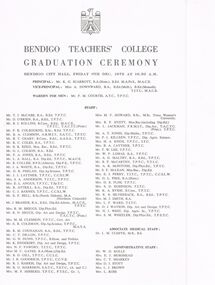
... Mr. W. D. Kolle, Mrs. E. J. Morshead, Mrs. C. T. Sharkey, Miss D. J. Stott, Mrs. L. J. Brown...Mr. W. D. Kolle, Mrs. E. J. Morshead, Mrs. C. T. Sharkey, Miss D. J. Stott, Mrs. L. J. Brown ...A white document titled "Bendigo Teachers' College Graduation Ceremony". Bendigo City Hall, Friday 8th Dec. 1972 at 10.30 A.M. Principal: Mr. K.G. Scarrott. Vice-Principal: Miss A. Downward. Warden for Men: Mr. F. M. Courtis. Below this is a list of the staff teaching in that year - Mr. T. J. McCabe, Mr. D. O'Brien, Mr. B. I. Rollins, Mr. F. R. Colbourne, Mr. B. A. Clemson, Mr. B. T. Geary, Mr. K. C. Coles, Mr. B. R. Red, Mr. G. L. Colson, Mr. F. A. Jones, Mr. L. A. Hall, Mr. R. Colliss, Mr. J. A. White, Mr. D. R. Phelan, Mr. J. J. Layther, Mrs. S. A. Anderson, Mrs. E. L. Angus, Mr. R. Attrill, Mr. C. J. Barnes, Mr. E. F. Bell, Mr. J. Brasier, Mrs. R. M. Briggs, Mr. R. N. Bruce, Mrs. M. M. Clemson, Mr. E. R. Coleman, Mr. R. M. Counahan, Mr. C. T. Dillon, Mr. G. N. Dunn, Mr. K. Endersby, Mrs. N. F. Fawdry, Miss M. C. Gates, Mr. B. D. Gill, Mr. J. R. Goodrich, Mr. R. J. Harris, Mr. . G. Harrison, Mrs. M. P. Hibberd, Miss M. F. Howard, Mrs. B. P. Hyett, Mr. L. Jackman, Mr. A. T. Jones, Mr. P. L. Kileen, Mrs. H. A. Knox, Mrs. B. A. Layther, Mr. T. W. Lee, Mr. W. P. Lomas, Mr. A. D. Maltby, Mr. B. F. McCarthy, Mr. A. R. McIntosh, Mt. S. F. McLean, Mrs. E. I. Perry, Mrs. D. E. Plim, Mrs. S. D. Robinson, Mr. K. A. Ryrie, Mr. R. B. Silverback, Mrs. M. J. Smith, Mrs. L. F. Ward, Mr. D. J. Watson, Mr. N. J. West, Mrs, S. M. Wheeler. Associate Medical Staff: Dr. L. M. Cleeve. Administrative Staff: Mr. W. D. Kolle, Mrs. E. J. Morshead, Mrs. C. T. Sharkey, Miss D. J. Stott, Mrs. L. J. Brown Mrs. L. Ross. On the inside page is the "Significance of the Ceremony" and words to "The College Anthem". The following page contains the "Order of the Ceremony". The back page lists the students who have received their teaching degrees. Diploma of Teaching (Primary) 1970 -1972 - Jeffrey R. Amos, Ann M. Babington, Heather C. Barlow, Glenda L. Blake, Marilyn J. Brinkley, Denise M. Broom, Linda D. Bryant, Margaret M. Cale, Pauline F. Casey, Glenys Chessells, Mrs. Clare M. Clancy, Elizabeth A, Clancy, Carol A. Coleman, Shirley J. Cooper, Elizabeth A. Dellar, Judith M. Ennor, Sandra J. Ferguson, Janice L. Finn, Angela M. Finnigan, Rae Fisher, Elaine T. Flight, Jacqueline P. A. Frost, Judith Gearon, Cheryl J. Godwill, Glenys D. Grose, Jennifer M. Haire, Mrs. Helen A. Harrington, Mrs. Rosalie J. Harvey, Marie T. Hayes, Wendy E. J. Hearps, Geraldine P. Henery, Darryl F. Higgins, Deidre C. Higgs, Cheryl D. Hobbs, Geoffrey K. Holland, Colin G. James, Margaret J. Kendall, Elinor V. Kennedy, Noeline A. Kerrins, Susan M. Kiss, Shane B. Landy, Margo E. Laughlin, Ian J. Leslie, Christine L. Letcher, Graeme R. Lloyd, Jenny Louey, Kathleen M. McCormack, Denise E. McGrath, Wayne McGrath, Paul D. McKenna, Maureen K. McKnight, Wendy C. Mackowski, Shirley P. Mangan, Philipa M. Marchbank, Margery J. Metelmann, Jane Miller, Glenda M. Minns, Geoffrey R. Neville, Catherine T. O'Brien, Heather D. O'Connell, Maureen T. O'Connor, Denis J. O'Connor, Wendy A. Parry, Mrs. Patricia M. Perry, Lynden L. Pinder, Margaret M. Plowman, Robert R. Quigg, Darrell J. Robinson, Carol A. Robson, Anne M. Rogan, Judith A. Satori, Geoffrey C. Slade, Judith E. Tedcastle, Alison J. Teitz, Robyn N. Thompson, Kaye F. Thurlow, Leonie K. Turner, June L. Weaver, Leonie Whalen, Deborah L. Williamson, Karen L. Wilson, John E. Windridge, Andre Wisniowski, Julie A. Witham, Glenda J. Wood, Gail D. Woolcock, Margaret Wright, Heather O. Wright and Elizabeth J. Yardy. Trained Primary Teacher's Certificate 1971 - 1972 - Margaret P. Anstey, Heather J. Avard, John H. Bakker, Wilermina Boers, Robyn J. Boundy, Gayle L. Catton, Judith Clancy, Anthony Dalton, Judith Downey, Patricia A. Geraughty, Mary E. Herrick, Ruth E. Hopkins, Deborah J. Hunter, Kristina M. Hussey, Graeme F. Keith, Mrs. Elizabeth King, Elizabeth J. King, Merilyn L. McGuinness, Robyn G. Moyle, Lynn D. Olsen, Rosemary Petschack, Margaret Pump Joan B. Ryan, Arina W. Serno, Judith A. Sheard, Mrs.c Christine M. Turner, Maree Valli, Lynette M. Wadeson, Wendy H. White and Trevor J. Wilcox. External Studies Trained Primary Teacher's Certificate - Susan Cody, Julie R. Crawford, Jennifer M. Crowe, Margaret A. Fullarton, Garry R. Hay Brendan J. Tinkler and Judith A. Twiss. External Studies Diploma of Teaching Diploma of Teaching (Primary) - Mrs. Laurel Astle, Brian R. Fitzgerald, Brendan C. L'Huillier, Elizabeth A. Petshack, Margaret A. Petzke, Elizabeth A. Wadelton, Ronald W. M. White and Mary A. Wright. Pianist: Barbara Hyett and Organist Michael Bottomleybendigo, education, bendigo teachers' college graduatio, la trobe university bendigo collection, collection, bendigo teachers' college, bendigo, education, teaching, teachers, students, graduation, bendigo teachers' college graduation, graduands, graduates, tertiary education, book, bendigo teachers' college students, bendigo teachers' college staff -
 Bendigo Historical Society Inc.
Document - LA TROBE UNIVERSITY BENDIGO COLLECTION: BENDIGO TEACHERS' COLLEGE GRADUATION CEREMONY 1962
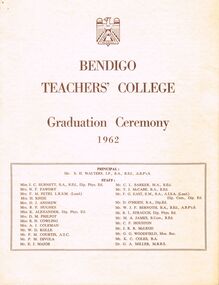
... Mr. L. J. Pryor Superintendent of Teacher Education. The following page contains a list of the "Students of 1960 - 1962 Trained Infant Teacher's Certificate". They are Glenys Faye Barrett, Marlene Isabella Bemrose, Beth Adora Bodinnar, Margaret Isobel Brown, Doris Lillian Chambers, Marie Ann Crawford, Margaret Carol Donne, Kaye Beverley Exell, Jannette Joyce Hughes, Margaret Christina Jenkins, Kathryn Margaret Lackmann, Susan Anne Lewer, Barbara June Lord, Jennifer Beris Matheson, Joy Lynette Messer, Geraldine Mary, Moylan, Patricia Joan O'Bree, Helen Jeanette Rodda, Lesley Scott, Heather Dawn Shenfield, Nola May Steele, Jennifer Margaret Weston and Alicia Yvonne Young. ...Mr. L. J. Pryor Superintendent of Teacher Education. The following page contains a list of the "Students of 1960 - 1962 Trained Infant Teacher's Certificate". They are Glenys Faye Barrett, Marlene Isabella Bemrose, Beth Adora Bodinnar, Margaret Isobel Brown, Doris Lillian Chambers, Marie Ann Crawford, Margaret Carol Donne, Kaye Beverley Exell, Jannette Joyce Hughes, Margaret Christina Jenkins, Kathryn Margaret Lackmann, Susan Anne Lewer, Barbara June Lord, Jennifer Beris Matheson, Joy Lynette Messer, Geraldine Mary, Moylan, Patricia Joan O'Bree, Helen Jeanette Rodda, Lesley Scott, Heather Dawn Shenfield, Nola May Steele, Jennifer Margaret Weston and Alicia Yvonne Young. ...Two copies of the Bendigo Teachers' College Graduation Ceremony 1962 program. On the front page is a list of the staff working at the college - Mr. S. H. Walters (Principal), Miss J. C. Burnett, Mrs. N. F. Fawdry, Mrs. F. M. Petri, Mrs. H. Knox, Mrs. D. J. Andrew, Mrs. B. F. Hughes, Miss K. Alexander, Mrs. D. M. Philpot, Miss B. H. Cowling, Mrs. A. J. Coleman, Mr. W. D. Kolle, Mr. F. M. Courtis, Mr. P. M. Divola, Mr. E. J. Major, Mr. C. L. Barker, Mr. T. J. McCabe, Mr. F. G. East, Mr. D. O'Brien, Mr. W. J. F. Bernoth, Mr. R. L. Strauch, Mr. M. A. James, Mr. C. F. Houston, M. J. R. R. McLeod, Mr. G. G. Woodfield, Mr. K. C. Coles and Dr. G. A. Miller. On the inside cover is the "Significance of the Ceremony" and the "Order of the Ceremony". Mr. F. M. Courtis welcomed the visitors and the Principal read the College Charge. The 'Graduation Book' was presented to Mr. W. F. R. Budge by Miss J. C. Burnett. Mr. C. L. Barker presented the T.P.T.C. graduating students to the Principal and Mrs. N. F. Fawdry presented the T.I.T.C. graduating students to the Principal. Congratulations were offered by the Mayor of Bendigo Cr. R. A. Rae, J.P., the President of Strathfieldsaye Shire Cr. K. Houlahan, J. P. and Mr. E. P. Seymour, Head Teacher, Violet Street State School. The Occasional Address was given by Mr. L. J. Pryor Superintendent of Teacher Education. The following page contains a list of the "Students of 1960 - 1962 Trained Infant Teacher's Certificate". They are Glenys Faye Barrett, Marlene Isabella Bemrose, Beth Adora Bodinnar, Margaret Isobel Brown, Doris Lillian Chambers, Marie Ann Crawford, Margaret Carol Donne, Kaye Beverley Exell, Jannette Joyce Hughes, Margaret Christina Jenkins, Kathryn Margaret Lackmann, Susan Anne Lewer, Barbara June Lord, Jennifer Beris Matheson, Joy Lynette Messer, Geraldine Mary, Moylan, Patricia Joan O'Bree, Helen Jeanette Rodda, Lesley Scott, Heather Dawn Shenfield, Nola May Steele, Jennifer Margaret Weston and Alicia Yvonne Young. It also contains a paragraph describing "The Perfect Teacher". The back cover of the booklet has a list of "Students of 1961 - 1962 Trained Primary Teacher's Certificate". John Walter Angel, Elisabeth Ann Arkinstall, Mary Christina Backway, Helen Elizabeth Barclay, Bruce Maxwell Bouch, Pamela Mary Braden, Howard Francis Briggs, Clare Antoinette Brown, Alan John Bruce, Peter John Burns, Valerie Jean Caldwell, Marie Lynette Chambers, Margaret Jeannette Christie, Alison Ruth Clement, Marie Elaine Collins, Gladys Helena Cooke, Lindsay Charles Coster, David John Cowan, Peter John Cronin, Berenice Margaret Cronk, Edeline May Crouch, Theodore Robert Dare, Lynette Joan Davis, Ian David Dawson, Mary DeAraugo, Kenneth Ross Erbs, Francis Elaine Mary Fallon, Margaret Fawcett, Janet Frances Filbey, Francesco Gargiulo, Ian John Glenister, Barbara Faye Gotch, Lynette Ellen Graham, Colin Athol Hayes, Marlene Grace Hazen, Desmond Brian Hearn, Brentford Graeme Heath, Carmel Jean Heslop, Pamela Joy Higgie, Lynette Rosemary Cecelia Hoare, Erica Fay Holloway, Marie Jean Jardine, Kenneth Neil Johnson, Laurel Robyn Jones, Glenys Lorraine Judd, Diane Elizabeth Kear, Ann Elizabeth Keenan, Monica Cecelia Kelly, Margaret Elizabeth Landini, Patricia Joy Langdon, Dorothy Margaret Leitch, Donald Alan Leslie, Mary Carmel McCormack, Helen Mary McCutcheon, Birgitt Marx, Claire Agnes Mullins, Lucille Anne Newcombe, Glenice Vivienne Orr, Judith Joyce Ozanne, Wilma Beverley Pape, Virginia Elizabeth Parke, Robin Parker, Dorothy Joan Peterson, Robin Joan Phillips, Cherril Margaret Probyn, Norma Lesley Rantall, Nola Read, Margaret Elaine Ridley, Thomas Charles Rilen, Marie Therese Sharkey, Judith Margaret Spackman, Desmond Thomas Stephens, Nancy Rae Telfer, Bernard James Trevaskis, Marjorie Ellen Warden, Laurice Helen Warwick, Judith Maree Weir, Maxwell John White, Norman Leslie Williams, Pamela Williams and Lloyd Reginald Wishart. Within this document is a loose page showing the seating arrangements for the graduation. Staff seating arrangements are as follows - Walters, Barker, Seymour, Fawdry, McCabe, Woodfield, Alexander, Hughes, Divola, Major, Strauch, Pryor, Budge, Burnett, East, Houston, Petri, Andrew, Coles, McLeod, James, O'Brien.bendigo, education, bendigo teachers' college graduatio, la trobe university bendigo collection, collection, bendigo teachers' college, bendigo, education, teaching, teachers, students, staff, bendigo teachers' college students, bendigo teachers' college staff, history, graduation, graduation ceremony, book, tertiary education, graduands, graduates -
 Bendigo Historical Society Inc.
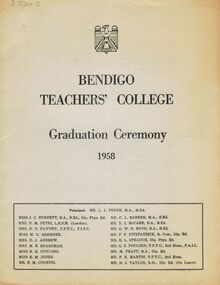
Document - LA TROBE UNIVERSITY BENDIGO COLLECTION: BENDIGO TEACHERS' COLLEGE GRADUATION CEREMONY 1958
... Mr. J. R. Lyall Assistant Chief Inspector of Primary Schools.The following page contains a list of the "Students of 1957-58" - John Victor Anderson, Margaret Betty Baker, Patricia Ann Banko, George Edward Bazley, Elizabeth Margaret Bower, Nancy Elva Boyle, Enid Gilmour Brown, Wendy Lorraine Bulleid, Fairlie Anne Burkinshaw, Barry Henry Burns, Katherine Alice Byrnes, Bryan Clarke Campbell, Elizabeth Joyce Chapman, Alison Amelia Clark, Valerie Nancy Clough, Georgina Mary Agnes Coppock, Eric Bruce Hindle Coventry, Faye Margaret Crump, Dorothy Lilian Cunnington, Elizabeth Jean Dalrymple, Lois Anne Davies, Brian Leslie Dolan, Moira Margaret Dowd, June Frances Ellis, James Cornelius Finnegan, Graeme Reynolds Fleet, Elaine Rose Fuga, Rosemary June Garonne, James Alfred Geehman, Ronald James Goodman, Bernard Thomas Gray, Dorothy June Gregson, Joy Margaret Ham, Dorothy Rose Harice, Arthur Herbert Harris, Brian Hopper, Dorothy Anne Hosking, Nancy Elizabeth Hughes, Irene Margaret Hynes, Donald James Low, Elspeth Faye McCarthy, Richard James McGowan, Geoffrey Douglas McLean, Junella Maree McPhail, Beryl Martin, Carmel Monica Mullins, Charles Peter O'Connor, Nancy Lorraine Peck, Ian Alwyn Raeburn, Raymond Edward Reardon, Ruth Lorraine Reid, Patricia Margaux Roberts, Robert Herbert Robertson, Phillip Edward Rowe, Lesley Margaret Silke, Francis William Sleeth, Margaret Joy Sloane, Murray Francis Sweeney, Elwyn Beth Thompson, Margaret Ann Wadley, Janet Ann Wallis, Geoffrey Michael Warman, Kevin George Watson, Patricia Anne Weight, Margaret Anne West, Ronald Thomas White and Irene Mary Wolfe. ...Mr. J. R. Lyall Assistant Chief Inspector of Primary Schools.The following page contains a list of the "Students of 1957-58" - John Victor Anderson, Margaret Betty Baker, Patricia Ann Banko, George Edward Bazley, Elizabeth Margaret Bower, Nancy Elva Boyle, Enid Gilmour Brown, Wendy Lorraine Bulleid, Fairlie Anne Burkinshaw, Barry Henry Burns, Katherine Alice Byrnes, Bryan Clarke Campbell, Elizabeth Joyce Chapman, Alison Amelia Clark, Valerie Nancy Clough, Georgina Mary Agnes Coppock, Eric Bruce Hindle Coventry, Faye Margaret Crump, Dorothy Lilian Cunnington, Elizabeth Jean Dalrymple, Lois Anne Davies, Brian Leslie Dolan, Moira Margaret Dowd, June Frances Ellis, James Cornelius Finnegan, Graeme Reynolds Fleet, Elaine Rose Fuga, Rosemary June Garonne, James Alfred Geehman, Ronald James Goodman, Bernard Thomas Gray, Dorothy June Gregson, Joy Margaret Ham, Dorothy Rose Harice, Arthur Herbert Harris, Brian Hopper, Dorothy Anne Hosking, Nancy Elizabeth Hughes, Irene Margaret Hynes, Donald James Low, Elspeth Faye McCarthy, Richard James McGowan, Geoffrey Douglas McLean, Junella Maree McPhail, Beryl Martin, Carmel Monica Mullins, Charles Peter O'Connor, Nancy Lorraine Peck, Ian Alwyn Raeburn, Raymond Edward Reardon, Ruth Lorraine Reid, Patricia Margaux Roberts, Robert Herbert Robertson, Phillip Edward Rowe, Lesley Margaret Silke, Francis William Sleeth, Margaret Joy Sloane, Murray Francis Sweeney, Elwyn Beth Thompson, Margaret Ann Wadley, Janet Ann Wallis, Geoffrey Michael Warman, Kevin George Watson, Patricia Anne Weight, Margaret Anne West, Ronald Thomas White and Irene Mary Wolfe. ...A faded document titled "Bendigo Teachers' College Graduation Ceremony 1958". The front cover also contains a list of the staff teaching at the college. They are The Principal Mr. L. J. Pryor, Miss J. C. Burnett, Mrs. F. M. Petri, Mrs. N. F. Fawdry, Miss M. G. Bremner, Mrs. D. J. Andrew, Mrs. M. E. Boardman, Miss B. H. Cowling, Miss E. M. Jones, Mr. F. M. Courtis, Mr. C. L. Barker, Mr. T. J. McCabe, Mr. G. W. D. Boyd, Mr. P. F. Fitzpatrick, Mr. R. L. Strauch, Mr. G. S. Poulsen, Mr. M. Pratt, Mr. F. X. Martin and Mr. N. J. Taylor. On the inside cover is the "Significance of the Ceremony" and the "Order of the Ceremony". Mr. F. M. Courtis gave the Welcome to Visitors and the College Charge was given by the Principal. The 'Graduation Book' was presented to Mr. A. L. Harris by Miss J. C. Burnett. Mr. C. L. Barker called the final roll for 1958 and Congratulations were offered by The Mayor Cr. H. W. Snell J.P. and Mr. R. L. Harrowfield Head Teacher of Golden Square State School. The Occasional Address was given by Mr. J. R. Lyall Assistant Chief Inspector of Primary Schools.The following page contains a list of the "Students of 1957-58" - John Victor Anderson, Margaret Betty Baker, Patricia Ann Banko, George Edward Bazley, Elizabeth Margaret Bower, Nancy Elva Boyle, Enid Gilmour Brown, Wendy Lorraine Bulleid, Fairlie Anne Burkinshaw, Barry Henry Burns, Katherine Alice Byrnes, Bryan Clarke Campbell, Elizabeth Joyce Chapman, Alison Amelia Clark, Valerie Nancy Clough, Georgina Mary Agnes Coppock, Eric Bruce Hindle Coventry, Faye Margaret Crump, Dorothy Lilian Cunnington, Elizabeth Jean Dalrymple, Lois Anne Davies, Brian Leslie Dolan, Moira Margaret Dowd, June Frances Ellis, James Cornelius Finnegan, Graeme Reynolds Fleet, Elaine Rose Fuga, Rosemary June Garonne, James Alfred Geehman, Ronald James Goodman, Bernard Thomas Gray, Dorothy June Gregson, Joy Margaret Ham, Dorothy Rose Harice, Arthur Herbert Harris, Brian Hopper, Dorothy Anne Hosking, Nancy Elizabeth Hughes, Irene Margaret Hynes, Donald James Low, Elspeth Faye McCarthy, Richard James McGowan, Geoffrey Douglas McLean, Junella Maree McPhail, Beryl Martin, Carmel Monica Mullins, Charles Peter O'Connor, Nancy Lorraine Peck, Ian Alwyn Raeburn, Raymond Edward Reardon, Ruth Lorraine Reid, Patricia Margaux Roberts, Robert Herbert Robertson, Phillip Edward Rowe, Lesley Margaret Silke, Francis William Sleeth, Margaret Joy Sloane, Murray Francis Sweeney, Elwyn Beth Thompson, Margaret Ann Wadley, Janet Ann Wallis, Geoffrey Michael Warman, Kevin George Watson, Patricia Anne Weight, Margaret Anne West, Ronald Thomas White and Irene Mary Wolfe. The back page has the "Principal's Charge". There is also a white type written insertion containing the words of the songs and a plan of the seating and movements of the ceremony. Boltons Print, Bendigo.bendigo, education, bendigo teachers' college graduatio, la trobe university bendigo collection, collection, bendigo, bendigo teachers' college, bendigo teachers' college students, education, teaching, teachers, students, graduation, tertiary education, book, graduation ceremony, graduands, history, bendigo teachers' college staff, history -
 Bendigo Historical Society Inc.
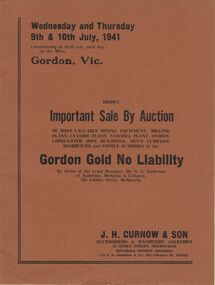
Document - IAN DYETT COLLECTION: AUCTION CATALOGUE - GORDON GOLD NO LIABILITY
... brown covered auction catalogues for an auction held at the Gordon Gold No Liability mine at Gordon, Vic. On the 9th and 10th July, 1941of mining equipment, milling plant, cyanide plant, sawmill plant, stores, corrugated iron buildings, men's cubicles, residences and costly sundries. Sale by order of the Legal Manager, Mr...BUSINESS Auctioneers j h curnow & son pty ltd Ian Dyett Collection - Auction Catalogue - Gordon Gold No Liability Mr G S Anderson Anderson hodgson & Lithgow J H Curnow & Son J L Jamieson & Co The Cambridge Press Two light brown covered auction catalogues for an auction held at the Gordon Gold No Liability mine at Gordon, Vic. ...Two light brown covered auction catalogues for an auction held at the Gordon Gold No Liability mine at Gordon, Vic. On the 9th and 10th July, 1941of mining equipment, milling plant, cyanide plant, sawmill plant, stores, corrugated iron buildings, men's cubicles, residences and costly sundries. Sale by order of the Legal Manager, Mr. G. S. Anderson of Anderson, Hodgson & Lithgow. J. H Curnow & Son were the auctioneers.business, auctioneers, j h curnow & son pty ltd, ian dyett collection - auction catalogue - gordon gold no liability, mr g s anderson, anderson hodgson & lithgow, j h curnow & son, j l jamieson & co, the cambridge press -
 Bendigo Historical Society Inc.
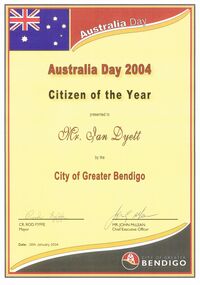
Document - IAN DYETT COLLECTION: CITIZEN OF THE YEAR AWARD
... Mr. John McLean (Chief Executive Officer). Certificate has the Australian flag in the top left corner and City of Greater Bendigo and logo in the bottom right corner. The background is coloured yellow. It is framed in a brown...Mr. John McLean (Chief Executive Officer). Certificate has the Australian flag in the top left corner and City of Greater Bendigo and logo in the bottom right corner. The background is coloured yellow. It is framed in a brown ...Australia Day 2004 Citizen of the Year presented to Mr. Ian Dyett by the City of Greater Bendigo, dated 26th January 2004. Signed by Cr. Rod Fyffe (Mayor) and Mr. John McLean (Chief Executive Officer). Certificate has the Australian flag in the top left corner and City of Greater Bendigo and logo in the bottom right corner. The background is coloured yellow. It is framed in a brown frame.business, auctioneers, j h curnow & son pty ltd, ian dyett collection - citizen of the year award, ian dyett, city f greater bendigo, cr rod fyffe, mr john mclean -
 Bendigo Historical Society Inc.
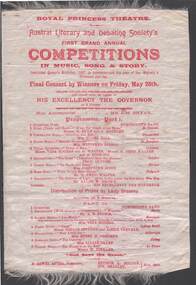
Document - AUSTRAL LITERARY AND DEBATING SOCIETY'S FIRST GRAND ANNUAL COMPETITIONS
... Those who took part are: Northcott's Band, R Rule, A Bottoms, Flora Hill, Winifred Bishop, Vida Rogers, G Walter, G Fred Walter, A Hosking, Prof Lupton, Josephine Scott, Ralph W Brown, Lady Brassey, A B Flohm, Eathorne Rogers, T Bockelmann, Ch H King, Nellie Jeffrey, Lizzie Trevean, Ethel Osborne, Lillie Sharp and W Tinkler. Hon. Accompanist was Mr...Those who took part are: Northcott's Band, R Rule, A Bottoms, Flora Hill, Winifred Bishop, Vida Rogers, G Walter, G Fred Walter, A Hosking, Prof Lupton, Josephine Scott, Ralph W Brown, Lady Brassey, A B Flohm, Eathorne Rogers, T Bockelmann, Ch H King, Nellie Jeffrey, Lizzie Trevean, Ethel Osborne, Lillie Sharp and W Tinkler. Hon. Accompanist was Mr ...Program for the Austral Literary and Debating Society's First Grand Annual Competitions in Music, Song and Story held at the Royal Princess Theatre. Program printed in red a creamy, silky material with a satin type finish. F. Aswel Apted, President. Arthur L. Bolton and Jtn. Smalley, Hon. Secs. Those who took part are: Northcott's Band, R Rule, A Bottoms, Flora Hill, Winifred Bishop, Vida Rogers, G Walter, G Fred Walter, A Hosking, Prof Lupton, Josephine Scott, Ralph W Brown, Lady Brassey, A B Flohm, Eathorne Rogers, T Bockelmann, Ch H King, Nellie Jeffrey, Lizzie Trevean, Ethel Osborne, Lillie Sharp and W Tinkler. Hon. Accompanist was Mr. J. H. Bryan and prizes were distributed by Lady Brassey.entertainment, concert, music, song & story, austral literary and debating society's first grand annual competitions, royal princess theatre, j h bryan, northcott's band, r rule, a bottoms, flora hill, winifred bishop, vida rogers, g walter, g fred walter, a hosking, prof lupton, josephine scott, ralph w brown, lady brassey, a b flohm, eathorne rogers, t bockelmann, ch h king, nellie jeffrey, lizzie trevean, ethel osborne, lillie sharp, w tinkler, f aswel apted, arthur l bolton, jtn smalley -
 Bendigo Historical Society Inc.
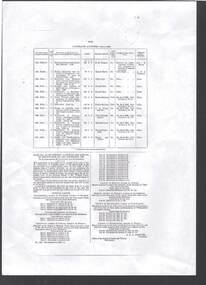
Document - BOARD OF WORKS, MELBOURNE: CONTRACTS ACCEPTED & LAND SALES FOR 1860
... Brown and Gibson... Queen Victoria... Mr...BRIDGE Construction timber bridges Board of Works Melbourne - Contracts Accepted & Land Sales 'Marilla' F M Pingree Jno R Bailey Robert Heron John Gray Donald Ross Hector McLean C J Glynn and Co John Nicholls and Co Michael Cleary Thomas Cairncross Brown and Gibson Queen Victoria Mr William Perry Mr De Castella Willoughby Barker A F A Greeves Board of Land and Works Melbourne Page 2223 titled Contracts Accepted - (Series 1860). ...Page 2223 titled Contracts Accepted - (Series 1860). Contracts accepted are for Raising and removing sunken ship Marilla; Removal of Toll-gate from Mount Alexander Road and re-erection of same at Middle Gully; Erection of toll-house on Melbourne/Ballarat Road near Ballan; Erection of toll-house on Bendigo Road at Kangaroo Flat; Castlemaine to Ballarat - Erection of toll-house at Campbell's Creek; Construction of 2870 chains of Lower Western Road, west of Camperdown; Erection of two bridges and other improvements on the Clunes to Amherst Road; Erection of timber bridge, & c., over Two-mile Creek - Beechworth to Bowman Forest; Formation of roadway at head of Buckland Gap - Beechworth to Bowman Forest; Construction of culvert, & c., Rowe's Creek - Beechworth to Bowman Forest; Ararat and South-western sea-board road - erection of bridge over Dennicull Creek and other improvements. Land Sales - 4 Lots - Elsternwick, parish of Prahran, County of Bourke; 2 Lots - Dandenong, County of Bourke; 20 Lots - Lillydale, Parish of Yering, County of Evelyn, 1 suburban Lot - County of Evelyn, Parish of Yering; 1 Allotment - Romsey, County of Bourke, Parish of Lancefield; 5 Lots - County of Mornington, Parish of Langwarrin, and 2 Lots - County of Mornington, Parish of Fingal. Lots to be sold at the Auction Rooms of Mr. William Perry, Great Collins Street, Melbourne. A F A Greaves, President, Office of the Board of Land and Works, Melbourne.bridge, construction, timber bridges, board of works, melbourne - contracts accepted & land sales, 'marilla', f m pingree, jno r bailey, robert heron, john gray, donald ross, hector mclean, c j glynn and co, john nicholls and co, michael cleary, thomas cairncross, brown and gibson, queen victoria, mr william perry, mr de castella, willoughby, barker, a f a greeves, board of land and works melbourne -
 Bendigo Historical Society Inc.
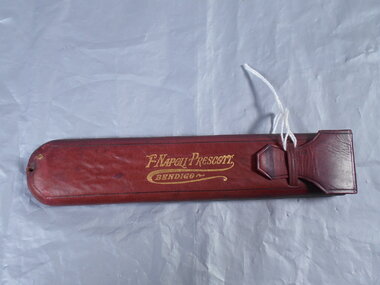
Accessory - Spectacle case
... Mr C.M. Dawe trading as Prescott & Dawe. Spectacles Spectacles case F Napoli Prescott In gold lettering on the front of the case "F Napoli Prescott Bendigo". Brown ...Frederick Napoli Prescott was a prominent Bendigo Optician and Jeweller. He was born and educated in Hobart before joining his father's jewellery and optical business. After studying in Europe to gain further qualifications he returned to Australia and opened a business at the corner of Mitchell and Hargreaves Street Bendigo. He was later in partnership with Mr C.M. Dawe trading as Prescott & Dawe. Brown leather look spectacle case. The case has a flip lid section at the top that opens to gain access to the case. The lid is held in place under a leather loop. In gold lettering on the front of the case "F Napoli Prescott Bendigo".spectacles, spectacles case, f napoli prescott -
 Bendigo Historical Society Inc.
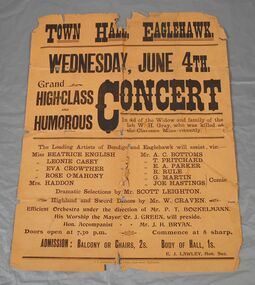
Poster - Town Hall Eaglehawk
... Brown poster advertising a concert at the Eaglehawk Town Hall. Wednesday, June 4th. Grand-class and humorous concert in the aid of the widow and family of the late W. H. Gray, who was killed at the Clarence mine recently. The leading artists of Bendigo and Eaglehawk will assist, viz. Miss Beatrice English, Miss Leonie Casey, Miss Eva Crowther, Miss Rose O'Mahoney, Mrs. Haddon, Mr...Brown poster advertising a concert at the Eaglehawk Town Hall. Wednesday, June 4th. Grand-class and humorous concert in the aid of the widow and family of the late W. H. Gray, who was killed at the Clarence mine recently. The leading artists of Bendigo and Eaglehawk will assist, viz. Miss Beatrice English, Miss Leonie Casey, Miss Eva Crowther, Miss Rose O'Mahoney, Mrs. Haddon, Mr ...William Henry Gray was killed when a large slab of rock fell on his head at the Clarence Mine, Eaglehawk in April 1902. He was only aged 32 and left a widow and five children. The family lived at Bracewell Street, Eaglehawk.Brown poster advertising a concert at the Eaglehawk Town Hall. Wednesday, June 4th. Grand-class and humorous concert in the aid of the widow and family of the late W. H. Gray, who was killed at the Clarence mine recently. The leading artists of Bendigo and Eaglehawk will assist, viz. Miss Beatrice English, Miss Leonie Casey, Miss Eva Crowther, Miss Rose O'Mahoney, Mrs. Haddon, Mr. A.C. Bottoms, Mr. T. Pritchard, Mr. E.A. Parker, Mr. R. Rule, Mr. G. Martin, Mr. Joe Hastings. Dramatic selections by Mr. Scott Leighton. Highland and sword dances by Mr. W. Craven. Efficient orchestra under the direction of Mr. P.T. Bockelmann. His Worship the mayor Cr. J. Green will preside. Hon. accompanist Mr. J.H. Bryan. Doors open at 7.30 p.m. Commence at 8 sharp. Admission: Balcony or chairs 2s. body of hall 1s. E.J. Lawley Hon. Sec. Printed by T.J. Anderson, High Street Eaglehawk. eaglehawk, eaglehawk town hall, concert, w.h. gray, clarence mine -
 Bendigo Historical Society Inc.
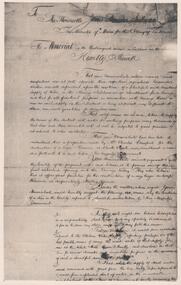
Photograph - PETITION FOR BACK CREEK RESERVOIR
... brown folder. On the front of the folder a stamp of the Royal Historical Society of Victoria Bendigo branch with the date:1960 and the number 217. Inside the cover in blue pen: donated by the Victoria Legislative through Mr. ...brown folder. On the front of the folder a stamp of the Royal Historical Society of Victoria Bendigo branch with the date:1960 and the number 217. Inside the cover in blue pen: donated by the Victoria Legislative through Mr. ...Petition sent in 1886 by the residents of Sandhurst to the Honourable James Sullivan Minister of mines in the colony of Victoria requesting the construction of a reservoir on back creek. The petition is on thirty-three photographs and is inside a quite well worn plain brown folder. On the front of the folder a stamp of the Royal Historical Society of Victoria Bendigo branch with the date:1960 and the number 217. Inside the cover in blue pen: donated by the Victoria Legislative through Mr. Galvin MLA and another RHSV stamp. The Mayor of Sandhurst at the time was John McIntyre.government, state, 1886 petition -
 Bendigo Historical Society Inc.
Book - VICTORIAN RAILWAYS RECORD OF DRILL SESSIONS ATTENDED 1956 - 1978
... Brown paper covered book. On front cover on a label: Mr. T. Chafer, Foreman Boiler maker, Workshop Manager, Bendigo Nth. ...BENDIGO Railways bendigo railways Brown paper covered book. On front cover on a label: Mr. T. Chafer, Foreman Boiler maker, Workshop Manager, Bendigo Nth. ...Brown paper covered book. On front cover on a label: Mr. T. Chafer, Foreman Boiler maker, Workshop Manager, Bendigo Nth. Inside front cover on an attached flimsy copy is a list of rules for the workshop drill implementation. e.g leader to make a note of nature of work performed at each drill, signed H.L. Wignall, Ambulance Officer. Book contains names of each person who attended a particular drill session, e.g 13.4.56, J. Smith, H. Latimer, N. Henderson, R. Walls, L. Smart, Dave Brown attended a 'poisons' drill session. Dates from 13.4.1956 to 23.5.1978. Also, at intervals in the book, is a summary of sessions attended for each employee.bendigo, railways, bendigo railways -
 Bendigo Historical Society Inc.
Photograph - WES HARRY COLLECTION: TWO PHOTOGRAPHS OF BENDIGO CHOIR
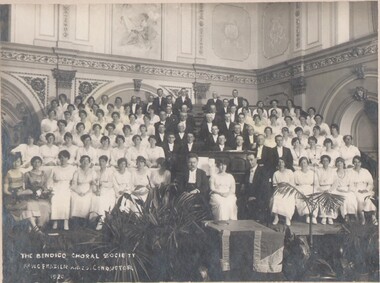
... Mr. W. C. Frazier B Bendigo & Castlemaine Choirs combined with Melbourne Oriana Choir performing at the Melbourne Town Hall, approx. 1920 A Bendigo Choral Society at the Bendigo Town Hall Owner Elva Jean Brown, of E.J. ...Mr. W. C. Frazier B Bendigo & Castlemaine Choirs combined with Melbourne Oriana Choir performing at the Melbourne Town Hall, approx. 1920 A Bendigo Choral Society at the Bendigo Town Hall Owner Elva Jean Brown, of E.J. ...two black & white mounted photographs of the Bendigo Choir, circa 1920s, Conductor Mr. W. C. Frazier B Bendigo & Castlemaine Choirs combined with Melbourne Oriana Choir performing at the Melbourne Town Hall, approx. 1920 A Bendigo Choral Society at the Bendigo Town Hall Owner Elva Jean Brown, of E.J. Brown Bookshop; from her brother Bernard Allen Brown (unknown how he came to him)A W. Vincent Kelly, Bendigo B Garge Photos, Collins Street, Melbournewes harry, bendigo choir -
 Bendigo Historical Society Inc.
Document - JOHN BROWN INDUSTRIES LETTER
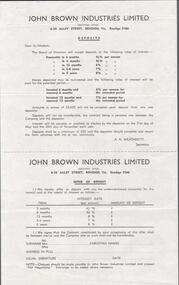
... Letter from John Brown Industries Limited to a Mr. Randall re: deposit plan. ...Mr. Randall and a reply paid envelope. Document JOHN BROWN INDUSTRIES LETTER ...Letter from John Brown Industries Limited to a Mr. Randall re: deposit plan. The letter is dated 19th June, 1958 and signed by N. Weatheritt, Secretary. Attached an application form for the investment. Also an envelope addressed to Mr. Randall and a reply paid envelope.bendigo, business, john brown knitwear -
 Bendigo Historical Society Inc.
Document - MISS G ALICE JONES COLLECTION: ACCOUNT
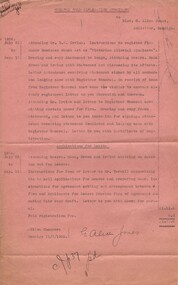
... Mr H W Irvine... Business Names Act... Victorian Alluvial Syndicate... Messrs Mann Brown...BHS Collection The Miss G Alice Jones Collection - Account Greater Gold Exploration Syndicate Mr H W Irvine Business Names Act Victorian Alluvial Syndicate Messrs Mann Brown and Irvine Mr Terrell Greater Gold Exploration Syndicate to Miss G. ...BHS CollectionGreater Gold Exploration Syndicate to Miss G. Alice Jones. Pink paper dated July 21 to Sep 17 1934, July 23 to Sep 10 1934 and 11/1/1935. Re Instructions to register firm under Business names Act as 'Victorian Alluvial Syndicate' but it was too similar to another already registered. Also application for leases. Cost £1.17.6. R599 delivered 12/1/35 JW in the top left corner.the miss g alice jones collection - account, greater gold exploration syndicate, mr h w irvine, business names act, victorian alluvial syndicate, messrs mann brown and irvine, mr terrell -
 Bendigo Historical Society Inc.
Document - ART EXHIBITION, BENDIGO, c1972
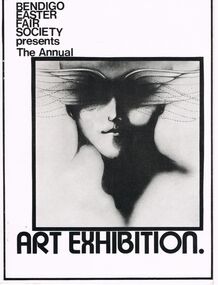
... Brown... Malcolm H Cannon... R L Carless... Pamela Caswell... Bett Cheek... Mrs Betty Cooper... Peter Costello... Jennifer Cottrell... Stephanie Cottrell... Dorothy Dempsey... Noelene Edmunds... Emma J.... Ruth Epps... Mrs Jean Ferguson... Mrs Margot Flood... Lorraine Fraser... Maureen French... Neil Friswell... Ian Glanville... Sheryl Gregory... Mrs Valmai Hill... Mr...Artists: Gordon Allen, Mrs D Allender, 'April', Bruce Barklamb, Thomas R W Benkendorff, Christine Berkman, Mrs J A Blakey, James E Bowman, Darryl Brown, Malcolm H Cannon, R L Carless, Pamela Caswell, Bett Cheek, Mrs Betty Cooper, Peter Costello, Jennifer Cottrell, Stephanie Cottrell, Dorothy Dempsey, Noelene Edmunds, Emma J., Ruth Epps, Mrs Jean Ferguson, Mrs Margot Flood, Lorraine Fraser, Maureen French, Neil Friswell, Ian Glanville, Sheryl Gregory, Mrs Valmai Hill, Mr A B Hocking, Ivy Jeffrey, George Kendall, Mrs Joan Kerr, Miss Jillian Locket, R McKenzie, Mrs J E McLean, Mrs Coral Manfield, Meenah Marchbank, Lillian B Mark, Ian John Mark, T Matthews, Mrs Judy Maxwell, Margaret Metcalf, Jean Morrissey, Mrs E Noble, I Osborne, Max Paull, R Paynter, Anthony N Penno, Norman William Penrose, Mark Phillips, Janice Pinder, Yvonne Pocock, Jennifer Reilly, Mrs S Reed, R J Ritter, Roma Robbins, Faye Roberts, Frank S Saunders, Jeanette Skrokov, Mrs C A Slootjes, John Spink, Ruth E Stewart, Mrs W Tebb, Gerard Terpstra, Stan Thomas, Pat Frewin, Dominic Tuohy, Peter Tyndall, Neil G West, Tony Wilson, Wilma Wilson, Pam Wright, A McGregor and R Pearce, T A Solbig. ...Artists: Gordon Allen Mrs D Allender 'April' Bruce Barklamb Thomas R W Benkendorff Christine Berkman Mrs J A Blakey James E Bowman Darryl Brown Malcolm H Cannon R L Carless Pamela Caswell Bett Cheek Mrs Betty Cooper Peter Costello Jennifer Cottrell Stephanie Cottrell Dorothy Dempsey Noelene Edmunds Emma J. Ruth Epps Mrs Jean Ferguson Mrs Margot Flood Lorraine Fraser Maureen French Neil Friswell Ian Glanville Sheryl Gregory Mrs Valmai Hill Mr A B Hocking Ivy Jeffrey George Kendall Mrs Joan Kerr Miss Jillian Locket R McKenzie Mrs J E McLean Mrs Coral Manfield Meenah Marchbank Lillian B Mark Ian John Mark T Matthews Mrs Judy Maxwell Margaret Metcalf Jean Morrissey Mrs E Noble I Osborne Max Paull R Paynter Anthony N Penno Norman William Penrose Mark Phillips Janice Pinder Yvonne Pocock Jennifer Reilly Mrs S Reed R J Ritter Roma Robbins Faye Roberts Frank S Saunders Jeanette Skrokov Mrs C A Slootjes John Spink Ruth E Stewart Mrs W Tebb Gerard Terpstra Stan Thomas Pat Frewin Dominic Tuohy Peter Tyndall Neil G West Tony Wilson Wilma Wilson Pam Wright A McGregor and R Pearce T A Solbig. ...Art Exhibition, Bendigo Easter Fair Society presents The Annual Art Exhibition. Painting Section. Artists: Gordon Allen, Mrs D Allender, 'April', Bruce Barklamb, Thomas R W Benkendorff, Christine Berkman, Mrs J A Blakey, James E Bowman, Darryl Brown, Malcolm H Cannon, R L Carless, Pamela Caswell, Bett Cheek, Mrs Betty Cooper, Peter Costello, Jennifer Cottrell, Stephanie Cottrell, Dorothy Dempsey, Noelene Edmunds, Emma J., Ruth Epps, Mrs Jean Ferguson, Mrs Margot Flood, Lorraine Fraser, Maureen French, Neil Friswell, Ian Glanville, Sheryl Gregory, Mrs Valmai Hill, Mr A B Hocking, Ivy Jeffrey, George Kendall, Mrs Joan Kerr, Miss Jillian Locket, R McKenzie, Mrs J E McLean, Mrs Coral Manfield, Meenah Marchbank, Lillian B Mark, Ian John Mark, T Matthews, Mrs Judy Maxwell, Margaret Metcalf, Jean Morrissey, Mrs E Noble, I Osborne, Max Paull, R Paynter, Anthony N Penno, Norman William Penrose, Mark Phillips, Janice Pinder, Yvonne Pocock, Jennifer Reilly, Mrs S Reed, R J Ritter, Roma Robbins, Faye Roberts, Frank S Saunders, Jeanette Skrokov, Mrs C A Slootjes, John Spink, Ruth E Stewart, Mrs W Tebb, Gerard Terpstra, Stan Thomas, Pat Frewin, Dominic Tuohy, Peter Tyndall, Neil G West, Tony Wilson, Wilma Wilson, Pam Wright, A McGregor and R Pearce, T A Solbig. World Prints. List of various world print available for sale and prices, for the first time in Australia. World Prints Pty. Ltd. Copyright. Aztec Graphics, Moorabbin.- Design R H Bultows 72Aztec Graphics, Moorabbinevent, easter fair, bendigo easter fair society, art exhibition, bendigo easter fair society annual art exhibition. artists: gordon allen, mrs d allender, 'april', bruce barklamb, thomas r w benkendorff, christine berkman, mrs j a blakey, james e bowman, darryl brown, malcolm h cannon, r l carless, pamela caswell, bett cheek, mrs betty cooper, peter costello, jennifer cottrell, stephanie cottrell, dorothy dempsey, noelene edmunds, emma j., ruth epps, mrs jean ferguson, mrs margot flood, lorraine fraser, maureen french, neil friswell, ian glanville, sheryl gregory, mrs valmai hill, mr a b hocking, ivy jeffrey, george kendall, mrs joan kerr, miss jillian locket, r mckenzie, mrs j e mclean, mrs coral manfield, meenah marchbank, lillian b mark, ian john mark, t matthews, mrs judy maxwell, margaret metcalf, jean morrissey, mrs e noble, i osborne, max paull, r paynter, anthony n penno, norman william penrose, mark phillips, janice pinder, yvonne pocock, jennifer reilly, mrs s reed, r j ritter, roma robbins, faye roberts, frank s saunders, jeanette skrokov, mrs c a slootjes, john spink, ruth e stewart, mrs w tebb, gerard terpstra, stan thomas, pat frewin, dominic tuohy, peter tyndall, neil g west, tony wilson, wilma wilson, pam wright, a mcgregor and r pearce, t a solbig. world prints. list of various world print available for sale and prices, for the first time in australia. world prints pty. ltd. copyright. aztec graphics, moorabbin.- design r h bultows 72 -
 Bendigo Historical Society Inc.
Document - ANCIENT ORDER OF FORESTERS NO. 3770 COLLECTION: TO PAY
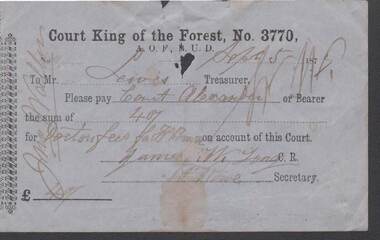
... Mr. Lewis, Treasurer. Please pay Court Alexander or Bearer the sum of 40/- for Doctors fees for H. Brown...Mr. Lewis, Treasurer. Please pay Court Alexander or Bearer the sum of 40/- for Doctors fees for H. Brown ...Blue paper headed Court King of the Forest, No. 3770 A.O.F, B.U.D., dated Sept 5 1877. To Mr. Lewis, Treasurer. Please pay Court Alexander or Bearer the sum of 40/- for Doctors fees for H. Brown on account of this Court. Signed by James W. Long, C. R. and Wm. Rowe, Secretary.societies, aof, correspondence, ancient order of foresters no. 3770 collection - to pay, court king of the forest no 3770, mr lewis, court alexander, james w long, wm rowe
