
Showing 65 items matching "hotel lamp"
-
 City of Ballarat Libraries
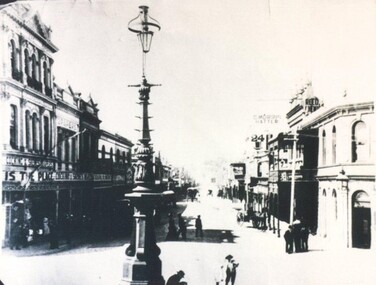
Photograph - Card Box Photographs, View east along Bridge Street, Ballarat circa 1890
... Hotel...C.Morris...Streetscape...Street Lamp...Bridge Street Cocking & Skewes Bucks Head Hotel C.Morris Streetscape Street Lamp Commerical Building Vehicle View east along Bridge Street, Ballarat circa 1890. ...Along the street are Cocking & Skewes, the Bucks Head Hotel and C. Morris, Hatter.bridge street, cocking & skewes, bucks head hotel, c.morris, streetscape, street lamp, commerical, building, vehicle -
 Kew Historical Society Inc
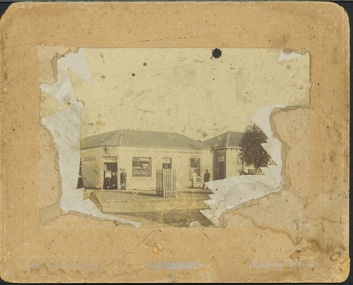
Photograph - Royal Hotel, Sunbury, C.H.R. Christianson, 1890s
... HOTEL [illegible] BILLIARDS." An attached building at right may be the residence of the licensee. Specific architectural features of the building include a corner doorway with a lamp above, three sash windows and a larger square lead-light window to the right of the doorway. ...HOTEL [illegible] BILLIARDS." An attached building at right may be the residence of the licensee. Specific architectural features of the building include a corner doorway with a lamp above, three sash windows and a larger square lead-light window to the right of the doorway. ...This item is part of a larger collection donated to the Kew Historical Society by Anna French. The collection includes personal items from the donor's family, as well as items given to the donor and her mother by a family friend, Lucy Merritt (Jean) Hornby. The item is from that part of the collection inherited or assembled by Jean Hornby. The collection is significant given Jean Hornby's mother's descent from Robert Hornby (1854-1935) and Eva Merritt (1865-1959); her mother the chid of a family who settled in Kew in the 1850s, this providing a chain of provenance for items dating to the mid-nineteenth century, when her maternal forebears arrived in Melbourne. Other items represent Jean Hornby's contribution to her local and wider community.This 19th century photograph includes significant architectural details of an important hotel in Sunbury, Victoria. Additionally, it was taken by a local photographer - CHR Christianson - who operated the Sunbury [photographic] Studio. Silver albumen print, mounted on board, of the original Royal Hotel on the corner of Brook and Evans Streets, Sunbury, Victoria.The single-storey, rendered brick building with a corrugated galvanised iron roof includes a number of pieces of information that may assist in dating the photograph. The licensee's name above the door appears to be M.A. Williams. To the left of the door on the external wall is a painted sign: 'BILLIARDS". Another painted sign on the front of the building reads "ROYAL HOTEL [illegible] BILLIARDS." An attached building at right may be the residence of the licensee. Specific architectural features of the building include a corner doorway with a lamp above, three sash windows and a larger square lead-light window to the right of the doorway. The latter identifies the space behind as the "BAR". On the footpath in front of this building is a grill set into the footpath to enable deliveries to a cellar. At least four figures can be identified in the photograph: a woman in the doorway, a man to her right, leaning against the wall, and two other men at the right hand side of the building. Beyond the boundary of the building is a sloping footpath to a bluestone edged gutter. An elm [sic] within a protective, picketed surround is in front of the building. C.H.R. Christianson is identified on the reverse as the photographer. Reverse in pencil: Royal Hotel Billards Sunbury / CHR Christianson photographerroyal hotel -- sunbury (vic.), chr christianson -- photographer, hotels -- sunbury (vic.), recreation -- billiards -
 Linton and District Historical Society Inc
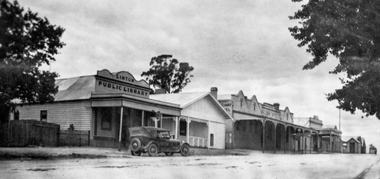
Photograph, Linton Public Library, Sussex Street, Linton, between 1927 and 1932
... Other buildings are the house owned by the Nelson family, the Railway Hotel, Dan Cornish's shoe shop and the weighbridge. A gas lamp is attached to the verandah of the library building. ...Other buildings are the house owned by the Nelson family, the Railway Hotel, Dan Cornish's shoe shop and the weighbridge. A gas lamp is attached to the verandah of the library building. ...The photograph is dated to between 1927 and 1932, as the Nelson house has been renovated (this happened in 1927). Dan Cornish sold his shoe shop in 1932 (it became Murrell's newsagency). Black and white image which shows buildings in Sussex Street, Linton. The building in the foreground, the Linton Public Library, has a car parked in front of it. Other buildings are the house owned by the Nelson family, the Railway Hotel, Dan Cornish's shoe shop and the weighbridge. A gas lamp is attached to the verandah of the library building. The library building still has the curvilinear parapet which is shown in a photo of the building taken between1901 and 1914.linton public library, nelson premises, railway hotel, dan cornish shoe shop, weighbridge -
 Melbourne Tram Museum
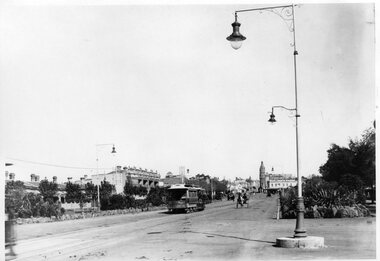
Photograph - Black and White - St Kilda Road, looking south to St Kilda Junction
... In the background is the Junction Hotel and the Corner Hotel advertising Black and White whiskey. There are a number of gas street lamps in the view....In the background is the Junction Hotel and the Corner Hotel advertising Black and White whiskey. There are a number of gas street lamps in the view. ...St Kilda Road, looking south to St Kilda Junction from near Peel Street. Photo shows a number of horse drawn vehicles and one cable tram on its way to St Kilda Beach. In the background is the Junction Hotel and the Corner Hotel advertising Black and White whiskey. There are a number of gas street lamps in the view.Yields information about St Kilda Road and St Kilda Junction about 1900.Black and white photograph - St Kilda Road, looking south to St Kilda Junction, c1900. Two copies held.tramways, trams, st kilda road, st kilda junction, cable trams, corner hotel, junction hotel -
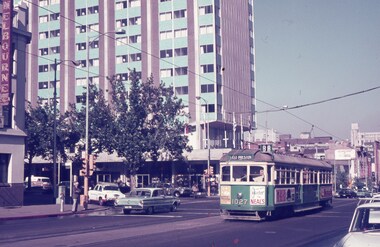 Melbourne Tram Museum
Slide - Set of 5, Keith Caldwell, Oct. 1978
... Hotel". "1-11-78" .2 - Z44 and Z51, west bound with the new building for the State Savings Bank of Victoria in the background along with London Stores, McEwans hardware store and the Rochelle House. Route 95. .3 - Z83 as for .2 .4 - Z75 - west bound between Queen and William St. .5 - Z83 outbound at the corner of Bourke and Spring Streets and Z94 inbound turning on the curve, both route 88. Photo taken from the steps of Parliament House and has one of the ornate lamps...Hotel". "1-11-78" .2 - Z44 and Z51, west bound with the new building for the State Savings Bank of Victoria in the background along with London Stores, McEwans hardware store and the Rochelle House. Route 95. .3 - Z83 as for .2 .4 - Z75 - west bound between Queen and William St. .5 - Z83 outbound at the corner of Bourke and Spring Streets and Z94 inbound turning on the curve, both route 88. Photo taken from the steps of Parliament House and has one of the ornate lamps ...Set of 5 Agfa colour slide, blue and white plastic mount, photo by Keith Caldwell Oct 1978 of trams in Bourke St. .1 - W7 1027 at Exhibition St with the Southern Cross Hotel in the background. Tram has the destination of West Preston Route 88. In the view is a sign for the "Melbourne Hotel". "1-11-78" .2 - Z44 and Z51, west bound with the new building for the State Savings Bank of Victoria in the background along with London Stores, McEwans hardware store and the Rochelle House. Route 95. .3 - Z83 as for .2 .4 - Z75 - west bound between Queen and William St. .5 - Z83 outbound at the corner of Bourke and Spring Streets and Z94 inbound turning on the curve, both route 88. Photo taken from the steps of Parliament House and has one of the ornate lamps in the view. Has the Imperial Hotel in the background, along with Hoyts the Cinema Centre, Windsor Hotel.1 - has "1-11-78" written in red ink.trams, tramways, bourke st, parliament, route 88, west preston, route 95, w7 class, z class, spring st, tram 1027, tram 44, tram 51, tram 83, tram 75, tram 94
