
Showing 90 items matching "the valley of love"
-
 Sunbury Family History and Heritage Society Inc.
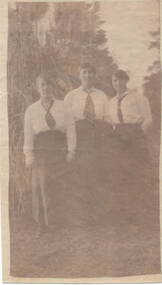
Photograph, Three ladies, c1910 - 1920
... LOVE/FROM MURIEL/I FORGOT TO PUT IT IN/MY LETTER. A non-digital sepia photograph with a cream border printed on very thin paper of three ladies dressed in long skirts and white long sleeved blouses with dark ties. They are standing in a valley ...A non-digital sepia photograph with a cream border printed on very thin paper of three ladies dressed in long skirts and white long sleeved blouses with dark ties. They are standing in a valley with a hill and trees behind them. Written on the back in ink: WITH FONDEST LOVE/FROM MURIEL/I FORGOT TO PUT IT IN/MY LETTER. -
 Whitehorse Historical Society Inc.
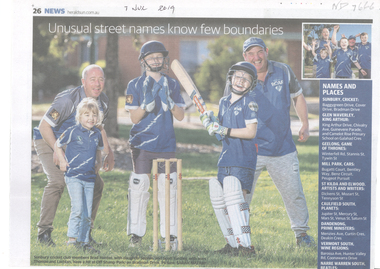
Article, Catchy Addresses, 2019
... Agra Street Mitcham Calcutta Street Mitcham Delhi Street Mitcham Barossa Avenue Vermont South Hunter Valley Road Vermont South Coonawarra Drive Vermont South Mitcham streets reflecting Indian cities that were named by a well-known local who loved travelling there. ...Mitcham streets reflecting Indian cities that were named by a well-known local who loved travelling there.Mitcham streets reflecting Indian cities that were named by a well-known local who loved travelling there. Vermont South streets named after Australia's best wine regions was testament to the suburb's wine-making history.Mitcham streets reflecting Indian cities that were named by a well-known local who loved travelling there. agra street, mitcham, calcutta street, mitcham, delhi street, mitcham, barossa avenue, vermont south, hunter valley road, vermont south, coonawarra drive, vermont south -
 Kew Historical Society Inc
Journal, Kewriosity : May 1984
... Valley Powerlines] / p4. Mayoral Comment - Kew, its park and the SEC / Cr Jill O'Brien p5. Kew heritage [proposed heritage study] / p5. Philharmonic [Kew Philharmonic Orchestra] / p6. Kew Holiday Programme [Sacred Heart Church] / p6. The Gibbs Wathen Family re-union / p6. Yarra River Study - Dights' Falls to Burke Road / p6. Starlight Theatrical Company / p6. Kew Community House - 2nd Term Programme / p7. Public meeting - information sharing in Kew [Kewriosity Editorial Committee] / p7. Recyclotron / p7. Public Meeting - SEC Power Line / p8. Datelines [KPSA auction of pre-loved ...Bringing back the memories - in style [William Martin, Elder Care] / p1. Petrie Square / p1. Billabong Club / p2. Kew Garden Club / p2. Gone Bush! [Native Plant Group] / p2. Kew Bowling Club / p2. The Rheumatism and Arthritis Association Kew Self Help Group / p2. National Arthritis Week in Victoria / p2. Kew (Daytime) Garden Club / p2. Hockey [Kew Women's Hockey Club] / p2. Scouts / p2. May School Holiday Programme [Mobile New Trailer Games; Drop-in Centre; Kew Traffic School; Building or renovating; / p3. Kew Youth Resource Centre / p3. How Green is Our Valley - a continuing saga [S.E.C. Yarra Valley Powerlines] / p4. Mayoral Comment - Kew, its park and the SEC / Cr Jill O'Brien p5. Kew heritage [proposed heritage study] / p5. Philharmonic [Kew Philharmonic Orchestra] / p6. Kew Holiday Programme [Sacred Heart Church] / p6. The Gibbs Wathen Family re-union / p6. Yarra River Study - Dights' Falls to Burke Road / p6. Starlight Theatrical Company / p6. Kew Community House - 2nd Term Programme / p7. Public meeting - information sharing in Kew [Kewriosity Editorial Committee] / p7. Recyclotron / p7. Public Meeting - SEC Power Line / p8. Datelines [KPSA auction of pre-loved goods; A.L.P.; Guide Dogs Toastmasters Club, Kew - 100th meeting] / p8. Building? [regulations] / p8.Kewriosity was a local newsletter combining Kew Council and community news. It was published between November 1983 and June 1994, replacing an earlier Kewriosity [broad] Sheet (1979-84). In producing Kewriosity, Council aimed to provide a range of interesting and informative articles covering its deliberations and decision making, together with items of general interest and importance to the Kew community and information not generally available through daily media outlets.non-fictionBringing back the memories - in style [William Martin, Elder Care] / p1. Petrie Square / p1. Billabong Club / p2. Kew Garden Club / p2. Gone Bush! [Native Plant Group] / p2. Kew Bowling Club / p2. The Rheumatism and Arthritis Association Kew Self Help Group / p2. National Arthritis Week in Victoria / p2. Kew (Daytime) Garden Club / p2. Hockey [Kew Women's Hockey Club] / p2. Scouts / p2. May School Holiday Programme [Mobile New Trailer Games; Drop-in Centre; Kew Traffic School; Building or renovating; / p3. Kew Youth Resource Centre / p3. How Green is Our Valley - a continuing saga [S.E.C. Yarra Valley Powerlines] / p4. Mayoral Comment - Kew, its park and the SEC / Cr Jill O'Brien p5. Kew heritage [proposed heritage study] / p5. Philharmonic [Kew Philharmonic Orchestra] / p6. Kew Holiday Programme [Sacred Heart Church] / p6. The Gibbs Wathen Family re-union / p6. Yarra River Study - Dights' Falls to Burke Road / p6. Starlight Theatrical Company / p6. Kew Community House - 2nd Term Programme / p7. Public meeting - information sharing in Kew [Kewriosity Editorial Committee] / p7. Recyclotron / p7. Public Meeting - SEC Power Line / p8. Datelines [KPSA auction of pre-loved goods; A.L.P.; Guide Dogs Toastmasters Club, Kew - 100th meeting] / p8. Building? [regulations] / p8. publications -- city of kew (vic.), kewriosity, council newsletters, community newsletters -
 Mont De Lancey
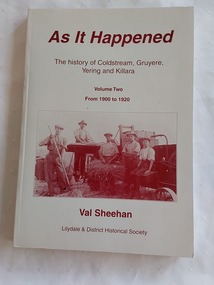
Book, Val Sheehan, As it Happened: The History of Coldstream, Gruyere, Yering and Killara: Volume Two, 2003
... Included is a local newspaper cutting from the Yarra Valley Leader June 23, 2003 p.14 titled: A Love of History about the Coldstream author and historian Val Sheehan....Included is a local newspaper cutting from the Yarra Valley Leader June 23, 2003 p.14 titled: A Love of History about the Coldstream author and historian Val Sheehan. ...Volume Two covers the history of the area from 1900 - 1920. The book is divided into sections covering family, sport, social life, disasters, transport, schools, business, Dame Nellie Melba and Lillydale Council. Includes extracts from newspapers, photographs and index. Included is a local newspaper cutting from the Yarra Valley Leader June 23, 2003 p.14 titled: A Love of History about the Coldstream author and historian Val Sheehan.A white covered book with all information printed in red - the title, As it Happened: The History of Coldstream, Gruyere, Yering and Killara Volume Two from 1900 to 1920 and a photograph of William Reade with his sons Bill, Sam, Ern and George at Glenadara harvesting a crop sitting by the side of a truck. The author is printed below along with Lilydale & District Historical Society at the bottom. The spine has the title, volume and author printed in green lettering. There is a Contents page and Index at the back. Inside are detailed facts, photographs, posters, Death Notices, Sports, Schools and more about the area's development to 1920. Reference is made to the Sebire family on p.8. On the back cover in red print is a photograph of a bronze plaque presented after the death of James Edward Fraser. Inscription: HE DIED FOR FREEDOM AND HONOUR. Pp.216. Included is a local newspaper cutting from the Yarra Valley Leader June 23, 2003 p.14 titled: A Love of History about the Coldstream author and historian Val Sheehan.non-fictionVolume Two covers the history of the area from 1900 - 1920. The book is divided into sections covering family, sport, social life, disasters, transport, schools, business, Dame Nellie Melba and Lillydale Council. Includes extracts from newspapers, photographs and index. Included is a local newspaper cutting from the Yarra Valley Leader June 23, 2003 p.14 titled: A Love of History about the Coldstream author and historian Val Sheehan.history - lilydale and district, settlement - lilydale and district, victoria - history -
 Mont De Lancey
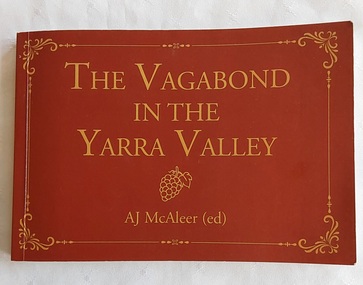
Book, A J McAleer, The Vagabond in the Yarra Valley, 2016
... Inside the front cover is a dedication to two ladies who loved the history of the Yarra Valley as well as full publishing details. ...Valley between 1877 and 1894 provide an invaluable historical snapshot of the region's evolving landscape, rural industries, and itinerant communities. A small tan rectangular book with the title printed in yellow at the top, an outline of a bunch of grapes and the editor's name below. There is a scroll style decorative edge around it. Inside the front cover is a dedication to two ladies who loved ..."The Vagabond" was the pen name of 19th-century investigative journalist John Stanley James (born Julian Thomas), who chronicled the hidden and working-class lives of Victoria's society. His vivid, often undercover essays detailing his visits to the Yarra Valley between 1877 and 1894 provide an invaluable historical snapshot of the region's evolving landscape, rural industries, and itinerant communities.A small tan rectangular book with the title printed in yellow at the top, an outline of a bunch of grapes and the editor's name below. There is a scroll style decorative edge around it. Inside the front cover is a dedication to two ladies who loved the history of the Yarra Valley as well as full publishing details. There is a Title page, Preface, Introduction, Foreword, Appendix, Acknowledgements and and Index. It tells the story of who 'The Vagabond' journalist was in his nomadic travels in the early settler days of the community. It has very informative stories and anecdotes, with black and white photographs. There is also a list of other titles by the same author inside the back cover. The back cover blurb states the contents of the book. Pp. 148non-fiction"The Vagabond" was the pen name of 19th-century investigative journalist John Stanley James (born Julian Thomas), who chronicled the hidden and working-class lives of Victoria's society. His vivid, often undercover essays detailing his visits to the Yarra Valley between 1877 and 1894 provide an invaluable historical snapshot of the region's evolving landscape, rural industries, and itinerant communities.yarra valley - history, yarra valley, yarra valley - victoria -
 Mont De Lancey
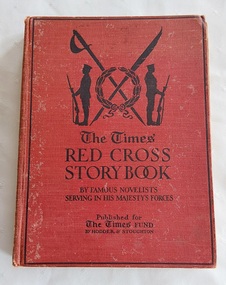
Book, Hodder & Stoughton, The Times' Red Cross Story Book, 1915
... "Valley View" Seville 25/12/1919' On the next page is: 'Ethel Moffat. from her loved little marie-in-law. ...loved little marie-in-law. Xmas 1919. Children's Books Children's Fiction WW1 The Times' Red Cross Story Book is a 1915 anthology of 18 short tales, featuring contributions by A.A. Milne, A.E.W. Mason, and Sir Arthur Quiller-Couch. Published during World War I by Hodder and Stoughton for The Times Fund for the Sick and Wounded, the volume showcased writing by active duty service members to benefit war relief. On the right front end paper: 'Ethel Moffat. "Valley ...The Times' Red Cross Story Book is a 1915 anthology of 18 short tales, featuring contributions by A.A. Milne, A.E.W. Mason, and Sir Arthur Quiller-Couch. Published during World War I by Hodder and Stoughton for The Times Fund for the Sick and Wounded, the volume showcased writing by active duty service members to benefit war relief.A red cloth covered book with the title printed in black with silhouettes of two soldiers standing each side of a wreath which has a crossed sword and nib quill pen behind. The publisher is printed below. The spine has the same details. There is a Contents page followed by the stories. On the right front end paper and on the next page are handwritten inscriptions. Black and white illustrations are throughout the book. Pp.192.fictionThe Times' Red Cross Story Book is a 1915 anthology of 18 short tales, featuring contributions by A.A. Milne, A.E.W. Mason, and Sir Arthur Quiller-Couch. Published during World War I by Hodder and Stoughton for The Times Fund for the Sick and Wounded, the volume showcased writing by active duty service members to benefit war relief. children's books, children's fiction, ww1 -
 Carlton Football Club
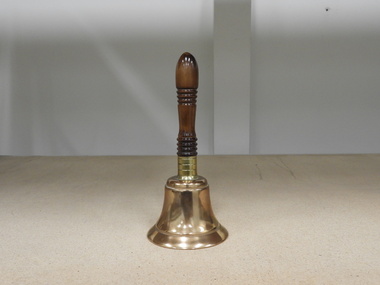
Hand Held Bell, Hand Held Bell with a small inscription on the inside
... Dear Pa, May you always ring true blue, Love Harry Just thinking about that inscription often brings big Al to tears. The story of the Espie bell has its origins at the old family property at Wandin in the picturesque Yarra Valley, in the days when the Espies’ kids were at the neighboring creek fossicking for local platypus. ...The bell was used for Trade Week to signify "time's up" at Optus Oval. Prior to this it was used to let Alan Espie's children on their Wandin property to come home.Why Al chimes in for Carlton Tony De Bolfo, Carlton Media Feb 20, 2014 11:05AM Alan Espie with the famous bell. (Photo: Carlton Football Club) Alan Espie with the famous bell. (Photo: Carlton Football Club) Related Etched into the rim of the bell Alan Espie has rung at every trade week gathering since 1994 is a touching quote attributed to his grandson. Dear Pa, May you always ring true blue, Love Harry Just thinking about that inscription often brings big Al to tears. The story of the Espie bell has its origins at the old family property at Wandin in the picturesque Yarra Valley, in the days when the Espies’ kids were at the neighboring creek fossicking for local platypus. “If they got too far away we’d ring an old cowbell,” Espie recalled, “and years later, my daughter Jo brought me this replacement bell from some second-hand naval place”. “Not long after Shane (O’Sullivan) asked me to officiate at trade week and that’s when the bell came into vogue.” A permanent fixture at trade week, Espie would ring the bell to signal the opening of trading when club recruiters gathered – initially within the confines of the Carlton Heroes Stand at Visy Park, more recently at Etihad Stadium. In those early days at Carlton he caused a stir as bell ringer, drawing curious responses from officiating journalists, recruiters and coaches alike. “I even remember (Kevin) Sheedy asking me if I was selling muffins,” he recalled. Then, when trade day was relocated to Etihad, Espie’s daughter thought it appropriate to get the bell inscribed. “Because the bell was leaving Carlton, Jo got it inscribed on my grandson’s behalf, because he was only four or five then. When I saw what was inscribed I was tearful,” Espie said. “The bell is very important to me, particularly at this time, because Jo is battling health problems at the moment, my grandson is autistic and she’s fought like hell to get him through.” Espie joined Carlton’s Under 19 committee on the eve of the senior Premiership season of 1979 and managed the club’s junior squads, the Bert Deacon Squad included. “I worked very closely with Geoff Southby, ‘Swan’ McKay and Trevor Keogh when they were coaching the Under 19s and I was recruiting as well,” he said. “In 1981 and ’82 I forward scouted for ‘Parko’ (David Parkin) and later on I did the same for ‘Wallsy’ (Robert Walls). After that I coordinated recruiting in central Victoria and it was nothing for me to do 25,000ks a year in my own car – and I loved every minute of it.” Espie’s passion for Carlton and empathy for its wartime players Bert Deacon, Ollie Grieve and Jack “Chooka” Howell can be sourced to his childhood years. His grandparents lived not far from the old ground on Wilson Street “and that’s how I got in for the ’45 Grand Final”. “My uncle, who had just got back from the war, grabbed a ladder from Wilson Street and set it up against the barbed wire fence at the ground. I climbed the ladder and caught my arm on the barbed wire, but I got over the top and saw the game while I straddled the fence,” Espie said. “What I saw was what you would today call ‘spotfires’ and I reckon it took football 20 years to get rid of it.” Today, Espie continues to ring in the yearly trade talk days at AFL headquarters (with the notable exception of 2012 when he was hospitalized), but he’s in no doubt as to where the bell belongs. “This bell has had nothing to do with Wandin but everything to do with Carlton - and with the 150th year of the club I think the bell stays here (at Visy Park). I still hope to ring the bell for the AFL this year, but at least I’ll know where it is,” Espie said. “I’ve told Jo about this and she tells me Harry’s rapt, because he’s a big Carlton supporter and he’s so happy his name is on the bell.”Wooden handle attached to a brass bell."Dear Pa, may you always ring true blue, Love Harry" -
 Carlton Football Club
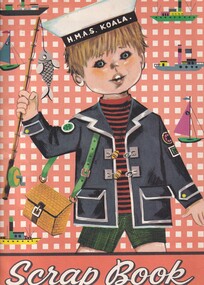
Scrap Book, Dedicated to Carlton Player John Goold
... loved the game of polo and the rough and tumble of fox hunting. While at school he was a fervent Melbourne supporter, but strangely, never had much confidence in his football ability. “If I thought I was good enough, I would certainly have gone to Melbourne,” he said many years later. “But I honestly didn’t think I would ever amount to anything in this game. Cricket and tennis were the games that really interested me.’ However, after graduating from MGS, Goold went home to Healesville to star in the Bloods’ 1962 Yarra Valley ...John Goold double Premiership PlayerA scrap Book dedicated to twice Premiership Player 1968 - 1970 John Goold Career : 1963 - 1970 Debut : Round 7, 1963 vs Footscray, aged 21 years, 338 days Carlton Player No. 754 Games : 108 Goals : 3 Last Game : Grand Final, 1970 vs Collingwood, aged 29 years, 90 days Guernsey No. 11 Height : 184 cm (6 ft ½ in.) Weight : 76 kg (12 stone, 0 lbs.) DOB : June 27, 1941 Premiership Player 1968, 1970 Carlton Hall of Fame All Australian 1966 A brilliant, flamboyant, two-time Premiership player for Carlton during the Barassi years in the ‘swingin’ sixties,’ John William Crosbie Goold became almost as famous for his dapper appearance off the field, as for his exploits on it. At the height of his football career, he was also a prominent ladies fashion designer – which led to him being dubbed ‘Mr Elegance’ by leading football commentator Lou Richards. Supporters and team-mates however, called him ‘Rags’ or ‘Ragsy,’ because of his involvement in the clothing, or ‘rag’ trade. Goold first came under notice as an outstanding junior athlete at Melbourne Grammar School. A true all-round sportsman, he shone at tennis, athletics, football and cricket. He was also a keen horseman who loved the game of polo and the rough and tumble of fox hunting. While at school he was a fervent Melbourne supporter, but strangely, never had much confidence in his football ability. “If I thought I was good enough, I would certainly have gone to Melbourne,” he said many years later. “But I honestly didn’t think I would ever amount to anything in this game. Cricket and tennis were the games that really interested me.’ However, after graduating from MGS, Goold went home to Healesville to star in the Bloods’ 1962 Yarra Valley Football Association Premiership team – an achievement that brought tempting offers from more than one VFL club. “Incentives were offered elsewhere,” he recalled, “but I gravitated to Carlton – partly because the deep blue of their guernsey attracted me, but mostly because of the good advice I got from people who even then were longsighted enough to predict that big things were ahead for this club.” The Blues were confident enough in Goold’s potential to offer him the guernsey number 11 previously worn with distinction by the likes of Jack Hale, Jim Knight, Ron Hines and Laurie Kerr, and his first senior game came in round 7, 1963 against Footscray at the Western Oval. He played on a half-forward flank alongside Brownlow Medallists Gordon Collis and John James on that Saturday afternoon, and kicked his first career goal in an 8-point win. Little did he know though, that it would be another six seasons before he would again experience the thrill of sending a football spinning between the big posts, because his future lay in defence. By his own admission, Goold struggled to find his feet in VFL football during his first two seasons, until the shock appointment of Ron Barassi as captain-coach of Carlton in 1965 began steering his career back on track. “I think you could say that 1965 was my first year of League football,” he said, “That’s the way I felt - that’s the way I reacted to Barassi.” Under Barassi, Goold rapidly developed into a superb running half-back flanker. Tenacious, and an often freakish high mark, he was unmistakable on the field thanks to his mane of dark hair, his loping running style and somewhat awkward kicking action. Furthermore, he had boundless courage. There is no doubt that he would have played many more games had he not been regularly pole-axed under the high ball – a fact he later freely admitted. “I was always getting knocked out,” he said, “and spent half my bloody time in hospital.” In the second half of 1965, an injury to centre half-back Gordon Collis forced Barassi to use Goold in the key defensive post. While it curtailed his rebounding instincts somewhat, ‘Ragsy’ rose to the challenge and rarely lowered his colours. Testament to his improvement, he finished third behind John Nicholls and Sergio Silvagni in Carlton’s 1965 Best and Fairest award, and followed up by being selected in the Victorian team for the 1966 Hobart Carnival. There, he had a superb series in which he was runner-up to West Australian Barry Cable in voting for the Tassie Medal, and capped it off by being named on a half-back flank in the All Australian team. Barassi’s influence at Carlton bore fruit in his third year, when the Blues returned to finals football at last. Richmond, Carlton, Geelong and Collingwood fought out the 1967 Premiership, and Ragsy Goold won the hearts of the Carlton faithful with two lion-hearted performances. Although Carlton was knocked out of contention by successive losses to Richmond and Geelong, Goold was tireless throughout both games, and it was obvious that he thrived on the added pressure of finals football. Precisely twelve months later, the bitter taste of those defeats was washed away when Barassi’s Blues edged out Essendon by 3 points in the 1968 Grand Final, and ended 21 years of despair at Princes Park. To win Carlton’s ninth VFL flag, the Blues had had to defeat the minor premier Bombers twice during the finals – and did so, thanks to a watertight defence led by Goold, and a dominant ruck division headed by John Nicholls. In round 5, 1969, Carlton hosted South Melbourne at Princes Park in a match significant for a number of reasons. As he regularly did, Ron Barassi swung his team around prior to the opening bounce, and Goold found himself in the unaccustomed role of ruck-rover. While the Blues set about establishing a good break on the scoreboard, Ragsy relished the freedom to kick two first half goals - his first majors for 78 games. Just before half-time however, he was flattened in a pack, concussed again, and replaced during the long break by Barry Gill. Alex Jesaulenko was substituted at the same time – by a shy, ambitious youngster named Bruce Doull, making his senior debut for Carlton in guernsey number 4. In September, 1969 the Navy Blues began their third straight finals campaign with an impressive 6-goal Semi Final win over Collingwood in front of more than 108,000 fans at the MCG. A fortnight later, Richmond stunned the flag favourites with a withering last quarter in the Grand Final, and knocked Carlton out of the Premiership race again at the last hurdle. Half-way through the year, Carlton's club doctor discovered that Goold had been playing with shin splints in both of his lower legs. The pain they caused was considerable, but Ragsy soldiered on and held down centre half-back throughout the season. John Goold’s VFL career at Carlton culminated in the fabled 1970 Grand Final triumph over Collingwood. What is not so well known is that Ragsy was only cleared to play in that game on the morning of the match. After narrowly losing to Collingwood in the second Semi Final, the Navy Blues destroyed St Kilda by 62 points in the Preliminary Final, and earned another shot at the Magpies in the decider. But one of Carlton’s problems was that Goold had been kicked on a shin against St Kilda, causing a burst blood vessel and serious swelling. Despite the best efforts of the club medical staff, Ragsy had only a slim chance of playing in the Grand Final right up until game day, when his worried coach reluctantly allowed him to take his place in the side. Later, Barassi justified his decision by saying that in his opinion, a less than fully fit Goold was still worth his place in the team. By half time in the Grand Final however, he was probably questioning that judgement - because Carlton had been totally outplayed, and trailed an impressive, cohesive Collingwood by 44 points. Therefore, Carlton’s magnificent comeback – orchestrated by Barassi, and sparked by the fairytale exploits of 19th man Ted Hopkins – is one of the greatest of all football stories. Against enormous odds, the Navy Blues fought their way back into the contest, and eventually, rolled over the top of the frantic Magpies to snatch victory by 10 points in the last few minutes of the match. Hopkins ended up with four goals, Barassi was hailed a genius, and Ragsy Goold was carted off to hospital immediately after the game to have further urgent treatment. While there, he decided that there was no better time to end his VFL career – especially because his burgeoning business interests were demanding more and more of his time. In the years after his football career ended, John Goold created a remarkably successful business empire. In 1971 he sold his fashion label and took up farming at Mortlake in western Victoria, where he coached the local football team for three seasons. Later, he formed a diversified pastoral company, and purchased a magnificent complex called Ballangeich Run at nearby Ellerslie. While his passion for farming and livestock grew, he began breeding top quality polo ponies, and represented Australia in international competition. During the 1997 and 1998 seasons, John's son Ed Goold played reserve grade football for Carlton. MEMORIES.... Ragsy Goold; the name stirs memories form my long ago childhood. Ragsy, with his unique kicking style, where he'd hold the ball (always a drop punt - in a time when the drop kick and the torpedo punt still reigned supreme) at the point of the ball, elbows bent and he'd lavishly drop the ball, his right arm then flinging back and up dramatically. That was the thing about Ragsy (so named because he worked in the clothing, or 'rag' trade), he was always dramatic. He always ensured his ankle guards and wrist guard were glowing white to match the great white CFC monogram he wore proudly on his chest, and with his long flowing locks, cut a dynamic figure through a young boy's mind. Ragsy was my idol. I loved his dashes from half back, his long accurate drop punts, most of all I loved his flair for the game. Ragsy played the game as an entertainer as well as a sportsman - he leapt high to punch or mark, and always seemed to have a bit of the thoroughbred about him - which is probably why after he retired, he took up fox chasing, polo, and riding his beloved thoroughbreds across the paddocks and over the fences of his property, I think he may have even represented Australia at the sport – really, that’s sort of how he played as a footballer. All sinewy muscle, long legs and famous leaps for the saving punch. Ragsy was part of the great backline that helped revive Carlton's fortunes. Legendary players Wes Lofts, Ian Collins, Kevin 'Racehorse' Hall, Vinnie Waite among them. All great teams have a great defence and the defence that Ragsy was an integral part of was no different. Where others provided the biffo, the muscle or the defensive pressure, Ragsy provided the dash, the flair, the sense of adventure that all great backlines must have. AND MORE.... I have had many favourite players while following the Blues, but there will always be a special spot for Ragsy Goold - running the lines, all long hair and flashing white guards. As a young man I moved to Carlton and began acting in a place called one-c-one. One night after a play, I was walking home. It was winter, and I was wearing my favouritte overcoat, a genuine ankle length tweed affair I had picked up in an Op Shop in Oakleigh for three dollars. As I strutted across Lygon Street, a deep male voice behind me called, 'hey laddie, how much for the overcoat?' I turned, and there was my childhood idol, Ragsy Goold, two beautiful women in tow, smiling and waiting for my answer. I loved that coat too much to part with it, even to Ragsy, so I shook my head - and he smiled, then walked off. I stood for a moment in the middle of the street shaking my head in disbelief. Ragsy bloody Goold had just offered to buy my overcoat! I knew at that point, as a young man of about twenty three, that life was going to be full of surprises and very entertaining - a bit like John ‘Ragsy’ Goold. ONE MORE.... A cold, wet day in the mid 1960's at the MCG and Victoria were playing South Australia (?) The ball that day was like a piece of soap, with players finding it impossible to mark. Just before half time a long kick sailed toward the mud heap that was the centre of the ground, and the pack rose to meet it. From this group of players an arm shot straight up, and the ball instantly came to a dead stop. The footy stuck in the player's palm as if the hand was coated in Tarzan's Grip. After all these years, it's the only recollection I have of that match, and that player was 'Mr. Elegance' John Goold. HUMOROUS HUNGRY.... Former opponent Richmond's Kevin Bartlett on Radio SEN in 2012 received a phone call from John. After the call Kevin told his listeners how "Mr Elegance" would always be dressed in a nice suit, shirt-tie and highly polished shoes. He then cracked a joke saying something like; "You know, John was so 'posh' that he used to play football wearing a cravat!" Milestones 50 Games: Round 15, 1967 vs Melbourne 100 Games: Round 13, 1970 vs Geelong Career Highlights 1965 - Percy Bentley Trophy - 3rd Best & Fairest 1966 - 5th Best & Fairest 1967 - Maurie Sankey Memorial Trophy - 4th Best & Fairest (on count back) 1968 - Premiership Player 1970 - 7th Best & Fairest 1970 - Premiership PlayerFoolscap Scrap Book -
 Falls Creek Historical Society
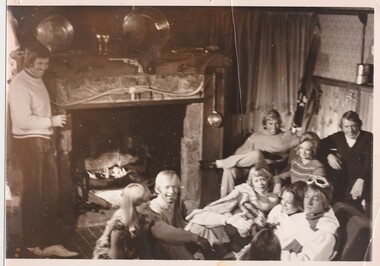
Photograph - Paul Hogan at Julian's Lodge 1973
... love for the mountains, Julian moved to Mt. Beauty and then Falls Creek. He worked for the SEC in the test laboratory at Rocky Valley reading weather instruments. ...love for the mountains, Julian moved to Mt. Beauty and then Falls Creek. He worked for the SEC in the test laboratory at Rocky Valley reading weather instruments. ...Julian Newton-Brown arrived at Falls Creek in 1957. He had studied Pharmacy at Melbourne University. After developing a love for the mountains, Julian moved to Mt. Beauty and then Falls Creek. He worked for the SEC in the test laboratory at Rocky Valley reading weather instruments. By working several jobs, Julian was able to build a small lodge of 10 beds named “Arundel”, located at 18 Slalom Street, Falls Creek. The lodge is now the “Elk at Falls”. Arundel prospered and Julian extended it to include 32 beds and changed its name to "Julian’s” in 1961. When alcohol restrictions were eased in Falls Creek, Julian built a night club which he called “Big Julian’s” and later “THE MAN”. When Julian and his wife Beth retired and left Falls Creek, their son took over running the lodge. An active community man, Julian was a member of the Falls Creek Chamber of Commerce, a member of the SES, a stakeholder in Falls Creek, an author and a documentary maker. Julian Newton-Brown died in May 2020. In 2003 when this flyer was published operation of Julian's Lodge transferred from Julian and is wife Beth to their son Charlie Brown, a former Australian Champion and World Cup skier and his wife, Bena.This item is significant because it gives details of an important lodge at Falls Creek, Victoria.A black and white image of Paul Hogan, John Cornell and other people sitting near fire place in the dining room at Julian's Lodge in 1973. Paul Hogan and a group of actors and film crew spent several days in Falls Creek filming a Winfield cigarette commercial, in which they were portrayed as ski instructors. According to Julian Brown's book "Falls Creek - How it came to be", they brought in a truck load of polystyrene balls to create snow. The commercial was in 16mm for television and 36 mm for cinemas. It took them three days to shoot a six second scene in the dining room at Julian's lodge.julian's lodge, julian newton brown, falls creek ski lodges, accommodation falls creek, charlie brown -
 Falls Creek Historical Society
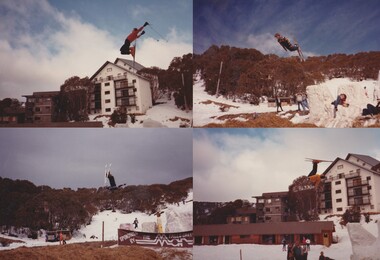
Photograph - Man made ski jump at Falls Creek 1961
... love for the mountains, Julian moved to Mt. Beauty and then Falls Creek. He worked for the SEC in the test laboratory at Rocky Valley reading weather instruments. ...love for the mountains, Julian moved to Mt. Beauty and then Falls Creek. He worked for the SEC in the test laboratory at Rocky Valley reading weather instruments. ...Julian Newton-Brown arrived at Falls Creek in 1957. He had studied Pharmacy at Melbourne University. After developing a love for the mountains, Julian moved to Mt. Beauty and then Falls Creek. He worked for the SEC in the test laboratory at Rocky Valley reading weather instruments. By working several jobs, Julian was able to build a small lodge of 10 beds named “Arundel”, located at 18 Slalom Street, Falls Creek. The lodge is now the “Elk at Falls”. Arundel prospered and Julian extended it to include 32 beds and changed its name to "Julian’s” in 1961. When alcohol restrictions were eased in Falls Creek, Julian built a night club which he called “Big Julian’s” and later “THE MAN”. When Julian and his wife Beth retired and left Falls Creek, their son took over running the lodge. An active community man, Julian was a member of the Falls Creek Chamber of Commerce, a member of the SES, a stakeholder in Falls Creek, an author and a documentary maker. Julian Newton-Brown died in May 2020. The ski jump was built by Julian Newton Brown and Nick Popov near Diana Lodge. Nick Popove and his wife Jean can be seen on the far right in the black and white image.This item is significant because it gives details of an important lodge at Falls Creek, Victoria.Photographs of action at the ski jump constructed c1960. julian's lodge, julian newton brown, falls creek ski lodges, accommodation falls creek, charlie brown -
 Falls Creek Historical Society
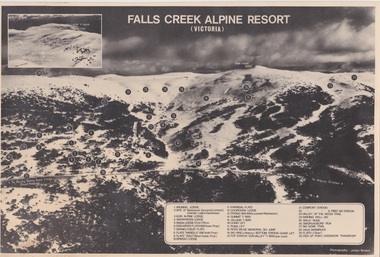
Map - Falls Creek Alpine Resort Map
... love for the mountains, Julian moved to Mt. Beauty and then Falls Creek. He worked for the SEC in the test laboratory at Rocky Valley reading weather instruments. ...love for the mountains, Julian moved to Mt. Beauty and then Falls Creek. He worked for the SEC in the test laboratory at Rocky Valley reading weather instruments. ...Julian Newton-Brown arrived at Falls Creek in 1957. He had studied Pharmacy at Melbourne University. After developing a love for the mountains, Julian moved to Mt. Beauty and then Falls Creek. He worked for the SEC in the test laboratory at Rocky Valley reading weather instruments. By working several jobs, Julian was able to build a small lodge of 10 beds named “Arundel”, located at 18 Slalom Street, Falls Creek. The lodge is now the “Elk at Falls”. Arundel prospered and Julian extended it to include 32 beds and changed its name to "Julian’s” in 1961. When alcohol restrictions were eased in Falls Creek, Julian built a night club which he called “Big Julian’s” and later “THE MAN”. When Julian and his wife Beth retired and left Falls Creek, their son took over running the lodge. An active community man, Julian was a member of the Falls Creek Chamber of Commerce, a member of the SES, a stakeholder in Falls Creek, an author and a documentary maker. Julian Newton-Brown died in May 2020.This map is significant because it contains an image of Falls Creek Alpine Resort.A black and white map of Falls Creek Alpine Resort Map featuring a photo taken by Julian Newton Brown. A numbered legend is included at the bottom right corner.dawn ski club, accommodation falls creek, lodges falls creek, tom mitchell -
 Falls Creek Historical Society
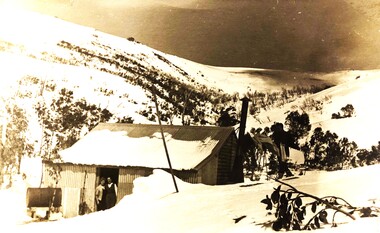
Photograph - SEC hut - home to Skippy and Toni St. Elmo
... love of skiing. Toni taught Skippy to ski and she practised on the High Plains where she and her husband lived. Toni entering her in the first club championships held by the Bogong Ski Club at Rocky Valley, which he had established. ...love of skiing. Toni taught Skippy to ski and she practised on the High Plains where she and her husband lived. Toni entering her in the first club championships held by the Bogong Ski Club at Rocky Valley, which he had established. ...Mavis Grace Lindsay born in 1917 and married Toni St. Elmo in Ballarat on 18 December 1944. She was known as “Skippy” from childhood. They moved from Melbourne in 1945 and spent the year living in Wallace’s Hut. Toni was employed by the State Electricity Commission to record weather-related data. They were to become responsible for early developments at the Falls Creek resort and for promoting a love of skiing. Toni taught Skippy to ski and she practised on the High Plains where she and her husband lived. Toni entering her in the first club championships held by the Bogong Ski Club at Rocky Valley, which he had established. Skippy St Elmo won many ski races during the 1950s and represented Australia in New Zealand. In 1947, the first ski lodge was built by six SEC employees including Toni St Elmo. The lodge was named “Skyline”. In 1957, Toni was involved in building the first rope tow at Falls Creek, called Nissen. He also established the Nissen Ski School. In 1949, Skippy won the Downhill and Combined State Championship held at Mt Buller. In 1950, Skippy was selected to compete in New Zealand with the Victorian team. Skippy trained with the men at the Bogong Ski Club which became a talking point in 1953 when the Albury Ski Club held an Open Championship and Skippy won in the Giant Slalom and Downhill. She went on to win many more races. In 1960, Skippy and Toni said farewell to Falls Creek. Skippy passed away in Queensland in July 2005 and Toni passed away in September of the same year. In November 2006 they were honoured at the Alpine Village at Falls Creek by the spreading of their ashes over Eagle Rock.A black and white photograph of Skippy and Toni St. Elmo standing in the doorway of their hut on the Bogong High Plains. A line of washing stretches behind the hut connected to the outside toilet.skippy st. elmo, toni st. elmo, sec hut skippy and toni st. elmo -
 Falls Creek Historical Society
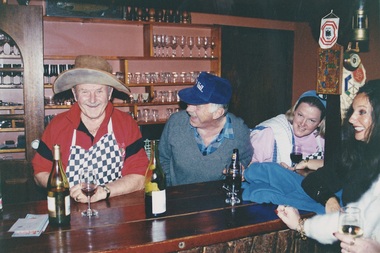
Photograph - Ernest Forras and Julian Brown at Julian's Lodge with Beth Brown and Marnie Searles
... love for the mountains, Julian moved to Mt. Beauty and then Falls Creek. He worked for the SEC in the test laboratory at Rocky Valley reading weather instruments. ...love for the mountains, Julian moved to Mt. Beauty and then Falls Creek. He worked for the SEC in the test laboratory at Rocky Valley reading weather instruments. ...Julian Newton-Brown arrived at Falls Creek in 1957. He had studied Pharmacy at Melbourne University. After developing a love for the mountains, Julian moved to Mt. Beauty and then Falls Creek. He worked for the SEC in the test laboratory at Rocky Valley reading weather instruments. By working several jobs, Julian was able to build a small lodge of 10 beds named “Arundel”, located at 18 Slalom Street, Falls Creek. The lodge is now the “Elk at Falls”. Arundel prospered and Julian extended it to include 32 beds and changed its name to "Julian’s” in 1961. When alcohol restrictions were eased in Falls Creek, Julian built a night club which he called “Big Julian’s” and later “THE MAN”. When Julian and his wife Beth retired and left Falls Creek, their son took over running the lodge. An active community man, Julian was a member of the Falls Creek Chamber of Commerce, a member of the SES, a stakeholder in Falls Creek, an author and a documentary maker. Julian Newton-Brown died in May 2020. Ernest Forras built Kooroora Chalet at Mount Buller with his brother, Aurel in 1953. They were both ski instructors and contributed greatly to the development of the ski industry.This item is significant because it gives details of an important lodge at Falls Creek, Victoria.A colour photograph of four friends inside Julian's Lodge, Falls Creekjulian's lodge, julian newton brown, falls creek ski lodges, earnest forrer -
 Falls Creek Historical Society
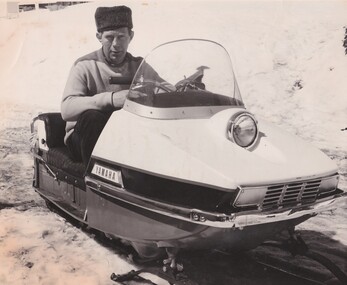
Photograph - Julian Newton Brown on Yamaha SL 351
... love for the mountains, Julian moved to Mt. Beauty and then Falls Creek. He worked for the SEC in the test laboratory at Rocky Valley reading weather instruments. ...love for the mountains, Julian moved to Mt. Beauty and then Falls Creek. He worked for the SEC in the test laboratory at Rocky Valley reading weather instruments. ...Julian Newton-Brown arrived at Falls Creek in 1957. He had studied Pharmacy at Melbourne University. After developing a love for the mountains, Julian moved to Mt. Beauty and then Falls Creek. He worked for the SEC in the test laboratory at Rocky Valley reading weather instruments. By working several jobs, Julian was able to build a small lodge of 10 beds named “Arundel”, located at 18 Slalom Street, Falls Creek. The lodge is now the “Elk at Falls”. Arundel prospered and Julian extended it to include 32 beds and changed its name to "Julian’s” in 1961. When alcohol restrictions were eased in Falls Creek, Julian built a night club which he called “Big Julian’s” and later “THE MAN”. When Julian and his wife Beth retired and left Falls Creek, their son took over running the lodge. An active community man, Julian was a member of the Falls Creek Chamber of Commerce, a member of the SES, a stakeholder in Falls Creek, an author and a documentary maker. Julian Newton-Brown died in May 2020. In 2003 when this flyer was published operation of Julian's Lodge transferred from Julian and his wife Beth to their son Charlie Brown, a former Australian Champion and World Cup skier and his wife, Bena.This item is significant because it gives details of an important lodge at Falls Creek, Victoria.A black and white image of Julian Newton Brown testing a Yamaha SL 351 in 1968.julian's lodge, julian newton brown, falls creek ski lodges, accommodation falls creek, charlie brown -
 Falls Creek Historical Society
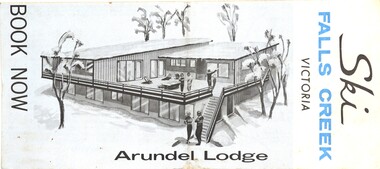
Flyer - Arundel Lodge Information
... love for the mountains, Julian moved to Mt. Beauty and then Falls Creek. He worked for the SEC in the test laboratory at Rocky Valley reading weather instruments. ...love for the mountains, Julian moved to Mt. Beauty and then Falls Creek. He worked for the SEC in the test laboratory at Rocky Valley reading weather instruments. ...This item is from the private collection of George Shirling of Red Onion, Falls Creek. Arundel was built by Julian Newton-Brown who arrived at Falls Creek in 1957. He had studied Pharmacy at Melbourne University. After developing a love for the mountains, Julian moved to Mt. Beauty and then Falls Creek. He worked for the SEC in the test laboratory at Rocky Valley reading weather instruments. By working several jobs, Julian was able to build a small lodge of 10 beds named “Arundel”, located at 18 Slalom Street, Falls Creek. The lodge is now the “Elk at Falls”. George Shirling arrived in Falls Creek in 1962. He engaged Phil Nowell to build the original Koki Alpine Lodge which opened in 1965 with 14 beds. George operated the lodge with Michael “Baldy” Blackwell as manager. He also graduated in sport psychology in 1981 and was invited to become team psychologist for the Australian Winter Olympic team which went to Albertville, France, in 1992. He later owned the Red Onion Chalet. George credited the success of Koki to “Baldy” Blackwell. “Baldy” and Phil Nowell started the Trackers Mountain Lodge in partnership during the 1980s. In 1971 George sold Koki Lodge to Sigi Doerr. In 2024 the renamed Koki Alpine resort remains a highly popular destination in Falls Creek. George Shirling passed away on 27th February 2023. He had remained actively involved in Falls Creek and was generous with his time and knowledge, always an amazing supporter of The Falls Creek Museum and Falls Creek Village.This flyer is significant because it was part of the early marketing for Arundel Lodge, Falls Creek A black and white promotional flyer for Arundel Lodge, Falls Creek.george shirling, arundel, julian newton brown, accommodation falls creek -
 Falls Creek Historical Society
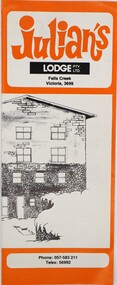
Flyer - Julian's Lodge 1980
... love for the mountains, Julian moved to Mt. Beauty and then Falls Creek. He worked for the SEC in the test laboratory at Rocky Valley reading weather instruments. ...love for the mountains, Julian moved to Mt. Beauty and then Falls Creek. He worked for the SEC in the test laboratory at Rocky Valley reading weather instruments. ...This item is from the private collection of George Shirling of Red Onion, Falls Creek. Julian's Lodge was built by Julian Newton-Brown who arrived at Falls Creek in 1957. He had studied Pharmacy at Melbourne University. After developing a love for the mountains, Julian moved to Mt. Beauty and then Falls Creek. He worked for the SEC in the test laboratory at Rocky Valley reading weather instruments. By working several jobs, Julian was able to build a small lodge of 10 beds named “Arundel”, located at 18 Slalom Street, Falls Creek. Arundel prospered and Julian extended it to include 32 beds and changed its name to Julian’s in 1961.The lodge is now the “Elk at Falls”. George Shirling arrived in Falls Creek in 1962. He engaged Phil Nowell to build the original Koki Alpine Lodge which opened in 1965 with 14 beds. George operated the lodge with Michael “Baldy” Blackwell as manager. He also graduated in sport psychology in 1981 and was invited to become team psychologist for the Australian Winter Olympic team which went to Albertville, France, in 1992. He later owned the Red Onion Chalet. George credited the success of Koki to “Baldy” Blackwell. “Baldy” and Phil Nowell started the Trackers Mountain Lodge in partnership during the 1980s. In 1971 George sold Koki Lodge to Sigi Doerr. In 2024 the renamed Koki Alpine resort remains a highly popular destination in Falls Creek. George Shirling passed away on 27th February 2023. He had remained actively involved in Falls Creek and was generous with his time and knowledge, always an amazing supporter of The Falls Creek Museum and Falls Creek Village.This flyer is significant because it was part of the early marketing for Arundel Lodge, Falls Creek A coloured flyer containing information about Julian's Lodge, Falls Creek for 1980. If includes a map of the Falls Creek area as well as tariffs and booking information.george shirling, arundel, julian newton brown, accommodation falls creek -
 Falls Creek Historical Society
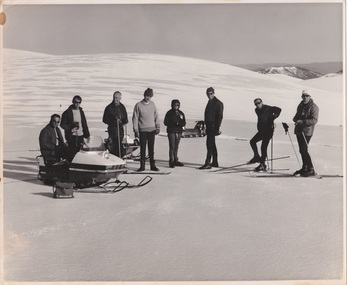
Photograph - Snowmobiles on Spion Kopje
... love for the mountains, Julian moved to Mt. Beauty and then Falls Creek. He worked for the SEC in the test laboratory at Rocky Valley reading weather instruments. ...love for the mountains, Julian moved to Mt. Beauty and then Falls Creek. He worked for the SEC in the test laboratory at Rocky Valley reading weather instruments. ...Julian Newton Brown arrived at Falls Creek in 1957. He had studied Pharmacy at Melbourne University. After developing a love for the mountains, Julian moved to Mt. Beauty and then Falls Creek. He worked for the SEC in the test laboratory at Rocky Valley reading weather instruments. By working several jobs, Julian was able to build a small lodge of 10 beds named “Arundel”, located at 18 Slalom Street, Falls Creek. The lodge is now the “Elk at Falls”. Arundel prospered and Julian extended it to include 32 beds and changed its name to "Julian’s” in 1961. When alcohol restrictions were eased in Falls Creek, Julian built a night club which he called “Big Julian’s” and later “THE MAN”. When Julian and his wife Beth retired and left Falls Creek, their son took over running the lodge. An active community man, Julian was a member of the Falls Creek Chamber of Commerce, a member of the SES, a stakeholder in Falls Creek, an author and a documentary maker. Julian Newton-Brown died in May 2020.This image is significant because it includes a prominent Falls Creek businessman and community member.A black and white image of a group of skiers and an early snowmobile on Spion Kopje, Left to Right:- Jim Flanagan, Julian Newton Brown, Bill Bridgford, unknown, Sun Newspaper Journalist, Pat Rauter, Geoff Henke, Rob Wardjulian newton brown, spion kopje, snowmobiles on falls creek -
 Falls Creek Historical Society
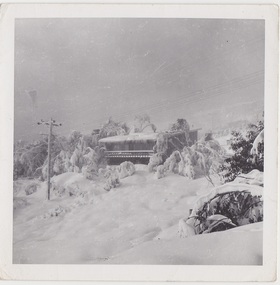
Photograph - Arundel Lodge
... love for the mountains, Julian moved to Mt. Beauty and then Falls Creek. He worked for the SEC in the test laboratory at Rocky Valley reading weather instruments. ...love for the mountains, Julian moved to Mt. Beauty and then Falls Creek. He worked for the SEC in the test laboratory at Rocky Valley reading weather instruments. ...Arundel was built by Julian Newton-Brown who arrived at Falls Creek in 1957. He had studied Pharmacy at Melbourne University. After developing a love for the mountains, Julian moved to Mt. Beauty and then Falls Creek. He worked for the SEC in the test laboratory at Rocky Valley reading weather instruments. By working several jobs, Julian was able to build a small lodge of 10 beds named “Arundel”, located at 18 Slalom Street, Falls Creek. The lodge is now the “Elk at Falls”. Arundel prospered and Julian extended it to include 32 beds and changed its name to "Julian’s” in 1961. When alcohol restrictions were eased in Falls Creek, Julian built a night club which he called “Big Julian’s” and later “THE MAN”. When Julian and his wife Beth retired and left Falls Creek, their son took over running the lodge. An active community man, Julian was a member of the Falls Creek Chamber of Commerce, a member of the SES, a stakeholder in Falls Creek, an author and a documentary maker. Julian Newton-Brown died in May 2020.This item is significant because the lodge was built by a prominent Falls Creek businessman who was a pioneer and dedicated member of the Falls Creek community.Three black and white photographs showing different aspects of Arundel Lodgejulian newton brown, arundel, the man, big julians falls creek -
 Falls Creek Historical Society
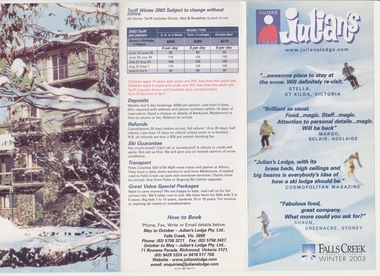
Flyer - Julian's Lodge 2003
... love for the mountains, Julian moved to Mt. Beauty and then Falls Creek. He worked for the SEC in the test laboratory at Rocky Valley reading weather instruments. ...love for the mountains, Julian moved to Mt. Beauty and then Falls Creek. He worked for the SEC in the test laboratory at Rocky Valley reading weather instruments. ...Julian Newton-Brown arrived at Falls Creek in 1957. He had studied Pharmacy at Melbourne University. After developing a love for the mountains, Julian moved to Mt. Beauty and then Falls Creek. He worked for the SEC in the test laboratory at Rocky Valley reading weather instruments. By working several jobs, Julian was able to build a small lodge of 10 beds named “Arundel”, located at 18 Slalom Street, Falls Creek. The lodge is now the “Elk at Falls”. Arundel prospered and Julian extended it to include 32 beds and changed its name to "Julian’s” in 1961. When alcohol restrictions were eased in Falls Creek, Julian built a night club which he called “Big Julian’s” and later “THE MAN”. When Julian and his wife Beth retired and left Falls Creek, their son took over running the lodge. An active community man, Julian was a member of the Falls Creek Chamber of Commerce, a member of the SES, a stakeholder in Falls Creek, an author and a documentary maker. Julian Newton-Brown died in May 2020. In 2003 when this flyer was published operation of Julian's Lodge transferred from Julian and is wife Beth to their son Charlie Brown, a former Australian Champion and World Cup skier and his wife, Bena.This item is significant because it gives details of an important lodge at Falls Creek, Victoria.A colour flyer which gives a large amount of information about facilities and tariffs for Julian's Lodge Falls Creek for the 2003 season. The flyer folds to one-third of its open size.julian's lodge, julian newton brown, falls creek ski lodges, accommodation falls creek, charlie brown -
 Falls Creek Historical Society
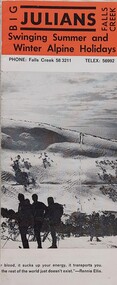
Booklet - Big Julians Falls Creek, 1973
... love for the mountains, Julian moved to Mt. Beauty and then Falls Creek. He worked for the SEC in the test laboratory at Rocky Valley reading weather instruments. ...love for the mountains, Julian moved to Mt. Beauty and then Falls Creek. He worked for the SEC in the test laboratory at Rocky Valley reading weather instruments. ...Julian Newton Brown arrived at Falls Creek in 1957. He had studied Pharmacy at Melbourne University. After developing a love for the mountains, Julian moved to Mt. Beauty and then Falls Creek. He worked for the SEC in the test laboratory at Rocky Valley reading weather instruments. By working several jobs, Julian was able to build a small lodge of 10 beds named “Arundel”, located at 18 Slalom Street, Falls Creek. The lodge is now the “Elk at Falls”. Arundel prospered and Julian extended it to include 32 beds and changed its name to ‘Julian’s” in 1961. When alcohol restrictions were eased in Falls Creek, Julian built a night club which he called “Big Julian’s” and later “THE MAN”. When Julian and his wife Beth retired and left Falls Creek, their son took over running the lodge. An active community man, Julian was a member of the Falls Creek Chamber of Commerce, a member of the SES, a stakeholder in Falls Creek, an author and a documentary maker. Julian Newton-Brown died in May 2020.This brochure is important because it documents an establishment operated by a highly regarded pioneer and businessman of Falls Creek.A brochure printed on glossy paper, featuring information and images. On Cover: BIG JULIANS FALLS CREEK Swinging Summer and Winter Alpine Holidays PHONE: Falls Creek 58 3211 TELEX:v56992accommodation falls creek, big julians falls creek, julian newton-brown -
 Falls Creek Historical Society
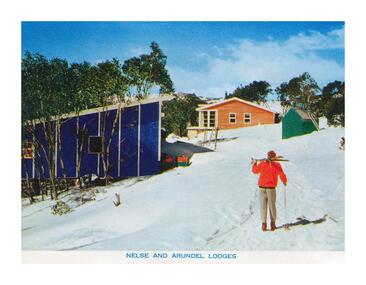
Postcard - Nelse and Arundel Lodges
... Valley T-bar. In 1973, Bob's widow sold Nelse Lodge to Jack and Elva Smith. Julian Newton-Brown arrived at Falls Creek in 1957. He had studied Pharmacy at Melbourne University. After developing a love...Valley T-bar. In 1973, Bob's widow sold Nelse Lodge to Jack and Elva Smith. Julian Newton-Brown arrived at Falls Creek in 1957. He had studied Pharmacy at Melbourne University. After developing a love ...These photographs were taken in and around Falls Creek by Samuel Keith Pearce and printed for him as a foldout postcard by NuColor Vue. The postcards state they were printed for S. K. Pearce Pty. Ltd of Tawonga and Mount Beauty. Samuel Keith Pearce was born on 24 June 1917 in Armadale, Victoria. By the late 1940s he owned the Mt Beauty Supermarket, Newsagency, Drapery and Hardware store at Mount Beauty and also a store at Tawonga in partnership with his brother Gordon Cathew Pearce. For some time, they operated as Pearce Brothers. In the early 1960s Keith also opened a mini mart In Falls Creek. As well as being a keen photographer and an astute businessman, Keith Pearce was a well-known identity in the Kiewa Valley, making many contributions to the development of the area over a long period. This included serving as a member of the Bright Shire Council for many years. He worked hard to promote the interests of the Upper Kiewa Valley. As a sign of recognition and appreciation for his contribution to the community, the park opposite the grocery store in Mount Beauty was named the SK Pearce Gardens in his honour. Samuel Keith Pearce died on 7 July 1994 in Mount Beauty, VictoriaThis collection of postcards and image is significant because they were commissioned by a highly successful business in Falls Creek, Victoria.A postcard showing Nelse and Arundel Lodges. Nelse Lodge was established in Falls Creek c1958 probably by Des Crosser. It was later purchased by Bob Scott (Scotty). He was killed during a tragic accident during the construction of the Sun Valley T-bar. In 1973, Bob's widow sold Nelse Lodge to Jack and Elva Smith. Julian Newton-Brown arrived at Falls Creek in 1957. He had studied Pharmacy at Melbourne University. After developing a love for the mountains, Julian moved to Mt. Beauty and then Falls Creek. He worked for the SEC in the test laboratory at Rocky Valley reading weather instruments. In 1959 Julian built a small lodge of 10 beds named “Arundel”, located at 18 Slalom Street, Falls Creek, now the “Elk at Falls”. Arundel prospered and Julian extended it to include 32 beds and changed its name to ‘Julian’s” in 1961. When alcohol restrictions were eased in Falls Creek, Julian built a night club which he called “Big Julian’s” and later “THE MAN”. An active community man, Julian was a member of the Falls Creek Chamber of Commerce, a member of the SES, a stakeholder, an author and a documentary maker. Julian Newton-Brown died in March 2020.astra falls creek, falls creek accommodation, falls creek businesses -
 Falls Creek Historical Society
Document - Junior Test Sheet, The Ski Club of Victoria Junior Test
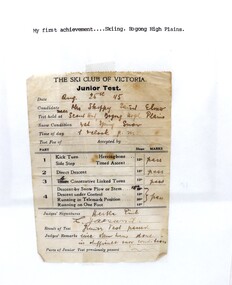
... love of skiing. Toni taught Skippy to ski and she practised on the High Plains where she and her husband lived. entering her in the first club championships held by the Bogong Ski Club at Rocky Valley, which he had established. ...love of skiing. Toni taught Skippy to ski and she practised on the High Plains where she and her husband lived. entering her in the first club championships held by the Bogong Ski Club at Rocky Valley, which he had established. ...This is a framed receipt in the name of Skippy St. Elmo for completion of the Ski Club of Victoria Junior test for ski instructor. The test was completed on 25 August 1945 at the Scout Hall, Bogong High Plains. The receipt was found inside the cover of a typed manuscript. Mavis Grace Lindsay (Skippy) born in 1917 and married Tony St. Elmo in Ballarat on 18 December 1944. She was known as “Skippy” from childhood. They moved from Melbourne in 1945 and spent the year living in Wallace’s Hut. Toni was employed by the State Electricity Commission to record weather-related data. They were to become responsible for early developments at the Falls Creek resort and for promoting a love of skiing. Toni taught Skippy to ski and she practised on the High Plains where she and her husband lived. entering her in the first club championships held by the Bogong Ski Club at Rocky Valley, which he had established. Skippy St Elmo won many ski races during the 1950’s and represented Australia in New Zealand. In 1947, the first ski lodge was built by six SEC employees including Toni St Elmo. The lodge was named “Skyline”. In 1957, Toni was involved in building the first rope tow at Falls Creek, called Nissen. He also established the Nissen Ski School. In 1949, Skippy won the Downhill and Combined State Championship held at Mt Buller. In 1950, Skippy was selected to compete in New Zealand with the Victorian team to compete in New Zealand Skippy trained with the men at the Bogong Ski Club and that fact became a talking point in 1953 when the Albury Ski Club held an Open Championship and Skippy won in giant slalom and downhill. She went on to win many more races. In 1960, Skippy and Toni said farewell to Falls Creek. Skippy passed away in Queensland in July 2005 and Toni passed away in the September of the same year. In November 2006 the pair was honoured at the Alpine Village at Falls Creek by the spreading of their ashes over Eagle Rock.This certificate is an early document belonging to Skippy St Elmo, a pioneer of Falls Creek.Framed marking sheet for a Junior ski test for Ms Skippy Elmo at Bogong High Plains on August 25 1945. The test sheet is attached to a white backing paper which has 'My First achievement....skiing. Bogong High Plains' typed on it. The sheet has been framed for displau.skippy st elmo, ski instructor test, ski club of victoria, bogong high plains -
 Falls Creek Historical Society
Photograph - Skippy St Elmo and the Ski Club of Victoria Junior Test
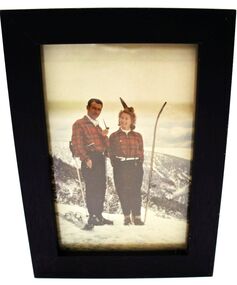
... love of skiing. Toni taught Skippy to ski and she practised on the High Plains where she and her husband lived. entering her in the first club championships held by the Bogong Ski Club at Rocky Valley, which he had established. ...love of skiing. Toni taught Skippy to ski and she practised on the High Plains where she and her husband lived. entering her in the first club championships held by the Bogong Ski Club at Rocky Valley, which he had established. ...Mavis Grace Lindsay born in 1917 and married Tony St. Elmo in Ballarat on 18 December 1944. She was known as “Skippy” from childhood. They moved from Melbourne in 1945 and spent the year living in Wallace’s Hut. Toni was employed by the State Electricity Commission to record weather-related data. They were to become responsible for early developments at the Falls Creek resort and for promoting a love of skiing. Toni taught Skippy to ski and she practised on the High Plains where she and her husband lived. entering her in the first club championships held by the Bogong Ski Club at Rocky Valley, which he had established. Skippy St Elmo won many ski races during the 1950’s and represented Australia in New Zealand. In 1947, the first ski lodge was built by six SEC employees including Toni St Elmo. The lodge was named “Skyline”. In 1957, Toni was involved in building the first rope tow at Falls Creek, called Nissen. He also established the Nissen Ski School. In 1949, Skippy won the Downhill and Combined State Championship held at Mt Buller. In 1950, Skippy was selected to compete in New Zealand with the Victorian team to compete in New Zealand Skippy trained with the men at the Bogong Ski Club and that fact became a talking point in 1953 when the Albury Ski Club held an Open Championship and Skippy won in giant slalom and downhill. She went on to win many more races. In 1960, Skippy and Toni said farewell to Falls Creek. Skippy passed away in Queensland in July 2005 and Toni passed away in the September of the same year. In November 2006 the pair was honoured at the Alpine Village at Falls Creek by the spreading of their ashes over Eagle Rock.Photograph of Ms Skippy Elmo and man at Bogong High Plains on August 25 1945 as well as a framed receipt for the Ski Club of Victoria Junior Test for Ski Instructorsskippy st elmo, skyline lodge, bogong high plains, ski instructor test -
 Falls Creek Historical Society
Plan - Additions to "The Man", 1979
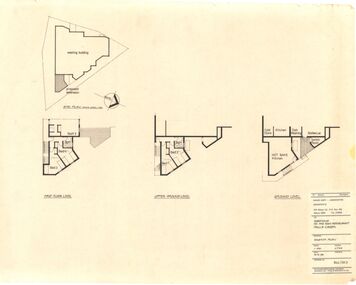
... love for the mountains, Julian moved to Mt. Beauty and then Falls Creek. He worked for the SEC in the test laboratory at Rocky Valley reading weather instruments. ...love for the mountains, Julian moved to Mt. Beauty and then Falls Creek. He worked for the SEC in the test laboratory at Rocky Valley reading weather instruments. ...Julian Newton-Brown arrived at Falls Creek in 1957. He had studied Pharmacy at Melbourne University. After developing a love for the mountains, Julian moved to Mt. Beauty and then Falls Creek. He worked for the SEC in the test laboratory at Rocky Valley reading weather instruments. By working several jobs, Julian was able to build a small lodge of 10 beds named “Arundel”. Arundel prospered and Julian extended it to include 32 beds and changed its name to "Julian’s” in 1961. Julian built a night club which he called “Big Julian’s” and later “THE MAN”. When Julian and his wife Beth retired and left Falls Creek, their son Charlie took over running the lodge. This plan is an architect’s plan for extension to “The Man” in 1979. The First Floor and Upper Ground Floor were to include four bedrooms, two bathrooms and a Staff area. The Ground Floor extension was to include the Hot Bake Kitchen opening to the outside of the building, as well as a kitchen, barbecue, cold store, dishwashing area and switch room. In 2025 "The Man" is a central entertainment hub on the resort known for live music, pizza, and après-ski activities.This plan is significant because it documents developments at a well-known Falls Creek business.Architects plans produced by David Hoff & Associates, Albury for the extension of "The Man" Falls Creek, Victoria. They include the site plan and plans for the First Floor, Upper Ground Level and Ground Level.the man, falls creek businesses, julian newton brown -
 City of Greater Bendigo - Civic Collection
Souvenir, Nucolorvue Productions, A Souvenir of Beautiful Bendigo, c. 1940
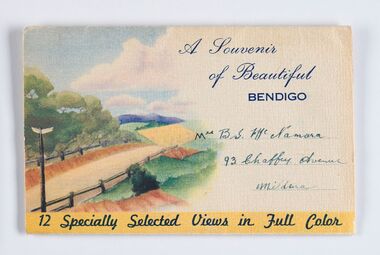
... Love / From / Your Loving / Son in Law Bill / Published by Nucolorvue Productions. Elwood. Victoria Mass produced souvenir foldout 'views' of Bendigo packaged in an envelope. Inside contains six double sided postcard sized, hand tinted photographs highlighting local popular sites. Includes text describing Bendigo's geographic location and main industries and attractions. Envelope is addressed. Nucolorvue Productions produced this style of souvenir with a generic country scene on the envelope and site specific information and images inside for such places as Adelaide Hills, Murray Valley ...As tourism and touring grew in the early and mid 20th century, sending letters and postcards was one of the main forms of communications friends and family would use to share their travels and remind loved ones that they were thinking of them while away. Bendigo's geographic location in central Victoria and relatively closeness to Melbourne has meant that capturing the tourist dollar has been an important focus for promotional activities of the City. Businesses such as Nucolorvue Productions serviced the need for high quality printed souvenirs such as these.Mass produced souvenir foldout 'views' of Bendigo packaged in an envelope. Inside contains six double sided postcard sized, hand tinted photographs highlighting local popular sites. Includes text describing Bendigo's geographic location and main industries and attractions. Envelope is addressed. Nucolorvue Productions produced this style of souvenir with a generic country scene on the envelope and site specific information and images inside for such places as Adelaide Hills, Murray Valley, Shepparton and Warrnambool.Front; A Souvenir / of Beautiful / BENDIGO / 12 Specially Selected Views in Full Colour /Mrs B. S. Mc Namara / 93 Chaffey Avenue / Mildura. Verso; Have a look of (sic) Bendigo / Love / From / Your Loving / Son in Law Bill / Published by Nucolorvue Productions. Elwood. Victoriacity of greater bendigo tourism -
 Victorian Railway History Library
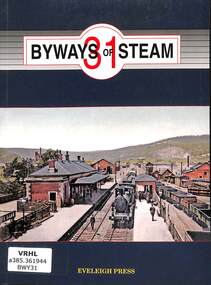
Book, Love, Ray, Byways of Steam 31, 2017
... valley. These are accompanied by another superb Dean Oliver drawing showing the location of the industries and mines and the rail lines. Steam Locomotive Depots in NSW: Lithgow. The feature essay in this volume is Ray Love’s ...The Industries and Railways of the Lithgow Valley. Mark Langdon, fresh from his coverage of the Wolgan Valley in Shale and Shays, has researched the rise of Lithgow as an industrial centre, including numerous mines and industries and the various rail links in the valley, west of the Blue Mountains. The expanded text is accompanied by many previously unpublished images of the period, including some wonderful panoramic photographs of the valley. These are accompanied by another superb Dean Oliver drawing showing the location of the industries and mines and the rail lines. Steam Locomotive Depots in NSW: Lithgow. The feature essay in this volume is Ray Love’s coverage of this steam locomotive depot, The expanded facilities at Lithgow covered the locomotives which worked over the mountains, including the Big Engines and those that worked to Bathurst and Mudgee, on the branch line. Interspersed throughout the expansive text are stories from railway enginemen, the result of many hours of recorded interviews by the author.ill, maps, p.216.non-fictionThe Industries and Railways of the Lithgow Valley. Mark Langdon, fresh from his coverage of the Wolgan Valley in Shale and Shays, has researched the rise of Lithgow as an industrial centre, including numerous mines and industries and the various rail links in the valley, west of the Blue Mountains. The expanded text is accompanied by many previously unpublished images of the period, including some wonderful panoramic photographs of the valley. These are accompanied by another superb Dean Oliver drawing showing the location of the industries and mines and the rail lines. Steam Locomotive Depots in NSW: Lithgow. The feature essay in this volume is Ray Love’s coverage of this steam locomotive depot, The expanded facilities at Lithgow covered the locomotives which worked over the mountains, including the Big Engines and those that worked to Bathurst and Mudgee, on the branch line. Interspersed throughout the expansive text are stories from railway enginemen, the result of many hours of recorded interviews by the author.railroads - nsw - history, steam locomotives - nsw – pictorial -
 Greensborough Historical Society
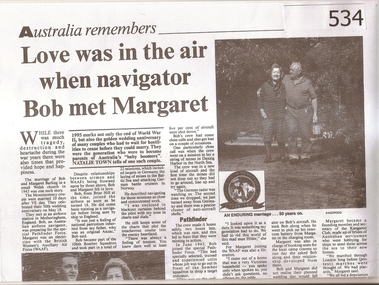
Article - Newspaper clipping, Diamond Valley Leader, Love was in the air when navigator Bob met Margaret, 1995
... Black text and image Love was in the air when navigator Bob met Margaret. Article Newspaper clipping Diamond Valley Leader ...This article tells the tale of how Bob and Margaret Barling met in England during WW2. Bob was born in Briar Hill and returned there with his bride after the war. They later moved to Montmorency. The article is one of series published as part of the Australia Remembers 1945 - 1995 program.An article written as part of the Australia Remembers 1945 - 1995 Commemoration. Black text and imageaustralia remembers 1945 - 1995, waaf, raaf, pathfinder squadron, ve day, war brides, barling family, world war ii -
Emerald Museum & Nobelius Heritage Park
Photograph - Emerald Football Club, 1985 Reserves, Unknown photographer, 1985
... Valley Mountain District Football League. Initially, their colours were blue and white, followed by green and gold, until they changed to the red and black we see here—which are still used today. The Bombers have claimed many premierships at numerous levels over the years. This item shows connection to a sport played and well loved ...The Emerald Football Club, also known as the Bombers, first formed in 1905. It was one of the earlier clubs in the Mountain District Football Association, which later merged to become the Yarra Valley Mountain District Football League. Initially, their colours were blue and white, followed by green and gold, until they changed to the red and black we see here—which are still used today. The Bombers have claimed many premierships at numerous levels over the years.This item shows connection to a sport played and well loved by members of the Emerald community. It displays style and colour of the team uniform worn at that time. There is also potential for research in the area of genealogy.Coloured rectangular photograph printed on gloss photographic paper. The coloured photograph shows a group of 25 unidentified males from the Emerald Reserves Football Team dressed in their team colours in 1985. Cars and trees can be seen in the background.Reverse: RESERVES 1985 /australian rules football, football team colours, sports -
Emerald Museum & Nobelius Heritage Park
Book - Books by Hilde Knorr and about Hans Knorr, Hilde Knorr, 1970s and 1980
... Valley, Hilde Knörr grew up in the Moe-Warragul district, then studied music in Melbourne. She married the Bavarian-born sculptor, Hans Knörr, and began writing articles and short stories when her children were small. She published novels, short fiction, biography and poetry. She also published the non-fiction works Religious Art in Australia (1967) and Merriang: An Early Victorian Homestead (1981), a property at Myrtleford, Victoria, where Knörr had resided. She and Hans lived in Emerald for many years. Hans Knorr Hilde Knorr Heywood Some Hilde Knorr books inscribed to Lil Hudson "sculpture of Hans Knorr" inscribed with " with love ...Hans Knorr (1915-1988) was a sculptor in bronze, wood, stone and mixed media - many of which were commissioned for churches. Hans was trained as a cabinet maker in Germany. Following internment in Victoria during world War II, he married author Hilde Dent in 1948, decided to remain in Australia and earned international acclaim as a sculptor. In 1961, he opened his own gallery, the Emerald Gallery in Emerald, which he ran for many years. Hilde Knorr (1917 – 2009) Descended from English and Scottish pioneers of the Latrobe Valley, Hilde Knörr grew up in the Moe-Warragul district, then studied music in Melbourne. She married the Bavarian-born sculptor, Hans Knörr, and began writing articles and short stories when her children were small. She published novels, short fiction, biography and poetry. She also published the non-fiction works Religious Art in Australia (1967) and Merriang: An Early Victorian Homestead (1981), a property at Myrtleford, Victoria, where Knörr had resided. She and Hans lived in Emerald for many years.8 Books - (1) Shoemakers children, (2) Peacock Morning, (3) A Private Viewing, (4) Group with Lady, (5) Journey with a Stranger, (6) From an Australian Homestead (7) Merriang - an Early Victorian Homestead, (8) Sculpture of Hans Knorr Donated by Patty HeywardSome Hilde Knorr books inscribed to Lil Hudson "sculpture of Hans Knorr" inscribed with " with love to Lil from Hans and Hilde Christmas 1976"hans knorr, hilde knorr, heywood -
 Emerald Museum & Nobelius Heritage Park
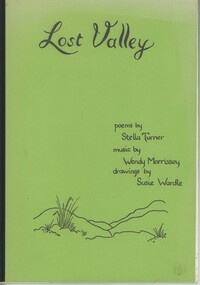
Booklet, Stella Turner et al, Lost Valley, 1986
... Her love of the natural environment inspired her to write poetry reflecting on this. Her poem, Lost Valley Olinda, which is the first poem in this booklet, was set to music by Wendy Morrissey 1926 - 2005 and won the 1985 Henry Lawson prize for Classical Song....Her love of the natural environment inspired her to write poetry reflecting on this. Her poem, Lost Valley Olinda, which is the first poem in this booklet, was set to music by Wendy Morrissey 1926 - 2005 and won the 1985 Henry Lawson prize for Classical Song. ...This book consists of four poems, each about a native orchid. Accompanying each poem is a line drawing of that orchid in its natural environment and that is followed by musical notation created for each poem.Green cover. Approx 32 pages. Booklet consists of four poems with black and white line drawings followed by musical notation. The inside front page has the autographs of the poet, the musician and the artist.non-fictionThis book consists of four poems, each about a native orchid. Accompanying each poem is a line drawing of that orchid in its natural environment and that is followed by musical notation created for each poem. stella turner, wendy morrissey, susie wardle
