
Showing 88 items matching "we are union"
-
 Australian Nursing & Midwifery Federation
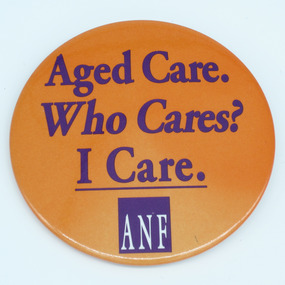
Australian Nursing Federation aged care campaign badge, 2001
... We care'. Therefore, it is believed that this badge was manufactured and distributed from August to December 2001. nursing nurses unionism aged care lobbying 2001 federal election funding badges buttons pins trade unions labour history staffing workforce patient care Circular orange and dark blue plastic badge. ...Button distributed to and worn by Australian Nursing Federation (ANF) members. The ANF has been campaigning for more funding and qualified nurses to improve the quality of aged care for the past several decades, and continues to do so. This particular badge is from a 2001 campaign in the lead up to a November 2001 Australian federal election. The campaign called on the government and opposition to make commitments to around aged care staffing and funding. Branch newsletters from late 2001 focused on aged care staff shortages & under-funding, with placards from rallies featuring slogans such as 'Aged care nurses. We care. Do you?' and 'Aged care. Who care? We care'. Therefore, it is believed that this badge was manufactured and distributed from August to December 2001.Circular orange and dark blue plastic badge. Silver metal, plastic-coated, with safety pin fastener adhered to back. Badge printed with 'Aged Care. Who Cares? I care.' and the ANF [Australian Nursing Federation] logo. 'I Care.' is underlined.nursing, nurses, unionism, aged care, lobbying, 2001 federal election, funding, badges, buttons, pins, trade unions, labour history, staffing, workforce, patient care -
 Australian Nursing & Midwifery Federation
1986 recording of 3CR Community Radio 'Smash and Grab' broadcast featuring nurses and guests discussing Victorian nurses strike, 1986 Nov 10
... Presenters Vig Geddes and Deb Welch recognised the nature of the nurses' struggle - a predominantly female union with a women leader - as a feminist issue, and that in this particular dispute, 3CR's long standing commitment to industrial coverage and its increasingly strong feminism converged. The issues being faced by nurses were being dismissed because nursing was seen as women's work. The response to the initial coverage of the dispute by 3CR was overwhelming. 'When we...Presenters Vig Geddes and Deb Welch recognised the nature of the nurses' struggle - a predominantly female union with a women leader - as a feminist issue, and that in this particular dispute, 3CR's long standing commitment to industrial coverage and its increasingly strong feminism converged. The issues being faced by nurses were being dismissed because nursing was seen as women's work. The response to the initial coverage of the dispute by 3CR was overwhelming. 'When we ...Broadcast of 'Smash and Grab' program on 3CR Community Radio. Historical information taken from 'Radical radio: celebrating 40 years of 3CR' (Ed. Juliet Fox, 2016, pp. 97-98): "Less than a week after the first hospital went out on strike, 3CR's Monday morning program Smash and Grab ran a special program on the issues surrounding the strike. Presenters Vig Geddes and Deb Welch recognised the nature of the nurses' struggle - a predominantly female union with a women leader - as a feminist issue, and that in this particular dispute, 3CR's long standing commitment to industrial coverage and its increasingly strong feminism converged. The issues being faced by nurses were being dismissed because nursing was seen as women's work. The response to the initial coverage of the dispute by 3CR was overwhelming. 'When we asked for talkback calls from the public, the lines were jammed, largely with callers wanting to offer their support to the nurses,' explained Deb Welch in the CRAM Guide February 1987. 'Others couldn't work out from the papers and the TV news what the strike was about. Many were outraged by the coverage the nurses had received and were fully aware how overworked and underpaid nurses have been.' In recognition of this outpouring of interest and support, 3CR decided to continue with a daily program - Nurses' Update. The program was presented by Vig and Deb every morning at 10am, and featured a range of nurses voicing their experiences and their concerns. 'Every morning, three or four nurses would cram into the 3CR studios and talk about the type of work they did, the pressures they worked under, their passion for nursing, their problems with the new award, why nurses' conditions are a women's issue, problems with understaffing and chronic tiredness, nursing history, relations between nurses and doctors - in fact the endless range of issues were what made the dispute so complex and history, reflects Deb [Welch]."Three audio files (.mp3 multimedia format), transferred from compact disc recording.3cr, community radio, melbourne, history, radio station, labor, labour history, nurses, royal australian nursing federation, strikes, industrial action, film, trade unions, 1986 victorian nurses strike, nursing, strike action, unionism, strikes and lockouts, victoria, feminism -
Australian Nursing & Midwifery Federation
1986 recording of 3CR Community Radio 'Nurses' Update' broadcast featuring nurses discussing 1986 Victorian nurses strike, 1986 Nov 11
... Presenters Vig Geddes and Deb Welch recognised the nature of the nurses' struggle - a predominantly female union with a women leader - as a feminist issue, and that in this particular dispute, 3CR's long standing commitment to industrial coverage and its increasingly strong feminism converged. The issues being faced by nurses were being dismissed because nursing was seen as women's work. The response to the initial coverage of the dispute by 3CR was overwhelming. 'When we...Presenters Vig Geddes and Deb Welch recognised the nature of the nurses' struggle - a predominantly female union with a women leader - as a feminist issue, and that in this particular dispute, 3CR's long standing commitment to industrial coverage and its increasingly strong feminism converged. The issues being faced by nurses were being dismissed because nursing was seen as women's work. The response to the initial coverage of the dispute by 3CR was overwhelming. 'When we ...Broadcast of short-lived 'Nurses' Update' program on 3CR Community Radio. Historical information taken from 'Radical radio: celebrating 40 years of 3CR' (Ed. Juliet Fox, 2016, pp. 97-98): "Less than a week after the first hospital went out on strike, 3CR's Monday morning program Smash and Grab ran a special program on the issues surrounding the strike. Presenters Vig Geddes and Deb Welch recognised the nature of the nurses' struggle - a predominantly female union with a women leader - as a feminist issue, and that in this particular dispute, 3CR's long standing commitment to industrial coverage and its increasingly strong feminism converged. The issues being faced by nurses were being dismissed because nursing was seen as women's work. The response to the initial coverage of the dispute by 3CR was overwhelming. 'When we asked for talkback calls from the public, the lines were jammed, largely with callers wanting to offer their support to the nurses,' explained Deb Welch in the CRAM Guide February 1987. 'Others couldn't work out from the papers and the TV news what the strike was about. Many were outraged by the coverage the nurses had received and were fully aware how overworked and underpaid nurses have been.' In recognition of this outpouring of interest and support, 3CR decided to continue with a daily program - Nurses' Update. The program was presented by Vig and Deb every morning at 10am, and featured a range of nurses voicing their experiences and their concerns. 'Every morning, three or four nurses would cram into the 3CR studios and talk about the type of work they did, the pressures they worked under, their passion for nursing, their problems with the new award, why nurses' conditions are a women's issue, problems with understaffing and chronic tiredness, nursing history, relations between nurses and doctors - in fact the endless range of issues were what made the dispute so complex and history, reflects Deb [Welch]."Audio file (.mp3 multimedia format), transferred from compact disc recording.3cr, community radio, melbourne, history, labour history, nurses, royal australian nursing federation, strikes, industrial action, trade unions, 1986 victorian nurses strike, nursing, strike action, unionism, strikes and lockouts, victoria -
Australian Nursing & Midwifery Federation
1986 recording of 3CR Community Radio 'Nurses' Update' broadcast featuring nurses discussing 1986 Victorian nurses strike, 1986 Nov 12
... Presenters Vig Geddes and Deb Welch recognised the nature of the nurses' struggle - a predominantly female union with a women leader - as a feminist issue, and that in this particular dispute, 3CR's long standing commitment to industrial coverage and its increasingly strong feminism converged. The issues being faced by nurses were being dismissed because nursing was seen as women's work. The response to the initial coverage of the dispute by 3CR was overwhelming. 'When we...Presenters Vig Geddes and Deb Welch recognised the nature of the nurses' struggle - a predominantly female union with a women leader - as a feminist issue, and that in this particular dispute, 3CR's long standing commitment to industrial coverage and its increasingly strong feminism converged. The issues being faced by nurses were being dismissed because nursing was seen as women's work. The response to the initial coverage of the dispute by 3CR was overwhelming. 'When we ...Broadcast of short-lived 'Nurses' Update' program on 3CR Community Radio. Historical information taken from 'Radical radio: celebrating 40 years of 3CR' (Ed. Juliet Fox, 2016, pp. 97-98): "Less than a week after the first hospital went out on strike, 3CR's Monday morning program Smash and Grab ran a special program on the issues surrounding the strike. Presenters Vig Geddes and Deb Welch recognised the nature of the nurses' struggle - a predominantly female union with a women leader - as a feminist issue, and that in this particular dispute, 3CR's long standing commitment to industrial coverage and its increasingly strong feminism converged. The issues being faced by nurses were being dismissed because nursing was seen as women's work. The response to the initial coverage of the dispute by 3CR was overwhelming. 'When we asked for talkback calls from the public, the lines were jammed, largely with callers wanting to offer their support to the nurses,' explained Deb Welch in the CRAM Guide February 1987. 'Others couldn't work out from the papers and the TV news what the strike was about. Many were outraged by the coverage the nurses had received and were fully aware how overworked and underpaid nurses have been.' In recognition of this outpouring of interest and support, 3CR decided to continue with a daily program - Nurses' Update. The program was presented by Vig and Deb every morning at 10am, and featured a range of nurses voicing their experiences and their concerns. 'Every morning, three or four nurses would cram into the 3CR studios and talk about the type of work they did, the pressures they worked under, their passion for nursing, their problems with the new award, why nurses' conditions are a women's issue, problems with understaffing and chronic tiredness, nursing history, relations between nurses and doctors - in fact the endless range of issues were what made the dispute so complex and history, reflects Deb [Welch]."Audio file (.mp3 multimedia format), transferred from compact disc recording.3cr, community radio, melbourne, history, labour history, nurses, royal australian nursing federation, strikes, industrial action, trade unions, 1986 victorian nurses strike, nursing, strike action, unionism, strikes and lockouts, victoria, feminism -
Australian Nursing & Midwifery Federation
1986 recording of 3CR Community Radio 'Nurses' Update' broadcast featuring nurses discussing 1986 Victorian nurses strike, 1986 Nov 13
... Presenters Vig Geddes and Deb Welch recognised the nature of the nurses' struggle - a predominantly female union with a women leader - as a feminist issue, and that in this particular dispute, 3CR's long standing commitment to industrial coverage and its increasingly strong feminism converged. The issues being faced by nurses were being dismissed because nursing was seen as women's work. The response to the initial coverage of the dispute by 3CR was overwhelming. 'When we...Presenters Vig Geddes and Deb Welch recognised the nature of the nurses' struggle - a predominantly female union with a women leader - as a feminist issue, and that in this particular dispute, 3CR's long standing commitment to industrial coverage and its increasingly strong feminism converged. The issues being faced by nurses were being dismissed because nursing was seen as women's work. The response to the initial coverage of the dispute by 3CR was overwhelming. 'When we ...Broadcast of short-lived 'Nurses' Update' program on 3CR Community Radio. Historical information taken from 'Radical radio: celebrating 40 years of 3CR' (Ed. Juliet Fox, 2016, pp. 97-98): "Less than a week after the first hospital went out on strike, 3CR's Monday morning program Smash and Grab ran a special program on the issues surrounding the strike. Presenters Vig Geddes and Deb Welch recognised the nature of the nurses' struggle - a predominantly female union with a women leader - as a feminist issue, and that in this particular dispute, 3CR's long standing commitment to industrial coverage and its increasingly strong feminism converged. The issues being faced by nurses were being dismissed because nursing was seen as women's work. The response to the initial coverage of the dispute by 3CR was overwhelming. 'When we asked for talkback calls from the public, the lines were jammed, largely with callers wanting to offer their support to the nurses,' explained Deb Welch in the CRAM Guide February 1987. 'Others couldn't work out from the papers and the TV news what the strike was about. Many were outraged by the coverage the nurses had received and were fully aware how overworked and underpaid nurses have been.' In recognition of this outpouring of interest and support, 3CR decided to continue with a daily program - Nurses' Update. The program was presented by Vig and Deb every morning at 10am, and featured a range of nurses voicing their experiences and their concerns. 'Every morning, three or four nurses would cram into the 3CR studios and talk about the type of work they did, the pressures they worked under, their passion for nursing, their problems with the new award, why nurses' conditions are a women's issue, problems with understaffing and chronic tiredness, nursing history, relations between nurses and doctors - in fact the endless range of issues were what made the dispute so complex and history, reflects Deb [Welch]."Audio file (.mp3 multimedia format), transferred from compact disc recording.3cr, community radio, melbourne, history, labour history, nurses, royal australian nursing federation, strikes, industrial action, trade unions, 1986 victorian nurses strike, nursing, strike action, unionism, strikes and lockouts, victoria, feminism -
Australian Nursing & Midwifery Federation
1986 recording of 3CR Community Radio 'Nurses' Update' broadcast featuring nurses discussing 1986 Victorian nurses strike, 1986 Nov 14
... Presenters Vig Geddes and Deb Welch recognised the nature of the nurses' struggle - a predominantly female union with a women leader - as a feminist issue, and that in this particular dispute, 3CR's long standing commitment to industrial coverage and its increasingly strong feminism converged. The issues being faced by nurses were being dismissed because nursing was seen as women's work. The response to the initial coverage of the dispute by 3CR was overwhelming. 'When we...Presenters Vig Geddes and Deb Welch recognised the nature of the nurses' struggle - a predominantly female union with a women leader - as a feminist issue, and that in this particular dispute, 3CR's long standing commitment to industrial coverage and its increasingly strong feminism converged. The issues being faced by nurses were being dismissed because nursing was seen as women's work. The response to the initial coverage of the dispute by 3CR was overwhelming. 'When we ...Broadcast of short-lived 'Nurses' Update' program on 3CR Community Radio. Historical information taken from 'Radical radio: celebrating 40 years of 3CR' (Ed. Juliet Fox, 2016, pp. 97-98): "Less than a week after the first hospital went out on strike, 3CR's Monday morning program Smash and Grab ran a special program on the issues surrounding the strike. Presenters Vig Geddes and Deb Welch recognised the nature of the nurses' struggle - a predominantly female union with a women leader - as a feminist issue, and that in this particular dispute, 3CR's long standing commitment to industrial coverage and its increasingly strong feminism converged. The issues being faced by nurses were being dismissed because nursing was seen as women's work. The response to the initial coverage of the dispute by 3CR was overwhelming. 'When we asked for talkback calls from the public, the lines were jammed, largely with callers wanting to offer their support to the nurses,' explained Deb Welch in the CRAM Guide February 1987. 'Others couldn't work out from the papers and the TV news what the strike was about. Many were outraged by the coverage the nurses had received and were fully aware how overworked and underpaid nurses have been.' In recognition of this outpouring of interest and support, 3CR decided to continue with a daily program - Nurses' Update. The program was presented by Vig and Deb every morning at 10am, and featured a range of nurses voicing their experiences and their concerns. 'Every morning, three or four nurses would cram into the 3CR studios and talk about the type of work they did, the pressures they worked under, their passion for nursing, their problems with the new award, why nurses' conditions are a women's issue, problems with understaffing and chronic tiredness, nursing history, relations between nurses and doctors - in fact the endless range of issues were what made the dispute so complex and history, reflects Deb [Welch]."Audio file (.mp3 multimedia format), transferred from compact disc recording.3cr, community radio, melbourne, history, labour history, nurses, royal australian nursing federation, strikes, industrial action, trade unions, 1986 victorian nurses strike, nursing, strike action, unionism, strikes and lockouts, victoria, feminism -
Australian Nursing & Midwifery Federation
1986 recording of 3CR Community Radio 'Nurses' Update' broadcast featuring nurses discussing 1986 Victorian nurses strike, 1986 Nov 18
... Presenters Vig Geddes and Deb Welch recognised the nature of the nurses' struggle - a predominantly female union with a women leader - as a feminist issue, and that in this particular dispute, 3CR's long standing commitment to industrial coverage and its increasingly strong feminism converged. The issues being faced by nurses were being dismissed because nursing was seen as women's work. The response to the initial coverage of the dispute by 3CR was overwhelming. 'When we...Presenters Vig Geddes and Deb Welch recognised the nature of the nurses' struggle - a predominantly female union with a women leader - as a feminist issue, and that in this particular dispute, 3CR's long standing commitment to industrial coverage and its increasingly strong feminism converged. The issues being faced by nurses were being dismissed because nursing was seen as women's work. The response to the initial coverage of the dispute by 3CR was overwhelming. 'When we ...Broadcast of short-lived 'Nurses' Update' program on 3CR Community Radio. Historical information taken from 'Radical radio: celebrating 40 years of 3CR' (Ed. Juliet Fox, 2016, pp. 97-98): "Less than a week after the first hospital went out on strike, 3CR's Monday morning program Smash and Grab ran a special program on the issues surrounding the strike. Presenters Vig Geddes and Deb Welch recognised the nature of the nurses' struggle - a predominantly female union with a women leader - as a feminist issue, and that in this particular dispute, 3CR's long standing commitment to industrial coverage and its increasingly strong feminism converged. The issues being faced by nurses were being dismissed because nursing was seen as women's work. The response to the initial coverage of the dispute by 3CR was overwhelming. 'When we asked for talkback calls from the public, the lines were jammed, largely with callers wanting to offer their support to the nurses,' explained Deb Welch in the CRAM Guide February 1987. 'Others couldn't work out from the papers and the TV news what the strike was about. Many were outraged by the coverage the nurses had received and were fully aware how overworked and underpaid nurses have been.' In recognition of this outpouring of interest and support, 3CR decided to continue with a daily program - Nurses' Update. The program was presented by Vig and Deb every morning at 10am, and featured a range of nurses voicing their experiences and their concerns. 'Every morning, three or four nurses would cram into the 3CR studios and talk about the type of work they did, the pressures they worked under, their passion for nursing, their problems with the new award, why nurses' conditions are a women's issue, problems with understaffing and chronic tiredness, nursing history, relations between nurses and doctors - in fact the endless range of issues were what made the dispute so complex and history, reflects Deb [Welch]."Audio file (.mp3 multimedia format), transferred from compact disc recording.3cr, community radio, melbourne, history, labour history, nurses, royal australian nursing federation, strikes, industrial action, trade unions, 1986 victorian nurses strike, nursing, strike action, unionism, strikes and lockouts, victoria, feminism -
Australian Nursing & Midwifery Federation
1986 recording of 3CR Community Radio 'Nurses' Update' broadcast featuring nurses discussing 1986 Victorian nurses strike, 1986 Nov 20
... Presenters Vig Geddes and Deb Welch recognised the nature of the nurses' struggle - a predominantly female union with a women leader - as a feminist issue, and that in this particular dispute, 3CR's long standing commitment to industrial coverage and its increasingly strong feminism converged. The issues being faced by nurses were being dismissed because nursing was seen as women's work. The response to the initial coverage of the dispute by 3CR was overwhelming. 'When we...Presenters Vig Geddes and Deb Welch recognised the nature of the nurses' struggle - a predominantly female union with a women leader - as a feminist issue, and that in this particular dispute, 3CR's long standing commitment to industrial coverage and its increasingly strong feminism converged. The issues being faced by nurses were being dismissed because nursing was seen as women's work. The response to the initial coverage of the dispute by 3CR was overwhelming. 'When we ...Broadcast of short-lived 'Nurses' Update' program on 3CR Community Radio. Historical information taken from 'Radical radio: celebrating 40 years of 3CR' (Ed. Juliet Fox, 2016, pp. 97-98): "Less than a week after the first hospital went out on strike, 3CR's Monday morning program Smash and Grab ran a special program on the issues surrounding the strike. Presenters Vig Geddes and Deb Welch recognised the nature of the nurses' struggle - a predominantly female union with a women leader - as a feminist issue, and that in this particular dispute, 3CR's long standing commitment to industrial coverage and its increasingly strong feminism converged. The issues being faced by nurses were being dismissed because nursing was seen as women's work. The response to the initial coverage of the dispute by 3CR was overwhelming. 'When we asked for talkback calls from the public, the lines were jammed, largely with callers wanting to offer their support to the nurses,' explained Deb Welch in the CRAM Guide February 1987. 'Others couldn't work out from the papers and the TV news what the strike was about. Many were outraged by the coverage the nurses had received and were fully aware how overworked and underpaid nurses have been.' In recognition of this outpouring of interest and support, 3CR decided to continue with a daily program - Nurses' Update. The program was presented by Vig and Deb every morning at 10am, and featured a range of nurses voicing their experiences and their concerns. 'Every morning, three or four nurses would cram into the 3CR studios and talk about the type of work they did, the pressures they worked under, their passion for nursing, their problems with the new award, why nurses' conditions are a women's issue, problems with understaffing and chronic tiredness, nursing history, relations between nurses and doctors - in fact the endless range of issues were what made the dispute so complex and history, reflects Deb [Welch]."Audio file (.mp3 multimedia format), transferred from compact disc recording.3cr, community radio, melbourne, history, labour history, nurses, royal australian nursing federation, strikes, industrial action, trade unions, 1986 victorian nurses strike, nursing, strike action, unionism, strikes and lockouts, victoria, feminism -
Australian Nursing & Midwifery Federation
1986 recording of 3CR Community Radio 'Nurses' Update' broadcast featuring nurses discussing 1986 Victorian nurses strike, 1986 Nov 21
... Presenters Vig Geddes and Deb Welch recognised the nature of the nurses' struggle - a predominantly female union with a women leader - as a feminist issue, and that in this particular dispute, 3CR's long standing commitment to industrial coverage and its increasingly strong feminism converged. The issues being faced by nurses were being dismissed because nursing was seen as women's work. The response to the initial coverage of the dispute by 3CR was overwhelming. 'When we...Presenters Vig Geddes and Deb Welch recognised the nature of the nurses' struggle - a predominantly female union with a women leader - as a feminist issue, and that in this particular dispute, 3CR's long standing commitment to industrial coverage and its increasingly strong feminism converged. The issues being faced by nurses were being dismissed because nursing was seen as women's work. The response to the initial coverage of the dispute by 3CR was overwhelming. 'When we ...Broadcast of short-lived 'Nurses' Update' program on 3CR Community Radio. Historical information taken from 'Radical radio: celebrating 40 years of 3CR' (Ed. Juliet Fox, 2016, pp. 97-98): "Less than a week after the first hospital went out on strike, 3CR's Monday morning program Smash and Grab ran a special program on the issues surrounding the strike. Presenters Vig Geddes and Deb Welch recognised the nature of the nurses' struggle - a predominantly female union with a women leader - as a feminist issue, and that in this particular dispute, 3CR's long standing commitment to industrial coverage and its increasingly strong feminism converged. The issues being faced by nurses were being dismissed because nursing was seen as women's work. The response to the initial coverage of the dispute by 3CR was overwhelming. 'When we asked for talkback calls from the public, the lines were jammed, largely with callers wanting to offer their support to the nurses,' explained Deb Welch in the CRAM Guide February 1987. 'Others couldn't work out from the papers and the TV news what the strike was about. Many were outraged by the coverage the nurses had received and were fully aware how overworked and underpaid nurses have been.' In recognition of this outpouring of interest and support, 3CR decided to continue with a daily program - Nurses' Update. The program was presented by Vig and Deb every morning at 10am, and featured a range of nurses voicing their experiences and their concerns. 'Every morning, three or four nurses would cram into the 3CR studios and talk about the type of work they did, the pressures they worked under, their passion for nursing, their problems with the new award, why nurses' conditions are a women's issue, problems with understaffing and chronic tiredness, nursing history, relations between nurses and doctors - in fact the endless range of issues were what made the dispute so complex and history, reflects Deb [Welch]."Audio file (.mp3 multimedia format), transferred from compact disc recording.3cr, community radio, melbourne, history, labour history, nurses, royal australian nursing federation, strikes, industrial action, trade unions, 1986 victorian nurses strike, nursing, strike action, unionism, strikes and lockouts, victoria, feminism -
Australian Nursing & Midwifery Federation
1986 recording of 3CR Community Radio 'Nurses' Update' broadcast featuring nurses discussing 1986 Victorian nurses strike, 1986 Nov 28
... Presenters Vig Geddes and Deb Welch recognised the nature of the nurses' struggle - a predominantly female union with a women leader - as a feminist issue, and that in this particular dispute, 3CR's long standing commitment to industrial coverage and its increasingly strong feminism converged. The issues being faced by nurses were being dismissed because nursing was seen as women's work. The response to the initial coverage of the dispute by 3CR was overwhelming. 'When we...Presenters Vig Geddes and Deb Welch recognised the nature of the nurses' struggle - a predominantly female union with a women leader - as a feminist issue, and that in this particular dispute, 3CR's long standing commitment to industrial coverage and its increasingly strong feminism converged. The issues being faced by nurses were being dismissed because nursing was seen as women's work. The response to the initial coverage of the dispute by 3CR was overwhelming. 'When we ...Broadcast of short-lived 'Nurses' Update' program on 3CR Community Radio. Historical information taken from 'Radical radio: celebrating 40 years of 3CR' (Ed. Juliet Fox, 2016, pp. 97-98): "Less than a week after the first hospital went out on strike, 3CR's Monday morning program Smash and Grab ran a special program on the issues surrounding the strike. Presenters Vig Geddes and Deb Welch recognised the nature of the nurses' struggle - a predominantly female union with a women leader - as a feminist issue, and that in this particular dispute, 3CR's long standing commitment to industrial coverage and its increasingly strong feminism converged. The issues being faced by nurses were being dismissed because nursing was seen as women's work. The response to the initial coverage of the dispute by 3CR was overwhelming. 'When we asked for talkback calls from the public, the lines were jammed, largely with callers wanting to offer their support to the nurses,' explained Deb Welch in the CRAM Guide February 1987. 'Others couldn't work out from the papers and the TV news what the strike was about. Many were outraged by the coverage the nurses had received and were fully aware how overworked and underpaid nurses have been.' In recognition of this outpouring of interest and support, 3CR decided to continue with a daily program - Nurses' Update. The program was presented by Vig and Deb every morning at 10am, and featured a range of nurses voicing their experiences and their concerns. 'Every morning, three or four nurses would cram into the 3CR studios and talk about the type of work they did, the pressures they worked under, their passion for nursing, their problems with the new award, why nurses' conditions are a women's issue, problems with understaffing and chronic tiredness, nursing history, relations between nurses and doctors - in fact the endless range of issues were what made the dispute so complex and history, reflects Deb [Welch]."Audio file (.mp3 multimedia format), transferred from compact disc recording.3cr, community radio, melbourne, history, labour history, nurses, royal australian nursing federation, strikes, industrial action, trade unions, 1986 victorian nurses strike, nursing, strike action, unionism, strikes and lockouts, victoria, feminism -
Australian Nursing & Midwifery Federation
1986 recording of 3CR Community Radio 'Nurses' Update' broadcast featuring nurses discussing 1986 Victorian nurses strike, 1986 Dec 9
... Presenters Vig Geddes and Deb Welch recognised the nature of the nurses' struggle - a predominantly female union with a women leader - as a feminist issue, and that in this particular dispute, 3CR's long standing commitment to industrial coverage and its increasingly strong feminism converged. The issues being faced by nurses were being dismissed because nursing was seen as women's work. The response to the initial coverage of the dispute by 3CR was overwhelming. 'When we...Presenters Vig Geddes and Deb Welch recognised the nature of the nurses' struggle - a predominantly female union with a women leader - as a feminist issue, and that in this particular dispute, 3CR's long standing commitment to industrial coverage and its increasingly strong feminism converged. The issues being faced by nurses were being dismissed because nursing was seen as women's work. The response to the initial coverage of the dispute by 3CR was overwhelming. 'When we ...Broadcast of short-lived 'Nurses' Update' program on 3CR Community Radio. Historical information taken from 'Radical radio: celebrating 40 years of 3CR' (Ed. Juliet Fox, 2016, pp. 97-98): "Less than a week after the first hospital went out on strike, 3CR's Monday morning program Smash and Grab ran a special program on the issues surrounding the strike. Presenters Vig Geddes and Deb Welch recognised the nature of the nurses' struggle - a predominantly female union with a women leader - as a feminist issue, and that in this particular dispute, 3CR's long standing commitment to industrial coverage and its increasingly strong feminism converged. The issues being faced by nurses were being dismissed because nursing was seen as women's work. The response to the initial coverage of the dispute by 3CR was overwhelming. 'When we asked for talkback calls from the public, the lines were jammed, largely with callers wanting to offer their support to the nurses,' explained Deb Welch in the CRAM Guide February 1987. 'Others couldn't work out from the papers and the TV news what the strike was about. Many were outraged by the coverage the nurses had received and were fully aware how overworked and underpaid nurses have been.' In recognition of this outpouring of interest and support, 3CR decided to continue with a daily program - Nurses' Update. The program was presented by Vig and Deb every morning at 10am, and featured a range of nurses voicing their experiences and their concerns. 'Every morning, three or four nurses would cram into the 3CR studios and talk about the type of work they did, the pressures they worked under, their passion for nursing, their problems with the new award, why nurses' conditions are a women's issue, problems with understaffing and chronic tiredness, nursing history, relations between nurses and doctors - in fact the endless range of issues were what made the dispute so complex and history, reflects Deb [Welch]."Audio file (.mp3 multimedia format), transferred from compact disc recording.3cr, community radio, melbourne, history, labour history, nurses, royal australian nursing federation, strikes, industrial action, trade unions, 1986 victorian nurses strike, nursing, strike action, unionism, strikes and lockouts, victoria, feminism -
Australian Nursing & Midwifery Federation
1986 recording of 3CR Community Radio 'Nurses' Update' broadcast featuring nurses discussing 1986 Victorian nurses strike, 1986 Dec 10
... Presenters Vig Geddes and Deb Welch recognised the nature of the nurses' struggle - a predominantly female union with a women leader - as a feminist issue, and that in this particular dispute, 3CR's long standing commitment to industrial coverage and its increasingly strong feminism converged. The issues being faced by nurses were being dismissed because nursing was seen as women's work. The response to the initial coverage of the dispute by 3CR was overwhelming. 'When we...Presenters Vig Geddes and Deb Welch recognised the nature of the nurses' struggle - a predominantly female union with a women leader - as a feminist issue, and that in this particular dispute, 3CR's long standing commitment to industrial coverage and its increasingly strong feminism converged. The issues being faced by nurses were being dismissed because nursing was seen as women's work. The response to the initial coverage of the dispute by 3CR was overwhelming. 'When we ...Broadcast of short-lived 'Nurses' Update' program on 3CR Community Radio. Historical information taken from 'Radical radio: celebrating 40 years of 3CR' (Ed. Juliet Fox, 2016, pp. 97-98): "Less than a week after the first hospital went out on strike, 3CR's Monday morning program Smash and Grab ran a special program on the issues surrounding the strike. Presenters Vig Geddes and Deb Welch recognised the nature of the nurses' struggle - a predominantly female union with a women leader - as a feminist issue, and that in this particular dispute, 3CR's long standing commitment to industrial coverage and its increasingly strong feminism converged. The issues being faced by nurses were being dismissed because nursing was seen as women's work. The response to the initial coverage of the dispute by 3CR was overwhelming. 'When we asked for talkback calls from the public, the lines were jammed, largely with callers wanting to offer their support to the nurses,' explained Deb Welch in the CRAM Guide February 1987. 'Others couldn't work out from the papers and the TV news what the strike was about. Many were outraged by the coverage the nurses had received and were fully aware how overworked and underpaid nurses have been.' In recognition of this outpouring of interest and support, 3CR decided to continue with a daily program - Nurses' Update. The program was presented by Vig and Deb every morning at 10am, and featured a range of nurses voicing their experiences and their concerns. 'Every morning, three or four nurses would cram into the 3CR studios and talk about the type of work they did, the pressures they worked under, their passion for nursing, their problems with the new award, why nurses' conditions are a women's issue, problems with understaffing and chronic tiredness, nursing history, relations between nurses and doctors - in fact the endless range of issues were what made the dispute so complex and history, reflects Deb [Welch]."Audio file (.mp3 multimedia format), transferred from compact disc recording.3cr, community radio, melbourne, history, labour history, nurses, royal australian nursing federation, strikes, industrial action, trade unions, 1986 victorian nurses strike, nursing, strike action, unionism, strikes and lockouts, victoria, feminism -
Australian Nursing & Midwifery Federation
1986 recording of 3CR Community Radio 'Nurses' Update' broadcast featuring nurses discussing 1986 Victorian nurses strike, 1986 Dec 15
... Presenters Vig Geddes and Deb Welch recognised the nature of the nurses' struggle - a predominantly female union with a women leader - as a feminist issue, and that in this particular dispute, 3CR's long standing commitment to industrial coverage and its increasingly strong feminism converged. The issues being faced by nurses were being dismissed because nursing was seen as women's work. The response to the initial coverage of the dispute by 3CR was overwhelming. 'When we...Presenters Vig Geddes and Deb Welch recognised the nature of the nurses' struggle - a predominantly female union with a women leader - as a feminist issue, and that in this particular dispute, 3CR's long standing commitment to industrial coverage and its increasingly strong feminism converged. The issues being faced by nurses were being dismissed because nursing was seen as women's work. The response to the initial coverage of the dispute by 3CR was overwhelming. 'When we ...Broadcast of short-lived 'Nurses' Update' program on 3CR Community Radio. Historical information taken from 'Radical radio: celebrating 40 years of 3CR' (Ed. Juliet Fox, 2016, pp. 97-98): "Less than a week after the first hospital went out on strike, 3CR's Monday morning program Smash and Grab ran a special program on the issues surrounding the strike. Presenters Vig Geddes and Deb Welch recognised the nature of the nurses' struggle - a predominantly female union with a women leader - as a feminist issue, and that in this particular dispute, 3CR's long standing commitment to industrial coverage and its increasingly strong feminism converged. The issues being faced by nurses were being dismissed because nursing was seen as women's work. The response to the initial coverage of the dispute by 3CR was overwhelming. 'When we asked for talkback calls from the public, the lines were jammed, largely with callers wanting to offer their support to the nurses,' explained Deb Welch in the CRAM Guide February 1987. 'Others couldn't work out from the papers and the TV news what the strike was about. Many were outraged by the coverage the nurses had received and were fully aware how overworked and underpaid nurses have been.' In recognition of this outpouring of interest and support, 3CR decided to continue with a daily program - Nurses' Update. The program was presented by Vig and Deb every morning at 10am, and featured a range of nurses voicing their experiences and their concerns. 'Every morning, three or four nurses would cram into the 3CR studios and talk about the type of work they did, the pressures they worked under, their passion for nursing, their problems with the new award, why nurses' conditions are a women's issue, problems with understaffing and chronic tiredness, nursing history, relations between nurses and doctors - in fact the endless range of issues were what made the dispute so complex and history, reflects Deb [Welch]."Audio file (.mp3 multimedia format), transferred from compact disc recording.3cr, community radio, melbourne, history, labour history, nurses, royal australian nursing federation, strikes, industrial action, trade unions, 1986 victorian nurses strike, nursing, strike action, unionism, strikes and lockouts, victoria, feminism -
Australian Nursing & Midwifery Federation
1986 recording of 3CR Community Radio 'Nurses' Update' broadcast featuring nurses discussing 1986 Victorian nurses strike, 1986 Dec 16
... Presenters Vig Geddes and Deb Welch recognised the nature of the nurses' struggle - a predominantly female union with a women leader - as a feminist issue, and that in this particular dispute, 3CR's long standing commitment to industrial coverage and its increasingly strong feminism converged. The issues being faced by nurses were being dismissed because nursing was seen as women's work. The response to the initial coverage of the dispute by 3CR was overwhelming. 'When we...Presenters Vig Geddes and Deb Welch recognised the nature of the nurses' struggle - a predominantly female union with a women leader - as a feminist issue, and that in this particular dispute, 3CR's long standing commitment to industrial coverage and its increasingly strong feminism converged. The issues being faced by nurses were being dismissed because nursing was seen as women's work. The response to the initial coverage of the dispute by 3CR was overwhelming. 'When we ...Broadcast of short-lived 'Nurses' Update' program on 3CR Community Radio. Historical information taken from 'Radical radio: celebrating 40 years of 3CR' (Ed. Juliet Fox, 2016, pp. 97-98): "Less than a week after the first hospital went out on strike, 3CR's Monday morning program Smash and Grab ran a special program on the issues surrounding the strike. Presenters Vig Geddes and Deb Welch recognised the nature of the nurses' struggle - a predominantly female union with a women leader - as a feminist issue, and that in this particular dispute, 3CR's long standing commitment to industrial coverage and its increasingly strong feminism converged. The issues being faced by nurses were being dismissed because nursing was seen as women's work. The response to the initial coverage of the dispute by 3CR was overwhelming. 'When we asked for talkback calls from the public, the lines were jammed, largely with callers wanting to offer their support to the nurses,' explained Deb Welch in the CRAM Guide February 1987. 'Others couldn't work out from the papers and the TV news what the strike was about. Many were outraged by the coverage the nurses had received and were fully aware how overworked and underpaid nurses have been.' In recognition of this outpouring of interest and support, 3CR decided to continue with a daily program - Nurses' Update. The program was presented by Vig and Deb every morning at 10am, and featured a range of nurses voicing their experiences and their concerns. 'Every morning, three or four nurses would cram into the 3CR studios and talk about the type of work they did, the pressures they worked under, their passion for nursing, their problems with the new award, why nurses' conditions are a women's issue, problems with understaffing and chronic tiredness, nursing history, relations between nurses and doctors - in fact the endless range of issues were what made the dispute so complex and history, reflects Deb [Welch]."Audio file (.mp3 multimedia format), transferred from compact disc recording.3cr, community radio, melbourne, history, labour history, nurses, royal australian nursing federation, strikes, industrial action, trade unions, 1986 victorian nurses strike, nursing, strike action, unionism, strikes and lockouts, victoria, feminism -
Australian Nursing & Midwifery Federation
1986 recording of 3CR Community Radio 'Nurses' Update' broadcast featuring nurses discussing 1986 Victorian nurses strike, 1986 Dec 17
... Presenters Vig Geddes and Deb Welch recognised the nature of the nurses' struggle - a predominantly female union with a women leader - as a feminist issue, and that in this particular dispute, 3CR's long standing commitment to industrial coverage and its increasingly strong feminism converged. The issues being faced by nurses were being dismissed because nursing was seen as women's work. The response to the initial coverage of the dispute by 3CR was overwhelming. 'When we...Presenters Vig Geddes and Deb Welch recognised the nature of the nurses' struggle - a predominantly female union with a women leader - as a feminist issue, and that in this particular dispute, 3CR's long standing commitment to industrial coverage and its increasingly strong feminism converged. The issues being faced by nurses were being dismissed because nursing was seen as women's work. The response to the initial coverage of the dispute by 3CR was overwhelming. 'When we ...Broadcast of short-lived 'Nurses' Update' program on 3CR Community Radio. Historical information taken from 'Radical radio: celebrating 40 years of 3CR' (Ed. Juliet Fox, 2016, pp. 97-98): "Less than a week after the first hospital went out on strike, 3CR's Monday morning program Smash and Grab ran a special program on the issues surrounding the strike. Presenters Vig Geddes and Deb Welch recognised the nature of the nurses' struggle - a predominantly female union with a women leader - as a feminist issue, and that in this particular dispute, 3CR's long standing commitment to industrial coverage and its increasingly strong feminism converged. The issues being faced by nurses were being dismissed because nursing was seen as women's work. The response to the initial coverage of the dispute by 3CR was overwhelming. 'When we asked for talkback calls from the public, the lines were jammed, largely with callers wanting to offer their support to the nurses,' explained Deb Welch in the CRAM Guide February 1987. 'Others couldn't work out from the papers and the TV news what the strike was about. Many were outraged by the coverage the nurses had received and were fully aware how overworked and underpaid nurses have been.' In recognition of this outpouring of interest and support, 3CR decided to continue with a daily program - Nurses' Update. The program was presented by Vig and Deb every morning at 10am, and featured a range of nurses voicing their experiences and their concerns. 'Every morning, three or four nurses would cram into the 3CR studios and talk about the type of work they did, the pressures they worked under, their passion for nursing, their problems with the new award, why nurses' conditions are a women's issue, problems with understaffing and chronic tiredness, nursing history, relations between nurses and doctors - in fact the endless range of issues were what made the dispute so complex and history, reflects Deb [Welch]."Audio file (.mp3 multimedia format), transferred from compact disc recording.3cr, community radio, melbourne, history, labour history, nurses, royal australian nursing federation, strikes, industrial action, trade unions, 1986 victorian nurses strike, nursing, strike action, unionism, strikes and lockouts, victoria, feminism -
Australian Nursing & Midwifery Federation
1986 recording of 3CR Community Radio 'Nurses' Update' broadcast featuring nurses discussing 1986 Victorian nurses strike, 1986 Dec 18
... Presenters Vig Geddes and Deb Welch recognised the nature of the nurses' struggle - a predominantly female union with a women leader - as a feminist issue, and that in this particular dispute, 3CR's long standing commitment to industrial coverage and its increasingly strong feminism converged. The issues being faced by nurses were being dismissed because nursing was seen as women's work. The response to the initial coverage of the dispute by 3CR was overwhelming. 'When we...Presenters Vig Geddes and Deb Welch recognised the nature of the nurses' struggle - a predominantly female union with a women leader - as a feminist issue, and that in this particular dispute, 3CR's long standing commitment to industrial coverage and its increasingly strong feminism converged. The issues being faced by nurses were being dismissed because nursing was seen as women's work. The response to the initial coverage of the dispute by 3CR was overwhelming. 'When we ...Broadcast of short-lived 'Nurses' Update' program on 3CR Community Radio. Historical information taken from 'Radical radio: celebrating 40 years of 3CR' (Ed. Juliet Fox, 2016, pp. 97-98): "Less than a week after the first hospital went out on strike, 3CR's Monday morning program Smash and Grab ran a special program on the issues surrounding the strike. Presenters Vig Geddes and Deb Welch recognised the nature of the nurses' struggle - a predominantly female union with a women leader - as a feminist issue, and that in this particular dispute, 3CR's long standing commitment to industrial coverage and its increasingly strong feminism converged. The issues being faced by nurses were being dismissed because nursing was seen as women's work. The response to the initial coverage of the dispute by 3CR was overwhelming. 'When we asked for talkback calls from the public, the lines were jammed, largely with callers wanting to offer their support to the nurses,' explained Deb Welch in the CRAM Guide February 1987. 'Others couldn't work out from the papers and the TV news what the strike was about. Many were outraged by the coverage the nurses had received and were fully aware how overworked and underpaid nurses have been.' In recognition of this outpouring of interest and support, 3CR decided to continue with a daily program - Nurses' Update. The program was presented by Vig and Deb every morning at 10am, and featured a range of nurses voicing their experiences and their concerns. 'Every morning, three or four nurses would cram into the 3CR studios and talk about the type of work they did, the pressures they worked under, their passion for nursing, their problems with the new award, why nurses' conditions are a women's issue, problems with understaffing and chronic tiredness, nursing history, relations between nurses and doctors - in fact the endless range of issues were what made the dispute so complex and history, reflects Deb [Welch]."Audio file (.mp3 multimedia format), transferred from compact disc recording.3cr, community radio, melbourne, history, labour history, nurses, royal australian nursing federation, strikes, industrial action, trade unions, 1986 victorian nurses strike, nursing, strike action, unionism, strikes and lockouts, victoria, feminism -
Australian Nursing & Midwifery Federation
1986 recording of 3CR Community Radio 'Nurses' Update' broadcast featuring nurses discussing 1986 Victorian nurses strike, 1986 Dec 17-18
... Presenters Vig Geddes and Deb Welch recognised the nature of the nurses' struggle - a predominantly female union with a women leader - as a feminist issue, and that in this particular dispute, 3CR's long standing commitment to industrial coverage and its increasingly strong feminism converged. The issues being faced by nurses were being dismissed because nursing was seen as women's work. The response to the initial coverage of the dispute by 3CR was overwhelming. 'When we...Presenters Vig Geddes and Deb Welch recognised the nature of the nurses' struggle - a predominantly female union with a women leader - as a feminist issue, and that in this particular dispute, 3CR's long standing commitment to industrial coverage and its increasingly strong feminism converged. The issues being faced by nurses were being dismissed because nursing was seen as women's work. The response to the initial coverage of the dispute by 3CR was overwhelming. 'When we ...Broadcast of short-lived 'Nurses' Update' program on 3CR Community Radio. Historical information taken from 'Radical radio: celebrating 40 years of 3CR' (Ed. Juliet Fox, 2016, pp. 97-98): "Less than a week after the first hospital went out on strike, 3CR's Monday morning program Smash and Grab ran a special program on the issues surrounding the strike. Presenters Vig Geddes and Deb Welch recognised the nature of the nurses' struggle - a predominantly female union with a women leader - as a feminist issue, and that in this particular dispute, 3CR's long standing commitment to industrial coverage and its increasingly strong feminism converged. The issues being faced by nurses were being dismissed because nursing was seen as women's work. The response to the initial coverage of the dispute by 3CR was overwhelming. 'When we asked for talkback calls from the public, the lines were jammed, largely with callers wanting to offer their support to the nurses,' explained Deb Welch in the CRAM Guide February 1987. 'Others couldn't work out from the papers and the TV news what the strike was about. Many were outraged by the coverage the nurses had received and were fully aware how overworked and underpaid nurses have been.' In recognition of this outpouring of interest and support, 3CR decided to continue with a daily program - Nurses' Update. The program was presented by Vig and Deb every morning at 10am, and featured a range of nurses voicing their experiences and their concerns. 'Every morning, three or four nurses would cram into the 3CR studios and talk about the type of work they did, the pressures they worked under, their passion for nursing, their problems with the new award, why nurses' conditions are a women's issue, problems with understaffing and chronic tiredness, nursing history, relations between nurses and doctors - in fact the endless range of issues were what made the dispute so complex and history, reflects Deb [Welch]."Audio file (.mp3 multimedia format), transferred from compact disc recording.3cr, community radio, melbourne, history, labour history, nurses, royal australian nursing federation, strikes, industrial action, trade unions, 1986 victorian nurses strike, nursing, strike action, unionism, strikes and lockouts, victoria, feminism -
Australian Nursing & Midwifery Federation
1987 recording of 3CR Community Radio 'Nurses' Update' broadcast featuring nurses discussing 1986 Victorian nurses strike, 1987 Jan 27
... Presenters Vig Geddes and Deb Welch recognised the nature of the nurses' struggle - a predominantly female union with a women leader - as a feminist issue, and that in this particular dispute, 3CR's long standing commitment to industrial coverage and its increasingly strong feminism converged. The issues being faced by nurses were being dismissed because nursing was seen as women's work. The response to the initial coverage of the dispute by 3CR was overwhelming. 'When we...Presenters Vig Geddes and Deb Welch recognised the nature of the nurses' struggle - a predominantly female union with a women leader - as a feminist issue, and that in this particular dispute, 3CR's long standing commitment to industrial coverage and its increasingly strong feminism converged. The issues being faced by nurses were being dismissed because nursing was seen as women's work. The response to the initial coverage of the dispute by 3CR was overwhelming. 'When we ...Broadcast of short-lived 'Nurses' Update' program on 3CR Community Radio, featuring audio recording of a members mass meeting at the Melbourne Sports and Entertainment Centre. Historical information on program taken from 'Radical radio: celebrating 40 years of 3CR' (Ed. Juliet Fox, 2016, pp. 97-98): "Less than a week after the first hospital went out on strike, 3CR's Monday morning program Smash and Grab ran a special program on the issues surrounding the strike. Presenters Vig Geddes and Deb Welch recognised the nature of the nurses' struggle - a predominantly female union with a women leader - as a feminist issue, and that in this particular dispute, 3CR's long standing commitment to industrial coverage and its increasingly strong feminism converged. The issues being faced by nurses were being dismissed because nursing was seen as women's work. The response to the initial coverage of the dispute by 3CR was overwhelming. 'When we asked for talkback calls from the public, the lines were jammed, largely with callers wanting to offer their support to the nurses,' explained Deb Welch in the CRAM Guide February 1987. 'Others couldn't work out from the papers and the TV news what the strike was about. Many were outraged by the coverage the nurses had received and were fully aware how overworked and underpaid nurses have been.' In recognition of this outpouring of interest and support, 3CR decided to continue with a daily program - Nurses' Update. The program was presented by Vig and Deb every morning at 10am, and featured a range of nurses voicing their experiences and their concerns. 'Every morning, three or four nurses would cram into the 3CR studios and talk about the type of work they did, the pressures they worked under, their passion for nursing, their problems with the new award, why nurses' conditions are a women's issue, problems with understaffing and chronic tiredness, nursing history, relations between nurses and doctors - in fact the endless range of issues were what made the dispute so complex and history, reflects Deb [Welch]."Audio file (.mp3 multimedia format), transferred from compact disc recording.3cr, community radio, melbourne, history, labour history, nurses, royal australian nursing federation, strikes, industrial action, trade unions, 1986 victorian nurses strike, nursing, strike action, unionism, strikes and lockouts, victoria, feminism -
 Australian Nursing & Midwifery Federation
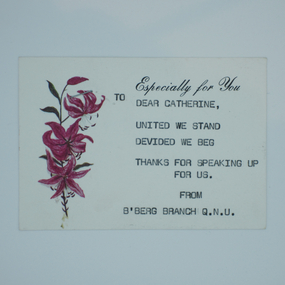
Card from Queensland Nurses Union (Bundaberg Branch) to Catherine Hutchings, visiting Victorian nurses union staff member, 1993
... Printed on one side with personalised, typed message 'DEAR CATHERINE, UNITED WE STAND DEVIDED [sic] WE BEG THANKS FOR SPEAKING UP FOR US. FROM B'BERG [Bundaberg] BRANCH Q.N.U. [Queensland Nurses Union]'....Catherine, Liz and Tracy extend sincere thanks to all interstate nurses who made their visits a success." nursing nurses unionism solidarity victoria queensland bundaberg campaigning 1993 federal election 1992 victorian election australian nursing federation trade unions politics queensland nurses union qnu anf Typed card given with flower bouquet. Printed on one side with personalised, typed message 'DEAR CATHERINE, UNITED WE STAND DEVIDED [sic] WE BEG THANKS FOR SPEAKING UP FOR US. ...Thank-you card given to Australian Nursing Federation (Victorian Branch) staff member Catherine Hutchings by staff at the Bundaberg Branch of the Queensland Nurses Union. In 1993, Victorian Branch staff travelled throughout Queensland, Western Australia and the Northern Territory for a series of meetings on recent events impacting nurses' conditions in Victoria. The meetings were strategically held ahead of the 1993 Federal election to discourage the election of a Coalition government. The election of the Coalition government in Victoria in 1992 had seen the introduction of the Employee Relations Act, which saw the end of the state award system in Victoria. This gave employers greater powers to establish wages and conditions and less power to the Industrial Relations Commission, foreshadowing what would later occur at a Federal level. An article in the Victorian Branch newsletter 'On the Record' from April 1993 describes the 'tour'. Entitled 'Vic. Nurses Spreading the Word in Queensland, Western Australia and the Northern Territory', it explains: "Catherine Huntchin[g]s and Elizabeth Hulme recently spent a week in Queensland informing nurses about the effect of a Liberal Government on nurses. As well, Tracy Austin visited WA to talk to nurses there about life under Kenneyt [sic]. Catherine and Liz held a total of 23 meetings from Cairns to Brisbane, as well as giving media interviews. It was well worth the effort and certainly there was much support given to nurses in Victoria. Perhaps the most interesting issue was that many nurses did not realise that they may find themselves in the same situation if we have a change in Federal Government. In February, Catherine went to the NT to talk to nurses in Darwin, Alice Springs and Katherine and despite some minor hiccoughs (the Health Department banned all the meetings so alternative venues had to be found) the turnout was gratifying - you have to be dedicated to attend a meeting held in a carpark in 32 C heat! Catherine says that the reception she received in both QLD and the NT was superb. "Everyone went out of their way to make us feel very welcome, and to shower us with sympathy over the situation. More important, is the fact that the information was distributed so no matter how the votes go on March 13 [1993, federal election] - they will be informed votes." she said. Catherine, Liz and Tracy extend sincere thanks to all interstate nurses who made their visits a success."Typed card given with flower bouquet. Printed on one side with personalised, typed message 'DEAR CATHERINE, UNITED WE STAND DEVIDED [sic] WE BEG THANKS FOR SPEAKING UP FOR US. FROM B'BERG [Bundaberg] BRANCH Q.N.U. [Queensland Nurses Union]'.nursing, nurses, unionism, solidarity, victoria, queensland, bundaberg, campaigning, 1993 federal election, 1992 victorian election, australian nursing federation, trade unions, politics, queensland nurses union, qnu, anf -
![Australian Nursing Federation bumper sticker, [1990s-2000s?]](/media/collectors/5bb42dc221eaf31100db1d3b/items/5dfabc5d21ea6710d0d3d9b1/item-media/5dfabcd021ea6710d0d43a98/item-fit-380x285.jpg?cb=6) Australian Nursing & Midwifery Federation
Australian Nursing & Midwifery FederationAustralian Nursing Federation bumper sticker, [1990s-2000s?]
... This sticker is one of many pieces of campaign materials and merchandise produced by the Australian Nursing Federation. nursing nurses stickers bumper stickers trade unions merchandise australian nursing federation Rectangular white and blue bumper sticker. Sticker printed with 'Nurses. We ...Bumper sticker designed for community to show support for nurses. This sticker is one of many pieces of campaign materials and merchandise produced by the Australian Nursing Federation.Rectangular white and blue bumper sticker. Sticker printed with 'Nurses. We can't live without them.' in large blue font.nursing, nurses, stickers, bumper stickers, trade unions, merchandise, australian nursing federation -
 Mont De Lancey
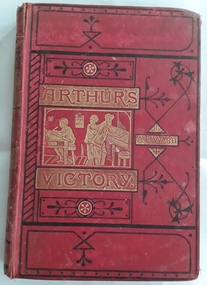
Book, Sunday School Union, Arthur's Victory, 1873
... we chapter. Illuminated style lettering is used for the first word of each chapter. Gold edging to the pages and a printed coloured Presented To, page is at the front of the book. The back cover has a fleur de lis symbol in the middle. This is a fine book depicting the world of the C19th. It is believed to be published in 1873. 174p. Arthur's Victory Book Sunday School Union ...A story depicting life in the C19th and schools. Arthur is a kid thoughtful pupil who goes through many trials and tribulations as he manages life each school day. Strong religious themes throughout to help with character development of boys who read this story.Small red cloth covered hardcover book for children with gold imprint picture of boys at school sitting at a desk in a classroom. The title and author are in red with a gold background. There are black lined patterns of fleur de lis on the front cover as well. Full page black and white illustrations are throughout as well as floral decorations at the top of each we chapter. Illuminated style lettering is used for the first word of each chapter. Gold edging to the pages and a printed coloured Presented To, page is at the front of the book. The back cover has a fleur de lis symbol in the middle. This is a fine book depicting the world of the C19th. It is believed to be published in 1873. 174p.fictionA story depicting life in the C19th and schools. Arthur is a kid thoughtful pupil who goes through many trials and tribulations as he manages life each school day. Strong religious themes throughout to help with character development of boys who read this story. religious stories, school stories, stories for boys -
 Ringwood RSL Sub-Branch
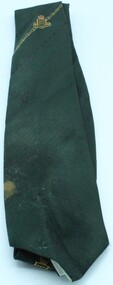
Uniform - Uniform Souvenir Tie
... This is a companion to another tie we have in the RSL collection which has the badge Java 1942. Neck Tie produced for Prisoner of War Re-union. ...Neck Tie produced for Prisoner of War Re-union.It has the badge of the Prisoner of War Association displayed on the front. This is a companion to another tie we have in the RSL collection which has the badge Java 1942. -
 Melbourne Tram Museum
Badge - RTBU Badge, Rail Transport and Bus Union (RTBU), c.2010s
... Round metallic badge with the text "WE RUN THE NETWORK" and "RAIL TRAM TRAM & BUS UNION" printed in front in concentric red and white circles. ...Public transport RTBU Unions Round metallic badge with the text "WE RUN THE NETWORK" and "RAIL TRAM TRAM & BUS UNION" printed in front in concentric red and white circles. ...Used for pinning onto clothing or other accessories. Advertisement of the RTBU is printed on one side.A recent item advertising the RTBU.Round metallic badge with the text "WE RUN THE NETWORK" and "RAIL TRAM TRAM & BUS UNION" printed in front in concentric red and white circles. Nestled within are the lines "RTBU" and "THE POWER OF UNION" printed in white, horizontally on a blue background.public transport, rtbu, unions -
 Melbourne Tram Museum
Document - Instruction, Swanston Trams, "New Years Eve Contingency Plans Update", Dec. 1999
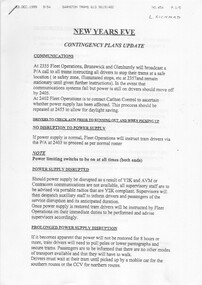
... We all survived! - then the fireworks started and all kept going). Also known as the year 2000 problem. All stapled in the top left hand corner. .1 - eight page document, titled "New Years Eve Contingency Plans Update", detailing what to do in the event the power supply failed. Also has plans for the AVM system, Customer bulletin for the all night service, services during the Christmas New Year period. plans from ADtranz - to provide coverage for the night and a Swanston Trams "All Staff Notice" regarding payment for working during the period and the agreement with the Union. .2 - Copy of the New Year Eve Fleet Rosters - 3 pages. .3 - Swanston Trams Contact List for the period including Customer Service Employees and Adtranz workers - 3 pages. .4 - Vehicle Group list - 3 pages at 238 am on 1/1/2000....We all survived! - then the fireworks started and all kept going). Also known as the year 2000 problem. All stapled in the top left hand corner. .1 - eight page document, titled "New Years Eve Contingency Plans Update", detailing what to do in the event the power supply failed. Also has plans for the AVM system, Customer bulletin for the all night service, services during the Christmas New Year period. plans from ADtranz - to provide coverage for the night and a Swanston Trams "All Staff Notice" regarding payment for working during the period and the agreement with the Union. .2 - Copy of the New Year Eve Fleet Rosters - 3 pages. .3 - Swanston Trams Contact List for the period including Customer Service Employees and Adtranz workers - 3 pages. .4 - Vehicle Group list - 3 pages at 238 am on 1/1/2000. ...Set of four photocopied documents issued by Swanston Trams for New Years Eve, 1/1/2000 - to address the matter known as the "Y2K bug" - where some computer systems or equipment may not have recognised the change of the year due to using only two digits for the year instead of four. (We all survived! - then the fireworks started and all kept going). Also known as the year 2000 problem. All stapled in the top left hand corner. .1 - eight page document, titled "New Years Eve Contingency Plans Update", detailing what to do in the event the power supply failed. Also has plans for the AVM system, Customer bulletin for the all night service, services during the Christmas New Year period. plans from ADtranz - to provide coverage for the night and a Swanston Trams "All Staff Notice" regarding payment for working during the period and the agreement with the Union. .2 - Copy of the New Year Eve Fleet Rosters - 3 pages. .3 - Swanston Trams Contact List for the period including Customer Service Employees and Adtranz workers - 3 pages. .4 - Vehicle Group list - 3 pages at 238 am on 1/1/2000.trams, tramways, swanston trams, year 2000, events, operations, planning, adtranz, rosters -
 Melbourne Tram Museum
Newsletter, Tramways rank and file group, "Trammie Link", 1978 - 1982 and 1991 and 1992
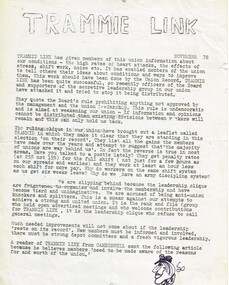
... union executive had arranged token action confined to this depot, but the members wanted more. The strike spread to Preston, then 2,000 trammies at a mass meeting voted for an indefinite strike amidst “rowdy outbursts”. When Biggs complained at being excluded from the meeting a conductress told her, “We...union executive had arranged token action confined to this depot, but the members wanted more. The strike spread to Preston, then 2,000 trammies at a mass meeting voted for an indefinite strike amidst “rowdy outbursts”. When Biggs complained at being excluded from the meeting a conductress told her, “We ...Set of 14 duplicated newsletters printed on coloured quarto or foolscap duplicated paper, "Trammie Link" .1 - November 1978 - 1 quarto sheet - complaining about the lack of union leadership - published by a "tramways rank and file group" .2 - March 1979 - 4 sheets - training, shift work, Burke Road tram, route 72 tram, Gardiner, lifeguards, uniforms. .3 - April 1979 - 4 sheets - disciplinary panel, rosters, Camberwell depot, route 72, buses, North Fitzroy, Doncaster, Clifton Hill, Z class cars. .4 - May 1979 - 4 sheets - discipline, lifeguards, bus safety, union issues. .5 - June 1979 - 3 sheets - politics and unions, Preston depot, Camberwell depot, wage indexation, union matters, finance for public transport, Tramway Record. .6 - August 1979 - 10 pages- Preston Depot, item written by Jim Harper, public transport and government, hook turns, union meetings, women, ACTU, wages, shift work, rosters, depots, wage indexation, shift lengths. .7 - June 1980? - two pages - undated - Service cuts at North Fitzroy, depot committees, news from depots, and note re a meeting on Monday 7 July. .8 - July 1979? - 4 pages - strikes, union campaigns, depot management, industrial issues, discipline, depot facilities. .9 - Sep. 1980 - 3 pages - Lonie report, buses, closure, public transport, union, 35 hour week, unions. .10 - Oct. 1980 - 4 pages - union elections, industrial campaigns, 35 hour week, Lonie repot, public transport. .11 - Oct. 1982 - 3 pages - Preston workshops and new trams, new trams, W class trams, accidents. .12 - Undated - 2 pages about Paul Krutulis - a scab or an Agent Provocateur - see https://www.anu.edu.au/polsci/marx/interventions/years/11revival.htm - accessed 30-8-2016. - Extracted are the 4th and 5th paragraph below which give a bit of a background. .13 - July 1991 - 4 pages - open letter to Jim Harper re union Amalgamation, rank file view, what it would mean to workers - a negative view. Amalgamation was a major push of the Hawke - Keating Government. .14 - March 1992 - supportive of Jim Harper, dismissive of Lou DiGregorio, Union executive, union amalgamation, cross linking of tram routes, racial discrimination within the PTC, Kew Depot, ACTU. Lists the rank and file committee - see key associations. Latham’s frustrations were shared by several would-be heroes in Victoria. In 1977 Paul Krutulis gained an exemption from union membership from the Arbitration Commission as a conscientious objector, only to find that tramway workers at Kew planned to stop work as soon as he appeared. Commissioner Cohen then recommended his dismissal, saying she “had to deal with the reality of the situation.” Krutulis later became president of a group called People Against Communism, before being murdered in September. Thus Krutulis departed the scene to be followed in early 1978 by motor mechanic Jack Kane, who had crossed a picket line at a Melbourne City Council depot. The AMWU forced the Council to sack him before it would end the strike. In September of the same year, Barbara Biggs succeeded in provoking a confrontation in the tramways where Krutulis had failed, by refusing to join the union and prompting 100 unionists at Brunswick depot to go on strike. The union executive had arranged token action confined to this depot, but the members wanted more. The strike spread to Preston, then 2,000 trammies at a mass meeting voted for an indefinite strike amidst “rowdy outbursts”. When Biggs complained at being excluded from the meeting a conductress told her, “We should have let you in, love. You would have been torn to pieces.” Paul was murdered by his brother George in Sydney - see the Age 29/11/1977, but there seems to be some conspiracy theories abounding as well.Handwritten note / letter from Chris Jacobson.trams, tramways, unions, training, shifts, uniforms, route 75, gardiner, light rail, camberwell, z class, buses, discipline, tramway record, preston, north fitzroy, services, strike, depots, discipline, lonie report, public transport, preston workshops, rtbu, actu, ptc -
 Melbourne Tram Museum
Newspaper, The Herald, The Sun, The Age, "We may get super trolley" "Trolley buses may roll soon" "Back to the buses move", 1979 - 1982
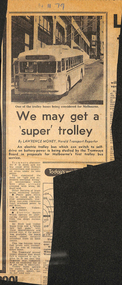
... union reaction - The Age 9/12/1980.\ .7 - "Monster bus will car 240" - with photo of a Daimler Benz guided (O Bahn) busway, notes the installation in Adelaide. The Age 4-10-1982 .8 - "State will buy 45 more super trains", about the purchase of new Comeng trains for Melbourne. "We ...Set of various newspaper cuttings about public transport in Melbourne, including trolley buses. .1 - "We may get a super trolley" - about the possibility of a trolley buses in Melbourne, being studied by the MMTB. The Herald, 14-11-1979, written by Lawrence Money. .2 - "Trolley buses may roll soon", as for above, quotes MMTB Annual Report. Written by Gary Walsh of The Sun newspaper. .3 - "Back to the buses move" - as above - The Sun newspaper - 4/3/1981. .4 - "Electric buses Studied" - as above - written by Geoff Strong - The Age, 14-11-1979 .5 - "Plan for super trains, buses" - as above and new trains - written by Gerry Carman - The Age, 2-1-1980 .6 - "Trolley buses could replace city trams" and other headlines concerning the Lonie Report, closure of rail and tram lines, union reaction - The Age 9/12/1980.\ .7 - "Monster bus will car 240" - with photo of a Daimler Benz guided (O Bahn) busway, notes the installation in Adelaide. The Age 4-10-1982 .8 - "State will buy 45 more super trains", about the purchase of new Comeng trains for Melbourne.trams, tramways, mmtb, trolley buses, public transport, lonie report, comeng -
 Melbourne Tram Museum
Newspaper, The Sun, The Herald, The Age, Southern Cross, "Tram works seek talks on services", "Risson: We should run all buses..." "Tram stop hinges on new rosters", Nov. 1968
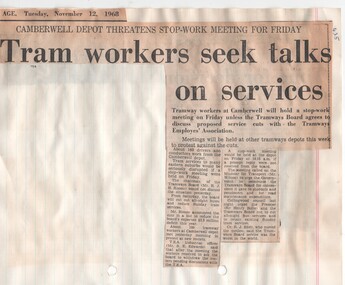
... Trams tramways Rosters Camberwell Depot Unions Tram Services Finances Buses Tram Stops Newspaper Clipping - set of ten clippings adhered to two sides of four sheets of ruled quarto paper with punched holes on the left hand side - primarily about the change in rosters proposed by the MMTB Nov. 1968. 1 - "Tram works seek talks on services" - industrial issues at Camberwell depot 2 - "Risson: We should run all buses..." 3 - "Tram stop hinges on new rosters" - quotes Clarrie O'Shea 4 - "The Govt should aid tramways" 5 - "Tram stop threatens" 6 - "Risson's No on new rosters" 7 - "Cut on local tram routes" - features a photo of 869, at a tram stop with a kerb - trip hazard. 8 - "Trams back, but cuts in services soon" 9 - "Off the tracks" - The Age editorial 10 - "Cabinet will rule on tram dispute" Also other items on new ideas for trams and trains, railway strike threats, fares and has A Place in the Sun written by Keith Dunstan on the Puffing Billy railway. ...Newspaper Clipping - set of ten clippings adhered to two sides of four sheets of ruled quarto paper with punched holes on the left hand side - primarily about the change in rosters proposed by the MMTB Nov. 1968. 1 - "Tram works seek talks on services" - industrial issues at Camberwell depot 2 - "Risson: We should run all buses..." 3 - "Tram stop hinges on new rosters" - quotes Clarrie O'Shea 4 - "The Govt should aid tramways" 5 - "Tram stop threatens" 6 - "Risson's No on new rosters" 7 - "Cut on local tram routes" - features a photo of 869, at a tram stop with a kerb - trip hazard. 8 - "Trams back, but cuts in services soon" 9 - "Off the tracks" - The Age editorial 10 - "Cabinet will rule on tram dispute" Also other items on new ideas for trams and trains, railway strike threats, fares and has A Place in the Sun written by Keith Dunstan on the Puffing Billy railway. Cuttings from The Herald, The Age and Sun, Southern Cross newspapers.trams, tramways, rosters, camberwell depot, unions, tram services, finances, buses, tram stops -
Surrey Hills Historical Society Collection
Work on paper - Vertical File, Level Crossing Removal Authority 1
... ‘We can’t save all the trees but many are worth fighting for!’ and ‘Boroondara Council proposals for Union Road’, SHNN 234, Nov....‘We can’t save all the trees but many are worth fighting for!’ and ‘Boroondara Council proposals for Union Road’, SHNN 234, Nov. ...LEVEL CROSSING REMOVAL AUTHORITY 1. Surrey Hills and Mont Albert Design Feedback Survey, undated (8 page booklet). 2. Letter from Boroondara Council, signed by Jim Hondrakis, Manager Traffic and Transport, re Surrey Hills Level crossing removal community consultation, 7.1.2021 (1 page). 3. Union Road/Mont Albert Road rail crossing removals, Eastsider News, February, 2021 (1 page). 4. Submission to the LXRA by the Tenant Clubs and Canterbury & District Preschool, 8.2.2021 (1 page printed both sides). 5. Letter to residents from Paul Hamer MP, State member for Box Hill, 24.2.2021 (1 page). 6. Level crossings fast-tracked, December, 2020 (4 page A4 folder, printed 8 sides). 7. Public meeting re Protection of Canterbury Sports Ground, 1.3.2021 (1 page printed both sides). 8. ‘Save Lorne Parade Reserve’ meeting flyer, 18.4.2021 (1 page, original and copy). 9. Letter to residents from Paul Hamer MP, State member for Box Hill, April 2021, update Level Crossing Removal Project – Use of Sporting Ovals (1 page). 10. Flyer re public meeting on Surrey Hills and Mont Albert Level Crossing Removal Project, 29.4.2021 (1 page). 11. Flyer ‘The truth about north-east link’, 29.4.2021 (1 page). 12. ‘Level Crossing Removal Update’, Greg Buchanan, Surrey Hills Progress Association; and ‘Rail Corridor Residents Group’, Susannah Aumann, SHNN 232, June/July 2021 (1 page, 2 copies). 13. ‘We can’t save all the trees but many are worth fighting for!’ and ‘Boroondara Council proposals for Union Road’, SHNN 234, Nov./Dec. 2021 (1 page). 14. ‘Level Crossing Removal Update’ by Michael Jacombs, Lindsay Wynne and Susannah Aumann; ‘Surrey Hills Progress Association’ by Greg Buchanan; and ‘Community group launches legal action against State Government’ SHNN 235 Dec. 2020/Jan. 2021, (1 page). 15. ‘Major works starting’, LXRA, January 2022, (4 page brochure). 16. ‘It’s our most dangerous crossing’, Camberwell-Boroondara Press, June, 2008 (1 page). 17. ‘LXRP fast-tracks Surrey Hills removal’, Boroondara Bulletin, May, 2021 (1 page). 18. LRXA Community Information Sessions, June and July, 2021 (2 copies of 1 page). 19. ‘Your new station precinct designs’, LXRA, June, 2021, (2 x 2 8 page brochures). 20. ‘Level Crossings fast-tracked’, LXRA, December 2020 2 x 2 8 page brochures). 21. ‘Level crossing removal works underway’, LXRA; ‘Victorian government rolling out most extensive infrastructure program’, Greg Buchanan; SHNN 236, February, 2022 (1 page). 22. ‘Major works starting’, LXRA, January, 2022 (4 page brochure). 23. Level crossing removal update, July 2019 (4 page brochure). 24. ‘Crossing removals on track’, Progress Leader, 4.6.2019 (1 page, 2 copies). 25. ‘Push to remove crossing’, Progress Leader, 15.5.2018 (1 page). 26. ‘Railway crossing removal update’, SHNN No. 231, April/May, 2021 (1 page). 27. Station Naming Feedback form dated 29.10.2021 28. Contract Awarded, Work Starting notification dated September 2021 29. Major Works Ramping Up notification dated May 2022 30. Trader Directory Shop Local 31. Trader Directory Shop Local 32. On Track for the Big Dig dated August 2022 33. Winter Construction Blitz 2022 34. Residents Fume over Street ban dated 18.8.2022 lxra, level crossing removal authority
