
Showing 1146 items matching "womens - clothing"
-
 Kew Historical Society Inc
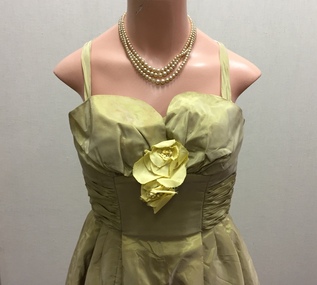
Clothing - Shot Silk Dance Frock & Wrap, Park Avenue Gowns, c.1960
... The Fashion & Design collection of the Kew Historical Society includes examples of women’s, men’s, children’s and infants’ clothing from the 18th, 19th and 20th centuries. ...The Fashion & Design collection of the Kew Historical Society includes examples of women’s, men’s, children’s and infants’ clothing from the 18th, 19th and 20th centuries. ...The Fashion & Design collection of the Kew Historical Society includes examples of women’s, men’s, children’s and infants’ clothing from the 18th, 19th and 20th centuries. Items in the collection were largely produced for, or purchased by women in Melbourne, and includes examples of outerwear, protective wear, nightwear, underwear and costume accessories.This 'dance frock' by Park Avenue Gowns is one of a number of garments in the collection by this designer.Metallic thread silk cocktail dress and wrap by Park Avenue Gowns, 1960. Virtually identical dresses by the designer were featured in the Australian Women's Weekly in 1960, described as 'dance frocks', to which the wide flairing skirt would be well suited.Label : "Park Avenue Gowns"women's clothing, cocktail dresses, dance frocks, australian fashion - 1960s, fashion designers - melbourne (vic) - park avenue gowns -
 Kew Historical Society Inc
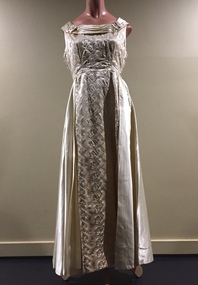
Clothing - Cream Satin Evening Dress, 1950s
... The Fashion & Design collection of the Kew Historical Society includes examples of women’s, men’s, children’s and infants’ clothing from the 18th, 19th and 20th centuries. ...The Fashion & Design collection of the Kew Historical Society includes examples of women’s, men’s, children’s and infants’ clothing from the 18th, 19th and 20th centuries. ...The Fashion & Design collection of the Kew Historical Society includes examples of women’s, men’s, children’s and infants’ clothing from the 18th, 19th and 20th centuries. Items in the collection were largely produced for, or purchased by women in Melbourne, and includes examples of outerwear, protective wear, nightwear, underwear and costume accessories.This evening gown is one of a number of items donated to the Collection by Rosemary-Vaughan Smith.Full length ivory satin evening gown, possibly used previously as a wedding dress. Inset figured brocade panel on front of skirt and bodice, with flared plain satin panels at sides. Bodice has a wide rounded neck decorated with bands of pleated satin, and broad satin shoulder straps. evening dresses, women's clothing, vaughan-smith collection, evening wear, australian fashion - 1950s -
 Kew Historical Society Inc
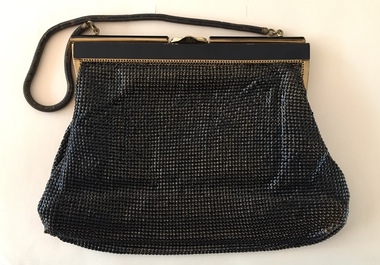
Accessory, Oroton, Black Enamel & Brass Handbag, 1960s
... It includes clothing and clothing accessories worn by four women in the Cohen and McIntyre families across three generations. ...The Kew Historical Society's Fashion & Design collection includes a small and representative collection of reticules, purses and handbags, purchased, inherited or collected by members of the Society. These items date from the Nineteenth and Twentieth centuries, and conform to fashions and styles popular during the period of their use. Some of the items are handmade, while others are mass-produced commercial products. The handbag was owned by, used and donated by Dione McIntyre.The McIntyre Collection of clothing and clothing accessories forms one of the largest single donations to our Fashion & Design collection. It includes clothing and clothing accessories worn by four women in the Cohen and McIntyre families across three generations. The items worn by Melbourne architect, and Kew resident, Dione McIntyre date from the 1960s and 1970s, and include evening wear, day wear, hats and shoes. As Dione McIntyre often accompanied her husband, fellow architect Peter McIntyre, to formal events, there are a number of pieces of evening wear among the items. The McIntyre Collection also includes items worn by women of an earlier generation: by Lilian Cohen, Dione McIntyre's mother, and by her mother-in-law, the wife of the architect Robert McIntyre. At the other end of the chronological spectrum are a number of outfits belonging to, worn and donated by Annie McIntyre. These include outfits created by notable late 20th century Australian and/or international fashion designers. The McIntyre Collection is significant historically and artistically as it includes examples of design that demonstrate changing tastes in fashion over an 80-year period. The collection is also significant in that it includes the work of a large number of Melbourne designers from the 1960s to the 1990s. Black Oroton handbag with brass and black enamel frame and handle. The inside label includes the company name - “OROTON” - and maker details - “Made in West Germany”.costume accessories, handbags, oroton, costume accessories, handbags, purses, oroton, mcintyre collection -
 Kew Historical Society Inc
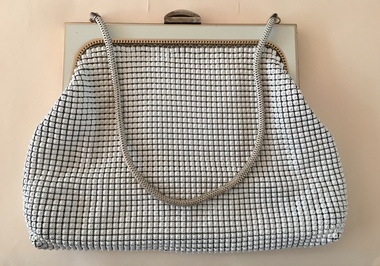
Accessory, Park Lane (handbags), White Enamel & Brass Handbag, 1960s
... It includes clothing and clothing accessories worn by four women in the Cohen and McIntyre families across three generations. ...The Kew Historical Society's Fashion & Design collection includes a small and representative collection of reticules, purses and handbags, purchased, inherited or collected by members of the Society. These items date from the Nineteenth and Twentieth centuries, and conform to fashions and styles popular during the period of their use. Some of the items are handmade, while others are mass-produced commercial products. The handbag was owned by Dione McIntyreThe McIntyre Collection of clothing and clothing accessories forms one of the largest single donations to our Fashion & Design collection. It includes clothing and clothing accessories worn by four women in the Cohen and McIntyre families across three generations. The items worn by Melbourne architect, and Kew resident, Dione McIntyre date from the 1960s and 1970s, and include evening wear, day wear, hats and shoes. As Dione McIntyre often accompanied her husband, fellow architect Peter McIntyre, to formal events, there are a number of pieces of evening wear among the items. The McIntyre Collection also includes items worn by women of an earlier generation: by Lilian Cohen, Dione McIntyre's mother, and by her mother-in-law, the wife of the architect Robert McIntyre. At the other end of the chronological spectrum are a number of outfits belonging to, worn and donated by Annie McIntyre. These include outfits created by notable late 20th century Australian and/or international fashion designers. The McIntyre Collection is significant historically and artistically as it includes examples of design that demonstrate changing tastes in fashion over an 80-year period. The collection is also significant in that it includes the work of a large number of Melbourne designers from the 1960s to the 1990s. White, Oroton style handbag with brass and white enamel frame and handle.handbags, costume accessories, oroton, mcintyre collection -
 Kew Historical Society Inc
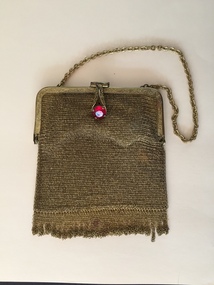
Accessory, Gilded mesh evening bag, 1920s
... It includes clothing and clothing accessories worn by four women in the Cohen and McIntyre families across three generations. ...The Kew Historical Society's Fashion & Design collection includes a small and representative collection of reticules, purses and handbags, purchased, inherited or collected by members of the Society. These items date from the Nineteenth and Twentieth centuries, and conform to fashions and styles popular during the period of their use. Some of the items are handmade, while others are mass-produced commercial products. This handbag was donated by Dione McIntyre.The McIntyre Collection of clothing and clothing accessories forms one of the largest single donations to our Fashion & Design collection. It includes clothing and clothing accessories worn by four women in the Cohen and McIntyre families across three generations. The items worn by Melbourne architect, and Kew resident, Dione McIntyre date from the 1960s and 1970s, and include evening wear, day wear, hats and shoes. As Dione McIntyre often accompanied her husband, fellow architect Peter McIntyre, to formal events, there are a number of pieces of evening wear among the items. The McIntyre Collection also includes items worn by women of an earlier generation: by Lilian Cohen, Dione McIntyre's mother, and by her mother-in-law, the wife of the architect Robert McIntyre. At the other end of the chronological spectrum are a number of outfits belonging to, worn and donated by Annie McIntyre. These include outfits created by notable late 20th century Australian and/or international fashion designers. The McIntyre Collection is significant historically and artistically as it includes examples of design that demonstrate changing tastes in fashion over an 80-year period. The collection is also significant in that it includes the work of a large number of Melbourne designers from the 1960s to the 1990s. Evening purse of gilded mesh with brass frame and chain handle. The base of the bag features a mesh fringe. The clasp includes a faceted red glass gem.purses, fashion accessories, lilian cohen, mcintyre collection, evening wear -
 Kew Historical Society Inc
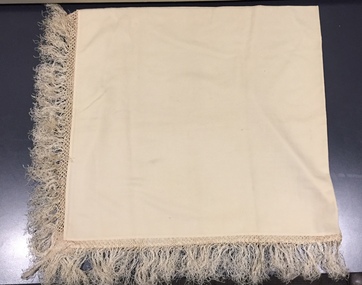
Clothing - Large Fringed Shawl, 20th Century
... shawls throws women's clothing Large cream coloured shawl or throw that includes a very wide fringe. ...Large cream coloured shawl or throw that includes a very wide fringe. The fabric used in its construction is possibly synthetic.shawls, throws, women's clothing -
 Kew Historical Society Inc
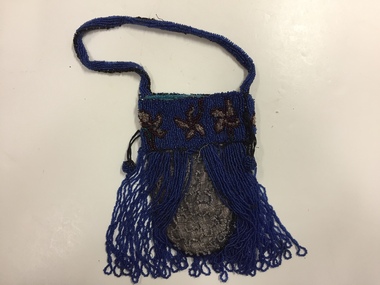
Accessory - Embroidered Silk Reticule with Beaded Fringe, 1880s
... Some of the items are handmade, while others are mass-produced commercial products. women's clothing -- accessories bags -- handbags bags -- reticules bags -- purses fashion accessories Beaded reticule with a fringe and handle of blue class beads. ...The Kew Historical Society's Fashion & Design collection includes a small and representative collection of reticules, purses and handbags, purchased, inherited or collected by members of the Society. These items date from the Nineteenth and Twentieth centuries, and conform to fashions and styles popular during the period of their use. Some of the items are handmade, while others are mass-produced commercial products.Beaded reticule with a fringe and handle of blue class beads. The internal prose has a blue silk lining and a pink silk outer encased in beaded net. Based on an examination of the fabric, the reticule has been dated to the 1880s.women's clothing -- accessories, bags -- handbags, bags -- reticules, bags -- purses, fashion accessories -
 Kew Historical Society Inc
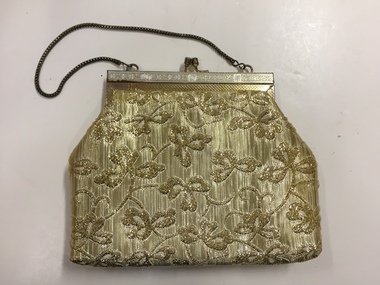
Accessory - Gold Brocade Evening Bag, 1950s
... Some of the items are handmade, while others are mass-produced commercial products. evening bags women's clothing -- accessories bags -- handbags bags -- purses fashion accessories Gold brocade evening bag with metal chain Accessory Gold Brocade Evening Bag ...The Kew Historical Society's Fashion & Design collection includes a small and representative collection of reticules, purses and handbags, purchased, inherited or collected by members of the Society. These items date from the Nineteenth and Twentieth centuries, and conform to fashions and styles popular during the period of their use. Some of the items are handmade, while others are mass-produced commercial products. Gold brocade evening bag with metal chainevening bags, women's clothing -- accessories, bags -- handbags, bags -- purses, fashion accessories -
 Kew Historical Society Inc
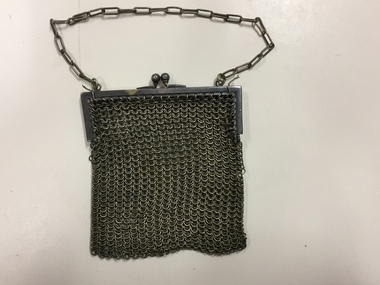
Accessory - Silver Chain Mesh Handbag, 19th Century
... It includes clothing and clothing accessories worn by four women in the Cohen and McIntyre families across three generations. ...The Kew Historical Society's Fashion & Design collection includes a small and representative collection of reticules, purses and handbags, purchased, inherited or collected by members of the Society. These items date from the Nineteenth and Twentieth centuries, and conform to fashions and styles popular during the period of their use. Some of the items are handmade, while others are mass-produced commercial products. The handbag was donated to the collection by Dione McIntyre.The McIntyre Collection of clothing and clothing accessories forms one of the largest single donations to our Fashion & Design collection. It includes clothing and clothing accessories worn by four women in the Cohen and McIntyre families across three generations. The items worn by Melbourne architect, and Kew resident, Dione McIntyre date from the 1960s and 1970s, and include evening wear, day wear, hats and shoes. As Dione McIntyre often accompanied her husband, fellow architect Peter McIntyre, to formal events, there are a number of pieces of evening wear among the items. The McIntyre Collection also includes items worn by women of an earlier generation: by Lilian Cohen, Dione McIntyre's mother, and by her mother-in-law, the wife of the architect Robert McIntyre. At the other end of the chronological spectrum are a number of outfits belonging to, worn and donated by Annie McIntyre. These include outfits created by notable late 20th century Australian and/or international fashion designers. The McIntyre Collection is significant historically and artistically as it includes examples of design that demonstrate changing tastes in fashion over an 80-year period. The collection is also significant in that it includes the work of a large number of Melbourne designers from the 1960s to the 1990s. Square silver chain pursehandbags, evening bags, bags, fashion accessories, silver mesh bags, mcintyre collection -
 Kew Historical Society Inc
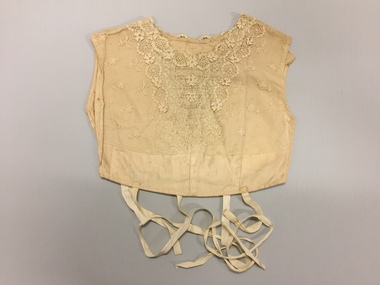
Clothing - Embroidered Chemisette, 1900-1910
... lace women's clothing australian fashion Coffee coloured chemisette with lace. ...Coffee coloured chemisette with lace. Machine sewn with two layers of netting applied by hand. Pink and green bullion knots worked on top net layer which is of machine made lace already embroidered and assembledlace, women's clothing, australian fashion -
 Kew Historical Society Inc
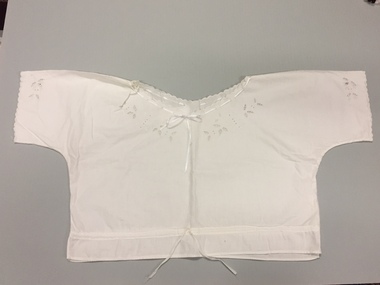
Clothing - Camisole, 1900s
... The Fashion & Design collection of Kew Historical Society includes examples of women’s, men’s, children’s and infants' clothing from the 18th, 19th and 20th centuries. ...While the collection includes some examples of international fashion, most items were handmade or purchased in Melbourne. lace women's clothing australian fashion White cotton cutwork camisole. ...The Fashion & Design collection of Kew Historical Society includes examples of women’s, men’s, children’s and infants' clothing from the 18th, 19th and 20th centuries. While the collection includes some examples of international fashion, most items were handmade or purchased in Melbourne. White cotton cutwork camisole. Tape insert around waist, ribbon insert around neckline. Front and back have a band of hand worked cutwork leaf sprays, as do the sleeves. The neckline is round. The garment is short sleevedlace, women's clothing, australian fashion -
 Kew Historical Society Inc
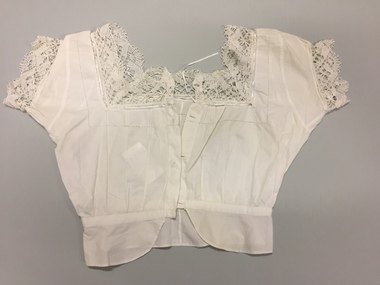
Clothing - Chemisette, 1900s
... The Fashion & Design collection of Kew Historical Society includes examples of women’s, men’s, children’s and infants' clothing from the 18th, 19th and 20th centuries. ...While the collection includes some examples of international fashion, most items were handmade or purchased in Melbourne. lace women's clothing underwear camisoles chemisettes undergarments Chemisette with a square neckline and three buttons down the front. ...The Fashion & Design collection of Kew Historical Society includes examples of women’s, men’s, children’s and infants' clothing from the 18th, 19th and 20th centuries. While the collection includes some examples of international fashion, most items were handmade or purchased in Melbourne. Chemisette with a square neckline and three buttons down the front. It has an attached peplum. The sleeves and neckline are edged with lace. A row of ribbon insertion lace tape is attached to fabric of neckline. 30 mm in from the front of the neckline is a row of drawn thread work. Bodice is also decorated with 4 rows of triple pin tucking. The garment is short sleeved. The buttonholes are concealedlace, women's clothing, underwear, camisoles, chemisettes, undergarments -
 Kew Historical Society Inc
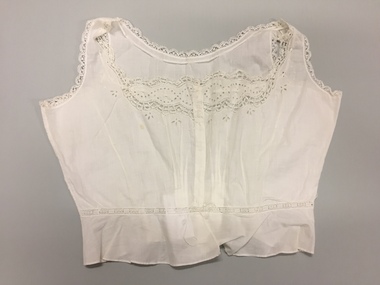
Clothing - Chemisette, 1900s
... The Fashion & Design collection of Kew Historical Society includes examples of women’s, men’s, children’s and infants' clothing from the 18th, 19th and 20th centuries. ...While the collection includes some examples of international fashion, most items were handmade or purchased in Melbourne. lace women's clothing underwear undergarments chemisettes Sleeveless chemisette with five concealed pearl buttons. ...The Fashion & Design collection of Kew Historical Society includes examples of women’s, men’s, children’s and infants' clothing from the 18th, 19th and 20th centuries. While the collection includes some examples of international fashion, most items were handmade or purchased in Melbourne. Sleeveless chemisette with five concealed pearl buttons. Hand worked broderie anglais lace. Peplum is attached to an insert of ribbon tape lace. Neckline and bodice edged with lace. The same lace is also used to border an insert cutwork panel with concealed button holes lace, women's clothing, underwear, undergarments, chemisettes -
 Kew Historical Society Inc
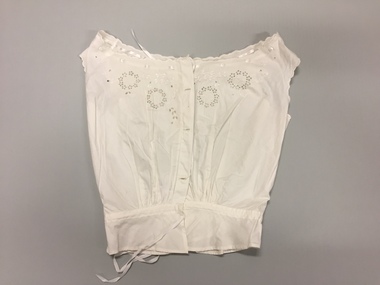
Clothing - Chemisette, 1900s
... The Fashion & Design collection of Kew Historical Society includes examples of women’s, men’s, children’s and infants' clothing from the 18th, 19th and 20th centuries. ...While the collection includes some examples of international fashion, most items were handmade or purchased in Melbourne. fashion and textiles collection - kew historical society lace women's clothing underwear undergarments chemisettes Sleeveless chemisette with 3 pearl buttons decorated with 4 rings of cut work flowers. ...The Fashion & Design collection of Kew Historical Society includes examples of women’s, men’s, children’s and infants' clothing from the 18th, 19th and 20th centuries. While the collection includes some examples of international fashion, most items were handmade or purchased in Melbourne. Sleeveless chemisette with 3 pearl buttons decorated with 4 rings of cut work flowers. Ribbon threaded around the neckline. Bodice gathered to attach to peplum at waist line. Handworked.fashion and textiles collection - kew historical society, lace, women's clothing, underwear, undergarments, chemisettes -
 Kew Historical Society Inc
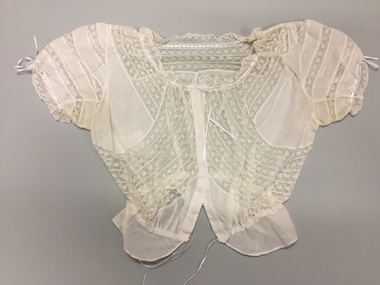
Clothing - Camisole, 1900s
... The Fashion & Design collection of Kew Historical Society includes examples of women’s, men’s, children’s and infants' clothing from the 18th, 19th and 20th centuries. ...While the collection includes some examples of international fashion, most items were handmade or purchased in Melbourne. fashion and textiles collection - kew historical society lace women's clothing australian fashion night wear White muslin camisole with fabric made by machine joined tape lace. ...The Fashion & Design collection of Kew Historical Society includes examples of women’s, men’s, children’s and infants' clothing from the 18th, 19th and 20th centuries. While the collection includes some examples of international fashion, most items were handmade or purchased in Melbourne. White muslin camisole with fabric made by machine joined tape lace. Sleeves have three layers tape lace between three pieces of muslin. Edges are of a layer of scalloped tape lace joined to sleeves by a ribbon insert tape lace.fashion and textiles collection - kew historical society, lace, women's clothing, australian fashion, night wear -
 Kew Historical Society Inc
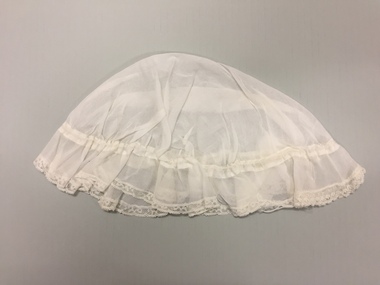
Headwear - Women's Mop cap, 1900s
... The Fashion & Design collection of Kew Historical Society includes examples of women’s, men’s, children’s and infants' clothing from the 18th, 19th and 20th centuries. ...While the collection includes some examples of international fashion, most items were handmade or purchased in Melbourne. fashion and textiles collection - kew historical society lace women's clothing australian fashion Circle of muslin, lace edged, with an attached bias tape to form a tube for gathering cap Headwear Women's Mop cap ...The Fashion & Design collection of Kew Historical Society includes examples of women’s, men’s, children’s and infants' clothing from the 18th, 19th and 20th centuries. While the collection includes some examples of international fashion, most items were handmade or purchased in Melbourne. Circle of muslin, lace edged, with an attached bias tape to form a tube for gathering capfashion and textiles collection - kew historical society, lace, women's clothing, australian fashion -
 Kew Historical Society Inc
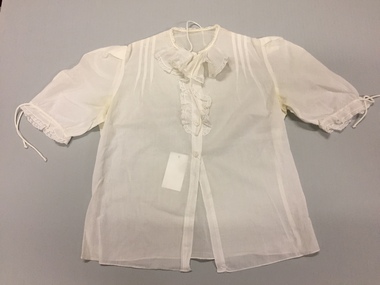
Clothing - Cotton Voile Blouse, 1900s
... The Fashion & Design collection of Kew Historical Society includes examples of women’s, men’s, children’s and infants' clothing from the 18th, 19th and 20th centuries. ...While the collection includes some examples of international fashion, most items were handmade or purchased in Melbourne. fashion and textiles collection - kew historical society lace women's clothing australian fashion White cotton voile blouse with short sleeves. ...The Fashion & Design collection of Kew Historical Society includes examples of women’s, men’s, children’s and infants' clothing from the 18th, 19th and 20th centuries. While the collection includes some examples of international fashion, most items were handmade or purchased in Melbourne. White cotton voile blouse with short sleeves. Neckline ornamented with collar and jabot style front edged with tape lace. Sleeves also ornamented with tape lace. Sleeves and neckline gathered with roulauxfashion and textiles collection - kew historical society, lace, women's clothing, australian fashion -
 Kew Historical Society Inc
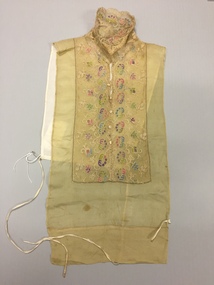
Clothing - Embroidered Silk Chemisette, 1900s
... The Fashion & Design collection of Kew Historical Society includes examples of women’s, men’s, children’s and infants' clothing from the 18th, 19th and 20th centuries. ...While the collection includes some examples of international fashion, most items were handmade or purchased in Melbourne. lace women's clothing australian fashion undergarments chemisettes Rectangular silk organza chemisette, with inset embroidered net at the front and at the neck. ...The Fashion & Design collection of Kew Historical Society includes examples of women’s, men’s, children’s and infants' clothing from the 18th, 19th and 20th centuries. While the collection includes some examples of international fashion, most items were handmade or purchased in Melbourne. Rectangular silk organza chemisette, with inset embroidered net at the front and at the neck. The free-form, multicoloured silk embroidery includes abstract flowers, fruit and leaves, and may be of Chinese origin. The chemisette has five decorative mother-of-pearl buttons at the front and silk organza ties at the waist.lace, women's clothing, australian fashion, undergarments, chemisettes -
 Kew Historical Society Inc
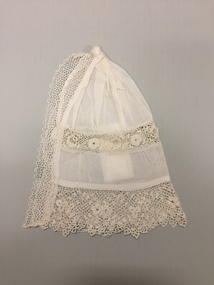
Clothing - Lace Jabot, 1900s
... The Fashion & Design collection of Kew Historical Society includes examples of women’s, men’s, children’s and infants' clothing from the 18th, 19th and 20th centuries. ...While the collection includes some examples of international fashion, most items were handmade or purchased in Melbourne. fashion and textiles collection - kew historical society lace women's clothing australian fashion White cotton jabot of Irish crotchet lace and machine made lace and machine sewn. ...The Fashion & Design collection of Kew Historical Society includes examples of women’s, men’s, children’s and infants' clothing from the 18th, 19th and 20th centuries. While the collection includes some examples of international fashion, most items were handmade or purchased in Melbourne. White cotton jabot of Irish crotchet lace and machine made lace and machine sewn. Inserted lace layer has flat and three dimensional crotchet roses. Lace edging at the bottom has three 3 dimensional roses and shamrocksfashion and textiles collection - kew historical society, lace, women's clothing, australian fashion -
 Kew Historical Society Inc
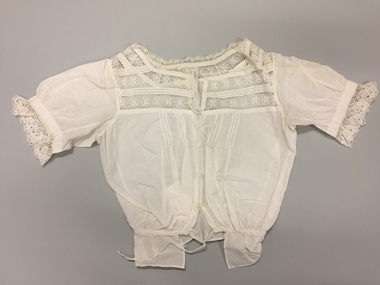
Clothing - Chemisette, 1900s
... The Fashion & Design collection of Kew Historical Society includes examples of women’s, men’s, children’s and infants' clothing from the 18th, 19th and 20th centuries. ...While the collection includes some examples of international fashion, most items were handmade or purchased in Melbourne. lace women's clothing underwear undergarments White cotton voile puff sleeved chemisette with four engraved pearl buttons. ...The Fashion & Design collection of Kew Historical Society includes examples of women’s, men’s, children’s and infants' clothing from the 18th, 19th and 20th centuries. While the collection includes some examples of international fashion, most items were handmade or purchased in Melbourne. White cotton voile puff sleeved chemisette with four engraved pearl buttons. Neck edged with an edging lace and narrow tape. Sleeves finished with two rows of pin tucking and edging lace. Insertion and tape lace at neckline.lace, women's clothing, underwear, undergarments -
 Kew Historical Society Inc
Clothing - Broderie Anglaise Camisole, 1910s
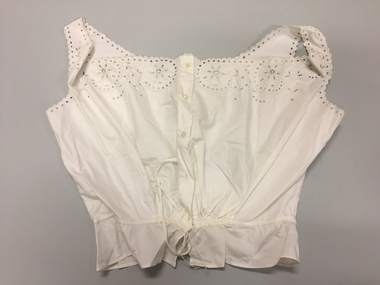
... The Fashion & Design collection of Kew Historical Society includes examples of women’s, men’s, children’s and infants' clothing from the 18th, 19th and 20th centuries. ...While the collection includes some examples of international fashion, most items were handmade or purchased in Melbourne. lace women's clothing lingerie broderie anglaise undergarments Camisole with pearl buttons. ...The Fashion & Design collection of Kew Historical Society includes examples of women’s, men’s, children’s and infants' clothing from the 18th, 19th and 20th centuries. While the collection includes some examples of international fashion, most items were handmade or purchased in Melbourne. Camisole with pearl buttons. Two circular floral motifs on either side of front buttons. Broderie finish to armholes and the back. Joined peplum for gatherhing tape at waist linelace, women's clothing, lingerie, broderie anglaise, undergarments -
 Kew Historical Society Inc
Clothing - Tenerife Lace Blouse, 1910s
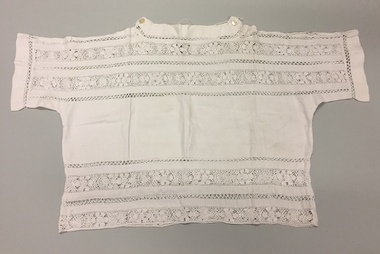
... The Fashion & Design collection of Kew Historical Society includes examples of women’s, men’s, children’s and infants' clothing from the 18th, 19th and 20th centuries. ...It uses drawn work embroidery. fashion and textiles collection - kew historical society lace women's clothing blouse tenerife lace Canary Island Tenerife lace blouse. ...The Fashion & Design collection of Kew Historical Society includes examples of women’s, men’s, children’s and infants' clothing from the 18th, 19th and 20th centuries. While the collection includes some examples of international fashion, most items were handmade or purchased in Melbourne. Tenerife lace (calado canario) is one of the traditional industries of the Canary Islands off the coast of West Africa. It uses drawn work embroidery.Canary Island Tenerife lace blouse. The blouse is decorated with bands of drawn thread lace of two widths at the waist line. There are two bands of wide lace featuring two circular motifs and two simple narrow bands. The neckline is decorated with two bands of the wide lace and three bands of the narrow lace. There is a single button opening at both sides of the necklinefashion and textiles collection - kew historical society, lace, women's clothing, blouse, tenerife lace -
 Kew Historical Society Inc
Clothing - Chemisette
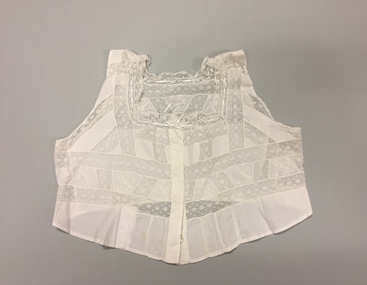
... The Fashion & Design collection of Kew Historical Society includes examples of women’s, men’s, children’s and infants' clothing from the 18th, 19th and 20th centuries. ...While the collection includes some examples of international fashion, most items were handmade or purchased in Melbourne. lace women's clothing lingerie underwear undergarments chemisettes Camisole comprised of three types of machine lace and an embroidered cotton joined together to form a fabric and backed with fine netting. ...The Fashion & Design collection of Kew Historical Society includes examples of women’s, men’s, children’s and infants' clothing from the 18th, 19th and 20th centuries. While the collection includes some examples of international fashion, most items were handmade or purchased in Melbourne. Camisole comprised of three types of machine lace and an embroidered cotton joined together to form a fabric and backed with fine netting. There is a band of narrow lace at the square neckline, this is attached to a band of insertion lace with ribbon holes and then wide bands of insertion lace. At the upper midriff level there is a band of lace interspersed with embroidered butterflies. Garment is buttoned at the front.lace, women's clothing, lingerie, underwear, undergarments, chemisettes -
 Kew Historical Society Inc
Clothing - White Muslin Directoire Knickers
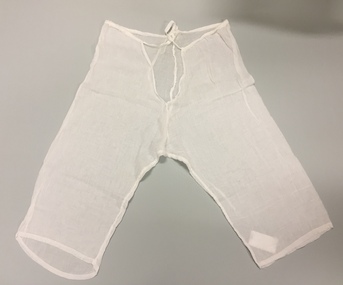
... The Fashion & Design collection of Kew Historical Society includes examples of women’s, men’s, children’s and infants' clothing from the 18th, 19th and 20th centuries. ...While the collection includes some examples of international fashion, most items were handmade or purchased in Melbourne. women's clothing underwear undergarments directoire knickers Crutchless Directoire knickers. ...The Fashion & Design collection of Kew Historical Society includes examples of women’s, men’s, children’s and infants' clothing from the 18th, 19th and 20th centuries. While the collection includes some examples of international fashion, most items were handmade or purchased in Melbourne. Crutchless Directoire knickers. Hand sewn muslin pant with a front central openingwomen's clothing, underwear, undergarments, directoire knickers -
 Kew Historical Society Inc
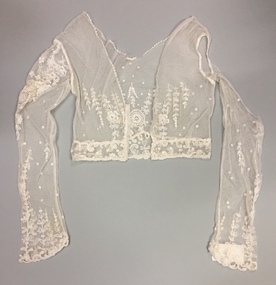
Clothing - Lace bodice, 1900s
... The Fashion & Design collection of Kew Historical Society includes examples of women’s, men’s, children’s and infants' clothing from the 18th, 19th and 20th centuries. ...While the collection includes some examples of international fashion, most items were handmade or purchased in Melbourne. fashion and textiles collection - kew historical society lace women's clothing White cotton machine made net bolero with tambour work and a chemical lace medallion inserted centre back Clothing Lace bodice ...The Fashion & Design collection of Kew Historical Society includes examples of women’s, men’s, children’s and infants' clothing from the 18th, 19th and 20th centuries. While the collection includes some examples of international fashion, most items were handmade or purchased in Melbourne. White cotton machine made net bolero with tambour work and a chemical lace medallion inserted centre backfashion and textiles collection - kew historical society, lace, women's clothing -
 Kew Historical Society Inc
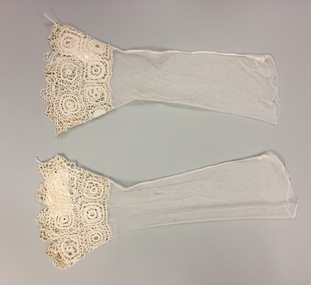
Clothing - Pair of Lace and Net Sleeve Cuffs, 1900s
... The Fashion & Design collection of Kew Historical Society includes examples of women’s, men’s, children’s and infants' clothing from the 18th, 19th and 20th centuries. ...While the collection includes some examples of international fashion, most items were handmade or purchased in Melbourne. lace women's clothing sleeve cuffs engageantes Two white engageantes with lace duffs. ...The Fashion & Design collection of Kew Historical Society includes examples of women’s, men’s, children’s and infants' clothing from the 18th, 19th and 20th centuries. While the collection includes some examples of international fashion, most items were handmade or purchased in Melbourne. Two white engageantes with lace duffs. The stitching suggests that they were hand madelace, women's clothing, sleeve cuffs, engageantes -
 Kew Historical Society Inc
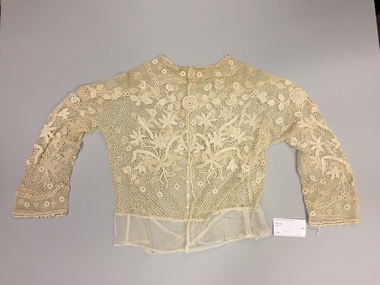
Clothing - Lace Bodice, 1930s
... Predictably with the growth of an ethnically and culturally more diverse community in Kew after the Second World War, textiles, clothing and objects in the collection inevitably reflected this diversity. lace women's clothing Cream crocheted bodice with pearl buttons. ...The Fashion & Design collection of Kew Historical Society includes examples of textiles dating from the 18th, 19th and 20th centuries. Some of the textiles, were used as items of clothing, others as items of household decoration, or simply as travel souvenirs. These textiles were created both domestically and internationally. Predictably with the growth of an ethnically and culturally more diverse community in Kew after the Second World War, textiles, clothing and objects in the collection inevitably reflected this diversity. Cream crocheted bodice with pearl buttons. A net band has been attached at the waistline to facilitate the garment being tucked in. There are some machine made elements hand tacked on but the garment is mainly hand made. Most of the garment is diamond mesh with picot. The yoke is crotchet mesh with applied daisy motifs. Large daffodils and daisy motifs are applied to the main body of the garmentlace, women's clothing -
 Kew Historical Society Inc
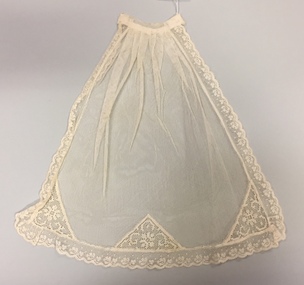
Clothing - Lace Jabot, 1900s
... Predictably with the growth of an ethnically and culturally more diverse community in Kew after the Second World War, textiles, clothing and objects in the collection inevitably reflected this diversity. lace women's clothing jabots Net jabot with 3 machine made filet inserts. ...The Fashion & Design collection of Kew Historical Society includes examples of textiles dating from the 18th, 19th and 20th centuries. Some of the textiles, were used as items of clothing, others as items of household decoration, or simply as travel souvenirs. These textiles were created both domestically and internationally. Predictably with the growth of an ethnically and culturally more diverse community in Kew after the Second World War, textiles, clothing and objects in the collection inevitably reflected this diversity. Net jabot with 3 machine made filet inserts. Edged with machine made tape lacelace, women's clothing, jabots -
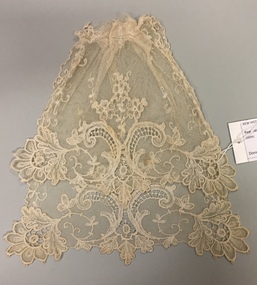 Kew Historical Society Inc
Clothing - Lace Jabot, 1900s
... Predictably with the growth of an ethnically and culturally more diverse community in Kew after the Second World War, textiles, clothing and objects in the collection inevitably reflected this diversity. lace women's clothing jabots Coffee coloured smaller and larger frills to wear at the neck. ...The Fashion & Design collection of Kew Historical Society includes examples of textiles dating from the 18th, 19th and 20th centuries. Some of the textiles, were used as items of clothing, others as items of household decoration, or simply as travel souvenirs. These textiles were created both domestically and internationally. Predictably with the growth of an ethnically and culturally more diverse community in Kew after the Second World War, textiles, clothing and objects in the collection inevitably reflected this diversity. Coffee coloured smaller and larger frills to wear at the neck. Chemical lace daisies sith the net cut away with a punch. The machine was set precisely to repeat the design with lock stitch and then satin stitch around the edgeslace, women's clothing, jabots -
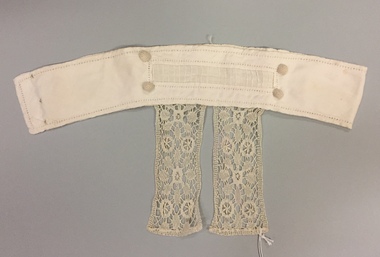 Kew Historical Society Inc
Clothing - Linen Waist Band and Lace Drops, 1900s
... Predictably with the growth of an ethnically and culturally more diverse community in Kew after the Second World War, textiles, clothing and objects in the collection inevitably reflected this diversity. lace women's clothing Curved white cotton band with pin tucked rectangular inset front and back. ...The Fashion & Design collection of Kew Historical Society includes examples of textiles dating from the 18th, 19th and 20th centuries. Some of the textiles, were used as items of clothing, others as items of household decoration, or simply as travel souvenirs. These textiles were created both domestically and internationally. Predictably with the growth of an ethnically and culturally more diverse community in Kew after the Second World War, textiles, clothing and objects in the collection inevitably reflected this diversity. Curved white cotton band with pin tucked rectangular inset front and back. It curves downward to enable the two bobbin lace panels to hang downwards. Has four crotched buttons. The stiches used are plait stitch, cloth stitch, and mesh stitch.lace, women's clothing
