
Showing 1190 items matching "metal manufacture"
-
 Bendigo Military Museum
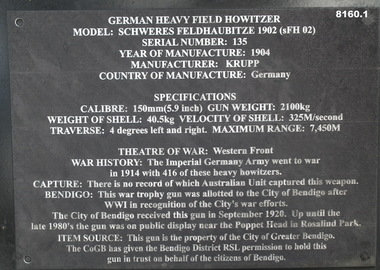
Weapon - HEAVY FIELD HOWITZER, Krupp, Germany, 1904
... Refer photo .1) for details re manufacture, history and use. brsl smirsl bdrslinc howitzer field .1) Plaque metal black on a stand with white text re details of the item. .2) Heavy Field Howitzer German 1902 (sFH02) painted green, on two timber/metal wheels, towed weapon . ...This item is on display in the gardens of the Bendigo District RSL Sub Branch Havilah Road. Refer photo .1) for details re manufacture, history and use..1) Plaque metal black on a stand with white text re details of the item. .2) Heavy Field Howitzer German 1902 (sFH02) painted green, on two timber/metal wheels, towed weapon .brsl, smirsl, bdrslinc, howitzer, field -
 Bendigo Military Museum
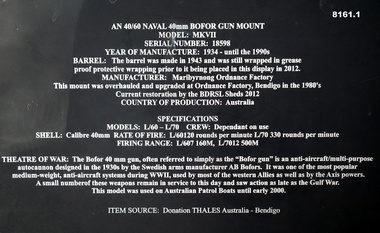
Weapon - NAVAL GUN MOUNT, 40MM, Maribyrnong Ordnance Factory Australia, C.1934 - 1990’s
... Refer photo .1) for details re manufacture, history and use. brsl smirsl bdrslinc bofor 40 mm naval .1) Plaque metal black on a stand with white text re details of the item. .2) Naval AN 40/60 Bofor Gun Mount Model MKV11 painted blueish colour, barrel black, sits on its traversing base. ...This item is on display in the gardens of the Bendigo District RSL Sub Branch Havilah Road. Refer photo .1) for details re manufacture, history and use..1) Plaque metal black on a stand with white text re details of the item. .2) Naval AN 40/60 Bofor Gun Mount Model MKV11 painted blueish colour, barrel black, sits on its traversing base.brsl, smirsl, bdrslinc, bofor, 40 mm, naval -
 Bendigo Military Museum
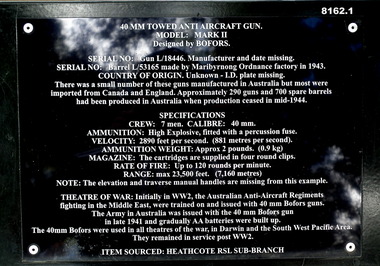
Weapon - ANTI AIRCRAFT GUN, TOWED, Unknown
... Refer photo .1) for details re manufacture, history and use. brsl smirsl bdrslinc bofor 40 mm anti aircraft .1) Plaque metal black on a stand with white text re details of the item. .2) Bofor 40 mm Anti Aircraft Gun M11 painted light green, mounted on a four wheeled base towed item. ...This item is on display in the gardens of the Bendigo District RSL Havilah Road. Refer photo .1) for details re manufacture, history and use..1) Plaque metal black on a stand with white text re details of the item. .2) Bofor 40 mm Anti Aircraft Gun M11 painted light green, mounted on a four wheeled base towed item.brsl, smirsl, bdrslinc, bofor, 40 mm, anti aircraft -
 Bendigo Military Museum
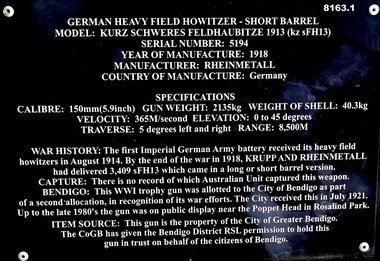
Weapon - HEAVY FIELD HOWITZER, GERMAN, Rheinmetall Germany, 1918
... Refer photo .1) for details re manufacture, history and use. brsl smirsl bdrslinc german field howitzer .1) Plaque metal black on a stand with white text re details of the item. .2) German heavy Field Howitzer short barrelled, Model year 1913, painted green, on two timber/metal wheels towed. ...This item is on display in the gardens of the Bendigo District RSL Sub Branch Havilah Road. Refer photo .1) for details re manufacture, history and use..1) Plaque metal black on a stand with white text re details of the item. .2) German heavy Field Howitzer short barrelled, Model year 1913, painted green, on two timber/metal wheels towed.brsl, smirsl, bdrslinc, german, field howitzer -
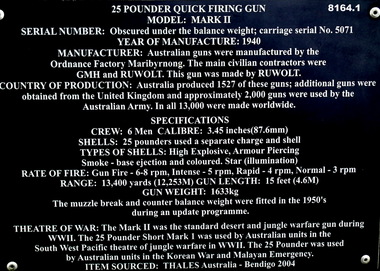 Bendigo Military Museum
Weapon - 25 POUNDER QUICK FIRING GUN, Ruwolt, C.1940
... Refer photo .1) for details re manufacture, history and use. Brsl smirsl bdrslinc 25 Pounder .1) Plaque metal black on a stand with white text re details of the item. .2) 25 Pounder Quick Firing Gun Model Mark 11, painted green, on two wheels, towed. ...This item is on display in the gardens of the Bendigo District RSL Sub Branch Havilah Road. Refer photo .1) for details re manufacture, history and use. .1) Plaque metal black on a stand with white text re details of the item. .2) 25 Pounder Quick Firing Gun Model Mark 11, painted green, on two wheels, towed.brsl, smirsl, bdrslinc, 25 pounder -
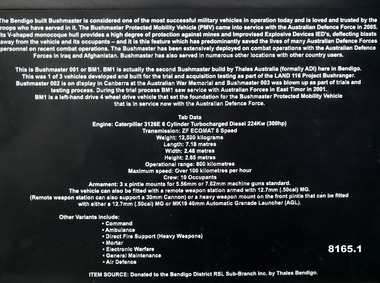 Bendigo Military Museum
Vehicle - BUSHMASTER, PROTECTED MOBILITY, C.2005
... Refer photo .1) for details re manufacture, history and use. Brsl smirsl bdrslinc vehicle bushmaster mobility .1) Plaque metal black on a stand with white text re details of the item. .2) Bushmaster BMI, Protected Mobility Vehicle (PMV) has multiple variation uses, painted brown on 4 rubber wheels. ...This item is on display in the gardens of the Bendigo District RSL Sub Branch Havilah Road. Refer photo .1) for details re manufacture, history and use..1) Plaque metal black on a stand with white text re details of the item. .2) Bushmaster BMI, Protected Mobility Vehicle (PMV) has multiple variation uses, painted brown on 4 rubber wheels.brsl, smirsl, bdrslinc, vehicle, bushmaster, mobility -
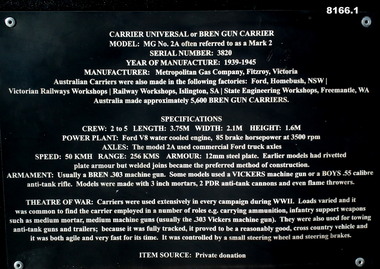 Bendigo Military Museum
Weapon - BREN GUN CARRIER, C.1939 - 45
... Refer photo .1) for details re manufacture, history and use. Brsl smirsl bdrslinc carrier Bren gun “3” - “3820” .1) Plaque metal black on a stand with white text re details of the item. .2) Bren Gun Carrier or Carrier Universal Model MG No 2A, in camouflage colours, tracked vehicle. ...This item is on display in the gardens of the Bendigo District RSL Sub Branch Havilah Road. Refer photo .1) for details re manufacture, history and use..1) Plaque metal black on a stand with white text re details of the item. .2) Bren Gun Carrier or Carrier Universal Model MG No 2A, in camouflage colours, tracked vehicle.“3” - “3820”brsl, smirsl, bdrslinc, carrier, bren gun -
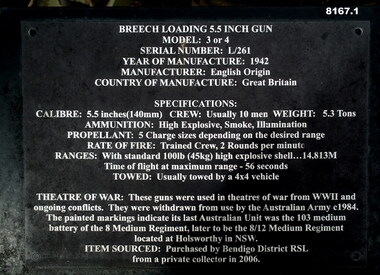 Bendigo Military Museum
Weapon - BREECH LOADING GUN, C.2006
... Refer photo .1) for details re manufacture, history and use. brsl smirsl breech looading 5.5 Bdrslinc .1) Plaque metal black on a stand with white text re details of the item. .2) Breech Loading Gun 5.5 inch Model 3 or 4 painted green colour, on two wheels, towed item. ...This item is on display in the gardens of the Bendigo District RSL Sub Branch Inc Havilah Road. Refer photo .1) for details re manufacture, history and use..1) Plaque metal black on a stand with white text re details of the item. .2) Breech Loading Gun 5.5 inch Model 3 or 4 painted green colour, on two wheels, towed item.brsl, smirsl, breech looading, 5.5, bdrslinc -
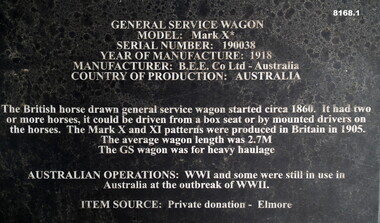 Bendigo Military Museum
Equipment - WAGON, GENERAL SERVICE, C.1918
... Refer Photo .1) for details of manufacture, history and use. brsl smirsl wagon General service Bdrslinc .1) Plaque metal black with white text re details of the item. .2) General Service Wagon Model: Mark X*, wood metal construction on 4 wheels. ...This item is on display in the gardens of the Bendigo District RSL Sub Branch Inc Havilah Road. Refer Photo .1) for details of manufacture, history and use..1) Plaque metal black with white text re details of the item. .2) General Service Wagon Model: Mark X*, wood metal construction on 4 wheels.brsl, smirsl, wagon, general service, bdrslinc -
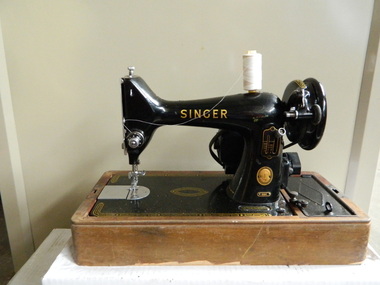 Kiewa Valley Historical Society
Sewing Machine
... Manufacturing Company" - gold embossed "No. EL 249 355" - oval disc "99K" - disc "Singer Manfg. Co. - disc The machine has a brown wood veneer base and a lid with a metal handle in the centre of the top. ...Sewing machines were used by some ladies to mend and make clothes for the family as shops were some distance away and bought clothes were much more expensive. The sewing machines were also used to sew items for fund raising e.g.. Church and School fetes.Used in the Kiewa Valley.The machine has a brown wood veneer base and a lid with a metal handle in the centre of the top. There is a long screw that fits in a hole at the top of the lid. The screw can be lifted out and used to open and take off the lid. Inside there is a black metal machine which is fitted onto the wooden base. There is a compartment in the base, right of the wheel of the machine, which holds an instruction manual and a tube of ""Singer" lubricant for electric machines". The light, above the needle is covered by bakelite. A leather belt runs around the wheel on the right to enable the machine to run. There is a foot pedal and an electric cord attached."Singer Manufacturing Company" - gold embossed "No. EL 249 355" - oval disc "99K" - disc "Singer Manfg. Co. - discsewing machine; singer manufacturing company; kiewa valley -
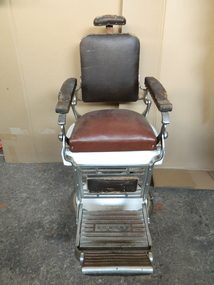 Kiewa Valley Historical Society
Barber's Chair
... manufactured chairs date to c1850. With a foot rest in 1878 and with a mechanically raised and lowered chair. Chairs have an adjustable height with foot operated jack or hand operated lever on the side. The chair can also rotate, or lean backwards (for hair washing and shaving) and has a head rest .Old Barber's chairs are made from metal and leather and are heavy. ...manufactured chairs date to c1850. With a foot rest in 1878 and with a mechanically raised and lowered chair. Chairs have an adjustable height with foot operated jack or hand operated lever on the side. The chair can also rotate, or lean backwards (for hair washing and shaving) and has a head rest .Old Barber's chairs are made from metal and leather and are heavy. ...The first factory manufactured chairs date to c1850. With a foot rest in 1878 and with a mechanically raised and lowered chair. Chairs have an adjustable height with foot operated jack or hand operated lever on the side. The chair can also rotate, or lean backwards (for hair washing and shaving) and has a head rest .Old Barber's chairs are made from metal and leather and are heavy. Mt Beauty township had a Barber's business during the construction of the Kiewa Hydro Electric Scheme and beyond. ""Sam The Barber" was an original Kiewa character. Probably for 45 years cut the hair of thousands of Kiewa workers with his scissors, hand clippers and cut throat razor." Ref. online: "The Mt Beauty & Murray connection"Brown leather padded seat, back rest, headrest and armrest. At the front of the arm rest is a wooden section (maybe for a cuppa?). The chair has a steel frame and foot rest. There is a large white enamel disc under the seat and a white enamel stand with a steel perimeter. A metal lever joins from the back of the footrest to the base enabling the chair to be tilted back.Embossed on foot rest: "Raynor"barber's chair, hair dressing, mt beauty shops, shaving -
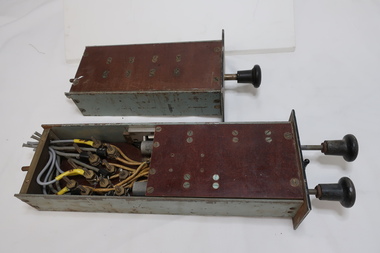 Kiewa Valley Historical Society
Electrical Equipment - Relays
... Manufacture: "The English Co. Ltd. London Collection of black metal rectangular boxes (heavy) containing electrical wires forming a circuit. ...Protective relays are one of the critical components of the elctrical power grid that serve to detect defective equipment or other dangerous or intolerable conditions and can either initiate or permit switching or simply provide an alarm to provide an alarm to provide a safer, more reliable delivery system. Used in power stations. The function of relay is to quickly remove from service any equipment that might suffer damage or otherwise affect the operation of the system. Relays protect the electrical system in 2 ways: Prevent failure or damage to electrical systems. Mitigate the effects of failure when it occurs. Switches that control other switches. Relays are used where it is necessary to control a circuit by an independent low-power signal, or where several circuits must be controlled by one signal.Used by the State Electricity Commission of Victoria for the Kiewa Hydro Electric Scheme in the power stations. Manually operated by remote control for an external circuit breaker. The relays were from a Kiewa Hydro Power Station control panel.Collection of black metal rectangular boxes (heavy) containing electrical wires forming a circuit. The longer, narrower rectangles have a bakelite knob at one end. Some of the boxes have one side of clear perspex and another has all sides of clear perspex. One is labelled "group relay". Another has windows with labels eg. 'turbine overspeed' 'emergency trip' and one has 3 steel knobs. - with 'stop', 'start'. One box is larger than the rest and has clear perspex side showing 'overcurrent relay' and workings.One has a plaque attached. Manufacture: "The English Co. Ltd. Londonpower circuits, electrical equipment, electric power control, power relays, power station, circuit breaker -
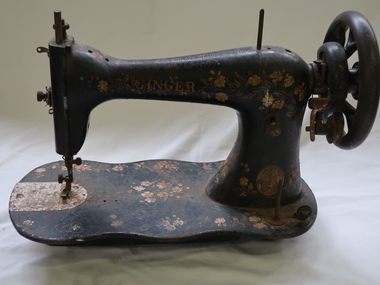 Kiewa Valley Historical Society
Sewing Machine - Singer
... Top: 'the Singer Manufacturing'. Front: 'Singer' and the Metal Plaque 'The Singer MFC Cony'...It was used for domestic sewing such as for making clothes for the family, making toys for eg. a fete and making useful items eg. a bag for school readers Singer manufacturing co. clothes sewing domestic Top: 'the Singer Manufacturing'. Front: 'Singer' and the Metal Plaque 'The Singer MFC Cony' Singer Fiddle Base treadle sewing machine with decoration of flowers. ...Singer began to market its machines internationally in 1855. They began mass-producing domestic electric machines in 1910. Treadle machines were powered mechanically by a foot pedal that is pushed back and forth by the operator's foot. There were also machines belt powered, hand powered and eventually electric powered. Treadle machines were made into the 1950s but they were most common during the late Victorian years (up to 1901). This machine is c1894.This machine was owned and used by a resident of the Kiewa Valley. It was used for domestic sewing such as for making clothes for the family, making toys for eg. a fete and making useful items eg. a bag for school readersSinger Fiddle Base treadle sewing machine with decoration of flowers. Straight stitch. No stand. A little rusty.Top: 'the Singer Manufacturing'. Front: 'Singer' and the Metal Plaque 'The Singer MFC Cony'singer manufacturing co., clothes, sewing, domestic -
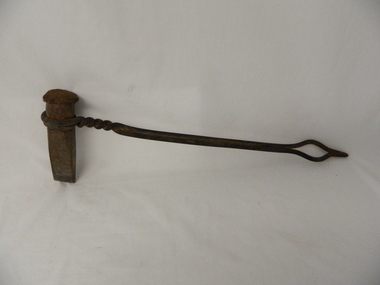 Kiewa Valley Historical Society
Hammer Blacksmith, 1900's
... This blacksmith's hammer was an integral tool used by cattle property "blacksmith's" for the maintenance of horse shoes and the manufacture/alterations and repair of any other metal item required by the property. ...This blacksmith's hammer was an integral tool used by cattle property "blacksmith's" for the maintenance of horse shoes and the manufacture/alterations and repair of any other metal item required by the property. ...This blacksmith's hammer was an integral tool used by cattle property "blacksmith's" for the maintenance of horse shoes and the manufacture/alterations and repair of any other metal item required by the property. Self sufficiency was the key element to the success of a cattle property especially in semi isolated rural areas(early Kiewa Valley) and the larger the property ie. stock holding the greater the need..This blacksmith's hammer would not only have been used on the cattle property of the pioneer family (the Ropers) in the earlier part of the 1900s but also up in the Bogong High Plains grazing region to maintain the constant refurbishment/maintenance of horse shoes and other metal items. Depending on each property's requirement for blacksmith's service, one from the larger property could have serviced all the valley's requirements.Large blacksmith's hammer has a handle of twisted iron encircling 19 cm. hammer head. It has a round striking end and a wedge shaped punch end.V.B. [in dots ]tools, horses, punch, blacksmiths -
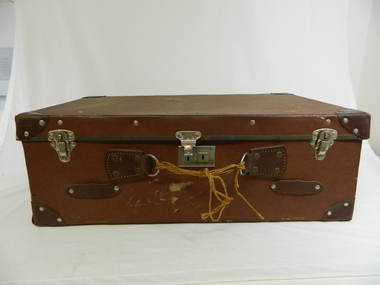 Kiewa Valley Historical Society
Suitcase
... The majority of manufactured goods especially locks and other metal components were sourced from England. ...manufactured items. This period 1920- 1950 shows the historical shift of the balance between the more complex metal imported items, mainly manufactured in Britain and that of the relevant infant stage of the developing manufacturing industries in the Australian market. ...Typical early 1920's to late 1950's suitcases made in Australia using Australian and British manufactured clasps and locks. The majority of manufactured goods especially locks and other metal components were sourced from England. English manufacturers, who in that period, where still world leaders of most manufactured items.This period 1920- 1950 shows the historical shift of the balance between the more complex metal imported items, mainly manufactured in Britain and that of the relevant infant stage of the developing manufacturing industries in the Australian market. The rarity of this type of suitcase is of significancy This suitcase belonged and was used by the C.W.A. of Tawonga.Suitcase brown, possibly lacquered cardboard with leather chrome studded reinforced corners. Lid has two silver coloured(chrome) clasps each end with chrome lock in centre. "D" rings for missing handle secured to main frame by leather straps, these having metal chrome studs. Substitute handle made from string. Metal protective trim on lid and top edge of suitcase compartmentLock stamped "Made in England" and two end clasps stamped "Made in Australia"case, luggage, travel suitcase, country women's association -
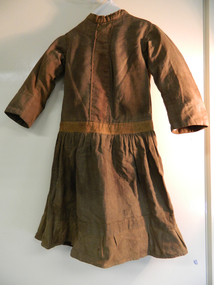 Kiewa Valley Historical Society
Dress
... manufacture, earthy colours and ease of mobility. Photos in the KVHS collection show girls from Tawonga Primary School in a dress that could be this dress which is dated 1910. dress clothing girl's dress home made no inscriptions or markings suggesting locally made. Dress brown cotton with long sleeves. Dress top and sleeves lined. Back of dress is open with metal ...made locally circa 1910. Due to relative long distance to haberdashery stores majority of children's garments were hand made by a local talented seamstress or mother/relativeHistorical significant to the period circa 1900 to circa 1950 when fashion was dictated by long lasting durability, local manufacture, earthy colours and ease of mobility. Photos in the KVHS collection show girls from Tawonga Primary School in a dress that could be this dress which is dated 1910. Dress brown cotton with long sleeves. Dress top and sleeves lined. Back of dress is open with metal hooks for fastening. Hand stitched eyelets and decorative strip down centre front bodice and around hips. Gathered skirt is joined at hip. One pocket on left side 6cm from waist band.Decorative strip at bottom of dress with a pleated hand and machine stitched frill.no inscriptions or markings suggesting locally made.dress, clothing, girl's dress, home made -
 Kiewa Valley Historical Society
Pin Hat
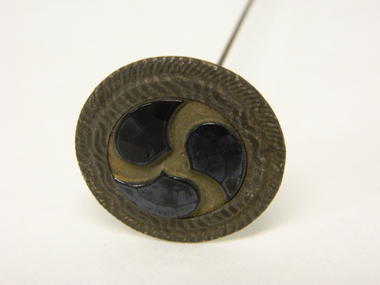
... manufactured hair sprays. It is also an example of society's mores of tidiness and quasi religious beliefs of covering the hair and head when outdoors costume female head ware accessories hat pin This hat pin is adorned with a flat metal circular head. ...Historically this item represents women's fashion in the 1920s to 1950s. As the material used in the construction is not of a high monetary value it can be assumed it was a day to day working woman apparel to keep the hat firmly fastened into the hair. It does indicate that fashion of the time was important within the regionThis item is a reflection of both the fashion mode of the 1920s to 1950s when long hair needed to be controlled by hair pins rather than later manufactured hair sprays. It is also an example of society's mores of tidiness and quasi religious beliefs of covering the hair and head when outdoorsThis hat pin is adorned with a flat metal circular head. There are two circles of narrow patterns around the outer edge. The centre is decorated with three shiny black faceted shapes producing a spoke like appearancecostume female head ware accessories, hat pin -
 Kiewa Valley Historical Society
Camera Box Brownie Folding, Six 20 Folding Brownie KodetteII, Circa 1948 to late 1970s
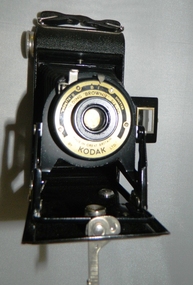
... No external makings but when the lens is folded out it exposes manufacturing information on metal base around the lens " Kodette II B I shutter"(B= Bulb and I= Instant), underneath this, in larger print, is "'FOLDING 'BROWNIE' SIX - 20" below the lens and in smaller print, "made in Great Britain" and underneath this "by KODAK ltd"...No external makings but when the lens is folded out it exposes manufacturing information on metal base around the lens " Kodette II B I shutter"(B= Bulb and I= Instant), underneath this, in larger print, is "'FOLDING 'BROWNIE' SIX - 20" below the lens and in smaller print, "made in Great Britain" and underneath this "by KODAK ltd" This is a black metal rectangular camera, rounded on the ends and has silver colored fittings(stainless steel) and a small leather handle on hinges the left side (facing the lens). ...This camera was made for the mobile photographer and the camera manufacturer Kodak was at the peak of production. Mr. George Eastman, the company's founder, who invented roll film, which could withstand the outdoor activities and therefor replaced photographic plates. In 1900, the Box Brownie camera was first released Kodak's motto was' "You push the button, we do the rest," The film used in this camera was Kodak Verichrome 620 introduced in 1936 and only went out of production 2009. This camera was a vintage 1970s one. Between 1963 and 1970 the company sold 50 million of this type of camera. The production of smaller and more user friendly digital cameras, mainly from Japan finally nailed the coffin lid on the Kodak Company. Ironically, one of Kodak's engineers called Steve Sasson, devised a camera that could save images using electronic circuits. The images were transferred onto a tape cassette and were viewable by attaching the camera to a TV screen, however Kodak tried to maintain its photographic film products beyond its "use by date". In1975 Kodak becomes the first company to make a digital camera, however the Japanese manufacturers could make smaller and more compact cameras ending Kodak's monopoly and eventual demise.This particular "box brownie" was used by Margaret Shefford, nee Turner, who with her husband retired, in the 1980s, to Mount Beauty. The camera was purchased in the 197's and used on their cruise to England. The significance of this item is that at the time of its introduction to Mount Beauty the camera was a "state of the art", for general public, camera introduced by an ever increasing influx of retirees. This identifies the Kiewa Valley not only as an attraction for sightseers and overseas tourists but also retirees. The social implications of this trend will continue to provide a broader requirement for medical and other facilities geared up to the requirements of an aging population. As a lot of cities in Australia have increasing levels of violence (mainly drug related) rural "retreats" are becoming more sought after by sections of "the gentle populous"This is a black metal rectangular camera, rounded on the ends and has silver colored fittings(stainless steel) and a small leather handle on hinges the left side (facing the lens). The folding lens and shutter component fold out from the main compartment. Two metal arms swing out and hold the lens and collapsible lens body to the required length. When not in use this collapsible (folding) lens extension is fastened to the main body structure providing security and preventing damage to the folding material. The camera has a collapsible eye piece or view finder at the top end. The right hand bottom end has a cylindrical film wider (polished steel). Inside there are two cylindrical cavities, one holding the roll of unexposed film and the other (winder) end a cylinder onto which the unexposed film is wound through for each picture frame. There is a locking mechanism to hold the folding lens structure to the main box structure. See KVHS 0419B for its carrying caseNo external makings but when the lens is folded out it exposes manufacturing information on metal base around the lens " Kodette II B I shutter"(B= Bulb and I= Instant), underneath this, in larger print, is "'FOLDING 'BROWNIE' SIX - 20" below the lens and in smaller print, "made in Great Britain" and underneath this "by KODAK ltd"kodak kodette ii, folding brownie camera, photography, hobby personal item, tourist gadgets. -
 Warrnambool and District Historical Society Inc.
Bottles, Early 20th century
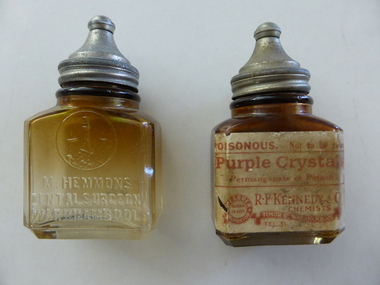
... manufacturing chemist business in Warrnambool in the 1880s. This business was regarded as the largest and best appointed pharmacy in Victoria for many years. The business continued until the 1920s trading as R..F. Kennedy & Co. These two bottles are of considerable interest as mementoes of two prominent Warrnambool identities of the past- Melsom Hemmons and Richard Kennedy. melsom hemmons warrnambool dentist .1 and .2 M HEMMONS DENTAL SURGEON WARRNAMBOOL .2 POISONOUS NOT TO BE TAKEN PURPLE CRYSTALS R.F KENNEDY & CO CHEMISTS TIMOR STREET WARRNAMBOOL .1 A brown glass bottle with a metal top and a white label with faded red writing pasted on. ...These two bottles have been used in the business of Melsom Hemmons a dentist who operated from the chemist shop of R.F. Kennedy & Co. in Timor Street, Warrnambool. Hemmons was a close friend of Richard Kennedy who established a large wholesale, retail and manufacturing chemist business in Warrnambool in the 1880s. This business was regarded as the largest and best appointed pharmacy in Victoria for many years. The business continued until the 1920s trading as R..F. Kennedy & Co. These two bottles are of considerable interest as mementoes of two prominent Warrnambool identities of the past- Melsom Hemmons and Richard Kennedy..1 A brown glass bottle with a metal top and a white label with faded red writing pasted on. On the other side is an embedded emblem of a lighthouse and lettering. The bottle is half filled with a liquid. The lid is rusted and the label is stained and torn. .2 As above except there is no label or liquid. .1 and .2 M HEMMONS DENTAL SURGEON WARRNAMBOOL .2 POISONOUS NOT TO BE TAKEN PURPLE CRYSTALS R.F KENNEDY & CO CHEMISTS TIMOR STREET WARRNAMBOOL melsom hemmons warrnambool dentist -
 Warrnambool and District Historical Society Inc.
Bottle, Soda Siphon, c. 1920
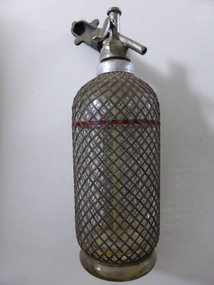
... manufacturing also in U.S.A. and Europe. This syphon has no known provenance but it could have been used in a hotel or a cordial factory in Warrnambool or district. This soda syphon is of interest as an example of how soft drinks were dispensed 90 to 100 years ago. It will be useful for display. sparklets company soda syphon bottle warrnambool ‘Sparklets’ ‘Admit gas slowly and shake vigorously’ Important. Do not fill the bottle above the red line’. This is a heavy glass bottle with a heavy base. It has a metal ...This soda syphon is a device for dispensing carbonated or soda water. It was also called a Seltzer bottle. The design of soda syphons used in the 20th century was first created in the late 1830s and these bottles were especially popular in the 1920s and 30s. This Sparklets Company syphon was probably made in England but the company was manufacturing also in U.S.A. and Europe. This syphon has no known provenance but it could have been used in a hotel or a cordial factory in Warrnambool or district. This soda syphon is of interest as an example of how soft drinks were dispensed 90 to 100 years ago. It will be useful for display.This is a heavy glass bottle with a heavy base. It has a metal mesh over the bottle with a metal (or material) red band around the bottle three-quarters of the way up from the bottom. The mechanisms for filling and siphoning at the top are made of metal (these include a funnel and two handles). Attached to the top and inside the bottle is a tube for syphoning. Directions for use are printed on the lid. ‘Sparklets’ ‘Admit gas slowly and shake vigorously’ Important. Do not fill the bottle above the red line’. sparklets company, soda syphon bottle, warrnambool -
 Warrnambool and District Historical Society Inc.
Badge, Warrnambool Butter
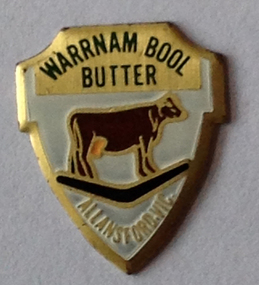
... manufacture. The Warrnambool Cheese and Butter Factory was established in 1888 and was one of the first co-operative butter factories in Victoria. Cheese making started at the factory in 1892, with the Kraft Food Company leasing the factory in the 1930s and continuing for many years to operate the cheese production area. These discs are of some interest as ones used by a premier factory in the Warrnambool district. Dairying in the Warrnambool district is of major significance. warrnambool cheese and butter factory allansford ‘Warrnambool Butter, Allansford’ These metal ...These discs come from the Warrnambool Cheese and Butter Factory at Allansford and promote the butter manufacture. The Warrnambool Cheese and Butter Factory was established in 1888 and was one of the first co-operative butter factories in Victoria. Cheese making started at the factory in 1892, with the Kraft Food Company leasing the factory in the 1930s and continuing for many years to operate the cheese production area. These discs are of some interest as ones used by a premier factory in the Warrnambool district. Dairying in the Warrnambool district is of major significance.These metal discs, four in number, are in the shape of a shield and have gold, brown and green enamelling on the front. There is an image of a cow with a boomerang shape underneath. The discs would be used for packaging and promotional material and are intended to be glued on to the material. ‘Warrnambool Butter, Allansford’warrnambool cheese and butter factory, allansford -
 Warrnambool and District Historical Society Inc.
Functional object - Window weights, Circa 1890
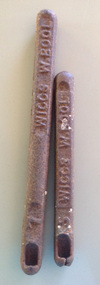
... The significance lies in the fact that the items were manufactured in Warrnambool by a well- established local business. warrnambool wiggs dutton & wiggs window weights S. Wiggs W,bool. One has the number 7 and the other 5 cast into the metal. ...Dutton and Wiggs operated a brass and iron foundry known as the Warrnambool Brass and iron Foundry situated in Timor St. Mr Dutton was a mechanical engineer and Mr C Wiggs was an experienced foundry worker. They were innovative in their work and also manufactured a large number of everyday items such as verandah posts, brackets and milk aerators.The significance lies in the fact that the items were manufactured in Warrnambool by a well- established local business. Two solid cast iron rods of cylindrical shape with one flattened edge with name imprinted. Hollowed out section on one end. S. Wiggs W,bool. One has the number 7 and the other 5 cast into the metal. warrnambool, wiggs, dutton & wiggs, window weights -
 Warrnambool and District Historical Society Inc.
Domestic object - Alex Anderson Kettle, Early 20th century
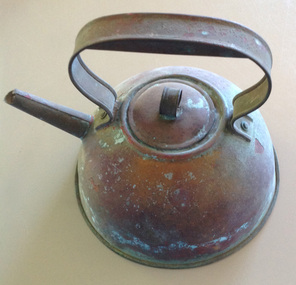
... A common item which was manufactured locally. warrnambool alex. anderson 178 fairy street warrnambool alex. anderson plumber warrnambool fairy street plumber A. Anderson Maker Warrnambool. Round copper kettle with lid and handle with folded metal ...Alex Anderson was a plumber and gasfitter who operated from 178 Fairy Street, Warrnambool, in the early part of the 20th century. They made and repaired water tanks, barrels milk and cream cans, chimneys and cattle troughs.A common item which was manufactured locally.Round copper kettle with lid and handle with folded metal edges. Handle reinforced with copper at top. Spout has a join at top. A. Anderson Maker Warrnambool. warrnambool, alex. anderson, 178 fairy street warrnambool, alex. anderson plumber warrnambool, fairy street, plumber -
 Kiewa Valley Historical Society
Tin Tea Pyramids Blend, early 1900's
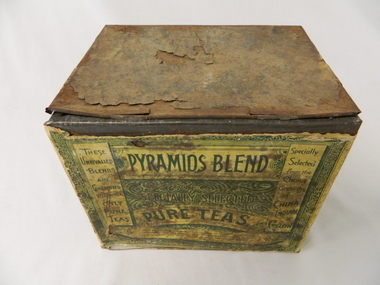
... This large metal tin container was specifically manufactured for the kitchens requiring a bulk storage "bin" type of loose leaf tea content. ...On lid and barely readable "FIVE POUNDS NET" This large metal tin container was specifically manufactured for the kitchens requiring a bulk storage "bin" type of loose leaf tea content. ...This early 1900's tin which contained loose leaf blended tea was imported into Australia by those tea merchants who wanted to provide the Australian tea drinkers with quality tea. It could well be early Lipton distributors to both city and rural clients and consumers. This was in a period when most rural families were heavy tea drinkers. It was well before the introduction of coffee as a drink (especially instant) for the early morning, after meals and general "drink any time" pick me up beverage.This relatively large tea tin marks a period in time when loose leaf tea was in great demand and large quantities were not only used by families but also restaurants, workers mess halls and remote large rural families. The ability to obtain a quick tea supply in semi remote rural areas such as the Kiewa Valley was not possible due to the factors of all weather road access and the economics of traders going out of their way. Stocking up with important beverages, such as tea, was a "one of those things" that early rural communities had to endure with. Bulk storage tins such as this item were not only a requirement but also offered storage for other household items. This usefulness was not overlooked by the "canny" rural family.This large metal tin container was specifically manufactured for the kitchens requiring a bulk storage "bin" type of loose leaf tea content. When emptied, it could also be used as a general kitchen storage container for other bulk consumables.On the front side and in the background, there are three sketches of Egyptian pyramids(increasing in size from left to right). At the forefront there is a camel "train" loaded with supplies and handlers, making their way over the sandy desert going towards a large sign(in a freehand script) "PYRAMIDS BLEND". The left side "Specially Selected" and underneath "PURE TEAS" below this and within a circle is the figure of a Geisha clad of Asian appearance (with a fan in a raised hand with boxes(of varying sizes) around her. All these are in (off white design and wording on a green background. On the back in green print on off white background "PYRAMIDS BLEND" and underneath "OF SPECIALLY SELECTED PURE TEAS". On either side are columns of similar print. To the left "THESE UNRIVALLED BLENDS ARE GUARANTEED TO CONTAIN ONLY PURE TEAS".To the right "SPECIALLY SELECTED FROM THE CHOICE GROWTHS OF CHINA INDIAN & CEYLON". Below both columns is "for delicacy & fragrance of flavor, combined with great strength, and are confidently recommended to the public as the best values in teas obtainable" On the last side is a sketch of an " Indian encircled, holding a staph with palm trees in the background and four tea containers on his left, with "PYRAMID BLEND" as a subject heading. There are two Oxen pulling a two wheeled cart with a load of six large boxes. On lid and barely readable "FIVE POUNDS NET"loose leaf tea containers, food storage tins, kitchen tidies -
 Kiewa Valley Historical Society
Tester Direct Current, mid 1900's
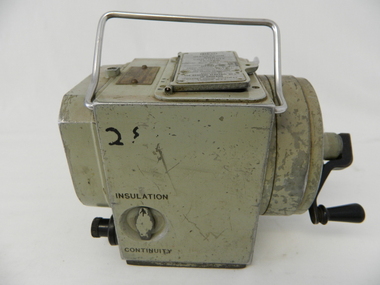
... manufacture SEC Vic equipment equipment ID number. For carrying purposes there is chromed steel (fold together) handle.The bottom of the unit has two metal "feet" 150mm long by 114mm wide...manufacture SEC Vic equipment equipment ID number. For carrying purposes there is chromed steel (fold together) handle.The bottom of the unit has two metal "feet" 150mm long by 114mm wide Tester Direct Current The General Electric Co. ...This tester was used between 1950 and 1980's. As part of the Occupation, Health and Safety requirements, equipment used to monitor the performance of electricity producing generators, regularly, hand held testers were used to check the insulation and the "earth" pin were up the the required operational levels. As the generators and their ancillary monitoring equipment was spread over a large area and cumbersome to service small hand held devices were required. These had to always be safe for the user to operate. A selected range of high quality meters were recalibrated every two years in the Meter and Calibration Laboratory at Yarraville(near Melbourne) This meter is very significant to The Kiewa Hydro Electricity Scheme because it was an integral part of maintaining the electricity producing water driven generators of the power stations. The reason why this meter was so essential is that provided the safety check on equipment used to monitor each Hydro Generator that they were complying within the grid network parameters. Grid parameters are set so that if there is an electrical fault on the system, that fault can be attended to with a very small change in the output stability of each generator. It is essential that the voltage of the network remain within the set limits. Generators are at Dartmouth, Mackay, Clover, West Kiewa, Yarrawonga, Cain Curran and three Power Stations in the Thornton area.This hand driven current generator produces 500 volts by winding the handle(on funnel curved side) to keep the voltage constant(one minute per test). The whole body is made from caste aluminium. One of the functions of this meter is to test the isolation resistance of any equipment being tested. This is to see if that equipment is safe to handle(no electrical shocks). The second function is to test the earth pin of any portable electrical equipment. The turn key on one side can direct which function is required(marked insulation or continuity). On the top side(enclosed in a glass fronted marked scale) is a continuity scale(top) and an insulation scale(bottom). This is covered , when not in use by "flip up" lid with manufacturer's details and name of the instrument. Opposite the winder are two screw tight knobs. One marked earth(left side) and one marked line(right side). On the top and next to the glass windowed scales in a post manufacture SEC Vic equipment equipment ID number. For carrying purposes there is chromed steel (fold together) handle.The bottom of the unit has two metal "feet" 150mm long by 114mm wideManufacturer's details on top side "MEG" underneath "INSULATION AND CONTINUITY TESTER" below this "constant 500 VOLT pressure" below this "REGISTERED MEG MEGGER TRADE MARK" below this "REG DESIGN NO. 690326" below this "UNITED KINGDOM PATENT Nos. 193746, 197178, 198182, 202062, 202398, 204649, 350715" below this "SUPPLIED BY THE GENERAL ELECTRIC Co. Ltd OF ENGLAND" below this "MAGNET HOUSE, KINGSWAY LONDON W.C.2" 'sec vic kiewa hydro scheme, alternate energy supplies, alpine feasibility studies temperature, rainfall -
 Kiewa Valley Historical Society
Tuyere Pipe, circa mid to late 1900's
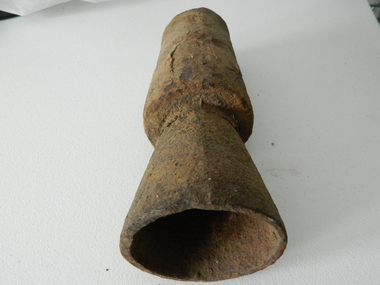
... This is one of the differences between country "rural" life and that found in cities and larger towns. blacksmith tool tue bellows fashioning metal forge manufacturing process This iron cone shaped tuyere has a small hole (diamenter 25mm) starting within an ever enlarging cone (amplification of the air pressure going through) delivering varying hot or extremely hot air into a furnace or hearth which intensifies the heat to allow the "shaping" of metal objects. ...This tuyere (word from French origin) was used by professional blacksmiths and or cattlemen before and during the Kiewa Hydro Electricity Scheme was being constructed. The need to use a furnace or forge in the shaping of metal rods, horse shoes and pipes is both a rural necessity and a construction, on site requirement. The "inventiveness" of cattlemen and construction workers to produce metal objects not available "off the shelf" is one of the inherent traits not only of rural self sufficiency but in the "pioneer" days of rural isolation one of survival.This tuyere is of great significance to the Kiewa Valley and its regions because it highlights one of the greatest strengths of the rural (especially isolated) life and its folk living there, and that is the great human factor of adaptability and survival techniques in sometimes harsh and demanding environmental circumstances. The inventiveness and the attitude, "she'll be right mate", demonstrates life on the land where specialised blacksmith activities can be found in non "professionals" because of the fact that "someone" has to do the job. This is one of the differences between country "rural" life and that found in cities and larger towns.This iron cone shaped tuyere has a small hole (diamenter 25mm) starting within an ever enlarging cone (amplification of the air pressure going through) delivering varying hot or extremely hot air into a furnace or hearth which intensifies the heat to allow the "shaping" of metal objects. The larger "flared" cone extension allows for the directed air to be spread and not concentrated.blacksmith tool, tue, bellows, fashioning metal, forge manufacturing process -
 Bendigo Military Museum
Equipment - VICKERS No1 MK III A.A. PREDICTOR, Commonwealth Government Ordnance Factory, c. 1942
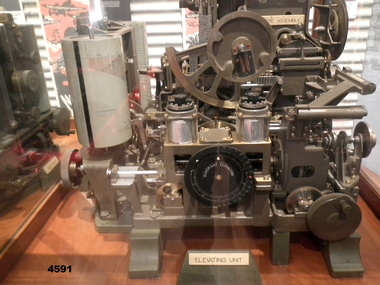
... PREDICTOR No1 MK III MANUFACTURED BY ORDNANCE FACTORY MARIBYRNONG' The item is made primarily from metal, is square shaped and bolted to a wooden base. ...This piece of equipment was used to predict the flight path of an aircraft in order for anti-aircraft artillery to fire accurately at an approaching enemy airborne target. A crew of six operated the machine with information ready to be relayed to a gun within 50 seconds. The predictor was manufactured at the Commonwealth Government Ordnance Factory, Maribyrnong.The item is made primarily from metal, is square shaped and bolted to a wooden base. Numerous hand operated wheel dials attached to gauges which input information related to wind speed, bearings and elevation are visible. Each of the four sides has a specific task with three sides being labelled - Elevation Unit, Wind Calculator, Bearing Unit. The item is housed in a glass and wood display case. Attached to the front of the display case: 'VICKERS A.A. PREDICTOR No1 MK III MANUFACTURED BY ORDNANCE FACTORY MARIBYRNONG'pedictor, military equipment, ordnance, anti-aircraft guns -
 4th/19th Prince of Wales's Light Horse Regiment Unit History Room
Specifications, Army Insignia, Badges and Buttons, 1951 - 1980
... Set of manufacturing specifications for Australian Army insignia, badges and buttons - on foolscap in two lever arch files Specifications include: VOLUME 1 Badges, head dress & collar, AMF Insignia, shoulder, title, AUSTRALIA Insignia, metal, AUSTRALIAN ARMY Button, insignia, AMF Badge, metal, qualification, skill-at-arms Medallion & lapel badge, ANZAC commemorative Badge, lapel, metal, Army Reserve Lapel badge, Returned from Active Service Insignia, metal, Royal Cipher, Queen Elizabeth II Badge, metal, retired officers Button, insignia, general officer Link, button Insignia, metal, rank, womens, Warrant Officer & NCO tropical Insignia, metal, rank, officer, sword & baton crossed (1975) Insignia, metal, rank, officer, sword & baton crossed (1969) Insignia, metal, rank, officers, crown Insignia, metal, rank, NCO, crown Insignia, metal, rank, Warrant Officer, crown Palm leaf device for Vietnamese Cross of Gallantry Medal, service, Vietnamese campaign Button, insignia, Corps of Staff Cadets Insignia, metal, RAAC, beret/collar Insignia, metal, 1 AR, beret/collar Insignia, metal, 1/15 RNSWL, beret/collar Insignia, metal, 2 Cav, beret/collar Insignia, metal, 2/14 QMI Insignia, metal, 3 Cav, beret/collar Insignia, metal, 3/9 SAMR Insignia, metal, 4 Cav, beret/collar 4/19 PWLH Regt badge, head dress or collar Insignia, metal, 4/19 PWLH 8/13 VMR badges, head dress or collar Insignia, 10 LH, collar, silver plated 12/16 HRL, badges, head dress or collar Insignia, metal, RAA, officers, cap/hat, collar Insignia, metal, RAA, other ranks Button, insignia, RAA Button, insignia, RAE Insignia, metal, RAE cap/hat collar Button, Insignia, Royal Aust Survey Corps Insignia, metal, Royal Aust Survey Corps Insignia, metal, Royal Aust Corps of Signals, cap/collar Button, insignia, Royal Aust Corps of Signals Button, insignia, R Aust Inf Insignia, metal, R Aust Inf, cap/hat, collar Insignia, metal, Commando Insignia, metal, RSAR, cap/hat collar Insignia, metal, RAR, cap/hat collar Insignia, metal, RNSWR Insignia, metal, RVR, cap/hat Insignia, metal, RQR ,cap/hat collar Insignia, metal, RWAR, cap/hat collar Badge, qualification, Infantry Combat Button, insignia, Chaplains, Christian Insignia, metal, Chaplains, Christian, cap/hat collar Insignia, metal, RACT Button, insignia RACT Button, insignia, RAAMC Insignia, metal, RAAMC, cap/hat collarl, Insignia, metal, RAADC, cap/hat collar Button, insignia, RAAOC Insignia, metal, RAAOC' VOLUME 2 Button, insignia, RAEME RAEME, badges, collar Insignia, metal, R Aust Army Educational Corps, cap/hat collar Button, insignia, AACC Insignia, metal, AACC, cap/hat collar Button insignia, R Aust Army Pay Corps Insignia, metal, R Aust Army Pay Corps, cap/hat collar Insignia, metal, Aust Army Legal Corps, cap/hat collar Insignia, metal, R Aust Army Provost Corps, cap/hat collar Button, insignia, R Aust Corps of MP Button, insignia, Aust Army Psych Corps Insignia, metal, Aust Army Psych Corps Button, insignia, Aust Army Nursing Corps Insignia, metal, R Aust Army Nursing Corps Button, insignia, WRAAC Insignia, metal, rank, mess undress, brooch type, RAAMC Insignia, metal, WRAAC Insignia, shoulder, Apprentice Insignia, metal, Army Apprentices School Button, insignia, OCS Button, insignia, OCS ,blazer Insignia, metal, OCS, cap/hat collar Button, insignia, RMC, blazer Insignia, metal, RMC Medallion, RMC Insignia, metal, AUR, cap/hat collar Button, insignia, MonUR Insignia, metal, MUR, cap/hat collar Button, insignia, MonUR Insignia, metal, MonUR, cap/hat collar Insignia, metal, UNSWR , cap/hat collar Insignia, metal, SUR, cap/hat collar Button, insignia, SUR Insignia, metal, QUR, cap/hat collar Button, insignia, QUR Insignia, metal, WAUR, cap/hat collar Button, insignia, WAUR Badge, metal, qualification, flying, Army pilot, Aust Army Aviation Corps Insignia, metal, Aust Army Aviation Corps Button, insignia, Aust Army Aviation Corps Badge, metal, qualification , bandsman Badge, metal, qualification, Drum Major Button, insignia, Aust Army Band Corps Insignia, metal, Aust Army Band Corps, cap/hat collar ...specifications Rubber stamp of Engineering Design Establishment giving conditions of issue to contractors Set of manufacturing specifications for Australian Army insignia, badges and buttons - on foolscap in two lever arch files Specifications include: VOLUME 1 Badges, head dress & collar, AMF Insignia, shoulder, title, AUSTRALIA Insignia, metal, AUSTRALIAN ARMY Button, insignia, AMF Badge, metal, qualification, skill-at-arms Medallion & lapel badge, ANZAC commemorative Badge, lapel, metal, Army Reserve Lapel badge, Returned from Active Service Insignia, metal, Royal Cipher, Queen Elizabeth II Badge, metal, retired officers Button, insignia, general officer Link, button Insignia, metal, rank, womens, Warrant Officer & NCO tropical Insignia, metal, rank, officer, sword & baton crossed (1975) Insignia, metal, rank, officer, sword & baton crossed (1969) Insignia, metal, rank, officers, crown Insignia, metal, rank, NCO, crown Insignia, metal, rank, Warrant Officer, crown Palm leaf device for Vietnamese Cross of Gallantry Medal, service, Vietnamese campaign Button, insignia, Corps of Staff Cadets Insignia, metal, RAAC, beret/collar Insignia, metal, 1 AR, beret/collar Insignia, metal, 1/15 RNSWL, beret/collar Insignia, metal, 2 Cav, beret/collar Insignia, metal, 2/14 QMI Insignia, metal, 3 Cav, beret/collar Insignia, metal, 3/9 SAMR Insignia, metal, 4 Cav, beret/collar 4/19 PWLH Regt badge, head dress or collar Insignia, metal, 4/19 PWLH 8/13 VMR badges, head dress or collar Insignia, 10 LH, collar, silver plated 12/16 HRL, badges, head dress or collar Insignia, metal, RAA, officers, cap/hat, collar Insignia, metal, RAA, other ranks Button, insignia, RAA Button, insignia, RAE Insignia, metal, RAE cap/hat collar Button, Insignia, Royal Aust Survey Corps Insignia, metal, Royal Aust Survey Corps Insignia, metal, Royal Aust Corps of Signals, cap/collar Button, insignia, Royal Aust Corps of Signals Button, insignia, R Aust Inf Insignia, metal, R Aust Inf, cap/hat, collar Insignia, metal, Commando Insignia, metal, RSAR, cap/hat collar Insignia, metal, RAR, cap/hat collar Insignia, metal, RNSWR Insignia, metal, RVR, cap/hat Insignia, metal, RQR ,cap/hat collar Insignia, metal, RWAR, cap/hat collar Badge, qualification, Infantry Combat Button, insignia, Chaplains, Christian Insignia, metal, Chaplains, Christian, cap/hat collar Insignia, metal, RACT Button, insignia RACT Button, insignia, RAAMC Insignia, metal, RAAMC, cap/hat collarl, Insignia, metal, RAADC, cap/hat collar Button, insignia, RAAOC Insignia, metal, RAAOC' VOLUME 2 Button, insignia, RAEME RAEME, badges, collar Insignia, metal, R Aust Army Educational Corps, cap/hat collar Button, insignia, AACC Insignia, metal, AACC, cap/hat collar Button insignia, R Aust Army Pay Corps Insignia, metal, R Aust Army Pay Corps, cap/hat collar Insignia, metal, Aust Army Legal Corps, cap/hat collar Insignia, metal, R Aust Army Provost Corps, cap/hat collar Button, insignia, R Aust Corps of MP Button, insignia, Aust Army Psych Corps Insignia, metal, Aust Army Psych Corps Button, insignia, Aust Army Nursing Corps Insignia, metal, R Aust Army Nursing Corps Button, insignia, WRAAC Insignia, metal, rank, mess undress, brooch type, RAAMC Insignia, metal, WRAAC Insignia, shoulder, Apprentice Insignia, metal, Army Apprentices School Button, insignia, OCS Button, insignia, OCS ,blazer Insignia, metal, OCS, cap/hat collar Button, insignia, RMC, blazer Insignia, metal, RMC Medallion, RMC Insignia, metal, AUR, cap/hat collar Button, insignia, MonUR Insignia, metal, MUR, cap/hat collar Button, insignia, MonUR Insignia, metal, MonUR, cap/hat collar Insignia, metal, UNSWR , cap/hat collar Insignia, metal, SUR, cap/hat collar Button, insignia, SUR Insignia, metal, QUR, cap/hat collar Button, insignia, QUR Insignia, metal, WAUR, cap/hat collar Button, insignia, WAUR Badge, metal, qualification, flying, Army pilot, Aust Army Aviation Corps Insignia, metal, Aust Army Aviation Corps Button, insignia, Aust Army Aviation Corps Badge, metal, qualification , bandsman Badge, metal, qualification, Drum Major Button, insignia, Aust Army Band Corps Insignia, metal, Aust Army Band Corps, cap/hat collar Specifications, Army Insignia, Badges and Buttons ...Set of manufacturing specifications for Australian Army insignia, badges and buttons - on foolscap in two lever arch files Specifications include: VOLUME 1 Badges, head dress & collar, AMF Insignia, shoulder, title, AUSTRALIA Insignia, metal, AUSTRALIAN ARMY Button, insignia, AMF Badge, metal, qualification, skill-at-arms Medallion & lapel badge, ANZAC commemorative Badge, lapel, metal, Army Reserve Lapel badge, Returned from Active Service Insignia, metal, Royal Cipher, Queen Elizabeth II Badge, metal, retired officers Button, insignia, general officer Link, button Insignia, metal, rank, womens, Warrant Officer & NCO tropical Insignia, metal, rank, officer, sword & baton crossed (1975) Insignia, metal, rank, officer, sword & baton crossed (1969) Insignia, metal, rank, officers, crown Insignia, metal, rank, NCO, crown Insignia, metal, rank, Warrant Officer, crown Palm leaf device for Vietnamese Cross of Gallantry Medal, service, Vietnamese campaign Button, insignia, Corps of Staff Cadets Insignia, metal, RAAC, beret/collar Insignia, metal, 1 AR, beret/collar Insignia, metal, 1/15 RNSWL, beret/collar Insignia, metal, 2 Cav, beret/collar Insignia, metal, 2/14 QMI Insignia, metal, 3 Cav, beret/collar Insignia, metal, 3/9 SAMR Insignia, metal, 4 Cav, beret/collar 4/19 PWLH Regt badge, head dress or collar Insignia, metal, 4/19 PWLH 8/13 VMR badges, head dress or collar Insignia, 10 LH, collar, silver plated 12/16 HRL, badges, head dress or collar Insignia, metal, RAA, officers, cap/hat, collar Insignia, metal, RAA, other ranks Button, insignia, RAA Button, insignia, RAE Insignia, metal, RAE cap/hat collar Button, Insignia, Royal Aust Survey Corps Insignia, metal, Royal Aust Survey Corps Insignia, metal, Royal Aust Corps of Signals, cap/collar Button, insignia, Royal Aust Corps of Signals Button, insignia, R Aust Inf Insignia, metal, R Aust Inf, cap/hat, collar Insignia, metal, Commando Insignia, metal, RSAR, cap/hat collar Insignia, metal, RAR, cap/hat collar Insignia, metal, RNSWR Insignia, metal, RVR, cap/hat Insignia, metal, RQR ,cap/hat collar Insignia, metal, RWAR, cap/hat collar Badge, qualification, Infantry Combat Button, insignia, Chaplains, Christian Insignia, metal, Chaplains, Christian, cap/hat collar Insignia, metal, RACT Button, insignia RACT Button, insignia, RAAMC Insignia, metal, RAAMC, cap/hat collarl, Insignia, metal, RAADC, cap/hat collar Button, insignia, RAAOC Insignia, metal, RAAOC' VOLUME 2 Button, insignia, RAEME RAEME, badges, collar Insignia, metal, R Aust Army Educational Corps, cap/hat collar Button, insignia, AACC Insignia, metal, AACC, cap/hat collar Button insignia, R Aust Army Pay Corps Insignia, metal, R Aust Army Pay Corps, cap/hat collar Insignia, metal, Aust Army Legal Corps, cap/hat collar Insignia, metal, R Aust Army Provost Corps, cap/hat collar Button, insignia, R Aust Corps of MP Button, insignia, Aust Army Psych Corps Insignia, metal, Aust Army Psych Corps Button, insignia, Aust Army Nursing Corps Insignia, metal, R Aust Army Nursing Corps Button, insignia, WRAAC Insignia, metal, rank, mess undress, brooch type, RAAMC Insignia, metal, WRAAC Insignia, shoulder, Apprentice Insignia, metal, Army Apprentices School Button, insignia, OCS Button, insignia, OCS ,blazer Insignia, metal, OCS, cap/hat collar Button, insignia, RMC, blazer Insignia, metal, RMC Medallion, RMC Insignia, metal, AUR, cap/hat collar Button, insignia, MonUR Insignia, metal, MUR, cap/hat collar Button, insignia, MonUR Insignia, metal, MonUR, cap/hat collar Insignia, metal, UNSWR , cap/hat collar Insignia, metal, SUR, cap/hat collar Button, insignia, SUR Insignia, metal, QUR, cap/hat collar Button, insignia, QUR Insignia, metal, WAUR, cap/hat collar Button, insignia, WAUR Badge, metal, qualification, flying, Army pilot, Aust Army Aviation Corps Insignia, metal, Aust Army Aviation Corps Button, insignia, Aust Army Aviation Corps Badge, metal, qualification , bandsman Badge, metal, qualification, Drum Major Button, insignia, Aust Army Band Corps Insignia, metal, Aust Army Band Corps, cap/hat collar Rubber stamp of Engineering Design Establishment giving conditions of issue to contractorsspecifications -
4th/19th Prince of Wales's Light Horse Regiment Unit History Room
Presentation display: Manufacturing stages for .303 inch service round, c 1950
... Top row - samples of the various metals used Centre row - Examples of components at stages of manufacture of cartridge case Bottom row - Examples of components at stages of manufacture of bullet...Top row - samples of the various metals used Centre row - Examples of components at stages of manufacture of cartridge case Bottom row - Examples of components at stages of manufacture of bullet Presentation display: Manufacturing stages for .303 inch service round Ammunition Factory Footscray ...Glass fronted wooden frame in which is mounted examples of components at the various stages of making .303 inch round. Top row - samples of the various metals used Centre row - Examples of components at stages of manufacture of cartridge case Bottom row - Examples of components at stages of manufacture of bulletOn back - 4/19 PWLH Sgts Mess 97 -
4th/19th Prince of Wales's Light Horse Regiment Unit History Room
Specifications, Specifications Army (Aust) 5368 and 368, (estimated); abt 1969-1980
... Manufacturing drawings. Specifications for Australian Army metal badges and insignia in two lever arch foolscap files. ...insignia badges specification 5368 manufacturing drawings defence contracts Manufacturing drawings. Specifications for Australian Army metal badges and insignia in two lever arch foolscap files. ...Manufacturing drawings. Specifications for Australian Army metal badges and insignia in two lever arch foolscap files. The drawings are appendices to Specifications 5368 and 368 insignia, badges, specification 5368, manufacturing drawings, defence contracts
