
Showing 948 items matching "guilding"
-
 Bendigo Historical Society Inc.
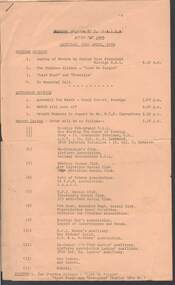
Document - R.S.L. BENDIGO COLLECTION: ANZAC SERVICE 1959, 25th April, 1959
... Women's Auxiliary, War Widows' Guild, S.S. & A. Mothers' Association, Ex-Navalmen's Club Ladies' Auxiliary, Airforce Association Ladies' Auxiliary, 38th Inf. ...Women's Auxiliary War Widows' Guild S.S. & A. Mothers' Association Ex-Navalmen's Club Ladies' Auxiliary Airforce Association Ladies' Auxiliary 38th Inf. ...Paper detailing the Morning and Afternoon Service, Wreath Laying, Order of March, Assembly Points and Movement for the Anzac Day Service on Saturday, 25th April, 1959. Mentioned are: Mr W E P Carruthers, Lt Commander Herniman RN, Col L J Lockwood, 38 Infantry Battalion, Lt Col D Scholes, Ex-Navalmen's Club, Airforce Association, Railway Sub-section R.S.L., Bendigo Legacy Club, 6th Battalion Social Club, 38th Battalion Social Club, Rats of Tobruk Association, Ex P.O.W. Association, R.A.A.O.C., T.P.I. Social Club, Interunits Social Club, 105 Anti-Tank Social Club, 4th Aust. Armoured Regt. Social Club, Repatriation Local Committee, Catholic War Veterans Association, Bendigo Dad's Association, Legion of Exservicemen and Women, R.S.L. Women's Auxiliary, War Widows' Guild, S.S. & A. Mothers' Association, Ex-Navalmen's Club Ladies' Auxiliary, Airforce Association Ladies' Auxiliary, 38th Inf. Bn Ladies' Auxiliary, Sea Cadets, Air Cadets, Major T Martin, Mr G Styles, Court House Hotel, Sound Shell, and G F Osborne.event, official, anzac memorial service, r.s.l. bendigo collection - anzac service 1959, mr w e p carruthers, lt commander herniman rn, col l j lockwood, 38 infantry battalion, lt col d scholes, ex-navalmen's club, airforce association, railway sub-section r.s.l., bendigo legacy club, 6th battalion social club, 38th battalion social club, rats of tobruk association, ex p.o.w. association, r.a.a.o.c., t.p.i. social club, interunits social club, 105 anti-tank social club, 4th aust. armoured regt. social club, repatriation local committee, catholic war veterans association, bendigo dad's association, legion of exservicemen and women, r.s.l. women's auxiliary, war widows' guild, s.s. & a. mothers' association, ex-navalmen's club ladies' auxiliary, airforce association ladies' auxiliary, 38th inf. bn ladies' auxiliary, sea cadets, air cadets, major t martin, mr g styles, court house hotel, sound shell, g f osborne -
 Mission to Seafarers Victoria
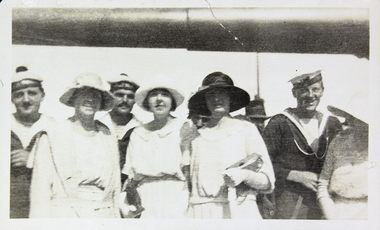
Photograph - Photograph, Black and white, 1923
... Amongst them the ladies from the Guild and especially Dora Walker. In the "Jottings from Our Log"number 69 dated from January 1923 we can read: Our French Visitors The French cruisers, “Jules Michelet” and “Victor Hugo”, each with a complement of 26 officers and 747 men, paid a visit to this port towards the end of the year. ...Amongst them the ladies from the Guild and especially Dora Walker. In the "Jottings from Our Log"number 69 dated from January 1923 we can read: Our French Visitors The French cruisers, “Jules Michelet” and “Victor Hugo”, each with a complement of 26 officers and 747 men, paid a visit to this port towards the end of the year. ...In January 1923, 5 years after the end of WWI, the two French cruisers Jules Michelet and Victor Hugo went on a tour in South East Asia, Australia and New Zealand consolidating the friendship between the countries. The cruisers arrived in January 1923 and Melbournians were invited to visit the ships. Amongst them the ladies from the Guild and especially Dora Walker. In the "Jottings from Our Log"number 69 dated from January 1923 we can read: Our French Visitors The French cruisers, “Jules Michelet” and “Victor Hugo”, each with a complement of 26 officers and 747 men, paid a visit to this port towards the end of the year. Many of the sailors made good use of our institute, and were supplied with French magazines and papers, and were delighted to find that quite a number of ladies could speak French fluently. Over one hundred men were present at the Institute on one of our special nights during Christmas week, when each French visitor was supplied with refreshments and a cigar. Through the great kindness of some of our ladies, each man aboard the two cruisers was supplied with a packet of cigarettes. These were greatly appreciated by the men, and a warm letter of thanks was received from each of the captains."Reflects the close links and mutual friendships developed between French and Australian community developed between LHLG members from 1906 onward especially during WW1 and support of the French Red Cross.Black and white photograph jules michelet, victor hugo, french cruiser, ww1, france, dora walker, french sailors, dora simpson, lhlg, navy -
 Federation University Historical Collection
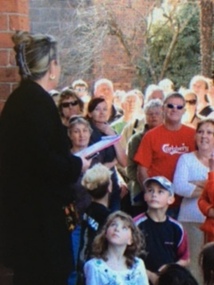
Article - Article - Women, Ballarat College of Advanced Education: Anne Stewart; Librarianship Storyteller
... Stewart has fulfilled a number of pro bono roles such as the President of the Australian Storytelling Guild (Vic Branch), and Council President of the Daylesford Primary School. ...Stewart has fulfilled a number of pro bono roles such as the President of the Australian Storytelling Guild (Vic Branch), and Council President of the Daylesford Primary School. ...Anne completed her secondary education at Presentation College Windsor. She left Melbourne to study Librarianship at Ballarat College of Advanced Education and completed a Graduate Diploma of Librarianship in 1981 and a Graduate Diploma of Education in 1986. During her studies Anne E. Stewart produced weekly shows on 3BBB Community Radio Ballarat, `As the assistant children's librarian at Geelong in 1987 Anne E. Stewart drove the Jolly Jumbuck storytelling van to various local sites, gathered the children and told a story. A keen community player Anne E. Stewart has fulfilled a number of pro bono roles such as the President of the Australian Storytelling Guild (Vic Branch), and Council President of the Daylesford Primary School. Anne E. Stewart is a senior writer for the 'Swag of Yarns' and has worn the prestigious storytellers Cape at Dromkeen, an institution that nurtures and develops children's literature. Returning to her alma mater in 2007 Anne E. Stewart developed a ghost tour through the historic Ballarat School of Mines (SMB) campus. Established in 1870, and incorporating a former gaol, the SMB ghosts came to life as she enthralled numerous groups visiting the campus on Open Day 2007, 2008 and 2009. In 2009 Anne E. Stewart was a principal teller at the Scottish International Storytelling Festival at Edinburgh.women of note, ballarat college of advanced education, anne stewart, presentaion college windsor, librarianship, graduate diploma of librarianship, graduate diploma of education, community radio, geelong library, jolly jumbuck van, storytelling, australian storytelling guild, daylesford primary school, swag of yarns, cape at dromkeen, children's literature, ghost tours, school of mines ballarat -
 Wodonga & District Historical Society Inc
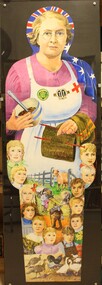
Painting - Portrait of Dolly Barton for Peoplescape, Betty L. Barberis, 2001
... She kept the family dairy farm running whilst her husband was serving in World War 2 whilst still supporting the war effort through the Red Cross and CWA and the church guild. Betty’s great body of work included landscapes, banners, millinery, ceramics, and a bronze sculpture of her husband Vern Barberis who was a fellow schoolteacher and represented Australia as a weightlifter, winning a bronze medal at the Helsinki Olympics in 1952. ...She kept the family dairy farm running whilst her husband was serving in World War 2 whilst still supporting the war effort through the Red Cross and CWA and the church guild. Betty’s great body of work included landscapes, banners, millinery, ceramics, and a bronze sculpture of her husband Vern Barberis who was a fellow schoolteacher and represented Australia as a weightlifter, winning a bronze medal at the Helsinki Olympics in 1952. ...In February 2001 the National Council for the Centenary of Federation called upon Australians to nominate someone whom they felt had significantly affected their lives, their community or our country. Thousands of these heroes and quiet achievers were selected. Betty Churcher, a member of the National Council, chaired the Peoplescape Selection Panel. Nominators then made life size, cutout figures to represent their "hero". The sculptures were installed in alphabetical order, on the hill at Parliament House and down to the Federation Mall in Canberra, each with a plaque at its base outlining the individual's achievement. This portrait was painted by Betty Barberis to represent her mother "Dolly" Barton. Dolly raised 12 children, lived through 2 World Wars and the depression. She kept the family dairy farm running whilst her husband was serving in World War 2 whilst still supporting the war effort through the Red Cross and CWA and the church guild. Betty’s great body of work included landscapes, banners, millinery, ceramics, and a bronze sculpture of her husband Vern Barberis who was a fellow schoolteacher and represented Australia as a weightlifter, winning a bronze medal at the Helsinki Olympics in 1952. She was also an art teacher of 22 years. Betty passed away at The Grange, Wodonga on 26 November 2013.This portrait was created by a renowned and highly regarded artist from Northeast Victoria for a national celebration of the centenary of Australian Federation in 2001.A large oil painting depicting a portrait of Dolly Barton, mother of the artist Betty L. Barberis. The painting includes representations of her 12 children, her farming way of life, her commitment to the community and to the war effort. The image was painted on to yellow corflute for exhibition. It has since been covered with perspex to protect the image.betty l. barberis, myrtle ann 'dolly" barton, peoplescape 2001 -
 Flagstaff Hill Maritime Museum and Village
Textile - Seat Squabs, mid-20th century
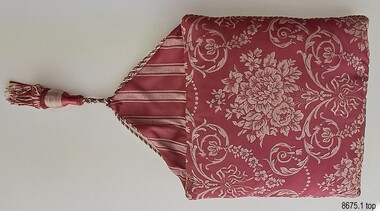
... The Guild continued its important work until the 1960s. ...The Guild continued its important work until the 1960s. ...The term 'seat squabs' is no longer commonly used, but is sometimes referred to in the upholstery and motor vehicle industries. Squabs are padded cushions frequently added to wooden chairs or benches to add comfort to their hard forms. They have been made to an 18th-to-19th-century pattern using beautiful, richly coloured satin fabric and fancy cord tassels. The weighted flap at the rear of the squabs helps to keep them in place on the chair, and could be used on the top of the backrest instead of on the seat. These days, squabs are attached with fabric ties or hook-and-loop tabs. These seat squabs were once used in the St Nicholas Seamen's Church at 139 Nelson Place, Williamstown, Victoria, which was purchased and furnished around 1943. The furniture and furnishings are now part of the St. Nicholas Seamen's Church collection. DETAILED HISTORY of the Missions to Seamen: - The Missions to Seamen is an Anglican (Church of England) charity that has served the world’s seafarers since 1856. It was inspired by the work of Rev. John Ashley, who, 20 years earlier, had pioneered a ministry to seafarers in the Bristol Channel in Great Britain. When Ashley retired, others continued the work, founding the Missions to Seamen. It adopted a Flying Angel as its symbol, inspired by a verse from the Bible in Revelation 14. Today, over 200 world ports have Missions to Seamen centres and chaplains. A Missions to Seamen’s club warmly welcomes sailors of all colours, creeds and races and provides a wide range of facilities. The Missions to Seamen organisation changed its name to the Mission to Seafarers in 2000, continuing to include Missions to Seamen clubs in Victoria’s cities of Melbourne, Portland, Geelong and Hastings. Flagstaff Hill’s St Nicholas’ Seamen’s Church is named after its namesake from Williamstown, Victoria, which began in 1857. Bishop Perry opened the first Sailors’ Church, which was known as ‘Bethel’, on an old hulk floating in Hobson’s Bay, Port of Melbourne. In 1860, a Sailors’ Rest started operating from rented premises in Williamstown. In 1878, the Sailors’ Church moved into an old Wesleyan chapel in Ann Street. By the end of that year, they managed to purchase the building, which they had already refurbished. In 1883, they affiliated with the Victorian Seamen’s Mission. A few years later, in 1906, the building had to be demolished because it was no longer safe. While they raised funds for a new building, the Sailors’ Rest temporarily moved to premises in front of Customs House in Nelson Place. Around this time, in 1906, the Ladies Harbour Lights Guild was formed in Australia to support and raise funds for the Mission to Seamen organisation in Melbourne. Two of the most significant ladies of the Guild were founding members Ethel Godfrey and Alice Sibthorpe. During the Mission's time at Siddeley Street, Melbourne, the activities of the Guild raised funds for the Mission to Seamen's Chapel at their new, and still current, premises in Flinders Street, Melbourne, opened in 1917. The Guild continued its important work until the 1960s. In 1908, the Williamstown Mission had enough money to purchase the former Mascotte skating rink on Thompson Street, Williamstown. In August of that year, they were inaugurated into the Victorian Missions to Seamen. They continued at that venue for a few decades. In 1943, the former ES&A Bank building at 139 Nelson Place, Williamstown, was purchased for the new Mission to Seaman’s Club. The official opening was on May 6th, 1944. It was described as a ‘distinctive little building’. Funds had previously been raised for the building and furnishing of the chapel at the rear. The chapel was named St Nicholas’ Seamen’s Church, after St Nicholas, fourth-century bishop and patron saint of sailors. Services were held on Wednesdays and Sundays. The church was supported by the Williamstown Lightkeepers’ Auxiliary, newly founded by Mrs Ethel Margaret Musther in 1943, as well as the Harbour Lights Guild and the League of Soldiers’ and Sailors’ Friends. The Williamstown Mission to Seamen’s Church operated until 1966, when large international ships no longer used the Port of Williamstown. The Commonwealth Government then leased the premises. In the formative years of Flagstaff Hill Maritime Village, the Advisory Board decided to include a Missions to Seamen Chapel and Recreation Room in its village. The Missions organisation was a significant feature of ports during the late 1800s and early 1900s, the period that the Village represents. They often erected Missions to house social and worshipful activities for seamen. Flagstaff Hill’s curator, Mr Ken Marshman, approached the Melbourne Board of Management of Missions to Seamen regarding the Williamstown branch. Consequently, the Board permitted the furnishings of the Williamstown chapel to be transferred to Flagstaff Hill Maritime Village. A provision of the transfer was that the Victoria Missions to Seamen be recognised, that the items would remain as a collection, and that the chapel would be called St Nicholas Seamen’s Church and conduct Divine services. The donation was approved on 21st May 1979. Flagstaff Hill's St. Nicholas Seamen's Church: - The idea behind Flagstaff Hill’s Missions to Seamen’s Church was partly driven by the offer of Stained Glass Memorial Windows that originated from the Warrnambool and District Base Hospital, which was undergoing multi-storey expansion in the late 1960s and early 1970s. The hospital’s Manager/Secretary was eager to see the historic window installed in a suitable place. The church, or chapel, was designed by a local architectural draftsman in collaboration with the Flagstaff Hill Planning Board and was constructed by Mr Leon Habel. The designers hoped the church would be used for formal worship, such as weddings, funerals, and multi-denominational special services like war commemorations. Its design was inspired by the ‘Missions to Seamen’ buildings in Portland and the Port of Melbourne. The furniture and furnishings were placed as accurately as possible according to photographs of the Williamstown St Nicholas Seamen’s Church and with assistance from local clergy. The Recreation Room was furnished and arranged on advice from experienced members of the Missions to Seamen organisation. A framed document in the building recognises the donor of the furnishings, Victoria Missions to Seamen, and includes the names of some original donors and their donated item/s. The building’s design incorporates local features such as Warrnambool sandstone, which was no longer commercially available but was procured from demolished buildings and uniformly cut to use as a veneer over the stronger Mt. Gambier stone. Also, traditional green American roofing slate was used, sourced from the 1908 local shipwreck “Falls of Halladale” by Flagstaff Hill volunteer divers. The bell tower includes a bell believed to be from a local shipwreck. Additional furnishings were acquired locally, and several items were donated by Warrnambool residents. Light fittings in both rooms were assembled to simulate 19th-century gas light fittings. The stained-glass window at the back of the church is a memorial to Dr Connell, a well-respected member of the Warrnambool community. It was originally installed in 1928 in the main building of Warrnambool Hospital. The St Nicholas’ Seamen’s Church at Flagstaff Hill was officially opened by His Worship the Mayor, Cr. John Lindsay, on Sunday, 11th October 1981. The event included a service of thanksgiving conducted by the Warrnambool Ministers Fraternal. Since then, the Chapel has been the historic venue for many weddings. This pair of seat squabs is historically significant for its origin in the St Nicholas Mission to Seamen's Church in Williamstown, established in 1857 to cater for seafarers’ physical, social, and spiritual needs. The organisation originated in Bristol, England, when a Seamen's Mission was formed in 1837. The squabs are also significant for their use in the St Nicholas Missions to Seamen's chapel, Williamstown, as the original building is now listed on the Victorian Heritage Register. Squabs or padded seat cushions, a pair of two. These 18th to 19th-century design squabs have crimson and cream satin fabric on top and underneath, and weighted tassels are attached to their rear corners. They can be used for comfort on hard seats and benches. The squabs were furnishings from the Missions to Seamen chapel in Williamstown, and they are now part of the St Nicholas Seamen's Church Collection.flagstaff hill, warrnambool, shipwrecked-coast, flagstaff-hill, flagstaff-hill-maritime-museum, maritime-museum, shipwreck-coast, flagstaff-hill-maritime-village, st nicholas mission to seamen's church williamstown, mission to seamen williamstown, mission to seamen victoria, st nicholas mission to seamen, st nicholas seamen's church, religion, religious service, sailor's rest, ladies harbour light guild, squab, seat covers, cushions, squabs, religious furnishing, padded seats, seating, accessory -
 Mission to Seafarers Victoria
Plaque - Memorial Plaque, Amy Neville Brown (1882-1974), 1976
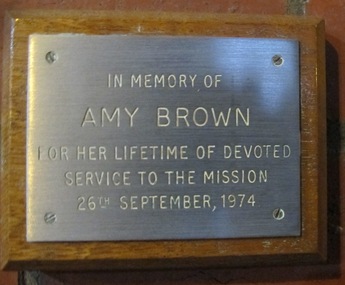
... was a member of the Harbour Lights Guild ( Honorary General Secretary in the 30s) then the Flying Angel League. ...was a member of the Harbour Lights Guild ( Honorary General Secretary in the 30s) then the Flying Angel League. ...Amy Neville Brown (1882-1974) was a longlife member of the Mission to Seafarers ladies' Committees: 1910 - Amy is first mentioned in our records as LHLG branch secretary for Elsternwick. (from diaries written by her and her sister Beatrice during 1909-1913 and held at the Glen Eira Historical Society, Amy tells she attends “kirk” with Miss Godfrey about once a month and each time they go to the “Institute” afterwards.) 1918 - 1922 sees Amy as “Schools secretary” LHLG. 1933 - Miss A N Brown becomes Honorary Secretary of the LHLG. 1946 – LHLG becomes “Harbour Lights Guild”. 1949 – Dora Simpson is president of HLG & Amy Brown is Honorary Secretary. 1957 – Amy retires as Honorary Secretary of the HLG. Other interests: 1933 - Amy founded the Victorian Aboriginal Group along with Valentine Alexa Leeper (1900-2001). She acted as Hon. Sec. to the VAG for 40 years until its winding up in 1971 8 boxes of papers related to their activities are held at the SLV under Amy’s name (with Val Leeper). 1950 - Amy was a member of the YWCA 1963 – she was president of the Agnes Benson Auxiliary of the YWCA. Amy’s parents were Andrew Howden Brown & Catherine Marianne (Kitty) Wight. She had 2 brothers: Charles John Brown, Edward Byam Brown & 3 sisters: Jean Constance Brown (1884-1973), Catherine Philpott Brown (1886-1980), Grace *Beatrice Brown (1889-1984) who was also a member of the Mission's ladies' committee. None of 4 sisters married, they lived all their lives in Elsternwick. Edward Byam Brown was an academic at Melbourne University rising to become Ass. Prof. of Electrical Engineering by the 1950s. He married Vera Scantlebury in 1926 – they had 2 children. Amy’s maternal grandparents were Edward Byam Wight and Catherine Philpott. Both arrived in Melbourne in the early 1840s. Edward Wight is included on Thomas Chuck’s collage of early Victorian pioneers. Anne Jackson has written a short biography of Catherine’s brother, William Philpott, which includes a paragraph on Edward Wight. Catherine’s youngest son, Neville Wight, became a solicitor living at Woodend. He married Grace Rutherford – Mrs Neville Wight was a member of our Executive Committee from 1929 to 1933. Neville Wight’s obituary states that “he served his articles with … the firm of Moule & Seddon”. The principal of this firm was W H Moule, well known judge and cricketer. His son, also W H Moule, was Honorary Secretary of MtSV Executive Committee for 20 years until his retirement in 1958. was a member of the Harbour Lights Guild ( Honorary General Secretary in the 30s) then the Flying Angel League. She passed away in September 1974. A protege and friend of the Godfreys and Ina Higgins she actively assisted in setting up school branches of LHLG and eventually became a leading member in the 1930s.The window made by Tony Hall along with this plaque were dedicated in 1976. Amy Neville Brown had a lifelong association with the Mission and other philanthropic and social causes. Small plaque mounted on wooded board.In memory of Amy Brown For her lifetime of devoted service to the Mission 26th September, 1974amy brown, plaque, memorial, flying angel club, lhlg, amy neville brown (1882-1974), victoria aboriginal group (1933-1971), vag, val leeper, valentina alexa leeper (1900-2001) -
 Embroiderers Guild, Victoria
Textile - Flounce (part), Coggeshall Lace Flounce, Early 1800
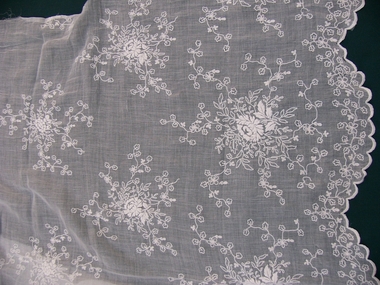
... Today Coggeshall lace is made by some members of the Lacemakers Guild and is taught as part of the City and Guilds course. https://coggeshallmuseum.org.uk/lace1.htm ...Today Coggeshall lace is made by some members of the Lacemakers Guild and is taught as part of the City and Guilds course. https://coggeshallmuseum.org.uk/lace1.htm Embroidery Garments Whitework England Tambour work Early 18th century White muslin, with sprays of roses in white satin stitch, surrounded by delicate tambour embroidery known as Coggeshall embroidery. ...Miss Bostock, Foundation member of the EGV, travelled to England and met with The Hon. Rachel Kay-Shuttleworth of Gawthorpe Hall. Rachel "cut" off many pieces from her extensive lace collection which were gifted to the EGV. A Brief History (Information from the work of the late Jean Dudding) About 1812 a French émigré, M. Drago and his two daughters settled in Coggeshall, Essex. Here they hired a room and began to teach the women and small children a method of decorating this net by using a tambour hook. Thus began the making of Coggeshall Lace (sometimes called tambour lace). Tambouring produces a line of chain stitches and originated in the Far East, where the workers used a round frame resembling a tambourine or drum. This they could grip between the knees, thereby releasing both hands for tambouring. Coggeshall workers used a rectangular frame and this type is still used today. Throughout the 19th century this tamboured net lace was made in the tambour rooms and cottages of Coggeshall, and also in the homes of surrounding villages. Lace manufacturers and lace dealers co-ordinated these workers by obtaining orders from London and elsewhere. Sometimes more sophisticated designs were introduced and these would be tamboured by the more proficient workers. Besides the designs, all the necessary net and threads would also be distributed to the lace workers. Liberty & Co., amongst others, were supplied with Coggeshall Lace. The fluctuations in prosperity of the tambour lacemakers were governed by many factors. Fashion requiring flounces and frills gave great encouragement but the invention of chain stitch sewing machines and of machine made laces imitating the hand made article, together with a deterioration in the quality of design meant hard times for the laceworkers. Just after 1900 there was a great improvement in the quality of Coggeshall Lace. This was due largely to the activities of two ladies, the Misses Spurge, who were the chief employers in the district. Their brother William was an art teacher who improved the general standard of design and also introduced some old Italian designs. The First World War resulted in a decline in the making of Coggeshall Lace. The workers found it more profitable to do tambour beading. In the 1930's a determined effort was made to revive the making of Coggeshall Lace, and three handkerchiefs were given to Princess Marina on her marriage (See below). Coggeshall Lace was made into dresses for the Queen, Princess Margaret and Princess Alexandra. This work was undertaken by three very proficient workers in Great Tey. Queen Mary also chose two lace dresses and a teacloth in Coggeshall Lace. It was hoped that this Royal Patronage would encourage a revival of the craft. However the financial return was too meagre and after the Second World War both net and threads disappeared. Today Coggeshall lace is made by some members of the Lacemakers Guild and is taught as part of the City and Guilds course. https://coggeshallmuseum.org.uk/lace1.htm White muslin, with sprays of roses in white satin stitch, surrounded by delicate tambour embroidery known as Coggeshall embroidery. Coggeshall being a town in Essex.embroidery, garments, whitework, england, tambour work, early 18th century -
 Ringwood and District Historical Society
Programme, Ringwood East Giant Community Fair in 1961
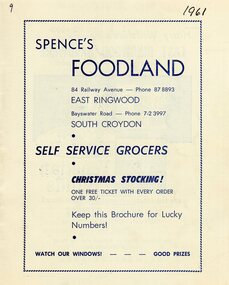
... Francis School Mothers Club, Ringwood East Tennis Club, Legacy, Yarra Valley, Police & Citizens Youth Club, Ladies Guilds of District Churches. Events include Dog Competition, Marching Girls, Boxing and Judo Display, Police Exhibition, Cake Stalls and a visit from Father Christmas. ...Francis School Mothers Club, Ringwood East Tennis Club, Legacy, Yarra Valley, Police & Citizens Youth Club, Ladies Guilds of District Churches. Events include Dog Competition, Marching Girls, Boxing and Judo Display, Police Exhibition, Cake Stalls and a visit from Father Christmas. ...Giant Community Fair organised by the Ringwood East Chamber of Commerce to be held in the Drill Hall Grounds Dublin Road Ringwood East on Saturday December 2nd 1961. All proceeds to aid Local Charities which include: Ringwood East Red Cross Company, Ringwood East Pre-school, Warrawong Holiday Kindergarten, Boy Scouts, Girl Guides, Maroondah Pre-School Centre, Eastwood Mothers Club, Ringwood East Mothers Club, St. Francis School Mothers Club, Ringwood East Tennis Club, Legacy, Yarra Valley, Police & Citizens Youth Club, Ladies Guilds of District Churches. Events include Dog Competition, Marching Girls, Boxing and Judo Display, Police Exhibition, Cake Stalls and a visit from Father Christmas. Advertising including Spences Foodland, Harry Wiltshire's East Ringwood Hardware, Whytes, Buchanan's Newsagency, Ian E Russell, Barry Hall Chemist, Orleans' Florist - Pet Shop, Sunrise Secretarial Service, Eastwood Cycle & Sports Store, Jenny & John Gift Shop, J.W.F. Sloan Butcher, Bill Patterson Motors, Shir-Vonne Beauty Salon, Eastwood Cake Shop, H.E. & M.D. Burridge, Kellettskornor and Joan's Handy Bar. -
 Flagstaff Hill Maritime Museum and Village
Education kit - Knot Board, Tom Long, DSM (Member of International Guild of Knot Tyers), ca 1975 to 1986
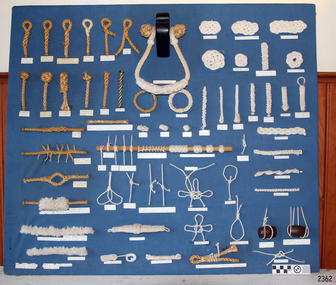
... The Display Board of Konts was handmade in Kings Lynn, Devon, England, by Tom Long DSM, a member of the International Guild of Knot Tyers. Tom Long more recently lived in a suburb of Melbourne. ...Tom Long, DSM (Member of International Guild of Knot Tyers) ...Education kit Knot Board Tom Long, DSM (Member of International Guild of Knot Tyers) ...The Display Board of Konts was handmade in Kings Lynn, Devon, England, by Tom Long DSM, a member of the International Guild of Knot Tyers. Tom Long more recently lived in a suburb of Melbourne. This display board shows the knots and joins used in ropework performed by a sailmaker and other skilled knot tyers and ropeworkers. It demonstrates the uses of some of the knots, such as knobs and handles, suspending lengths of wood, reinforcing spliced rope and even for decorative work. The sailmakers, travelling as part of the ship’s crew, stored their tool kit in a canvas ditty bag. It contained needles, awls, a sailmaker’s leather-palmed glove with a heavily reinforced palm, a shuttle to mend and make nets, fids, knives, mallets, brushes, rulers, and rope gauges. Sailmakers used their ropework and knot-making skills for various purposes and chose the type of rope fibre for its particular properties. For example, Italian hemp rope was preferred for the light line used in shore-to-ship rescues because it was lightweight, not easily knotted, and absorbed less water. A supply of various types of rope was a commodity on board a ship and on land in the new colonies. It was flexible, easily stored, and could be worked to create an endless variety of objects on its own or with other materials like wood. An example is a simple rope ladder. Lengths could be combined to make various thicknesses, and pieces could be skilfully joined together by splicing. The importance of knots in seafaring cannot be overestimated. When ships relied on only the wind for power and speed, there were a huge number of various ropes in use, particularly about the sails and rigging. Seafarers would be judged on their ability to tie knots speedily and correctly. A mounted display of authentic seamen's knots is on a board covered in blue fabric. Various rope grades and fibres were used to work numerous knots and splices. Some of the uses are familiar, such as the toggle, the pineapple knot, and the Turk’s head. A selection of rope grades and fibres was used to work numerous knots and splices. Some of the uses are familiar, such as the toggle, the pineapple knot, and the Turk’s head. The name or purpose of the knot is on the label below it. Labels below each knot give its name or use.flagstaff hill, warrnambool, maritime museum, maritime village, great ocean road, shipwreck coast, knot display, knot making, ropework, marine technology, sailmaker's work, sailor's knots, ship's rigging, seamen's knots, handmade, rope craft, knots, splices, display board of knots, knot board, tom long, sailmaker's knots, mariner's knots -
 Mission to Seafarers Victoria
Photograph - Photograph, Sepia, Mr and Mrs Gurney Goldsmith, Picnic at Orchard House, Cup Day 1909, 2 Novembre 1909
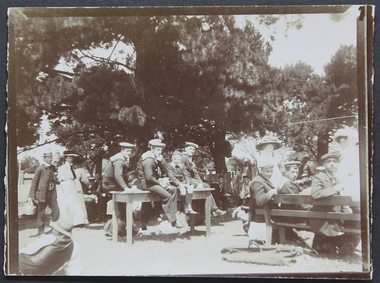
... George Higgins and the Malvern members of the Ladies' Harbour Lights Guild entertained some 110 sailors from the Royal Navy and Merchant Service. ...George Higgins and the Malvern members of the Ladies' Harbour Lights Guild entertained some 110 sailors from the Royal Navy and Merchant Service. ...This photograph depicts a picnic for Cup Day (Tuesday 2 November 1909) organised by the Mission and the LHLG members at Orchard House. The property belongs to Mr George Higgins, engineer and his wife, Beatrice who was the LHLG Malvern branch secretary. Beatrice nee Shuter was the daughter of Charles Shuter. In the Punch published on 11 November 1909, we could read: "The pretty garden of "Orchard House," and the paddock adjoining (kindly lent by Mr. and Mrs. Singleton), was the scene on Cup Day of a most successful sailors' picnic, when Mr. and Mrs. George Higgins and the Malvern members of the Ladies' Harbour Lights Guild entertained some 110 sailors from the Royal Navy and Merchant Service. A football match, sports, and "costume" races were indulged in by the more active members of the party, while others enjoyed the unusual pleasure of sitting on the green grass under the trees. Mrs. MacLeod, Mrs. Knight, Mrs. Simon Fraser, Mrs. H. B. Higgins, Mrs. Albert Keep, Miss Ethel Godfrey, the Misses Wollaston, and a number of other ladies assisted to wait on the "tars." One "Jack," from H.M.S. Cambrian, voted it the "nicest day he had had since leaving the Old Country." Hearty cheers for the kind hostesses closed the proceedings. The evening was spent at the Institutes of the Missions to Seamen on the Australian Wharf and at Port Melbourne respectively, where prizes were distributed to the successful competitors. "Small monochrome photograph1909, malvern, cup day, mr george higgins, mce, beatrice elizabeth higgins (nee shuter), h.m.s. cambrian, ethel augusta godfrey, orchard house, ina higgins, rica godfrey, rita godfrey, reverend alfred gurney goldsmith, picnics, social events, frederica godfrey, entertainments, sailors, seafarers, seamen, goldsmith album -
 Orbost & District Historical Society
black and white photograph, 16.7.1956
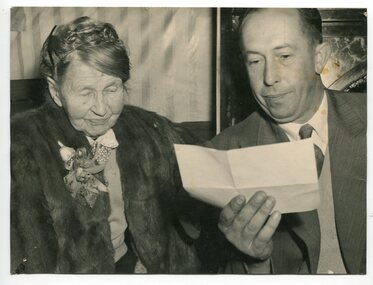
... She was a foundation member of the Methodist Ladies’ Guild in 1912. She lived in Salisbury Street, Orbost. ...She was a foundation member of the Methodist Ladies’ Guild in 1912. She lived in Salisbury Street, Orbost. ...This photograph shows Nelson Burn reading a telegram from the queen to his grandmother, Mrs Paul Hocking, on her 100th birthday. Her husband, James Hocking, was the first watchmaker in Orbost. He had been a lay preacher at Wangaratta and Yan Yean before coming to Orbost. He was an 1891 Rechabite and an Orbost Shire Councillor. Eliza Ann Hocking (nee Eddy) was born on 16.7.1856 at Blackwater Hall in England, She had arrived in Australia on the sailing boat "Poocia" on 8-7-1880. The voyage following the Cape route took about 7 weeks. For a time, with her husband, she lived at Chewton, on the gold fields, before coming to Orbost. She was a foundation member of the Methodist Ladies’ Guild in 1912. She lived in Salisbury Street, Orbost. She died on 9.4.1957. Colin Nelson Burn, born 7.7.1921, was her grandson, son of Robert Alfred Burn and Edith Jane Hocking. He began Sta-Brite' Painting and Decorating Services in Salisbury Street, Orbost. He served in the forces during World War II. He was a Life member of the Snowy Rovers Football Club. He joined the Orbost Fire Brigade on 1-5-1946. He died 1.2.2015. His son, Peter continues the painting business in Orbost. (info. from John Phillips)This is a pictorial record of an Orbost resident reaching 100 years. A 100 year birthday is a significant milestone. The Hocking / Burn family have been associated with the Orbost district since 1889.A large black / white photograph of an elderly lady standing beside a younger man who is holding a letter and reading to her.hocking-mrs burn-nelson telegram-queen-100th-birthday -
 Orbost & District Historical Society
account, 30th June 1891
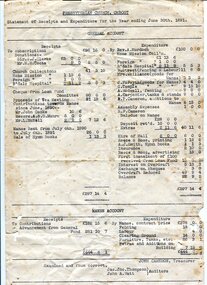
... She was a loyal member of the Presbyterian Church and a stalwart of the Ladies’ Guild, an energetic worker for the Municipal Auxiliary and a member of the Red Cross. ...She was a loyal member of the Presbyterian Church and a stalwart of the Ladies’ Guild, an energetic worker for the Municipal Auxiliary and a member of the Red Cross. ...The first Presbyterian Church service was conducted at the Orbost Station Homestead in 1885, during a visit by Sir William Clarke, who was accompanied by two ministers. The organist was resident Grace Jennings Carmichael. Services were later held in Mr J. W. Borland’s shop and the Mechanics Hall. In 1887 the land on which the church now stands was purchased from Mr James Hossack snr, for £50 ($100). The trustees were Mr John, Peter and Hugh Cameron, Mr John A Watt and Mr James Hossack Jnr. Timber from Richardson’s Tabbara Mill was used by builder Mr R. P Cameron and at a cost of £ 311.3.7 ($622) the church was opened January 9th 1898. This item is from the estate of Elsie Cooke. Elsie Cooke was a librarian in Orbost for many years. She was the daughter of John Cooke early Brodribb settler. Elsie Cooke lived all her life in Gippsland,. She was born at Brodribb in 1895 and died in 1970, Elsie Cooke lived at Bruthen for a short time and, in 1937, moved to live with her aunt, Miss Jean Munro. Miss Cooke was Librarian at the Mechanics Institute for many years. Kindness and consideration for other were Miss Cooke’s attributes and she endeared herself to all who knew her. She was a loyal member of the Presbyterian Church and a stalwart of the Ladies’ Guild, an energetic worker for the Municipal Auxiliary and a member of the Red Cross. (ref. Mary Gilbert This item is associated with the Presbyterian Church in Orbost. It is an example of early book-keeping and is also associated with Elsie Cooke.Two white paper accounts. They are typed in black and are statements of receipts and expenditure for the Presbyterian Church in Orbost. On one sheet is an alhabetical list of subscribers for the year ending June 30, 1891. On the other is a general account of receipts and expenditure.presbyterian-church-orbost account-book-keeping -
 Orbost & District Historical Society
program, Snowy River Mail, 1891
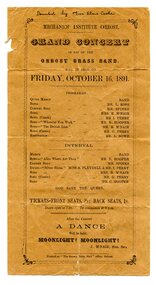
... She was a loyal member of the Presbyterian Church and a stalwart of the Ladies’ Guild, an energetic worker for the Municipal Auxiliary and a member of the Red Cross. ...She was a loyal member of the Presbyterian Church and a stalwart of the Ladies’ Guild, an energetic worker for the Municipal Auxiliary and a member of the Red Cross. ...This concert was held in the Mechanics' Institute on Friday, October 16th, 1891 commencing at 8pm. A dance was held after the concert. The secretary at that time was J. McNair. The first Orbost Brass Band was formed in 1889. Around 1908 the town band split and the Orbost Workers' Band was formed. Eventually the two bands merged in 1913 to reform as the Orbost Municipal Band under conductorship of Charles Spink. The band continued for many years but was later disbanded and again reformed. This was to happen a number of times, the last time being in 1961 and continuing through to the late 1970's. Further info and Ref: In Times Gone By - Deborah Hall From the estate of Elsie Cooke. Elsie Cooke was a librarian in Orbost for many years. She was the daughter of John Cooke early Brodribb settler. Elsie Cooke lived all her life in Gippsland,. She was born at Brodribb in 1895 and died in 1970, Elsie Cooke lived at Bruthen for a short time and, in 1937, moved to live with her aunt, Miss Jean Munro. Miss Cooke was Librarian at the Mechanics Institute for many years. Kindness and consideration for other were Miss Cooke’s attributes and she endeared herself to all who knew her. She was a loyal member of the Presbyterian Church and a stalwart of the Ladies’ Guild, an energetic worker for the Municipal Auxiliary and a member of the Red Cross. (ref. Mary Gilbert)The various Orbost bands over the years played a major role in community activities providing entertainment and musical experiences for the many members.An orange, paper program with black print. The program and details are inside a black frame. It is for a concert in aid of the Orbost Brass Band.At the top handwritten in black pen is" Donated by Mrs Elsie Cooke".orbost-brass-band-programme cooke-elsie -
 Bendigo Historical Society Inc.
Document - LA TROBE UNIVERSITY BENDIGO COLLECTION: GRADUATE DIPLOMA IN EDUCATION 2003
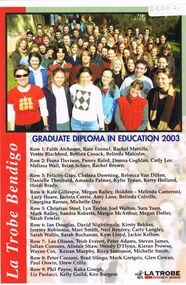
... They are Faith Atcheson, Kate Esnouf, Rachel Mattille, Yvette Blachford, Bettina Cusack, Belinda Malcolm, Fiona Davison, Penny Baird, Donna Coghlan, Carly Lee, Melissa Wall, Brian Schorr, Rachel Brown, Felicity Gray, Chelsea Downing, Rebecca Van Dillen, Danielle Theobald, Amanda Palmer, Kylie Tynan, Kerry Holland, Heidi Brady, Kate Gillespie, Megan Bailey, Melinda Cameron, Lucy Hoare, Jacinta Corrie, Amy Lane, Belinda Colville, Georgina Barnes, Michelle Day, Christian Steel, Lyn Taylor, Joel Walton, Sara Yuen, Mark Bailey, Sandra Roberts, Margie McArthur, Megan Doller, Sarah Fowler, Ian Douglas, David Nightingale, Kirsty Bekker, Jeremy Robinson, Marc Smith, Neil Renfrey, Carly Langley, Sarah Wallis, Sarah Buchanan, Kym Lloyd, Jackie Kellow, Lee Olsson, Trish Everett, Peter Adams, Steven James, Julian Connors, Alistair Shaw, Wendy O'Flynn, Kieran Prowse, Wayne Cox, Keiran Murphy, Riccy Jamieson, Michelle Smith, Peter Coceani, Brad Slingo, Mark Gretgrix, Glen Cowan, Paul Oswin, Drew Crilly, Phil Payne, Kaka Gough, Liz Paolacci, Kelly Guild and Ken Burgess....They are Faith Atcheson, Kate Esnouf, Rachel Mattille, Yvette Blachford, Bettina Cusack, Belinda Malcolm, Fiona Davison, Penny Baird, Donna Coghlan, Carly Lee, Melissa Wall, Brian Schorr, Rachel Brown, Felicity Gray, Chelsea Downing, Rebecca Van Dillen, Danielle Theobald, Amanda Palmer, Kylie Tynan, Kerry Holland, Heidi Brady, Kate Gillespie, Megan Bailey, Melinda Cameron, Lucy Hoare, Jacinta Corrie, Amy Lane, Belinda Colville, Georgina Barnes, Michelle Day, Christian Steel, Lyn Taylor, Joel Walton, Sara Yuen, Mark Bailey, Sandra Roberts, Margie McArthur, Megan Doller, Sarah Fowler, Ian Douglas, David Nightingale, Kirsty Bekker, Jeremy Robinson, Marc Smith, Neil Renfrey, Carly Langley, Sarah Wallis, Sarah Buchanan, Kym Lloyd, Jackie Kellow, Lee Olsson, Trish Everett, Peter Adams, Steven James, Julian Connors, Alistair Shaw, Wendy O'Flynn, Kieran Prowse, Wayne Cox, Keiran Murphy, Riccy Jamieson, Michelle Smith, Peter Coceani, Brad Slingo, Mark Gretgrix, Glen Cowan, Paul Oswin, Drew Crilly, Phil Payne, Kaka Gough, Liz Paolacci, Kelly Guild and Ken Burgess. Document LA TROBE UNIVERSITY BENDIGO COLLECTION: GRADUATE DIPLOMA IN EDUCATION 2003 ...A laminated copy of the "Graduate Diploma in Education 2003". It displays a photo and the names of the recipients. They are Faith Atcheson, Kate Esnouf, Rachel Mattille, Yvette Blachford, Bettina Cusack, Belinda Malcolm, Fiona Davison, Penny Baird, Donna Coghlan, Carly Lee, Melissa Wall, Brian Schorr, Rachel Brown, Felicity Gray, Chelsea Downing, Rebecca Van Dillen, Danielle Theobald, Amanda Palmer, Kylie Tynan, Kerry Holland, Heidi Brady, Kate Gillespie, Megan Bailey, Melinda Cameron, Lucy Hoare, Jacinta Corrie, Amy Lane, Belinda Colville, Georgina Barnes, Michelle Day, Christian Steel, Lyn Taylor, Joel Walton, Sara Yuen, Mark Bailey, Sandra Roberts, Margie McArthur, Megan Doller, Sarah Fowler, Ian Douglas, David Nightingale, Kirsty Bekker, Jeremy Robinson, Marc Smith, Neil Renfrey, Carly Langley, Sarah Wallis, Sarah Buchanan, Kym Lloyd, Jackie Kellow, Lee Olsson, Trish Everett, Peter Adams, Steven James, Julian Connors, Alistair Shaw, Wendy O'Flynn, Kieran Prowse, Wayne Cox, Keiran Murphy, Riccy Jamieson, Michelle Smith, Peter Coceani, Brad Slingo, Mark Gretgrix, Glen Cowan, Paul Oswin, Drew Crilly, Phil Payne, Kaka Gough, Liz Paolacci, Kelly Guild and Ken Burgess.bendigo, education, la trobe university bendigo, la trobe university bendigo collection, collection, bendigo, education, teaching, teachers, students, graduate diploma, la trobe university bendigo, tertiary education -
 Sunshine and District Historical Society Incorporated
Archive - Gwen Mousley Collection - History of St John's Deer Park, 1892-1986 - including newspaper cuttings
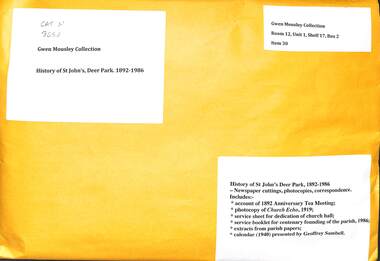
... .| Photocopy of balance sheet and part of report, 1892| Centenary service, commemorating 100 years since the foundation of the parish in 1886| Centenary service commemorating 100 years since dedication of St John's Church, Deer Park| Service sheet for dedication of church hall, 1954| Article on Geoffrey Sambell, Archbishop of Perth,1969-1980| Calendar, 1940, sent to Mr & Mrs Mousley signed by Geoffrey Sambell| Cuttings, including extract from' T'he Advertiser', 17 October 1891 (photocopy),''The Advocate', including 'This week in history', from 60 years before and 25 years before, 'Deer Park Diary', 'Deer Park Notes, ' 'The Age', 18 Dec. 1954, extract from 'The Faith' re St John's Deer Park, 1946, Golden Jubilee of St John's Deer Park, St John's Deer Park Ladies' Guild, St John's Girls' Freindly Society, St Mark's Church of England new building fund, photo of interior of St John's Deer Park in 'The Advocate', 1 October 1986, 'The Witness', March 1937,| Notes on early history of St John's church by the Dicksons (hand-written)| Extract from 'The Witness, October 1936| New Sunshine State School to be opened 21 March 1931| Farewell to Rev. ....| Photocopy of balance sheet and part of report, 1892| Centenary service, commemorating 100 years since the foundation of the parish in 1886| Centenary service commemorating 100 years since dedication of St John's Church, Deer Park| Service sheet for dedication of church hall, 1954| Article on Geoffrey Sambell, Archbishop of Perth,1969-1980| Calendar, 1940, sent to Mr & Mrs Mousley signed by Geoffrey Sambell| Cuttings, including extract from' T'he Advertiser', 17 October 1891 (photocopy),''The Advocate', including 'This week in history', from 60 years before and 25 years before, 'Deer Park Diary', 'Deer Park Notes, ' 'The Age', 18 Dec. 1954, extract from 'The Faith' re St John's Deer Park, 1946, Golden Jubilee of St John's Deer Park, St John's Deer Park Ladies' Guild, St John's Girls' Freindly Society, St Mark's Church of England new building fund, photo of interior of St John's Deer Park in 'The Advocate', 1 October 1986, 'The Witness', March 1937,| Notes on early history of St John's church by the Dicksons (hand-written)| Extract from 'The Witness, October 1936| New Sunshine State School to be opened 21 March 1931| Farewell to Rev. ...Part of Gwen Mousley Collection. This bundle has a picture of a beautiful and historic chalice, but it was never at Deer Park or Sunshine.Some items have a date, or year, written on. The 1940 calendar is significant because of Geoffrey Sambell's Christmas wishes to Mr & Mrs Mousley. [Geoffrey Sambell was later Anglican Archbishop of Perth]st. johns church, deer park, miles street, church -
 Bendigo Historical Society Inc.
Document - MERLE HALL COLLECTION: DOCUMENTS RELATING TO ORGANIZATIONS (NOT BENDIGO BASED)
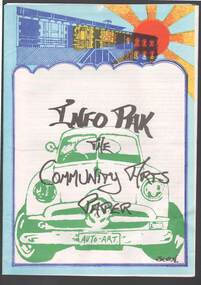
... Copied extracts from ''Australian Quilts - The People and Their Art'' descriptions of the work of nine quilters from The Quilters Guild, pub. By Simon Schuster (no date); j. letter from The Lieder Society of Victoria Inc to Arts Bendigo October 2001 re opportunities for concerts in area; k. information about various performances of the Australian Performing Group, APG, (Pram Factory) -no stated date...Copied extracts from ''Australian Quilts - The People and Their Art'' descriptions of the work of nine quilters from The Quilters Guild, pub. By Simon Schuster (no date); j. letter from The Lieder Society of Victoria Inc to Arts Bendigo October 2001 re opportunities for concerts in area; k. information about various performances of the Australian Performing Group, APG, (Pram Factory) -no stated date Document MERLE HALL COLLECTION: DOCUMENTS RELATING TO ORGANIZATIONS (NOT BENDIGO BASED) ...Documents relating to organizations (not Bendigo based): a. Flyer (bi fold) ''A Community Radio Station for Central Victoria?'' re obtaining an FM radio broadcasting licence- Central Victorian Community Broadcasting Association; b. paper presented at Bendigo seminar for ''Regionalism and the Arts'' 13/7/1985 by Ric McCracken, Footscray Community Arts Centre; c. 12 page booklet ''Info Pak - the Community Arts Paper'' published by the Footscray Community Arts Centre, 1978; d. 4 -paged Newsletter of the Victoria Welsh Male Voice Choir, issue 1, May2002 ''Tongues of Fire''; e. 8-paged booklet describing the Robert Blackwood Hall, Monash University, Clayton (pub. Ca. 1971?); f. 26- paged ''Work Guide - How to establish an Artist In Community project'' , published by the Community Arts Resource Centre, East Melbourne , 1989; g. info sheet on residential schools, Jan 1979 - ''Mime and Dance Education'', Dept of Continuing Education, University of New England; h. personal and artistic information re potter, Judy Lorraine , Wedderburn; i. Copied extracts from ''Australian Quilts - The People and Their Art'' descriptions of the work of nine quilters from The Quilters Guild, pub. By Simon Schuster (no date); j. letter from The Lieder Society of Victoria Inc to Arts Bendigo October 2001 re opportunities for concerts in area; k. information about various performances of the Australian Performing Group, APG, (Pram Factory) -no stated datemerle hall collection, community arts, australian performing group -
![Album (item) - Photographic Album, digital copy, Freda Kathleen Oxley (1882-1969), Album of photographs of a voyage to Australia and visit to the Mission to Seamen, Melbourne [picture] / Freda Oxley, 1925-1928](/media/collectors/4f729f5897f83e0308601603/items/672c59ac552587060c889944/item-media/67a6dc3cd7095b7115fefda2/item-fit-380x285.jpg?cb=6) Mission to Seafarers Victoria
Mission to Seafarers VictoriaAlbum (item) - Photographic Album, digital copy, Freda Kathleen Oxley (1882-1969), Album of photographs of a voyage to Australia and visit to the Mission to Seamen, Melbourne [picture] / Freda Oxley, 1925-1928
... She stayed at the Mission for several years, and became a host of the many picnics, making friends with the ladies from the Guild, taking photographs of people and events. ...She stayed at the Mission for several years, and became a host of the many picnics, making friends with the ladies from the Guild, taking photographs of people and events. ...This is a copy of an album of photographs held at the National Library of Australia. The album was photographed by Reverend's Weller grand daughter. Freda Oxley was a friend of the Wellers. She was born in Windsor in 1882 where Alexina Weller (nee Caley) was also born in 1885. She travelled on the SS Persic from England and arrived in 1925. She stayed at the Mission for several years, and became a host of the many picnics, making friends with the ladies from the Guild, taking photographs of people and events. Page 1 to 3: Outward Bound - SS Persic - September 26th .... November 12th 1925 Page 4: Interiors of the Mission to Seamen Melbourne Page 5: Mission to Seamen exteriors and wharf Page 6: Wellers with officers during lunch in the Manse Page 7-8: Mission's staff, garden, Wellers Page 8: Freda Oxley, the Wellers, Alexina Weller, Xmas Day 1927, Dora Walker and Rev. Weller Page 9: Gardens: the photographs show the garden's plants in its early years / Botanical Gardens / Nellie Melba's gardens in her estate Coombe: Walter Butler, the architect of the Mission had designed some extensions for Nellie Melba's estate and part of the gardens of the property, so it was likely through they acquaintance that the Mission's reverend and friends were invited. Page 10: Ships in the Yarra River Page 11: Skaregrom and Mitchell ships Page 12-15: Picnics Page 16: Christmas at the Mission, tennis court Page 17: Picnic Page 18: Dora Walker's wedding Page 19: Beach holiday Freda went back to the UK in March 1929 on the Cathay. But she came back to help the Mission as she's listed on the electoral roll in 1931 living there with the Olivers.This album provides valuable photographs of the Mission's interiors, garden, staff, guests and activities during the Wellers stay. It also provides the provenance of the Weller album held in the Mission's collection.The album was donated to the National Library of Australia by Miss Elizabeth Phillips, with her address in England, with a typed note attached that reads: 'These photographs were taken by my aunt Miss Freda Oxley between 1925 and 1928. She went out to Melbourne at that time and stayed at the Mission to Seamen with her friends the Revd Jack Weller and Mrs Weller. The Revd Weller later became Bishop of the Falkland Islands.'freda kathleen oxley 1882-1969, ss persic, gardens, botanical garden, picnics, officers, portsea, sydney, rev. w.m robertson, dora simpson nee walker, wedding, alice sibthorpe tracy, ethel augusta godfrey 1861-1935, royal botanical garden, nellie melba, coombe, zoo, seamen, sailors, walter richmond butler (1864–1949), juan oyarzo, john oyarzo, fern tree gully, kerferd family -
 Mission to Seafarers Victoria
Photograph, 14 February 1928
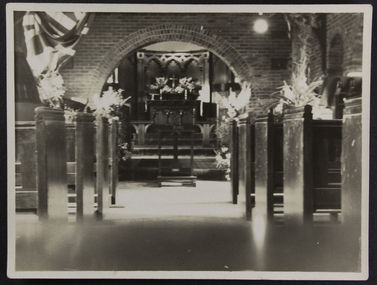
... Dora Walker, a member of the Ladies Harbour Lights Guild married H.P. Simpson on 14 February 1928. ...Dora Walker, a member of the Ladies Harbour Lights Guild married H.P. Simpson on 14 February 1928. ...Dora Walker, a member of the Ladies Harbour Lights Guild married H.P. Simpson on 14 February 1928. The wedding was celebrated at the Mission's chapel at 2.45pm. The article in the Herald of the day describes the event: "WEDDING AT SEAMEN'S CHAPEL Reception at Hotel Windsor The pretty little chapel at the Sea men's Institute was packed with interested friends this afternoon, when Miss Dora Walker, one of the Mission's most enthusiastic and efficient voluntary helpers, chose it as the setting for her marriage with Mr H. P. Simpson, son of Mr and Mrs J. H. Simpson, of Mornington. A group of her fellow workers decorated the chapel with lovely pink and white gladioli, carnations and roses. The ceremony was performed by the Rev. J. R. Weller, chaplain of the Mission, and the bride was given away by her father, Mr A. W. Walker, of Manning road, East Malvern. She wore a lovely ivory georgette frock, the finely tucked skirt being fashioned with a deep transparent hem of Chantilly lace. Over it fell a beautiful Honiton lace veil mounted on tulle and arranged to give the ef fect of a train. Fragrant white roses composed her bouquet. Two attendants followed her down the aisle — her sister, Miss Molly Walker, and Miss Ella Kendall — both wearing dainty shrimp pink georgette frocks and large crinoline straw hats in the same shade with a dainty edging of tulle. They carried bouquets of pink cactus dahlias nnd delphiniums. Mr Louis Buscombe was best man, and Mr George Thompson grooms man. After the ceremony Mr and Mrs Walker entertained about 50 guests at the Hotel Windsor."2 original prints and a reprinted version depicting the St Peter chapel decorated with flowers for Dora Walker's wedding in 1928 wedding, dora walker, st peter chapel, mission to seamen, mission to seafarers, flinders st, lhlg, dora simpson, 1928, valentine's day, amy dora walker, ladies harbour lights guild, malvern, reverend j.r. weller, molly walker, ella kendall, flowers -
 National Wool Museum
Textile - Quilt, Mrs Beryl Andersen, Chicken Feed Wagga, 1995-2001
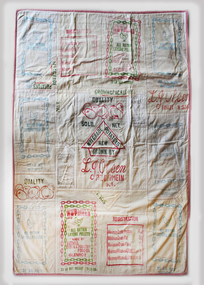
... Beryl was the inaugural president of the Hamilton Quilters Guild and is a well-known quilter. Perhaps her best-known work was the “Quilt for Hope”, a living memorial for victims of institutional church-related sexual abuse. ...Beryl was the inaugural president of the Hamilton Quilters Guild and is a well-known quilter. Perhaps her best-known work was the “Quilt for Hope”, a living memorial for victims of institutional church-related sexual abuse. ...Norma Dessent (the donor) was cleaning out her Mother-in-law Amy Dessent’s home, after she passed away in 1995. She came across a collection of gunny sacks for chicken feed, potatoes, and flour. Norma gave the bags to her good friend Beryl Andersen, thinking she might be able to make use of the material in her quilting. Many years later in 2001, Beryl gave Norma this quilt made in a wagga style out of the bags. This was both a great surprise and a great delight for Norma. Amy Dessent was a housewife. Her chickens were her friends, keeping her company as she worked in her renowned garden and while she cooked and maintained a beautiful home. Typically, Amy would have a dozen chickens clucking around at a time. In the style of the time, everything was kept for a possible repurposing later in life, such as these gunny sacks. The Chicken Feed Wagga was created in Ballarat by Mrs Beryl Andersen. Beryl was the inaugural president of the Hamilton Quilters Guild and is a well-known quilter. Perhaps her best-known work was the “Quilt for Hope”, a living memorial for victims of institutional church-related sexual abuse. More information about this quilt can be found on the following link. https://www.nationalquiltregister.org.au/quilts/quilt-of-hope/). The wool blanket used as a backing belonged to Beryl’s mother. Beryl’s mother married in 1930 and the blanket is thought to have been a present from this wedding, making the blanket close to a century old. Norma donated the quilt to the National Wool Museum in 2021 as a result of downsizing. She no longer had room for the quilt to hang on her wall. Before downsizing, the quilt had hung in the entryway to her home for the last two decades.Wagga style quilt made with a appliqué top layer of gunny sacks that once held chicken feed, flour, and potatoes. The insulating internal material is not known. The backing fabric is made from a cream woollen blanket. The edges are bound with a material of a red and white plaid. The gunny sacks are quilted together with a machine stitch of red thread. The sacks contain imagery pertaining to their previous use. Some sacks have an image of a chicken applied with blue, red, or green ink. Other sacks contain imagery of potatoes. While other sacks contain information “Minimum Crude Protein 14%, Minimum Crude Fat 3%, Maximum Crude Fibre 7%”. One of the sacks shows a handwritten price for a bag of chicken feed in a red ink.Numerous. See multimediaquilts, wagga, gunny sacks, upcycle -
 Mission to Seafarers Victoria
Painting - Oil painting, Madeline M.Ravenna Lewellin, Start Point Light, Devonshire, 1875
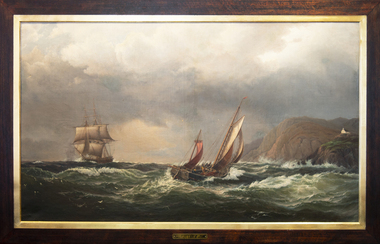
... Miss Lewellin, who had a love of the sea and ships as subject matter is listed in 1910 as a donor as a 10/6 member donating to the motor launch fund and in 1918 as a working member of the Ladies Harbour Lights Guild which involved regular volunteer shifts at the Mission to Seamen on canteen and other duties. ...Miss Lewellin, who had a love of the sea and ships as subject matter is listed in 1910 as a donor as a 10/6 member donating to the motor launch fund and in 1918 as a working member of the Ladies Harbour Lights Guild which involved regular volunteer shifts at the Mission to Seamen on canteen and other duties. ...This painting was made after an artwork by Wilhelm Melby held at the National Gallery of Victoria. Melby is a Danish artist (1824-1882). It depicts a famous Devonshire coastal region famous now for its lighthouse and the pick up point for the pilot when entering waters approaching Dartmouth. The sailing vessels pre-date the construction of the famous lighthouse. Over the centuries the view would have been familiar to many sailors as they left or approached the English mainland and south coast ports in the English Channel. Madeline Mary Ravenna Lewellin (1854 – 24 November 1944) was born in Victoria to Dr John Henry Hill Lewellin, a physician, and Grace Elizabeth (née Danneby). She was one of five daughters, and the family lived in Prahran. Lewellin's brother, Captain Herbert Gordon Hill Lewellin, was a commander in the P. and O. fleet (apprentice on the Romanoff, Lieutenant RNR on the HMS Arethusa in 1899, RMS Mongolia in 1913 sunk in 1917, Naldera in 1920). She studied painting at the National Gallery School in 1879 under Eugene von Guerard. She's also known for collecting and painting specimens, and became a member of the Field Naturalists Club of Victoria in 1885. In 1884 she won a silver medal for her studies of fungi. She collected plants for Australian botanist Ferdinand von Mueller, and the variety of Dicrastylis lewellinii (Purple sand-sage) is named after her. Miss Lewellin, who had a love of the sea and ships as subject matter is listed in 1910 as a donor as a 10/6 member donating to the motor launch fund and in 1918 as a working member of the Ladies Harbour Lights Guild which involved regular volunteer shifts at the Mission to Seamen on canteen and other duties. The painting was donated by Miss Lewellin in 1918 and hanged above the stage in the main hall; it appears on several postcards of the time.Marine art, Maritime artThis oil painting has a dark polished wood and gold leaf slip. The painting depicts two masted boats. The choppy sea takes up the lower-third of the painting, and the other two-thirds of the image of made up of stormy grey clouds. A rocky cliff face can be seen on the right-hand side of the painting. A small church can be seen on the hillside. The ship on the left third of the painting sits on the horizon line of the sea. The centre ship with two masts appears to be leaning to the right and its deck is exposed to the viewer showing four men attempting to handle the masts and rigging. The left-hand ship with three masts is surrounded by two grey distant silhouetted mast ships. There are three seagulls at the upper left-centre of the image. There are another three gulls down on the lower-left of the image. Front: ENGRAVED PLAQUE: Start Point Light. Devonshire. SIGNATURE: After W. Melby / M.M.R Lewellin. 1875. Reverse: IN BLACK MARKER PEN: * Hang from two points * WHITE STICKER WITH CONSERVATOR DETAILS: Art Conservation Frames / 118 Bridport Street, Albert Park, VIC, 3206 / 9696 9066 / artconservationframers.com.aupainting, ships, mast, church, sea, storm, oil painting, seagulls, madeline r. lewellin, artwork-paintings, ngv, wilhelm melby, eugene von guerard, botanist, rms mongolia, captain herbert gordon hill lewellin (1862-1935), paddy lewellin, reproduction, seascape, danger -
 Mission to Seafarers Victoria
Photograph - Photograph, Sepia, 14 February 1928
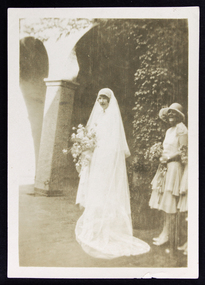
... Dora Walker was a student of Milverton school, one of the Ladies Schools, a branch of the Ladies Harbour Light's Guild. Amy Dora Walker (known as Dora) of East Malvern married Harold Priestley Simpson of Surrey Hills on 14 February 1928. ...Dora Walker was a student of Milverton school, one of the Ladies Schools, a branch of the Ladies Harbour Light's Guild. Amy Dora Walker (known as Dora) of East Malvern married Harold Priestley Simpson of Surrey Hills on 14 February 1928. ...Dora Walker was a student of Milverton school, one of the Ladies Schools, a branch of the Ladies Harbour Light's Guild. Amy Dora Walker (known as Dora) of East Malvern married Harold Priestley Simpson of Surrey Hills on 14 February 1928. The bride's maids were Ella Kendall and Molly Walker. The article in the Herald of the day describes the event: "WEDDING AT SEAMEN'S CHAPEL Reception at Hotel Windsor The pretty little chapel at the Sea men's Institute was packed with interested friends this afternoon, when Miss Dora Walker, one of the Mission's most enthusiastic and efficient voluntary helpers, chose it as the setting for her marriage with Mr H. P. Simpson, son of Mr and Mrs J. H. Simpson, of Mornington. A group of her fellow workers decorated the chapel with lovely pink and white gladioli, carnations and roses. The ceremony was performed by the Rev. J. R. Weller, chaplain of the Mission, and the bride was given away by her father, Mr A. W. Walker, of Manning road, East Malvern. She wore a lovely ivory georgette frock, the finely tucked skirt being fashioned with a deep transparent hem of Chantilly lace. Over it fell a beautiful Honiton lace veil mounted on tulle and arranged to give the ef fect of a train. Fragrant white roses composed her bouquet. Two attendants followed her down the aisle — her sister, Miss Molly Walker, and Miss Ella Kendall — both wearing dainty shrimp pink georgette frocks and large crinoline straw hats in the same shade with a dainty edging of tulle. They carried bouquets of pink cactus dahlias nnd delphiniums. Mr Louis Buscombe was best man, and Mr George Thompson grooms man. After the ceremony Mr and Mrs Walker entertained about 50 guests at the Hotel Windsor."A member of the Ladies Harbour Lights Guild, Dora is one of the few ladies who married at the Mission.Sepia toned photograph of bride and attendants in the courtyard of the Mission to Seafarers. The bride's dress is calf length and she is standing with her veil draped in front of her, holding a large bouquet. There is one attendant to the right of the photograph, wearing a layered calf length dress and holding a smaller bouquet. Both are standing in front of one of the columns in the courtyard which has ivy growing over it.Blue ink on rear of photograph: 4 49hat, flowers, veil, wedding, dress, ivy, columns, shoes, dora walker, dora simpson, milverton school, ladies school, lhlg, mrs h.p. simpson, mrs harry simpson, courtyard, amy dora walker, ella kendall, molly walker, reverend j.r. weller, david simpson -
 National Wool Museum
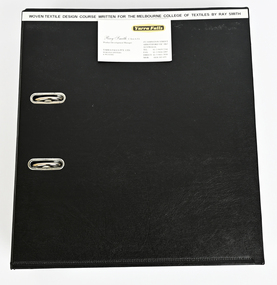
Document - Woven Textile Design Course for Melbourne College of Textiles, Ray Smith, 1996
... Over the next five decades, Ray furthered his education in textile design, weaving design, knitting and later computer aided design, including qualifications from Gordon Textile College, City and Guilds of London Institute, The Textile Institute, Melbourne Institute of Textiles and Royal Melbourne Institute of Technology (RMIT). ...Over the next five decades, Ray furthered his education in textile design, weaving design, knitting and later computer aided design, including qualifications from Gordon Textile College, City and Guilds of London Institute, The Textile Institute, Melbourne Institute of Textiles and Royal Melbourne Institute of Technology (RMIT). ...Part of a collection of books, fabric samples and documents from the working life of Ray Smith. Ray began his career at the age of 15, working at the Albion Woollen Mills in Geelong in 1953. Over the next five decades, Ray furthered his education in textile design, weaving design, knitting and later computer aided design, including qualifications from Gordon Textile College, City and Guilds of London Institute, The Textile Institute, Melbourne Institute of Textiles and Royal Melbourne Institute of Technology (RMIT). After ten years at Albion Woollen Mills, Ray went on to hold fabric design positions at Prestige Fabrics and Yarra Falls, working up to management roles in both the Weaving and Fabric Design Divisions, and then as Product Development Manager at Yarra Falls until 2000. Ray shares some career highlights below: In 1977 and 1978 I won the Wool Corporation’s Celsius 30 Awards as Yarra Falls Designer. (See photos attached.) These awards came with study trips to the major Textile Centres and Trade Fairs around the world. This was proven to be beneficial and Yarra Falls sent me overseas every year for the next 22 years. On stopovers in Hong Kong we appointed an agent and took part in Textile Trade Fairs at Interstoff Asia and exhibited designs in 1991, 92, 93, 94. I created a pattern book for a chain of shops called “Kwun KeeTailors” for their customers to select our fabrics to be made up into suits for the tourists. I also had several trips to New York to try to export to America with some success. I was commissioned by the Melbourne College of Textiles to write a Woven Textile Design Course to be taught under the outreach program. This was eventually translated into Spanish to be used by developing textile industries in South America.Black two armed binder folder with over one hundred pages of typed paper in plastic sleeves. Documents contain details of sixty eight topics for Woven Textile Design Course. The folder has a label attached across the top edge, and a business card attached with tape to the front.Front [printed label]: WOVEN TEXTILE DESIGN COURSE WRITTEN FOR THE MELBOURNE COLLEGE OF TEXTILES BY RAY SMITHray smith, yarra falls, mills, textile design, fabric design, product development, wool corporation, textile design course, coursework, melbourne college of textiles, study, students -
 National Wool Museum
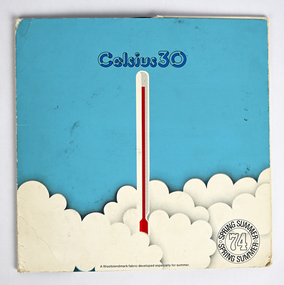
Booklet - Celsius 30, Spring Summer Fabric Samples, Australian Wool Corporation, 1974
... Over the next five decades, Ray furthered his education in textile design, weaving design, knitting and later computer aided design, including qualifications from Gordon Textile College, City and Guilds of London Institute, The Textile Institute, Melbourne Institute of Textiles and Royal Melbourne Institute of Technology (RMIT). ...Over the next five decades, Ray furthered his education in textile design, weaving design, knitting and later computer aided design, including qualifications from Gordon Textile College, City and Guilds of London Institute, The Textile Institute, Melbourne Institute of Textiles and Royal Melbourne Institute of Technology (RMIT). ...Part of a collection of books, fabric samples and documents from the working life of Ray Smith. Ray began his career at the age of 15, working at the Albion Woollen Mills in Geelong in 1953. Over the next five decades, Ray furthered his education in textile design, weaving design, knitting and later computer aided design, including qualifications from Gordon Textile College, City and Guilds of London Institute, The Textile Institute, Melbourne Institute of Textiles and Royal Melbourne Institute of Technology (RMIT). After ten years at Albion Woollen Mills, Ray went on to hold fabric design positions at Prestige Fabrics and Yarra Falls, working up to management roles in both the Weaving and Fabric Design Divisions, and then as Product Development Manager at Yarra Falls until 2000. Ray shares some career highlights below: In 1977 and 1978 I won the Wool Corporation’s Celsius 30 Awards as Yarra Falls Designer. (See photos attached.) These awards came with study trips to the major Textile Centres and Trade Fairs around the world. This was proven to be beneficial and Yarra Falls sent me overseas every year for the next 22 years. On stopovers in Hong Kong we appointed an agent and took part in Textile Trade Fairs at Interstoff Asia and exhibited designs in 1991, 92, 93, 94. I created a pattern book for a chain of shops called “Kwun KeeTailors” for their customers to select our fabrics to be made up into suits for the tourists. I also had several trips to New York to try to export to America with some success. I was commissioned by the Melbourne College of Textiles to write a Woven Textile Design Course to be taught under the outreach program. This was eventually translated into Spanish to be used by developing textile industries in South America.Card folder featuring pale blue and white clouds and sky motifs, with a thermometer on the cover. Folder holds eleven circular black cards, eight have wool fabric samples attached.Front [printed]: Celsius 30 / SPRING SUMMER / 74 / SPRING SUMMER / A Woolblendmark fabric developed especially for summer.ray smith, yarra falls, mills, textile design, fabric design, product development, wool corporation, fabric samples, 1970s fashion -
 National Wool Museum
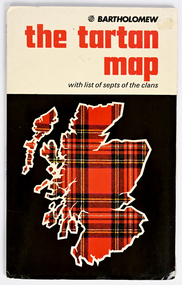
Map - The Tartan Map, John Bartholomew & Son Ltd, 1970s
... Over the next five decades, Ray furthered his education in textile design, weaving design, knitting and later computer aided design, including qualifications from Gordon Textile College, City and Guilds of London Institute, The Textile Institute, Melbourne Institute of Textiles and Royal Melbourne Institute of Technology (RMIT). ...Over the next five decades, Ray furthered his education in textile design, weaving design, knitting and later computer aided design, including qualifications from Gordon Textile College, City and Guilds of London Institute, The Textile Institute, Melbourne Institute of Textiles and Royal Melbourne Institute of Technology (RMIT). ...Part of a collection of books, fabric samples and documents from the working life of Ray Smith. Ray began his career at the age of 15, working at the Albion Woollen Mills in Geelong in 1953. Over the next five decades, Ray furthered his education in textile design, weaving design, knitting and later computer aided design, including qualifications from Gordon Textile College, City and Guilds of London Institute, The Textile Institute, Melbourne Institute of Textiles and Royal Melbourne Institute of Technology (RMIT). After ten years at Albion Woollen Mills, Ray went on to hold fabric design positions at Prestige Fabrics and Yarra Falls, working up to management roles in both the Weaving and Fabric Design Divisions, and then as Product Development Manager at Yarra Falls until 2000. Ray shares some career highlights below: In 1977 and 1978 I won the Wool Corporation’s Celsius 30 Awards as Yarra Falls Designer. (See photos attached.) These awards came with study trips to the major Textile Centres and Trade Fairs around the world. This was proven to be beneficial and Yarra Falls sent me overseas every year for the next 22 years. On stopovers in Hong Kong we appointed an agent and took part in Textile Trade Fairs at Interstoff Asia and exhibited designs in 1991, 92, 93, 94. I created a pattern book for a chain of shops called “Kwun KeeTailors” for their customers to select our fabrics to be made up into suits for the tourists. I also had several trips to New York to try to export to America with some success. I was commissioned by the Melbourne College of Textiles to write a Woven Textile Design Course to be taught under the outreach program. This was eventually translated into Spanish to be used by developing textile industries in South America.Folded map attached inside a card folder, featuring a map of Scotland with tartan design and red and black text on the cover.Front [printed]: BARTHOLOMEW / the tartan map / with list of septs of the clansray smith, yarra falls, mills, textile design, fabric design, product development, wool corporation, map, tartan, scotland -
 National Wool Museum
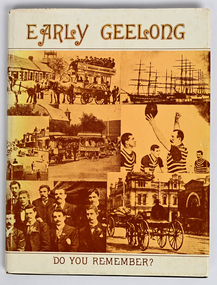
Book - Early Geelong, Do You Remember?, Solomons Pty Ltd, 1940s
... Over the next five decades, Ray furthered his education in textile design, weaving design, knitting and later computer aided design, including qualifications from Gordon Textile College, City and Guilds of London Institute, The Textile Institute, Melbourne Institute of Textiles and Royal Melbourne Institute of Technology (RMIT). ...Over the next five decades, Ray furthered his education in textile design, weaving design, knitting and later computer aided design, including qualifications from Gordon Textile College, City and Guilds of London Institute, The Textile Institute, Melbourne Institute of Textiles and Royal Melbourne Institute of Technology (RMIT). ...Part of a collection of books, fabric samples and documents from the working life of Ray Smith. Ray began his career at the age of 15, working at the Albion Woollen Mills in Geelong in 1953. Over the next five decades, Ray furthered his education in textile design, weaving design, knitting and later computer aided design, including qualifications from Gordon Textile College, City and Guilds of London Institute, The Textile Institute, Melbourne Institute of Textiles and Royal Melbourne Institute of Technology (RMIT). After ten years at Albion Woollen Mills, Ray went on to hold fabric design positions at Prestige Fabrics and Yarra Falls, working up to management roles in both the Weaving and Fabric Design Divisions, and then as Product Development Manager at Yarra Falls until 2000. Ray shares some career highlights below: In 1977 and 1978 I won the Wool Corporation’s Celsius 30 Awards as Yarra Falls Designer. (See photos attached.) These awards came with study trips to the major Textile Centres and Trade Fairs around the world. This was proven to be beneficial and Yarra Falls sent me overseas every year for the next 22 years. On stopovers in Hong Kong we appointed an agent and took part in Textile Trade Fairs at Interstoff Asia and exhibited designs in 1991, 92, 93, 94. I created a pattern book for a chain of shops called “Kwun KeeTailors” for their customers to select our fabrics to be made up into suits for the tourists. I also had several trips to New York to try to export to America with some success. I was commissioned by the Melbourne College of Textiles to write a Woven Textile Design Course to be taught under the outreach program. This was eventually translated into Spanish to be used by developing textile industries in South America.Fifty two page hard cover book featuring yellow and brown images and text on the front and back cover showing scenes from Geelong. The book features sepia toned printed photographs and brown text.Front [printed]: EARLY GEELONG / DO YOU REMEMBER?ray smith, yarra falls, mills, textile design, fabric design, geelong, geelong advertiser -
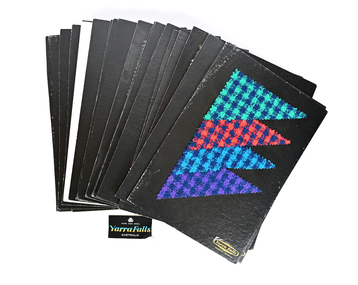 National Wool Museum
Textile - Fabric Samples, Yarra Falls Ltd, 1970s
... Over the next five decades, Ray furthered his education in textile design, weaving design, knitting and later computer aided design, including qualifications from Gordon Textile College, City and Guilds of London Institute, The Textile Institute, Melbourne Institute of Textiles and Royal Melbourne Institute of Technology (RMIT). ...Over the next five decades, Ray furthered his education in textile design, weaving design, knitting and later computer aided design, including qualifications from Gordon Textile College, City and Guilds of London Institute, The Textile Institute, Melbourne Institute of Textiles and Royal Melbourne Institute of Technology (RMIT). ...Part of a collection of books, fabric samples and documents from the working life of Ray Smith. Ray began his career at the age of 15, working at the Albion Woollen Mills in Geelong in 1953. Over the next five decades, Ray furthered his education in textile design, weaving design, knitting and later computer aided design, including qualifications from Gordon Textile College, City and Guilds of London Institute, The Textile Institute, Melbourne Institute of Textiles and Royal Melbourne Institute of Technology (RMIT). After ten years at Albion Woollen Mills, Ray went on to hold fabric design positions at Prestige Fabrics and Yarra Falls, working up to management roles in both the Weaving and Fabric Design Divisions, and then as Product Development Manager at Yarra Falls until 2000. Ray shares some career highlights below: In 1977 and 1978 I won the Wool Corporation’s Celsius 30 Awards as Yarra Falls Designer. (See photos attached.) These awards came with study trips to the major Textile Centres and Trade Fairs around the world. This was proven to be beneficial and Yarra Falls sent me overseas every year for the next 22 years. On stopovers in Hong Kong we appointed an agent and took part in Textile Trade Fairs at Interstoff Asia and exhibited designs in 1991, 92, 93, 94. I created a pattern book for a chain of shops called “Kwun KeeTailors” for their customers to select our fabrics to be made up into suits for the tourists. I also had several trips to New York to try to export to America with some success. I was commissioned by the Melbourne College of Textiles to write a Woven Textile Design Course to be taught under the outreach program. This was eventually translated into Spanish to be used by developing textile industries in South America.A collection of fabric samples from Yarra Falls, including twenty three sets of woollen fabric samples on black backing card, three sets of woollen fabric samples on white backing card and one Yarra Falls fabric label.PURE NEW WOOL / Yarra Falls / MELBOURNE AUSTRALIAray smith, yarra falls, mills, textile design, fabric design, geelong, geelong advertiser, fabric samples -
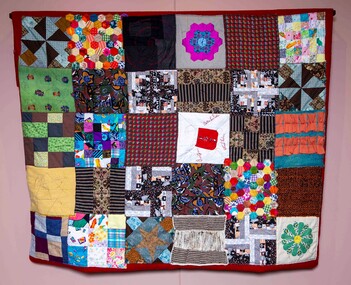 National Wool Museum
Textile - Quilt, Judith Oke et al, Isolation Quilt, 2020-2021
... Judith is a local patchwork and quilter and a member of Geelong Patchwork & Quilters Guild. Through the process she was inspired by the tradition of wagga quilts, where bits and pieces are stitched together, sometimes lined with whatever the sewer found available, such as clothing and sacking, to provide warmth. ...Judith is a local patchwork and quilter and a member of Geelong Patchwork & Quilters Guild. Through the process she was inspired by the tradition of wagga quilts, where bits and pieces are stitched together, sometimes lined with whatever the sewer found available, such as clothing and sacking, to provide warmth. ...In 2020 during the period of lockdown due to COVID the National Wool Museum asked their volunteers to make and donate blocks made from a variety of materials found in their homes, for an ISO quilt. The NWM reached out to the patchwork and quilter community to find a local quilter to sew the donated blocks together. The quilt is sewn together and quilted by Judith Oke, 2020-2021. Judith is a local patchwork and quilter and a member of Geelong Patchwork & Quilters Guild. Through the process she was inspired by the tradition of wagga quilts, where bits and pieces are stitched together, sometimes lined with whatever the sewer found available, such as clothing and sacking, to provide warmth. In construction of the finished quilt the challenge was combining 10 inch blocks made from a variety of materials, with uneven sizing. The aim was to combine these very different blocks into a harmonious whole. To this end a light and dark pattern was planned, with the blocks to be sewn onto a blanket. The choice to layer the blocks over each other, rather than sew an even seam was aimed at emphasizing the make do nature of these ISO blocks. Due to the weight of the blanket a decision was made to sew the blocks onto a base before the whole was stitched onto the blanket. The blanket was sourced from NWM donations. The rich, red of the blanket provides a bright, warm background for the colourful squares. Some of the light weight blocks were backed with iron-on interfacing to strengthen them for sewing. The edges of two of the woven squares were blanket stitched with knitting wool. The 10 inch donated blocks/squares were machine sewn to a cotton sheet base, with liberal use of blanket stitching, as the blanket was too heavy to sew the blocks directly onto the blanket. The base with squares was then machine sewn onto the red blanket backing.Various multi coloured and designed patchwork squares sewn onto a red woollen blanket. isolation, covid, quilt, wool -
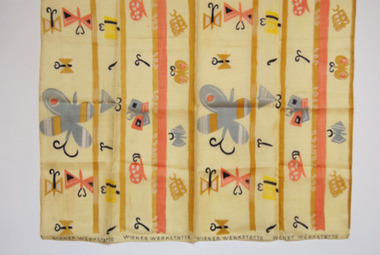 Duldig Studio museum + sculpture garden
Fabric, Mathilda Flogl, Falter designed by Mathilda Flogl 1924-31, 1924-31
... The Wiener Werkstätte (Vienna Workshop) was a guild of designers and craftsmen that was founded by the architect Josef Hoffman (1879-1956) and the designer Koloman Moser (1868-1918). ...The Wiener Werkstätte (Vienna Workshop) was a guild of designers and craftsmen that was founded by the architect Josef Hoffman (1879-1956) and the designer Koloman Moser (1868-1918). ...This piece of fabric, known Fälter (butterfly), was designed by Mathilda Flögl (1893-1958), who worked in the textile department of the Wiener Werkstätte in Vienna. It is a remnant of the fabric that was used to make a bedspread for Karl and Slawa’s bed in their Vienna apartment where it lay decoratively over a gold brocade eiderdown. The purchase demonstrated Slawa’s interest in and knowledge of modern design and her commitment to the idea of enriching everyday life with beautiful objects, a principal of the Viennese Secession. Following the Duldigs removal from Vienna, the original bedspread and remnant were safeguarded and preserved by Slawa’s sister, Rella, in the basement of her Paris apartment. In 1948 the bedspread and this remnant were sent to Australia. The bedspread was a much-loved item but deteriorated over the years. In 1955 it was made into curtains, which are held in the Duldig Studio Collection. The Photographs of the bedspread in its original location are also held in the collection. The remnant is in pristine condition. The Wiener Werkstätte (Vienna Workshop) was a guild of designers and craftsmen that was founded by the architect Josef Hoffman (1879-1956) and the designer Koloman Moser (1868-1918). The firm manufactured a range of interior furnishings between 1903 and 1932. The textile department opened in 1900, and produced about 1,800 designs, mainly for printed fabrics for furnishings and apparel. The designs were characterised by simplified forms and vivid colours, and inspired by Eastern European peasant art and geometric motifs in contemporary painting. The workshop had a profound impact of European art and design, and its work is still celebrated today. Mathilde Flögl was born in the Czech Republic in 1893, and studied at the Kunstgerwerbeschule in Vienna. In 1916 she began working at the Weiner Werkstätte, and where she designed more than 120 textile patterns. This fabric Fälter or Butterfly was designed in 1924. The butterfly was a favourite motif of Flögl. In this design she plays with a variety of whimsical abstractions and arrangement of both the butterfly and the snail on a background of abstract colour stripes and blocks. Ann Carew 2016The fabric is of great aesthetic interest as an example of the work of the Viennese workshops, and the noted designer textile designer Mathilde Flögl. The original pencil drawings, pencil and gouache designs, and fabric swatches for Fälter are held in the MAK Museum in Vienna, and the Victorian and Albert Museum in London have a sample of piece of the silk fabric in an alternate colour wave. The Museum of Applied Arts in Sydney holds a swatch book of textiles from the Wiener Werkstätte, however Flögl’s work is not represented. The National Gallery of Victoria holds a similar swatch book. The remnant has an excellent provenance, is associated with a powerful personal narrative, and is significant and rare item relating to history of the Wiener Werkstätte in Vienna, and the oeuvre of Matilda Flögl. Ann Carew 2016Remnant of a block-printed silk fabric used to make the bedspread for Karl Duldig and Slawa Horowitz-Duldig's bed in Vienna. -
 Bendigo Historical Society Inc.
Document - BALLET VICTORIA ON TOUR, BENDIGO, 20 June
... The Victorian Ballet Guild Patron: The Lady Casey. Chairman: W C Jewell. ...The Victorian Ballet Guild Patron: The Lady Casey. Chairman: W C Jewell. ...Ballet Victoria On Tour, Bendigo, 20 June. Program. Articles on: Elaine Fifield, Rex McNeill and Laurel Martyn. Photographs of: Elaine Fifield, Rex McNeill, Laurel Martyn, Julie Mann, John Nunn, Margaret Wilson, Dianne Parrington, Sherril Smith, Robyn Niblett, David Pierce and Halina Zdanowicz. Ballet Victoria. Artist Director: Laurel Martyn. Administrator: Peter K Burch. Artists: Elaine Fifield, Rex McNeill, Dianne Parrington, Sherril Smith, John Nunn, David Pierce, Julie Mann, Margaret Wilson, Robyn Niblett, Halina Zdanowicz, Gaye Sinclair. Administration: Maurice Scott, Stefan Wenczel, Jennie Miles, Val Baenziger, Arthur Turnbull, Janina Cunovas, Stefan Wenczel, Richard Divall, William Ilster, William Baxter, Luba Nedbajlo, Athol Shmith & John Cato. Production: Graham McGuffie, Barry N W Benson, David Brindley, Judith Allen & Judith Sinclair. Head office and Studios: 49 Bouverie Street, Carlton, Victoria, 3053. Short articles with photos of; Elaine Fifield, Rex McNeill and Laurel Martyn. Photographs of Julie Mann, John Nunn, Margaret Wilson, Dianne Parrington, Sherril Smith, Robyn Niblett, David Pierce and Halina Zdanowicz. The Victorian Ballet Guild Patron: The Lady Casey. Chairman: W C Jewell. Directors: Harold Badger, Brian Dixon, MLA. L St. B Foster, R N Grove, G J Troup, J Scandrett. Ballet Victoria Production Credits: Lighting for all Ballets was designed by Graham McGuffie. Shoes and tights supplied by Martin's Ballet Boutique Advance Manager's car supplied by AVIS Rent-A-Car Audio consultant Graeme Thorne All scenery and costumes made in the Ballet Victoria workshops. Ballet Victoria wishes to particularly express its gratitude to Dame Peggy van Praagh, D.B.E., Co-Artistic Director . . . 20 June Bendigo. Some advertisements also appear in program.Kenneth James Print Melbourneentertainment, theatre, ballet victoria, ballet victoria on tour, bendigo, 20 june. program. articles on: elaine fifield, rex mcneill and laurel martyn. photographs of: elaine fifield, rex mcneill, laurel martyn, julie mann, john nunn, margaret wilson, dianne parrington, sherril smith, robyn niblett, david pierce and halina zdanowicz.. artist director: laurel martyn. administrator: peter k burch. artists: elaine fifield, rex mcneill, dianne parrington, sherril smith, john nunn, david pierce, julie mann, margaret wilson, robyn niblett, halina zdanowicz, gaye sinclair. administration: maurice scott, stefan wenczel, jennie miles, val baenziger, arthur turnbull, janina cunovas, stefan wenczel, richard divall, william ilster, william baxter, luba nedbajlo, athol shmith & john cato. production: graham mcguffie, barry n w benson, david brindley, judith allen & judith sinclair. head office and studios: bouverie street, carlton, victoria, . elaine fifield, rex mcneill and laurel martyn. photographs of julie mann, john nunn, margaret wilson, dianne parrington, sherril smith, robyn niblett, david pierce and halina zdanowicz. the lady casey. chairman: w c jewell. directors: harold badger, brian dixon, mla. l st. b foster, r n grove, g j troup, j scandrett. ballet victoria production credits: graham mcguffie. martin's ballet boutique avis rent-a-car audio consultant graeme thorne. dame peggy van praagh, d.b.e., co-artistic director . . . 20 june bendigo. advertisements in program. -
 Bendigo Historical Society Inc.
Book - ST JOHN'S PRESBYTERIAN CHURCH, c1972
... The history goes on detailing the growth of the organisations in the church; Choir, Sunday School Sunday School Ladies Auxiliary, PWMU, Afernoon Fellowship, Ladies Guild, PGF, Men's Club and Brotherhood, Bible Class, Sporting Clubs, PFA, Mission Band, Creche, Cradle Roll, Board of Management. ...The history goes on detailing the growth of the organisations in the church; Choir, Sunday School Sunday School Ladies Auxiliary, PWMU, Afernoon Fellowship, Ladies Guild, PGF, Men's Club and Brotherhood, Bible Class, Sporting Clubs, PFA, Mission Band, Creche, Cradle Roll, Board of Management. ...Centenary of St. John's Presbyterian Church Forest Street, Bendigo 1872-1972. List of former Ministers of St. John's Church. A brief account of the history of the church is given. Extracts from minutes of Presbytery Church of Castlemaine 2/7/1872 states that they had not yet held any Sabbath Services in Sandhurst a grant not exceeding Twenty Pounds to meet the expenses of such Services necessary to establish a Second Charge in Sandhurst. Services were conducted in the Albion Hall, collections were obtained were liberal, Memorial signed by 104 members and adherents who expressed their desire to be recognized as a Congregation. St. John's first met at the Orderly Room (site of the Art Gallery), then at the Albion Hall (site of the Royal Princess Theatre), they then moved to St. James Hall (now Myer Store). In 1874 a weatherboard church in Forest St. was erected seating 550 persons, and named St. John's Presbyterian Church. It then became known as St John's Free Church and in 1880 it was admitted into the Presbyterian Church of Victoria and named Chalmer's Church. History accounts goes on to explain the further changes which happened within the church to 1972. Many other details have been included in the book such as the costs of the pews the 'Ladies Work Committee', a monthly church paper, Anniversary platform, securing a Manse, the year of the 'black-out', food parcels, the purchase of a building, the pioneering of religious films in church services, renovations, Sunday School, Stewardship Campaign, electronic organ. The history goes on detailing the growth of the organisations in the church; Choir, Sunday School Sunday School Ladies Auxiliary, PWMU, Afernoon Fellowship, Ladies Guild, PGF, Men's Club and Brotherhood, Bible Class, Sporting Clubs, PFA, Mission Band, Creche, Cradle Roll, Board of Management. A list of 'Memorials and Other Gifts Through the Years' from 1904 to 1972. Present 'Office Bearers of the Church'. Photo of present church on front cover, on rear cover is the church erected in 1897. With Indexchurch, centenary, st john's bendigo, st john's presbyterian church forest street bendigo centenary
