
Showing 1132 items matching "air war"
-
 Ballarat Tramway Museum
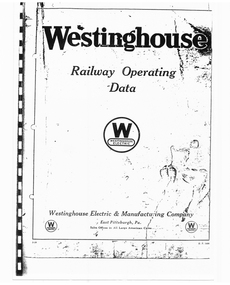
Document - Instruction Book, Westinghouse Brake Company of Australasia Limited and The Westinghouse Brake & Saxby Signal Co. Ltd. of 82 York Road and Kings Cross London, "Westinghouse Railway Operating Data", 2000
... Care and repair of commutators 1 Undercutting commutators 2 Railway Motor carbon brushes 3 Brush holders 4 Flashing of railway motors 5 Soldering railway armatures 6 Armature Winding 7 Banding armatures 8 Railway Motor Bearings 9 Lubrication of railway motor bearings 10 How to babbitt motor bearings 11 Oil, grease and waster for motors and gears 12 Saturation of motor bearing waste 13 Testing Polarity of Field Coils 14 Charging of storage batteries on Interurban & street rail cars 15 Precautions to be taken with blower installations on motor cars 16 Putting on Railway Motor Pinions 17 How to take armatures out of box frame motors 18 Dipping and Baking of Railway Motors 19 War time dipping and baking outfits 20 Dipping and baking railway motors will decrease troubles 21 Protection of Motor Bearings from Dust 25 Winter Operation of Railway Motor equipments 26 Installation of Air piping to prevent freezing 27 Maintenance of Traction Brake Equipment 28 Maintenance of controller fingers and contacts 29 Hand operated circuit breakers 30 Railway Motor Testing I 31 Railway Motor Testing II 33 Railway Motor Testing III 35 Railway Motor Testing IV 36 Railway Motor Testing V 37 Removing and replacing railway motor armature shaft 39 Mounting and Maintenance of car resistors 40 Lubrication of control apparatus 41 Maintenance of fuse boxes for railway service 42 Does it pay to dip and bake armatures 43 Dipping and Baking as a financial asset 44 Shop Organisation 45 Tinning Malleable Iron Bearing shells 46 Life of armature bearings or railway motors 47 The assembly of complete sets of commutator segments 48 Electric welding as a factor in reclamation 50 Metal to Metal press, shrink and clamping fit allowances 52 Life of railway motor carbon brushes 54 General information of grid resistance design for the operating man 56 Stopping a car by braking with the motors 57 Railway Motor shafts and their maintenance 58 Axle collars 59 Gear cases 60 Ventilated railway motors 62 Revamping Loose armature bearings 64 Life of axle bearings of railway motors 65 Heat-treated bolts for railway service 66 Document imaged over 7 parts 7-9-2016 - see hi res files. ...Care and repair of commutators 1 Undercutting commutators 2 Railway Motor carbon brushes 3 Brush holders 4 Flashing of railway motors 5 Soldering railway armatures 6 Armature Winding 7 Banding armatures 8 Railway Motor Bearings 9 Lubrication of railway motor bearings 10 How to babbitt motor bearings 11 Oil, grease and waster for motors and gears 12 Saturation of motor bearing waste 13 Testing Polarity of Field Coils 14 Charging of storage batteries on Interurban & street rail cars 15 Precautions to be taken with blower installations on motor cars 16 Putting on Railway Motor Pinions 17 How to take armatures out of box frame motors 18 Dipping and Baking of Railway Motors 19 War time dipping and baking outfits 20 Dipping and baking railway motors will decrease troubles 21 Protection of Motor Bearings from Dust 25 Winter Operation of Railway Motor equipments 26 Installation of Air piping to prevent freezing 27 Maintenance of Traction Brake Equipment 28 Maintenance of controller fingers and contacts 29 Hand operated circuit breakers 30 Railway Motor Testing I 31 Railway Motor Testing II 33 Railway Motor Testing III 35 Railway Motor Testing IV 36 Railway Motor Testing V 37 Removing and replacing railway motor armature shaft 39 Mounting and Maintenance of car resistors 40 Lubrication of control apparatus 41 Maintenance of fuse boxes for railway service 42 Does it pay to dip and bake armatures 43 Dipping and Baking as a financial asset 44 Shop Organisation 45 Tinning Malleable Iron Bearing shells 46 Life of armature bearings or railway motors 47 The assembly of complete sets of commutator segments 48 Electric welding as a factor in reclamation 50 Metal to Metal press, shrink and clamping fit allowances 52 Life of railway motor carbon brushes 54 General information of grid resistance design for the operating man 56 Stopping a car by braking with the motors 57 Railway Motor shafts and their maintenance 58 Axle collars 59 Gear cases 60 Ventilated railway motors 62 Revamping Loose armature bearings 64 Life of axle bearings of railway motors 65 Heat-treated bolts for railway service 66 Document imaged over 7 parts 7-9-2016 - see hi res files. ...Photocopy of 54 data sheets published by Westinghouse Electric & Manufacturing Company of East Pittsburgh Pa, USA c1920. Consists of plastic cover, header page with Westinghouse logo, contents sheets (2 pages), forward, 67 pages (single side photocopy) and heavy rear card cover bound with a green comb binder. Original material lent by Craig Tooke of the Melbourne Tramcar Preservation Association at Haddon. Photocopied by Warren Doubleday March 2000. List of contents produced 30/6/2000 and then bound. Contains data sheets regarding motors, commutators, brushes, armatures, bearings, field coils, pinions, lubrication, air piping, axle collars, resistance grids, gear cases and other technical information. Westinghouse Railway Operating Data 30/6/2000 List of Contents Page No. Care and repair of commutators 1 Undercutting commutators 2 Railway Motor carbon brushes 3 Brush holders 4 Flashing of railway motors 5 Soldering railway armatures 6 Armature Winding 7 Banding armatures 8 Railway Motor Bearings 9 Lubrication of railway motor bearings 10 How to babbitt motor bearings 11 Oil, grease and waster for motors and gears 12 Saturation of motor bearing waste 13 Testing Polarity of Field Coils 14 Charging of storage batteries on Interurban & street rail cars 15 Precautions to be taken with blower installations on motor cars 16 Putting on Railway Motor Pinions 17 How to take armatures out of box frame motors 18 Dipping and Baking of Railway Motors 19 War time dipping and baking outfits 20 Dipping and baking railway motors will decrease troubles 21 Protection of Motor Bearings from Dust 25 Winter Operation of Railway Motor equipments 26 Installation of Air piping to prevent freezing 27 Maintenance of Traction Brake Equipment 28 Maintenance of controller fingers and contacts 29 Hand operated circuit breakers 30 Railway Motor Testing I 31 Railway Motor Testing II 33 Railway Motor Testing III 35 Railway Motor Testing IV 36 Railway Motor Testing V 37 Removing and replacing railway motor armature shaft 39 Mounting and Maintenance of car resistors 40 Lubrication of control apparatus 41 Maintenance of fuse boxes for railway service 42 Does it pay to dip and bake armatures 43 Dipping and Baking as a financial asset 44 Shop Organisation 45 Tinning Malleable Iron Bearing shells 46 Life of armature bearings or railway motors 47 The assembly of complete sets of commutator segments 48 Electric welding as a factor in reclamation 50 Metal to Metal press, shrink and clamping fit allowances 52 Life of railway motor carbon brushes 54 General information of grid resistance design for the operating man 56 Stopping a car by braking with the motors 57 Railway Motor shafts and their maintenance 58 Axle collars 59 Gear cases 60 Ventilated railway motors 62 Revamping Loose armature bearings 64 Life of axle bearings of railway motors 65 Heat-treated bolts for railway service 66 Document imaged over 7 parts 7-9-2016 - see hi res files. trams, tramways, westinghouse, motors, data sheets, technical information -
 Brighton Historical Society
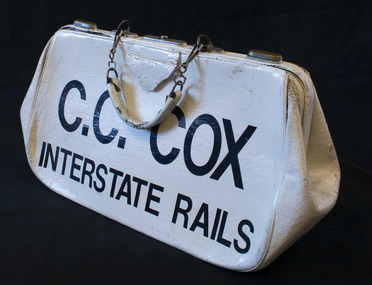
Bag, Bookmaker's bag, circa 1960s-1990s
... After serving in the Air Force during the Second World War, Charlie entered the business during the 1940s, initially fielding at greyhound, trots and gallop meetings. ...After serving in the Air Force during the Second World War, Charlie entered the business during the 1940s, initially fielding at greyhound, trots and gallop meetings. ...Bags such as this one were used by bookmakers to collect and securely hold punters' bets at racing events. This bag belonged to Charlie Cox, a second-generation Australian bookmaker. His father, George Gordon Cox, ran bookmaking operations primarily during the 1920s and 1930s. After serving in the Air Force during the Second World War, Charlie entered the business during the 1940s, initially fielding at greyhound, trots and gallop meetings. In the early 1960s he moved to Melbourne, where he got his first big financial break when he was offered an interstate license to operate on the rails at all city tracks. He was a leading Melbourne bookmaker on the interstate rails racing circuit from the 1960s to the 1990s, from which period this bag originated.White painted leather bag with metal fastening mechanism. A short painted leather handle is joined to the bag by metal fastening clips.Painted on one side of the bag in black letters: "C.C. COX / INTERSTATE RAILS".bookmakers, horse racing, charlie cox, c. c. cox, interstate rails -
 Brighton Historical Society
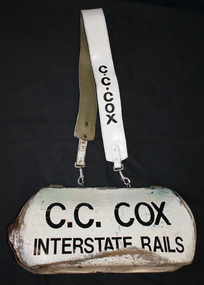
Bag, Bookmaker's bag, circa 1960s-1990s
... After serving in the Air Force during the Second World War, Charlie entered the business during the 1940s, initially fielding at greyhound, trots and gallop meetings. ...After serving in the Air Force during the Second World War, Charlie entered the business during the 1940s, initially fielding at greyhound, trots and gallop meetings. ...Bags such as this one were used by bookmakers to collect and securely hold punters' bets at racing events. This bag belonged to Charlie Cox, a second-generation Australian bookmaker. His father, George Gordon Cox, ran bookmaking operations primarily during the 1920s and 1930s. After serving in the Air Force during the Second World War, Charlie entered the business during the 1940s, initially fielding at greyhound, trots and gallop meetings. In the early 1960s he moved to Melbourne, where he got his first big financial break when he was offered an interstate license to operate on the rails at all city tracks. He was a leading Melbourne bookmaker on the interstate rails racing circuit from the 1960s to the 1990s, from which period this bag originated.White painted leather bag with metal fastening mechanism. A short painted leather handle is joined to the bag by metal fastening clips. A long painted leather strap is joined to the bag by metal fastening clips.Painted on one side of the bag in black letters: "C.C. COX / INTERSTATE RAILS". "C.C. COX" is also painted in black at either end of the shoulder strap.bookmakers, horse racing, charlie cox, c. c. cox, interstate rails -
 Lake Boga Flying Boat Museum
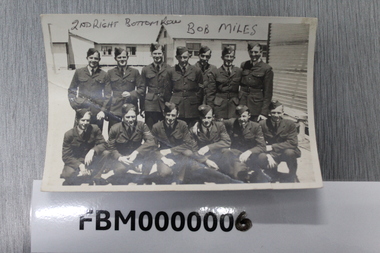
Photograph
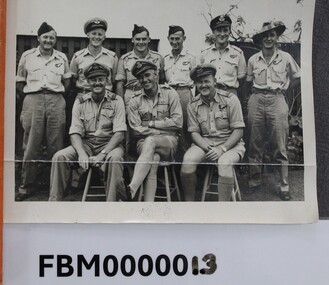
... Air Gunner in 1942. He was in 11 Squadron and 20 Squadron. Both Squadrons flew Catalinas on special missions dropping sea mines into enemy controlled harbors. These Catalinas were painted black for night missions and were known as the Black Cats. The Black Cat Catalina flying boats were serviced at the No 1 Flying Boat Repair Depot, Lake Boga, during World War...Air Gunner in 1942. He was in 11 Squadron and 20 Squadron. Both Squadrons flew Catalinas on special missions dropping sea mines into enemy controlled harbors. These Catalinas were painted black for night missions and were known as the Black Cats. The Black Cat Catalina flying boats were serviced at the No 1 Flying Boat Repair Depot, Lake Boga, during World War ...Bob Miles enlisted in the Royal Australian Air Force in May 1940. He trained as Fitter in 1941, then as an Air Gunner in 1942. He was in 11 Squadron and 20 Squadron. Both Squadrons flew Catalinas on special missions dropping sea mines into enemy controlled harbors. These Catalinas were painted black for night missions and were known as the Black Cats. The Black Cat Catalina flying boats were serviced at the No 1 Flying Boat Repair Depot, Lake Boga, during World War II.Corporal Bob Miles' logbook shows he was at the No 1 Flying Boat Repair Depot, Lake Boga, on February 1st - 2nd 1945 for air testing. He was in Catalina A24-304.Black and white photograph of 13 enlisted men. 2 rows of men, 7 men standing in the back row, 6 men squatting in the front row. Corrugated iron buildings in the background. Front of Photo -2ND RIGHT BOTTOM ROW BOB MILES Back of Photo - Bob Miles/2nd Right Bottom Row. 14 signatures. /HUT 73/No 2 B.A.G.S./PORT PIRIE/13-10-1941(8HRS DAY /MARCH)bob miles, catalina, wwii, lake boga, flying boat depot, black cats -
 Lake Boga Flying Boat Museum
Booklet - Royal Australian Air Force Member's Pay Book - Robert George Miles
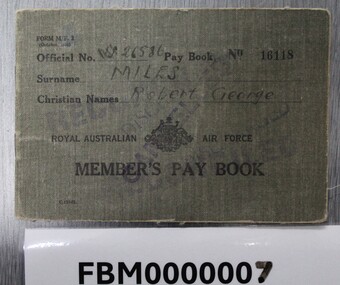
... Air Gunner in 1942. He was in 11 Squadron and 20 Squadron. Both Squadrons flew Catalinas on special missions dropping sea mines into enemy controlled harbors. These Catalinas were painted black for night missions and were known as the Black Cats. The Black Cat Catalina flying boats were serviced at the No 1 Flying Boat Repair Depot, Lake Boga, during World War...Air Gunner in 1942. He was in 11 Squadron and 20 Squadron. Both Squadrons flew Catalinas on special missions dropping sea mines into enemy controlled harbors. These Catalinas were painted black for night missions and were known as the Black Cats. The Black Cat Catalina flying boats were serviced at the No 1 Flying Boat Repair Depot, Lake Boga, during World War ...Bob Miles enlisted in the Royal Australian Air Force in May 1940. He trained as a Fitter in 1941, then as an Air Gunner in 1942. He was in 11 Squadron and 20 Squadron. Both Squadrons flew Catalinas on special missions dropping sea mines into enemy controlled harbors. These Catalinas were painted black for night missions and were known as the Black Cats. The Black Cat Catalina flying boats were serviced at the No 1 Flying Boat Repair Depot, Lake Boga, during World War II.Corporal Bob Miles' logbook shows he was at the No 1 Flying Boat Repair Depot, Lake Boga, on February 1st - 2nd 1945 for air testing. He was in Catalina A24-304.Khaki green buckram covered RAAF Member's pay bookOfficial No. 26586 Pay Book No. 16118/Surname MILES/Christian Names Robert George/ROYAL AUSTRLAIAIN AIR FORCE/MEMBER'S PAY BOOKbob miles, wwii, catalina, black cats, no 1 flying boat repair depot -
 Lake Boga Flying Boat Museum
Card - Passing Out Dinner Menu
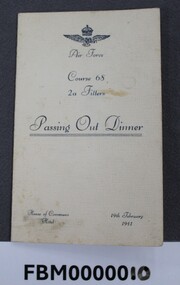
... Air Gunner in 1942. He was in 11 Squadron and 20 Squadron. Both Squadrons flew Catalinas on special missions dropping sea mines into enemy controlled harbors. These Catalinas were painted black for night missions and were known as the Black Cats. The Black Cat Catalina flying boats were serviced at the No 1 Flying Boat Repair Depot, Lake Boga, during World War...Air Gunner in 1942. He was in 11 Squadron and 20 Squadron. Both Squadrons flew Catalinas on special missions dropping sea mines into enemy controlled harbors. These Catalinas were painted black for night missions and were known as the Black Cats. The Black Cat Catalina flying boats were serviced at the No 1 Flying Boat Repair Depot, Lake Boga, during World War ...Bob Miles enlisted in the Royal Australian Air Force in May 1940. He trained as a Fitter in 1941, then as an Air Gunner in 1942. He was in 11 Squadron and 20 Squadron. Both Squadrons flew Catalinas on special missions dropping sea mines into enemy controlled harbors. These Catalinas were painted black for night missions and were known as the Black Cats. The Black Cat Catalina flying boats were serviced at the No 1 Flying Boat Repair Depot, Lake Boga, during World War II.Corporal Bob Miles' logbook shows he was at the No 1 Flying Boat Repair Depot, Lake Boga, on February 1st - 2nd 1945 for air testing. He was in Catalina A24-304.Rectangular cream card, Navy writingFront cover: Air Force/ Course 68/ 2a Fitters/Passing Out Dinner/House of Commons Hotel/19th February 1941 Inside: Menu Rear cover: Autographs (of course participants including Bob Miles')wwii, bob miles, catalina, black cats, no 1 flying boat repair depot -
 Lake Boga Flying Boat Museum
Book - Royal Australian Air Force Member's Log Book - Robert George Miles, OBSERVER'S AIR GUNNER'S AND W/T OPERATOR'S FLYING LOG BOOK
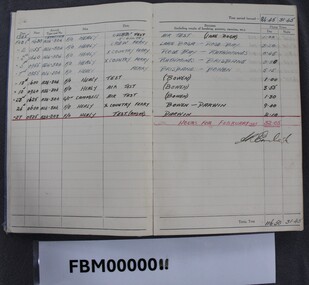
... Air Gunner in 1942. He was in 11 Squadron and 20 Squadron. Both Squadrons flew Catalinas on special missions dropping sea mines into enemy controlled harbors. These Catalinas were painted black for night missions and were known as the Black Cats. The Black Cat Catalina flying boats were serviced at the No 1 Flying Boat Repair Depot, Lake Boga, during World War...Air Gunner in 1942. He was in 11 Squadron and 20 Squadron. Both Squadrons flew Catalinas on special missions dropping sea mines into enemy controlled harbors. These Catalinas were painted black for night missions and were known as the Black Cats. The Black Cat Catalina flying boats were serviced at the No 1 Flying Boat Repair Depot, Lake Boga, during World War ...Bob Miles enlisted in the Royal Australian Air Force in May 1940. He trained as a Fitter in 1941, then as an Air Gunner in 1942. He was in 11 Squadron and 20 Squadron. Both Squadrons flew Catalinas on special missions dropping sea mines into enemy controlled harbors. These Catalinas were painted black for night missions and were known as the Black Cats. The Black Cat Catalina flying boats were serviced at the No 1 Flying Boat Repair Depot, Lake Boga, during World War II.Corporal Bob Miles' logbook shows he was at the No 1 Flying Boat Repair Depot, Lake Boga, on February 1st - 2nd 1945 for air testing. He was in Catalina A24-304.blue cloth covered book, black writing on cover, flight entries handwritten insideFORM A.73/(June, 1933)/ROYAL AUSTRALIAN AIR FORCE/OBSERVER'S AIR GUNNER'S AND W/T OPERATO'S FLYING LOG BOOK Name 26586 MILES RGcatalina, black cats, bob miles, wwii, flying boat repair depot, lake boga, log book -
 Lake Boga Flying Boat Museum
Photograph
... Air Gunner in 1942. He was in 11 Squadron and 20 Squadron. Both Squadrons flew Catalinas on special missions dropping sea mines into enemy controlled harbors. These Catalinas were painted black for night missions and were known as the Black Cats. The Black Cat Catalina flying boats were serviced at the No 1 Flying Boat Repair Depot, Lake Boga, during World War...Air Gunner in 1942. He was in 11 Squadron and 20 Squadron. Both Squadrons flew Catalinas on special missions dropping sea mines into enemy controlled harbors. These Catalinas were painted black for night missions and were known as the Black Cats. The Black Cat Catalina flying boats were serviced at the No 1 Flying Boat Repair Depot, Lake Boga, during World War ...Bob Miles enlisted in the Royal Australian Air Force in May 1940. He trained as a Fitter in 1941, then as an Air Gunner in 1942. He was in 11 Squadron and 20 Squadron. Both Squadrons flew Catalinas on special missions dropping sea mines into enemy controlled harbors. These Catalinas were painted black for night missions and were known as the Black Cats. The Black Cat Catalina flying boats were serviced at the No 1 Flying Boat Repair Depot, Lake Boga, during World War II.Corporal Bob Miles' logbook shows he was at the No 1 Flying Boat Repair Depot, Lake Boga, on February 1st - 2nd 1945 for air testing. He was in Catalina A24-304.Black and white photograph of 6 servicemen standing, 3 seatedBack of photo: Caterlina No.20 Squadron Taken Islands/Bob Miles - 1st Row Left sidebob miles, wwii, catalina, black cats, no 1 flying boat repair depot -
 Lake Boga Flying Boat Museum
Photograph
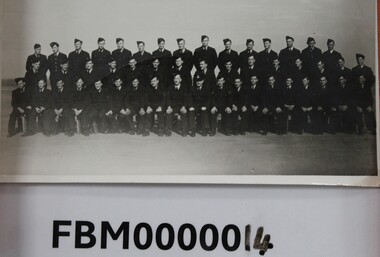
... Air Gunner in 1942. He was in 11 Squadron and 20 Squadron. Both Squadrons flew Catalinas on special missions dropping sea mines into enemy controlled harbors. These Catalinas were painted black for night missions and were known as the Black Cats. The Black Cat Catalina flying boats were serviced at the No 1 Flying Boat Repair Depot, Lake Boga, during World War...Air Gunner in 1942. He was in 11 Squadron and 20 Squadron. Both Squadrons flew Catalinas on special missions dropping sea mines into enemy controlled harbors. These Catalinas were painted black for night missions and were known as the Black Cats. The Black Cat Catalina flying boats were serviced at the No 1 Flying Boat Repair Depot, Lake Boga, during World War ...Bob Miles enlisted in the Royal Australian Air Force in May 1940. He trained as a Fitter in 1941, then as an Air Gunner in 1942. He was in 11 Squadron and 20 Squadron. Both Squadrons flew Catalinas on special missions dropping sea mines into enemy controlled harbors. These Catalinas were painted black for night missions and were known as the Black Cats. The Black Cat Catalina flying boats were serviced at the No 1 Flying Boat Repair Depot, Lake Boga, during World War II.Corporal Bob Miles' logbook shows he was at the No 1 Flying Boat Repair Depot, Lake Boga, on February 1st - 2nd 1945 for air testing. He was in Catalina A24-304.Black and white photo of 49 servicemen, in three rowsRear of photo: 2 B.A.G.S./June 1942/B SECTION MAINTENANCE RGMiles/(PART)bob miles, wwii, catalina, black cats, no 1 flying boat repair depot -
 Lake Boga Flying Boat Museum
Photograph
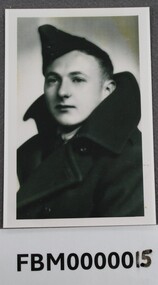
... Air Gunner in 1942. He was in 11 Squadron and 20 Squadron. Both Squadrons flew Catalinas on special missions dropping sea mines into enemy controlled harbors. These Catalinas were painted black for night missions and were known as the Black Cats. The Black Cat Catalina flying boats were serviced at the No 1 Flying Boat Repair Depot, Lake Boga, during World War...Air Gunner in 1942. He was in 11 Squadron and 20 Squadron. Both Squadrons flew Catalinas on special missions dropping sea mines into enemy controlled harbors. These Catalinas were painted black for night missions and were known as the Black Cats. The Black Cat Catalina flying boats were serviced at the No 1 Flying Boat Repair Depot, Lake Boga, during World War ...Bob Miles enlisted in the Royal Australian Air Force in May 1940. He trained as a Fitter in 1941, then as an Air Gunner in 1942. He was in 11 Squadron and 20 Squadron. Both Squadrons flew Catalinas on special missions dropping sea mines into enemy controlled harbors. These Catalinas were painted black for night missions and were known as the Black Cats. The Black Cat Catalina flying boats were serviced at the No 1 Flying Boat Repair Depot, Lake Boga, during World War II.Corporal Bob Miles' logbook shows he was at the No 1 Flying Boat Repair Depot, Lake Boga, on February 1st - 2nd 1945 for air testing. He was in Catalina A24-304.A recent photo taken of a black and white photograph with Bob Miles in uniform coat and hatbob miles, wwii, catalina, black cats, no 1 flying boat repair depot -
 Lake Boga Flying Boat Museum
Badge - Pin
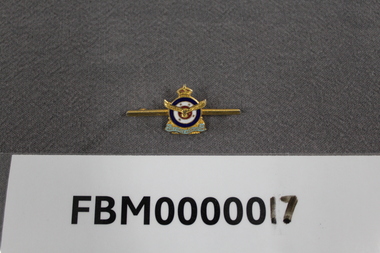
... Air Gunner in 1942. He was in 11 Squadron and 20 Squadron. Both Squadrons flew Catalinas on special missions dropping sea mines into enemy controlled harbors. These Catalinas were painted black for night missions and were known as the Black Cats. The Black Cat Catalina flying boats were serviced at the No 1 Flying Boat Repair Depot, Lake Boga, during World War...Air Gunner in 1942. He was in 11 Squadron and 20 Squadron. Both Squadrons flew Catalinas on special missions dropping sea mines into enemy controlled harbors. These Catalinas were painted black for night missions and were known as the Black Cats. The Black Cat Catalina flying boats were serviced at the No 1 Flying Boat Repair Depot, Lake Boga, during World War ...Bob Miles enlisted in the Royal Australian Air Force in May 1940. He trained as a Fitter in 1941, then as an Air Gunner in 1942. He was in 11 Squadron and 20 Squadron. Both Squadrons flew Catalinas on special missions dropping sea mines into enemy controlled harbors. These Catalinas were painted black for night missions and were known as the Black Cats. The Black Cat Catalina flying boats were serviced at the No 1 Flying Boat Repair Depot, Lake Boga, during World War II.This Airforce Association badge belonged to Robert George (Bob) Milesgold lapel pin, blue, white and red enamel shield, gold eagle and crown, light blue scroll with textAirforce Associationwwii, badge, airforce, bob miles -
 Lake Boga Flying Boat Museum
Badge - Pin
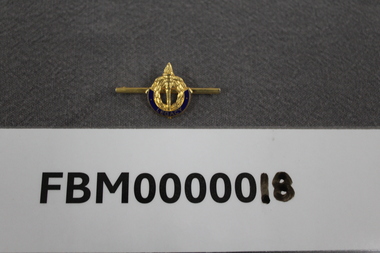
... Air Gunner in 1942. He was in 11 Squadron and 20 Squadron. Both Squadrons flew Catalinas on special missions dropping sea mines into enemy controlled harbors. These Catalinas were painted black for night missions and were known as the Black Cats. The Black Cat Catalina flying boats were serviced at the No 1 Flying Boat Repair Depot, Lake Boga, during World War...Air Gunner in 1942. He was in 11 Squadron and 20 Squadron. Both Squadrons flew Catalinas on special missions dropping sea mines into enemy controlled harbors. These Catalinas were painted black for night missions and were known as the Black Cats. The Black Cat Catalina flying boats were serviced at the No 1 Flying Boat Repair Depot, Lake Boga, during World War ...Bob Miles enlisted in the Royal Australian Air Force in May 1940. He trained as a Fitter in 1941, then as an Air Gunner in 1942. He was in 11 Squadron and 20 Squadron. Both Squadrons flew Catalinas on special missions dropping sea mines into enemy controlled harbors. These Catalinas were painted black for night missions and were known as the Black Cats. The Black Cat Catalina flying boats were serviced at the No 1 Flying Boat Repair Depot, Lake Boga, during World War II. Bob married Lois Baird WAAAF in 1947. When Bob passed in 1969 Lois was awarded a War Widows Pension and received the Legacy Badge.Lois Baird served in WWII in the WAAAF. Her husband Robert George (Bob) Miles served in the RAAF, a member of 20 Squadron, flying the Catalinas.Gold lapel pin, round emblem with gold torch and wreath, blue scroll with textLegacywwii, catalina, legacy, lois miles, bob miles -
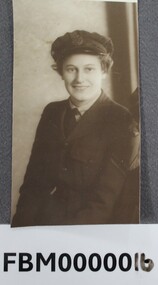 Lake Boga Flying Boat Museum
Photograph
... Air Gunner in 1942. He was in 11 Squadron and 20 Squadron. Both Squadrons flew Catalinas on special missions dropping sea mines into enemy controlled harbors. These Catalinas were painted black for night missions and were known as the Black Cats. The Black Cat Catalina flying boats were serviced at the No 1 Flying Boat Repair Depot, Lake Boga, during World War...Air Gunner in 1942. He was in 11 Squadron and 20 Squadron. Both Squadrons flew Catalinas on special missions dropping sea mines into enemy controlled harbors. These Catalinas were painted black for night missions and were known as the Black Cats. The Black Cat Catalina flying boats were serviced at the No 1 Flying Boat Repair Depot, Lake Boga, during World War ...Bob Miles enlisted in the Royal Australian Air Force in May 1940. He trained as a Fitter in 1941, then as an Air Gunner in 1942. He was in 11 Squadron and 20 Squadron. Both Squadrons flew Catalinas on special missions dropping sea mines into enemy controlled harbors. These Catalinas were painted black for night missions and were known as the Black Cats. The Black Cat Catalina flying boats were serviced at the No 1 Flying Boat Repair Depot, Lake Boga, during World War II.Sergeant Lois Baird WAAAF married Bob Miles, Catalina Squadron member.sepia photograph of Lois Baird in WAAAF uniformon back of photograph: Sergeant - W.A.A.A.F./Lois Baird/Brisbane 1942/(Married Robert/George Miles/1947/(Malvern Meth. Church)catalina, waaaf, wwii, bob miles -
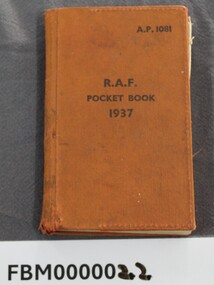 Lake Boga Flying Boat Museum
Book - R.A.F. Pocket Book
... Kevin O'Doherty was an Armourer/Air Gunner on Catalina flying boats, while he was flying in 11 and 43 Squadrons. Catalina flying boats were serviced at the No 1 Flying Boat Repair Depot, Lake Boga, during World War II. ...Book belonging to Sgt Kevin O'Doherty, while he was in 11 Squadron. Kevin O’Doherty was a Catalina crew member in 11 and 43 Squadrons. He flew operations in 1943 and 1944 with these squadrons as an Armourer/Air Gunner. With 43 Squadron he flew 9 operational sorties, which entailed 100 hours at night and 64 hours during the day. Details from his logbook show flights included bombing strikes, practice torpedo drops, a special mission in co-operation with the army, torpedo and mine drops in the South West Pacific Arena. Kevin O'Doherty was an Armourer/Air Gunner on Catalina flying boats, while he was flying in 11 and 43 Squadrons. Catalina flying boats were serviced at the No 1 Flying Boat Repair Depot, Lake Boga, during World War II.brown bound book, black writing on cover, black print inside on white pagesCover: A.P.1081/R.A.F./POCKET BOOK/1937 Inside cover on front page: Signature: Sgt Kevin O'Doherty/11 Sqdnwwii, catalina, kevin o'doherty, no 1 flying boat repair depot, raaf -
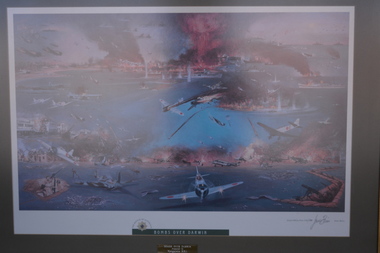 Wangaratta RSL Sub Branch
Print - Framed Print, Bombs over Darwin, 1991
... War II. Darwin was lightly defended, relative to the size of the attack, and the Japanese inflicted heavy losses upon Allied forces at little cost to themselves. The two Japanese air...War II. Darwin was lightly defended, relative to the size of the attack, and the Japanese inflicted heavy losses upon Allied forces at little cost to themselves. The two Japanese air ...On the 19 February 1942, 242 Japanese aircraft, in two separate raids, attacked the town of Darwin, ships in the harbour and the town's two airfields in an attempt to prevent the Allies from using them as bases to contest the invasion of Timor and Java during World War II. Darwin was lightly defended, relative to the size of the attack, and the Japanese inflicted heavy losses upon Allied forces at little cost to themselves. The two Japanese air raids were the first, and largest, of more than 100 air raids against Australia during 1942–43.The Bombing of Darwin, also known as the Battle of Darwin, on 19 February 1942 was the largest single attack ever mounted by a foreign power on Australia. The urban areas of Darwin also suffered damage from the raids and there were a number of civilian casualties. As a result more than half of Darwin's civilian population left the area permanently, before or immediately after the attack. Timber framed containing coloured print of planes depicting the bombing of Darwin Harbour. Gold metal plaque - BOMBS OVER DARWIN Presented to Wangaratta RSL Limited Edition Print 234/1800 by James Baineswwii, bombing of darwin, battle of darwin -
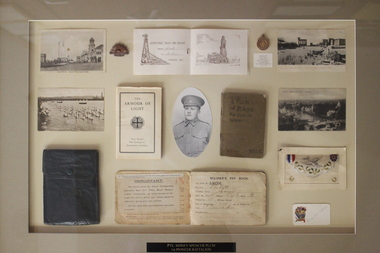 Wangaratta RSL Sub Branch
Mixed media - Framed photograph and objects, Pte Sidney Spencer Plum
... air services" book, Soldier's Pay Book, a "To my dear Mother" card, a black leather pouch, a rising sun badge, round gold medallion. A framed montage of personal items belonging to Private Sydney Spencer PLUM compiled by his family to honour his memory and service. In addition to general military issue the remaining items were most likely purchased whilst on leave in France and England during the first world war ...Collection of personal effects that belonged to Private SIdney Spencer Plum, 3431 1st Pioneer Battalion. SIdney was born on 3/1/1894 at Dockers Plains via Wangaratta. He attended both North Wangaratta and Dockers Plains schools. He was a Blacksmith aged 21 years when he enlisted on 12/6/1915 and embarked on 11/10/1915 on board HMAT Nestor. He was wounded three times and was discharged from the AIF on 16/3/1919. Items include oval photo of Sidney Plum in the centre surrounded by four post cards, one embroidered post card of a dove with an envelope in it's beak with the Union Jack and French flag, a Greetings From The Front" booklet, "The Armour of Light" bible, "A Form of Prayer for open air services" book, Soldier's Pay Book, a "To my dear Mother" card, a black leather pouch, a rising sun badge, round gold medallion. A framed montage of personal items belonging to Private Sydney Spencer PLUM compiled by his family to honour his memory and service. In addition to general military issue the remaining items were most likely purchased whilst on leave in France and England during the first world war. Postcards particularly embroidered postcards were sent home to loved ones and friends.Framed Collection of personal effects - Private Sidney Spencer Plum, 1st Pioneer Battalion. Includes oval photo of Sidney Plum in the centre surrounded by four post cards, one embroidered post card of a dove with an envelope in it's beak with the Union Jack and French flag, a Greetings From The Front" booklet, "The Armour of Light" bible, "A Form of Prayer for open air services" book, Soldier's Pay Book, a "To my dear Mother" card, a black leather pouch, a risen sun badge, round gold coloured medalion. Frame has a donation plaque.Front: Pte Sidney Spencer Plum, 1st Pioneer Battalion. Donated by Max & Hilary (Plum) Ryan and Sylvia Reed (Plum) of Wangarattaa Back: Wangaratta Picture Framers 9 Oct 2003. Also has messages from front postcards; Dear Mother, Just a few lines to let you know that I am alright hoping that you and all the rest is well too. We have had three fogs over here and it is very cold at night. I was picked in Cairo and they had some Turkey Officers an a German spy in gaol there. I wrote to Aunt Nelline. I got two letters from Alf. Maude Saxby hasnt wrote to me since I was up there on final leave. I get the letters quicker. I got Alf photos all right. I will be having Christmas in London. Well I think this is all this. I remain you son Sid. Tell Alf to send me over the Age so I can see how the war is going. I suppose Dad and the rest is busy harvesting now. Glad to hear that you got the photos all right. I think this is all this time from Sid same address as before. Dear Mother, Just a few lines to let you know that I am keeping well hoping that you and every body is the same. We have some great fogs over here, it rained all one night. We had a very good Christmas we got a billy issued to us and it had every thing in it. The Captain of our company gave me a Christmas pudding. All the same I wished I were back in Australia again. I think this is all this time. Yours truely son Sid, 25/12/15plum, sidney, world war 1, postcards, embroidered postcard, soldier's pay book, leather pouch, bible, prayer book, sydney -
 Wangaratta RSL Sub Branch
Photograph - Framed photograph, N.E. Framing Studio, Aircrew Training
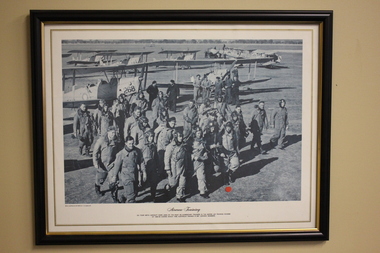
... air training scheme of 1940-44 during which time Australia trained 27,387 aircrew members. Although primarily employed as trainers, a few Tiger Moths were camouflaged and used operationally with army co-operation units in New Guinea. The Tiger Moth remained in RAAF service for almost 17 years, and several Tiger Moths were also transferred to the RAN after World War...war 2 tiger moth Front: Aircrew Training. DH Tiger Moth Aircraft were used by the RAAF as elementary trainers in the empire air training scheme of 1940-44 during which time Australia trained 27,387 aircrew members. ...DH Tiger Moth Aircraft were used by the RAAF as elementary trainers in the empire air training scheme of 1940-44 during which time Australia trained 27,387 aircrew members. Although primarily employed as trainers, a few Tiger Moths were camouflaged and used operationally with army co-operation units in New Guinea. The Tiger Moth remained in RAAF service for almost 17 years, and several Tiger Moths were also transferred to the RAN after World War II. Eventually, on 9 January 1957, the last 10 RAAF Tiger Moths were flown from Point Cook to Tocumwal for disposal.The de Havilland Tiger Moth aircraft is a 1930's biplane which was a primary trainer aircraft used to train over 27,000 aircrew in Australia during the Second World War.Black frame with gold insert and cream mounting containing black and white photo of several planes in the background and numerous aircrew members in the foreground. Front: Aircrew Training. DH Tiger Moth Aircraft were used by the RAAF as elementary trainers in the empire air training scheme of 1940-44 during which time Australia trained 27,387 aircrew members. Royal Australian Air Force No.11 in a series of 25. raaf, aircrew, training, world war 2, tiger moth -
 Wangaratta RSL Sub Branch
Print - Framed Print, Darwin Harbour
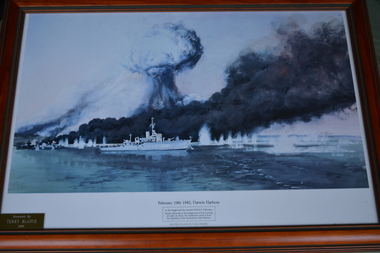
... air raid on Australia's mainland, at Darwin on 19 February 1942. In the foreground is HMAS Deloraine which survived unscathed. On that day, 236 people were killed when 242 Japanese aircraft, in two separate raids, attacked the town, ships in Darwin's harbour and the town's two airfields in an attempt to prevent the Allies from using them as bases to contest the invasion of Timor and Java during World War II. ...air raid on Australia's mainland, at Darwin on 19 February 1942. In the foreground is HMAS Deloraine which survived unscathed. On that day, 236 people were killed when 242 Japanese aircraft, in two separate raids, attacked the town, ships in Darwin's harbour and the town's two airfields in an attempt to prevent the Allies from using them as bases to contest the invasion of Timor and Java during World War II. ...Image depicting the explosion of a ship, filled with TNT and ammunition, hit during the first Japanese air raid on Australia's mainland, at Darwin on 19 February 1942. In the foreground is HMAS Deloraine which survived unscathed. On that day, 236 people were killed when 242 Japanese aircraft, in two separate raids, attacked the town, ships in Darwin's harbour and the town's two airfields in an attempt to prevent the Allies from using them as bases to contest the invasion of Timor and Java during World War II. MV Neptuna was a 5,952 ton cargo motor vessel. and was 1 of 11 sunk during the Japanese air raid on Darwin on 19 February 1942. In January 1942 HMAS Deloraine evaded an attack by the Japanese submarine I-124 north-west of Darwin and was jointly credited with the submarines' sinking after she inflicted the initial damage. The Bombing of Darwin, also known as the Battle of Darwin, on 19 February 1942 was the largest single attack ever mounted by a foreign power on Australia. Brown timber frame containing blue black and white print of ships being bombed.February 19th 1942, Darwin Harbour In the foreground the corvette HMAS Deloraine. Smoke billowing in the background is from burning oil tanks on shore, the mushroom cloud is from the explosionof the ammunition ship Neptuna. Watercolour by Tom Offordbombing of darwin, battle of darwin, 19 february 1942, ww2, mv neptuna, hmas deloraine -
 Wangaratta RSL Sub Branch
Print - Framed print
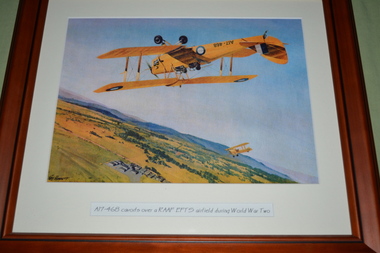
... During World War II, the RAAF established twelve Elementary Flying Training Schools (EFTS) to meet the rapid demand for pilots in an expanding Air Force....Due to a shortage of pilots, observers, wireless operators and gunners, the Dominions of the Commonwealth agreed to establish a co-ordinate scheme to train 28,000 air crew each year to help England fight the war in Europe. It was known as the Empire Air Training Scheme (EATS). ...During World War II, the RAAF established twelve Elementary Flying Training Schools (EFTS) to meet the rapid demand for pilots in an expanding Air Force.Due to a shortage of pilots, observers, wireless operators and gunners, the Dominions of the Commonwealth agreed to establish a co-ordinate scheme to train 28,000 air crew each year to help England fight the war in Europe. It was known as the Empire Air Training Scheme (EATS). The Dominions would supply the trained aircrew and the mother country would provide the aircraft. Brown timber frame with cream mount containing print of two planes flying over landA17-468 cavorts over a RAAF EFTS airfield during World War Twoa17-468, raaf, ww2 -
 Wangaratta RSL Sub Branch
Book, Clyde Press, Ex-Serviceman’s Annual
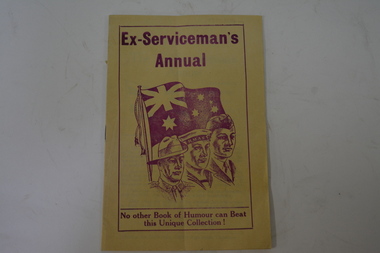
... war 2 On front cover: No other Book of Humour can Beat this Unique Collection! In front cover: Complied by P. Walsh, 1st A.I.F and A. Williams, Returned Sailor Small book of yellowing pages, with marron coloured lettering and picture of the Australian flag and three men, army, navy and air force. ...Small book of yellowing pages, with marron coloured lettering and picture of the Australian flag and three men, army, navy and air force. Book is titled Ex-Serviceman's Annual.On front cover: No other Book of Humour can Beat this Unique Collection! In front cover: Complied by P. Walsh, 1st A.I.F and A. Williams, Returned Sailorex-serviceman's annual, book of humour, wwii, world war 2 -
 Wangaratta RSL Sub Branch
Print - Framed print, Catalina Flying Boat
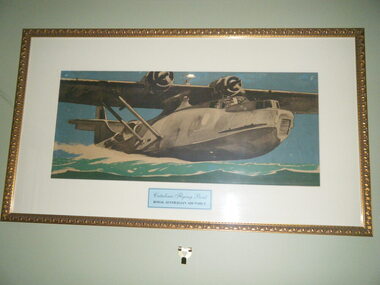
... Watercolour painting of Catalina Flying Boat - Attached to rear of frame is a short history of the Catalina Flying Boat together with the service history of Owen and and his younger brother Roy MORTIMER who both served in the Royal Australian Air Force in the South West Pacific area during WW2 Developed as a naval patrol aircraft, the Consolidated PBY Catalina was a widely exported flying boat during World War II. ...Watercolour painting of Catalina Flying Boat - Attached to rear of frame is a short history of the Catalina Flying Boat together with the service history of Owen and and his younger brother Roy MORTIMER who both served in the Royal Australian Air Force in the South West Pacific area during WW2 Developed as a naval patrol aircraft, the Consolidated PBY Catalina was a widely exported flying boat during World War II. Over the course of the conflict it served with a number of different nations in a variety of roles. In the Royal Australian Air Force, PBYs and PB2Bs (a variant built by Boeing in Canada) served as multi role bombers and scouts, the type eventually earning great renown among Australian aircrews. The motto of the Catalina squadrons was "The First and Furthest." Gold painted embossed metal frame with cream coloured mount containing watercolour painting of plane on waterCatalina Flying Boat Royal Australian Air Force catalina flying boat, raaf, mortimer, ww2 -
 Wangaratta RSL Sub Branch
Work on paper - Envelope Art
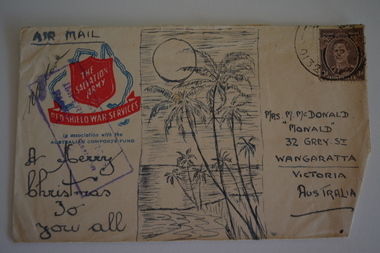
... Top left - AIR MAIL above The Salvation Army Red Shield War Services Top right - postage stamp Left side - AIF Censor stamp Bottom left - " A Merry Christmas to you all" Right side Mrs M McDonald "Monald" 32 Grey Street Wangaratta Victoria Australia ...Even though the Battation was disbanded in 1946 members and their families return each year, in November, for a commemorative service at the 2/24th Battalion Memorial Wall at the Wangaratta Cemetery. ww2 envelope art Top left - AIR MAIL above The Salvation Army Red Shield War Services Top right - postage stamp Left side - AIF Censor stamp Bottom left - " A Merry Christmas to you all" Right side Mrs M McDonald "Monald" 32 Grey Street Wangaratta Victoria Australia Cream paper envelope with sketch of full moon over water and palm trees - to the left of this outline in blue of map of Australia with red shield in centre Work on paper Envelope Art ...One of several illustrated envelopes, without letter, sketched by soldier/s during second world war and sent to Mrs McDonald of WangarattaVictoria's 2/24th Infantry Battalion was raised in Wangaratta in July 1940. They were welcomed with open arms by the local community as they rapidly built up their numbers. The people of Wangaratta adopted the Battalion and they became known as "Wangaratta's Own" because of the time the battalion spent in the town during its formative period prior to deployment overseas. Many of the soldiers maintained life long friendships with the people of Wangaratta. Even though the Battation was disbanded in 1946 members and their families return each year, in November, for a commemorative service at the 2/24th Battalion Memorial Wall at the Wangaratta Cemetery.Cream paper envelope with sketch of full moon over water and palm trees - to the left of this outline in blue of map of Australia with red shield in centreTop left - AIR MAIL above The Salvation Army Red Shield War Services Top right - postage stamp Left side - AIF Censor stamp Bottom left - " A Merry Christmas to you all" Right side Mrs M McDonald "Monald" 32 Grey Street Wangaratta Victoria Australia ww2, envelope art -
 Wangaratta RSL Sub Branch
Newspaper, Table Tops, 3/10/1944
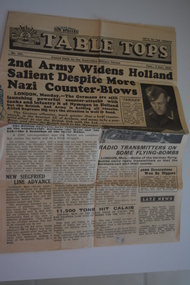
... It contained news on the progress of the war, as well as home news such as current events in Australia and sport results. table tops ww2 Table Tops - Free to the Troops Air Special No 501 Issued Daily by the Australian Military Forces Tues 3 Oct., 1944 Two page cream coloured newspaper with rising sun badge top left corner of heading Table Tops Newspaper Newspaper Australian Army Printing and Press Unit ...Table Tops was a free daily newspaper produced for Australian Army personnel, published in the Atherton Tableland Training Area in Queensland, Australia, with regional editions produced abroad for serving personnel. Table Tops was produced by the staff of the AIF News, who were part of the First Australian Army Printing and Press Unit.The newspaper was produced seven days a week: weekday and Saturday editions were four pages long while Sunday editions were eight pages. The pages were demy quarto size. Occasional special editions were produced in addition to the daily editions. It contained news on the progress of the war, as well as home news such as current events in Australia and sport results.Two page cream coloured newspaper with rising sun badge top left corner of heading Table Tops - Free to the Troops Air Special No 501 Issued Daily by the Australian Military Forces Tues 3 Oct., 1944table tops, ww2 -
 Wangaratta RSL Sub Branch
Audio - Oral history interview, Joyce Barry
... Joyce Barry served in the Women's Auxiliary Air Force during the Second World War. In her interview, Joyce shares what inspired her to join the services and what training was like for a young woman living in Victoria. ...Joyce Barry served in the Women's Auxiliary Air Force during the Second World War. In her interview, Joyce shares what inspired her to join the services and what training was like for a young woman living in Victoria. ...Joyce Barry served in the Women's Auxiliary Air Force during the Second World War. In her interview, Joyce shares what inspired her to join the services and what training was like for a young woman living in Victoria. Joyce was born on 1/5/1922 and passed away on the 26/10/2025 at the age of 103. She enlisted in the Women’s Auxiliary Australian Air Force at the age of 19 years and 11 months on April 8 1942 and was discharged on November 11 1946. Her service number was 95156 and performed duty as a Clerk Stores Assistant. Her husband Richard Barry served with the RAN during WW2 and her father John “Jack” Poulter 1296, born in Wangaratta served with the 8 Light Horse during WW1. He was wounded in action on 2/11/1917 receiving a gunshot wound to the thigh. He was discharged on 25/10/1919 and later became a policeman. Joyce passed away in October 2025 at the age of 103.This digital oral history interview was conducted at Wangaratta RSL Sub Branch on March 21, 2018 as part of the Veterans Heritage Project.joyce barry, waaf, ww2, oral history, wangaratta -
 Wangaratta RSL Sub Branch
Photograph, c1945
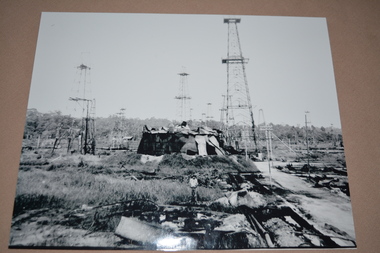
... War Tarakan Island was part of the Dutch East Indies and an important oil-producing centre. In early 1942 it was occupied by the Japanese. The primary objective for the Allied attack on Tarakan (code-named "Oboe One") was to secure and develop the island's airstrip so that it could be used to provide air cover for subsequent landings in Brunei, Labuan and Balikpapan. ...War Tarakan Island was part of the Dutch East Indies and an important oil-producing centre. In early 1942 it was occupied by the Japanese. The primary objective for the Allied attack on Tarakan (code-named "Oboe One") was to secure and develop the island's airstrip so that it could be used to provide air cover for subsequent landings in Brunei, Labuan and Balikpapan. ...Prior to the Second World War Tarakan Island was part of the Dutch East Indies and an important oil-producing centre. In early 1942 it was occupied by the Japanese. The primary objective for the Allied attack on Tarakan (code-named "Oboe One") was to secure and develop the island's airstrip so that it could be used to provide air cover for subsequent landings in Brunei, Labuan and Balikpapan. The secondary objective for the operation was to secure Tarakan's oilfields and bring them into operation as a source of oil for the Allied forces. As part of the 26th Brigade the 2/24 Battalion landed at Tarakan on May1 1945. The task of capturing Tarakan's airstrip was assigned to the 2/24th Battalion. The Battalion's initial attack on the airstrip on the night of 2 May was delayed when the Japanese set off large explosive charges, and the airstrip was not secured until 5 MayThe 2/24th Battalion was an infantry battalion of the Australian Army, which served during World War II .A unit of all-volunteers, it was formed in July 1940 from primarily Victorian volunteers and was known as "Wangaratta's Own" because of the time the battalion spent in the town during its formative period prior to deployment overseas. It served in North Africa in 1941–1942 as part of the 26th Brigade, which was assigned to the 7th Division, before being reassigned to the 9th Division. In early 1943, the battalion returned to Australia and later took part in campaigns against the Japanese in New Guinea in 1943–1944 and Borneo in 1945, before being disbanded in 1946. The 2/24th suffered the highest number of casualties of any 2nd AIF infantry battalion. The Unit was granted the Freedom of the City by the Rural City of Wangaratta in 1996 and one of the first, if not the first, to receive this type of honour. Reproduced black and white photograph of metal pylon structures with man standing in bombed foreground Handwritten on rear - Oil wells on Tarakan2/24th battalion, tarakan, ww2 -
 Wangaratta RSL Sub Branch
Photograph, c1944
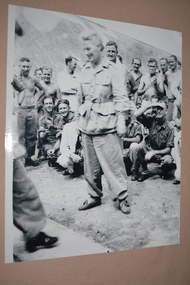
... When World War II was declared and whilst recovering from surgery she threw herself into her work and signed up for the Entertainments National Service Association (ENSA). Fields travelled to France to entertain the troops in the midst of air...When World War II was declared and whilst recovering from surgery she threw herself into her work and signed up for the Entertainments National Service Association (ENSA). Fields travelled to France to entertain the troops in the midst of air ...Dame Gracie Fields, DBE (born Grace Stansfield; 9 January 1898 – 27 September 1979) was an English actress, singer and comedienne and star of both cinema and music hall. When World War II was declared and whilst recovering from surgery she threw herself into her work and signed up for the Entertainments National Service Association (ENSA). Fields travelled to France to entertain the troops in the midst of air-raids, performing on the backs of open lorries and in war-torn areas. She performed many times for Allied troops, travelling as far as New Guinea, where she received an enthusiastic response from Australian personnel. In late 1945 she toured the South Pacific Islands. In 1979, seven months before her death, she was invested a Dame by Queen Elizabeth II for services to the entertainment industry.Reproduced black and white photograph of female wearing army jacket with soldiers kneeling and standing in background. Handwritten on rear - Gracie Fields in Pacificgracie fields, ww2, new guinea, 1945, south pacific islands -
 Wangaratta RSL Sub Branch
Letter
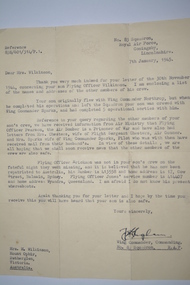
... ...world war two...air...See also 237 and 240. pilot kia killed in action dfc distinguished flying cross wwii world war two air force Original letter in black type Single page with embossed crest letterhead Letter Letter ...Letter dated 7/1/1945 from Wing Commander ???? 83 Squadron RAF in Lincolnshire to Mrs Wilkinson acknowledging her letter dated 30/11/1944 seeking names and addresses of members of her late son's crew on the night they went missing. From collection of photographs and cuttings dedicated to the memory of WILKINSON JOHN HUDSON : Service Number - 400444 : Date of birth - 18 Feb 1914 : Place of birth - RUTHERGLEN VIC : Place of enlistment - MELBOURNE : Next of Kin - WILKINSON HUDSON. Wilkinson was awarded the distinguished flying cross in March 1944 and tragically killed in action over Germany also in 1944. See also 237 and 240. Original letter in black type Single page with embossed crest letterheadpilot, kia, killed in action, dfc, distinguished flying cross, wwii, world war two, air force -
 Wangaratta RSL Sub Branch
Letter
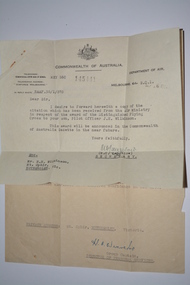
... ...world war two...air...See also 237 and 240. pilot kia killed in action dfc distinguished flying cross wwii world war two air force Letter - Commonwealth of Australia - Department of Air Envelope addressed to - Mr HH Wilkinson, Mount Ophir, Rutherglen. ...Letter dated 16/9/1944 from M C Langslow Secretary, Department of Air, Commonwealth of Australia to Mr H H Wilkinson advising of citation received from the Air Ministry in respect of award of the Distinguished Flying Cross to his son Pilot Officer J H WILKINSON and future announcement in the Commonwealth of Australia Gazette. Citation attached signed by H R Winneke, Group Captain. From collection of photographs and cuttings dedicated to the memory of WILKINSON JOHN HUDSON : Service Number - 400444 : Date of birth - 18 Feb 1914 : Place of birth - RUTHERGLEN VIC : Place of enlistment - MELBOURNE : Next of Kin - WILKINSON HUDSON. Wilkinson was awarded the distinguished flying cross in March 1944 and tragically killed in action over Germany also in 1944. See also 237 and 240. Original letter in black type. Two page with embossed crest letterhead. Stamped envelope.Letter - Commonwealth of Australia - Department of Air Envelope addressed to - Mr HH Wilkinson, Mount Ophir, Rutherglen.pilot, kia, killed in action, dfc, distinguished flying cross, wwii, world war two, air force -
 Wangaratta RSL Sub Branch
Newspaper - Newspaper cutting, J H Wilkinson
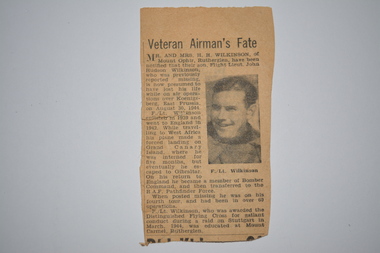
... ...world war two...air...J H Wilkinson previously reported missing now presumed to have lost his life whilst on air operations over East Prussia on 30 August, 1944. pilot kia killed in action dfc distinguished flying cross wwii world war two air force Veteran Airman's Fate Newspaper cutting containing photograph and type J H Wilkinson Newspaper Newspaper cutting ...From collection of photographs and cuttings dedicated to the memory of WILKINSON JOHN HUDSON : Service Number - 400444 : Date of birth - 18 Feb 1914 : Place of birth - RUTHERGLEN VIC : Place of enlistment - MELBOURNE : Next of Kin - WILKINSON HUDSON. Wilkinson was awarded the distinguished flying cross in March 1944 and tragically killed in action over Germany also in 1944. See also 237 and 240. Newspaper notice advising Flight Lieut. J H Wilkinson previously reported missing now presumed to have lost his life whilst on air operations over East Prussia on 30 August, 1944. Newspaper cutting containing photograph and typeVeteran Airman's Fatepilot, kia, killed in action, dfc, distinguished flying cross, wwii, world war two, air force -
 Wangaratta RSL Sub Branch
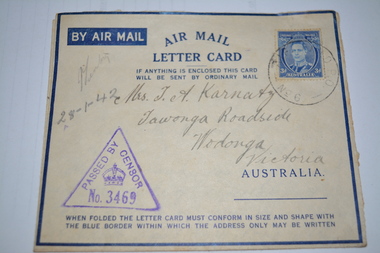
Letter - Handwritten letters
... Reported missing in action on 6/5/1941 and officially prisoner of war on 8/7/1941. 26/4/1945 recovered POW arrived in UK prior to returning to Australia. WW2 2/24 Battalion Tobruk Thomas KARNATZ POW Air Mail Letter Card addressed to Mrs T A Karnatz Tawonga Roadside Wodonga Victoria Australia Purple triangle stamp containing Passed by Censor No 3469 with a crown in the centre. ...Two handwritten letters - dated 27/6/1941 on blue lined writing paper from Pte D Detbridge VX31082 D Coy2/24 Batt. AIF Abroad to Mrs Karnatz advised her husband Tom was safe. He and several others were surrounded and forced to surrender and taken prisoners. Two of the boys managed to escape and brought the good news about Tom and others, being well and safe……… Airmail letter card dated 2/1/1942 from Pte Detbridge to Mrs Karnatz thanking her for the cake of chocolate and enquiring about Tom and if he had mentioned Tim Rogers, a mate who has not been heard of for some time. Thomas Allan Karnatz VX 48290 2/24 Battalion - born 16/7/1916. Enlisted Albury 22/7/1940 - Caulfield 8/8/1940 aged 24 years 17/10/1940 posted from 2/23 to 2/24 Battalion. Embarked 16/11/1940 and disembarked Middle East 17/12/1940. Reported missing in action on 6/5/1941 and officially prisoner of war on 8/7/1941. 26/4/1945 recovered POW arrived in UK prior to returning to Australia. Two handwritten letters - one in lead pencil on blue lined writing paper and the second in black ink on Airmail Letter Card with square blue stamp top right corner and triangular purple stamp lower left corner.Air Mail Letter Card addressed to Mrs T A Karnatz Tawonga Roadside Wodonga Victoria Australia Purple triangle stamp containing Passed by Censor No 3469 with a crown in the centre.ww2, 2/24 battalion, tobruk, thomas karnatz, pow
