
Showing 1484 items matching "alexandra"
-
 Kew Historical Society Inc
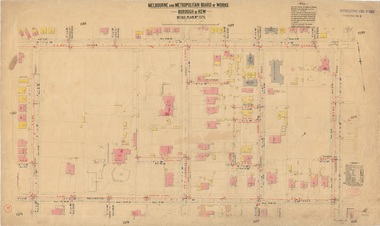
Plan, Melbourne & Metropolitan Board of Works : Borough of Kew : Detail Plan No.1576, 1904
... The lower paddocks of Madford were sold in 1905 by his wife to the Borough of Kew and, after landscaping by George and Thomas Pockett, opened as the Alexandra Gardens in 1908. Elm Lodge/Madford was in 1922 to become St. ...The lower paddocks of Madford were sold in 1905 by his wife to the Borough of Kew and, after landscaping by George and Thomas Pockett, opened as the Alexandra Gardens in 1908. Elm Lodge/Madford was in 1922 to become St. ...The Melbourne and Metropolitan Board of Works (MMBW) plans were produced from the 1890s to the 1950s. They were crucial to the design and development of Melbourne's sewerage and drainage system. The plans, at a scale of 40 feet to 1 inch (1:480), provide a detailed historical record of Melbourne streetscapes and environmental features. Each plan covers one or two street blocks (roughly six streets), showing details of buildings, including garden layouts and ownership boundaries, and features such as laneways, drains, bridges, parks, municipal boundaries and other prominent landmarks as they existed at the time each plan was produced. (Source: State Library of Victoria)This plan forms part of a large group of MMBW plans and maps that was donated to the Society by the Mr Poulter, City Engineer of the City of Kew in 1989. Within this collection, thirty-five hand-coloured plans, backed with linen, are of statewide significance as they include annotations that provide details of construction materials used in buildings in the first decade of the 20th century as well as additional information about land ownership and usage. The copies in the Public Record Office Victoria and the State Library of Victoria are monochrome versions which do not denote building materials so that the maps in this collection are invaluable and unique tools for researchers and heritage consultants. A number of the plans are not held in the collection of the State Library of Victoria so they have the additional attribute of rarity.Original survey plan, issued by the MMBW to a contractor with responsibility for constructing sewers in the area identified on the plan within the Borough of Kew. The plan was at some stage hand-coloured, possibly by the contractor, but more likely by officers working in the Engineering Department of the Borough and later Town, then City of Kew. The hand-coloured sections of buildings on the plan were used to denote masonry or brick constructions (pink), weatherboard constructions (yellow), and public buildings (grey). Development in the 20th century has irreparably altered that part of Kew represented in this plan. In the block bounded by Cotham Road, Charles Street, Wellington Street and Gellibrand; just one house standing in 1903 remains. This block included two of the most historic houses in Kew: ‘Ordsall’ (later ‘Southesk’) and ‘Madford’ (previously ‘Elm Lodge’). Ordsall was the home of the second chairman of Kew, John Halfey. It contained some of the most significant interior murals in Kew, created for Halfey by artists working for Cullen & Co. It was demolished in 1960 to make way for the Kew Civic Centre. Elm Lodge had been built for William Siddeley in ca. 1864. Arthur Septimus King purchased it in 1874. The lower paddocks of Madford were sold in 1905 by his wife to the Borough of Kew and, after landscaping by George and Thomas Pockett, opened as the Alexandra Gardens in 1908. Elm Lodge/Madford was in 1922 to become St. Anthony’s Home for Little Children before its subsequent demolition in the 1980s.melbourne and metropolitan board of works, detail plans, maps - borough of kew, mmbw 1576, cartography -
 Marysville & District Historical Society
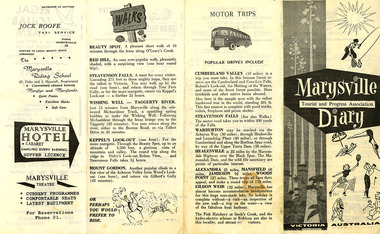
Ephemera (Item) - Programme of events, Marysville Tourist & Progress Association, Marysville Tourist and Progress Association Diary, 1963
... ...alexandra...A programme of events taking place in January, 1963, published by the Marysville Tourist and Progress Association. 1963 was Marysville's centenary year. marysville victoria programme marysville tourist and progress association misslynn beauty salon marysville garage crossways cabaret l.h. potter marysville swimming pool regal squab farm bartons stores fruit salad farm percy postlethwaite jock roofe taxi service the marysville riding school marysville hotel marysville theatre cumberland valley steavenson falls warburton healesville alexandra mansfield jamieson wood's point eildon weir snob's creek rubicon beauty spot walk red hill walk wishing well taggerty river keppel's lookout mount gordon A programme of events taking place in January, 1963, published by the Marysville Tourist and Progress Association. 1963 was Marysville's centenary year. ...A programme of events taking place in January, 1963, published by the Marysville Tourist and Progress Association. 1963 was Marysville's centenary year. The Association was formed in November 1907 to promote tourism within the area. This included the physical creation of signage, parklands, roads and walks to various attractions. A programme of events taking place in January, 1963, published by the Marysville Tourist and Progress Association. 1963 was Marysville's centenary year.marysville, victoria, programme, marysville tourist and progress association, misslynn beauty salon, marysville garage, crossways cabaret, l.h. potter, marysville swimming pool, regal squab farm, bartons stores, fruit salad farm, percy postlethwaite, jock roofe taxi service, the marysville riding school, marysville hotel, marysville theatre, cumberland valley, steavenson falls, warburton, healesville, alexandra, mansfield, jamieson, wood's point, eildon weir, snob's creek, rubicon, beauty spot walk, red hill walk, wishing well, taggerty river, keppel's lookout, mount gordon -
 Bendigo Historical Society Inc.
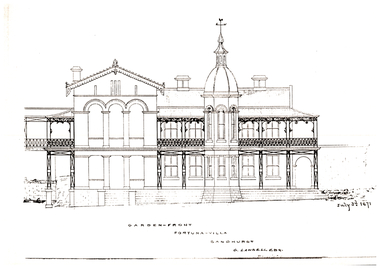
Plan - Fortuna Article - Plans of the Villa, July 3rd 1871
... He Designed many of Bendigo’s most prominent buildings, including the Town Hall, Shamrock Hotel, Bendigo Hospital, Benevolent Asylum, School of Mines, Mechanics Institute, Princess Theatre, Masonic Temple, Alexandra Fountain, and several banks and churches. ...He Designed many of Bendigo’s most prominent buildings, including the Town Hall, Shamrock Hotel, Bendigo Hospital, Benevolent Asylum, School of Mines, Mechanics Institute, Princess Theatre, Masonic Temple, Alexandra Fountain, and several banks and churches. ...Architect of Fortuna Villa Carl William Vahland was born in 1828 in Nienburg an der Weser, Germany. He trained at the prestigious Polytechnic Baugewerkschule in Holzminden, excelling in building and architecture. Emigrated to Melbourne in 1854, motivated by political unrest in Germany and the lure of the goldfields. Quickly he moved to Bendigo, joining other German migrants who contributed significantly to the region. Early Initially worked as a carpenter, then established himself as an architect in Bendigo by 1856. He Formed partnerships with other German architects, notably Robert Getzschmann and later his son Henry.Major. He Designed many of Bendigo’s most prominent buildings, including the Town Hall, Shamrock Hotel, Bendigo Hospital, Benevolent Asylum, School of Mines, Mechanics Institute, Princess Theatre, Masonic Temple, Alexandra Fountain, and several banks and churches. His firm also worked in other Victorian towns and opened an office in Echuca. Favored French Renaissance and Hellenistic Greek styles, influenced by German architectural trends. He Married Jane Barrow in 1859; they had ten children, though three died young. Became a naturalized Australian and anglicized his name to William Vahland. He Owned and developed the Charterhouse estate and vineyard at Runnymede, exporting award-winning wine to Europe. Justice of the Peace for over 40 years, city councillor, and mayor of Bendigo. Held leadership roles in the fire brigade, German Association, Bendigo Mutual Permanent Land and Building Society, and other local organizations. Active Freemason and published a book on freemasonry in Bendigo. Retired in 1900, briefly returned to the firm after his son’s death, and finally retired in 1912. Died in 1915 at age 87; his funeral was attended by many prominent citizens, and flags were flown at half-mast in his honor. William Vahland’s legacy is seen in Bendigo’s architectural heritage and his broad contributions to the city’s civic, cultural, and economic life.Fortuna Article - Plans of the Villa 1871 This item contains the following documents: 11217.81a Plan Garden Front for G. Lansell Esq. - 1 A4 Sheet 11217.81b Plan Facade 2 - 1 A4 Sheet 11217.81c Plan Facade 6 - 1 A4 Sheet 11217.81d Plan Garden Elevation and plan of Ground Floor and Second Floor with Section on line xx - 1 A4 Sheet 11217.81e Plan Basement and ground floor- 1 A4 Sheet 11217.81f Plan Basement and ground floor - 1 A3 Sheet - stamped with William C Vahland Architect Sandhurstnon-fictionbendigo, fortuna, george lansell, william vahland -
 Surrey Hills Historical Society Collection
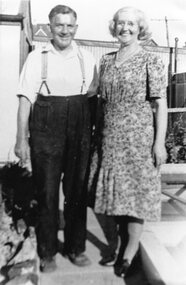
Photograph, Mr and Mrs Percy Pledger senior
... Percy had a tailoring and later knitwear business at 418 Canterbury Road, almost opposite Alexandra Avenue (? also at another time in Hansen's Terrace in Canterbury Road). ...Percy had a tailoring and later knitwear business at 418 Canterbury Road, almost opposite Alexandra Avenue (? also at another time in Hansen's Terrace in Canterbury Road). ...Percy Henry (Harry) Pledger (1884-1954) and Eleanor Elizabeth George (1888-1963). They married in 1908 in St Peters, Paddington, London. Percy was a tailor in Barnet, Middlesex and the family migrated to Australia in 1923, arriving in Brisbane on 11 December 1923. They settled in Surrey Hills. Percy had a tailoring and later knitwear business at 418 Canterbury Road, almost opposite Alexandra Avenue (? also at another time in Hansen's Terrace in Canterbury Road). The family was musical. Their children were: Son Percy who joined the staff at Allan’s Music House and rose to become their chief accountant. He also taught and played the violin in a number of orchestras. (See individual entry for him - SH1207) Daughter Jessie married Arthur John Marston Bate (1906-1994) in 1941; he was born in Birmingham and his father was also a tailor. Arthur gained BA and MA from the University of New Zealand. He was also primarily a musician, but worked in theatre, broadcasting and teaching in New Zealand and at the State Theatre in Melbourne and the ABC. He was a pilot during WW2 (SERN 255363), rising to the rank of Flight Lieutenant and also a RAAF Chaplain. Jessie and Arthur lived in Hawthorn, Ashwood and Mount Waverley. They are buried in Box Hill Cemetery (CE-213-0029) along with daughter Christine Elizabeth. Stanley Bertram Pledger, along with Harold Sydserf, assisted Stan's brother Percy to establish the Surrey Hills Musical Club in the 1920s . It soon increased to 12 or 15 members, giving 4 concerts a year. They combined with the Surrey Hills Dramatic Society to produce operettas. In time the group expanded to a total of 30 players and became the Camberwell Symphony Orchestra. Stanley Bertram Pledger (1912-1996) is listed in electoral rolls at a number of addresses around Surrey Hills: 1927 - 36 Suffolk Road; 1940s - Essex Road; 1977 - Burwood. All entries consistently give his occupation as manufacturer and it is assumed that this was with the family business. He retired to Kiama, NSW.A black and white photograph of a couple standing in the rear garden. The lady is wearing a short sleeved, knee length dress and the man is wearing long trousers held up by braces and a short sleeved shirt.clothing and dress, tailor and knitwear, (mr) percy henry pledger, (mrs) eleanor elizabeth pledger, (mrs) nell pledger, (miss) eleanor elizabeth george -
 Surrey Hills Historical Society Collection
Photograph, Mrs Nell Pledger in Canterbury Road
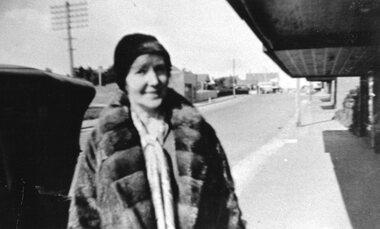
... Percy had a tailoring and later knitwear business at 418 Canterbury Road, almost opposite Alexandra Avenue (? also at another time in Hansen's Terrace in Canterbury Road). ...Percy had a tailoring and later knitwear business at 418 Canterbury Road, almost opposite Alexandra Avenue (? also at another time in Hansen's Terrace in Canterbury Road). ...Nell Pledger - Eleanor Elizabeth George (1888-1963) was the wife of Percy Henry (Harry) Pledger (1884-1954). They married in Paddington, London in 1908. Percy was a tailor in Barnet, Middlesex and the family migrated to Australia in 1923, arriving in Brisbane on 11 December 1923. They settled in Surrey Hills. Percy had a tailoring and later knitwear business at 418 Canterbury Road, almost opposite Alexandra Avenue (? also at another time in Hansen's Terrace in Canterbury Road). The family was musical. After leaving school son Percy joined the staff at Allan’s Music House and rose to become their chief accountant. He also taught and played the violin in a number of orchestras. (See individual entry for him - SH1207) Jessie married Arthur John Marston Bate (1906-1994) in 1941; he was born in Birmingham and his father was also a tailor. Arthur gained BA and MA from the University of New Zealand. He was also primarily a musician, but worked in theatre, broadcasting and teaching in New Zealand and at the State Theatre in Melbourne and the ABC. He was a pilot during WW2 (SERN 255363), rising to the rank of Flight Lieutenant and also a RAAF Chaplain. Jessie and Arthur lived in Hawthorn, Ashwood and Mount Waverley. They are buried in Box Hill Cemetery (CE-213-0029) along with daughter Christine Elizabeth. In the 1920s Stanley Bertram Pledger, along with Harold Sydserf, assisted Stan's brother Percy to establish the Surrey Hills Musical Club. It soon increased to 12 or 15 members, giving 4 concerts a year. They combined with the Surrey Hills Dramatic Society to produce operettas. In time the group expanded to a total of 30 players and became the Camberwell Symphony Orchestra. Stanley Bertram Pledger (1912-1996) is listed in electoral rolls at a number of addresses around Surrey Hills: 1927 - 36 Suffolk Road; 1940s - Essex Road; 1977 - Burwood. All entries consistently give his occupation as manufacturer and it is assumed that this was with the family business. He retired to Kiama, NSW.A black and white photograph of a lady dresses in a fur coat, and standing on the pavement with buildings in the background.alexandra avenue, canterbury road, union road, surrey hills, knitwear business, streetscape, (mrs) eleanor elizabeth pledger, (mrs) nell pledger, (mr) percy pledger, (miss) eleanor elizabeth george -
 Sunshine and District Historical Society Incorporated
Photograph - Sunshine Photographs 2022 Part 1, John Alchin, 2022
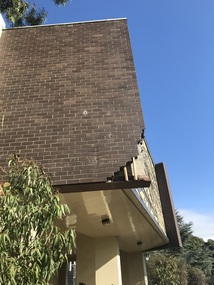
... 5627.01 - Alexandra Ave Sunshine - Sunshine Muncipal Offices 2022 Photo 01.JPG 5627.02 - Alexandra Ave Sunshine - Sunshine Muncipal Offices 2022 Photo 02.JPG 5627.03 - Alexandra Ave Sunshine - Sunshine Muncipal Offices 2022 Photo 05.JPG 5627.04 - Anderson Rd - Sunshine Vietnamese Baptist Church.JPG 5627.05 - Anderson Rd 79 - Andy's Service Station Sign 2022 Photo 02.JPG 5627.06 - Anderson Rd 79 Sunshine - Andy's Service Station Sign 2022 Photo 01.JPG 5627.07 - Anderson Rd 126 Sunshine - Sunhine Presbyterian Church Manse 2022 Photo 01.JPG 5627.08 - Andersons Rd 101 - 103 Sunshine 2022 Photo 01.JPG 5627.09 - Ballarat Rd 503 Sunshine - StoreLocal 2022 Photo 01.JPG 5627.10 - Ballarat Rd 505 Sunshine - Former AMF Ten Pin Bowling Centre 2022.JPG 5627.11 - Ballarat Rd 505 Sunshine - Melbourne Airport Rail Construction Support Facility Sign 2022 Photo 02.JPG 5627.12 - Ballarat Service Rd Sunshine - Stony Creek Culvert 2022 Photo 01.JPG 5627.13 - City Place 2 -4 Sunshine 2022 Photo 01.JPG 5627.14 - City Place 8 - 12 Sunshine 2022 Photo 01.JPG 5627.15 - City Place 22 Sunshine 2022 Photo 01.JPG 5627.16 - City Place 24 Sunshine 2022 Photo 01.JPG 5627.17 - City Place Sunshine - Reflexio Qualis 2022 Photo 02.JPG 5627.18 - Clarke St 6 Sunshine 2022 Photo 01.JPG 5627.19 - Derby Rd Sunshine - Kororoit Creek Bridge 2022 Photo 02.JPG 5627.20 - Derby St 105 Sunshine 2022 Photo 01.JPG 5627.21 - Devonshire Rd 5 Sunshine 2020 Photo 01.JPG 5627.22 - Dickson St 9 - 15 Sunshine 2022 Photo 01.JPG 5627.23 - Dickson St Sunshine - Reflexio Qualis 2022 Photo 02.JPG 5627.24 - Durham Rd 113 Sunshine 2022 Photo 01.JPG 5627.25 - Durham St 115 Sunshine - Former Bank 2022 Photo 01.JPG 5627.26 - Forrest St Railway Bridge Kororoit Creek 2022 Photo 01.JPG 5627.27 - Fraser St 75 Sunshine - Wilfred Clayton's House 2022 Photo 01.JPG 5627.28 - Fraser St Sunshine - Legenda's Garden 2022 Photo 01.JPG 5627.29 - Fraser St Sunshine - Legenda's Garden 2022 Photo 04.JPG 5627.30 - H.V. ...Sunshine Municipal Offices Alexandra Avenue Sunshine Sunshine Presbyterian Church Anderson Road Andy's Service Station Service Station Sunshine Presbyterian Church Manse Hot Springs Spa StoreLocal Ten Pin Bowling Centre Ballarat Road Service Road Stony Creek Stony Creek Drain Sun Crescent City Place Reflexio Qualis Clarke Street Derby Road Bridge Derby Road Devonshire Road Dickson Street Durham Road Glengala Road Bridge Fraser Street Legenda's Garden H.V. ...These photographs provide a visual record of assorted buildings, street views, and notable locations throughout Sunshine in 2022.This collection of photographs preserves a visual record of Sunshine 2022.5627.01 - Alexandra Ave Sunshine - Sunshine Muncipal Offices 2022 Photo 01.JPG 5627.02 - Alexandra Ave Sunshine - Sunshine Muncipal Offices 2022 Photo 02.JPG 5627.03 - Alexandra Ave Sunshine - Sunshine Muncipal Offices 2022 Photo 05.JPG 5627.04 - Anderson Rd - Sunshine Vietnamese Baptist Church.JPG 5627.05 - Anderson Rd 79 - Andy's Service Station Sign 2022 Photo 02.JPG 5627.06 - Anderson Rd 79 Sunshine - Andy's Service Station Sign 2022 Photo 01.JPG 5627.07 - Anderson Rd 126 Sunshine - Sunhine Presbyterian Church Manse 2022 Photo 01.JPG 5627.08 - Andersons Rd 101 - 103 Sunshine 2022 Photo 01.JPG 5627.09 - Ballarat Rd 503 Sunshine - StoreLocal 2022 Photo 01.JPG 5627.10 - Ballarat Rd 505 Sunshine - Former AMF Ten Pin Bowling Centre 2022.JPG 5627.11 - Ballarat Rd 505 Sunshine - Melbourne Airport Rail Construction Support Facility Sign 2022 Photo 02.JPG 5627.12 - Ballarat Service Rd Sunshine - Stony Creek Culvert 2022 Photo 01.JPG 5627.13 - City Place 2 -4 Sunshine 2022 Photo 01.JPG 5627.14 - City Place 8 - 12 Sunshine 2022 Photo 01.JPG 5627.15 - City Place 22 Sunshine 2022 Photo 01.JPG 5627.16 - City Place 24 Sunshine 2022 Photo 01.JPG 5627.17 - City Place Sunshine - Reflexio Qualis 2022 Photo 02.JPG 5627.18 - Clarke St 6 Sunshine 2022 Photo 01.JPG 5627.19 - Derby Rd Sunshine - Kororoit Creek Bridge 2022 Photo 02.JPG 5627.20 - Derby St 105 Sunshine 2022 Photo 01.JPG 5627.21 - Devonshire Rd 5 Sunshine 2020 Photo 01.JPG 5627.22 - Dickson St 9 - 15 Sunshine 2022 Photo 01.JPG 5627.23 - Dickson St Sunshine - Reflexio Qualis 2022 Photo 02.JPG 5627.24 - Durham Rd 113 Sunshine 2022 Photo 01.JPG 5627.25 - Durham St 115 Sunshine - Former Bank 2022 Photo 01.JPG 5627.26 - Forrest St Railway Bridge Kororoit Creek 2022 Photo 01.JPG 5627.27 - Fraser St 75 Sunshine - Wilfred Clayton's House 2022 Photo 01.JPG 5627.28 - Fraser St Sunshine - Legenda's Garden 2022 Photo 01.JPG 5627.29 - Fraser St Sunshine - Legenda's Garden 2022 Photo 04.JPG 5627.30 - H.V. McKay Memorial Gardens 2022 Photo 02.JPG 5627.31 - H.V. McKay Memorial Gardens 2022 Photo 03.JPG 5627.32 - H.V. McKay Memorial Gardens 2022 Photo 04.JPG 5627.33 - H.V. McKay Pedestrian Bridge 2022 Photo 01.JPG 5627.34 - Hampshire Rd 36 Sunshine 2022 Photo 01.JPG 5627.35 - Hampshire Rd 42 Sunshine 2022 Photo 01.JPG 5627.36 - Hampshire Rd 44 Sunshine 2022 Photo 01.JPG 5627.37 - Hampshire Rd 68 - 70 Sunshine 2022 Photo 01.JPG 5627.38 - Hampshire Rd 74 - 76 Sunshine - Shops 2022 Photo 01.JPG 5627.39 - Hampshire Rd 74 - 76 Sunshine 2022 Photo 01.JPG 5627.40 - Hampshire Rd 74 - 76 Sunshine 2022 Photo 02.JPG 5627.41 - Hampshire Rd 74 - 76 Sunshine 2022 Photo 04.JPG 5627.42 - Hampshire Rd 86 - 88 Sunshine - Shops 2022 Photo 02.JPG sunshine municipal offices, alexandra avenue, sunshine, sunshine presbyterian church, anderson road, andy's service station, service station, sunshine presbyterian church manse, hot springs spa, storelocal, ten pin bowling centre, ballarat road service road, stony creek, stony creek drain, sun crescent, city place, reflexio qualis, clarke street, derby road bridge, derby road, devonshire road, dickson street, durham road, glengala road bridge, fraser street, legenda's garden, h.v. mckay memorial gardens, sunshine pedestrian bridge, hampshire road -
 Surrey Hills Historical Society Collection
Photograph, Pledger family - Percy, Jessie and Stan in 1930s
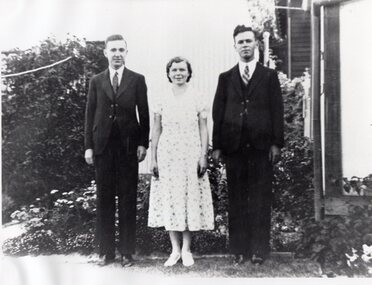
... Percy had a tailoring and later knitwear business at 418 Canterbury Road, almost opposite Alexandra Avenue (? also at another time in Hansen's Terrace in Canterbury Road). ...Percy had a tailoring and later knitwear business at 418 Canterbury Road, almost opposite Alexandra Avenue (? also at another time in Hansen's Terrace in Canterbury Road). ...Percy Alfred William (1910- ), Stanley Bertram (1912-1996) and Jessie Eleanor (1915-2008) were the children of Percy Henry (Harry) Pledger (1884-1954) and Eleanor Elizabeth George (1888-1963). Percy was a tailor in Barnet, Middlesex and the family migrated to Australia in 1923, arriving in Brisbane on 11 December 1923. They settled in Surrey Hills. Percy had a tailoring and later knitwear business at 418 Canterbury Road, almost opposite Alexandra Avenue (? also at another time in Hansen's Terrace in Canterbury Road). The family was musical. After leaving school son Percy joined the staff at Allan’s Music House and rose to become their chief accountant. He also taught and played the violin in a number of orchestras. (See individual entry for him - SH1207) Jessie married Arthur John Marston Bate (1906-1994) in 1941; he was born in Birmingham and his father was also a tailor. Arthur gained BA and MA from the University of New Zealand. He was also primarily a musician, but worked in theatre, broadcasting and teaching in New Zealand and at the State Theatre in Melbourne and the ABC. He was a pilot during WW2 (SERN 255363), rising to the rank of Flight Lieutenant and also a RAAF Chaplain. Jessie and Arthur lived in Hawthorn, Ashwood and Mount Waverley. They are buried in Box Hill Cemetery (CE-213-0029) along with daughter Christine Elizabeth. In the 1920s Stanley Bertram Pledger, along with Harold Sydserf, assisted Stan's brother Percy to establish the Surrey Hills Musical Club. It soon increased to 12 or 15 members, giving 4 concerts a year. They combined with the Surrey Hills Dramatic Society to produce operettas. In time the group expanded to a total of 30 players and became the Camberwell Symphony Orchestra. Stanley Bertram Pledger (1912-1996) is listed in electoral rolls at a number of addresses around Surrey Hills: 1927 - 36 Suffolk Road; 1940s - Essex Road; 1977 - Burwood. All entries consistently give his occupation as manufacturer and it is assumed that this was with the family business. He retired to Kiama, NSW.A black and white photograph of two young men and a young lady standing in a garden setting. The men are dressed in suits whilst the lady is dressed in a short sleeved, knee length summer dress.canterbury road, surrey hills, pledger's knitwear, alexandra avenue, canterbury, victorian symphony orchestra, violinist, clothing and dress, mr percy alfred william pledger, mr stanley bertram pledger, miss jessie eleanor pledger, mrs jessie eleanor bate, mr arthur john marston bate, surrey hills music club -
 Bendigo Historical Society Inc.
Photograph - National Trust Collection: "Album of Sandhurst Views" sketches of Bendigo buildings forming a leporello (folding book), 09/06/2025
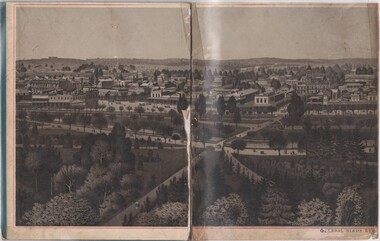
... Killian's Church 3084.101D Four sketches - Sandhurst Mechanic's Institute and School of Mines, Masonic Hall, Sandhurst Benevolent Asylum & Sandhurst State Scholl (Camp Hill PS) 3084.101E Three sketches - Alexandra Fountain and Pall Mall from Charing Cross, The Mining Exchange & Sandhurst Hospital 3084.101F Two sketches - Sandhurst Post office and Telegraph Offices, & Town Hall 3084.101G Four sketches - The Fernery in the City Reserve, The City Family Hotel, The New Chum Line of Reef, & Pioneer Battery at Long Gully. ...Killian's Church 3084.101D Four sketches - Sandhurst Mechanic's Institute and School of Mines, Masonic Hall, Sandhurst Benevolent Asylum & Sandhurst State Scholl (Camp Hill PS) 3084.101E Three sketches - Alexandra Fountain and Pall Mall from Charing Cross, The Mining Exchange & Sandhurst Hospital 3084.101F Two sketches - Sandhurst Post office and Telegraph Offices, & Town Hall 3084.101G Four sketches - The Fernery in the City Reserve, The City Family Hotel, The New Chum Line of Reef, & Pioneer Battery at Long Gully. ...historic buildingNational Trust Collection: 12 pages with 24 sketches of buildings in Sandhurst (Bendigo), circa 1888. The book has been dismantled and the pages mounted on paper. The book was produced by Schutze, Steffens and Company, 272 Little Collins Street, Melbourne (refer 3084.101H). The book contains B&W high quality sketches of Sandhurst / Bendigo. 3084.101A & 3084.101B Cover of the book has been affixed to the paper no longer accessible. The two sketches, along with the two sketches on 3084.101B, provide a "general bird's eye view" of the development of Bendigo around 1888 across Rosiland Park 3084.101C Seven sketches - Sandhurst Savings Bank, Wesleyan Church, Congregational Church, S. Paul's Church, All Saints Church, Roman Catholic Bishop's Palace, & Roman Catholic St. Killian's Church 3084.101D Four sketches - Sandhurst Mechanic's Institute and School of Mines, Masonic Hall, Sandhurst Benevolent Asylum & Sandhurst State Scholl (Camp Hill PS) 3084.101E Three sketches - Alexandra Fountain and Pall Mall from Charing Cross, The Mining Exchange & Sandhurst Hospital 3084.101F Two sketches - Sandhurst Post office and Telegraph Offices, & Town Hall 3084.101G Four sketches - The Fernery in the City Reserve, The City Family Hotel, The New Chum Line of Reef, & Pioneer Battery at Long Gully. Also includes a newspaper cutting showing the redevelopment of the ANZ Bank site (Williamson Street & Pall Mall) which incorporates the wrought iron balustrade from the prior building on the site 3084.101H Messrs Schutze , Steffens & Company, 272 Little Collins Street Melbourne (the company produced the "Album of Sandhurst Views" book)views of significant buildings in sandhurst / bendigo circa 1888 -
 Bendigo Historical Society Inc.
Slide - Images by Arthur Pulfer, About 1957-1970
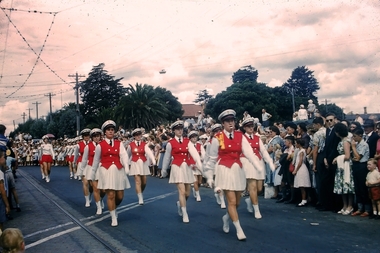
... This item contains the following slides: 7795.2a Public Toilets Williamson Street Bendigo 7795.2b The Bendigo Easter Parade - - Easter Sunday 1959 - Marching Girls and brass band turning into Rosalind Park from Mitchell Street with the Rifle Brigade Hotel in the background. 7795.2c Charing Cross (High Street) Bendigo Cenotaph 7795.2d The Conservatory and gardens, Pall Mall Bendigo looking towards Rosalind Park 7795.2e Alexandra Fountain and Fountain Plaza, Cenotaph and Lyric Theatre rear top right. 7795.2f From the lookout in Rosalind Park, Bendigo - cricket match on the Queen Elizabeth Oval - looking westward. 7795.2g Rosalind Park "sound shell" Orchestra and Spectators - Herald Sun Van in the backround. 7795.2h Tom Flood centre (showgrounds) - Bendigo Show 1958 - with the Benevolent Home (Anne Caudle Centre) and the Bendigo Base Hospital in the background. 7795.2i The Bendigo Easter Parade - Easter Monday 1959 - Marching Girls coming out of Mollison Street to come down Mitchell Street. 7795.2j Bendigo Ambulance headquarters opening September 1958 7795.2k Bendigo Ambulance headquarters opening September 1958 7795.2l The Bendigo Easter Parade - - Easter Monday 1959 - Brass Band coming out of Mollison Street to come down Mitchell Street. 7795.2m Peacock at White Hill Botanical Gardens 7795.2n Bendigo from One Tree Hill Lookout 7795.2o W H Gardiner Reserve Golden Square Bendigo...This item contains the following slides: 7795.2a Public Toilets Williamson Street Bendigo 7795.2b The Bendigo Easter Parade - - Easter Sunday 1959 - Marching Girls and brass band turning into Rosalind Park from Mitchell Street with the Rifle Brigade Hotel in the background. 7795.2c Charing Cross (High Street) Bendigo Cenotaph 7795.2d The Conservatory and gardens, Pall Mall Bendigo looking towards Rosalind Park 7795.2e Alexandra Fountain and Fountain Plaza, Cenotaph and Lyric Theatre rear top right. 7795.2f From the lookout in Rosalind Park, Bendigo - cricket match on the Queen Elizabeth Oval - looking westward. 7795.2g Rosalind Park "sound shell" Orchestra and Spectators - Herald Sun Van in the backround. 7795.2h Tom Flood centre (showgrounds) - Bendigo Show 1958 - with the Benevolent Home (Anne Caudle Centre) and the Bendigo Base Hospital in the background. 7795.2i The Bendigo Easter Parade - Easter Monday 1959 - Marching Girls coming out of Mollison Street to come down Mitchell Street. 7795.2j Bendigo Ambulance headquarters opening September 1958 7795.2k Bendigo Ambulance headquarters opening September 1958 7795.2l The Bendigo Easter Parade - - Easter Monday 1959 - Brass Band coming out of Mollison Street to come down Mitchell Street. 7795.2m Peacock at White Hill Botanical Gardens 7795.2n Bendigo from One Tree Hill Lookout 7795.2o W H Gardiner Reserve Golden Square Bendigo Slide Images by Arthur Pulfer. ...Arthur William Pulfer was born on 18 April 1918, in Bendigo, Victoria, Australia, his father, Harold Victor Pulfer, was 30 and his mother, Elsie Maud Rumball, was 26. He married Norma Stewart in Bendigo, Victoria, Australia. He died on 6 March 2001, in his hometown, at the age of 82, and was buried in the Bendigo Cemetery.Many images from by Arthur Pulfer copied to slides. Fifteen Slides of the Bendigo Easter parade, includes the Bendigo Show, Rosalind Park Sound Shell and lookout; One Tree Hill Lookout and Williamson Street Toilet Block. This item contains the following slides: 7795.2a Public Toilets Williamson Street Bendigo 7795.2b The Bendigo Easter Parade - - Easter Sunday 1959 - Marching Girls and brass band turning into Rosalind Park from Mitchell Street with the Rifle Brigade Hotel in the background. 7795.2c Charing Cross (High Street) Bendigo Cenotaph 7795.2d The Conservatory and gardens, Pall Mall Bendigo looking towards Rosalind Park 7795.2e Alexandra Fountain and Fountain Plaza, Cenotaph and Lyric Theatre rear top right. 7795.2f From the lookout in Rosalind Park, Bendigo - cricket match on the Queen Elizabeth Oval - looking westward. 7795.2g Rosalind Park "sound shell" Orchestra and Spectators - Herald Sun Van in the backround. 7795.2h Tom Flood centre (showgrounds) - Bendigo Show 1958 - with the Benevolent Home (Anne Caudle Centre) and the Bendigo Base Hospital in the background. 7795.2i The Bendigo Easter Parade - Easter Monday 1959 - Marching Girls coming out of Mollison Street to come down Mitchell Street. 7795.2j Bendigo Ambulance headquarters opening September 1958 7795.2k Bendigo Ambulance headquarters opening September 1958 7795.2l The Bendigo Easter Parade - - Easter Monday 1959 - Brass Band coming out of Mollison Street to come down Mitchell Street. 7795.2m Peacock at White Hill Botanical Gardens 7795.2n Bendigo from One Tree Hill Lookout 7795.2o W H Gardiner Reserve Golden Square Bendigohistory, bendigo, james lerk collection, bendigo easter parade, bendigo conservatory, one tree hill lookout, marching girls bendigo, brass bands bendigo, bendigo rosalind park, arthur pulfer -
 Bendigo Historical Society Inc.
Document - SHORT ARTICLES (RHSV, BENDIGO BRANCH): ''LOOKING BACK 100 YEARS''
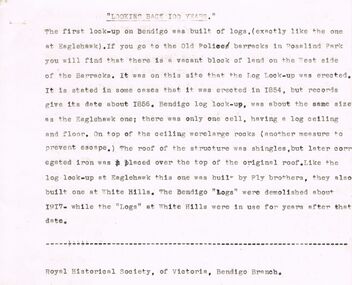
... Sly grog selling (from Bendigo Advertiser 18/4/1874); 9. Alexandra Fountain. Mention of Mr P Finn, monumental mason and building of the fountain; 10. ...Sly grog selling (from Bendigo Advertiser 18/4/1874); 9. Alexandra Fountain. Mention of Mr P Finn, monumental mason and building of the fountain; 10. ...Typewritten short articles (RHSV, Bendigo Branch): ''Looking back 100 Years''. Possibly all authored by John O'C Hattam, Bendigo and ?? Published in the Newsletter/magazine of the Society. Titles for the articles and key points within are as follow: 1. ''Lock-ups'' in Bendigo (Rosalind Park, Eaglehawk and White Hills); 2. Curnow's Auction Rooms, corner Mitchell and Queen Streets. with mention of Goodwin’s grocer shop and ''Her Majesties Theatre''; 3. Hebrew Synagogue (sic) in Dowling St (Hopetoun St); 4. Caltex oil deport (end of Hopetoun St) with mention of Knight's Brick kiln and quarry; 5. First fire brigade (Pall Mall, near Bull St); 6. Sandhurst Flour Mills (corners Lyttleton Terrace, Myers and Bernal (now Chapel Streets). Mention of Iser home on site; 7. Article similar to article #5 re first fire brigade with some different details; 8. Sly grog selling (from Bendigo Advertiser 18/4/1874); 9. Alexandra Fountain. Mention of Mr P Finn, monumental mason and building of the fountain; 10. ''Joke'' re pyrites/gold taken from Bendigo Advertiser 7/4/1874; 11. Interesting article from Bendigo Advertiser re ''lost'' including advertisement for one child; 12. Gambling on the Reserve from Bendigo Advertiser April 1874; 13. ''Settling a dispute'' from Bendigo Advertiser 11/4/1874; 14. Articles re ''selling liquor'' and ''furious riding'' taken from Bendigo Advertiser 15/4/1874;document, names of bendigo pioneers, bendigo advertiser, mr p. finn. curnow's auction room. sandhurst flour mills. goodwin's grocer shop. -
 Bendigo Historical Society Inc.
Document - LONG GULLY HISTORY GROUP COLLECTION: GUIDE TO SOME FAMOUS MINES
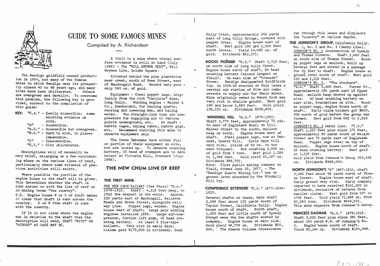
... North of Staley,The Duke of Edinburgh, New St Mungo, Duchess Tribute, South Devonshire, Duchess of Edinburgh, Princess Alexandra, West United Devonshire, Hopewell, Phoenix. ...North of Staley,The Duke of Edinburgh, New St Mungo, Duchess Tribute, South Devonshire, Duchess of Edinburgh, Princess Alexandra, West United Devonshire, Hopewell, Phoenix. ...Three pages titled Guide to Some Famous Mines. Compiled by A Richardson. Each mine is listed as on the reef it is situated on. Reefs are The New Chum Line of Reef and the Garden Gully Line of Reefs, and the Devonshire Group. Mentioned is the mine's location, depth of shaft, poppet legs, machinery, location of engine house, gold yield, dividends and owners of mine. The mines are: The New Chum Line of Reef. The New Chum Railway, Kochs Pioneer, Windmill Hill, Confidence Extended, Johnson's No 1, Johnson's No2, Johnson's No 3, North Johnson's, Princess Dagmar, Golden Age, Johnson's Reef Extended, Golden Pyke, Constellation, Great Northern, Virginia, Specimen Hill United, New Argus, Clarence United, North Argus, South New Moon, New Chum Hill, The New Chum and Victoria, Catherine Reef United. Garden Gully Line of Reefs. The Great Southern, Ulster United, Londonderry, South Garden, The Sea Amalgamated, Garden Gully United, Victory and Pandora, Unity Mine, Carlisle United, Cornish United, Eureka Extended, South Belle Vue United, Shenandoah, Shamrock, New Chum Consolidated, New Chum United, Lansell's 222, Rae's Open Cut, Great Central Victoria, Victoria Consols, The Ironbark, Hercules and Energetic, Pearl, The Devonshire Group. North of Staley,The Duke of Edinburgh, New St Mungo, Duchess Tribute, South Devonshire, Duchess of Edinburgh, Princess Alexandra, West United Devonshire, Hopewell, Phoenix. Yhe Mungo Mines. Unicorn, South St Mungo, Lady Barkly, The St Mungo, Sadowa, Eastwood. Snobs Hill Group. The Ellenborough, The Belmont and Saxby, York and Durham, The Acadia, William's United, The Victoria Hill - Ironbark, The North Old Chum, Lansell's Big 180, Ballerstadt's Open-Cut and The Victoria Quartz.bendigo, history, long gully history group, the long gully history group - guide to some famous mines, a richardson, the new chum railway, kochs pioneer, windmill hill, confidence extended, johnson's no 1, johnson's no2, johnson's no 3, north johnson's, princess dagmar, golden age, johnson's reef extended, golden pyke, constellation, great northern, virginia, specimen hill united, new argus, clarence united, north argus, south new moon, new chum hill, the new chum and victoria, catherine reef united, the great southern, ulster united, londonderry, south garden, the sea amalgamated, garden gully united, victory and pandora, unity mine, carlisle united, cornish united, eureka extended, south belle vue united, shenandoah, shamrock, new chum consolidated, new chum united, lansell's 222, rae's open cut, great central victoria, victoria consols, the ironbark, hercules and energetic, pearl, the duke of edinburgh, new st mungo, duchess tribute, south devonshire, duchess of edinburgh, princess alexandra, west united devonshire, hopewell, phoenix, unicorn, south st mungo, lady barkly, the st mungo, sadowa, eastwood, the ellenborough, the belmont and saxby, york and durham, the acadia, william's united, the victoria hill - ironbark, the north old chum, lansell's big 180, ballerstadt's open-cut, the victoria quartz -
 Bendigo Historical Society Inc.
Book - CITY OF BENDIGO HISTORICAL WALK BOOK, 2001
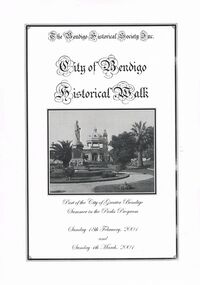
... Prison Bendigo, Camp Hill Police Barracks, Sandhurst Corporate High School, Central State School No. 1976, The Cascades, District Lands Office (Dudley House), Masonic Temple and Hall, Sandhurst Volunteer Rifle Brigade Orderly Room, Bank of Victoria, Henry Jackson's Store View Point,Alexandra Fountain, Beehive Store/Mining Exchange, Colonial Bank. ...Prison Bendigo, Camp Hill Police Barracks, Sandhurst Corporate High School, Central State School No. 1976, The Cascades, District Lands Office (Dudley House), Masonic Temple and Hall, Sandhurst Volunteer Rifle Brigade Orderly Room, Bank of Victoria, Henry Jackson's Store View Point,Alexandra Fountain, Beehive Store/Mining Exchange, Colonial Bank. ...Photocopy mock up of original booklet of The Bendigo Historical Society Inc. 'City of Bendigo Historical Walk' containing photographs of historic buildings to be seen on the walk. Front cover Queen Victorian Gardens, Town hall, Mechanics Institute/School Of Mines and Industry, H. M. Prison Bendigo, Camp Hill Police Barracks, Sandhurst Corporate High School, Central State School No. 1976, The Cascades, District Lands Office (Dudley House), Masonic Temple and Hall, Sandhurst Volunteer Rifle Brigade Orderly Room, Bank of Victoria, Henry Jackson's Store View Point,Alexandra Fountain, Beehive Store/Mining Exchange, Colonial Bank. Hustlers Royal Reserve NO. 2/R.S.L. Memorial Hall, Post Office 3rd 4th and final, Bendigo Law Courts, Shamrock Hotel 2nd and another view. Important Bendigo Dates; 1851, April gold discovered at Golden Square by Margaret Kennedy,1851 Approx. 200,000Troy oz. of gold found in Bendigo, 1852 475,857 Troy oz. Gold for the year, 1853 November 31st Bendigo Hospital admits first patient,1853 December 9th Bendigo Advertiser first issue printed, 1854 First Land Sales and streets are surveyed and named for the first time, 1854 Census of Bendigo showed 15,480 residents plus 4,000 Chinese, 1855 Sandhurst Municipal District formed, 1861 Sandhurst Proclaimed a Town. 1862 Railway to Melbourne opened, 1867 Visit by His Royal Highness the Duke of Edinburgh, 1871 July 21st Sandhurst proclaimed a City, 1881 Population of Sandhurst 14,577 residents, 1882 First telephone communications introduced, 1890 Electric trams (battery) commenced running, 1891 May 18th City of Sandhurst changes its name to City of Bendigo.book, bendigo, buildings, historic -
 Flagstaff Hill Maritime Museum and Village
Weapon - Ammunition, Before 1878
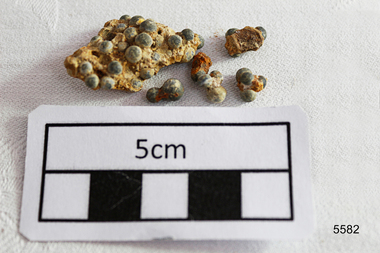
... In 1882 Richard Hodgson erected the 160 feet round chimney-shaped Clifton Hill shot tower on Alexandra Parade (VHR H0709) and in 1889 Walter Coop built the 160 feet square tower-shaped Melbourne Central shot tower on La Trobe Street (VHR H0067). ...In 1882 Richard Hodgson erected the 160 feet round chimney-shaped Clifton Hill shot tower on Alexandra Parade (VHR H0709) and in 1889 Walter Coop built the 160 feet square tower-shaped Melbourne Central shot tower on La Trobe Street (VHR H0067). ...The objects are a small sample of small gauge lead shot raised by Flagstaff Hill divers from the LOCH ARD shipwreck site in 1976. Companion pieces are in the Maritime Village collection. The three masted, iron hulled, LOCH ARD was wrecked against the tall limestone cliffs of Mutton Bird Island in the early hours of the first of June 1878. Included in her diverse and valuable cargo were 22 tons of lead shot, packed in cloth bags and wooden casks. Bulk quantities of lead shot, uniformly round balls of dull grey metal ranging from 2mm “birdshot” to 8mm “buckshot”, were routinely exported to the Australian colonies. Shot was used mostly as projectiles fired from smooth bored guns to bring down moving targets such as wild ducks and small game. It was also useful as ballast, when a dense, “pourable” weight was required to fill cavities or establish volume within a measuring container. The production of consistently round spheres of lead shot required the pouring of molten metal through a sieve and then a long drop through the atmosphere to a water filled basin for final cooling and collection. This “shot tower” process was first patented by William Watts of Bristol in 1782. His calculation of a 150 feet fall was not only to form evenly spherical droplets through surface tension, but also to provide partial cooling and solidification to each shot before they hit the water below. The value of his innovation was the minimising of indentation and shape distortion, avoiding the expense of re-smelting and re-moulding the lead. Lead shot was already being produced in Australia at the time the LOCH ARD loaded her cargo and left Gravesend on the second of March 1878. James Moir constructed a 157 feet circular stone shot tower near Hobart in 1870, with a peak annual production of 100 tons of lead shot sold in 28 pound linen bags. However colonial demand exceeded this source of local supply. The continued strength of the market for lead shot in the Colony of Victoria prompted substantial investment in additional productive capacity in Melbourne in the next decade. In 1882 Richard Hodgson erected the 160 feet round chimney-shaped Clifton Hill shot tower on Alexandra Parade (VHR H0709) and in 1889 Walter Coop built the 160 feet square tower-shaped Melbourne Central shot tower on La Trobe Street (VHR H0067). At its peak, the Coop Tower produced 6 tons of lead shot per week, or 312 tons per annum. The shipwreck of the LOCH ARD is of State significance – Victorian Heritage Register S417 Flagstaff Hill’s collection of artefacts from LOCH ARD is significant for being one of the largest collections of artefacts from this shipwreck in Victoria. It is significant for its association with the shipwreck, which is on the Victorian Heritage Register (VHR S417). The collection is significant because of the relationship between the objects, as together they have a high potential to interpret the story of the LOCH ARD. The LOCH ARD collection is archaeologically significant as the remains of a large international passenger and cargo ship. The LOCH ARD collection is historically significant for representing aspects of Victoria’s shipping history and its potential to interpret sub-theme 1.5 of Victoria’s Framework of Historical Themes (living with natural processes). The collection is also historically significant for its association with the LOCH ARD, which was one of the worst and best known shipwrecks in Victoria’s history. A quantity of 2mm and 4mm lead shot ammunition retrieved from the LOCH ARD shipwreck site. They are concreted together by sediment. There are (6) small pieces with some single shot and a larger conglomerate of cemented shot. flagstaff hill, warrnambool, shipwrecked coast, flagstaff hill maritime museum, maritime museum, shipwreck coast, flagstaff hill maritime village, great ocean road, loch line, loch ard, captain gibbs, eva carmichael, tom pearce, glenample station, mutton bird island, loch ard gorge, lead shot, colonial industry, melbourne shot towers, victorian metallurgy, colonial imports -
 Kew Historical Society Inc
Archive (Sub-series) - Subject File, Kew Historical Society, Gardens (Kew), 1979
... She refers to: the pear trees planted by William Oswin in c. 1845 near what is now the Burke Road Bridge (she notes that a search for the trees at the time of the construction of the Eastern Freeway was unsuccessful), a camellia planted by the Dannocks near the corner of Derby and High Street, a c.1876 pine tree in Field Place, Henty Court, an 1875 Moreton Bay fig at Tarring, Ruyton, a Moreton Bay fig at Roxeth, Trinity Grammar, an 1840s oak tree and a 120-year old olive tree at Fairholme, Barry Street, 1870 pine trees at D’Estaville, Barry Street, trees at Turinville, Barnard Grove, dating to 1846, pine trees dating from 1845-6 on the Willsmere Farm, red gums in Victoria Park, pine trees in the Cemetery dating from the 1860s, trees in the Alexandra Gardens and at Kew Primary School, palm trees at La Verna, Sackville Street dating from the 1890s, the trees and gardens at Ross House (Charleville), and the trees at Merridale, Sackville Street which date from the 1880s, a magnolia at Lalla Rookh. ...She refers to: the pear trees planted by William Oswin in c. 1845 near what is now the Burke Road Bridge (she notes that a search for the trees at the time of the construction of the Eastern Freeway was unsuccessful), a camellia planted by the Dannocks near the corner of Derby and High Street, a c.1876 pine tree in Field Place, Henty Court, an 1875 Moreton Bay fig at Tarring, Ruyton, a Moreton Bay fig at Roxeth, Trinity Grammar, an 1840s oak tree and a 120-year old olive tree at Fairholme, Barry Street, 1870 pine trees at D’Estaville, Barry Street, trees at Turinville, Barnard Grove, dating to 1846, pine trees dating from 1845-6 on the Willsmere Farm, red gums in Victoria Park, pine trees in the Cemetery dating from the 1860s, trees in the Alexandra Gardens and at Kew Primary School, palm trees at La Verna, Sackville Street dating from the 1890s, the trees and gardens at Ross House (Charleville), and the trees at Merridale, Sackville Street which date from the 1880s, a magnolia at Lalla Rookh. ...Various partiesReference, Research, InformationSecondary Values (KHS Imposed Order)Correspondence and newspaper articles/clippings relating to historic gardens in Kew. The oldest item is a letter from the National Trust Victoria announcing their two-year garden study and seeking information on gardens in Kew. Mavis Rolley, Secretary of the Society, made handwritten notes in response, which are kept in the file. She refers to: the pear trees planted by William Oswin in c. 1845 near what is now the Burke Road Bridge (she notes that a search for the trees at the time of the construction of the Eastern Freeway was unsuccessful), a camellia planted by the Dannocks near the corner of Derby and High Street, a c.1876 pine tree in Field Place, Henty Court, an 1875 Moreton Bay fig at Tarring, Ruyton, a Moreton Bay fig at Roxeth, Trinity Grammar, an 1840s oak tree and a 120-year old olive tree at Fairholme, Barry Street, 1870 pine trees at D’Estaville, Barry Street, trees at Turinville, Barnard Grove, dating to 1846, pine trees dating from 1845-6 on the Willsmere Farm, red gums in Victoria Park, pine trees in the Cemetery dating from the 1860s, trees in the Alexandra Gardens and at Kew Primary School, palm trees at La Verna, Sackville Street dating from the 1890s, the trees and gardens at Ross House (Charleville), and the trees at Merridale, Sackville Street which date from the 1880s, a magnolia at Lalla Rookh. These dates are probably highly contestable. Other handwritten notes from 1979 about significant gardens included: 5 Molesworth Street, Red Bluff - Redmond Street (garden now destroyed), Campion House, Studley Park Road, Raheen, Studley Park Road, Ross House, Cotham Road (Charleville), 7 Adeney Avenue, 20-21 Belmont Avenue, 52 Mary Street, an Edna Walling garden on the corner of Argyle Road and Victor Avenue, Merridale, Sackville Street, Roseneath, and Reno, St John’s Parade.gardens - private - kew (vic), garden design - kew (vic), kew horticultural societygardens - private - kew (vic), garden design - kew (vic), kew horticultural society -
Federation University Historical Collection
Reports, Unidentified Mammal Report, 1970-1990, 1970-1990
... ...alexandra...The folder was collected for research being conducted by David Waldron. australian mythical animals collection david waldron thylacine sassafras peter monhorst jodie hoey kelvin smith traralgon south gormondale bridgewater g. mcclure whorouly albury jim walker andrea westcott john dawson nicole walsh grampians eddy scott talbot lancefield kalorama inglewood gavin cerini dereel rosemary fernandez brian walters alexandra unidentified mammel romsey bill butterworth flowerdale bob hoare trafalgar lyn demopolis broadford green gully ian weir noel pascoe bruce carter mount stirling andrea cooper stawell yvonne shepherd red hills halls gap jill reid puma w.r.c. hill caelli Folder of reports relating to "Big Cats", Thylacines, and other large predators sightings Unidentified Mammal Report, 1970-1990 Reports ...The folder or correspondence is the result of a Freedom of Information request made to the Department of of Conservation, Forests and Lands in 2011. The folder was collected for research being conducted by David Waldron.Folder of reports relating to "Big Cats", Thylacines, and other large predators sightings australian mythical animals collection, david waldron, thylacine, sassafras, peter monhorst, jodie hoey, kelvin smith, traralgon south, gormondale, bridgewater, g. mcclure, whorouly, albury, jim walker, andrea westcott, john dawson, nicole walsh, grampians, eddy scott, talbot, lancefield, kalorama, inglewood, gavin cerini, dereel, rosemary fernandez, brian walters, alexandra, unidentified mammel, romsey, bill butterworth, flowerdale, bob hoare, trafalgar, lyn demopolis, broadford, green gully, ian weir, noel pascoe, bruce carter, mount stirling, andrea cooper, stawell, yvonne shepherd, red hills, halls gap, jill reid, puma, w.r.c. hill, caelli -
Tatura Irrigation & Wartime Camps Museum
President's Collar
... 1953-54 David Munro Albury|1954-55 Jack Chisholm Ballarat|1955-56 Trevor Kimball Benalla|1956-57 Keith Whitwood Kerang|1957-58 Ray McPherson Benalla|1958-59 Jack McKendrick Mildura|1959-60 Bob Crosby Wodonga|1960-61 Bill Elgin Euroa|1961-62 Ken Billing Yarrawonga|1962-63 Geoff Anderson Seymour|1963-64 Edgar Charlesworth Wangaratta|1964-65 Worral Jones Alexandra|1965-66 Fred Ellis Maryborough|1966-67 John Gerrard Shepparton|1967-68 Clive Coventry Kyabram|1968-69 Richie Trevaskis Tatura|1969-70 Graeme Elvey Bendigo|1970-71 Peter Slade Tongala|1971-72 Mac Spring Echuca|1972-73 Anthony Smith Urana|1973-74 Geoff Johnston Merriwa Wangaratta|1974-75 Bruce Tuhan Tongala|1975-76 Bob Osborne Maryborough|1976-77 Ken Slatter Boort|1977-78 Garry Leget Broadford|1978-79 Brian Paatsch North Albury|1979-80 Richard Guy Bendigo|1980-81 Kevin Moon Dragon City|1981-82 Geoff Long Kerang|1982-83 Ian (Kippy) McIntosh Cobram-Barooga|1983-84 Howard Pascoe Swan Hill|1984-85 Richard Trigg Kerang|1985-86 Terry Hudson Albury|1986-87 Harry Boerkamp Stanhope|1987-88 John Walker Sherbourne, Shepparton|1988-89 Greg Wilder Mansfield|1989-90 Gary Whyte Tatura...Collar naming all Zone 7 Presidents from 1953-1990 presidents' collar apex club tatura service clubs civic momentos regalia numismatics badges 1953-54 David Munro Albury|1954-55 Jack Chisholm Ballarat|1955-56 Trevor Kimball Benalla|1956-57 Keith Whitwood Kerang|1957-58 Ray McPherson Benalla|1958-59 Jack McKendrick Mildura|1959-60 Bob Crosby Wodonga|1960-61 Bill Elgin Euroa|1961-62 Ken Billing Yarrawonga|1962-63 Geoff Anderson Seymour|1963-64 Edgar Charlesworth Wangaratta|1964-65 Worral Jones Alexandra|1965-66 Fred Ellis Maryborough|1966-67 John Gerrard Shepparton|1967-68 Clive Coventry Kyabram|1968-69 Richie Trevaskis Tatura|1969-70 Graeme Elvey Bendigo|1970-71 Peter Slade Tongala|1971-72 Mac Spring Echuca|1972-73 Anthony Smith Urana|1973-74 Geoff Johnston Merriwa Wangaratta|1974-75 Bruce Tuhan Tongala|1975-76 Bob Osborne Maryborough|1976-77 Ken Slatter Boort|1977-78 Garry Leget Broadford|1978-79 Brian Paatsch North Albury|1979-80 Richard Guy Bendigo|1980-81 Kevin Moon Dragon City|1981-82 Geoff Long Kerang|1982-83 Ian (Kippy) McIntosh Cobram-Barooga|1983-84 Howard Pascoe Swan Hill|1984-85 Richard Trigg Kerang|1985-86 Terry Hudson Albury|1986-87 Harry Boerkamp Stanhope|1987-88 John Walker Sherbourne, Shepparton|1988-89 Greg Wilder Mansfield|1989-90 Gary Whyte Tatura Blue velvet collar with 38 oblong badges (with a pin and clasp on the back) of all Presidents' names and year of Presidency of Zone 7 of Apex. ...Collar naming all Zone 7 Presidents from 1953-1990Blue velvet collar with 38 oblong badges (with a pin and clasp on the back) of all Presidents' names and year of Presidency of Zone 7 of Apex. Brass bar inscribed "Zone 7 Presidents collar presented 2-10-76 by B Tuhan on behalf of Past Presidents". On the back of the Triangular Apex Logo badge which is attached to point of collar by a small ring "Added to Presidents collar by Bob Osborne 1977.1953-54 David Munro Albury|1954-55 Jack Chisholm Ballarat|1955-56 Trevor Kimball Benalla|1956-57 Keith Whitwood Kerang|1957-58 Ray McPherson Benalla|1958-59 Jack McKendrick Mildura|1959-60 Bob Crosby Wodonga|1960-61 Bill Elgin Euroa|1961-62 Ken Billing Yarrawonga|1962-63 Geoff Anderson Seymour|1963-64 Edgar Charlesworth Wangaratta|1964-65 Worral Jones Alexandra|1965-66 Fred Ellis Maryborough|1966-67 John Gerrard Shepparton|1967-68 Clive Coventry Kyabram|1968-69 Richie Trevaskis Tatura|1969-70 Graeme Elvey Bendigo|1970-71 Peter Slade Tongala|1971-72 Mac Spring Echuca|1972-73 Anthony Smith Urana|1973-74 Geoff Johnston Merriwa Wangaratta|1974-75 Bruce Tuhan Tongala|1975-76 Bob Osborne Maryborough|1976-77 Ken Slatter Boort|1977-78 Garry Leget Broadford|1978-79 Brian Paatsch North Albury|1979-80 Richard Guy Bendigo|1980-81 Kevin Moon Dragon City|1981-82 Geoff Long Kerang|1982-83 Ian (Kippy) McIntosh Cobram-Barooga|1983-84 Howard Pascoe Swan Hill|1984-85 Richard Trigg Kerang|1985-86 Terry Hudson Albury|1986-87 Harry Boerkamp Stanhope|1987-88 John Walker Sherbourne, Shepparton|1988-89 Greg Wilder Mansfield|1989-90 Gary Whyte Taturapresidents' collar, apex club, tatura, service clubs, civic, momentos, regalia, numismatics, badges -
 Embroiderers Guild, Victoria
Textile - Flounce (part), Coggeshall Lace Flounce, Early 1800
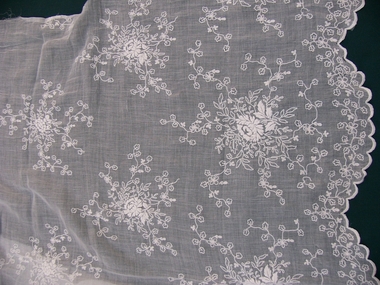
... Coggeshall Lace was made into dresses for the Queen, Princess Margaret and Princess Alexandra. This work was undertaken by three very proficient workers in Great Tey. ...Coggeshall Lace was made into dresses for the Queen, Princess Margaret and Princess Alexandra. This work was undertaken by three very proficient workers in Great Tey. ...Miss Bostock, Foundation member of the EGV, travelled to England and met with The Hon. Rachel Kay-Shuttleworth of Gawthorpe Hall. Rachel "cut" off many pieces from her extensive lace collection which were gifted to the EGV. A Brief History (Information from the work of the late Jean Dudding) About 1812 a French émigré, M. Drago and his two daughters settled in Coggeshall, Essex. Here they hired a room and began to teach the women and small children a method of decorating this net by using a tambour hook. Thus began the making of Coggeshall Lace (sometimes called tambour lace). Tambouring produces a line of chain stitches and originated in the Far East, where the workers used a round frame resembling a tambourine or drum. This they could grip between the knees, thereby releasing both hands for tambouring. Coggeshall workers used a rectangular frame and this type is still used today. Throughout the 19th century this tamboured net lace was made in the tambour rooms and cottages of Coggeshall, and also in the homes of surrounding villages. Lace manufacturers and lace dealers co-ordinated these workers by obtaining orders from London and elsewhere. Sometimes more sophisticated designs were introduced and these would be tamboured by the more proficient workers. Besides the designs, all the necessary net and threads would also be distributed to the lace workers. Liberty & Co., amongst others, were supplied with Coggeshall Lace. The fluctuations in prosperity of the tambour lacemakers were governed by many factors. Fashion requiring flounces and frills gave great encouragement but the invention of chain stitch sewing machines and of machine made laces imitating the hand made article, together with a deterioration in the quality of design meant hard times for the laceworkers. Just after 1900 there was a great improvement in the quality of Coggeshall Lace. This was due largely to the activities of two ladies, the Misses Spurge, who were the chief employers in the district. Their brother William was an art teacher who improved the general standard of design and also introduced some old Italian designs. The First World War resulted in a decline in the making of Coggeshall Lace. The workers found it more profitable to do tambour beading. In the 1930's a determined effort was made to revive the making of Coggeshall Lace, and three handkerchiefs were given to Princess Marina on her marriage (See below). Coggeshall Lace was made into dresses for the Queen, Princess Margaret and Princess Alexandra. This work was undertaken by three very proficient workers in Great Tey. Queen Mary also chose two lace dresses and a teacloth in Coggeshall Lace. It was hoped that this Royal Patronage would encourage a revival of the craft. However the financial return was too meagre and after the Second World War both net and threads disappeared. Today Coggeshall lace is made by some members of the Lacemakers Guild and is taught as part of the City and Guilds course. https://coggeshallmuseum.org.uk/lace1.htm White muslin, with sprays of roses in white satin stitch, surrounded by delicate tambour embroidery known as Coggeshall embroidery. Coggeshall being a town in Essex.embroidery, garments, whitework, england, tambour work, early 18th century -
 Bendigo Historical Society Inc.
Financial record - INVOICE COLLECTION: Various Businesses
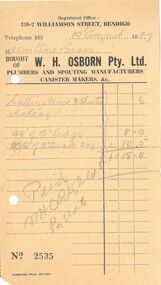
... The page has two punched holes in the left side, along a perforated edge. the header reads: Payne & Whitington Joinery Works McKenzie Street, Alexandra, Vic. Phone: 13 Handwritten in blue pen, the receipt is dated 2 April 1951. price of items is listed in pound reading 236 pound, 8 shilling and 7 pence....The page has two punched holes in the left side, along a perforated edge. the header reads: Payne & Whitington Joinery Works McKenzie Street, Alexandra, Vic. Phone: 13 Handwritten in blue pen, the receipt is dated 2 April 1951. price of items is listed in pound reading 236 pound, 8 shilling and 7 pence. ...10934.38a: no. 2535 A small rectangular piece of paper with the header and body printed in black ink. The page has two punched holes in the left side, along a perforated edge. the header reads: Bought of W. H. Osborn Pty. Ltd. Plumbers and spouting manufacturers, canister makers, &c. 130-2 Williamson Street, Bendigo. telephone 162 typed in black ink, the receipt is dated 19 August 1949. price of items is pounds, reading 1 pound, 18 shillings and 11 pence. 10934.38b: no. 4042 A cut rectangular piece of paper with the header and body printed in blue ink. The page has 2 punched holes in the left-hand side. the header reads: Bought of Mayfair Distributors Pty. Ltd. Incorporated in New South Wales. Distributors of Mayfair brand products. Telegraphic Address: Maypack, Bendigo Telephone: Bendigo 406 P.O. Box 90 typed in black ink, the receipt is dated 12 August 1947. price of items is pounds, reading 1 pound, 19 shillings and 1 pence. 10934.38c: no. 468 A small, square piece of paper printed with the header and body printed in black ink. The page has to punched holes in the left side, along a perforated edge. the header reads: Northern Terrazzo Co. G. Miles, Prop. Lyttleton Terrace, Bendigo Memorial Work A speciality - washtroughs, sinks, baths etc. Phone 319 Handwritten in grey lead pencil, the receipt is dated 12 April 1939. price of items is listed in pound reading 1 pound, 1 shilling. 10934.38d: no. 2155 A small, rectangle piece of paper printed with the header and body printed in black ink. The page has two punched holes in the left side, along a perforated edge. the header reads: Payne & Whitington Joinery Works McKenzie Street, Alexandra, Vic. Phone: 13 Handwritten in blue pen, the receipt is dated 2 April 1951. price of items is listed in pound reading 236 pound, 8 shilling and 7 pence.ac morton, northern terrazzo co, payne and whitington, wh osborn, mayfair distribuors -
 Ballarat Tramway Museum
Slide - 35mm slide/s - set of 12, Noel Simons, 28 Feb. 1972
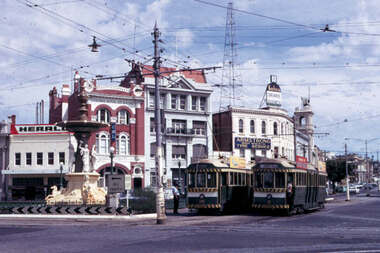
... in the background. 1207.2 - as for 1207.1 but with Alexandra fountain in the foreground. 1207.3 - No. 2 in Mitchell St. heading for Quarry Hill. ...Has the Colonial Mutual Life, Armstrong Tyre Service, and Australian Mutual Provident Society buildings and a Cohns Drinks ad. in the background. 1207.2 - as for 1207.1 but with Alexandra fountain in the foreground. 1207.3 - No. 2 in Mitchell St. heading for Quarry Hill. ...Set of 12 transparencies taken on 28/2/1972 on Kodak mounts. 1207.1 - Bendigo 26 and 2 at Charing Cross. 26 en route for Eaglehawk, 2 for Quarry Hill. Has the Colonial Mutual Life, Armstrong Tyre Service, and Australian Mutual Provident Society buildings and a Cohns Drinks ad. in the background. 1207.2 - as for 1207.1 but with Alexandra fountain in the foreground. 1207.3 - No. 2 in Mitchell St. heading for Quarry Hill. Photo taken after tram has passed photographer. Has buildings on either side of Mitchell St. in the background, including the Plaza Theatre. 1207.4 - No. 6 en route for Golden Square departing Charing Cross. Has the RACV and ANZ bank in the background. 1207.5 - No. 2 crossing Pall Mall to enter Charing Cross ex Quarry Hill, with the Fountain Plaza in the background. 1207.6 - No. 6 arriving Charing Cross ex Golden Square with No. 21 alongside. No. 21 has the SEC ad. 'Everything's fine in my all electric kitchen.' Has the City Family Hotel and the Fountain Plaza shopping centre in the background. 1207.7 - No. 5 at Charing Cross en route for Quarry Hill with No. 2 behind. No. 2 has two SEC roof ads, 'Everything s fine in my all electric kitchen' and 'Electricity best for cooking'. RACV building in the background. Tram crews are discussing the day in the front of the tram. 1207. 8 - No. 21 in High St. Bendigo with the Cathedral in the background. No. 21 has two SEC roof ads, 'Everything's fine in my all electric kitchen' and 'Electricity best for cooking'. 1207.9 - No. 6 in High St. Bendigo with the Cathedral in the background. 1207.10 - No. 6 in High St. Bendigo, just past Wattle St. Photo taken after the tram has passed the photographer from within the Highway Car Sales yard. 1207.11 - No. 26 bound for Eaglehawk at the end of the double track in View St., note signal contactors, tram stop and section signs mounted on pole. 1207.12 - No. 26 turning from View St. into Barnard St.Information written on in blue ink and date stamped on purple ink. 1207. 1- "Nos. 26 and 2 at Charing Cross." 1207.2 - "Nos. 26 and 2 at Charing Cross." 1207.3 - "No. 2 in Mitchell St. just after leaving Charing Cross." 1207.4 - "No.6 leaving Charing Cross for Golden Square." 1207.5 - "No. 2 arriving at Charing Cross from Quarry Hill." 1207.6 - "No. 21 waits at Charing Cross as No. 6 arrives from Golden Square." 1207.7 - "No 5 at Charing Cross with No. 2 lurking behind." 1207.8 - "No. 21 in High St. at cnr of Wattle St." 1207.9 - "No. 6 in High St. at cnr of Wattle St." 1207.10 - "No. 6 in High St. between Wattle and Vine Sts." 1207.11 - "No. 26 at end of double track in View St. near Barnard. St. 1207.12 - "No. 26 seen at dusk turning from View St. into Barnard St."tramways, trams, bendigo, charing cross, high st, view st., tram 2, tram 5, tram 6, tram 21, tram 26 -
 Ballarat Tramway Museum
Postcard, Nucolorvue postcards - Bendigo
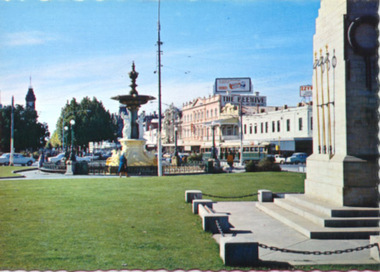
... Series of six (6) Nucolorvue postcards with serrated edges of scenes around Bendigo featuring Bendigo trams under the operation of either the SECV or the Bendigo Trust. 963.1 - "The Cenotaph and Alexandra Fountain" at Charing Cross. Has Bendigo bogie car in background. ...Trams tramways Bendigo The Bendigo Trust Charing Cross Royal Visit tram 37 Series of six (6) Nucolorvue postcards with serrated edges of scenes around Bendigo featuring Bendigo trams under the operation of either the SECV or the Bendigo Trust. 963.1 - "The Cenotaph and Alexandra Fountain" at Charing Cross. Has Bendigo bogie car in background. ...Series of six (6) Nucolorvue postcards with serrated edges of scenes around Bendigo featuring Bendigo trams under the operation of either the SECV or the Bendigo Trust. 963.1 - "The Cenotaph and Alexandra Fountain" at Charing Cross. Has Bendigo bogie car in background. Also the Beehive building and Ezywalkin shoes. Nucolorvue postcard BE41 on rear and other information in green ink. 963.2 - "Tram No. 25, a maximum traction car built in 1916. Now operated by The Bendigo Trust between Central Deborah Mine and Emu Point." Features No. 25 in Bendigo Trust colours with Coca Cola and Bendigo Timber Co ads on the roof. On nearby pole is a "Bendigo Talking Vintage Tram" signs. In background is the Beehive building and other buildings near Charing Cross. Nucolorvue postcard BE52 on rear and other information in green ink. 963.3 - "Birney Tram No. 30 decorated for a Royal Tour occasion. The Bendigo trust operates this tram and others on a tourist service between Central Deborah Mine and the Chinese Joss House at Emu Point." Features No. 30 decorated for a visit of Prince Charles, 26/10/1974 with crown, Australian and English flags. Has Myer building in the background. On adjacent pole are two signs "Cars stop on Request". Nucolorvue postcard BE 44 on rear and information in green ink. 963.4 - "The Central Deborah Gold Mine and a vintage tram operated by the Bendigo Trust" Features Birney No. 28 at the mine terminus. Nucolorvue postcard BE48 on rear and other information in green ink. 963.5 - "Charing Cross Bendigo Vic." featuring SECV trams 5, 19 and other bogie car crossing street heading for Quarry Hill. Has Fountain Plaza building in background. Nucolorvue and other information in brown ink. 963.6 - "The Sacred Heart Cathedral looking from High St." Has tram 25 in Bendigo Trust colour running along street in front of Cathedral. Work to complete the spire on the Cathedral underway. Nucolorvue postcard BE47 and other information on rear in green ink. Bendigo Vintage Talking Trams - K.S.Kingstrams, tramways, bendigo, the bendigo trust, charing cross, royal visit, tram 37 -
 Marysville & District Historical Society
Ephemera (Item) - Tourist brochure, Victorian Government Tourist Bureau, Marysville Victoria Australia, Unknown
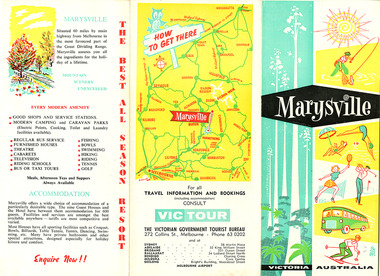
... ...alexandra...A tourist brochure on Marysville and the surrounding area published by the Victorian Government Tourist Bureau for the Marysville Tourist and Progress Association. marysville victoria tourist brochure victorian government tourist bureau cumberland valley cumberland falls cora-lyn falls robart's lookout meeting of the waters warburton acheron way healesville launching place reefton spur upper yarra dam maroondah highway black spur maroondah dam alexandra mansfield jamieson wood's point eildon weir snob's creek rubicon lake mountain marysville tourist and progress association the cumberland kerami guest house kooringa guest house marylands guest house marylyn guesthouse marysville hotel mount kitchener house barton brothers' store fruit salad farm marysville dairy marysville caravan park marysville garage marysville riding school marysville theatre mckenzie's tourist services potters fruit and milk bar arosa holiday cottages scenic motel beauty spot walk red hill walk wishing well taggerty river mount gordon steavenson falls keppel's lookout keppel's falls A tourist brochure on Marysville and the surrounding area published by the Victorian Government Tourist Bureau for the Marysville Tourist and Progress Association. ...A tourist brochure on Marysville and the surrounding area published by the Victorian Government Tourist Bureau for the Marysville Tourist and Progress Association.A tourist brochure on Marysville and the surrounding area published by the Victorian Government Tourist Bureau for the Marysville Tourist and Progress Association.marysville, victoria, tourist brochure, victorian government tourist bureau, cumberland valley, cumberland falls, cora-lyn falls, robart's lookout, meeting of the waters, warburton, acheron way, healesville, launching place, reefton spur, upper yarra dam, maroondah highway, black spur, maroondah dam, alexandra, mansfield, jamieson, wood's point, eildon weir, snob's creek, rubicon, lake mountain, marysville tourist and progress association, the cumberland, kerami guest house, kooringa guest house, marylands guest house, marylyn guesthouse, marysville hotel, mount kitchener house, barton brothers' store, fruit salad farm, marysville dairy, marysville caravan park, marysville garage, marysville riding school, marysville theatre, mckenzie's tourist services, potters fruit and milk bar, arosa holiday cottages, scenic motel, beauty spot walk, red hill walk, wishing well, taggerty river, mount gordon, steavenson falls, keppel's lookout, keppel's falls -
 Marysville & District Historical Society
Ephemera (Item) - Tourist brochure, Victorian Government Tourist Bureau, Marysville Victoria Australia, Unknown
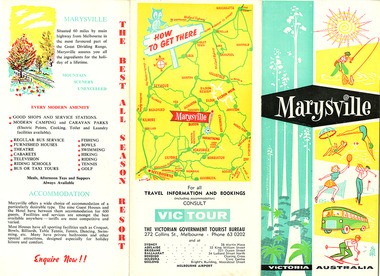
... ...alexandra...A tourist brochure on Marysville and the surrounding area published by the Victorian Government Tourist Bureau for the Marysville Tourist and Progress Association. marysville victoria tourist brochure victorian government tourist bureau cumberland valley cumberland falls cora-lyn falls robart's lookout meeting of the waters warburton acheron way healesville launching place reefton spur upper yarra dam maroondah highway black spur maroondah dam alexandra mansfield jamieson wood's point eildon weir snob's creek rubicon lake mountain marysville tourist and progress association the cumberland kerami guest house kooringa guest house marylands guest house marylyn guesthouse marysville hotel mount kitchener house barton brothers' store fruit salad farm marysville dairy marysville caravan park marysville garage marysville riding school marysville theatre mckenzie's tourist services potters fruit and milk bar arosa holiday cottages scenic motel beauty spot walk red hill walk wishing well taggerty river mount gordon steavenson falls keppel's lookout keppel's falls A tourist brochure on Marysville and the surrounding area published by the Victorian Government Tourist Bureau for the Marysville Tourist and Progress Association. ...A tourist brochure on Marysville and the surrounding area published by the Victorian Government Tourist Bureau for the Marysville Tourist and Progress Association.A tourist brochure on Marysville and the surrounding area published by the Victorian Government Tourist Bureau for the Marysville Tourist and Progress Association.marysville, victoria, tourist brochure, victorian government tourist bureau, cumberland valley, cumberland falls, cora-lyn falls, robart's lookout, meeting of the waters, warburton, acheron way, healesville, launching place, reefton spur, upper yarra dam, maroondah highway, black spur, maroondah dam, alexandra, mansfield, jamieson, wood's point, eildon weir, snob's creek, rubicon, lake mountain, marysville tourist and progress association, the cumberland, kerami guest house, kooringa guest house, marylands guest house, marylyn guesthouse, marysville hotel, mount kitchener house, barton brothers' store, fruit salad farm, marysville dairy, marysville caravan park, marysville garage, marysville riding school, marysville theatre, mckenzie's tourist services, potters fruit and milk bar, arosa holiday cottages, scenic motel, beauty spot walk, red hill walk, wishing well, taggerty river, mount gordon, steavenson falls, keppel's lookout, keppel's falls -
 Bendigo Historical Society Inc.
Document - LIST OF FRIENDLY SOCIETIES: BENDIGO
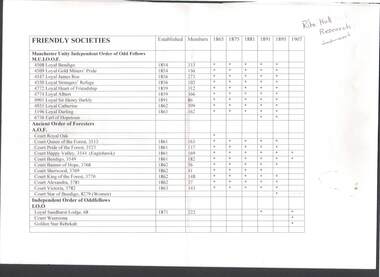
... . - Court Royal Oak, Court Queen of the Forest, Court Pride of the Forest, Court Happy Valley, Court Bendigo, Court Banner of Hope, Court Sherwood, Court King of the Forest, Court Alexandra, Court Victoria and Court Star of Bendigo (Women). .... - Court Royal Oak, Court Queen of the Forest, Court Pride of the Forest, Court Happy Valley, Court Bendigo, Court Banner of Hope, Court Sherwood, Court King of the Forest, Court Alexandra, Court Victoria and Court Star of Bendigo (Women). ...Three pages of research by Rita Hull on Friendly Societies. Includes name of Society, when established, the number of Members, and the years 1865,1875, 1881,1891, 1895 and 1907 (an asterisk if they were still operating). Listed are the Society names and the different Court, Lodge, etc. under the name. They are: Manchester Unity Independent Order of Odd Fellows M.U.I.O.O.F. - Loyal Bendigo Loyal Gold Miners' Pride, Loyal James Roe, Loyal Strangers' Refuge, Loyal Heart of Friendship, Loyal Albert, Loyal Sir Henry Barkly, Loyal Catherine, Loyal Darling and Earl of Hopetoun. Ancient Order of Foresters A.O.F. - Court Royal Oak, Court Queen of the Forest, Court Pride of the Forest, Court Happy Valley, Court Bendigo, Court Banner of Hope, Court Sherwood, Court King of the Forest, Court Alexandra, Court Victoria and Court Star of Bendigo (Women). Independent Order of Oddfellows I.O.O. - Loyal Sandhurst Lodge, Court Weeroona and Golden Star Rebekah. Independent Order of Rechabites I.O.R. - Tent Star of Bendigo, Tent Refuge, Tent Cobden, Tent Olive Branch, Tent Laurel, Tent Sutton and Tent Herald of Peace. Sons and Daughters of Temperance - Royal Diadem Division, Ark of Safety, Royal Septre, Hope of Sandhurst (Ladies), Princess Beatrice (Ladies), Lady Loch (Ladies) and Laurel (Ladies). Grand United Order of Oddfellows G.U.O.O.F. - Lodge Star of Eaglehawk, Lodge Sandhurst, Lodge Pride of Bendigo, Lodge Olive Branch and Lodge Belvidere. United Ancient Order of Druids U.A.O.D. - Lodge Quartzopolis, Lodge Eldorado, Lodge Caractacus, Lodge Bendigo and Lodge Sandhurst. Order of St Andrew (Scottish Constitution) - Bendigo Lodge No 1. Order of St Andrew (All Nations) - Lodge Sandhurst and Lodge Unity. Royal Antediluvian Order of Buffaloes R.A.O.B. - Provincial Grand Lodge No 1, Prairie Lodge, Forest Lodge and Southern Cross Lodge. The Hibernian Australasian Catholic Benefit Society H.A.C.B.S. - St Kilian's No 4 and Eaglehawk Branch. Independent Order of Good Templars - Lodge Bendigo, Lodge Guiding Star, and Lodge Hope of Golden Square. Loyal Orange Institution of Victoria - Lodge William Lodge and Loyal Governor Bowen (Pride of Eaglehawksocieties, order of .., list, list of friendly societies, rita hull, manchester unity independent order of odd fellows m.u.i.o.o.f., ancient order of foresters a.o.f., independent order of oddfellows i.o.o., independent order of rechabites i.o.r., sons and daughters of temperance, grand united order of oddfellows g.u.o.o.f., united ancient order of druids u.a.o.d., order of st andrew (scottish constitution), order of st andrew (all nations), royal antediluvian order of buffaloes r.a.o.b., the hibernian australasian catholic benefit society h.a.c.b.s., independent order of good templars, loyal orange institution of victoria, australian natives association a.n.a. -
 Marysville & District Historical Society
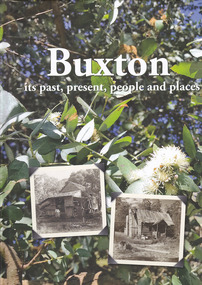
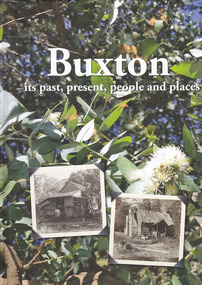
Book - Hardcover book, The Buxton Progress Association Inc, Buxton-its past, present, people and places, 2023
... Thank you to the following people whose knowledge and support filled in some gaps during the editing process: Leanne Croucher (Wells),/ Wendy Henderson (Jones), Helen Elliott (Smith), Brian Worcester, Lyn Pope, Lorraine Whitehead, Joy Burchell (Alexandra and District Historical/ Society), Harry and Pat Whiteley, Heather Davey (Scott family), Margaret Carlton (Jones), Loris Wells (Jones), David Perry, Wayne Fiske,/ Kingsley Fiske, Laraine Padgham, Angela Ten Buuren, David Sorrell, Ian Jones, Ramon Jones, Ken Carlton, Bruce Ackerman, Yvonne Bellingham,/ Peter Birtchnell, Danny Hogan, Les Perry, Sue Talbot, Geoff Sharrock, Ken Foletta, Shirley Johns, Graeme Robb, Linda Ellis, John Mole,/ Catherine Broderick, Rene DeKoning via the Marysville and District Historical Society, Beth Thorp, Ron Menz, Vicki Moritz, Robin Rishworth,/ Marianne Menz, and so many more I may have missed. ...Thank you to the following people whose knowledge and support filled in some gaps during the editing process: Leanne Croucher (Wells),/ Wendy Henderson (Jones), Helen Elliott (Smith), Brian Worcester, Lyn Pope, Lorraine Whitehead, Joy Burchell (Alexandra and District Historical/ Society), Harry and Pat Whiteley, Heather Davey (Scott family), Margaret Carlton (Jones), Loris Wells (Jones), David Perry, Wayne Fiske,/ Kingsley Fiske, Laraine Padgham, Angela Ten Buuren, David Sorrell, Ian Jones, Ramon Jones, Ken Carlton, Bruce Ackerman, Yvonne Bellingham,/ Peter Birtchnell, Danny Hogan, Les Perry, Sue Talbot, Geoff Sharrock, Ken Foletta, Shirley Johns, Graeme Robb, Linda Ellis, John Mole,/ Catherine Broderick, Rene DeKoning via the Marysville and District Historical Society, Beth Thorp, Ron Menz, Vicki Moritz, Robin Rishworth,/ Marianne Menz, and so many more I may have missed. ...A book that was produced by The Buxton Progress Association on the history of Buxton and its people through the eyes of its people.Hardcover. A book that was produced by The Buxton Progress Association on the history of Buxton and its people through the eyes of its people.non-fictionA book that was produced by The Buxton Progress Association on the history of Buxton and its people through the eyes of its people.buxton, victoria, local history, australia -
 Marysville & District Historical Society
Book - Hardcover book, The Buxton Progress Association Inc, Buxton-its past, present, people and places, 2023
... Thank you to the following people whose knowledge and support filled in some gaps during the editing process: Leanne Croucher (Wells),/ Wendy Henderson (Jones), Helen Elliott (Smith), Brian Worcester, Lyn Pope, Lorraine Whitehead, Joy Burchell (Alexandra and District Historical/ Society), Harry and Pat Whiteley, Heather Davey (Scott family), Margaret Carlton (Jones), Loris Wells (Jones), David Perry, Wayne Fiske,/ Kingsley Fiske, Laraine Padgham, Angela Ten Buuren, David Sorrell, Ian Jones, Ramon Jones, Ken Carlton, Bruce Ackerman, Yvonne Bellingham,/ Peter Birtchnell, Danny Hogan, Les Perry, Sue Talbot, Geoff Sharrock, Ken Foletta, Shirley Johns, Graeme Robb, Linda Ellis, John Mole,/ Catherine Broderick, Rene DeKoning via the Marysville and District Historical Society, Beth Thorp, Ron Menz, Vicki Moritz, Robin Rishworth,/ Marianne Menz, and so many more I may have missed. ...Thank you to the following people whose knowledge and support filled in some gaps during the editing process: Leanne Croucher (Wells),/ Wendy Henderson (Jones), Helen Elliott (Smith), Brian Worcester, Lyn Pope, Lorraine Whitehead, Joy Burchell (Alexandra and District Historical/ Society), Harry and Pat Whiteley, Heather Davey (Scott family), Margaret Carlton (Jones), Loris Wells (Jones), David Perry, Wayne Fiske,/ Kingsley Fiske, Laraine Padgham, Angela Ten Buuren, David Sorrell, Ian Jones, Ramon Jones, Ken Carlton, Bruce Ackerman, Yvonne Bellingham,/ Peter Birtchnell, Danny Hogan, Les Perry, Sue Talbot, Geoff Sharrock, Ken Foletta, Shirley Johns, Graeme Robb, Linda Ellis, John Mole,/ Catherine Broderick, Rene DeKoning via the Marysville and District Historical Society, Beth Thorp, Ron Menz, Vicki Moritz, Robin Rishworth,/ Marianne Menz, and so many more I may have missed. ...A book that was produced by The Buxton Progress Association on the history of Buxton and its people through the eyes of its people.Hardcover. A book that was produced by The Buxton Progress Association on the history of Buxton and its people through the eyes of its people.non-fictionA book that was produced by The Buxton Progress Association on the history of Buxton and its people through the eyes of its people.buxton, victoria, local history, australia -
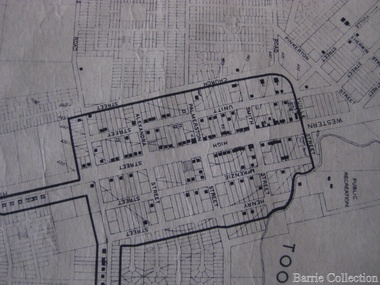 Melton City Libraries
Map, Streets of Melton, 1963
... Alphabetical List Aboriginal place names, Early Family Names and landowners, Agricultural, Shop and Commercial premises, Places and Events Melton & District Historical Society Street Naming Project 1972 – c 1998 Suburb Name – KURUNJANG - Kirkton, 1972, Brookfield, West, 1988 Melton and Town Centre - A joint collaboration with the Shire of Melton and Subdivision Developers ARNOLD Court – Family house - Arnolds Creek ALKEMADE Drive Family – Lime kilns Coimadia ALEXANDRA Street 1902 – Corination of King Edward VII and Queen Alexandra AVIATOR Place Event, location of plane crash – Jimmy Melrose 1936 Adina ?...Alphabetical List Aboriginal place names, Early Family Names and landowners, Agricultural, Shop and Commercial premises, Places and Events Melton & District Historical Society Street Naming Project 1972 – c 1998 Suburb Name – KURUNJANG - Kirkton, 1972, Brookfield, West, 1988 Melton and Town Centre - A joint collaboration with the Shire of Melton and Subdivision Developers ARNOLD Court – Family house - Arnolds Creek ALKEMADE Drive Family – Lime kilns Coimadia ALEXANDRA Street 1902 – Corination of King Edward VII and Queen Alexandra AVIATOR Place Event, location of plane crash – Jimmy Melrose 1936 Adina ? ...MELTON’S STREETS Heritage Week 2014 What’s in a Name? Alphabetical List Aboriginal place names, Early Family Names and landowners, Agricultural, Shop and Commercial premises, Places and Events Melton & District Historical Society Street Naming Project 1972 – c 1998 Suburb Name – KURUNJANG - Kirkton, 1972, Brookfield, West, 1988 Melton and Town Centre - A joint collaboration with the Shire of Melton and Subdivision Developers ARNOLD Court – Family house - Arnolds Creek ALKEMADE Drive Family – Lime kilns Coimadia ALEXANDRA Street 1902 – Corination of King Edward VII and Queen Alexandra AVIATOR Place Event, location of plane crash – Jimmy Melrose 1936 Adina ?Annibee - Anniba? Agricultural Avon court .. .. BAKERY Square - Location of Jongebloed shop, bakehouse and stables BALUK Place Aboriginal BARLEYCORN Place Agricultural BILLING Place Name of Jimmy Melrose Uncle Noel Pemberton Billing BLACKWOOD Drive - Alexander Blackwood 1860c Registrar BARRIES Road C. E. Barrie “Darlingsford” farmer 1911, chaff mill owner BROOKLYN Road Staughton family residence. 1875 – Dismantled c 193? CAHILL Drive Family - Glenville Dairy CAMERON Court Family Canopus Place ? CANALLAN Drive Early Surveyor CAMPBELL Court Aviation – Melrose passenger 6th July 1936 CARBERRY Drive Michael, early landowner family CAREW Court Edward and Michael. Royal Hotel. Vera (Carew) Forran Singer - Opera CASEY Court Family CASHIN Court Family CHEVIOT Court Agriculture, breed of sheep CHESNEY Road was re named ( Minns Road being duplicated c 1973) CHRISTINA Crescent Christina McPherson, daughter of James and Mary Mary McPherson. Died 1955 aged 85 years COLLYER Close a deleted street (parallel to Yuille) re-used CORRIEDALE Road Breed of sheep CORR Court Teacher at first school, landowner CROXTON Court Name of the Hornbuckle and Knox family home DALEY Court - William Daley and family 1865 Bootmaker High Street DARLINGSFORD Boulevard - Name of early homestead Thomas B Darling 1853 DJERRIWARRH Court - Parish County of Bourke - very early map. DODEMAIDE Place Early land owners - Melton Football Team had 6 brothers playing c 1924 DONALD Court McPherson family 6 generations in Melton in 1936 DOUGAL Court DUNCAN Court .. .. DUNVEGAN Circuit Home of the McPherson family, castle Isle of Skye Name of bluestone house Smith Street (now at Willows) EMIL Court Jongebloed family EXELL Avenue Farming family Melton Sth- Closer Settlement 1907 EXFORD Road Exe former name of the Werribee river FARMER Court Name of early postmistress FERRIS Road John Ferris Farmer HANNAH Close First name of Hannah Watts – midwife HAYBALE Place Agricultural HELDER Court Early surveyor J Helder Wedge map HEWSON Street Winston Hewson Shire Engineer – check title c 1960 HENRY Street Township map c 1860 HESTON Street Heston Phoenix – C.J. Melrose plane HILDEGARDE Court Jimmy Melrose’s mothers name HOMESTEAD Close HORNBUCKLE Cres Farmers. Three members of family - Shire Presidents HURLEY Street Farmers IAIN Court Descendent of James and Mary McPherson JAMES MELROSE Drive Name appears on 2013 Melton information map JANG Place KURUN – jang KIRKTON Drive Name of the McPherson family home Toolern Vale Road KIRWIN Street Michael early landowners (deleted for freeway construction) KILPATRICKS Road Deleted when Barries Road was extended across Station Rd KOROROIT Court Early map, Parish of Kororoit. Creek name KNOX Circuit Family – Hornbuckle “Croxton Park” KURRUNJANG Drive Aboriginal name for people of the red earth – Suburb name Lara Place ? LLOYD Court Garage owners High Street. Laura lived to 100 years D 1955 LUBY Court John Luby – Crown Grant Land Title LITTLE Court MANNING Avenue Richard, hotel owner 1891 MARGARET Drive McPherson family McDONALD Street Melton South family name McKENZIE Street Township c1860 MORROW Street Early name MOWBRAY Crescent Name of English Melton, popularly believed origin of Melton MYERS Court Early setters c 1866 Crown Grant Land Title NIMMO Street Early name NIXON Street Name submitted by Mary nee Nixon Collins c1985 OLDERSHAW Road Early builder PALMERSTON Street Early township map c 1860 PEART Court Early name PENNYROYAL Avenue Plant growing by the creek. Early name used for the Toolern Toolam Creek PINKERTON Street Family name and early street map PINNACLE Crescent Agricultural - type of wheat PHOENIX Circuit C.J. Melrose Phoenix Heston Plane 2013 map PRATT Family PRIOR Court PYKE Place Brothers – early settlement 1838 RADFORD Court Land owners and business operators. Former Royal Hotel Grocer High Street demolished 1970 RAGLAN Court Hotel 19th century Lord Raglan RALEIGHS Road Oliver Reierson family (Norweigen) Shopkeeper – Dressmakers RIDDELL Drive (misspelt Riddle) Resident and land owner RODERICK Road McPherson family – a re occurring name ROLLAND Court Jones family ROSS Court Daniel. Landowner. Agnes Ross music teacher RUSSELL Court Robert. Early land surveyor of Melton 1853 RYAN Court Family early landowner. Member of the 1862 Road Board SHEBLER Place Augustus early Melton resident – Golden Fleece Hotel SHEEPFOLD Court Farming SHERWIN Court Sherwin Street earliest Township map– became Golf course SMITH Street Early township map. STRATHULLOH Circuit Strathtulloh Homestead. STAUGHTON Street Family – LARGE land owners Strachan ? SWANEY Court Marie Swaney earlier resident of Strathtulloh. SUTHERLAND Family name TOOLERN Street TOOLAM – TOOLERN Creek TULLIDGE St Road marked on 1861 map UNITT Street Early Township c 1860 WALLACE Square Cr Jack Wallace 5 terms as President 46 years unopposed WATTS Court Hannah Watts – midwife, cottage hospital WALSINGHAM Name of house of Minns family. From Walsingham Norfolk England WESTLEY Place Name of Jimmy Melrose Percival Gull Plane WESTLAKE Drive Early resident WHICKHAM Street Family Name Melton South WILSON Road Albert, Melton South YUILLE Street William Cross, early landowner, Rockbank run Zoomed in section of Melton Streets including Church and High Streetlandscapes of significance -
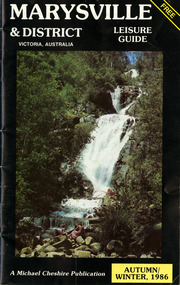 Marysville & District Historical Society
Booklet (Item) - Leisure guide, Michael Chesire & Associates Pty. Ltd, MARYSVILLE & DISTRICT LEISURE GUIDE-AUTUMN/WINTER, 1986, 1986
... ...alexandra...A free leisure guide to Marysville and the surrounding district published for Autumn and Winter, 1986. marysville victoria australia leisure guide michael cheshire & associates pty ltd marysville golf club blackwood lodges sir colin mackenzie fauna park lake eildon fraser national park yarra valley wineries marysville coach tours kooringa marylands guest house lady talbot forest drive wishing well taggerty river recreation area athols abbey phantom falls keppel falls the beeches walking track marylyn guest house kufstein inn motel the cumberland marysville tourist & progress association marysville newsagency & general store crossways restaurant & motel beauty spot walk tree fern gully walk michaeldene track keppel track woods lookout track marysville hotel motel lake mountain ski hire marysville recreation and fun park mytanta horseback safaris upper big river valley the big culvert marysville mountain view horse hire maryton park amber view holiday lodges cathedral restaurant the top shop tower motel menzes garage beauty spot nursery marysville ski hire lake mountain ski school faraway forest scenic motel buxton trout farm marysville hardware timbertop steakhouse marysville trout farm healesville sanctuary buxton hotel motel nanda binya lodge buxton antique and furniture mart the black spur inn hotel alexandra lake mountain geoffrey pope & associates A free leisure guide to Marysville and the surrounding district published for Autumn and Winter, 1986. ...A free leisure guide to Marysville and the surrounding district published for Autumn and Winter, 1986. This was produced by Michael Cheshire as a free publication to promote tourism in Marysville and the surrounding district. It includes maps of the Big River Valley, Cumberland Valley, Lady Talbot Forest Drive, the Marysville area, and the township of Marysville. It was released in the autumn of 1986 and was sponsored by the Marysville Tourist & Progress Association. The Association was formed in November 1907 to promote tourism within the area. This included the physical creation of signage, parklands, roads, and walks to various attractions. A free leisure guide to Marysville and the surrounding district published for Autumn and Winter, 1986.marysville, victoria, australia, leisure guide, michael cheshire & associates pty ltd, marysville golf club, blackwood lodges, sir colin mackenzie fauna park, lake eildon, fraser national park, yarra valley wineries, marysville coach tours, kooringa, marylands guest house, lady talbot forest drive, wishing well, taggerty river recreation area, athols abbey, phantom falls, keppel falls, the beeches walking track, marylyn guest house, kufstein inn motel, the cumberland, marysville tourist & progress association, marysville newsagency & general store, crossways restaurant & motel, beauty spot walk, tree fern gully walk, michaeldene track, keppel track, woods lookout track, marysville hotel motel, lake mountain ski hire, marysville recreation and fun park, mytanta horseback safaris, upper big river valley, the big culvert, marysville mountain view horse hire, maryton park, amber view holiday lodges, cathedral restaurant, the top shop, tower motel, menzes garage, beauty spot nursery, marysville ski hire, lake mountain ski school, faraway forest, scenic motel, buxton trout farm, marysville hardware, timbertop steakhouse, marysville trout farm, healesville sanctuary, buxton hotel motel, nanda binya lodge, buxton antique and furniture mart, the black spur inn hotel, alexandra, lake mountain, geoffrey pope & associates -
Bendigo Historical Society Inc.
Document - SPECIMEN COTTAGE COLLECTION: VARIOUS DOCUMENTS
... Royal Flying Doctor Service 1963 coach run and the 1963 coach run itinerary. 4028.21 Various newspaper clippings on Rosalind Park. 4028.22 Rosalind Park discovery walk brochure and heritage mosaic Rosalind Park lookout brochure. 4028.23 Camp Reserve, Rosalind Park, used and abused by James Lerk, also newspaper articles by James Lerk about Rosalind Park and various other documents relating to the Park. 4028.24 Rotary Club History - A bulletin from 1971 and two cards in the name of Albert Richardson. 4028.25 History Lives: Bendigo east's Anzac Avenue photographs and documents. 4028.26 Short biography of John Walker. 4028.27 Restoring our heritage - The Beehive story. 4028.28 Documents about the Bendigo Advertiser, including historical notes by Carol Holsworth and notes given in 2005 by Leanne Younes. 4028.29 Document - National Trust of Australia: City of Bendigo abattoirs (form, 47 Lansell Street. 4028.30 The Alexandra Fountain by Lucy Williams also newspaper clippings and a document from the RHSV. 4028.31 Newspaper clippings and correspondence on the demolition of the A.N.A. building....Royal Flying Doctor Service 1963 coach run and the 1963 coach run itinerary. 4028.21 Various newspaper clippings on Rosalind Park. 4028.22 Rosalind Park discovery walk brochure and heritage mosaic Rosalind Park lookout brochure. 4028.23 Camp Reserve, Rosalind Park, used and abused by James Lerk, also newspaper articles by James Lerk about Rosalind Park and various other documents relating to the Park. 4028.24 Rotary Club History - A bulletin from 1971 and two cards in the name of Albert Richardson. 4028.25 History Lives: Bendigo east's Anzac Avenue photographs and documents. 4028.26 Short biography of John Walker. 4028.27 Restoring our heritage - The Beehive story. 4028.28 Documents about the Bendigo Advertiser, including historical notes by Carol Holsworth and notes given in 2005 by Leanne Younes. 4028.29 Document - National Trust of Australia: City of Bendigo abattoirs (form, 47 Lansell Street. 4028.30 The Alexandra Fountain by Lucy Williams also newspaper clippings and a document from the RHSV. 4028.31 Newspaper clippings and correspondence on the demolition of the A.N.A. building. ...Various documents in plastic folders. The topics are: 4028.1. The Myer story - articles on the history of the Myer family and business. 4028.2 The history of the Bendigo Railway and memoirs of early train travel by Bob Carr. 4028.3 Victorian history of railway and Bendigo, linking a state. 4028.4 A brief history of steam locomotives R711 and R766. 4028.5 Bendigo Advertiser article: coming of the railway with 4 photos. 4028.6 Celebrating 150 years of rail in Bendigo brochure plus postcard and Bendigo Railway Museum newsletter. 4028.7 Phoenix FM radio interview 13th September 2011. interviewer John Hall, guest: Garry Long, Convenor friends of the Bendigo-Kilmore rail trail. 4028.8 Mail by rail by Tom Luke and Railway history Leo Hogan. 4028.9 Document on the Red Ribbon Movement. 4028.10 Document - Sport in Bendigo in the early days. 4028.11 History of the Girton Church of England Girls' Grammar School with a list of prominent students. 4028.12 Bendigo's loss-Chinese secret society's gain? Talk given by Carol Holsworth. 4028.13 Document - Bendigo in the fifties. 4028.14 Jones, Miller & Co. history. 4028.15 Transcript of an audio tape by Cyril Michelsen, black and white photo and newspaper article. 4028.16 A garden history by Ken Maes. 4028.17 Document - Marsh and Scholten Coach builders. 4028.18 Notes from the diary of Thomas Ninnes, newspaper articles on the restoration of the Ninnes grave. 4028.19 Sandhurst 1853-54 The Southern world Rev. Robert Young. 4028.20 Correspondence from Cobb & Co. Royal Flying Doctor Service 1963 coach run and the 1963 coach run itinerary. 4028.21 Various newspaper clippings on Rosalind Park. 4028.22 Rosalind Park discovery walk brochure and heritage mosaic Rosalind Park lookout brochure. 4028.23 Camp Reserve, Rosalind Park, used and abused by James Lerk, also newspaper articles by James Lerk about Rosalind Park and various other documents relating to the Park. 4028.24 Rotary Club History - A bulletin from 1971 and two cards in the name of Albert Richardson. 4028.25 History Lives: Bendigo east's Anzac Avenue photographs and documents. 4028.26 Short biography of John Walker. 4028.27 Restoring our heritage - The Beehive story. 4028.28 Documents about the Bendigo Advertiser, including historical notes by Carol Holsworth and notes given in 2005 by Leanne Younes. 4028.29 Document - National Trust of Australia: City of Bendigo abattoirs (form, 47 Lansell Street. 4028.30 The Alexandra Fountain by Lucy Williams also newspaper clippings and a document from the RHSV. 4028.31 Newspaper clippings and correspondence on the demolition of the A.N.A. building.bendigo, businesses, buildings, heritage -
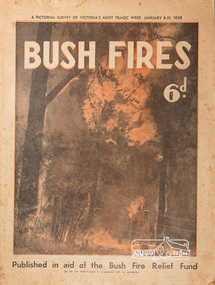 Eltham District Historical Society Inc
Magazine, Sun News-Pictorial, Bush Fires: A pictorial survey of Victoria's most tragic week, January 8-15, 1939, 1939
... Twelve died at a Rubicon mill, five on the road at Narbethong. At Alexandra, not far distant, a baby was born while the fires raged, and stretcher-bearers brought in the injured. ...Twelve died at a Rubicon mill, five on the road at Narbethong. At Alexandra, not far distant, a baby was born while the fires raged, and stretcher-bearers brought in the injured. ...THE WEEK REVIEWED (Article; Bush Fires: A pictorial survey of Victoria's most tragic week, January 8-15, 1939. Published in aid of the Bush Fire Relief Fund by the Sun News-Pictorial in co-operation with its newsagents, pp2-3) THE fiercest bush fires Australia has known since its discovery are quiescent at the moment, and Victoria, in the comparative coolness of the change which came with rain on Sunday night, has begun·to count its losses. In the fiery eight days, from Sunday to Sunday, at least sixty-six men, women and children have lost their lives in forest fires, or have succumbed to burns and shock; many others have died from heat; and several serious cases of burns are being treated in hospitals. Two babies in Narrandera district have died, and ten others are in hospital, because of milk soured by the record temperatures of those eight days. Forest damage totals at least a million pounds, and incalculable damage has been done to the seedlings which were to have been the forests of the future. Water conservation will be seriously affected by the silting-up of reservoirs and streams from which protective timber has been taken by the all-engulfing flames. More than a thousand houses have been destroyed, and these, with 40 mills, and schools, post-offices, churches, and other buildings, represent a loss of at least half a million. At least 1500 are homeless. For their aid, money raised in appeals has now passed the £50,000 mark, and the biggest relief organisation ever set up in peace time has swung into operation. The First Hint Victoria's first hint of what was to come appeared on Sunday, January 8, when most parts of the State awoke to find a blistering day awaiting. At 12.20 p.m., when the thermometer reached its highest for the day, 109.6 degrees, the first fire victims were at that moment going to their death on a bush track five feet wide off the main road to Narbethong. They were the forestry officers Charles Isaac Demby and John Hartley Barling, who went to warn Demby of his danger when he parted from his companions, and was himself surrounded by the treacherous fire. It was not until 8 o'clock next morning that the tragic news was flashed throughout the State. Searchers found the two charred bodies close together, one seeking protection in the nook of two logs. Barling's watch had stopped at 1.20. In the meantime, tragedy was spreading its cloak. By Monday, big fires were raging at Toolangi, Erica, Yallourn, Monbulk, Frankston, Dromana, Drouin South, Glenburn, and Blackwood, with smaller outbreaks at many other centres. In the ensuing week, while women and children were evacuated as fast as the flames would permit, Erica-scene of the 1926 fire disaster-thrice escaped doom by a change of wind. Indeed, those who have been in the fire country these past days say that the numbers of times a change of wind has saved towns from destruction is amazing. In the towns they speak of miracles. Monday's Miracles The escapes from Monett's Mill at Erica and from the Hardwood Company's Mill at Murrindindi, near where Demby and Barling went to their death, were Monday's miracles. Twenty came out alive from each mill. At the first a 60ft. dugout provided an oven-like refuge; at the second, 12 women and children survived in the smoke-filled gloom of a three-roomed cottage while their eight men, their clothes sometimes afire, poured water on the wooden walls. Three houses out of ten remained when the fire had passed. Record Temperatures Sunday had been the hottest Melbourne day for 33 years; Monday dropped to a 76.1 degree maximum; but Tuesday dawned hotter than ever, the mercury reaching 112.5. By now rumor was racing ahead of fact; whole towns were being reported lost; the alarm was raised for scores of missing persons. But fact soon overtook rumor, and within a few days the staggering toll began to mount to a figure beyond the wildest imaginings of the panic-stricken. Six died from heat on this torrid Tuesday, and the fires spread in a wide swathe from south-west to north-east across the State. Fish died in shallow streams. A curtain of smoke hid the sky from all Victoria, and hung far out to sea. It alarmed passengers on ships. On the Ormonde, on the voyage to Sydney from Burnie, women ran on deck, believing fire had broken out in the hold. Days later the smoke reached New Zealand. In Melbourne thousands of fire-volunteers were leaving in cars: vans, motor-buses-anything reliable on wheels-to aid the country in its grim fight. In the fires at Rubicon and. Narbethong, seventeen were facing death this day. But not till Wednesday, when Melbourne breathed again in a cool change, while the country still sweltered in temperatures up to 117 degrees, did the news come through the tree blocked roads. A woman and her little daughter, trapped on the road, were among those who died. Their bodies, and those of menfolk with them, were found strewn out at intervals along the road, where the furnace of the surrounding fire had dropped them in their tracks as they ran. Twelve died at a Rubicon mill, five on the road at Narbethong. At Alexandra, not far distant, a baby was born while the fires raged, and stretcher-bearers brought in the injured. On Thursday the State Government voted £5000 for the relief of fire victims. The Governor (Lord Huntingfield) and the Lord Mayor (Cr. Coles) visited some of the stricken areas, and dipped into their pockets personally. Later, the City Council, too, voted £5000. Friday, The 13th Friday, the Thirteenth, justified its evil name. A blistering northerly came early in the morning, presaging destruction, and forcing the mercury to a new record of 114 degrees. Racing fires killed at least ten in those terrible 12 hours. Four children were engulfed in the furnace at Colac. Panic drove them, uncontrollable, into the smoke-filled road when the fire raced down behind their home. They choked to death. In other parts fires were joining to make fronts of scores of miles. Kinglake was being menaced on two fronts, £60,000 worth of timber was going up in smoke in Ballarat district. Warburton was surrounded. Residents at Lorne, favoured resort, were being driven to the sea-front by a fire which destroyed at least 20 homes. Healewille. with flames visible from the town at one stage, was in a trough between two fires which burned four guest-houses, seven homes and left its surrounding beauty-spots wastes of bowed-over, blackened tree-fern fronds; with its famous Sanctuary, however, intact. Most of Omeo was destroyed this black day: Noojee. while 200 residents crouched in the river, was being reduced to a waste of buckled iron and smoking timber; Erica was once again saved by a change of wind. Beneath a pall of smoke, the Rubicon victims were buried at Alexandra. Friday night and the early hours of Saturday saw the streets of beleagured towns strewn with exhausted fire-fighters. Their flails beside them, ready for the next call, they lay where exhaustion overtook them-on footpaths, beside lamp-posts, in gutters, in cars, under trucks. Saturday's dawn brought clear skies and lower temperatures in many parts, and from the burnt-out areas came a great rush of tragic reports. The death-roll rushed past the fifty mark with incredible speed. Some had been trapped on roads, others at mills; some, after burying their treasures, had clung too long to the places they had made their homes for many years. Four men lost their lives because one went back for his dog. By Sunday, when the first of the saving rain came, nearly another score of names had been added to the list.Newspaper magazine, 48 pages (incl. covers). Fully digitised and searchable PDFPublished in aid of the Bush Fire Relief Fund by the Sun News-Pictorial in co-operation with its newsagents.bushfires, 1939 bushfires, black friday, warrandyte -
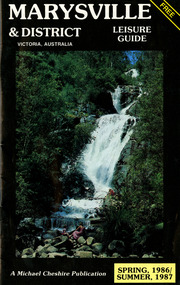 Marysville & District Historical Society
Booklet (Item) - Leisure guide, Michael Chesire & Associates Pty. Ltd, MARYSVILLE & DISTRICT LEISURE GUIDE-SPRING, 1986/SUMMBER, 1987, 1986
... ...alexandra...A free leisure guide to Marysville and the surrounding district published for Spring 1986, and Summer 1987. marysville victoria australia leisure guide michael cheshire & associates pty ltd marysville golf club blackwood lodges sir colin mackenzie fauna park lake eildon fraser national park yarra valley wineries marysville coach tours kooringa marylands guest house lady talbot forest drive wishing well taggerty river recreation area athols abbey phantom falls keppel falls the beeches walking track marylyn guest house kufstein inn motel the cumberland marysville tourist & progress association marysville newsagency & general store crossways restaurant & motel beauty spot walk tree fern gully walk michaeldene track keppel track woods lookout track marysville hotel motel lake mountain ski hire marysville recreation and fun park mytanta horseback safaris upper big river valley the big culvert marysville mountain view horse hire maryton park amber view holiday lodges cathedral restaurant the top shop tower motel menzes garage beauty spot nursery marysville ski hire lake mountain ski school faraway forest scenic motel buxton trout farm marysville hardware timbertop steakhouse marysville trout farm healesville sanctuary buxton hotel motel nanda binya lodge buxton antique and furniture mart the black spur inn hotel alexandra lake mountain j l gould sawmills pty. ltd. geoffrey pope & associates marysville crafts & gifts olde yarra track shoppe cumberland scenic reserve tudor lodge road house fruit salad farm highwayman's retreat Kilmore Historical Society *10/183 *MDL.1. ...A free leisure guide to Marysville and the surrounding district published for Spring 1986, and Summer, 1987. This was produced by Michael Cheshire as a free publication to promote tourism in Marysville and the surrounding district. It includes maps of the Big River Valley, Cumberland Valley, Lady Talbot Forest Drive, the Marysville area, and the township of Marysville. It was released in the spring of 1986. A free leisure guide to Marysville and the surrounding district published for Spring 1986, and Summer 1987.Kilmore Historical Society *10/183 *MDL.1.marysville, victoria, australia, leisure guide, michael cheshire & associates pty ltd, marysville golf club, blackwood lodges, sir colin mackenzie fauna park, lake eildon, fraser national park, yarra valley wineries, marysville coach tours, kooringa, marylands guest house, lady talbot forest drive, wishing well, taggerty river recreation area, athols abbey, phantom falls, keppel falls, the beeches walking track, marylyn guest house, kufstein inn motel, the cumberland, marysville tourist & progress association, marysville newsagency & general store, crossways restaurant & motel, beauty spot walk, tree fern gully walk, michaeldene track, keppel track, woods lookout track, marysville hotel motel, lake mountain ski hire, marysville recreation and fun park, mytanta horseback safaris, upper big river valley, the big culvert, marysville mountain view horse hire, maryton park, amber view holiday lodges, cathedral restaurant, the top shop, tower motel, menzes garage, beauty spot nursery, marysville ski hire, lake mountain ski school, faraway forest, scenic motel, buxton trout farm, marysville hardware, timbertop steakhouse, marysville trout farm, healesville sanctuary, buxton hotel motel, nanda binya lodge, buxton antique and furniture mart, the black spur inn hotel, alexandra, lake mountain, j l gould sawmills pty. ltd., geoffrey pope & associates, marysville crafts & gifts, olde yarra track shoppe, cumberland scenic reserve, tudor lodge road house, fruit salad farm, highwayman's retreat
