
Showing 1047 items matching "army units"
-
 Bendigo Military Museum
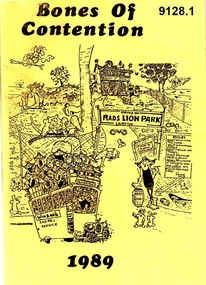
Booklet - Bones of Contention Souvenir Program 1989, RAAF School of Radio, 1989
... units. The day major sports trophy was the "Large Bone Trophy" and the evening minor sports trophy was the "Little Bone Trophy". The day sports contested were: Basketball, Cross Country, Golf, Hockey, Indoor Cricket, Lawn Bowls, Orienteering, Sailing, Softball, Squash, Tennis, Touch football, Tug of War and Volleyball. The Night Sports contested were: Carpet Bowls, Darts, Hookey, Quoits, Snooker and Table Tennis. 9128.1 Cover of Booklet 9128.2 List of Winners since 1950 Royal Australian Survey Corps RASvy Fortuna Army ...This is the program for the annual sports competition between the RAAF School of Radio, Laverton and the AHQ Survey Regiment, Bendigo. The location of the sports day alternated annually between the two units. The day major sports trophy was the "Large Bone Trophy" and the evening minor sports trophy was the "Little Bone Trophy". The day sports contested were: Basketball, Cross Country, Golf, Hockey, Indoor Cricket, Lawn Bowls, Orienteering, Sailing, Softball, Squash, Tennis, Touch football, Tug of War and Volleyball. The Night Sports contested were: Carpet Bowls, Darts, Hookey, Quoits, Snooker and Table Tennis. 9128.1 Cover of Booklet 9128.2 List of Winners since 1950 Booklet, B5 size, cream covered card, title, Bones of Contention, 32 pages, caricatures for each sport contested. Stapled in the spline.Forward by Wing Commander JM Dallimore, Commanding Officer RAAF School of Radio.royal australian survey corps, rasvy, fortuna, army survey regiment, army svy regt, asr, raaf, raaf school of radio, bones day -
 Bendigo Military Museum
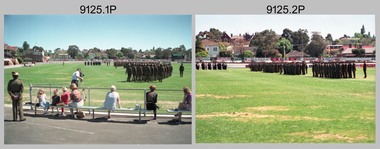
Photograph - Army Survey Regiment Freedom of Entry Parade, Bendigo CBD, 1990
... units to periodically exercise their freedom by arranging a parade through the city. The event began with a ceremonial parade at the Queen Elizabeth II Oval. The RAAF Central Command Band provided the music at the parade. After formal inspections of the troops, the Army...units to periodically exercise their freedom by arranging a parade through the city. The event began with a ceremonial parade at the Queen Elizabeth II Oval. The RAAF Central Command Band provided the music at the parade. After formal inspections of the troops, the Army ...The Freedom of Entry to the City on the 26th of October 1990 was an honour first conferred by the Bendigo City Council to the Army Survey Regiment in 1970. This was the fifth time the unit exercised its freedom of marching into the city with swords drawn, bayonets fixed and drums beating. The honour is usually bestowed upon local regiments, in recognition of their dedicated service, and it is common for military units to periodically exercise their freedom by arranging a parade through the city. The event began with a ceremonial parade at the Queen Elizabeth II Oval. The RAAF Central Command Band provided the music at the parade. After formal inspections of the troops, the Army Survey Regiment saluted as it marched past the Reviewing Officer - Mayor of Bendigo Councillor James Douglass, military dignitaries and guests. Led by the Regiment’s CO – LTCOL Rene van den Tol, the unit marched down View St, along Pall Mall and to Gaol Rd. Regiment members were treated to a civic reception at the City Hall after the ceremony. The Regiment also exercised its Freedom of Entry with anniversary parades in 1977, 1980, 1985, 1992 and 1996. See items 9124.28P and 9126.24P for additional sets of photos taken at the event. The formal booklet covering the event is catalogued under item 9123.This set of 54 photographs of the Army Survey Regiment were taken at the Freedom of Entry parade, held at the City of Bendigo’s Queen Elizabeth Oval (QEO) on the 26th of October 1990. The colour photographs are on 35mm negative film and scanned at 2400 dpi. They are part of the Army Survey Regiment’s Collection. .1) - Photo, colour, 1990. Army Survey Regiment marches on to the QEO. .2) - Photo, colour, 1990. Army Survey Regiment formed up at the start of the parade. .3) & .4) - Photo, colour, 1990. Lithographic Squadron fixes bayonets. Centre rank: LCPL Damien Cole, remainder unidentified. Rear rank R to L: CPL Peter Swandale, SPR Andrew Arman, remainder unidentified. SSM WO1 Bill Jones at far right. .5) - Photo, colour, 1990. Army Survey Regiment await the order to take posts. .6) - Photo, colour, 1990. Army Survey Regiment standing at ease await the arrival of the Parade Host. .7) - Photo, colour, 1990. Arrival of the Parade Host - D-SVY COL Don Swiney MBE. L to R: CPL Mick McConnell, CPL Warren ‘Waldo’ Shirley, unidentified. .8) - Photo, colour, 1990. The Parade Host - D-SVY COL Don Swiney MBE and MAJ John South at his right returns the Regiment’s salute. .9) - Photo, colour, 1990. Arrival of dignitaries: L to R: CPL Mick McConnell, City of Bendigo Mayor - Councillor James Douglass, City of Bendigo Chief Executive Officer - Mr. R. J. Burton, CPL Warren ‘Waldo’ Shirley, unidentified. .10) - Photo, colour, 1990. Arrival of dignitaries: L to R: CPL Mick McConnell, Chief Superintendent F. Fox (presumed), unidentified, D-SVY COL Don Swiney MBE, CPL Warren ‘Waldo’ Shirley, unidentified. .11) - Photo, colour, 1990. Arrival of dignitaries: L to R: CPL Mick McConnell, Bishop of Sandhurst most Reverend N. Daly DD, unidentified padre, CPL Warren ‘Waldo’ Shirley, unidentified, D-SVY COL Don Swiney MBE. .12) - Photo, colour, 1990. L to R: City of Bendigo Mayor - Councillor James Douglass, City of Bendigo Chief Executive Officer - Mr. R. J. Burton view the parade from the dias. .13) - Photo, colour, 1990. CO of the Army Survey Regiment greets the parade dignitaries. L to R: CO LTCOL Rene van den Tol, D-SVY COL Don Swiney MBE, City of Bendigo Mayor - Councillor James Douglass, City of Bendigo Chief Executive Officer - Mr. R. J. Burton. .14) - Photo, colour, 1990. Headquarters Squadron inspection L to R: CO LTCOL Rene van den Tol, Chief Executive Officer - Mr. R. J. Burton, D-SVY COL Don Swiney MBE, Mayor - Councillor James Douglass, 2nd from right SGT Brendan McKinless, supernumerary WO2 Steve Hansen in background, remainder unidentified. .15) - Photo, colour, 1990. Unidentified squadron inspection L to R: D-SVY COL Don Swiney MBE, Chief Executive Officer - Mr. R. J. Burton, Mayor - Councillor James Douglass, CO LTCOL Rene van den Tol. .16) - Photo, colour, 1990. Air Survey Squadron inspection L to R: unidentified, SSGT Bob Garritty, CPL Craig Kellet, CPL Raelene (Munting) Brodie, unidentified, SPR Jodi Seath, remainder ranks unidentified, Mayor - Councillor James Douglass, Chief Executive Officer - Mr. R. J. Burton, CO LTCOL Rene van den Tol. .17) - Photo, colour, 1990. Lithographic Squadron inspection L to R: CO LTCOL Rene van den Tol, SGT Brian Paul, Mayor - Councillor James Douglass, SGT Steve Burke, D-SVY COL Don Swiney MBE. .18) - Photo, colour, 1990. The official party pass behind Headquarters Squadron and head towards the RAAF Central Command Band. L to R: Chief Executive Officer - Mr. R. J. Burton, Mayor - Councillor James Douglass, D-SVY COL Don Swiney MBE. .19) - Photo, colour, 1990. RAAF Central Command Band inspection L to R: Deputy Music Director Flying Officer S. Wright, Mayor - Councillor James Douglass, remainder unidentified. .20) - Photo, colour, 1990. RAAF Central Command Band inspection L to R: Chief Executive Officer - Mr. R. J. Burton, Deputy Music Director Flying Officer S. Wright, Mayor - Councillor James Douglass, remainder unidentified. .21) - Photo, colour, 1990. Cartographic Squadron commanded by OC MAJ Neil Taylor performs left form in slow time. .22) - Photo, colour, 1990. RAAF Central Command Band performs drill manoeuvre. .23) - Photo, colour, 1990. Air Survey Squadron commanded by OC MAJ Peter Clark performs left form. .24) - Photo, colour, 1990. Headquarters Squadron commanded by OC MAJ Ray Redman marches forward in slow time. .25) - Photo, colour, 1990. Army Survey Regiment in formation commanded by CO LTCOL Rene van den Tol advances in slow time. 2IC MAJ Duncan Burns at left. MAJ Bob Williams at right. .26) - Photo, colour, 1990. Air Survey 2IC MAJ Duncan Burns at left Squadron commanded by OC MAJ Peter Clark advances in quick time. WO1 Graham Ragless is closest to camera. .27) & .28) - Photo, colour, 1990. Lithographic Squadron commanded by OC MAJ Bob Coote advances before left form. LT Marty Lyons at left. LT Derek Bell at right. .29) - Photo, colour, 1990. Army Survey Regiment salutes as it marches past the Reviewing Officer Mayor - Councillor James Douglass, Chief Executive Officer - Mr. R. J. Burton and D-SVY COL Don Swiney MBE at the dias. .30) - Photo, colour, 1990. Parade official guests L to R: unidentified, MAJ John South, unidentified (x5), MAJ B.J. Donaldson – US Exchange, unidentified, unidentified padres (x2), Bishop of Sandhurst most Reverend N. Daly DD. .31) - Photo, colour, 1990. Army Survey Regiment salutes as it marches past the dias. .32) - Photo, colour, 1990. Lithographic Squadron commanded by OC MAJ Bob Coote performs left form. .33) - Photo, colour, 1990. Deputy Music Director Flying Officer S. Wright conducts the RAAF Central Command Band. .34) - Photo, colour, 1990. The RAAF Central Command Band performs during the parade. All musicians are unidentified. .35) - Photo, colour, 1990. Lithographic Squadron commanded by OC MAJ Bob Coote marches forward in quick time. .36) - Photo, colour, 1990. Cartographic Squadron commanded by OC MAJ Neil Taylor marches forward in quick time. .37) - Photo, colour, 1990. Lithographic Squadron commanded by OC MAJ Bob Coote marches forward in quick time. .38) - Photo, colour, 1990. Army Survey Regiment salutes as it marches past the dias. .39) - Photo, colour, 1990. L to R: Reviewing Officer Mayor - Councillor James Douglass, Chief Executive Officer - D-SVY COL Don Swiney MBE, Mr. R. J. Burton and at the dias. Parade official guests L to R: unidentified (x2), MAJ John South, unidentified (x5), MAJ B.J. Donaldson – US Exchange, unidentified, unidentified padres (x2), Bishop of Sandhurst most Reverend N. Daly DD. .40) - Photo, colour, 1990. Army Survey Regiment salutes as it marches past the Reviewing Officer Mayor - Councillor James Douglass, Chief Executive Officer - Mr. R. J. Burton and D-SVY COL Don Swiney MBE at the dias. MAJ P.G. Dinwiddie – UK Exchange is seen among the guests. .41) - Photo, colour, 1990. Air Survey Squadron commanded by OC MAJ Peter Clark stands at attention. .42) - Photo, colour, 1990. Headquarters Squadron commanded by OC MAJ Ray Redman stands at ease. 2IC MAJ Duncan Burns at far left. .43) - Photo, colour, 1990. Cartographic Squadron commanded by OC MAJ Neil Taylor stands at ease. CO LTCOL Rene van den Tol in foreground. .44) & .45) - Photo, colour, 1990. The Parade Host: D-SVY COL Don Swiney MBE addresses the Parade. .46) - Photo, colour, 1990. The Reviewing Officer: Mayor - Councillor James Douglass addresses the Parade. .47) - Photo, colour, 1990. L to R: City of Bendigo Chief Executive Officer - Mr. R. J. Burton, Reviewing Officer Bendigo Mayor - Councillor James Douglass. .48) - Photo, colour, 1990. Parade official guests Middle row L to R: MAJ P.G. Dinwiddie – UK Exchange, Chief Superintendent F. Fox, unidentified MAJ B.J. Donaldson – US Exchange, remainder unidentified. Front row L to R: unidentified (x2), MAJ John South, unidentified (x4). .49) - Photo, colour, 1990. Unidentified padre addresses the Parade. On his left: City of Bendigo Chief Executive Officer - Mr. R. J. Burton, Bishop of Sandhurst most Reverend N. Daly DD. .50) - Photo, colour, 1990. Unidentified padre addresses the Parade. On his right: Bishop of Sandhurst most Reverend N. Daly DD, City of Bendigo Chief Executive Officer - Mr. R. J. Burton, Reviewing Officer Bendigo Mayor - Councillor James Douglass. .51) - Photo, colour, 1990. Departure of Chief Superintendent F. Fox at conclusion of Parade. .52) - Photo, colour, 1990. Departure of unidentified padres (x2), Bishop of Sandhurst most Reverend N. Daly DD at conclusion of Parade. .53) & .54) - Photo, colour, 1990. Departure of Parade Host - D-SVY COL Don Swiney MBE at conclusion of Parade. No personnel or civilians are identified. ‘Freedom of Entry Parade ‘90’ is annotated on plastic negative sleeve.royal australian survey corps, rasvy, army survey regiment, army svy regt, fortuna -
 Bendigo Military Museum
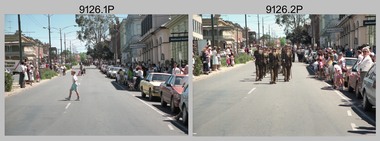
Photograph - Army Survey Regiment Freedom of Entry Parade, Bendigo CBD, 1990
... units to periodically exercise their freedom by arranging a parade through the city. The event began with a ceremonial parade at the Queen Elizabeth II Oval. The RAAF Central Command Band provided the music at the parade. After formal inspections of the troops, the Army...units to periodically exercise their freedom by arranging a parade through the city. The event began with a ceremonial parade at the Queen Elizabeth II Oval. The RAAF Central Command Band provided the music at the parade. After formal inspections of the troops, the Army ...The Freedom of Entry to the City on the 26th of October 1990 was an honour first conferred by the Bendigo City Council to the Army Survey Regiment in 1970. This was the fifth time the unit exercised its freedom of marching into the city with swords drawn, bayonets fixed and drums beating. The honour is usually bestowed upon local regiments, in recognition of their dedicated service, and it is common for military units to periodically exercise their freedom by arranging a parade through the city. The event began with a ceremonial parade at the Queen Elizabeth II Oval. The RAAF Central Command Band provided the music at the parade. After formal inspections of the troops, the Army Survey Regiment saluted as it marched past the Reviewing Officer - Mayor of Bendigo Councillor James Douglass, military dignitaries and guests. Led by the Regiment’s CO – LTCOL Rene van den Tol, the unit marched down View St, along Pall Mall and to Gaol Rd. Regiment members were treated to a civic reception at the City Hall after the ceremony. The Regiment also exercised its Freedom of Entry with anniversary parades in 1977, 1980, 1985, 1992 and 1996. See items 9124.28P and 9125.54P for additional sets of photos taken at the event. The formal booklet covering the event is catalogued under item 9123.This set of 24 photographs of the Army Survey Regiment were taken at the Freedom of Entry parade, held at the City of Bendigo’s Queen Elizabeth Oval (QEO) on the 26th of October 1990. The colour photographs are on 35mm negative film and scanned at 2400 dpi. They are part of the Army Survey Regiment’s Collection. .1) - Photo, colour, 1990. The Army Survey Regiment marches down View St towards Pall Mall. .2) - Photo, colour, 1990. The Army Survey Regiment marches down View St towards Pall Mall. L to R: 2IC MAJ Duncan Burns, CO LTCOL Rene van den Tol, MAJ Bob Williams. .3) - Photo, colour, 1990. The Army Survey Regiment marches down View St towards Pall Mall. L to R: 2IC MAJ Duncan Burns, CO LTCOL Rene van den Tol, MAJ Bob Williams, RSM WO1 Neville Stone. .4) - Photo, colour, 1990. The RAAF Central Command Band marches down View St towards Pall Mall led by L to R: Drum Major Warrant Officer E. Hayward and Deputy Music Director Flying Officer S. Wright. WO1 Rowan Gillies at fat left. .5) - Photo, colour, 1990. City Marshall – Superintendent D.R. Mansell standing at the ready in Charing Cross, to challenge the entry of the Army Survey Regiment at the bottom of View St. .6) - Photo, colour, 1990. The Army Survey Regiment at the halt in View St ready to exercise its right to pass through the City of Bendigo. L to R: 2IC MAJ Duncan Burns, CO LTCOL Rene van den Tol, ADJT CAPT Peter Parkes. .7) - Photo, colour, 1990. The Army Survey Regiment salutes parade dignitaries as it marches down Pall Mall past the dias. L to R: CO LTCOL Rene van den Tol, 2IC MAJ Duncan Burns, MAJ Bob Williams. At the dias L to R: City of Bendigo Chief Executive Officer - Mr. R. J. Burton, Reviewing Officer: City of Bendigo Mayor - Councillor James Douglass, Parade Host -D-SVY COL Don Swiney MBE. .8) - Photo, colour, 1990. The RAAF Central Command Band salutes parade dignitaries as it marches down Pall Mall past the dias. L to R: Drum Major Warrant Officer E. Hayward and Deputy Music Director Flying Officer S. Wright. .9) - Photo, colour, 1990. Air Survey Squadron salutes parade dignitaries as it marches down Pall Mall past the dias. L to R: LT Craig Hersant, OC MAJ Peter Clark, LT Simon Buckpitt, WO1 Allan Hancox, SGT Max Watson, remainder unidentified. .10) - Photo, colour, 1990. Cartographic Squadron salutes parade dignitaries as it marches down Pall Mall past the dias. L to R: LT Garret Addison, OC MAJ Neil Taylor, CAPT Dave McLachlan, LT Steve Hledik, WO1 Graham Ragless, SSGT Graham Johnston, SSGT Dennis Learmoth, SPR Cam Bramich, remainder unidentified. .11) - Photo, colour, 1990. Lithographic Squadron salutes parade dignitaries as it marches down Pall Mall past the dias. L to R: LT Marty Lyons, OC MAJ Bob Coote, SGT Steve Burke, SGT Brian Paul, LT Derek Bell, WO2 Rob Bogumil, SPR Doug Whiteside, remainder unidentified. .12) - Photo, colour, 1990. Air Survey Squadron marches down Pall Mall towards Gaol Rd. L to R: LT Craig Hersant, OC MAJ Peter Clark, LT Simon Buckpitt, WO1 Allan Hancox, SGT Max Watson, remainder unidentified. .13) to .15) - Photo, colour, 1990. The RAAF Central Command Band marches down Gaol Rd. L to R: Drum Major Warrant Officer E. Hayward and Deputy Music Director Flying Officer S. Wright. .16) - Photo, colour, 1990. Air Survey Squadron marches down Gaol Rd. L to R: LT Craig Hersant, OC MAJ Peter Clark, SPR Ian Baldwin, LT Simon Buckpitt, WO1 Allan Hancox, SGT Max Watson, remainder unidentified. .17) - Photo, colour, 1990. Cartographic Squadron marches down Gaol Rd. L to R: LT Garret Addison, OC MAJ Neil Taylor, CAPT Dave McLachlan, CPL Guenther Ebenwaldner, SGT Doug Carswell, LT Steve Hledik, WO1 Graham Ragless, SSGT Graham Johnston, SSGT Dennis Learmoth, SPR Cam Bramich, remainder unidentified. .18) - Photo, colour, 1990. Lithographic Squadron marches down Gaol Rd. L to R: OC MAJ Bob Coote, LT Marty Lyons, SGT Steve Burke, SGT Brian Paul, SSGT Peter Imeson, SPR Shane Campbell, LT Derek Bell, WO2 Rob Bogumil, SPR Doug Whiteside, SPR Scott Cameron, remainder unidentified. .19) - Photo, colour, 1990. Headquarters Squadron in Gaol Rd stands at ease. Right marker SGT Chris Edwards 6th from left, OC MAJ Ray Redman at far right, remainder unidentified. .20) - Photo, colour, 1990. Army Survey Regiment in transit. L to R: unidentified, CAPT Noel ‘Nesty’ Coulthard, unidentified, LT Simon Buckpitt. .21) - Photo, colour, 1990. Civic reception at the City Hall after the ceremony. .22) - Photo, colour, 1990. Civic reception at the City Hall after the ceremony. L to R: unidentified (x2), WO2 Mick Flynn, WO2 Steve Hansen, MAJ Neil Taylor, remainder unidentified. .23) - Photo, colour, 1990. Civic reception at the City Hall after the ceremony. L to R: WO2 Steve Hansen, WO2 Rhys De Laine, unidentified (x4), WO2 Alan Virtue. .24) - Photo, colour, 1990. Civic reception at the City Hall after the ceremony. L to R: unidentified, CO LTCOL Rene van den Tol, Chief Superintendent F. Fox.No personnel or civilians are identified. ‘Freedom of Entry Parade ‘90’ is annotated on plastic negative sleeve.royal australian survey corps, rasvy, army survey regiment, army svy regt, fortuna -
 Bendigo Military Museum
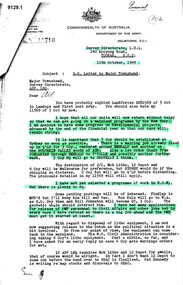
Letter - Letters from Australian Survey Directorate to Maj A Townsend (RASvy) 1945, Survey Directorate, 1945
... Units return to Australia as soon as possible to start work on much needed Australian Survey priorities. It also discusses what action should be taken on Survey Corps mapping equipment. Also of particular note is the Location of the Directorate on Letter dated 15 November 1945 (9129.2) that has the Survey Directorate at HQ Australian Military Forces at Victoria Barracks, Melbourne. This letter discusses who should possibly be presented with some Japanese captured swords. Royal Australian Survey Corps RASvy Fortuna Army ...Of particular note is the location of the Directorate on Letter dated 11 October 1945 (9129.1) that has the Survey Directorate as part of Land Headquarters 242 Kooyong Road TOORAK SE2 Melbourne. This letter expressed the desire to see overseas Survey Units return to Australia as soon as possible to start work on much needed Australian Survey priorities. It also discusses what action should be taken on Survey Corps mapping equipment. Also of particular note is the Location of the Directorate on Letter dated 15 November 1945 (9129.2) that has the Survey Directorate at HQ Australian Military Forces at Victoria Barracks, Melbourne. This letter discusses who should possibly be presented with some Japanese captured swords.Two single page A4 sized photocopies of typed letters on Commonwealth of Australia, Survey Directorate Letterheads to Maj Alf Townsend (RASvy) .1 Letter dated 11 October 1945 Serial Number 11710 .2 Letter Dated 15 November 1945 Serial Number 11774.1 has a number of paragraphs highlighted in green.royal australian survey corps, rasvy, fortuna, army survey regiment, army svy regt, asr, survey corps directorate -
 Bendigo Military Museum
Letter - CORRESPONDENCE, WW1, WW1
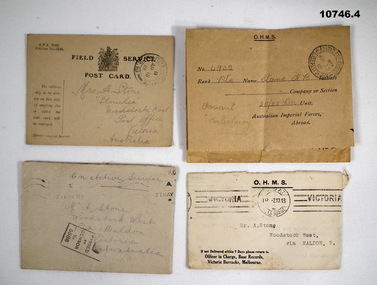
... Unit 13.7.1918, discharged 10.7.1919. 2. Pte Stone KR. Refer Cat No 10742.15 for his service details. 3. From Ern. Ernest William Smith No 6894 (born Maldon, enlisted Bendigo) on …………. Refer Cat No. 10742.15 for details. Kenneth Reginald Stone, Reg. No. 6903A. ERN 6894A Woodstock. Ernest William Smith, Enlisted 13.07.1917, Embarked 21.11.1917- K.I.A. 18.08.1918 Kenneth Reginald Stone Correspondence Stonecollectionww1 1. Lightweight cardboard - beige "FIELD SERVICE POST CARD" Addressed to "Mrs A. Stone/ 'Stonelea'/ Woodstock West/ Post Office/ Victoria/ Australia" signed by W.A. Hepburn. Dated 18 April 1918. 2. Paper - Beige. "POSTAL INSTRUCTIONS/ ISSUED BY/ THE AUSTRALIAN ARMY ...1. Signed by W A Hepburn. William Andrew Hepburn No1725 (born Laanecorrie, enlisted Maldon) on 1.7.1915 in 2nd Reinforcements 29th Bn age 23 years 6 months, embark for Eygpt 29.12.1915, transfers to 4th Piioneers 16.3.1916, embark for France 4.6.1916, accidental bomb wound 6.8.1916, rejoin Unit14.8.1916, appointed Driver, hospital 15.12.1916 with Diarrhoea then Dysentry then Typhoid, rejoin Unit 5.3.1918, hospital 25.6.1918 with Influenza, rejoin Unit 13.7.1918, discharged 10.7.1919. 2. Pte Stone KR. Refer Cat No 10742.15 for his service details. 3. From Ern. Ernest William Smith No 6894 (born Maldon, enlisted Bendigo) on …………. Refer Cat No. 10742.15 for details. Kenneth Reginald Stone, Reg. No. 6903A. ERN 6894A Woodstock. Ernest William Smith, Enlisted 13.07.1917, Embarked 21.11.1917- K.I.A. 18.08.19181. Lightweight cardboard - beige "FIELD SERVICE POST CARD" Addressed to "Mrs A. Stone/ 'Stonelea'/ Woodstock West/ Post Office/ Victoria/ Australia" signed by W.A. Hepburn. Dated 18 April 1918. 2. Paper - Beige. "POSTAL INSTRUCTIONS/ ISSUED BY/ THE AUSTRALIAN ARMY POSTAL SERVICE" for Pte Stone K.R. Date stamped "AP25 18". 3. Envelope and letter - plain beige paper. 'From Ern' to "Dear Mr Stone". Envelope addressed to M. A Stone/ Woodstock West/ Via Maldon/ Victoria/ Australia" Dated "May 21st 1918/ France" Written in grey lead pencil. 4. Paper - beige, "AUSTRALIAN IMPERIAL FORCE" correspondence sent to "MR A. STONE/ WOODSTOCK WEST/ Via MALDON, V".kenneth reginald stone, correspondence, stonecollectionww1 -
 Bendigo Military Museum
Award - MEDAL, 1914-15 STAR
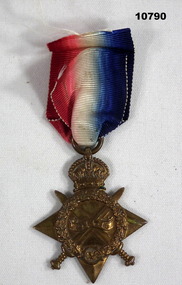
... Medal awarded to Pte Ralph Henry Perkins, No. 1016, (Born Campbellfield, Enlisted Bendigo) on 31.1.1915 in D Coy 21st Battalion aged 18 years 11 months, embarked for Eygpt 8.5.1915, embark for France 19.3 1916, WIA 9.6.1918 Gassed, rejoin unit 17.6.1918, transfer to 24th Bn 13.10.1918, discharged from the Army 9/3/1919....Medal awarded to Pte Ralph Henry Perkins, No. 1016, (Born Campbellfield, Enlisted Bendigo) on 31.1.1915 in D Coy 21st Battalion aged 18 years 11 months, embarked for Eygpt 8.5.1915, embark for France 19.3 1916, WIA 9.6.1918 Gassed, rejoin unit 17.6.1918, transfer to 24th Bn 13.10.1918, discharged from the Army 9/3/1919. ...Medal awarded to Pte Ralph Henry Perkins, No. 1016, (Born Campbellfield, Enlisted Bendigo) on 31.1.1915 in D Coy 21st Battalion aged 18 years 11 months, embarked for Eygpt 8.5.1915, embark for France 19.3 1916, WIA 9.6.1918 Gassed, rejoin unit 17.6.1918, transfer to 24th Bn 13.10.1918, discharged from the Army 9/3/1919.Bronze coloured WW1 1914-15 Star, with original red, white and blue ribbon. Recipients' name engraved on reverse.Engraved on reverse: "1016, Pte R.H. Perkins, 21/Bn, A.I.F"medal, award, 1914-15 star, ww1, r.h.perkins -
 Bendigo Military Museum
Photograph - Commander 3rd Military District Visit – Army Survey Regiment Fortuna, Bendigo, 1990
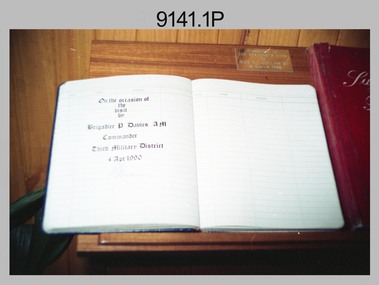
... This is a set of 11 photographs of a visit to the Army Survey Regiment, Fortuna, Bendigo by the Commander 3rd Military District BRIG P. Davies AM, ADC on the 4th of March 1990. In this set the CMDR 3MD met unit...This is a set of 11 photographs of a visit to the Army Survey Regiment, Fortuna, Bendigo by the Commander 3rd Military District BRIG P. Davies AM, ADC on the 4th of March 1990. In this set the CMDR 3MD met unit ...This is a set of 11 photographs of a visit to the Army Survey Regiment, Fortuna, Bendigo by the Commander 3rd Military District BRIG P. Davies AM, ADC on the 4th of March 1990. In this set the CMDR 3MD met unit personnel at a morning tea held in Fortuna’s ballroom.This is a set of 11 photographs of a visit to the Army Survey Regiment, Fortuna, Bendigo by the Commander 3rd Military District (CMDR 3MD) BRIG P. Davies AM ADC on the 4th of March 1990. The photographs are on 35mm negative film and were scanned at 2400 dpi. They are part of the Army Survey Regiment’s Collection. .1) - Photo, colour, 1990. Visitors’ Book in readiness for the CMDR 3MD’s signature. .2) & .3) - Photo, colour, 1990. CMDR 3MD BRIG P. Davies AM ADC signs the Visitors’ Book outside the Messes. .4) - Photo, colour, 1990. L to R: CMDR 3MD BRIG P. Davies AM ADC, SPR Andrew Morrison-Evans. .5) - Photo, colour, 1990. L to R: OR’s Mess PMC CPL Brendon McKinless, CMDR 3MD BRIG P. Davies AM ADC. .6) - Photo, colour, 1990. L to R: CMDR 3MD BRIG P. Davies AM ADC, OR’s Mess PMC CPL Brendon McKinless. .7) - Photo, colour, 1990. In foreground L to R: CPL Steve Coulson, CMDR 3MD BRIG P. Davies AM ADC, CPL Colin McInnes. .8) - Photo, colour, 1990. CO LTCOL Rene van den Tol. .9) - Photo, colour, 1990. CMDR 3MD BRIG P. Davies AM ADC .10) - Photo, colour, 1990. L to R: CMDR 3MD BRIG P. Davies AM ADC, OR’s Mess PMC CPL Brendon McKinless. .11) - Photo, colour, 1990. L to R: CMDR 3MD BRIG P. Davies AM ADC, unidentified.‘CMDR 3MD Visit Mar 90’ is annotated on the film negative sleeve.royal australian survey corps, rasvy, army survey regiment, army svy regt, fortuna -
 Bendigo Military Museum
Photograph - Army Survey Regiment – Corps Day Celebrations, Fortuna Villa, Bendigo, 1990
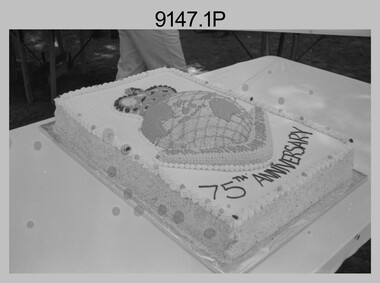
... This set of 16 photographs were taken in mid-1990 during a family function held at the BBQ area of the Army Survey Regiment, Fortuna, Bendigo to commemorate the 75th anniversary of the formation of the Royal Australian Survey Corps. Traditionally the cutting of the cake was performed by the Unit commanding Officer and the youngest soldier. ...This set of 16 photographs were taken in mid-1990 during a family function held at the BBQ area of the Army Survey Regiment, Fortuna, Bendigo to commemorate the 75th anniversary of the formation of the Royal Australian Survey Corps. Traditionally the cutting of the cake was performed by the Unit commanding Officer and the youngest soldier. ...This set of 16 photographs were taken in mid-1990 during a family function held at the BBQ area of the Army Survey Regiment, Fortuna, Bendigo to commemorate the 75th anniversary of the formation of the Royal Australian Survey Corps. Traditionally the cutting of the cake was performed by the Unit commanding Officer and the youngest soldier. The name of the soldier assisting CO LTCOL Rene van den Tol is not known. This occasion was one of several events held in 1990 to commemorate the 75th anniversary. More information is provided in pages 147 and 150 of Valerie Lovejoy’s book 'Mapmakers of Fortuna – A history of the Army Survey Regiment’ ISBN: 0-646-42120-4. This is a set of 16 photographs of a family BBQ held at the Army Survey Regiment, Fortuna, Bendigo in mid-1990. The black and white photographs are on 35mm negative film and scanned at 2400 dpi. They are part of the Army Survey Regiment’s Collection. .1) & .2) - Photo, black & white, 1990. RA Svy 75th anniversary cake. .3) - Photo, black & white, 1990. L to R: SPR Caroline (Wyatt) Evans, SPR Sandra Dee, unidentified. .4) - Photo, black & white, 1990. L to R: unidentified, SPR Caroline (Wyatt) Evans, SPR Sandra Dee, remainder unidentified. .5) - Photo, black & white, 1990. L to R: CPL Di (Thomas) Sutar, SPR Caroline (Wyatt) Evans, unidentified. .6) - Photo, black & white, 1990. Cutting of the cake L to R: unidentified guests, CO LTCOL Rene van den Tol, unidentified. .7) - Photo, black & white, 1990. Cutting of the cake L to R: unidentified children, CO LTCOL Rene van den Tol, unidentified. Adults in background L to R: SPR Jeanette Drury-Lane, CPL Guenther Ebenwaldner, CPL Perry Burt, SPR Harris Lee, Karen Rothwell, SPR Neil Pedler, WO1 Allan Hancox, unidentified, SGT Wolfgang Thun, Joe Farrington. .8) - Photo, black & white, 1990. Cutting of the cake L to R: unidentified children, CO LTCOL Rene van den Tol, unidentified. Adults in background L to R: Karen Rothwell, SPR Neil Pedler, WO1 Allan Hancox, unidentified, SGT Wolfgang Thun, Joe Farrington, remainder unidentified. .9) - Photo, black & white, 1990. Cutting of the cake L to R: CO LTCOL Rene van den Tol, unidentified. Adults in background L to R: unidentified, SGT Wolfgang Thun, unidentified, PTE Gary Sievers, unidentified (x4), Pat Thwaites, remainder unidentified. .10) - Photo, black & white, 1990. Cutting of the cake L to R: CO LTCOL Rene van den Tol, unidentified. Adults in background L to R: unidentified, SGT Wolfgang Thun, PTE Gary Sievers, Joe Farrington, remainder unidentified. .11) - Photo, black & white, 1990. Cutting of the cake L to R: CO LTCOL Rene van den Tol, unidentified. Adults in background L to R: unidentified, WO1 Allan Hancox, Joe Farrington, PTE Gary Sievers. .12) - Photo, black & white, 1990. Cutting of the cake L to R: CO LTCOL Rene van den Tol, unidentified. Adults in background L to R: SGT Wolfgang Thun, unidentified, Joe Farrington, PTE Gary Sievers, remainder unidentified. .13) - Photo, black & white, 1990. BBQ L to R: MAJ Bob Williams, D-SVY COL Don Swiney MBE, unidentified. .14) - Photo, black & white, 1990. BBQ L to R: MAJ Peter Clark, WO1 Bill Jones, D-SVY COL Don Swiney MBE, unidentified. .15) - Photo, black & white, 1990. BBQ L to R: SPR Leigh Palfrey, unidentified. .16) - Photo, black & white, 1990. BBQ L to R: SGT Brian Paul, WO2 Rob Bogumil.There are no annotations.royal australian survey corps, rasvy, army survey regiment, army svy regt, fortuna -
 Bendigo Military Museum
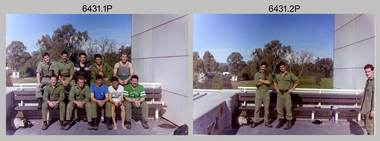
Photograph - Flag Day - Army Survey Regiment Verses School of Military Survey, Latchford Barracks, Bonegilla, 1990
... These 34 photographs were taken at Flag Day, an annual sports competition between the Army Survey Regiment and the School of Military Survey (SMS) at Latchford Barracks, Bonegilla in May 1990. The two RASvy units...These 34 photographs were taken at Flag Day, an annual sports competition between the Army Survey Regiment and the School of Military Survey (SMS) at Latchford Barracks, Bonegilla in May 1990. The two RASvy units ...These 34 photographs were taken at Flag Day, an annual sports competition between the Army Survey Regiment and the School of Military Survey (SMS) at Latchford Barracks, Bonegilla in May 1990. The two RASvy units took turns each year to host the event. The day competition usually comprised basketball, cross country, golf, sailing, squash softball, tennis, touch football, tug-of-war and volleyball. The evening competition often included darts, carpet bowls, hookey, quoits and snooker. The Flag handover and speeches were held in SMS’s Café Slater recreation/morning tea area. It is not clear which RA Svy unit was the winner.This is a set of 34 photographs were taken at Flag Day, an annual sports competition between the Army Survey Regiment (ASR) and the School of Military Survey (SMS) at Latchford Barracks, Bonegilla in May 1990. There are more photographs available on colour negatives and 35mm positive proofs. The photo proofs were printed on photographic paper and are part of the Army Survey Regiment’s Collection. The 35mm colour negatives photographs were scanned at 96 dpi. .1) - Photo, colour, 1990, ASR Tug-of-war team. Back row L to R: Cameron Kelly, Geoff Ford, Ken Slater, Andrew Woodman, Anthony Hesling. Front row L to R: Mick Hogan, Mick Duggan, Damien Killeen, Chris Woodman, Guenther Ebenwaldner. .2) - Photo, colour, 1990, ASR Tug-of-war team. L to R: Geoff Ford, Cameron Kelly, Andrew Woodman. .3) - Photo, colour, 1990, ASR volleyball team L to R: unidentified (x4), Phuc Tran, Guenther Ebenwaldner, unidentified (x4), Neil Taylor. .4) - Photo, colour, 1990, ASR volleyball team L to R: unidentified (x2), Neil Taylor. .5) - Photo, colour, 1990, ASR volleyball team L to R: unidentified, Phuc Tran, Guenther Ebenwaldner, Barry Hogan -spiking. SMS volleyball team L to R: unidentified (x2), Rod Skidmore, unidentified (x2). .6) - Photo, colour, 1990, ASR volleyball team Neil Taylor – serving, L to R: unidentified, Guenther Ebenwaldner, unidentified. .7) - Photo, colour, 1990, ASR volleyball team Phuc Tran – serving. .8) - Photo, colour, 1990, ASR volleyball team unidentified – serving. .9) - Photo, colour, 1990, ASR volleyball team L to R: Guenther Ebenwaldner – serving, unidentified. .10) - Photo, colour, 1990, L to R: SMS volleyball team, all unidentified. ASR volleyball team L to R: Greg Howell, Richard Arman, Rachel (Stanford) Scott, SPR Caroline (Wyatt) Evans, Tracy Tillman, unidentified SMS team member. .11) - Photo, colour, 1990, L to R: ASR volleyball team L to R: Neil Taylor, Guenther Ebenwaldner, unidentified (x2), Tracy Tillman – No.13, Barry Hogan – No.1, Richard Arman, Greg Howell, SPR Rachel (Stanford) Scott, SPR Caroline (Wyatt) Evans. .12) - Photo, colour, 1990, L to R: Bob Thrower, Rod Skidmore – No.5, unidentified referee, Guenther Ebenwaldner, Neil Taylor. .13) - Photo, colour, 1990, L to R: unidentified (x2), Rod Skidmore – No.5, unidentified, unidentified referee, unidentified, Guenther Ebenwaldner – No.2, Phuc Tran - No.8, Neil Taylor - No.9., .14) - Photo, colour, 1990, L to R: unidentified – serving, Neil Taylor. .15) - Photo, colour, 1990, L to R: unidentified (x2), Bob Thrower – No. 2, unidentified referee, Phuc Tran, unidentified, Barry Hogan – No.1, Guenther Ebenwaldner – No.2, unidentified. .16) - Photo, colour, 1990, L to R: unidentified, unidentified referee, unidentified, Neil Taylor - No.9, Guenther Ebenwaldner – No.2, unidentified. .17) - Photo, colour, 1990, L to R: Tracy Tillman, SPR Rachel (Stanford) Scott, SPR Caroline (Wyatt) Evans, Phuc Tran. .18) - Photo, colour, 1990, L to R: Guenther Ebenwaldner – serving, Barry Hogan. .19) - Photo, colour, 1990, L to R: unidentified – serving, unidentified. .20) - Photo, colour, 1990, ASR volleyball team L to R: unidentified, Guenther Ebenwaldner, SPR Caroline (Wyatt) Evans – No. 20, unidentified (x2), Richard Arman No.11, unidentified, Barry Hogan – No.1, Tracy Tillman – No.13, Neil Taylor, Rachel (Stanford) Scott, Phuc Tran. .21) - Photo, colour, 1990, SMS volleyball team, L to R: Rod Skidmore Bob Thrower, remainder unidentified. ASR volleyball team L to R: unidentified, Rachel (Stanford) Scott, Barry Hogan, Greg Howell, unidentified, Guenther Ebenwaldner, unidentified, Phuc Tran, Neil Taylor, Richard Arman. .22) - Photo, colour, 1990, SMS volleyball team, L to R: unidentified Rod Skidmore – No. 5, Bob Thrower, remainder unidentified. .23) - Photo, colour, 1990, ASR basketball team, L to R: unidentified (x3), Dave Longbottom. .24) & .25) - Photo, colour, 1990, Presentations. L to R: CAPT Brian Sloan, ASR RSM WO1 Neville Stone, SPR Frank Savy, WO2 Neil ‘Ned’ Kelly. .26) - Photo, colour, 1990, Presentations. L to R: CAPT Brian Sloan, ASR RSM WO1 Neville Stone, SPR Frank Savy, SPR Marcus Seecamp, WO2 Neil ‘Ned’ Kelly, SMS RSM WO1 Greg Francis-Wright, remainder unidentified. .27) - Photo, colour, 1990, Presentations. L to R: SPR Frank Savy, SPR Andrew Morrison-Evans – with flag, unidentified, SPR Derek Percival– with flag, SPR Dawn Hoadley, ASR CO LTCOL Rene van den Tol, CAPT Brian Sloan, ASR RSM WO1 Neville Stone, unidentified. .28) - Photo, colour, 1990, Presentations. L to R: ASR CO LTCOL Rene van den Tol, unidentified, SPR Derek Percival– with flag, SPR Dawn Hoadley, unidentified, ASR RSM WO1 Neville Stone, SMS CO LTCOL Harry Hansen. .29) - Photo, colour, 1990, Presentations. L to R: ASR CO LTCOL Rene van den Tol, SMS CO LTCOL Harry Hansen, SPR Dawn Hoadley, ASR RSM WO1 Neville Stone, unidentified, SGT Ian Fitzgerald, WO2 Tony Clark, WO2 Harald Mai. .30) - Photo, colour, 1990, Presentations. L to R: unidentified, SPR Derek Percival, ASR CO LTCOL Rene van den Tol, ASR RSM WO1 Neville Stone, SMS CO LTCOL Harry Hansen, CPL Kevin ‘Chuck’ Berry, SGT Ian Fitzgerald, WO2 Tony Clark, WO2 Harald Mai, unidentified. .31) - Photo, colour, 1990, Presentations. L to R: SPR Marcus Seecamp, SPR Dawn Hoadley, ASR CO LTCOL Rene van den Tol, unidentified, SMS CO LTCOL Harry Hansen, CPL Kevin ‘Chuck’ Berry, ASR RSM WO1 Neville Stone, SMS RSM WO1 Greg Francis-Wright, SGT Ian Fitzgerald. .32) - Photo, colour, 1990, Presentations. L to R: SPR Dawn Hoadley, ASR CO LTCOL Rene van den Tol, unidentified, SMS CO LTCOL Harry Hansen, ASR RSM WO1 Neville Stone, SMS RSM WO1 Greg Francis-Wright, SGT Ian Fitzgerald, CPL Barry Hogan, remainder unidentified. .33) - Photo, colour, 1990, Presentations. Those identified L to R: CPL Raelene Munting, CPL Peter Swandale, SGT Paul Baker, WO1 Gordon Lowery, SPR Caroline (Wyatt) Evans, SMS CO LTCOL Harry Hansen, WO2 Alan Glanville, CPL Michelle Griffith, SGT Peter Peterson, WO1 Russell ‘Rusty’ Williams, WO1 Colin Cuskelly, CPL Peter McCurdy, WO2 Steve Egan, SSGT Doug Carswell, WO1 Bill Jones, WO2 Rob Bogumil, SPR Andrew Morrison-Evans. .34) - Photo, colour, 1990, Presentations. Those identified L to R: SMS CO LTCOL Harry Hansen, SPR Anthony Hesling CPL Peter Swandale, SGT Paul Baker, CPL Tony Bestall, SPR Shane ‘Smily’ Campbell. .1P to .36P – no annotationsroyal australian survey corps, rasvy, army survey regiment, army svy regt, fortuna, asr, flag day, school of military survey -
 Bendigo Military Museum
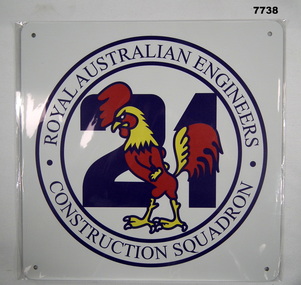
Sign - STEEL SIGN, ROYAL AUSTRALIAN ENGINEERS CONSTRUCTION SQUADRON, c.2022
... Army. Sign Royal Australian Engineers Front - "Royal Australian Engineers - Construction Squadron". Back - Stamp "Steel made by Bluescope CC38A Z47910. 22 Sep 2022 8..." Twice. White Square steel sign with hole in each corner on front and image of a fighting rooster (red and yellow) over the number 21 in purple. Surrounded by two concentric circles with the identification of the unit ...21st Construction Squadron is part of the 6th Engineering Regiment based at Amberley and is drawn mainly from Regular Army.White Square steel sign with hole in each corner on front and image of a fighting rooster (red and yellow) over the number 21 in purple. Surrounded by two concentric circles with the identification of the unit also in purple. All wrapped in clear plastic on back a stamp saying who made the steel. Some codes and dates.Front - "Royal Australian Engineers - Construction Squadron". Back - Stamp "Steel made by Bluescope CC38A Z47910. 22 Sep 2022 8..." Twice.sign, royal australian engineers -
 Bendigo Military Museum
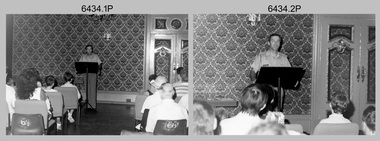
Photograph - Army Survey Regiment Open Day - Briefings and Tours, Fortuna, Bendigo, 1990
... Army Survey Regiment Open Day at Fortuna Villa, Bendigo on the 24th of February 1990. This occasion was one of several events held to commemorate the 75th anniversary of the formation of the Royal Australian Survey Corps. Although historical tours of Fortuna occurred on a regular basis, this was the first technical open day since 1972. The Royal Australian Survey Corps recognised that an Open Day was the best way for the local community in Bendigo to gain an insight into the unit’s...Army Survey Regiment Open Day at Fortuna Villa, Bendigo on the 24th of February 1990. This occasion was one of several events held to commemorate the 75th anniversary of the formation of the Royal Australian Survey Corps. Although historical tours of Fortuna occurred on a regular basis, this was the first technical open day since 1972. The Royal Australian Survey Corps recognised that an Open Day was the best way for the local community in Bendigo to gain an insight into the unit’s ...These 27 photographs were taken at an Army Survey Regiment Open Day at Fortuna Villa, Bendigo on the 24th of February 1990. This occasion was one of several events held to commemorate the 75th anniversary of the formation of the Royal Australian Survey Corps. Although historical tours of Fortuna occurred on a regular basis, this was the first technical open day since 1972. The Royal Australian Survey Corps recognised that an Open Day was the best way for the local community in Bendigo to gain an insight into the unit’s important role as Defence’s map production agency, its technical equipment, and its economic importance to Bendigo. It also gave them an opportunity to tour through historic Fortuna Villa. This occasion is covered in more detail in page 143 of Valerie Lovejoy’s book 'Mapmakers of Fortuna – A history of the Army Survey Regiment’ ISBN: 0-646-42120-4. Refer to items 6435.35P and 6436.18P for more photos of the Open Day taken in the Map Production areas of Air Survey and Cartographic Squadron, and production areas of Lithographic Squadron. Photo prints of some of these photos were scanned and catalogued in items 6247.30P and 6291.6P.These 27 photographs were taken at an Army Survey Regiment Open Day held at Fortuna, Bendigo on the 24th of February 1990. The 35mm colour and black & white negatives photographs were scanned at 96 dpi and are part of the Army Survey Regiment’s Collection. .1) & .2) - Photo, black & white, 1990. Ballroom - Visitor briefings by CO LTCOL Rene van den Tol. .3) - Photo, colour, 1990. Ballroom - Visitor briefings by MAJ Ray Redman. .4) - Photo, colour, 1990. Ballroom - Visitor briefings by unidentified UK Exchange officer. .5) - Photo, black & white, 1990. Music Room - Visitor briefings by MAJ Bob Williams. .6) - Photo, black & white, 1990. Orderly Room - ADJT CAPT Peter Parkes. .7) - Photo, colour, 1990. Music Room - ADJT CAPT Peter Parkes with civilian visitors. .8) - Photo, colour, 1990. Music Room - Visitor briefings by CPL Le-Anne (Smallshaw) Shirley. .9) - Photo, colour, 1990. Entrance Foyer - Visitor briefings. .10) - Photo, colour, 1990. CO’s Office - Visitor briefings by CPL Raelene (Munting) Brodie. .11) - Photo, colour, 1990. Mr Pat Thwaites outlining utilisation of satellite imagery to civilian visitors. .12) - Photo, black & white, 1990. Mr Pat Thwaites outlining utilisation of satellite imagery to civilian visitors. .13) - Photo, colour, 1990. Staircase leading up to the top floor - Visitor briefings by CPL Ian Nelson. .14) - Photo, colour, 1990. Building 16 - Visitor briefings by RSM WO1 Neville Stone. .15) - Photo, colour, 1990. Civilian visitors enjoying views of the garden from Fortuna Villa’s rooftop. .16) - Photo, black & white, 1990. Visitor briefings at Fortuna’s rear steps. .17) - Photo, black & white, 1990. Outside Building 16 - Visitor briefings by WO1 Gary Warnest. .18) - Photo, colour, 1990. Outside Building 16 - Visitor briefings by WO2 Adrian ‘Charlie’ Creedy. .19) - Photo, colour, 1990. Outside Building 16 - L to R: SPR Sue (Foote) Bourne, LCPL Sandy Winn, WO2 Adrian ‘Charlie’ Creedy. .20) - Photo, colour, 1990. Outside Building 16 - SGT Greg Byers. .21) - Photo, colour, 1990. Visitors enjoying Devonshire Tea in the gardens next to the Tavern. .22) - Photo, colour, 1990. RSM WO1 Neville Stone and family enjoying Devonshire Tea in the gardens next to the Tavern. .23) - Photo, colour, 1990. Visitors relaxing in the garden next to Fortuna’s lake. .24) - Photo, black & white, 1990. CPL Trevor Poll and others serve up BBQ lunch next to the tennis courts. .25) to .27) - Photo, colour, 1990. Parking at a premium inside the Army Survey Regiment and Chum Street..1P to .27P – no annotationsroyal australian survey corps, rasvy, army survey regiment, army svy regt, fortuna, asr -
 Bendigo Military Museum
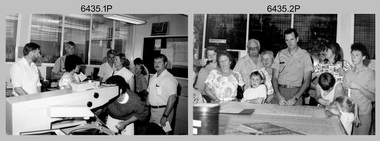
Photograph - Army Survey Regiment Open Day - Map Production, Fortuna, Bendigo, 1990
... Army Survey Regiment Open Day at Fortuna Villa, Bendigo on the 24th of February 1990. This occasion was one of several events held to commemorate the 75th anniversary of the formation of the Royal Australian Survey Corps. Although historical tours of Fortuna occurred on a regular basis, this was the first technical open day since 1972. The Royal Australian Survey Corps recognised that an Open Day was the best way for the local community in Bendigo to gain an insight into the unit’s...Army Survey Regiment Open Day at Fortuna Villa, Bendigo on the 24th of February 1990. This occasion was one of several events held to commemorate the 75th anniversary of the formation of the Royal Australian Survey Corps. Although historical tours of Fortuna occurred on a regular basis, this was the first technical open day since 1972. The Royal Australian Survey Corps recognised that an Open Day was the best way for the local community in Bendigo to gain an insight into the unit’s ...These 35 photographs were taken at an Army Survey Regiment Open Day at Fortuna Villa, Bendigo on the 24th of February 1990. This occasion was one of several events held to commemorate the 75th anniversary of the formation of the Royal Australian Survey Corps. Although historical tours of Fortuna occurred on a regular basis, this was the first technical open day since 1972. The Royal Australian Survey Corps recognised that an Open Day was the best way for the local community in Bendigo to gain an insight into the unit’s important role as Defence’s map production agency, its technical equipment, and its economic importance to Bendigo. It also gave them an opportunity to tour through historic Fortuna Villa. This occasion is covered in more detail in page 143 of Valerie Lovejoy’s book 'Mapmakers of Fortuna – A history of the Army Survey Regiment’ ISBN: 0-646-42120-4. Refer to items 6434.27P and 6436.18P for more photos of the Open Day taken inside Fortuna, the garden areas and production areas of Lithographic Squadron. Photo prints of some of these photos were scanned and catalogued in items 6247.30P and 6291.6P.These 35 photographs were taken at an Army Survey Regiment Open Day held at Fortuna, Bendigo on the 24th of February 1990. The 35mm colour and black & white negatives photographs were scanned at 96 dpi and are part of the Army Survey Regiment’s Collection. .1) - Photo, black & white, 1990. CPL Neale ‘Tex’ Houston with visitors in Aerotriangulation Section. .2) - Photo, black & white, 1990. L to R: MAJ Peter Clark and WO2 Neil ‘Ned’ Kelly with visitors in Aerotriangulation Section. .3) - Photo, black & white, 1990. SGT Bruce Hammond with visitors in Aerotriangulation Section. .4) - Photo, colour, 1990. SGT Bruce Hammond with visitors in Aerotriangulation Section. .5) - Photo, colour, 1990. SGT Steve Gloster with visitors in Aerotriangulation Section. .6) - Photo, colour, 1990. L to R: CPL Noel Brinsmead and CPL Darren Wilkinson with visitors in Aerotriangulation Section. .7) - Photo, colour, 1990. L to R: CPL Noel Brinsmead with visitors in Aerotriangulation Section. .8) - Photo, colour, 1990. MAJ Peter Clark with visitors in Aerotriangulation Section. .9) - Photo, colour, 1990. CPL Mark Lander with visitors in Plotting Section. .10) - Photo, colour, 1990. SSGT Andy Boath with visitors in Plotting Section. .11) - Photo, colour, 1990. SPR Stuart Bowd with visitors in Plotting Section. .12) - Photo, colour, 1990. CAPT Roger Hancock with visitors in Plotting Section. .13) & .14) - Photo, colour, 1990. AUTOMAP 2 - CPL Peter Peterson with visitors. .15) - Photo, colour, 1990, AUTOMAP 2 - L to R: SSGT Graham Johnston, SPR Grant Davis with civilian visitors. .16) - Photo, colour, 1990, AUTOMAP 2 - L to R: CPL Steve McGuiness, SSGT Graham Johnston with civilian visitors. .17) - Photo, colour, 1990, AUTOMAP 2 - civilian visitors. .19) - Photo, colour, 1990, AUTOMAP 2 - L to R: unidentified, SPR Tony Jackson, CPL Mark Westbrook, SSGT Bob Bright, with civilian visitors. .20) - Photo, colour, 1990, AUTOMAP 2 - L to R: WO2 Adrian ‘Charlie’ Creedy, CPL Mark Westbrook, SPR Mick Duggan with civilian visitors. .21) - Photo, colour, 1990, AUTOMAP 2 - L to R: SPR Mick Duggan, CO LTCOM Rene van den Tol, SSGT Bob Bright, CPL Mark Westbrook with civilian visitors. .22) - Photo, colour, 1990, AUTOMAP 2 - L to R: SPR Damien Nolan, unidentified, SPR Peter Smyth with civilian visitors. .23) - Photo, black & white, 1990, AUTOMAP 2 - L to R: SPR Peter Smyth, CAPT Steve Hledik, SGT Martin Evans, MAJ Neil Taylor with civilian visitors. .24) - Photo, black & white, 1990, AUTOMAP 2 - L to R: SPR Mick Duggan, CPL Mark Westbrook with civilian visitors. .25) - Photo, black & white, 1990, AUTOMAP 2 – LCPL Sandy Winn with civilian visitor. .26) - Photo, black & white, 1990. Display of digital storage media. .27) & .28) - Photo, colour, 1990. Cartography - SPR Ian Baldwin with civilian visitors. .29) - Photo, black & white, 1990. Cartography - SPR Ian Baldwin with civilian visitors. .30) - Photo, black & white, 1990. Cartography - SGT Sherri (Dally) Burke with civilian visitors. .31) - Photo, colour, 1990. Cartography - L to R: SGT Sherri (Dally) Burke, SSGT Dennis Learmonth with civilian visitors. .32) - Photo, colour, 1990. Cartography – SGT Barry Hogan with civilian visitors. .33) & .34) - Photo, colour, 1990. Cartography – CPL Dan Cirsky with civilian visitors. .35) - Photo, colour, 1990. Cartography – L to R: SPR Jeanette (Lane) Dury-Lane, CPL Diane (Thomas) Soutar with civilian visitors..1P to .35P – no annotationsroyal australian survey corps, rasvy, army survey regiment, army svy regt, fortuna, asr, automap 2 -
 Bendigo Military Museum
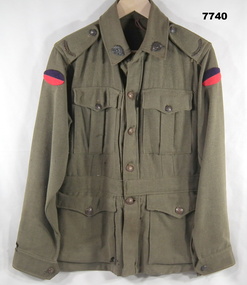
Uniform - JACKET, BATTLE DRESS - ARMY, Australian Defence Industries, 1942
... Army Battle Dress WW2 Manufacturers information on two labels. Black ink print - "REGIMENTAL NO./NAME" Red ink print - "V162/ MADE IN/ AUSTRALIA/ 1942/ size". Handwritten black ink pen "XXX/ 20X" Jacket - Khaki colour wool serge fabric. Battle Dress style with belt at waist. Brown metal buttons with shank and split pin. Buttons have raised emblem - map of Australa and Crown and lettering "AUSTRALIAN MILITARY FORCES". Collar, shoulder epaulettes, four front pockets with button down flaps, sleeve cuffs. Unit ...Jacket - Khaki colour wool serge fabric. Battle Dress style with belt at waist. Brown metal buttons with shank and split pin. Buttons have raised emblem - map of Australa and Crown and lettering "AUSTRALIAN MILITARY FORCES". Collar, shoulder epaulettes, four front pockets with button down flaps, sleeve cuffs. Unit colour patch insignia - handmade purple over red - 38th Battalion. Collar badges - metal - Rising Sun Badge. Shoulder epaulettes - metal "AUSTRALIA" badge. Manufacturers white cotton fabric label - inside right pocket.Manufacturers information on two labels. Black ink print - "REGIMENTAL NO./NAME" Red ink print - "V162/ MADE IN/ AUSTRALIA/ 1942/ size". Handwritten black ink pen "XXX/ 20X" uniform, army, battle dress, ww2 -
 Bendigo Military Museum
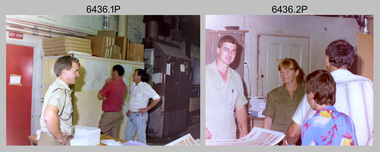
Photograph - Army Survey Regiment Open Day – Lithographic Squadron, Fortuna, Bendigo, 1990
... Army Survey Regiment Open Day at Fortuna Villa, Bendigo on the 24th of February 1990. This occasion was one of several events held to commemorate the 75th anniversary of the formation of the Royal Australian Survey Corps. Although historical tours of Fortuna occurred on a regular basis, this was the first technical open day since 1972. The Royal Australian Survey Corps recognised that an Open Day was the best way for the local community in Bendigo to gain an insight into the unit’s...Army Survey Regiment Open Day at Fortuna Villa, Bendigo on the 24th of February 1990. This occasion was one of several events held to commemorate the 75th anniversary of the formation of the Royal Australian Survey Corps. Although historical tours of Fortuna occurred on a regular basis, this was the first technical open day since 1972. The Royal Australian Survey Corps recognised that an Open Day was the best way for the local community in Bendigo to gain an insight into the unit’s ...These 18 photographs were taken at an Army Survey Regiment Open Day at Fortuna Villa, Bendigo on the 24th of February 1990. This occasion was one of several events held to commemorate the 75th anniversary of the formation of the Royal Australian Survey Corps. Although historical tours of Fortuna occurred on a regular basis, this was the first technical open day since 1972. The Royal Australian Survey Corps recognised that an Open Day was the best way for the local community in Bendigo to gain an insight into the unit’s important role as Defence’s map production agency, its technical equipment, and its economic importance to Bendigo. It also gave them an opportunity to tour through historic Fortuna Villa. This occasion is covered in more detail in page 143 of Valerie Lovejoy’s book 'Mapmakers of Fortuna – A history of the Army Survey Regiment’ ISBN: 0-646-42120-4. Refer to items 6434.27P and 6435.35P for more photos of the Open Day taken inside Fortuna, the garden areas and Map Production areas of Air Survey and Cartographic Squadron. Photo prints of some of these photos were scanned and catalogued in items 6247.30P and 6291.6P.These 18 photographs were taken at an Army Survey Regiment Open Day held at Fortuna, Bendigo on the 24th of February 1990. The 35mm colour and black & white negatives photographs were scanned at 96 dpi and are part of the Army Survey Regiment’s Collection. .1) - Photo, colour, 1990. Print Troop – WO2 Rob Bogumil with visitors. .2) - Photo, colour, 1990. Print Troop – L to R: SPR Ross Anza, LCPL Janet Murray with visitors. .3) - Photo, black & white, 1990. Print Troop – L to R: LCPL Janet Murray, MAJ Bob Coote, SPR Gary Lord with visitors. .4) - Photo, black & white, 1990. Photo Troop – L to R: WO2 Keith Fenton RE UK Exchange, SGT Steve Burke with visitors. .5) - Photo, colour, 1990. Photo Troop – SGT Steve Burke with visitors. .6) - Photo, colour, 1990. Photo Troop – L to R: unidentified, SGT Steve Burke with visitors. .7) - Photo, colour, 1990. Print Troop – L to R: CPL Peter Breukel, WO2 Keith Fenton RE. UK Exchange with visitors. .8) - Photo, black & white, 1990. Photo Troop - WO2 Keith Fenton RE. UK Exchange. .9) - Photo, black & white, 1990. Print Troop - civilian visitors. .10) - black & white, Print Troop, 1990. - L to R: civilian visitors, SSGT Ian Nichols, CPL John ‘Flash’ Anderson. .11) - Photo, black & white, 1990. Print Troop - L to R: SSGT Ian Nichols, CPL Dale Hudson, Planeta printing press, with civilian visitors. .12) - Photo, colour, 1990. Print Troop - L to R: SSGT Ian Nichols, CAPT Roger Hancock with civilian visitors. .13) - Photo, colour, 1990. Print Troop - LT Marty Lyons with civilian visitors. .14) - Photo, black & white, 1990. Print Troop - L to R: LT Marty Lyons, unidentified with civilian visitors. .15) - Photo, black & white, 1990. Orthophoto Mapping Section - L to R: SSGT Peter Imeson, SGT Bob Garritty with civilian visitors. .16) - Photo, colour, 1990. Optronics raster scanner - WO2 Adrian ‘Charlie’ Creedy with civilian visitors. .17) - Photo, colour 1990. Outside Photo Troop office - L to R: SSGT Rhys De Laine, WO2 Rob Bogumil. .18) - Photo, black & white, 1990. Photo Troop - civilian visitors..1P to .18P – no annotationsroyal australian survey corps, rasvy, army survey regiment, army svy regt, fortuna, asr, litho sqn -
 Bendigo Military Museum
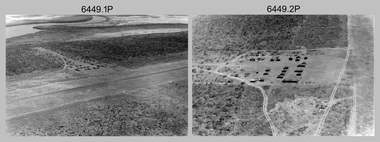
Photograph - RA Svy Project C4 Aerodist Operation, Eastern Arnhem Land, NT, 1967
... Army Svy Regt...Fortuna...ASR...AERODIST...surveying...Central Comd Fd Svy Unit...Unit (Adelaide - Major Don Ridge) on Project C4 eastern-Arnhem Land NT, where 317 Aerodist lines measuring 17,300 line miles were successfully completed. This was the most productive Aerodist project thus far. The most common helicopter used by RA Svy up to 1972 was the civilian Bell 47G-2 and the Sioux Light Observation Helicopters (LOH), the Australian Army’s equivalent featured in this photo set. ...Unit (Adelaide) – OC Major Don Ridge. .23) to .25) - Photo, black & white, 1967. Aero Commander VH-EXX probably at Gove, NT. Unidentified personnel. .26) - Photo, black & white, 1967. Aero Commander VH-EXX probably at Gove, NT. Aerodist antenna pods are visible on the aircraft. .27) to .29) - Photo, black & white, 1967. Australian Army...Royal Australian Survey Corps RASvy Army Survey Regiment Army Svy Regt Fortuna ASR AERODIST surveying Central Comd Fd Svy Unit .1P to .2P – date and location on edge of film negative. .5P to .28P – no annotations .29P - annotated in white ‘RW-JEP Gove NT’ .30P - annotated in white ‘U337 Spool No1 Jun67’ This is a set of 30 photographs of Royal Australian Survey Corps (RA Svy) personnel on Aerodist survey operations in Eastern Arnhem Land, Northern Territory in 1967. ...This is a set of 30 photographs of Royal Australian Survey Corps (RA Svy) personnel from Central Comd Fd Svy Unit (Adelaide) on Aerodist survey operation - Project C4 in Eastern Arnhem Land, Northern Territory in 1967. Photos of personnel were taken either at the operations base at Numbulwar or the main base at Gove (Nhulunbuy). RA Svy conducted nineteen Aerodist operations for 12 years from 1964 to 1975. Aerodist MRC2 was a tellurometer-based system adapted for aircraft to accurately measure distances between non-intervisible ground survey stations, using the aircraft as an intermediate station. Lower order geodetic results could be achieved by survey network trilateration. The measured distances between stations formed survey networks from which each station’s latitude and longitude was computed. Aerodist MRC2 was RA Svy’s major horizontal control survey tool for mainly medium scale topographic mapping (scale 1:100,000 Class A being spatially accurate to within 50 metres) in PNG, northern NT, north-west WA, Kalimantan Barat (West) Indonesia, Sumatra Indonesia, Gulf of Carpentaria and Cape York, QLD. In 1967, the Aerodist MRC2 Master equipment was installed in the aircraft featured in this set of photos, Executive Air Services’ (Essendon VIC) Grand Aero Commander VH-EXX. It was the same aircraft type and company contracted to Division of National Mapping for Aerodist MRC2 surveys. From July to October 1967 the aircraft was attached to Central Comd Fd Svy Unit (Adelaide - Major Don Ridge) on Project C4 eastern-Arnhem Land NT, where 317 Aerodist lines measuring 17,300 line miles were successfully completed. This was the most productive Aerodist project thus far. The most common helicopter used by RA Svy up to 1972 was the civilian Bell 47G-2 and the Sioux Light Observation Helicopters (LOH), the Australian Army’s equivalent featured in this photo set. These light observation helicopters had a limiting load carrying capacity of up to about 500 pounds. By comparison, one Aerodist team including two people weighed up to 1,500 pounds. Source: Royal Australian Survey Corps – Aerodist Years 1964-1975 by Peter Jensen. Refer to Item 9061.26P for more photos taken during this Aerodist survey operation.This is a set of 30 photographs of Royal Australian Survey Corps (RA Svy) personnel on Aerodist survey operations in Eastern Arnhem Land, Northern Territory in 1967. The photographs are on 35mm negative film and scanned at 96 dpi. They are part of the Army Survey Regiment’s Collection. .1) to .4) - black & white, 20th August 1967, Project C4 Aerodist Operations Base - Numbulwar, NT. .5) - Photo, black & white, 1967. Probable wrecked Indonesian fishing vessel. .6) to .8) - Photo, black & white, 1967. Unidentified survey operations base, L to R: unidentified personnel. .9) - Photo, black & white, 1967. Unidentified survey operations base, unidentified soldier driving a Haflinger 4x4 Light utility vehicle. .10) - Photo, black & white, 1967. Unidentified survey operations base, L to R: unidentified technician. .11) - Unidentified technician reading two survey altimeters to compute corrections to the measured distances for atmospheric refraction and to compute the sea level distances from the slope distances aircraft to the ground stations. .12) - Photo, black & white, 1967. Survey operations base, L to R: unidentified (x3), W01 Pat Wood BEM, unidentified. .13) to .16) - Photo, black & white, 1967. Unidentified personnel operating remote Aerodist MRC2 ground instruments. .17) to .18) - Photo, black & white, 1967. Unknown RA Svy office location. .19) to .20) - Photo, black & white, 1967. Aerodist MRC2 Master equipment. .21) to .22) - Photo, black & white, 1967. Aero Commander VH-EXX probably at Gove, NT, Central Comd Fd Svy Unit (Adelaide) – OC Major Don Ridge. .23) to .25) - Photo, black & white, 1967. Aero Commander VH-EXX probably at Gove, NT. Unidentified personnel. .26) - Photo, black & white, 1967. Aero Commander VH-EXX probably at Gove, NT. Aerodist antenna pods are visible on the aircraft. .27) to .29) - Photo, black & white, 1967. Australian Army Sioux Light Observation Helicopter (LOH) probably at Gove, NT. .30) - Photo, black & white, 1967. Panelled U337 survey station, visible as a white cross on aerial identification photo..1P to .2P – date and location on edge of film negative. .5P to .28P – no annotations .29P - annotated in white ‘RW-JEP Gove NT’ .30P - annotated in white ‘U337 Spool No1 Jun67’royal australian survey corps, rasvy, army survey regiment, army svy regt, fortuna, asr, aerodist, surveying, central comd fd svy unit -
 Bendigo Military Museum
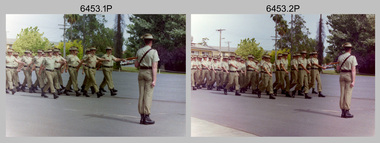
Photograph - Officer Commissioning and CO’s Handover Parade, Army Survey Regiment, Fortuna Villa, Bendigo, 1992
... Army Survey Regiment, Fortuna, Bendigo in 1992. On this parade WO1 Bill Jones received his commission and by promotion to Captain from CO LTCOL Rene van den Tol. Command of the unit...Army Survey Regiment, Fortuna, Bendigo in 1992. On this parade WO1 Bill Jones received his commission and by promotion to Captain from CO LTCOL Rene van den Tol. Command of the unit ...This is a set of 28 photographs taken at a CO’s Parade at the Army Survey Regiment, Fortuna, Bendigo in 1992. On this parade WO1 Bill Jones received his commission and by promotion to Captain from CO LTCOL Rene van den Tol. Command of the unit was handed over to LTCOL Rob McHenry. It is probable the commissioning and handover ceremonies occurred on the CO’s Parade. LTCOL Rene van den Tol was CO from 1989 to 1992 and LTCOL Rob McHenry was CO from 1992 to 1993.This is a set of 28 photographs taken at a CO’s Parade at the Army Survey Regiment, Fortuna, Bendigo in 1992. The colour photographs are on 35mm negative film and scanned at 96 dpi. They are part of the Army Survey Regiment’s Collection. .1) - Photo, colour, 1992. Headquarters Squadron marches past RSM WO1 Graham Ragless. .2) - Photo, colour, 1992. Cartographic Squadron marches past RSM WO1 Graham Ragless. L to R: unidentified personnel, WO2 Steve Hansen, CPL Roger Pearson, WO1 Gary Warnest, SSGT Dennis Learmonth, SSGT Greg Else, CPL Ian Bowes, SGT Stuart Symonds. .3) - Photo, colour, 1992. Lithographic Squadron marches past RSM WO1 Graham Ragless. L to R: unidentified personnel, WO1 Steve Egan, LCPL John Bragg, unidentified personnel, WO2 Rob Bogumil, unidentified personnel, SPR Corey Hill. .4) - Photo, colour, 1992. Air Survey Squadron marches past RSM WO1 Graham Ragless. L to R: unidentified personnel, WO1 Allan Hancox, SSGT Wolfgang Thun, unidentified personnel, WO2 Neil ‘Ned’ Kelly, unidentified personnel, SGT Dave Longbottom, SGT Brian Johnson. .5) - Photo, colour, 1992. Cartographic Squadron. L to R: unidentified personnel, SGT Stuart Symonds, CPL Col McInnes, CAPT Mary Anne Martinek in foreground, SPR Jodi Seith, unidentified personnel, SPR Avril (Bray) Lloyd. .6) - Photo, colour, 1992. Air Survey Squadron. L to R: unidentified officer, SSGT Bruce Hammond, SPR Tracy Tillman, SPR Rachel (Stanford) Scott, SPR Paula (Golding) Brinsmead, SGT Graeme Reany, unidentified officer in foreground, unidentified personnel, CPL Steve Coulson. .7) - Photo, colour, 1992. Cartographic Squadron inspection. L to R: RSM WO1 Graham Ragless, unidentified, OC MAJ Graeme Wastell, CO LTCOL Rene van den Tol, unidentified personnel, CPL Col McInnes, SPR Jodi Seith, SPR Avril (Bray) Lloyd. CPL Steve Ellis, SPR Ian Brown, SPR Andrew Lazdovskis. .8) - Photo, colour, 1992. Cartographic Squadron inspection. L to R: OC MAJ Graeme Wastell, CO LTCOL Rene van den Tol, SPR Avril (Bray) Lloyd, CPL Steve Ellis, SPR Ian Brown, SPR Andrew Lazdovskis, SPR Adrian Taylor, unidentified, SPR Mick Knight, SPR Dawn Hoadley, CPL Craig Kellet. .8) to .12) - Photo, colour, 1992. Officer Commissioning Ceremony. L to R: CO LTCOL Rene van den Tol, WO1 Bill Jones promoted to Captain. .13) - Photo, colour, 1992. Officer Commissioning Ceremony. L to R: ADJT CAPT Geoff Ford, RSM WO1 Graham Ragless, CO LTCOL Rene van den Tol, WO1 Bill Jones promoted to Captain. .14) - Photo, colour, 1992. Officer Commissioning Ceremony. WO1 Bill Jones promoted to Captain. .15) - Photo, colour, 1992. Commanding Officer Handover. CO LTCOL Rene van den Tol delivers speech. .16) to .17) - Photo, colour, 1992. Commanding Officer Handover. R to L: CO LTCOL Rene van den Tol hands over to incoming CO LTCOL Rob McHenry. .18) - Photo, colour, 1992. Commanding Officer Handover. L to R: RSM WO1 Graham Ragless, ADJT CAPT Geoff Ford, CO LTCOL Rob McHenry. .19) - Photo, colour, 1992. Commanding Officer Handover. L to R: ADJT CAPT Geoff Ford, RSM WO1 Graham Ragless, CO LTCOL Rob McHenry. .20) - Photo, colour, 1992. Cartographic Squadron marches off parade ground. L to R: OC MAJ Graeme Wastell, unidentified officer, CAPT Greg Oaten CSC, LT Matt Jackson CSM, CAPT Mary Anne Martinek, SPR Mick Knight. .21) & .22) - Photo, colour, 1992. Cartographic Squadron marches off parade ground. .23) - Photo, colour, 1992. Lithographic Squadron marches off parade ground. L to R: OC Bob Coote, unidentified officer, SPR Scott Cameron, unidentified officer, SSGT Russ Mollenhauer, SGT Brian Fauth. .24) - Photo, colour, 1992. Lithographic Squadron marches off parade ground. L to R: LCPL Janet Murray, unidentified, SPR Mick Muzeen, Allison (Ottaway) Wooldrage, SGT Keith Quinton, SGT Frank Lenane, SGT Laurie Justin, SGT Dale Hudson, LCPL John Bragg, unidentified, SGT Kim Reynolds, SPR Corey Hill, SPR Andrew Arman, SPR Ross Anza, WO1 Peter Coombes. .25) - Photo, colour, 1992. Parade guests. L to R: unidentified guests, MAJ Peter Jensen. .26) - Photo, colour, 1992. Parade guests. L to R: unidentified guests, CAPT Doug Arman, unidentified guests. .27) - Photo, colour, 1992. Parade personnel march off. L to R: unidentified, WO2 Ted Burgess, WO1 Ken Slater. .28) - Photo, colour, 1992. Parade personnel. L to R: unidentified, SPR Allan Blake..1P to .28P – There are no annotations.royal australian survey corps, rasvy, army survey regiment, army svy regt, fortuna, asr -
 Bendigo Military Museum
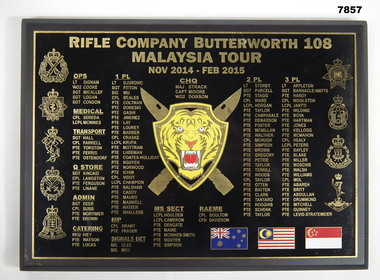
Plaque - PLAQUE, RIFLE COMPANY 108
... Army has been rotating a rifle company through the Australian Base at Butterworth, Penang, Malaysia. It's aim now is to train soldiers in jungle warfare and rotation occurs quarterly. Butterworth Rifle Company Plaque Headed "Rifle Company Butterworth 108 Malaysia Tour Nov 14 - Feb 2015. Black Wooden Plaque with full listing of all members of Rifle Company Butterworth 108. Personnel in gold print and listed by Company Platoons and various support units ...Over several decades the Australian Army has been rotating a rifle company through the Australian Base at Butterworth, Penang, Malaysia. It's aim now is to train soldiers in jungle warfare and rotation occurs quarterly.Black Wooden Plaque with full listing of all members of Rifle Company Butterworth 108. Personnel in gold print and listed by Company Platoons and various support units with their respective unit badges on each side. Unit badge of cross bayonets and a Tigers head on a shield in the centre. in bottom right corner, 3 flags - Australia/ Malayasia/ Singapore. A hole is drilled into it.Headed "Rifle Company Butterworth 108 Malaysia Tour Nov 14 - Feb 2015.butterworth, rifle company, plaque -
 Bendigo Military Museum
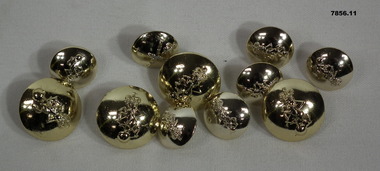
Uniform - BUTTONS, RAEME
... Each button bears a unit insignia - RAEME. Each button has a loop on back for attaching to an army jacket....Each button bears a unit insignia - RAEME. Each button has a loop on back for attaching to an army jacket. ...Each button bears the Insignia of Royal Australian Electrical and Mechanical Engineers (RAEME). Part of the Cooper Collection.Collection of four large and seven small round gold coloured buttons. Each button bears a unit insignia - RAEME. Each button has a loop on back for attaching to an army jacket.Stamped on back of large buttons: 'STOKES & SONS, MELB'. Stamped on back of small buttons: 'STOKES, MELB.'cooper collection, uniform, buttons, raeme -
 Warrnambool and District Historical Society Inc.
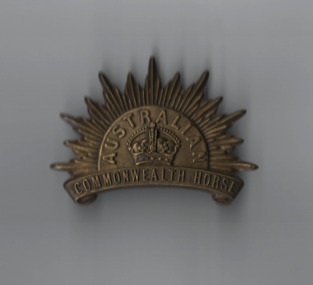
Badge, Australian Commonwealth Horse, C1902
... This is the badge of the Australian Commonwealth Horse which was a mounted infantry unit of the Australian Army established during the Second Boer War in 1902. ...This is the badge of the Australian Commonwealth Horse which was a mounted infantry unit of the Australian Army established during the Second Boer War in 1902. ...This is the badge of the Australian Commonwealth Horse which was a mounted infantry unit of the Australian Army established during the Second Boer War in 1902. It was the first expeditionary force established by the Commonwealth of Australia following Federation in 1901 and the first to wear the Rising Sun Badge, a design chosen by the British Commander in Chief of the Australian Forces, Sir Edward Hutton. This Rising Sun Badge was the second version of a military badge used by Australian soldiers in 1902.This badge is of great interest as the hat badge worn by the Australian Commonwealth Horse in the Boer War. It is not known if it has any local significance. Brass semi-circular badge in the shape of the rising sun with slightly curved bottom edge. There is text along the bottom edge with "Australia" in a semi-circle above a crown in low relief.two hooks on the back of the badge."Commonwealth Horse" in scroll alonf bottom of badge. "Australia " in semicircle below the rays of the sun.warrnambool, commonwealth horse badge, military badges of australia, australian commonwealth horse badge -
 Warrnambool and District Historical Society Inc.
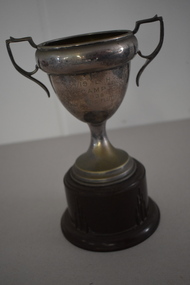
Trophy, 4/19 L H Camp 1938, 1930s
... This regiment kept alive the tradition of the original Light Horse units, becoming part of the Australian Army Reserve and members served in Vietnam and East Timor. ...This regiment kept alive the tradition of the original Light Horse units, becoming part of the Australian Army Reserve and members served in Vietnam and East Timor. ...This is a trophy awarded at a camp of the 4/19 Light Horse Regiment. This regiment appeared to have been based in the Corangamite region of the Western District and included regiment members from Warrnambool. It is not known exactly what type of competition was an ‘Officers Flutter’. Light Horse regiments were cavalry regiments that were established at the time of the Crimean War in the 1860s. During the First World War the 4th Light Horse served with distinction in France, Gallipoli and Palestine. In 1948 the 17th Prince of Wales Light Horse, the 19th Yarrowee Light Horse and the 4th (ex 20th ) Corangamite Light Horse amalgamated to form a revived 4/19 Light Horse. This regiment kept alive the tradition of the original Light Horse units, becoming part of the Australian Army Reserve and members served in Vietnam and East Timor. This cup is of interest as an example of the trophies awarded for competition at a Light Horse regiment camp in the 1930s. This is a metal cup (silver amalgam)) with two side handles and a narrow stem attached to a silver base. The cup is attached to a brown Bakelite stand. The inside of the cup has some white paint streaks and the cup itself is much stained and pock-marked. ‘Westminster’ 4/19 L.H. Camp 1938 Officers Flutter light horse regiments. warrnambool district, history of warrnambool -
 Warrnambool and District Historical Society Inc.
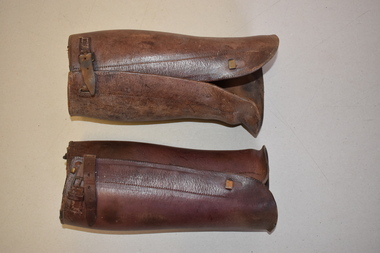
Spats, Early 20th century
... These spats appear to be part of an army uniform and may have been worn by a member of an Australian Lighthorse unit. ...These spats appear to be part of an army uniform and may have been worn by a member of an Australian Lighthorse unit. ...These spats appear to be part of an army uniform and may have been worn by a member of an Australian Lighthorse unit. The Victorian Mounted Rifles was established in 1885 by Colonel Tom Price who lived in his retirement years in Warrnambool. Many members of the G Company Mounted Rifles from Warrnambool and district enlisted in World War One and served with distinction in the Victorian Lighthorse units which evolved from the Mounted Rifles units. These spats are retained as they are possibly part of the uniform of an Australian Lighthorse soldier early in the 20th century and may have local provenance.These are two spats or leggings made of stiffened brown leather shaped to fit the lower calf of the leg. They have leather straps and metal buckles at the top end. australian lighthorse regiments, spats, history of warrnambool -
 Warrnambool and District Historical Society Inc.
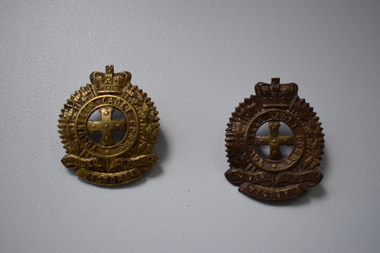
Badges, Volunteer Cadet Corps, Late 19th century
... units were initially based at the Warrnambool State School and the Warrnambool Grammar School. Later groups were formed in other schools and competed against each other in rifle shooting competitions, marching and parade skills etc. The Warrnambool groups were trained and assisted by members of the local adult Volunteer Corps. Today cadet groups are sponsored by the Australian Army...units were initially based at the Warrnambool State School and the Warrnambool Grammar School. Later groups were formed in other schools and competed against each other in rifle shooting competitions, marching and parade skills etc. The Warrnambool groups were trained and assisted by members of the local adult Volunteer Corps. Today cadet groups are sponsored by the Australian Army ...These are badges or pieces of insignia that would have been worn on the collar or cap of members of the Victorian Volunteer Corps. This organization was formed in Victoria in 1867 with the object of fostering in young men leadership, discipline, loyalty and initiative through training programs and community service. The Victorian Volunteer Corps was established in Warrnambool in 1868 and units were initially based at the Warrnambool State School and the Warrnambool Grammar School. Later groups were formed in other schools and competed against each other in rifle shooting competitions, marching and parade skills etc. The Warrnambool groups were trained and assisted by members of the local adult Volunteer Corps. Today cadet groups are sponsored by the Australian Army and there is revived interest in Warrnambool in school cadet groups. These insignia items have no known local provenance but are of historical interest as mementoes of the Volunteer Cadet Corps that operated in Warrnambool from the late 1860s through to the early 20th century. .1 This is a bronze-coloured metal badge with gold lettering, a crown on top, a cross with stars in the middle section and laurel leaves around the outer edges. The two clips at the back are for attachment of the badge to a collar or cap. .2 as above except that this badge has been damaged and somewhat flattened. Volunteer Cadet Corps Victoria Pro Deo et Patria volunteer cadet corps,, history of warrnambool -
 Wangaratta RSL Sub Branch
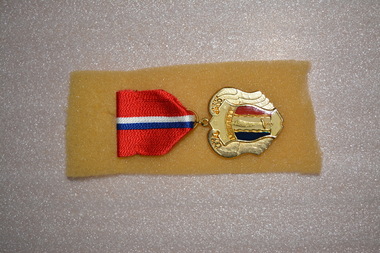
Medal, Philippine Liberation, c1995
... The Australian Army played virtually no part in the Philippines. However, units from the Royal Australian Air Force and the Royal Australian Navy, were involved.The ships that delivered American troops included three Australian landing ships, HMA Ships Kanimbla, Manoora and Westralia. ...The Australian Army played virtually no part in the Philippines. However, units from the Royal Australian Air Force and the Royal Australian Navy, were involved.The ships that delivered American troops included three Australian landing ships, HMA Ships Kanimbla, Manoora and Westralia. ...The Philippine Liberation Medal is intended to recognize military service during the last eleven months of World War II when the military of Japan was driven from the Philippines before their surrender in September 1945. Robert Hamilton Hutchieson PM 4802 served on HMAS Westralia as a landing craft coxswain in the Southwest Pacific Campaign 1942 to 1945. The Australian Army played virtually no part in the Philippines. However, units from the Royal Australian Air Force and the Royal Australian Navy, were involved.The ships that delivered American troops included three Australian landing ships, HMA Ships Kanimbla, Manoora and Westralia. In 1995, fifty years after the liberation of the Philippines from Japanese occupation, the Republic of the Philippines announced the awarding of a Philippines Liberation Medal to Allied veterans who served in the country or its territorial waters during 1944-45. More than 3000 Australians have received this medalGold with white enamel irregular shaped medal attached to orange ribbon with central thin blue and white stripe. Liberty (front) For The Liberation of The Philippines (back)philippine liberation medal, ww2, robert hutchieson -
 Wangaratta RSL Sub Branch
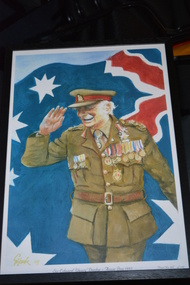
Print - Framed print, c1993
... Born 12 July 1907 Major Plains, Victoria Died 2 July 1993 (aged 85) Service/branch Australian Army Years of service 1935–1946 Rank Colonel Unit Royal Australian Army Medical Corps 2/2nd Casualty Clearing Station Commands held No.1 Allied General Hospital Battles/wars World War II Battle of Greece North African Campaign Syria-Lebanon campaign South West Pacific New Guinea Campaign South East Asia Campaign Awards Companion of the Order of Australia Knight Bachelor Companion of the Order of St Michael and St George Officer of the Order of the British Empire Knight of the Venerable Order of Saint John Mentioned in Despatches ...Born 12 July 1907 Major Plains, Victoria Died 2 July 1993 (aged 85) Service/branch Australian Army Years of service 1935–1946 Rank Colonel Unit Royal Australian Army Medical Corps 2/2nd Casualty Clearing Station Commands held No.1 Allied General Hospital Battles/wars World War II Battle of Greece North African Campaign Syria-Lebanon campaign South West Pacific New Guinea Campaign South East Asia Campaign Awards Companion of the Order of Australia Knight Bachelor Companion of the Order of St Michael and St George Officer of the Order of the British Empire Knight of the Venerable Order of Saint John Mentioned in Despatches colonel sir ernest edward dunlop "weary" dunlop surgeon Sir Edward "Weary" Dunlop - Anzac Day 1993 Print No 455 of 500 Black timber frame containing coloured caricature of saluting Army Officer with flag in background. ...Colonel Sir Ernest Edward "Weary" Dunlop, AC, CMG, OBE (Born at Wangaratta 12 July 1907 – 2 July 1993) was an Australian surgeon who was renowned for his leadership while being held prisoner by the Japanese during World War II. Born 12 July 1907 Major Plains, Victoria Died 2 July 1993 (aged 85) Service/branch Australian Army Years of service 1935–1946 Rank Colonel Unit Royal Australian Army Medical Corps 2/2nd Casualty Clearing Station Commands held No.1 Allied General Hospital Battles/wars World War II Battle of Greece North African Campaign Syria-Lebanon campaign South West Pacific New Guinea Campaign South East Asia Campaign Awards Companion of the Order of Australia Knight Bachelor Companion of the Order of St Michael and St George Officer of the Order of the British Empire Knight of the Venerable Order of Saint John Mentioned in Despatches Black timber frame containing coloured caricature of saluting Army Officer with flag in background.Sir Edward "Weary" Dunlop - Anzac Day 1993 Print No 455 of 500colonel sir ernest edward dunlop, "weary" dunlop, surgeon -
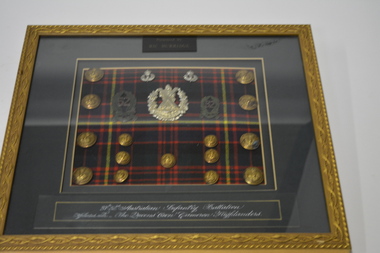 Wangaratta RSL Sub Branch
Memorabilia - Framed buttons and badges
... units were also known by the name of their shire. Thus, the Victorian 37th Infantry Battalion was the "Hunt Regiment", while the 52nd Infantry Battalion was the "Gippsland Regiment". Both were raised in 1921 and linked in 1930, forming the 37th/52nd Infantry Battalion. In 1937 the battalion was separated but merged again in August 1942, after Japan's entry into the Second World War and the subsequent reorganisation of the Australian Army...units were also known by the name of their shire. Thus, the Victorian 37th Infantry Battalion was the "Hunt Regiment", while the 52nd Infantry Battalion was the "Gippsland Regiment". Both were raised in 1921 and linked in 1930, forming the 37th/52nd Infantry Battalion. In 1937 the battalion was separated but merged again in August 1942, after Japan's entry into the Second World War and the subsequent reorganisation of the Australian Army ...After the First World War the defence of the Australian mainland lay with the part-time soldiers of the Citizens Military Force (CMF), also known as the Militia. The Militia was organized to maintain the structure of the First AIF and kept the same numerical designations. The Militia units were distributed in the same areas the original AIF units were raised. Consequently, Militia units were also known by the name of their shire. Thus, the Victorian 37th Infantry Battalion was the "Hunt Regiment", while the 52nd Infantry Battalion was the "Gippsland Regiment". Both were raised in 1921 and linked in 1930, forming the 37th/52nd Infantry Battalion. In 1937 the battalion was separated but merged again in August 1942, after Japan's entry into the Second World War and the subsequent reorganisation of the Australian Army. gold coloured metal frame with green mount containing 3 silver and 2 green badges 8 large and 7 small gold coloured buttons on tartan cloth background.37th-52rd Australian Infantry Battalion Affilitated with The Queens "Own" Cameron Highlanders 37th/52nd australian infantry battalion, cameron highlanders -
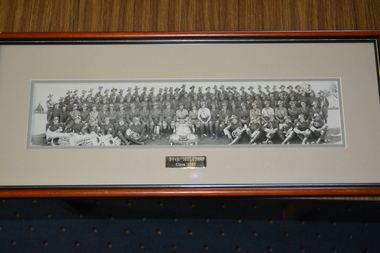 Wangaratta RSL Sub Branch
Photograph - Framed photograph, 59th Battalion
... Army. Initially raised for service during World War I, the battalion fought on the Western Front in France and Belgium between 1916 and 1918, before being disbanded in 1919. In 1921, it was re-raised as a part-time unit...Army. Initially raised for service during World War I, the battalion fought on the Western Front in France and Belgium between 1916 and 1918, before being disbanded in 1919. In 1921, it was re-raised as a part-time unit ...The 59th Battalion was an infantry battalion of the Australian Army. Initially raised for service during World War I, the battalion fought on the Western Front in France and Belgium between 1916 and 1918, before being disbanded in 1919. In 1921, it was re-raised as a part-time unit of the Militia in Victoria. They remained in existence until 1942 when, due to a manpower shortage in the Australian economy, the decision was made to amalgamate the battalion with the 58th Battalion to form the 58th/59th Battalion. Together they remained linked throughout World War II, serving in New Guinea and Bougainville in 1943–1945. In 1952, the 59th Battalion was re-raised and subsequently was absorbed into the Royal Victoria Regiment in 1960.Brown timber frame containing cream coloured mount and photograph of large group of soldiers and bandsmenPlaque -59th Militia Circa 193959th militia, ww1, ww2, 1939 -
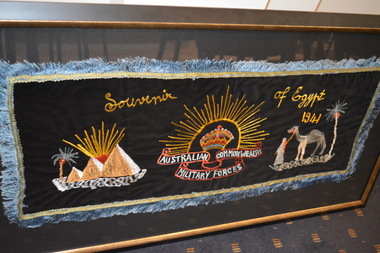 Wangaratta RSL Sub Branch
Memorabilia - Framed embroidered cloth
... Others show images associated with different armies (such as the Australian Rising Sun Badge, New Zealand General Service Badge or British unit badges) or nations (such as the Australian coat of arms). ...Others show images associated with different armies (such as the Australian Rising Sun Badge, New Zealand General Service Badge or British unit badges) or nations (such as the Australian coat of arms). ...The embroideries were machine chained onto colourful cotton sateen (often mistakenly thought to be silk) and usually bear the words 'Souvenir of Egypt' and a year date. Most have a distinctly Egyptian flavour and show the pyramids, camels or date palms. Others show images associated with different armies (such as the Australian Rising Sun Badge, New Zealand General Service Badge or British unit badges) or nations (such as the Australian coat of arms). However, during WW2 they were usually embroidered on black velveteen and the variety of images was not as great as had been available during the First World War. These types of souvenirs were very popular with Australian troops; they were easy to send home and were colourful. The vendors would have a number of designs for sale already machine embroidered, from which the soldier could select and then personalise with a date or message.Black and gold timber frame containing rectangular black cloth edged in light blue fringe. Machine embroidered on the cloth is image of rising sun badge with a camel and pyramids either side. Souvenir of Egypt 1941 Australian Commonwealth Military Forces1941, ww2, embroidered souvenir, egypt -
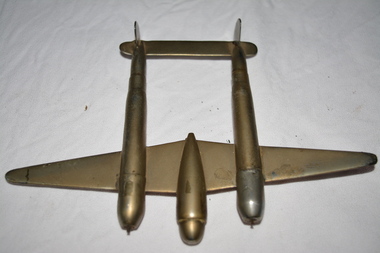 Wangaratta RSL Sub Branch
Memorabilia - Trench Art - Plane
... VX132480 born on 8/1/1915 at Bendigo and joined the Army May 1941, served with Survey Battery Unit at Buna and Finschaven New Guinea. ...VX132480 born on 8/1/1915 at Bendigo and joined the Army May 1941, served with Survey Battery Unit at Buna and Finschaven New Guinea. ...Trench art in the form of a model plane made out of 303 shells acquired during the second world war in New Guinea by Syd Marsh. VX132480 born on 8/1/1915 at Bendigo and joined the Army May 1941, served with Survey Battery Unit at Buna and Finschaven New Guinea. Joined Wangaratta Sub-Branch 1946. Delegate to the 34th Dist. Board and delegate to State Conference on several occasions. Received Life membership in May 1970.Silver/bronze coloured metal object in the shape of a model P38 plane made out of 303 shellsNiltrench art, ww2, new guinea -
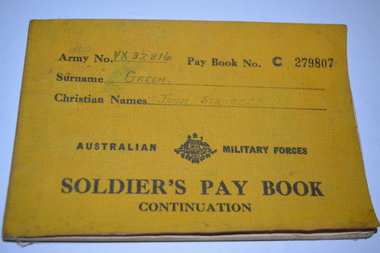 Wangaratta RSL Sub Branch
Financial record - Soldier's Pay Book, c1940
... Army No. VX32816. Pay Book No: C279807. Surname: Green. Christian Names: John Strobel. Unit...Army No. VX32816. Pay Book No: C279807. Surname: Green. Christian Names: John Strobel. Unit ...Soldier's Pay book continuation issued to John Strobel Green VX32816. Born at Wonthaggi on the 19/4/1913. These books were usually carried by the soldiers in their battle dress breast pocket. They note personal details, rate of pay and promotions, and the place in which the soldier was paid each fortnight – effectively plotting soldiers' movements in the Army. From the pay book GREEN enlisted in June 1940, at the age of 27, before embarking overseas on 5 February 1941 for the Middle East. Inside the rear cover are two photographs of GREEN. His mother Kate Green of Yallourn is listed as next of kin.Yellow covered booklet with black writing and Crest in the middle of the cover.Army No. VX32816. Pay Book No: C279807. Surname: Green. Christian Names: John Strobel. Unit: . Australian Military Forces. Soldier's Pay Book. Continuation.wwii, world war 2, pay book, soldier's pay book, army pay book, john strobel green -
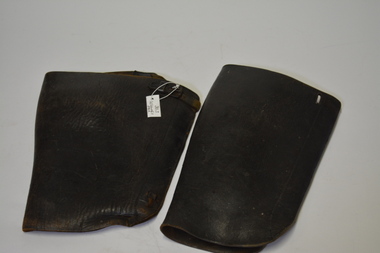 Wangaratta RSL Sub Branch
Uniform - Leather Leggings
... Leggings were known to be worn by the Australian Light Horse and other units such as Artillery however this pair may possibly be police not army issue....Leggings were known to be worn by the Australian Light Horse and other units such as Artillery however this pair may possibly be police not army issue. leggings Light horse One has Piece 17 1/2 Pair of black leather leggings. ...Leggings were known to be worn by the Australian Light Horse and other units such as Artillery however this pair may possibly be police not army issue.Pair of black leather leggings. Have metal slot clip at ankle and a leather and metal buckle at the top of calf. The metal slide is missing on one legging.One has Piece 17 1/2leggings, light horse
