
Showing 1341 items matching "skyes"
-
 Falls Creek Historical Society
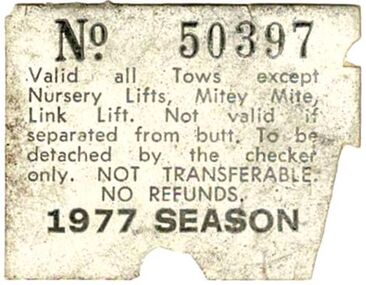
Falls Creek Lift Pass 1977
... SKI TICKETS Before tows and lifts were introduced at Falls Creek, it could take skiers 20 minutes to climb to the Summit … but only TWO minutes to go back to the bottom. ...SKI TICKETS Before tows and lifts were introduced at Falls Creek, it could take skiers 20 minutes to climb to the Summit … but only TWO minutes to go back to the bottom. ...SKI TICKETS Before tows and lifts were introduced at Falls Creek, it could take skiers 20 minutes to climb to the Summit … but only TWO minutes to go back to the bottom. The arrival of tows, then chairlifts and T-bars changed the face of skiing forever. The first rope tow was constructed by Toni St. Elmo for the 1951 winter season. Bob Hymans installed a smaller tow for his guests at Skyline Lodge. Tows were still quite slow, so in 1956 Bob Hymans created his single chairlift. In 1958 the Village rope tow, designed by Albury engineer Jock Wilson, opened. It was financed by shareholders including Bill Griffith (Bowna Ski Club) and the Bridgford family (St. Trinian’s Ski Club). Several other tows followed including the Summit T-bar in 1961, built by Ron McCallum and operated by Alpine Developments Pty. Ltd. which was a company formed by C. H. (Bill) Bridgford. By 1982 Falls Creek was served by 16 different lifts or T-bars, all owned and operated by Alpine Developments (Holdings) Pty. Ltd. During the development of Falls Creek, different methods have been used to pay for the use of tows, lifts and T-bars … including metal tokens, single tickets, strips of tickets and season passes. The Falls Creek Historical Society Collection includes many examples of these items.This ticket is significant because it represents a stage in the management at Falls Creek Tourist Village.Pass No 50397 for the 1977 Season. It was valid for all Tows except the Nursery Lifts, Mitey Mite and the Link Lift. ski lift, lift passes, season pass -
 Falls Creek Historical Society
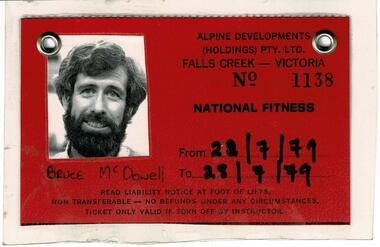
Permit Bruce McDowell 1979, 1980, 1981
... SKI TICKETS Before tows and lifts were introduced at Falls Creek, it could take skiers 20 minutes to climb to the Summit … but only TWO minutes to go back to the bottom. ...SKI TICKETS Before tows and lifts were introduced at Falls Creek, it could take skiers 20 minutes to climb to the Summit … but only TWO minutes to go back to the bottom. ...SKI TICKETS Before tows and lifts were introduced at Falls Creek, it could take skiers 20 minutes to climb to the Summit … but only TWO minutes to go back to the bottom. The arrival of tows, then chairlifts and T-bars changed the face of skiing forever. The first rope tow was constructed by Toni St. Elmo for the 1951 winter season. Bob Hymans installed a smaller tow for his guests at Skyline Lodge. Tows were still quite slow, so in 1956 Bob Hymans created his single chairlift. In 1958 the Village rope tow, designed by Albury engineer Jock Wilson, opened. It was financed by shareholders including Bill Griffith (Bowna Ski Club) and the Bridgford family (St. Trinian’s Ski Club). Several other tows followed including the Summit T-bar in 1961, built by Ron McCallum and operated by Alpine Developments Pty. Ltd. which was a company formed by C. H. (Bill) Bridgford. By 1982 Falls Creek was served by 16 different lifts or T-bars, all owned and operated by Alpine Developments (Holdings) Pty. Ltd. During the development of Falls Creek, different methods have been used to pay for the use of tows, lifts and T-bars … including metal tokens, single tickets, strips of tickets and season passes. The Falls Creek Historical Society Collection includes many examples of these items.These tickets are significant because they are representative of activities at the National Fitness Camp at Falls Creek.A set of Identification cards, including a photograph, belonging to Bruce McDowell at the National Fitness Camp, Falls Creek for the years 1979, 1980, and 1981. Also included is the back of one ticket showing Conditions of use of the tickets. The National Fitness Camp at Howmans Gap was run by the Victorian State National Fitness Council. Initially the camp was leased from the State Electricity Commission (SEC). It had a capacity of 110 participants and offered both summer and winter activities.national fitness camp howmans gap, falls creek management -
 Falls Creek Historical Society
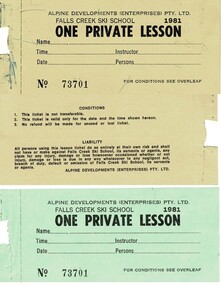
Lifts and Ski School Lesson tickets 1981
... SKI TICKETS Before tows and lifts were introduced at Falls Creek, it could take skiers 20 minutes to climb to the Summit … but only TWO minutes to go back to the bottom. ...SKI TICKETS Before tows and lifts were introduced at Falls Creek, it could take skiers 20 minutes to climb to the Summit … but only TWO minutes to go back to the bottom. ...SKI TICKETS Before tows and lifts were introduced at Falls Creek, it could take skiers 20 minutes to climb to the Summit … but only TWO minutes to go back to the bottom. The arrival of tows, then chairlifts and T-bars changed the face of skiing forever. The first rope tow was constructed by Toni St. Elmo for the 1951 winter season. Bob Hymans installed a smaller tow for his guests at Skyline Lodge. Tows were still quite slow, so in 1956 Bob Hymans created his single chairlift. In 1958 the Village rope tow, designed by Albury engineer Jock Wilson, opened. It was financed by shareholders including Bill Griffith (Bowna Ski Club) and the Bridgford family (St. Trinian’s Ski Club). Several other tows followed including the Summit T-bar in 1961, built by Ron McCallum and operated by Alpine Developments Pty. Ltd. which was a company formed by C. H. (Bill) Bridgford. By 1982 Falls Creek was served by 16 different lifts or T-bars, all owned and operated by Alpine Developments (Holdings) Pty. Ltd. During the development of Falls Creek, different methods have been used to pay for the use of tows, lifts and T-bars … including metal tokens, single tickets, strips of tickets and season passes. The Falls Creek Historical Society Collection includes many examples of these items.These tickets are significant because they represent a stage in the management at Falls Creek Tourist Village.A set of tickets available for the Winter season of 1981ski tickets falls creek, falls creek tourism, falls creek management -
 Falls Creek Historical Society
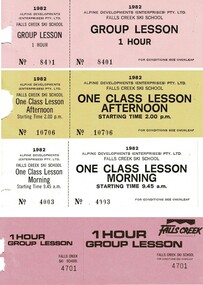
Lifts and Ski School Lesson tickets 1982
... SKI TICKETS Before tows and lifts were introduced at Falls Creek, it could take skiers 20 minutes to climb to the Summit … but only TWO minutes to go back to the bottom. ...SKI TICKETS Before tows and lifts were introduced at Falls Creek, it could take skiers 20 minutes to climb to the Summit … but only TWO minutes to go back to the bottom. ...SKI TICKETS Before tows and lifts were introduced at Falls Creek, it could take skiers 20 minutes to climb to the Summit … but only TWO minutes to go back to the bottom. The arrival of tows, then chairlifts and T-bars changed the face of skiing forever. The first rope tow was constructed by Toni St. Elmo for the 1951 winter season. Bob Hymans installed a smaller tow for his guests at Skyline Lodge. Tows were still quite slow, so in 1956 Bob Hymans created his single chairlift. In 1958 the Village rope tow, designed by Albury engineer Jock Wilson, opened. It was financed by shareholders including Bill Griffith (Bowna Ski Club) and the Bridgford family (St. Trinian’s Ski Club). Several other tows followed including the Summit T-bar in 1961, built by Ron McCallum and operated by Alpine Developments Pty. Ltd. which was a company formed by C. H. (Bill) Bridgford. By 1982 Falls Creek was served by 16 different lifts or T-bars, all owned and operated by Alpine Developments (Holdings) Pty. Ltd. During the development of Falls Creek, different methods have been used to pay for the use of tows, lifts and T-bars … including metal tokens, single tickets, strips of tickets and season passes. The Falls Creek Historical Society Collection includes many examples of these items.These tickets are significant because they represent a stage in the management at Falls Creek Tourist Village.A set of tickets showing the array of passes available for the 1982 season.falls creek passes, falls creek ski school, falls creek management -
 Falls Creek Historical Society
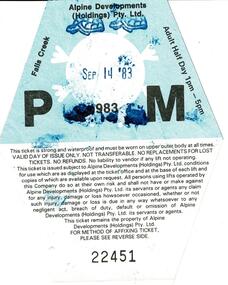
Lifts and Ski School Lesson tickets 1983, Alpine Development Holdings Pty Ltd
... SKI TICKETS Before tows and lifts were introduced at Falls Creek, it could take skiers 20 minutes to climb to the Summit … but only TWO minutes to go back to the bottom. ...SKI TICKETS Before tows and lifts were introduced at Falls Creek, it could take skiers 20 minutes to climb to the Summit … but only TWO minutes to go back to the bottom. ...SKI TICKETS Before tows and lifts were introduced at Falls Creek, it could take skiers 20 minutes to climb to the Summit … but only TWO minutes to go back to the bottom. The arrival of tows, then chairlifts and T-bars changed the face of skiing forever. The first rope tow was constructed by Toni St. Elmo for the 1951 winter season. Bob Hymans installed a smaller tow for his guests at Skyline Lodge. Tows were still quite slow, so in 1956 Bob Hymans created his single chairlift. In 1958 the Village rope tow, designed by Albury engineer Jock Wilson, opened. It was financed by shareholders including Bill Griffith (Bowna Ski Club) and the Bridgford family (St. Trinian’s Ski Club). Several other tows followed including the Summit T-bar in 1961, built by Ron McCallum and operated by Alpine Developments Pty. Ltd. which was a company formed by C. H. (Bill) Bridgford. By 1982 Falls Creek was served by 16 different lifts or T-bars, all owned and operated by Alpine Developments (Holdings) Pty. Ltd. During the development of Falls Creek, different methods have been used to pay for the use of tows, lifts and T-bars … including metal tokens, single tickets, strips of tickets and season passes. The Falls Creek Historical Society Collection includes many examples of these items.These tickets are significant because they represent a stage in the management at Falls Creek Tourist Village.A collection of the tickets available at Falls Creek for the 1983 Season.falls creek passes, falls creek management, falls creek ski school -
 Falls Creek Historical Society
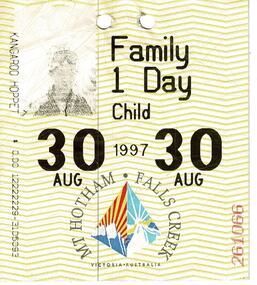
Family 1 Day Pass 30 August 1997 - Kangaroo Hoppet
... SKI TICKETS Before tows and lifts were introduced at Falls Creek, it could take skiers 20 minutes to climb to the Summit … but only TWO minutes to go back to the bottom. ...SKI TICKETS Before tows and lifts were introduced at Falls Creek, it could take skiers 20 minutes to climb to the Summit … but only TWO minutes to go back to the bottom. ...SKI TICKETS Before tows and lifts were introduced at Falls Creek, it could take skiers 20 minutes to climb to the Summit … but only TWO minutes to go back to the bottom. The arrival of tows, then chairlifts and T-bars changed the face of skiing forever. The first rope tow was constructed by Toni St. Elmo for the 1951 winter season. Bob Hymans installed a smaller tow for his guests at Skyline Lodge. Tows were still quite slow, so in 1956 Bob Hymans created his single chairlift. In 1958 the Village rope tow, designed by Albury engineer Jock Wilson, opened. It was financed by shareholders including Bill Griffith (Bowna Ski Club) and the Bridgford family (St. Trinian’s Ski Club). Several other tows followed including the Summit T-bar in 1961, built by Ron McCallum and operated by Alpine Developments Pty. Ltd. which was a company formed by C. H. (Bill) Bridgford. By 1982 Falls Creek was served by 16 different lifts or T-bars, all owned and operated by Alpine Developments (Holdings) Pty. Ltd. During the development of Falls Creek, different methods have been used to pay for the use of tows, lifts and T-bars … including metal tokens, single tickets, strips of tickets and season passes. The Falls Creek Historical Society Collection includes many examples of these items.This ticket is significant because it was issued for the day of the Kangaroo Hoppet, an important annual event in the Falls Creek calendar.A child's pass as part of a 1 Day Family ticket issued for 30 August 1997. This date was the day of the annual Kangaroo Hoppet event. The ticket features the logo for Mt Hotham - Falls Creek. kangaroo hoppet, family ski ticket, falls creek passes -
 Falls Creek Historical Society
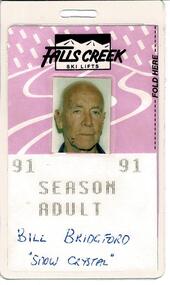
Pass 1991 - Phyl and Bill Bridgford
... SKI TICKETS Before tows and lifts were introduced at Falls Creek, it could take skiers 20 minutes to climb to the Summit … but only TWO minutes to go back to the bottom. ...SKI TICKETS Before tows and lifts were introduced at Falls Creek, it could take skiers 20 minutes to climb to the Summit … but only TWO minutes to go back to the bottom. ...SKI TICKETS Before tows and lifts were introduced at Falls Creek, it could take skiers 20 minutes to climb to the Summit … but only TWO minutes to go back to the bottom. The arrival of tows, then chairlifts and T-bars changed the face of skiing forever. The first rope tow was constructed by Toni St. Elmo for the 1951 winter season. Bob Hymans installed a smaller tow for his guests at Skyline Lodge. Tows were still quite slow, so in 1956 Bob Hymans created his single chairlift. In 1958 the Village rope tow, designed by Albury engineer Jock Wilson, opened. It was financed by shareholders including Bill Griffith (Bowna Ski Club) and the Bridgford family (St. Trinian’s Ski Club). Several other tows followed including the Summit T-bar in 1961, built by Ron McCallum and operated by Alpine Developments Pty. Ltd. which was a company formed by C. H. (Bill) Bridgford. By 1982 Falls Creek was served by 16 different lifts or T-bars, all owned and operated by Alpine Developments (Holdings) Pty. Ltd. During the development of Falls Creek, different methods have been used to pay for the use of tows, lifts and T-bars … including metal tokens, single tickets, strips of tickets and season passes. The Falls Creek Historical Society Collection includes many examples of these items.These ski passes are significant because they were issued to a pioneer of the ski industry in Falls Creek, Victoria.Passes for Phyl and Bill Bridgford for 1991' Charles (Bill) Bridgeford built a family lodge called St. Trinian's in the early 1950s. Bill had previously worked in the family shipping firm and had been Member for South Eastern in the Victorian Parliament. He became one of the shareholders in the Village rope tow which had been a failure partly because too many people had been involved. In 1960 Bridgeford approached Toni St. Elmo with an offer to buy the Nissen tow and Nissen Lodge which was accepted. With friends Geoff Henke and Ron McCallum, an engineer, he formed Alpine Developments (Holdings) Pty. Ltd. Ron had also been Lift Manager at Mt. Buller and together they acquired the Village rope tow and replaced it with a T-bar. They gained the franchise to operate all ski lifts and T-bars and later the Falls Creek Ski School. Alpine Developments (Holdings) Pty. Ltd continued to expand the lift network until 1983 when the lifts were sold to Transfield.Card 1 - 91 Season Adult BILL BRIDGFORD "SNOW CRYSTAL" Card 2 - 91 Season Adult PHYL BRIDGFORD "SNOW CRYSTAL" Card 3 - 91 ADULT MORNING AUG 18 - 18 VIC VETERANS RACE !! On Reverse - instructions $032.00 Card 4 - 91 1 DAY ADLT JUL 26 - 26 FRYERS FRIDAY FRENZY On Reverse - instructions $043.00bill bridgford, 1991 season pass, vic veterans race falls creek 1991 -
 Falls Creek Historical Society
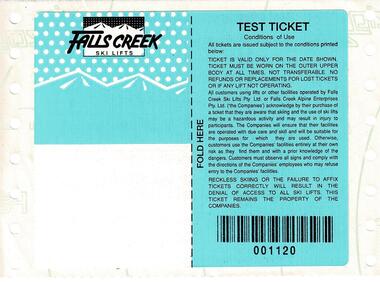
Ski Lift Test Ticket 1995
... SKI TICKETS Before tows and lifts were introduced at Falls Creek, it could take skiers 20 minutes to climb to the Summit … but only TWO minutes to go back to the bottom. ...SKI TICKETS Before tows and lifts were introduced at Falls Creek, it could take skiers 20 minutes to climb to the Summit … but only TWO minutes to go back to the bottom. ...SKI TICKETS Before tows and lifts were introduced at Falls Creek, it could take skiers 20 minutes to climb to the Summit … but only TWO minutes to go back to the bottom. The arrival of tows, then chairlifts and T-bars changed the face of skiing forever. The first rope tow was constructed by Toni St. Elmo for the 1951 winter season. Bob Hymans installed a smaller tow for his guests at Skyline Lodge. Tows were still quite slow, so in 1956 Bob Hymans created his single chairlift. In 1958 the Village rope tow, designed by Albury engineer Jock Wilson, opened. It was financed by shareholders including Bill Griffith (Bowna Ski Club) and the Bridgford family (St. Trinian’s Ski Club). Several other tows followed including the Summit T-bar in 1961, built by Ron McCallum and operated by Alpine Developments Pty. Ltd. which was a company formed by C. H. (Bill) Bridgford. By 1982 Falls Creek was served by 16 different lifts or T-bars, all owned and operated by Alpine Developments (Holdings) Pty. Ltd. During the development of Falls Creek, different methods have been used to pay for the use of tows, lifts and T-bars … including metal tokens, single tickets, strips of tickets and season passes. The Falls Creek Historical Society Collection includes many examples of these items.This ticket is significant because they represent a stage in the progression of chair lifts and management at Falls Creek Tourist Village.A test ticket produced prior to the full run of tickets being created for the 1995 season.falls creek passes, falls creek ski lifts, falls creek tourism -
 Falls Creek Historical Society
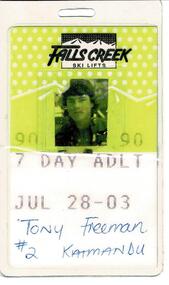
Ski Lift Passes 1990
... SKI TICKETS Before tows and lifts were introduced at Falls Creek, it could take skiers 20 minutes to climb to the Summit … but only TWO minutes to go back to the bottom. ...SKI TICKETS Before tows and lifts were introduced at Falls Creek, it could take skiers 20 minutes to climb to the Summit … but only TWO minutes to go back to the bottom. ...SKI TICKETS Before tows and lifts were introduced at Falls Creek, it could take skiers 20 minutes to climb to the Summit … but only TWO minutes to go back to the bottom. The arrival of tows, then chairlifts and T-bars changed the face of skiing forever. The first rope tow was constructed by Toni St. Elmo for the 1951 winter season. Bob Hymans installed a smaller tow for his guests at Skyline Lodge. Tows were still quite slow, so in 1956 Bob Hymans created his single chairlift. In 1958 the Village rope tow, designed by Albury engineer Jock Wilson, opened. It was financed by shareholders including Bill Griffith (Bowna Ski Club) and the Bridgford family (St. Trinian’s Ski Club). Several other tows followed including the Summit T-bar in 1961, built by Ron McCallum and operated by Alpine Developments Pty. Ltd. which was a company formed by C. H. (Bill) Bridgford. By 1982 Falls Creek was served by 16 different lifts or T-bars, all owned and operated by Alpine Developments (Holdings) Pty. Ltd. During the development of Falls Creek, different methods have been used to pay for the use of tows, lifts and T-bars … including metal tokens, single tickets, strips of tickets and season passes. The Falls Creek Historical Society Collection includes many examples of these items.These tickets are significant because they represent a stage in the progression of chair lifts and management at Falls Creek Tourist Village.A selection of unused Falls Creek Ski Lift passes and one 7 Day Adult Pass issued to Tony Freeman # s Kathmandu. Different coloured tickets were for a different length of visit. A 7 Day Adult pass cost $234.On completed pass FALLS CREEK SKI LIFTS 90 7 DAY ADULT JUL 28 - 03 TONY FREEMAN #2 KATHMANDUchairlift falls creek, falls creek passes -
 Falls Creek Historical Society
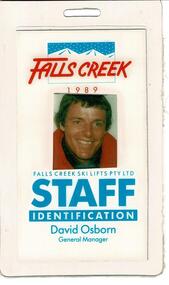
Staff Identification Tag David Osborn 1989
... SKI TICKETS Before tows and lifts were introduced at Falls Creek, it could take skiers 20 minutes to climb to the Summit … but only TWO minutes to go back to the bottom. ...SKI TICKETS Before tows and lifts were introduced at Falls Creek, it could take skiers 20 minutes to climb to the Summit … but only TWO minutes to go back to the bottom. ...SKI TICKETS Before tows and lifts were introduced at Falls Creek, it could take skiers 20 minutes to climb to the Summit … but only TWO minutes to go back to the bottom. The arrival of tows, then chairlifts and T-bars changed the face of skiing forever. The first rope tow was constructed by Toni St. Elmo for the 1951 winter season. Bob Hymans installed a smaller tow for his guests at Skyline Lodge. Tows were still quite slow, so in 1956 Bob Hymans created his single chairlift. In 1958 the Village rope tow, designed by Albury engineer Jock Wilson, opened. It was financed by shareholders including Bill Griffith (Bowna Ski Club) and the Bridgford family (St. Trinian’s Ski Club). Several other tows followed including the Summit T-bar in 1961, built by Ron McCallum and operated by Alpine Developments Pty. Ltd. which was a company formed by C. H. (Bill) Bridgford. By 1982 Falls Creek was served by 16 different lifts or T-bars, all owned and operated by Alpine Developments (Holdings) Pty. Ltd. During the development of Falls Creek, different methods have been used to pay for the use of tows, lifts and T-bars … including metal tokens, single tickets, strips of tickets and season passes. The Falls Creek Historical Society Collection includes many examples of these items.This Staff Identification Card is significant because it belonged to David Osborn who lead developments at Falls Creek in the late 1980s.A staff identification tag featuring a coloured photograph of David Osborn. He came to Falls Creek to take up the position of General Manager, Falls Creek Ski Lifts Pty. Ltd. He continued in this role until 1990 when he was offered the position of Managing Director at Thredbo. During his period as General Manager major projects carried out at Falls Creek were:- the construction of Halleys Comet Chairlift, Slalom Street Plaza development, the introduction of snowmaking, Cloud 9 Restaurant, the construction of the Scott Chair and the Village Bowl. In 2022 David Osborn released a book, "Falls Creek Stories 1984 - 1990" which documents the developments which occurred in Falls Creek and the people who made them possible.At top: FALLS CREEK 1989 Below photo: FALLS CREEK SKI LIFTS PTY.LTD STAFF IDENTIFICATION David Osborn General Manager chairlift falls creek, david osborn, falls creek development 1980s -
 Falls Creek Historical Society
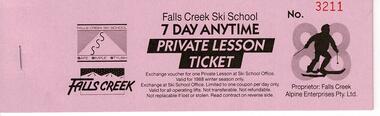
Lift and Ski School Lesson tickets 1988, Alpine Development Holdings Pty Ltd
... SKI TICKETS Before tows and lifts were introduced at Falls Creek, it could take skiers 20 minutes to climb to the Summit … but only TWO minutes to go back to the bottom. ...SKI TICKETS Before tows and lifts were introduced at Falls Creek, it could take skiers 20 minutes to climb to the Summit … but only TWO minutes to go back to the bottom. ...SKI TICKETS Before tows and lifts were introduced at Falls Creek, it could take skiers 20 minutes to climb to the Summit … but only TWO minutes to go back to the bottom. The arrival of tows, then chairlifts and T-bars changed the face of skiing forever. The first rope tow was constructed by Toni St. Elmo for the 1951 winter season. Bob Hymans installed a smaller tow for his guests at Skyline Lodge. Tows were still quite slow, so in 1956 Bob Hymans created his single chairlift. In 1958 the Village rope tow, designed by Albury engineer Jock Wilson, opened. It was financed by shareholders including Bill Griffith (Bowna Ski Club) and the Bridgford family (St. Trinian’s Ski Club). Several other tows followed including the Summit T-bar in 1961, built by Ron McCallum and operated by Alpine Developments Pty. Ltd. which was a company formed by C. H. (Bill) Bridgford. By 1982 Falls Creek was served by 16 different lifts or T-bars, all owned and operated by Alpine Developments (Holdings) Pty. Ltd. During the development of Falls Creek, different methods have been used to pay for the use of tows, lifts and T-bars … including metal tokens, single tickets, strips of tickets and season passes. The Falls Creek Historical Society Collection includes many examples of these items.A set of three 7 Day Anytime tickets for the 1988 Season. This set includes one ticket for a private lesson, one for a class lesson and the final ticket is for a child. These tickets could redeemed at any time during the 1988 winter season.7 day anytime tickets, falls creek passes, falls creek winter season -
 Falls Creek Historical Society
Lift and Ski School Lesson tickets 1987
... SKI TICKETS Before tows and lifts were introduced at Falls Creek, it could take skiers 20 minutes to climb to the Summit … but only TWO minutes to go back to the bottom. ...SKI TICKETS Before tows and lifts were introduced at Falls Creek, it could take skiers 20 minutes to climb to the Summit … but only TWO minutes to go back to the bottom. ...SKI TICKETS Before tows and lifts were introduced at Falls Creek, it could take skiers 20 minutes to climb to the Summit … but only TWO minutes to go back to the bottom. The arrival of tows, then chairlifts and T-bars changed the face of skiing forever. The first rope tow was constructed by Toni St. Elmo for the 1951 winter season. Bob Hymans installed a smaller tow for his guests at Skyline Lodge. Tows were still quite slow, so in 1956 Bob Hymans created his single chairlift. In 1958 the Village rope tow, designed by Albury engineer Jock Wilson, opened. It was financed by shareholders including Bill Griffith (Bowna Ski Club) and the Bridgford family (St. Trinian’s Ski Club). Several other tows followed including the Summit T-bar in 1961, built by Ron McCallum and operated by Alpine Developments Pty. Ltd. which was a company formed by C. H. (Bill) Bridgford. By 1982 Falls Creek was served by 16 different lifts or T-bars, all owned and operated by Alpine Developments (Holdings) Pty. Ltd. During the development of Falls Creek, different methods have been used to pay for the use of tows, lifts and T-bars … including metal tokens, single tickets, strips of tickets and season passes. The Falls Creek Historical Society Collection includes many examples of these items.These tickets are significant because they represent a stage in the progression of chair lifts and management at Falls Creek Tourist Village.A collection of tickets issued for entry to Falls Creek in 1987. This set includes a 7 day anytime ticket. This ticket could be redeemed at any stage during the 1987 Winter season. In 1987 an adult Five day adult lift pass cost $135.chairlift falls creek, falls creek ski lifts, falls creek ski school -
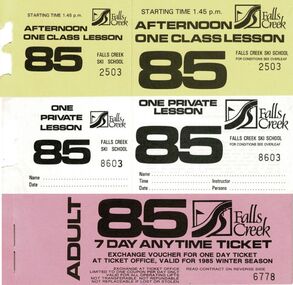 Falls Creek Historical Society
Lift and Ski School Lesson tickets 1985, Falls Creek Alpine Enterprises
... SKI TICKETS Before tows and lifts were introduced at Falls Creek, it could take skiers 20 minutes to climb to the Summit … but only TWO minutes to go back to the bottom. ...SKI TICKETS Before tows and lifts were introduced at Falls Creek, it could take skiers 20 minutes to climb to the Summit … but only TWO minutes to go back to the bottom. ...SKI TICKETS Before tows and lifts were introduced at Falls Creek, it could take skiers 20 minutes to climb to the Summit … but only TWO minutes to go back to the bottom. The arrival of tows, then chairlifts and T-bars changed the face of skiing forever. The first rope tow was constructed by Toni St. Elmo for the 1951 winter season. Bob Hymans installed a smaller tow for his guests at Skyline Lodge. Tows were still quite slow, so in 1956 Bob Hymans created his single chairlift. In 1958 the Village rope tow, designed by Albury engineer Jock Wilson, opened. It was financed by shareholders including Bill Griffith (Bowna Ski Club) and the Bridgford family (St. Trinian’s Ski Club). Several other tows followed including the Summit T-bar in 1961, built by Ron McCallum and operated by Alpine Developments Pty. Ltd. which was a company formed by C. H. (Bill) Bridgford. By 1982 Falls Creek was served by 16 different lifts or T-bars, all owned and operated by Alpine Developments (Holdings) Pty. Ltd. During the development of Falls Creek, different methods have been used to pay for the use of tows, lifts and T-bars … including metal tokens, single tickets, strips of tickets and season passes. The Falls Creek Historical Society Collection includes many examples of these items.These tickets are significant because they represent a stage in the progression of chair lifts and management at Falls Creek Tourist Village.A collection of tickets issued for entry to Falls Creek, lift passes and lessons at Falls Creek Ski School for 1984. The tickets include adult and child passes and range from a single lesson passes up to booklets for seven lessons. They also cover the low, shoulder and high season.ski tickets falls creek, falls creek management, falls creek ski school -
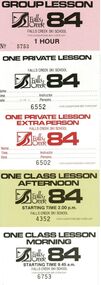 Falls Creek Historical Society
Lift and Ski School Lesson tickets 1984
... SKI TICKETS Before tows and lifts were introduced at Falls Creek, it could take skiers 20 minutes to climb to the Summit … but only TWO minutes to go back to the bottom. ...SKI TICKETS Before tows and lifts were introduced at Falls Creek, it could take skiers 20 minutes to climb to the Summit … but only TWO minutes to go back to the bottom. ...SKI TICKETS Before tows and lifts were introduced at Falls Creek, it could take skiers 20 minutes to climb to the Summit … but only TWO minutes to go back to the bottom. The arrival of tows, then chairlifts and T-bars changed the face of skiing forever. The first rope tow was constructed by Toni St. Elmo for the 1951 winter season. Bob Hymans installed a smaller tow for his guests at Skyline Lodge. Tows were still quite slow, so in 1956 Bob Hymans created his single chairlift. In 1958 the Village rope tow, designed by Albury engineer Jock Wilson, opened. It was financed by shareholders including Bill Griffith (Bowna Ski Club) and the Bridgford family (St. Trinian’s Ski Club). Several other tows followed including the Summit T-bar in 1961, built by Ron McCallum and operated by Alpine Developments Pty. Ltd. which was a company formed by C. H. (Bill) Bridgford. By 1982 Falls Creek was served by 16 different lifts or T-bars, all owned and operated by Alpine Developments (Holdings) Pty. Ltd. During the development of Falls Creek, different methods have been used to pay for the use of tows, lifts and T-bars … including metal tokens, single tickets, strips of tickets and season passes. The Falls Creek Historical Society Collection includes many examples of these items.These tickets are significant because they represent a stage in the progression of chair lifts and management at Falls Creek Tourist Village.A collection of tickets issued for entry to Falls Creek, lift passes and lessons at Falls Creek Ski School for 1984. The tickets include a full set of adult passes and a set of children’s passes. Other ticket include those for Mountain Staff and Falls Creek Tourist Area Management Committee (F.C.T.A.M.C.) Volunteers.passes falls creek, chairlift falls creek, falls creek ski school -
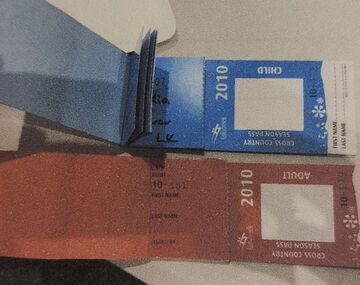 Falls Creek Historical Society
Falls Creek Cross Country Season Pass Books 2010
... SKI TICKETS Before tows and lifts were introduced at Falls Creek, it could take skiers 20 minutes to climb to the Summit … but only TWO minutes to go back to the bottom. ...SKI TICKETS Before tows and lifts were introduced at Falls Creek, it could take skiers 20 minutes to climb to the Summit … but only TWO minutes to go back to the bottom. ...SKI TICKETS Before tows and lifts were introduced at Falls Creek, it could take skiers 20 minutes to climb to the Summit … but only TWO minutes to go back to the bottom. The arrival of tows, then chairlifts and T-bars changed the face of skiing forever. The first rope tow was constructed by Toni St. Elmo for the 1951 winter season. Bob Hymans installed a smaller tow for his guests at Skyline Lodge. Tows were still quite slow, so in 1956 Bob Hymans created his single chairlift. In 1958 the Village rope tow, designed by Albury engineer Jock Wilson, opened. It was financed by shareholders including Bill Griffith (Bowna Ski Club) and the Bridgford family (St. Trinian’s Ski Club). Several other tows followed including the Summit T-bar in 1961, built by Ron McCallum and operated by Alpine Developments Pty. Ltd. which was a company formed by C. H. (Bill) Bridgford. By 1982 Falls Creek was served by 16 different lifts or T-bars, all owned and operated by Alpine Developments (Holdings) Pty. Ltd. During the development of Falls Creek, different methods have been used to pay for the use of tows, lifts and T-bars … including metal tokens, single tickets, strips of tickets and season passes. The Falls Creek Historical Society Collection includes many examples of these items.These tickets are significant because they represent an aspect of the management of activities at Falls Creek.Two books of Cross Country Season Pass Tickets for 2010. The blue tickets are Child's tickets and the red tickets for adults. Each book contains 20 tickets.Blue Tickets: FALLS CREEK CROSS COUNTRY SEASON PASS CHILD Red Tickets: FALLS CREEK CROSS COUNTRY SEASON PASS ADULTfalls creek cross country, falls creek ski tickets, season pass -
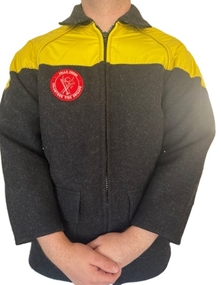 Falls Creek Historical Society
Clothing - Jacket - Falls Creek Volunteer Fire Brigade
... The Falls Creek Brigade volunteers continues providing an essential service for local residents and skiers who visit the mountain each year. ...The Falls Creek Brigade volunteers continues providing an essential service for local residents and skiers who visit the mountain each year. This item is significant becaust it represents a community volunteer organisation which has protected the Falls Creek Community for over 20 years. ...The Falls Creek Volunteer Fire Brigade provided a critical service at Falls Creek. They have since become the Falls Creek CFA with continued support of local Volunteers. The Fire Brigade was formally established in 1995. Support for fighting fires at Falls Creek dates back to 1956 when the State Electricity Commission of Victoria (SECV) was building hydroelectric facilities in the area. But this support came from Mount Beauty, 30 kilometres away down the mountain. Falls Creek locals were concerned by this, so used six available hydrants and a canvas hose to fight any fires on the mountain. In 1964 the SECV gave the village a trailer which could be used with both wheels and skis for summer and winter operations. But this trailer only lasted two years. In the early 1970s, the village was given a 2,000-gallon Ford Blitz 4x4 truck, and additional equipment was quickly acquired by the village including a new locally-constructed trailer with a pumper unit. Falls Creek’s alpine pumper was the first of its kind in Australia, and pumpers used in other ski resorts in Australia are based on this vehicle. In the 1990s, a change in land status meant the Falls Creek area became the responsibility of the Country Fire Authority. This status was formalised in 1995 by a public meeting that formed Falls Creek Fire Brigade. The Falls Creek Brigade volunteers continues providing an essential service for local residents and skiers who visit the mountain each year. This item is significant becaust it represents a community volunteer organisation which has protected the Falls Creek Community for over 20 years.A wool-blend zip fronted jacket with collar and pockets. The body is of black woollen material. The shoulders feature bright yellow reflective material. The logo of Falls Creek Volunteer Fire Brigade is on the upper right chest.Red and white logo featuring fire helmet, axe and hose.falls creek volunteer fire brigade, volunteers falls creek -
 Kiewa Valley Historical Society
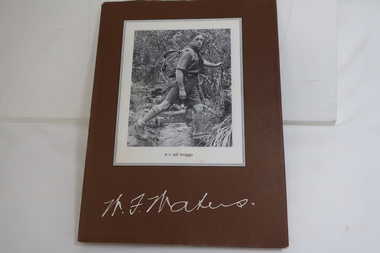
Bogong 3 Items: Rover Scouts Skis x2; Bogong Rover Scout shirt; Book with signature by WF (Bill) Waters, Book: WF "Bill" Waters A Biography A man of the Mountains - Stephenson 1983 Publisher; The Scout Association Carlton 1983
... The second pair of skies are red plastic. Possibly Italian with an unusual downhill & touring binding circa 1970. 198 cm long and 7 cm wide Bogong Rover overshirt (winter). ...The second pair of skies are red plastic. Possibly Italian with an unusual downhill & touring binding circa 1970. 198 cm long and 7 cm wide Bogong Rover overshirt (winter). ...1. These Skis were hand carved in Sweden around 1937 and brought to Australia where they were purchased around 1962 by a Bogong Rover Scout. They were refurbished with steel edging and plastic soles and saw extensive service on the Bogong High Plains between 1962 and 1968. They performed magnificently, riding out the deepest mogul with ease because of their highly curved tips. Of particuular interest is the way the Kandahar toe iron has been attached to the ski. The ski was slotted through its width, the tow iron inserted and then folded vertically to give an integral attachment. In those days skins were used extensively for uphill climbing, hence the yellow plastic patch on the back surface to protect from the skin buckle. Cable bindings were used to enable the boot to lift for climbing. When ready for a downhill run, the cable was slipped under the side-pulls to anchor the heel. The beauty of these bindings in those days was that they were composite downhill and touring skis. These particular skis were of lightweight timber (timber unknown) compared to others of their day, which are often made of Hickory which is much denser and heavier. Rover Scouts and the Bogong High Plains The Bogong Rover Lodge started as an SEC (State Electricity Commission) hut near Langford's Gap and was carried on the backs of Rover Scouts across to its present location on the Southern side of the Bogong High Plains around 1937 under the direction of W.F. (Bill) Waters, a skiing pioneer, synonymous with establishing skiing on the BHP. The Rover Scouts left Melbourne by train to Bairnsdale. They went onto Omeo (bus?) where they stayed overnight at the pub then (bus?) to Fitzgerald's farm on the Omeo Highway. Then on packhorses to the snow line. Then they carried their packs and skis. to the lodge. The Lodge continues to this day (2026) as a base for Scouts skiing and bushwalking on the Bogong High Plains. Rovers, the senior branch of Scouting, are aged between 18 to 25 years. The Bogong Rover Lodge / Chalet / or Scout Hut is open all year round.1. 2 pairs of skis: One pair is hand-crafted Swedish wooden skis circa 1937. Quite a thick ski. Tapered shape with a distinctive pointed toe. Coated with dark brown varnish which is lifting in some parts. The ski has a yellow plastic patch at the rear and a re-inforced foot plate. Bindings are metal and leather. 216 cm long and 7 cm wide. The second pair of skies are red plastic. Possibly Italian with an unusual downhill & touring binding circa 1970. 198 cm long and 7 cm wide Bogong Rover overshirt (winter). Pure wool, long sleeves, 2 front buttons, pockets with insignia include Box Hill District Boy Scouts Alpine Rovers Badge on right top of sleeve. Epaulettes on the left and right shoulders. Left hand side has 8 pieces of coloured tabs attached. Also, Green triangular cotton neck tie with leather toggle.Labels 'pure wool'; 'scout shop' 'size 14'rover scouts, cross country skiing, bill waters, swedish skis, scouts uniform -
 Ballarat Tramway Museum
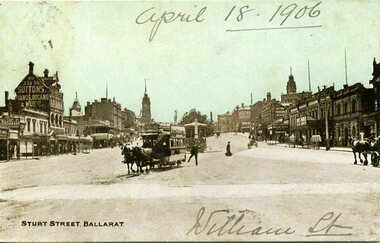
Postcard, E.W. Cole Arcade, Ballarat Horse tram arriving at the Grenville St. terminus, c1900
... Printed black and white postcard with hand painted light blue sky background of Ballarat Horse tram arriving at the Grenville St. terminus, at the bottom end of Sturt St terminus with a person stepping off the tramcar. ...On top edge stamp "E.G.Butland" Printed black and white postcard with hand painted light blue sky background of Ballarat Horse tram arriving at the Grenville St. terminus, at the bottom end of Sturt St terminus with a person stepping off the tramcar. ...Demonstrates aspects of working of Ballarat tramways, with a passenger stepping off a moving horse tram at Grenville St. Has a strong association with the sender and receiver, giving family/friends movements. Hand painted card.Printed black and white postcard with hand painted light blue sky background of Ballarat Horse tram arriving at the Grenville St. terminus, at the bottom end of Sturt St terminus with a person stepping off the tramcar. Has buildings on both sides of Sturt St. in photograph, and one other horse drawn vehicle. Also Suttons and Richards & Co. buildings in photo. See Reg. Item 1539 for photographic image of the postcard and 2762, and 3298. Titled "Sturt Street, Ballarat" in bottom left hand corner". On rear of postcard, printed is the words "Post Card", areas for "This space may be used for correspondence" and "The Address to be written here" and in stamp area in a square "Penny Stamp here". On the left hand side of the card "Cole's Sunny Australia 96 Views", E.W. Cole Book Arcade Melbourne, Sydney and Adelaide. See also Reg Item 2762 for another postcard using the same photograph and Reg Item 3298 for another version with some writing on the card.On front of card in black ink "April 18 1906" and "William St" On rear stamped "Melbourne, 17.4.06", 1d stamp and addressed to Mrs. Keast, Cumberland, Waymouth St Adelaide. and a message about family members/friends travelling. On top edge stamp "E.G.Butland"trams, tramways, sturt st, postcards, horse tram, grenville st, tram 35 -
 Falls Creek Historical Society
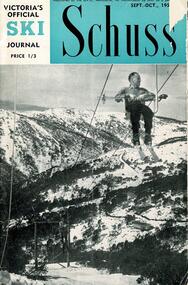
Journal - Schuss Vol. 23. No. 7 September - October 1957
... Page 246 "The Chair Lift is Fabulous" reports on Bob Hymans' ski lift based on comments from skiers who have used it over the preceding months. ...Page 246 "The Chair Lift is Fabulous" reports on Bob Hymans' ski lift based on comments from skiers who have used it over the preceding months. ...Schuss was advertised as Victoria’s Official Ski Journal It was issued monthly from 1935 to 1961 except during the war when summer issues covered two months. This continued after the war, but it averaged 10 issues annually over its 25 year life. Schuss was published by the Ski Club of Victoria which had a membership of 38 Ski Clubs and demanded to be recognised as the prime authority on skiing in the state. The other 30 ski clubs with 85% of the members disagreed and the politics of skiing became heated. These clubs formed the Federation of Victorian Ski Clubs with their own journal, Ski Horizon. With the establishment of the Victorian Ski Association, Ski-Horizon published its last issue in Nov - Dec. 1955 and the role of the official journal was fully taken over by “Schuss”. This item is significant because it contains stories, images and information reporting on activities at Falls Creek in the late 1950s.The journal features stories and events chronicling developments in Victoria and internationally. In this issue:- Front Cover features a photo Hymans Chair Lift at Falls Creek. Dick McGain of St. Trinians relaxes on his chair. Visible is the Ski Village, St. Trinians, Kiewa Valley. Diane, Galleon and Bowna Lodges, Grand Coeur Chalet and Dobson’s Store. The photo was taken by Eric Burt. Page 240 mentions new facilities at different ski fields. Page 246 "The Chair Lift is Fabulous" reports on Bob Hymans' ski lift based on comments from skiers who have used it over the preceding months. Page 253 A photo of Frank Sicktanc in the Victorian Jump competition at Falls Creek. Page 255 A photo of The Lower Slopes of Frying Pan Spur at Falls Creek Pages 257 - 258 contain a report on the Falls Creek State Nordic Championships N.E.D.S.A. Inter Club Events. Page 262 reports on the Albury Ski Club Open Championships.schuss journal, the ski club of victoria, bob hymans, albury ski club, hymans chair lift -
 Maccabi Victoria
Accessory, 1983-1967
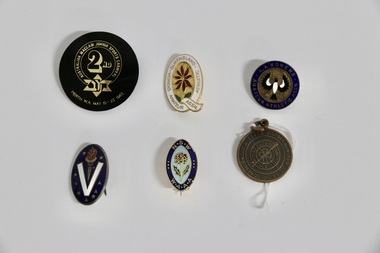
... 01: Junior Carnival badge -2nd carnival held in Perth 12-22 May 1983, gold on black plastic 02: Queensland Womens Athletic Association pin (x2) - white "Q" with gold text & red & green flower (Cooktown orchid) inside 03: Victorian pin - royal blue oval with torch flamein red & gold, white "V" and VWAAA in gold - Victorian Women's Amateur Athletic Association 04: NSW royal blue, sky blue, flower (waratah) in red & green & gold WAAA - Women's Amateur Athletic Association (on back Angus & Coote & patent no.) 05: South Australia pin (x 2) - royal blue border with gold inside & black & white state bird (piping shrike or white-backed magpie), text on border in gold - S.A. ...pins from women's associations in NSW, SA, QLD, VIC Maccabi Junior Carnival 2 01: Junior Carnival badge -2nd carnival held in Perth 12-22 May 1983, gold on black plastic 02: Queensland Womens Athletic Association pin (x2) - white "Q" with gold text & red & green flower (Cooktown orchid) inside 03: Victorian pin - royal blue oval with torch flamein red & gold, white "V" and VWAAA in gold - Victorian Women's Amateur Athletic Association 04: NSW royal blue, sky blue, flower (waratah) in red & green & gold WAAA - Women's Amateur Athletic Association (on back Angus & Coote & patent no.) 05: South Australia pin (x 2) - royal blue border with gold inside & black & white state bird (piping shrike or white-backed magpie), text on border in gold - S.A. ...pins from women's associations in NSW, SA, QLD, VIC01: Junior Carnival badge -2nd carnival held in Perth 12-22 May 1983, gold on black plastic 02: Queensland Womens Athletic Association pin (x2) - white "Q" with gold text & red & green flower (Cooktown orchid) inside 03: Victorian pin - royal blue oval with torch flamein red & gold, white "V" and VWAAA in gold - Victorian Women's Amateur Athletic Association 04: NSW royal blue, sky blue, flower (waratah) in red & green & gold WAAA - Women's Amateur Athletic Association (on back Angus & Coote & patent no.) 05: South Australia pin (x 2) - royal blue border with gold inside & black & white state bird (piping shrike or white-backed magpie), text on border in gold - S.A. Womens Amateur Athletic Assn 06: Royal Life Saving Society bronze medal pendant, on back engraved - M. Kohn 1967maccabi junior carnival 2 -
 Maccabi Victoria
Accessory, 1985-1996
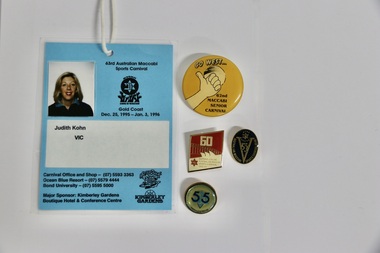
... Senior Carnival Maccabi pins, badges and lD lanyard. 01: Ajax Maccabi 53rd Australian Maccabi Sports Carnival 85-86 - gold V on black oval pin 02: 55th Australian Maccabi Sports Carnival Melbourne 19877-88 sky blue, navy blue, gold 03: 60 Diamond Jubilee Australian Maccabi Sports Carnival 1992-93 - red, cream gold with Hebrew Maccabi logo and bridge and opera house 04: GO WEST… 62nd Maccabi Senior Carnival - yellow plastic badge with fist thumbing towards west x2 05: Lanyard with photo of Judy Kohn VIC and 63rd Australian Maccabi Sports Carnival Gold Coast Dec. 25 1995 - Jan. 3 1996- blue paper. ...other sizes 02: 2.7cm diam. 03: 4.5 x 3.6cm 04: 5cm diam. 05: 14.2 x 11.4cm Maccabi Senior Carnival 53 Maccabi Senior Carnival 55 Maccabi Senior Carnival 60 Maccabi Senior Carnival 62 Maccabi Senior Carnival 63 Senior Carnival Maccabi pins, badges and lD lanyard. 01: Ajax Maccabi 53rd Australian Maccabi Sports Carnival 85-86 - gold V on black oval pin 02: 55th Australian Maccabi Sports Carnival Melbourne 19877-88 sky blue, navy blue, gold 03: 60 Diamond Jubilee Australian Maccabi Sports Carnival 1992-93 - red, cream gold with Hebrew Maccabi logo and bridge and opera house 04: GO WEST… 62nd Maccabi Senior Carnival - yellow plastic badge with fist thumbing towards west x2 05: Lanyard with photo of Judy Kohn VIC and 63rd Australian Maccabi Sports Carnival Gold Coast Dec. 25 1995 - Jan. 3 1996- blue paper. ...other sizes 02: 2.7cm diam. 03: 4.5 x 3.6cm 04: 5cm diam. 05: 14.2 x 11.4cmSenior Carnival Maccabi pins, badges and lD lanyard. 01: Ajax Maccabi 53rd Australian Maccabi Sports Carnival 85-86 - gold V on black oval pin 02: 55th Australian Maccabi Sports Carnival Melbourne 19877-88 sky blue, navy blue, gold 03: 60 Diamond Jubilee Australian Maccabi Sports Carnival 1992-93 - red, cream gold with Hebrew Maccabi logo and bridge and opera house 04: GO WEST… 62nd Maccabi Senior Carnival - yellow plastic badge with fist thumbing towards west x2 05: Lanyard with photo of Judy Kohn VIC and 63rd Australian Maccabi Sports Carnival Gold Coast Dec. 25 1995 - Jan. 3 1996- blue paper. Includes phone numbers of Carnival Office & Shop, Ocean Blue Resort Bond University. Major sponsor: Kimberley Gardens Boutique Hotel & Conference Centre & MaccaDuck logomaccabi senior carnival 53, maccabi senior carnival 55, maccabi senior carnival 60, maccabi senior carnival 62, maccabi senior carnival 63 -
 Sunshine and District Historical Society Incorporated
Administrative record - City of Sunshine - Commissioner Mr Alexander Alex George Gillon Collection 1976 - 1982 - Extraordinary business 14th October 1980, City of Sunshine, 14th October 1980
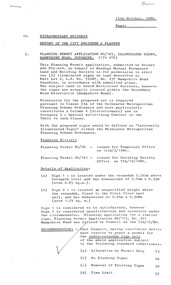
... Albans Planning Permit Application Sky Sign corner Geelong Road and Francis Street Brooklyn Planning Permit Application Flats 185A Main Road West Planning Permit Application Additional to existing petrol filling station corner St. ...Albans Planning Permit Application Sky Sign corner Geelong Road and Francis Street Brooklyn Planning Permit Application Flats 185A Main Road West Planning Permit Application Additional to existing petrol filling station corner St. ...Planning Permit Application Illuminated Signs 237 Hampshire Road Sunshine Planning Permit Application Boiler House Extensions 465 Somerville Road Footscray West Planning Permit Application Commercial Vehicle Park Lot 1 Geelong Road Planning Permit Application Flats Lot 472 Henry Street Sunshine West Planning Permit Application Display Homes and Associated Car Park Furlong Road St. Albans Planning Permit Application Sky Sign corner Geelong Road and Francis Street Brooklyn Planning Permit Application Flats 185A Main Road West Planning Permit Application Additional to existing petrol filling station corner St. Albans Road and Percy Street St. Albans Station Road Widening Acquisition of 88 Station Road Deer Park Warrs Road Private Street Scheme Maribyrnong Height of Sunblind 254 Hampshire Road Sunshinehampshire road, sunshine, somerville road, footscray west, geelong road, brooklyn, henry street, sunshine west, furlong road, francis street, main road west, st. albans road, percy street, st. albans, station road, deer park, warrs road, maribyrnong -
 Royal Australian and New Zealand College of Obstetricians & Gynaecologists (RANZCOG)
Print - Colour print, Charles Webb, Original design of the Alfred Hospital, c. 1870
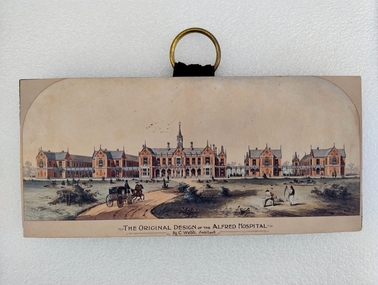
... A flock of birds is visible in the sky in the central background, above the main hospital building. ...A flock of birds is visible in the sky in the central background, above the main hospital building. ...This 1870 print displays the original design of The Alfred Hospital by Charles Webb. This design was designed in 'accordance with the principles laid down by Florence Nightingale to maximise ventilation and so minimise infection' (Victorian Heritage Database). The Alfred Hospital was founded in 1869 as a result of the work of various Melbourne doctors who fought a long and internecine battle for an additional general hospital. The Alfred Hospital treated their first patient in 1871. Prahran Council donated a parcel of low-lying land for the provision of a hospital. In 1870, the Melbourne architect, Charles Webb, won the competition to design The Alfred Hospital with his revolutionary design. Webb incorporated the "Nightingale" design - principles by designing large light filled pavilions as wards connected by covered corridors or walkways." (Alfred Health)This print includes small colour print mounted on a wood block. The print depicts a series of five red brick buildings at centre, with a dirt road snaking up from the left foreground to the front of the central building. A man is driving a two-horse buggy along the dirt road towards the buildings. The landscape on either side of the road consists of grassland and low vegetation, as well as four shallow circular pits (two on either side) which contain vegetation. There are two figures in the right foreground cutting grass with scythes. A flock of birds is visible in the sky in the central background, above the main hospital building. There is text printed below the image which reads 'THE ORIGINAL DESIGN OF THE ALFRED HOSPITAL/By C.Webb, Arckitect (sic)'. The back of the wooden block to which the print is affixes is painted black, and a circular hook has been attached to the centre back of the block for hanging of the artwork. The hook is gold coloured and attached using two gold-coloured pins and a small strap. There is handwriting at bottom right of the back of the object reads 'ANN TAVELL'.There is text printed below the image which reads 'THE ORIGINAL DESIGN OF THE ALFRED HOSPITAL/By C.Webb, Arckitect (sic)'. There is handwriting at bottom right of the back of the object reads 'ANN TAVELL'. -
 Moorabbin Air Museum
Document (item) - Brian Ridgeway Collection Miscellaneous aircraft photos, newspaper items etc. See under "Description" Section
... Photos Sundry photos. Book Man of the Sky- Featuring the sketches and paintings of Flight Lieutenant Terence Duigan. ...Photos Sundry photos. Book Man of the Sky- Featuring the sketches and paintings of Flight Lieutenant Terence Duigan. ... -
 Villa Alba Museum
Decorative object - Suite of seven curtain panels, 1850s-90s
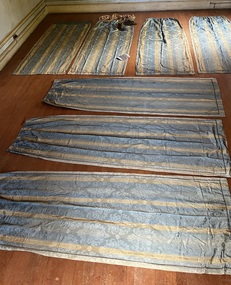
... Fabric: silk-wool mix, sky blue ground with narrow vertical gold stripes. ...Fabric: silk-wool mix, sky blue ground with narrow vertical gold stripes. ...The curtains are significant for their comparative rarity of survival, and at the same time, are highly representative of opulent colonial taste in interior decor in the boom period. The curtain panels are of high quality materials and in unusually good condition, indicating they were used in a window with relatively little sunlight shining on them. They can be imagined in a grand room with one or more matching dressed windows.7 curtain panels, all the same size, possibly to fit a 3-light bay window; or alternately, to fit 3 windows in the same room (or something else altogether, if this is not the original total number of panels). Fabric: silk-wool mix, sky blue ground with narrow vertical gold stripes. The fabric is a damask weave with a watered (moiré) finish; the large, woven motif depicts an urn filled with stylised flowers, leaves and curlicues; the spacing of the motifs is more 19thC than older styles using much the same motif. Each curtain drop is decorated with an applied band of narrow, colour-matched gimp braid around the sides and lower end. The bottom hems are weighted with what feels like lead shot. The curtains are lined with sturdy brown cotton. They are gathered at the top edge on drawstring tape; and hand-sewn with small metal hanging rings. Faded vertical bands of sun exposure are visible on most of the curtains, and one panel has a mended tear on a lower side. Otherwise they are in excellent, sound condition.interior decoration-19th century, curtains-19th century, colonial taste-victoria, gold boom melbourne -
 Maccabi Victoria
Accessory, 1972-1981
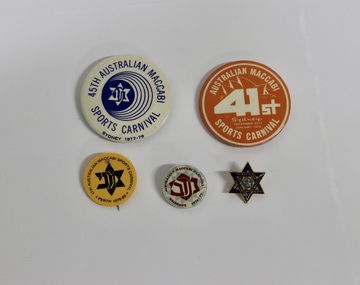
... Senior Carnival Maccabi pins and badges. 40 inside magen david Melbourne Maccabi Australian Sports Carnival 1972-73 - aqua, navy, gold - similar to badge of 33rd & 38th Carnivals also held in Melbourne (see 2023.0752) x 3 , 41st Australian Maccabi Sports Carnival, Sydney December 1973, January 1974 with opera house silhouette - white on orange plastic badge x2, Australian Maccabi Carnival Brisbane 1976-77, plastic badge - sky blue, white and dark red Maccabi Hebrew logo , 45th Australian Maccabi Sports Carnival Sydney 1977-78 - large blue on white w Maccabi Hebrew logo, 46 in gold & gold text Australian Maccabi Sports Carnival Adelaide 1978-79 on navy blue triangular pin, Hebrew Maccabi logo & 47th Australian Maccabi Sports Carnival Perth 1979-1980 - black on yellow plastic, Hebrew Maccabi logo 48th Australian Maccabi Sports Carnival, Melbourne 1980-81 -blue, gold and peach...other sizes 02: 5.6cm diam. 03: 2.7cm diam. 04: 5.6cm diam. 05: 2.3 x 2cm 06: 3.2cm diam. 07: 2.7 x 2cm Maccabi Senior Carnival 40 Maccabi Senior Carnival 41 Maccabi Senior Carnival 44 Maccabi Senior Carnival 45 Maccabi Senior Carnival 46 Maccabi Senior Carnival 47 Maccabi Senior Carnival 48 Senior Carnival Maccabi pins and badges. 40 inside magen david Melbourne Maccabi Australian Sports Carnival 1972-73 - aqua, navy, gold - similar to badge of 33rd & 38th Carnivals also held in Melbourne (see 2023.0752) x 3 , 41st Australian Maccabi Sports Carnival, Sydney December 1973, January 1974 with opera house silhouette - white on orange plastic badge x2, Australian Maccabi Carnival Brisbane 1976-77, plastic badge - sky blue, white and dark red Maccabi Hebrew logo , 45th Australian Maccabi Sports Carnival Sydney 1977-78 - large blue on white w Maccabi Hebrew logo, 46 in gold & gold text Australian Maccabi Sports Carnival Adelaide 1978-79 on navy blue triangular pin, Hebrew Maccabi logo & 47th Australian Maccabi Sports Carnival Perth 1979-1980 - black on yellow plastic, Hebrew Maccabi logo 48th Australian Maccabi Sports Carnival, Melbourne 1980-81 -blue, gold and peach Accessory ...other sizes 02: 5.6cm diam. 03: 2.7cm diam. 04: 5.6cm diam. 05: 2.3 x 2cm 06: 3.2cm diam. 07: 2.7 x 2cmSenior Carnival Maccabi pins and badges. 40 inside magen david Melbourne Maccabi Australian Sports Carnival 1972-73 - aqua, navy, gold - similar to badge of 33rd & 38th Carnivals also held in Melbourne (see 2023.0752) x 3 , 41st Australian Maccabi Sports Carnival, Sydney December 1973, January 1974 with opera house silhouette - white on orange plastic badge x2, Australian Maccabi Carnival Brisbane 1976-77, plastic badge - sky blue, white and dark red Maccabi Hebrew logo , 45th Australian Maccabi Sports Carnival Sydney 1977-78 - large blue on white w Maccabi Hebrew logo, 46 in gold & gold text Australian Maccabi Sports Carnival Adelaide 1978-79 on navy blue triangular pin, Hebrew Maccabi logo & 47th Australian Maccabi Sports Carnival Perth 1979-1980 - black on yellow plastic, Hebrew Maccabi logo 48th Australian Maccabi Sports Carnival, Melbourne 1980-81 -blue, gold and peachmaccabi senior carnival 40, maccabi senior carnival 41, maccabi senior carnival 44, maccabi senior carnival 45, maccabi senior carnival 46, maccabi senior carnival 47, maccabi senior carnival 48 -
 Flagstaff Hill Maritime Museum and Village
Instrument - Barometer, Early 20th century
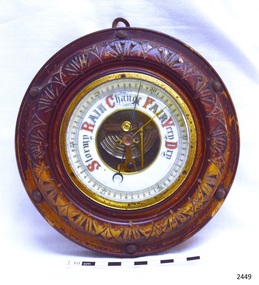
... At around this time Duke Ferdinand II of Tuscany organized the first short-lived meteorological network among scientists in other Italian cities, gathering observations of pressure, temperature, humidity, wind direction, and state of the sky....At around this time Duke Ferdinand II of Tuscany organized the first short-lived meteorological network among scientists in other Italian cities, gathering observations of pressure, temperature, humidity, wind direction, and state of the sky. Theis barometer is an example of a household item from the early 20th century, used to determine the day's weather. ...A barometer is an instrument used for measuring atmosphere pressure thus determining weather changes.The first apparatus generally accepted as a barometer was that set up in Florence in 1644 by Evangelista Torricelli (1608–1647), a mathematician and physicist. Torricelli filled a glass tube with mercury, sealed it at one end, and inverted it with its open end in a dish of mercury. The level always fell a short way down the tube, then settled at a height of about thirty inches. He concluded correctly that the mercury column was sustained by the weight of the air pressing on the open surface of mercury, and further experiments convinced him that the space above the mercury in the tube was a vacuum. He noted that the level rose and fell with changing temperature, but he was unable to use his apparatus to measure variations in the weight of the atmosphere because he had not foreseen that temperature would affect the level of the mercury. News of this experiment circulated quickly among European scientists, who hastened to replicate the experiment. Torricelli's conclusions were not universally accepted because some disputed whether the air had weight, while both Aristotle and the Catholic Church denied the possibility of a vacuum. In France, the philosopher René Descartes (1596–1650) seems to have been the first person, probably in 1647, to attach a graduated scale to the tube so that he could record any changes attributable to the weather. At around this time Duke Ferdinand II of Tuscany organized the first short-lived meteorological network among scientists in other Italian cities, gathering observations of pressure, temperature, humidity, wind direction, and state of the sky.Theis barometer is an example of a household item from the early 20th century, used to determine the day's weather. The barometer is significant as an aid to human social, material and scientific development.Barometer, round, brass housing inset into carved wooden casing (lacquer mostly worn off). Decorative lettering for weather conditions "Stormy, Rain, Change, Fair, Very Dry". Workings are visible through opening in centre of dial. Indicator needle and another adjustable needle . Hook screwed into back of case.flagstaff hill, warrnambool, shipwrecked coast, flagstaff hill maritime museum, maritime museum, shipwreck coast, flagstaff hill maritime village, great ocean road, barometer, scientific instrument, weather forcasting instrument, weather gauge -
 Eltham District Historical Society Inc
Document, Prospectus: Kinloch Gardens, Eltham Victoria, 1998c
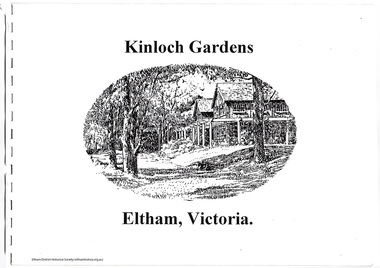
... The existing buildings, amongst the most significant of the Eltham / Montsalvat domestic building tradition are set in park like surrounds and enjoy panoramic views of the ranges to the north east and the city sky line to the west. New houses combined with sensitive landscaping will blend immediately into the established garden environment and will share the amenity and ambience of a very private and unique estate. ...The existing buildings, amongst the most significant of the Eltham / Montsalvat domestic building tradition are set in park like surrounds and enjoy panoramic views of the ranges to the north east and the city sky line to the west. New houses combined with sensitive landscaping will blend immediately into the established garden environment and will share the amenity and ambience of a very private and unique estate. ...“Kinloch Gardens at Eltham, Victoria is planned as a comprehensively designed and cohesive residential environment.” “Only twelve innovatively designed houses ,will be situated within the established gardens and grounds of this historic Eltham estate. Building design and development will be under the control of the Kinloch Gardens design and construction team.” “Kinloch Gardens is situated on one of the highest points in Eltham and enjoys panoramic views in all directions.” “Kinloch Gardens lies hidden from the outside world behind high stone retaining walls, terraced embankments and extensive landscaping. The existing buildings, amongst the most significant of the Eltham / Montsalvat domestic building tradition are set in park like surrounds and enjoy panoramic views of the ranges to the north east and the city sky line to the west. New houses combined with sensitive landscaping will blend immediately into the established garden environment and will share the amenity and ambience of a very private and unique estate. The central theme of the landscape master plan is a garden reserve and a planted avenue terminating in a -small square.” “Houses vary in size from 120m2 (12.9 squares) to 210m2 (22.6 squares) (or larger) and include an extensive range of planning options. House types include: The Studio House The Tower House The Pergola House The Gallery House 'The Barn' is one of the existing buildings of Kinloch Gardens and is situated on the premium Lot 11.” Developer: Kinloch Pty Ltd. Project Managers: Creative Block Design Pty Ltd. Architects: Graeme Gunn and Ian Jelbart. Landscape Architect: Suzy Boyd. Builder: Vizarje Homes Pty Ltd. Surveyors and Engineers: Miller Merrigan.Digital file only; created from scan undertaken by EDHSarthur street, creative block design pty ltd., eltham, graeme gunn, houses, ian jelbart, kinloch gardens, kinloch pty ltd, miller merrigan, real estate, suzy boyd, vizarje homes pty ltd. -
 Eltham District Historical Society Inc
Document, Kinloch Gardens Property Album; Elders Real Estate sales material, 1998
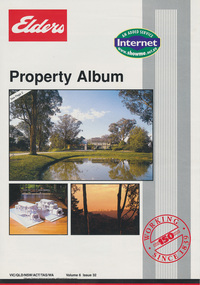
... The existing buildings, amongst the most significant of the Eltham / Montsalvat domestic building tradition are set in park like surrounds and enjoy panoramic views of the ranges to the north east and the city sky line to the west. New houses combined with sensitive landscaping will blend immediately into the established garden environment and will share the amenity and ambience of a very private and unique estate. ...The existing buildings, amongst the most significant of the Eltham / Montsalvat domestic building tradition are set in park like surrounds and enjoy panoramic views of the ranges to the north east and the city sky line to the west. New houses combined with sensitive landscaping will blend immediately into the established garden environment and will share the amenity and ambience of a very private and unique estate. ...“Kinloch Gardens at Eltham, Victoria is planned as a comprehensively designed and cohesive residential environment.” “Only twelve innovatively designed houses ,will be situated within the established gardens and grounds of this historic Eltham estate. Building design and development will be under the control of the Kinloch Gardens design and construction team.” “Kinloch Gardens is situated on one of the highest points in Eltham and enjoys panoramic views in all directions.” “Kinloch Gardens lies hidden from the outside world behind high stone retaining walls, terraced embankments and extensive landscaping. The existing buildings, amongst the most significant of the Eltham / Montsalvat domestic building tradition are set in park like surrounds and enjoy panoramic views of the ranges to the north east and the city sky line to the west. New houses combined with sensitive landscaping will blend immediately into the established garden environment and will share the amenity and ambience of a very private and unique estate. The central theme of the landscape master plan is a garden reserve and a planted avenue terminating in a -small square.” “Houses vary in size from 120m2 (12.9 squares) to 210m2 (22.6 squares) (or larger) and include an extensive range of planning options. House types include: The Studio House The Tower House The Pergola House The Gallery House 'The Barn' is one of the existing buildings of Kinloch Gardens and is situated on the premium Lot 11.” Developer: Kinloch Pty Ltd. Project Managers: Creative Block Design Pty Ltd. Architects: Graeme Gunn and Ian Jelbart. Landscape Architect: Suzy Boyd. Builder: Vizarje Homes Pty Ltd. Surveyors and Engineers: Miller Merrigan.Digital file only; created from scan undertaken by EDHSarthur street, elders real estate, eltham, kinloch gardens, real estate agent, the barn -
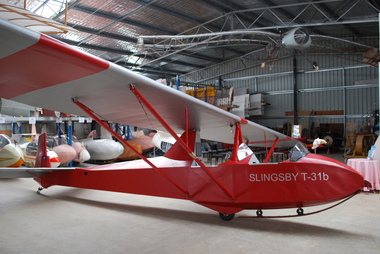 Australian Gliding Museum
Machine - Glider – Sailplane, 29/071956
... The Australian Gliding Museum’s example (currently registered as VH-GDB) is one of five of this type to grace Australian skies. Three including GDB were assembled in Australia from kits supplied by Slingsby’s in England, the other two were delivered as completed airframes. ...The Australian Gliding Museum’s example (currently registered as VH-GDB) is one of five of this type to grace Australian skies. Three including GDB were assembled in Australia from kits supplied by Slingsby’s in England, the other two were delivered as completed airframes. ...The Slingsby T31 is a two seat training glider that came available in 1951. It is, in effect, a two seat version of the single seat Kirby Tutor. The T31 was marketed by Slingsby Sailplanes both as complete aircraft and kits of parts for assembly. The Australian Gliding Museum’s example (currently registered as VH-GDB) is one of five of this type to grace Australian skies. Three including GDB were assembled in Australia from kits supplied by Slingsby’s in England, the other two were delivered as completed airframes. To date only four remain of which two are airworthy. This aircraft began flying in at Caversham in Western Australia (the then home of the Gliding Club of Western Australia) in July 1956. It was badly damaged in a crash in June 1958. The wreckage was sent to Schneiders in Adelaide for repair. However, the Club decided against having the repairs done, opting instead to buy a new ES52 Kookaburra. After a couple of years, the wreck was purchased by a member of the Waikerie Gliding Club whereupon the glider was rebuilt with some modifications, including a more rounded and better streamlined fuselage nose. It returned to the air in October 1961 at Clare in South Australia. The ownership of VH-GDB passed through a number of clubs, including at Dubbo in New South Wales, Wimmera in Victoria and Pioneer Valley at Mackay in Queensland. Eventually, it came into the hands of Bill Riley of Tocumwal in New South Wales who held it in storage for many years. Riley donated the aircraft to the Museum. It has been restored to airworthiness and is flown at vintage glider rallies and on Museum open days. This exhibit is an excellent example of a Slingsby T31 Tandem Tutor, a type of glider that was used by a number of clubs in the 1950s and 1960s for dual training of pilots to the solo capability.The Slingsby T31b Tandem Tutor is an open cockpit, tandem, two-seater glider with high, pylon mounted two piece wing supported by double, wire braced, steel tube struts. The glider is fitted with a main wheel, rubber-block sprung, wooden nose skid and steel leaf sprung, brass shod tailskid. The basic controls of aileron, rudder and elevator are not supplemented with pitch trim. Wing lift spoilers and both aerotow and winch releases are fitted. The instrument panels in both cockpits are fitted with an airspeed indicator, cosim variometer and altimeter. This red and silver painted wood and fabric covered aircraft is in excellent condition having been restored to full airworthy status by the Australian Gliding Museum. SLINGSBY – T31b (nose – both sides) DB Australian Gliding Museum (rudder – both sides) It has been given Serial Number GFA/HB/12 and is registered as VH-GDBaustralian gliding, glider, sailplane, slingsby, tandem tutor, t31, gliding club of western australia, waikerie gliding club, wimmera soaring club, pioneer valley soaring club
