
Showing 101 items matching " underwater"
-
 Phillip Island and District Historical Society Inc.
Book, JORDAN, D.J, East coast shipwrecks : a thematic historical survey, 1996
... shipwrecks victoria historic sites underwater archaeology East coast shipwrecks : a thematic historical survey Book JORDAN, D.J. ...shipwrecks, victoria, historic sites, underwater archaeology -
 Flagstaff Hill Maritime Museum and Village
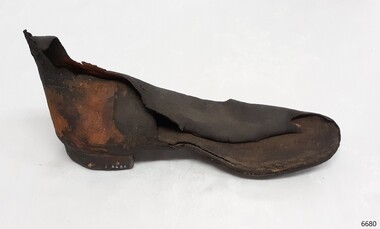
Footwear - Rubber Boot, 1900-1908
... It is remarkable that it has survived almost seventy years underwater. The Falls of Halladale shipwreck is listed on the Victorian Heritage (No. ...The Falls of Halladale was an iron-hulled, four-masted barque, used as a bulk carrier of general cargo. She left New York in August 1908 bound for Melbourne and Sydney. In her hold was general cargo consisting of roof tiles, barbed wire, stoves, oil, and benzene as well as many other manufactured items. After three months at sea and close to her destination, a navigational error caused the Falls of Halladale to be wrecked on a reef off the Peterborough headland on the 15th of November, 1908. The captain and 29 crew members survived, but her cargo was largely lost, despite two salvage attempts in 1908-09 and 1910. The Court of Marine Inquiry in Melbourne ruled that the foundering of the ship was entirely due to Captain David Wood Thomson's navigational error, not too technical failure of the Clyde-built ship. The Falls of Halladale was built in1886 by Russell & Co., at Greenock shipyards on the River Clyde, Scotland for Wright, Breakenridge & Co of Glasgow. She was one of several designs of the Falls Line of ships named after waterfalls in Scotland. The company had been founded between 1870- 1873 as a partnership between Joseph Russell, Anderson Rodger, and William Todd Lithgow. During the period 1882-92 Russell & Co. standardised designs, which sped up their building process so much that they were able to build 271 ships during that time. The Falls of Halladale had a sturdy construction built to carry maximum cargo and was able to maintain full sail in heavy gales, one of the last of the 'windjammers' that sailed the Trade Route. She and her sister ship, the Falls of Garry, were the first ships in the world to include fore and aft lifting bridges. Previous to this, heavily loaded vessels could have heavy seas break along the full length of the deck, causing serious injury or even death to those on deck. The new raised catwalk-type decking allowed the crew to move above the deck in stormy conditions. This rubber boot is significant for being the only rubber boot in our collection. It is remarkable that it has survived almost seventy years underwater. The Falls of Halladale shipwreck is listed on the Victorian Heritage (No. S255). She was one of the last ships to sail the Trade Routes from Europe and the Americas. Also of significance is that the vessel was one of the first ships to have fore and aft lifting bridges as a significant safety feature still in use on modern vessels today. The subject model is an example of an International Cargo Ship used during the 19th and early 20th centuries to transport goods around the world and represents aspects of Victoria’s shipping industry. Rubber boot, left foot, Boot is ankle height and adult size. The heel appears to be solid rubber and the inner sole resembles leather. The rubber has come away from the outer boot in places, revealing a fabric base. Recovered from the Falls of Halladale. flagstaff hill, warrnambool, flagstaff hill maritime museum and village, shipwreck coast, great ocean road, russell & co., rubber boot, protective footwear, shipwreck artefact -
 Queenscliffe Maritime Museum
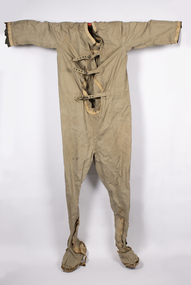
Clothing - Diving suit
... Early type of diving suit used in underwater construction since the 1940s before rubber wet or dry suits. ...This type of diving suit was used for construction diving by the Melbourne Port Emergency Service.Early type of diving suit used in underwater construction since the 1940s before rubber wet or dry suits.Siebe Gorman standard dress full body diving suit with head cap and gogglesdiving suit, diving, underwater construction, mpes -
 Queenscliffe Maritime Museum
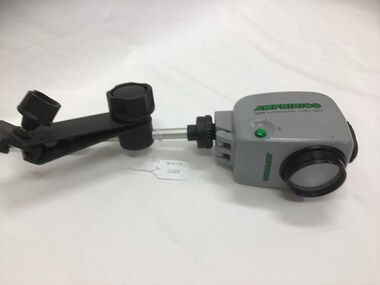
Equipment - Light, underwater photography
... Equipment used by pro diver underwater photography photography Amphibico 100s Light on bracket to be attached to camera Equipment Light, underwater photography ...Equipment used by pro diverLight on bracket to be attached to cameraAmphibico 100sunderwater photography, photography -
 Queenscliffe Maritime Museum
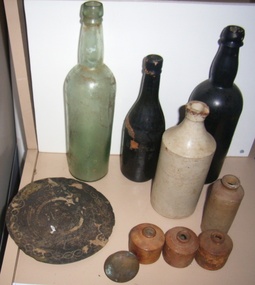
Domestic object - 10 items recovered from the Cambridgeshire wreck site
... Read more at wrecksite: https://wrecksite.eu/wreck.aspx?54312 Underwater relics Salvage Glass bottles Ceramic bottles Ceramic ink wells 3 glass bottles, 3 ceramic ink bottles, 2 ceramic bottles, 1 brass door knob, 1 engraved metal disc Domestic object 10 items recovered from the Cambridgeshire wreck site ...CAMBRIDGESHIRE (J. Marshall) was on voyage from Gravesend UK to Sydney, New South Wales with a cargo of general goods and a crew of 40, when she was lost off Cambridgeshire Reef. Read more at wrecksite: https://wrecksite.eu/wreck.aspx?543123 glass bottles, 3 ceramic ink bottles, 2 ceramic bottles, 1 brass door knob, 1 engraved metal discunderwater relics, salvage, glass bottles, ceramic bottles, ceramic ink wells -
 Monbulk RSL Sub Branch
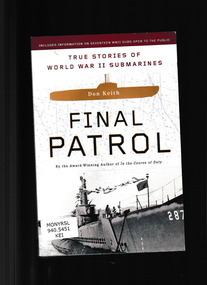
Book, NAL Caliber, Final patrol : true stories of World War II submarines, 2006
... But despite the odds, these underwater warriors accounted for almost sixty percent of Japanese shipping losses and were a major factor in winning the war. ...During World War II, the U.S. Navy's submarine service suffered the highest percentage of casualties of any branch of the American armed forces. One in five submariners was lost. But despite the odds, these underwater warriors accounted for almost sixty percent of Japanese shipping losses and were a major factor in winning the war.Index, ill, p.331.During World War II, the U.S. Navy's submarine service suffered the highest percentage of casualties of any branch of the American armed forces. One in five submariners was lost. But despite the odds, these underwater warriors accounted for almost sixty percent of Japanese shipping losses and were a major factor in winning the war.submarine warfare - world war ii, world war 1939-1945 - naval operations - united states -
 Monbulk RSL Sub Branch
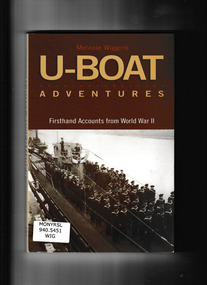
Book, Naval Institute, U-boat adventures : firsthand accounts from World War II, 2010
... Melanie Wiggins interviewed seventeen men of the enlisted ranks, along with five commanders, to take readers into the terrifying world of underwater warfare, where every single crewman made a crucial difference in the fate of his boat. ...Twenty-two U-boat veterans tell their stories in this collection of their experiences, recorded by the author during several years of travel throughout Germany. While many books have been written about the U-boat war, this is one of the few that focuses on the lives of the submariners, and rarer still is its concentration on the crewmen rather than the officers. Melanie Wiggins interviewed seventeen men of the enlisted ranks, along with five commanders, to take readers into the terrifying world of underwater warfare, where every single crewman made a crucial difference in the fate of his boat. As she searched for and interviewed U-boat men, Wiggins also collected photographs from scrapbooks and archives, and consulted war-era personnel records and secret diaries. Her attendance at a reunion of the crew of U-682 netted a wealth of information as did her interviews with submarine veterans in Gؤrlitz, former East Germany. Her interviews with Admiral Otto Kretschmer just two months before his death and ninety-four-year-old Commander Jѓrgen Wattenberg in Hamburg add important dimensions to the work. Among the individual sagas included are Radioman Hans Bѓrck's description of his 1942 patrol to Aruba and the visit of Japanese submarine I-30 at Lorient; Fireman 2nd Class Josef Erben's explanation of how his boat, U-128, got stuck on a large rock and had to be hauled free; POW Ernst Gؤ:thling's memories of being wounded in a British prison camp when German planes mistakenly dropped bombs in the area.Index, bibliography, notes, ill, p.250.non-fictionTwenty-two U-boat veterans tell their stories in this collection of their experiences, recorded by the author during several years of travel throughout Germany. While many books have been written about the U-boat war, this is one of the few that focuses on the lives of the submariners, and rarer still is its concentration on the crewmen rather than the officers. Melanie Wiggins interviewed seventeen men of the enlisted ranks, along with five commanders, to take readers into the terrifying world of underwater warfare, where every single crewman made a crucial difference in the fate of his boat. As she searched for and interviewed U-boat men, Wiggins also collected photographs from scrapbooks and archives, and consulted war-era personnel records and secret diaries. Her attendance at a reunion of the crew of U-682 netted a wealth of information as did her interviews with submarine veterans in Gؤrlitz, former East Germany. Her interviews with Admiral Otto Kretschmer just two months before his death and ninety-four-year-old Commander Jѓrgen Wattenberg in Hamburg add important dimensions to the work. Among the individual sagas included are Radioman Hans Bѓrck's description of his 1942 patrol to Aruba and the visit of Japanese submarine I-30 at Lorient; Fireman 2nd Class Josef Erben's explanation of how his boat, U-128, got stuck on a large rock and had to be hauled free; POW Ernst Gؤ:thling's memories of being wounded in a British prison camp when German planes mistakenly dropped bombs in the area.world war 1939 – 1945 –naval operations - germany, germany - u-boats -
 Peterborough History Group
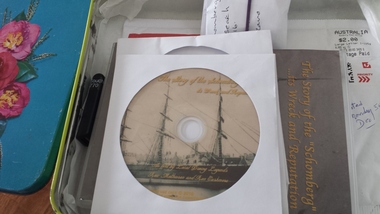
Memorabilia - Schomberg Collection Tin, c2017
... They collected artefacts and took underwater photographs at that time. Additionally, there is research conducted by Shannon Azzaro about the Captain, 'Bully' Forbes and The Schomberg. schomberg schomberg rock schomberg-shipwreck rex mathieson ron cashmore shipwrecks great ocean road shipwreck coast captain bully forbes Old chocolate tin containing DVD of Rex Mathieson and Ron Cashmore's story about the Schomberg with particular reference to their extensive diving experience. ...Video of Rex Mathieson and Ron Cashmore's story about the Schomberg and their experiences diving on the wreck. the video was shown at the Peterborough Hall in January 2017, with live commentary by the divers, and accompanied by artefacts lent to the History Group by Flagstaff Hill Maritime Museum.The Schomberg wrecked close to the town of Peterborough and this video is narrated by Rex Mathieson and Ron Cashmore who dived on the wreck over a period of years prior to the Historic Shipwrecks Act 1976. They collected artefacts and took underwater photographs at that time. Additionally, there is research conducted by Shannon Azzaro about the Captain, 'Bully' Forbes and The Schomberg.Old chocolate tin containing DVD of Rex Mathieson and Ron Cashmore's story about the Schomberg with particular reference to their extensive diving experience. USB with research information about the Schomberg.schomberg, schomberg rock, schomberg-shipwreck, rex mathieson, ron cashmore, shipwrecks, great ocean road, shipwreck coast, captain bully forbes -
 Lilydale RSL Sub Branch
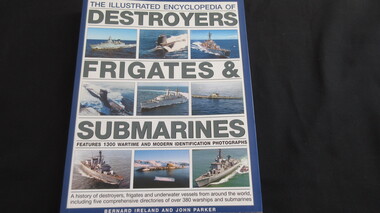
Book, Bernard Ireland and John Parker, The Illustrated Encyclopedia of Destroyers, Frigates and Submarines, 2011
... A History of destroyers, frigates and underwater vessels from around the World, including five comprehensive directories of over 380 warships and submarines. ...A History of destroyers, frigates and underwater vessels from around the World, including five comprehensive directories of over 380 warships and submarines.Booknon-fictionA History of destroyers, frigates and underwater vessels from around the World, including five comprehensive directories of over 380 warships and submarines. -
Kew Historical Society Inc
Journal, Kewriosity : December 1986 / January 1987
... [Hays Paddock; Willsmere Park; Hyde Park; Eglinton Reserve] / p8. Having fun underwater [Kew Skindiving Club] / p8. Australia's fastest growing sport [East Kew Bowling Club] / G Petrie p8. ...Kew playgroups are great! [Highbury Grove; Woodlands Avenue] / p1. A gentle reminder about Kew's By-laws - Don't smoke your neighbour out / p1. Dates for December / p2. [Community] Notices / p2. Christmas services / p2. Commentary - The year that was / Cr Joe Ormando, Mayor of Kew p3. Good gardening - Trees: friends or foes? / Peter Davies p3. Profile - Cr James McKenzie / p4. Family Carols in Petrie Square / G Petrie p4. Would you like to be part of Kewriosity [Editorial committee] / p4. In Brief [Post Office complex classified; Don't forget to put your bottles out; Images of Kew; Kew Full Day-care Centre; School Holiday Program] / p5. Children's Services update [ Kew Children's Services Consultative Committee] / Krista Bell p5. Kew Community House [Courses for 1987; VCE (TOP) ; Pamphlet; Christmas Greetings; Christmas Beak-up] / p6. Overmantle returns to Villa Alba after 90 years / p6. Memories of a motor mechanic [Eric Buzza; Williams Motors; 1st Kew Scouts] / p7. Fine music all the way [3MBS] / p7. What's what in the playground? [Hays Paddock; Willsmere Park; Hyde Park; Eglinton Reserve] / p8. Having fun underwater [Kew Skindiving Club] / p8. Australia's fastest growing sport [East Kew Bowling Club] / G Petrie p8. Keeping you informed [Citizens Advice Bureau] / p8. Kew Citizens' Band [European] Tour Appeal / p8.Kewriosity was a local newsletter combining Kew Council and community news. It was published between November 1983 and June 1994, replacing an earlier Kewriosity [broad] Sheet (1979-84). In producing Kewriosity, Council aimed to provide a range of interesting and informative articles covering its deliberations and decision making, together with items of general interest and importance to the Kew community and information not generally available through daily media outlets.non-fictionKew playgroups are great! [Highbury Grove; Woodlands Avenue] / p1. A gentle reminder about Kew's By-laws - Don't smoke your neighbour out / p1. Dates for December / p2. [Community] Notices / p2. Christmas services / p2. Commentary - The year that was / Cr Joe Ormando, Mayor of Kew p3. Good gardening - Trees: friends or foes? / Peter Davies p3. Profile - Cr James McKenzie / p4. Family Carols in Petrie Square / G Petrie p4. Would you like to be part of Kewriosity [Editorial committee] / p4. In Brief [Post Office complex classified; Don't forget to put your bottles out; Images of Kew; Kew Full Day-care Centre; School Holiday Program] / p5. Children's Services update [ Kew Children's Services Consultative Committee] / Krista Bell p5. Kew Community House [Courses for 1987; VCE (TOP) ; Pamphlet; Christmas Greetings; Christmas Beak-up] / p6. Overmantle returns to Villa Alba after 90 years / p6. Memories of a motor mechanic [Eric Buzza; Williams Motors; 1st Kew Scouts] / p7. Fine music all the way [3MBS] / p7. What's what in the playground? [Hays Paddock; Willsmere Park; Hyde Park; Eglinton Reserve] / p8. Having fun underwater [Kew Skindiving Club] / p8. Australia's fastest growing sport [East Kew Bowling Club] / G Petrie p8. Keeping you informed [Citizens Advice Bureau] / p8. Kew Citizens' Band [European] Tour Appeal / p8. publications -- city of kew (vic.), kewriosity, council newsletters, community newsletters -
 Mrs Aeneas Gunn Memorial Library
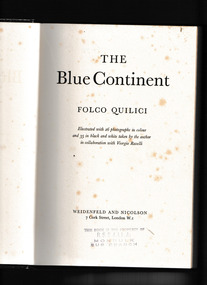
Book, Weidenfeld & Nicolson, The blue continent, 1954
... Marine biology - Red sea Underwater exploration - Red sea A story of underwater exploration in the Red sea Ill, p.169. ...A story of underwater exploration in the Red seaIll, p.169.non-fictionA story of underwater exploration in the Red seamarine biology - red sea, underwater exploration - red sea
