
Showing 135 items matching "homeless"
-
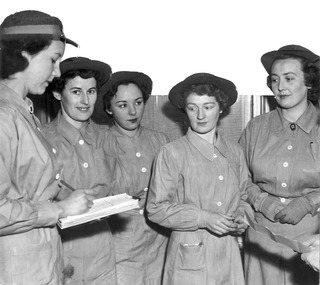 Royal District Nursing Service (now known as Bolton Clarke)
Photograph - Photograph, black and white, 17.10.1952
... HIV/AIDS nursing care was provided; visits to Homeless Persons were made. Personal care was given to patients ranging in age and with varying mobility problems, such as those with MS, MND, Guillan-Barre Syndrome, Quadriplegia, Paraplegia, Acquired Brain Injury, to those following a Cerebrovascular Accident (Stroke), those with severe Arthritis and those with a form of Dementia. ...The Melbourne District Nursing Society (MDNS) Trained nurses (Sisters) are receiving their morning briefing from Matron D. Tupper before leaving their Headquarters at 39 Victoria Parade, Collingwood to go to their areas (districts) in the Melbourne suburbs to give nursing care to patients in their homes The Sisters averaged 30 calls a day each, mainly wound dressings; personal care, mostly sponges in bed; and injections (insulin and diabetes management). The Trained nurses of the Melbourne District Nursing Society (MDNS), later known as Royal District Nursing Service (RDNS), visited patients in their home and gave best practice care in many fields of nursing, and to people of many cultures, throughout its 130 years of expansion. Initial visits not only assessed the specific nursing situation but the situation as a whole. Their patients ranged in age from babes, children, adults to the elderly and referrals were taken from Hospitals, General Practitioners and allied Health facilities. Some of the care the Sisters provided is as follows: – Post-Natal care given to mother and babe, Wound Care following various types of surgery, accidents, burns, cancer, leg ulcers etc. Supervising and teaching Diabetic Care, including teaching and supervising people with Diabetes to administer their own Insulin, and administering Insulin to those unable to give their own injections. Administering other injections and setting up weekly medication boxes. The Sisters performed Catheterizations on adults suffering from conditions such as Quadriplegia, Paraplegia, Multiple Sclerosis (MS), Motor Neurone Disease (MND) and Guillan-Barre Syndrome, and when required at school on children for e.g. those with Spina Bifida. The Sisters visited those requiring Cystic Fibrosis support and care; those requiring Haemo-Oncology care, including visiting children at school; those requiring Home Enteral Feeding care, and those requiring IV therapy at home and home Dialysis. Palliative Care was given including pain relief with the use of syringe drivers, personal care as needed, and advice and support to both patient and family. The Sisters provided Stoma management to those needing Urostomy, Ileostomy and Colostomy care and those requiring Continence care. HIV/AIDS nursing care was provided; visits to Homeless Persons were made. Personal care was given to patients ranging in age and with varying mobility problems, such as those with MS, MND, Guillan-Barre Syndrome, Quadriplegia, Paraplegia, Acquired Brain Injury, to those following a Cerebrovascular Accident (Stroke), those with severe Arthritis and those with a form of Dementia. When necessary the elderly were assisted with personal care and advice given on safety factors with the use of hand rails, bath or shower seats, and hand showers. Rehabilitation with an aim towards independence remained at the forefront of the Sister’s minds and when possible using aids and instruction on safe techniques enabled the person to become fully independent. All care included giving advice and support to the patient and their Carers. The Sisters liaised with the persons Doctor, Hospital and allied Health personal when necessary.This photograph depicts five Melbourne District Nursing Society (MDNS) Sisters of varying heights standing in a row. They are wearing their grey long sleeve uniform dresses which have peaked collars, a pocket on the upper left and lower right, and white buttons down the centre. They are all wearing their grey brimmed hats over their short dark curled hair. From left to right is Sister (Sr) J Faust, who is looking down at a clipboard she is holding in her left hand which has paper held on it by a black bulldog clip. There is writing on the top sheet of white paper and she is holding a pen in her right hand poised near a section of writing on the paper. Next is Sr. M Sexton who is looking at the camera, then Sr. B Nunn who is looking towards a mainly hidden person on the far right. The next two are Sr E Blair, who has items in her lower pocket, and Sr B White who are both looking at the clipboard and paper held by Sr. Faust. In the far lower right corner of the photograph you can see the fingers of hands holding a sheet of paper. There is no further vision of this person.Operator 59. Finisher 30melbourne district nursing society, mdns, mdns uniforms, royal district nursing service, rdns, sister j. faust, sister m. sexton, sister b. nunn, sister e. blair, sister b. white -
 Whitehorse Historical Society Inc.
Article, Housing Crisis, 2018
... housing community housing limited council to homeless persons city of whitehorse Low income earners are being forced to seek emergency accommodation as Whitehorse's surging rental prices squeeze them out of the market. ...Low income earners are being forced to seek emergency accommodation as Whitehorse's surging rental prices squeeze them out of the market.Low income earners are being forced to seek emergency accommodation as Whitehorse's surging rental prices squeeze them out of the market.Low income earners are being forced to seek emergency accommodation as Whitehorse's surging rental prices squeeze them out of the market.housing, community housing limited, council to homeless persons, city of whitehorse -
 Kew Historical Society Inc
Journal, Kewriosity : July 1992
... My feelings on Kew / Chris Howlett p6. Youth homelessness / p6. Kew Festival / p6. Victorian Disabled Skiers' Assoc./ p7. ...City of Kew Ward boundaries [map] / p1. Council election Saturday 1st August, 1992 Prospect Ward / p1. Letter from resident 'waste management' / Katrine Keuneman p2. Kew Junction Commercial Centre Precinct 8 / p2. Kew and Hawthorn a place for cyclists / p2. Mayor's Comment / Cr Daryl Oldaker p3. Come rain, hail or sunshine [school crossings] / p3 Kew Lioness Club / p3. Diary Dates for July/August pp.4-5. In Brief [Sold Kew Post Office; Help your postie deliver your mail; Carnsworth Nursing Home volunteers] / p4. In Brief continued [Kew Bowling Club; The Asthma Foundation of Victoria; Work at home as a family day caregiver; Kew Band; Kew Senior Citizens: Lions Club Opportunity Shop] / p5. My feelings on Kew / Chris Howlett p6. Youth homelessness / p6. Kew Festival / p6. Victorian Disabled Skiers' Assoc./ p7. Midwifery commemoration / p7. Vaccination against Haemophilus Influenzae Type B Disease / p7. Quit Quiz / p7. Our [Four Seasons] window [by Alan Sumner, in Kew Library] / p7. Pictures of Kew Kew High School students; Dedication of Burke Hall oval to past Mayor of Kew, the late Jack Gervasoni; Volunteers Reception; Bryan Berry] p8.Kewriosity was a local newsletter combining Kew Council and community news. It was published between November 1983 and June 1994, replacing an earlier Kewriosity [broad] Sheet (1979-84). In producing Kewriosity, Council aimed to provide a range of interesting and informative articles covering its deliberations and decision making, together with items of general interest and importance to the Kew community and information not generally available through daily media outlets.non-fictionCity of Kew Ward boundaries [map] / p1. Council election Saturday 1st August, 1992 Prospect Ward / p1. Letter from resident 'waste management' / Katrine Keuneman p2. Kew Junction Commercial Centre Precinct 8 / p2. Kew and Hawthorn a place for cyclists / p2. Mayor's Comment / Cr Daryl Oldaker p3. Come rain, hail or sunshine [school crossings] / p3 Kew Lioness Club / p3. Diary Dates for July/August pp.4-5. In Brief [Sold Kew Post Office; Help your postie deliver your mail; Carnsworth Nursing Home volunteers] / p4. In Brief continued [Kew Bowling Club; The Asthma Foundation of Victoria; Work at home as a family day caregiver; Kew Band; Kew Senior Citizens: Lions Club Opportunity Shop] / p5. My feelings on Kew / Chris Howlett p6. Youth homelessness / p6. Kew Festival / p6. Victorian Disabled Skiers' Assoc./ p7. Midwifery commemoration / p7. Vaccination against Haemophilus Influenzae Type B Disease / p7. Quit Quiz / p7. Our [Four Seasons] window [by Alan Sumner, in Kew Library] / p7. Pictures of Kew Kew High School students; Dedication of Burke Hall oval to past Mayor of Kew, the late Jack Gervasoni; Volunteers Reception; Bryan Berry] p8.publications -- city of kew (vic.), kewriosity, council newsletters, community newsletters -
Kew Historical Society Inc
Journal, Kewriosity : October 1989
... Council supports submission on youth homelessness / p3. Budget worries for Council / p3. ...Deafness Awareness Week at MLC / p1. Children's Week / p1. Democrats announce Kew candidate / p1. Dates for October / p2. Spring fairs, fetes / p2. New courses focus on small business and recreational skills [MLC] / p2. Commentary / Cr Michael Montalto [environment] / p3. Council supports submission on youth homelessness / p3. Budget worries for Council / p3. Kew's Chief resigns [Adrian Halliday] / p3. Notices / p4. Local families urged to join emergency foster care / p4. Healthy lifestyles / p4. 40th Birthday for St George's [Hospital] / p5. October clean-up for Yarra / p5. Kew Community House / p6. Coroner highlights dangers in children's play / p6. Shopping for Christmas? [Kew Living 1988] / p6. Mediation a plus for families / p6. Want to play cricket? [Kew Willsmere Cricket Club] / p6. Exciting new venture in children's entertainment [Kew Children's Integration Project] / p7. Cuts in State Budget halts E6 / p7. UN Treaty on Child's Rights / p7. ARA encourages reading from birth [Australian Reading Association] / p8. Wise walking / p8. Young People's Day [Kew Youth Resource Centre] / p8. Second round of hard rubbish collections starts soon / p8.Kewriosity was a local newsletter combining Kew Council and community news. It was published between November 1983 and June 1994, replacing an earlier Kewriosity [broad] Sheet (1979-84). In producing Kewriosity, Council aimed to provide a range of interesting and informative articles covering its deliberations and decision making, together with items of general interest and importance to the Kew community and information not generally available through daily media outlets.non-fictionDeafness Awareness Week at MLC / p1. Children's Week / p1. Democrats announce Kew candidate / p1. Dates for October / p2. Spring fairs, fetes / p2. New courses focus on small business and recreational skills [MLC] / p2. Commentary / Cr Michael Montalto [environment] / p3. Council supports submission on youth homelessness / p3. Budget worries for Council / p3. Kew's Chief resigns [Adrian Halliday] / p3. Notices / p4. Local families urged to join emergency foster care / p4. Healthy lifestyles / p4. 40th Birthday for St George's [Hospital] / p5. October clean-up for Yarra / p5. Kew Community House / p6. Coroner highlights dangers in children's play / p6. Shopping for Christmas? [Kew Living 1988] / p6. Mediation a plus for families / p6. Want to play cricket? [Kew Willsmere Cricket Club] / p6. Exciting new venture in children's entertainment [Kew Children's Integration Project] / p7. Cuts in State Budget halts E6 / p7. UN Treaty on Child's Rights / p7. ARA encourages reading from birth [Australian Reading Association] / p8. Wise walking / p8. Young People's Day [Kew Youth Resource Centre] / p8. Second round of hard rubbish collections starts soon / p8. publications -- city of kew (vic.), kewriosity, council newsletters, community newsletters -
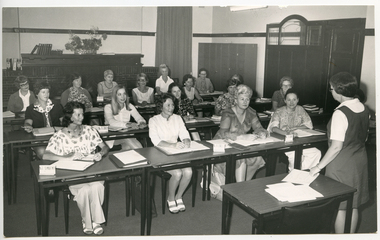 Royal District Nursing Service (now known as Bolton Clarke)
Photograph - Photograph, black and white, Barry Sutton, 1974
... At RDNS many programs were run, including: a Post Basic Course, Cardiac Rehabilitation Nursing, Haematology/Oncology Nursing, Palliative Care program, Diabetic Stabilization Program, Leg Ulcer Management Program, Wound Care Specialist Program, HIV/AIDS Nursing Care, Cystic Fibrosis Home Support, Veterans Home Care Program, Breast Cancer Support Program, Continence Management Program, Stomal Therapy Program, In-Home Lactation Support Program and the Homeless Persons Program. RDNS Sisters attended several hospitals to observe and learn special care needed to some patients, e.g. to the Austin Hospital to learn the care required for paraplegic and quadriplegic patients at home, and to Mount Royal Hospital to observe the care of patients in the Rehabilitation ward. ...Sr. Pat (Paddy) Rowley is the Principal Nurse Educator at RDNS and is giving a lecture to RDNS Sisters in the Education Department at 452 St. Kilda Rd, Melbourne. She is wearing the RDNS summer uniform of a white short sleeve blouse under a royal blue V neck tunic style frock with the RDNS insignia on the upper left.Education was an integral part of Melbourne District Nursing Society (MDNS), from its inception in 1885, later, in 1966, called Royal District Nursing Service, (RDNS). From 1885, only Trained Nurses (Nurses), through the Hospital training system, were employed by the Society, and on visits to patients they taught the necessity of hygiene and cleanliness, as well as the need for a good diet, to bring about good health. Doctor’s lectures were later given at the MDNS home to instruct patients and their families on prevention of disease. Education to patients continued throughout the years regarding health care and the use of equipment in the home. In 1961, Education programs commenced at MDNS with Trained nurses (Sisters) receiving In-service education. Sr. Pat (Paddy) Rowley was a leader in In-service Education and established the RDNS Department of Community Nursing Education in 1962. Staff could also apply for scholarships to further their education outside of RDNS. Many of their senior Sisters received Postgraduate diplomas from the College of Nursing in Community Health Nursing, Education, and Administration, and several travelled overseas visiting nursing organizations viewing their public health and District nursing systems. At RDNS many programs were run, including: a Post Basic Course, Cardiac Rehabilitation Nursing, Haematology/Oncology Nursing, Palliative Care program, Diabetic Stabilization Program, Leg Ulcer Management Program, Wound Care Specialist Program, HIV/AIDS Nursing Care, Cystic Fibrosis Home Support, Veterans Home Care Program, Breast Cancer Support Program, Continence Management Program, Stomal Therapy Program, In-Home Lactation Support Program and the Homeless Persons Program. RDNS Sisters attended several hospitals to observe and learn special care needed to some patients, e.g. to the Austin Hospital to learn the care required for paraplegic and quadriplegic patients at home, and to Mount Royal Hospital to observe the care of patients in the Rehabilitation ward. A Community Nursing Education Program was extended to student nurses from hospitals and to other nursing organizations. These Education programs kept the RDNS Sisters abreast of new techniques, such as changes in technology for e.g. new testing methods in detecting glucose levels in Diabetic patients. Sr. Nan Deakin obtained a Post Basic Certificate in Psychiatric Nursing and included this area in her Education lectures. Sr. Daphne Geldard specialized in the area of Alzheimer’s disease and Dementia. These Sisters visited patients in District areas with the regular RDNS Sister when required. Every member of staff, both professional and non professional staff, received regular education in the Education Department. In 1980, a Home Health Aide pilot study, funded by the Federal Government, the Brotherhood of St. Laurence and RDNS, with the program written and taught by Sr. Rowley, was evaluated as successful, and Home Health Aides were employed and worked in RDNS Centres under the supervision of the RDNS Sisters. This black and white photograph shows Royal District Nursing Service (RDNS) Sister Pat (Paddy) Rowley and seventeen (some partly hidden), Royal District Nursing Service (RDNS) Sisters. The bulk of the photograph shows the front view of three rows of RDNS Sisters sitting at tables which have books and sheets of paper on them. The Sisters are wearing a variety of day clothes. In the right foreground of the Photograph is a table containing papers, and standing to its right, facing the group, is the back view of Sr. Rowley, who has short dark hair and glasses. She has her left hand on a sheet of paper on the table. She is wearing her RDNS uniform of a white short sleeve blouse under a dark tunic style frock. In the rear of the photograph a brick fireplace can be seen with some books and a vase of flowers on the mantelpiece. On the right is a long curtain, some lockers and an open wooden door with glass panel. Some of the Sisters named are:- Ann Greenwood, Judy Peter, Ethel Fullarton, Barbara Lovell, Shirley Lewis, Jane Ball..Barry Sutton Stamp. Quote LY 68royal district nursing service (1966-2017), rdns, rdns education, sister ethel fullerton, sister barbara lovell, sister shirley lewis, sister jane ball, sister pat (paddy) rowley, sister ann greenwood, sister judy peter -
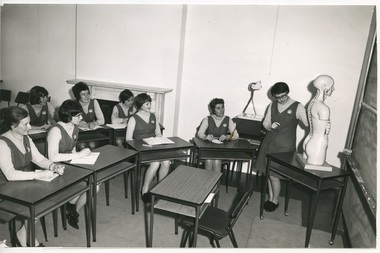 Royal District Nursing Service (now known as Bolton Clarke)
Photograph - Photograph, black and white, Barry Sutton, 14.09.1972
... At RDNS many programs were run, including: a Post Basic Course, Cardiac Rehabilitation Nursing, Haematology/Oncology Nursing, Palliative Care program, Diabetic Stabilization Program, Leg Ulcer Management Program, Wound Care Specialist Program, HIV/AIDS Nursing Care, Cystic Fibrosis Home Support, Veterans Home Care Program, Breast Cancer Support Program, Continence Management Program, Stomal Therapy Program, In-Home Lactation Support Program and the Homeless Persons Program. RDNS staff attended several hospitals to observe and learn special care needed to some patients, e.g. to the Austin Hospital to learn the care required for paraplegic and quadriplegic patients at home, and to Mount Royal Hospital to observe the care of patients in the Rehabilitation ward. ...This black and white photograph shows a group of RDNS Sisters who are part of the Post Basic Community Nursing Course. They are receiving education from Sr. Pat (Paddy) Rowley, RDNS Principal Nurse Educator. The session is being held in the Education Department at the Royal District Nursing Service Headquarters, 452 St. Kilda Rd, Melbourne.The RDNS winter uniform worn is a blue/grey skivvie under a blue/grey V neck tunic style herringbone winter material frock.Melbourne District Nursing Service ran its first Post-Basic Course for community nurses in 1962. Sisters attended the course for 12 weeks. The course ran annually until the mid 1990s. Education was an integral part of Melbourne District Nursing Society (MDNS), from its inception in 1885, later, in 1966, called Royal District Nursing Service, (RDNS). From 1885, only Trained nurses (Nurses) through the Hospital training system, were employed by the Society, and on visits to patients they taught the necessity of hygiene and cleanliness, as well as the need for a good diet, to bring about good health. Doctor’s lectures were later given at the MDNS home to instruct patients and their families on prevention of disease. Education to patients continued throughout the years regarding health care and the use of equipment in the home. In 1961, Education programs commenced at MDNS with their Trained nurses (Sisters) receiving In-service education. Sr. Pat (Paddy) Rowley was a leader in In-service Education and established the RDNS Department of Community Nursing Education in 1962. Staff could also apply for scholarships to further their education outside of RDNS. Many of their senior Sisters received Postgraduate diplomas from the College of Nursing in Community Health Nursing, Education, and Administration, and several travelled overseas visiting nursing organizations viewing their public health and District nursing systems. At RDNS many programs were run, including: a Post Basic Course, Cardiac Rehabilitation Nursing, Haematology/Oncology Nursing, Palliative Care program, Diabetic Stabilization Program, Leg Ulcer Management Program, Wound Care Specialist Program, HIV/AIDS Nursing Care, Cystic Fibrosis Home Support, Veterans Home Care Program, Breast Cancer Support Program, Continence Management Program, Stomal Therapy Program, In-Home Lactation Support Program and the Homeless Persons Program. RDNS staff attended several hospitals to observe and learn special care needed to some patients, e.g. to the Austin Hospital to learn the care required for paraplegic and quadriplegic patients at home, and to Mount Royal Hospital to observe the care of patients in the Rehabilitation ward. A Community Nursing Education Program was extended to student nurses from hospitals and to other nursing organizations. These Education programs kept the RDNS Sisters abreast of new techniques, such as changes in technology for e.g. new testing methods in detecting glucose levels in Diabetic patients. Sr. Nan Deakin obtained a Post Basic Certificate in Psychiatric Nursing and included this area in her Education lectures. Sr. Daphne Geldard specialized in the area of Alzheimer’s disease and Dementia. These Sisters visited patients in District areas with the regular RDNS Sister when required. Every member of staff, both professional and non professional staff, received regular education in the Education Department. In 1980, a Home Health Aide pilot study, funded by the Federal Government, the Brotherhood of St. Laurence and RDNS, with the program written and taught by Sr. Rowley, was evaluated as successful, and Home Health Aides were employed and worked in RDNS Centres under the supervision of RDNS Sisters. This black and white photograph is of a group of seven Royal District Nursing Service (RDNS) Sisters sitting in a semi-circle in two rows at single small two shelf tables. There are open white paged books or papers on each table and some of the Sisters have pens in their hands. The Sister sitting in the front far right is Sr. Affleck, who has dark short curly hair. The other Sisters have dark short hair in various styles. Further right in the photograph stands Sr. Rowley, who has dark short hair and is wearing glasses. She has her left hand supporting a torso of an anatomical model which is sitting on a table slightly to her left. She and the Sisters are looking at the vertebrae down the spine of the model. Another empty table is in front of the semi-circle and it sits in the centre foreground of the photograph. In the rear between Sr. Affleck and Sr. Rowley, a piece of equipment stands on a table. To the right of the photograph part of a large blackboard can be seen. The Sisters are wearing light grey skivvies under a darker V neck tunic style frock with the RDNS insignia on its upper left.Photographers stamp. Quote No. LD 8rdns education, rdns uniform, royal district nursing service, sister pat (paddy) rowley, sister margaret affleck -
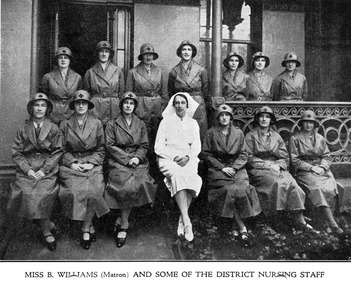 Royal District Nursing Service (now known as Bolton Clarke)
Photograph - Photograph, black and white, 1933
... HIV/AIDS nursing care was provided; visits to Homeless Persons were made. Personal care was given to patients ranging in age and with varying mobility problems, such as those with MS, MND, Guillan-Barre Syndrome, Quadriplegia, Paraplegia, Acquired Brain Injury, to those following a Cerebrovascular Accident (Stroke), those with severe Arthritis and those with a form of Dementia. ...This photograph is a record of Matron Beatrice Williams with some of the Trained nurses (Sisters) who worked in the District division of Melbourne District Nursing Society After Care Home in 1933, just prior to Matron Williams resigning to be married. It was taken in front of the Nurses Home at 39 Victoria Parade, Collingwood and shows part of the District nursing uniform worn by the MDNS Sisters in the 1930s. At that time their uniform dresses, worn under their coats, were grey cotton and their brimmed hats were made of felt and had a red Maltese cross applied to the centre front of the hatband.Miss Beatrice Williams worked as a Trained Nurse (Sister) with the Melbourne District Nursing Society (MDNS) before going to England to gain her Midwifery certificate. After qualifying, she worked as a Tutor sister and a District Superintendent at the University College Hospital in London. On returning to Australia she was appointed, in April 1929, Matron of the District division of the MDNS After-Care Home (Hospital from 1934). She convinced the Committee of the need for Ante Natal care and in 1930 the Ante Natal Clinic was opened at the After-Care. She continued as Matron until 1933 when she married Dr. J.P Major, and was invited to join the Committee of Management. In the early 1950s when the Government requested the Society separate and it take over the After Care Hospital, she became President of the now named Melbourne District Nursing Service with its Headquarters and Nursing Home moving to 452 St. Kilda Road, Melbourne. Beatrice had an understanding of the poor, the sick and the aged, and was known for her kindness and sympathy. Her foresight, leadership and enthusiasm brought forth the expansion of District nursing. She died on the 15th of August 1958. The Trained nurses of the Melbourne District Nursing Society (MDNS), later known as Royal District Nursing Service (RDNS), visited patients in their home and gave best practice care in many fields of nursing, and to people of many cultures, throughout its 130 years of expansion. Initial visits not only assessed the specific nursing situation but the situation as a whole. Their patients ranged in age from babes, children, adults to the elderly and referrals were taken from Hospitals, General Practitioners and allied Health facilities. Some of the care the Sisters provided is as follows: – Post-Natal care given to mother and babe, Wound Care following various types of surgery, accidents, burns, cancer, leg ulcers etc. Supervising and teaching Diabetic Care, including teaching and supervising people with Diabetes to administer their own Insulin, and administering Insulin to those unable to give their own injections. Administering other injections and setting up weekly medication boxes. The Sisters performed Catheterizations on adults suffering from conditions such as Quadriplegia, Paraplegia, Multiple Sclerosis (MS), Motor Neurone Disease (MND) and Guillan-Barre Syndrome, and when required at school on children for e.g. those with Spina Bifida. The Sisters visited those requiring Cystic Fibrosis support and care; those requiring Haemo-Oncology care, including visiting children at school; those requiring Home Enteral Feeding care, and those requiring IV therapy at home and home Dialysis. Palliative Care was given including pain relief with the use of syringe drivers, personal care as needed, and advice and support to both patient and family. The Sisters provided Stoma management to those needing Urostomy, Ileostomy and Colostomy care and those requiring Continence care. HIV/AIDS nursing care was provided; visits to Homeless Persons were made. Personal care was given to patients ranging in age and with varying mobility problems, such as those with MS, MND, Guillan-Barre Syndrome, Quadriplegia, Paraplegia, Acquired Brain Injury, to those following a Cerebrovascular Accident (Stroke), those with severe Arthritis and those with a form of Dementia. When necessary the elderly were assisted with personal care and advice given on safety factors with the use of hand rails, bath or shower seats, and hand showers. Rehabilitation with an aim towards independence remained at the forefront of the Sister’s minds and when possible using aids and instruction on safe techniques enabled the person to become fully independent. All care included giving advice and support to the patient and their Carers. The Sisters liaised with the persons Doctor, Hospital and allied Health personal when necessary.Black and white photograph showing Matron, Miss Beatrice Williams, wearing a white uniform and veil over her short dark hair, and a group of thirteen Melbourne District Nursing Society Trained nurses (Sisters) outside the front of their Nurses Home. The Sisters are wearing grey coats over their grey uniforms and grey brimmed hats with a Maltese cross applied to the white headband. Matron is sitting in the centre of six Sisters and there are seven Sisters standing behind them on the veranda; a round column is seen to the right between the 4th and 5th Sisters. Part of the grey building behind shows an open door to the left and a long window to the right. A scrolled metal safety rail, running from the round column, is seen in front of the three nurses on the right. The seated Sisters and Matron have their legs crossed at the ankles, melbourne district nursing society, mdns nurses, mdns, rdns, royal district nursing service, mdns uniforms, matron beatrice mary williams -
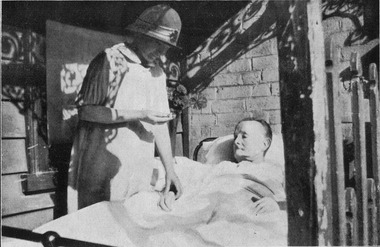 Royal District Nursing Service (now known as Bolton Clarke)
Photograph - Photograph, black and white, c.1930
... HIV/AIDS nursing care was provided; visits to Homeless Persons were made. Personal care was given to patients ranging in age and with varying mobility problems, such as those with MS, MND, Guillan-Barre Syndrome, Quadriplegia, Paraplegia, Acquired Brain Injury, to those following a Cerebrovascular Accident (Stroke), those with severe Arthritis and those with a form of Dementia. ...This photograph shows a Melbourne District Nursing Society (MDNS) Sister visiting a patient in his home. The photograph shows her taking his temperature and pulse and carrying out basic nursing observations. The Sister kept a record of this information in the man's Nursing History at MDNS Headquarters and conveyed it to the patient's Doctor as required.The Trained nurses of the Melbourne District Nursing Society (MDNS), later known as Royal District Nursing Service (RDNS), visited patients in their home and gave best practice care in many fields of nursing, and to people of many cultures, throughout its 130 years of expansion. Initial visits not only assessed the specific nursing situation but the situation as a whole. Their patients ranged in age from babes, children, adults to the elderly and referrals were taken from Hospitals, General Practitioners and allied Health facilities. Some of the care the Sisters provided is as follows: – Post-Natal care given to mother and babe, Wound Care following various types of surgery, accidents, burns, cancer, leg ulcers etc. Supervising and teaching Diabetic Care, including teaching and supervising people with Diabetes to administer their own Insulin, and administering Insulin to those unable to give their own injections. Administering other injections and setting up weekly medication boxes. The Sisters performed Catheterizations on adults suffering from conditions such as Quadriplegia, Paraplegia, Multiple Sclerosis (MS), Motor Neurone Disease (MND) and Guillan-Barre Syndrome, and when required at school on children for e.g. those with Spina Bifida. The Sisters visited those requiring Cystic Fibrosis support and care; those requiring Haemo-Oncology care, including visiting children at school; those requiring Home Enteral Feeding care, and those requiring IV therapy at home and home Dialysis. Palliative Care was given including pain relief with the use of syringe drivers, personal care as needed, and advice and support to both patient and family. The Sisters provided Stoma management to those needing Urostomy, Ileostomy and Colostomy care and those requiring Continence care. HIV/AIDS nursing care was provided; visits to Homeless Persons were made. Personal care was given to patients ranging in age and with varying mobility problems, such as those with MS, MND, Guillan-Barre Syndrome, Quadriplegia, Paraplegia, Acquired Brain Injury, to those following a Cerebrovascular Accident (Stroke), those with severe Arthritis and those with a form of Dementia. When necessary the elderly were assisted with personal care and advice given on safety factors with the use of hand rails, bath or shower seats, and hand showers. Rehabilitation with an aim towards independence remained at the forefront of the Sister’s minds and when possible using aids and instruction on safe techniques enabled the person to become fully independent. All care included giving advice and support to the patient and their Carers. The Sisters liaised with the persons Doctor, Hospital and allied Health personal when necessary.This black and white photograph shows a Melbourne District Nursing Society (MDNS) Trained nurse (Sister) standing on the left of a man who is in his bed on the veranda of his home. She is wearing a white gown over her uniform and her grey uniform hat, which has a hatband showing a Maltese cross in the centre; she has her left hand on the man's right wrist and is looking down at a watch she is holding in her right hand. The man, who has short dark hair, is holding a thermometer in his mouth. He is partly propped up with his head resting on a white covered pillow; part of the iron frame of the bed is seen to its left. Most of his body is covered with light coloured bedclothes; part of his pyjamas can be seen. Part of a vase of flowers is seen just behind the Sister's left arm. In the left of the photograph, part of the weatherboards of the house can be seen with a window, partly obscured with a blind. To the right of the man is a veranda post and some pickets of a wooden fence; behind him part of a brick wall is seen.melbourne district nursing society, mdns, mdns uniforms, rdns, royal district nursing service -
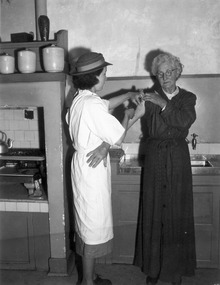 Royal District Nursing Service (now known as Bolton Clarke)
Photograph - Photograph, black and white:, 1952
... HIV/AIDS nursing care was provided; visits to Homeless Persons were made. Personal care was given to patients ranging in age and with varying mobility problems, such as those with MS, MND, Guillan-Barre Syndrome, Quadriplegia, Paraplegia, Acquired Brain Injury, to those following a Cerebrovascular Accident (Stroke), those with severe Arthritis and those with a form of Dementia. ...This photograph is taken in the home of the lady and shows MDNS Sister J. Faust giving an injection, using a glass syringe, into the right upper arm of the lady. This type of syringe was re sterilized. These syringes remained in use until the mid 1960s when disposable plastic syringes took their place. This photograph was used in a video on the history of RDNS which is held by the organization. It is a record of the type of care given by Melbourne District Nursing Society (MDNS) Trained nurses in a patient's home.The Trained nurses of the Melbourne District Nursing Society (MDNS), later known as Royal District Nursing Service (RDNS), visited patients in their home and gave best practice care in many fields of nursing, and to people of many cultures, throughout its 130 years of expansion. Initial visits not only assessed the specific nursing situation but the situation as a whole. Their patients ranged in age from babes, children, adults to the elderly and referrals were taken from Hospitals, General Practitioners and allied Health facilities. Some of the care the Sisters provided is as follows: – Post-Natal care given to mother and babe, Wound Care following various types of surgery, accidents, burns, cancer, leg ulcers etc. Supervising and teaching Diabetic Care, including teaching and supervising people with Diabetes to administer their own Insulin, and administering Insulin to those unable to give their own injections. Administering other injections and setting up weekly medication boxes. The Sisters performed Catheterizations on adults suffering from conditions such as Quadriplegia, Paraplegia, Multiple Sclerosis (MS), Motor Neurone Disease (MND) and Guillan-Barre Syndrome, and when required at school on children for e.g. those with Spina Bifida. The Sisters visited those requiring Cystic Fibrosis support and care; those requiring Haemo-Oncology care, including visiting children at school; those requiring Home Enteral Feeding care, and those requiring IV therapy at home and home Dialysis. Palliative Care was given including pain relief with the use of syringe drivers, personal care as needed, and advice and support to both patient and family. The Sisters provided Stoma management to those needing Urostomy, Ileostomy and Colostomy care and those requiring Continence care. HIV/AIDS nursing care was provided; visits to Homeless Persons were made. Personal care was given to patients ranging in age and with varying mobility problems, such as those with MS, MND, Guillan-Barre Syndrome, Quadriplegia, Paraplegia, Acquired Brain Injury, to those following a Cerebrovascular Accident (Stroke), those with severe Arthritis and those with a form of Dementia. When necessary the elderly were assisted with personal care and advice given on safety factors with the use of hand rails, bath or shower seats, and hand showers. Rehabilitation with an aim towards independence remained at the forefront of the Sister’s minds and when possible using aids and instruction on safe techniques enabled the person to become fully independent. All care included giving advice and support to the patient and their Carers. The Sisters liaised with the persons Doctor, Hospital and allied Health personal when necessary.Black and white photograph of Melbourne District Nursing Society (MDNS), Sister J. Faust who is wearing her grey brimmed uniform hat over her dark curled hair and is wearing a white gown over her grey uniform which is seen below her gown. In her right hand, she is holding a syringe, with needle against the lady's skin, and her left hand is on the upper right arm of the lady above the needle site. The lady, who has light coloured curled hair and is wearing a dark coloured long frock, is standing to the right of the Sister and is holding the right sleeve of her dress up with her left hand. A metal sink with cupboards below is behind the lady. To the left is fireplace which is now tiled at the rear and has a gas stove with kettle on a jet in the space. A row of three pale coloured kitchen canisters in decreasing size sit on the mantle piece. On a shelf above these sit a dark coloured box and a tall thin vase. Staff members name is written on the back of the photograph.melbourne district nursing society, nursing care, royal district nursing service, rdns, mdns, nursing care - medications, mdns uniforms, j. faust -
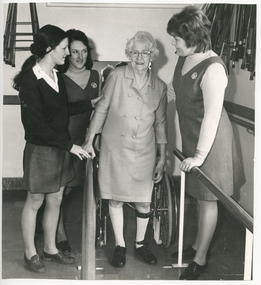 Royal District Nursing Service (now known as Bolton Clarke)
Photograph - Photograph, black and white, Barry Sutton, 20.07.1972
... Many programs were run at RDNS, including: a Post Basic Course, Cardiac Rehabilitation Nursing, Haematology/Oncology Nursing, Palliative Care program, Diabetic Stabilization Program, Leg Ulcer Management Program, Wound Care Specialist Program, HIV/AIDS Nursing Care, Cystic Fibrosis Home Support, Veterans Home Care Program, Breast Cancer Support Program, Continence Management Program, Stomal Therapy Program, In-Home Lactation Support Program and the Homeless Persons Program. RDNS staff attended several hospitals to observe and learn special care needed to some clients, e.g. to the Austin Hospital to learn the care required for paraplegic and quadriplegic clients at home, and to Mount Royal Hospital to observe the care of clients in the Rehabilitation ward. ...The photograph is taken in the Physiotherapy Department at Mount Royal Hospital. RDNS Sr. Sue Revill is from RDNS Moorabbin Centre and Sr. Helen Watt is from Footscray Centre, They are attending an Education session on Rehabilitation at Mount Royal. Hospital. They are wearing the RDNS winter uniform of a blue/grey skivvie under a V neck tunic style herringbone winter material dress with the RDNS insignia emblazoned on its upper left.Education was an integral part of Melbourne District Nursing Society (MDNS), from its inception in 1885, later, in 1966, called Royal District Nursing Service, (RDNS). From 1885, only Trained Nurses (Nurses) who trained through the Hospital training system were employed by the Society, and on visits to patients they taught the necessity of hygiene and cleanliness, as well as the need for a good diet, to bring about good health. Doctor’s lectures were later given at the MDNS home to instruct patients and their families on prevention of disease. Education to patients continued throughout the years regarding health care and the use of equipment in the home. In 1961, Education programs commenced at MDNS with their Trained nurses (Sisters) receiving In-service education. Sister Pat (Paddy) Rowley was a leader in this In-service Education and established the MDNS, later called RDNS, Department of Community Nursing Education in 1962. Staff could also apply for scholarships to further their education outside of RDNS. Many of their senior Sisters received Postgraduate diplomas from the College of Nursing in Community Health Nursing, Education, and Administration, and several travelled overseas visiting nursing organizations viewing their public health and district nursing systems. Many programs were run at RDNS, including: a Post Basic Course, Cardiac Rehabilitation Nursing, Haematology/Oncology Nursing, Palliative Care program, Diabetic Stabilization Program, Leg Ulcer Management Program, Wound Care Specialist Program, HIV/AIDS Nursing Care, Cystic Fibrosis Home Support, Veterans Home Care Program, Breast Cancer Support Program, Continence Management Program, Stomal Therapy Program, In-Home Lactation Support Program and the Homeless Persons Program. RDNS staff attended several hospitals to observe and learn special care needed to some clients, e.g. to the Austin Hospital to learn the care required for paraplegic and quadriplegic clients at home, and to Mount Royal Hospital to observe the care of clients in the Rehabilitation ward. A Community Nursing Education Program was extended to Student nurses from Hospitals and to other nursing organizations. These Education programs kept the RDNS Sisters abreast of new techniques, such as changes in technology for e.g. new testing methods in detecting glucose levels in Diabetic patients. Sr. Nan Deakin did a Post Basic Course in Psychiatric Nursing and included this area in her education lectures. Sr. Daphne Geldard specialized in the area of Alzheimer’s disease and Dementia. These Sisters visited patients in District areas with the regular RDNS Sister when required. Every member of staff, both professional and non professional staff, received regular education in the Education Department. In 1980, a Home Health Aide pilot study, funded by the Federal Government, the Brotherhood of St. Laurence and RDNS, with the program written and taught by Sr. Rowley, was evaluated as successful, and Home Health Aides were employed and worked in RDNS Centres under the supervision of the RDNS Registered Nurses. Black and white photograph depicting, on the left, a side-on view of a Hospital Physiotherapist with her long hair drawn back in a pony tail, and wearing a grey V neck dress over a white blouse and a dark cardigan who is facing right. She has her left hand on the arm of a standing lady and her right hand on the lady's hand which is on a walking rail. To the right rear of the Physiotherapist is Royal District Nursing Service (RDNS) Sister Sue Revill who has shoulder length dark hair and is looking at the lady. To her right the elderly lady who is wearing glasses; has wavy white hair and is wearing a light grey frock, is standing in front of a wheelchair with her right hand on the walking rail. Her left arm hangs loosely by her side. To her right is a walking rail and standing to its right is Sr. Helen Watt who is looking towards the lady. She has short dark wavy hair, and has her right arm around the back of the lady and her left hand is on the walking rail. In the background of the photograph, the lower section of several 4 prong walking stick are seen hanging on the wall. Barry Sutton photographer's stamp. Quote KY 78rdns, royal district nursing service, rdns uniform, rdns education, sister sue revill, sister helen watt -
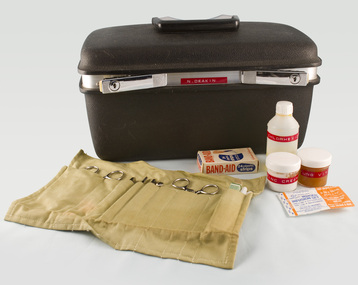 Royal District Nursing Service (now known as Bolton Clarke)
Equipment - Photograph, colour, c.1970
... HIV/AIDS nursing care was provided; visits to Homeless Persons were made. Personal care was given to patients ranging in age and with varying mobility problems, such as those with MS, MND, Guillan-Barre Syndrome, Quadriplegia, Paraplegia, Acquired Brain Injury, to those following a Cerebrovascular Accident (Stroke), those with severe Arthritis and those with a form of Dementia. ...This is style of nursing case and type of equipment used by the Sisters of the Royal District Nursing Service (RDNS) in the 1970s. The Sisters worked throughout the Melbourne inner and outer suburbs visiting patients to administer nursing care in their homes and other arranged venues. The Trained nurses of the Melbourne District Nursing Society (MDNS), later known as Royal District Nursing Service (RDNS), visited patients in their home and gave best practice care in many fields of nursing, and to people of many cultures, throughout its 130 years of expansion. Initial visits not only assessed the specific nursing situation but the situation as a whole. Their patients ranged in age from babes, children, adults to the elderly and referrals were taken from Hospitals, General Practitioners and allied Health facilities. Some of the care the Sisters provided is as follows: – Post-Natal care given to mother and babe, Wound Care following various types of surgery, accidents, burns, cancer, leg ulcers etc. Supervising and teaching Diabetic Care, including teaching and supervising people with Diabetes to administer their own Insulin, and administering Insulin to those unable to give their own injections. Administering other injections and setting up weekly medication boxes. The Sisters performed Catheterizations on adults suffering from conditions such as Quadriplegia, Paraplegia, Multiple Sclerosis (MS), Motor Neurone Disease (MND) and Guillan-Barre Syndrome, and when required at school on children for e.g. those with Spina Bifida. The Sisters visited those requiring Cystic Fibrosis support and care; those requiring Haemo-Oncology care, including visiting children at school; those requiring Home Enteral Feeding care, and those requiring IV therapy at home and home Dialysis. Palliative Care was given including pain relief with the use of syringe drivers, personal care as needed, and advice and support to both patient and family. The Sisters provided Stoma management to those needing Urostomy, Ileostomy and Colostomy care and those requiring Continence care. HIV/AIDS nursing care was provided; visits to Homeless Persons were made. Personal care was given to patients ranging in age and with varying mobility problems, such as those with MS, MND, Guillan-Barre Syndrome, Quadriplegia, Paraplegia, Acquired Brain Injury, to those following a Cerebrovascular Accident (Stroke), those with severe Arthritis and those with a form of Dementia. When necessary the elderly were assisted with personal care and advice given on safety factors with the use of hand rails, bath or shower seats, and hand showers. Rehabilitation with an aim towards independence remained at the forefront of the Sister’s minds and when possible using aids and instruction on safe techniques enabled the person to become fully independent. All care included giving advice and support to the patient and their Carers. The Sisters liaised with the persons Doctor, Hospital and allied Health personal as necessary.Black deep case made of man made material. it has a raised lid with attached handle. The metal section between the lid and body of the case has metal clasps attached to it which open and close within this section. The deep section contains a cotton bag sewn in sections which contain artery forceps, dissecting forceps, scissors, thermometer, wooden spatula. Shown are a packet of Band-Aids, plastic bottle containing chlorhexidine, jar containing soft-soap and jar containing Saf-sol which were carried within the body of the case.rdns, royal district nursing service, rdns equipment, melbourne district nursing society -
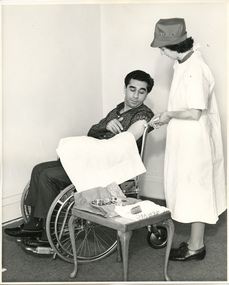 Royal District Nursing Service (now known as Bolton Clarke)
Photograph - Photograph, black and white, 1967
... HIV/AIDS nursing care was provided; visits to Homeless Persons were made. Personal care was given to patients ranging in age and with varying mobility problems, such as those with MS, MND, Guillan-Barre Syndrome, Quadriplegia, Paraplegia, Acquired Brain Injury, to those following a Cerebrovascular Accident (Stroke), those with severe Arthritis and those with a form of Dementia. ...This photograph depicts a Royal District Nursing Service, (RDNS), Sister administering an injection, which has been ordered by a Doctor, into the left arm of a gentleman who is sitting in a wheelchair in his home. This photograph depicts one of the types of nursing care given by the trained nurses working at RDNS in the late 1960s. The syringe being used is a disposable type which came into use in the middle 1960s.The Trained nurses of the Melbourne District Nursing Society (MDNS), later known as Royal District Nursing Service (RDNS), visited patients in their home and gave best practice care in many fields of nursing, and to people of many cultures, throughout its 130 years of expansion. Initial visits not only assessed the specific nursing situation but the situation as a whole. Their patients ranged in age from babes, children, adults to the elderly and referrals were taken from Hospitals, General Practitioners and allied Health facilities. Some of the care the Sisters provided is as follows: – Post-Natal care given to mother and babe, Wound Care following various types of surgery, accidents, burns, cancer, leg ulcers etc. Supervising and teaching Diabetic Care, including teaching and supervising people with Diabetes to administer their own Insulin, and administering Insulin to those unable to give their own injections. Administering other injections and setting up weekly medication boxes. The Sisters performed Catheterizations on adults suffering from conditions such as Quadriplegia, Paraplegia, Multiple Sclerosis (MS), Motor Neurone Disease (MND) and Guillan-Barre Syndrome, and when required at school on children for e.g. those with Spina Bifida. The Sisters visited those requiring Cystic Fibrosis support and care; those requiring Haemo-Oncology care, including visiting children at school; those requiring Home Enteral Feeding care, and those requiring IV therapy at home and home Dialysis. Palliative Care was given including pain relief with the use of syringe drivers, personal care as needed, and advice and support to both patient and family. The Sisters provided Stoma management to those needing Urostomy, Ileostomy and Colostomy care and those requiring Continence care. HIV/AIDS nursing care was provided; visits to Homeless Persons were made. Personal care was given to patients ranging in age and with varying mobility problems, such as those with MS, MND, Guillan-Barre Syndrome, Quadriplegia, Paraplegia, Acquired Brain Injury, to those following a Cerebrovascular Accident (Stroke), those with severe Arthritis and those with a form of Dementia. When necessary the elderly were assisted with personal care and advice given on safety factors with the use of hand rails, bath or shower seats, and hand showers. Rehabilitation with an aim towards independence remained at the forefront of the Sister’s minds and when possible using aids and instruction on safe techniques enabled the person to become fully independent. All care included giving advice and support to the patient and their Carers. The Sisters liaised with the persons Doctor, Hospital and allied Health personal when necessary.To the right in the black and white photograph is a Royal District Nursing Service (RDNS), Sister who is wearing a white gown over her uniform frock, and wearing a peaked grey uniform hat and black shoes. She is standing side-on facing a man on her left who is sitting in a wheelchair. She is holding the barrel of a syringe in her right hand and has her left hand on the end of the plunger of the syringe; the needle of the syringe is in the left upper arm of a gentleman. He is on the left of the photograph and has short dark hair; is wearing dark trousers and a dark patterned shirt and is watching as the Sister gives the injection. A white towel is draped over part of his left arm,. A small table, with nursing equipment on the top, stands beside the wheelchair and in front of the Sister.Photographers stamp and the word 'Publicity'rdns, royal district nursing service, rdns treatment - injection -
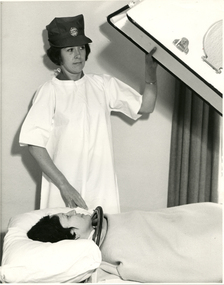 Royal District Nursing Service (now known as Bolton Clarke)
Photograph - Photograph, black and white, c.1960
... HIV/AIDS nursing care was provided; visits to Homeless Persons were made. Personal care was given to patients ranging in age and with varying mobility problems, such as those with MS, MND, Guillan-Barre Syndrome, Poliomyelistis, Quadriplegia, Paraplegia, Acquired Brain Injury, to those following a Cerebrovascular Accident (Stroke), those with severe Arthritis and those with a form of Dementia. ...This photograph depicts one of the forms of nursing care given by Melbourne District Nursing Service (MDNS), Sisters in the home of a patient. In this photograph, the Sister is visiting the home of a lady who is confined to a Negative Pressured Ventilator, also known as an 'Iron Lung', which assists her to breathe. The Sister gave both physical and emotional care to the patient, as well as support and advice to those who were caring for her.The Trained nurses of the Melbourne District Nursing Society (MDNS), later known as Royal District Nursing Service (RDNS), visited patients in their home and gave best practice care in many fields of nursing, and to people of many cultures, throughout its 130 years of expansion. Initial visits not only assessed the specific nursing situation but the situation as a whole. Their patients ranged in age from babes, children, adults to the elderly and referrals were taken from Hospitals, General Practitioners and allied Health facilities. Some of the care the Sisters provided is as follows: – Post-Natal care given to mother and babe, Wound Care following various types of surgery, accidents, burns, cancer, leg ulcers etc. Supervising and teaching Diabetic Care, including teaching and supervising people with Diabetes to administer their own Insulin, and administering Insulin to those unable to give their own injections. Administering other injections and setting up weekly medication boxes. The Sisters performed Catheterizations on adults suffering from conditions such as Quadriplegia, Paraplegia, Multiple Sclerosis (MS), Motor Neurone Disease (MND) and Guillan-Barre Syndrome, and when required at school on children for e.g. those with Spina Bifida. The Sisters visited those requiring Cystic Fibrosis support and care; those requiring Haemo-Oncology care, including visiting children at school; those requiring Home Enteral Feeding care, and those requiring IV therapy at home and home Dialysis. Palliative Care was given including pain relief with the use of syringe drivers, personal care as needed, and advice and support to both patient and family. The Sisters provided Stoma management to those needing Urostomy, Ileostomy and Colostomy care and those requiring Continence care. HIV/AIDS nursing care was provided; visits to Homeless Persons were made. Personal care was given to patients ranging in age and with varying mobility problems, such as those with MS, MND, Guillan-Barre Syndrome, Poliomyelistis, Quadriplegia, Paraplegia, Acquired Brain Injury, to those following a Cerebrovascular Accident (Stroke), those with severe Arthritis and those with a form of Dementia. When necessary the elderly were assisted with personal care and advice given on safety factors with the use of hand rails, bath or shower seats, and hand showers. Rehabilitation with an aim towards independence remained at the forefront of the Sister’s minds and when possible using aids and instruction on safe techniques enabled the person to become fully independent. All care included giving advice and support to the patient and their Carers. The Sisters liaised with the persons Doctor, Hospital and allied Health personal when necessary.Black and white photograph showing a Melbourne District Nursing Service (MDNS) Sister, who has short dark hair; is wearing a white gown over her uniform and her grey peaked hat with attached RDNS badge. She is attending to a female patient who is lying in a Negative Pressure Ventilator in her home. The Sister is standing behind the Negative Pressure Ventilator, known as an 'Iron Lung', with her left arm extended holding the lid open. The lady is in the foreground, and is lying with her head towards the left of the photograph. She has short dark hair and lies on the bed of the Ventilator with a neck ring visible. Her head is resting on a white covered pillow. Part of a dark coloured pleated curtain can be seen in the right hand side background of the photographPhotographer's stamprdns, royal district nursing service, patient care, mdns, melbourne district nursing service, mdns nursing care - negative pressure ventilator, 'iron lung' -
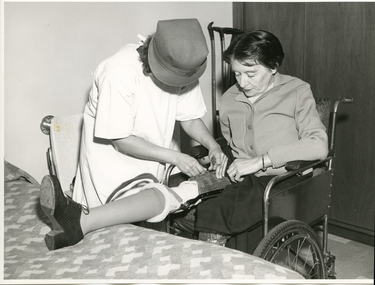 Royal District Nursing Service (now known as Bolton Clarke)
Photograph - Photograph, black and white, c. 1967
... HIV/AIDS nursing care was provided; visits to Homeless Persons were made. Personal care was given to patients ranging in age and with varying mobility problems, such as those with MS, MND, Guillan-Barre Syndrome, Poliomyelistis, Quadriplegia, Paraplegia, Acquired Brain Injury, to those following a Cerebrovascular Accident (Stroke), those with severe Arthritis and those with a form of Dementia. ...The RDNS Sister is applying a splint to the lady's leg after attending to any other nursing care required. This photograph depicts one of the types of nursing care carried out by the Royal District Nursing Service (RDNS). The Trained nurses of the Melbourne District Nursing Society (MDNS), later known as Royal District Nursing Service (RDNS), visited patients in their home and gave best practice care in many fields of nursing, and to people of many cultures, throughout its 130 years of expansion. Initial visits not only assessed the specific nursing situation but the situation as a whole. Their patients ranged in age from babes, children, adults to the elderly and referrals were taken from Hospitals, General Practitioners and allied Health facilities. Some of the care the Sisters provided is as follows: – Post-Natal care given to mother and babe, Wound Care following various types of surgery, accidents, burns, cancer, leg ulcers etc. Supervising and teaching Diabetic Care, including teaching and supervising people with Diabetes to administer their own Insulin, and administering Insulin to those unable to give their own injections. Administering other injections and setting up weekly medication boxes. The Sisters performed Catheterizations on adults suffering from conditions such as Quadriplegia, Paraplegia, Multiple Sclerosis (MS), Motor Neurone Disease (MND) and Guillan-Barre Syndrome, and when required at school on children for e.g. those with Spina Bifida. The Sisters visited those requiring Cystic Fibrosis support and care; those requiring Haemo-Oncology care, including visiting children at school; those requiring Home Enteral Feeding care, and those requiring IV therapy at home and home Dialysis. Palliative Care was given including pain relief with the use of syringe drivers, personal care as needed, and advice and support to both patient and family. The Sisters provided Stoma management to those needing Urostomy, Ileostomy and Colostomy care and those requiring Continence care. HIV/AIDS nursing care was provided; visits to Homeless Persons were made. Personal care was given to patients ranging in age and with varying mobility problems, such as those with MS, MND, Guillan-Barre Syndrome, Poliomyelistis, Quadriplegia, Paraplegia, Acquired Brain Injury, to those following a Cerebrovascular Accident (Stroke), those with severe Arthritis and those with a form of Dementia. When necessary the elderly were assisted with personal care and advice given on safety factors with the use of hand rails, bath or shower seats, and hand showers. Rehabilitation with an aim towards independence remained at the forefront of the Sister’s minds and when possible using aids and instruction on safe techniques enabled the person to become fully independent. All care included giving advice and support to the patient and their Carers. The Sisters liaised with the persons Doctor, Hospital and allied Health personal when necessary.On the left of this black and white photograph is a Royal District Nursing Service, (RDNS), Sister wearing a white gown over her grey uniform. She is bending over and slightly towards her right; her face is not visible, only the crown of her grey peaked hat is seen. On her right is a lady sitting in a wheelchair with her right leg extended resting on a bed. The Sister has her left hand on, with her fingers holding the strap, and her right hand on the strap below, of a Splint on the upper right leg of the lady who is watching the procedure. The lady has short dark hair and is wearing a grey buttoned up cardigan and dark skirt; she is wearing a black shoe on the foot of her extended leg. Her left leg is bent at the knee and the top of a splint with some of the straps are visible. Part of the bedspread covering the bed has a grey and white pattern. A pair of crutches and a dark drape can be seen behind the Sister and wheelchair. photographer stamprdns, royal district nursing service, rdns patient care -
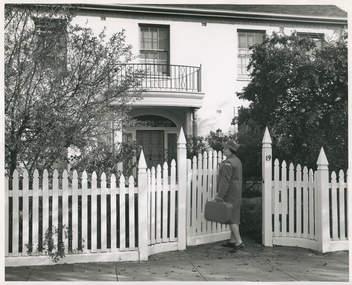 Royal District Nursing Service (now known as Bolton Clarke)
Photograph - Photograph, black and white, 15. 05.1967
... HIV/AIDS nursing care was provided; visits to Homeless Persons were made. Personal care was given to patients ranging in age and with varying mobility problems, such as those with MS, MND, Guillan-Barre Syndrome, Poliomyelistis, Quadriplegia, Paraplegia, Acquired Brain Injury, to those following a Cerebrovascular Accident (Stroke), those with severe Arthritis and those with a form of Dementia. ...Sister McDonald is visiting a patient to give them nursing care as requested. The photograph depicts the RDNS uniform in 1967. Her coat with the blue background Royal District Nursing Service material badge attached to the top of each sleeve, is worn over a grey cotton uniform dress.The Trained nurses of the Melbourne District Nursing Society (MDNS), later known as Royal District Nursing Service (RDNS), visited patients in their home and gave best practice care in many fields of nursing, and to people of many cultures, throughout its 130 years of expansion. Initial visits not only assessed the specific nursing situation but the situation as a whole. Their patients ranged in age from babes, children, adults to the elderly and referrals were taken from Hospitals, General Practitioners and allied Health facilities. Some of the care the Sisters provided is as follows: – Post-Natal care given to mother and babe, Wound Care following various types of surgery, accidents, burns, cancer, leg ulcers etc. Supervising and teaching Diabetic Care, including teaching and supervising people with Diabetes to administer their own Insulin, and administering Insulin to those unable to give their own injections. Administering other injections and setting up weekly medication boxes. The Sisters performed Catheterizations on adults suffering from conditions such as Quadriplegia, Paraplegia, Multiple Sclerosis (MS), Motor Neurone Disease (MND) and Guillan-Barre Syndrome, and when required at school on children for e.g. those with Spina Bifida. The Sisters visited those requiring Cystic Fibrosis support and care; those requiring Haemo-Oncology care, including visiting children at school; those requiring Home Enteral Feeding care, and those requiring IV therapy at home and home Dialysis. Palliative Care was given including pain relief with the use of syringe drivers, personal care as needed, and advice and support to both patient and family. The Sisters provided Stoma management to those needing Urostomy, Ileostomy and Colostomy care and those requiring Continence care. HIV/AIDS nursing care was provided; visits to Homeless Persons were made. Personal care was given to patients ranging in age and with varying mobility problems, such as those with MS, MND, Guillan-Barre Syndrome, Poliomyelistis, Quadriplegia, Paraplegia, Acquired Brain Injury, to those following a Cerebrovascular Accident (Stroke), those with severe Arthritis and those with a form of Dementia. When necessary the elderly were assisted with personal care and advice given on safety factors with the use of hand rails, bath or shower seats, and hand showers. Rehabilitation with an aim towards independence remained at the forefront of the Sister’s minds and when possible using aids and instruction on safe techniques enabled the person to become fully independent. All care included giving advice and support to the patient and their Carers. The Sisters liaised with the persons Doctor, Hospital and allied Health personal when necessary.Black and white photograph of Royal District Nursing Service, (RDNS,) Sister B. McDonald, wearing her grey uniform coat with the words 'Royal District Nursing Service' written in white on a dark curved material badge attached to the left upper sleeve; she is wearing her grey peaked uniform hat over her dark short hair. She is carrying her rectangular nursing case in her left hand and is opening the gate of a tall white picket fence before entering a patient's home. Number '19' is on the right hand side gate post. Trees can be seen behind the fence on either side of the gate. A two storey white attached house is in the background. The grey front door with white surround, can be seen on the ground floor. Two posts are supporting a balcony which protrudes from the top storey; a safety rail runs around its outer edge. A closed colonial door can be seen behind the balcony on the upper storey.Photographers stamp. Quote No. GE 42rdns, royal district nursing service, rdns uniform, sister betty mcdonald -
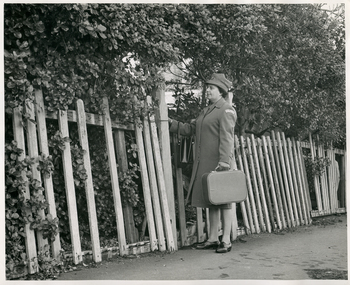 Royal District Nursing Service (now known as Bolton Clarke)
Photograph - Photograph, black and white, 15 05 1967
... HIV/AIDS nursing care was provided; visits to Homeless Persons were made. Personal care was given to patients ranging in age and with varying mobility problems, such as those with MS, MND, Guillan-Barre Syndrome, Poliomyelistis, Quadriplegia, Paraplegia, Acquired Brain Injury, to those following a Cerebrovascular Accident (Stroke), those with severe Arthritis and those with a form of Dementia. ...RDNS Sister, Betty. McDonald, is about to enter the home of a patient to administer nursing care.The Trained nurses of the Melbourne District Nursing Society (MDNS), later known as Royal District Nursing Service (RDNS), visited patients in their home and gave best practice care in many fields of nursing, and to people of many cultures, throughout its 130 years of expansion. Initial visits not only assessed the specific nursing situation but the situation as a whole. Their patients ranged in age from babes, children, adults to the elderly and referrals were taken from Hospitals, General Practitioners and allied Health facilities. Some of the care the Sisters provided is as follows: – Post-Natal care given to mother and babe, Wound Care following various types of surgery, accidents, burns, cancer, leg ulcers etc. Supervising and teaching Diabetic Care, including teaching and supervising people with Diabetes to administer their own Insulin, and administering Insulin to those unable to give their own injections. Administering other injections and setting up weekly medication boxes. The Sisters performed Catheterizations on adults suffering from conditions such as Quadriplegia, Paraplegia, Multiple Sclerosis (MS), Motor Neurone Disease (MND) and Guillan-Barre Syndrome, and when required at school on children for e.g. those with Spina Bifida. The Sisters visited those requiring Cystic Fibrosis support and care; those requiring Haemo-Oncology care, including visiting children at school; those requiring Home Enteral Feeding care, and those requiring IV therapy at home and home Dialysis. Palliative Care was given including pain relief with the use of syringe drivers, personal care as needed, and advice and support to both patient and family. The Sisters provided Stoma management to those needing Urostomy, Ileostomy and Colostomy care and those requiring Continence care. HIV/AIDS nursing care was provided; visits to Homeless Persons were made. Personal care was given to patients ranging in age and with varying mobility problems, such as those with MS, MND, Guillan-Barre Syndrome, Poliomyelistis, Quadriplegia, Paraplegia, Acquired Brain Injury, to those following a Cerebrovascular Accident (Stroke), those with severe Arthritis and those with a form of Dementia. When necessary the elderly were assisted with personal care and advice given on safety factors with the use of hand rails, bath or shower seats, and hand showers. Rehabilitation with an aim towards independence remained at the forefront of the Sister’s minds and when possible using aids and instruction on safe techniques enabled the person to become fully independent. All care included giving advice and support to the patient and their Carers. The Sisters liaised with the persons Doctor, Hospital and allied Health personal when necessary.Black and white photograph of Royal District Nursing Service, (RDNS), Sister B. McDonald, who is wearing her grey uniform coat, with RDNS insignia on the upper sleeve, and her peaked grey hat over her dark short hair. She is holding her rectangular nursing case in her left hand. Her right arm is through the long handles of a black bag which is hanging under it, and her hand is on the top of the gate; Number '39' is attached to the top of the gate post. A tall broken paling fence, with many gaps between the palings, can be seen running along the edge of the footpath to the left and right of the gate. The fence is leaning over in places. Bushes can be seen behind the fence and part of a white building is seen in the background.Photographers stamp. Quote No. GE 5rdns, royal district nursing service, rdns uniform, rdns patient care, sister betty mcdonald -
 Royal District Nursing Service (now known as Bolton Clarke)
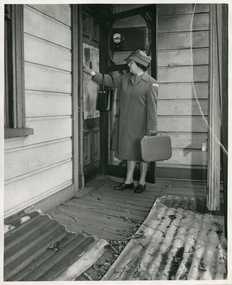
Photograph - Photograph, black and white, 15 05 1967
... HIV/AIDS nursing care was provided; visits to Homeless Persons were made. Personal care was given to patients ranging in age and with varying mobility problems, such as those with MS, MND, Guillan-Barre Syndrome, Poliomyelistis, Quadriplegia, Paraplegia, Acquired Brain Injury, to those following a Cerebrovascular Accident (Stroke), those with severe Arthritis and those with a form of Dementia. ...Sister McDonald is visiting a patient in her home to administer nursing care. The Trained nurses of the Melbourne District Nursing Society (MDNS), later known as Royal District Nursing Service (RDNS), visited patients in their home and gave best practice care in many fields of nursing, and to people of many cultures, throughout its 130 years of expansion. Initial visits not only assessed the specific nursing situation but the situation as a whole. Their patients ranged in age from babes, children, adults to the elderly and referrals were taken from Hospitals, General Practitioners and allied Health facilities. Some of the care the Sisters provided is as follows: – Post-Natal care given to mother and babe, Wound Care following various types of surgery, accidents, burns, cancer, leg ulcers etc. Supervising and teaching Diabetic Care, including teaching and supervising people with Diabetes to administer their own Insulin, and administering Insulin to those unable to give their own injections. Administering other injections and setting up weekly medication boxes. The Sisters performed Catheterizations on adults suffering from conditions such as Quadriplegia, Paraplegia, Multiple Sclerosis (MS), Motor Neurone Disease (MND) and Guillan-Barre Syndrome, and when required at school on children for e.g. those with Spina Bifida. The Sisters visited those requiring Cystic Fibrosis support and care; those requiring Haemo-Oncology care, including visiting children at school; those requiring Home Enteral Feeding care, and those requiring IV therapy at home and home Dialysis. Palliative Care was given including pain relief with the use of syringe drivers, personal care as needed, and advice and support to both patient and family. The Sisters provided Stoma management to those needing Urostomy, Ileostomy and Colostomy care and those requiring Continence care. HIV/AIDS nursing care was provided; visits to Homeless Persons were made. Personal care was given to patients ranging in age and with varying mobility problems, such as those with MS, MND, Guillan-Barre Syndrome, Poliomyelistis, Quadriplegia, Paraplegia, Acquired Brain Injury, to those following a Cerebrovascular Accident (Stroke), those with severe Arthritis and those with a form of Dementia. When necessary the elderly were assisted with personal care and advice given on safety factors with the use of hand rails, bath or shower seats, and hand showers. Rehabilitation with an aim towards independence remained at the forefront of the Sister’s minds and when possible using aids and instruction on safe techniques enabled the person to become fully independent. All care included giving advice and support to the patient and their Carers. The Sisters liaised with the persons Doctor, Hospital and allied Health personal when necessary.Black and white photograph of Royal District Nursing Sister, (RDNS), Sister B. McDonald, wearing her grey uniform coat, and her grey peaked hat over her dark short hair and is carrying her rectangular nursing case in her left hand. She is standing on the wooden veranda between the open wire door and the house; her right hand is knocking on the main door of a patient's home. Behind her, an electricity meter can be seen on the wall of the house behind the wire door. The door of the house sits near the corner of the horizontal weatherboard house, whose weatherboards can be seen to the left and right of Sister McDonald. Part of a fluted veranda post can be seen to the right of the photograph and two sheets of corrugated iron can be seen in the foreground.Photographers stamp. 'Quote No. GE 55rdns, royal district nursing service, rdns uniform, rdns patient care, sister betty mcdonald -
 Royal District Nursing Service (now known as Bolton Clarke)
Photograph - Photograph, black and white, 23.05.1967
... HIV/AIDS nursing care was provided; visits to Homeless Persons were made. Personal care was given to patients ranging in age and with varying mobility problems, such as those with MS, MND, Guillan-Barre Syndrome, Poliomyelistis, Quadriplegia, Paraplegia, Acquired Brain Injury, to those following a Cerebrovascular Accident (Stroke), those with severe Arthritis and those with a form of Dementia. ...The photograph shows a RDNS Sister driving her RDNS car along a dirt road to reach a patient to administer nursing care. It shows the typical conditions of the roads the RDNS trained nurses encountered in some districts. The photograph also depicts an Australian made Holden car of the mid 1960s Melbourne District Nursing Society, later Royal District Nursing Service (RDNS) has had various modes of transport over the last 130 years. At first their Trained nurses (Nurses) walked the streets and lane ways amid the slums of central Melbourne. As the Society expanded bicycles, public transport, District cars, the use of a Motor Auxiliary, the Trained nurses (Sisters) own cars, and even a motorcycle were used, and all these forms were intermingled until RDNS had its own fleet of vehicles. By 2009 there were 598 cars in the fleet and the Sisters travelled 9 million 200,000 kilometres – this is equivalent to 12 trips to the moon and back. The Trained nurses of the Melbourne District Nursing Society (MDNS), later known as Royal District Nursing Service (RDNS), visited patients in their home and gave best practice care in many fields of nursing, and to people of many cultures, throughout its 130 years of expansion. Initial visits not only assessed the specific nursing situation but the situation as a whole. Their patients ranged in age from babes, children, adults to the elderly and referrals were taken from Hospitals, General Practitioners and allied Health facilities. Some of the care the Sisters provided is as follows: – Post-Natal care given to mother and babe, Wound Care following various types of surgery, accidents, burns, cancer, leg ulcers etc. Supervising and teaching Diabetic Care, including teaching and supervising people with Diabetes to administer their own Insulin, and administering Insulin to those unable to give their own injections. Administering other injections and setting up weekly medication boxes. The Sisters performed Catheterizations on adults suffering from conditions such as Quadriplegia, Paraplegia, Multiple Sclerosis (MS), Motor Neurone Disease (MND) and Guillan-Barre Syndrome, and when required at school on children for e.g. those with Spina Bifida. The Sisters visited those requiring Cystic Fibrosis support and care; those requiring Haemo-Oncology care, including visiting children at school; those requiring Home Enteral Feeding care, and those requiring IV therapy at home and home Dialysis. Palliative Care was given including pain relief with the use of syringe drivers, personal care as needed, and advice and support to both patient and family. The Sisters provided Stoma management to those needing Urostomy, Ileostomy and Colostomy care and those requiring Continence care. HIV/AIDS nursing care was provided; visits to Homeless Persons were made. Personal care was given to patients ranging in age and with varying mobility problems, such as those with MS, MND, Guillan-Barre Syndrome, Poliomyelistis, Quadriplegia, Paraplegia, Acquired Brain Injury, to those following a Cerebrovascular Accident (Stroke), those with severe Arthritis and those with a form of Dementia. When necessary the elderly were assisted with personal care and advice given on safety factors with the use of hand rails, bath or shower seats, and hand showers. Rehabilitation with an aim towards independence remained at the forefront of the Sister’s minds and when possible using aids and instruction on safe techniques enabled the person to become fully independent. All care included giving advice and support to the patient and their Carers. The Sisters liaised with the persons Doctor, Hospital and allied Health personal when necessary.In the centre of this black and white photograph is a Royal District Nursing Service, (RDNS), Sister at the wheel of her RDNS Holden car, which has a black rear Victorian number plate with 'JPH - 516' written in white letters. Through the back window you can see part of the Sister's uniform and her peaked hat worn over her short curled hair. Her left hand is on the upper part of the steering wheel. The dirt road on which she is travelling has mud and some grass tufts either side of it. On the right of the car is a hip roof brick house which has a single storey front area with attached two storey section at the rear. A short open Besser brick fence, with a white wooden gate, is seen running from the front of the property to the house, and beyond this a clothes line and shed. Beyond this, part of a tall paling fence is seen from the front of the property to the shed. The top section of the next brick house is seen beyond the fence; it has a white railed veranda along part of it and the house has a flat roof.Photographers stamp. Quote No. GE 90rdns, royal district nursing service, rdns transport, rdns patient care -
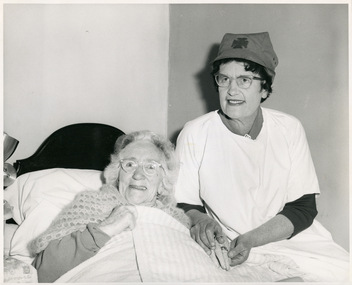 Royal District Nursing Service (now known as Bolton Clarke)
Photograph, 30 06 1965
... HIV/AIDS nursing care was provided; visits to Homeless Persons were made. Personal care was given to patients ranging in age and with varying mobility problems, such as those with MS, MND, Guillan-Barre Syndrome, Poliomyelistis, Quadriplegia, Paraplegia, Acquired Brain Injury, to those following a Cerebrovascular Accident (Stroke), those with severe Arthritis and those with a form of Dementia. ...The Melbourne District Nursing Service (MDNS) Sister is massaging the left hand of the patient. The Sister is wearing her grey cotton uniform dress and red cardigan under her white gown. A red Maltese cross emblazoned on her peaked hat. The Trained nurses of the Melbourne District Nursing Society (MDNS), later known as Royal District Nursing Service (RDNS), visited patients in their home and gave best practice care in many fields of nursing, and to people of many cultures, throughout its 130 years of expansion. Initial visits not only assessed the specific nursing situation but the situation as a whole. Their patients ranged in age from babes, children, adults to the elderly and referrals were taken from Hospitals, General Practitioners and allied Health facilities. Some of the care the Sisters provided is as follows: – Post-Natal care given to mother and babe, Wound Care following various types of surgery, accidents, burns, cancer, leg ulcers etc. Supervising and teaching Diabetic Care, including teaching and supervising people with Diabetes to administer their own Insulin, and administering Insulin to those unable to give their own injections. Administering other injections and setting up weekly medication boxes. The Sisters performed Catheterizations on adults suffering from conditions such as Quadriplegia, Paraplegia, Multiple Sclerosis (MS), Motor Neurone Disease (MND) and Guillan-Barre Syndrome, and when required at school on children for e.g. those with Spina Bifida. The Sisters visited those requiring Cystic Fibrosis support and care; those requiring Haemo-Oncology care, including visiting children at school; those requiring Home Enteral Feeding care, and those requiring IV therapy at home and home Dialysis. Palliative Care was given including pain relief with the use of syringe drivers, personal care as needed, and advice and support to both patient and family. The Sisters provided Stoma management to those needing Urostomy, Ileostomy and Colostomy care and those requiring Continence care. HIV/AIDS nursing care was provided; visits to Homeless Persons were made. Personal care was given to patients ranging in age and with varying mobility problems, such as those with MS, MND, Guillan-Barre Syndrome, Poliomyelistis, Quadriplegia, Paraplegia, Acquired Brain Injury, to those following a Cerebrovascular Accident (Stroke), those with severe Arthritis and those with a form of Dementia. When necessary the elderly were assisted with personal care and advice given on safety factors with the use of hand rails, bath or shower seats, and hand showers. Rehabilitation with an aim towards independence remained at the forefront of the Sister’s minds and when possible using aids and instruction on safe techniques enabled the person to become fully independent. All care included giving advice and support to the patient and their Carers. The Sisters liaised with the persons Doctor, Hospital and allied Health personal when necessary.On the left of the black and white photograph is a a lady laying in her bed, and to her right is a Melbourne District Nursing Service, (MDNS), Sister sitting beside her. The Sister is wearing glasses, and has a white gown over her uniform; with the grey collar of her uniform and dark sleeves of her cardigan in view. The Sister is wearing her grey peaked uniform hat, with a Maltese cross emblazoned in the centre front, over her short dark curled hair. The Sister has her hands on the left hand of the lady, who is wearing glasses, has white curly hair, and is wearing a crocheted shawl over her grey nightgown. Her head is resting on the pillow on her bed which has a dark bedhead, .Light coloured bedding covers most of her body.Photographers stamp and 'Quote No. DW 86'mdns, melbourne district nursing service, mdns patient care -
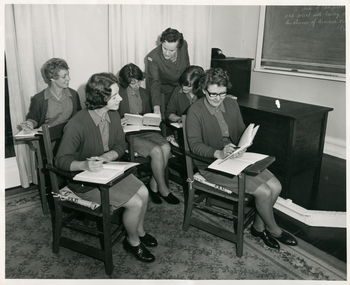 Royal District Nursing Service (now known as Bolton Clarke)
Photograph - Photograph, black and white, 07 06 1967
... At RDNS many programs were run, including: a Post Basic Course, Cardiac Rehabilitation Nursing, Haematology/Oncology Nursing, Palliative Care program, Diabetic Stabilization Program, Leg Ulcer Management Program, Wound Care Specialist Program, HIV/AIDS Nursing Care, Cystic Fibrosis Home Support, Veterans Home Care Program, Breast Cancer Support Program, Continence Management Program, Stomal Therapy Program, In-Home Lactation Support Program and the Homeless Persons Program. RDNS staff attended several hospitals to observe and learn special care needed to some clients, e.g. to the Austin Hospital to learn the care required for paraplegic and quadriplegic clients at home, and to Mount Royal Hospital to observe the care of clients in the Rehabilitation ward. ...Miss Evans, Director of Nursing of Royal District Nursing Service, (RDNS), is holding an Education session with RDNS staff. Her uniform is a grey skirt and jacket with the RDNS badge emblazoned on her right shoulder. The badge has a white background and black writing. The RDNS Sisters are wearing their grey uniform frocks and red cardigans. Education was an integral part of Melbourne District Nursing Society (MDNS), from its inception in 1885, later, in 1966, called Royal District Nursing Service, (RDNS). From 1885, only Trained Nurses, through the hospital training system, were employed by the Society, and on visits to patients they taught the necessity of hygiene and cleanliness, as well as the need for a good diet, to bring about good health. Doctor’s lectures were later given at the MDNS home to instruct patients and their families on prevention of disease. Education to patients continued throughout the years regarding health care and the use of equipment in the home. In 1961, Education programs commenced at MDNS with Sisters receiving In-service education. Sr. Pat (Paddy) Rowley was a leader in In-service Education and established the RDNS Department of Community Nursing Education in 1962. Staff could also apply for scholarships to further their education outside of RDNS. Many of their senior trained nurses received Postgraduate diplomas from the College of Nursing in Community Health Nursing, Education, and Administration and several travelled overseas visiting nursing organizations viewing their public health and district nursing systems. At RDNS many programs were run, including: a Post Basic Course, Cardiac Rehabilitation Nursing, Haematology/Oncology Nursing, Palliative Care program, Diabetic Stabilization Program, Leg Ulcer Management Program, Wound Care Specialist Program, HIV/AIDS Nursing Care, Cystic Fibrosis Home Support, Veterans Home Care Program, Breast Cancer Support Program, Continence Management Program, Stomal Therapy Program, In-Home Lactation Support Program and the Homeless Persons Program. RDNS staff attended several hospitals to observe and learn special care needed to some clients, e.g. to the Austin Hospital to learn the care required for paraplegic and quadriplegic clients at home, and to Mount Royal Hospital to observe the care of clients in the Rehabilitation ward. A Community Nursing Education Program was extended to student nurses from hospitals and to other nursing organizations. These Education programs kept the RDNS Sisters abreast of new techniques, such as changes in technology for e.g. new testing methods in detecting glucose levels in Diabetic patients. Sr. Nan Deakin obtained a Post Basic Certificate in Psychiatric Nursing and included this area in her education lectures. Sr. Daphne Geldard specialized in the area of Alzheimer’s disease and Dementia. These Sisters visited patients in District areas with the regular RDNS Sister when required. Every member of staff, both professional and non professional staff, received regular education in the Education Department. In 1980, a Home Health Aide pilot study, funded by the Federal Government, the Brotherhood of St. Laurence and RDNS, with the program written and taught by Sr. Rowley, was evaluated as successful, and Home Health Aides were employed and worked in RDNS Centres under the supervision of the RDNS Registered Nurses. Black and white photograph showing Miss Mary Evan standing in the centre rear of the photograph. She is with five RDNS Sisters who have short hair, three with curly hair and two with straight hair, who are sitting on chairs with white paged books resting on 'over the lap' tables. Three Sisters are seated in front of Miss Evans, and another two Sisters are sitting in the foreground. Miss Evans, who has short dark curled hair, is wearing her grey uniform jacket which can be seen with the RDNS cloth badge visible at the top of her right sleeve. She is bending over one of the Sisters and has her right hand pointing to something on the Sister's book. Closed light curtains are seen in the rear of the photograph and a dark desk to the right. On the wall above this, part of a blackboard can be seen.Photographers stamp. Quote No. GF 28rdns, royal district nursing service, rdns education, miss mary evans, rdns d.o.n -
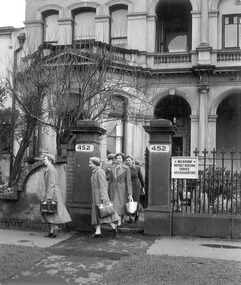 Royal District Nursing Service (now known as Bolton Clarke)
Photograph - Photograph, black and white:, c.1960
... HIV/AIDS nursing care was provided; visits to Homeless Persons were made. Personal care was given to patients ranging in age and with varying mobility problems, such as Amputees, those with MS, MND, Guillan-Barre Syndrome, Poliomyelitis, Quadriplegia, Paraplegia, Acquired Brain Injury, to those following a Cerebrovascular Accident (Stroke), those with severe Arthritis and those with a form of Dementia. ...This photograph was taken just a few years after the District division of the 'Melbourne District Nursing Society and After Care Hospital' separated in 1957. The District Division then became known as 'Melbourne District Nursing Service'. They moved into their Headquarters at 452 St. Kilda Road, Melbourne which was used as the Nurses Home as well as for Administrative purposes. The Sisters left from there each day to do their rounds and returned to do their book work before retiring at the end of the day. This photograph depicts the winter uniform worn at this time; a grey felt beret which had a red Maltese cross attached in the centre; a grey cotton frock and red cardigan, and a grey woolen coat, some with a grey belt, worn over their uniform.In 1885, 50 years after Melbourne was founded, it was recognized that nursing care was needed for the sick poor in inner Melbourne. The Melbourne District Nursing Society (MDNS), the first Society of its kind in Australia, was founded in February 1885 with one Trained nurse (Nurse), and a second employed six months later, working in the now CBD ie. from Spencer Street to Spring Street and from Victoria Parade to Flinders Street. From its inception the Society was at the forefront of health care. They provided high quality trained nursing care; educated their patients in the curing and prevention of disease; teaching the importance of cleanliness and good nutrition, both by verbal instruction and demonstration, even supplying soup and milk when needed. At that time they walked the streets and lane ways amid the slums of inner Melbourne carrying their nursing bag containing lotion and dressings, and supplying equipment on loan, such as feeding mugs, bedpans, air-cushions, splints, bed cradles feeding mugs and providing clean bed linen and nightdresses as necessary. Trained midwives began home births in August 1893 taking midwifery bundles and providing clothes for the babe and mother as needed. The Society were pioneers in recognizing the need for premises where patients too ill to be in their own home, but not ill enough to go to hospital, was needed, and the Society built, then opened, the After-Care Home, (later called After-Care Hospital), in 1926, for their patients, and patients from Hospitals. Many children were nursed there, some long term during the Polio epidemic; the Society employed two School Teachers. The Society now ran two divisions, the After-Care with its own Trained nurses (Sisters) and nurses and the District division. The Society were the first in Melbourne, in early 1928, to recognize some patients leaving the After-Care, and many at home, needed further social care and they set up ‘Almoners’ from their Committee to visit these patients and be intermediaries in getting them social assistance. It was late the following year before the first training of Almoners took place in Melbourne. In 1930 the Society employed a full time kindergarten teacher to visit poor children in their homes. That year the Society were pioneers in opening an Ante-Natal Clinic at the After-Care, setting a high standard with equipment, keeping records and providing leaflets with instructions in how to keep healthy during pregnancy, what complications to look for and what to do when labour commenced. In 1934 the Society were pioneers again when they opened the first Women’s Welfare Clinic in Melbourne giving advice on birth-control, at first attended by their own patients, but then accepting patients from public hospitals until their own clinics were opened. A Social Service Officer was employed at the After-Care who successfully gained better housing from the Housing Commission for families living under unsuitable conditions. In 1957 the Hospital and Charities Commission decided to take over the After-Care Hospital, so the 'Melbourne District Nursing Society and After-Care Hospital' separated and the 'Melbourne District Nursing Service' was formed, setting up Headquarters at 452 St. Kilda Road. Royal patronage was granted in 1966, now becoming the Royal District Nursing Service, (RDNS). Liaison with public hospitals began with a District nurse attached to a hospital visiting patients before going home. Education continued to be at the forefront of District with research by RDNS Educators and programs being implemented. Initial visits not only assessed the specific nursing situation but the situation as a whole. Their patients ranged in age from babes, children, adults to the elderly and referrals were taken from Hospitals, General Practitioners and allied Health facilities. Some of the care the Sisters provided is as follows: – Post-Natal care given to mother and babe, Wound Care following various types of surgery, accidents, burns, cancer, leg ulcers etc. Supervising and teaching Diabetic Care, including teaching and supervising people with Diabetes to administer their own Insulin, and administering Insulin to those unable to give their own injections. Administering other injections and setting up weekly medication boxes. The Sisters performed Catheterizations on adults suffering from conditions such as Quadriplegia, Paraplegia, Multiple Sclerosis (MS), Motor Neurone Disease (MND) and Guillan-Barre Syndrome, and when required at school on children for e.g. those with Spina Bifida. The Sisters visited those requiring Cystic Fibrosis support and care; those requiring Haemo-Oncology care, including visiting children at school; those requiring Home Enteral Feeding care, and those requiring IV therapy at home and home Dialysis. Palliative Care was given including pain relief with the use of syringe drivers, personal care as needed, and advice and support to both patient and family. The Sisters provided Stoma management to those needing Urostomy, Ileostomy and Colostomy care and those requiring Continence care. HIV/AIDS nursing care was provided; visits to Homeless Persons were made. Personal care was given to patients ranging in age and with varying mobility problems, such as Amputees, those with MS, MND, Guillan-Barre Syndrome, Poliomyelitis, Quadriplegia, Paraplegia, Acquired Brain Injury, to those following a Cerebrovascular Accident (Stroke), those with severe Arthritis and those with a form of Dementia. When necessary the elderly were assisted with personal care and advice given on safety factors with the use of hand rails, bath or shower seats, and hand showers. Rehabilitation with an aim towards independence remained at the forefront of the Sister’s minds and when possible using aids and instruction on safe techniques enabled the person to become fully independent. All care included giving advice and support to the patient and their Carers. The Sisters liaised with the persons Doctor, Hospital and allied Health personal when necessary.Black and White photograph of seven (some partly hidden) Melbourne District Nursing Service (MDNS) Sisters wearing full winter uniform of grey berets and grey long coats, with lapels, over their uniform which is partly seen on one Sister. Some are on a path, and others walking to the open metal gate; one Sister is between two tall, square, dark grey concrete columns. Looking at the photograph, two Sisters have turned left onto the footpath. These two Sisters are carrying oblong leather type bags in their left hand and the Sister between the columns is carrying a white soft material type bag. The Sisters seen have short dark hair under their berets. White plaques with the black numbers '452' are attached to the top 1/3 of each column and an arched grey concrete fence with brick top runs to the left. Behind this are two medium size leafless trees. A metal spiked fence runs from the column to the right of the photograph. Attached to this, near the column, is a white plaque with 'Melbourne District Nursing Service Headquarters' written in black. In the rear is a light grey two story Italian style building with a polygon shaped bay window to the left on the ground floor. It has a long window in the front and another on the side. To the right of this is a veranda with two concrete arches, separated by a roman column. A door can be seen behind the first arch. Above the bay window on the second story are three long arched windows, and to the right of that an arched opening with a roman column separating the partially seen next window. A concrete balustrade is seen at the front of the second story.melbourne district nursing service, headquarters, mdns, nurses, nurses uniforms, royal district nursing service, rdns -
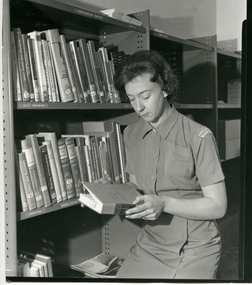 Royal District Nursing Service (now known as Bolton Clarke)
Photograph - Photograph, black and white, c.1967
... Many programs were run at RDNS, including: a Post Basic Course, Cardiac Rehabilitation Nursing, Haematology/Oncology Nursing, Palliative Care program, Diabetic Stabilization Program, Leg Ulcer Management Program, Wound Care Specialist Program, HIV/AIDS Nursing Care, Cystic Fibrosis Home Support, Veterans Home Care Program, Breast Cancer Support Program, Continence Management Program, Stomal Therapy Program, In-Home Lactation Support Program and the Homeless Persons Program. RDNS staff attended several hospitals to observe and learn special care needed to some clients, e.g. to the Austin Hospital to learn the care required for paraplegic and quadriplegic clients at home, and to Mount Royal Hospital to observe the care of clients in the Rehabilitation ward. ...Sister Rignall is undergoing In-service education at RDNS and is wearing the grey RDNS uniform of that era.Education was an integral part of Melbourne District Nursing Society (MDNS), from its inception in 1885, later, in 1966, called Royal District Nursing Service, (RDNS). From 1885, only Trained Nurses who trained through the Hospital training system were employed by the Society, and on visits to patients they taught the necessity of hygiene and cleanliness, as well as the need for a good diet, to bring about good health. Doctor’s lectures were later given at the MDNS home to instruct patients and their families on prevention of disease. Education to patients continued throughout the years regarding health care and the use of equipment in the home. In 1961, Education programs commenced at MDNS with nurses receiving In-service education. Sr. Pat (Paddy) Rowley was a leader in this In-service Education and established the MDNS, later called RDNS, Department of Community Nursing Education in 1962. Staff could also apply for scholarships to further their education outside of RDNS. Many of their senior trained nurses received Postgraduate diplomas from the College of Nursing in Community Health Nursing, Education, and Administration, and several travelled overseas visiting nursing organizations viewing their public health and district nursing systems. Many programs were run at RDNS, including: a Post Basic Course, Cardiac Rehabilitation Nursing, Haematology/Oncology Nursing, Palliative Care program, Diabetic Stabilization Program, Leg Ulcer Management Program, Wound Care Specialist Program, HIV/AIDS Nursing Care, Cystic Fibrosis Home Support, Veterans Home Care Program, Breast Cancer Support Program, Continence Management Program, Stomal Therapy Program, In-Home Lactation Support Program and the Homeless Persons Program. RDNS staff attended several hospitals to observe and learn special care needed to some clients, e.g. to the Austin Hospital to learn the care required for paraplegic and quadriplegic clients at home, and to Mount Royal Hospital to observe the care of clients in the Rehabilitation ward. A Community Nursing Education Program was extended to student nurses from hospitals and to other nursing organizations. These Education programs kept the RDNS Sisters abreast of new techniques, such as changes in technology for e.g. new testing methods in detecting glucose levels in Diabetic patients. Sr. Nan Deakin did a Post Basic Course in Psychiatric Nursing and included this area in her education lectures. Sr. Daphne Geldard specialized in the area of Alzheimer’s disease and Dementia. These Sisters visited patients in District areas with the regular RDNS Sister when required. Every member of staff, both professional and non professional staff, received regular education in the Education Department. Black and white photograph showing Royal District Nursing Service (RDNS), Sister J. Rignall using the Library facilities at RDNS. Sister Rignall has short curly hair and is wearing her short sleeve grey uniform frock; the RDNS insignia is seen at the top of her left sleeve. She is standing and looking down at a book she is holding. Shelves of library books are seen running behind her on her left hand side.Photographers Stamp and Quote No. GW 94melbourne district nursing society, mdns, royal district nursing service, rdns, rdns education, rdns library, sister j. rignall -
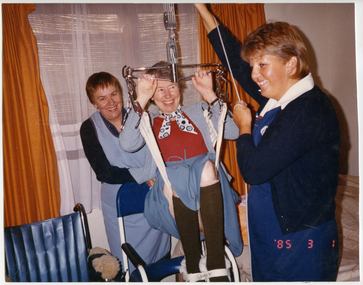 Royal District Nursing Service (now known as Bolton Clarke)
Photograph - Photograph, colour, 01 03 1985
... HIV/AIDS nursing care was provided; visits to Homeless Persons were made. Personal care was given to patients ranging in age and with varying mobility problems, such as those with MS, MND, Guillan-Barre Syndrome, Poliomyelitis, Quadriplegia, Paraplegia, Acquired Brain Injury, to those following a Cerebrovascular Accident (Stroke), those with severe Arthritis and those with a form of Dementia. ...The Royal District Nursing Service (RDNS) Sisters are using a hoist to transfer a lady who has limited mobility into her wheelchair. The photograph is taken in the lady's home. From the founding of the Melbourne District Nursing Society (MDNS), in 1885, known as the Royal District Nursing Service (RDNS) from 1966, equipment was loaned and demonstrated to patients, and their family members, to enable them to care for their loved ones in their home. RDNS employed a Physiotherapist who taught RDNS staff the correct transferring techniques. New lifting techniques, such as the use of a hoist, was taught to RDNS staff and were used in patient's homes to undertake safe transfer of the patient and to reduce physical strain on RDNS nursing staff and family members. The Trained nurses of the Melbourne District Nursing Society (MDNS), later known as Royal District Nursing Service (RDNS), visited patients in their home and gave best practice care in many fields of nursing, and to people of many cultures, throughout its 130 years of expansion. Initial visits not only assessed the specific nursing situation but the situation as a whole. Their patients ranged in age from babes, children, adults to the elderly and referrals were taken from Hospitals, General Practitioners and allied Health facilities. Some of the care the Sisters provided is as follows: – Post-Natal care given to mother and babe, Wound Care following various types of surgery, accidents, burns, cancer, leg ulcers etc. Supervising and teaching Diabetic Care, including teaching and supervising people with Diabetes to administer their own Insulin, and administering Insulin to those unable to give their own injections. Administering other injections and setting up weekly medication boxes. The Sisters performed Catheterizations on adults suffering from conditions such as Quadriplegia, Paraplegia, Multiple Sclerosis (MS), Motor Neurone Disease (MND) and Guillan-Barre Syndrome, and when required at school on children for e.g. those with Spina Bifida. The Sisters visited those requiring Cystic Fibrosis support and care; those requiring Haemo-Oncology care, including visiting children at school; those requiring Home Enteral Feeding care, and those requiring IV therapy at home and home Dialysis. Palliative Care was given including pain relief with the use of syringe drivers, personal care as needed, and advice and support to both patient and family. The Sisters provided Stoma management to those needing Urostomy, Ileostomy and Colostomy care and those requiring Continence care. HIV/AIDS nursing care was provided; visits to Homeless Persons were made. Personal care was given to patients ranging in age and with varying mobility problems, such as those with MS, MND, Guillan-Barre Syndrome, Poliomyelitis, Quadriplegia, Paraplegia, Acquired Brain Injury, to those following a Cerebrovascular Accident (Stroke), those with severe Arthritis and those with a form of Dementia. When necessary the elderly were assisted with personal care and advice given on safety factors with the use of hand rails, bath or shower seats, and hand showers. Rehabilitation with an aim towards independence remained at the forefront of the Sister’s minds and when possible using aids and instruction on safe techniques enabled the person to become fully independent. All care included giving advice and support to the patient and their Carers. The Sisters liaised with the persons Doctor, Hospital and allied Health personal when necessary.Coloured photograph showing Royal District Nursing Service (RDNS), Sister Helen Pelosi on the left hand side. She has short dark hair; is wearing a a light blue apron over her RDNS uniform, and is moving a lady in a hoist to a wheelchair. Another RDNS Sister, who has short blonde hair, is wearing her RDNS uniform of Royal blue V neck tunic style frock, with part of her white blouse seen and a navy blue cardigan. She has her right arm extended towards the top of a hoist. The lady is laughing and is suspended in a sling attached to the metal hoist. Around her neck is a white scarf with blue dots which is hanging over her red jumper. She is wearing a blue dress and long dark socks. Both her hands are extended upward holding onto the metal cross bar of the hoist. Part of a wheelchair is seen in the left foreground. Open long gold curtains with voile curtains in the centre can be seen in the background.royal district nursing service, rdns, patient care, rdns equipment, sister helen pelosi -
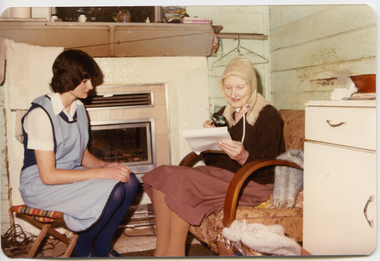 Royal District Nursing Service (now known as Bolton Clarke)
Photograph - Photograph, colour, c.1975
... Many programs were run at RDNS, including: a Post Basic Course, Cardiac Rehabilitation Nursing, Haematology/Oncology Nursing, Palliative Care program, Diabetic Stabilization Program, Leg Ulcer Management Program, Wound Care Specialist Program, HIV/AIDS Nursing Care, Cystic Fibrosis Home Support, Veterans Home Care Program, Breast Cancer Support Program, Continence Management Program, Stomal Therapy Program, In-Home Lactation Support Program and the Homeless Persons Program. RDNS staff attended several hospitals to observe and learn special care needed to some clients, e.g. to the Austin Hospital to learn the care required for paraplegic and quadriplegic clients at home, and to Mount Royal Hospital to observe the care of clients in the Rehabilitation ward. ...This photograph is taken in Mrs. McDonald's home and she is reading information provided to her by Sister Faye Cook of the Royal District Nursing Service (RDNS) who is visiting to provide her with nursing care. Written communication is required between Mrs. McDonald and Sr. Cook. Sisters from the Royal District Nursing Service (RDNS) used various means to communicate with their patients who had various health conditions. Sometimes this was by written word, using interpreters or using digital devices. The RDNS Education department wrote instructions for patients to follow for various conditions and treatments to assist them in their care. The attending Sister discussed the instructions and left the leaflet with the patient. Examples of instruction included on how to sterilize dressings and equipment in the home and another giving information and instructions on diabetic care.. Education was an integral part of Melbourne District Nursing Society (MDNS), from its inception in 1885, later, in 1966, called Royal District Nursing Service, (RDNS). From 1885, only Trained Nurses (Nurses) who trained through the Hospital training system were employed by the Society, and on visits to patients they taught the necessity of hygiene and cleanliness, as well as the need for a good diet, to bring about good health. Doctor’s lectures were later given at the MDNS home to instruct patients and their families on prevention of disease. Education to patients continued throughout the years regarding health care and the use of equipment in the home. In 1961, Education programs commenced at MDNS with their Trained nurses (Sisters) receiving In-service education. Sr. Pat (Paddy) Rowley was a leader in this In-service Education and established the MDNS, later called RDNS, Department of Community Nursing Education in 1962. Staff could also apply for scholarships to further their education outside of RDNS. Many of their senior Sisters received Postgraduate diplomas from the College of Nursing in Community Health Nursing, Education, and Administration, and several travelled overseas visiting nursing organizations viewing their public health and district nursing systems. Many programs were run at RDNS, including: a Post Basic Course, Cardiac Rehabilitation Nursing, Haematology/Oncology Nursing, Palliative Care program, Diabetic Stabilization Program, Leg Ulcer Management Program, Wound Care Specialist Program, HIV/AIDS Nursing Care, Cystic Fibrosis Home Support, Veterans Home Care Program, Breast Cancer Support Program, Continence Management Program, Stomal Therapy Program, In-Home Lactation Support Program and the Homeless Persons Program. RDNS staff attended several hospitals to observe and learn special care needed to some clients, e.g. to the Austin Hospital to learn the care required for paraplegic and quadriplegic clients at home, and to Mount Royal Hospital to observe the care of clients in the Rehabilitation ward. A Community Nursing Education Program was extended to student nurses from hospitals and to other nursing organizations. These Education programs kept the RDNS Sisters abreast of new techniques, such as changes in technology for e.g. new testing methods in detecting glucose levels in Diabetic patients. Sr. Nan Deakin did a Post Basic Course in Psychiatric Nursing and included this area in her education lectures. Sr. Daphne Geldard specialized in the area of Alzheimer’s disease and Dementia. These Sisters visited patients in District areas with the regular RDNS Sister when required. Every member of staff, both professional and non professional staff, received regular education in the Education Department. In 1980, a Home Health Aide pilot study, funded by the Federal Government, the Brotherhood of St. Laurence and RDNS, with the program written and taught by Sr. Rowley, was evaluated as successful, and Home Health Aides were employed and worked in RDNS Centres under the supervision of the RDNS Registered Nurses. Coloured photograph of Sister Faye Cook of the Royal District Nursing Service (RDNS), sitting with Mrs McDonald who is reading the top page of a white writing pad. On the left, sitting 'side on' looking at Mrs McDonald, is Sister Cook who has short dark hair, and is wearing her pale blue RDNS apron over her RDNS royal blue V neck tunic style frock which is over her short sleeve white blouse; she is wearing blue stockings. She is seated on a striped low stool in Mrs. McDonald's room. Mrs.McDonald is to her right, and is seated in a bone and brown patterned lounge chair with wooden arms. She has a bone coloured wrap over her hair, and is wearing a dark brown V neck jumper over a deep pink frock. She is hoding a magnifying glass in her right hand and is reading information on a white writing pad which she is holding in her left hand. In the rear of the photograph is a gas type fire set into a fireplace. A white cupboard with a drawer is seen to the right hand side. The wall behind is vertical boards.Red coloured 'Kodak' stamps. Handwritten information.royal district nursing service, rdns, rdns education, mrs mcdonald, sister faye cook -
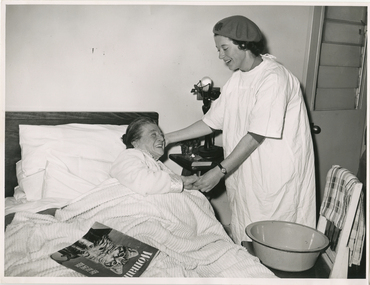 Royal District Nursing Service (now known as Bolton Clarke)
Photograph - Photograph, black and white, c.1960
... HIV/AIDS nursing care was provided; visits to Homeless Persons were made. Personal care was given to patients ranging in age and with varying mobility problems, such as those with MS, MND, Guillan-Barre Syndrome, Poliomyelitis, Quadriplegia, Paraplegia, Acquired Brain Injury, to those following a Cerebrovascular Accident (Stroke), those with severe Arthritis and those with a form of Dementia. ...A Melbourne District Nursing Service (MDNS) Sister is giving nursing care to a lady in her own home. The Sister is wearing the grey uniform dress of that era under her gown. Her grey beret has a red Maltese cross applied to its centre front. The Trained nurses of the Melbourne District Nursing Society (MDNS), later known as Melbourne District Nursing Service and from 1966 Royal District Nursing Service (RDNS), visited patients in their home and gave best practice care in many fields of nursing, and to people of many cultures, throughout its 130 years of expansion. Initial visits not only assessed the specific nursing situation but the situation as a whole. Their patients ranged in age from babes, children, adults to the elderly and referrals were taken from Hospitals, General Practitioners and allied Health facilities. Some of the care the Sisters provided is as follows: – Post-Natal care given to mother and babe, Wound Care following various types of surgery, accidents, burns, cancer, leg ulcers etc. Supervising and teaching Diabetic Care, including teaching and supervising people with Diabetes to administer their own Insulin, and administering Insulin to those unable to give their own injections. Administering other injections and setting up weekly medication boxes. The Sisters performed Catheterizations on adults suffering from conditions such as Quadriplegia, Paraplegia, Multiple Sclerosis (MS), Motor Neurone Disease (MND) and Guillan-Barre Syndrome, and when required at school on children for e.g. those with Spina Bifida. The Sisters visited those requiring Cystic Fibrosis support and care; those requiring Haemo-Oncology care, including visiting children at school; those requiring Home Enteral Feeding care, and those requiring IV therapy at home and home Dialysis. Palliative Care was given including pain relief with the use of syringe drivers, personal care as needed, and advice and support to both patient and family. The Sisters provided Stoma management to those needing Urostomy, Ileostomy and Colostomy care and those requiring Continence care. HIV/AIDS nursing care was provided; visits to Homeless Persons were made. Personal care was given to patients ranging in age and with varying mobility problems, such as those with MS, MND, Guillan-Barre Syndrome, Poliomyelitis, Quadriplegia, Paraplegia, Acquired Brain Injury, to those following a Cerebrovascular Accident (Stroke), those with severe Arthritis and those with a form of Dementia. When necessary the elderly were assisted with personal care and advice given on safety factors with the use of hand rails, bath or shower seats, and hand showers. Rehabilitation with an aim towards independence remained at the forefront of the Sister’s minds and when possible using aids and instruction on safe techniques enabled the person to become fully independent. All care included giving advice and support to the patient and their Carers. The Sisters liaised with the persons Doctor, Hospital and allied Health personal when necessary.Black and white photograph of a Melbourne District Nursing Service (MDNS), Sister attending a lady in the bedroom of her home. The Sister, who is smiling, is wearing a white gown over her grey uniform with part of the collar visible, and her grey uniform beret over her short dark hair. She is standing to the right of the bed looking at the lady, and has her right arm extended touching the pillow on the bed. With her other hand she is holding the right hand of the lady. The lady, who is smiling, has short dark swept back hair and is lying on her left side against two pillows on the bed; she is covered with light coloured bed coverings, A metal type, pale colour with dark rim, wash basin is sitting on a white wooden chair to the front of the Sister. A towel is hanging over the back of the chair. On the bottom left of the bed is a magazine with the word 'Woman' and below this a picture of a cat, on its cover. A small table with a lamp on it is behind the Sister and part of a concertina door to her rear right.Photographer Stamp. Quote No. 2568melbourne district nursing service, mdns, mdns patient care -
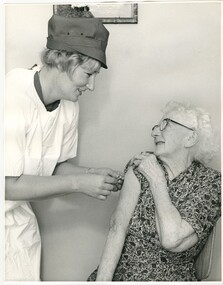 Royal District Nursing Service (now known as Bolton Clarke)
Photograph - Photograph, black and white, c.1960
... HIV/AIDS nursing care was provided; visits to Homeless Persons were made. Personal care was given to patients ranging in age and with varying mobility problems, such as those with MS, MND, Guillan-Barre Syndrome, Poliomyelitis, Quadriplegia, Paraplegia, Acquired Brain Injury, to those following a Cerebrovascular Accident (Stroke), those with severe Arthritis and those with a form of Dementia. ...This photograph shows a Melbourne District Nursing Service (MDNS) Sister is visiting the lady in her own home and is giving medication in the form of an injection which has been ordered by a Doctor. The Sisters is wearing her grey cotton uniform frock under her white gown and her grey peaked hat. The Trained nurses (Nurses) of the Melbourne District Nursing Society (MDNS), later known as Melbourne District Nursing Service and from 1966 Royal District Nursing Service (RDNS), visited patients in their home and gave best practice care in many fields of nursing, and to people of many cultures, throughout its 130 years of expansion. Initial visits not only assessed the specific nursing situation but the situation as a whole. Their patients ranged in age from babes, children, adults to the elderly and referrals were taken from Hospitals, General Practitioners and allied Health facilities. Some of the care the Trained nurses (Sisters) provided is as follows: – Post-Natal care given to mother and babe, Wound Care following various types of surgery, accidents, burns, cancer, leg ulcers etc. Supervising and teaching Diabetic Care, including teaching and supervising people with Diabetes to administer their own Insulin, and administering Insulin to those unable to give their own injections. Administering other injections and setting up weekly medication boxes. The Sisters performed Catheterizations on adults suffering from conditions such as Quadriplegia, Paraplegia, Multiple Sclerosis (MS), Motor Neurone Disease (MND) and Guillan-Barre Syndrome, and when required at school on children for e.g. those with Spina Bifida. The Sisters visited those requiring Cystic Fibrosis support and care; those requiring Haemo-Oncology care, including visiting children at school; those requiring Home Enteral Feeding care, and those requiring IV therapy at home and home Dialysis. Palliative Care was given including pain relief with the use of syringe drivers, personal care as needed, and advice and support to both patient and family. The Sisters provided Stoma management to those needing Urostomy, Ileostomy and Colostomy care and those requiring Continence care. HIV/AIDS nursing care was provided; visits to Homeless Persons were made. Personal care was given to patients ranging in age and with varying mobility problems, such as those with MS, MND, Guillan-Barre Syndrome, Poliomyelitis, Quadriplegia, Paraplegia, Acquired Brain Injury, to those following a Cerebrovascular Accident (Stroke), those with severe Arthritis and those with a form of Dementia. When necessary the elderly were assisted with personal care and advice given on safety factors with the use of hand rails, bath or shower seats, and hand showers. Rehabilitation with an aim towards independence remained at the forefront of the Sister’s minds and when possible using aids and instruction on safe techniques enabled the person to become fully independent. All care included giving advice and support to the patient and their Carers. The Sisters liaised with the persons Doctor, Hospital and allied Health personal when necessary.Black and white photograph showing a Melbourne District Nursing Service (MDNS), Sister on the left of the photograph giving an injection into the upper right arm of a lady. On the right of the photograph is an elderly lady who is sitting on a chair, she has white short curly hair; is wearing glasses and wearing a black and white patterned dress. Her head is turned to her right and she is smiling at the Sister.as she holds up the sleeve of her dress with her left hand. The MDNS Sister, who is wearing her uniform peaked grey hat over her short blond hair and wearing a white gown over her grey uniform with peaks just seen, is smiling at the lady. In both hands she.is holding a glass and metal syringe; the needle is inserted in the lady's arm.Photographer stamprdns, royal district nursing service, melbourne district nursing service, mdns, mdns patient care - injection -
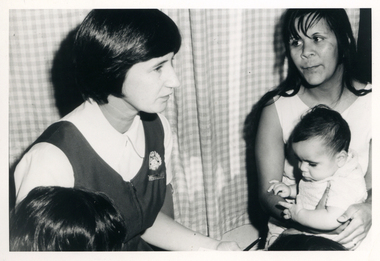 Royal District Nursing Service (now known as Bolton Clarke)
Photograph - Photograph, black and white, c.1980
... HIV/AIDS nursing care was provided; visits to Homeless Persons were made. Personal care was given to patients ranging in age and with varying mobility problems, such as those with MS, MND, Guillan-Barre Syndrome, Poliomyelitis, Quadriplegia, Paraplegia, Acquired Brain Injury, to those following a Cerebrovascular Accident (Stroke), those with severe Arthritis and those with a form of Dementia. ...RDNS Sister Pilmore is visiting a babe and mother to administer Post Natal nursing care and give health advice. The Trained nurses of the Melbourne District Nursing Society (MDNS), later known as Royal District Nursing Service (RDNS), visited patients in their home and gave best practice care in many fields of nursing, and to people of many cultures, throughout its 130 years of expansion. Initial visits not only assessed the specific nursing situation but the situation as a whole. Their patients ranged in age from babes, children, adults to the elderly and referrals were taken from Hospitals, General Practitioners and allied Health facilities. Some of the care the Sisters provided is as follows: – Post-Natal care given to mother and babe, Wound Care following various types of surgery, accidents, burns, cancer, leg ulcers etc. Supervising and teaching Diabetic Care, including teaching and supervising people with Diabetes to administer their own Insulin, and administering Insulin to those unable to give their own injections. Administering other injections and setting up weekly medication boxes. The Sisters performed Catheterizations on adults suffering from conditions such as Quadriplegia, Paraplegia, Multiple Sclerosis (MS), Motor Neurone Disease (MND) and Guillan-Barre Syndrome, and when required at school on children for e.g. those with Spina Bifida. The Sisters visited those requiring Cystic Fibrosis support and care; those requiring Haemo-Oncology care, including visiting children at school; those requiring Home Enteral Feeding care, and those requiring IV therapy at home and home Dialysis. Palliative Care was given including pain relief with the use of syringe drivers, personal care as needed, and advice and support to both patient and family. The Sisters provided Stoma management to those needing Urostomy, Ileostomy and Colostomy care and those requiring Continence care. HIV/AIDS nursing care was provided; visits to Homeless Persons were made. Personal care was given to patients ranging in age and with varying mobility problems, such as those with MS, MND, Guillan-Barre Syndrome, Poliomyelitis, Quadriplegia, Paraplegia, Acquired Brain Injury, to those following a Cerebrovascular Accident (Stroke), those with severe Arthritis and those with a form of Dementia. When necessary the elderly were assisted with personal care and advice given on safety factors with the use of hand rails, bath or shower seats, and hand showers. Rehabilitation with an aim towards independence remained at the forefront of the Sister’s minds and when possible using aids and instruction on safe techniques enabled the person to become fully independent. All care included giving advice and support to the patient and their Carers. The Sisters liaised with the persons Doctor, Hospital and allied Health personal when necessary.On the left of the black and white photograph is the side on view of a seated Royal District Nursing Service (RDNS), Sister Kaye Pilmore, who is visiting a mother and her babe in their home. On the right the mother, who is seated, has dark shoulder length straight hair, and is wearing a white sleeveless frock. She is looking at the Sister while she holds her dark haired baby on her knee. The babe is wearing a light coloured top. Sister, Pilmore who has dark short straight hair, is wearing her RDNS summer uniform of a white short sleeve blouse under a dark V neck tunic style frock with the RDNS insignia on the upper left. She is holding a pen in her left hand. Closed checked long curtains are seen in the background of the photograph. The partial dark haired head of another person can be seen in the left hand side foreground.. G 155 is stamped in green inkrdns, royal district nursing service, rdns patient care, sister kaye pilmore, rdns domiciliary infant and maternal care (dimc) -
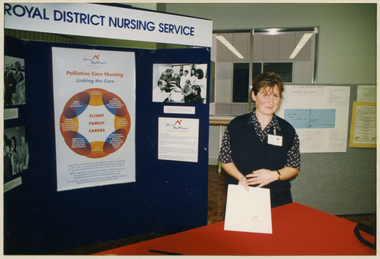 Royal District Nursing Service (now known as Bolton Clarke)
Photograph - Photograph, colour, c.2000
... At RDNS many programs were run, including: a Post Basic Course, Cardiac Rehabilitation Nursing, Haematology/Oncology Nursing, Palliative Care program, Diabetic Stabilization Program, Leg Ulcer Management Program, Wound Care Specialist Program, HIV/AIDS Nursing Care, Cystic Fibrosis Home Support, Veterans Home Care Program, Breast Cancer Support Program, Continence Management Program, Stomal Therapy Program, In-Home Lactation Support Program and the Homeless Persons Program. RDNS staff attended several hospitals to observe and learn special care needed to some clients, e.g. to the Austin Hospital to learn the care required for paraplegic and quadriplegic clients at home, and to Mount Royal Hospital to observe the care of clients in the Rehabilitation ward. ...This photograph shows some of the information documents displayed on boards during an Education session on Palliative Care run by the Royal District Nursing Service Education Department.Education was an integral part of Melbourne District Nursing Society (MDNS), from its inception in 1885, later, in 1966, called Royal District Nursing Service, (RDNS). From 1885, only Trained Nurses (Nurses), through the Hospital training system, were employed by the Society, and on visits to patients they taught the necessity of hygiene and cleanliness, as well as the need for a good diet, to bring about good health. Doctor’s lectures were later given at the MDNS home to instruct patients and their families on prevention of disease. Education to patients continued throughout the years regarding health care and the use of equipment in the home. In 1961, Education programs commenced at MDNS with their Trained nurses (Sisters) receiving In-service education. Sr. Pat (Paddy) Rowley was a leader in In-service Education and established the RDNS Department of Community Nursing Education in 1962. Staff could also apply for scholarships to further their education outside of RDNS. Many of their senior Sisters received Postgraduate diplomas from the College of Nursing in Community Health Nursing, Education, and Administration and several travelled overseas visiting nursing organizations viewing their public health and district nursing systems. At RDNS many programs were run, including: a Post Basic Course, Cardiac Rehabilitation Nursing, Haematology/Oncology Nursing, Palliative Care program, Diabetic Stabilization Program, Leg Ulcer Management Program, Wound Care Specialist Program, HIV/AIDS Nursing Care, Cystic Fibrosis Home Support, Veterans Home Care Program, Breast Cancer Support Program, Continence Management Program, Stomal Therapy Program, In-Home Lactation Support Program and the Homeless Persons Program. RDNS staff attended several hospitals to observe and learn special care needed to some clients, e.g. to the Austin Hospital to learn the care required for paraplegic and quadriplegic clients at home, and to Mount Royal Hospital to observe the care of clients in the Rehabilitation ward. A Community Nursing Education Program was extended to student nurses from hospitals and to other nursing organizations. These Education programs kept the RDNS Sisters abreast of new techniques, such as changes in technology for e.g. new testing methods in detecting glucose levels in Diabetic patients. Sr. Nan Deakin obtained a Post Basic Certificate in Psychiatric Nursing and included this area in her Education lectures. Sr. Daphne Geldard specialized in the area of Alzheimer’s disease and Dementia. These Sisters visited patients in District areas with the regular RDNS Sister when required. Every member of staff, both professional and non professional staff, received regular education in the Education Department. In 1980, a Home Health Aide pilot study, funded by the Federal Government, the Brotherhood of St. Laurence and RDNS, with the program written and taught by Sr. Rowley, was evaluated as successful, and Home Health Aides were employed and worked in RDNS Centres under the supervision of the RDNS SistersColoured photograph of a Royal District Nursing Service (RDNS) Sister standing in front of a Palliative Nursing Display board. The board has a white banner across the top with the dark blue words 'Royal District Nursing Service' written in capital letters. There are several light coloured background posters displayed on the large dark coloured display board. The Sister, who has her dark hair drawn up, is wearing a RDNS blue and white patterned blouse and short sleeve V neck dark blue jumper with a name badge attached on the upper left. The Sister is holding.a white sheet of paper. Part of a red covered table is seen in front of her. A mid green board with documents attached to it is behind and to the right of the Sister. Behind this is a pale green wall with part of a bench and two large windows showing a room beyond.royal district nursing service, rdns, rdns palliative care nursing, rdns education -
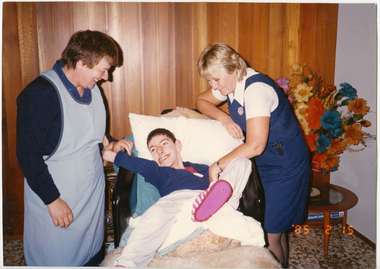 Royal District Nursing Service (now known as Bolton Clarke)
Photograph - Photograph, colour, 15.02.1985
... HIV/AIDS nursing care was provided; visits to Homeless Persons were made. Personal care was given to patients ranging in age and with varying mobility problems, such as those with MS, MND, Guillan-Barre Syndrome, Poliomyelitis, Quadriplegia, Paraplegia, Acquired Brain Injury, to those following a Cerebrovascular Accident (Stroke), those with severe Arthritis and those with a form of Dementia. ...Two Royal District Nursing Service (RDNS) Sisters are assisting a young male patient who has a movement disorder, to change position in his reclined chair.The Trained nurses (Nurses) of the Melbourne District Nursing Society (MDNS), later known as Royal District Nursing Service (RDNS), visited patients in their home and gave best practice care in many fields of nursing, and to people of many cultures, throughout its 130 years of expansion. Initial visits not only assessed the specific nursing situation but the situation as a whole. Their patients ranged in age from babes, children, adults to the elderly and referrals were taken from Hospitals, General Practitioners and allied Health facilities. Some of the care the Trained nurse (Sisters) provided is as follows: – Post-Natal care given to mother and babe, Wound Care following various types of surgery, accidents, burns, cancer, leg ulcers etc. Supervising and teaching Diabetic Care, including teaching and supervising people with Diabetes to administer their own Insulin, and administering Insulin to those unable to give their own injections. Administering other injections and setting up weekly medication boxes. The Sisters performed Catheterizations on adults suffering from conditions such as Quadriplegia, Paraplegia, Multiple Sclerosis (MS), Motor Neurone Disease (MND) and Guillan-Barre Syndrome, and when required at school on children for e.g. those with Spina Bifida. The Sisters visited those requiring Cystic Fibrosis support and care; those requiring Haemo-Oncology care, including visiting children at school; those requiring Home Enteral Feeding care, and those requiring IV therapy at home and home Dialysis. Palliative Care was given including pain relief with the use of syringe drivers, personal care as needed, and advice and support to both patient and family. The Sisters provided Stoma management to those needing Urostomy, Ileostomy and Colostomy care and those requiring Continence care. HIV/AIDS nursing care was provided; visits to Homeless Persons were made. Personal care was given to patients ranging in age and with varying mobility problems, such as those with MS, MND, Guillan-Barre Syndrome, Poliomyelitis, Quadriplegia, Paraplegia, Acquired Brain Injury, to those following a Cerebrovascular Accident (Stroke), those with severe Arthritis and those with a form of Dementia. When necessary the elderly were assisted with personal care and advice given on safety factors with the use of hand rails, bath or shower seats, and hand showers. Rehabilitation with an aim towards independence remained at the forefront of the Sister’s minds and when possible using aids and instruction on safe techniques enabled the person to become fully independent. All care included giving advice and support to the patient and their Carers. The Sisters liaised with the persons Doctor, Hospital and allied Health personal when necessary.A coloured photograph showing two Royal District Nursing (RDNS) Sisters with a young male patient who is lying in a reclined chair. The Sister standing on his left is smiling; she has short straight dark hair, and is wearing a RDNS light blue apron over her royal blue dress and darker blue long sleeve cardigan. The Sister on the right hand side of the patient's chair is laughing. She has blonde hair and is slightly bent over the chair as her left hand is supporting his left leg. She is wearing the RDNS summer uniform of the day - a white short sleeve blouse under a royal blue V neck tunic style frock. Her right arm is bent and resting on top of the patient's chair and pillow. The young man has short dark hair and is smiling and looking towards the left of the photograph. He is wearing a dark blue long sleeve top and his right arm is extended toward the Sister on the left hand side of the photograph. His legs are over his coverings with his left leg bent at the knee. He is wearing light coloured pants and has a pink and white striped slipper on his foot. His pillow is white, and coverings seen are blue and white check, white, and a pale pink sheepskin. A wood board wall is in the background. A vase of flowers are standing on the part of a round low table that can be seen in the right hand rear corner. A pale lilac wall can be seen on the right hand side. A small section of a dark patterned carpet can be seen.royal district nursing service, rdns, rdns uniform, rdns patient care -
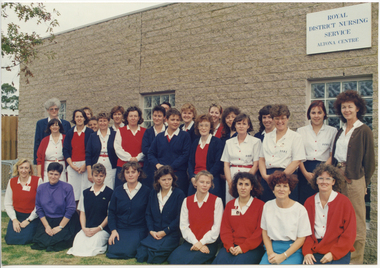 Royal District Nursing Service (now known as Bolton Clarke)
Photograph - Photograph, colour, c.1990
... HIV/AIDS nursing care was provided; visits to Homeless Persons were made. Personal care was given to patients ranging in age and with varying mobility problems, such as those with MS, MND, Guillan-Barre Syndrome, Poliomyelitis, Quadriplegia, Paraplegia, Acquired Brain Injury, to those following a Cerebrovascular Accident (Stroke), those with severe Arthritis and those with a form of Dementia. ...The Royal District Nursing Service (RDNS) Altona Centre was situated at Blackshaws Road, Altona. This photograph is a pictorial record of the staff at Altona Centre in the 1990s.Gradually over the years, Melbourne District Nursing Service (MDNS), later known as Royal District Nursing Service (RDNS) from 1966 when they received Royal patronage, opened Centres throughout the Melbourne Metropolitan area and outer suburbs with Heidelberg Centre opening in 1971. Their Trained nurses (Sisters) left from these Centres each morning to carry out their nursing visits in a specific area (district), taking any sterilized equipment needed with them. They returned at the end of the day to write up their patients nursing histories, clean and reset any equipment used ready for sterilization, and contact other medical and community personal as necessary. The Trained nurses (Nurses) of the Melbourne District Nursing Society (MDNS), later known as Royal District Nursing Service (RDNS), visited patients in their home and gave best practice care in many fields of nursing, and to people of many cultures, throughout its 130 years of expansion. Initial visits not only assessed the specific nursing situation but the situation as a whole. Their patients ranged in age from babes, children, adults to the elderly and referrals were taken from Hospitals, General Practitioners and allied Health facilities. Some of the care their Trained nurses (Sisters) provided is as follows: – Post-Natal care given to mother and babe, Wound Care following various types of surgery, accidents, burns, cancer, leg ulcers etc. Supervising and teaching Diabetic Care, including teaching and supervising people with Diabetes to administer their own Insulin, and administering Insulin to those unable to give their own injections. Administering other injections and setting up weekly medication boxes. The Sisters performed Catheterizations on adults suffering from conditions such as Quadriplegia, Paraplegia, Multiple Sclerosis (MS), Motor Neurone Disease (MND) and Guillan-Barre Syndrome, and when required at school on children for e.g. those with Spina Bifida. The Sisters visited those requiring Cystic Fibrosis support and care; those requiring Haemo-Oncology care, including visiting children at school; those requiring Home Enteral Feeding care, and those requiring IV therapy at home and home Dialysis. Palliative Care was given including pain relief with the use of syringe drivers, personal care as needed, and advice and support to both patient and family. The Sisters provided Stoma management to those needing Urostomy, Ileostomy and Colostomy care and those requiring Continence care. HIV/AIDS nursing care was provided; visits to Homeless Persons were made. Personal care was given to patients ranging in age and with varying mobility problems, such as those with MS, MND, Guillan-Barre Syndrome, Poliomyelitis, Quadriplegia, Paraplegia, Acquired Brain Injury, to those following a Cerebrovascular Accident (Stroke), those with severe Arthritis and those with a form of Dementia. When necessary the elderly were assisted with personal care and advice given on safety factors with the use of hand rails, bath or shower seats, and hand showers. Rehabilitation with an aim towards independence remained at the forefront of the Sister’s minds and when possible using aids and instruction on safe techniques enabled the person to become fully independent. All care included giving advice and support to the patient and their Carers. The Sisters liaised with the persons Doctor, Hospital and allied Health personal when necessary.The coloured photograph shows 29 female staff of the Royal District Nursing Service (RDNS), Altona Centre. The rear and centre rows of staff are standing and the front row of staff are kneeling. They are outside a grey brick building with a flat roof. A white sign is on the right hand upper corner of the building and has the words, written in blue capital letters, "Royal District Nursing Service Altona Centre". Part of a window can be seen beneath this. Part of two other windows can be seen in the centre and to the left of the building. Most Sisters are wearing RDNS uniforms, some with a short sleeve white with a blue pattern dress and a red belt. Others with a white with pattern blouse and dark blue skirt, and some have a red sleeveless jumper over their uniform, and some are wearing a dark blue cardigan or long sleeve dark blue jumper. Three staff are wearing day wear, one with a purple blouse and black skirt, another with a white blouse and pale blue skirt and the third wearing a white blouse, brown cardigan and bone slacks.. royal district nursing service, rdns, rdns centre, rdns uniform
