
Showing 295 items matching "national archives of australia"
-
 Mission to Seafarers Victoria
Film - Documentary, Wind and Sky Productions, Harbour Lights, 2019-2020
... Credits: Narrator Sharon Turley Featuring (in order of appearance) Dr Chris McConville, Gordon MacMillan, Janet Miller, Professor Kate Darian-Smith and Jill Garner With Raul S Gantalao Jr, Escoto Lemuel, Ben Schroeder, Cinda Manins And Ian Fletcher, Yuan Jia, Uma Kothari, Gordon Lansley, William Reed and Cheka Samaranayake Directed by Jary Nemo Written and Produced by Lucinda Horrocks and Jary Nemo Music by Richard Chew Executive Producers Sue Dight and Gordon MacMillan Research advisors Geraldine Brault, Maria Culka, Professor Kate Darian-Smith, Ros Fletcher, Professor Uma Kothari, Dr Barbara Lemon, Catherine McLay, Dr Chris McConville, Janet Miller, Rick Mitchell, Duncan ‘John’ Perryman, Dr Annette Sheill and Peter Taylor Archival photographs, music and footage courtesy of Australian Red Cross Society, Central Highlands Libraries, Internet Archive, National Film and Sound Archive, National Library of Australia, Mackarness Family Personal Archives, Mission to Seafarers Victoria, Public Record Office Victoria, State Library of Victoria and US National Archives Music Harbour Lights. ...Credits: Narrator Sharon Turley Featuring (in order of appearance) Dr Chris McConville, Gordon MacMillan, Janet Miller, Professor Kate Darian-Smith and Jill Garner With Raul S Gantalao Jr, Escoto Lemuel, Ben Schroeder, Cinda Manins And Ian Fletcher, Yuan Jia, Uma Kothari, Gordon Lansley, William Reed and Cheka Samaranayake Directed by Jary Nemo Written and Produced by Lucinda Horrocks and Jary Nemo Music by Richard Chew Executive Producers Sue Dight and Gordon MacMillan Research advisors Geraldine Brault, Maria Culka, Professor Kate Darian-Smith, Ros Fletcher, Professor Uma Kothari, Dr Barbara Lemon, Catherine McLay, Dr Chris McConville, Janet Miller, Rick Mitchell, Duncan ‘John’ Perryman, Dr Annette Sheill and Peter Taylor Archival photographs, music and footage courtesy of Australian Red Cross Society, Central Highlands Libraries, Internet Archive, National Film and Sound Archive, National Library of Australia, Mackarness Family Personal Archives, Mission to Seafarers Victoria, Public Record Office Victoria, State Library of Victoria and US National Archives Music Harbour Lights. ...Synopsis: “In WW1 Melbourne a pioneering network of women at the Mission to Seafarers called the Ladies Harbour Lights Guild supported sailors who risked their lives at sea. The documentary “Harbour Lights” tells the remarkable story of the Ladies Harbour Lights Guild and the lives of seafarers in early 20th century Melbourne. It focuses on Melbourne’s iconic Mission to Seafarers building, its connection to the Great War and to a unique community of ships crew and volunteers. Featuring Melbourne historians, commentators, archivists and architects and rare footage and images of sailing and social life in and around the ports of Melbourne, this film will inform and connect audiences young and old.” Commissioned by Victorian Government The movie was produced in collaboration with the Mission to Seafarers Victoria. It was directed by Jary Nemo and written and produced by Lucinda Horrocks and Jary Nemo with executive producers Sue Dight and Gordon MacMillan. The film features: Jill Garner Kate Darian-Smith Chris McConville Janet Miller (curator) Gordon MacMillan (former seafarer and board committee member) Narrated by Sharon Turley. Music by Richard Chew (professor of the Arts Academy in Ballarat) The film was presented at several festival in Australia and abroad in 2020-2021. Credits: Narrator Sharon Turley Featuring (in order of appearance) Dr Chris McConville, Gordon MacMillan, Janet Miller, Professor Kate Darian-Smith and Jill Garner With Raul S Gantalao Jr, Escoto Lemuel, Ben Schroeder, Cinda Manins And Ian Fletcher, Yuan Jia, Uma Kothari, Gordon Lansley, William Reed and Cheka Samaranayake Directed by Jary Nemo Written and Produced by Lucinda Horrocks and Jary Nemo Music by Richard Chew Executive Producers Sue Dight and Gordon MacMillan Research advisors Geraldine Brault, Maria Culka, Professor Kate Darian-Smith, Ros Fletcher, Professor Uma Kothari, Dr Barbara Lemon, Catherine McLay, Dr Chris McConville, Janet Miller, Rick Mitchell, Duncan ‘John’ Perryman, Dr Annette Sheill and Peter Taylor Archival photographs, music and footage courtesy of Australian Red Cross Society, Central Highlands Libraries, Internet Archive, National Film and Sound Archive, National Library of Australia, Mackarness Family Personal Archives, Mission to Seafarers Victoria, Public Record Office Victoria, State Library of Victoria and US National Archives Music Harbour Lights. Music by Richard Chew. Westering. Music by Richard Chew. Twilight (Crépuscule) by Jules Massenet. Performed by Amelita Galli-Curci. I Love You So, Waltz from The Merry Widow by Franz Lehár. Performed by Elise Stephenson and Harry Macdonough with Orchestra. Harbour Lights 2. Music by Richard Chew. If I Could Fly by Walking Hearts featuring Jennifer Holm. Courtesy of Epidemic Sound. With thanks to Peter Barrow, Sarah Bartak, Lin Bender AM, Patty Braumueller, Csilla Csongvay, Emer Diviney, Moira Drew, Ian Fletcher, Ajith Jayasuriya, Ben Jones, Patience Jones, Cinda Manins, Madeleine Martiniello, Georgia Melville, Elisabeth Moglia, Tara Oldfield, Lyn Pasquier, Nigel Porteous, Rev’d Onofre (Inni) Punay, Dr Rosalie Triolo, Ben Schroeder, David Simpson, Cheka Samaranayake, Daria Wray, the Helen Macpherson Smith Trust and KPMG. A special thanks to The women of the Ladies Harbour Lights Guild 1906 to 1961 Produced in collaboration with The Mission to Seafarers Victoria Created with the support of The Victorian Government Licensing This film has been released under a Creative Commons BY-NC-ND 4.0 International license Acknowledgement of country Project production and development took place on the lands of the Kulin nation. We acknowledge Traditional Owners and pay our respects to Elders past, present and future. Production company A Wind & Sky Production Copyright with © Wind & Sky Productions MMXIX The film was launched on Wednesday 26th February 2020 at the Mission. Speech by Veterans Affairs. Amongst the guests were current and former volunteers (Maria Culka, Gordon MacMillan, Elisabeth Moglia), curators (Georgia Melville, Jay Miller, Geraldine Brault)18mn documentary mixed of photographs from teh collection and interviews about the Ladies Harbour Lights Guild work during WWIladies harbour lights guild, documentary, jay miller, janet miller, geraldine brault, lucinda horrocks, gordon macmillan, jary nemo, kate darian-smith, jill garner, chris mcconville, sharon turley, richard chew, footage, archive -
 Lara RSL Sub Branch
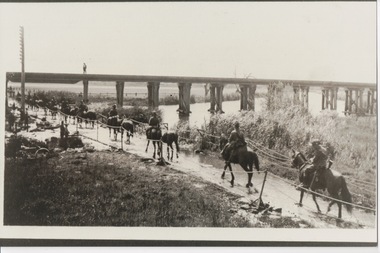
Photograph, Set 4 photographs. and others for Torquay Light Horse camp, 1940
... References: Australian Light Horse Association www.lighthorse.org.au National Australia Archives Australian War Memorial Surf Coast Shire WW1 memorials www.togethertheyserved.com The Light horse- a Cavalry under Canvas Light Horse, Training Camp, Torquay, WW2 Late in 1939 it was decided to set up a Lighthorse training camp in Torquay to train both men and horses for the battles of the Second World War. ...References: Australian Light Horse Association www.lighthorse.org.au National Australia Archives Australian War Memorial Surf Coast Shire WW1 memorials www.togethertheyserved.com The Light horse- a Cavalry under Canvas Light Horse, Training Camp, Torquay, WW2 Late in 1939 it was decided to set up a Lighthorse training camp in Torquay to train both men and horses for the battles of the Second World War. ...These images capture for all time Light Horsemen travelling through Geelong on their way to camp at Torquay for the last Group meeting in Australia . information following - details obtained from .........https://torquayhistory.com/light-horse-brigade/ On Australia Day, 1997, Sir John Young unveiled this plaque on Point Danger, Torquay. Torquay history, Light Horse Training Camp, WW2 Plaque at Pt. Danger Note----- (See images to view plaque) The plaque identifies a significant event in Torquay’s history and the sentiments of ‘change’ for the Light Horse Brigade – from horses to machines. In 1940 the four Light Horse Regiments (4th, 8th, 13th and 20th), some 5000 Light Horse and 2000 horses camped and trained at Torquay. Three other regiments, formerly mounted on horses, were also at Torquay ‘mounted’ on privately owned trucks and cars. Division troops included Artillery, Engineers, Signals, Field Ambulance and other branches of the Army necessary to enable a Division to function. It wasn’t just the sheer numbers of men coming to this little town that made the event significant, it was also the fact that the men of the Light Horse were dramatic, almost glamorous figures and it is easy to see their exploits as some splendid adventure. Horses have played a special role in the story of Australia. They were the only means of transport across this huge country, so it was necessary for everyone to have the ability to ride a horse. When war broke out in 1899 between Britain and the Boers of South Africa (“Boer” was Dutch for “farmer”) Australia sent troops to fight. At first Britain was wary of using untried, unprofessional colonial cavalrymen but soon saw that the slouch-hatted Australian “bushmen” were a match for the fast-moving and unconventional mounted commandos of the Boers. The Australians proved themselves to be expert rough-riding horsemen and good shots. Bush life had hardened them to go for long periods with little food and water. They also showed remarkable ability to find their way in a strange country and use its features for cover, in both attack and defence. By 1914, when Australia joined the war against Germany, there were 23 Light Horse regiments of militia volunteers. Many men from these units joined the Light Horse regiments of the Australian Imperial Force (AIF). Men were given remounts (if not using their own horses) – army horses bought by Commonwealth purchasing officers from graziers and breeders. These were called “walers” because they were a New South Wales stockhorse type – strong, great-hearted animals with the strains of the thoroughbred and semi-draught to give them speed, strength and stamina. On 1st November, 1914, Australia’s First Infantry Division and the first four Light Horse regiments sailed for England in a fleet of transport ships. The first of the Light Horse arrived at Gallipoli in May without their horses. Back with their horses after Gallipoli, they were formidable combatants across the Sinai and Palestine. Some British commanders observed that the light horseman moved with a “lazy, slouching gait, like that of a sleepy tiger” but described how the promise of battle “changes that careless gait, into a live athletic swing that takes him over the ground much quicker than other troops”. They had Light Horse, Torquay, training campdeveloped a reputation as formidable infantrymen. The Turks called them “the White Ghurkas” – a reference to their deadly skill with the bayonet. The Arabs called them “The Kings of the Feathers”. The plume had originally been a battle honour of the Queensland Mounted Infantry for their work in the shearer’s strike of 1891. During WW1 it was adopted by almost all the Light Horse Regiments. It was the proud badge of the light horseman. The most famous of their battles was the attack on Beersheba- the charge of the 4th Light Horse Brigade. Mounted infantrymen and their superb walers had carried out one of the most successful cavalry charges in history – against what seemed impossible odds. They surprised the Turks by charging cavalry-style, when they would normally have ridden close to an objective then dismounted to fight. The fall of Beersheba swung the battle tide against the Turks in Palestine; and changed the history of the Middle East. While 19 men from the Surf Coast Shire served with the 4th Light Horse over the course of WW1, only four were involved in the charge of Beersheba- John GAYLARD, Philip QUINN.(Winchelsea); Wallace FINDLAY (Anglesea); Harry TRIGG (Bambra). After the war, Light Horse units played a key role in the Australian Government’s compulsory military training programme. The Citizen Military Forces (C.M.F.) thrived on the glamour of the wartime Light Horse tradition, ignoring the possibility that motor vehicles would soon replace the horses. When training was no longer compulsory, the C.M.F. regiments declined and horses became more of a luxury during the 1930s depression years of poverty and unemployment. Some regiments were motorised. Then, in 1939, Australia joined Britain in another world war. Training was increased for the militia at both home bases and regional training camps. The camp at Torquay in 1940, commanded by Major General Rankin, was at Divisional strength. By the end of the camp some felt that the Division was ready for active service. Gradually, over the next four years, the Australian Light Horse units were mounted on wheels and tracks and the horses were retired. Six men enlisted at the Torquay camp and another 57 men and women enlisted at Torquay for service in WW2. Those who served in the Militia provided valuable Officers and NCOs and men for the armed services during the war. Each infantry division of the 2nd AIF had a Light Horse regiment attached to it. But the day of the Australian mounted soldier hadn’t quite passed. During World War II, Australia’s 6th Cavalry Regiment formed a mounted unit they called “The Kelly Gang” which did valuable scouting work. In New Guinea, a mounted Light Horse Troop did patrol duty and helped carry supplies. Some fully equipped walers were flown into Borneo for reconnaissance in rugged mountain country. But by the end of the war, in 1945, the horse had disappeared from the Australian Army. References: Australian Light Horse Association www.lighthorse.org.au National Australia Archives Australian War Memorial Surf Coast Shire WW1 memorials www.togethertheyserved.com The Light horse- a Cavalry under Canvas Light Horse, Training Camp, Torquay, WW2 Late in 1939 it was decided to set up a Lighthorse training camp in Torquay to train both men and horses for the battles of the Second World War. Horses, men and equipment came on special trains from all over Victoria and NSW, and as you would expect horseman came from areas such as Omeo and Sale, the Wimmera and the Western District. They arrived at the Geelong racecourse for watering in the Barwon River and then were ridden across the ford at the breakwater and began their 11 mile trek to Torquay. Light Horse, Training Camp, Torquay, WW2 Tent city By the end of January 1940 the camp at Torquay accommodated some 5000 men and 2500 horses of the Second Cavalry Division. The rows of horses, tents and huts near Blackgate Road were quite a sight. While the cavalrymen engaged in exercises on the land and on the beaches, many of the troops took over the Torquay School for special training of men and officers. Mr Bob Pettit local farmer and Councillor for the Barrabool Shire, wrote about the Light horse in the Surf Coast Community News in 1985 saying “They used to travel about the district riding four abreast in one long convoy. To my annoyance they went through my property and shut all the gates behind them. I had certain gates open to let stock in to the water holes and it would take me three -quarters of an hour to follow the horsemen up and put all the gates right again” he continued “the men from the Light Horse were here when the fire went through in March 1940. He recalled an incident when early one morning, as some one blew the bugle, a soldier putting a white sheet on the line frightened the horses. They panicked and ran off in all directions. Six went over the cliff near Bird Rock, five were never found, and the rest were gathered up after nearly a fortnight in the bush around Addiscott and Anglesea" Light Horse, Training Camp, Torquay, WW2, Geelong Parade Geelong parade The training camp culminated in a parade through the streets of Geelong on March 12th 1940. The salute was given at the Town Hall and the troops continued on a route to the You Yang’s for a training exercise. Note-----(see media section for photograph) The Camp was abandoned in mid 1940 as it was deemed unsuitable for training during winter and the cost of a permanent camp could not be justified if it could not be used all year. Historic.......Rare,,,Interpretive.Sepia photographs.set of four ....post card size ....Horses &LighthorsemenNo 1, Lighthorsemen Regiment Geelong 1940......No 2 Light Horse at Breakwater Geelong 1938 to 1940....No 3 Light Horse at Breakwater Geelong 1938 to 1940.....No 4 Light Horse crossing Breakwater camped at Geelong Showgrounds. These markings are on reverse of photographs.light horsemengeelong 1940., world war 2 -
 City of Melbourne Libraries
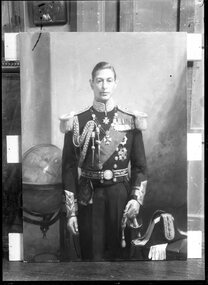
Photograph, Bull, Hugh Jones, 1897-1993, "A Royal Portrait" (Duke of York), 1933
... Retrieved April 4, 2025, from http://nla.gov.au/nla.news-article223616143 National Archives of Australia, Aboriginal [Jimmy Clements, a Wiradjuri elder] on steps of Parliament House (King Billy), https://recordsearch.naa.gov.au/SearchNRetrieve/Interface/ViewImage.aspx?...Retrieved April 4, 2025, from http://nla.gov.au/nla.news-article223616143 National Archives of Australia, Aboriginal [Jimmy Clements, a Wiradjuri elder] on steps of Parliament House (King Billy), https://recordsearch.naa.gov.au/SearchNRetrieve/Interface/ViewImage.aspx? ...Published: The Age, Sat 14 October 1933 Published title: A Royal Portrait Published caption: "Seen at his studio, Alphington, Mr. W. B. Mclnnes's portrait of the Duke of York, which he painted recently on commission from the trustees of the Castlemaine Gallery, at St. John’s Wood, London, impresses as a vital record of one whose natural habitat is a palace, and whose place in life is one of near relationship to the throne of England. The Duke is painted in the uniform of the admiral of the fleet, a highly ornate vesture entailing much elaboration of gold and numerous medals, in dealing with which the artist has not failed to centre his attention on the head, and has succeeded in producing what is undoubtedly a soundly painted portrait and a good likeness. During the five fittings Mr. Mclnnes, apart from the ordinary social amenities, found his Royal sitter little inclined to talk, though he spoke feelingly of his trip to Australia and the pleasure it had given him: but with the Duchess the tendency to be sociable was much more clearly pronounced. She took, and expressed, a keen interest in the social and political matters of the day with a special concern for the supremacy of England and Australia in all questions relating to sport, such as cricket, tennis and golf. She spoke well of her portrait painted by Quinn, and regretted that she would not see the two hung side by side at the Castlemaine Gallery." Description: An unframed painting of a standing, middle-aged man dressed in the uniform of a Royal Navy admiral of the Fleet with medals, sash, ornate belt, cuffs and epaulettes. His left hand rests on the handle of a sword in its scabbard and his bicorn hat and white gloves are on a table beside him. To his right is a globe of the world showing Australia. Research by project volunteer, Fiona Collyer: In 1933, Castlemaine Art Gallery trustees commissioned artist W.B. McInnes (1889-1939) to paint a portrait of Prince Albert, Duke of York as a companion piece to the portrait of his wife, the Duchess of York, that the gallery had commissioned Australian official war artist James Quinn (1869-1951) to paint in 1930. During the First World War, the Duchess’s childhood home, Glamis Castle in Scotland was used as a makeshift military hospital and convalescence home for wounded soldiers. Many servicemen from the Castlemaine area recuperated there and had fond memories of the kindness of the teenage Lady Elizabeth Bowes-Lyon (1900-2002, later Duchess of York) who spent the war years running errands and aiding in the welfare and morale of the patients. In 1927, the Duke and Duchess of York (later King George VI and Queen Elizabeth) came to Australia to formally open the newly built Parliament House in Canberra and to tour the country. While visiting Victoria in April, they embarked on a whistle-stop train journey to Bendigo, stopping at Kyneton for ten minutes and Castlemaine for 15 minutes. At Kyneton, an excited crowd of 10,000 people welcomed the couple with “three cheers and three cheers for Baby Betty” before the Duchess was presented with a bouquet of locally grown roses and the Duke a bound album of photographs of noted beauty spots of the district. Next the Royal Couple stopped at Castlemaine to the cheers of 15,000 people. There the couple were presented with a basket of prime quality Harcourt apples and a pair of cot blankets, manufactured at Castlemaine Woollen Mills, a birthday gift for baby Princess Betty. The Duchess recognised Colonel W.E. James, of the Seventh Battalion, who had convalesced at Glamis Castle in 1917, and they chatted before the train departed, while the Duke shook hands with returned soldiers. Last stop was the town of Bendigo which was colourfully decorated with bunting and flags, arches and flowers. 3000 pigeons were released on their arrival and the liberated birds circled overhead for several minutes as if to welcome the Royal Couple. A crowd of 50,000 cheering people lined the streets in bright sunshine as the couple drove by. From an arch over Hargreaves Street, pretty girls showered the pair with rose petals. The Duke was presented with a gold nugget and an album, handsomely bound in morocco, of a history of the Bendigo mining industry, while the Duchess received a bouquet of prize winning white chrysanthemums. After 75 minutes in Bendigo they journeyed back to Melbourne for a State reception. While the couple were in Melbourne, the Duke often played lawn tennis at the Government House courts with three times Grand Slam champion Norman Brookes, who declared that while he considered the Duke a second class player whose serve lacked sting, he had a fine backhand and with time and practice he could become a first class player. The federal Parliament had previously been situated in Melbourne, but Canberra was chosen as the location for Australia’s capital as a compromise between fierce rival states, Victoria and NSW. It is written in the Constitution that the federal capital would be in “the State of NSW... distant not less than one hundred miles from Sydney.” The word Canberra is thought to derive from the local Ngunnawal word “Kanbarra” meaning “meeting place”. The Provisional Parliament House was a large, white, three storey building facetiously dubbed “The Wedding Cake”, plonked down in a bare, former sheep paddock. It was decorated for the event with Union Jacks and Australian red ensign flags. On 9 May, the day of the opening, the expectant crowd assembled in front of the building. Only two of the spectators were Aboriginal. One was Jimmy Clements (1847-1927, aka Nangar or Yangar, but popularly known as “King Billy”), accompanied by his three dogs. (The title “King” or “Queen” was often given by white settlers to Aborigines who were seen as allies and could maintain good relations between First Nations groups and the colonists. Some were given inscribed brass breastplates or gorgets to wear.) Jimmy was an excellent horse breaker and expert tracker for the police. He was also the nephew of “Queen” Nellie Hamilton (1842-1897) of the Canberra-Queanbeyan region, home of the Ngambri and Ngunnawal people. Nellie was the oldest surviving full-blooded Aboriginal woman in the district. The other was George John Noble (1840s-1928, aka Ooloogan, also “Marvellous” due to his regular use of the word). Both were initiated Wiradjuri walamira elders: “clever men” believed to have the ability to heal physical and spiritual ailments. They were also travelling showmen, skilled at boomerang and spear throwing and often performed at country agricultural shows and football matches. They had walked barefoot for three days from the Brungle Mission, near Gundagai. 11 May 1927, The Argus reported that “King Billy... claims sovereign rights to the Federal Territory” which the National Archives of Australia describes as “possibly the first recorded instance of Aboriginal protest at Parliament House in Canberra.” 10 May 1927, The Argus reported on Jimmy Clements: “During the wait great interest was taken in the appearance near the east stand of an aborigine, a member of the Gundagai tribe, and a well known character in the district. He was very old and grey and ruggedly picturesque. He was determined to go his own way in spite of the arguments of two inspectors and one sergeant of police. Immediately and instinctively the crowd in the stands rallied to his side. There were choruses of advice and encouragement for him to do as he pleased. A well-known clergyman stood up and called out that the aborigine had a better right than any man present to a place on the steps of the House of Parliament and in the Senate during the ceremony. The old man’s persistence and the sympathy of the crowd won him an excellent position and also a shower of small change that must have amounted to 30/ or 40/ [shillings].” At 10.30 am, Australia’s eighth Prime Minister, Mr Stanley Bruce (1923-1929) welcomed the Royal couple onto the crimson carpeted portico. Unfortunately, Dame Nellie Melba’s rendition of “God Save the King” and the greater part of the Duke’s reply was drowned out by the roar of squadrons of aeroplanes circling overhead. A brief religious service followed, conducted by leaders of the Methodist, Presbyterian and Anglican churches. Interestingly, there was no Roman Catholic representation at the ceremony even though around one quarter of Australians were Catholic at the time. The Duke unlocked the front doors with a golden key, then unveiled a statue of his father King George V by sculptor Sir Bertram Mackennal in the King’s Hall. Then the official party, Senators, members of the House of Representatives and invited guests entered the Senate chamber where the Duke read a message from the King, establishing Canberra as the seat of the Federal Government, watched on by Australia’s elite. The conclusion of the ceremony was announced by a gay fanfare of trumpets from the entrance of Parliament House and a 21 gun salute and answered by cheers from the crowd. The dignitaries then feasted on a luncheon of turtle soup, poached schnapper, fillets of beef, roast chicken and ham, straw potatoes, green peas, Canberra Pudding (a pudding made with dripping, dried fruit and jam), fruit, ices, coffee and cheese. They toasted the King with non-alcoholic fruit punch as the Federal Capital Territory (later ACT) was a “dry” area and no speeches were made. The diary entry that day of Ethel Baird, Lady Stonehaven, the wife of the Governor-General, is brief and to the point: “To P.H. & waited for Yorks. Ceremony went off without a hitch. Ghastly Banquet Lunch.” Later that day, the Duke mounted a coal black mare, police horse Number 303 which had been hastily re-named “Black Bess” for the occasion, to receive the final salute from the assembled troops and returned soldiers dressed in mufti. The RAAF squadron were flying overhead in “V” formations when suddenly, one of the planes, piloted by Flying Officer Francis Charles Ewen, left the formation, nose-diving 900 metres from Parliament House and landing behind the Y.W.C.A. refreshment marquee. Francis, aged only 28, tragically died of his wounds later that day. The Federal Capital Commission contracted Sargent’s Pies of Sydney to supply 5000 meals for the event. They supplied pies, sausage rolls, scones and sandwiches with the agreed price of 3 shillings a head. Only 1200 meals were served and the uneaten remainder dumped, with the Commission bearing the cost of the unsold food. An estimated crowd of 20,000 attended the opening, far fewer than the expected 100,000. Many visitors travelled long distances, bringing their own hampers of food and camping in tents as there was very limited accommodation available. Thousands of people around Australia listened to the ceremony broadcast on the wireless, with receiving sets installed in schools, public halls and workplaces and it was also filmed for posterity. The next morning, the Royal couple, along with Prime Minister Bruce and Mrs Bruce held an informal public reception on the steps of Parliament House where early settlers, residents and visitors to Canberra filed past them. The Press widely reported Jimmy Clements’ encounter with the Duke and Duchess. The Sun-Pictorial reported 11 May 1927: "MET THE DUKE. ABORIGINE KING HE APPROVED Sugarbag: Sports Suit. John Clements, otherwise King Billy, a full blooded aborigine king, aged 86, was among the 2000 who filed past the Duke and the Duchess at the public reception at Canberra to day. “How you likem Duke and Duchess Billy?” he was asked afterwards. “I think they are both very nice.” he replied in good English. King Billy was a very bedraggled figure, with tangled locks and a beard which almost hid his wrinkled and black face. He wore an old sports suit and carried a sugarbag. Passing the Duke and Duchess he turned full towards them. The crowd cheered, and the Duke and Duchess smiled. The Duke was particularly amused.” The Canberra Times reported 13 May 1927: "A REAL AUSTRALIAN. A quaint but pathetic figure stood in broad relief in the queue of ranks at the reception. Where his dusky forbears have gathered in native ceremonial for centuries past, a lone representative of a fast vanishing race saluted visiting Royalty. Despite the grotesque garb and untamed mane the aborigine comported himself not without dignity. With his three faithful dogs, he made an immediate target for a battery of cameras.” "The Argus reported 11 May 1927: "...an ancient aborigine who calls himself King Billy and who claims sovereign rights to the federal Territory walked slowly forward alone and saluted the Duke and Duchess. They cheerily acknowledged his greeting. The old aborigine, with his long, matted beard and nondescript clothing, is a popular identity of Canberra, and must be one of the most extraordinary figures who has received a Royal salute.” The Sun (Sydney) reported 10 May 1927: “Suddenly, in the midst of the forest of green and white colored hats of women, appeared a head with a shaggy leonine mane and a patriarchal beard. Jacky, the aboriginal, an identity of the district, who is also known as the King of Canberra, had arrived to testify to his loyalty. He saluted the Duke with an excellent dash, and shambled past with his faithful sheep dog aide-de-camp at his heels. The Duke and Duchess were highly amused at this quaint figure moving along with a sort of bodyguard of shrieking young boys and girls.” The Sydney Morning Herald 11 May 1927 mistook Jimmy for his friend “Marvellous”: “...the appearance of an aged aboriginal widely known in the district as “Marvellous, the uncrowned king of Queanbeyan." His beaming black countenance was almost hidden beneath a shock of hair and beard. Bare-footed and carrying a sugar bag in one hand and a tiny Australian flag in the other, he at first mistook a policeman at the foot of the steps for the Duke. To his great embarrassment and to the vast amusement of the onlookers, the policeman became the object of a hearty salutation. However, "Marvellous" was quickly shepherded back to a position in the procession and as he passed along brought his hand up to an approved military salute for the benefit of their Royal Highnesses. The Duke returned it with a special wave.” The Labor Daily 11 May 1927 irreverently reported on the scene: "People March Past. Some 400 people, old identities of Canberra marched past. They were mostly aged ladies with memories faithfully preserving the traditions of other days and curtsied reverently. The younger generations, who speedily joined the procession, behaved differently however. Surely it was the most motley collection that ever passed before Royalty. Men without collars jostled others well dressed. Fat women, young women, children of all heights and ages were there. The oldest inhabitants, in the persons of the abo, "Marbly", and his companion were present. The poor old fellows evidently were keen to get closer to the Duke than the procession dared go, but they were overawed by the stern glances of military men.” The Canberra Times reported 13 May 1927: "...and towards the end of the procession, a full-blooded aboriginal, bareheaded and barefooted, and carrying an old swag on his back, made a picturesque figure as he several times saluted the Royal couple, his old eyes beaming inexpressible delight.” The Register reported 11 May 1927: "PUBLIC MARCH PAST. Old “Jacky”, an aboriginal identity of the district, who has been following the proceedings of the various ceremonies with apparently great interest, appeared in the march past. He halted in front of the steps and raised his hand to his shaggy grey locks in an attempt at a salute. Smiling, the Duke returned the salute, and the Duchess bestowed a charming smile on the figure of mingled pathos and comedy.” Tweed Daily reported 12 May 1927: “King Billy” WAS THERE. Appropriately enough, the inevitable “King Billy” with his refreshing impression of possum and gum-leaves, was present at the dedication of the Federal capital at Canberra. Bare-footed, in a dingy old suit and battered felt hat, he wandered on to the empty stand after the illustrious assemblage had passed into Parliament House. A desolate figure in all that he stood for, he proved, an amiable representative of the dispossessed race. He cheerfully waved a Union Jack for the camera man, and grinned into the very eye of a movie man’s camera without flinching.” Footage of Jimmy filmed that day features in the film “The Birth Of White Australia” produced in 1928 and shows him enthusiastically waving a small Union Jack flag in front of Parliament House with his three dogs at his feet. The caption reads " "King Billy" calls for cheers for the son of the great white King across the seas. “Mine tinkit that pfellers father budgeree King liket me” supposedly says Jimmy." Jimmy told the Daily Telegraph, 13 May 1927 “I have opened your Parliament House on my own ground, now you can go and look at it." Jimmy died on 28 August 1927, aged 80. The Herald newspaper on 30 August 1927, published an illustration depicting Jimmy’s dog standing on his grave, his customary chimney pot hat leaning on his headstone. The caption reads: “The Dead King — His Only Mourner. Drawn by Will Dyson (King Billy, last of the Canberra aborigines, lived just long enough to see the Duke of York open Australia’s capital on the site where his tribe once roamed. He died in the Queanbeyan Hospital yesterday morning.)” A letter published in the Sydney Morning Herald, 19 September 1927 reported: "Old King Billy... Sir, ...I would like to mention... the passing away of one, if not the last remaining aboriginal chieftains. He may be called “Old King Billy,” and his death occurred here in Queanbeyan a few weeks ago. The removal of this well-known black has left another big gap in all that remains distinctively Australian in character. He was one of the last remaining tribe of the Monaro district, and one of the most predominant personalities throughout the Commonwealth. ...he had lived through 80 years all told. He was on many occasions sought by artists for his splendid physique and personality as a model, and many a journey he has had to make to Sydney on that account. A more striking and pronounced type could not be found. ...A very fine cast in lifelike form is to be seen in the Australian Museum, Sydney ...his last important appearance in public was at the Commonwealth celebrations at Canberra, to which territory he partly belonged. ...we have no aborigine statue chiselled to the memory of their race, a more fitting and lasting memorial could not be undertaken than to have one modelled from this fine figure and erected to the memory of his race at Canberra... It would be a fitting adornment if planted with the Australian gumtrees for any avenue or garden. [King Billy] ...a very intelligent fellow, responding readily to kindness and common sense. Hoping yet to see a befitting testimonial and a lasting memorial to a race that is rapidly and I may say, unfortunately, disappearing, I am etc., SYDNEY R.OAKLEY, Queanbeyan." The “lifelike form” referred to by the correspondent was a sculpture that Jimmy Clements had posed for: “The Wunderlich Aboriginal Group” for The Australian Museum in Sydney. In 1925, Mr Ernest Wunderlich, director of Wunderlich Limited, manufacturer of building materials and President of the Board of Trustees at The Australian Museum, commissioned renowned sculptor George Rayner Hoff (sculptor of the Anzac Memorial in Hyde Park, Sydney, National War Memorial in Adelaide, and “Lion” the original Holden Motor Company car emblem) to sculpt a life sized Aboriginal family group diorama as a gift to the Museum. There was much concern at this time that the Aboriginal population and especially the “full blooded” were fading into oblivion so fast that they may soon become extinct. Three “full blooded” Aborigines were chosen for models. An article in The Australian Museum magazine, July/September 1926 about The Wunderlich Aboriginal Group explained “...it will not be many years before the aborigine, in New South Wales and Victoria at least, will be an entity of the past. Every year sees a shrinkage in their number, and the coastal tribes that once roamed the Sydney district are, unfortunately, no longer with us. ...the man, who is hurling a boomerang, is Yangar, or “Jimmy Clements,” son of Gayan-Bleuet-Galoom, the late “King of Orange,” western New South Wales. “Jimmy” is an old man, but well preserved. He has a very retentive memory and recollects the various tribal customs and initiation ceremonies, but regarding these he is extremely reticent and will not communicate his “honoured secrets.” The female figure is “Nellie Walker,” a daughter of Geri-Bungel, and a native of Bombala, Monaro district, southern New South Wales. The boy is Harold Marsh, aged nine years, who was born at Kinchela, Macleay River, northern New South Wales. He is now living at the Brewarrina settlement... In the selection of aborigines great care had to be taken to ensure that the individuals were pure bloods, and to the Aborigines’ Protection Board and the Police Department of this State thanks are due for the valuable assistance rendered by them.” Ngarigo woman, Nellie Bungil Walker (1867-1932) had five children, two died as babies and her remaining children were taken from her. She worked as a domestic and was living at La Perouse Aboriginal Community, Sydney at the time of her sculpture’s creation. In the years after the sculpture was made, Nellie and Rayner remained friends. Yaegl boy Harold “Harry” Marsh was from the Kinchela Aboriginal Training Home for boys near Kempsey, (1924-1970), an agricultural training institution under the jurisdiction of the Aboriginal Protection Board to house Aboriginal boys forcibly removed from their families “in the interest of the moral or physical welfare” of the boys. The boys at Kinchela were aged 5-15 years old and referred to as numbers, not names and any connection to Aboriginal culture or language was forbidden. Brutal and cruel physical punishment and sexual assaults were rampant. Survivors recall being flogged and chained naked to a huge Morton Bay fig tree overnight or “sent down the line” where every boy was ordered to punch the “wrong doer” as hard as possible for fear that they would be next. The Kinchela children are acknowledged as part of the Stolen Generation. In 1925, Rayner Hoff created a terracotta bust “Harry Marsh” which is in the collection of the Art Gallery of New South Wales. The figures of the trio were modelled in clay before being cast in plaster and hand-coloured by Museum artist Miss Ethel A. King. The finished figures were completed with wigs and fur pelts and with Jimmy hurling a boomerang and Nellie holding a dilly-bag. They were placed in a glass cabinet in the Australian Ethnology Gallery. The subjects were not named. The Sydney Morning Herald 1 July 1926 critiqued the sculptures. "A GROUP OF STATUARY. MUSEUM’S ACQUISITION. Artistically the group is very fine, for the sculptor has caught his subjects in attitudes that reveal all the stalwart athletic lines of their bodies... The man, who is depicted as about 60 years of age, is bearded, immense, and savagely primitive-is throwing a boomerang, and beside him a boy, aged about 11 years is following beneath a shading hand, the flight of birds at which the hunter aims. Behind them, patient, obedient, stand(s) the woman waiting with her dilly bag to gather the spoils.” In 1996, Nellie’s daughter, Victoria Kempsey née Walker, happened to visit The Australian Museum and saw the sculpture of her mother, displayed semi-naked in a glass cabinet, alongside glass cabinets of taxidermied animals. She had last seen her mother 62 years previously when Nellie was dying from tuberculosis. Greatly distressed, Victoria wrote to the Museum requesting that they remove the sculpture, which they did. In 2023, a documentary was produced called “Her Name Is Nanny Nellie” which follows the journey of Nellie Walker’s great-granddaughter Auntie Irene Ridgeway discovering Nellie’s story, honouring her life and restoring her sculpture. Irene told Refinery29 Australia that “It was about reclaiming her life, reclaiming her history and who she really was as a real person. She was not a naked and unnamed lady standing in a museum. It's giving them back their families, they weren't just there to be looked at as flora and fauna or as 'natives'." The documentary was written and directed by Irene’s son Daniel King and premiered at the 2023 Adelaide Film Festival and broadcast on NITV. The restored sculpture of Nellie, dressed in 1920s style clothing was displayed at The Australian Museum, Sydney in The Bayala Nura Gallery in 2023. Irene wanted Nellie to be depicted in the way she actually was when she posed for the sculpture in 1925. The other two sculptures were not displayed due to ongoing conversations with family members and the fragility of the sculptures. It is anticipated that they may be displayed in the future. Melbourne born William Beckwith (Bill) McInnes (1889-1939) studied drawing at National Gallery School in Melbourne from the age of 14 under the tuition of artist Frederick McCubbin before succeeding his former teacher as Master of Drawing at the School from 1916-1934. He was acting Director of the NGV and Head of the National Gallery School from 1934. In 1927, Bill and official war artist H. Septimus Power were commissioned to paint the opening of the new federal Parliament House in Canberra. Septimus painted the general scene of the arrival of the Royal entourage in front of Parliament House, while Bill depicted the ceremony inside the Senate chamber. Bill was widely acclaimed for his landscapes and lauded as the heir to great Australian landscape artist Arthur Streeton. He won the Archibald Prize seven times (including the inaugural, a portrait of architect Desbrowe Annear) which made him a highly sought after portrait painter and he earned kudos for his commission to paint the Duke of York. During the breaks in painting the portrait, the pair chatted and Bill was surprised by the Duke’s wide knowledge of Australian affairs. The Duke was particularly interested to hear how the rabbit crisis was being handled. Bill’s work is held in major Australian galleries including the NGV, which has 12 of his paintings in their collection. Bill was married to fellow artist Violet McInnes and they lived at “The Poplars” in Alphington with their six children. Violet painted still life of flowers and portraits. In 1941, she entered her portrait of fellow artist Sybil Craig into the Archibald Prize and in 1945 Violet was appointed an official war artist. Defending his traditional style Bill said “...we in Australia have not been bitten by Cubism or Futurism or other of the “isms”...and I am glad of it”. References: THE DUCHESS OF YORK. (1931, December 7). The Argus (Melbourne, Vic. : 1848 - 1957), p. 8. Retrieved April 3, 2025, from http://nla.gov.au/nla.news-article4427568 WAR NURSE (1930, March 11). The Sun (Sydney, NSW : 1910 - 1954), p. 1. Retrieved April 3, 2025, from http://nla.gov.au/nla.news-article223714728 The Royal Visit. (1927, April 29). The Age (Melbourne, Vic. : 1854 - 1954), p. 9. Retrieved April 4, 2025, from http://nla.gov.au/nla.news-article205813465 Canberra. (1927, April 30). Advocate (Burnie, Tas. : 1890 - 1954), p. 5. Retrieved January 10, 2025, from http://nla.gov.au/nla.news-article68233606 Australian Dictionary of Biography, Nangar, https://adb.anu.edu.au/biography/nangar-33736 Australian Dictionary of Biography, Jimmy Clements, https://en.wikipedia.org/wiki/Jimmy_Clements Wikipedia, George John Noble, https://en.wikipedia.org/wiki/George_John_Noble PARLIAMENT AT CANBERRA. (1927, May 14). The Australasian (Melbourne, Vic. : 1864 - 1946), p. 37 (METROPOLITAN EDITION). Retrieved December 25, 2024, from http://nla.gov.au/nla.news-article140733921 CANBERRA CEREMONY (1927, May 10). The Argus (Melbourne, Vic. : 1848 - 1957), p. 19. Retrieved November 3, 2024, from http://nla.gov.au/nla.news-article3853643 CANBERRA. (1927, May 11). The Argus (Melbourne, Vic. : 1848 - 1957), p. 20. Retrieved November 24, 2024, from http://nla.gov.au/nla.news-article3853897 THE FINAL SCENES (1927, May 11). The Labor Daily (Sydney, NSW : 1924 - 1938), p. 5. Retrieved January 10, 2025, from http://nla.gov.au/nla.news-article236614453 TWIN SONS (1927, May 10). The Sun (Sydney, NSW : 1910 - 1954), p. 11. Retrieved April 4, 2025, from http://nla.gov.au/nla.news-article223616143 National Archives of Australia, Aboriginal [Jimmy Clements, a Wiradjuri elder] on steps of Parliament House (King Billy), https://recordsearch.naa.gov.au/SearchNRetrieve/Interface/ViewImage.aspx?B=3050026 Sydney Morning Herald, The chant of Jimmy Clements: I’ll do the honours on my ground, thanks, https://www.smh.com.au/national/the-chant-of-jimmy-clements-i-ll-do-the-honours-on-my-ground-thanks-20241023-p5kkt5.html MET THE DUKE (1927, May 11). The Sun News-Pictorial (Melbourne, Vic. : 1922 - 1954; 1956), p. 14. Retrieved November 3, 2024, from http://nla.gov.au/nla.news-article275177101 PUBLIC MARCH PAST. (1927, May 11). The Register (Adelaide, SA : 1901 - 1929), p. 11. Retrieved April 2, 2025, from http://nla.gov.au/nla.news-article54271512 A REAL AUSTRALIAN (1927, May 13). The Canberra Times (ACT : 1926 - 1995), p. 12. Retrieved December 18, 2024, from http://nla.gov.au/nla.news-article1213124 THE PEOPLE'S DAY (1927, May 13). The Canberra Times (ACT : 1926 - 1995), p. 3. Retrieved April 3, 2025, from http://nla.gov.au/nla.news-article1213105 KING BILLY" WAS THERE. (1927, May 12). Tweed Daily (Murwillumbah, NSW : 1914 - 1949), p. 2. Retrieved November 27, 2024, from http://nla.gov.au/nla.news-article190193273 A BUSY DAY. (1927, May 11). The Sydney Morning Herald (NSW : 1842 - 1954), p. 15. Retrieved November 3, 2024, from http://nla.gov.au/nla.news-article16374845 Nothing Wrong With Canberra Opening, Says "King Billy" (1927, May 13). The Daily Telegraph (Sydney, NSW : 1883 - 1930), p. 2. Retrieved November 3, 2024, from http://nla.gov.au/nla.news-article245750627 THIS IS MARVELLOUS! (1927, May 11). The Sun News-Pictorial (Melbourne, Vic. : 1922 - 1954; 1956), p. 16. Retrieved December 9, 2024, from http://nla.gov.au/nla.news-article275177155 Mildenhall's Canberra, Royal Visit, May 1927. Canberra citizens passing the Royal Party on the front steps of Parliament House at the Civic Reception 1927 [photograph], https://mildenhall.moadoph.gov.au/rephoto/62 Australian Dictionary of Biography, 1927 - Jimmy Clements, John Noble, and the Opening of Parliament House, https://adb.anu.edu.au/the-quest-for-indigenous-recognition/jimmy-clements YouTube, The Birth of White Australia (1928), amateurish racism on the big screen [Jimmy Clements at 11.12 minutes in], https://www.youtube.com/watch?v=OByX4iPsTgo YouTube, We Were Just Little Boys, https://m.youtube.com/watch?v=u4Hw9d91k2E WASTE AT CANBERRA. (1927, May 20). The South Eastern Times (Millicent, SA : 1906 - 1954), p. 1. Retrieved April 4, 2025, from http://nla.gov.au/nla.news-article200058308 YouTube, Museum of Australian Democracy at Old Parliament House, Whispers in the Corridors-An Aboriginal Presence, https://www.youtube.com/watch?v=fwifXP61M5Y History Snoop, Air Fatality in Canberra Scars an Historic Day in Australia, https://www.historysnoop.com/air-fatality-in-canberra/ YouTube, NFSA Films, The Opening Of Canberra, Australia's Capital City, https://www.youtube.com/watch?v=pOA8llA0iE0 Pauline Conolly, Pudding & Pies at Parliament House, https://paulineconolly.com/2022/pudding-and-pies-at-parliament-house/ THE MENU (1927, May 5). The Sun (Sydney, NSW : 1910 - 1954), p. 13 (FINAL EXTRA). Retrieved April 2, 2025, from http://nla.gov.au/nla.news-article223623278 PROMISING (1927, May 7). The Sun (Sydney, NSW : 1910 - 1954), p. 2. Retrieved December 15, 2024, from http://nla.gov.au/nla.news-article223616208 The Dead King -- His Only Mourner (1927, August 30). The Herald (Melbourne, Vic. : 1861 - 1954), p. 6. Retrieved November 3, 2024, from http://nla.gov.au/nla.news-article244196114 The VOICE of the CITY (1927, August 31). The Daily Telegraph (Sydney, NSW : 1883 - 1930), p. 4. Retrieved December 26, 2024, from http://nla.gov.au/nla.news-article246406061 THE LAST OF HIS TRIBE. (1927, September 2). Bairnsdale Advertiser and Tambo and Omeo Chronicle (Vic. : 1882 - 1946), p. 6. Retrieved December 24, 2024, from http://nla.gov.au/nla.news-article269318935 GONE WEST. (1927, September 17). The Irwin Index (Mingenew, WA : 1926 - 1956), p. 1. Retrieved December 23, 2024, from http://nla.gov.au/nla.news-article251554113 King Billy Dead. (1927, September 10). The Port Macquarie News and Hastings River Advocate (NSW : 1882 - 1950), p. 5. Retrieved December 1, 2024, from http://nla.gov.au/nla.news-article112534982 DEATH OF KING BILLY OF CANBERRA. (1927, September 16). Huon Times (Franklin, Tas. : 1910 - 1933), p. 5. Retrieved December 23, 2024, from http://nla.gov.au/nla.news-article136428435 OLD KING BILLY. (1927, September 19). The Sydney Morning Herald (NSW : 1842 - 1954), p. 5. Retrieved November 19, 2024, from http://nla.gov.au/nla.news-article16404722 "Marvellous" is Dead. (1928, March 30). The Gundagai Times and Tumut, Adelong and Murrumbidgee District Advertiser (NSW : 1868 - 1931), p. 2. Retrieved December 8, 2024, from http://nla.gov.au/nla.news-article122748136 LAST OF LACHLAN RIVER TRIBE (1926, May 3). Evening News (Sydney, NSW : 1869 - 1931), p. 7. Retrieved December 18, 2024, from http://nla.gov.au/nla.news-article117289515 Coal Strike Effects (1926, June 11). The Daily Telegraph (Sydney, NSW : 1883 - 1930), p. 14. Retrieved November 30, 2024, from http://nla.gov.au/nla.news-article245759732 SBS On Demand, Her name is Nanny Nellie, https://www.sbs.com.au/ondemand/movie/her-name-is-nanny-nellie/2300137539512 The Australian Museum Magazine, Vol. 2, No. 11, July-Sept 1926, The Wunderlich Aboriginal Group, https://shorturl.at/uViTe ABC News, King Billy and Marvellous were not invited to the 1927 opening of Parliament House — but that didn't stop their fight for sovereignty, https://shorturl.at/HGpjC Museum of Australian Democracy at Old Parliament House, The thieving diva: behind the scenes of the opening ceremony at Parliament House, https://www.moadoph.gov.au/explore/stories/heritage/the-thieving-diva-behind-the-scenes-of-the-opening-ceremony-at-parliament Refinery29, Beyond a museum glass case: one First Nations woman's quest to reclaim her ancestors' story, https://www.refinery29.com/en-au/my-name-is-nelly-documentary-irene-ridgeway-interview Sydney Morning Herald, Why it took 100 years to restore the dignity of Nanny Nellie, https://www.smh.com.au/national/why-it-took-100-years-to-restore-the-dignity-of-nanny-nellie-20230719-p5dpjo.html Australian Museum, Meeting Nanny Nellie, https://australian.museum/publications/explore_summer2024/nanny-nellie/ ABORIGINES. (1926, July 1). The Sydney Morning Herald (NSW : 1842 - 1954), p. 14. Retrieved November 29, 2024, from http://nla.gov.au/nla.news-article16302447 Wikipedia, Kinchela Aboriginal Boys Training Home, https://en.wikipedia.org/wiki/Kinchela_Aboriginal_Boys%27_Training_Home Art Gallery NSW, Harry Marsh by Rayner Hoff, https://www.artgallery.nsw.gov.au/collection/works/59.2000/ Art Gallery of South Australia, Lion (produced for the Holden Motor Company) by Rayner Hoff, https://www.agsa.sa.gov.au/collection-publications/collection/works/lion-produced-for-the-holden-motor-company/27253/ Wikipedia, William Beckwith McInnes, https://en.wikipedia.org/wiki/William_Beckwith_McInnes DUKE OF YORK PORTRAIT UNIVEILED IN CASTLEMAINE GALLERY (1933, December 4). The Sun News-Pictorial (Melbourne, Vic. : 1922 - 1954; 1956), p. 18. Retrieved April 4, 2025, from http://nla.gov.au/nla.news-article276125581 Castlemaine Art Museum, Portrait of His Royal Majesty the Duke of York, https://collection.castlemaineartmuseum.org.au/objects/181/portrait-of-his-royal-majesty-the-duke-of-yorkPhotographer notations on slide: "Portrait of Duke of York by W.B. McInnes 1933 B4".1930-1939, aboriginal culture, royal visits, openings (events), sculpture, land rights, museums, museum displays -
 Marysville & District Historical Society
THE TRIANGLE NEWS-VOL 40 NO 28-JULY 26 2013
... marysville victoria australia international delegates look to murrindindi leadership what's on when in august intrepid triangle bushwalkers the committee of management of the gallipoli park precinct creative triangle marysville community market captive bred regent honeyeaters put on a show at chiltern department of environment & primary industries marysville & district lions club water diving course (scuba) church notices new beginnings my hope for australia paster charles & marjorie lazaro from india councillor comment narbethong community hall free movie night marysville preschool hosts annual fundraiser footy-pie night taggerty community dinner pioneer reserve gets a minor makeover stolen wood piece of history to take root in shire murrindindi shire council the hovell tree school crossing safely the marysville historical society sharing community stories for historical archives real estate marysville football club reunion premiers 1973 black spur inn ugfm presents a taste of tamworth snags survey to guide work on victorian rivers mayor's chair australian grief and bereavement centre buxton fire brigade bushdance at buxton hall triangle community dance group lions-wood raffle have your say on new national parks regulations municipal public health and wellbeing plan 2013-2017 buxton recreation reserve notice of agm alexandra tennis club committee of management notice of agm THE TRIANGLE NEWS-VOL 40 NO 28-JULY 26 2013 ...marysville, victoria, australia, international delegates look to murrindindi leadership, what's on when in august, intrepid triangle bushwalkers, the committee of management of the gallipoli park precinct, creative triangle, marysville community market, captive bred regent honeyeaters put on a show at chiltern, department of environment & primary industries, marysville & district lions club, water diving course (scuba), church notices, new beginnings my hope for australia, paster charles & marjorie lazaro from india, councillor comment, narbethong community hall, free movie night, marysville preschool hosts annual fundraiser footy-pie night, taggerty community dinner, pioneer reserve gets a minor makeover, stolen wood, piece of history to take root in shire, murrindindi shire council, the hovell tree, school crossing safely, the marysville historical society, sharing community stories for historical archives, real estate, marysville football club reunion premiers 1973, black spur inn, ugfm presents a taste of tamworth, snags survey to guide work on victorian rivers, mayor's chair, australian grief and bereavement centre, buxton fire brigade, bushdance at buxton hall, triangle community dance group, lions-wood raffle, have your say on new national parks regulations, municipal public health and wellbeing plan 2013-2017, buxton recreation reserve notice of agm, alexandra tennis club committee of management notice of agm -
 Shepparton RSL Sub Branch
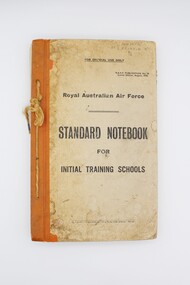
Book, Royal Australian Air Force, Standard Notebook for Initial Training Schools: Air Navigation, August 1942
... Roy Eliason's service history is well documented in the National Archives of Australia and this book provides an insight into a period of his service. ...This notebook contains information on air navigation and electrical science. It was issued to Roy Eliason (449852), a Shepparton local who enlisted in 1944 and served as a Leading Aircraftman with the 2nd Operational Training Unit Mildura. Contents include: Appendix I: Law, Discipline, Administration and Organisation, Hygiene and Sanitation, Notes on Meteorology, Definitions, The principles of flight, Airframes, Engine; Appendix II: Mathematics problems for revision.This notebook has significant research potential, as it bears the service number of the owner: Roy Eliason. Roy Eliason's service history is well documented in the National Archives of Australia and this book provides an insight into a period of his service. Notebooks such as this were presumably issued to new recruits in the early stages of their service. Though this copy is in fair condition with several signs of wear, these signs may in fact increase the significance of the item, demonstrating the frequent use of this item in the hands of a new recruit to the Royal Australian Air Force. Series of pages bound via twine passed through four holes along left side. Front and back cover are card with orange vinyl/fabric strip and paper cover bearing title text. Orange pages throughout mark sections. Book printed throughout.Inscribed on front cover: "449852/AC2 ELIASON R/B/2". Inscribed on interior "449852/ELIASON. R./B/2". air navigation, training, royal australian air force, raaf, eliason, world war ii, wwii, second world war -
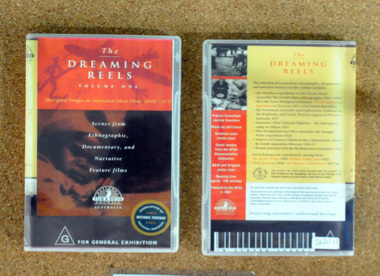 Orbost & District Historical Society
video, The Dreaming Reels, 1997
... It also contains footage from several Australian films depicting Aborigines. The Dreaming Reels video National Film and Sound Archives ...This disc was a project supported by the Festival of the Dreaming, a festival leading up to the 2000 Sydney Olympic Games.This disc is a significant research tool as it contains contemporary film of the early indigenous people of Australia.A video disc titled, The Dreaming Reels. it is a compilation of scenes from the Hadden expedition to the Torres Strait in 1898, Lake Tyers settlement, Northwest Scientific Exploration in the Kimberleys, the aboriginal camp at Orbost in 1921, the Douglas Wylie Expedition in 1926, Princess Charlotte Bay 1926-1927 and McRobertson's Expedition. It also contains footage from several Australian films depicting Aborigines. aboriginal-history dreaming -
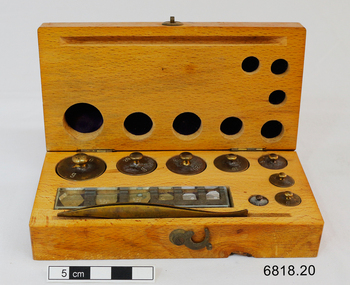 Flagstaff Hill Maritime Museum and Village
Instrument - Apothecary Set of Weights, 1903 – 1917
... (Australian National University Archives; H B Selby and Company Proprietary Limited) This apothecary weights set was donated to Flagstaff Hill Maritime Village by the family of Doctor William Roy Angus, Surgeon and Oculist. ...(Australian National University Archives; H B Selby and Company Proprietary Limited) This apothecary weights set was donated to Flagstaff Hill Maritime Village by the family of Doctor William Roy Angus, Surgeon and Oculist. ...This apothecary weights set was supplied by the company 'H B Silberberg & Company, Melbourne.' The company used this name in Melbourne from 1903-1917, then changed their name to “H.B. Selby & Company”. The firm specialised in the manufacture, import and supply of scientific instruments, laboratory apparatus, chemicals and industrial equipment. It was founded in Melbourne around 1889 by Carl de Beer and traded under the name of his brother Ernest de Beer and Company. Herbert B Silberberg joined the de Beer partnership in 1903 and, later in the same year, bought the de Beers’ shares in the business. Silberberg carried on as de Beer, Silberberg & Company for four months, after which he changed the name to H B Silberberg & Company. (Australian National University Archives; H B Selby and Company Proprietary Limited) This apothecary weights set was donated to Flagstaff Hill Maritime Village by the family of Doctor William Roy Angus, Surgeon and Oculist. It is part of the “W.R. Angus Collection” that includes historical medical equipment, surgical instruments and material once belonging to Dr Edward Ryan and Dr Thomas Francis Ryan, (both of Nhill, Victoria) as well as Dr Angus’ own belongings. The Collection’s history spans the medical practices of the two Doctors Ryan, from 1885-1926 plus that of Dr Angus, up until 1969. ABOUT THE “W.R.ANGUS COLLECTION” Doctor William Roy Angus M.B., B.S., Adel., 1923, F.R.C.S. Edin.,1928 (also known as Dr Roy Angus) was born in Murrumbeena, Victoria in 1901 and lived until 1970. He qualified as a doctor in 1923 at University of Adelaide, was Resident Medical Officer at the Royal Adelaide Hospital in 1924 and for a period was house surgeon to Sir (then Mr.) Henry Simpson Newland. Dr Angus was briefly an Assistant to Dr Riddell of Kapunda, then commenced private practice at Curramulka, Yorke Peninsula, SA, where he was physician, surgeon and chemist. In 1926, he was appointed as new Medical Assistant to Dr Thomas Francis Ryan (T.F. Ryan, or Tom), in Nhill, Victoria, where his experiences included radiology and pharmacy. In 1927 he was Acting House Surgeon in Dr Tom Ryan’s absence. Dr Angus had become engaged to Gladys Forsyth and they decided he would take time to further his studies overseas in the UK in 1927. He studied at London University College Hospital and at Edinburgh Royal Infirmary and in 1928, was awarded FRCS (Fellow from the Royal College of Surgeons), Edinburgh. He worked his passage back to Australia as a Ship’s Surgeon on the on the Australian Commonwealth Line’s T.S.S. Largs Bay. Dr Angus married Gladys in 1929, in Ballarat. (They went on to have one son (Graham 1932, born in SA) and two daughters (Helen (died 12/07/1996) and Berenice (Berry), both born at Mira, Nhill ) Dr Angus was a ‘flying doctor’ for the A.I.M. (Australian Inland Ministry) Aerial Medical Service in 1928 . The organisation began in South Australia through the Presbyterian Church in that year, with its first station being in the remote town of Oodnadatta, where Dr Angus was stationed. He was locum tenens there on North-South Railway at 21 Mile Camp. He took up this ‘flying doctor’ position in response to a call from Dr John Flynn; the organisation was later known as the Flying Doctor Service, then the Royal Flying Doctor Service. A lot of his work during this time involved dental surgery also. Between 1928-1932 he was surgeon at the Curramulka Hospital, Yorke Peninsula, South Australia. In 1933 Dr Angus returned to Nhill where he’d previously worked as Medical Assistant and purchased a share of the Nelson Street practice and Mira hospital from Dr Les Middleton one of the Middleton Brothers, the current owners of what was once Dr Tom Ryan’s practice. Dr L Middleton was House Surgeon to the Nhill Hospital 1926-1933, when he resigned. [Dr Tom Ryan’s practice had originally belonged to his older brother Dr Edward Ryan, who came to Nhill in 1885. Dr Edward saw patients at his rooms, firstly in Victoria Street and in 1886 in Nelson Street, until 1901. The Nelson Street practice also had a 2 bed ward, called Mira Private Hospital ). Dr Edward Ryan was House Surgeon at the Nhill Hospital 1884-1902 . He also had occasions where he successfully performed veterinary surgery for the local farmers too. Dr Tom Ryan then purchased the practice from his brother in 1901. Both Dr Edward and Dr Tom Ryan work as surgeons included eye surgery. Dr Tom Ryan performed many of his operations in the Mira private hospital on his premises. He too was House Surgeon at the Nhill Hospital 1902-1926. Dr Tom Ryan had one of the only two pieces of radiology equipment in Victoria during his practicing years – The Royal Melbourne Hospital had the other one. Over the years Dr Tom Ryan gradually set up what was effectively a training school for country general-practitioner-surgeons. Each patient was carefully examined, including using the X-ray machine, and any surgery was discussed and planned with Dr Ryan’s assistants several days in advance. Dr Angus gained experience in using the X-ray machine there during his time as assistant to Dr Ryan. Dr Tom Ryan moved from Nhill in 1926. He became a Fellow of the Royal Australasian College of Surgeons in 1927, soon after its formation, a rare accolade for a doctor outside any of the major cities. He remained a bachelor and died suddenly on 7th Dec 1955, aged 91, at his home in Ararat. Scholarships and prizes are still awarded to medical students in the honour of Dr T.F. Ryan and his father, Dr Michael Ryan, and brother, John Patrick Ryan. ] When Dr Angus bought into the Nelson Street premises in Nhill he was also appointed as the Nhill Hospital’s Honorary House Surgeon 1933-1938. His practitioner’s plate from his Nhill surgery states “HOURS Daily, except Tuesdays, Fridays and Saturday afternoons, 9-10am, 2-4pm, 7-8pm. Sundays by appointment”. This plate is now mounted on the doorway to the Port Medical Office at Flagstaff Hill Maritime Village, Warrnambool. Dr Edward Ryan and Dr Tom Ryan had an extensive collection of historical medical equipment and materials spanning 1884-1926 and when Dr Angus took up practice in their old premises he obtained this collection, a large part of which is now on display at the Port Medical Office at Flagstaff Hill Maritime Village in Warrnambool. During his time in Nhill Dr Angus was involved in the merging of the Mira Hospital and Nhill Public Hospital into one public hospital and the property titles passed on to Nhill Hospital in 1939. In 1939 Dr Angus and his family moved to Warrnambool where he purchased “Birchwood,” the 1852 home and medical practice of Dr John Hunter Henderson, at 214 Koroit Street. (This property was sold in1965 to the State Government and is now the site of the Warrnambool Police Station. ). The Angus family was able to afford gardeners, cooks and maids; their home was a popular place for visiting dignitaries to stay whilst visiting Warrnambool. Dr Angus had his own silk worm farm at home in a Mulberry tree. His young daughter used his centrifuge for spinning the silk. Dr Angus was appointed on a part-time basis as Port Medical Officer (Health Officer) in Warrnambool and held this position until the 1940’s when the government no longer required the service of a Port Medical Officer in Warrnambool; he was thus Warrnambool’s last serving Port Medical Officer. (The duties of a Port Medical Officer were outlined by the Colonial Secretary on 21st June, 1839 under the terms of the Quarantine Act. Masters of immigrant ships arriving in port reported incidents of diseases, illness and death and the Port Medical Officer made a decision on whether the ship required Quarantine and for how long, in this way preventing contagious illness from spreading from new immigrants to the residents already in the colony.) Dr Angus was a member of the Australian Medical Association, for 35 years and surgeon at the Warrnambool Base Hospital 1939-1942, He served as a Surgeon Captain during WWII1942-45, in Ballarat, Victoria, and in Bonegilla, N.S.W., completing his service just before the end of the war due to suffering from a heart attack. During his convalescence he carved an intricate and ‘most artistic’ chess set from the material that dentures were made from. He then studied ophthalmology at the Royal Melbourne Eye and Ear Hospital and created cosmetically superior artificial eyes by pioneering using the intrascleral cartilage. Angus received accolades from the Ophthalmological Society of Australasia for this work. He returned to Warrnambool to commence practice as an ophthalmologist, pioneering in artificial eye improvements. He was Honorary Consultant Ophthalmologist to Warrnambool Base Hospital for 31 years. He made monthly visits to Portland as a visiting surgeon, to perform eye surgery. He represented the Victorian South-West subdivision of the Australian Medical Association as its secretary between 1949 and 1956 and as chairman from 1956 to 1958. In 1968 Dr Angus was elected member of Spain’s Barraquer Institute of Barcelona after his research work in Intrasclearal cartilage grafting, becoming one of the few Australian ophthalmologists to receive this honour, and in the following year presented his final paper on Living Intrasclearal Cartilage Implants at the Inaugural Meeting of the Australian College of Ophthalmologists in Melbourne In his personal life Dr Angus was a Presbyterian and treated Sunday as a Sabbath, a day of rest. He would visit 3 or 4 country patients on a Sunday, taking his children along ‘for the ride’ and to visit with him. Sunday evenings he would play the pianola and sing Scottish songs to his family. One of Dr Angus’ patients was Margaret MacKenzie, author of a book on local shipwrecks that she’d seen as an eye witness from the late 1880’s in Peterborough, Victoria. In the early 1950’s Dr Angus, painted a picture of a shipwreck for the cover jacket of Margaret’s book, Shipwrecks and More Shipwrecks. She was blind in later life and her daughter wrote the actual book for her. Dr Angus and his wife Gladys were very involved in Warrnambool’s society with a strong interest in civic affairs. Their interests included organisations such as Red Cross, Rostrum, Warrnambool and District Historical Society (founding members), Wine and Food Society, Steering Committee for Tertiary Education in Warrnambool, Local National Trust, Good Neighbour Council, Housing Commission Advisory Board, United Services Institute, Legion of Ex-Servicemen, Olympic Pool Committee, Food for Britain Organisation, Warrnambool Hospital, Anti-Cancer Council, Boys’ Club, Charitable Council, National Fitness Council and Air Raid Precautions Group. He was also a member of the Steam Preservation Society and derived much pleasure from a steam traction engine on his farm. He had an interest in people and the community He and his wife Gladys were both involved in the creation of Flagstaff Hill, including the layout of the gardens. After his death (28th March 1970) his family requested his practitioner’s plate, medical instruments and some personal belongings be displayed in the Port Medical Office surgery at Flagstaff Hill Maritime Village, and be called the “W. R. Angus Collection”. The W.R. Angus Collection is significant for still being located at the site it is connected with, Doctor Angus being the last Port Medical Officer in Warrnambool. The collection of medical instruments and other equipment is culturally significant, being an historical example of medicine from late 19th to mid-20th century. Dr Angus assisted Dr Tom Ryan, a pioneer in the use of X-rays and in ocular surgery. Apothecary or pharmacy weights set, metric, in fitted wooden box with metal hook latch. Part of the W.R. Angus Collection. Round brass weights (50g, 20g, 20g, 10g, 5g, 2g, 2g, 1g) and small silver sheet weights under glass (500mg, 200mg, 200mg, 50mg, 10mg, 5mg, & 5 other smaller ones), plus brass tweezers. Lid of the box has maker's plate "MADE SPECIALLY / FOR / H B SILBERBERG & CO. / MELBOURNE"flagstaff hill, warrnambool, shipwrecked coast, flagstaff hill maritime museum, maritime museum, shipwreck coast, flagstaff hill maritime village, great ocean road, dr w r angus, dr ryan, nhill base hospital, warrnambool base hospital, mira hospital, apothecary weights set, pharmacist weights, weights and measures, chemist weights -
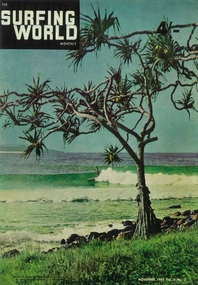 Australian National Surfing Museum
Magazine, Bob Evans, The Surfing World Monthly, November 1963, Volume 3, Number 3, 1/11/1963 (estimated)
... Australia's oldest surfing magazine. Surfing World was the first major national surfing publication in Australia established in 1962. Its stories and photographs captured the early years of growth of surfing in Australia during the 1960's. The magazine inspired a generation of people to start surfing and provides an important archive ...Surfing World, or SW as it is know, first issue appeared Sept 1962. Edited by Bob Evans this monthly magazine was published "in the interests of promoting surfing in Australia and overseas". This issue (Volume 3, Number 3) is one of a series of early 1960's SW's donated as an incomplete collection. SURFING WORLD is still published today and is Australia's oldest surfing magazine.Surfing World was the first major national surfing publication in Australia established in 1962. Its stories and photographs captured the early years of growth of surfing in Australia during the 1960's. The magazine inspired a generation of people to start surfing and provides an important archive into Australian surf culture during the sixties.Surfing World (SW) magazine Volume 3 Number 3, Nov 1963. Surfing World banner in top left over a colour photograph of (possibly) Crescent Head beach with a tree in the foreground and a surfer riding a small wave in the background. -
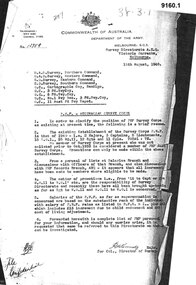 Bendigo Military Museum
Administrative record - Australian Survey Corps - PMF Establishment and Estimated Expenditure 1945-1946, Australian Survey Corps Directorate AHQ, 15 Sep 1945 and 15 Aug 1946
... This document in an attempt to quantify estimated expenses, addresses proposed manning and planned tasking for the Australian Survey Corps post WWII. These documents are believed to be copies from the National Archives and are an important snapshot of what was the situation at the time....This document in an attempt to quantify estimated expenses, addresses proposed manning and planned tasking for the Australian Survey Corps post WWII. These documents are believed to be copies from the National Archives and are an important snapshot of what was the situation at the time. ...The first document is an important record of the size and makeup of the Australian Survey Corps - Permanent Military Force (PMF) as of 15 Aug 1946. It details the establishment, salaries and promotion guidelines and has a table of the names of the individuals occupying those positions. The second document (its draft and final document dated 25 Aug 1945) discuss in detail estimates of Expenditure for the Australian Survey Corps for 1945/46. This document in an attempt to quantify estimated expenses, addresses proposed manning and planned tasking for the Australian Survey Corps post WWII. These documents are believed to be copies from the National Archives and are an important snapshot of what was the situation at the time.An A4 and an A3 sized photocopy, stapled of typed text and 3 x photocopies of each of a Draft and Final A4 document of typed textThe First document (PMF) dated 15 Aug 1946 has a handwritten annotation "Confidential", the second document (Estimated Expenditure) dated 25 Aug 1945 has a typed classification of "SECRET" (Both Classifications have since expired)royal australian survey corps, rasvy, fortuna, army survey regiment, army svy regt, asr -
 Bendigo Military Museum
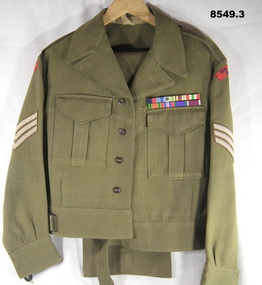
Uniform - BATTLE DRESS, ARMY, Esquire, 1950 and 1981
... POST WWII: As a member of the British Armed Forces he applied to stay in Australia – the National Archives holds his application form. ...POST WWII: As a member of the British Armed Forces he applied to stay in Australia – the National Archives holds his application form. ...John Bruce MacCathie. POB: Dalkeith, Scotland. DOB: 4 AUG 1923. WWII: He served in the Royal Navy, Service No C/JX340061. POST WWII: As a member of the British Armed Forces he applied to stay in Australia – the National Archives holds his application form. MARRIAGE: He married Isabel Noel Fulton in 1949, in Vic. AUST. MIL. FORCES: He joined the Aust. Army and served from 1953 to 1977. His number then was 35175 in the Royal Aust. Engineers. His last rank was Sergeant. Returned Service League: He spent some time as a member of the Castlemaine Sub Branch. DEATH: He died 28 JUN 2005. His remains are in the Garden of Remembrance, Springvale, VIC. FAMILY: He was survived by his wife Isabel ( dec 2020) and two children. Ribbons 1. 1939-45 Star 2. Atlantic Star with Rosette, 3. Africa Star with Rosette. 4. Italy Star, 5. Defence Medal, 6. War Medal 1939-45, 7. General Service Medal 1962, 8. Long Service and Good Conduct Medal.1. Jacket - Khaki, woollen. On both arms are Sergeants cloth stripes and a cloth badge for Royal Aust. Engineers. It has eight medal ribbons on left breast. 2. Trousers - Khaki, woollen. Zip fly, no cuffs on ankles. 3. Lanyard - cotton, black. Small loop one end, large loop at other end.Written in jacket is “35175 MacCathie” A tag in jacket shows his Navy no. “C/JX340061” - British Navy.post ww2, uniform, winter, passchendaele barracks trust -
 Eltham District Historical Society Inc
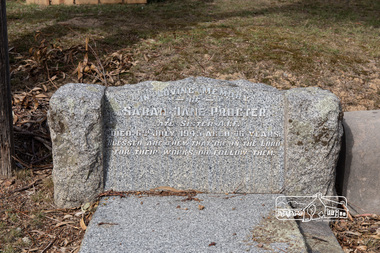
Photograph, Peter Pidgeon, Grave of Sarah Jane Procter, Eltham Cemetery, Victoria, 5 April 2021
... Australia soon afterwards and was assigned to No. 11 AGH at Caulfield from 9 February, 1919 until her appointment was terminated on 3 May. Born Stawell, Protestant, Sarah Jane Procter died at 75 years of age in a private hospital in St. Kilda, on 6 July, 1945 as the result of an accident and was interred in Eltham Cemetery. Her National Archives...Australia soon afterwards and was assigned to No. 11 AGH at Caulfield from 9 February, 1919 until her appointment was terminated on 3 May. Born Stawell, Protestant, Sarah Jane Procter died at 75 years of age in a private hospital in St. Kilda, on 6 July, 1945 as the result of an accident and was interred in Eltham Cemetery. Her National Archives ...Nurse Sarah Procter stretched the limits by enlisted on 12 August, 1915 at 45 years of age, the maximum acceptable age. A sister, Mrs J H Treloar (Amelia) in Hamilton was given as next of kin. Her Attestation shows she had 13 years nursing experience, having earned her Certificate at Stawell Hospital, served for one year with the Women's Hospital with the balance with private amenities. The Embarkation Roll lists her residential address simply as Brunswick - there is no Attestation or other material surviving to suggest a more specific address. She embarked from Melbourne on board RMS Morea on 24 August, 1915 and like many the served in Egypt in 1915, her record is a little hazy, but it appears at in January, 1916 after serving with No. 2 AGH, she was promoted to Nursing Sister and returned on HMAT Ulysses transporting wounded back to Australia. Nurse Procter embarked again on 4 April, 1916 to re-join her unit. She arrived in England 30 December after further service at Alexandria and was initially assigned to No. 2 A.A.H, then at Southall, She was transferred just a few weeks later to No. 1 AAH at Barefield where she remained until February, 1918. She proceeded to join No.5 AGH at Rouen, France in May, 1918; she returned to England on 23 November, 1918 after spending a month off duty with general debility and on return was admitted to South Kensington hospital with rheumatism. She was released around a fortnight later and at the same time promoted to the rank of Sister. Perhaps because of her age, she embarked for Australia soon afterwards and was assigned to No. 11 AGH at Caulfield from 9 February, 1919 until her appointment was terminated on 3 May. Born Stawell, Protestant, Sarah Jane Procter died at 75 years of age in a private hospital in St. Kilda, on 6 July, 1945 as the result of an accident and was interred in Eltham Cemetery. Her National Archives are held as Procter, AWM files as Proctor, the former is correct. (Brian Membery for Wikinorthia) Sarah Jane Procter never married and served in WW1. She enlisted at 45, but said she was only 40 on the enlistment papers. Sarah is buried in CE Monumental Section Grave 182. She was born in Stawell in 1869 and died accidentally in Heidelberg 1945. She lays next to an older brother, George Charles Alfred Procter, born 1865. died 1935 in grave CE 181. In Loving Memory of Sarah Jane Proctor Late Sister A.I.F. Died 6th July 1945 aged 76 years Blessed are they that die in the Lord For their works do follow them.Born Digitaleltham cemetery, gravestones, proctor, george charles alfred procter, sarah jane procter -
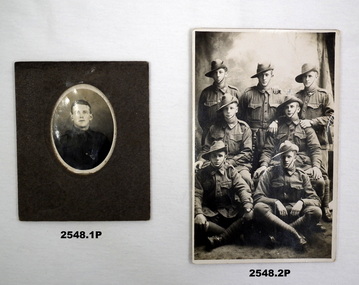 Bendigo Military Museum
Photograph - PHOTOGRAPHS WW1, 2) Kitchener Studio - Ainar Studio Auburn, c.WWI
... National Archives records) As No 6826 he enlisted in the AIF in 20th reinforcements 22nd Batt on 28.7.1917 age 18 years 10 months. Embarked 21.11.1917 and arrived Suez 15.12.1917, embark for England 9.1.1918, allotted letter A on Regt No due to duplication (6826A), hospital 16.4.1918 (unclear), rejoin unit 25.4.1918, embark for France 29.4.1918, WIA 17.7.1918 Gassed, move to overseas Training Brigade 2.11.1918, embark for Australia 8.1.1919, discharged medically unfit 14.3.1919. ...National Archives records) As No 6826 he enlisted in the AIF in 20th reinforcements 22nd Batt on 28.7.1917 age 18 years 10 months. Embarked 21.11.1917 and arrived Suez 15.12.1917, embark for England 9.1.1918, allotted letter A on Regt No due to duplication (6826A), hospital 16.4.1918 (unclear), rejoin unit 25.4.1918, embark for France 29.4.1918, WIA 17.7.1918 Gassed, move to overseas Training Brigade 2.11.1918, embark for Australia 8.1.1919, discharged medically unfit 14.3.1919. ...William HOLMES served 6 months in the Junior Cadets prior to WW1(National Archives records) As No 6826 he enlisted in the AIF in 20th reinforcements 22nd Batt on 28.7.1917 age 18 years 10 months. Embarked 21.11.1917 and arrived Suez 15.12.1917, embark for England 9.1.1918, allotted letter A on Regt No due to duplication (6826A), hospital 16.4.1918 (unclear), rejoin unit 25.4.1918, embark for France 29.4.1918, WIA 17.7.1918 Gassed, move to overseas Training Brigade 2.11.1918, embark for Australia 8.1.1919, discharged medically unfit 14.3.1919. He again enlisted in the Volunteer Defence Corp on 28.3.1942 as No V352711, promoted to Lieutenant 10.12.1942, discharged from the Corp on 31.10.1945. Items are part of a collection. .1) Small oval portrait in dark grey mount. .2) Group photo of WWI uniformed soldiers. WILLIAM HOLMES marked with blue ink above his head - middle row RHS..1) Handwritten: “W HOLMES, Dad when a boy” .2) Handwritten: “Dad when away” Stamped in blue ink: - Kitchener Studio Broadmeadows Camp - Ainar Studio Auburnphotography-photographs, military history - army -
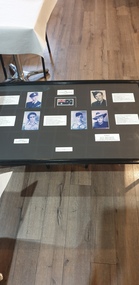 Colac RSL Sub Branch
Archive (item) - SPURRELL BROS
... National Service. Discharged ?? Bottom left: Spurrell: Douglas: Service No: VX 69390. Signalman, Australian Army. Born 26/11/1922 at Hinnomunjie, Vic. Enlisted 5/1/1942 at Colac, Vic. Discharged 4/1/1947 Bottom right: Spurrell: Clifford Lindsay. Service No: VX 500607. Born 2/2/1927 at Camperdown, Vic. Enlisted ? at Colac, Vic. Stationed in Japan Black Wooden frame with glass front containing photos and information sheets. Australian flag in the centre Archive ...Spurrell Family Service recordHighTop left: Spurrell: Walter George. Service No: 12352. Warrant Officer. RAAF. DOB: 27/5/1919 at Terang, Vic. Enlisted 23/10/1940 at Melbourne, Vic. Discharged 8/1/1946. Top centre: Australian Flag Bottom centre: Spurrell: Kenneth Edwards Service No: 120787. RAAF. Leading Aircraftman. Born 21/10/11924 at Camperdown, Victoria. Enlisted 12/11/1942 at Melbourne, Vic. Discharged 10/1/1946 Top right: Spurrell: Graham Lyle. Service No: A 38867. RAAF. Born 3/11/1933 at Colac, Vic. Enlisted ?? at Caulfield, Vic. National Service. Discharged ?? Bottom left: Spurrell: Douglas: Service No: VX 69390. Signalman, Australian Army. Born 26/11/1922 at Hinnomunjie, Vic. Enlisted 5/1/1942 at Colac, Vic. Discharged 4/1/1947 Bottom right: Spurrell: Clifford Lindsay. Service No: VX 500607. Born 2/2/1927 at Camperdown, Vic. Enlisted ? at Colac, Vic. Stationed in Japan -
 Eltham District Historical Society Inc
Film - Video (Digital), Charles Tait, The Story of the Kelly Gang (1906), 1906 / 2006
... Australian bushranger, Ned Kelly. The 1906 film is believed to have been about one hour in length. Only fragments, approximately 15 minutes survive, the majority of the cellulose nitrate film stock degrading. In 2006 with meticulous restoration work by the National Film & Sound Archive...Australian bushranger, Ned Kelly. The 1906 film is believed to have been about one hour in length. Only fragments, approximately 15 minutes survive, the majority of the cellulose nitrate film stock degrading. In 2006 with meticulous restoration work by the National Film & Sound Archive ...In 1906, Australia produced The Story of the Kelly Gang, claimed to be the world’s first commercial feature-length fiction film. Shot on location outside Melbourne, the film traces the life of the legendary Australian bushranger, Ned Kelly. The 1906 film is believed to have been about one hour in length. Only fragments, approximately 15 minutes survive, the majority of the cellulose nitrate film stock degrading. In 2006 with meticulous restoration work by the National Film & Sound Archive, nearly a quarter of the film was pieced together and digitally restored by Haghefilm preservation laboratories in Amsterdam. The film's narrative has been reconstructed based on the original footage and intertitles. Additional titles (based on text from original program booklet) and associated material has been inserted to provide a more complete sense of the original production. The film is of particular interest to the Society as it is alleged that some scenes were filmed in and around the Eltham district though not yet identified or confirmed.Digital file only MP4 00:31:52; 233MB (Reference only - not for public access)the story of the kelly gang, ned kelly, national fim & sound archive, charles tait, eltham -
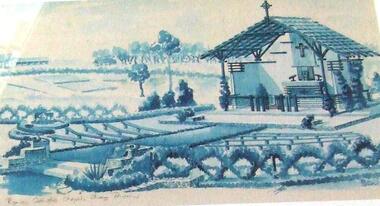 Waverley RSL Sub Branch
Poster, Changi Chapel
... National Archives of Singapore. Also in the museum is a collection of watercolour paintings by Mary Angela Bateman who was among the thousands of women and children held at Changi Prison for more than three years during the war.[1] Changi Changi Chapel Changi History Poster produced by Australian War Memorial detailing the history of The Changi Chapel Framed Changi Chapel Poster ...The Changi Museum is a museum dedicated to Singapore's history during the Second World War. The original chapel has been re-erected at Duntroon Military Academy and is on public display as a memorial to the P.O.W's In 1988, Singapore built a replica Chapel and Museum next to the Changi Prison. When Changi Prison was expanded in 2001, the Chapel and Museum was relocated to a new site 1 km away and the Changi Chapel and Museum was officially established on 15 February 2001. Bernard Stogden, the son of Sgt. Harry Stogden, was invited to place the cross that his father made onto the wreathed altar in the new Chapel. He was claimed to have cried while doing so, as this was one of the only chances he got to interact with his father(through his work) as "Harry" Stogden died during the war. The Museum has a collection of paintings, photographs and personal effects donated by former POWs. Among the collection is a series of paintings and sketches by a POW named William Haxworth which provide valuable insight on the daily life of the internees during the occupation. In 1986, Haxworth's wife donated a collection of over 400 paintings and sketches to the National Archives of Singapore. Also in the museum is a collection of watercolour paintings by Mary Angela Bateman who was among the thousands of women and children held at Changi Prison for more than three years during the war.[1]Poster produced by Australian War Memorial detailing the history of The Changi Chapel Framedchangi, changi chapel, changi history -
 Bendigo Historical Society Inc.
Archive - Golden Pipeline Heritage Trail
... Western Australia Golden Pipeline Heritage trail DVD. 17 narrations interpreting the Golden Pipeline Heritage Trail, a project of the Western Australia branch of the National Trust. Archive Golden Pipeline Heritage Trail ...DVD. 17 narrations interpreting the Golden Pipeline Heritage Trail, a project of the Western Australia branch of the National Trust.western australia, golden pipeline heritage trail -
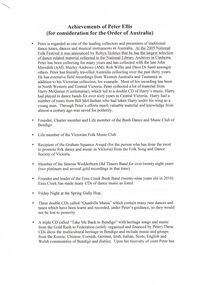 Bendigo Historical Society Inc.
Document - PETER ELLIS COLLECTION: ORDER OF AUSTRALIA
... Australia. At the 2005 National Folk Festival it was announced by Robyn Holmes that he has the largest selection of dance related material collected in the National Library Archives in Canberra. ...Australia. At the 2005 National Folk Festival it was announced by Robyn Holmes that he has the largest selection of dance related material collected in the National Library Archives in Canberra. ...4 page A4 printed document. Achievements of Peter Ellis (for consideration for the Order of Australia) Peter is regarded as one of the leading collectors and presenters of traditional dance tunes, dances and musical instruments in Australia. At the 2005 National Folk Festival it was announced by Robyn Holmes that he has the largest selection of dance related material collected in the National Library Archives in Canberra. Peter has been collecting for many years and has collected with the late John Meredith (AM), Shirley Andrews (AM), Rob Willis and Dave Di Santi amongst others. Peter has literally travelled Australia collecting over the past thirty years. He has extensive field recordings from Western Australia and Tasmania in addition to his Victorian collection, for example. Most of his recording has been in North Western and Central Victoria. Peter collected a lot of his material from Harry McQueen ( Castlemaine), which led to a double CD of Harry's music. Harry had played in dance bands for over sixty years in Central Victoria. Harry had a number of tunes from Bill McGlashan who had taken Harry under his wing as a young man. Through Peter's efforts much valuable material and knowledge from almost a century ago was saved for posterity. Founder, Charter member and life member of the Bush Dance and Music Club of Bendigo. Life Member of the Victorian Folk Music Club. Recipient of the Graham Squance award (for the person who has done the most to promote folk dance and music in Victoria)) from the Folk Song and Dance Society of Victoria. Member of the famous Wedderburn Old Timers Band for over twenty-eight years (two platinum and several gold recordings in that time). Founder and leader of the Emu Creek Bush Band (twenty-nine years old in 2010) Emu Creek has made many CDs of dance music as listed. Friday Night at the Spring Gully Hop, Three double CDs called 'Quadrille Mania' which contain many rare dances and tunes which have been learnt and recorded, under Peter's guidance, so they would not be lost to posterity. A triple CD called 'Take Me Back To Bendigo' with heritage songs and music from the Gold Rush to Federation (solely organised and financed by Peter) These CDs show the multicultural heritage in Bendigo and include music and groups from the Koorie, Chinese, Cornish, German, Irish, Italian, Scots, English and Welsh communities of Bendigo and district. Upon his recovery of costs Peter has handed over copyright to the Bendigo Community so future profits go back into the community. Three double CDs called 'The Merry Country Dance' with dances and tunes going back to the time of Governor Lachlan Macquarie's Ball in 1804. Most of the tracks are performed by Emu Creek Following much practice under Peter's tutelage. For further authenticity Peter liaised with other musicians to record some tracks which were revived from almost two hundred years ago and have now been recorded using the instruments of the time. A three volume set of Bush Concert recordings (Vol 1 Goornong (launched Australia Day 2006 with any profits going to the Soldier's Memorial Hall Committee), Vol 2 Heywood and Vol 3 Maldon/Sutton Grange, already recorded and to be released as money from other projects becomes available. NOTE: None of these CDs have led to any profit. All money raised is put back into the community and further heritage recordings, books and videos through the Bush Dance and Music Club of Bendigo Inc. In 2009 a full collection of all Peter's book and CDs was donated to the John Gorton Library as part of the recognition of the fifty year career of the Gay Charmers Dance Band from Lake Charm. 'Music of the Diggings' (4 tracks by Peter or Emu Creek). In addition the Emu Creek Band, under Peter's leadership, has appeared on a CD backing Bruce Watson on his song, 'The Old Bush Dance'. Emu Creek has performed at National Folk Festivals in four states and several times at the National Folk Festival in Canberra. They have also been mainstays of the Maldon Folk Festival for over twenty years as well as doing dance programs for the Port Fairy Folk Festival on two occasions. Peter has written and published many books related to traditional music and dance. These include Three volumes of 'Collectors Choice' which is musical notation for bush dances coupled with much dance history which would have been lost without Peter's efforts. 'Two Hundred Dancing Years - How to run a Colonial Ball: (co-authored with Shirley Andrews (A.M.), 'Music Makes Me Smile - The Music of the Nariel Valley' (co-authored with Harry Gardner). The Merry Country Dance' (292 pages) a companion to the three double CDs. He has also been a contributor to Verandah Music' authors Rob Willis and Graham Seal and 'The Oxford Companion to Australia Folklore' Ed Graham Seal. Peter is also a regular contributor to 'Trad and Now' Magazine. His latest completed book is titled 'The Merry Country Dance' and is over three hundred pages of social history, recipes and dance instructions. It was completed with the assistance of a Victorian Government Heritage Grant. The first edition sold out in only a few weeks. Peter has taught many children about old time musicianship through the junior bands which have functioned over the years with many children joining Emu Creek and then going on to follow their own musical inclinations. He has trained several young concertina and button accordion players over the years. Peter has been a regular tutor with Continuing Education in tin whistle, harmonica and old time dancing for many years. Peter has conducted workshops in music dance at National Folk Festivals in Perth, Alice Springs, Maleny, Melbourne, Adelaide, Kuranda and more recently at several Canberra National folk Festivals. He has also done this at Maldon for many years, Port Fairy, Glen Innes, Jamberoo and Kiama Festivals. For over thirty years Peter has been a guest player and MC for the dances at the Nariel Folk Festival (Australia's oldest continuing Folk Festival) Peter is very well known in the Corryong area as a collector and the co-author of the book, Music Makes Me Smile, about the Klippel/Simpson dynasty in the Nariel Creek Band. This book is currently being revised for re-issue as more material has come to light since the original publication. For many years Peter trained Debutante Sets in the Bendigo District. Peter was an instigator of the annual Dinki Di Ball held each September in Eaglehawk for the past thirteen years. At this ball three bands play for a quarter of the night and then join together for the final part of the evening. The bands are Emu Creek, The Wedderburn Old Timers and the Gay Charmers. Up to four hundred dancers, many in heritage costumes have attended this dance. The ball also pays tribute to, and involves, the old MC's. Through this example their skills have been passed down to a younger generation of MC's. All profits are returned to the Dance Club to foster our musical heritage. Each Ball includes presentations designed to promote social dancing in Australia. Over the years several young musicians have been presented with musical instruments at the Ball, libraries have been given copies of Peter's books and CDs and one year a keen young dancer was presented a pair of dancing shoes. Peter is a trained ballroom dancer and has gained gold medal status in this field. Peter is an accomplished musician and is one of Australia's foremost button accordion players. He is also highly accomplished on the tin whistle, bones and harmonica. He is the only exponent of the Swanee whistle that I have seen. Peter also plays the piano and ukulele. Thirty six years membership of the Bendigo Field Naturalists Club, Secretary in the 1970s and actively involved in campaigns to save Lake Pedder and establish the Whipstick and Kamarooka State Parks (now part of the Bendigo National Park). Peter was also extremely active in the establishment of the Salomon's Gully and Jackass Flat Flora Reserves in Bendigo which have now been saved for posterity. Peter has also been involved in efforts to save One Tree Hill and this area has now been included in the Greater Bendigo National Park. He has discovered and named new plant species in the Whipstick Forest and propagates Australian plants. Peter takes regular guided tours of interested people through the Whipstick each Spring on wild flower educational tours. He is a keen and gifted photographer of local plant species. Life member of the Bendigo Field Naturalists. Peter contributed text and photographs to their publication 'Wildflowers of Bendigo'. When the Victorian State Parliament had its first historical sitting outside Melbourne Emu Creek played during lunch for the guests and public. They have also played at functions such as the Centenaries of Federation, the Bendigo Post Office, the Shamrock Hotel and the opening of the new Melbourne Museum and the Federation Museum in Bendigo. The band regularly plays for Seniors week and at homes for the aged such as Bethlehem, Mirridong, Bignold Park, Bendigo Village and others. Peter has been instrumental in getting the band to play for fundraisers such as schools, scouts and environmental groups. The band plays many charitable 'gigs'. The band supports the Bendigo Easter Fair and the Eaglehawk Fair when able and has appeared in several parades over the years. The above list shows the invaluable contribution that Peter Ellis has made towards the collecting and distributing of Australia's musical and dance heritage. No one has done more than Peter in this area. He has also been active locally and nationally in his endeavours towads saving the natural environment. He has put many years of time and energy into both area's and has many on going projects in mind for the years ahead. The awarding of an honour from Australia would be just reward for a man who has preserved so much of our musical and dance heritage for future generations. Knowing Peter I have no doubt he would treasure such an honour as he has given so much to preserve Australia's music and dance heritage over most of his sixty plus years. Compiled by John Williams. Handwritten notes at bottom of last page reads: Referees Jacinta Allan MLA Steve Gibbons MHR Willie Carney ex Mayor of Bendigo Supporting letter Mary Smith Sec. Bush Dance + Music Club.person, individual, peter ellis oam -
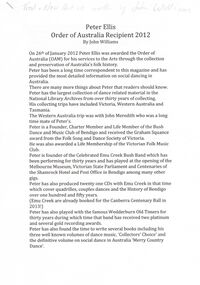 Bendigo Historical Society Inc.
Document - PETER ELLIS COLLECTION: PETER ELLIS ORDER OF AUSTRALIA RECIPIENT, 26th January, 2012
... Australia. There are many more things about Peter that readers should know. Peter has the largest collection of dance related material in the National Library Archives from over thirty years of collecting. ...Australia. There are many more things about Peter that readers should know. Peter has the largest collection of dance related material in the National Library Archives from over thirty years of collecting. ...2 page article printer on A4 printer paper. Handwritten in greylead pencil across top of first page reads: Trad + Now Article written by John Williamson. Peter Ellis Order of Australia Recipient 2012 By John Williams. On 26th of January 2012 Peter Ellis was awarded the Order of Australia (OAM) for his services to the Arts through the collection and preservation of Australia's folk history. Peter has been a long time correspondent to this magazine and has provided the most detailed information on social dancing in Australia. There are many more things about Peter that readers should know. Peter has the largest collection of dance related material in the National Library Archives from over thirty years of collecting. His collecting trips have included Victoria, Western Australia and Tasmania. The Western Australia trip was with John Meredith who was a long time mate of Peter's. Peter is a founder, charter member and life member of the Bush Dance and Music Club of Bendigo and received the Graham Squance award from the Folk Song and Dance Society of Victoria. He was also awarded a life membership of the Victorian Folk Music Club. Peter is founder of the Celebrated Emu Creek Bush Band which has been performing for thirty years and has played at the opening of the Melbourne Museum, Victorian State Parliament and Centenaries of the Shamrock Hotel and Post Office in Bendigo among many other gigs. Peter has also produced twenty one CDs with Emu Creek in that time which cover quadrilles, couples dances and the History of the Bendigo over one hundred and fifty years. (Emu Creek are already booked for the Canberra Centenary Ball in 2013!) Peter has also played with the famous Wedderburn Old Timers for thirty years during which time that band has received two platinum and several gold recording awards. Peter has also found the time to write several books including his three well know volumes of dance music, 'Collectors Choice' and the definitive volume on social dance in Australia 'Merry Country Dance'. He has also co-authored 'Two Hundred Dancing Years' with Shirley Andrews and 'Music Makes Me Smile - The music of the Nariel Valley' with Harry Gardner. Peter has also contributed to books compiled by others such as Rob Willis, Graham Seal and Dave Di Santi. Peter has trained many young musicians and conducted continuing Ed classes and Deb sets. He is a gold medal standard ballroom dancer in his own right which many dancers say contributes to his understanding of the correct tempo for all the dances he plays for. Peter has also been instrumental in the Bendigo Field Naturalist's Club of which he is a life member. He has been heavily involved in campaigns that have led to the establishment of two flora reserves and extensions to the Greater Bendigo National Park when housing developments threatened native bushland. He has contributed text and photographs to the publication 'Wildflowers of Bendigo'. Peter's award was really well deserved as you can see. What is really fitting is that he received the award on Australia Day. How fitting for a man who has single handedly saved more of Australia's Social Dance music and history than any other person. Australian dancing, music and the environment really owes Peter a lot. Well done from all your Trad and Now readers.person, individual, peter ellis oam -
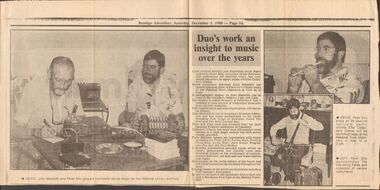 Bendigo Historical Society Inc.
Newspaper - PETER ELLIS COLLECTION: BENDIGO ADVERTISER SATURDAY DECEMBER 3, 1998, 3rd December, 1998
... National Library archives. Top right picture is captioned: ABOVE: Peter Ellis plays and 80-year-old celluloid penny whistle. Ellis' 'Collector's Choice' will be launched today at the National Trust chambers in View St at 3 pm. LEFT: Peter Ellis demonstrates the one string fiddle and collection of various instruments. Article reads: Duo's work an insight to music over the years. Local musical identity and Australian...National Library archives. Top right picture is captioned: ABOVE: Peter Ellis plays and 80-year-old celluloid penny whistle. Ellis' 'Collector's Choice' will be launched today at the National Trust chambers in View St at 3 pm. LEFT: Peter Ellis demonstrates the one string fiddle and collection of various instruments. Article reads: Duo's work an insight to music over the years. Local musical identity and Australian ...Newspaper cutting from Bendigo Advertiser, dated Saturday, December 3, 1988 - Page 14. Photo on left is captioned: ABOVE: John Meredith and Peter Ellis prepare traditional dance music for the National Library archives. Top right picture is captioned: ABOVE: Peter Ellis plays and 80-year-old celluloid penny whistle. Ellis' 'Collector's Choice' will be launched today at the National Trust chambers in View St at 3 pm. LEFT: Peter Ellis demonstrates the one string fiddle and collection of various instruments. Article reads: Duo's work an insight to music over the years. Local musical identity and Australian social dance authority Peter Ellis, co-author of the Bicentennial publication 200 Dancing Years, has completed his series on dance music entitled 'Collector's Choice'. Noted Australian folklorist John Meredith will launch volume three of Collector's Choice today at the National Trust chambers in View St at 3 pm. A photographic display by John Meredith can be seen at the chambers between 2pm and 5pm. The display is called Pioneers of Performers and it exhibits a cross section of traditional musicians from all over Australia. Fifty superb black and white toned prints will also be on display. John Meredith is one of Australia's foremost folklorists and has many publications to his credit including Folk Songs of Australia, Frank the Poet and The Wild Colonial Boy. Peter and John have just returned from the third national folklore conference in Canberra. Collector's Choice has more than 300 popular tunes written in a clear single melody line with guitar chords provided. Forty different dances are represented with music including the Pride of Erin, Parma Waltz, Evening Three-step, Swing Waltz, Barn Dance, Progressive Jive and Old Time Medley. A detailed introduction provides handy advice on choice, presentation and suitable tunes plus historical details on the evolvement of colonial, modern ballroom, old time and new vogue dances and music. Illustrations on the social history of the bands and individual musicians can be found throughout the book. Bendigo bands of old which are illustrated including Cyril Sawyer's Swingsters. As part of the launch the Sandhurst Dance Club will host a free dance from 8pm at the Marong Public Hall.Bendigo advertiserperson, individual, peter ellis oam -
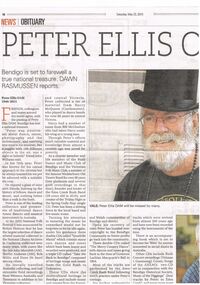 Bendigo Historical Society Inc.
Document - PETER ELLIS COLLECTION: PETER ELLIS OBITUARY, 23rd May, 2015
... Australia. At the 2005 National Folk Festival it was announced by Robyn Holmes that he has the largest selection of dance related material collected in the National Library Archives in Canberra, collected over many years, with mates like the late John Meredith (AM), Shirley Andrews (AM), Rob Willis and Dave Di Santi among others. ...Australia. At the 2005 National Folk Festival it was announced by Robyn Holmes that he has the largest selection of dance related material collected in the National Library Archives in Canberra, collected over many years, with mates like the late John Meredith (AM), Shirley Andrews (AM), Rob Willis and Dave Di Santi among others. ...Colour photocopy of newspaper article Obituary. Dated Saturday, May 23, 2015. Article is not complete. Titled Peter Ellis O. Reads: Bendigo is set to farewell a true national treasure. Dawn Rasmussen reports. Peter Ellis OAM 1946-2015. Friends, colleagues and mates around the world agree, with the passing of Peter Ellis OAM, Bendigo has lost a national treasure. 'Peter was passionate about dance, music, photography and the environment, and watching him tend to his interests, like a juggler with 100 different objects in the air, was a sight to behold,' friend John Williams said. In his 70th year, Peter was known for his casual approach to the niceties but he always insisted his teapot be adorned with a suitable tea cosy. He enjoyed a glass of wine with friends, hunting up the history of folklore, dance and music, and nothing better than a walk in the bush. Peter is one of the leading collectors and presenters of traditional dance tunes, dances and musical instruments in Australia. At the 2005 National Folk Festival it was announced by Robyn Holmes that he has the largest selection of dance related material collected in the National Library Archives in Canberra, collected over many years, with mates like the late John Meredith (AM), Shirley Andrews (AM), Rob Willis and Dave Di Santi among others. He literally travelled Australia collecting, and had extensive field recordings from Western Australia and Tasmania in addition to his Victorian collection. .. .. .. And central Victoria. Peter collected a lot of material from Harry McQueen (Castlemaine), who played in dance bands for over 60 years in central Victoria. Harry had a number of tunes from Bill McGlashan who had taken Harry under his wing as a young man. Through Peter's efforts much valuable material and knowledge from almost a century ago was saved for posterity. As a charter member and life member of the Bush Dance and Music Club of Bendigo and the Victorian Folk Music Club, a member of the famous Wedderburn Old Timers Band for over 28 years (two platinum and several gold recordings in that time), founder and leader of the Emu Creek Bush Band (29 years old in 2010) and creator of the 'Friday Night at the Spring Gully Hop' single CD, Peter has been a driving force in the local band and live music scene. Turning his attention to ensuring the music he unearthed would not be forgotten or let lay idle again, under his guidance three double CD's called Quadrille Mania' which contain many rare dances and tunes which have been learnt and recorded were produced, and a triple CD called 'Take Me back To Bendigo', composed of heritage songs and music from the Gold Rush to Federation. These Cd's show the multicultural heritage in Bendigo and include music and songs from the Koorie.. .. … and Welsh communities of Bendigo and district. Upon his recovery of costs Peter has handed over copyright to the Bendigo Community so future profits go back into the community. Three double CDs called 'The Merry Country Dance' with dances and tunes going back to the time of Governor Lachlan Macquarie's Ball in 1804. Most of the tracks are performed by the Emu Creek bush Band following much practice under Peter's tutelage. For further authenticity .. .. .. Tracks which were revived from almost 200 years ago and have now been recorded using the instruments of the time. There is an accompanying book which is set to become the 'Bible' for anyone interested in social dance in Australia. Other CDs include Bush Concert recordings (Volume 1 Goornong), Cooee, Songs of the ANZACs two- CD set in conjunction with the Bendigo Historial Society, 'Music of the Diggings' (four tracks by Peter or Emu Creek) and many more guest… ARTICLE CUT OFFperson, individual, peter ellis oam -
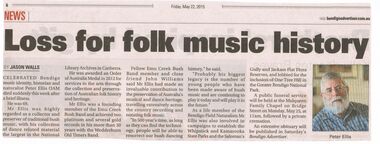 Bendigo Historical Society Inc.
Newspaper - PETER ELLIS COLLECTION: NEWSPAPER ARTICLE, 22nd May, 2015
... Mr Ellis was highly regarded as a collector and preserver of traditional bush music, with his collection of dance related material the largest in the National Library Archives in Canberra. He was award an Order of Australia Medal in 2012 for services to the arts through the collection and preservation of Australian folk history and heritage. ...Mr Ellis was highly regarded as a collector and preserver of traditional bush music, with his collection of dance related material the largest in the National Library Archives in Canberra. He was award an Order of Australia Medal in 2012 for services to the arts through the collection and preservation of Australian folk history and heritage. ...Newspaper article from the Bendigo Advertiser stuck on A4 printer paper. Article is dated Friday, May 22, 2015. Article is accompanied by a picture of Peter Ellis and is captioned as such. Article is written by Jason Walls and is titled Loss for folk music history. Article reads: Celebrated Bendigo Music identity, historian and naturalist Peter Ellis OAM died suddenly this week after a brief illness. He was 69. Mr Ellis was highly regarded as a collector and preserver of traditional bush music, with his collection of dance related material the largest in the National Library Archives in Canberra. He was award an Order of Australia Medal in 2012 for services to the arts through the collection and preservation of Australian folk history and heritage. Mr Ellis was a founding member of the Emu Creek Bush Band and achieved two platinum and several gold records in his more than 30 years with the Wedderburn Old Timers Band. Fellow Emu Creek Bush Band member and close friend John Williams said Mr Ellis had made an invaluable contribution to the preservation of Australia's musical and dance heritage, travelling extensively across the country recording and notating folk music. 'In 500 year's time, as long as they can find the technology, people will be able to resurrect our bush dancing history,' he said. 'Probably his biggest legacy is the number of young people who have been made aware of bush music and are continuing to play it today and will play it in the future.' As a life member of the Bendigo Field Naturalists Mr Ellis was also involved in campaigns to establish the Whipstick and Kamarooka State Parks and the Saloman's Gully and Jackass Flat Flora Reserves, and lobbied for the inclusion of One Tree Hill in the Greater Bendigo National Park. A public funeral service will beheld at the Mulqueen Family Chapel on Bridge Street on Monday, May 25, at 11am, followed by a private cremation. An extensive obituary will be published in Saturday's Bendigo Advertiser.person, individual, peter ellis oam -
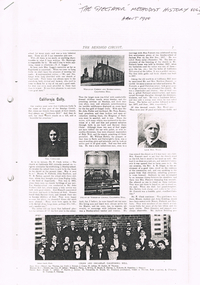 Bendigo Historical Society Inc.
Document - LONG GULLY HISTORY GROUP COLLECTION: A VOICE FROM THE GOLDEN CITY - BENDIGO
... National Library of Australia... National Sound and Film Archive...BHS Collection BENDIGO History long gully history group The Long Gully History Group - A Voice from the Golden City - Bendigo Cassell's Picturesque Australasia Thomas Wright John Carter Northcote W E D Stewart Alexander Fox Nicholas Caire George Rowe Ludwig becker S T Gill George Lacy James Edwin Meadows C D Richardson Dr Backhaus George Lansell William Charles Vahland robert Getzschmann William Beebe Cohn Brothers Bolton Brothers Bendigo Pottery Bendigo Advertiser Bendigo Tramways Sandhurst Trustees Sun Loong Chinese Dragon Shamrock Hotel Diamond Lil Bendigo William thompson Knipe's Castle No 3 Shaft of the Garden Gully Mine Cascade in Rosalind Park Dame Nellie Melba Post Office Clock Alexandra Fountain Town Hall Post Office Masonic Hall Beehive Store Princess Theatre Bendigo Art Gallery Karen Quinlan Australian Unity Bendigo Historical Society City of Greater Bendigo National Library of Australia National Sound and Film Archive the National Trust Bendigo Branch North Central Goldfields Library Coliban Water 3BO Ten Victoria Albion Chambers Albion Hotel Leaflet titled A Voice from the Golden City - Bendigo Artists, Architects and Visionaries. ...BHS Collection Leaflet titled A Voice from the Golden City - Bendigo Artists, Architects and Visionaries. An exhibition held at the Bendigo Art Gallery until 4 July 1999. Mentioned are photographers and artists including Thomas Wright, John Carter Northcote, W E D Stuart, Alexander Fox, Nicholas Caire, George Rowe, Ludwig Becker, S T Gill and George Lacy who took photos and painted pictures of the City from local vantage points. Also included are local identities and buildings. Written by Karen Quinlan, Curator. The front has a faded out impression of the fountain, and the back has a photo taken by Nicholas Caire titled Sandhurst - North Part, as seen from the top of the Masonic Hall 1875 photograph: Bendigo Art Gallery.bendigo, history, long gully history group, the long gully history group - a voice from the golden city - bendigo, cassell's picturesque australasia, thomas wright, john carter northcote, w e d stewart, alexander fox, nicholas caire, george rowe, ludwig becker, s t gill, george lacy, james edwin meadows, c d richardson, dr backhaus, george lansell, william charles vahland, robert getzschmann, william beebe, cohn brothers, bolton brothers, bendigo pottery, bendigo advertiser, bendigo tramways, sandhurst trustees, sun loong chinese dragon, shamrock hotel, diamond lil, bendigo william thompson, knipe's castle, no 3 shaft of the garden gully mine, cascade in rosalind park, dame nellie melba, post office clock, alexandra fountain, town hall, post office, masonic hall, beehive store, princess theatre, bendigo art gallery, karen quinlan, australian unity, bendigo historical society, city of greater bendigo, national library of australia, national sound and film archive, the national trust, bendigo branch, north central goldfields library, coliban water, 3bo, ten victoria, albion chambers, albion hotel -
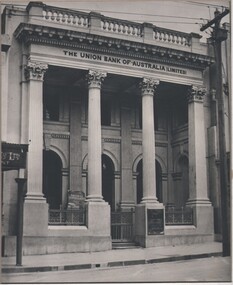 Bendigo Historical Society Inc.
Photograph - THE UNION BANK OF AUSTRALIA LIMITED, c1900s
... The Union Bank of Australia Limited in View Street Bendigo, now houses Wine Bank on View Café/Restaurant. Sign on left side of door 'Savings Certificate'. Markings/Inscriptions: Courtesy National Trust, Photo Courtesy ANZ archives....The Union Bank of Australia Limited in View Street Bendigo, now houses Wine Bank on View Café/Restaurant. Sign on left side of door 'Savings Certificate'. Markings/Inscriptions: Courtesy National Trust, Photo Courtesy ANZ archives. ...Black and white photo. The Union Bank of Australia Limited in View Street Bendigo, now houses Wine Bank on View Café/Restaurant. Sign on left side of door 'Savings Certificate'. Markings/Inscriptions: Courtesy National Trust, Photo Courtesy ANZ archives.organization, business, the union bank of australia ltd -
 Alfred Hospital Nurses League - Nursing History Collection
Book - Illustrated Book, Richard Reid (1944-) et al, Just wanted to be there: Australian Service Nurses 1899-1999, 1999
... Australian Service Nurses National Memorial on ANZAC Parade, Canberra Of significance to the AHNL as many Alfred graduates served. Military nursing-Australia-History Nurses-Australia-History Australian Army Nurses A history of the Royal Australian Army Nursing Service 1899-1999 At the bottom right of the titlepage is a printed black and white donation sticker: black Maltese cross in circle, "This book was donated to Alfred Archival Association Nursing Division by" Norma Hodge (handwritten in black ink) Also previous catalogue number handwritten in black ink on this sticker. ...A history of the Royal Australian Army Nursing Service 1899-1999Illustrated book with dust pink cover. front cover has a black and white photograph of s nurse with two hospital beds covered with mosquito tents (No 74 Camp Hospital, Katherine, NT, 1945). Part of title printed in black ink above this photo, remainder of title overprinted in white ink at the bottom of this photo. Below this is a small rectangular illustration and words: their service our heritage. Title is also printed in black ink on spine along with publishers logonon-fictionA history of the Royal Australian Army Nursing Service 1899-1999military nursing-australia-history, nurses-australia-history, australian army nurses -
 Alfred Hospital Nurses League - Nursing History Collection
Book - Illustrated Book, Richard Reid (1944-) et al, Just wanted to be there: Australian Service Nurses 1899-1999- Duplicate Copy, 1999
... Published to commemorate the centenary of the RAANC and to coincide with the opening of the Australian Aervice nurses National Memomorial on ANZAC Parade, Canberra Of significance to the AHNL as Alfred graduates/staff were among those who served Military nursing-Australia-History Nuses-Australia-History Australia Army-Nurses A history of the Royal Australian Army Nursing Service 1899-1999 At the bottom right of the titlepage is a printed black and white donation sticker: black Maltese cross in circle, "This book was donated to Alfred Archival Association Nursing Division by" Norma Hodge (handwritten in black ink) Also previous catalogue number handwritten in black ink on this sticker. ...A history of the Royal Australian Army Nursing Service 1899-1999Illustrated book with dust pink cover. front cover has a black and white photograph of s nurse with two hospital beds covered with mosquito tents (No 74 Camp Hospital, Katherine, NT, 1945). Part of title printed in black ink above this photo, remainder of title overprinted in white ink at the bottom of this photo. Below this is a small rectangular illustration and words: their service our heritage. Title is also printed in black ink on spine along with publishers logo.non-fictionA history of the Royal Australian Army Nursing Service 1899-1999military nursing-australia-history, nuses-australia-history, australia army-nurses -
National Vietnam Veterans Museum (NVVM)
Document, Collection of documents on Australian Naval Support & logs for the ships, HMAS Vendetta, HMAS Swan, HMAS Duchess, HMAS Vampire, HMAS Sydney & HMAS Torrens
... Vietnam War 1961-1975 - Naval operations - Australian HMAS Sydney (Aircraft carrier) HMAS Vampire HMAS Torrens HMAS Vendetta HMAS Swan HMAS Duchess Collection of documents on Australian Naval Support & logs for the ships, HMAS Vendetta, HMAS Swan, HMAS Duchess, HMAS Vampire, HMAS Sydney & HMAS Torrens Box of photocopies and print outs from government websites and the National Archives of Aust. ...Collection of documents on Australian Naval Support & logs for the ships, HMAS Vendetta, HMAS Swan, HMAS Duchess, HMAS Vampire, HMAS Sydney & HMAS TorrensBox of photocopies and print outs from government websites and the National Archives of Aust.Collection of documents on Australian Naval Support & logs for the ships, HMAS Vendetta, HMAS Swan, HMAS Duchess, HMAS Vampire, HMAS Sydney & HMAS Torrens vietnam war, 1961-1975 - naval operations - australian, hmas sydney (aircraft carrier), hmas vampire, hmas torrens, hmas vendetta, hmas swan, hmas duchess -
National Vietnam Veterans Museum (NVVM)
Document, Collection of documents on Australian Naval Support & logs for the ships, HMAS Vendetta, HMAS Swan, HMAS Duchess, HMAS Vampire, HMAS Sydney & HMAS Torrens
... Vietnam War 1961-1975 - Naval operations - Australian HMAS Sydney (Aircraft carrier) HMAS Vendetta HMAS Swan HMAS Duchess HMAS Vampire HMAS Torrens Collection of documents on Australian Naval Support & logs for the ships, HMAS Vendetta, HMAS Swan, HMAS Duchess, HMAS Vampire, HMAS Sydney & HMAS Torrens Box of photocopies and print outs from government websites and the National Archives of Aust. ...Collection of documents on Australian Naval Support & logs for the ships, HMAS Vendetta, HMAS Swan, HMAS Duchess, HMAS Vampire, HMAS Sydney & HMAS TorrensBox of photocopies and print outs from government websites and the National Archives of Aust.Collection of documents on Australian Naval Support & logs for the ships, HMAS Vendetta, HMAS Swan, HMAS Duchess, HMAS Vampire, HMAS Sydney & HMAS Torrens vietnam war, 1961-1975 - naval operations - australian, hmas sydney (aircraft carrier), hmas vendetta, hmas swan, hmas duchess, hmas vampire, hmas torrens -
 Alfred Hospital Nurses League - Nursing History Collection
Book, Commonwealth Department of Veteran Affairs, The nominal roll of Vietnam veterans, 1996
... Australia's defence forces during the period 23 May 1962 to 29 April 1975 either in Vietnam or in the waters adjacent to Vietnam. Inside front cover at lower left of is a printed black and white donation sticker: black Maltese cross in circle, "This book was donated to Alfred Archival Association Nursing Division by'. Maureen Spicer (nee McCleod) handwritten in black ink along with previous catalogue number. Book with black cover, title printed in white on front and spine, and in grey on back cover. Front cover also has a photograph of a memorial (Australian Vietnam Forces National ...The Nominal Roll of Vietnam Veterans honours and commemorates approximately 61,000 people who served in Australia's defence forces during the period 23 May 1962 to 29 April 1975 either in Vietnam or in the waters adjacent to Vietnam.Book with black cover, title printed in white on front and spine, and in grey on back cover. Front cover also has a photograph of a memorial (Australian Vietnam Forces National Memorial, Canberra) The back cover has a small photograph of a person with witting in the background (Australian Vietnam Forces National Memorial, Canberra).non-fictionThe Nominal Roll of Vietnam Veterans honours and commemorates approximately 61,000 people who served in Australia's defence forces during the period 23 May 1962 to 29 April 1975 either in Vietnam or in the waters adjacent to Vietnam.vietnam war 1061-1975-nominal roll-australia, vietnam war 1961-1975-paticipation-australian, australia-armed forces-registers, vietnam war 1961-1975-registers -
 Alfred Hospital Nurses League - Nursing History Collection
Programme - Order of service, Commonwealth of Australia Department of Veterans Affairs, A memorial in glass and light - The Australian Service Nurses National Memorial - order of service 2 - October 1999, September 1999
... Order of service for the opening ceremony of theAustralian Service Nurses National Memorial in Canberra, held on 2 October 1999, includes a description of the memorial designed by Robin Moorhouse Of significance to the AHNL as a memory of Alfred nurses who served Australian Service Nurses National Memorial Nurses War Memorials-Australian There is a printed black and white donation sticker: black Maltese cross in circle, 'This book was donated to Alfred Archival Association Nursing Division by Jan Ekins [handwritten in black ink] bottom of front end-page, Previous catalogue number is written in black ink at top right of this page Stapled booklet with salmon pink cover and black print, in adition to the title, there is a black & white illustration of the Australian Service Nurses memorial, Canberra and logo of 'their service -our heritage', a Federal Government programme A memorial in glass and light - The Australian Service Nurses National Memorial - order of service 2 - October 1999 Programme Order of service Commonwealth of Australia Department of Veterans Affairs Looking Glass Press Pty Ltd ...Order of service for the opening ceremony of theAustralian Service Nurses National Memorial in Canberra, held on 2 October 1999, includes a description of the memorial designed by Robin MoorhouseOf significance to the AHNL as a memory of Alfred nurses who servedStapled booklet with salmon pink cover and black print, in adition to the title, there is a black & white illustration of the Australian Service Nurses memorial, Canberra and logo of 'their service -our heritage', a Federal Government programmeThere is a printed black and white donation sticker: black Maltese cross in circle, 'This book was donated to Alfred Archival Association Nursing Division by Jan Ekins [handwritten in black ink] bottom of front end-page, Previous catalogue number is written in black ink at top right of this pageaustralian service nurses national memorial, nurses, war memorials-australian -
 Alfred Hospital Nurses League - Nursing History Collection
Programme - Order of service, Commonwealth of Australia Department of Veterans Affairs, A memorial in glass and light - The Australian Service Nurses National Memorial - order of service 2 - October 1999, September 1999
... Order of service for the opening ceremony of theAustralian Service Nurses National Memorial in Canberra, held on 2 October 1999, includes a description of the memorial designed by Robin Moorhouse Of significance to the AHNL as a memory of Alfred nurses who served Australian Service Nurses National Memorial Nurses War Memorials-Australian There is a printed black and white donation sticker: black Maltese cross in circle, 'This book was donated to Alfred Archival Association Nursing Division by Jan Ekins [handwritten in black ink] bottom of front end-page, Previous catalogue number is written in black ink at top right of this page Stapled booklet with salmon pink cover and black print, in adition to the title, there is a black & white illustration of the Australian Service Nurses memorial, Canberra and logo of 'their service -our heritage', a Federal Government programme A memorial in glass and light - The Australian Service Nurses National Memorial - order of service 2 - October 1999 Programme Order of service Commonwealth of Australia Department of Veterans Affairs Looking Glass Press Pty Ltd ...Order of service for the opening ceremony of theAustralian Service Nurses National Memorial in Canberra, held on 2 October 1999, includes a description of the memorial designed by Robin MoorhouseOf significance to the AHNL as a memory of Alfred nurses who servedStapled booklet with salmon pink cover and black print, in adition to the title, there is a black & white illustration of the Australian Service Nurses memorial, Canberra and logo of 'their service -our heritage', a Federal Government programmeThere is a printed black and white donation sticker: black Maltese cross in circle, 'This book was donated to Alfred Archival Association Nursing Division by Jan Ekins [handwritten in black ink] bottom of front end-page, Previous catalogue number is written in black ink at top right of this pageaustralian service nurses national memorial, nurses, war memorials-australian
