
Showing 1313 items matching "african"
-
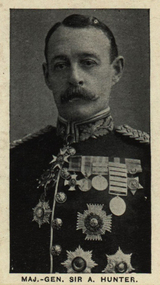 Federation University Historical Collection
Photograph (black & White), Major-General Sir Archibald Hunter - South Africa
... Major-General Sir Archibald Hunter - South Africa ...He was awarded Knight Grand Cross of the Order of the Bath, Knight Grand Cross of the Royal Victorian Order, Territorial Decoration Legion of Honour (France) second boer war major generl archibald hunter natal field force battle of ladysmith general officer commanding sir george white guerrilla warfare orange free state brandwater basin marthinus prinsloo knight grand cross of the order of the bath knight grand crossof the royal victorian order legion of honour (france) Individual image taken from photographed poster of tobacco and cigarette cards Major-General Sir Archibald Hunter - South Africa Photograph (black & White) ...At the outbreak of the Second Boer War, Major General Hunter was on the staff of Sir George White's Natal Field Force during the Battle of Ladysmith in Natal. He led a small raid against some of the Boers' guns, disabled them and relieved the town. Promotion followed and he became General Officer Commanding 10th Division. The Division was sent to join Lord Roberts' army camped at the captured Orange Free State capital. Hunter led them in the march on Pretoria. Once Pretoria was captured they still had to deal with Guerrilla Warfare and Hunter was sent south as overall commander of five columns that converged on the Free State army camped at Brandwater Basin, forcing the surrender of 4,314 Boers led by Marthinus Prinsloo. He was awarded Knight Grand Cross of the Order of the Bath, Knight Grand Cross of the Royal Victorian Order, Territorial Decoration Legion of Honour (France)Individual image taken from photographed poster of tobacco and cigarette cardssecond boer war, major generl, archibald hunter, natal field force, battle of ladysmith, general officer commanding, sir george white, guerrilla warfare, orange free state, brandwater basin, marthinus prinsloo, knight grand cross of the order of the bath, knight grand crossof the royal victorian order, legion of honour (france) -
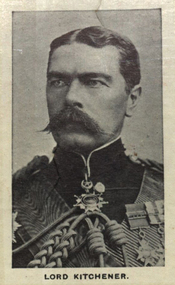 Federation University Historical Collection
Photograph (black & White), Horatio Herbert Kitchener, 1st Earl Kitchener - South Africa
... Horatio Herbert Kitchener, 1st Earl Kitchener - South Africa...Horatio Herbert Kitchener, 1st Earl Kitchener - South Africa Photograph (black & White) ...For his achievements in the Battle of Omdurman and Sudan in 1898, Kitchener was made Lord Kitchener of Khartoum, becoming an Earl - qualifying peer of mid-rank. Kitchener was a senior British Army officer and colonial administrator who won notoriety for his campaigns, most especially his scorched earth policy against the Boers and his establishment of concentration camps during the Second Boer War. Awards he received include: Knight of the Order of the Garter; Knight of the Order of St Patrick; Knight Grand Cross of the Order of the Bath; Member of the Order of Merit; Knight Grand Commander of the Order of the Star of India; Knight Grand Cross of the Order of St Michael and St George; Knight Grand Commander of the Order of the Indian Empire. Individual imagae take from photographed poster of tobacco and cigarette cards.battle of omdurman, sudan, kitchener, earl, scorched earth policy, boers, concentration camps, colonial administrator, knight of the order of st patrick, knight of the order of the garter, knight grand cross of the order of st michael and st george, knight grand cross of the order of the bath, member of the order of merit, knight grand commander of the order of the star of india, knight grand commander of the order of the indian empire -
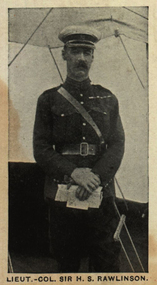 Federation University Historical Collection
Photograph (black & White), Lieutenant-Colonel Sir Henry Seymour Rawlinson, 1st Baron Rawlinson - South Africa
... Lieutenant-Colonel Sir Henry Seymour Rawlinson, 1st Baron Rawlinson - South Africa ...Lieutenant-Colonel Sir Henry Seymour Rawlinson, 1st Baron Rawlinson - South Africa Photograph (black & White) ...Rawlinson served with distinction in a field command in the Second Boer War from 1899 to 1902. He was in Western Transvaal during early 1902 and led a column taking part in the Battle of Rooiwai, the last battle of the war. Following the end of hostilities he returned to England. Rawlinson, for his commands and the battles and wars he was engaged in during his career was awarded many times. Knight Grand Cross of the Royal Victorian Order, 1917; Knight Commander of the Order of St Michael and St George, 1918; Knight Grand Cross of the Order of the Bath, 1919; Baron Rawlinson, of Trent in the County of Dorset, 1919. Grand Officer of the Legion of Honour of France, 1916; Order of Danilo, 1st Class of the Kingdom of Montenegro, 1916; Obilitch Medal in Gold of the Kingdom of Montenegro, 1917; Order of St George, 4th Class of the Empire of Russia, 1917; Grand Officer of the Order of Leopold of Belgium, 1917; Croix de Guerre of Belgium, 1918; Croix de Guerre of France, 1919; American Army Distinguished Service Medal, 1919; Knight Grand Commander of the Order of the Star of India, 1924. Individual image from photographed poster of tobacco and cigarette cards.rawlinson, second boer war, western transvaal, battle of rooiwai, 1st baron of trent, dorset, knight grand cross of the royal victorian order, knight commander of the order of st michael and st george, knight grand cross of the order of the bath, grand officer of the legion of honour france, order of danilo 1st class of the kingdom of montenegro, obilitch medal in gold of the kingdom of montenegro, order fo st george 4th class of theempire of russia, grand officer of the order of leopold of belgium, croix de guerra of belgium, croix de guerra of france, american army distinguished service medal, knight grand commander of the order of the star of india -
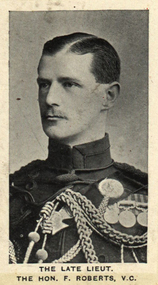 Federation University Historical Collection
Photograph (black & White), Lieutenant, The Honourable Frederick Hugh Sherston Roberts - South Africa
... Lieutenant, The Honourable Frederick Hugh Sherston Roberts - South Africa ...Lieutenant, The Honourable Frederick Hugh Sherston Roberts - South Africa Photograph (black & White) ...Frederick Roberts was the son of Field Marshall Frederick Roberts, 1st Earl Roberts. At the age of 27 he went with the King's Rifles to the Second Boer War. During battle he, with two officers tried to assist and save guns when the detachments serving the guns had all become casualties or been driven away. While doing this Roberts fell badly wounded and 2 days later died. Commander-in-Chief Redvers Buller recommended Roberts for the Victoria Cross. Confirmation of the award made after his death. Roberts and his father were one of only three father son pairs to win the Victoria Cross. His father's was in 1858.Individual image from photographed poster of tobacco and cigarette cards.frederick roberts, field marshall roberts, king's rifles, second boer war, redvers buller, south africa -
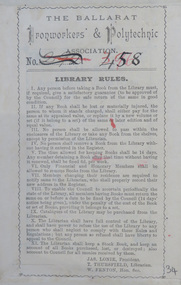 Federation University Historical Collection
Book, Geological Gossip or Stray Chapters on Earth and Ocean, 1860, 1860
... ...africa...geology water rivers the atlantic great deep africa australian interior eyre's expedition murray river darling river earthqaukes leichardt moreton bay volcanos darwin's theory evolution egyptian race human remains in caverns and gravel rocks metamorphism iron ores coal coal fields gold deposits california water-glass artificial stone porous stones cements Brown hard covered book Brown hard covered book. ...Brown hard covered book. Chapter 16 is on gold deposits and discusses the discovery of gold in California and Australia.Brown hard covered book geology, water, rivers, the atlantic, great deep, africa, australian interior, eyre's expedition, murray river, darling river, earthqaukes, leichardt, moreton bay, volcanos, darwin's theory, evolution, egyptian race, human remains in caverns and gravel, rocks, metamorphism, iron ores, coal, coal fields, gold deposits, california, water-glass, artificial stone, porous stones, cements -
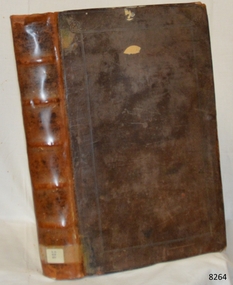 Flagstaff Hill Maritime Museum and Village
Book - Reference Encyclopedic Compendium, Peter Heylyn, Cosmography in Four Books, 1674
... Book II: Asia and its kingdoms. Book III: Africa, its provinces, and coastal regions. ...Cosmography in Four Books was originally published as Cosmographie and is one of the most famous and comprehensive English encyclopedic compendiums of global geography, history, and chorography, meaning regional topography, produced in the 17th century. The work was first published in 1652 and attempts to document every known region of the world at the time. The information is bound together as a single large folio volume and divided into four main sections or books: Book I: Europe and its surrounding islands. Book II: Asia and its kingdoms. Book III: Africa, its provinces, and coastal regions. Book IV: America, split into Northern and Southern America. Book IV features an Appendix speculating on Terra Australis Incognita (the unknown Southern Continent). Each section outlines geographical coordinates, local climates, political histories, royal lineages, cultures, and notable geographical features, accompanied by four large folding engraved maps, one for each continent.Hard cover book,Cosmography in Four Books Author: Peter Heylyn Publisher: Philip Cherwind & Anne Seile, London. Date: (MDCLXXIV) 1674 Further Information: Brown Leather bound volume, library label to spine, spine has raised ribbing front cover has border in gilt.non-fictionCosmography in Four Books was originally published as Cosmographie and is one of the most famous and comprehensive English encyclopedic compendiums of global geography, history, and chorography, meaning regional topography, produced in the 17th century. The work was first published in 1652 and attempts to document every known region of the world at the time. The information is bound together as a single large folio volume and divided into four main sections or books: Book I: Europe and its surrounding islands. Book II: Asia and its kingdoms. Book III: Africa, its provinces, and coastal regions. Book IV: America, split into Northern and Southern America. Book IV features an Appendix speculating on Terra Australis Incognita (the unknown Southern Continent). Each section outlines geographical coordinates, local climates, political histories, royal lineages, cultures, and notable geographical features, accompanied by four large folding engraved maps, one for each continent.flagstaff hill, warrnambool, shipwrecked coast, flagstaff hill maritime museum, maritime museum, shipwreck coast, flagstaff hill maritime village, great ocean road, book, pattison collection, warrnambool library, warrnambool mechanics’ institute, ralph eric pattison, corangamite regional library service, warrnambool city librarian, mechanics’ institute library, victorian library board, warrnambool books and records, warrnambool children’s library, cosmography in four books, philip chetwind, anne seile -
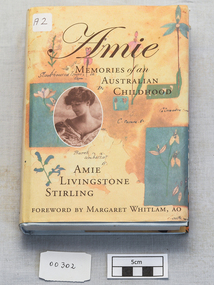 City of Moorabbin Historical Society (Operating the Box Cottage Museum)
Book, Stirling, Amie Livingstone, Amie, Memories of an Australian Childhood, 1980
... Her grand-daughter Linda Harrison compiled her writings and added stories from her later life in Paris and North Africa On spine - ' AMIE: MEMORIES OF AN / AUSTRALIAN CHILDHOOD/ AMIE / LIVINGSTON / STIRLING / Black Inc. ...Amie Livingston Stirling 1880-1945 recorded her memories of growing up in Omeo, Elwood and San Remo in Victoria and in 1880s and '90s. About her father James Stirling, the famous coal-mining pioneer and geologist. Her grand-daughter Linda Harrison compiled her writings and added stories from her later life in Paris and North Africa274 p. : ill., ports., tables ; Pale blue hardback book of the childhood memories of Amie Livingston Stirling1880- 1945, compiled by her grand-daughter Linda Harrison in1980 non-fictionAmie Livingston Stirling 1880-1945 recorded her memories of growing up in Omeo, Elwood and San Remo in Victoria and in 1880s and '90s. About her father James Stirling, the famous coal-mining pioneer and geologist. Her grand-daughter Linda Harrison compiled her writings and added stories from her later life in Paris and North Africastirling james, reid elizabeth, early settlers, pioneers, surveyors, geologists, gippsland, omeo, elwood, melbourne, victoria, geelong, mining, botany, von mueller baron, elster creek, brighton, moorabbin, howitt alfred william, murray r a f, goodsir agnes, amie stirling -
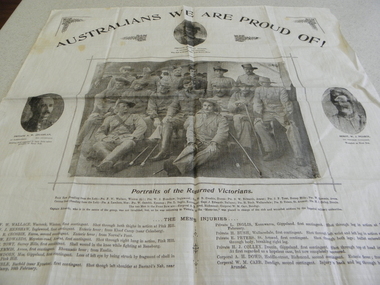 Geelong RSL Sub Branch
Linen Cloth - Australians we are Proud Of!, Early 20th Century
... The cloth is an original and has the portraits of Victorian Servicemen to went to South Africa during the Boer War. Linen Cloth, Boer War Portraits of Serviceman and their Names and Units, where they came from and injuries received during their service. ...This cloth has portraits, units, names addresses and injuries that the men received during their service during the Boer War.The cloth is an original and has the portraits of Victorian Servicemen to went to South Africa during the Boer War.A square, white cotton cloth with portraits of Victorians who served during the Boer War.Portraits of Serviceman and their Names and Units, where they came from and injuries received during their service.linen cloth, boer war -
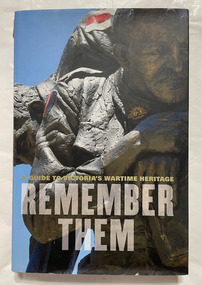 City of Moorabbin Historical Society (Operating the Box Cottage Museum)
Book, Hutchinson, Garrie, Remember them : a guide to Victoria's wartime heritage, 2007
... war memorials soldier monuments soldiers World War one World War Two korean war Vietnam War South African War monuments ""Remember them" has been funded by the Government of Victoria, and produced by the Veteran's Unit, Department of Planning and Community Development." ...""Remember them" has been funded by the Government of Victoria, and produced by the Veteran's Unit, Department of Planning and Community Development."--Title page verso.308 p. : ill. (some col.), maps ; non-fiction""Remember them" has been funded by the Government of Victoria, and produced by the Veteran's Unit, Department of Planning and Community Development."--Title page verso.war memorials, soldier monuments, soldiers, world war one, world war two, korean war, vietnam war, south african war, monuments -
 Mission to Seafarers Victoria
Letter - Correspondence, 1/09/1950
... Quinn Collection letters-from-abroad quinn m.s. mongabarra capetown, south africa A self-folding letter written in green ink (0846.a), headed M.S. ...Allan described his shore leave in Capetown. He writes that on the return trip to Gothenburg the ship will be calling in at the Belgium Congo, Antwerp and Copenhagen. He expects to arrive in Gothenburg in mid October.Quinn CollectionA self-folding letter written in green ink (0846.a), headed M.S. Mongabarra, Durban and dated 1/09/1950. The letter is addressed to Mrs E. Quinn. Postmarked Durban the postage is sixpence.letters-from-abroad, quinn, m.s. mongabarra, capetown, south africa -
Phillip Island and District Historical Society Inc.
Book, J. Macgowan, Field of Mars : being an alphabetical digestion of the principal naval and military engagements in Europe, Asia, Africa and America, particularly of Great Britain and her allies, from the ninth century to the present period, 1781
... Field of Mars : being an alphabetical digestion of the principal naval and military engagements in Europe, Asia, Africa and America, particularly of Great Britain and her allies, from the ninth century to the present period.....Field of Mars : being an alphabetical digestion of the principal naval and military engagements in Europe, Asia, Africa and America, particularly of Great Britain and her allies, from the ninth century to the present period.. ...Inscribed: To John Cleeland from J.A.L [?] 30/9/71. Labelled: Phillip Island Historical Society, Cleeland Bequest. Cowes Free Public Library. -
Phillip Island and District Historical Society Inc.
Book, ROBERTSON, John S, life of David Livingstone, Ll.D. : the great missionary explorer, 1888
... ...africa...David Livingstone missionaries africa explorers biography Labelled 'Cowes Free Public Library'. ...Labelled 'Cowes Free Public Library'. Labelled: 'Phillip Island Historical Society. Cleeland Bequest'.david livingstone, missionaries, africa, explorers, biography -
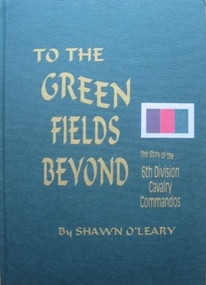 Australian Commando Association - Victoria
Book - 6th Div, Shawn OLeary, To The Green Fields Beyond:The story of the 6th Division Cavalry Commandos
... As an armoured cavalry unit it fought the Italians and Germans in the sands of the African desert and the Vichy French in the mountains of Syria. ...The comprehensive history of the 6th Australian Division Cavalry Commandos – a (now out of print) reprint of one of the rarer Armoured unit history books. This is the story of one of Australia’s most famous fighting regiments during World War II. As an armoured cavalry unit it fought the Italians and Germans in the sands of the African desert and the Vichy French in the mountains of Syria. Later as a dismounted commando unit it fought the Japanese in the terrifying jungles of New Guinea. The heroism of the men in its ranks and the actions in which they engaged are portrayed in a way which makes battle deeds leap realistically from the pages. “To The Green Fields Beyond” is a documented and detailed book which is of value to everyone who is interested in Australia’s story. Seldom before has such a contribution been made to record of our national history. The book has been approved and sponsored by the Australian War Memorial. The 6th Division Cavalry Regiment was formed in November 1939 and, just two months later, was sent overseas to the Middle East in January 1940. Arriving in Egypt, the regiment immediately went to Palestine, where it joined the rest of the 6th Division and trained using machine-gun carriers and, from October, six old Vickers light tanks. At the end of the year the regiment moved into the Western Desert, where it joined British forces ready for the major offensive to commence on 9 December. Two days later the regiment became the first unit of the 2nd Australian Imperial Force (AIF) to go into action when one of its squadron fought a sharp action against the Italians holding Garn el Grein and Fort Maddalina on 11 and 12 December. By 21 December British forces had captured Sidi Barrrani and the desert was now open for the 6th Division’s advance along the Libyan coast. On 3 January 1941 the division attacked and captured the Italian fort of Bardia. The regiment’s A Squadron, under the command of Major Denzil Macarthur-Onslow, who went on to command the 4th Armoured Brigade, supported the attack. Tobruk was the next Italian fort to be captured, with the regiment again in support and covering the 19th Brigade’s advance. The regiment, though, was under-equipped and without its full compliment of vehicles, using only machine gun carriers. To compensate for this, A Squadron was parity re-equipped with captured Italian light tanks, which had large kangaroos painted on the hulls and turrets to distinguish them from enemy vehicles. After Tobruk, the regiment was used as part of the advance guard in the capture of Derna and then Benghazi. In April the unit moved to Helwan, where it was equipped with Vickers light tanks and machine-gun carriers, and operated with British troops in capturing Sollum. Towards the end of May the regiment moved to Palestine, where it came under the command of the 7th Division for the imminent invasion of Syria. The regiment experienced its heaviest fighting during the Syrian campaign, which began on 7 June. A Squadron was attached to the 21st Brigade and advanced along the coast, where the rugged hills made it difficult to manoeuvre the tanks and carriers. The squadron was relieved by one of the 9th Division Cavalry Regiment’s squadrons on 13 and 14 June. C Squadron, meanwhile, was with the 25th Brigade, and advanced along the Rosh Pinna road, engaging strong enemy defences at Fort Khirbe. C Squadron was relieved by B Squadron, which was later attacked by Vichy French tanks that were supported by heavy artillery and machine-gun fire, which forced the Australians to withdrawal. Always willing or needing to improvise during the campaign, A and B Squadrons both operated three captured French R35 Renault light tanks, while C Squadron provided personnel for a horse troop, quickly nicknamed the “Kelly Gang”, to patrol the high, rugged hills near the Mardjayoun–Banis Road. The regiment remained in Syria as part of the occupation force and returned to Australia in March 1942. It was sent to the Adelaide River, in the Northern Territory, and then later to Murgon, in Queensland. In 1943 and 1944 divisional cavalry regiments were reorganised into cavalry (commando) regiments. In January 1944 the 6th Division Cavalry Regiment became the 2/6th Cavalry (Commando) Regiment. The regiment lost its vehicles and became the administrative headquarters for the 2/7th, 2/9th, and 2/10th Commando Squadrons. The regiment remained with the 6th Division and participated in the Aitpae–Wewak campaign, in New Guinea, during 1945. Includes Nominal Rollnon-fictionThe comprehensive history of the 6th Australian Division Cavalry Commandos – a (now out of print) reprint of one of the rarer Armoured unit history books. This is the story of one of Australia’s most famous fighting regiments during World War II. As an armoured cavalry unit it fought the Italians and Germans in the sands of the African desert and the Vichy French in the mountains of Syria. Later as a dismounted commando unit it fought the Japanese in the terrifying jungles of New Guinea. The heroism of the men in its ranks and the actions in which they engaged are portrayed in a way which makes battle deeds leap realistically from the pages. “To The Green Fields Beyond” is a documented and detailed book which is of value to everyone who is interested in Australia’s story. Seldom before has such a contribution been made to record of our national history. The book has been approved and sponsored by the Australian War Memorial. The 6th Division Cavalry Regiment was formed in November 1939 and, just two months later, was sent overseas to the Middle East in January 1940. Arriving in Egypt, the regiment immediately went to Palestine, where it joined the rest of the 6th Division and trained using machine-gun carriers and, from October, six old Vickers light tanks. At the end of the year the regiment moved into the Western Desert, where it joined British forces ready for the major offensive to commence on 9 December. Two days later the regiment became the first unit of the 2nd Australian Imperial Force (AIF) to go into action when one of its squadron fought a sharp action against the Italians holding Garn el Grein and Fort Maddalina on 11 and 12 December. By 21 December British forces had captured Sidi Barrrani and the desert was now open for the 6th Division’s advance along the Libyan coast. On 3 January 1941 the division attacked and captured the Italian fort of Bardia. The regiment’s A Squadron, under the command of Major Denzil Macarthur-Onslow, who went on to command the 4th Armoured Brigade, supported the attack. Tobruk was the next Italian fort to be captured, with the regiment again in support and covering the 19th Brigade’s advance. The regiment, though, was under-equipped and without its full compliment of vehicles, using only machine gun carriers. To compensate for this, A Squadron was parity re-equipped with captured Italian light tanks, which had large kangaroos painted on the hulls and turrets to distinguish them from enemy vehicles. After Tobruk, the regiment was used as part of the advance guard in the capture of Derna and then Benghazi. In April the unit moved to Helwan, where it was equipped with Vickers light tanks and machine-gun carriers, and operated with British troops in capturing Sollum. Towards the end of May the regiment moved to Palestine, where it came under the command of the 7th Division for the imminent invasion of Syria. The regiment experienced its heaviest fighting during the Syrian campaign, which began on 7 June. A Squadron was attached to the 21st Brigade and advanced along the coast, where the rugged hills made it difficult to manoeuvre the tanks and carriers. The squadron was relieved by one of the 9th Division Cavalry Regiment’s squadrons on 13 and 14 June. C Squadron, meanwhile, was with the 25th Brigade, and advanced along the Rosh Pinna road, engaging strong enemy defences at Fort Khirbe. C Squadron was relieved by B Squadron, which was later attacked by Vichy French tanks that were supported by heavy artillery and machine-gun fire, which forced the Australians to withdrawal. Always willing or needing to improvise during the campaign, A and B Squadrons both operated three captured French R35 Renault light tanks, while C Squadron provided personnel for a horse troop, quickly nicknamed the “Kelly Gang”, to patrol the high, rugged hills near the Mardjayoun–Banis Road. The regiment remained in Syria as part of the occupation force and returned to Australia in March 1942. It was sent to the Adelaide River, in the Northern Territory, and then later to Murgon, in Queensland. In 1943 and 1944 divisional cavalry regiments were reorganised into cavalry (commando) regiments. In January 1944 the 6th Division Cavalry Regiment became the 2/6th Cavalry (Commando) Regiment. The regiment lost its vehicles and became the administrative headquarters for the 2/7th, 2/9th, and 2/10th Commando Squadrons. The regiment remained with the 6th Division and participated in the Aitpae–Wewak campaign, in New Guinea, during 1945. Includes Nominal Rollww2, australian commandos, australian special forces, world war 2 -
 Flagstaff Hill Maritime Museum and Village
Book - Fictional Story, John Masefield, Dead Ned, 1938
... It has a sequel, Live and Kicking Ned (1939), a seafaring novel about the African slave trade that continues the 1938 story. ...The full title for Dead Ned is The Autobiography of a Corpse Who Recovered Life Within the Coast of Dead Ned and Came to What Fortune You Shall Hear. The novel follows a young doctor who is hanged for a murder he did not commit, is rescued just in time, and rushed out of the country on a slave ship. The novel is an 18th-century-set adventure about a wrongly accused medical student, Ned Mansell. While he's aboard the slave ship, the story follows his journey as he is saved from the gallows at the last minute by friends who send him off to hide as a doctor on the vessel. It has a sequel, Live and Kicking Ned (1939), a seafaring novel about the African slave trade that continues the 1938 story.Hard cover book. Dead Ned Author: John Masefield Publisher: William Heinemann Ltd Date: 1938 Further Information: Green Cloth hardcover with lettering and patterning to spine in black. The spine has a Library label with an inscription.fictionThe full title for Dead Ned is The Autobiography of a Corpse Who Recovered Life Within the Coast of Dead Ned and Came to What Fortune You Shall Hear. The novel follows a young doctor who is hanged for a murder he did not commit, is rescued just in time, and rushed out of the country on a slave ship. The novel is an 18th-century-set adventure about a wrongly accused medical student, Ned Mansell. While he's aboard the slave ship, the story follows his journey as he is saved from the gallows at the last minute by friends who send him off to hide as a doctor on the vessel. It has a sequel, Live and Kicking Ned (1939), a seafaring novel about the African slave trade that continues the 1938 story.warrnambool, shipwrecked-coast, flagstaff-hill, flagstaff-hill-maritime-museum, maritime-museum, shipwreck-coast, flagstaff-hill-maritime-village, shipwrecked-artefact, book, dead ned, john masefield, warrnambool mechanics’ institute, pattison collection, warrnambool library, ralph eric pattison, corangamite regional library service, warrnambool city librarian, mechanics’ institute library, victorian library board, warrnambool books and records, warrnambool children’s library -
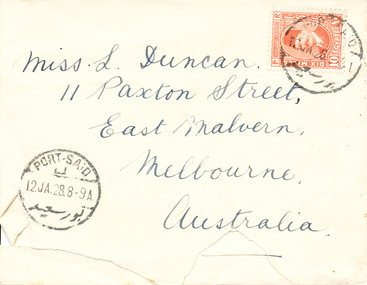 Mission to Seafarers Victoria
Letter - Correspondence, Letter to Lillie from Ted, 4 January 1928
... ...africa...This letter, and the series of which it is a part, underscores the importance of making relationships abroad for those who earned their living on the seas. melbourne ted letters somerset lillie duncan lillian duncan ladies harbour lights guild lhlg port said mission to seafarers stamp africa seamen's mission ss mandasor Postmark in top right hand corner of envelope is indecipherable. ...This is one in a series of letters written by various seafarers to Lillie Duncan. Lillie was a member of the Ladies' Harbour Lights Guild during the 1920s. She seems to have struck up a number of friendships with seafarers who used the facility. The Ladies' Harbour Lights Guild was responsible for much of the fundraising that constructed and maintained the organisation from its inception in 1902. They were also responsible for arranging dances and other social activities designed to make seafarers welcome in a strange environment.The purpose of the Mission to Seafarers is, as it always was, to provide comfort and welfare services to visiting seafarers. This letter, and the series of which it is a part, underscores the importance of making relationships abroad for those who earned their living on the seas.Handwritten letter in four parts consisting of an envelope with three pages of handwritten text in black ink using only the face of each page.Postmark in top right hand corner of envelope is indecipherable. Postmark in bottom left hand corner of envelope: PORT SAID/indecipherable/12JA.28.8-9A/indecipherablemelbourne, ted, letters, somerset, lillie duncan, lillian duncan, ladies harbour lights guild, lhlg, port said, mission to seafarers, stamp, africa, seamen's mission, ss mandasor -
Phillip Island and District Historical Society Inc.
Book, STANLEY, Henry M, Through the dark continent, or, the sources of the Nile around the great lakes of equatorial Africa and down the Livingston River to the Atlantic Ocean, 1890
... Through the dark continent, or, the sources of the Nile around the great lakes of equatorial Africa and down the Livingston River to the Atlantic Ocean...Through the dark continent, or, the sources of the Nile around the great lakes of equatorial Africa and down the Livingston River to the Atlantic Ocean Book STANLEY, Henry M. ... -
 Bendigo Military Museum
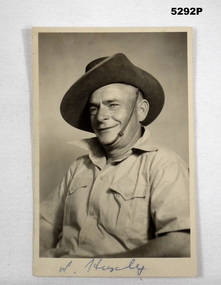
Postcard - POSTCARD, FROM NORTH AFRICA, 8 November 1941
... Postcard POSTCARD, FROM NORTH AFRICA. ...Picture postcard of Norman Huxley No. NX18101. 2/1 HQ Guard Battalion taken HAIFA, Egypt 8/11/1941.Postcard sent to pen pal Thelma Benson.Black & White Picture postcard of Norman Huxley on front and message on back.Picture postcard of Norman Huxley on front with name in pen. Message on back to pen pal Thelma Benson and signed by Norman Huxley.ww2, north africa, egypt, postcards -
 Bendigo Military Museum
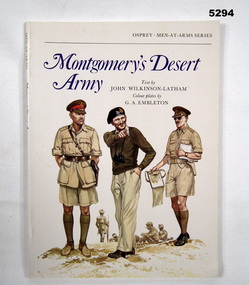
Book - BOOK, WW2, NORTH AFRICA, JOHN WILKINSON- LATHAM, Montgomery's Desert Army, 1977
... Montgomery's Desert Army Book BOOK, WW2, NORTH AFRICA JOHN WILKINSON- LATHAM OSPREY PUBLISHING HOUSE LTD BAS Printers Limited ...Colour Plates by 'G.A. EMELETON'. OSPREY MEN AT ARMS SERIES.Soft cover book. Soft cover - cardboard, blue and black colour print on front, spine and back. Front cover illustration of three army personnel on white background. 40 pages, paper, cut, plain, white. Illustrated - black and white photographs, maps and colour plates. Title page - two owner's stamps.Title page - owner's stamp, black ink, "MR. W.J. HAMMILL, A.A.I.M./ PO BOX 76, KANGAROO FLAT/ VICTORIA, 3555, AUSTRALIA,"books, history, ww2 -
 Bendigo Military Museum
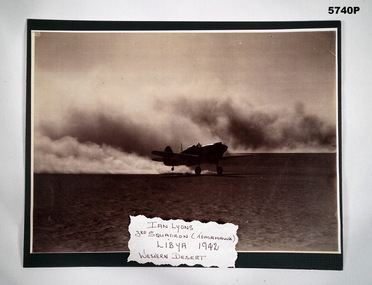
Photograph - PHOTOGRAPH, WW2 TOMAHAWK AIRCRAFT
... See Catalogue No. 5374P for details of his service record. WW2 North Africa Western Desert Libya Tomahawk aircraft Ian A. ...Photograph depicts a WW2 Tomahawk aircraft piloted by Ian A. Lyons. Part of Flight Lieutenant Ian A, 'Joe' Lyons Collection. See Catalogue No. 5374P for details of his service record.Black and white photograph of a piloted WW2 Tomahawk aircraft taxiing on a desert landing strip. Photograph is mounted on dark green coloured cardboard. A handwritten caption on white paper is attached to the bottom of the photograph.Handwritten caption: 'IAN LYONS, 3RD SQUADRON (TOMAHAWK) LIBYA 1942, WESTERN DESERT'.ww2, north africa, western desert, libya, tomahawk aircraft, ian a. 'joe' lyons -
 Warrnambool and District Historical Society Inc.
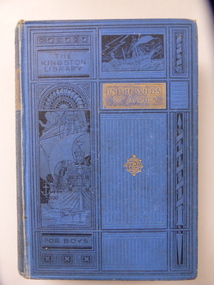
Book, In The Wilds of Africa, 1901
... In The Wilds of Africa...The inscription on the first page, with the page partly detached, is handwritten in blue ink. In The Wilds of Africa Book ...This is a boy’s adventure book owned by Francis Skuse of Strathallan, Allansford in 1906. Francis Skuse, the son of John and Catherine Skuse, was a grazier at the property Strathallan, six kilometres from Allansford. His property included the Strathallan mine which had limestone/carbonates deposits. He died in 1962. This book is of interest because it was owned by Francis Skuse, a farmer and long-time resident of Strathallan, near Allansford.This is a hard cover book of 558 pages. It has a blue cover with the names of the title and author in blue print on a gold background. The front cover and the spine are patterned with scrolls and imprints of sailing ships. The book contains several black and white sketches. The inscription on the first page, with the page partly detached, is handwritten in blue ink. ‘Francis Skuse, Strathallan, Allansford, June 3rd 1906’. francis skuse, strathallan, allansford -
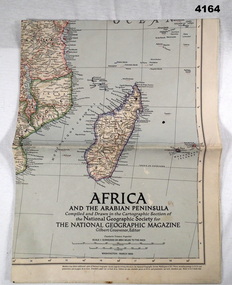 Bendigo Military Museum
Map - MAP, COLOURED, The National geographic Magazine, Africa & the Arabian Peninsula, March 1950
... Africa & the Arabian Peninsula......Africa...Africa & the Arabian Peninsula Map MAP, COLOURED The National geographic Magazine ...Part of the collection of Frederick Gardner Davey DFC No 410533 RAAF. Refer Cat No 3536P for his service details.Coloured political map featuring borders,towns,and Allies, small physical inset in bottom LH corner.maps, africa, arabian -
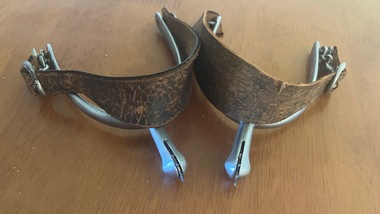 Colac RSL Sub Branch
Memorabilia (item), THOMAS YATES
... THOMAS YATES SERVICE NO 253 DATE OF BIRTH 4/7/1874 PLACE OF BIRTH COLAC VICTORIA DATE OF ENLISTEMENT PLACE OF ENLISTMENT WARRION VICTORIA NEXT OF KIN WILLIAM YATES FARTHER MARCELLA YATES DATE DISCHARGED DIED BEFORE HE WAS DISCHARGED RANK PRIVATE WITH THE VICTORIAN IMPERIAL BUSHMEN REGIMENT DATE OF DEATH 17/7/1901 THOMAS AN THREE OF HIS MATES ALL JOINED THE VICTORIAN IMPERIAL BUSHMENS REGIMENT TO GO TO THE BOAR WAR 1899 THEY ALL WENT TO SOUTH AFRICA WHERE EDGAR QUARTUS ROBERTSON NOEL LEONARD CALVERT AN ARTHUR EDWARD MURPHY WHERE ALL KILLED IN ACTION THOMAS SURVICED THROUGH THE WAR THOMAS RETURNED TO MELBOURNE ON 12th JULY 1901 AN DIED IN A MELBOURNE HOSPITAL ON 17 JULY 1901 NILL A PAIR OF MENS HORSE RIDING SPURS THOMAS YATES Memorabilia ...THOMAS YATES SERVICE NO 253 DATE OF BIRTH 4/7/1874 PLACE OF BIRTH COLAC VICTORIA DATE OF ENLISTEMENT PLACE OF ENLISTMENT WARRION VICTORIA NEXT OF KIN WILLIAM YATES FARTHER MARCELLA YATES DATE DISCHARGED DIED BEFORE HE WAS DISCHARGED RANK PRIVATE WITH THE VICTORIAN IMPERIAL BUSHMEN REGIMENT DATE OF DEATH 17/7/1901 THOMAS AN THREE OF HIS MATES ALL JOINED THE VICTORIAN IMPERIAL BUSHMENS REGIMENT TO GO TO THE BOAR WAR 1899 THEY ALL WENT TO SOUTH AFRICA WHERE EDGAR QUARTUS ROBERTSON NOEL LEONARD CALVERT AN ARTHUR EDWARD MURPHY WHERE ALL KILLED IN ACTION THOMAS SURVICED THROUGH THE WAR THOMAS RETURNED TO MELBOURNE ON 12th JULY 1901 AN DIED IN A MELBOURNE HOSPITAL ON 17 JULY 1901 NILL -
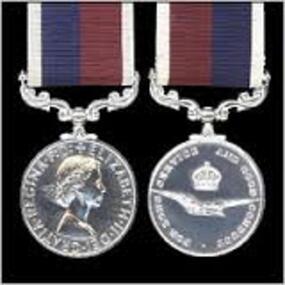 Waverley RSL Sub Branch
R.A.A.F. Long Service Medal
... It served in the Middle East and Africa, from Cairo across North Africa, to Italy, and eventually back to England to treat returned prisoners of war. ...Awarded to Alan Bowers (A236814) who was a R.A.A.F. dental mechanic who serverd during WWII including service in Darwin, and then continued in the R.A.A.F. for some years after the end of WWII The Royal Australian Air Force (and all Commonwealth Air Forces) Long Service and Good Conduct Medal: Awarded to NCOs and ORs of the RAAF (RAF, RCAF etc) for 15 years service. A cupro-nickel plated medal, the obverse features the sovereign's head, the reverse features the crown and eagle emblem of the RAAF (and RAF). Officers are eligible for the award provided they have served a minimum 12 years in the ranks. The riband is dark blue and maroon with white edges. This medal ceased to be awarded in Australia in 1975 when it was replaced by the National Medal (and sbsequently the DFSM and DLSM) in the Australian system of honours and awards. http://www.heritagemedals.com.au/medals-1/service-long-service/air-force-long-service-and-good-conduct-medal.html History of the RAAF Dental Branch It took six years following the formation of the RAAF in 1921 for the first Dental Clinic to be established at Point Cook, Victoria. On 10th June 1927 Flying Officer James Carl Rosenbrock commenced work as an RAAF Dental Officer for the FlyingTraining School at Point Cook. As personnel numbers were still relatively small, Rosenbrock was also responsible for the dental care of all Victorian RAAF units, which involved treating members at 1AD Laverton, as well as Air Force Headquarters at Victoria Barracks in Melbourne. As Army Dental Officers were currently caring for RAAF personnel at Richmond, NSW, the Senior Dental Officer of the 3rd Military District in Victoria (SDO 3MD) requested through the military board that a similar arrangement be established, where that the newly appointed RAAF Dentist provide part time dental services to the Army units stationed at Queenscliff. This was seen as an effective reciprocal arrangement, with both units having a Dental Officer in attendance for, in total, around 3-4 weeks a year. Rosenbrock continued to serve as the sole RAAF Dental Officer until the middle of 1933, when the Air Board asked for his service to be terminated following ‘behaviour unbecoming of a RAAF officer'. He had borrowed several sums of money, of around 40 Pounds or so, from junior ranks on base (as well as from the Regimental Sergeant Major) and had failed to pay the money back. He was replaced by a fellow Victorian, FLGOFF Norman Henry Andrews, on the 18th Sep 1933, who went on to become our first Director of Dental Services, and was instrumental in establishing the organisations and conditions of the Branch that are still present today. Through a fair amount of persistence and hard work on the part of Norman Andrews, the RAAF Dental Branch began to expand from 1937, with the introduction of 2 additional positions, at RAAF station Richmond, and at the FlyingTraining School at Point Cook. This gave the RAAF 3 uniformed Dental Officers, which was expanded to 5 in the months leading up to WW2. 4 of these Dental Officers were based in Victoria and 1 at Richmond, with the other two RAAF units being cared for by the Army (as in the case of Pearce in WA) or by civilians (as in Darwin). With the sudden increase in RAAF personnel required at the outbreak of WW2, the number of RAAF Dental Officers increased dramatically, from 5 in 1939, 28 in 1940, 64 in 1941, 147 in 1942, 193 in 1943, 219 in 1944, and peaking at 227 in 1945. RAAF Dental Officers were required to work in a variety of locations, both in and out of Australia. Between 1940 and 1942 a massive construction programme occurred, with new dental clinics being established around Australia. Priority was given to aircrew training units in order to get these personnel dentally fit for operational deployment, but Dental Officers could equally find themselves posted to recruit depots, fixed stations, medical clearance stations, mobile dental sections, and RAAF and civilian hospitals. RAAF Dental Officers were posted to the large dental centres at Ascot Vale (Vic) and Bradfield Park (NSW) when first appointed, where they received military and clinical training, before being deployed to their needed location. Mobile Dental Units When Japan entered the war in 1941, the rapid deployment of troops to northern operational areas with less than ideal dental fitness was extremely high. As a result, the RAAF deployed a range of mobile dental units, either alone or with medical sections, to support the increasing number of isolated deployed personnel within Australia and overseas. There were three types of mobile unit used: a. Mobile Dental Unit – relied on using either a semi-trailer to get around or by building a surgery directly on to the truck chassis, and installing hydraulic chairs, units, x-rays, and laboratory equipment. They were able to move around between small units, such as RAAF radar stations, where they could plug into the local power supply and work immediately. b. Transportable Dental Units – used for stops of longer duration, where field equipment was carried in panniers from one unit to another by road or rail and housed in whatever accommodation was available at the destination. They were often carried within Australia on Tiger Moths and Dakota aircraft. c. Itinerant Dental Units – in some areas, the dental equipment was installed at the RAAF unit and the Dental Officer and their staff would travel from unit to unit, using the equipment available at each location. RAAF Dental BadgeAs the war developed in Europe, it soon became obvious that the RAF Dental support was not capable of supporting the increasing numbers of RAAF aircrew that were being sent for service with the RAF, with only enough Dental Officers available to provide one to every 2000 men ( instead of the preferred 1 to 600). As a result, the RAAF provided a mobile dental unit, fitted out in a caravan and pulled by a Ford V8 Coupe, to travel around England in support of RAAF personnel at various squadrons. Some degree of tact was needed to ensure that the RAF did not take this as a comment on the treatment they were providing, but it proved successful in maintaining a satisfactory state of dental fitness in RAAF personnel, and a second mobile unit was soon dispatched. They were also set up with a laboratory on board as well as the surgery, which was a major difference between the RAF and RAAF, as the RAF did not provide dentures for their troops (the RAAF would, providing they had served for 6 years). In 1943 the RAF was no longer able to provide Dental support to Australian troops in the Middle East, which resulted in the need for a transportable dental unit to be deployed from Australia. It functioned in a similar manner to the RAF, by moving from one squadron to another. It served in the Middle East and Africa, from Cairo across North Africa, to Italy, and eventually back to England to treat returned prisoners of war. GPCAPT Norman Andrews The growth and development of the RAAF Dental Branch owes a debt to one man in particular, GPCAPT Norman Andrews. As the second RAAF Dental Officer to enlist on 18 Sep 1933, Andrews became the principal architect of the structure and organisation of the RAAF Dental Branch leading up to and during WW2. Until early 1940, the RAAF Dental Branch was administered by the Director of Medical Services (Air), which placed it under the control of the Army Medical staff. The Army would provide their Inspector of Dental Services for advice whenever needed. In April 1940, the RAAF Medical service separated from the Army, resulting in the control of the RAAF Dental Branch shifting back to the RAAF. Andrews became the first Director of Dental Services, when the position was created in 1943 as recognition of the higher profile the Dental Branch was now playing in the RAAF Medical service. Until this time, Andrews's title had been as the Dental Staff Officer to the RAAF Medical Service. Andrews was responsible for the establishment of the war-time structure of the Dental service, establishing new dental centres at all major bases, creating mobile and transportable dental units, ensuring the continual growth of the Branch, maintaining professional development of staff through the establishment of a professional journal, and by organising renowned lecturers to speak at RAAF bases. He also believed in visiting as many dental units as possible to see for himself what conditions were like and to talk first-hand to staff in remote units. His itinerary during the war years, both in and out of Australia, shows a large number of trips in a variety of modes of transport in order to reach remote areas where units were serving. He was promoted to GPCAPT in July 1944, as the numbers of Dental Officers soon peaked at 227 towards the end of the war (1 GPCAPT, 9 WGCDRs, 60 SQNLDRs, and 157 FLTLTs). After the war, with the reduction in RAAF personnel required in uniform, the Dental Branch also reduced its numbers significantly. By 1947 there were only 18 Dental Officers serving (many part-time), with 1 GPCAPT, 1 WGCDR, 10 SQNLDRs, and 6 FLTLTs, and only 13 by 1950. With the decrease in Branch personnel numbers, the ‘powers to be' saw fit to reduce the Director of Dental Service rank to WGCDR, and as a result Norman Andrews found that in order to continue serving in the RAAF he would have to wear a reduced rank. This appears to have been a contributing factor in his decision to discharge at the relatively early age of 43 and accept an administrative job as Director of the Victorian Government's School Dental Service. Norman Andrews holds the proud honour of being the founder of the RAAF Dental Branch, which during the war was instrumental in educating servicemen of the importance of dental health and maintaining the dental fitness of troops in a variety of areas. Dental Orderlies (Assistants) The dental orderly mustering was first introduced in 1937. Until that time, medical orderlies were assigned to assist the Dental officer with their duties. As early as 1931 it had been noted by both RAAF and Army Dental Officers working in Victoria and Richmond that a lot of the troubles they were having would be solved by appointing a permanent Dental Orderly. Often they would find that the medical orderly they were assigned was a different one each day, and as a result the administration and work in general was very inefficient. By 1937, with the increase in Dental Officers to 3, it was realised that a Dental Orderly mustering needed to be created. Dental Mechanics/Technicians Before WW2, dental laboratory work was provided by civilian laboratories, as most RAAF units were stationed around metropolitan areas. At this time, service personnel were still required to pay for their own dentures, unless they had served for six years or had their dentures damaged during performance of their duties. In July 1940, mainly in response to the development of more remote RAAF dental units and the increasing demand for dental prostheses, the Dental Mechanic mustering was established. Unfortunately there was a very limited pool of civilian dental mechanics to recruit from, and as a result the RAAF set up a training school at Laverton (which was later moved to Ascot Vale) in June 1941 which conducted an intensive 6 month course in Dental mechanics. Dental mechanics were quickly in demand. In all fixed and mobile dental units at least 1 Mechanic was supplied for each Dental Officer, and indeed the RAAF supplied Dental Mechanics throughout all its deployments, something the RAF were unwilling, or unable, to do. Two grades of dental mechanic existed: the Senior Mechanic (with the rank of NCO), who was competent in all phases of laboratory work; and the Junior Mechanic, who could only handle routine work and not more advanced denture work. The progression to Senior required a further trade test in techniques including setting up, clasp-forming, casting and backing teeth. During the course of the War, two special courses were held for Mechanics. The first, directed at senior mechanics so that they could instruct others, was in 1942 when Acrylic Resin was first introduced as a denture base material, as an alternative to the current option of vulcanite. Later, towards the end of the War, a ‘refresher' course was provided for those that had served for the greatest period of time in order to allow them retraining in techniques that they had not practised during their service and which were common in civilian life. This included cast base dentures, crowns and bridges, partial dentures, and retainers. Towards the end of the War, a course was held with WAAAF trainees to train them as Mechanics. However, as the War was soon to end they never had the opportunity to progress within the mustering to become Senior Mechanics. The RAAF Dental Branch has survived 75 years of turbulence, with reviews of its viability occurring regularly every few years from as early as 1937. The Branch continues to provide excellent service to the ADF community and, despite reduced manpower, will continue to play an important role in Air Force Health operations. http://www.defence.gov.au/health/about/docs/RAAFDental.pdf40cm cupro-nickel plated medal, the obverse features the sovereign's head, the reverse features the crown and eagle emblem of the RAAF (and RAF). A23814 BOWERS.A. A. F.r.a.a.f long service medal, r.a.a.f good conduct, r.a.a.f. dental service medal -
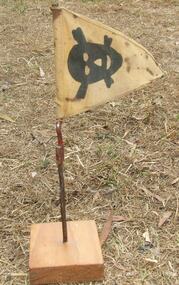 Waverley RSL Sub Branch
Minefield Warning Flag
... In turn this would lead to German intervention in the fighting in North Africa, changing the nature of the war in that theatre. ...German Luftwaffe (Land Forces) minefield warning flag from WWII.originally intended to be gas markers, rather than mines, but as it turned out, the use changed .they were mounted on a red metal pole & there were 12 to a set in a leather pack. This Flag was presented to the Treasurer of Waverley RSL. It is a souvenir from Bardia in Libya The Battle of Bardia was fought over three days between 3 and 5 January 1941, as part of Operation Compass, the first military operation of the Western Desert Campaign of the Second World War. It was the first battle of the war in which an Australian Army formation took part, the first to be commanded by an Australian general and the first to be planned by an Australian staff. Major General Iven Mackay's 6th Division assaulted the strongly held Italian fortress of Bardia, Libya, assisted by air support and naval gunfire, and under the cover of an artillery barrage. The 16th Infantry Brigade attacked at dawn from the west, where the defences were known to be weak. Sappers blew gaps in the barbed wire with Bangalore torpedoes and filled in and broke down the sides of the anti-tank ditch with picks and shovels. This allowed the infantry and 23 Matilda II tanks of the 7th Royal Tank Regiment to enter the fortress and capture all their objectives, along with 8,000 prisoners. In the second phase of the operation, the 17th Infantry Brigade exploited the breach made in the perimeter, and pressed south as far as a secondary line of defences known as the Switch Line. On the second day, the 16th Infantry Brigade captured the township of Bardia, cutting the fortress in two. Thousands of prisoners were taken, and the Italian garrison now held out only in the northern and southernmost parts of the fortress. On the third day, the 19th Infantry Brigade advanced south from Bardia, supported by artillery and the Matilda tanks, now reduced in number to just six. Its advance allowed the 17th Infantry Brigade to make progress as well, and the two brigades reduced the southern sector of the fortress. Meanwhile, the Italian garrisons in the north surrendered to the 16th Infantry Brigade and the Support Group of the British 7th Armoured Division outside the fortress. In all, some 36,000 Italian prisoners were taken. The victory at Bardia enabled the Allied forces to continue the advance into Libya and ultimately capture almost all of Cyrenaica. In turn this would lead to German intervention in the fighting in North Africa, changing the nature of the war in that theatre. Bardia boosted the competence and reputation of the Australian Army. Perhaps most important of all, it raised confidence in the possibility of an ultimate Allied victory around the world, which would lead to the Lend-Lease Act being passed in the United States http://en.wikipedia.org/wiki/Battle_of_BardiaCloth Flag bearing a skull and cross Bones on a metal spike mounted on a square varnished wooden basebardia, land mine, marker flag, minefield, mustard gas -
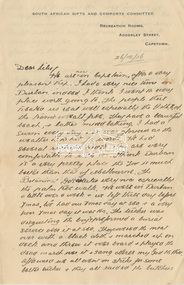 Eltham District Historical Society Inc
Letter, Letter to Lily Howard from Ernest W. Welsby, Capetown, 26 December 1916, 1916
... Capetown, South Africa...Welsby, First World War, Letters, Lew Howard Collection, South Africa, WW1 Digital file only - scanned by EDHS from item on loan Letter to Lily Howard from Ernest W. ...First World War letters and postcards from various (unknown) servicemen written to Lily Thompson (Lew Howard's aunty). She would write to the servicemen.Digital file only - scanned by EDHS from item on loan aif, capetown, ernest w. welsby, first world war, letters, lew howard collection, south africa, ww1 -
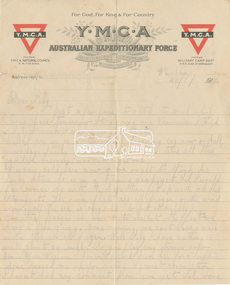 Eltham District Historical Society Inc
Letter, Letter to Lily Howard from Charlie Harris, Wareham, England, 28 January 1917, 1917
... She would write to the servicemen. aif, capetown, ernest w. welsby, first world war, letters, lew howard collection, south africa, ww1 Digital file only - scanned by EDHS from item on loan Letter to Lily Howard from Charlie Harris, Wareham, England, 28 January 1917 Letter ...First World War letters and postcards from various (unknown) servicemen written to Lily Thompson (Lew Howard's aunty). She would write to the servicemen.Digital file only - scanned by EDHS from item on loan aif, capetown, ernest w. welsby, first world war, letters, lew howard collection, south africa, ww1 -
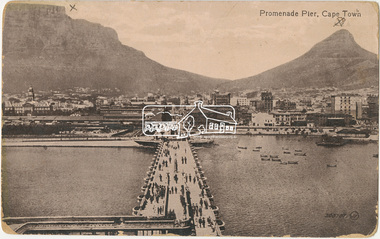 Eltham District Historical Society Inc
Postcard, Postcard to Lily Howard from Eric, Cape Town, c.1915, 1915
... Cape Town, South Africa...AIF, Cape Town, Eric, First World War, Letters, Lew Howard Collection, South Africa, WW1 Digital file only - scanned by EDHS from item on loan Postcard to Lily Howard from Eric, Cape Town, c.1915 Postcard ...Digital file only - scanned by EDHS from item on loan aif, cape town, eric, first world war, letters, lew howard collection, south africa, ww1 -
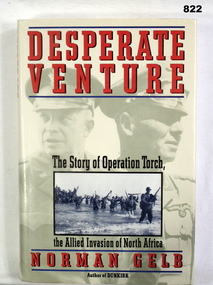 Bendigo Military Museum
Book, Norman Gelb, Desperate Venture - The Story of Operation Torch, the Allied Invasion of North Africa, 1992
... Desperate Venture - The Story of Operation Torch, the Allied Invasion of North Africa...Desperate Venture - The Story of Operation Torch, the Allied Invasion of North Africa Book BOOK Norman Gelb William Morrow & Company Inc Printed ...Red and grey hard cover book with dust jacket. Dust jacket sepia photo background of 2 officers plus black & white photo of soldiers coming ashore from a boat.Written on title page in pen: Donated by Bendigo Y Mens Clubbooks, military, history -
 4th/19th Prince of Wales's Light Horse Regiment Unit History Room
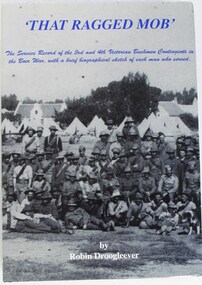
Book, Robin W. F. Droogleever, That Ragged Mob, 2009
... The modern day 4th/19th Prince of Wales's Light Horse Regiment is the custodian of the theatre Battle Honour "SOUTH AFRICA 1899-1902" awarded to the 9th and 11th Light Horse Regiments. ...The Service Record of the 3rd and 4th Victorian Bushmen Contingents in the Boer War with a brief biographical sketch of each man who served. The modern day 4th/19th Prince of Wales's Light Horse Regiment is the custodian of the theatre Battle Honour "SOUTH AFRICA 1899-1902" awarded to the 9th and 11th Light Horse Regiments. This Battle Honour was awarded to all extant Light Horse units in Australia under Military Order 123 of 1908, in recognition of all states' contribution to the forces who represented Australia against the Boers. Hard covered book.Signed by the author: "With the compliments of the author Robin Droogleever 104/10" ISBN 978-0-646-5186-9boer war, victoria army victorian contingent 3rd, victoria army victorian contingent 4th, south african war 1899 1902, robin drooglever, biography, boer war, victoria army victorian contingent 3rd, victoria army victorian contingent 4th, south african war 1899 1902, robin drooglever, biography -
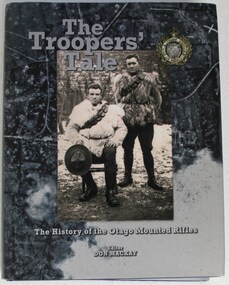 4th/19th Prince of Wales's Light Horse Regiment Unit History Room
Book, Don Mackay, The Troopers' Tale - The History of the Otago Mounted Rifles, 2012
... "The Troopers' Tale" records the history of the regiment from the 1860's to the present day, and tells the personal stories of many previously unknown New Zealand soldiers. book otago mounted rifles history south african war world war 1 book otago mounted rifles history south african war world war 1 ISBN 978-0-47320462-4 Hard cover book. 382 pages The Troopers' Tale - The History of the Otago Mounted Rifles Book Book Don Mackay Turnbull Ross Publishing Southern Colour Print ...The Otago Mounted Rifles served in the Boer War. In World War 1 the Regiment fought at Gallipoli, then, later, on the Western Front they were part of 1 ANZAC Corps with elements of the 4th and 8th Australian Light Horse Regiments. Later the OMR was reorganised into II ANZAC Corps with B and D Squadrons of the 4th Australian light Horse. Featuring nearly 400 photographs, illustrations and maps. "The Troopers' Tale" records the history of the regiment from the 1860's to the present day, and tells the personal stories of many previously unknown New Zealand soldiers. Hard cover book. 382 pagesISBN 978-0-47320462-4book, otago mounted rifles, history, south african war, world war 1, book, otago mounted rifles, history, south african war, world war 1
