
Showing 141 items matching " gold panning"
-
 Stawell Historical Society Inc
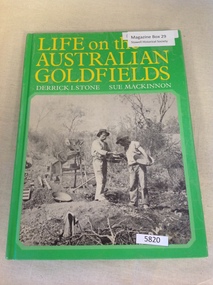
Book, Derrick I. Stone & Sue Mackinnon, Life on the Australian Goldfields, 1976
... Early Photographs of mining towns and Sites as well as people, throughout Australia. stawell gold mining Life on the Australian Goldfields. Derrick I. Stone Sue Mackinnon Hard Green cover with b/w photo of two miners with pans and hats. ...Early Photographs of mining towns and Sites as well as people, throughout Australia.Hard Green cover with b/w photo of two miners with pans and hats. Life on the Australian Goldfields. Derrick I. Stone Sue Mackinnonstawell gold mining -
 National Wool Museum
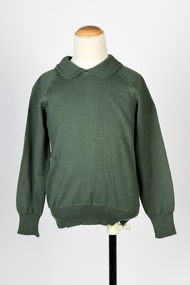
Textile - Children's Jumper, Tina Knitwear, 1980-2000
... gold”. We will forever be grateful that our parents’ life journey gave us the opportunity to live in a home filled with creativity, dedication and passion, amazing work ethic and mutual respect, lifelong friendships and a lifetime of love. knitwear clothing italy migrants brighton knitting machine linking machine garments business family community Children’s moss green knitted jumper with a peter pan collar, centre back zip and raglan sleeves. ...Part of a selection of garments knitted by ‘Tina Knitwear’. Tina Knitwear was a successful made to order knitwear business in Brighton from the mid-1960s to around 2010, run by Assunta and Franco Liburti. Daughter Melissa Persi writes: Our parents Assunta (Mum) and Franco (Dad) Liburti ran a successful made to order knitwear business in Brighton from the mid-1960s to around 2010. Assunta was affectionately known to her family as Assuntina, therefore the business was named "Tina Knitwear" after her. Assunta and Franco were born in the beautiful seaside town of Terracina in Italy in 1933 and 1930 respectively. As was so common in Italy in the 1950s, Assunta who was in her late teens and early twenties learnt the intricate skills of machine knitting, dressmaking and pattern making. Franco on the other hand, learnt the building trade with his 2 brothers and specialised in bricklaying and tiling. As was so common after the war, Assunta and Franco yearned for a better life so they decided that they would get engaged and then migrate to Australia to be married and raise their family in Australia, a land of much opportunity which they no longer felt their beloved Italy held for them. Assunta migrated to Australia first in 1957 and later Franco joined her in 1958 where they were married. For the first few years, Franco (also known as Frank) worked as bricklayer /tiler on buildings such as the Robert Menzies building at Monash University in Clayton and various buildings in the Melbourne CBD. Assunta on the other hand put her machine knitting skills to use working in factories doing piece machine knitting for various knitwear companies. The hours were long, the conditions were difficult, and travel was onerous without a car. After their 2 older children were born, it was decided that dad would leave the building trade and they would start their own made to order knitwear business. That way they could work from home and raise their family together. Mum taught dad everything he needed to know so he could operate the knitwear machinery. They purchased COPPO knitting machines from Italy and a Linking machine from Germany. Initially they had a knitwear shopfront in Bay Street Brighton where a store assistant would take the orders and client’s measurements and Assunta would then make the garments from a small workshop in their home. Unfortunately, the assistants were not skilled dressmakers and often measurements and orders were incorrectly taken. Assunta being the perfectionist and highly skilled machinist that she was, decided that she needed to oversee the entire process from meeting the client, to taking their order, right thru to the fittings and completion of the garment. It therefore made sense that they should close the shop front and run their business from their own home in Brighton and hence “Tina Knitwear” was born. Together, for more than 40 years they ran their very respected and successful business and were well known in the Bayside area. They specialised in made to order knitwear for both men and women using mainly pure wool (from Patons, Wangaratta Mills, Japan and Italy) but also lurex and estacel. Over those years, many of their clients became their close friends. It wasn't unusual for clients to come to order garments and then end up in the kitchen chatting over a cup of Italian espresso coffee and homemade biscuits. Some of their clients were especially memorable and became lifelong friends. Mrs Connell was a dear friend of mum’s, each year she would buy tickets for the “Gown of the Year” fashion show. She would insist on taking Assunta and her 2 daughters so that we could see the latest fashions. Then there was their dear friend Ms Griffiths. She had been a Matron nurse at the Queen Victoria Hospital when she met my parents in the 1970s. She returned to live in New Zealand in the 1980s but came back to Melbourne every year to stay for 2 weeks with the sole purpose of visiting my parents (she adored them) and order garments. For those 2 solid weeks, mum and dad would only knit for Ms Griffiths and she would go back to New Zealand with at least 5 or 6 new outfits. I actually think she enjoyed mum’s homemade pasta almost as much as her new clothes! Over the years, my parents learnt to speak English very well given that majority of their clients were not Italian speaking. Their oldest child John born in 1960 learnt to speak English with the help of those clients who were such a big part of our childhood. Mum and dad always went above and beyond to ensure their clients were satisfied. Mum was an absolute perfectionist and it showed in her attention to detail and the quality of their beautiful work. You only need to look at the garments that have stood the test of time or speak to their clients to know that this is true. Their clients would always comment on how well their clothes would last and much of their clients came via word of mouth and recommendations. Occasionally there would be disagreements because mum had found an error in dad's knitting (either a wrong stitch or a sizing mistake mainly) and would ask him to redo a piece, he would argue back saying that it was fine, but we always knew who would win the argument and that the piece would get remade! Similarly, we recall discussions where mum would ask dad to find a particular colour of wool in the garage where the stock was kept. He would try to convince her that they were out of stock of that colour and that the client should choose a different colour. She would insist they had it and then after hours of searching, he would return into the house sheepishly holding the wool! Our childhood is full of beautiful memories of mum and dad always being present, clients coming and going, mum humming her favourite songs as she worked often late into the night and sometimes, we even fell asleep to the hum of the machinery. They put their heart and soul into "Tina Knitwear" and took pride in providing only the best quality garments for their clients. In Italian there is a saying “lei ha le mani d’oro” which literally translated means “she has hands of gold”. Franco enjoyed his work but for Assunta, it was more than just work and there is no better way to describe her skills, passion and dedication to her machine knitting… she truly did have “hands of gold”. We will forever be grateful that our parents’ life journey gave us the opportunity to live in a home filled with creativity, dedication and passion, amazing work ethic and mutual respect, lifelong friendships and a lifetime of love. Children’s moss green knitted jumper with a peter pan collar, centre back zip and raglan sleeves.knitwear, clothing, italy, migrants, brighton, knitting machine, linking machine, garments, business, family, community -
 Clunes Museum
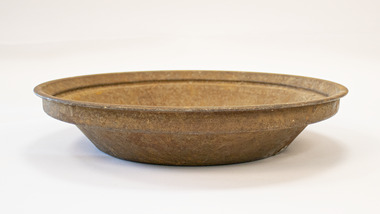
Tool - GOLD MINING PAN
... GOLD MINING PAN...Gold pans Gold Mining Gold mining tools Nil Four metal goldmining pans Tool GOLD MINING PAN ...Four metal goldmining pans Nilgold pans, gold mining, gold mining tools -
 Buda Historic Home & Garden Castlemaine
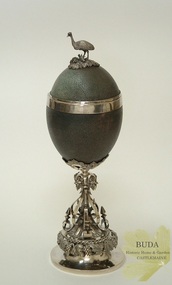
Decorative object - Metalcraft - Silverware, Silver Mounted Emu Egg Goblet with Emu Figure, c1855 - 1858
... gold-wash interior and cast emu figure on lid. Silver stem has elaborate scrolled ribbon design and cast decoration topped by four heads of the god Pan. ...gold-wash interior and cast emu figure on lid. Silver stem has elaborate scrolled ribbon design and cast decoration topped by four heads of the god Pan. ...Decorative object made by Ernest Leviny probably to sell in his jewellers and watchmakers shop in Market Square Castlemaine.Silver mounted emu egg goblet with gold-wash interior and cast emu figure on lid. Silver stem has elaborate scrolled ribbon design and cast decoration topped by four heads of the god Pan. Filigree silver design of grapes and vine leaves above base. 'Egg' rests in 'cup' of filigree feathers/shell and acanthus leaves. Lost wax casting method used.Noneernest leviny, silversmithing, colonial silverware, decorative arts, natural history specimens, ornithology -
 Rutherglen Historical Society
Image, c1990
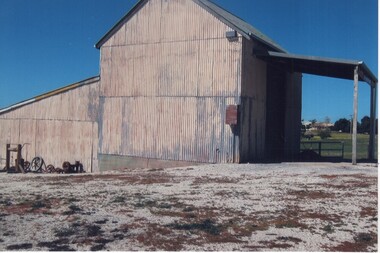
... gold from within. The battery was erected in 1908 and consists of a five-head battery, Wilfrey table, Bergin pan, portable steam engine and shed. ...gold from within. The battery was erected in 1908 and consists of a five-head battery, Wilfrey table, Bergin pan, portable steam engine and shed. ...This photograph is of the side of the Gold Battery building, and is one of a series of photographs of the Rutherglen Gold Battery. Its purpose was to crush quartz from nearby quartz reefs and extract gold from within. The battery was erected in 1908 and consists of a five-head battery, Wilfrey table, Bergin pan, portable steam engine and shed. The battery was restored in 2011/12 and can be viewed daily between 9.00am and 5.00pm. See website for details.Colour photograph of the side of a corrugated iron buildinggold battery, gold processing -
 Federation University Art Collection
Print - Printmaking - Lithograph, Tulloch, David, 'Great Meeting of Gold Diggers Dec 15th 1851' by Thomas Ham, 1852
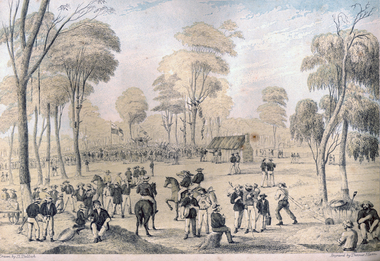
... ...gold pan...The Art Collection features over 2000 works and was listed as a 'Ballarat Treasure' in 2007. art artwork ham thomas ham tulloch castlemaine goldfields agitation printmaking edition coloured lithograph david tulloch gold pan shovel wheelbarrow waggon bark hut ring barked tree gold mining lower centre "Great Meeting of Gold Diggers Dec 15th 1851" lower left side "Drawn By D. ...One of the first large goldfield meetings was at Castlemaine in 1851. After the extraordinary success of the Mt Alexander Diggings the Government issued a proclamation, raising the licence fee from thirty shillings to three pounds. As soon as these intentions became known a public meeting of miners was held. For miles around work ceased, with diggers travelling as far as Bendigo to attend the meeting. It is estimated that around 18,000 people attended the meeting. The notes with the engraving state The trees in this locality are chiefly Stringybark; some of them are peeled of their covering, as many persons prefer erecting bark huts to living in a comfortless tent. The various groups, and costumes of the men, are characteristic of our gold digging community. This item is part of the Federation University Art Collection. The Art Collection features over 2000 works and was listed as a 'Ballarat Treasure' in 2007.Colour lithograph of a meeting of diggers at a meeting in Mt Alexander. The meeting was the result of goldfields agitations against the license fee. lower centre "Great Meeting of Gold Diggers Dec 15th 1851" lower left side "Drawn By D. Tulloch" lower right side "Engraved by Thomas Ham"art, artwork, ham, thomas ham, tulloch, castlemaine, goldfields agitation, printmaking, edition, coloured lithograph, david tulloch, gold pan, shovel, wheelbarrow, waggon, bark hut, ring barked tree, gold mining -
 Whitehorse Historical Society Inc.
Machine - Carpet Sweeper
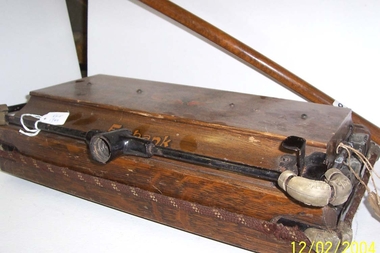
... Balal roller between wheels is painted gold with 'Ewbank Patent Ball Bearing - 23610 1902 18397 1904. Metal lever for dropping pans has Press Slide etched on. ...Balal roller between wheels is painted gold with 'Ewbank Patent Ball Bearing - 23610 1902 18397 1904. Metal lever for dropping pans has Press Slide etched on. ...Carpet sweeper with wooden casing enclosing brush rollers. Four metal wheels with rubber covers and attached wooden handle. Metal handle with rubber bumpers with 'Ewbank Patent No. 183576 1920s logo on top of lion on wooden base with crossed flags behind crown and sign British Manufacture. Front and back have 'Ewbank Magnum' on case. Bumper is cord with rubber at corners with 'Ewbank 1925 Patent No. 34357 written on it. Balal roller between wheels is painted gold with 'Ewbank Patent Ball Bearing - 23610 1902 18397 1904. Metal lever for dropping pans has Press Slide etched on. Instructions underneath on paper labelsAs abovedomestic items, cleaning -
 Parks Victoria - Maldon State Battery
Pan, Berdan
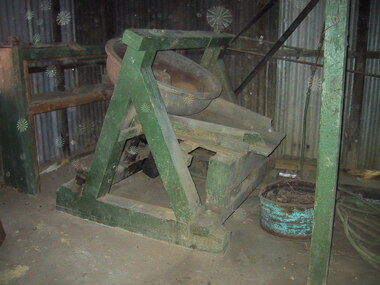
... The circular pan was set at an angle, and as the pan revolved, a heavy iron ball rotated in the lowest point, grinding sand or mineral to a fine powder. It was frequently used to grind impurities out of amalgam (gold in mercury), and to grind batch-lots of heavy mineral. ...The circular pan was set at an angle, and as the pan revolved, a heavy iron ball rotated in the lowest point, grinding sand or mineral to a fine powder. It was frequently used to grind impurities out of amalgam (gold in mercury), and to grind batch-lots of heavy mineral. ...A Berdan pan was a grinding pan. The circular pan was set at an angle, and as the pan revolved, a heavy iron ball rotated in the lowest point, grinding sand or mineral to a fine powder. It was frequently used to grind impurities out of amalgam (gold in mercury), and to grind batch-lots of heavy mineral. It is also known as a ball mill. Two strong wooden A frames supporting large iron pivotable bowl with a large iron ball inside the bowl. There are cogs underneath bowl which are connected to rotating belts extending from main battery shaft. The chute attached below the bowl is directed into a circular metal container. The frame is painted green. -
 Rutherglen Historical Society
Image, c1990
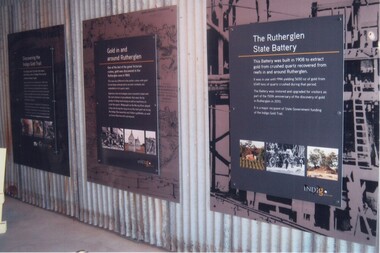
... gold from within. The battery was erected in 1908 and consists of a five-head battery, Wilfrey table, Bergin pan, portable steam engine and shed. ...gold from within. The battery was erected in 1908 and consists of a five-head battery, Wilfrey table, Bergin pan, portable steam engine and shed. ...This photograph is of the viewing room inside the Gold Battery building, with story boards on the wall. One of a series of photographs of the Rutherglen Gold Battery. Its purpose was to crush quartz from nearby quartz reefs and extract gold from within. The battery was erected in 1908 and consists of a five-head battery, Wilfrey table, Bergin pan, portable steam engine and shed. The battery was restored in 2011/12 and can be viewed daily between 9.00am and 5.00pm. See website for details.Colour photograph of the interior of a building showing three story boards mounted on a corrugated iron wall.gold battery, gold processing -
 Rutherglen Historical Society
Image, c1990
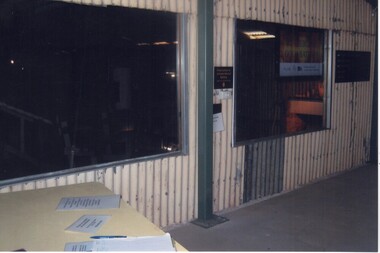
... gold from within. The battery was erected in 1908 and consists of a five-head battery, Wilfrey table, Bergin pan, portable steam engine and shed. ...gold from within. The battery was erected in 1908 and consists of a five-head battery, Wilfrey table, Bergin pan, portable steam engine and shed. ...This photograph is of the viewing room inside the building, this side with windows overlooking the machinery and a video screen with a switchboard to run the video. One of a series of photographs of the Rutherglen Gold Battery. Its purpose was to crush quartz from nearby quartz reefs and extract gold from within. The battery was erected in 1908 and consists of a five-head battery, Wilfrey table, Bergin pan, portable steam engine and shed. The battery was restored in 2011/12 and can be viewed daily between 9.00am and 5.00pm. See website for details.Colour photograph of the interior of a building showing two large windows and a video screen on a corrugated iron wall.gold battery, gold processing -
 Rutherglen Historical Society
Image, c1990
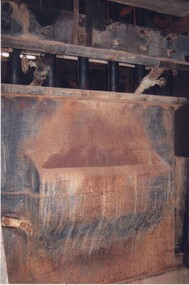
... gold from within. The battery was erected in 1908 and consists of a five-head battery, Wilfrey table, Bergin pan, portable steam engine and shed. ...gold from within. The battery was erected in 1908 and consists of a five-head battery, Wilfrey table, Bergin pan, portable steam engine and shed. ...This photograph is of Battery Box, showing the mouth where quartz is fed in. The five stamper rods can also be seen. This is one of a series of photographs of the Rutherglen Gold Battery. The battery's purpose was to crush quartz from nearby quartz reefs and extract gold from within. The battery was erected in 1908 and consists of a five-head battery, Wilfrey table, Bergin pan, portable steam engine and shed. The battery was restored in 2011/12 and can be viewed daily between 9.00am and 5.00pm. See website for details. Colour photograph of a large piece of machinery inside a buildinggold battery, gold processing -
 Rutherglen Historical Society
Image, c1990
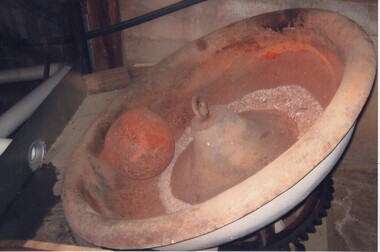
... The Pan revolves and the large manganese iron ball does the crushing. This is one of a series of photographs of the Rutherglen Gold Battery. ...gold from within. The battery was erected in 1908 and consists of a five-head battery, Wilfrey table, Bergin pan, portable steam engine and shed. ...This photograph is of the Burdun Pan where small quantities of quartz material can be crushed. The Pan revolves and the large manganese iron ball does the crushing. This is one of a series of photographs of the Rutherglen Gold Battery. The battery's purpose was to crush quartz from nearby quartz reefs and extract gold from within. The battery was erected in 1908 and consists of a five-head battery, Wilfrey table, Bergin pan, portable steam engine and shed. The battery was restored in 2011/12 and can be viewed daily between 9.00am and 5.00pm. See website for details. Colour photograph of a metal pan, mounted on a geared shaft, with a metal ball.gold battery, gold processing -
 Rutherglen Historical Society
Image, c1990
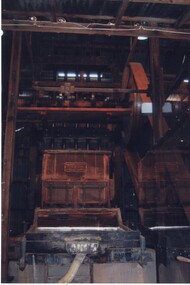
... gold from within. The battery was erected in 1908 and consists of a five-head battery, Wilfrey table, Bergin pan, portable steam engine and shed. ...gold from within. The battery was erected in 1908 and consists of a five-head battery, Wilfrey table, Bergin pan, portable steam engine and shed. ...This photograph is a view from the lower side of the stamper, showing amalgam table, box and stampers. This is one of a series of photographs of the Rutherglen Gold Battery. The battery's purpose was to crush quartz from nearby quartz reefs and extract gold from within. The battery was erected in 1908 and consists of a five-head battery, Wilfrey table, Bergin pan, portable steam engine and shed. The battery was restored in 2011/12 and can be viewed daily between 9.00am and 5.00pm. See website for details. Colour photograph of a large piece of machinery inside a buildinggold battery, gold processing -
 Rutherglen Historical Society
Image, c1990
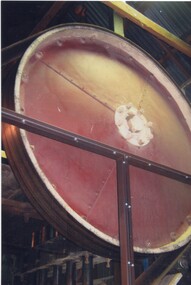
... gold from within. The battery was erected in 1908 and consists of a five-head battery, Wilfrey table, Bergin pan, portable steam engine and shed. ...gold from within. The battery was erected in 1908 and consists of a five-head battery, Wilfrey table, Bergin pan, portable steam engine and shed. ...This photograph is a view of the flywheel that drives the stampers. This is one of a series of photographs of the Rutherglen Gold Battery. The battery's purpose was to crush quartz from nearby quartz reefs and extract gold from within. The battery was erected in 1908 and consists of a five-head battery, Wilfrey table, Bergin pan, portable steam engine and shed. The battery was restored in 2011/12 and can be viewed daily between 9.00am and 5.00pm. See website for details. Colour photograph of a large piece of machinery inside a buildinggold battery, gold processing -
 Rutherglen Historical Society
Image, c1990
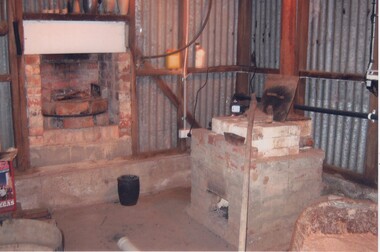
... gold from within. The battery was erected in 1908 and consists of a five-head battery, Wilfrey table, Bergin pan, portable steam engine and shed. ...gold from within. The battery was erected in 1908 and consists of a five-head battery, Wilfrey table, Bergin pan, portable steam engine and shed. ...This photograph shows the pre-heater on the left and the furnace on the right. After clean up of stamper table, amalgam is placed in a retort, then placed in the furnace where mercury is condensed and runs down the small pipe into an enamel bucket and can be reused. This is one of a series of photographs of the Rutherglen Gold Battery. The battery's purpose was to crush quartz from nearby quartz reefs and extract gold from within. The battery was erected in 1908 and consists of a five-head battery, Wilfrey table, Bergin pan, portable steam engine and shed. The battery was restored in 2011/12 and can be viewed daily between 9.00am and 5.00pm. See website for details.Colour photograph of the interior of a room with corrugated iron walls, with a fireplace on the left and a furnace on the right.gold battery, gold processing -
 Rutherglen Historical Society
Image, c1990
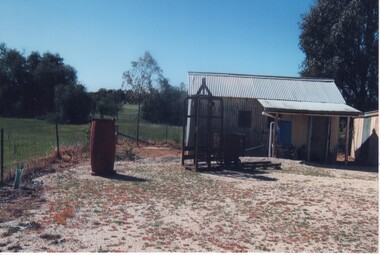
... gold from within. The battery was erected in 1908 and consists of a five-head battery, Wilfrey table, Bergin pan, portable steam engine and shed. ...gold from within. The battery was erected in 1908 and consists of a five-head battery, Wilfrey table, Bergin pan, portable steam engine and shed. ...This photograph shows the workers' amenities at the Gold Battery. The building has a bedroom and kitchen. In front is a Baler Bucket and a cage. This particular cage was for raising and lowering the skips which brought the material to the surface. This is one of a series of photographs of the Rutherglen Gold Battery. The battery's purpose was to crush quartz from nearby quartz reefs and extract gold from within. The battery was erected in 1908 and consists of a five-head battery, Wilfrey table, Bergin pan, portable steam engine and shed. The battery was restored in 2011/12 and can be viewed daily between 9.00am and 5.00pm. See website for details.Colour photograph of a corrugated iron cottage, with several pieces of machinery around it.gold battery, gold processing -
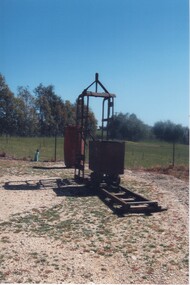 Rutherglen Historical Society
Image, c1990
... gold from within. The battery was erected in 1908 and consists of a five-head battery, Wilfrey table, Bergin pan, portable steam engine and shed. ...gold from within. The battery was erected in 1908 and consists of a five-head battery, Wilfrey table, Bergin pan, portable steam engine and shed. ...This photograph is of machinery in the yard of the Gold Battery. The Baler Bucket is at the rear, the cage in the centre and the skip at the front. This is one of a series of photographs of the Rutherglen Gold Battery. The battery's purpose was to crush quartz from nearby quartz reefs and extract gold from within. The battery was erected in 1908 and consists of a five-head battery, Wilfrey table, Bergin pan, portable steam engine and shed. The battery was restored in 2011/12 and can be viewed daily between 9.00am and 5.00pm. See website for details.Colour photograph of a pieces of machinery in the yard of the Gold Batterygold battery, gold processing -
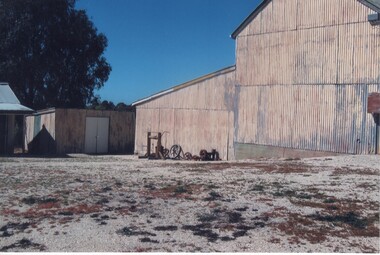 Rutherglen Historical Society
Image, c1990
... gold from within. The battery was erected in 1908 and consists of a five-head battery, Wilfrey table, Bergin pan, portable steam engine and shed. ...gold from within. The battery was erected in 1908 and consists of a five-head battery, Wilfrey table, Bergin pan, portable steam engine and shed. ...This photograph is of the side of the main building of the Gold Battery with workshop at rear (now demolished). Beside building is a hand windlass, along with some old pulleys and various parts. This is one of a series of photographs of the Rutherglen Gold Battery. The battery's purpose was to crush quartz from nearby quartz reefs and extract gold from within. The battery was erected in 1908 and consists of a five-head battery, Wilfrey table, Bergin pan, portable steam engine and shed. The battery was restored in 2011/12 and can be viewed daily between 9.00am and 5.00pm. See website for details.Colour photograph of the side of a corrugated iron building with a smaller building at the left, and a number of pieces of machinery next to the buildinggold battery, gold processing -
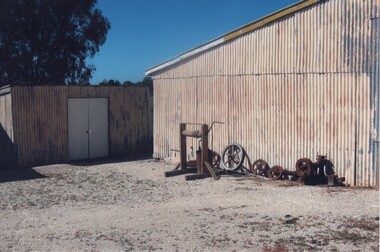 Rutherglen Historical Society
Image, c1990
... gold from within. The battery was erected in 1908 and consists of a five-head battery, Wilfrey table, Bergin pan, portable steam engine and shed. ...gold from within. The battery was erected in 1908 and consists of a five-head battery, Wilfrey table, Bergin pan, portable steam engine and shed. ...This photograph is of the back end of the side of the main building of the Gold Battery with workshop at rear (now demolished). Beside building is a hand windlass, along with some old pulleys and various parts. This is one of a series of photographs of the Rutherglen Gold Battery. The battery's purpose was to crush quartz from nearby quartz reefs and extract gold from within. The battery was erected in 1908 and consists of a five-head battery, Wilfrey table, Bergin pan, portable steam engine and shed. The battery was restored in 2011/12 and can be viewed daily between 9.00am and 5.00pm. See website for details.Colour photograph of the side of a corrugated iron building with a smaller building at the left, and a number of pieces of machinery next to the buildinggold battery, gold processing -
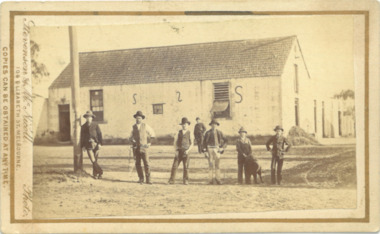 Bacchus Marsh & District Historical Society
Photograph, Woolpack Stables Bacchus Marsh 1883
... gold border framing photograph. Housed in the Jeremeas Family Album which contains photographs of Bacchus Marsh and District in 1883 by the photographers Stevenson and McNicoll. The photo is of a gable-roofed commercial stables with shingled roofing, and white-washed render to the walls, standing in a large cleared yard. There is a skillion extension to the south-west corner. On the front (northern) wall can be seen a door and three windows, two large and one small paned...gold border framing photograph. Housed in the Jeremeas Family Album which contains photographs of Bacchus Marsh and District in 1883 by the photographers Stevenson and McNicoll. The photo is of a gable-roofed commercial stables with shingled roofing, and white-washed render to the walls, standing in a large cleared yard. There is a skillion extension to the south-west corner. On the front (northern) wall can be seen a door and three windows, two large and one small paned ...This image is one of a series of photographs taken by Melbourne based photographers Stevenson and McNicoll who visited Bacchus Marsh and its nearby districts between September and November 1883. James Elijah Crook settled in Bacchus Marsh in 1841 and soon after held a licence for a lodging house on the Portland Road. In about 1845, he built the first Woolpack Inn, a slab building of eight rooms. This was replaced in 1850 with a “stately country villa” of brick and stone. The stables were also built in 1850 to accommodate twenty horses. In 1851, Crook established a coach service to the goldfields. After being in use as a Court of Petty Sessions, the Woolpack Inn lost its licence and closed in 1862. After this date, Crook took an interest in horse-breeding and continued to use the stables for his horses. His most notable success was with his horse, Saladin, which won the Australia Cup in 1872, after two exciting dead-heats with The Flying Dutchman. James Elijah Crook died in 1889. The Woolpack Inn and Stables were sold and then used as a hay and corn store. In 1910 the site was leased for use as an abattoir. The Woolpack Inn was demolished in 1931. The site is still in use as an abattoir. Little remains of the original stables.Small sepia 'carte de viste' style unframed photograph on card with gold border framing photograph. Housed in the Jeremeas Family Album which contains photographs of Bacchus Marsh and District in 1883 by the photographers Stevenson and McNicoll. The photo is of a gable-roofed commercial stables with shingled roofing, and white-washed render to the walls, standing in a large cleared yard. There is a skillion extension to the south-west corner. On the front (northern) wall can be seen a door and three windows, two large and one small paned window in the centre. The eastern window is paned, while the western window has louvres and a pull-out blind. Three S shaped stays can be seen on the northern wall. Along the western wall are two more windows and doors. A mound of hay lies at the north-western corner. Standing at the front of the stables is a group of five men and two boys, one holding a large dog. Four of the men are dressed in workman’s clothing and some are holding tools of their trade. The man at the back is wearing more formal clothes and has distanced himself from the workmen. The pole against which one of the workmen is leaning appears to have damage along one side. This pole may have been used as a hitching post as there is a footrest installed lower down to make mounting easier. Printed On the front: Stevenson & McNicoll. Photo. 108 Elizabeth St. Melbourne. COPIES CAN BE OBTAINED AT ANY TIME. On the back: LIGHT & TRUTH inscribed on a banner surmounted by a representation of the rising sun. Copies of this Portrait can be had at any time by sending the Name and Post Office Money Order or Stamps for the amount of order to STEVENSON & McNICOLL LATE BENSON & STEVENSON, Photographers. 108 Elizabeth Street, MELBOURNE. stevenson and mcnicoll 1883 photographs of bacchus marsh and district -
 City of Greater Bendigo - Civic Collection
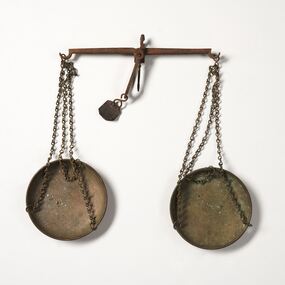
Equipment - Gold Scales, Late 19th / early 20th century
... Set of small scales possibly from a travelling boxed set due to their small size, similar to those used in an apothecary and weighing gold. Scales have two round brass pans with a cross bar and chains and pointer central on the lever arm. ...City of Greater Bendigo Commerce Making a Nation exhibition City of Greater Bendigo Mining Set of small scales possibly from a travelling boxed set due to their small size, similar to those used in an apothecary and weighing gold. Scales have two round brass pans with a cross bar and chains and pointer central on the lever arm. ...This type of balance scales allows precise measurements to be achieved by ensuring that the balance's fulcrum is essentially friction-free by attaching a pointer to the beam which amplifies any deviation from a balance position; and finally by using the lever principle, which allows fractional masses to be applied by movement of a small mass along the measuring arm of the beam. The standardization of the weights used – and ensuring traders used the correct weights – was a considerable preoccupation of governments throughout this time and inspections were held regularly. When the Weights and Measures Act was passed in Victoria in 1862 local inspectors were established throughout the colony to ensure accuracy particularly in the weighing of gold. By the 1870's each local council had a set of standards that were used to test the scales, weights and measures of local merchants and businesses.Set of small scales possibly from a travelling boxed set due to their small size, similar to those used in an apothecary and weighing gold. Scales have two round brass pans with a cross bar and chains and pointer central on the lever arm. At top of lever arm above pointer is a small leather tag from which to hold up the scales. city of greater bendigo commerce, making a nation exhibition, city of greater bendigo mining
