
Showing 132 items matching "churns"
-
 Port Melbourne Historical & Preservation Society
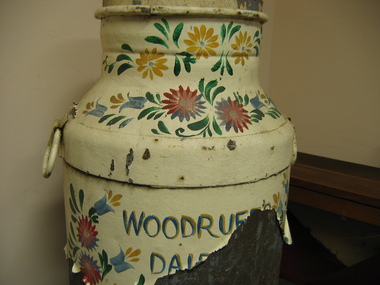
Photograph - Hand painted milk churn, Woodruff's Dairy, Port Melbourne, Julie Duncan, Jun 2006
... This photograph was taken because the can donated to the society is deteriorating rapidly, the paint peeling off the metal surface. business and traders - dairies woodruff's royal dairy stan woodruff stan Photographs of item 2146.01, hand painted milk can from Woodruff's dairyl Photograph Hand painted milk churn, Woodruff's Dairy, Port Melbourne Julie Duncan ...This photograph was taken because the can donated to the society is deteriorating rapidly, the paint peeling off the metal surface.Photographs of item 2146.01, hand painted milk can from Woodruff's dairylbusiness and traders - dairies, woodruff's royal dairy, stan woodruff, stan -
 Malmsbury Historical Society
Photograph (Item), "Daffodil Display, Cherry Churn/Accordian-Ludwick", Malmsbury ca 1989
... "Daffodil Display, Cherry Churn/Accordian-Ludwick", Malmsbury ca 1989...Buildings - Town Hall People - "Cherry,T; Orton, H; Mitchell, L & R" "Daffodil Display, Cherry Churn/Accordian-Ludwick", Malmsbury ca 1989 Photograph Photograph ...Buildings - Town Hall People - "Cherry,T; Orton, H; Mitchell, L & R" -
Tatura Irrigation & Wartime Camps Museum
Blow Butter Churn
... Blow Butter Churn...Blow Butter Churn ... -
Tatura Irrigation & Wartime Camps Museum
Butter Churn from Dollers
... Butter Churn from Dollers...Butter Churn from Dollers ... -
Clunes Museum
Functional object - BUTTER CHURN
... BARREL BOUND WITH METAL HOOPS Functional object BUTTER CHURN ...BUTTERCHURN OWNED AND USED ON ONE OF THE ORIGINAL FARMS IN DUNACH DISTRICT BY MAVIS HARRISWOODEN BARREL BUTTERCHURN WITH HANDLE - HAND OPERATED WOODEN BARREL ON WOODEN STAND. BARREL BOUND WITH METAL HOOPSbutter churn, domestic appliance -
 Whitehorse Historical Society Inc.
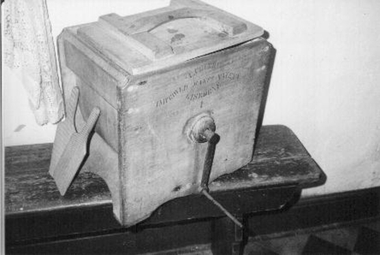
Functional object - Butter Churn
... Functional object Butter Churn ...Lidded wooden box with metal turning handle on outside. Inside has a curved bottom and a paddle wheel turned by the metal handle.E. Cherry - Maker - Gisborne Improved Patentdomestic items, food preparation -
 Whitehorse Historical Society Inc.
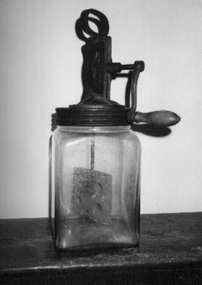
Domestic object - Butter Churn
... Domestic object Butter Churn ...Solid square glass jar with metal top and gear wheel, wooden handle and wooden paddle.domestic items, food preparation, food technology, dairying -
 Whitehorse Historical Society Inc.
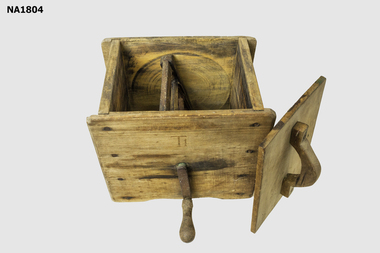
Domestic object - Butter Churn
... Domestic object Butter Churn ...Large lidded wooden box with metal turning handle on outside. Inside it has a curved bottom and a paddle wheel tuned by the metal handle.TIfood technology, dairying, rural industry, livestock -
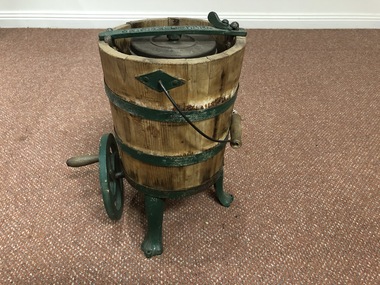 Mont De Lancey
Ice Cream Maker
... Ice-cream churns Original Model 2 Wooden ice cream maker with three green metal bands around it. ...Wooden ice cream maker with three green metal bands around it. Bottom band forms base with a cast iron three feet stand and hand-cranked wheel. Cast iron locking mechanism on top. Wire and wooden handle to carry. Within a metal drum for freezing cream.Original Model 2ice-cream churns -
Linton Mechanics Institute and Free Library Collection
Book - Novel, Burton, Miles, The milk-churn murder, [n.d.] [1935?]
... The milk-churn murder...(Title page missing.) The milk-churn murder Book Novel Burton, Miles The Crime Club ...Crime fiction.In the village of Tolsham, a man always regarded as a "foreigner" suddenly disappears, and at the same time a dismembered corpse is found inside a milk-churn at a local dairy. Inspector Arnold and his friend Desmond Merrion set out to solve the case.252 p. : plain red cover (original dust jacket removed?), tjitle and author's name hand printed in white on spine.Publisher's summary of plot printed on reverse of half-title page.page. (Title page missing.)fictionCrime fiction.In the village of Tolsham, a man always regarded as a "foreigner" suddenly disappears, and at the same time a dismembered corpse is found inside a milk-churn at a local dairy. Inspector Arnold and his friend Desmond Merrion set out to solve the case.fiction, crime fiction, miles burton -
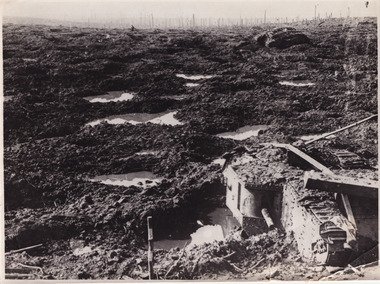 The Beechworth Burke Museum
Photograph, c. 1917
... Finally, with the army stuck in muddy fields churned up by the artillery fire, the bloody offensive came to an untidy close. ...This photograph depicts the third battle of Ypres (Battle of Passchendaele). Depicted is a trench battlefield that has been turned to mud. Two army tank vehicles have been buried in the mud of the trenches. A single soldier stands in the background surveying the battlefield.After mid-1917, and following mutinies in the over-strained French Army, the British Forces had to assume an even greater role in the war on the Western Front. For Field Marshal Sir Douglas Haig, the British commander-in-chief, this provided an opportunity to launch an offensive that he had long wanted. Attacking from Ypres in Belgium, he planned to drive the Germans from the surrounding dominant ridges and even hoped to reach the Belgian coast. Following on the success at Messines in June, he unleashed his great attack on 31 July 1917. Fighting went on, often in appalling weather and despite crippling losses, until November. Finally, with the army stuck in muddy fields churned up by the artillery fire, the bloody offensive came to an untidy close. Many would afterwards call this offensive, actually a series of battles, after the name of the village that had become the last objective – 'Passchendaele'. In the Battle off Passchendaele, the 1st, 2nd and 3rd Australian Divisions captured Broodseinde Ridge on 4 October 1917. It was a vital victory. But, then it began to rain. Five days later the 2nd Australian Division suffered heavily in a further attack in the mud. Finally, on 12 October, another attack, involving the 3rd Division assisted by the 4th, was made against the village of Passchendaele atop the main ridge. In the face of heavy fire, the men fought in the mire while struggling to keep up with their artillery barrages. Ground was taken but it could not be held. In wretched conditions, with casualties mounting at an appalling rate, the Australians had to fall back. The troops were finally exhausted and could do no more; by 15 November they handed over to the Canadians.Black and white rectangular reproduced photograph printed on mate photographic paperReverse: 6523/ (A copyright and reproduction notice from the Australian War Museum, printed upside-down in blue ink)/military album, burke museum, beechworth, military vehicle, trenches, trench warfare, wwi, world war one, world war 1, ypres, belgium -
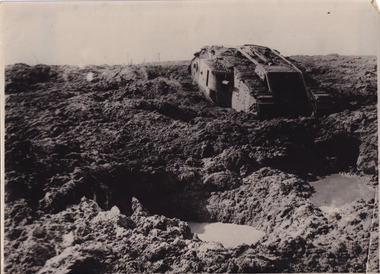 The Beechworth Burke Museum
Photograph
... Finally, with the army stuck in muddy fields churned up by the artillery fire, the bloody offensive came to an untidy close. ...This photograph depicts the third battle of Ypres (Battle of Passchendaele). Depicted is a trench battlefield that has been turned to mud. One army tank vehicle has become stuck in the mud of the battlefield.After mid-1917, and following mutinies in the over-strained French Army, the British Forces had to assume an even greater role in the war on the Western Front. For Field Marshal Sir Douglas Haig, the British commander-in-chief, this provided an opportunity to launch an offensive that he had long wanted. Attacking from Ypres in Belgium, he planned to drive the Germans from the surrounding dominant ridges and even hoped to reach the Belgian coast. Following on the success at Messines in June, he unleashed his great attack on 31 July 1917. Fighting went on, often in appalling weather and despite crippling losses, until November. Finally, with the army stuck in muddy fields churned up by the artillery fire, the bloody offensive came to an untidy close. Many would afterwards call this offensive, actually a series of battles, after the name of the village that had become the last objective – 'Passchendaele'. In the Battle off Passchendaele, the 1st, 2nd and 3rd Australian Divisions captured Broodseinde Ridge on 4 October 1917. It was a vital victory. But, then it began to rain. Five days later the 2nd Australian Division suffered heavily in a further attack in the mud. Finally, on 12 October, another attack, involving the 3rd Division assisted by the 4th, was made against the village of Passchendaele atop the main ridge. In the face of heavy fire, the men fought in the mire while struggling to keep up with their artillery barrages. Ground was taken but it could not be held. In wretched conditions, with casualties mounting at an appalling rate, the Australians had to fall back. The troops were finally exhausted and could do no more; by 15 November they handed over to the Canadians.Black and white rectangular reproduced photograph printed on mate photographic paperReverse: 6524/ (A copyright and reproduction notice from the Australian War Museum, printed upside-down in blue ink)/military album, burke museum, beechworth, military vehicle, trenches, trench warfare, wwi, world war one, world war 1, ypres, belgium
