
Showing 1547 items matching "aboriginal australians -- victoria -- criminal justice system. | prisoners"
-
 Monbulk RSL Sub Branch
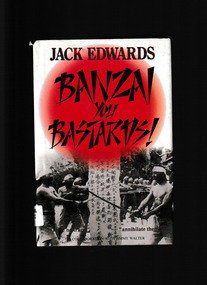
Book, Souvenir, Banzai, you bastards, 1991
... ...Ex prisoners of war - Biography...World war 1939 – 1945 - Prisons and prisoners - Japanese Ex prisoners of war - Biography Descriptions of the experiences of allied prisoners of way in Taiwan Ill, maps, p.264 Banzai, you bastards Book Souvenir Jack Edwards ...Descriptions of the experiences of allied prisoners of way in TaiwanIll, maps, p.264non-fictionDescriptions of the experiences of allied prisoners of way in Taiwanworld war 1939 – 1945 - prisons and prisoners - japanese, ex prisoners of war - biography -
 Monbulk RSL Sub Branch
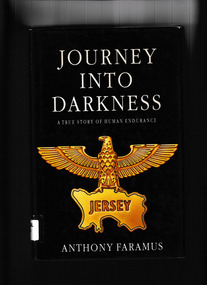
Book, Grafton, Journey into darkness, 1990
... World war 1939 – 1945 - Prisons and prisoners – Germany...World war 1939 – 1945 - Prisons and prisoners – Germany Jersey - History Relates the experiences of a Jersey islander as a prisoner of the Nazis Index, ill, p.310. ...Relates the experiences of a Jersey islander as a prisoner of the NazisIndex, ill, p.310.non-fictionRelates the experiences of a Jersey islander as a prisoner of the Nazisworld war 1939 – 1945 - prisons and prisoners – germany, jersey - history -
 Monbulk RSL Sub Branch
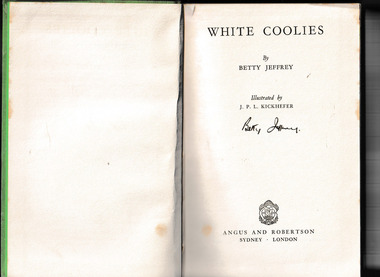
Book, Betty Jeffrey, White coolies, 1954
... World war 1939 – 1945 - Prisons and prisoners - Japanese...World war 1939 – 1945 - Prisons and prisoners - Japanese Prisoners of war - Biography - Australia In 1942, a group of Australian Army nursing sisters was evacuated from Malaya a few days before the fall of Singapore. two days later their ship was bombed and sunk by the Japanese. ...In 1942, a group of Australian Army nursing sisters was evacuated from Malaya a few days before the fall of Singapore. two days later their ship was bombed and sunk by the Japanese. Of the fifty-three survivors who scrambled ashore, twenty-one were murdered and the remainder taken prisoner. this engrossing record was kept by one of the surviving sisters, Betty Jeffrey, during the three-and-a-half gruelling years of imprisonment that followed.p.204.non-fictionIn 1942, a group of Australian Army nursing sisters was evacuated from Malaya a few days before the fall of Singapore. two days later their ship was bombed and sunk by the Japanese. Of the fifty-three survivors who scrambled ashore, twenty-one were murdered and the remainder taken prisoner. this engrossing record was kept by one of the surviving sisters, Betty Jeffrey, during the three-and-a-half gruelling years of imprisonment that followed. world war 1939 – 1945 - prisons and prisoners - japanese, prisoners of war - biography - australia -
 Monbulk RSL Sub Branch
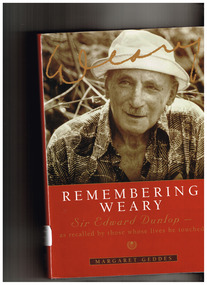
Book, Viking, Remembering Weary : Sir Edward Dunlop as recalled by those whose lives he touched, 1996
... World war 1939 – 1945 - Prisons and prisoners - Japanese...Edward Dunlop - Biography World war 1939 – 1945 - Prisons and prisoners - Japanese Collection of interviews with friends, colleagues and family which provide an insight into Sir Edward 'Weary' Dunlop. ...Collection of interviews with friends, colleagues and family which provide an insight into Sir Edward 'Weary' Dunlop. Also includes letters and the eulogy from his funeral service delivered by the former governor general, Sir Ninian Stephen. Illustrated with black and white photographs. Includes an index. Author is a journalist with the 'Age' newspaper.Ill, index, p.448.non-fictionCollection of interviews with friends, colleagues and family which provide an insight into Sir Edward 'Weary' Dunlop. Also includes letters and the eulogy from his funeral service delivered by the former governor general, Sir Ninian Stephen. Illustrated with black and white photographs. Includes an index. Author is a journalist with the 'Age' newspaper.edward dunlop - biography, world war 1939 – 1945 - prisons and prisoners - japanese -
 Monbulk RSL Sub Branch
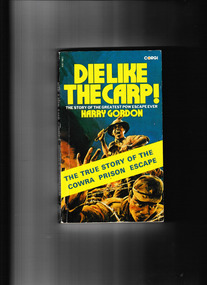
Book, Corgi Books, Die like the carp! : the story of the greatest prison escape ever, 1978
... Escaped prisoners of war - Australia...Escaped prisoners of war - Australia Japanese prisoners of war - Australia Escape of Japanese prisoners of war held at Cowra, N.S.W., Australia. ...Escape of Japanese prisoners of war held at Cowra, N.S.W., Australia.Ill, p.285.non-fictionEscape of Japanese prisoners of war held at Cowra, N.S.W., Australia.escaped prisoners of war - australia, japanese prisoners of war - australia -
 Monbulk RSL Sub Branch
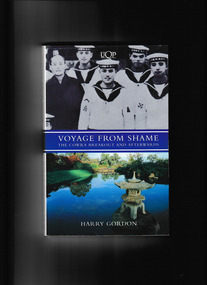
Book, Harry Gordon, Voyage from shame: The Cowra breakout and afterwards, 1994
... Escaped prisoners of war - Australia...Escaped prisoners of war - Australia Japanese prisoners of war - Australia Escape of Japanese prisoners of war held at Cowra, N.S.W., Australia. ...Escape of Japanese prisoners of war held at Cowra, N.S.W., Australia.Index, bibliography, ill, p.313.non-fictionEscape of Japanese prisoners of war held at Cowra, N.S.W., Australia.escaped prisoners of war - australia, japanese prisoners of war - australia -
 Monbulk RSL Sub Branch
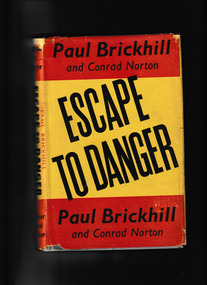
Book, Faber and Faber et al, Escape to danger, 1946
... World War 1939-1945 - prisoners of war - Germany...World War 1939-1945 - prisoners of war - Germany World war 1939-1945 - Personal narratives Story of the captivity, experiences and escapes of of British airmen in World war Two. ...Story of the captivity, experiences and escapes of of British airmen in World war Two.Ill, p.341.non-fictionStory of the captivity, experiences and escapes of of British airmen in World war Two.world war 1939-1945 - prisoners of war - germany, world war 1939-1945 - personal narratives -
 Monbulk RSL Sub Branch
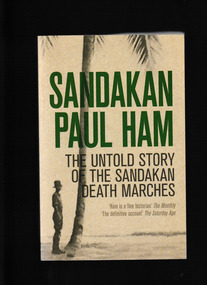
Book, William Heinemann, Sandakan : the untold story of the Sandakan Death Marches, 2013
... World War 1939-1945 - Prisoners of war - Sandakan...World War 1939-1945 - Prisoners of war - Sandakan Japan - prisons and prisoners of war The untold story of the Sandakan death marches of World War II. ...The untold story of the Sandakan death marches of World War II. After the fall of Singapore, in February 1942, the Japanese conquerors rounded up tens of thousands of British and Australian soldiers and shipped them to prison camps scattered throughout Hirohito's newly won Empire. The fall of Britain's 'impregnable fortress' was the greatest humiliation in British military history, for which Churchill never forgave the Japanese. But nothing would surpass the wretched fate of some 2,700 British and Australian prisoners who were shipped to British North Borneo later that year. They landed in Sandakan, on the east coast of the island, after a 10-day voyage on a Japanese 'hell' ship, and were herded into a jungle camp some eight miles inland. Thus began the three-year ordeal of the Sandakan prisoners of war - a barely known story of unimaginable horror.Index, bibliography, notes, ill, p.688.non-fictionThe untold story of the Sandakan death marches of World War II. After the fall of Singapore, in February 1942, the Japanese conquerors rounded up tens of thousands of British and Australian soldiers and shipped them to prison camps scattered throughout Hirohito's newly won Empire. The fall of Britain's 'impregnable fortress' was the greatest humiliation in British military history, for which Churchill never forgave the Japanese. But nothing would surpass the wretched fate of some 2,700 British and Australian prisoners who were shipped to British North Borneo later that year. They landed in Sandakan, on the east coast of the island, after a 10-day voyage on a Japanese 'hell' ship, and were herded into a jungle camp some eight miles inland. Thus began the three-year ordeal of the Sandakan prisoners of war - a barely known story of unimaginable horror.world war 1939-1945 - prisoners of war - sandakan, japan - prisons and prisoners of war -
 Monbulk RSL Sub Branch
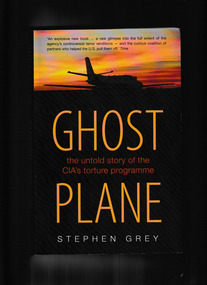
Book, Scribe, Ghost plane : the untold story of the CIA's torture programme, 2013
... Prisoners of war - Abuse of - United States...Prisoners of war - Abuse of - United States Central Intelligence Agency In December 2005 Condoleezza Rice, the US Secretary of State, assured the world that the flights of CIA private jets that have criss-crossed Europe since 9/11 had no role in sending prisoners to be tortured. ...In December 2005 Condoleezza Rice, the US Secretary of State, assured the world that the flights of CIA private jets that have criss-crossed Europe since 9/11 had no role in sending prisoners to be tortured. 'The United States has not transported anyone, and will not transport anyone, to a country when we believe he will be tortured,' she said. Tony Blair assured Parliament: 'I have absolutely no evidence to suggest that anything illlegal has been happening here at all.' But as Stephen Grey reveals in this book, Rice's claims were false - and the British governemnt has also turned a blind eye to a CIA operation that systematically out-sources the hasrh interrogation of its captives. Grey reveals how the Agency's programme, known by the euphemism 'extraordinary rendition', has transported hundreds of prisoners to foreign jails and its own secret facilities in the full knowledge they will face harsh torture.Index, notes, p.339.non-fictionIn December 2005 Condoleezza Rice, the US Secretary of State, assured the world that the flights of CIA private jets that have criss-crossed Europe since 9/11 had no role in sending prisoners to be tortured. 'The United States has not transported anyone, and will not transport anyone, to a country when we believe he will be tortured,' she said. Tony Blair assured Parliament: 'I have absolutely no evidence to suggest that anything illlegal has been happening here at all.' But as Stephen Grey reveals in this book, Rice's claims were false - and the British governemnt has also turned a blind eye to a CIA operation that systematically out-sources the hasrh interrogation of its captives. Grey reveals how the Agency's programme, known by the euphemism 'extraordinary rendition', has transported hundreds of prisoners to foreign jails and its own secret facilities in the full knowledge they will face harsh torture.prisoners of war - abuse of - united states, central intelligence agency -
 Monbulk RSL Sub Branch
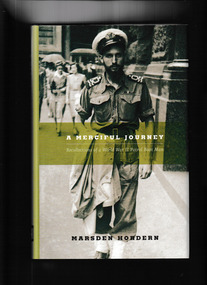
Book, The Miegunyah Press, A merciful journey : recollections of a World War II patrol boat man, 2005
... In small patrol boats, Fairmiles and a Harbour Defence Motor Launch, he patrolled the shores of Japanese-held territory, assisted beleaguered commandos in Timor, and was finally caught up in the drama of rounding up Japanese prisoners of war and guarding them in New Guinea. ...In 1939 Marsden Hordern's mother refused to sign the paper allowing her seventeen-year-old son to fight overseas with the Royal Australian Air Force. 'I did not rear you to be killed in an airplane,' she said. 'Join the navy.' He took her advice and in doing so determined his future. In small patrol boats, Fairmiles and a Harbour Defence Motor Launch, he patrolled the shores of Japanese-held territory, assisted beleaguered commandos in Timor, and was finally caught up in the drama of rounding up Japanese prisoners of war and guarding them in New Guinea.Index, bibliography, notes,maps, ill, p.334.non-fictionIn 1939 Marsden Hordern's mother refused to sign the paper allowing her seventeen-year-old son to fight overseas with the Royal Australian Air Force. 'I did not rear you to be killed in an airplane,' she said. 'Join the navy.' He took her advice and in doing so determined his future. In small patrol boats, Fairmiles and a Harbour Defence Motor Launch, he patrolled the shores of Japanese-held territory, assisted beleaguered commandos in Timor, and was finally caught up in the drama of rounding up Japanese prisoners of war and guarding them in New Guinea.world war 1939-1945 - naval operations - australia, royal australian navy -
 Monbulk RSL Sub Branch
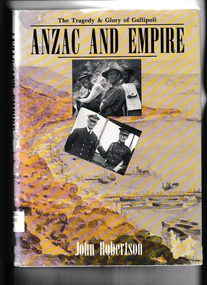
Book, Hamlyn, Anzac and Empire : the tragedy and glory of Gallipoli, 1990
... World War 1914-1918 - Campaigns - Gallipoli Australia - Military relations - Great Britain The book investigates aspects not often covered fully in works on Gallipoli, including treatment of the sick and wounded, the plight of prisoners of war, and the place occupied by Australian issues in the wartime port-mortem on the campaign, the Dardanelles Commission of 1916-17. ...The book investigates aspects not often covered fully in works on Gallipoli, including treatment of the sick and wounded, the plight of prisoners of war, and the place occupied by Australian issues in the wartime port-mortem on the campaign, the Dardanelles Commission of 1916-17. It also deals with origin of Anzac Day and the place of Gallipoli in the Australian ethos.Index, bib, notes, ill, maps, p.318.non-fictionThe book investigates aspects not often covered fully in works on Gallipoli, including treatment of the sick and wounded, the plight of prisoners of war, and the place occupied by Australian issues in the wartime port-mortem on the campaign, the Dardanelles Commission of 1916-17. It also deals with origin of Anzac Day and the place of Gallipoli in the Australian ethos.world war 1914-1918 - campaigns - gallipoli, australia - military relations - great britain -
 Monbulk RSL Sub Branch
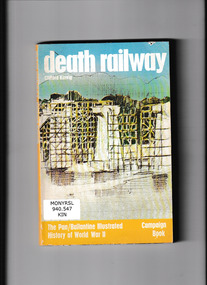
Book, Pan Books, Death Railway, 1973
... world war 1939-1945 - prisoners of war - japan...world war 1939-1945 - prisoners of war - japan Burma - Thailand Railway The building of the Burma - Thailand Railway by allied prisoners of war Ill, maps, p.159. ...The building of the Burma - Thailand Railway by allied prisoners of warIll, maps, p.159.non-fictionThe building of the Burma - Thailand Railway by allied prisoners of warworld war 1939-1945 - prisoners of war - japan, burma - thailand railway -
 Healesville Sanctuary Heritage Centre
Newspaper - Cutting, Minister wants a report on wrong house raid, 2 October 1983
... 1980s Police raid the wrong house looking for escaped prisoners photocopy x 1 Minister wants a report on wrong house raid Newspaper Cutting ...Police raid the wrong house looking for escaped prisonersphotocopy x 1non-fictionPolice raid the wrong house looking for escaped prisoners1980s -
 Monbulk RSL Sub Branch
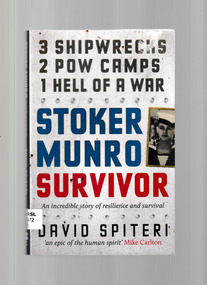
Book, David Spiteri, Stoker Munro : survivor, 2014
... World war 1939 – 1945 - Prisons and prisoners - Japanese...World War 1939-1945 - Personal narratives - Australia World war 1939 – 1945 - Prisons and prisoners - Japanese Stoker Munro was just an inexperienced seventeen year old knockabout kid when he went to war, but he turned out to be an extraordinary survivor. the sinking of the Perth was only the beginning of his war. ...Stoker Munro was just an inexperienced seventeen year old knockabout kid when he went to war, but he turned out to be an extraordinary survivor. the sinking of the Perth was only the beginning of his war. Stoker suffered through years of harsh imprisonment in Java and the infamous Changi prison camp, as well as the horrors of the thai-Burma Railway. then, just as conditions improved, he was shipped off to Japan and another disaster.Ill, p.263.non-fictionStoker Munro was just an inexperienced seventeen year old knockabout kid when he went to war, but he turned out to be an extraordinary survivor. the sinking of the Perth was only the beginning of his war. Stoker suffered through years of harsh imprisonment in Java and the infamous Changi prison camp, as well as the horrors of the thai-Burma Railway. then, just as conditions improved, he was shipped off to Japan and another disaster.world war 1939-1945 - personal narratives - australia, world war 1939 – 1945 - prisons and prisoners - japanese -
 Monbulk RSL Sub Branch
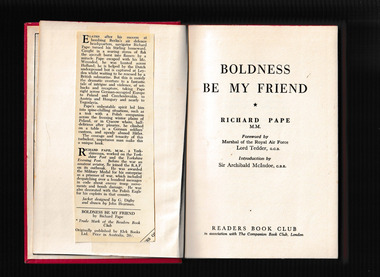
Book - Boldness be my friend, Readers Book Club, 1954
... prisoners of war - Germany - Escapes...prisoners of war - Germany - Escapes World war 1939 – 1945 - Prisons and prisoners – Germany Aggressive, impetuous and resolute, Richard Pape was never going to sit out the war in a Nazi prison. ...Aggressive, impetuous and resolute, Richard Pape was never going to sit out the war in a Nazi prison. Captured after going on the run when his bomber crashed in occupied Holland, Pape's thoughts turned at once to escape. In the most appalling of conditions, his ingenuity did not fail him. Not only did he send over a hundred coded messages to the War Office, but he swapped identities with a fellow prisoner and took on heavy mining work to put himself in a position to make a break-out. This proved to be only the beginning of his adventuresIll, maps, p.287.Aggressive, impetuous and resolute, Richard Pape was never going to sit out the war in a Nazi prison. Captured after going on the run when his bomber crashed in occupied Holland, Pape's thoughts turned at once to escape. In the most appalling of conditions, his ingenuity did not fail him. Not only did he send over a hundred coded messages to the War Office, but he swapped identities with a fellow prisoner and took on heavy mining work to put himself in a position to make a break-out. This proved to be only the beginning of his adventures prisoners of war - germany - escapes, world war 1939 – 1945 - prisons and prisoners – germany -
 Monbulk RSL Sub Branch
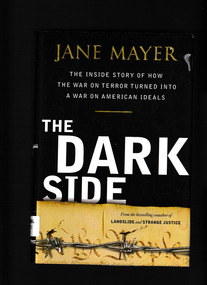
Book, Jane Mayer, The dark side : the inside story of how the War on Terror turned into a war on American ideals, 2008
... ...Prisoners of war - Abuse of - United States...September 2011 Terrorist attacks Prisoners of war - Abuse of - United States In the days immediately following September 11th, the most powerful people in the country were panic-stricken. ...In the days immediately following September 11th, the most powerful people in the country were panic-stricken. Radical decisions about how to combat terrorists and strengthen national security were made in a state of chaos and fear, but the key players, Vice President Cheney and his powerful, secretive adviser David Addington, used the crisis to further a long-held agenda to enhance presidential powers to a degree never known in U.S. history, and obliterate Constitutional protections that define the very essence of the American experiment.Ill, index, bib, p.392.non-fictionIn the days immediately following September 11th, the most powerful people in the country were panic-stricken. Radical decisions about how to combat terrorists and strengthen national security were made in a state of chaos and fear, but the key players, Vice President Cheney and his powerful, secretive adviser David Addington, used the crisis to further a long-held agenda to enhance presidential powers to a degree never known in U.S. history, and obliterate Constitutional protections that define the very essence of the American experiment.september 2011 terrorist attacks, prisoners of war - abuse of - united states -
 Monbulk RSL Sub Branch
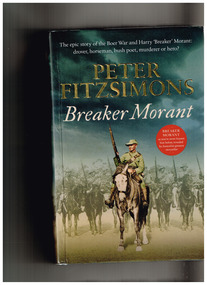
Book, Peter Fitzimons, Breaker Morant, 2020
... In September 1901 Morant and two other Australians, Lieutenants Peter Handcock and George Witton, were arrested for the murder of Boer prisoners. Morant and Handcock were court-martialled and executed in February 1902 as the Boer War was in its closing stages, but the debate over their convictions continues to this day. ...The epic story of the Boer War and Harry 'Breaker' Morant: drover, horseman, bush poet - murderer or hero? Most Australians have heard of the Boer War of 1899 to 1902 and of Harry 'Breaker' Morant, a figure who rivals Ned Kelly as an archetypal Australian folk hero. Born in England and emigrating to Queensland in 1883 in his early twenties, Morant was a charming but reckless man who established a reputation as a rider, polo player and writer. He submitted ballads to The Bulletin that were published under the name 'The Breaker' and counted Banjo Paterson as a friend. When appeals were made for horsemen to serve in the war in South Africa, Morant joined up, first with the South Australian Mounted Rifles and then with a South African irregular unit, the Bushveldt Carbineers. In September 1901 Morant and two other Australians, Lieutenants Peter Handcock and George Witton, were arrested for the murder of Boer prisoners. Morant and Handcock were court-martialled and executed in February 1902 as the Boer War was in its closing stages, but the debate over their convictions continues to this day. Does Breaker Morant deserve his iconic status? Who was Harry Morant? What events and passions led him to a conflict that was essentially an Imperial war, played out on a distant continent under a foreign flag? Was he a scapegoat for British war crimes or a criminal himself? With his trademark brilliant command of story, Peter FitzSimons unravels the many myths and fictions that surround the life of Harry Morant. The truths FitzSimons uncovers about 'The Breaker' and the part he played in the Boer War are astonishing - and, in the hands of this master storyteller, make compelling reading.Ill, bib, index, p.500.non-fictionThe epic story of the Boer War and Harry 'Breaker' Morant: drover, horseman, bush poet - murderer or hero? Most Australians have heard of the Boer War of 1899 to 1902 and of Harry 'Breaker' Morant, a figure who rivals Ned Kelly as an archetypal Australian folk hero. Born in England and emigrating to Queensland in 1883 in his early twenties, Morant was a charming but reckless man who established a reputation as a rider, polo player and writer. He submitted ballads to The Bulletin that were published under the name 'The Breaker' and counted Banjo Paterson as a friend. When appeals were made for horsemen to serve in the war in South Africa, Morant joined up, first with the South Australian Mounted Rifles and then with a South African irregular unit, the Bushveldt Carbineers. In September 1901 Morant and two other Australians, Lieutenants Peter Handcock and George Witton, were arrested for the murder of Boer prisoners. Morant and Handcock were court-martialled and executed in February 1902 as the Boer War was in its closing stages, but the debate over their convictions continues to this day. Does Breaker Morant deserve his iconic status? Who was Harry Morant? What events and passions led him to a conflict that was essentially an Imperial war, played out on a distant continent under a foreign flag? Was he a scapegoat for British war crimes or a criminal himself? With his trademark brilliant command of story, Peter FitzSimons unravels the many myths and fictions that surround the life of Harry Morant. The truths FitzSimons uncovers about 'The Breaker' and the part he played in the Boer War are astonishing - and, in the hands of this master storyteller, make compelling reading. boer war 1899-1901 - history, boer war 1899-1902 - biography -
 Monbulk RSL Sub Branch
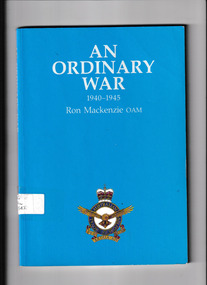
Book, Ron McKenzie, An ordinary war : 1940-19450, 1995
... Ex prisoners of war - Biography...Ex prisoners of war - Biography World war 1939 – 1945 - Prisons and prisoners – Germany This is the modest story of Ron McKenzies years as a prisoner of war in occupied Europe Ill, p.118. ...This is the modest story of Ron McKenzies years as a prisoner of war in occupied EuropeIll, p.118.This is the modest story of Ron McKenzies years as a prisoner of war in occupied Europeex prisoners of war - biography, world war 1939 – 1945 - prisons and prisoners – germany -
 RSL Victoria - Anzac House Reference Library and Memorabilia Collection
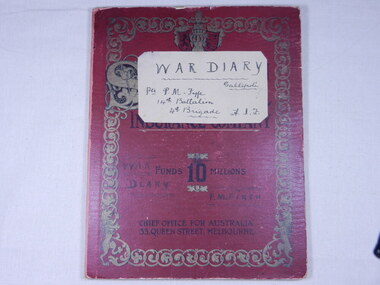
Diary and letter of Peter Maurice Fyfe - (Items held at Monash Memorial Defence Library), Peter Maurice Fyfe, April 1915 to February 1916
... ...prisoners of war...Fyfe embarked again from Melbourne in October 1916 and was a POW in Europe. gallipoli diaries peter maurice fyfe 14 battalion prisoners of war john henry cartwright margaret taylor Handwritten copy (sixty two pages) of WW1 diary of Peter Fyfe (709 - 14th Battalion). ...Period covered by diary from April 1915 until Fyfe's return to Australia in February 1916, includes Gallipoli operations. Letter outlines details and circumstances of the death at Gallipoli of John (Jack) Henry Cartwright (Taylor's son). Fyfe embarked again from Melbourne in October 1916 and was a POW in Europe.Handwritten copy (sixty two pages) of WW1 diary of Peter Fyfe (709 - 14th Battalion). Sheets enclosed in a Scottish Union & National Insurance Company cover. Two-page letter dated June 1916 to Mrs Margaret Taylor of Korumburra.gallipoli, diaries, peter maurice fyfe, 14 battalion, prisoners of war, john henry cartwright, margaret taylor -
 RSL Victoria - Anzac House Reference Library and Memorabilia Collection
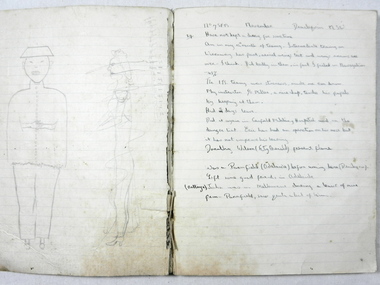
Diary of Peter Waters - (Item held by Monash Memorial Defence Library)
... ...prisoners of war...The autograph book belonged to Waters mother (Maude), and records the appreciation of the service personnel who lodged at her residence in Bridge Street, Hampton. peter waters maude waters ww2 prisoners of war raaf 80 squadron WW 2 diary, notes, and sketches of Peter Waters (410186 RAAF 80 Sqn). ...Diary covers the period from November 1942 to September 1944. Waters was executed by the Japanese in New Guinea in March 1945. The autograph book belonged to Waters mother (Maude), and records the appreciation of the service personnel who lodged at her residence in Bridge Street, Hampton.WW 2 diary, notes, and sketches of Peter Waters (410186 RAAF 80 Sqn).peter waters, maude waters, ww2, prisoners of war, raaf, 80 squadron -
 Alfred Hospital Nurses League - Nursing History Collection
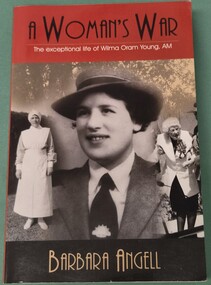
Book - Illustrated book, Barbara Angell 1935, A woman's war; the exceptional life of Wilma Oram Young, AM, 2003
... World Ward 1939-1945-prisoners and prisons-Japaneses...Yet, through the comradeship of her fellow prisoners, she also experienced humankind at its best. ...This is the story of one of Australia's most remarkable women. As a prisoner of war for three and a half years during World War II, Wilma Oram, a young Australian nurse experienced the very worst of human brutality: starvation, deprivation and degradation. Yet, through the comradeship of her fellow prisoners, she also experienced humankind at its best. Following her return to Australia, Wilma was inspired to help her fellow ex-POWs and war veterans through her tireless work with the RSL.Illustrated book, with three black and white photographs of Wilma Oram Young (as student nurse, in army uniform and in older age). There is a mid-brown band above this photo on which the title is printed in black and white, below the photos there is a black band on which the author's name is printed in light brown. Spine has mid brown background with title printed in black, author's name in light brown, and publisher's mark in white. The back cover has a summary of the book printed in black ink on a light brown background.non-fictionThis is the story of one of Australia's most remarkable women. As a prisoner of war for three and a half years during World War II, Wilma Oram, a young Australian nurse experienced the very worst of human brutality: starvation, deprivation and degradation. Yet, through the comradeship of her fellow prisoners, she also experienced humankind at its best. Following her return to Australia, Wilma was inspired to help her fellow ex-POWs and war veterans through her tireless work with the RSL.wilma oram young, nurses-australia-biography, world ward 1939-1945-prisoners and prisons-japaneses -
 Alfred Hospital Nurses League - Nursing History Collection
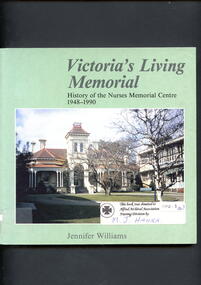
Book - Illustrated book, Jennifer Williams, Victoria's living memorial: history of the Nurses Memorial Centre 1948-1990, 1991
... The nurses Memorial Centre is a living memorial to the heroism and sacrifice of the 76 Australian nurses who died during World War Two and to those who survived years in prisoner-of-war camps during that time. At lower right of front cover is a printed black and white donation sticker: black Maltese cross in circle, "This book was donated to Alfred Archival Association Nursing Division by" M.J.Hanna (handwritten in ink). ...This is a history of the Nurses Memorial Centre, including the fund-raising efforts of Vivian Bullwinkel and Betty Jeffrey who visited every hospital in Victoria with more than twenty beds, recounting their war time experiences. The nurses Memorial Centre is a living memorial to the heroism and sacrifice of the 76 Australian nurses who died during World War Two and to those who survived years in prisoner-of-war camps during that time.Illustrated book with light green cover. On the front cover, in addition to the title and author's name printed in dark grey and black ink, is a coloured photograph of the original Nurses Memorial Centre at 431 St Kilda Rd Melbourne. Title and authors name also printed on the spine. On the back cover are comments about the Centre by Vivian Statham (Bullwinkel) and Betty Jeffrey.non-fictionThis is a history of the Nurses Memorial Centre, including the fund-raising efforts of Vivian Bullwinkel and Betty Jeffrey who visited every hospital in Victoria with more than twenty beds, recounting their war time experiences. The nurses Memorial Centre is a living memorial to the heroism and sacrifice of the 76 Australian nurses who died during World War Two and to those who survived years in prisoner-of-war camps during that time.nurses memorial centre-history, nursing -victoria-history -
 Alfred Hospital Nurses League - Nursing History Collection
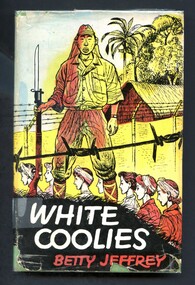
Book - Illustrated Book, Betty Jeffrey 1908-2000 et al, White Coolies, 1954
... World War 1939-1945 prisoners of war...Of the fifty-three survivors who scrambled ashore, twenty-one were murdered and the remaining thirty-two were taken prisoner. The book is the engrossing record kept by one of the sisters, Betty Jeffrey, during the three grueling years of imprisonment that followed. ...In 1942 a group of sixty-five Australian Army nursing sisters was evacuated from Malaya aboard the Vyner Brooke, a few days before the fall of Singapore. Two days later their ship was bombed and sunk by the Japanese. Of the fifty-three survivors who scrambled ashore, twenty-one were murdered and the remaining thirty-two were taken prisoner. The book is the engrossing record kept by one of the sisters, Betty Jeffrey, during the three grueling years of imprisonment that followed. It is an amazing story of survival and deprivation in the harshest of conditions.Illustrated book with dustjacket. Book has a light green cover, with an image of a compass embossed in gold. on the front. The tile author's surname and publisher's name are embossed in gold on the spine. Dust jacket has multicoloured illustration by J.P.L Kickhefer on front and spine: group of women, some with head scarves walking behind a ?prison guard, barbed wire topped fence in front of and behind group. In the background is a hut and tropical plants. Title (white print) and authors name (red print) appear on a black background at base of front of dustjacket. Title, author's and publisher's names are printed in black on spinenon-fictionIn 1942 a group of sixty-five Australian Army nursing sisters was evacuated from Malaya aboard the Vyner Brooke, a few days before the fall of Singapore. Two days later their ship was bombed and sunk by the Japanese. Of the fifty-three survivors who scrambled ashore, twenty-one were murdered and the remaining thirty-two were taken prisoner. The book is the engrossing record kept by one of the sisters, Betty Jeffrey, during the three grueling years of imprisonment that followed. It is an amazing story of survival and deprivation in the harshest of conditions.world war 1939-1945 prisoners of war, betty jeffrey -
 Alfred Hospital Nurses League - Nursing History Collection
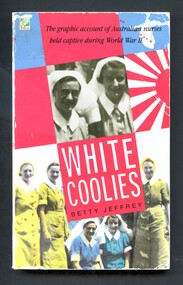
Book, Betty Jeffrey 1908-2000, White Coolies, 1988
... World War 1939-1945 prisoners of war...Of the fifty-three survivors who scrambled ashore, twenty-one were murdered and the remaining thirty-two were taken prisoner. The book is the engrossing record kept by one of the sisters, Betty Jeffrey, during the three grueling years of imprisonment that followed. ...n 1942 a group of sixty-five Australian Army nursing sisters was evacuated from Malaya aboard the Vyner Brooke, a few days before the fall of Singapore. Two days later their ship was bombed and sunk by the Japanese. Of the fifty-three survivors who scrambled ashore, twenty-one were murdered and the remaining thirty-two were taken prisoner. The book is the engrossing record kept by one of the sisters, Betty Jeffrey, during the three grueling years of imprisonment that followed. It is an amazing story of survival and deprivation in the harshest of conditions.Book has a red white and Malaya 1941, Nursing Sisters of cover, tile printed in white and author's name printed in black on front cover. On the front cover is a coloured black and white photograph "Malaya 1941, Nursing Sisters of 2/4 Clearing Station, 8 Division. Title and author's name also printed in white on spine. The back cover has a summary of the booknon-fictionn 1942 a group of sixty-five Australian Army nursing sisters was evacuated from Malaya aboard the Vyner Brooke, a few days before the fall of Singapore. Two days later their ship was bombed and sunk by the Japanese. Of the fifty-three survivors who scrambled ashore, twenty-one were murdered and the remaining thirty-two were taken prisoner. The book is the engrossing record kept by one of the sisters, Betty Jeffrey, during the three grueling years of imprisonment that followed. It is an amazing story of survival and deprivation in the harshest of conditions.world war 1939-1945 prisoners of war, nurses -
 Alfred Hospital Nurses League - Nursing History Collection
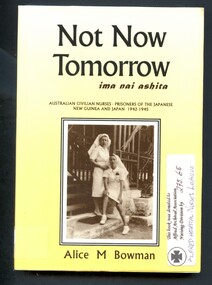
Book - Illustrated Book, Alice M. (Alice Mary) Bowman 1912-2000, Not now tomorrow=ima nai ashita, 1996
... ...Prisoners of War-Japan...Of significance to the AHNL as it is an important record of the conditions nurses endured ad prisoners of war World War 1939-1945 Prisoners of War-Papua New Guinea Prisoners of War-Japan nurses A true story of a civilian nurse from the Government Hospital in Rabaul, who was held prisoner in New Britain (six months) and Japan (3 years) following the Japanese attack of Rabaul in 1942 On the front of the dustjacket is a printed black and white donation sticker: black Maltese cross in circle, "This book was donated to Alfred Archival Association Nursing Division by" Alfred Hospital Nurses League (handwritten in black ink) Also previous catalogue number handwritten in black ink on this label Illustrated book with dust jacket. ...A true story of a civilian nurse from the Government Hospital in Rabaul, who was held prisoner in New Britain (six months) and Japan (3 years) following the Japanese attack of Rabaul in 1942Illustrated book with dust jacket. Book has a yellow cover with title and author's name printed in white on front and spine. Dust jacket has a pale-yellow background, title and author's name printed in brown on front and spine. The front of the dustjacket also has a black and white photograph of the author (Alice Bowman) (seated) and Joyce McGahan (standing) they are wearing Sisters uniforms; a building of the Namanalu Hospital, Rabaul is behind them (1939). On the back cover is another black and white photograph: Rabaul panorama, and a summary of the book in brown print. non-fictionA true story of a civilian nurse from the Government Hospital in Rabaul, who was held prisoner in New Britain (six months) and Japan (3 years) following the Japanese attack of Rabaul in 1942world war 1939-1945, prisoners of war-papua new guinea, prisoners of war-japan, nurses -
 Alfred Hospital Nurses League - Nursing History Collection
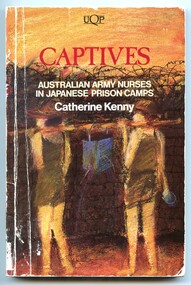
Book - Illustrated Book, Catherine Kenny 1962, Captives: Australian army nurses in Japanese prison camps, 1986
... ...prisoners of War...Twelve drowned when the ship was sunk off the coast of Sumatra, a further 21 died in the Banka Island massacre, and another eight died in captivity Of significance to AHNL as Alfred graduates were among the captives World War 1939-1945 Australian Army Nurses prisoners of War military nursing nurses Experiences of Australian Army nurses who were prisoners of the Japanese during World War two At the bottom left of the first page is a printed coloured donation sticker: AHNL logo, "This book was donated to AHNL Inc-Nursing Archives by" the Alfred Hospital Library 21/3/18 (handwritten in ink) The previous catalogue number is handwritten in ink at top right of this page. ...Experiences of Australian Army nurses who were prisoners of the Japanese during World War twoIllustrated book. Front cover has a painting by Cynthia Breusch depicting two female figures carrying a container hanging from a pole on their shoulders. Behind them is a barbwire topped fence. The book title is printed over this painting in red and white ink. The author's name is printed in white below the title, and the publisher's mark is printed in black above the title. The Spine is cream in colour, with abbreviated title printed in red, author's surname and publishers mark printed in black. The back cover has a cream background, with quotes from two nurses and a summary of the book overprinted in blacknon-fictionExperiences of Australian Army nurses who were prisoners of the Japanese during World War twoworld war 1939-1945, australian army nurses, prisoners of war, military nursing, nurses -
 Alfred Hospital Nurses League - Nursing History Collection
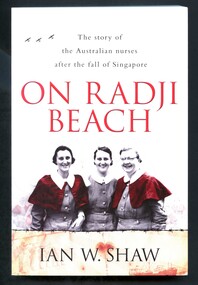
Book - Illustrated Book, Ian Winton Shaw, On Radji Beach, 2010
... World War 1939-1945 prisoners of war...Researched from the diaries and papers of some of the nurses who survived Of significance to the AHNL as it is an important part of nursing history Vivian Bullwinkel Vyner Brooke Australia Army-Nurses World War 1939-1945 prisoners of war Nurses Australia The story of Australian nurses after the fall of Singapore in World War Two At the bottom right of the front page is a printed black and white donation sticker: black Maltese cross in circle, "This book was donated to Alfred Archival Association Nursing Division by"AHNL (handwritten in black ink) Also previous catalogue number handwritten in black ink on this sticker. ...The story of Australian nurses after the fall of Singapore in World War TwoIllustrated book with red and black print on front and spine. Front cover also has a red, grey and white photograph of three nurses in uniform. Title and authors name on front and spine. Summary of book in black print on back covernon-fictionThe story of Australian nurses after the fall of Singapore in World War Twovivian bullwinkel, vyner brooke, australia army-nurses, world war 1939-1945 prisoners of war, nurses australia -
 National Vietnam Veterans Museum (NVVM)
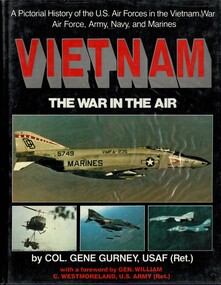
Book, Gurney, Gene Col. USAF (Ret.), Vietnam: The War In The Air - A Pictorial History of the U.S. Air Forces in the Vietnam War, Air Force, Army, Navy, and Marines
... Navy Vietnam Illustrated with nore than 300 full-colour and duotone photographs and maps, this history covers th entire Vietnam War from the first entrance of U.S. places to the prisoners of war. Vietnam: The War In The Air - A Pictorial History of the U.S. ...Illustrated with nore than 300 full-colour and duotone photographs and maps, this history covers th entire Vietnam War from the first entrance of U.S. places to the prisoners of war.Illustrated with nore than 300 full-colour and duotone photographs and maps, this history covers th entire Vietnam War from the first entrance of U.S. places to the prisoners of war.u.s air force, u.s. army, marines, u.s. navy, vietnam -
 National Vietnam Veterans Museum (NVVM)
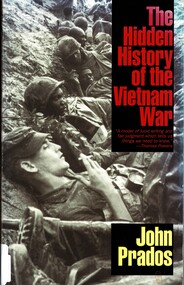
Book, Prados, John, The Hidden History of the Vietnam War, 1995
... ...American Prisoners...Vietnamese Conflict 1961-1975 - United States President J F Kennedy President Lyndon Johnson American Prisoners A model of lucid writing and fair judgement which tells us things we need to know. ...A model of lucid writing and fair judgement which tells us things we need to know.A model of lucid writing and fair judgement which tells us things we need to know.vietnamese conflict, 1961-1975 - united states, president j f kennedy, president lyndon johnson, american prisoners -
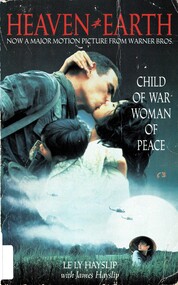 National Vietnam Veterans Museum (NVVM)
Book, Hayslip, Le Ly, Child of War, Woman of Peace: Heaven and Earth, Part 2. Heaven and Earth (Now a major motion picture from Warner Bros.), 1993
... ...Rescued prisoners...South Vietnamese Soldier Viet Cong Le Ly Hayslip Tortured Rescued prisoners Imprisioned and tortured by the South Vietnamese soldiers, sentenced to death by the Viet Cong, Le Ly Hayslip quickly learnt how to survive in wartorn Vietnam. ...Imprisioned and tortured by the South Vietnamese soldiers, sentenced to death by the Viet Cong, Le Ly Hayslip quickly learnt how to survive in wartorn Vietnam. Escaping to the United States, she thought whe was swapping hell for heaven.Imprisioned and tortured by the South Vietnamese soldiers, sentenced to death by the Viet Cong, Le Ly Hayslip quickly learnt how to survive in wartorn Vietnam. Escaping to the United States, she thought whe was swapping hell for heaven.south vietnamese soldier, viet cong, le ly hayslip, tortured, rescued prisoners
