
Showing 268 items matching "sleep"
-
 Kiewa Valley Historical Society
Photographs - Townships of Mt Beauty and Bogong and the Kiewa Valley, c 1940, 1950, 1960
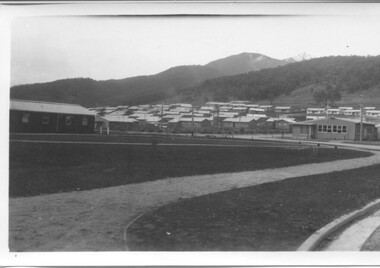
... This photo is of Junction Camp at Bogong Village and was commenced late in 1939 and by 1940 accommodated 96 men who were engaged in work on Junction Dam. Sleeping accommodation was provided in hutments, each of four rooms, each room being approx. 12 feet by 10 feet and provided for the accommodation of 2 men. ...This photo is of Junction Camp at Bogong Village and was commenced late in 1939 and by 1940 accommodated 96 men who were engaged in work on Junction Dam. Sleeping accommodation was provided in hutments, each of four rooms, each room being approx. 12 feet by 10 feet and provided for the accommodation of 2 men. ...The township of Mt. Beauty was built to provide family accommodation for personnel working on the construction of the Kiewa Scheme. construction commenced in 1946. Photo 1 is looking towards the corner of Lakeside Ave. and Kiewa Crescent. The Post Office is on the corner and the original building housing the Co op store was in Kiewa Crescent. Photo 2 is taken at a later date as the garden in front of the Post Office is well established. The Community Centre is centre left of the photo and the back buildings are the staff accommodation called "The Chalet". Photo 3. Farming country taken from Wallacedale. The Wallaces were one of he early farming families in the Kiewa Valley. Photo 4. This photo is of Junction Camp at Bogong Village and was commenced late in 1939 and by 1940 accommodated 96 men who were engaged in work on Junction Dam. Sleeping accommodation was provided in hutments, each of four rooms, each room being approx. 12 feet by 10 feet and provided for the accommodation of 2 men. This camp remained in use until November 1962.These photos have both historical and social significance. They show the type of accommodation available for workers during the construction of the SEC Kiewa Hydro Scheme as well as early streetscape views of Mt. Beauty. The Junction Camp photo also shows the state of the forest following the 1939 fires in the area.4 Black and white photographs of various sizes.Photo 1. On back, hand written in pencil: top left hand corner: "Sept 1950". Centre of photo: "Return to Gibson Envelope". Right hand side: "Cooper". Bottom left corner: "Mt. Beauty Camp SEC Kiewa Scheme". Photo 2. No inscriptions or markings. Photo 3. Back of photo handwritten in pencil: "In W>T> June 14. 1961 page31. Some of the farming country in the Kiewa Valley. This taken from the home of Mr. Geoff Wallace Wallacedale, Kergunyah where some of his 600 cattle were rounded up." Bottom right corner "Return to Gibson Envelope". There is a copyright stamp belonging to "the Herald & Weekly Times Ltd. also on the back. Photo 4. Typed on a sticker on the back of the photo "Stable attendants Cottage and Camp Sept. 1940".camp, sec kiewa scheme, kiewa, cattle, mt. beauty -
 Jewish Museum of Australia
Diary of Alfred Broch, 10/7/1940 - 17/12/1940
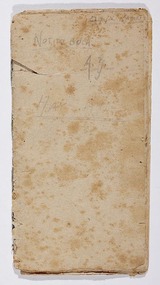
... Complete helplessness. No sleeping facilities. All sleep on the floor, on tables etc. ...Complete helplessness. No sleeping facilities. All sleep on the floor, on tables etc. ...This diary was handwritten by Alfred Broch over the course of four months in 1940. It was kept while Alfred Broch was travelling on the HMT Dunera and then during his detainment in the Hay internment camp.Bound with cotton and handwritten in pencil. Bound with cotton and handwritten in pencil.[selected passage translation from German, further translation available] : “Dunera” 10.VII – 6.IX.1940 First impression very depressing. Fears. Confusion with prisoners of war. Never mind. Corrected. Continuing further bad treatment. Boarding the ship assisted by rifle butts. Robbed as soon as we reached the deck. Impression of a death ship. Complete helplessness. No sleeping facilities. All sleep on the floor, on tables etc. Intended accommodation taken up by luggage cases. (barbed wire). Food good but only spoons. Next day: robbery from the cases. Own people steal. Purloined objects even include toothbrushes and toothpaste. Much to eat. Small convoy with one cruiser. In the same convoy a women’s transport which soon leaves us as it is bound for Canada and we are quite surprised. The English soldiers and officers have another side. While in the danger zone they only had a webbing belt and slippers. In case of torpedoes – expecting certain death. Bad air as all vents are closed. Other Inscriptions: Front page, upper right, underlined: "Alfred Broch" Front page, upper, underlined: "Notitz Buch" Front page, centre, underlined: "Hay 1941" Page 1, upper right: "Mittwoch 10. VII." Page 3, upper right: "10. VII. - 6. IX. 1940 Page 4, centre: "[...] ARANDORA STAR" Page 11, upper, underlined: "Von Liverpool Nach Hay / Mittwoch 10 VII" dunera, wwii, internment, jewish history & people -
 Surrey Hills Historical Society Collection
Photograph, Kenneth (Ken) Tudor Hall, Alfred Davies grocery store, corner Canterbury and Union Roads, 1906 or 1909, Original: 1906 or 1909; Copy photo by Ken Hall c1982
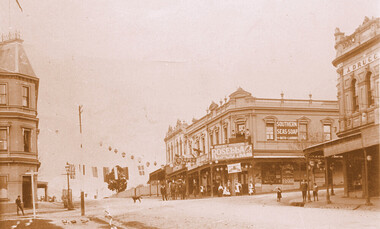
... His son Cyril recalled sleeping on the corner balcony on hot nights. ...His son Cyril recalled sleeping on the corner balcony on hot nights. ...Ref: Mr & Mrs J Davies, Greensborough - Alfred Davies took over this store in 1904. He lived with his wife, Lucretia and 5 children above the store. His son Cyril recalled sleeping on the corner balcony on hot nights. Alfred Davies was a strong Temperance man and gave up the store when clients pressured him to collect their beer from the hotel opposite and deliver it with their grocery orders. The pharmacy moved across the road to this corner in 1936 when acquired by Dartnells. The corner shop in Woodheads building was a store and other businesses over the years. The "Druggist" on right, in Hansen's Exchange building, was established in 1889. From 1910 Percy Cathcart conducted the pharmacy there until 1936 when he was joined by Vic Dartnell, his cousin. In 1940, Vic transferred the business to Woodheads corner. His son John followed as a pharmacist until his daughter Amanda became the pharmacist. After the Dartnell family sold the business, the pharmacy continued in a similar manner as a compounding pharmacy and retained 'Dartnell' in its name.This documents the importance given to celebration of the British Empire in the Surrey Hills area in the first half of the 20th century. It also documents the earliest centre of business activity in the area with 2 major sets of dual occupancy residential and retail terraces - the Woodhead buildings and Hansen's Exchange, the later set of terraces having been demolished c1971.Sepia photo of the corner of Canterbury and Union Roads in 1906 or 1909 festooned with flags and lanterns for Empire Day celebrations. On the SE corner is Alfred Davies grocery store with advertising signs for Rosella jams and Southern Seas soap. There are people standing on a balcony above the Rosella advertising sign. Other adults and children stand in the street and there is a cab outside the draper's further east in Canterbury Road. On the opposite corner to Alfred Davies is a druggist and on the north-west corner is McNeil's Family Hotel.mcneil's family hotel, empire day, festivals and celebrations, grocers, pharmacists, alfred davies, businesses, woodhead's buildings, john woodhead, percy cathcart, hansen's exchange, hansen's folly -
 Old Colonists' Association of Ballarat Inc.
Photograph - Image, Members of the Old Colonists' Association, 1917, 1904
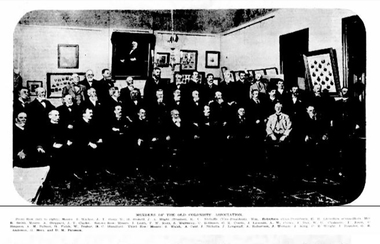
... Front Row (left to Right): Messrs. S. Walker, J. T. Sleep, W. H. Stokeld, J. A. Blight (Trustees), R.U. ...Front Row (left to Right): Messrs. S. Walker, J. T. Sleep, W. H. Stokeld, J. A. Blight (Trustees), R.U. ...Although the portrait of Graham is still in existence, the rest of the memorbilia on the wall is no longer in the hands of the Association. Members of the Old Colonists' Association in the Old Colonists' Hall. Front Row (left to Right): Messrs. S. Walker, J. T. Sleep, W. H. Stokeld, J. A. Blight (Trustees), R.U. Nicholls (Vice-President), Wm. Robertson (Vice-President). E. E. Llewellyn (Councillor). Mrs. R. Smith, Messrs, A. Sheppard, J. T. Clarke. Second Row: Messrs. J. Lamb, T. W. Scott, S. Walmsley, C. Robinson, G. R. Coutts, J. Lammin, A. W. Crowe, J. Don, W, G. Chalmers, J, Jones, C. Simpson, A. M. Palmer, H. Fields, W. Trahar, H. C. Handford. Third Row: Messrs. S. Walsh, A. Cant, J. Nicholls, J. Longstaff, A. Robertson, J. Welham, J. King, C. E. Wright, J. Pounder, C. R. Anderson, G. Merz, and D. M. Paterson. old colonists' hall, s. walker, j. t. sleep, w. h. stokeld,, j. a. blight, r.u. nicholls, william robertson, e. e. llewellyn, mrs. r. smith, a. sheppard, j. t. clarke, j. lamb, t. w. scott, s. walmsley, c. robinson, g. r. coutts, j. lammin, a. w. crowe, j. don, w. g. chalmers, j, jones, c. simpson, a. m. palmer, h. fields, w. trahar, h. c. handford, s. walsh, a. cant, j. nicholls, j. longstaff, a. robertson, j. welham, j. king, c. e. wright, j. pounder, c. r. anderson, g. merz, d. m. paterson -
 Eltham District Historical Society Inc
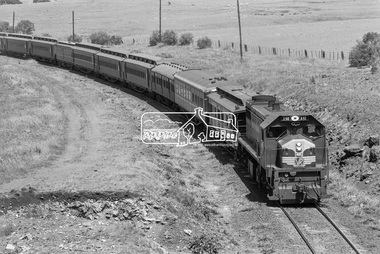
Photograph, The Train of Knowledge, hauled by an X-class diesel locomotive, X48, near Ballan, c.October 1982, 1982
... As of 1976, the consist used up to five of the six available E type sleeping cars, each with 20 berths, plus the shower car Carey, formerly a horsebox, Melville, a former royal carriage used to provide power for lighting, heating and cooking, 43BPL (a former sitting carriage) used as a classroom, and Avoca as the dining car for the train, with 48 seats allowing serving the whole train meals in two sittings....As of 1976, the consist used up to five of the six available E type sleeping cars, each with 20 berths, plus the shower car Carey, formerly a horsebox, Melville, a former royal carriage used to provide power for lighting, heating and cooking, 43BPL (a former sitting carriage) used as a classroom, and Avoca as the dining car for the train, with 48 seats allowing serving the whole train meals in two sittings. ballan, train of knowledge, x48, x-class diesel locomotive, state car no.2 (melville) Digital TIFF file Scan of 35mm Ilford FP4 black and white transparency The Train of Knowledge, hauled by an X-class diesel locomotive, X48, near Ballan, c.October 1982 Photograph George Coop ...X48 entered service in 1977 (Wikipedia https://en.wikipedia.org/wiki/Victorian_Railways_X_class_(diesel)) The car immediately behind the locomtive is State Car No. 2 (Melville) which was used as a power unit for the train. https://www.pjv101.net/cd/pages/c160v03.htm Train of Knowledge https://en.wikipedia.org/wiki/Train_of_Knowledge The Train of Knowledge was an Australian school camp on wheels, allowing students and teachers to visit multiple locations around Victoria without having to organise accommodation or transport. The train was formed originally with whatever rolling stock was available, but within a few years it had settled to a standard consist made up to carry between 80 and 90 school children, 6 teachers and four railway staff members. As of 1976, the consist used up to five of the six available E type sleeping cars, each with 20 berths, plus the shower car Carey, formerly a horsebox, Melville, a former royal carriage used to provide power for lighting, heating and cooking, 43BPL (a former sitting carriage) used as a classroom, and Avoca as the dining car for the train, with 48 seats allowing serving the whole train meals in two sittings.Digital TIFF file Scan of 35mm Ilford FP4 black and white transparencyballan, train of knowledge, x48, x-class diesel locomotive, state car no.2 (melville) -
 Parks Victoria - Mount Buffalo Chalet
Bell
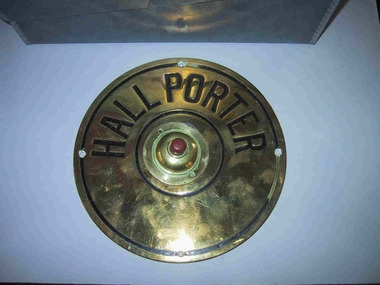
... A personal recollection is of Joseph the Night Porter welcoming and assisting when as a family with four sleeping children we would arrive after midnight to the Chalet where rooms would be ready, beds turned down and all unpacking of the car supervised by Joseph. ...A personal recollection is of Joseph the Night Porter welcoming and assisting when as a family with four sleeping children we would arrive after midnight to the Chalet where rooms would be ready, beds turned down and all unpacking of the car supervised by Joseph. ...Was attached to a wall near reception but was removed to storage in approx.. 2000 - 2002. The bell has strong associations with the Victorian Railways Era reflecting the service and ethos of Railways with its uniformed Porters welcoming and on duty as Night Porter and day for all guests needs. (Especially lost keys) assistance with luggage, room service and co-ordinating transit and transport with Railways buses and services. A personal recollection is of Joseph the Night Porter welcoming and assisting when as a family with four sleeping children we would arrive after midnight to the Chalet where rooms would be ready, beds turned down and all unpacking of the car supervised by Joseph. (J. Skeggs) "A number of specific items, which have been useful in the day to day operations of the Chalet, remain in the building with each complementing the other to provide context ,meaning and character to their setting. Items such as the hall porter bell, the many signs providing information to the guests, the wall clock, barometer and dinner bell point to the Chalet being a well-run social institution with a pleasant environment for rest, recreation and congenial company." (Pg 81 Historica, MBCC) Listed in Draft Inventory of Significant Collection items A.3 Fixtures and Fitttings. (Pg 165. Historica MBCC)Circular brass disc with inner (separate ) maroon button mounted in raised circular disc. Hall Porter is embossed with black colouring around half of outer, larger disc."HALL PORTER" -
 Ringwood and District Historical Society
Newspaper, "Age" Newspaper cutting announcing the death of Catherine Maggs on 14th. October 1960
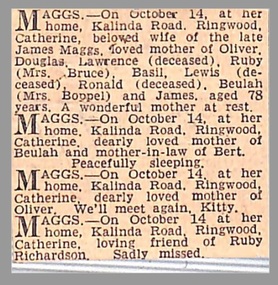
... —On October 14, at her home, Kalinda Road, Ringwood, Catherine, dearly loved mother of Beulah and mother-in-law of Bert. Peacefully sleeping. MAGGS.—on October 14, at her home, Kalinda Road, Ringwood, Catherine, dearly loved mother of Oliver. ...—On October 14, at her home, Kalinda Road, Ringwood, Catherine, dearly loved mother of Beulah and mother-in-law of Bert. Peacefully sleeping. MAGGS.—on October 14, at her home, Kalinda Road, Ringwood, Catherine, dearly loved mother of Oliver. ...Catherine Maggs was married to James Maggs who belonged to a large pioneer family in the Ringwood area. They had nine children. James died in July 1940. (From the book "Ringwood Place of Many Eagles by Hugh Anderson)Small newpaper cutting.MAGGS.—On October 14, at her home, Kalinda Road, Ringwood, Catherine, beloved wife of the late James Maggs, loved mother of Oliver, Douglas, Lawrence (deceased), Ruby (Mrs. Bruce), Basil, Lewis (deceased), Ronald (deceased), Beulah (Mrs. Boppel) and James, aged 78 years. A wonderful mother at rest. MAGGS.—On October 14, at her home, Kalinda Road, Ringwood, Catherine, dearly loved mother of Beulah and mother-in-law of Bert. Peacefully sleeping. MAGGS.—on October 14, at her home, Kalinda Road, Ringwood, Catherine, dearly loved mother of Oliver. We'll meet again, Kitty. MAGGS.—on October 14, at her home, Kalinda Road, Ringwocd, Catherine, loving friend of Ruby Richardson. Sadly missed. -
 Ballarat Tramway Museum
Newspaper, The Courier Ballarat, introspect or looking at the past from The Ballarat Courier, c1938, 1930-1940
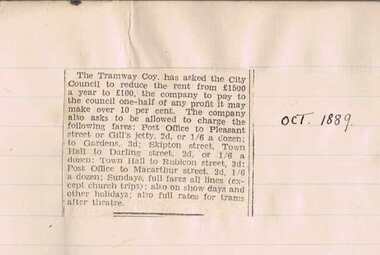
... - Operation of trams in Flinders St at night and problems with homeless people sleeping near the tracks. Contained within Reg Item 5485 - Service Exercise Book, black covers, with label, red binding titled "No. 2 - Ballarat Tramways & S.E.C. ... - Operation of trams in Flinders St at night and problems with homeless people sleeping near the tracks. Contained within Reg Item 5485 - Service Exercise Book, black covers, with label, red binding titled "No. 2 - Ballarat Tramways & S.E.C. ...Yields information about the history of tramway operations in Ballarat and Bendigo through looking at the past from cuttings in newspapers - The Courier.Newspaper clippings inside the rear cover and Second last page - possibly from an "introspect" or looking at the past from The Ballarat Courier, c1938. - Ballaarat Tramway company asking the City of Ballarat to reduce the rent and different fares. - Battery trams in East Ballarat - "Hopes that failed" - Electric Trams - Ballarat Service began in 1905 - notes a reference to the SEC operations. - Electricity Commission in Ballarat and its tram and power supply to the country - dated 1938 - tramway operations in Bendigo (Sandhurst to Eaglehawk) - resolving issues between the City of Ballarat and the Ballaarat Tramway Co. - Licensing of horse tram drivers in Ballarat. - start of construction of the horse trams in Ballarat - destruction of the horse tram depot by fire in Sebastopol - Demonstration of the Julien Battery tramcar in Drummond St. - Operation of trams in Flinders St at night and problems with homeless people sleeping near the tracks. Contained within Reg Item 5485 - Service Exercise Book, black covers, with label, red binding titled "No. 2 - Ballarat Tramways & S.E.C. Systems". bendigo, ballarat, cable trams, battery trams, steam trams, sec, esco -
 Falls Creek Historical Society
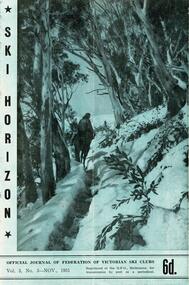
Journal - Ski-Horizon Vol. 3 No 3
... Fred says you are welcome to bring your sleeping bag and stay the night (what's left of it) at Toonallook where the recovery from hangover can be spent very pleasantly on the property or swimming and boating on the Hume Weir nearby...Fred says you are welcome to bring your sleeping bag and stay the night (what's left of it) at Toonallook where the recovery from hangover can be spent very pleasantly on the property or swimming and boating on the Hume Weir nearby ...Ski-Horizon is the official journal of the Federation of Victorian Ski Clubs which began publication in 1949. The were 26 original member clubs which included Albury Ski Club, Bogong Ski Club, Myrtleford Ski Club, Tallangatta and District Ski Club and Wangaratta Ski Club. Two pioneers of Falls Creek, Tom Mitchell, M.L.A., and Martin Romuld were Vice-Presidents of the Federation.This Journal is significant because it documents the early development of skiing in Victoria.The journal features stories and events chronicling developments in Victoria and internationally. Items related to the Falls Creek Area in this publication include:- Page 2: The road to Falls Creek from Howmans Gap likely to be closed while activities on the Kiewa Hydro Electric Scheme are restricted due to VIctoria's lack of finance for public works. Page 5 - A note from Fred Griffith (President, Albury Ski Club) gave plans for the club's annual Ski Ball on Friday, 30th November. It will be held in the Toonallook Woolshed. Fred says you are welcome to bring your sleeping bag and stay the night (what's left of it) at Toonallook where the recovery from hangover can be spent very pleasantly on the property or swimming and boating on the Hume Weir nearby. - N.E.D.S.A. officials are getting preparations in hand for the visit next year of a N.E.D.S.A. team to New Zealand. John Robertson, of Myrtleford Ski Club, is the Trip Secretary and Toni St. Elmo is acting at present as Manager.ski history victoria, federation of victorian ski clubs, ernest forras -
 Bendigo Historical Society Inc.
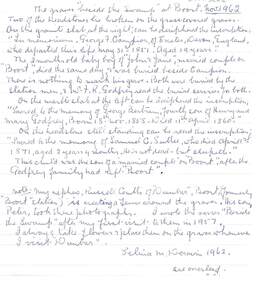
Document - HARRY BIGGS COLLECTION: BOORT CEMETERY
... Long gone are they who loved them best/The trees still whisper by the swamp; the night birds call, and vigil keep/As in those far-off yesterdays - where Campion and three children sleep........'Selina White Birth Date Abt 1882 Birth Place Serpentine Creek, Victoria Registration Year 1882 Registration Place Victoria, Australia Father John White Mother Aary Ann Nicholls Registration Number 25736 ...Long gone are they who loved them best/The trees still whisper by the swamp; the night birds call, and vigil keep/As in those far-off yesterdays - where Campion and three children sleep........'Selina White Birth Date Abt 1882 Birth Place Serpentine Creek, Victoria Registration Year 1882 Registration Place Victoria, Australia Father John White Mother Aary Ann Nicholls Registration Number 25736 MEMORIALS Graveboards Boort Cemetry Russell Coutts 'Dunbar' Peter Coutts George F. ...Selina Deravin (Born 1882, Serpentine Creek. Died 1968, Melbourne, age 85), father John White, mother Mary Ann Nicholls was married to Garnet Deravin, a medical doctor. In 1928, (Electoral Roll Bendigo) Garnet and Selina were living at 109 Queen Street, Bendigo; later at 13 Tuxon Street, North Balwyn, where Garnet died on 15th. April, 1954 (Argus, 17th April, 1954). Deravin family owned the Chateau Dore vineyard and winery. Selina published a book of her poetry. A poem ' Beside the Swamp' was written following her visit to the swamp at Boort: ' In silence by the graves I stood, of those who long had lain at rest/In lonely quiet, in the bush. Long gone are they who loved them best/The trees still whisper by the swamp; the night birds call, and vigil keep/As in those far-off yesterdays - where Campion and three children sleep........'Selina White Birth Date Abt 1882 Birth Place Serpentine Creek, Victoria Registration Year 1882 Registration Place Victoria, Australia Father John White Mother Aary Ann Nicholls Registration Number 25736 Hand written letter by Selina De Ravin, titled 'The graves beside the swamp at Boort.' dated November 1962. Two of the headstones lie broken on the grass covered graves. On the granite slab at the right is the inscription 'In memoriam. George F. Campion of Exeter Devon, England, who departed this life, May 31st 1851. Aged 19 years. The 2 month old baby boy of 'John and Jane', married couple on 'Boort', died the same day and was buried beside Campion. There is nothing to mark his grave. Both were buried by the Station men. Mr J. R. Godfrey read the burial services for both. On the marble slab at the left can be deciphered the inscription sacred to the memory of George Bertram, fourth son of Henry and Mary Godfrey, Born 18th November 1858. Died 11th April 1860. On the headstone still standing can be read the inscription Sacred to the memory of Samuel C. Sutlee, who died April 1st 1871, aged 2 years 4 months. He is not dead - but sleepeth. This child was the son of a married couple 'on Boort', after the Godfrey family had left 'Boort'. Note - My nephew Russell Coutts of 'Dunbar', Boort, (formerly 'Boort' Station) is erecting a fence around the graves. His son, Peter took these photographs. I wrote the verses 'Beside the Swamp' after my first visit to them in 1957. I always take flowers and place them on the graves whenever I visit 'Dunbar' Selina M. Deravin 1962Russell Coutts and his son Peter have restored the graves beside the Lake at 'Dunbar' and erected a graveyard. This photograph was taken by Peter and the flowers placed on the graves by his mother Wilma who helps to care for them. They also discovered a fifth unknown grave there when erecting the fence and re- erecting the broken and fallen headstones. S. M. Deravin. (Selina De Ravin) a. Typed poem on carbon copy flimsy paper: 'Beside the Swamp', signed in blue pen by Lina Deravin, January 1957'. Written on the bottom in blue pen: ' In February 1960 when on a visit to Boort I took some flowers and placed them on these graves beside the swamp'. Signed Lina Devarin.Selina M. Deravinmemorials, graveboards, boort cemetry, russell coutts, 'dunbar', peter coutts, george f. campion, boort cemetery, samuel c. sutlee?., poetry, poem, garnet deravin, selina deravin -
 Brighton Historical Society
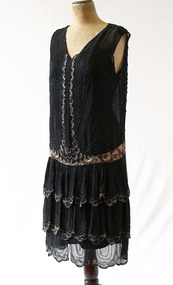
Dress, circa 1920
... During this time, Margaret says, Ellen "had a life of luxury, having servants at her beck and call and even sleeping at the foot of her bed to protect her from any harm". ...During this time, Margaret says, Ellen "had a life of luxury, having servants at her beck and call and even sleeping at the foot of her bed to protect her from any harm". ...This dress belonged to Ellen Davis, nee McLaughlin (1870-1956), great-grandmother of Margaret Lake. Ellen was born in County Donegal, Ireland. She married George Washington Davis in 1890 and the couple moved to South Africa, where George owned a bicycle store. During this time, Margaret says, Ellen "had a life of luxury, having servants at her beck and call and even sleeping at the foot of her bed to protect her from any harm". She was a "tiny lady of 5 foot tall" and George "could put his hands around her waist of 18 inches". On coming to Australia they opened a garage and taxi service in Graham Street, Port Melbourne. They lived here until Ellen's death in a road accident in 1956. Ellen gave the dress to her great-granddaughter when Margaret was ten years old. Aged 62, Margaret told BHS, "I have worn it on several occasions, mostly to costume parties and fancy-dress balls when I was younger. I have loved it all this time and displayed it on a dress model in my last home". As she had no granddaughter of her own to leave it to, she decided to donate the dress so that it would continue to be cared for.Sleeveless black silk crepe dress with V-neck and scalloped hem. Covered with black beaded designs, with white bead and iridescent pink sequin accents.margaret lake, ellen davis, ellen mclaughlin, beading, 1920s -
 Wodonga & District Historical Society Inc
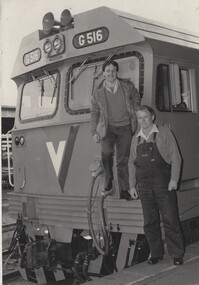
Photograph - Fred Rochow Railways Collection - Driver Tom Symonds and Fireman Billy Hyde, 3 August 1986
... The Southern Aurora consisted of 14 stainless steel cars: a luggage van, a power van, a dining car, a lounge car, and ten First Class Sleeping Cars. The total capacity was 198 passengers. ...The Southern Aurora consisted of 14 stainless steel cars: a luggage van, a power van, a dining car, a lounge car, and ten First Class Sleeping Cars. The total capacity was 198 passengers. ...The Fred Rochow Railways Collection incorporates photos related to the operation of the Wodonga Railway Station including different types of trains and railways staff C. 1930 – 1990. It was donated to the Wodonga Historical Society by Fred Rochow, a railwayman who spent many years based in Wodonga. He joined the Victorian Railways on 17th June l947 and retired in 1988. For some time, he was a member of the Australian Federated Union of Locomotive Enginemen and served a term as a member of the Trades Hall Council. He had an extensive knowledge of the struggles that took place to achieve better conditions for railway workers. Fred worked for many years as a fireman and then worked his way up the ranks to driver, experiencing many changes from the days of steam locomotives through to diesel trains, locomotives and even the modern XPT train. He worked throughout Victoria at different stages of his career, with his final working years focused on the northeast of Victoria and the Albury to Melbourne line. After his retirement, Fred continued to share his love of steam miniature trains with the community.This collection has local and statewide significance as it captures images of trains, locomotives and personnel who operated the railway services in Wodonga and throughout Northeast Victoria. The railways played a critical role in opening up Victoria and connecting Australia for trade, business, social communication and transport.At Spencer Street Station on the last “Southern Aurora". The locomotive was G516. Driver Tom Symonds was based in Wodonga from 1955 to 1987. He served as AFULE Branch Secretary from 1962 to 1963 and 1966 to 1971. G Class Locomotives - G Class locomotives were primarily intended for hauling freight services, they were also used on passenger trains such as the “Southern Aurora” and the “Intercapital Daylight”. Locomotive G516 came into service in December 1984. After a series of contractual changeovers between companies it was transferred to QR National and is still in operation, The "Southern Aurora", the overnight Sydney-Melbourne express, was one of the icons of Australian railways in the 1960s and 1970s. Uniquely in Australia, it conveyed only First Class passengers, all of whom were accommodated in air-conditioned sleeping cars, all equipped with showers. The Southern Aurora was introduced when part of Australia's rail gauge problem was solved with the construction of a new standard gauge line. The new line was a 317 km long line running from Albury, NSW, parallel to the existing broad gauge line to Melbourne, connecting Australia's two largest cities by standard gauge. The Southern Aurora consisted of 14 stainless steel cars: a luggage van, a power van, a dining car, a lounge car, and ten First Class Sleeping Cars. The total capacity was 198 passengers. For a number of years, there were no intermediate stops for passengers, and the train had the longest non-stop run in Australia, 430 km from Goulburn to Albury. Dining car crews changed at Goulburn and Albury, and locos were changed at Albury. The first train ran from Sydney on Thursday 14th April 1962, with full regular services starting from both Sydney and Melbourne on Monday 16th April 1962. The classic S Class locomotive was used to haul the early Southern Aurora trains. From 1984 it was also hauled by the new G Class locomotives, On the morning of 7th February 1969, the southbound Southern Aurora collided head-on with a northbound goods near Violet Town, Victoria. Nine passengers and crew were killed, and seven carriages were destroyed. A steady decline in patronage saw the withdrawal of the service in August 1986. At top of locomotive "G516". In centre of locomotive, "V" insignia of VLinerailways wodonga, fred rochow, wodonga railway men, g class locomotives, the southern aurora -
 Federation University Historical Collection
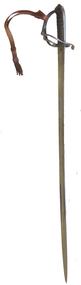
Weapon - Object, Sword, 1877
... Whyte ; the "second to Sergeant Blight; the third, to Trooper Jenkins; and the fourth, to Trooper Orr, of Creswick. Major Sleep officiated as timekeeper. The colonel commandant complimented Captain Med-calf upon the efficiency of the troop, and officers and men afterwards dined together at Craig's hotel. ...Whyte ; the "second to Sergeant Blight; the third, to Trooper Jenkins; and the fourth, to Trooper Orr, of Creswick. Major Sleep officiated as timekeeper. The colonel commandant complimented Captain Med-calf upon the efficiency of the troop, and officers and men afterwards dined together at Craig's hotel. ...In 1862, the units of the Mounted Volunteer Corps in Victoria were formed into a single regiment known as the Victorian Volunteer Light Horse. This title changed again in 1863, to the Prince of Wales Victorian Volunteer Light Horse ( Hussars ). In 1870 a uniform was adopted that was based on the British 19th Hussars. Troops were based at various times at Geelong, Ballarat, Kyneton, Bendigo, Castlemaine and Dandenong, as well as metropolitan Melbourne. In 1885, most of the Cavalry were incorporated into a newly formed Victorian Mounted Rifles. (http://www.awm.gov.au/collection/REL/18070.001) "It is notified in the Gazette that Lieutenant Laurence Whyte, Ballarat troop Prince of Wales Light Horse, has been appointed captain, seniority to date from January 31. " (The Argus, 17 February 1883) "An official inspection of the P.W.L.H. took place in the Royal Park last evening by the colonel-commandant, assisted by Colonel Rede; Captain Medealf in command of the, troop. After bring exercised in field movements, a sword competition took place, toe first prize bring awarded to Trooper L. Whyte ; the "second to Sergeant Blight; the third, to Trooper Jenkins; and the fourth, to Trooper Orr, of Creswick. Major Sleep officiated as timekeeper. The colonel commandant complimented Captain Med-calf upon the efficiency of the troop, and officers and men afterwards dined together at Craig's hotel. (Ballarat Courier, 09 March 1877.)Silver coloured sword and scabbard with leather hand grip within the hilt. The sword was awarded to Trooper Whyte of the Prince of Wales Victorian Volunteer Light Horse (Ballarat) in 1877.. Engraved into handle "Ballarat Troop P.W.V.V.L.H Officers Trophy FIRST PRIZE WON BY Trooper Whyte AT SWORD Competition 8th March 1877" volunteer forces, sword, trooper whyte, prince of wales victorian volunteer light horse (ballarat), l. whyte, laurence whyte -
 The Beechworth Burke Museum
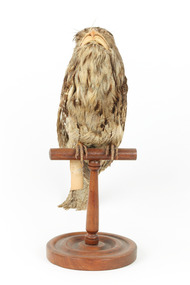
Animal specimen - Tawny Frogmouth, Trustees of the Australian Museum, 1860-1880
... Masters of camouflage, the Tawny Frogmouth sleeps during the day on tree branches in a stiff upward facing position (as with this specimen) to mimic broken tree branches, their feathers assist in this deception as the mottled grey and brown colours blend into the environment seamlessly. ...Masters of camouflage, the Tawny Frogmouth sleeps during the day on tree branches in a stiff upward facing position (as with this specimen) to mimic broken tree branches, their feathers assist in this deception as the mottled grey and brown colours blend into the environment seamlessly. ...The Tawny Frogmouth, although often mistaken for an owl, is a nocturnal Australian bird of the Podargidae family that is more closely related to the nightjars. They are widespread in terms of distribution and can be found all across mainland Australia and Tasmania in a diverse variety of habitats from woodlands, forests and urban areas. Masters of camouflage, the Tawny Frogmouth sleeps during the day on tree branches in a stiff upward facing position (as with this specimen) to mimic broken tree branches, their feathers assist in this deception as the mottled grey and brown colours blend into the environment seamlessly. This specimen differs in colours from the usual appearance of a Tawny Frogmouth, as the beak is usually a olive-grey to blackish tone and the plumage is generally more dominantly grey all over the bird. This specimen is part of a collection of almost 200 animal specimens that were originally acquired as skins from various institutions across Australia, including the Australian Museum in Sydney and the National Museum of Victoria (known as Museums Victoria since 1983), as well as individuals such as amateur anthropologist Reynell Eveleigh Johns between 1860-1880. These skins were then mounted by members of the Burke Museum Committee and put-on display in the formal space of the Museum’s original exhibition hall where they continue to be on display. This display of taxidermy mounts initially served to instruct visitors to the Burke Museum of the natural world around them, today it serves as an insight into the collecting habits of the 19th century.This specimen is part of a significant and rare taxidermy mount collection in the Burke Museum. This collection is scientifically and culturally important for reminding us of how science continues to shape our understanding of the modern world. They demonstrate a capacity to hold evidence of how Australia’s fauna history existed in the past and are potentially important for future environmental research. This collection continues to be on display in the Museum and has become a key part to interpreting the collecting habits of the 19th century.This Tawny Frogmouth has a broad head and a creamy beige coloured wide triangular beak with a hooked tip. The plumage on the head and back of the bird is a combination of darker and rufous browns, mottled with streaks of cream and grey. The underside of the bird from the bottom of the beak to the tail tip is a lighter cream colour with streaks of rufous-brown. The feet are an orange-brown colour. This specimen is adopting the skyward looking pose associated with the species, mimicking dead tree branches.1a. / More-Park / See Catalogue, page 7 /taxidermy mount, taxidermy, burke museum, beechworth, australian museum, skin, reynell eveleigh johns, bird, australian birds, tawny frogmouth, frogmouth -
 Eltham District Historical Society Inc
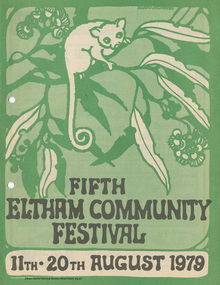
Booklet - Program, Progress Press, Fifth Eltham Community Festival, 11th - 20th August 1979, 1979
... Kidd, Sa Boutique, Siri Omberg, Skybeam Antennas, Specialised Sleep Centre, Style Interiors, The Living Water Bookshop, Thompsons Amcal Pharmacy, Valley Tiffany Lighting, Vonni’s, W. ...Kidd, Sa Boutique, Siri Omberg, Skybeam Antennas, Specialised Sleep Centre, Style Interiors, The Living Water Bookshop, Thompsons Amcal Pharmacy, Valley Tiffany Lighting, Vonni’s, W. ...Event program, 101 events, Friday, August 10th through Sunday, August 17th and local advertisers: 1979, Alan Marshall (Pioneers and Painters), Aljon, Artist Showcase, Beth Knight, Bimbi World, Briar Hill Timber & Trading, Chantelle Boutique, Classic Fireplace & Rangehood Centre, Country Art Store, Debonaire Air Conditioning Pty Ltd, Diamond Valley Bathroom & Plumbing Centre, Diamond Valley Drapes, Diamond Valley News, Diamond Valley Windscreens, Eccacentre, Economy Timber & Hardware, Edens Hobbycraft & Art Supplies, Eltham Community Festival, Eltham Festival, Eltham Fun Run, Eltham Gallery, Eltham Hardware & Plumbing Supplies Pty Ltd, eltham hotel, Eltham Living and Learning Centre, Eltham Produce Store, Eltham Village Shopping Centre, Grimshaw Motor Cycles, Halchem, Kenton Footwear, L.T. Cabinets, Lamers Construction Pty Ltd, Lovittools, Maggie Lorraine, Marion & Julian Bruere, Montmorency Hardware, Montmorency Pets, Pegasus Interiors, Penguin Drycleaners, Pioneers and Painters, Program, R & S Slocum Floorcovering Pty Ltd, R.F. & D.M. Kidd, Sa Boutique, Siri Omberg, Skybeam Antennas, Specialised Sleep Centre, Style Interiors, The Living Water Bookshop, Thompsons Amcal Pharmacy, Valley Tiffany Lighting, Vonni’s, W. Hutchison16 pages, stapled, coloured1979, alan marshall (pioneers and painters), aljon, artist showcase, beth knight, bimbi world, briar hill timber & trading, chantelle boutique, classic fireplace & rangehood centre, country art store, debonaire air conditioning pty ltd, diamond valley bathroom & plumbing centre, diamond valley drapes, diamond valley news, diamond valley windscreens, eccacentre, economy timber & hardware, edens hobbycraft & art supplies, eltham community festival, eltham festival, eltham fun run, eltham gallery, eltham hardware & plumbing supplies pty ltd, eltham hotel, eltham living and learning centre, eltham produce store, eltham village shopping centre, grimshaw motor cycles, halchem, kenton footwear, l.t. cabinets, lamers construction pty ltd, lovittools, maggie lorraine, marion & julian bruere, montmorency hardware, montmorency pets, pegasus interiors, penguin drycleaners, pioneers and painters, program, r & s slocum floorcovering pty ltd, r.f. & d.m. kidd, sa boutique, siri omberg, skybeam antennas, specialised sleep centre, style interiors, the living water bookshop, thompsons amcal pharmacy, valley tiffany lighting, vonni’s, w. hutchison, eltham phoenix club -
 Brighton Historical Society
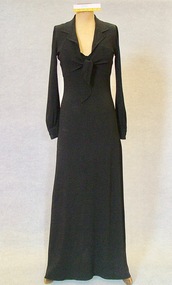
Outfit, Mandamatilda, Evening dress and jacket, c1975
... Di purchased this two piece ensemble from the influential fashion boutique "The House of Merivale and Mr John" to wear to a performance of "The Sleeping Beauty" by London Festival Ballet, featuring Rudolph Nureyev at the Palais Theatre in St Kilda in May 1975....Di purchased this two piece ensemble from the influential fashion boutique "The House of Merivale and Mr John" to wear to a performance of "The Sleeping Beauty" by London Festival Ballet, featuring Rudolph Nureyev at the Palais Theatre in St Kilda in May 1975. di reidie 1970s house of merivale manda matilda "Mandamatilda", "Dry Clean Only, SSW A two piece ensemble consisting of long evening dress (.1) and matching jacket (.2), cropped jacket of black acetate. ...This item is part of the Di Reidie collection. Diane Reidie was a much loved volunteer and President of Brighton Historical Society from 1999 until 2016. Originally from New Zealand, Di and her family lived in Male Street, Brighton for many years. A vibrant and energetic person with a zest for life and a gift for bringing people together, Di was a friend to many in the Bayside community and active in local community organisations. Her tireless work as President of BHS saw her named Bayside Citizen of the Year in 2008. As a seller and collector of vintage clothing, she was passionate about fashion history; one of her many enduring contributions to BHS was her extensive work in preserving, developing and promoting the Society's costume collection. In 2018-19, Di donated more than one hundred items from her personal vintage clothing collection to the Society. The collection, which includes clothing, hats, handbags and shoes from local and international designers, is representative of Di's wide-ranging interests, colourful personality, creativity, humour and love of fashion and travel. Di purchased this two piece ensemble from the influential fashion boutique "The House of Merivale and Mr John" to wear to a performance of "The Sleeping Beauty" by London Festival Ballet, featuring Rudolph Nureyev at the Palais Theatre in St Kilda in May 1975.A two piece ensemble consisting of long evening dress (.1) and matching jacket (.2), cropped jacket of black acetate. The jacket features a tie front and long buttoned sleeve. The full length dress is slim fitting with centre back zip, shoestring straps and shaped bust with ruched centre front."Mandamatilda", "Dry Clean Only, SSWdi reidie, 1970s, house of merivale, manda matilda -
 Bendigo Historical Society Inc.
Document - LA TROBE UNIVERSITY BENDIGO COLLECTION: BENDIGO TEACHERS' COLLEGE GRADUATION CEREMONY
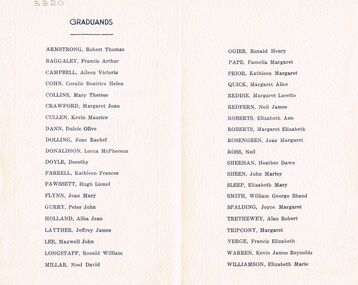
... On the inside cover is a list of the Graduands - Robert Thomas Armstrong, Francis Arthur Baggage, Aileen Victoria Campbell, Coralie Beatrice Helen Cohn, Mary Therese Collins, Margaret Joan Crawford, Kevin Maurice Cullen, Dulcie Olive Dann, June Rachel Dolling, Lorna McPherson Donaldson, Dorothy Doyle, Kathleen Frances Farrell, Hugh Lionel Fawssett, Joan Mary Flynn, Peter John Gurry, Ailsa Jean Holland, Jeffrey James Layther, Maxwell John Lee, Ronald William Longstaff, Noel David Millar, Ronald Henry Ogier, Pamelia Margaret Pape, Margaret Alice Quick, Neil James Redfern, Elizabeth Ann Roberts, Margaret Elizabeth Roberts, Joan Margaret Rosengren, Neil Ross, Heather Dawn Sheehan, John Marley Sheen, Elizabeth Mary Sleep, William George Shand Smith, Joyce Margaret Spalding, Alan Robert Trethewey, Margaret Tripcony, Francis Elizabeth Verge, Kevin James Reynolds Warren and Elizabeth Marie Williamson. ...On the inside cover is a list of the Graduands - Robert Thomas Armstrong, Francis Arthur Baggage, Aileen Victoria Campbell, Coralie Beatrice Helen Cohn, Mary Therese Collins, Margaret Joan Crawford, Kevin Maurice Cullen, Dulcie Olive Dann, June Rachel Dolling, Lorna McPherson Donaldson, Dorothy Doyle, Kathleen Frances Farrell, Hugh Lionel Fawssett, Joan Mary Flynn, Peter John Gurry, Ailsa Jean Holland, Jeffrey James Layther, Maxwell John Lee, Ronald William Longstaff, Noel David Millar, Ronald Henry Ogier, Pamelia Margaret Pape, Margaret Alice Quick, Neil James Redfern, Elizabeth Ann Roberts, Margaret Elizabeth Roberts, Joan Margaret Rosengren, Neil Ross, Heather Dawn Sheehan, John Marley Sheen, Elizabeth Mary Sleep, William George Shand Smith, Joyce Margaret Spalding, Alan Robert Trethewey, Margaret Tripcony, Francis Elizabeth Verge, Kevin James Reynolds Warren and Elizabeth Marie Williamson. ...A small cream copy of the 1952 Bendigo Teachers' College Graduation Ceremony. On the inside cover is a list of the Graduands - Robert Thomas Armstrong, Francis Arthur Baggage, Aileen Victoria Campbell, Coralie Beatrice Helen Cohn, Mary Therese Collins, Margaret Joan Crawford, Kevin Maurice Cullen, Dulcie Olive Dann, June Rachel Dolling, Lorna McPherson Donaldson, Dorothy Doyle, Kathleen Frances Farrell, Hugh Lionel Fawssett, Joan Mary Flynn, Peter John Gurry, Ailsa Jean Holland, Jeffrey James Layther, Maxwell John Lee, Ronald William Longstaff, Noel David Millar, Ronald Henry Ogier, Pamelia Margaret Pape, Margaret Alice Quick, Neil James Redfern, Elizabeth Ann Roberts, Margaret Elizabeth Roberts, Joan Margaret Rosengren, Neil Ross, Heather Dawn Sheehan, John Marley Sheen, Elizabeth Mary Sleep, William George Shand Smith, Joyce Margaret Spalding, Alan Robert Trethewey, Margaret Tripcony, Francis Elizabeth Verge, Kevin James Reynolds Warren and Elizabeth Marie Williamson. Within the program is a loose sheet of paper with a copy of the graduation procedure.bendigo, education, bendigo teachers' college graduatio, latrobe university bendigo collection, collection, bendigo teachers' college, bendigo, education, teaching, teachers, student, bendigo teachers' college graduation, graduation, bendigo teachers' college students, bendigo teachers' college staff, tertiary education, book, history -
 The Beechworth Burke Museum
Animal specimen - Morepork, Trustees of the Australian Museum, 1860-1880
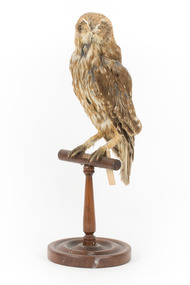
... They reside in habitats with trees, they sleep in roosts and hunt mainly in the evenings and early morning. ...They reside in habitats with trees, they sleep in roosts and hunt mainly in the evenings and early morning. ...The Morepork is a small brown and white spotted owl found in New Zealand, Tasmania and Norfolk Island. It is known by around twenty different names which are all onomatopoeic which emulate the birds distinctive two-pitched call. They are mostly nocturnal and carnivorous (eating insects and small vertebrates). They reside in habitats with trees, they sleep in roosts and hunt mainly in the evenings and early morning. Females are slightly bigger than males. This species attains full plumage in its third or fourth year. They can turn their heads 270 degrees." In Māori tradition the morepork was seen as a watchful guardian. It belonged to the spirit world as it is a bird of the night. Although the more-pork or ruru call was thought to be a good sign, the high pitched, piercing, ‘yelp’ call was thought to be an ominous forewarning of bad news or events." (NZ Department of Conservation). This specimen is part of a collection of almost 200 animal specimens that were originally acquired as skins from various institutions across Australia, including the Australian Museum in Sydney and the National Museum of Victoria (known as Museums Victoria since 1983), as well as individuals such as amateur anthropologist Reynell Eveleigh Johns between 1860-1880. These skins were then mounted by members of the Burke Museum Committee and put-on display in the formal space of the Museum’s original exhibition hall where they continue to be on display. This display of taxidermy mounts initially served to instruct visitors to the Burke Museum of the natural world around them, today it serves as an insight into the collecting habits of the 19th century.This specimen is part of a significant and rare taxidermy mount collection in the Burke Museum. This collection is scientifically and culturally important for reminding us of how science continues to shape our understanding of the modern world. They demonstrate a capacity to hold evidence of how Australia’s fauna history existed in the past and are potentially important for future environmental research. This collection continues to be on display in the Museum and has become a key part to interpreting the collecting habits of the 19th century.This Morepork (also known as the Masked Owl) is covered in brown and white plumage on its head and body. The white feathers delineate its round yellow eyes. Its belly and back are brown and white with the white feathering appearing spotted. This Morepork specimen sits on a wooden perch with his head turned to the left. A swing tag is attached to its left leg.Swing tag: 10 / Masked Owl / See Catalogue, page 3 /taxidermy mount, taxidermy, animalia, burke museum, beechworth, australian museum, skin, reynell eveleigh johns, bird, ruru, spotted owl, tasmanian spotted owl, morepork, mopoke, new zealand owls, new zealand birds, tasmanian owls, tasmanian birds, norfolk island owls, norfolk island birds -
 The Beechworth Burke Museum
Animal specimen - Morepork, Trustees of the Australian Museum, 1860-1880
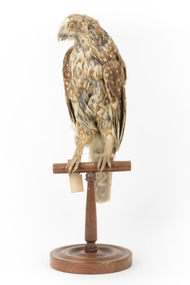
... They reside in habitats with trees, they sleep in roosts and hunt mainly in the evenings and early morning. ...They reside in habitats with trees, they sleep in roosts and hunt mainly in the evenings and early morning. ...The Morepork is a small brown and white spotted owl found in New Zealand, Tasmania and Norfolk Island. It is known by around twenty different names which are all onomatopoeic which emulate the birds distinctive two-pitched call. They are mostly nocturnal and carnivorous (eating insects and small vertebrates). They reside in habitats with trees, they sleep in roosts and hunt mainly in the evenings and early morning. Females are slightly bigger than males. This species attains full plumage in its third or fourth year. They can turn their heads 270 degrees." In Māori tradition the morepork was seen as a watchful guardian. It belonged to the spirit world as it is a bird of the night. Although the more-pork or ruru call was thought to be a good sign, the high pitched, piercing, ‘yelp’ call was thought to be an ominous forewarning of bad news or events." (NZ Department of Conservation). This specimen is part of a collection of almost 200 animal specimens that were originally acquired as skins from various institutions across Australia, including the Australian Museum in Sydney and the National Museum of Victoria (known as Museums Victoria since 1983), as well as individuals such as amateur anthropologist Reynell Eveleigh Johns between 1860-1880. These skins were then mounted by members of the Burke Museum Committee and put-on display in the formal space of the Museum’s original exhibition hall where they continue to be on display. This display of taxidermy mounts initially served to instruct visitors to the Burke Museum of the natural world around them, today it serves as an insight into the collecting habits of the 19th century.This specimen is part of a significant and rare taxidermy mount collection in the Burke Museum. This collection is scientifically and culturally important for reminding us of how science continues to shape our understanding of the modern world. They demonstrate a capacity to hold evidence of how Australia’s fauna history existed in the past and are potentially important for future environmental research. This collection continues to be on display in the Museum and has become a key part to interpreting the collecting habits of the 19th century.This Morepork (also known as a Masked Owl) is covered in brown and white plumage on its head and body. The white feathers delineate its round yellow eyes. Its belly and back are brown and white with the white feathering appearing spotted. He sits on a wooden perch with his head turned to the left. A swing tag is attached to its leg.11 / Masked Owl / See Catalogue, page 3 /taxidermy mount, taxidermy, animalia, burke museum, beechworth, australian museum, skin, reynell eveleigh johns, bird, ruru, spotted owl, tasmanian spotted owl, morepork, mopoke, new zealand owls, new zealand birds, tasmanian owls, tasmanian birds, norfolk island owls, norfolk island birds -
 Coal Creek Community Park & Museum
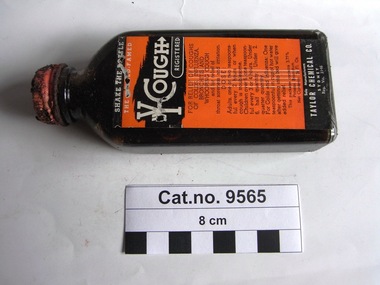
Bottle glass, c. 1935 -1955
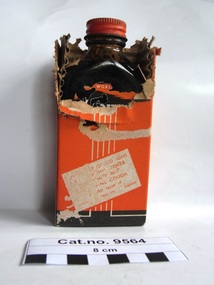
... Y- Cough will relieve your cough or cold while you sleep peacefully! 1'9 AT ALL CHEMISTS AND STORES. ...Y- Cough will relieve your cough or cold while you sleep peacefully! 1'9 AT ALL CHEMISTS AND STORES. ...TROVE: The Advertiser (Adelaide S.A. 1931-1954) Sat 22 June 1935, page 24, Advertising 'PUBLIC NOTICE TO BOTTLERS, BOTTLE DEALERS, ETC., RE PROPERTY BRANDED BOTTLES WHICH ARE NOT SOLD. The undermentioned. Firms and Companies, carrying on business at Sydney and elsewhere. HEREBY GIVE NOTICE that all Bottles delivered by them, to their customers, having a notification moulded thereon that they are, or remain, the property of the Firms and Companies mentioned below. ARE NOT SOLD WITH THE CONTENTS THEREOF, BUT REMAIN THE PROPERTY OF SUCH FIRMS and COMPANIES. Such Bottles are loaned solely for me purpose of enabling the contents to be delivered to the purchasers from the said Firms and Companies, and to all subsequent purchasers of the contents. As soon as the Bottles are emptied of their contents they must not be refilled, destroyed, damaged, or used again for any purpose, but must, on demand, be delivered up to the Companies or Firms whose names are moulded thereon, or to their Accredited Agents:— BUTLER AND NORMAN. LTD., MANDIBLE ST., ALEXANDRIA, NJS.W. The remuneration received by Collectors, Dealers, etc. Is simply an allowance for the safe custody, and collection of the Bottles. LEGAL ACTION WILL BE TAKEN AGAINST ANY PERSON OR COMPANY VIOLATING THE PROPERTY RIGHTS OF THESE FIRMS' OR COMPANIES' BRANDED BOTTLES........................Taylor Chemical Co..............'. TROVE : Courier-Mail (Brisbane, Qld. : 1933 - 1954), Thursday 5 July 1945, page 7, Advertising. DON'T COUGH ALL NIGHT ! take a dose of YCOUGH at bedtime! Y- Cough will relieve your cough or cold while you sleep peacefully! 1'9 AT ALL CHEMISTS AND STORES. On box labels : Taylor Chemical Co. Sydney, Reg. Vic. 3146. Clear, rectangular in section, screw top bottle with orange metal lid and orange, brown & white printed paper label, containing dark brown liquid, in a corrugated cardboard lined orange, dark brown and white printed cardboard box. Embossed on side of bottle in cartouche 'THIS BOTTLE LWAYS REMAINS THE PROPERTY OF TAYLOR CHEMICAL CO. SYDNEY'. Embossed on base of bottle AGM logo with the numerals '16510' along side and the numeral '3' below. On orange metal top printed in white 'Y-COUGH' and 'PLEASANT TO TAKE'. On paper bottle label '....world.......Y-COUGH REGISTERED FOR RELIEF OF COUGHS, OF COLDS, INFLUENXA, BRONCHITUS AND WHOOPING COUGH and for the relief of throat soreness and irritation. DOSE : Adults : one or two teaspoonsful every 2 hours or when cough is troublesome. Children over 6, one teaspoonful every 3 or 4 hours. Under 6, half quantity. FOR Colds and Influenza : one teaspoonful in cup of hot water after getting into bed will give added relief. This package contains 3.77% Potassii Bromidum. Net Contents : 2 1/2 Fl. Oz. Sole Manufacturers TAYLOR CHEMICAL CO. SYDNEY. Reg. Vic. 3146'. Front of box & repeated rear ' Y-COUGH REGISTERED FOR RELIEF OF COUGHS, OF COLDS, INFLUENXA, BRONCHITUS AND WHOOPING COUGH and for relief of throat soreness and irritation. Side 1. of box 'PLEASANT TO TAKE Sole Manufacturers TAYLOR CHEMICAL CO. SYDNEY. Reg. Vic. 3146'. Side 2. of box 'NO HARMFUL DRUGS Sole Manufacturers TAYLOR CHEMICAL CO. SYDNEY. Reg. Vic. 3146'. chemist, medicine, influenza -
 Coal Creek Community Park & Museum
Bottle, glass, c. 1935 -1955
... Y- Cough will relieve your cough or cold while you sleep peacefully! 1'9 AT ALL CHEMISTS AND STORES. ...Y- Cough will relieve your cough or cold while you sleep peacefully! 1'9 AT ALL CHEMISTS AND STORES. ...TROVE: The Advertiser (Adelaide S.A. 1931-1954) Sat 22 June 1935, page 24, Advertising 'PUBLIC NOTICE TO BOTTLERS, BOTTLE DEALERS, ETC., RE PROPERTY BRANDED BOTTLES WHICH ARE NOT SOLD. The undermentioned. Firms and Companies, carrying on business at Sydney and elsewhere. HEREBY GIVE NOTICE that all Bottles delivered by them, to their customers, having a notification moulded thereon that they are, or remain, the property of the Firms and Companies mentioned below. ARE NOT SOLD WITH THE CONTENTS THEREOF, BUT REMAIN THE PROPERTY OF SUCH FIRMS and COMPANIES. Such Bottles are loaned solely for me purpose of enabling the contents to be delivered to the purchasers from the said Firms and Companies, and to all subsequent purchasers of the contents. As soon as the Bottles are emptied of their contents they must not be refilled, destroyed, damaged, or used again for any purpose, but must, on demand, be delivered up to the Companies or Firms whose names are moulded thereon, or to their Accredited Agents:— BUTLER AND NORMAN. LTD., MANDIBLE ST., ALEXANDRIA, NJS.W. The remuneration received by Collectors, Dealers, etc. Is simply an allowance for the safe custody, and collection of the Bottles. LEGAL ACTION WILL BE TAKEN AGAINST ANY PERSON OR COMPANY VIOLATING THE PROPERTY RIGHTS OF THESE FIRMS' OR COMPANIES' BRANDED BOTTLES........................Taylor Chemical Co..............'. TROVE : Courier-Mail (Brisbane, Qld. : 1933 - 1954), Thursday 5 July 1945, page 7, Advertising. DON'T COUGH ALL NIGHT ! take a dose of YCOUGH at bedtime! Y- Cough will relieve your cough or cold while you sleep peacefully! 1'9 AT ALL CHEMISTS AND STORES. On box labels : Taylor Chemical Co. Sydney, Reg. Vic. 3146. Clear, rectangular in section, screw top bottle with orange metal lid and orange, brown & white printed paper label, containing dark brown liquid, in a corrugated cardboard lined orange, dark brown and white printed cardboard box. Embossed on side of bottle in cartouche 'THIS BOTTLE LWAYS REMAINS THE PROPERTY OF TAYLOR CHEMICAL CO. SYDNEY'. Embossed on base of bottle AGM logo with the numerals '16510' along side and the numeral '3' below. On orange metal top printed in white 'Y-COUGH' and 'PLEASANT TO TAKE'. On paper bottle label '....world.......Y-COUGH REGISTERED FOR RELIEF OF COUGHS, OF COLDS, INFLUENXA, BRONCHITUS AND WHOOPING COUGH and for the relief of throat soreness and irritation. DOSE : Adults : one or two teaspoonsful every 2 hours or when cough is troublesome. Children over 6, one teaspoonful every 3 or 4 hours. Under 6, half quantity. FOR Colds and Influenza : one teaspoonful in cup of hot water after getting into bed will give added relief. This package contains 3.77% Potassii Bromidum. Net Contents : 2 1/2 Fl. Oz. Sole Manufacturers TAYLOR CHEMICAL CO. SYDNEY. Reg. Vic. 3146'. Front of box & repeated rear ' Y-COUGH REGISTERED FOR RELIEF OF COUGHS, OF COLDS, INFLUENXA, BRONCHITUS AND WHOOPING COUGH and for relief of throat soreness and irritation. Side 1. of box 'PLEASANT TO TAKE Sole Manufacturers TAYLOR CHEMICAL CO. SYDNEY. Reg. Vic. 3146'. Side 2. of box 'NO HARMFUL DRUGS Sole Manufacturers TAYLOR CHEMICAL CO. SYDNEY. Reg. Vic. 3146'. chemist, medicine, infuenza -
 Falls Creek Historical Society
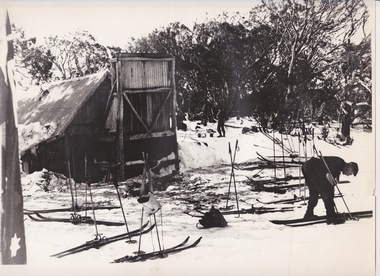
Photograph - At Wallace' s Hut
... The slab walls were lined with hessian and later with tar-paper, and inside there was a bush table, sleeping platform and a rustic fire-side settle. ...The slab walls were lined with hessian and later with tar-paper, and inside there was a bush table, sleeping platform and a rustic fire-side settle. ...Wallace's Hut is the oldest surviving cattlemen's hut on the High Plains, built in 1889 by the three Wallace brothers - Arthur, William and Stewart. Their father David bought land at Kergunyah as well as grazing land on the banks of the Kiewa River, North East Victoria. Once the boys were old enough, the family followed the local squatters’ custom of taking their cattle up to the mountains for the spring and summer to fatten the mob, at the same time resting their home pastures. They decided to build a hut where they could shelter from the extreme mountain weather. The timber was cut from the forest about four hundred metres east of the hut, and the hearth stone was dragged in from Pretty Valley. The chimney had a base of rubble and above this iron sheeting on a timber frame. The slab walls were lined with hessian and later with tar-paper, and inside there was a bush table, sleeping platform and a rustic fire-side settle. The hut nestled among snow gums sheltered by a rocky outcrop. The names of the Wallace brothers were burnt into the tie-beams of the roof and at the back of the mantelpiece. The Wallace family’s lease expired in the late 1930s and the hut was bought by the State Electricity Commission to house staff on the High Plains and it became the first home of Toni and Skippy St. Elmo. The SEC covered the old shingles with iron, and later on the walls and chimney as well, and they added a lean-to. Wallace’s Hut is now owned by the Crown and maintained by Parks Victoria. It is on the Historic Buildings Register and is classified by the National Trust.This image is significant because it depicts an important heritage-listed structure and refuge for cattlemen and other travellers in Victoria's High Country.A black and white photograph of a skier outside of Wallace's Hut. Several sets of skis and poles are standing around and other skiers are in the background.wallace's hut, toni and skippy st. elmo, high country huts -
 Bendigo Historical Society Inc.
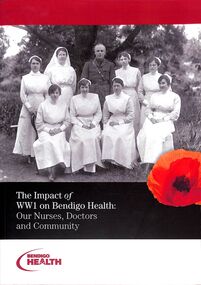
Book - "The Impact of WW1 on Bendigo Health: Our nurses, Doctors and Community.", 1914
... Unhealthy living conditions for soldiers (and sailors) included: poor diet lack of sleep exposure to cold contact with mice, rats, fleas, lice and other parasites. ...Unhealthy living conditions for soldiers (and sailors) included: poor diet lack of sleep exposure to cold contact with mice, rats, fleas, lice and other parasites. ...Over 4000 Bendigo residents enlisted to serve in W.W. 1. Much is known about their contributions to the war effort, but less is known about the contributions made by the medical staff who provided care at the front lines or otherwise supported care. People enlisted for many reasons - patriotism, duty and adventure being just a few. Over 416,000 persons enlisted to serve in World War One out of a population of 5 million. The Australian Government recorded 215,585 casualties during the war. Over 80% of those casualties occurred on the Western Front, in Belgium and France. The weapons used in trench warfare created horrendous injuries for both sides in the war. In the Australian Imperial Force (AIF), for example, most wounds were the result of flying metal. During their service, many of the 331,781 AIF troops and medical staff were injured more than once: over 50% were hit by shell fragments or shrapnel bullets from artillery fire 40% were hit by high-velocity bullets from rifles or machine guns 12% were affected by chlorine or mustard gas 2% were hit by bombs or grenades only 0.3% suffered bayonet wounds Many health risks also developed into large-scale problems on the front. Those who served lived and work in crowded spaces, which helped to spread bacterial, viral and parasitic infections. Unhealthy living conditions for soldiers (and sailors) included: poor diet lack of sleep exposure to cold contact with mice, rats, fleas, lice and other parasites. Soft cover. 41pp. Black and white image of nurses on front cover, along with red poppy. Tile written in white to bottom third of front cover on black background. Bendigo Health logo to bottom of front cover. Back cover has image of signage for the 'Old Mortuary' of Bendigo Hospital, with burgundy, black and white stipes above and below image. Contains black and white and color images. soldiers, world war one, british empire, doctors, nurses, bendigo hospital -
 Marysville & District Historical Society
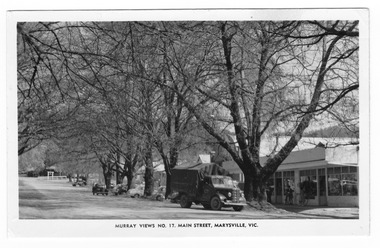
Postcard (Item) - Black and white postcard, Murray Views, Murray Views No. 17. Main Street, Marysville, Vic, c1940s
... / Think of me eating, sleeping/ & playing won't you./ There are 17 people here. .../ Think of me eating, sleeping/ & playing won't you./ There are 17 people here. ...A black and white photograph of Murchison Street in Marysville in Victoria.A black and white photograph of the main street in Marysville in Victoria. This is now known as Murchison Street. This postcard was produced by Murray Views in Gympie in Queensland as a souvenir of Marysville.POST CARD STAMP REAL (illegible)/ AUSTRALIA BY MURRAY (illegible) Tuesday 1st/ Dear Ade,/ Well here I am/ as I said/ writing/ to you. I have 8 minutes/ before the dinner gong goes so/ I'd better hurry./ We're having a super/ time, but the weather is/ shocking. Today we put/ on our raincoats, golf shoes/ & umbrellas & walked to/ the Taggerty River & back/ via Talbot Drive. It/ was lovely (& wet(. It's about/ 6 miles or maybe more./ I didn't think you or John/ would come on such a / terrible day. How's work?/ Think of me eating, sleeping/ & playing won't you./ There are 17 people here. There/ were 30 when we arrived./ Doesn't the Main Street look/ beaut? That's how it really look./ Saw "Mad About Men" here on/ Saturday night. Extra good/ show. Must close. See you/ Friday week. Love Pat.murchison street, marysville, victoria, murray views pty ltd, murray views no 17, postcard, souvenir -
 Eltham District Historical Society Inc
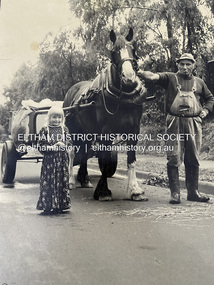
Photograph - Digital copy of photograph, Gordon Allingham, Danielle Hardiman with Eltham Shire Council garbage collector, Joe Buhagiar with his horse drawn cart, Rattray Road, Montmorency, c.1965
... Large street sweeper trucks clean the streets, often while we sleep, whereas in the past it was indeed very different. ...Large street sweeper trucks clean the streets, often while we sleep, whereas in the past it was indeed very different. ...Lots of Rubbish by Jim Connor (EDHS Newsletter No. 252, June 2020 History is often about change and we experience this all around us, even with such basic services about how our rubbish is collected and even how our streets are cleaned. Many people will remember putting out the sometimes battered steel or plastic rubbish bin to be collected by the ‘garbos’ as they rushed down the street and at times precariously hung off the back of a Council truck. They often seemed to be in a hurry as they grabbed a bin, tossed the contents into the truck and then went off on their merry way. Now, we need to decide which large coloured plastic ‘wheely’ bin to put out to be picked up by a mechanical arm extending from the truck, while the driver is ensconced in his cabin. Today they rarely handle the bins. Large street sweeper trucks clean the streets, often while we sleep, whereas in the past it was indeed very different. When Montmorency was part of the Shire of Eltham, prior to the municipal restructure in 1994, there was one Council employee who was particularly well known in the area. This was Joe Buhagier, a unique and interesting sight, who with his trusty horse walked and cleaned the local streets. Lyn and Graeme Hardiman remember him as a private person and Lyn would often talk with him each time he came along Rattray Road. One day he reluctantly agreed to have his photograph taken with their daughter Danielle, who was about 5 years old at the time, though he was a little embarrassed about all the fuss. Joe features in the Were Street footpath mosaics showing some of the well-known local Montmorency characters.council staff, danielle hardiman, eltham shire council, garbage collection, graeme hardiman collection, joe buhagiar, montmorency, horse, horse drawn vehicles, lyn dodkins, mosaics, were street, rattray road -
 Surrey Hills Historical Society Collection
Work on paper - Vertical file, Arkley family
... Postcard promoting The City Wakes, The City Sleeps Tarrawarra Museum of Art in the Yarra Valley 29 Nov 2025 – 1 March 2026. ...Postcard promoting The City Wakes, The City Sleeps Tarrawarra Museum of Art in the Yarra Valley 29 Nov 2025 – 1 March 2026. ...Howard Arkley was born 5 May 1951 in Surrey Hills. His family lived at 72 Essex Road; the house has been demolished and replaced by units. He is widely recognised as the foremost painter of Australian suburbia.A vertical file of information relating to the Arkely family: 1.1. Handout from Ruth Arkley at her talk to Surrey Hills Historical Society, (undated) including 8 copies of photos (1 page) and Milestones in life (3 pages). 2. Timeline from National Gallery of Victoria website, 1951-1999 (6 pages). 3. Information from NGV website (4 pages). 4. Australia Post brochure ‘postjournal’ with article re Howard Arkley stamp and his brother Rob, June/July 2003 (20 pages). 5. ‘A perverse delight in gilding the silly’, re ‘Howard Arkley and friends’ exhibition at TarraWarra Museum of Art, The Age, 15.1.2016 (1 page). 6. ‘The art of suburbia’ re exhibition at TarraWarra, The Age, 22.11.2016, compiled by Gabriella Coslovich. (Friends and collaborators recalled the influence he had on them. These include Callum Morton, Kathy Temin, Elizabeth Gower and John Nixon). (3 pages). 7. ‘Exhibition: Howard Arkley found inspiration close to home’, Jo Davy, The Weekly Review, 2013 (3 pages). 8. “An Open Door to Arkley’s Final Work.” By Elizabeth Flux 8.2.2024 9. Postcard promoting The City Wakes, The City Sleeps Tarrawarra Museum of Art in the Yarra Valley 29 Nov 2025 – 1 March 2026. Postcard shows painting by Howard Arkley titled “The Bay Window” 1988. howard arkley, tarrawarra museum of art, robert arkley -
 Sunshine and District Historical Society Incorporated
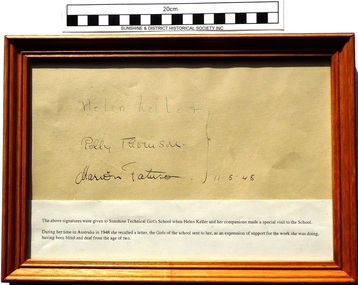
Memorabilia - Signature of Hellen Keller, Helen Keller, Polly Thomson, Marion Fatuson, 1948
... On June 1, 1968 Helen died in her sleep, and her ashes have been interred with those of Anne and Polly at the National Cathedral. ...On June 1, 1968 Helen died in her sleep, and her ashes have been interred with those of Anne and Polly at the National Cathedral. ...In 1948 during her Australian tour Helen Keller visited the west suburban SUNSHINE GIRLS TECHNICAL SCHOOL, to express her thanks for a letter written by the students in support of her work with deaf and blind people. She and her travelling companions presented the school with their signatures. Helen Keller was born on June 27, 1880 and due to an illness at the age of 20 months lost both her sight and hearing. Helen was taught to communicate by Anne Sullivan who wrote words into her hand, and she also learned to speak by touching the throat and lips of people as they spoke. In June 28, 1904 Helen Keller graduated from Radcliffe College with a Bachelor of Arts degree, being the first deaf and blind person to do so. In October 1914 Polly Thomson joined up with Helen and Anne. Helen published an account of her religious beliefs and an autobiography, and in 1930 the three women travelled to Scotland, England and Ireland. In 1931 they participated in the first World Council for the Blind. After Anne Sullivan Macy died in 1936 Helen and Polly continued to travel to several countries. In 1943 Helen visited blind, deaf, and disabled soldiers in a USA military hospital, which she described as "the crowning experience of my life". In 1946 Helen and Polly made their first world tour for the American Foundation for the Overseas Blind and over the next 11 years visited 35 countries. In 1955 Helen became the first woman to be honoured with an honorary degree from Harvard University. In 1960 Polly Thomson died, and in 1961 Helen suffered her first stroke and so retired from public life. In 1964 President Johnson conferred the Presidential Medal of Freedom however she was unable to attend the ceremony. On June 1, 1968 Helen died in her sleep, and her ashes have been interred with those of Anne and Polly at the National Cathedral. Over 1200 mourners attended the funeral.It is significant that Helen Keller actually took the time and effort to visit the Sunshine Girls Technical School to thank the students for their supporting letter. Helen Keller's many achievements show that a severely handicapped deaf and blind person can make significant contributions to society, if they apply themselves and receive assistance from dedicated friends. Helen Keller, Polly Thomson, Marion Fatuson, 11.5.48deaf, blind, signatures, helen keller, polly thomson, marion fatuson, anne sullivan macy, radcliffe college, sunshine girls technical school -
 Melbourne Legacy
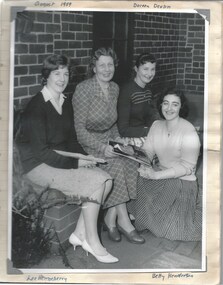
Photograph, Legacy 'Mother' to Twenty Three, 1959
... Mention of the routine of the house include that the girls sleep in large airy bedrooms which they look after themselves. ...Mention of the routine of the house include that the girls sleep in large airy bedrooms which they look after themselves. ...A photo from a book compiled about the Legacy children's residence called Stanhope. This photo shows Matron Dorrie Vines with three residents. Names around the photo L to R: Lee Henneberry, Doreen Devlin, and Betty Henderson. The newspaper article from The Age was published on 28 August 1959 and mentions Miss Vines has worked at Stanhope since 1946 when she returned from war service. She had been a trained nurse and served in Middle East and New Guinea with the RAANC. She had been awarded the medal of an Associate of the Royal Red Cross and was mentioned in despatches. Mention of the routine of the house include that the girls sleep in large airy bedrooms which they look after themselves. They generally do their own washing and ironing. There is a well equipped sewing room where they can make their own clothes. There is a radio and television and piano though between 7 and 9pm is quiet study time. A legacy member joins them for dinner most evenings and the girls do their own washing up. They can cook in the kitchen if they wish. There is staff of an assistant matron, a cook and two housemaids. Girls have picnics and outings arranged and three or four times a year and they have informal dances at Stanhope. Stanhope was supervised by Matron Dorothy (Dorrie) Vines from the time it opened in 1946 until she retired in December 1966. It is likely she compiled this notebook as she is referred to as 'self' in one photo. Individual pages of photos or newspaper clippings have been added separately. Items 01817 to 01834. Stanhope was a residence run by Melbourne Legacy to take care of children whose fathers were deceased servicemen, and who may have been left orphans, or whose mother may have been unable to care for them herself, or they needed to stay in Melbourne for further education. Generally Stanhope looked after girls over 14. The children were cared for until they were old enough to become independent. A record of life at Stanhope as reported in the Age Newspaper.Black and white photo of Matron and girls in 1959 along with a newspaper clipping about her.residences, dorothy vines, stanhope -
 Eltham District Historical Society Inc
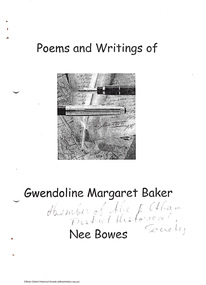
Document - Folder, Poems and writings of Gwendoline Margaret Baker, nee Bowes, 1997
... It is typical of her humour that after visiting the site she wrote: "I have seen the Cemetery, so if I wake in sleep it has a nice view" Gwen was a foundation member of our Society. ...It is typical of her humour that after visiting the site she wrote: "I have seen the Cemetery, so if I wake in sleep it has a nice view" Gwen was a foundation member of our Society. ...Various short pieces of writing, some dated, earliest 1971, latest in 1997. Gwen Baker (1928-2005) was a foundation member of EDHS. See Also Newsleter 162, May 2005 GWENDOLINE MARGARET BAKER NEE BOWES 1928- 2005 Gwen Baker as we knew her, often used her full name in her writings and even acknowledged her maiden family name as a means of reinforcing her own personal identity. Gwen died on 28 Februrary 2005 and has been buried at Arthurs Creek Cemetery in accordance with her wishes. It is typical of her humour that after visiting the site she wrote: "I have seen the Cemetery, so if I wake in sleep it has a nice view" Gwen was a foundation member of our Society. We remember her mainly for her contribution to our meetings, her witty comments or questions to our speakers and, of course, her collection of plants that she contributed to help the finances of our Society. Her friends in the Society also remember her cards and brief letters on a wide range of subjects. Gwen's wide range of interests included pottery, poetry and of course her gardening. She was an active member of many organizations including the Red Cross, Catholic Church, Nillumbik Garden Club and the former Eltham Arts Council. Her small self- published booklet of poems and writings starts with tins item written at 2am on Easter Sunday 1975. THOUGHT The seeming steady stillness of this quiet night has varied sound to one who sits and thinks of life. Of times of your of pleasant things and if the future has in store a place to be - a reason to exist. One hears a bird upon the roof scratching at his mate while in the distance a car goes by returning home quite late. A neighbours dog goes forth and bark! then stillness once again, like sunshine after rain. and so the thinker having heard and thought, carefully turns out the light and goes to bed. 41 pages (20 A4 pages cut in half). Folder 76 from Harry Gilham Collectionpoetry, creative writing, gwen baker -
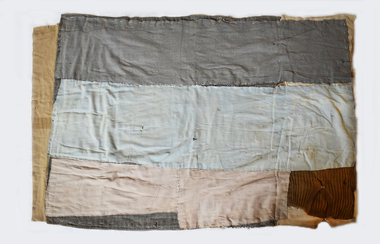 National Wool Museum
Textile - Quilt, Mrs Eileen Pattle, Old Harry's Wagga, 1942-50
... The wagga saw many more camping trips until the arrival of Bev’s “lovely new lightweight and down filled sleeping bag”. The wagga was made with a “make do, waste not, want not” attitude. ...The wagga saw many more camping trips until the arrival of Bev’s “lovely new lightweight and down filled sleeping bag”. The wagga was made with a “make do, waste not, want not” attitude. ...This traditional wagga blanket was made by Mrs Eileen Pattle between 1942 and 1950. The wagga was used as everyday bedding, as Eileen and her husband had very few possessions. They boarded with a man who they called “Old Harry” in Footscray. Old Harry had recently lost his wife and looked after the young couple well. They could stay with him and use his house as their own, and all that Old Harry asked for in return was for Eileen to cook him one good meal a day. The blanket was given to Mrs Beverley (Bev) Maguire, the daughter of Eileen, when she and her husband went camping one winter. Her husband was a “mad” fisherman and on one trip on which Bev joined him, her father offered the couple his old tent, that had a wall missing, and the wagga. The wagga was much appreciated as when the couple woke in the countryside, it was freezing, and they could see snow through the missing tent wall. From then on, the tent and the wagga were theirs. The wagga saw many more camping trips until the arrival of Bev’s “lovely new lightweight and down filled sleeping bag”. The wagga was made with a “make do, waste not, want not” attitude. The wagga started as an army issued blanket. The front layer has clothing and panels of mismatched material which has been added to over time. This includes an overcoat, two knitted garments, a panel from a skirt, and a panel from Old Harry’s Trousers. It also includes a man’s sleeveless knitted vest, and a knitted pram blanket. This is all stitched together with string, and the odd button. Bev said she would love to unpick the quilt to see what else is hiding inside but has resisted the urge to do so. All these layers have made the blanket incredibly warm, and heavy. The wagga has been within Bev’s family since creation and comes into the National Wool Museum Collection after serving the family well. It was used to keep everyone warm when not camping over many a winter’s night. Beverley is now getting on in years and donated the Wagga to the National Wool Museum in 2021. Her family referred to the wagga as a “collection of rags”, indicating to her that they did not wish to inherit the blanket. The wagga started as an army issue blanket. It has been made by stitching the khaki army blanket onto a hessian rear. The front layer has clothing and panels of mismatched material. This includes an overcoat, two knitted garments, a panel from a skirt, and a panel from Old Harry’s Trousers. It also includes a man’s sleeveless knitted vest, and a knitted pram blanket. This is all stitched together with string, and the odd button. It is thought that other materials are hiding within the layers of this wagga, however, uncovering these layers would involve unpicking the quilt. The wagga is 1360 x 1880mm, sized to suit a double bed. It is a heavy blanket, originating from all its panels of mismatched reused clothing. The wagga is well worn but has lasted almost 80 years. It has holes that have been lovingly re-stitched.wagga, quilt, upcycle
