
Showing 2641 items matching "https://11btn.wags.org.au/"
-
 City of Melbourne Libraries
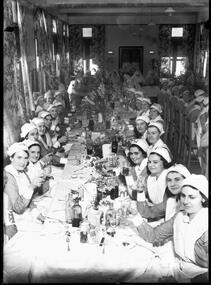
Photograph, Bull, Hugh Jones, 1897-1993, The Nurses' Christmas, Alfred Hospital
... Trove article identifier: http://nla.gov.au/nla.news-article203364946 Description: Group of nurses in uniform enjoying Christmas dinner at the Alfred Hospital. ...Trove article identifier: http://nla.gov.au/nla.news-article203364946 Description: Group of nurses in uniform enjoying Christmas dinner at the Alfred Hospital. ...Published: The Age 26 Dec 1933 page 9 Published title: "THE NURSES' CHRISTMAS." Trove article identifier: http://nla.gov.au/nla.news-article203364946 Description: Group of nurses in uniform enjoying Christmas dinner at the Alfred Hospital. Research by project volunteer Ernie Ward: Alfred Hospital nurses enjoy their Christmas Lunch: The hierarchical system of Nursing and Nurse Training (as indicated by the headwear, armbands and seating positions) is on full display as Alfred Hospital nurses propose a Christmas Lunch toast (strictly non-alcoholic) to The Age photographer, Hugh Bull. Some of the bolder nurses have decorated their headwear in a festive way that would be frowned upon the other 364 days of the year. The soft drinks are Marchants and Elliotts, the flower arrangements feature the highly fashionable gladioli, and the floral patterned curtains have been pulled aside so the summer sunshine can stream in. The sunshine would, in a couple of hours, be replaced by flooding rainstorms which caused havoc on Christmas night. This very Melbourne weather phenomenon was the focus of The Age Boxing Day edition pictorial. At the rear of the room is Matron Grace Wilson C.B.E, already a World War One heroine for setting up and working at Australian military hospitals in Greece, Egypt and France (as seen on the second episode of the 2014 television series Anzac Girls). As Australia’s most highly-ranked peacetime military nurse, Matron Wilson also appears as the only woman in any official capacity at the Dedication of the Shrine of Remembrance in 1934. She can be seen in the grand panorama documenting this occasion (also featured in this exhibition).Photographer notations on slide: "The Nurses' Christmas Alfred Hospital Age 1933 B9".nurses, christmas, 1930-1939 -
 City of Melbourne Libraries
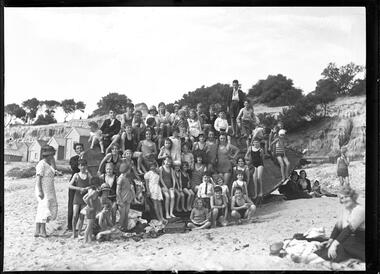
Photograph, Bull, Hugh Jones, 1897-1993, Group visit to beach
... Retrieved August 8, 2025, from http://nla.gov.au/nla.news-article203840391...Retrieved August 8, 2025, from http://nla.gov.au/nla.news-article203840391 beaches 1930-1939 Photographer notations on slide: "B19". ...A group of beach revellers of all ages pose happily for the photographer against a timber boat, propped sideways on the sand. Iconic bayside bathing boxes line the familiar eroding cliff face and indigenous coastal vegetation of the sand belt. A group of beach revellers of all ages pose happily for the photographer against a timber boat, propped sideways on the sand. Iconic bayside bathing boxes line the familiar eroding cliff face and indigenous coastal vegetation of the sand belt. The story and exact location of this image remain a mystery. Perhaps they are city folk who have caught the train down to Sandringham or Brighton for a liberating day in the sun, sand and water. Featured in "Newsworthy: Melbourne in photographs 1933-1936" exhibition at East Melbourne Library, October to December 2023. Exhibition caption by Fiona Campbell. In August 2025 the image was found published in The Age with the following caption: "Five thousand Richmond district scholars had a day at the beach this week. It was not warm enough for them all to go in bathing." Again the location is not given though it very much resembles Half Moon Bay off Beach Road, Black Rock. It seems unlikely that 5000 individuals were present on the excursion! References: PYRAMIDS IN THE SUN--RICHMOND GOES TO THE BEACH--PALS--"FOUR"--MEMORIAL FOUNTAIN. (1934, March 23). The Age (Melbourne, Vic. : 1854 - 1954), p. 3. Retrieved August 8, 2025, from http://nla.gov.au/nla.news-article203840391Photographer notations on slide: "B19".beaches, 1930-1939 -
 City of Melbourne Libraries
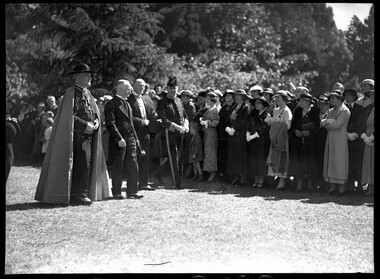
Photograph, Bull, Hugh Jones, 1897-1993, Cardinal MacRory meets "old girls" of Sacre Coeur Convent
... Retrieved January 23, 2024, from http://nla.gov.au/nla.news-article205082619 . ...Retrieved January 23, 2024, from http://nla.gov.au/nla.news-article205082619 . ...Photographer notations on slide: Cardinal MacRory meets "old girls" of Sacre Coeur Convent Age Dec 6 34 B61 Published: The Age, 6 Dec 1934 Published title and caption: CARDINAL MACRORY MEETS OLD GIRLS OF SACRE COEUR CONVENT. The Papal Legate, Cardinal MacRory, accompanied by Mr. E. L. Kiernan, M.L.C., Mr. T. Gaffney and the Papal Chamberlain, Mr. E. Hollingdale, at the garden party at the Sacre Coeur Convent yesterday. The Cardinal’s sister was at one time Mother Superior of this Convent, and many of the girls she had taught were presented to him. Reference: WOMAN'S INTERESTS (1934, December 6). The Age (Melbourne, Vic. : 1854 - 1954), p. 6. Retrieved January 23, 2024, from http://nla.gov.au/nla.news-article205082619 . Description: The photograph shows Cardinal MacRory in full regalia accompanied by diginaries walking beside a crowd of mostly women in an open garden setting. This event was one of the many that took place during the National Eucharistic Congress which took place from Sunday 2 to Sunday 9 December 1934. An initiative of the Roman Catholic Church, it was their contribution to Melbourne’s Centenary Celebrations. 200,000 Catholics resided in Melbourne at this time – one quarter of the city’s population. While the Congress was aimed at Catholics, and acted as an opportunity to reinforce their living faith and homage, it contained a variety of events of splendour, solemnity and significance designed to appeal to Melbournians, and would additionally provide incentive for people to travel to Victoria, thereby creating an economic benefit to the state. Photographer notations on slide: "Cardinal MacRory meets "old girls" of Sacre Coeur Convent Age Dec 6 34 B61".catholic church, centenaries, 1930-1939, schools, clothing and dress, religious festivals -
 City of Greater Bendigo - Civic Collection
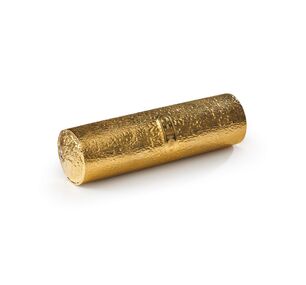
Artwork, other - Gold Chicko Roll, Simplot Australia, Chicko, 2001
... By 1965 the ubiquitous Chicko Roll was sold in every fish and chip shop throughout the country and at the height of their popularity in the 1970s, 40 million Chiko Rolls were being sold Australia-wide each year and more than one million were exported to Japan.(Wikipedia https://en.wikipedia.org/wiki/Chiko_Roll). ...By 1965 the ubiquitous Chicko Roll was sold in every fish and chip shop throughout the country and at the height of their popularity in the 1970s, 40 million Chiko Rolls were being sold Australia-wide each year and more than one million were exported to Japan.(Wikipedia https://en.wikipedia.org/wiki/Chiko_Roll). ...Commemorative object produced by The Simplot Company (Food Service) and presented to the City of Greater Bendigo on the occasion of the 50th anniversary of the creation of the Chicko Roll by Bendigo born boiler maker, Frank McEncroe. The Chicko Roll has been an Australian icon since the 1960's and 70's. Inspired by the Chinese spring roll and first sold in 1951 as the "Chicken Roll" despite not actually containing chicken. The snack was designed to be easily eaten on the move without a plate or cutlery and is typically deep-fried in vegetable oil. By 1965 the ubiquitous Chicko Roll was sold in every fish and chip shop throughout the country and at the height of their popularity in the 1970s, 40 million Chiko Rolls were being sold Australia-wide each year and more than one million were exported to Japan.(Wikipedia https://en.wikipedia.org/wiki/Chiko_Roll). Advertised with the slogan 'Grab a Chiko', 'Hit the Hot Spot' and 'You Can't Knock the Roll' the marketing around the Chicko Roll was aimed towards the male population with women perched on Harley Davidson's provocatively preparing to bite into a Chicko Roll. In 2008 with a push towards healthier eating, Chicko Roll reviewed its advertising and although it continues to target young men, it switched to using a 'fun, active' young women, riding a retro pushbike near the beach to improve its image. In 1995 J.R. Simplot, an American company who also own Leggo's, Birds Eye, Edgell and John West acquired Chicko Roll to sure up their foothold in the Australian market. Life size gold plated chicko roll in a hinged wooden presentation box with red lining. Double sided, printed letter accompanying the object explains its creation and significance.CHICKOcity of greater bendigo commerce, mayor acherman -
 The Beechworth Burke Museum
Photograph
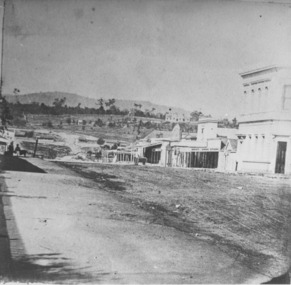
... Extensive internal renovations have also been made to the original buildings. [https://vhd.heritagecouncil.vic.gov.au/places/118]...Extensive internal renovations have also been made to the original buildings. [https://vhd.heritagecouncil.vic.gov.au/places/118] The Ovens and Murray Hospital for the Aged is of architectural significance as an unusual example of Flemish influenced design from the 1860s. ...Taken in Beechworth, this photograph depicts the business of Camp Street looking towards the Ovens and Murray Benevolent Asylum. In the foreground of right hand side; there are row of buildings, on the left hand side; there are a two standing figures. The Ovens Benevolent Asylum (or the Ovens and Murray Hospital for the Aged) was constructed in 1862 on an elevated site overlooking the township of Beechworth. This Asylum was built in response to boom in population due to the discovery of Gold in Beechworth in 1852. This period also saw the development of additional administration buildings such as; the Court house, the Town Hall, and offices. The original Benevolent Asylum building was designed in an unusual Flemish Gothic Revival style. The single storey building is of red brick on a dressed granite base, and the main facade is dominated by four curved, Flemish gable ends, those at the extremities being added to the original central section in 1867. This facade incorporates paired windows of pointed Gothic form and dark brick diaperwork patterning. The adjacent J. A. Wallace Wing of 1899 was designed by Donald Fiddes as a separate building. Also constructed of red brick, Fiddes adopted a conservative approach, designing a simple domestic scale building with central projecting gable porch and flanking bull nosed verandahs. The Benevolent Asylum was renamed the Ovens Benevolent Home in 1935 and The Ovens and Murray Home in 1954. Many buildings have been added to this site, particularly since the 1960s, including a poorly sited addition to the front of the original building. Extensive internal renovations have also been made to the original buildings. [https://vhd.heritagecouncil.vic.gov.au/places/118]The Ovens and Murray Hospital for the Aged is of architectural significance as an unusual example of Flemish influenced design from the 1860s. Although the facade has been partly obscured, it remains intact, and, together with the more simply designed Wallace wing, are important examples of early buildings designed for the specific purpose of aged care. The Flemish gables remain as a dominant form of Beechworth's urban landscape. The Ovens and Murray Hospital for the Aged is of historical significance due to its association with the early development of Beechworth and its dominant siting within the town. It is illustrative of the civic development that took place in the town after the peak of the gold rush, when Beechworth was develpoing as the administrative centre of the north east of Victoria. [https://vhd.heritagecouncil.vic.gov.au/places/118]Black and white rectangular photograph. Image is printed on matte photographic paper. Obverse: BOOT SHOE STORE Reverse: 7770.2 / 1997.3099beechworth, burke museum, diggings, camp street, the benevolent asylum, ovens benevolent hom, gold rush -
 Bendigo Historical Society Inc.
Plan - Victoria Reef Surface Plan, W.H. Cundy, Mining Engineer, 1908
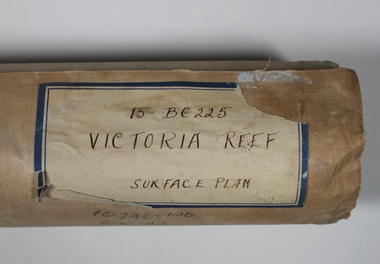
... (City of Great Bendigo: https://www.bendigo.vic.gov.au/things-do/gardens-and-natural-reserves/victoria-hill-diggings...(City of Great Bendigo: https://www.bendigo.vic.gov.au/things-do/gardens-and-natural-reserves/victoria-hill-diggings gold mining gold Margaret Roberts Collection Advance Co Koch and Jaggasser Ballerstedt Gibbs and Wells Rae Victoria Quartz Victoria Reef Victoria Hill 'Thomas Forbes, Mining Surveyor, November 6th, 1866', hand written on plan, underneath title. ...Gold was discovered on Victoria Hill in 1854 and by 1861, 1,200,000 ounces of gold had been extracted from the site. The first claim was bought for 80 pounds by Prussian immigrant Christopher Ballerstedt and his son Theodore. Christopher Ballerstedt was nicknamed the "Father of the Hill" and was the first to prove that gold reefs extended below the surface. His 200-foot plus mine shafts yielded quartz rich with gold, inspired other miners, and were instrumental in Bendigo becoming the world's deepest and richest goldfield. The site still features relics of nineteenth century mining including quartz crushing machinery and the foundations of George Lansell’s 180 mine. These features are characteristic of Bendigo’s mining history and represent two prominent nineteenth century miners, Christopher Ballerstedt and George Lansell, who held important roles in the development of Bendigo. Victoria Hill Quartz Gold Mines are registered as a site of significance. The site is of historical, archaeological and scientific importance to Victoria. The mines represent the symbolic heart of Bendigo’s gold mining history and the importance that mining played in wealth creation and the development of Victoria. The diggings reserve is accessed from the rear of Albert Richardson Reserve located on Marong Road. The site has steep and unformed paths and is closed to the public at dusk. It is important to stay to the paths to avoid the diggings. Interpretive signs help visitors to appreciate the importance of the site and the remaining relics of Bendigo’s mining history. (City of Great Bendigo: https://www.bendigo.vic.gov.au/things-do/gardens-and-natural-reserves/victoria-hill-diggingsPlan of Victoria Reef showing lease numbers and some lease holder names. Printed on top right hand corner of plan: 'Surface Plan Victoria Reef'. Scale described underneath. On outside of plan, on label with blue border: '15 BE 225 Victoria Reef Surface Plan' Leaseholder names include: Advance Co; Koch and Jaggasser; Ballerstedt; Gibbs and Wells; Rae; and Victoria Quartz. Victoria Reef Surface plan is part of the Margaret Roberts Collection. 'Thomas Forbes, Mining Surveyor, November 6th, 1866', hand written on plan, underneath title.gold mining, gold, margaret roberts collection, advance co, koch and jaggasser, ballerstedt, gibbs and wells, rae, victoria quartz, victoria reef, victoria hill -
 Eltham District Historical Society Inc
Document - Binder, Eltham Justice Precinct, 1969-2020
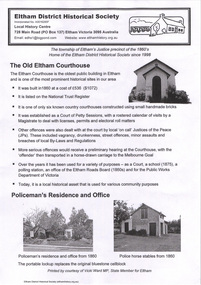
... Retrieved July 5, 2022, from http://nla.gov.au/nla.news-article60667022 ii. ...Retrieved July 5, 2022, from http://nla.gov.au/nla.news-article60667022 ii. ...EDHS_04863 - Binder: Eltham Justice Precinct Report: Conservation Management Plan (draft) for Justice Precinct Eltham, 5 August 2005; prepared for Nillumbik Shire by Ivar Nelsen and Janette Hodgson, Land Stewardship and Biodiversity - Historic Places, Department of Sustainability and Environment 1. Courthouse 1. Eltham Courthouse interesting facts i. Photocopy (2 pages) of extract from Petty Sessions at Eltham before C.S. Strutt Esq., Chairman; and (indecipherable) on the 12th day of September 1871; Case numbers 117 to 127. Details listed include Complainant, Defendant, Fees, Cause, Decision, Remarks. Defendants listed include Edward Bettison and John McCall, N.J. Keylock [Kaylock], Patrick Clark, Michael Keenan, Ann Hayden, Henry Edelman, Alexander Falkiner, Charles Long, Joseph Morris, Daniel Ryan ii. Photocopy (2 pages) of list of Convictions for surnames commencing with ‘B’ from 23 December 1890 to December 1905. 2. Plan and elevation drawings 3. Other courthouse plans and fittings 1880s – Brunswick, Maffra, Dunolly , Sunbury, Landsborough and Wodonga 4. Newspaper articles: i. ELTHAM POLICE COURT. (1892, April 1). Evelyn Observer, and South and East Bourke Record (Vic. : 1882 - 1902), p. 2 (MORNING.). Retrieved July 5, 2022, from http://nla.gov.au/nla.news-article60667022 ii. BREAKING A PUBLICAN'S LEG. (1900, July 13). Evelyn Observer, and South and East Bourke Record (Vic. : 1882 - 1902), p. 2 (MORNING.). Retrieved July 5, 2022, from http://nla.gov.au/nla.news-article60688367 iii. ELTHAM COURT. (1901, March 1). Mercury and Weekly Courier (Vic. : 1878 - 1903), p. 3. Retrieved July 5, 2022, from http://nla.gov.au/nla.news-article58578953 iv. ANNIE CHASES A TINKER. (1902, October 3). Evelyn Observer, and South and East Bourke Record (Vic. : 1882 - 1902), p. 2 (MORNING.). Retrieved July 5, 2022, from http://nla.gov.au/nla.news-article64029968 v. ELTHAM POLICE COURT. (1927, May 6). Advertiser (Hurstbridge, Vic. : 1922 - 1939), p. 4 (AFTERNOON). Retrieved July 5, 2022, from http://nla.gov.au/nla.news-article57754748 vi. ELTHAM POLICE COURT. (1927, May 20). Advertiser (Hurstbridge, Vic. : 1922 - 1939), p. 3 (AFTERNOON). Retrieved July 5, 2022, from http://nla.gov.au/nla.news-article57754814 vii. Eltham Police Court (1931, January 9). Advertiser (Hurstbridge, Vic. : 1922 - 1939), p. 4. Retrieved July 5, 2022, from http://nla.gov.au/nla.news-article56734073 viii. Repairs to Eltham Police Station, The Advertiser (1929, May 24). Advertiser (Hurstbridge, Vic. : 1922 - 1939), p. 2 (AFTERNOON.). Retrieved July 5, 2022, from http://nla.gov.au/nla.news-article57759907 ix. ELTHAM COURT. (1929, August 2). Advertiser (Hurstbridge, Vic. : 1922 - 1939), p. 4 (AFTERNOON.). Retrieved July 5, 2022, from http://nla.gov.au/nla.news-article57760345 x. See also Trove list https://trove.nla.gov.au/list/116634 5. Letter: Shire of Eltham Historical Society to Shire of Eltham, 1 July 1969 regarding potential replacement of Eltham Courthouse and the building’s historical significance and acknowledgement 10 July 1969 6. Letter: Shire of Eltham Historical Society to Law Department, 26 May 1972, re preservation of Eltham Courthouse and potential classification and acknowledgement 7 June 1972 7. Newspaper article: Strangers around, so Eltham sought protection by Marguerite Marshall, Diamond Valley News, Tuesday, April 6, 1982, p2 (On reverse side, Top job for our Pauline, p1) 8. Eltham Courthouse Colour Scheme, Public Works Department, 10 September 1983 9. Newspaper article: Eltham Courthouse under threat of closure by Helen Gillman, Diamond Valley News, October 16, 1984 10. Newspaper article: Courthouse to close by Helen Gillman, Diamond Valley News, Tuesday, November 20, 1984, p1 (also on p2 an article about Diamond Valley Shire festivities for the State’s 150th) 11. We will keep your court – Kennett, Diamond Valley News (probable), c.Dec. 1984 12. Letter: Shire of Eltham to Shire of Eltham Historical Society, 15 March 1985, regarding potential for use of building as a museum and reply dated 17 April 1985 regarding Society’s interest in use of the building 13. Letter: Department of Conservation Forests & Lands to Shire of Eltham, August 1987, regarding expressions of interest in the building and letter from Shire (18 August 1987) to Society advising of same 14. Letter: Department of Conservation Forests & Lands to Shire of Eltham, 30 March 1988, advising Courthouse to be used by Eltham Youth Resources Centre and the rear section by other community groups. Noted that the historical society was suggested by Council as a future user of the adjoining police residence when Council first sought management of the building and that should be investigated. Includes Schedule of Repair and Maintenance Work (4 pages), Existing Conditions Survey 30/7/1987 (6 pages) and 1 page plan view diagram 15. Memo: Historic Places Section to Eltham Youth Resource Centre re paint analysis of Courthouse, 17/5/1988, (6 pages) 16. Newspaper article: Courthouse renovation by Jodie Haythorne, Diamond Valley News, November 23, 1992 17. National Trust of Australia Registration (classified 20 Oct 1977), printed March 2000 18. Letter: Heritage Victoria 28 Feb 2002 regarding the replacement of the Courthouse Stand (Witness Box) 19. Article: There’s still order in this stately court house, Eltham Shire (magazine), date unk., p22-23 20. Eltham Court House, Statement of Significance, Heritage Victoria Register, printed Nov 2004 21. Eltham 1860 Former Court House 730 Main Road Eltham, collated by Eltham District Historical Society Incorporated 2005 (4 pages) 22. Book Extract: Eltham, Historical Court Houses of Victoria by Michael Challinger, Palisade Press, 2001 23. Newspaper article: Courthouse rich with history by Harry Gilham, Nillumbik Mail, c.2001 (see also EDHS_03333) 24. Notes on history of site from Crown Reserve File Rs 12128, Municipal Buildings (Local Community Welfare Reserve) at Eltham, Department of Sustainability and Environment, April 2005 (4 pages) 25. Newspaper article: Historic building upgrade, Diamond Valley Leader, August 3, 2005, p17 26. Newspaper article: Courthouse regeneration secures boost, Valley Weekly, August 10, 2005 with picture of Harry Gilham, Steve Herbert and Greg Johnson 27. Newspaper article: Poets are summonsed, Diamond Valley Leader February 22, 2006, p37 features picture of Helen Lucas at the Eltham Courthouse 28. Newspaper article: Sharing a love of legalities, Diamond Valley Leader, March 1, 2006, p7 features a picture of Rob Hulls and Steve Herbert talking to students in the courthouse 29. Newspaper advertisement: Nillumbik Tender No. 2021-33, Building Restoration Works, Old Eltham Courthouse, The Age, November 7, 2020 30. Form: Police Officer’s Return To A Warrant Of Distress 31. Handwritten notes: three pages listing all 48 of the pigeon hole form listings in the cabinet in the courthouse 32. Newspaper article: Historic Eltham Courthouse reopens, Manningham and Nillumbik Bulletin, April 2022, p22 33. Expression of Interest, Eltham Courthouse, 730 Main Road, Eltham; Nillumbik Shire Council Living and Learning Centres Eltham & Panton Hill, 8 May 2000 (Committee of Management) 2. Police Quarters 1. 1971 Surveyors Plan of 728 Main Road and the Adjoining Courthouse. Also includes notes (1963) on Lots 4 and 5 southeast corner of Main Road and Brougham Street owned by James Wallace Graham, Contractor, and Elsie May Graham. 2. Letter: Shire of Eltham to Shire of Eltham Historical Society, 5 June 1981, requesting the society give consideration to the suitability of the existing buildings (former Vermin and Noxious Weeds Office, Department of Crown Lands and Survey) for historical purposes such as a museum 3. Minutes: Shire of Eltham Historical Society Committee Meeting, 10 June 1981 (2 pages) includes reference to possible use of building as a museum (also reference to Bills Horse trough to be retained) 4. Extract from Victoria Police Gazette 1930 with details of building and site 5. Newspaper article: Cubby haven, Diamond Valley News, October 28, 1991 about replica Police Station with picture of replica along with Monika Roitinger and Garry Bartlett outside the Police Station 6. Environment office up for sale? Mountain Views, Monday, June 12, 1995 (Nillumbik Shire Council proposing to sell property. Did not proceed as ownership held by the State of Victoria) 7. Extract from National Trust February 1998 edition, “Police Rescue” which states Heidelberg and Eltham Police Residences are the oldest known Police Residences in the Melbourne Metropolitan district 8. Newspaper article: The first police office by Harry Gilham, Nillumbik Mail, December 13, 2000 (also photocopy with notations on picture identifying buildings and Harry’s typed draft) 9. Fax Memo: Victoria Police List of Officers in Charge, Eltham Police Station, 1857-1991 onward, 21 Jan 2003 10. Former Police Quarters, Statement of Significance, Heritage Victoria Register, printed Nov 2004 11. Eltham 1860 Former Police Quarters 728 Main Road Eltham, collated by Eltham District Historical Society Incorporated 2005 (5 pages) 12. Report: Eltham District Historical Society to Living and Learning Nillumbik, 14 April 2010 regarding the poor state of condition of the former Police Residence 13. Photocopy of three photos of the former Police Residence, former Police Station (relocated to rear of site) and Stables, October 18, 1991 3. Lockup 1. Newspaper article: Heritage permit bid, Diamond Valley News, January 17, 2001 (also article “Eltham library tops”) includes picture of lockup located in Youth Road 2. Newspaper article: Old lockup in new site, Diamond Valley Leader, March 21, 2001, p15. Includes picture of Harry Gilham with lockup at justice Precinct 3. Letter: Victoria Police to Eltham District Historical Society, 20 March 1991 including laser print photo of lockup in 1963 at 23 Pryor Street 4. Fax: Graham Clark, Associated Crane Trucks Pty Ltd, 833 Main Road Hurstbridge; Quote 26.2.99 for $1,080 to move lockup from Youth Road to 728 Main Road 4. Local History Centre 1. Victoria Government Gazette: Photocopy, No. 165, Tuesday, December 7, 1858, establishment of a Court of Petty Sessions at Eltham, 7 December 1858 2. Victoria Government Gazette: Photocopy, September 16, 1859, contract issued for Police buildings at Eltham to Langridge and Co., McCarter, Baillie, Nicol and Co, Chadley, Amos and Co., Cameron, Payne, £1,150.7.0 3. Victoria Government Gazette: Photocopy, October 2, 1860, contract issued for Court of Petty Sessions at Eltham to James Duncan, £600 4. President’s Report, Eltham District Historical Society, Annual General Meeting, Wednesday, March 11, 1998 – covers the establishment of the Local History Centre and new home for the Society 5. Extract for EDHS Newsletter July 1998 – Eltham Local History Centre – Official Opening 6. Unveiling of 728 Street Sign, Speech notes by Cr Dianne Bullen, December 2000, includes invoice from John Sharp Signs Pty Ltd, 24/10/2000 and planning approval drawing dated 24/3/1999 reproduced in Newsletter No. 135 November 2000 7. Letter: Eltham District Historical Society to Living and Learning Centre, undated draft regarding being a member of the committee reviewing the development of the site 8. Notes from Rod Grant re funding of site development under the Community Jobs Program 9. Letter: Eltham District Historical Society to Nillumbik Living and Learning, 28 October 2004 re inclusion of the Society in enhancing the site under the Community Jobs Program 10. Letter: Department of Sustainability and Environment to Eltham District Historical Society, 28 February 2005 re preparing draft Conservation Plan and copy of cover letter in response 2 April 2005 11. Levels and Layout Plan, Nillumbik Shire Council, September 2005, AO copy 12. Letter: Department of Sustainability and Environment to Eltham District Historical Society, 12 September 2005 re Eltham Justice Precinct Conservation Management Plan 13. Letter: Living and Learning Nillumbik, 2 February 2006 to Eltham District Historical Society re forming a Committee to advise on the use, maintenance, management and preservation of the Justice Precinct 14. Minutes: Meeting of a Task group to explore the establishment of a Committee to manage the Eltham Justice Precinct, 20 December 2005 (with hand written notes) 15. President’s notes (EDHS), General Meeting item, 11 May 2006 pertaining to use and condition of the Eltham Justice Precinct 16. Paint estimates, Old Eltham Court House, undated 17. Notes from meeting 26 September (2006), Eltham Justice Precinct Committee 18. Notes from meeting 27 November (2006), Eltham Justice Precinct Committee 19. Terms of Reference for the Eltham Justice Precinct Committee, Draft for Living and Learning Committee Meeting 24 Jan 2007 (4 pages) 20. Newspaper article: Panel set up, Diamond Valley Leader, 7 March 2007 21. Minutes: Meeting of Eltham Justice Precinct Subcommittee, 10 May 2007 22. Minutes: Meeting of Eltham Justice Precinct Subcommittee, 5 July 2007 23. Minutes: Meeting of Eltham Justice Precinct Subcommittee, 11 October 2007 24. Minutes: Meeting of Eltham Justice Precinct Subcommittee, 7 February 2008 25. Minutes: Meeting of Eltham Justice Precinct Subcommittee, 10 April 2008 26. Minutes: Meeting of Eltham Justice Precinct Subcommittee, 14 August 2008 27. Letter: EDHS (Sue Law) to Living and Learning, 6 September 2008 re proposed signage 28. Agenda: Meeting of Eltham Justice Precinct Subcommittee, 16 October 2008 29. Suggested guidelines for use of the Court House for exhibitions 30. Handwritten note re Ken Eckersal and Uniting Church of possible donation of church organ for sale, proceeds to be used for activities at the Justice precinct 31. One page typed notes on each of the buildings in the Eltham Justice Precinct 32. Newspaper article: Historic Eltham Courthouse reopens, Manningham and Nillumbik Bulletin, April 2022, p22 5. Miscellaneous 1. Photocopy from Pioneers & Painters (2 pages) covering the establishment of Police and Court of Petty Sessions at Eltham 2. Photocopy of photo looking northeast across Little Eltham buildings c.1910 with notes 3. Photocopy of J.H Clarke photo looking up Maria Street from near Dalton Street with notes identifying precinct buildings 4. Photocopy of photo of Court House and Police Quarters with cow outside from Heather Jenkins scrapbook with notes identifying buildings 5. Sketch and notes with dimensions for blue stone lockup including other miscellaneous handwritten notes 6. Unidentified heritage review details of Justice Precinct (c.2004) 7. Hand written notes of telephone conversation held with Dennis McKay (6 May 1997) re Council use of site 8. Flyer: Victoria Police Historical Unit 9. Photocopy of thumbnail images of various Justice Precincts (not identified) 10. Email correspondence, 4 and 10 January 2008; J. Connor to Council and Councillors pertaining to proposed new toilet facilities at rear of Courthouse annexe. Two ring lever arch binder, white with various photocopies, printouts, newspaper clippingsHG Folders 15/52/59 integratedharry gilham collection, eltham courthouse, eltham justice precinct, eltham police residence, lockup, eltham community festival, eltham festival, eltham, heritage assessment, police residence, conservation, alexander falkiner, ann hayden, charles long, court of petty sessions, daniel ryan, edward bettison and john mccall, eltham court house, henry edelman, joseph morris, michael keenan, n.j. kaylock, patrick clark, elsie may graham, franco and co, james wallace graham, surveyor field notes -
 City of Melbourne Libraries
Photograph, Bull, Hugh Jones, 1897-1993, Mrs T S McKay (Miss Odette Lefebvre)
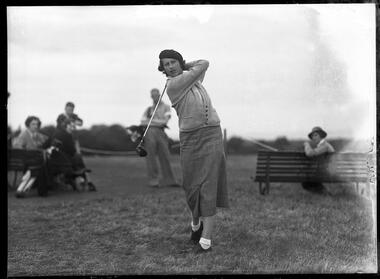
... Retrieved September 18, 2023, from http://nla.gov.au/nla.news-article243259621...Retrieved September 18, 2023, from http://nla.gov.au/nla.news-article246443596 GOLF WITHOUT STOCKINGS (1934, May 5). ...Mrs T S McKay, née Odette Lefebvre “Killara Amazon who drives like a man, smiles like a school girl and dresses like a picture” – Smiths Weekly 22 July 1933 In 1934, the Ladies Golf Union of NSW introduced a rule forbidding women not wearing stockings from competing in games under their control. Rather than wear stockings, Odette Lefebvre (1910-1991) withdrew from her team causing a media stir. She subsequently agreed to wear stockings for any NSW game she wished to play in. She said that a player had every right to dress as she wished, providing it did not offend modesty. She found it more comfortable to play without stockings. Featured in "Newsworthy: Melbourne in photographs 1933-1936" exhibition at East Melbourne Library, October to December 2023. Exhibition caption by project volunteer, Fiona Collyer. Photographer notations on slide: "Golf Ch'ship Mrs McKay B98" Description: Female golfer teeing off with 3 wood, wearing beret, cardigan, straight skirt, ankle socks, sensible shoes. Blurred spectators are visible in the background. Research by project volunteer, Fiona Collyer: Mrs T S McKay, née Odette Lefebvre (1910-1991), was a NSW champion golfer. She won the NSW Women’s Championship 1931, 1933. Odette competed in the Australian Women’s Golf Championship at Royal Melbourne against the British Women’s Team in 1935. She was defeated by Mrs Sloan Morpeth nee Susie Tolhurst in the semifinals. A tall, willowy, beautiful brunette with a winning smile and sparkly blue eyes and exotically of French origin, the press reported the outdoor sports loving young woman’s social and golf activities closely. In 1933 (27/7/1933), the Smith’s Weekly headline ran “Drives like a man but is a real girl – always”. The article called her the “Killara Amazon who drives like a man, smiles like a school girl and dresses like a picture”. In 1934, the Ladies Golf Union of NSW introduced a rule forbidding women without stockings to compete in games within their control. Rather than wear stockings, Odette withdrew from her team, causing a media stir. She subsequently agreed to wear stockings for any game she was keen to play in. She said that a player had every right to dress as she wished, providing it did not offend modesty. She found it more comfortable to play without stockings. Fellow women golfers were sympathetic to the non-stocking brigade. Mrs J J Hollywood, president of the Maitland Golf Club Associates said, “What a storm in a teacup over nothing! As if a pair of stockings could possibly make all the difference to a person’s game. However, I think the mosquitoes settle that question for the L.G.V. in the North”, she added with a laugh. (Newcastle Sun 5/5/1934) Acting president of the Victorian Women’s Golf Union, Mrs J B Bellair, said, “It is much warmer in Sydney than here and must be more comfortable without stockings. Miss Lefebvre too, has such beautiful legs and they are so brown, that she can afford to dispense with stockings. Women in Victoria are not likely to play without stockings, however, it is much too cold here. I have never seen any of them on the links in bare legs.” (Newcastle Sun 5/5/1934) Mrs L Griffiths, president of the Steelworks Associate Club in Newcastle said, “It appears to be an unnecessary rule that the L.G.V. has enforced. Why, if they started laying down laws like that, where would we end? What about ties etc being compulsory for men?” (Newcastle Sun 5/5/1934) The L.G.V. insisted that the dignity of the game should not be impaired by players who dared to show any originality in clothes, even if they did add comfort. (The Sun, Sydney 5/5/1934) Even in 1941, despite wartime shortages, the L.G.V. NSW was insisting that – “no player may play in open L.G.V. competitions without stockings.” (Yass Tribune-Courier 6/11/1941) In 1934, Odette married champion golfer and barrister Thomas McKay who later became a NSW Liberal Party politician. They had two children before divorcing in 1946. Sources: Drives Like A Man, But Is A Real Girl--Always (1933, July 22). Smith's Weekly (Sydney, NSW : 1919 - 1950), p. 6. Retrieved September 18, 2023, from http://nla.gov.au/nla.news-article235071983 Woman Golfer Will Not Play In Stockings (1934, May 5). The Daily Telegraph (Sydney, NSW : 1931 - 1954), p. 1. Retrieved September 18, 2023, from http://nla.gov.au/nla.news-article246443596 GOLF WITHOUT STOCKINGS (1934, May 5). The Herald (Melbourne, Vic. : 1861 - 1954), p. 23. Retrieved September 18, 2023, from http://nla.gov.au/nla.news-article243259621Photographer notations on slide: "G Ch'ship Mrs McKay B98".golf, women golfers, royal melbourne golf club -
 Federation University Art Collection
Ceramic - Artwork - Ceramics, Ray Hearn, 'End Game' by Ray Hearn
... Nothing could be more useless in a practical sense than a work of art, especially a painting--yet most craftwork has a passing reference at least to function." ( https://www.thefreelibrary.com/Above+and+beyond+function%3A+Ray+Hearn+explains+the+reasons+behind+his......Nothing could be more useless in a practical sense than a work of art, especially a painting--yet most craftwork has a passing reference at least to function." ( https://www.thefreelibrary.com/Above+and+beyond+function%3A+Ray+Hearn+explains+the+reasons+behind+his... ...Dr Ray HEARN (1943- ) Born Stawell, Victoria Ray Hearn graduated from the Ballarat School of Mines Technical Art School with a Diploma of Art (Ceramics) in 1970, followed by an Master of Fine Art from Regina Canada in 1976. He holds a PhD in Anthropology from Northern Territory, Darwin in 2003, with field work, exhibitions and teaching in Thailand since 1996. He has completed his MA in art curatorship from the University of Melbourne, with a thesis on Sidney Nolan and Ned Kelly.From Above and beyond function: Ray Hearn explains the reasons behind his useless ceramics:- "End Game suggests a climax of a tactical and intellectual struggle, in ceramics or chess, but it is also about beginnings and endings, for in chess the king can never be captured--one game ends and the board is reset so the next can begin. I made this piece at the start of my PhD work, acknowledging then that as there were once potters so too there are potters today--and tomorrow. The ceramic pieces were all collected in Tanon Suthep, one of Chiang Mai's streets. The board is a fragment of white tiles from a pharmacy building being remodelled, the bowl is a broken fast food noodle bowl from the ubiquitous street stalls, and the new small blue and white jars purchased from a market stall. Typical of my work, the objects are familiar--they might be just like ones we have at home today, had but threw away only yesterday, or objects we might purchase tomorrow. Clay lives on, and the ceramic 'game' starts again too. As it transpires End Game is about my own work too. All research degrees require an end--a thesis must reach a conclusion, and like a game of chess, start again. The sculptural potential of clay is unlimited, and in theory functional clay wares' aesthetic potential unlimited too, from a classic Song celadon to Arneson's genital encrusted teapots (which I first saw illustrated in Craft Horizons 1971). West Coast funk with its kitschy teapots and cups were vehicles for sculptural objects never meant to be drunk from, and a genre of useless functional wares emerged. Nothing could be more useless in a practical sense than a work of art, especially a painting--yet most craftwork has a passing reference at least to function." ( https://www.thefreelibrary.com/Above+and+beyond+function%3A+Ray+Hearn+explains+the+reasons+behind+his...-a0172598257, accessed 07 February 2018:)ray hearn, ballarat school of mines, ballarat technical art school, alumni, ceramics -
 Federation University Historical Collection
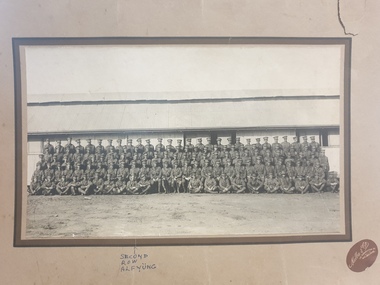
Photograph, Melba & Co, 7th Australian Infantry Training Battalion WW1
... In turn, this battalion was merged with another, formed from the 5th and 8th Battalions, to form the 2nd Brigade Battalion. https://www.awm.gov.au/collection/U51447...George Alfred Yung, known as Alf, pictured in the second row, 10th from the left, enlisted on 25/02/1916; embarked on 19/02/1917; was killed during the battle of Menin Gate at Yrpres, Belgium on 20/09/1917. https://www.awm.gov.au/collection/U51447 The 7th Battalion was among the first infantry units raised for the AIF during the First World War. ...George Alfred Yung, known as Alf, pictured in the second row, 10th from the left, enlisted on 25/02/1916; embarked on 19/02/1917; was killed during the battle of Menin Gate at Yrpres, Belgium on 20/09/1917. https://www.awm.gov.au/collection/U51447 The 7th Battalion was among the first infantry units raised for the AIF during the First World War. Like the 5th, 6th and 8th Battalions, it was recruited from Victoria and, together with these battalions, formed the 2nd Brigade. The battalion was raised by Lieutenant Colonel H. E. "Pompey" Elliott within a fortnight of the declaration of war in August 1914 and embarked just two months later. After a brief stop in Albany, Western Australia, the battalion proceeded to Egypt, arriving on 2 December. It later took part in the ANZAC landing on 25 April 1915, as part of the second wave. Ten days after the landing, the 2nd Brigade was transferred from ANZAC to Cape Helles to help in the attack on the village of Krithia. The attack captured little ground but cost the brigade almost a third of its strength. The Victorian battalions returned to ANZAC to help defend the beachhead, and in August the 2nd Brigade fought at the battle of Lone Pine. While holding positions captured by the 1st Brigade, four members of the 7th Battalion, Corporal A. S. Burton, Acting Corporal W. Dunstan, Lieutenant W. Symons and Captain F. H. Tubb, earned the Victoria Cross - Burton posthumously. The battalion served at ANZAC until the evacuation in December. After the withdrawal from Gallipoli in December 1915, the battalion returned to Egypt. In March 1916, it sailed for France and the Western Front and entered the front line trenches for the first time on 3 May. The battalion's first major action in France was at Pozieres in the Somme valley where it fought between 23-27 July and 15-21 August. After Pozieres the battalion manned trenches in the Ypres salient in Belgium, before returning to the Somme valley. It saw out the horrendous winter of 1916-1917 rotating between training, working parties and duty in the trenches. In early 1917, the Germans withdrew to the Hindenburg Line and the 7th Battalion participated in the brief advance that followed and then came to a grinding halt before Bullecourt. The battalion was withdrawn from the front line for training on 9 May 1917 and did not return to action until the Ypres offensive of September and October. It fought major battles at Menin Road on 20 September and Broodseinde on 4 October, and then spent much of ensuing winter in the Ypres mud. In March and April 1918 the 7th helped stop the German spring offensive in northern France and later participated in the Allies' own great offensive of 1918, that began with the battle of Amiens on 8 August. The advance by British and empire troops on 8 August was the greatest success in a single day on the Western Front, one that German General Erich Ludendorff described as, "the black day of the German Army in this war". The battalion continued operations until late September 1918. At 11 am on 11 November 1918, the guns fell silent. The November armistice was followed by the peace treaty of Versailles signed on 28 June 1919. In November 1918 members of the AIF began to return to Australia for demobilisation and discharge. In March, the battalion was so reduced that it and the 6th Battalion were amalgamated to form a composite battalion. In turn, this battalion was merged with another, formed from the 5th and 8th Battalions, to form the 2nd Brigade Battalion. https://www.awm.gov.au/collection/U51447army, soldier, alf yung, 7th australian infantry battalion -
 Eltham District Historical Society Inc
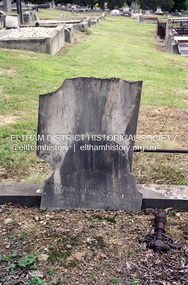
Negative - Photograph, Russell Yeoman, Grave of Edmund John Schlötel and Elizabeth Schlötel, Eltham Cemetery, Mount Pleasant Road, Eltham, Victoria, c.Sep. 2000
... Retrieved May 10, 2026, from http://nla.gov.au/nla.news-article139806588 A Google search in 2026 revealed additional information: E. ...Retrieved May 10, 2026, from http://nla.gov.au/nla.news-article139806588 A Google search in 2026 revealed additional information: E. ...From EDHS Newsletter No. 135 - November 2000 Marion and Russell Yeoman have had a letter from Margaret Taylor of Eltham England which includes the following:- "John Kennett went on a tour of West Norwood cemetery with the 'Edith Nesbit Society" and his eye was accidentally drawn to a mention of John Edmond SCHLOTEL 1838-1905 who was buried in ELTHAM VICTORIA. His mother was an Eltham girl." "Sophia (Sophie) Rowley, 1802-1870 was the daughter of James Rowley of Eltham (U.K.) who was an assistant teacher and married to Ann, maiden surname Tyhurst. She had older brothers and sisters baptised in Eltham 1795- 1801, namely Charity, Maria, Arthur Partridge, James Union and then Sophie, born 9th October and baptised 31st October 1802." "We have no idea where or when (not Eltham we think) but she apparently married Mr Charles Schlotel, who was possibly three years younger than herself. Their offspring included John Edmond SCHLOTEL 1839-1905 who was buried in your Eltham, Victoria. " This seemed like a bit of challenge to Marion who paid a visit to the Eltham Cemetery and almost immediately located the grave of Edmund John Schlötel who died on 12th May 1905 and was buried there on 14th May. The headstone says he was late of Brixton England. This is a double grave with no indication of who else is buried there. Cemetery records show that Elizabeth Schlötel was buried there in 1917. The records say that Edmund Schlötel came from Brighton England but a hand written version of Brixton or Brighton could easily be confused. Death records in the La Trobe Library record the death at Eltham in 1905 of Edward John Schlötel, son of Charles Bartholemew Schlötel and Sophia Ann Rowley. There appears to be nothing in the Evelyn Observer about Schlötel's death. SCHLOTEL.—On the 12th May, at his residence, Eltham, Edmund John Schlotel, late of Brixton, England, in his 66th year. Family Notices (1905, May 20). The Australasian (Melbourne, Vic. : 1864 - 1946), p. 60. Retrieved May 10, 2026, from http://nla.gov.au/nla.news-article139806588 A Google search in 2026 revealed additional information: E. J. Schlötel. (2026, May 10). Retrieved from https://nzhistory.govt.nz/suffragist/e-j-schlotel Elizabeth Salmon married Edmund John Schlötel, an accountant, on 17 October 1881 in Dunedin. Edmund had arrived on the Sebastian into Port Chalmers on 8 October 1859. He lived at Spylaw station in Otago before moving to Dunedin. In 1878 Edmund was the only candidate for the office of Mayor of North-East Valley and so was declared duly elected. Three years before this petition was signed Elizabeth and Edmund’s five roomed house in the North-East Valley was destroyed by fire. It was insured for £610 (about $109,000 in today’s money). (Biography contributed by Katherine Blakeley.) Elizabeth Salmon was born about 1851. She had a daughter, Nina, who was born about 1876 and was an accomplished violinist. The fire that destroyed their home was in 1890 - in the mid 1890’s the family moved to Victoria, Australia. Edmund died at their home in Eltham on 12 May 1905 and Elizabeth died in December 1917 – they are buried together in the Eltham Cemetery. Eltham Cemetery transcription details of the headstone recorded in November 1984: SCHLOTEL In loving memorry of Edmund John Schlotel late of Brixton, England, died 12 July 1905 aged 63 (Broken stone) edmund john schlötel, elizabeth schlötel (nee salmon), eltham cemetery, gravestones, film - kodak gc 400-6, headstones, russell yeoman collection, scan - 35mm negative -
 City of Melbourne Libraries
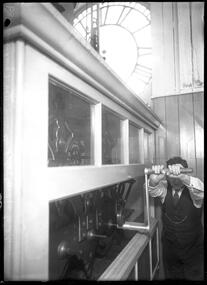
Photograph, Bull, Hugh Jones, 1897-1993, Winding Melbourne Town Hall clock by hand for the last time
... The Age 5 September 1933 p11 http://nla.gov.au/nla.news-article205111165...The Age 12 December 1933 p8 http://nla.gov.au/nla.news-article203350688 Additional information: "THE TOWN HALL CLOCK. ...Waistcoated man using both hands to wind the Melbourne Town Hall clock mechanism via metal handle. The large glass clock face is visible in the background. The man wears a fob watch. Photographer notations on slide: "Winding T. Hall, Melb. clock by hand for last time B8" Published: The Age The Age 5 September 1933 p11 Published title: "THE TOWN HALL CLOCK." Featured in "Newsworthy: Melbourne in photographs 1933-1936" exhibition at East Melbourne Library, October to December 2023. Exhibition caption: In December 1933, The Age reported that the manually wound mechanisms at both Melbourne and North Melbourne Town Halls would be replaced with electric motors: "Town Hall Timekeeping. Maintaining that the system of keeping time in the civic centre was antiquated, the chairman of the Town Hall and baths committee (Mr. E. L. Morton) stated yesterday that it had been proposed to install electric motors for the winding of the tower clocks at the Melbourne and North Melbourne town halls. At present it takes 600 turns four times a week to wind up the North Melbourne town hall clock, and the winding is no light task, it being a "two-handed job." However, the installation of electric motors for the winding of these tower clocks is but one aspect of the general developmental programme contemplated in regard to the timekeeping at the Town Hall. It is proposed to institute a complete system of electric clocks all functioning from the one master clock in the tower. At present the town hall clocks show varying times. The only one which is systematically checked daily is the town clock." Source: "NEWS OF THE DAY." The Age 12 December 1933 p8 http://nla.gov.au/nla.news-article203350688 Additional information: "THE TOWN HALL CLOCK. RECONDITIONING WORK IN HAND. Desirous of keeping abreast of the time in a literal sense at least, the inconsistency of the massive clock in the tower of the Melbourne Town Hall has caused the City Council authorities considerable inconvenience of late. After twenty-five years of efficient service, the Town Hall clock recently gave manifestations of the most flagrant flippancy. Reports were brought to the notice of the town clerk (Mr. W. V. McCall) that one day it was fast, whilst the next day it was slow. These "blow hot, blow cold" tactics caused much annoyance, and at least one member of the City Council nearly missed a game of billiards as a result. So the order was given to have the clock's four faces lifted and the inner workings reconditioned. Facing north, south, east and west at the one time, the Town Hall clock has been regarded as symbolic of the City Council. Ticking out eternity as it faces the east, that fourth face of the clock has suffered most. It looks in the direction, of Parliament House, but now the glass has cracked. The weather has got to the works, and after languishing to the extent of twenty minutes late, it has now stopped. The experts are on the job, and like the secondhand automobile which the council has purchased for the Lord Mayor, they are going to make a job of it. Within a few days, with its face lifted and the works revitalised, the Town Hall clock will once again look even better than its old self. Even time takes toll of a clock." References: "THE TOWN HALL CLOCK." The Age 5 September 1933 p11 http://nla.gov.au/nla.news-article205111165Photographer notations on slide: "Winding T. Hall, Melb. clock by hand for last time B8".clocks, town halls, 1930-1939 -
 Flagstaff Hill Maritime Museum and Village
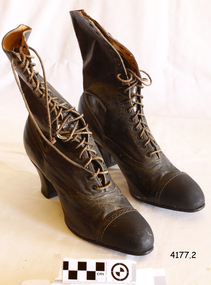
Footwear - Pair of Ladies' Boots, Second half of the 19th Century
... Only very wealthy women owned multiple pairs of boots that featured eye-catching design elements. https://www.wardrobeshop.com/blogs/victorian-era/an-in-depth-look-at-victorian-footwear These boots appear to be of a practical nature, designed for comfort, warmth, and proof against the rain and mud, rather than high fashion....Only very wealthy women owned multiple pairs of boots that featured eye-catching design elements. https://www.wardrobeshop.com/blogs/victorian-era/an-in-depth-look-at-victorian-footwear These boots appear to be of a practical nature, designed for comfort, warmth, and proof against the rain and mud, rather than high fashion. ...Starting in around 1850, women began wearing boots that resembled the ones already worn by men in high society. Women’s Victorian boots were slightly more feminine in nature, however, than those worn by their male counterparts. The boots first worn by women extended to the middle of the calf so that her ankle would stay properly covered underneath her many skirts. These boots often featured laces or a row of buttons to keep them secure to the foot and ankle. Although usually made from durable materials like rubber and leather, boots that were worn purely for fashion were sometimes made of more elegant materials like patent leather or dyed suede. Fashion boots from the Victorian era exude all of the opulence and decadence that are unique to that time period. Design elements like scalloped trims, intricate embroidery, and lace accents were also not uncommon when it came to elaborately designed Victorian boots. Unlike men’s boots, they also boasted a slight heel that was thinner and more feminine in design. How lavish a woman’s boots were greatly depended upon how much money her family had and her place within society. While footwear was standard during this time, shoes were still quite a luxury to the modern Victorian. Only very wealthy women owned multiple pairs of boots that featured eye-catching design elements. https://www.wardrobeshop.com/blogs/victorian-era/an-in-depth-look-at-victorian-footwear These boots appear to be of a practical nature, designed for comfort, warmth, and proof against the rain and mud, rather than high fashion.These ladies' boots are historically significant for their manufacture and use during the Victorian period.Pair of ankle length black ladies' boots with long tan coloured laces.flagstaff hill, warrnambool, shipwrecked-coast, flagstaff-hill, flagstaff-hill-maritime-museum, maritime-museum, shipwreck-coast, flagstaff-hill-maritime-village, boots, victorian, leather, footwear -
 Federation University Historical Collection
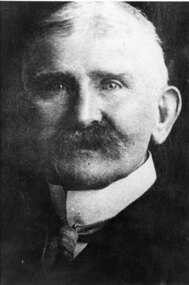
Photograph - Photograph (black & white), Ferdinand Moritz Krause
... He died on 16 June, survived by his wife, three sons and a daughter. (http://adb.anu.edu.au/biography/krause-ferdinand-moritz-3971, accessed 20 November 2018) ...He died on 16 June, survived by his wife, three sons and a daughter. (http://adb.anu.edu.au/biography/krause-ferdinand-moritz-3971, accessed 20 November 2018) ballarat school of mines ferdinand krause geology fm krause krause Ballarat School of Mines Museum Black and White photograph of the head and shoulders of Professor Ferdinand Krause of the Ballarat School of Mines. ...Civil engineer and geologist Ferdinand Moritz Krause lecturered at the Ballarat School of Mines from 1880 to 1895. He was born at Kassel, Germany on 24 February 1841, the youngest son of Frederich Wilhelm Krause. Ferdinand Krause married Amy Augusta Dimock. He died in South Africa 16 June 1918. In June 1880 Krausé was appointed to the Ballarat School of Mines as lecturer in 'geology, palaeontology, mineralogy, electricity, magnetism, scientific mining, geological and topographical surveying' and as museum curator. In 1881 he was appointed Professor of Geology and in 1892 was elected president of the Staff Association. He was held in high repute by his students and also known as a keen musician. He resigned from the School of Mines to be lecturer in mining at the University of Melbourne from June 1895 to January 1897. Whilst at Ballarat in 1887-90 he had completed geological maps and reports on the parishes of Haddon, Carngham, Scarsdale, Lillerie, Smythesdale and Comeralghip; these were published in 1898. The Institute of Surveyors elected him a member in 1891. His Introduction to the study of Mineralogy for Australian readers was published in Melbourne in 1896. In January 1897 he became manager of the General Gordon mine near Kalgoorlie. In 1900 he contributed an article to the Ballarat School of Mines Students' Magazine on the mining geology of Kalgoorlie. Invited by a former student, George Denny, Krausé left for South Africa in 1901. His last work was a geological map of the Barberton area, Transvaal, published in March 1918. He died on 16 June, survived by his wife, three sons and a daughter. (http://adb.anu.edu.au/biography/krause-ferdinand-moritz-3971, accessed 20 November 2018) Black and White photograph of the head and shoulders of Professor Ferdinand Krause of the Ballarat School of Mines.ballarat school of mines, ferdinand krause, geology, fm krause, krause, ballarat school of mines museum -
 Federation University Historical Collection
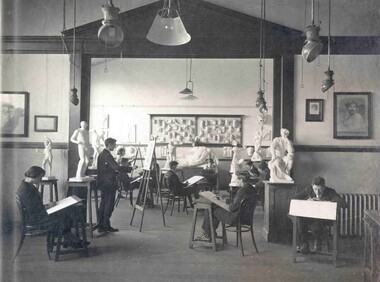
Photograph - Art class photograph, Drawing from the Antique, 1920, c1920
... This opening features classical plaster pilasters with a pediment above. (http://guerin.ballarat.edu.au/curator/buildings/technical_art_school.shtml) ...This opening features classical plaster pilasters with a pediment above. (http://guerin.ballarat.edu.au/curator/buildings/technical_art_school.shtml) drawing ballarat school of mines ballarat technical art school art studio plaster caste gribble building illisos hercules Drawing from the Antique Visual Arts Black and white mounted photograph showing eleven students of the Ballarat School of Mines Technical Art School drawing from plaster models of human bodies in various poses and of various scales. ...The large plaster Illisos depicted in the back of this image is still held by Federation University Australia. The Ballarat Technical Art School (No. 10) was part of the Ballarat School of Mines and was established in 1907. After conducting classes in various locations around Ballarat a custom built art school was erected on the site of the former Ballarat Circuit Court House, previously used as the initial building of the Ballarat School of Mines. Examples of drawings undertaken by students, as well as some plaster castes are held in the University of Ballarat Historical Collection. The Ballarat Technical art School is the oldest continuous Tertiary Art School in Australia. Sir Alexander Peacock opened the new Ballarat Technical Art School building in July 1915. It cost 10,000 pounds and was constructed by the Public Works Department from plans drawn by the then Art School Principal, Herbert H. Smith. The building contractors were Messrs Gower and Eddards. According to the SMB Annual Report of 1914 'the internal upholstering and fittings have all been carried out in Australian timbers, with Queensland maple largely used throughout.' The building could be described as federation-art deco in style. It features sandstone insertion with sandstone string coursing. The base of the building is rusticated sandstone. The building is functional in design with large metal windows in the south wall to ensure good light into the studios. The northern wall has standard double hung windows. The interior of the building features a carved wooden staircase and cast iron ceiling vents. The rear drawing studios could be made into one large studio by opening panelled timber doors. This opening features classical plaster pilasters with a pediment above. (http://guerin.ballarat.edu.au/curator/buildings/technical_art_school.shtml) Black and white mounted photograph showing eleven students of the Ballarat School of Mines Technical Art School drawing from plaster models of human bodies in various poses and of various scales. The students are in a room of the Ballarat Technical Art School which was custom built for teaching art. The image was reproduced in the 1920 Ballarat School of Mines Students' Magazine. drawing, ballarat school of mines, ballarat technical art school, art studio, plaster caste, gribble building, illisos, hercules, drawing from the antique, visual arts -
 Federation University Historical Collection
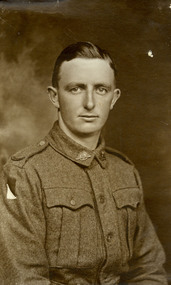
Photograph - Photograph - Sepia Postcard, Henry Smerdon Holmes, c 1915
... Henry served at the famous battlegrounds of Ypes and Somme in the Australian Army 8th Battalion https://www.awm.gov.au/collection/U51448 He was a Driver with the 4th D.A.C.https://www.awm.gov.au/collection/U51219 According to his Soldier's Pay Books (Cat. ...Henry served at the famous battlegrounds of Ypes and Somme in the Australian Army 8th Battalion https://www.awm.gov.au/collection/U51448 He was a Driver with the 4th D.A.C.https://www.awm.gov.au/collection/U51219 According to his Soldier's Pay Books (Cat. ...HENRY SMERDON (Harry) HOLMES was born in 1897 at the family property, ’Sauchieburn’, 17 km north of Ballarat, in the Ascot district. He was the youngest of four children. After finishing his education at St Patrick’s College, Ballarat, Henry joined the Holmes family farming interests. At the age of 18 he enlisted and served with AIF in Egypt, France and Belgium 1915-1918. Henry served at the famous battlegrounds of Ypes and Somme in the Australian Army 8th Battalion https://www.awm.gov.au/collection/U51448 He was a Driver with the 4th D.A.C.https://www.awm.gov.au/collection/U51219 According to his Soldier's Pay Books (Cat. No. 20112) Holmes Registration number was 7983. He was Catholic and enlisted in the Third Military District on 17 September 1915, and embarked on 8 November 1915. Holmes was in the 18th AASC Unit with the rank of Driver at that time. On 15 November 1918 Holmes was promoted to Lance Corporal. He received leave on: * 3 August 1917 - London (10 days) * 19 February 1918 - Paris (10 days) * 27 August 1918 - London (14 days) In 1922 Harry married Edith Pickford of 'Yeovil', Clunes, and they lived at 'Sauchieburn' with Henry's brother Willie. In 1933 Harry and Edith built a new timber home 'Launchley' (Ascot) on the rise east of 'Sauchieburn' on the Ballarat - Maryborough Road. The home was built by Con Zilles to the designs of Clegg and Morrow. In 1938 Harry and Edith purchased a property at Derrinallum, Victoria and called it 'Launchley Park' on their first son's return from World War 2. In 1953 Harry purchased William and Charlotte's portion of 'Sauchieburn' for his son, Bill, and daughter-in-law Margaret. [Source: Unpublished notes by Jane Dyer ( nee Chatham)]Sepia photographic postcard of a World War 1 Australian soldier in uniform, Henry Smerdon Holmes from Ascot Victoria.Verso in pen "The boys say this isn't to (sic) bad so it will show you any changes. Heaps of love to all. Harrychatham, chatham family collection, holmes, harry holmes, henry holmes, smerdon, world war, world war 1, world war i, uniform -
Federation University Historical Collection
Tool - Object, E. Thomas & Williams Limited, Cambrian Lampworks, Kop Staszic Carbide Lamp
... This is emptied into a waste bag and the chamber can be refilled. (http://en.wikipedia.org/wiki/Carbide_lamp, accessed 06/05/2015)...This is emptied into a waste bag and the chamber can be refilled. (http://en.wikipedia.org/wiki/Carbide_lamp, accessed 06/05/2015) miners lamp mining lamp statszic poland carbide mining Metal Carbide Mining lamp with light reflector and hook. ...Carbide lamps, or acetylene gas lamps, are simple lamps that produce and burn acetylene (C2H2) which is created by the reaction of calcium carbide (CaC2) with water. Acetylene gas lamps were used to illuminate buildings, as lighthouse beacons, and as headlights on motor-cars and bicycles. Portable acetylene gas lamps, worn on the hat or carried by hand, were widely used in mining in the early twentieth century. A mining or caving lamp has calcium carbide placed in a lower chamber, the generator. The upper reservoir is then filled with water. A threaded valve or other mechanism is used to control the rate at which the water is allowed to drip into the chamber containing the calcium carbide. By controlling the rate of water flow, the production of acetylene gas is controlled. This, in turn, controls the flow rate of the gas and the size of the flame at the burner, and thus the amount of light it produces. Staszic is a coal mine located in Katowice , in the district Giszowiec, Poland This type of lamp generally has a reflector behind the flame to help project the light forward. An acetylene gas powered lamp produces a bright, broad light. Many cavers prefer this type of unfocused light as it improves peripheral vision in the complete dark. The reaction of carbide with water produces a fair amount of heat independent of the flame. In cold caves, carbide lamp users can use this heat to help stave off hypothermia. When all of the carbide in a lamp has been reacted, the carbide chamber contains a wet paste of slaked lime (calcium hydroxide). This is emptied into a waste bag and the chamber can be refilled. (http://en.wikipedia.org/wiki/Carbide_lamp, accessed 06/05/2015)Metal Carbide Mining lamp with light reflector and hook.miners lamp, mining lamp, statszic, poland, carbide, mining -
 Flagstaff Hill Maritime Museum and Village
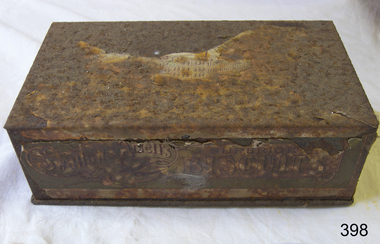
Container - Biscuit Tin, Swallow and Ariell Pty Ltd, Mid-19th to mid-20th century
... The factory was later registered by the National Trust and converted into units. https://www.emelbourne.net.au/biogs/EM01456b.htm...The factory was later registered by the National Trust and converted into units. https://www.emelbourne.net.au/biogs/EM01456b.htm This biscuit tin is representative of local Melbourne and Victorian produce. ...This tin was made in Melbourne and contained Swallows and Ariells biscuits. The label was written in four languages. The biscuits may have been made for export or perhaps for immigrants now living in Australia. Australia's first biscuit company was founded in 1854 by Thomas Swallow. Within five years he had taken in a partner, T.H. Ariell. After Ariell died in 1875, F.T. Derham was appointed partner and managing director in 1877, a position held by several generations of his descendants. By the early 1880s the Port Melbourne factory extended to 3 acres (1.2 ha), and the company owned flourmills and sugar plantations in the Goulburn Valley and Northern Queensland. With no equal outside Great Britain, Swallow & Ariell was the fifth largest biscuit company in the world, manufacturing over 100 varieties, including the common ship biscuit (an original product) and meat biscuits (apparently taken by Burke and Wills on their ill-fated expedition). The company also boasted popular sideline products, including cakes, plum puddings, ice-cream and dried fruit. Renowned for its patriotic fundraising campaigns during both world wars, it diverted most of its biscuits and plum puddings to the Australian and US services in World War II. Company employees were filmed leaving work in 1905 in the Salvation Army film unit's first sponsored industrial documentary film. The surviving opening sequences are held by ScreenSound Australia. The company was delisted on 5 August 1964 following acquisition of more than 95% of its capital by the Australian Biscuit Co. The factory was later registered by the National Trust and converted into units. https://www.emelbourne.net.au/biogs/EM01456b.htmThis biscuit tin is representative of local Melbourne and Victorian produce. The label was in four languages, perhaps for export or for local immigrants. The firm Swallow and Ariells Pty Ltd was a very early manufacture and was in business for over 100 years.Rectangular tin container with attached lid. Label advertises Swallow and Ariells biscuits. Made in Melbourne. The label is written in four languages. The trademark, a swallow, is on the tin. The tin is very badly corroded.'Swallow and Ariells Superior Melbourne Biscuits' Trademark: image [swallow]flagstaff hill, warrnambool, shipwrecked-coast, flagstaff-hill, flagstaff-hill-maritime-museum, maritime-museum, shipwreck-coast, flagstaff-hill-maritime-village, metal craft, tin ware, biscuit box, biscuit tin, food container, melbourne biscuit maker, swallow, thomas swallow, thomas ariell, ariell -
 Upper Yarra Museum
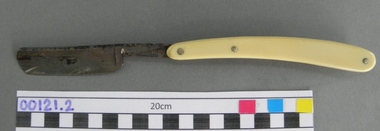
Razor, Cut throat
... Sharped Edged instrument used for cleaning hair from the skin. http://en.wikipedia.org/wiki/Straight_razor A straight razor is a razor with a blade that can fold into its handle.[1] They are also called open razors and cut-throat razors. ...Sharped Edged instrument used for cleaning hair from the skin. http://en.wikipedia.org/wiki/Straight_razor A straight razor is a razor with a blade that can fold into its handle.[1] They are also called open razors and cut-throat razors. ...Sharped Edged instrument used for cleaning hair from the skin. http://en.wikipedia.org/wiki/Straight_razor A straight razor is a razor with a blade that can fold into its handle.[1] They are also called open razors and cut-throat razors. HISTORY The first modern straight razor complete with decorated handles and hollow ground blades was constructed in Sheffield, England, by Benjamin Huntsman in 1740. Huntsman's process was adopted by the French sometime later. The English manufacturers were even more reluctant than the French to adopt the process and only did so after they saw its success in France.[5] Straight razors were the most common form of shaving before the 20th century and remained that common in many countries until the 1950s. TODAY Straight razors are still manufactured. DOVO, of Solingen, Germany, and Thiers Issard of France are two of the most well-known European manufacturers. Feather Safety Razor Co. Ltd. of Osaka, Japan makes a razor with the same form as a traditional straight, but featuring a disposable blade that can be installed through an injector-type system. Modern straight razor users are known to favor them for a variety of reasons. Some are attracted to the nostalgia of using old and traditional methods of shaving. It is a masculine ritual comparable to pipe smoking. Others profess an interest in reducing the waste of disposable blades.[11][22] Still others agree that straight razors provide a superior shave through a larger blade and greater control of the blade including the blade angle. Straight razors cover a much greater area per shaving stroke because their cutting edge is much longer than any of the multiblade razors. Ivory cut throat razor, with cream case 00121.3.Known as a straight razor.Razor with square point, full hollow ground 5/8” blade and double transverse stabiliser. The centre pin adds stability and rigidity to the handle---I think this is it ROM Parts The narrow end of the blade pivots on a pin, between 2 pieces of ivory forms the handle. LONG EXTRACT FROM WIKI _ SHORTEN to describe 00121 The parts of a straight razor and their function are described as follows: The narrow end of the blade rotates on a pin called the pivot, between two protective pieces called the scales or handle. The upward curved metal end of the narrow part of the blade beyond the pivot is called the tang and acts as a lever to help raise the blade from the handle. One or two fingers resting on the tang also help stabilize the blade while shaving. The narrow support piece between the tang and the main blade is called the shank, but this reference is often avoided because it can be confusing. The shank sometimes features decorations and the stamp of the country of origin. The top side and the underside of the shank can sometimes exhibit indentations known as fluting, or jimps for a more secure grip.[8] The curved lower part of the main blade from the shank to the cutting edge is called the shoulder.[9] The point where the shoulder joins the cutting edge is called the heel. A thick strip of metal running transversely at the junction where the main blade attaches to the shank is called the stabiliser. The stabiliser can be double,[10] single or can be absent in some razor models. The first stabiliser is usually very narrow and thicker and runs at the shank to blade junction, covering the shank and just spilling over to the shoulder. The second stabiliser can be distinguished since it is considerably wider and narrower, appearing after the first stabiliser and running lower into the shoulder. The non-cutting top of the blade is called the back or the spine while the cutting part of the blade opposite the back is called the cutting edge.[11] Finally the other free end of the blade, at the opposite end of the tang, is called the point and, sometimes, the head or the nose.[9][12] There are two to three pins in any handle. The middle pin, if present, is plastic coated and is called the plug.[13] Its function is to stabilise the sides of the handle so that they cannot be squeezed in the middle. When folded into the scales, the blade is protected from accidental damage, and the user is protected from accidental injury. During folding, the back of the blade, being thick and normally with a curved cross-section, acts as a natural stopper and prevents further rotation of the blade out of the handle from the other side shaving, lever, handle, blade, pivot, razor, tang -
 Ballarat Clarendon College
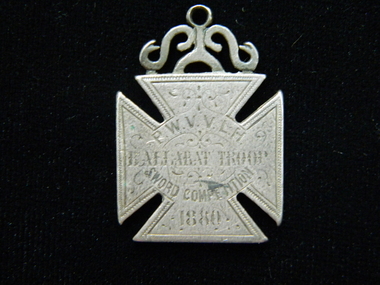
Medal
... In 1885, most of the Cavalry were incorporated into a newly formed Victorian Mounted Rifles. (http://www.awm.gov.au/collection/REL/18070.001) John Garbutt was Principal of Ballarat College 1877 - 1909. ...In 1885, most of the Cavalry were incorporated into a newly formed Victorian Mounted Rifles. (http://www.awm.gov.au/collection/REL/18070.001) John Garbutt was Principal of Ballarat College 1877 - 1909. ...The medal was awarded to Trooper John Garbutt of the Prince of Wales Victorian Volunteer Light Horse (Ballarat) in 1880 for attaining fourth prize n the sword competition. In 1862, the units of the Mounted Volunteer Corps in Victoria were formed into a single regiment known as the Victorian Volunteer Light Horse. This title changed again in 1863, to the Prince of Wales Victorian Volunteer Light Horse ( Hussars ). In 1870 a uniform was adopted that was based on the British 19th Hussars. Troops were based at various times at Geelong, Ballarat, Kyneton, Bendigo, Castlemaine and Dandenong, as well as metropolitan Melbourne. In 1885, most of the Cavalry were incorporated into a newly formed Victorian Mounted Rifles. (http://www.awm.gov.au/collection/REL/18070.001) John Garbutt was Principal of Ballarat College 1877 - 1909. He was educated at Geelong National Grammar School and in 1860 was the first dux of the college. He was educated at Geelong National Grammar School and in 1860 was the first dux of the college. Fist class Honourman Arts and Laws at Melbourne University 1866; Two years a master at Geelong College; seven years master and three years senior master at Scotch College, Melbourne. Mein's 1964 History of Ballarat College states: 'To summarise, it may be fairly claimed that the College's War Record in 1914-1918 would have reflected great credit on a school with ten times its numbers...Some of the credit of the college war record must be attributed to the influence of Major John Garbutt, M.A. who was Principal of the College for 33 years...Nearly all the old Collegians who distinguished themselves in the war had been trained by him. Silver coloured maltese cross medal with decorative link attached to top and engraved on both sides. The medal was awarded to Trooper Whyte of the Prince of Wales Victorian Volunteer Light Horse (Ballarat) in 1877. Face: P.W.V.V.L.H. / BALLARAT TROOP / SWORD COMPETITION / 1880 Verso: 4th PRIZE / Trooper garbutt ballarat-college, principal-john-garbutt, prince of wales victorian volunteer light horse, medal, 1880, principal -
 Mission to Seafarers Victoria
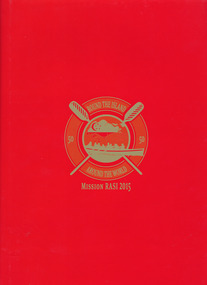
Book, Mission to Seafarers, Round the Island- Around the World - Mission RASI 2015, 2015
... Raising funds for our work is extremely challenging and we are deeply grateful to the RASI team for their enthusiasm and drive to get this project off the round.” Read more at https://www.todayonline.com/sports/misson-row-around-singapore-island-rasi-endurance-challenge-2015-launches-singapore...Raising funds for our work is extremely challenging and we are deeply grateful to the RASI team for their enthusiasm and drive to get this project off the round.” Read more at https://www.todayonline.com/sports/misson-row-around-singapore-island-rasi-endurance-challenge-2015-launches-singapore Documentation of a unique event with proceeds going to MTS (UK). mission to seafarers worldwide charity volunteers singapore nigel porteous andrea fleming london rasi row around singapore island 2015 fundraising reverend andrew wright mts london mts singapore rowing "In connection with the SG50 celebrations in Singapore, Mission RASI (Row Around Singapore Island) will see a team of Singaporeans join hands with friends from overseas in a test of endurance and teamwork, to raise funds to further the Mission's work in promoting good shipping practices and a safe working environment for seafarers"--Page 4. ..."In connection with the SG50 celebrations in Singapore, Mission RASI (Row Around Singapore Island) will see a team of Singaporeans join hands with friends from overseas in a test of endurance and teamwork, to raise funds to further the Mission's work in promoting good shipping practices and a safe working environment for seafarers"--Page 4.Red cardboard hard cover book with red paper outer sleeve. 55 pages : color illustrations, color map ; 31 cmnon-fiction"In connection with the SG50 celebrations in Singapore, Mission RASI (Row Around Singapore Island) will see a team of Singaporeans join hands with friends from overseas in a test of endurance and teamwork, to raise funds to further the Mission's work in promoting good shipping practices and a safe working environment for seafarers"--Page 4.mission to seafarers, worldwide, charity, volunteers, singapore, nigel porteous, andrea fleming, london, rasi, row around singapore island, 2015, fundraising, reverend andrew wright, mts london, mts singapore, rowing -
 Cheese World Museum
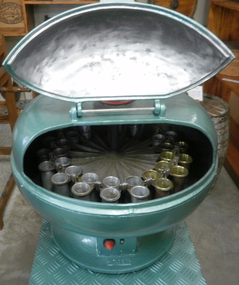
Centrifuge, electric
... From the very beginning it was so complete in every detail that no change has had to be made in it.’ (Babcock Test http://www.en.wikipedia.org/wki/Babcock_test 31 March 2009) ...From the very beginning it was so complete in every detail that no change has had to be made in it.’ (Babcock Test http://www.en.wikipedia.org/wki/Babcock_test 31 March 2009) allansford dairy manufacturing milk testing Babcock test Babcock, Stephen Moulton butter warrnambool cheese and butter factory company 7173 BABCOCKTESTER 190 Round green metal container with opening lid. ...This Babcock tester was used in the laboratory at the Kraft cheese factory, Allansford. When it was superseded it was passed to one of the users of the machine, Les O'Callaghan, president of the Warrnambool & District Historical Society who placed it in the historical society collection. In 2009 when the historical society premises were upgraded there was insufficient room to store the tester so it was donated to Cheese World Museum. The machine was used to test the butterfat content of milk. Prior to dairy factories coming into existence farmers made butter individually on farms. There was no need for milk testing until farmers supplied factories for payment. Payment was based on a gallon of milk weighing 10lbs (pounds) and this led to richer milk, containing a high degree of butterfat for use in buttermaking, being paid at the same rate as lesser quality milk. In 1890 Stephen Moulton Babcock, an American professor at the University of Wisconsin-Madison, developed a method of determining the amount of butterfat in milk, thus providing a standardised and fairer system for payment. Babcock Test Process 1. 18 grams of milk (17.6ml) was put into a test tube 2. The same amount of sulphuric acid was added 3. A centrifuge at 50ºC was rotated at more than 900 revs per minute 4. The fat floating on top of the liquid in the test tube was measured The Babcock Test provided fairer compensation to farmers and also helped produce a consistent product for consumers. It also allowed for selective breeding when dairy herd testing evolved. ‘The Babcock Test is so simple that it can be used by any careful person, and it is inexpensive to operate. From the very beginning it was so complete in every detail that no change has had to be made in it.’ (Babcock Test http://www.en.wikipedia.org/wki/Babcock_test 31 March 2009) Round green metal container with opening lid. Inside houses a spinning rotor with 20 test tube holders around the outside in two circular rows.7173 BABCOCKTESTER 190allansford, dairy manufacturing, milk testing, babcock test, babcock, stephen moulton, butter, warrnambool cheese and butter factory company -
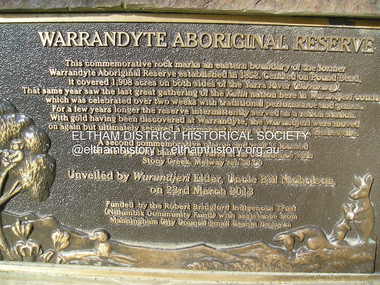 Eltham District Historical Society Inc
Photograph, Fay Bridge, Eastern boundary of former Warrandyte Aboriginal Reserve, North Warrandyte, 7 November 2016
... Melway ref : 23 C 9 Unveiled by Wurundjeri Elder, Uncle Bill Nicholson on 23rd March 2013 Funded by the Robert Bridgford Indigenous Trust (Nillumbik Community Fund) with assistance from Manningham City Council Small Grants Program Ref: Monument Autralia https://monumentaustralia.org.au/themes/culture/indigenous/display/99680-warrandyte-aboriginal-reserve-...Melway ref : 23 C 9 Unveiled by Wurundjeri Elder, Uncle Bill Nicholson on 23rd March 2013 Funded by the Robert Bridgford Indigenous Trust (Nillumbik Community Fund) with assistance from Manningham City Council Small Grants Program Ref: Monument Autralia https://monumentaustralia.org.au/themes/culture/indigenous/display/99680-warrandyte-aboriginal-reserve- Fay Bridge Collection 2016-11-07 aboriginal reserve North Warrandyte Plaques Warrandyte Aboriginal Reserve 1 images - born digital Eastern boundary of former Warrandyte Aboriginal Reserve, North Warrandyte Photograph Photograph Fay Bridge ...Two bronze commemorative plaques on rocks, unveiled by Wurundjeri Tribe Council Elders, mark two eastern boundaries of the former Warrandyte Aboriginal Reserve on the north and south sides of the Yarra. This project was initiated by Nillumbik Reconciliation Group in close association with Reconciliation Manningham and the Wurundjeri Tribe Council, as a means of commemorating the last great corroboree of the Kulin Nation which was held at Pound Bend in March 1852. This plaque is on the Nillumbuk side of the Yarra, accessed via The Boulevard, North Warrandyte. The plaque is set on a rock approximately 50 metres before the turning circle at the end of The Boulevard. Plaque : Warrandyte Aboriginal Reserve This commemorative rock marks an eastern boundary of the former Warrandyte Aboriginal Reserve established in 1852. Centred on Pound Bend, it covered 1,908 acres on both sides of the Yarra River (Birrarung). That same year saw the last great gathering of the Kulin nation here in Wurundjeri country which was celebrated over two weeks with traditional performance and games. For a few years longer the reserve intermittently served as a ration station.With gold having been discovered at Warrandyte, the Wurundjeri were moved on again but ultimately secured a permanent home at Coranderrk, Healesville. A second commemorative plaque and rock is located on the opposite bank of the Yarra and its confluence with Stony Creek. Melway ref : 23 C 9 Unveiled by Wurundjeri Elder, Uncle Bill Nicholson on 23rd March 2013 Funded by the Robert Bridgford Indigenous Trust (Nillumbik Community Fund) with assistance from Manningham City Council Small Grants Program Ref: Monument Autralia https://monumentaustralia.org.au/themes/culture/indigenous/display/99680-warrandyte-aboriginal-reserve-fay bridge collection, 2016-11-07, aboriginal reserve, north warrandyte, plaques, warrandyte aboriginal reserve -
 Eltham District Historical Society Inc
Album - Photograph, J.A. McDonald, Dixons Creek Road, June 1957
... Retrieved August 24, 2022, from http://nla.gov.au/nla.news-article71777065 SHIRE OF ELTHAM. ...Retrieved August 24, 2022, from http://nla.gov.au/nla.news-article71777065 SHIRE OF ELTHAM. ...Bridge over Dixons Creek Job 56FD330 June 1957 Formwork for Dixons Creek pier completed Advertising (1957, January 19). The Argus (Melbourne, Vic. : 1848 - 1957), p. 33 (Col. 9). Retrieved August 24, 2022, from http://nla.gov.au/nla.news-article71777065 SHIRE OF ELTHAM. Loan No. 27.-Notice of Intention to Borrow Sum of £ 15,000 for Permanent Works and Undertakings. - Notice is hereby given, that the Council of the Shire of Eltham proposes to borrow the sum of £15,000 on the credit of the municipal revenues of the president, councillors, and ratepayers for the said shire, such sum to be raised by the Issue of debentures in accordance with the provisions of the Local Government Acts. 1. Maximum rate of interest that may be paid is £5/10/ per cent, per annum. 2. The purposes for which the loan is to be applied are: Construction of Sanitary Conveniences at Shire Office, Council's contribution towards costs of Dixons Creek Bridge, Construction of Mt. Pleasant rd., Construction of Cherry Tree rd. 3. The period of the loan shall be 10 years. 4. Moneys borrowed will be repayable by providing out of the Municipal Fund twenty half-yearly instalments of approximately £985/1/6 each, including principal and interest on the first day of October and the first day of April during the currency of the loan. The first Instalment shall be payable on the first day of October 1957. 5. Such moneys shall be repayable at the Commercial Bank of Australia Limited, Melbourne, or at the Council's bankers for the time being in Melbourne. The plans and specifications and the estimates of the costs of the proposed works and a statement showing the proposed expenditure of the moneys to be borrowed are open for inspection at the Shire Office, Eltham. R. J. HAM. Shire Secretary.Record of various Shire of Eltham infrastructure works undertaken during the period of 1952-1962 involving bridge and road reconstruction projects, sometimes with Eltham Shire Council Project Reference numbers quoted. It was during this period that a number of significant improvements were made to roads and new bridges constructed within the shire that remain in place as of present day (2022). In many situations, the photos provide a tangible visible record of infrastructure that existed throughout the early days of the Shire. The album was put together by or under the direction of the Shire Engineer, J.A. McDonald.infrastructure, road construction, shire of eltham, bridge construction, dixons creek bridge, dixon's creek road, 1957-06 -
 Eltham District Historical Society Inc
Album - Photograph, J.A. McDonald, Dixons Creek Road, June 1957
... Retrieved August 24, 2022, from http://nla.gov.au/nla.news-article71777065 SHIRE OF ELTHAM. ...Retrieved August 24, 2022, from http://nla.gov.au/nla.news-article71777065 SHIRE OF ELTHAM. ...Piles being cast 1957 P. Morris on vibrator Advertising (1957, January 19). The Argus (Melbourne, Vic. : 1848 - 1957), p. 33 (Col. 9). Retrieved August 24, 2022, from http://nla.gov.au/nla.news-article71777065 SHIRE OF ELTHAM. Loan No. 27.-Notice of Intention to Borrow Sum of £ 15,000 for Permanent Works and Undertakings. - Notice is hereby given, that the Council of the Shire of Eltham proposes to borrow the sum of £15,000 on the credit of the municipal revenues of the president, councillors, and ratepayers for the said shire, such sum to be raised by the Issue of debentures in accordance with the provisions of the Local Government Acts. 1. Maximum rate of interest that may be paid is £5/10/ per cent, per annum. 2. The purposes for which the loan is to be applied are: Construction of Sanitary Conveniences at Shire Office, Council's contribution towards costs of Dixons Creek Bridge, Construction of Mt. Pleasant rd., Construction of Cherry Tree rd. 3. The period of the loan shall be 10 years. 4. Moneys borrowed will be repayable by providing out of the Municipal Fund twenty half-yearly instalments of approximately £985/1/6 each, including principal and interest on the first day of October and the first day of April during the currency of the loan. The first Instalment shall be payable on the first day of October 1957. 5. Such moneys shall be repayable at the Commercial Bank of Australia Limited, Melbourne, or at the Council's bankers for the time being in Melbourne. The plans and specifications and the estimates of the costs of the proposed works and a statement showing the proposed expenditure of the moneys to be borrowed are open for inspection at the Shire Office, Eltham. R. J. HAM. Shire Secretary.Record of various Shire of Eltham infrastructure works undertaken during the period of 1952-1962 involving bridge and road reconstruction projects, sometimes with Eltham Shire Council Project Reference numbers quoted. It was during this period that a number of significant improvements were made to roads and new bridges constructed within the shire that remain in place as of present day (2022). In many situations, the photos provide a tangible visible record of infrastructure that existed throughout the early days of the Shire. The album was put together by or under the direction of the Shire Engineer, J.A. McDonald.infrastructure, road construction, shire of eltham, bridge construction, dixons creek bridge, dixon's creek road, 1957-06, p. morris -
 Eltham District Historical Society Inc
Album - Photograph, J.A. McDonald, Dixons Creek Road, June 1957
... Retrieved August 24, 2022, from http://nla.gov.au/nla.news-article71777065 SHIRE OF ELTHAM. ...Retrieved August 24, 2022, from http://nla.gov.au/nla.news-article71777065 SHIRE OF ELTHAM. ...Dixons Creek Road P. Morris – Contractor Dixons Creek (North) abutment 1957 Advertising (1957, January 19). The Argus (Melbourne, Vic. : 1848 - 1957), p. 33 (Col. 9). Retrieved August 24, 2022, from http://nla.gov.au/nla.news-article71777065 SHIRE OF ELTHAM. Loan No. 27.-Notice of Intention to Borrow Sum of £ 15,000 for Permanent Works and Undertakings. - Notice is hereby given, that the Council of the Shire of Eltham proposes to borrow the sum of £15,000 on the credit of the municipal revenues of the president, councillors, and ratepayers for the said shire, such sum to be raised by the Issue of debentures in accordance with the provisions of the Local Government Acts. 1. Maximum rate of interest that may be paid is £5/10/ per cent, per annum. 2. The purposes for which the loan is to be applied are: Construction of Sanitary Conveniences at Shire Office, Council's contribution towards costs of Dixons Creek Bridge, Construction of Mt. Pleasant rd., Construction of Cherry Tree rd. 3. The period of the loan shall be 10 years. 4. Moneys borrowed will be repayable by providing out of the Municipal Fund twenty half-yearly instalments of approximately £985/1/6 each, including principal and interest on the first day of October and the first day of April during the currency of the loan. The first Instalment shall be payable on the first day of October 1957. 5. Such moneys shall be repayable at the Commercial Bank of Australia Limited, Melbourne, or at the Council's bankers for the time being in Melbourne. The plans and specifications and the estimates of the costs of the proposed works and a statement showing the proposed expenditure of the moneys to be borrowed are open for inspection at the Shire Office, Eltham. R. J. HAM. Shire Secretary.Record of various Shire of Eltham infrastructure works undertaken during the period of 1952-1962 involving bridge and road reconstruction projects, sometimes with Eltham Shire Council Project Reference numbers quoted. It was during this period that a number of significant improvements were made to roads and new bridges constructed within the shire that remain in place as of present day (2022). In many situations, the photos provide a tangible visible record of infrastructure that existed throughout the early days of the Shire. The album was put together by or under the direction of the Shire Engineer, J.A. McDonald.infrastructure, road construction, shire of eltham, bridge construction, dixons creek bridge, dixon's creek road, 1957-06 -
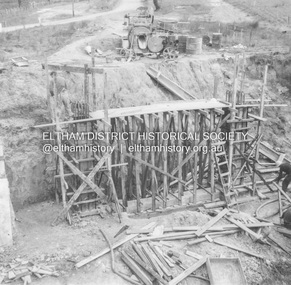 Eltham District Historical Society Inc
Album - Photograph, J.A. McDonald, Dixons Creek Road, June 1957
... Retrieved August 24, 2022, from http://nla.gov.au/nla.news-article71777065 SHIRE OF ELTHAM. ...Retrieved August 24, 2022, from http://nla.gov.au/nla.news-article71777065 SHIRE OF ELTHAM. ...Dixons Creek Road Bridge over Dixons Creek – 56FD330 June 1957 Dixons Creek pier forming columns and beam Advertising (1957, January 19). The Argus (Melbourne, Vic. : 1848 - 1957), p. 33 (Col. 9). Retrieved August 24, 2022, from http://nla.gov.au/nla.news-article71777065 SHIRE OF ELTHAM. Loan No. 27.-Notice of Intention to Borrow Sum of £ 15,000 for Permanent Works and Undertakings. - Notice is hereby given, that the Council of the Shire of Eltham proposes to borrow the sum of £15,000 on the credit of the municipal revenues of the president, councillors, and ratepayers for the said shire, such sum to be raised by the Issue of debentures in accordance with the provisions of the Local Government Acts. 1. Maximum rate of interest that may be paid is £5/10/ per cent, per annum. 2. The purposes for which the loan is to be applied are: Construction of Sanitary Conveniences at Shire Office, Council's contribution towards costs of Dixons Creek Bridge, Construction of Mt. Pleasant rd., Construction of Cherry Tree rd. 3. The period of the loan shall be 10 years. 4. Moneys borrowed will be repayable by providing out of the Municipal Fund twenty half-yearly instalments of approximately £985/1/6 each, including principal and interest on the first day of October and the first day of April during the currency of the loan. The first Instalment shall be payable on the first day of October 1957. 5. Such moneys shall be repayable at the Commercial Bank of Australia Limited, Melbourne, or at the Council's bankers for the time being in Melbourne. The plans and specifications and the estimates of the costs of the proposed works and a statement showing the proposed expenditure of the moneys to be borrowed are open for inspection at the Shire Office, Eltham. R. J. HAM. Shire Secretary.Record of various Shire of Eltham infrastructure works undertaken during the period of 1952-1962 involving bridge and road reconstruction projects, sometimes with Eltham Shire Council Project Reference numbers quoted. It was during this period that a number of significant improvements were made to roads and new bridges constructed within the shire that remain in place as of present day (2022). In many situations, the photos provide a tangible visible record of infrastructure that existed throughout the early days of the Shire. The album was put together by or under the direction of the Shire Engineer, J.A. McDonald.infrastructure, road construction, shire of eltham, bridge construction, dixons creek bridge, dixon's creek road, 1957-06 -
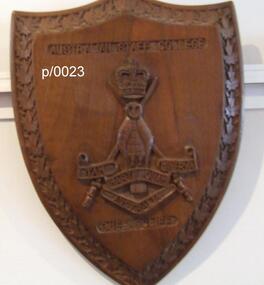 Waverley RSL Sub Branch
Plaque Australian Staff College Queenscliffe, Australian Staff College Queenscliffe
... The last course conducted under single service auspices, graduated in December 2000, thus bringing to a close a successful 62 years of Command and Staff College operation. http://www.fortqueenscliff.com.au/page11.htm...The last course conducted under single service auspices, graduated in December 2000, thus bringing to a close a successful 62 years of Command and Staff College operation. http://www.fortqueenscliff.com.au/page11.htm Australian Staff College Queenscliffe Wooden Plaque 15cm x 13cm Australian Staff College Queenscliffe Plaque Australian Staff College Queenscliffe ...At the end of World War II, the Federal Government decided to increase the strength of the post-war Regular Army and Cabinet gave approval for the establishment of a Staff College in Australia. On 27 February 1946, the Staff School (Australia) was re-named the Australian Staff College. Authority was given to raise the College and to locate it at Fort Queenscliff. Because the Fort was not ready for immediate occupation, a temporary home was found for the College, in June 1946, at the School of Infantry, Seymour Victoria. On 26 October 1946, the advance party of the College arrived at Fort Queenscliff and the first staff course to be conducted at the new College began in January 1947. Only in November 1979, after much thought and discussion, was it decided that the Australian Army Staff College would have a permanent home at Fort Queenscliff. On 1 January 1982, the College was renamed the Command and Staff College. This reflected the new aim of the Course which included both command and staff aspects. New support facilities were opened at Crow’s Nest Barracks in 1985 and work began in 1986 on the new instruction block at Fort Queenscliff. On 29 January 1988, the new Military Instructional Facility (MIF) was officially opened by the then Chief of the General Staff (CGS). The MIF features a lecture hall, a model room, syndicate rooms, computer centre, and library. Major rebuilding of the Officers Mess and Mess Accommodation was completed in mid-1990. By December 1996, 1224 officers had graduated from the Command and Staff College. The last course conducted under single service auspices, graduated in December 2000, thus bringing to a close a successful 62 years of Command and Staff College operation. http://www.fortqueenscliff.com.au/page11.htmWooden Plaque 15cm x 13cmAustralian Staff College Queenscliffe -
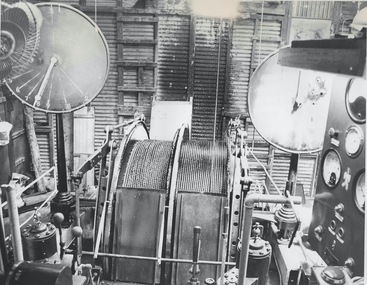 Bendigo Historical Society Inc.
Photograph - AUSTIN COLLECTION: Wattle Gully Gold Mine, Chewton, Not dated but possibly 1980's
... Heritage Council Victoria: https://vhd.heritagecouncil.vic.gov.au/places/2380 ...Heritage Council Victoria: https://vhd.heritagecouncil.vic.gov.au/places/2380 Gold Mining underground Wattle Gully Gold Mine Chewton winding gear Black and white photograph: view of engine room. ...Wattle Gully Mine holds a pivotal position in the history of the State's quartz mining industry. The rich strike at Wattle Gully mine in 1937 helped revive the State's gold mining industry that had been in the doldrums since the First World War. Wattle Gully, and a handful of other 'new' companies - the Maude and Yellow Girl, Morning Star, A 1, and North Deborah - were the flagships of the revived industry and sustained the State's gold production for some 30 years. Wattle Gully mine, with a yield of 350,000 ounces, was the richest mine of its era. By 1940, the Wattle Gully Company had paid out £207,000 in dividends to its shareholders. The company continued to mine profitably through the Second World War, though it struggled due to a shortage of manpower. After the war, the mine continued to develop - in the early 1950s new plant including a winding engine, steel poppet head, and twenty-head battery was added. The plant was obtained from the Central Nell Gwynne Company, Bendigo. On 13 March 1969, the Wattle Gully Company closed down the mine, laying off 62 men. Since 1970 Wattle Gully mine has worked intermittently. Recent additions to the mine's infrastructure has been a new ore processing plant and a decline tunnel. The ore processing plant was operated by Newmont mining from 1987 to 1990 and subsequently operated by Consolidated Victorian Mines and Duketon Goldfields. The mine site has retained evidence of its development since 1937 with its most recent periods of equipment upgrades in the 1950s and 1980s being documented by buildings, structures and intact and working machinery. Heritage Council Victoria: https://vhd.heritagecouncil.vic.gov.au/places/2380 Black and white photograph: view of engine room. Wattle Gully Gold Mine winding gear, two winding wheels in centre of image.gold mining, underground, wattle gully gold mine, chewton, winding gear -
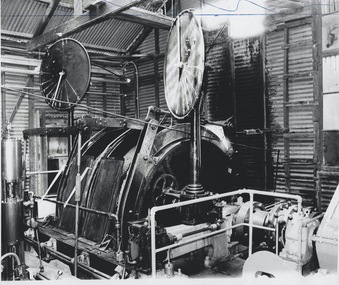 Bendigo Historical Society Inc.
Photograph - AUSTIN COLLECTION: Winding Gear, Wattle Gully Gold Mine, Chewton, 1982
... Heritage Council Victoria: https://vhd.heritagecouncil.vic.gov.au/places/2380 ...Heritage Council Victoria: https://vhd.heritagecouncil.vic.gov.au/places/2380 Gold Mining underground Wattle Gully Gold Mine Chewton winding gear Black and white photograph: view of engine room. ...Wattle Gully Mine holds a pivotal position in the history of the State's quartz mining industry. The rich strike at Wattle Gully mine in 1937 helped revive the State's gold mining industry that had been in the doldrums since the First World War. Wattle Gully, and a handful of other 'new' companies - the Maude and Yellow Girl, Morning Star, A 1, and North Deborah - were the flagships of the revived industry and sustained the State's gold production for some 30 years. Wattle Gully mine, with a yield of 350,000 ounces, was the richest mine of its era. By 1940, the Wattle Gully Company had paid out £207,000 in dividends to its shareholders. The company continued to mine profitably through the Second World War, though it struggled due to a shortage of manpower. After the war, the mine continued to develop - in the early 1950s new plant including a winding engine, steel poppet head, and twenty-head battery was added. The plant was obtained from the Central Nell Gwynne Company, Bendigo. On 13 March 1969, the Wattle Gully Company closed down the mine, laying off 62 men. Since 1970 Wattle Gully mine has worked intermittently. Recent additions to the mine's infrastructure has been a new ore processing plant and a decline tunnel. The ore processing plant was operated by Newmont mining from 1987 to 1990 and subsequently operated by Consolidated Victorian Mines and Duketon Goldfields. The mine site has retained evidence of its development since 1937 with its most recent periods of equipment upgrades in the 1950s and 1980s being documented by buildings, structures and intact and working machinery. Heritage Council Victoria: https://vhd.heritagecouncil.vic.gov.au/places/2380 Black and white photograph: view of engine room. Wattle Gully Gold Mine winding gear, two winding wheels in centre of image.gold mining, underground, wattle gully gold mine, chewton, winding gear
