
Showing 22701 items matching "horseshoe-gold"
-
 Ballan Shire Historical Society
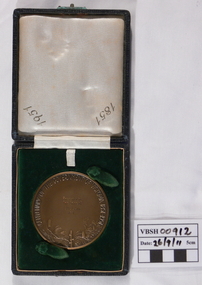
Plaque - Plaque. Centenary of Government and Gold discovery, 1951
... The item is a Plaque struck in 1951 to celebrate the Centenary of Government in Victoria and the Centenary of the discovery of gold....It is a 1951 Commemorative Plaque to mark the Centenary of Government in Victoria and Centenary of the Discovery of Gold. There is a printed insert card describing the obverse and reverse sides of the Medallion....Centenary of Government and Gold discovery. The Government of Victoria. ...The item is a Plaque struck in 1951 to celebrate the Centenary of Government in Victoria and the Centenary of the discovery of gold.A round bronze medallion set in a green baize lift out in a black presentation case. It is a 1951 Commemorative Plaque to mark the Centenary of Government in Victoria and Centenary of the Discovery of Gold. There is a printed insert card describing the obverse and reverse sides of the Medallion."Presented to the Shire of Ballan 1951" is engraved on the reverse side. "1851" and "1951" are marked on the lining of the cover of the box.medallion, plaque, shire of ballan, centenary of government -
 Warrnambool and District Historical Society Inc.
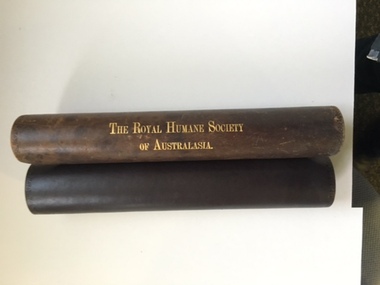
Certificate, Royal Human Society, 1921
... The text sits within a border with coats of Arms at the top The certificate sits on a paper lined brown leather scroll with gold lettering on the outside. ...The Royal Humane Society of Australasia in gold lettering on the outside.awarded to leslie Arthur Tinker16th June 1921 Nestor jan 9, 1921 Mason Firth and McCutcheon on the bottom of the certificate. ...The text sits within a border with coats of Arms at the top The certificate sits on a paper lined brown leather scroll with gold lettering on the outside. Royal Human Society Certificate ...This item is a Certificate of Merit awarded to Leslie Arthur Tinker for bravery in risking his life in going to the rescue of passengers on the motor launch "Nestor " on the Hopkins River at Warrnambool On January 09 1921. Leslie Arthur Tinker was 31 years of age at the time of this rescue of passengers from the launch"Nestor". Les Tinker was the third son of Jessie and Frank Tinker. He was caretaker at the Town Hall for many years and lived on site. He was married to Elsie Moore and they had one son Donald born 1928. The sinking of the Nestor claimed 10 lives in Warrnambool that day and was a tragedy for Warrnambool. Two long remaining survivors were Janet Glass Dickson who died in 2011 at 97 years of age and A Mr Jim Russell who was still living in Warrnambool in 2011 at the age of 94.This certificate has strong historical and social significance with strong links to one of Warrnambool's larger families. The event itself was a tragedy for Warrnambool with ten people losing their lives. The award comes from The Royal Humane Society of Australasia and as such is a national recognition. Cream parchment certificate with black text. The text sits within a border with coats of Arms at the top The certificate sits on a paper lined brown leather scroll with gold lettering on the outside. The Royal Humane Society of Australasia in gold lettering on the outside.awarded to leslie Arthur Tinker16th June 1921 Nestor jan 9, 1921 Mason Firth and McCutcheon on the bottom of the certificate. Signed by George Lush and Thomas Brentnall. warrnambool, leslie tinker, royal humane society, nestor rescue, nestor warrnambool, certificate of merit tinker -
 Lara RSL Sub Branch
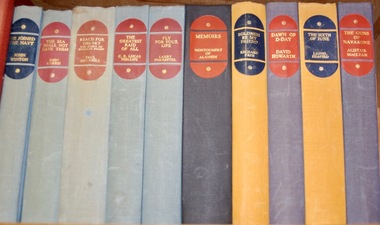
Book Series, We Joined the Navy John Winton, 1939 this copy 1960
... On the spine is the name of the book in gold writing with dark oliptical marking with gold stars in the top and bottom...john winton novel companion book club companion novel navy On the spine is the name of the book in gold writing with dark oliptical marking with gold stars in the top and bottom Blue book in good faded condition of paper and cardboard covers We Joined the Navy John Winton Book Series ...Blue book in good faded condition of paper and cardboard coversOn the spine is the name of the book in gold writing with dark oliptical marking with gold stars in the top and bottomjohn winton novel companion book club, companion, novel, navy -
 Disability Sport & Recreation Victoria
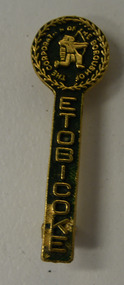
Lapel pin, The Corporation of the Borough of Etobicoke, 1975
... Image (in gold) of an archer and the words "The Corporation of the Borough of Etobicoke", also in gold, on a dark green background....Quite how this and related items from that anniversary entered the collection of Disability Sports and Recreation Victoria is unknown. the corporation of the borough of etobicoke Image (in gold) of an archer and the words "The Corporation of the Borough of Etobicoke", also in gold, on a dark green background. ...Etobicoke - then on the outskirts of Toronto, and now a part of Toronto proper - was designated as a borough between 1967-1984. It celebrated its 125th anniversary in 1975. Quite how this and related items from that anniversary entered the collection of Disability Sports and Recreation Victoria is unknown.Elongated lapel pin - round top third, rectangular bottom two thirdsImage (in gold) of an archer and the words "The Corporation of the Borough of Etobicoke", also in gold, on a dark green background.the corporation of the borough of etobicoke -
 Bendigo Historical Society Inc.
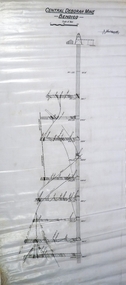
Plan - Central Deborah Gold Mine, 22.10.45
... ...gold...CENTRAL DEBORAH GOLD MINE 76 VIOLET STREET BENDIGO, GREATER BENDIGO CITY: The Central Deborah Gold Mine was developed from 1939 and operated as a working mine until 1954. ...Transverse section of Central Deborah Gold Mine, Bendigo. Printed on top in bold black text: ' Central Deborah Mine Bendigo'. ...CENTRAL DEBORAH GOLD MINE 76 VIOLET STREET BENDIGO, GREATER BENDIGO CITY: The Central Deborah Gold Mine was developed from 1939 and operated as a working mine until 1954. ...CENTRAL DEBORAH GOLD MINE 76 VIOLET STREET BENDIGO, GREATER BENDIGO CITY: The Central Deborah Gold Mine was developed from 1939 and operated as a working mine until 1954. The mine was one of a minority that continued to function during the Second World War. In 1939 the mine boasted a small timber poppet head, boiler steam winch, compressor, blacksmith shop, store, change rooms, and offices. Between 1945-46 the company upgraded the mine with extensions to sheds and the installation of new steam machinery, electric air compressor, steel poppet head, and ore bins. The Central Deborah Gold Mine is historically significant for its ability to demonstrate the tangible and important links to twentieth century quartz mining. It is of outstanding historical significance as the last intact and working example of the 5,500 quartz mines that won Bendigo widespread fame as a gold mining centre. At one time Bendigo had the world’s deepest shafts. Of particular importance are original buildings, fittings and mining machinery that document the mine’s character from 1939 to 1954. (Criterion A) The Central Deborah Gold Mine is archaeologically significant for its ability and potential to illustrate important aspects of early twentieth century mining. The physical evidence at the site has excellent interpretative value and the ability to answer archaeological research questions. (Criterion C) The Central Deborah Gold Mine is significant as a notable and fine example of the class of twentieth century quartz mine. The working machinery—including a Cornish boiler, winding engine and two compressors—comprise one of the few publicly accessible and in situ collections in the State. Central Deborah Company Gold Mine is now a popular tourist mine and a living part of the story of gold mining in Australia. Its historic mining equipment is still functional, and several levels underground are accessible to visitors. (Victorian Heritage Database: https://vhd.heritagecouncil.vic.gov.au/places/5996) Transverse section of Central Deborah Gold Mine, Bendigo. Printed on top in bold black text: ' Central Deborah Mine Bendigo'. Handwritten on plan: J.Caldwell 12.10.45 Plan forms part of the Margaret Roberts Collection.gold mining, gold, bendigo, central deborah gold mine, transverse -
 Kiewa Valley Historical Society
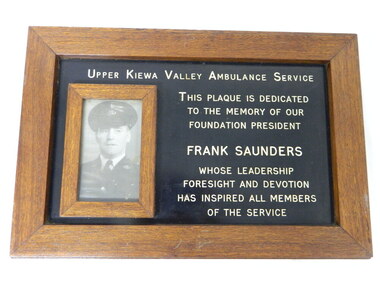
Plaque - Ambulance Service
... This brown wooden framed plaque is backed by masonite and surrounds a black metal sign with gold lettering beside which there is a photo of a Frank Saunders. ...Metal plate with gold letters in capitals: "Upper Kiewa Valley Ambulance Service / This Plaque is Dedicated / to the Memory of our / Foundation President / Frank Saunders / whose Leadership / Foresight and Devotion / has Inspired all Members/ of the Service"...April 1940.) frank saunders. ambulance. upper kiewa. Metal plate with gold letters in capitals: "Upper Kiewa Valley Ambulance Service / This Plaque is Dedicated / to the Memory of our / Foundation President / Frank Saunders / whose Leadership / Foresight and Devotion / has Inspired all Members/ of the Service" This brown wooden framed plaque is backed by masonite and surrounds a black metal sign with gold lettering beside which there is a photo of a Frank Saunders. ...Frank Saunders was the foundation president of the Upper Kiewa Valley Ambulance Service. There was an Ambulance service in the Upper Kiewa Valley commencing in April 1940 when a four stretcher ambulance was made available on the Kiewa Hydro Electric Scheme. It was designed for comparatively long and rough trips, involving some departures from usual ambulance design. Companies involved were O/C Motor Vehicles (Mr Frank Stone), in collaboration with the builders, Messrs. Jas. Thompson & Co. of South Yarra. (Ref. SECV magazine. April 1940.)This brown wooden framed plaque is backed by masonite and surrounds a black metal sign with gold lettering beside which there is a photo of a Frank Saunders. The photo is also framed with wood.Metal plate with gold letters in capitals: "Upper Kiewa Valley Ambulance Service / This Plaque is Dedicated / to the Memory of our / Foundation President / Frank Saunders / whose Leadership / Foresight and Devotion / has Inspired all Members/ of the Service"frank saunders. ambulance. upper kiewa. -
 Emerald Museum & Nobelius Heritage Park
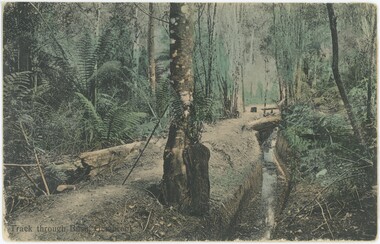
Postcard, Victoria Stamp Market, Track through Bush, c. 1905
... Gold mining in Emerald was most popular in the 1850s and 60s. ...Obverse, Caption: "Track through Bush, Gembrook" Reverse: Handwritten Annotation: "Water race along the Menzies Creek / near A'Vard Park. / GOLD" Printed Label, Vertical: "Printed in Prussia" Printed Label, Horizontal: "V.S.M. ...Gold mining in Emerald was most popular in the 1850s and 60s. ...While the caption on this postcard says 'Gembrook', this photograph is believed to be from Menzies Creek (where VEMUP0840.1 and VEMUP0840.3 were taken). Menzies Creek does not run to Gembrook; it diverges from Woori Yallock Creek at Butterfield Reserve in Emerald and then runs to the town of Menzies Creek. This makes it more likely that this photograph is from Emerald or Menzies Creek, with the annotation on the reverse suggesting it was near A'Vard Park (where Menzies Creek intersects A'Vard Road) and therefore in Emerald. It is part of Melbourne's V.S.M. (Victoria Stamp Market) Series, printed in Prussia, Germany alongside several similar hand-coloured postcards in our collection. This postcard is believed to originate from c. 1905, but the image itself - depicting a gold washing bath on Menzies Creek - might be older. Gold mining in Emerald was most popular in the 1850s and 60s. However, gold mining on Menzies Creek reopened in the 1890s depression, which is a more likely source of this photograph.This postcard is significant for its relative uniqueness as a colourised depiction of Emerald's gold mining history.This item is a hand-coloured photographic postcard. The reverse has empty message, stamp, and address sections, with a small handwritten annotation in pencil and printed publication information. The photograph is accompanied by a printed caption in the bottom-left. It depicts a walking track running alongside a channel or creek, with both approaching from the centre of the background to the left of the foreground. They are surrounded on either side by trees, shrubs, and ferns. The paper of the reverse is slightly yellowed.Obverse, Caption: "Track through Bush, Gembrook" Reverse: Handwritten Annotation: "Water race along the Menzies Creek / near A'Vard Park. / GOLD" Printed Label, Vertical: "Printed in Prussia" Printed Label, Horizontal: "V.S.M. Series, Melbourne"1890s, emerald, gold mining -
 Bendigo Military Museum
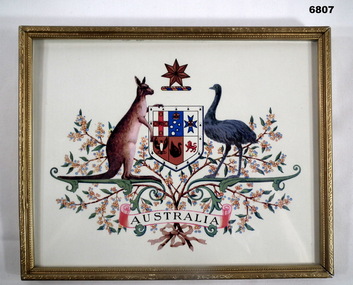
Print - PRINT, FRAMED, COAT of ARMS, Unknown
... Wreath colours of gold and blue are colours of Australia's livery and shield held up by native animals of Kangaroo and Emu....Gold ornate metallic frame with a coloured print of Australian Coat of Arms (Wreath of gold and blue with Kangaroo and Emu holding a shield and at top a 7 pointed star). ...Stamp on back stating "Passchendaele Barracks Trust". Gold ornate metallic frame with a coloured print of Australian Coat of Arms (Wreath of gold and blue with Kangaroo and Emu holding a shield and at top a 7 pointed star). ...Seven point star represents 6 states and 7th for Territorial shield has 6 symbols for each of 6 states. Wreath colours of gold and blue are colours of Australia's livery and shield held up by native animals of Kangaroo and Emu.Gold ornate metallic frame with a coloured print of Australian Coat of Arms (Wreath of gold and blue with Kangaroo and Emu holding a shield and at top a 7 pointed star). Is in colour on a white background. Image has glass protection and frame has hard cardboard backing with a hook on either side connected with a length of copper hanging wire. Coat of Arms with "Australia" at bottom. Stamp on back stating "Passchendaele Barracks Trust".coat of arms, passchendaele barracks trust -
 City of Warrnambool Rowing Club
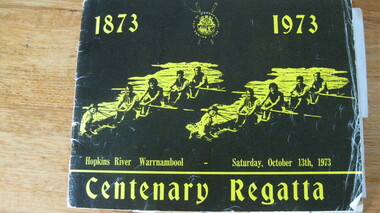
Rowing Program, Title Centenary regatta, 1873 1973 : Hopkins River, Warrnambool, Saturday, October 13th, 1973 / City of Warrnambool Rowing Club
... Black and gold colored rowing program- containing historical information about the Warrnambool Rowing Club, race events for the regatta and advertisements. ...Black and gold colored rowing program- containing historical information about the Warrnambool Rowing Club, race events for the regatta and advertisements....Black and gold colored rowing program- containing historical information about the Warrnambool Rowing Club, race events for the regatta and advertisements. ...Black and gold colored rowing program- containing historical information about the Warrnambool Rowing Club, race events for the regatta and advertisements. Another copy is in the state library of new south wales Mitchell Library - Onsite Storage Q797.123/2 REQUEST ITEMBlack and gold colored rowing program- containing historical information about the Warrnambool Rowing Club, race events for the regatta and advertisements.city of warrnambool rowing club, warrnambool rowing club, hopkins river warrnambool, regatta program, centenary regatta, rowing -
 Brighton Historical Society
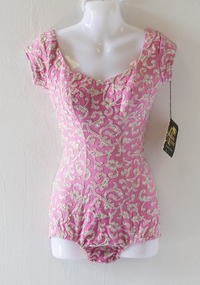
Swimsuit, late 1950s - early 1960s
... Sweetheart neckline and low-cut back with metal zip. A black and gold swing tag is attached to one sleeve....Back: gold with black text. “‘Limited Edition’”. ...Back: gold with black text. “‘Limited Edition’”. ...Ada of California was a Melbourne swimwear company founded in the early 1950s by Brighton locals Ada and Toni Murkies. Born in Poland in 1922, Ada was 17 when the Second World War reached her doorstep. She and her family were torn from their home by Soviet soldiers and sent to a brutal labour camp in Siberia as part of a series of mass deportations. In order to escape the horrific conditions of the camp, Ada and her sister Barbara joined the Soviet-backed Polish Army. During her time in the military she became close with a handsome young Jewish officer, Lieutenant Antoni Murkies, who later became her husband. After the war Toni was awarded 15 medals including the highest Polish military honour, the Virtuti Militari. Ada was awarded 10 medals, including the Order of the Cross of Grunwald. Emigrating to Australia as postwar refugees in 1948, Ada and Toni arrived in Melbourne with little to their name. Working initially in garment factories and building their connections, by the mid-1950s the couple were able to start a company of their own, with Ada designing the garments and Toni managing the business. Within ten years, Ada of California swimwear was being sold in department stores throughout Australia, and the Murkies family were able to build a permanent home of their own in Brighton. By the early 1980s they had acquired several other major labels, including Watersun. This swimsuit is believed to be one of a large quantity of samples, seconds and unsold Ada Productions stock donated to Brighton Historical Society in late 1990 by Brian Samuel, who worked at the company between 1979 and 1990.Pink short-sleeved one-piece swimsuit with silver lamé embellishment. Sweetheart neckline and low-cut back with metal zip. A black and gold swing tag is attached to one sleeve.Label in bra: “Ada OF CALIFORNIA / MIRACULOUS s-t-r-e-t-c-h BRI-NYLON / 34” Swing tag, front: black with gold text and palm tree logo. “Ada / OF CALIFORNIA / ‘Limited Edition’”. Back: gold with black text. “‘Limited Edition’”. Interior: “Congratulations on your choice of ADA OF CALIFORNIA ‘Limited Edition” Swimsuit contoured for your discriminating taste. / Style 546 / Size 34 / Price £11.9.6”. Care instructions also included.swimwear, ada productions, ada of california, ada murkies, toni murkies, melbourne designers -
 Hume City Civic Collection
Document - Address, Address to His Majesty King Edward V11
... It has a cloth cover with gold print on the front and the inside pages have signatures from leaders of cities, towns, boroughs and shires. ...A bound address with a blue cloth cover and gold print on the front to His Majesty King Edward V11....It has a cloth cover with gold print on the front and the inside pages have signatures from leaders of cities, towns, boroughs and shires. ...This is a printed address to His Majesty King Edward V11 swearing allegiance to him and wishing him a long reign on behalf of the Municipalities of Victoria dated 30 January 1901. It has a cloth cover with gold print on the front and the inside pages have signatures from leaders of cities, towns, boroughs and shires. It was produced by the Municipalities of Victoria in 1901.A bound address with a blue cloth cover and gold print on the front to His Majesty King Edward V11.1900s, municipal association of victoria, starkie joseph, daniel john -
 Bendigo Military Museum
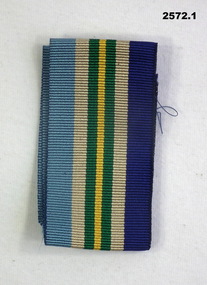
Accessory - MEDAL RIBBON & CONTAINERS, c.1992
... .1) Ribbon for Australian Service Medal 1945-75. .2) Wallet, green plastic with gold lettering on front: POW Medal Australia. .3) Case, covered in black leatherette, black felt & satin lining for Australian Service Medal 1945-75, contains .1). .4) Paper insert in green wallet giving details of POW commemorative medal history.....2) Gold letter on front: “POW / MEDAL / AUSTRALIA” .3) Silver lettering on lid: “AUSTRALIAN / SERVICE / MEDAL / 1945 - 1975”...See also Registration No 2347.2P containers personal effects military history .2) Gold letter on front: “POW / MEDAL / AUSTRALIA” .3) Silver lettering on lid: “AUSTRALIAN / SERVICE / MEDAL / 1945 - 1975” .1) Ribbon for Australian Service Medal 1945-75. .2) Wallet, green plastic with gold lettering on front: POW Medal Australia. .3) Case, covered in black leatherette, black felt & satin lining for Australian Service Medal 1945-75, contains .1). .4) Paper insert in green wallet giving details of POW commemorative medal history. ...See also Registration No 2347.2P.1) Ribbon for Australian Service Medal 1945-75. .2) Wallet, green plastic with gold lettering on front: POW Medal Australia. .3) Case, covered in black leatherette, black felt & satin lining for Australian Service Medal 1945-75, contains .1). .4) Paper insert in green wallet giving details of POW commemorative medal history..2) Gold letter on front: “POW / MEDAL / AUSTRALIA” .3) Silver lettering on lid: “AUSTRALIAN / SERVICE / MEDAL / 1945 - 1975”containers, personal effects, military history -
 Federation University Historical Collection
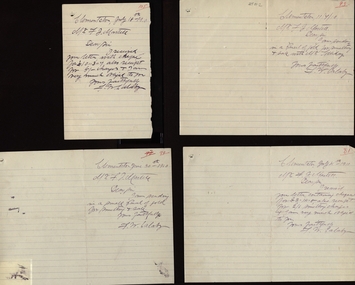
Letter, F.W. Calaby, Letters from F.W. Calaby to School of Mines Ballarat, 18/07/1910
... Clementston is a small gold town to the north of Creswick, Victoria. ...Martell Ser Sir, I am sending in a parcel of gold for smeling and sale with Mr Tolliday. ...Clementston is a small gold town to the north of Creswick, Victoria. ...Clementston is a small gold town to the north of Creswick, Victoria. Formerly known as Beaconsfield, the Beaconsfield gold mining mullock heap is probably the sole remaining remnant of the village.Hand written noteClemontston 11/7/1910 Mr F.W. Martell Ser Sir, I am sending in a parcel of gold for smeling and sale with Mr Tolliday. Yours Faithfully F.W. Calaby. Clemontston, July, 18th 1910 Mr F.J. Martell Dear Sir I received your letter with cheque for 10 poinds 3 shillings 7 pence, also receipt for 5 shillings charges and I am very much obliged to you. Yours faithfully F.W. Calabyf.w. calaby, frederick martell, clementston, beacsonfield -
 Bendigo Historical Society Inc.
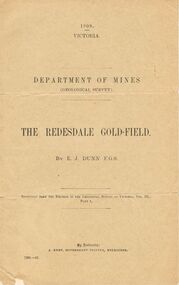
Document - MCCOLL, RANKIN AND STANISTREET COLLECTION: THE REDESDALE GOLDFIELD, 1909
... Reefs mentioned are the Horseshoe Bend Reef, Linda Reef, Bill Smith's workings, the Ben Guy Reef and the Amelia Reef...GOLD MINING Miners' Safety Cage Redesdale Goldfield Gold mining Redesdale. ...1909 report from the Department of Mines Geological Survey on the Redesdale Goldfield by E. J. Dunn. F.G.S. Reefs mentioned are the Horseshoe Bend Reef, Linda Reef, Bill Smith's workings, the Ben Guy Reef and the Amelia ReefDepartment of Minesgold mining, miners' safety cage, redesdale goldfield, gold mining, redesdale. -
 Royal Australian and New Zealand College of Obstetricians & Gynaecologists (RANZCOG)
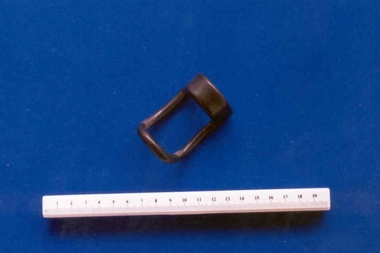
Galabin's Anteversion cradle pessary associated with Dr Frank Forster, c. 1870 to 1930
... Seen vertically the object resembles a horseshoe. The front section of the cradle is much thicker than the moulded curve of the pessary. ...Seen vertically the object resembles a horseshoe. The front section of the cradle is much thicker than the moulded curve of the pessary. ...Black vulcanite pessary. Seen vertically the object resembles a horseshoe. The front section of the cradle is much thicker than the moulded curve of the pessary. Label, typed "GALABIN'S ANTEVERSION PESSARY" and tag with string "Galabin's ante/version/ pessary".intrauterine device, pessary -
 Wangaratta High School
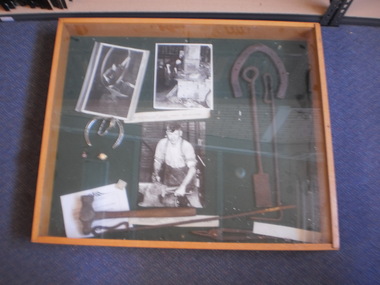
Mervyn 'Banjo' Harris blacksmith display box, 1927
... Contains three black and white images of Mervyn Harris and his metalwork, along with a horseshoe, hammer, pliers and various other blacksmith tools and some printed description labels....Contains three black and white images of Mervyn Harris and his metalwork, along with a horseshoe, hammer, pliers and various other blacksmith tools and some printed description labels. ...Wood and Glass display box with green felt lining. Contains three black and white images of Mervyn Harris and his metalwork, along with a horseshoe, hammer, pliers and various other blacksmith tools and some printed description labels. -
 Whitehorse Historical Society Inc.
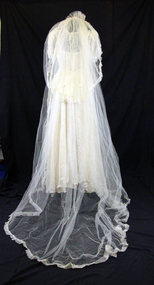
Clothing - Wedding Veil, 1948
... See also knickers NA4921, Negligee Set NA4922, Wedding Dress NA4923, Horseshoes NA4924...See also knickers NA4921, Negligee Set NA4922, Wedding Dress NA4923, Horseshoes NA4924 Clothing Wedding Veil ...Wedding held 13 March 1948 at Church of England, Thornbury, Victoria. Charlotte Edith (Tottie) Tooke nee Ryder (Maurice Wyatt's aunt) to Alfred George Tooke b. 1898 d. 1998 England1948 Long Tulle cream wedding veil with pleated edges and short face veil attached to a ruffled edge decorative headpiece. See also knickers NA4921, Negligee Set NA4922, Wedding Dress NA4923, Horseshoes NA4924costume, female ceremonial, wyatt m -
Clunes Museum
Book - BIOGRAPHY, LES HUGHES, A YOUNG AUSTRALIAN PIONEER HENRY MUNDY, 2003
... HE ARRIVED IN AUSTRALIA IN 1844, JOINED THE GOLD RUSH. HE WAS IN BALLARAT DURING THE EUREKA STOCKADE...DARK BLUE HARDCOVER BOOK WITH GOLD EMBOSSING ON SPINE: "HENRY MUNDY A YOUNG AUSTRALIAN PIONEER". ...HE ARRIVED IN AUSTRALIA IN 1844, JOINED THE GOLD RUSH. HE WAS IN BALLARAT DURING THE EUREKA STOCKADE HENRY MUNDY LES HUGHES HISTORICAL AUTOBIOGRAPHY THE BIOGRAPHY OF HENRY MUNDY ABOUT HIS LIFE IN AUSTRALIA DURING THE GOLDRUSH DARK BLUE HARDCOVER BOOK WITH GOLD EMBOSSING ON SPINE: "HENRY MUNDY A YOUNG AUSTRALIAN PIONEER". ...THE BIOGRAPHY OF HENRY MUNDY ABOUT HIS LIFE IN AUSTRALIA DURING THE GOLDRUSHDARK BLUE HARDCOVER BOOK WITH GOLD EMBOSSING ON SPINE: "HENRY MUNDY A YOUNG AUSTRALIAN PIONEER". BLUE PAPER DUST COVER WITH SUNSET PICTURE ON FRONT. 279 PAGES non-fictionTHE BIOGRAPHY OF HENRY MUNDY ABOUT HIS LIFE IN AUSTRALIA DURING THE GOLDRUSHhenry mundy, les hughes, historical autobiography -
 Flagstaff Hill Maritime Museum and Village
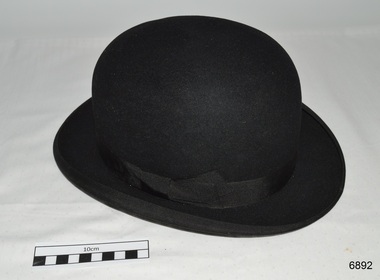
Hat, early to mid 20th century
... Sold by Henry Buck Pty Ltd, Gentlemen's Outfitters, Melbourne. Gold embossed labels on sweatband and lining. ...Sweatband has punched letters “W R A” and gold embossed ‘PURE FUR FELT / Made in England” and "[logo] the sign of excellence. ...Sold by Henry Buck Pty Ltd, Gentlemen's Outfitters, Melbourne. Gold embossed labels on sweatband and lining. ...This felt bowler hat was partof Dr Angus' wardrobe. It was donated to Flagstaff Hill Maritime Village by the family of Doctor William Roy Angus, Surgeon and Oculist. It is part of the “W.R. Angus Collection” includes historical medical equipment, surgical instruments and material once belonging to Dr Edward Ryan and Dr Thomas Francis Ryan, (both of Nhill, Victoria) as well as Dr Angus’ own belongings. The Collection’s history spans the medical practices of the two Doctors Ryan, from 1885-1926 plus that of Dr Angus, up until 1969. ABOUT THE “W.R.ANGUS COLLECTION” Doctor William Roy Angus M.B., B.S., Adel., 1923, F.R.C.S. Edin.,1928 (also known as Dr Roy Angus) was born in Murrumbeena, Victoria in 1901 and lived until 1970. He qualified as a doctor in 1923 at University of Adelaide, was Resident Medical Officer at the Royal Adelaide Hospital in 1924 and for a period was house surgeon to Sir (then Mr.) Henry Simpson Newland. Dr Angus was briefly an Assistant to Dr Riddell of Kapunda, then commenced private practice at Curramulka, Yorke Peninsula, SA, where he was physician, surgeon and chemist. In 1926, he was appointed as new Medical Assistant to Dr Thomas Francis Ryan (T.F. Ryan, or Tom), in Nhill, Victoria, where his experiences included radiology and pharmacy. In 1927 he was Acting House Surgeon in Dr Tom Ryan’s absence. Dr Angus had become engaged to Gladys Forsyth and they decided he further his studies overseas in the UK in 1927. He studied at London University College Hospital and at Edinburgh Royal Infirmary and in 1928, was awarded FRCS (Fellow from the Royal College of Surgeons), Edinburgh. He worked his passage back to Australia as a Ship’s Surgeon on the on the Australian Commonwealth Line’s T.S.S. Largs Bay. Dr Angus married Gladys in 1929, in Ballarat. (They went on to have one son (Graham 1932, born in SA) and two daughters (Helen (died 12/07/1996) and Berenice (Berry), both born at Mira, Nhill ) According to Berry, her mother Gladys made a lot of their clothes. She was very talented and did some lovely embroidery including lingerie for her trousseau and beautifully handmade baby clothes. Dr Angus was a ‘flying doctor’ for the A.I.M. (Australian Inland Ministry) Aerial Medical Service in 1928 . Its first station was in the remote town of Oodnadatta, where Dr Angus was stationed. He was locum tenens there on North-South Railway at 21 Mile Camp. He took up this ‘flying doctor’ position in response to a call from Dr John Flynn; the organisation was later known as the Flying Doctor Service, then the Royal Flying Doctor Service. A lot of his work during this time involved dental surgery also. Between 1928-1932 he was surgeon at the Curramulka Hospital, Yorke Peninsula, South Australia. In 1933 Dr Angus returned to Nhill and purchased a share of the Nelson Street practice and Mira hospital (a 2 bed ward at the Nelson Street Practice) from Dr Les Middleton one of the Middleton Brothers, the current owners of what previously once Dr Tom Ryan’s practice. Dr Tom and his brother had worked as surgeons included eye surgery. Dr Tom Ryan performed many of his operations in the Mira private hospital on his premises. He had been House Surgeon at the Nhill Hospital 1902-1926. Dr Tom Ryan had one of the only two pieces of radiology equipment in Victoria during his practicing years – The Royal Melbourne Hospital had the other one. Over the years Dr Tom Ryan had gradually set up what was effectively a training school for country general-practitioner-surgeons. Each patient was carefully examined, including using the X-ray machine, and any surgery was discussed and planned with Dr Ryan’s assistants several days in advance. Dr Angus gained experience in using the X-ray machine there during his time as assistant to Dr Ryan. When Dr Angus bought into the Nelson Street premises in Nhill he was also appointed as the Nhill Hospital’s Honorary House Surgeon 1933-1938. His practitioner’s plate from his Nhill surgery is now mounted on the doorway to the Port Medical Office at Flagstaff Hill Maritime Village, Warrnambool. When Dr Angus took up practice in the Dr Edward and Dr Tom Ryan’s old premises he obtained their extensive collection of historical medical equipment and materials spanning 1884-1926. A large part of this collection is now on display at the Port Medical Office at Flagstaff Hill Maritime Village in Warrnambool. In 1939 Dr Angus and his family moved to Warrnambool where he purchased “Birchwood,” the 1852 home and medical practice of Dr John Hunter Henderson, at 214 Koroit Street. (This property was sold in1965 to the State Government and is now the site of the Warrnambool Police Station. and an ALDI sore is on the land that was once their tennis court). The Angus family was able to afford gardeners, cooks and maids; their home was a popular place for visiting dignitaries to stay whilst visiting Warrnambool. Dr Angus had his own silk worm farm at home in a Mulberry tree. His young daughter used his centrifuge for spinning the silk. Dr Angus was appointed on a part-time basis as Port Medical Officer (Health Officer) in Warrnambool and held this position until the 1940’s when the government no longer required the service of a Port Medical Officer in Warrnambool; he was thus Warrnambool’s last serving Port Medical Officer. (Masters of immigrant ships arriving in port reported incidents of diseases, illness and death and the Port Medical Officer made a decision on whether the ship required Quarantine and for how long, in this way preventing contagious illness from spreading from new immigrants to the residents already in the colony.) Dr Angus was a member of the Australian Medical Association, for 35 years and surgeon at the Warrnambool Base Hospital 1939-1942, He served with the Australian Department of Defence as a Surgeon Captain during WWII 1942-45, in Ballarat, Victoria, and in Bonegilla, N.S.W., completing his service just before the end of the war due to suffering from a heart attack. During his convalescence he carved an intricate and ‘most artistic’ chess set from the material that dentures were made from. He then studied ophthalmology at the Royal Melbourne Eye and Ear Hospital and created cosmetically superior artificial eyes by pioneering using the intrascleral cartilage. Angus received accolades from the Ophthalmological Society of Australasia for this work. He returned to Warrnambool to commence practice as an ophthalmologist, pioneering in artificial eye improvements. He was Honorary Consultant Ophthalmologist to Warrnambool Base Hospital for 31 years. He made monthly visits to Portland as a visiting surgeon, to perform eye surgery. He represented the Victorian South-West subdivision of the Australian Medical Association as its secretary between 1949 and 1956 and as chairman from 1956 to 1958. In 1968 Dr Angus was elected member of Spain’s Barraquer Institute of Barcelona after his research work in Intrasclearal cartilage grafting, becoming one of the few Australian ophthalmologists to receive this honour, and in the following year presented his final paper on Living Intrasclearal Cartilage Implants at the Inaugural Meeting of the Australian College of Ophthalmologists in Melbourne In his personal life Dr Angus was a Presbyterian and treated Sunday as a Sabbath, a day of rest. He would visit 3 or 4 country patients on a Sunday, taking his children along ‘for the ride’ and to visit with him. Sunday evenings he would play the pianola and sing Scottish songs to his family. One of Dr Angus’ patients was Margaret MacKenzie, author of a book on local shipwrecks that she’d seen as an eye witness from the late 1880’s in Peterborough, Victoria. In the early 1950’s Dr Angus, painted a picture of a shipwreck for the cover jacket of Margaret’s book, Shipwrecks and More Shipwrecks. She was blind in later life and her daughter wrote the actual book for her. Dr Angus and his wife Gladys were very involved in Warrnambool’s society with a strong interest in civic affairs. He had an interest in people and the community They were both involved in the creation of Flagstaff Hill, including the layout of the gardens. After his death (28th March 1970) his family requested his practitioner’s plate, medical instruments and some personal belongings be displayed in the Port Medical Office surgery at Flagstaff Hill Maritime Village, and be called the “W. R. Angus Collection”. The W.R. Angus Collection is significant for still being located at the site it is connected with, Doctor Angus being the last Port Medical Officer in Warrnambool. The collection of medical instruments and other equipment is culturally significant, being an historical example of medicine from late 19th to mid-20th century. Dr Angus assisted Dr Tom Ryan, a pioneer in the use of X-rays and in ocular surgery. Black bowler hat, part of the W.R. Angus Collection. English made gentleman's bowler hat, black pure fur felt, black ribbon hatband, brown leather sweatband, coffee coloured silk lining. Dr Angus' initiials W.R.A. punched into leather sweatband. Sold by Henry Buck Pty Ltd, Gentlemen's Outfitters, Melbourne. Gold embossed labels on sweatband and lining. Lining also has Australia’s Coat of Arms. Sweatband has punched letters “W R A” and gold embossed ‘PURE FUR FELT / Made in England” and "[logo] the sign of excellence. Stamped on linng, gold embossed “HENRY BUCK PTY LTD / Gentlemen’s Outfitters / 76 Swanston St Melbourne” and logo of Australia’s Coat of Arms. flagstaff hill, warrnambool, shipwrecked coast, flagstaff hill maritime museum, maritime museum, shipwreck coast, flagstaff hill maritime village, great ocean road, dr w r angus, dr ryan, surgical instrument, t.s.s. largs bay, warrnambool base hospital, nhill base hospital, mira hospital, flying doctor, felt bowler het, gentleman's hat, dr w.r. angus wardrobe, formal wear hat, henry buck pty ltd melbourne -
 Ballarat Tramway Museum
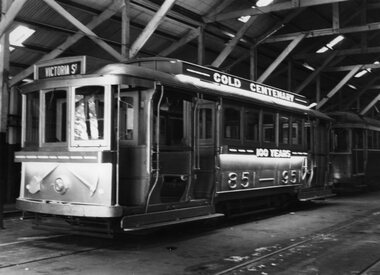
Photograph - SECV Ballarat 23 as the Gold Tram in depot, Keith Kings, 19.8.1951
... ... Gold...Photograph of SEC Tram No. 23, painted up for the Centenary of Gold. Photographed inside the depot with bogie tram No. 15 behind. ...E (x)(1) Copyright reserved" and "Victoria commemorated the centenary of the discovery of gold in 1951 with various exhibitions and celebrations. ...Photograph of SEC Tram No. 23, painted up for the Centenary of Gold. Photographed inside the depot with bogie tram No. 15 behind. ...Photograph of SEC Tram No. 23, painted up for the Centenary of Gold. Photographed inside the depot with bogie tram No. 15 behind. Photographed 19/8/1951, by Keith Kings. Tram showing destination of Victoria St. i1 - scan of original print collected i2 - scan of print in the Wal Jack album - two copies held. 2nd one ex Keith Kings i3 - scan of the rear of the print in the album i4 - hi res scan of print in album See item 1378A for a larger format copy.Yields information about Ballarat 's No. 23 illuminated in the depot and arrangements within the depot at the time of the photograph.Black and white photograph with notes on the rear.On rear of photo in blue ink. "Ballarat: "K.S. Kings No. E (x)(1) Copyright reserved" and "Victoria commemorated the centenary of the discovery of gold in 1951 with various exhibitions and celebrations. The SEC decorated their Ballarat No. 23 as shown and painted it, appropriately gold. On the rear of the 6" x 4" print held in AS Box 78, hand-written wording reads: Ballarat. No.23 (ex Adelaide), as decorated and illuminated for Centenery of Discovery of Gold (1851-1951). 23/8/51. Depot. This view was taken inside the tram depot and shows the construction of the former horse tram shed." .1 - 'SEC Ballarat Car No. 23 decorated for Gold Celebrations 1951 (19.8.51)" and KS Kings stamp in top right hand corner with number "E(x)(i)" written in.trams, tramways, decorated trams, ballarat depot, buildings, gold, centenary of gold, tram 23 -
 Bendigo Military Museum
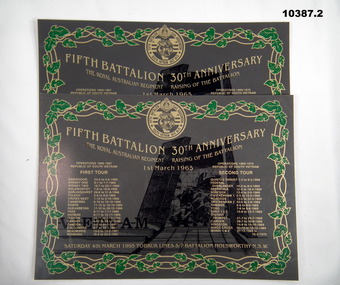
Memorabilia - FIFTH BATTALION, ARMY, The Royal Australian Regiment, 1995
... Extensive information in gold print....Information in large gold print. Top: "FIFTH BATTALION 30th ANNIVERSARY/ THE ROYAL AUSTRALIAN REGIMENT RAISING OF THE BATTALION/ 1st March 1965". ...Extensive information in gold print. Memorabilia FIFTH BATTALION, ARMY The Royal Australian Regiment ...1. & 2. Placemats - grey colour hard plastic rectangular shape mat. used as a dinner placemat for an Anniversary event. Gold, green and black colour print on grey background. Illustrated with "FIFTH BATTALION/ R.A.R. ASSOCIATION/ SOUTH VIETNAM 66-67, 69-70" with a tiger motto; border of intertwined vine leaves with silhouette style memorial in background. Extensive information in gold print.Information in large gold print. Top: "FIFTH BATTALION 30th ANNIVERSARY/ THE ROYAL AUSTRALIAN REGIMENT RAISING OF THE BATTALION/ 1st March 1965". Bottom: "SATURDAY 4th MARCH 1995 TOBRUK LINES 5/7 BATTALION HOLSWORTHY N.S.W.".memorabilia, fifth battalion, anniversary -
Whitehorse Historical Society Inc.
Document, Notes on Job. Hone, n.d
... One of the first people to discover gold at Avoca, returned to Box Hill in 1853 and bought land. ...Notes on Job Hone's arrival in Victoria in 1850, one of the first people to discover gold at Avoca, returned to Box Hill in 1853 and bought land. ...One of the first people to discover gold at Avoca, returned to Box Hill in 1853 and bought land. he assisted in establishing most of the churches in the area. ...Notes on Job Hone's arrival in Victoria in 1850.Notes on Job Hone's arrival in Victoria in 1850, one of the first people to discover gold at Avoca, returned to Box Hill in 1853 and bought land. he assisted in establishing most of the churches in the area.Notes on Job Hone's arrival in Victoria in 1850. hone, job, pioneers -
 Returned Nurses RSL Sub-branch
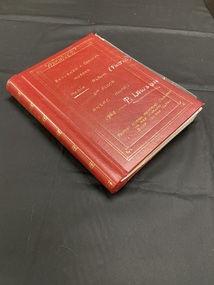
Album - Photograph and media album, Archives: Returned and Services Nurses Media Album, unknown
... Dark red spiral bound photograph album with gold ornate pattern down the spine. An ornate gold triple line border on the front cover with gold handwriting and additional inscriptions in silver marker. ...JAPAN.' [Hand written in gold ink on the front cover] 'SB / 9' [Hand written in silver ink on the spine] '(PHOTOS) / B.LAWSON' [handwritten in silver marker on the front cover]...An ornate gold triple line border on the front cover with gold handwriting and additional inscriptions in silver marker. ...A collection of media archived by the Returned and Services Nurses relating to Australian Army nurses and nursing. The collection includes: - newspaper clippings relating to nursing, nurses and the Australian Army Nursing Service, published between 1963-1999. - Programs and menu's from commemorative ceremonies for Returned Nurses - memorabilia from memorial services -handwritten profiles of nurses such as Lieutenant Bertha Alma Hewson - a typed account and photocopies of photos from Sister Kathleen Teresia Keely's wedding at Moratai - Annual reports - photos of 113 AGH Sisters in Darwin Dark red spiral bound photograph album with gold ornate pattern down the spine. An ornate gold triple line border on the front cover with gold handwriting and additional inscriptions in silver marker. The inside pages are paper with plastic pocket inserts across three quarters of each page, the remaining quarter of each page has lined memo sections to fill in. The album contains a variety of mixed media.' "ARCHIVES" / RETURNED + SERVICES / NURSES. / MEDIA ALBUM. / 2nd FLOOR / ANZAC HOUSE / 1963 / Photos: NURSES MEMORIAL CANBERRA / 113 AGH. DARWIN / BCOF. 130 AGH. JAPAN.' [Hand written in gold ink on the front cover] 'SB / 9' [Hand written in silver ink on the spine] '(PHOTOS) / B.LAWSON' [handwritten in silver marker on the front cover]royal australian army nursing corps, raanc, ceremonies, anniversaries, wwii, second world war, ww2, military nursing - australia, bertha alma hewson, 113 australian general hospital, australian army nursing service, aans, returned nurses, returned nurses members -
Bendigo Historical Society Inc.
Document - Printed Copy of Henry Frenchman's Family History by Geoffrey Rodda(2025)
... Henry Frensham was mentioned in the 1980 Select Legislative Assembly of the Colony of Victoria that was established to consider who first found gold in Bendigo. In his book "The Gold Rush That Never Ended", Geoffrey Blainey said Henry, Frencham a journalist in a red shirt and knee boots, using a nom-de-plume "Bendigo" announced the discovery of gold. ...Title Henry Frencham's "discovery" of Gold and his Family Tree. In a clear plastic folder, each double-sided page is in a separate clear plastic holder. ...Henry Frensham was mentioned in the 1980 Select Legislative Assembly of the Colony of Victoria that was established to consider who first found gold in Bendigo. In his book "The Gold Rush That Never Ended", Geoffrey Blainey said Henry, Frencham a journalist in a red shirt and knee boots, using a nom-de-plume "Bendigo" announced the discovery of gold. ...Henry Frensham was mentioned in the 1980 Select Legislative Assembly of the Colony of Victoria that was established to consider who first found gold in Bendigo. In his book "The Gold Rush That Never Ended", Geoffrey Blainey said Henry, Frencham a journalist in a red shirt and knee boots, using a nom-de-plume "Bendigo" announced the discovery of gold. He also claimed to have had a major role in the demonstration at Bendigo against the new three pound gold licence fee. In 1854 the Government charged the miners this fee and the miners started to rebel. Frisby & Mason Photography was located at 134 Bridge Road Richmond and was first listed there in 1887.A 24 page, A4 document beginning with page 5 to page 26. Title Henry Frencham's "discovery" of Gold and his Family Tree. In a clear plastic folder, each double-sided page is in a separate clear plastic holder. White pages with black print with black and white and colored photographs. henry frencham, first gold discovery -
 Melbourne Tram Museum
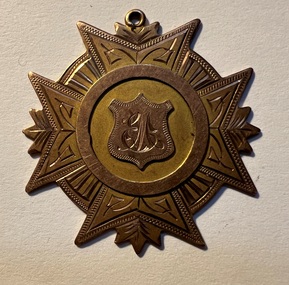
Badge - Medallion, Catanach Jewellers, Presented to E Murphy Malvern Tramways, c1915
... Gold Medallion 8 stars, with a shield in the centre which has been engraved "E M". ...Metal - 9ct gold - medallion engraved with the initials EM on the front and an engraving on the rear. ...Gold Medallion 8 stars, with a shield in the centre which has been engraved "E M". ...Gold Medallion 8 stars, with a shield in the centre which has been engraved "E M". On the rear engraved "Presented to E Murphy as a token of esteem from fellow employees at Malvern Tramways". On base stamped "Catanach" with three jewellers Hallmarks. Possibly c1915. Made for Catanach Jewellers of Melbourne, by based on the Hallmarks, by Willis & Sons of Melbourne, manufacturing jewellers.Demonstrates a gold medallion presentation by the Malvern Tramways (PMTT).Metal - 9ct gold - medallion engraved with the initials EM on the front and an engraving on the rear. Has an eyelet on the top.See imagemalvern, medallion, presentations, e murphy, catanach jewellers, willis & sons -
 Bendigo Military Museum
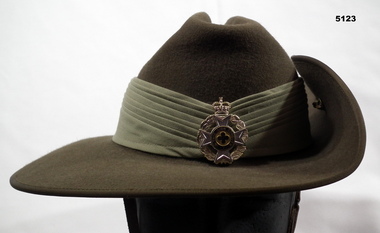
Headwear - HAT, SLOUCH, MOUNTCASTLE, 1991
... Brown felt Australian Army slouch hat with left hand brim pinned up and secured with a brass clip. A gold coloured plastic Rising Sun badge is attached. ...Stamped on the sweat band in gold lettering: '(upwards arrow), MOUNTCASTLE, 1991, MADE IN AUSTRALIA, 57'. ...Stamped on the sweat band in gold lettering: '(upwards arrow), MOUNTCASTLE, 1991, MADE IN AUSTRALIA, 57'. ...Part of the Reverend Chaplain Major Thomas Bruce Williams, No 556101, Collection.Brown felt Australian Army slouch hat with left hand brim pinned up and secured with a brass clip. A gold coloured plastic Rising Sun badge is attached. The seven fold khaki puggaree has an Army Christian Chaplain's badge attached on the front. The hat has a brown leather chin strap and brown leather sweat band.Stamped on the sweat band in gold lettering: '(upwards arrow), MOUNTCASTLE, 1991, MADE IN AUSTRALIA, 57'. On the Rising Sun badge: 'THE AUSTRALIAN ARMY'.headwear, slouch hat, army chaplain, major thomas b. williams. -
 Orbost & District Historical Society
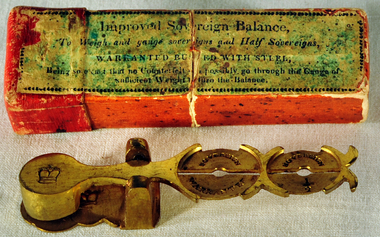
sovereign balance
... This simple brass see-saw balance was used to test the gold sovereign coin and its half for wear, and to detect counterfeit coins...Counterweighted desktop rocker tests for British gold Sovereigns and Half Sovereigns, both weight and thickness. ...Counterweighted desktop rocker tests for British gold Sovereigns and Half Sovereigns, both weight and thickness. ...This simple brass see-saw balance was used to test the gold sovereign coin and its half for wear, and to detect counterfeit coinsSovereigns and half sovereigns are no longer in use.A metal sovereign balance with two measuring plates and weight. Counterweighted desktop rocker tests for British gold Sovereigns and Half Sovereigns, both weight and thickness. It has the original green box with label on lid top.Front - sovereign - half - Askey's improved warranted - son -Bush'ssovereign-balance instrument weighing sovereign -
Clunes Museum
Book, Dictionary of Derivations of the English Language, Unknown
... The Golden Horse Shoe mine was reported to be one of the richest gold mines in Western Australia...Hardcover book with brown coloured cover. Title in gold is stamped into the spine, black ink printed border of fleur de lys on front cover surrounding the title printed in black ink....Title in gold is stamped into the spine, black ink printed border of fleur de lys on front cover surrounding the title printed in black ink. ...It appears Harrie Quayle moved to Boulder City, Western Australia as a man. The Golden Horse Shoe mine was reported to be one of the richest gold mines in Western AustraliaHardcover book with brown coloured cover. Title in gold is stamped into the spine, black ink printed border of fleur de lys on front cover surrounding the title printed in black ink.Various inscriptions: on second page, handwritten in pencil " Harrie Quayle, Smeaton Road, Clunes upper sixth class written in ink below this Harrie Quayle, North Clunes State School 1890 on last page handwritten in pencil "Harrie Quayle, Fireman, boulder city 1905 Golden Horse Shoereference book, north clunes primary school, quayle, fraser -
Frankston RSL Sub Branch
Plaque, 1974
... The plaque has a bust of Churchill in relief in the centre and the words "Author Statesman Soldier Artist 1874 Sir Winston Churchill 1965" in gold lettering around the circumference. The base has an inscription....The plaque has the following inscription: "AUTHOR - STATESMAN - SOLDIER - ARTIST 1874 - SIR WINSTON CHURCHILL - 1965" in gold lettering around the circumference. The base has the inscription (also in gold lettering): "CHURCHILL CENTENARY 1874 - 1974" "To commemorate the birth of Sir WINSTON CHURCHILL 30th November 1874" and "enthusiastic in debate, imperturbable in adversity and generous in triumph" "Her Majesty Queen Elizabeth II" ...leader churchill plaque wedgwood The plaque has the following inscription: "AUTHOR - STATESMAN - SOLDIER - ARTIST 1874 - SIR WINSTON CHURCHILL - 1965" in gold lettering around the circumference. The base has the inscription (also in gold lettering): "CHURCHILL CENTENARY 1874 - 1974" "To commemorate the birth of Sir WINSTON CHURCHILL 30th November 1874" and "enthusiastic in debate, imperturbable in adversity and generous in triumph" "Her Majesty Queen Elizabeth II" Black ceramic plaque made to commemorate the centenary of the birth of Sir Winston Churchill. ...Black ceramic plaque made to commemorate the centenary of the birth of Sir Winston Churchill. The plaque has a bust of Churchill in relief in the centre and the words "Author Statesman Soldier Artist 1874 Sir Winston Churchill 1965" in gold lettering around the circumference. The base has an inscription.The plaque has the following inscription: "AUTHOR - STATESMAN - SOLDIER - ARTIST 1874 - SIR WINSTON CHURCHILL - 1965" in gold lettering around the circumference. The base has the inscription (also in gold lettering): "CHURCHILL CENTENARY 1874 - 1974" "To commemorate the birth of Sir WINSTON CHURCHILL 30th November 1874" and "enthusiastic in debate, imperturbable in adversity and generous in triumph" "Her Majesty Queen Elizabeth II" leader, churchill, plaque, wedgwood -
 Bendigo Historical Society Inc.
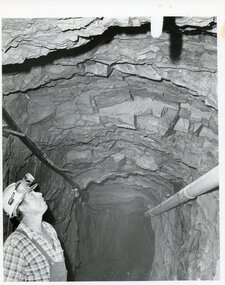
Photograph - AUSTIN COLLECTION: Central Deborah Gold Mine
... At its peak, Central Deborah Gold Mine reached a depth of 412 metres. It has 17 separate levels and 15 kilometres of drives and cross cuts (tunnels). ...Black and white photo of miner Ray Beer, wearing hard hat and mining lamp, checking mine roof at Central Deborah Gold Mine, Bendigo....Photograph AUSTIN COLLECTION: Central Deborah Gold Mine ...At its peak, Central Deborah Gold Mine reached a depth of 412 metres. It has 17 separate levels and 15 kilometres of drives and cross cuts (tunnels). The Central Deborah was very much a hands-on mine and the conditions that the miners worked in would be considered shocking by today's standards – being lowered underground in a cage with only two sides, often working ankle to knee deep in water, filling up to 32 ore trucks a shift by hand which were then pushed a mile or more along rails in the drives, working by carbide lamp, breathing in the fumes and rock dust and communication by bells. However, at the time working conditions were considered to be among the best on the goldfields at Central Deborah, after all it was one of the only mines that had hot showers. Following Central Deborah Gold Mine's closure, the Bendigo skyline began to noticeably change. Obvious remnants of mining such as poppet heads, engine rooms, service quarters, battery houses and chimneys were steadily disappearing. After intense lobbying by the local community, the Bendigo City Council purchased the still very much intact Central Deborah Gold Mine in 1970 for a mere $6,000 to ensure that a vital link to Bendigo's historic golden past was maintained. https://www.central-deborah.com/about-us/central-deborah-gold-mine-s-history Black and white photo of miner Ray Beer, wearing hard hat and mining lamp, checking mine roof at Central Deborah Gold Mine, Bendigo.mining, central deborah gold mine, ray beer
