
Showing 22695 items matching "hall-marks"
-
 Bendigo Historical Society Inc.
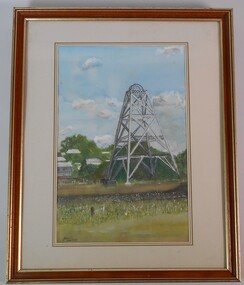
Painting - JOHN HALL COLLECTION: WATER COLOUR PAINTING GOLDFIELDS UNITED MINE, 2015
... Water colour painting by John Hall of Goldfields United mine poppet head in Collins St Golden Square....John Hall...ARTWORK Water colour gold mines John Hall Water colour painting by John Hall of Goldfields United mine poppet head in Collins St Golden Square. ...Water colour painting by John Hall of Goldfields United mine poppet head in Collins St Golden Square.John Hallartwork, water colour, gold mines -
 Clunes Museum
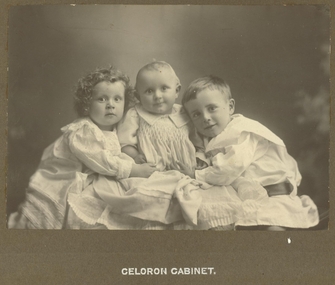
Photograph, FRASER STUDIO, LAZARUS CHILDREN
... BLACK AND WHITE PHOTOGRAPH OF LAZARUS CHILDREN - NAOMI, HARRY AND MARK ....LEFT TO RIGHT- NAOMI, HARRY AND MARK LAZARUS, CLUNES CELORON CABINET...local history photography photographs crick shrigley mc lennan lazarus LEFT TO RIGHT- NAOMI, HARRY AND MARK LAZARUS, CLUNES CELORON CABINET BLACK AND WHITE PHOTOGRAPH OF LAZARUS CHILDREN - NAOMI, HARRY AND MARK . ...BLACK AND WHITE PHOTOGRAPH OF LAZARUS CHILDREN - NAOMI, HARRY AND MARK .LEFT TO RIGHT- NAOMI, HARRY AND MARK LAZARUS, CLUNES CELORON CABINETlocal history, photography, photographs, crick, shrigley, mc lennan, lazarus -
 Mission to Seafarers Victoria
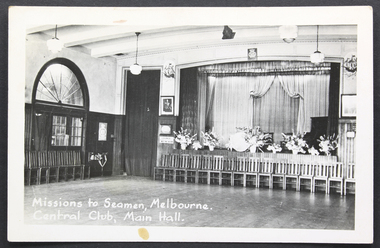
Postcard - Postcard, Black and white, KODAK, The Mission to Seamen, Melbourne - Central Hall, Main Hall, c. 1950 (pre 1952)
... The Mission to Seamen, Melbourne - Central Hall, Main Hall...The Mission to Seamen, Melbourne - Central Hall, Main Hall Postcard Postcard, Black and white KODAK ...One of a series of Mission to Seamen postcards produced in the immediate post-war and post WW2 period.Visual record of the club area of Mission to Seafarers, 717 Flinders Street, Melbourne in the 1950s (before Queen Elizabeth's corporation) ready for the dances.Black and white gloss postcard depicts the central club space. Taken facing stage with flowers on stage, a drum kit and a piano. Curtained backdrop with sixteen chairs in front of the proscenium. Shows dance floorboards and fan-shaped window above doorway on far left wall.Printed on back: 'POST CARD/CORRESPONDENCE ADDRESS ONLY/' . Stamp location is top right and is indicated by the word 'KODAK' on four sides.club, stage, mission to seafarers, seamen's mission, mission to seamen, main hall, dancing, events, curtains, royal portraits, king george vi, drums, piano, chairs, music, band -
 Mission to Seafarers Victoria
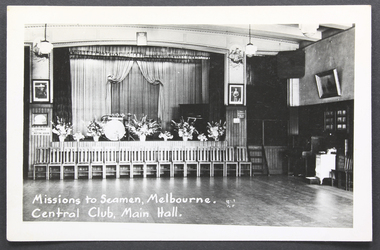
Postcard - Postcard, Black and white, KODAK, The Mission to Seamen, Melbourne - Central Hall, Main Hall, c. 1950
... The Mission to Seamen, Melbourne - Central Hall, Main Hall...The Mission to Seamen, Melbourne - Central Hall, Main Hall Postcard Postcard, Black and white KODAK ...One of a series of Mission to Seamen postcards produced in the immediate post-war and post WW2 period. Visual record of the club area in the 1950s (before Queen Elizabeth's coronation) ready for the dances.Black and white gloss postcard depicts the central club space facing stage with flowers on stage, a drum kit and a piano. Curtained backdrop with sixteen chairs in front of the proscenium. Shows dance floorboards. Note: Possible heater at far right of picture frame.Printed on back: 'POST CARD/CORRESPONDENCE ADDRESS ONLY/' . Stamp location is top right is indicated by the word 'KODAK' on four sides.stage, curtains, mission to seafarers, seamen's mission, main hall, dancing, events, concerts, band, flowers, drums, piano, paintings, royal portraits, flinders street, melbourne, mission to seamen, wood floor, writing room, heater, stairs, chairs, king george vi, queen mother -
 Eltham District Historical Society Inc
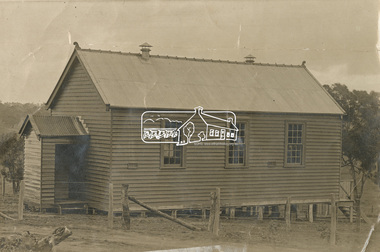
Photograph - Sepia Print, Unidentified hall; possibly the Montmorency Presbyterian Church Hall, Rattray Road, Greensborough, c.1918
... Unidentified hall; possibly the Montmorency Presbyterian Church Hall, Rattray Road, Greensborough...Montmorency Montmorency Presbyterian Church Hall Rattray Road Sepia pint, 10 x 14.6 cm, wrinkles and creases and evidence of paper adhered to lower edge Unidentified hall; possibly the Montmorency Presbyterian Church Hall, Rattray Road, Greensborough Photograph Sepia Print ...From Eltham Montmorency Uniting Church, History http://www.elthammontmorencyuca.org/history/ In 1914 a small group of Presbyterians living on 'The Montmorency Estate', which had been established when the railway was extended to Eltham several years before, began meeting for worship in the Rattray Rd home of Robert Sharpe. Two years later a small weatherboard church, administered from Scots Church, Heidelberg, was built on land donated by Mr. Sharpe. In 1931 this building was moved to the corner of Rattray Road and Mountain View Roads. In the next few years local elders were elected and the congregation adopted the name St. Andrew’s Presbyterian Church, Montmorency.montmorency, montmorency presbyterian church hall, rattray road -
 Eltham District Historical Society Inc
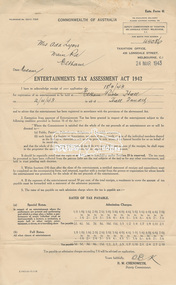
Receipt, Receipt (Entertainment Tax assessment Act 1942) of application dated 18 March 1943 to provide entertainment at Eltham Public Hall on April 2nd, 1943 in aid of Hall funds, 24 March 1943, 1943
... Receipt (Entertainment Tax assessment Act 1942) of application dated 18 March 1943 to provide entertainment at Eltham Public Hall on April 2nd, 1943 in aid of Hall funds, 24 March 1943...Arthur Street, Eltham Public Hall, Entertainment Tax Assements Act 1942, Main Road, Maria Street, mrs ada lyon, Receipt Foolscap paper preprinted form with ink handwriting Receipt (Entertainment Tax assessment Act 1942) of application dated 18 March 1943 to provide entertainment at Eltham Public Hall on April 2nd, 1943 in aid of Hall funds, 24 March 1943 Receipt ...Foolscap paper preprinted form with ink handwritingarthur street, eltham public hall, entertainment tax assements act 1942, main road, maria street, mrs ada lyon, receipt -
 Stawell Historical Society Inc
Archive - CD/DVD, Cox Family Images. Including WW2 images, Town Hall Hotel with Brass Band of Stawell and Town Hall with Stawell Brass and, 2013
... Including WW2 images, Town Hall Hotel with Brass Band of Stawell and Town Hall with Stawell Brass and...Including WW2 images, Town Hall Hotel with Brass Band of Stawell and Town Hall with Stawell Brass and Archive CD/DVD ...stawell -
 Ukrainian Historical Society Sunshine
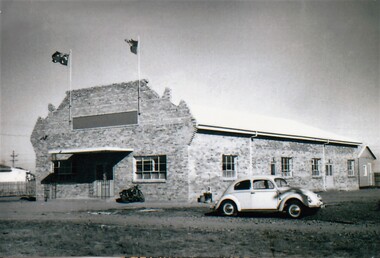
Photograph - photo, Ukrainian Hall in 1957 with school visible in back of hall
... Ukrainian Hall in 1957 with school visible in back of hall....Ukrainian Hall in 1957 with school visible in back of hall. ... -
 City of Ballarat Libraries
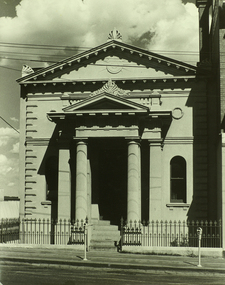
Photograph, Former Freemasons Hall, also known as Electra Hall
... Former Freemasons Hall, also known as Electra Hall...Erected 1872-74, this building now houses The Lost Ones Gallery. freemasons camp st, ballarat greek revival Former Freemasons Hall, also known as Electra Hall Photograph ...An image from the Herbert Richmond collection, gifted in 1982 to the Ballarat Library. The collection contains approximately 200 photographs of Ballarat and district in the 1940s, 50s and 60s, as well as photo albums, glass negatives and other memorabilia. Herb Richmond was a keen photographer, a foundation member and a life member of the Ballarat Camera Club, and a photographer with the Ballarat Courier during the 1940s. The Ballarat Camera Club named an annual award after him. Mr Richmond died in 1981 aged 79. These images were digitally re-photographed by members of the Ballarat Camera Club in September 2006. Erected 1872-74, this building now houses The Lost Ones Gallery.freemasons, camp st, ballarat, greek revival -
 Wonga Park Community Cottage History Group
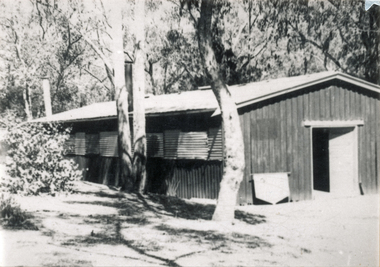
Photograph (sub-item) - Black and White, Rowallan Hall, 1984, built for the Scouts by voluntary labour on Yarra Brae, the site of both Pan-Pacific Jamborees in 1948 and 1955, and of the 1961 World Rover Moot. Now the Scout movement owns this hall and surrounding land
... Now the Scout movement owns this hall and surrounding land....Now the Scout movement owns this hall and surrounding land. Photograph Black and White ... -
Glenelg Shire Council Cultural Collection
Photograph - Photograph - Steele Hall, 1969
... Raymond Steele Hall is a former Australian politician. He was the premier of South Australia from 1968 until 1970....Black & white photo showing Steele Hall, Premier of South Australia, making a speech; man and lady on left, two men on right. ...Back: Blue photographers stamp, 69/1655 in pencil "Steele Hall speaking Tarragal delivery, Adelaide" - blue biro...Photograph Photograph - Steele Hall ...Raymond Steele Hall is a former Australian politician. He was the premier of South Australia from 1968 until 1970.Back: Blue photographers stamp, 69/1655 in pencil "Steele Hall speaking Tarragal delivery, Adelaide" - blue birosteele hall, politician, premier south australia, politics, portland -
 Ballarat Tramway Museum
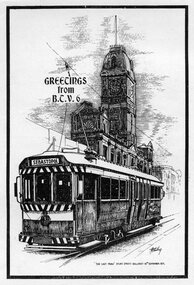
Drawing - Illustration/s, Gordon Thurling, B&W drawing of tram 39 and Ballarat Town Hall, 1971
... B&W drawing of tram 39 and Ballarat Town Hall...890.1 - black and white drawing of tram 39, with destination "Sebastopol" with Ballarat Town Hall in background. Has words "Greetings from BTV 6" by the top of the trolley pole and "The last tram Sturt St. ...Trams tramways 39 City of Ballarat BTV 6 Town Hall 890.1 - black and white drawing of tram 39, with destination "Sebastopol" with Ballarat Town Hall in background. ...890.1 - black and white drawing of tram 39, with destination "Sebastopol" with Ballarat Town Hall in background. Has words "Greetings from BTV 6" by the top of the trolley pole and "The last tram Sturt St. Ballarat - 19th September 1971" with a thick black border. Printed onto white paper with a slight gloss. Understood to be a copy of the drawing used on Ballarat TV channel 6's Christmas card for 1971. 890.2 - same drawing printed on one half of dark orange heavy paper, but without the words "from BTV6". Understood to be used as a Christmas card by the City of Ballarat for 1971. See btm6422 for a coloured large version. Original drawing by Gordon Thurling, BTV6 graphic artist at the time.trams, tramways, 39, city of ballarat, btv 6, town hall -
 Bendigo Historical Society Inc.
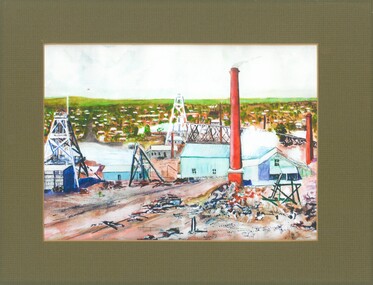
Photograph - JOHN HALL COLLECTION: COLOURED PHOTOGRAPH - CALIFORNIA GULLY MINE,MOUNTED
... Coloured photograph - California Gully mine John Hall - artist Photograph mounted with green border...John Hall, artist...John Hall California Gully Mine John Hall, artist Coloured photograph - California Gully mine John Hall - artist Photograph mounted with green border Photograph JOHN HALL COLLECTION: COLOURED PHOTOGRAPH - CALIFORNIA GULLY MINE,MOUNTED ...Coloured photograph - California Gully mine John Hall - artist Photograph mounted with green borderJohn Hall, artistjohn hall, california gully mine -
 Working Heritage Crown Land Collection
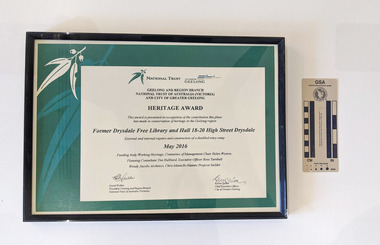
Award - former Drysdale Free Library Heritage Award, Former Drysdale Free Library and Hall 18-20 High Street Drysdale
... Former Drysdale Free Library and Hall 18-20 High Street Drysdale...National Trust, City of Greater Geelong, Geelong and Regional Branch National Trust of Australia (Victoria) and City of Greater Geelong, Heritage Award, This award is presented in recognition of the contribution this place has made to conservation of heritage in the Geelong region, Former Drysdale Free Library and Hall 18-20 High Street Drysdale, External and internal repairs and construction of a disabled entry ramp, May 2016m Funding body Working Heritage, Committee of Management Chair Helen Weston, Planning Construction Consultant Tim Hubbard, Executive Officer Ross Turnbull, Wendy Jacobs Architect, Chris Mantello Mantec Projects builder ...National Trust, City of Greater Geelong, Geelong and Regional Branch National Trust of Australia (Victoria) and City of Greater Geelong, Heritage Award, This award is presented in recognition of the contribution this place has made to conservation of heritage in the Geelong region, Former Drysdale Free Library and Hall 18-20 High Street Drysdale, External and internal repairs and construction of a disabled entry ramp, May 2016m Funding body Working Heritage, Committee of Management Chair Helen Weston, Planning Construction Consultant Tim Hubbard, Executive Officer Ross Turnbull, Wendy Jacobs Architect, Chris Mantello Mantec Projects builder Framed Award Former Drysdale Free Library and Hall 18-20 High Street Drysdale Award former Drysdale Free Library Heritage Award ...Framed AwardNational Trust, City of Greater Geelong, Geelong and Regional Branch National Trust of Australia (Victoria) and City of Greater Geelong, Heritage Award, This award is presented in recognition of the contribution this place has made to conservation of heritage in the Geelong region, Former Drysdale Free Library and Hall 18-20 High Street Drysdale, External and internal repairs and construction of a disabled entry ramp, May 2016m Funding body Working Heritage, Committee of Management Chair Helen Weston, Planning Construction Consultant Tim Hubbard, Executive Officer Ross Turnbull, Wendy Jacobs Architect, Chris Mantello Mantec Projects builder -
 Kew Historical Society Inc
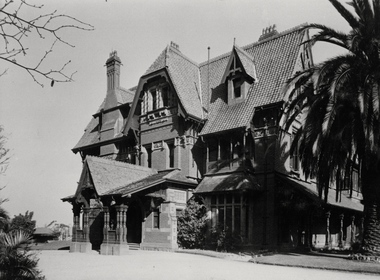
Photograph - Porte-cochere, 'Tara Hall', Studley Park Road, Marc Strizic (attrib), c.1960
... A chapter in the book was devoted to Goathland, later known as Tara Hall. To supplement the text, he sourced photographs from a range of suppliers, chiefly the Royal Women's Hospital which had once owned Tara Hall, but had sold it in 1960. ...Porte-cochere, Tara Hall, circa 1957. The main entrance to Tara Hall (previously named Byram, Goathland and Lowan). ...Typed inscription on reverse: "Goathland, also known as Tara Hall (Royal Women's Hospital, Melbourne)."...Porte-cochere, Tara Hall, circa 1957. The main entrance to Tara Hall (previously named Byram, Goathland and Lowan). ...'Lost Glories: a memorial to forgotten Australian buildings' was published by David Latta in 1986. It tells the story of a number of significant Australian buildings that had previously been demolished. A chapter in the book was devoted to Goathland, later known as Tara Hall. To supplement the text, he sourced photographs from a range of suppliers, chiefly the Royal Women's Hospital which had once owned Tara Hall, but had sold it in 1960. This is one of the photographs donated to KHS by the author. Porte-cochere, Tara Hall, circa 1957. The main entrance to Tara Hall (previously named Byram, Goathland and Lowan). The entrance, through a porte-cochère, was located on the side of the house facing east. During construction, commentators described the house as being in the ‘Elizabethan style’. The architectural style of the exterior, with its innovatory use of red brick and Italian tiles was more influenced by American models. Edward George Kilburn, of Ellerker & Kilburn, designed Byram for the industrialist George Ramsden in 1888. Typed inscription on reverse: "Goathland, also known as Tara Hall (Royal Women's Hospital, Melbourne)."goathland -- kew (vic), byram -- kew (vic), tara hall - kew (vic), studley park road -
 Port Melbourne Historical & Preservation Society
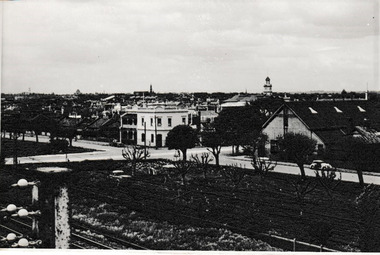
Photograph - Station Hotel, corner Bridge and Station Streets, Port Melbourne, c. 1950
... Black & white photograph of the Station Hotel looking down onto Railway Reserve & Excelsior Hall....On reverse ' Station Hotel, Excelsior Hall later R.S.S. Hall Station Station Streets'...Business and Traders - Hotels Built Environment - Commercial Built Environment - Domestic Station Hotel Excelsior Hall On reverse ' Station Hotel, Excelsior Hall later R.S.S. ...Black & white photograph of the Station Hotel looking down onto Railway Reserve & Excelsior Hall.On reverse ' Station Hotel, Excelsior Hall later R.S.S. Hall Station Station Streets'business and traders - hotels, built environment - commercial, built environment - domestic, station hotel, excelsior hall -
 Bendigo Historical Society Inc.
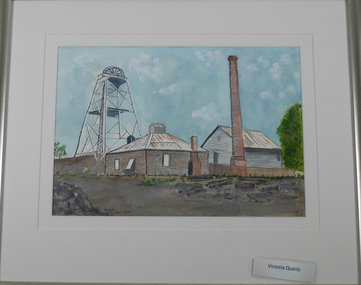
Painting - JOHN HALL COLLECTION: WATER COLOUR VICTORIA QUARTZ MINE
... Painted by Mr John Hall....John Hall...ARTWORK Water colour gold mines John Hall John Hall Water colour painting of the Victoria Quartz mine Victoria Hill, framed under glass. ...Water colour painting of the Victoria Quartz mine Victoria Hill, framed under glass. Painted by Mr John Hall.John Hallartwork, water colour, gold mines, john hall -
 Bendigo Historical Society Inc.
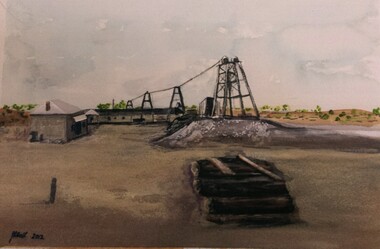
Photograph - JOHN HALL COLLECTION: PHOTO OF THE ORIGINAL WATER COLOUR PAINTING: HUSTLERS REEF
... JOHN HALL COLLECTION: PHOTO OF THE ORIGINAL WATER COLOUR PAINTING: Hustlers Reef Written on the rear Hustlers Reef 2...John Hall...ARTWORK Water colour gold mines John Hall JOHN HALL COLLECTION: PHOTO OF THE ORIGINAL WATER COLOUR PAINTING: Hustlers Reef Written on the rear Hustlers Reef 2 Photograph JOHN HALL COLLECTION: PHOTO OF THE ORIGINAL WATER COLOUR PAINTING: HUSTLERS REEF ...JOHN HALL COLLECTION: PHOTO OF THE ORIGINAL WATER COLOUR PAINTING: Hustlers Reef Written on the rear Hustlers Reef 2John Hallartwork, water colour, gold mines -
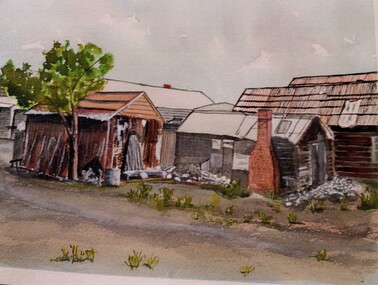 Bendigo Historical Society Inc.
Photograph - JOHN HALL COLLECTION: PHOTO OF THE ORIGINAL WATER COLOUR PAINTING: CHINESE CAMP
... JOHN HALL COLLECTION: PHOTO OF THE ORIGINAL WATER COLOUR PAINTING: Chinese Camp Written on the rear Chinese Camp 2...John Hall...ARTWORK Water colour gold mines John Hall JOHN HALL COLLECTION: PHOTO OF THE ORIGINAL WATER COLOUR PAINTING: Chinese Camp Written on the rear Chinese Camp 2 Photograph JOHN HALL COLLECTION: PHOTO OF THE ORIGINAL WATER COLOUR PAINTING: CHINESE CAMP ...JOHN HALL COLLECTION: PHOTO OF THE ORIGINAL WATER COLOUR PAINTING: Chinese Camp Written on the rear Chinese Camp 2John Hallartwork, water colour, gold mines -
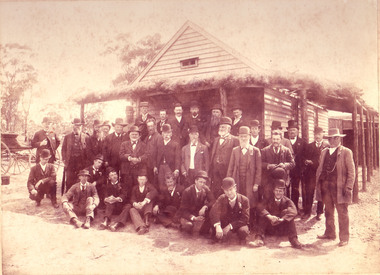 University of Melbourne, Burnley Campus Archives
Photograph - Black and white photocopy, A.E. Bennett, Members of the Horticultural Board Outside the Dunolly Town Hall, 1893
... Members of the Horticultural Board Outside the Dunolly Town Hall...J.P. and students of the Horticultural College, Burnley outside the Dunolly Town Hall on the second annual trip of students to the Government Scent farm, 23rd November, 1893. (3) Photocopy of A.E. ...Members of the Horticultural Board Outside the Dunolly Town Hall Photograph Black and white photocopy A.E. ...Photocopy of a photograph. (1) "Group photograph following luncheon at Government Scent Farm, Dunolly on the second annual trip of the Students of the Horticultural College, Burnley, 23.11.1893. Val Caire photo, 57 Toorak Rd Sth Yarra." (Descendent of J.N. Caire.) Photocopy donated by Bruce Draper, descendent of Charles Draper. (2) Handwritten list of names: "Members of the Horticultural Board, Professor McAlpine, Mr Max Pincus?, Mr J.N. Caire, Mr McFarlane, Mr Ogle, Mr Churchill, with the Mayor of Dunolly J. Desmond Esq. J.P. and students of the Horticultural College, Burnley outside the Dunolly Town Hall on the second annual trip of students to the Government Scent farm, 23rd November, 1893. (3) Photocopy of A.E. Bennett's "Prize Essays, "Essay on trip to Dunolly Scent farm, 1893." p117.luncheon, government, scent farm, dunolly, trip, students, horticultural college, burnley, val caire, bruce draper, charles draper, horticultural board, professor mcalpine, max pincus, j.n. caire, mr mcfarlane, mr ogle, mr churchill, j. desmond esq., students, town hall, a.e. bennett, prize essays -
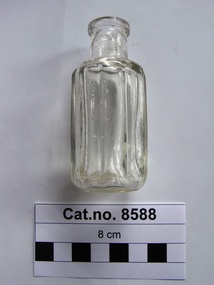 Coal Creek Community Park & Museum
Bottle, glass
... Round clear glass bottle , two thirds of bottle sides 'fluted'. Mark embossed on base....Mark on base an elongated diamond / lozenge shape...Mark embossed on base. Bottle, glass ...Round clear glass bottle , two thirds of bottle sides 'fluted'. Mark embossed on base.Mark on base an elongated diamond / lozenge shape -
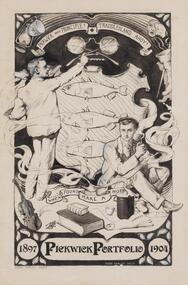 Kew Historical Society Inc
Work on paper, Pickwick Portfolio 1897-1904
... Alice Bale is recorded in the 1912 edition as using the name Mark Tapley, a character in Martin Chuzzlewit (Dickens, 1842). ...Signed lower left by Mark Tapley, the pseudonym within the Club of the artist A.M.E. ...Lower left in pencil "Mark Tapley" (pseudonym). Initials above to the right AMEB (Alice ME Bale)...Signed lower left by Mark Tapley, the pseudonym within the Club of the artist A.M.E. ...The Pickwick Club of Kew was founded by local residents in 1897. In 1904 it produced its first publication - Pickwick Portfolio Vol.1 No.1 - for which the local artist and member Alice Marion Ellen Bale (1875-1955) designed this frontispiece. The frontispiece was printed in Volume 1/1 and adapted for Vol.1/2 in 1912. Each member of the Club adopted a pseudonym from a work by Charles Dickens. Alice Bale is recorded in the 1912 edition as using the name Mark Tapley, a character in Martin Chuzzlewit (Dickens, 1842). Gift of the Friends of the KHS Collection, 2022Frontispiece, created in watercolour and ink on artist's paper, for the first edition of the Pickwick Portfolio of 1904 by the Kew Pickwick Club. Signed lower left by Mark Tapley, the pseudonym within the Club of the artist A.M.E. Bale.Lower left in pencil "Mark Tapley" (pseudonym). Initials above to the right AMEB (Alice ME Bale)a m e bale, pickwick clubs, pickwick club of kew -
 National Wool Museum
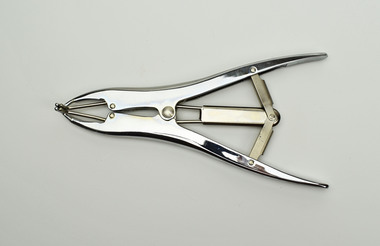
Tool - Elastrator
... Elastrator. Registered trade mark - 3 parts incorporated. ...For the original and genuine 'Elastrator' Marking Instrument Reg Trade Mark...For the original and genuine 'Elastrator' Marking Instrument Reg Trade Mark Elastrator. Registered trade mark - 3 parts incorporated. ...Elastrator. Registered trade mark - 3 parts incorporated. This is your seal of quality. For the original and genuine 'Elastrator' Marking Instrument Reg Trade Marktextile mills -
 Warrnambool and District Historical Society Inc.
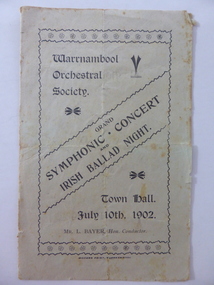
Programme, Original D Symphonic concert Town Hall July 10 1902, 1902
... Original D Symphonic concert Town Hall July 10 1902...This is a programme of a concert called ‘Grand Symphonic Concert and Irish Ballad Night’ staged by the Warrnambool Orchestral Society at the Warrnambool Town Hall on July 10th 1902. The conductor was Louis Bayer (1857-1907). ...Original D Symphonic concert Town Hall July 10 1902 Programme ...This is a programme of a concert called ‘Grand Symphonic Concert and Irish Ballad Night’ staged by the Warrnambool Orchestral Society at the Warrnambool Town Hall on July 10th 1902. The conductor was Louis Bayer (1857-1907). Born in Germany, Bayer came to Warrnambool in 1891 and, with his wife, Eleanor, taught piano. violin, orchestration and singing and established the Warrnambool Orchestral Society. In 1896-7 Bayer was the musical director of the Warrnambool Industrial and Art exhibition, composing the Cantata for the opening ceremony and directing over 60 musical performances, including 22 operas and many concerts. Bayer was a composer and wrote several operas, including one called ‘Federation’. Bayer’s wife was an accompaniste at this symphonic concert and two of his sons played the horn and the drums. The soloists at this symphonic concert included Minnie Sloane, Lucy Meares and J. Robertson. This programme is of great significance as it features a concert conducted by Louis Bayer, one of the most important musicians in Warrnambool’s history. This is a yellow-coloured piece of paper folded in two to make four pages. The pages have details of the concert programme, a list of members of the orchestra, one advertisement and a front page with the concert headings in a fancy border. The pages are somewhat torn at the folds and there is heavy staining, especially on the back page. warrnambool orchestral society, louis bayer, history of warrnambool -
 Bendigo Historical Society Inc.
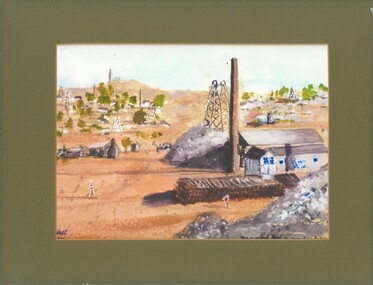
Photograph - JOHN HALL COLLECTION: COLOURED PHOTOGRAPH - HUSTLER'S REEF MINE
... Coloured photograph of John Hall's watercolour - Hustler's Reef Mine. The photograph ismounted with green cardboard border. ...John Hall, artist...John Hall Hustler's Mine John Hall, artist Coloured photograph of John Hall's watercolour - Hustler's Reef Mine. ...Coloured photograph of John Hall's watercolour - Hustler's Reef Mine. The photograph ismounted with green cardboard border. John Hall, artistjohn hall, hustler's mine -
 Eltham District Historical Society Inc
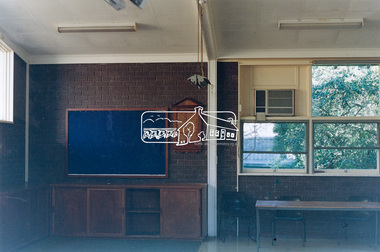
Photograph - Colour Print, Harry Gilham, Eltham Roll of Honour, Eltham War Memorial Hall, Nov 2004
... Eltham Roll of Honour, Eltham War Memorial Hall...The Honour Roll Board was retrieved by former Eltham District Historical Society President, Harry Gilham in September 2004 who arranged for it to be re-hung in the Eltham War Memorial Hall (former Children's Library) where it was attached to the brick wall face of the west (rear) wall of the Hall (as seen in this photograph). ...Eltham War Memorial Hall honour board Honour Roll Roll of Honour Colour print on commercial photo paper 10 x 15 cm Eltham Roll of Honour, Eltham War Memorial Hall Photograph Colour Print Harry Gilham ...The Eltham Roll of Honour Board was originally commissioned and paid for by the Eltham War Memorial Trust from funds raised by public donation. It was originally hung in the Infant Welfare Centre. In 1999 the Honour Roll Board was removed from the Eltham War Memorial by members of the RSL and relocated to the Eltham RSL sub-branch on Main Road. Following financial collapse of the Eltham RSL sub-branch and merger of the Eltham and Montmorency sub-branches and subsequent sale of the Eltham property, the WW1 obelisk was relocated to a location in front of the Eltham War Memorial. The Honour Roll Board was retrieved by former Eltham District Historical Society President, Harry Gilham in September 2004 who arranged for it to be re-hung in the Eltham War Memorial Hall (former Children's Library) where it was attached to the brick wall face of the west (rear) wall of the Hall (as seen in this photograph). Sometime around late 2018 when Council was investigating the potential sale and development of the Eltham War Memorial, the Eltham Honour Roll Board was once again removed from the Eltham War Memorial by persons unknown, under the pretext of ‘safekeeping,’ to a location outside of the Shire of Nillumbik, in the City of Banyule. In early 2021 Eltham District Historical Society was made aware of the removal of the Honour Roll Board. A formal request was made by EDHS to return this community asset to its rightful place as intended when it was commissioned and paid for by the Eltham War Memorial Trust. This request was rebutted. Nillumbik Shire Council has also since been made aware of the removal of this community asset and formally requested its return prior to Anzac Day, 2021 where it can once again be made accessible to members of the community to pay their respects as originally intended. As of July 2022, the Honour Board remains missing from its rightful place at the Eltham War Memorial. eltham war memorial hall, honour board, honour roll, roll of honour -
 Eltham District Historical Society Inc
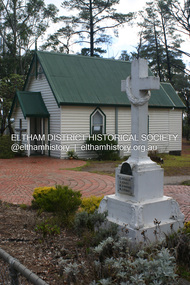
Photograph - Digital Photograph, Alan King, St Matthew's Church and Hall, Panton Hill, 27 March 2008
... St Matthew's Church and Hall, Panton Hill...The building was also used for Sunday School, a school and a hall.1 The St Matthew’s Church and hall at the corner of Church Road and Kangaroo Ground-St Andrews Road, were built in the early 20th century in the standard rectangular style of the times. ...The building was also used for Sunday School, a school and a hall.1 The St Matthew’s Church and hall at the corner of Church Road and Kangaroo Ground-St Andrews Road, were built in the early 20th century in the standard rectangular style of the times. ...St. Matthew's Church has historic significance as the town's church and physical and social focus for the community. The standard design buildings are good examples and important streetscape elements. The war memorial cross is the area's monument to the 20th century wars and its modest scale in comparison with the granite Eltham and towered Kangaroo Ground memorials illustrates the lack of affluence in the town and surrounding area. The grouping of church, school, store and post office is typical of country villages throughout Victoria. The Radiata Pine plantings are significant as an intact line of shelterbelt planting typical of the early 20th century. (Bick Study 1992) Covered under Heritage Overlay, Nillumbik Planning Scheme. Published: Nillumbik Now and Then / Marguerite Marshall 2008; photographs Alan King with Marguerite Marshall.; p63 Panton Hill’s first church services were held in a simple building made of paling timber, opposite the Hotel de France. The building was also used for Sunday School, a school and a hall.1 The St Matthew’s Church and hall at the corner of Church Road and Kangaroo Ground-St Andrews Road, were built in the early 20th century in the standard rectangular style of the times. The intact belt of Radiata Pines was common at that time. The war memorial concrete cross is the area’s monument for the 20th century wars. It is much more modest than those in Eltham, and particularly in Kangaroo Ground, demonstrating those townships’ comparative affluence.2 Early settler J Hughes, who donated the land to the Church of England, was the first to be married at St Matthews when he married Rachel Coutie. In later life he became a minister of religion.3 One much-liked preacher was George Hollow, who with his sister playing the harmonium, conducted church services at Panton Hill, St Andrews and Christmas Hills, for many years.This collection of almost 130 photos about places and people within the Shire of Nillumbik, an urban and rural municipality in Melbourne's north, contributes to an understanding of the history of the Shire. Published in 2008 immediately prior to the Black Saturday bushfires of February 7, 2009, it documents sites that were impacted, and in some cases destroyed by the fires. It includes photographs taken especially for the publication, creating a unique time capsule representing the Shire in the early 21st century. It remains the most recent comprehenesive publication devoted to the Shire's history connecting local residents to the past. nillumbik now and then (marshall-king) collection, panton hill, st matthew's church, panton hill war memorial -
 Sunshine and District Historical Society Incorporated
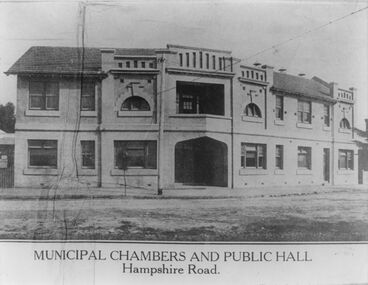
Photograph - Municipal chambers and public hall in 1923
... Photograph Braybrook Municipal Chambers and the public hall Hall was built in 1922 to serve as municipal offices public hall and as a memorial to men from the area who served and died in the First World War Portion of the building door on right of photograph served as rooms for returned servicemens club rooms RSL...Municipal Chambers and Public Hall Hampshire Road...Municipal Chambers and Public Hall Hampshire Road Photograph Braybrook Municipal Chambers and the public hall Hall was built in 1922 to serve as municipal offices public hall and as a memorial to men from the area who served and died in the First World War Portion of the building door on right of photograph served as rooms for returned servicemens club rooms RSL Photograph Municipal chambers and public hall in 1923 ...Municipal Chambers and Public Hall Hampshire Road -
 Bendigo Historical Society Inc.
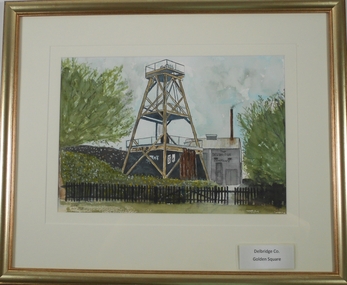
Painting - JOHN HALL COLLECTION: WATER COLOUR DELBRIDGE COMPANY MINE
... Painted by Mr. John Hall....John Hall...ARTWORK Water colour gold mines John Hall John Hall Water colour painting of the Delbridge Company mine, poppet head in centre, framed under glass. ...Water colour painting of the Delbridge Company mine, poppet head in centre, framed under glass. Painted by Mr. John Hall.John Hallartwork, water colour, gold mines, john hall -
 Greensborough Historical Society
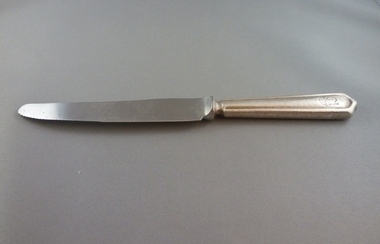
Knife, Unknown, 1950s
... Single knife, possible part of cutlery set. Mark on handle is not identified....Metal knife with serrated blade and marks on handle....Single knife, possible part of cutlery set. Mark on handle is not identified. knife Metal knife with serrated blade and marks on handle. ...Single knife, possible part of cutlery set. Mark on handle is not identified.Metal knife with serrated blade and marks on handle.knife
