
Showing 1928 items matching "war veterans"
-
 Emerald Museum & Nobelius Heritage Park
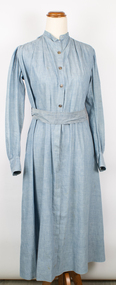
Uniform - Nurse Dress, 1900s
... war effort at home. They filled a need created by the exit of a large number of Australian nurses to the front and by the influx of seriously injured personnel who were brought back home. In 1919, Ethel Stoddart married Arthur James Ogilvy, a veteran...war effort at home. They filled a need created by the exit of a large number of Australian nurses to the front and by the influx of seriously injured personnel who were brought back home. In 1919, Ethel Stoddart married Arthur James Ogilvy, a veteran ...Ethel May Ogilvy (nee Stoddart) became a Red Cross Nurse during World War I after completing a course in Nursing and Hygiene conducted by the St John Ambulance Association in November 1914. The Red Cross was ostensibly non-military in line with its principles of neutrality and independence. While a group of 20 nurses were sent to Europe by the NSW Division of the Red Cross, most Red Cross nurses, like Ethel, contributed to the war effort at home. They filled a need created by the exit of a large number of Australian nurses to the front and by the influx of seriously injured personnel who were brought back home. In 1919, Ethel Stoddart married Arthur James Ogilvy, a veteran of the Boer War and World War I. The couple moved to Emerald in 1936 where they lived the remainder of their lives. This dress is part of a complete World War I Red Cross nurse uniform held by the Museum which was worn by a young woman who later moved to Emerald. The uniform is emblematic of the variety of ways in which women contributed to the war effort.Long blue cotton dress with long sleeves - at the end of each sleeve are two mother of pearl buttons and buttonholes. The dress has four mother of pearl buttons and buttonholes down the front and two buttonholes at the neck. There are three loops at the waist at the back for a belt to be threaded through. Separate long narrow sash-like belt of the same material. (The belt may have originally had a buckle.)red cross, world war 1, nurse uniform -
 Emerald Museum & Nobelius Heritage Park
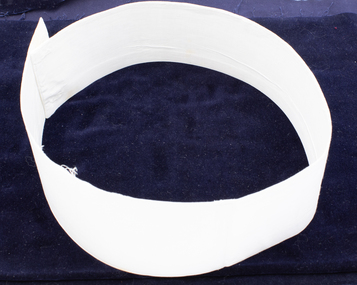
Uniform - Nurse Belts, 1900s
... war effort at home. They filled a need created by the exit of a large number of Australian nurses to the front and by the influx of seriously injured personnel who were brought back home. In 1919, Ethel Stoddart married Arthur James Ogilvy, a veteran...war effort at home. They filled a need created by the exit of a large number of Australian nurses to the front and by the influx of seriously injured personnel who were brought back home. In 1919, Ethel Stoddart married Arthur James Ogilvy, a veteran ...Belts on nurse uniforms were made to be detachable for ease of laundering. Ethel May Ogilvy (nee Stoddart) became a Red Cross Nurse during World War I after completing a course in Nursing and Hygiene conducted by the St John Ambulance Association in November 1914. The Red Cross was ostensibly non-military in line with its principles of neutrality and independence. While a group of 20 nurses were sent to Europe by the NSW Division of the Red Cross, most Red Cross nurses, like Ethel, contributed to the war effort at home. They filled a need created by the exit of a large number of Australian nurses to the front and by the influx of seriously injured personnel who were brought back home. In 1919, Ethel Stoddart married Arthur James Ogilvy, a veteran of the Boer War and World War I. The couple moved to Emerald in 1936 where they lived the remainder of their lives. These belts are part of a complete World War I Red Cross nurse uniform held by the Museum which was worn by a young woman who later moved to Emerald. The uniform is emblematic of the variety of ways in which women contributed to the war effort.Three pairs of white starched belts for a nurse uniform. One belt (1/3) has a long narrow rectangular shape with two buttonholes at each end. The other belt (2/3) has a triangular shape at one end with two press studs (rings) at this end. There may have been two posts at the other end at one time. The third (3/3) has three buttonholes at each end.At one end of belt 1/3 hand printed: 'E. M. Stoddart' At one end of belt 3/3 hand-written: 'Stoddart' and underneath printed '?8412'red cross, world war 1, nurse uniform -
 Emerald Museum & Nobelius Heritage Park
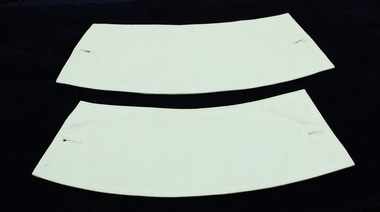
Uniform - Nurse Cuffs, 1900s
... war effort at home. They filled a need created by the exit of a large number of Australian nurses to the front and by the influx of seriously injured personnel who were brought back home. In 1919, Ethel Stoddart married Arthur James Ogilvy, a veteran...war effort at home. They filled a need created by the exit of a large number of Australian nurses to the front and by the influx of seriously injured personnel who were brought back home. In 1919, Ethel Stoddart married Arthur James Ogilvy, a veteran ...Cuffs on nurse uniforms were made to be detachable for ease of laundering. Ethel May Ogilvy (nee Stoddart) became a Red Cross Nurse during World War I after completing a course in Nursing and Hygiene conducted by the St John Ambulance Association in November 1914. The Red Cross was ostensibly non-military in line with its principles of neutrality and independence. While a group of 20 nurses were sent to Europe by the NSW Division of the Red Cross, most Red Cross nurses, like Ethel, contributed to the war effort at home. They filled a need created by the exit of a large number of Australian nurses to the front and by the influx of seriously injured personnel who were brought back home. In 1919, Ethel Stoddart married Arthur James Ogilvy, a veteran of the Boer War and World War I. The couple moved to Emerald in 1936 where they lived the remainder of their lives. These cuffs are part of a complete World War I Red Cross nurse uniform held by the Museum which was worn by a young woman who later moved to Emerald. The uniform is emblematic of the variety of ways in which women contributed to the war effort.Two pairs of white starched cuffs for a nurse uniform. Each cuff has a buttonhole at each end which would enable the cuff to be joined by cufflink-like buttons.On each cuff, printed: 'NURSE 8 G' On each cuff handwritten: 'Stoddart'red cross, world war 1, nurse uniform -
 Surrey Hills Historical Society Collection
Work on paper - Vertical File, World War 2
... veterans Russell Zenner and Jack Bell, Boroondara Local Review, undated (2 pages). 21. ‘Forty years on’, Edel Wignell, 1984 (1 page). 22. Howell Monteath Tipping, notes by Margaret Edwards (daughter), 20.9.2020 (1 page). 23. My Time – article on Alton Jackson. Progress Press April 2005 24. Box Hill RSL, Oral History Project. Summary of interview with Peter Chester, RANR, 1942-1946 by Janet Baker World War ...WORLD WAR 2 LOCAL INFORMATION 1. Red Cross Junior War Funds Krazy Whist night 29.7. ? (1 page). 2. Chatham Ladies P.O.W. Group, Entertainment, 1.8.1943 (1 page). 3. ‘At the Seymour camp’, (photocopy of 2 photos), The Argus, 18.3.1936 (1 page. 4. Photocopy of photo of liberated POWs from Sumatra including Pte J.A. Wicks of S.H.; The Argus, 29.9.1945 (1 page). 5. Map of District Camberwell Area G Sector 49, original laminated and copy, undated (2 pages). 6. A.R.F. training poison war gases: the gas arsine, undated (1 page). 7. Anti-gas respirator drawing, undated (1page). 8. The war gases, undated (1 page). 9. Planning meat ration meals, c. 1943 (32 page book). 10. Air raid precautions advice to householders, State Emergency Council for Civil Defence Victoria, April, 1941 (37 page book and cover). 11. Air raid precautions: notebook holding very brief notes of ARP street warden G.R.H. Hall, 1942 (leatherette notebook). 12. Women – wartime, research by Kitty McEwan of Women’s Land Army, extract from History of Ormiston School, undated (1 page). 13. Miss Kitty McEwan, Superintendent of Australian Women’s Land Army 1941-6, extract from History of Ormiston School 1849-1964, (1 page). 14. Interview with Miss M. George, re Mr. Joe George Air Raid Warden of 26 Scheele Street, S.H.; and photocopy of photo of J. George) (2 pages). 15. Wartime in Surrey Hills 1942, by Norman Carter. (1 page). 16. Wartime – Mont Albert, 1939-45. Extract from ‘Ross of Mont Albert’, (1 page). 17. Morotai ‘Table tops’ No. 244, 3.2.1946. (Original and photocopy 2 pages). 18. Wartime restrictions Control of Photography Order undated (1 page). 19. Family fun day, 2.4.1995, Wattle Park Australia remembers 1945-1995 (1 page). 20. Over the fence, re WW2 veterans Russell Zenner and Jack Bell, Boroondara Local Review, undated (2 pages). 21. ‘Forty years on’, Edel Wignell, 1984 (1 page). 22. Howell Monteath Tipping, notes by Margaret Edwards (daughter), 20.9.2020 (1 page). 23. My Time – article on Alton Jackson. Progress Press April 2005 24. Box Hill RSL, Oral History Project. Summary of interview with Peter Chester, RANR, 1942-1946 by Janet Baker world war 2 -
 Mont De Lancey
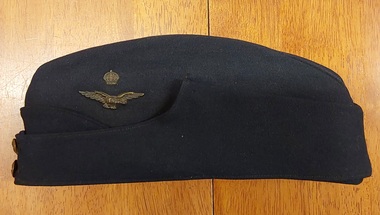
Uniform - Officer's Forage Cap, 1940's
... The blue forage cap (frequently referred to as a side cap, wedge cap, or garrison cap) during World War II was a practical, foldable soft cap widely adopted by air forces and naval units, most notably by the Royal Australian Air Force (RAAF) and Commonwealth aircrews. In bomber and fighter squadrons, a well-worn, battered forage cap became an informal badge of honor, distinguishing seasoned veterans from new arrivals ("sprogs")....The blue forage cap (frequently referred to as a side cap, wedge cap, or garrison cap) during World War II was a practical, foldable soft cap widely adopted by air forces and naval units, most notably by the Royal Australian Air Force (RAAF) and Commonwealth aircrews. In bomber and fighter squadrons, a well-worn, battered forage cap became an informal badge of honor, distinguishing seasoned veterans from new arrivals ("sprogs"). ...The blue forage cap (frequently referred to as a side cap, wedge cap, or garrison cap) during World War II was a practical, foldable soft cap widely adopted by air forces and naval units, most notably by the Royal Australian Air Force (RAAF) and Commonwealth aircrews. In bomber and fighter squadrons, a well-worn, battered forage cap became an informal badge of honor, distinguishing seasoned veterans from new arrivals ("sprogs").A navy blue woolen WW11 Officer's Forage Cap with shaped folded sides. It has a fastening at the front with two small brass buttons with wings and a crown insignia attached. Inside is a brown lining with a brown velvet band at the top. A large safety pin on the lining holds the crown closed from the outside. The clips to hold the badges on the outside can be seen inside on the lining. It was issued in 1943.Inside the cap is stamped: 'MV(faded unknown letter)D 58'ww11 uniform, ww11 badge, ww11, ww11raaf, ww11 cap -
 Alfred Hospital Nurses League - Nursing History Collection
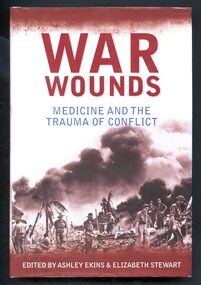
Book - Illustrated book, Elizabeth Stewart 1964- et al, War wounds: medicine and the trauma of conflict, 2011
... War has been an accelerator of the advances in medical treatment and surgery. As modern weaponry became more destructive, medicine developed techniques and procedures to deal with the volume and nature of battlefield casualties. This book is a collection of chapters by historians, medical practitioners and researchers, former and serving military medical officers, surgeons, nurses and veterans, who explore the impact of war, wounds and trauma through the historical record, reported narratives and personal experiences. ...War has been an accelerator of the advances in medical treatment and surgery. As modern weaponry became more destructive, medicine developed techniques and procedures to deal with the volume and nature of battlefield casualties. This book is a collection of chapters by historians, medical practitioners and researchers, former and serving military medical officers, surgeons, nurses and veterans, who explore the impact of war, wounds and trauma through the historical record, reported narratives and personal experiences.Illustrated book with dust jacket. Book has a light brown cover with abbreviated title authors' and publisher's names embossed in silver on the spine. Dust jacket has background of shades of brown, off-white and grey. On the front is a photograph 'Australian infantrymen evacuate a wounded soldier on a stretcher to the beach during the landing at Balikpapan, Borneo, July 1945, along with the title printed in brown and navy, and the authors names printed in white. On the spine, the abbreviated title is printed in brown, authors names in black, and publishers name in white. On the back cover is a photograph of a soldier with arm in a sling (in an advanced dressing station on the Menin Road near Ypres, Belgium, 20 September 1917) Also on the back cover is a quote from Graham Edwards (Vietnam veteran, veteran's advocate and former MP) and a list of other contributors to the book. non-fictionWar has been an accelerator of the advances in medical treatment and surgery. As modern weaponry became more destructive, medicine developed techniques and procedures to deal with the volume and nature of battlefield casualties. This book is a collection of chapters by historians, medical practitioners and researchers, former and serving military medical officers, surgeons, nurses and veterans, who explore the impact of war, wounds and trauma through the historical record, reported narratives and personal experiences.war-medical aspects, medicine-military-history-australia, soldiers-wounds and injuries-treatment-australia, alfred nurses -
 National Vietnam Veterans Museum (NVVM)
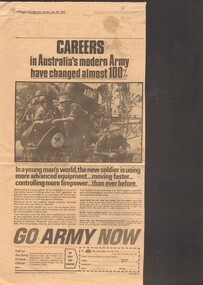
Newspaper - Recruitment advertisement
... war in Vietnam. This item was donated by Colin Laurence Grey OAM. Colin was the driving force behind many of the displays at the National Vietnam Veterans Museum. ...war in Vietnam. This item was donated by Colin Laurence Grey OAM. Colin was the driving force behind many of the displays at the National Vietnam Veterans Museum. ...This item contributes to an understanding of the experience of Australian society and attitudes to the war in Vietnam. This item was donated by Colin Laurence Grey OAM. Colin was the driving force behind many of the displays at the National Vietnam Veterans Museum. He will be remembered for his expertise, and boundless enthusiasm for all things Australian. Colin organised teams of like-minded souls to bring home and restore many important historical aircraft. His success has been recognised and rewarded with an Order of Australian Medal 2000, and he is named in the Worldwide Who’s Who 2014-2015. Colin’s skills as an engineer, tool maker, boiler maker and organiser enabled him to restore steam trains, trucks, tanks, infantry weapons, various aircraft including a MIG-15 jet fighter and his largest project the Consolidated B-24 Liberator bomber. He even replicated two dinosaur skeletons for Museum Victoria. In 1989 Colin joined the fledgling B-24 Liberator Memorial Fund as Project Manager/Restoration Co-Ordinator with the task to build a volunteer organisation that could find the AUD$10m required, source parts and materials for the largest aircraft restoration in Australia. The B-24 program had 10 volunteers, 60 sponsors and an international support network that provided parts, tooling, aviation equipment and political support. Colin’s combined engineering, academic and logistical skills provided the basis for advancing the skills of a very disparate group of volunteers form all walks of life. Colin established links with Centrelink, Corrections Victoria, RMT Uni and the ADF to develop the skills base of many less fortunate individuals of all ages and backgrounds. Colin’s work in this area gained him an AOM (2000). He featured in an ABC Australian Stories program and was awarded a life membership of the organisation. Colin was a founding member and President of the Oceania Aviation Museum Inc. which was instrumental in the historic listing of the joint WW2 USAAC/RAAF facility at Werribee and the Preserve Point Cook Aerodrome Group. Colin developed best practice engineering and fund-raising programs for a volunteer group, the Phillip Island Aquatic Centre. Colin’s constant learning, curiosity, passion and contribution to all things Australian have been an inspiration and a great example to all of us. He will be sorely missed and fondly remembered. Yellowed newspaper Army recruitment article from The Sun 20/01/1969. Photo of 3 young men in Australian Army uniform a Sioux helicopter with a kangaroo emblem. Beneahan article are the words 'Go Army Now" and a coupon to be detached, filled and posted.The Sun newspaper Jan 20 1969. Careers/in Australia's modern army/changed almost 100%. Picture of Australian helicopter with pilot inside and two soldiers beside the helicopter. Flying kangaroo on the side of the helicopter.careers, army, recruitment, vietnam, newspaper article, medal of the order of australia -
 National Vietnam Veterans Museum (NVVM)
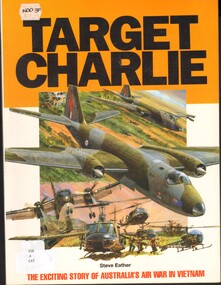
Book, Eather, Steve, Target Charlie: The Exciting Story Of Australia's Air War In Vietnam, 1993
... Vietnam War - artillery Royal Australian Air Force Vietnamese Conflict 1961-1975 - Australia Colin Grey Medal of the Order of Australia Target Charlie, for the first time ever, includes a comprehensive analysis of Australia's air war in Vietnam backed up by individual chapters on the operations of 35 Sqn (DHC Caribou), This item was donated by Colin Laurence Grey OAM. Colin was the driving force behind many of the displays at the National Vietnam Veterans Museum. ...Target Charlie, for the first time ever, includes a comprehensive analysis of Australia's air war in Vietnam backed up by individual chapters on the operations of 35 Sqn (DHC Caribou), This item was donated by Colin Laurence Grey OAM. Colin was the driving force behind many of the displays at the National Vietnam Veterans Museum. He will be remembered for his expertise, and boundless enthusiasm for all things Australian. Colin organised teams of like-minded souls to bring home and restore many important historical aircraft. His success has been recognised and rewarded with an Order of Australian Medal 2000, and he is named in the Worldwide Who’s Who 2014-2015. Colin’s skills as an engineer, tool maker, boiler maker and organiser enabled him to restore steam trains, trucks, tanks, infantry weapons, various aircraft including a MIG-15 jet fighter and his largest project the Consolidated B-24 Liberator bomber. He even replicated two dinosaur skeletons for Museum Victoria. In 1989 Colin joined the fledgling B-24 Liberator Memorial Fund as Project Manager/Restoration Co-Ordinator with the task to build a volunteer organisation that could find the AUD$10m required, source parts and materials for the largest aircraft restoration in Australia. The B-24 program had 10 volunteers, 60 sponsors and an international support network that provided parts, tooling, aviation equipment and political support. Colin’s combined engineering, academic and logistical skills provided the basis for advancing the skills of a very disparate group of volunteers form all walks of life. Colin established links with Centrelink, Corrections Victoria, RMT Uni and the ADF to develop the skills base of many less fortunate individuals of all ages and backgrounds. Colin’s work in this area gained him an AOM (2000). He featured in an ABC Australian Stories program and was awarded a life membership of the organisation. Colin was a founding member and President of the Oceania Aviation Museum Inc. which was instrumental in the historic listing of the joint WW2 USAAC/RAAF facility at Werribee and the Preserve Point Cook Aerodrome Group. Colin developed best practice engineering and fund-raising programs for a volunteer group, the Phillip Island Aquatic Centre. Colin’s constant learning, curiosity, passion and contribution to all things Australian have been an inspiration and a great example to all of us. He will be sorely missed and fondly remembered.Target Charlie, for the first time ever, includes a comprehensive analysis of Australia's air war in Vietnam backed up by individual chapters on the operations of 35 Sqn (DHC Caribou), This item was donated by Colin Laurence Grey OAM. Colin was the driving force behind many of the displays at the National Vietnam Veterans Museum. He will be remembered for his expertise, and boundless enthusiasm for all things Australian. Colin organised teams of like-minded souls to bring home and restore many important historical aircraft. His success has been recognised and rewarded with an Order of Australian Medal 2000, and he is named in the Worldwide Who’s Who 2014-2015. Colin’s skills as an engineer, tool maker, boiler maker and organiser enabled him to restore steam trains, trucks, tanks, infantry weapons, various aircraft including a MIG-15 jet fighter and his largest project the Consolidated B-24 Liberator bomber. He even replicated two dinosaur skeletons for Museum Victoria. In 1989 Colin joined the fledgling B-24 Liberator Memorial Fund as Project Manager/Restoration Co-Ordinator with the task to build a volunteer organisation that could find the AUD$10m required, source parts and materials for the largest aircraft restoration in Australia. The B-24 program had 10 volunteers, 60 sponsors and an international support network that provided parts, tooling, aviation equipment and political support. Colin’s combined engineering, academic and logistical skills provided the basis for advancing the skills of a very disparate group of volunteers form all walks of life. Colin established links with Centrelink, Corrections Victoria, RMT Uni and the ADF to develop the skills base of many less fortunate individuals of all ages and backgrounds. Colin’s work in this area gained him an AOM (2000). He featured in an ABC Australian Stories program and was awarded a life membership of the organisation. Colin was a founding member and President of the Oceania Aviation Museum Inc. which was instrumental in the historic listing of the joint WW2 USAAC/RAAF facility at Werribee and the Preserve Point Cook Aerodrome Group. Colin developed best practice engineering and fund-raising programs for a volunteer group, the Phillip Island Aquatic Centre. Colin’s constant learning, curiosity, passion and contribution to all things Australian have been an inspiration and a great example to all of us. He will be sorely missed and fondly remembered. vietnam war - artillery, royal australian air force, vietnamese conflict , 1961-1975 - australia, colin grey, medal of the order of australia
