
Showing 8736 items matching " canning "
-
 Phillip Island and District Historical Society Inc.
Photograph, 1983
... This photograph was taken from an early postcard, date unknown. West's store can be seen next door....This photograph was taken from an early postcard, date unknown. West's store can be seen next door. Local History PHOTOGRAPHY Photographs Slides Film Chicory Industry Black & White Photograph Audrey McFee West Store Phillip Island First brick chicory kiln, situated in Thompson Avenue near The Esplanade. ...This photograph was taken from an early postcard, date unknown. West's store can be seen next door.First brick chicory kiln, situated in Thompson Avenue near The Esplanade. This kiln was built in 1872 from hand-made bricks, made on Phillip Island.local history, photography, photographs, slides, film, chicory industry, black & white photograph, audrey mcfee, west store, phillip island -
 Greensborough Historical Society
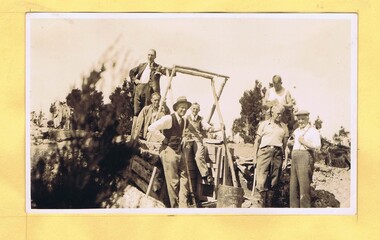
Photograph - Digital Image, Mystery mine photographs: Workers at top of shaft, 1935c
... This photograph shows workers at the mine site, at the top of the mine shaft. A ladder can be seen at centre of photo....This photograph shows workers at the mine site, at the top of the mine shaft. A ladder can be seen at centre of photo. .An interesting collection of photographs, the connection to Greensborough remains a mystery. tasmania mines and mining mining machinery Photos have no markings or dates. ...This photograph shows workers at the mine site, at the top of the mine shaft. A ladder can be seen at centre of photo..An interesting collection of photographs, the connection to Greensborough remains a mystery. Digital copy of black and white photograph, one of 30 photos of mining operations. Photos have no markings or dates. Donor unknown.tasmania, mines and mining, mining machinery -
 Flagstaff Hill Maritime Museum and Village
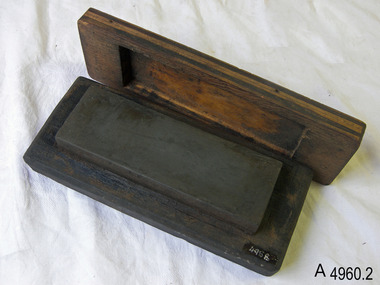
Functional object - Sharpening Stone, 1950+
... Sharpening stones are part of a carpenter or woodworker's took kit so that blades of tools can be kept sharp....Sharpening stones are part of a carpenter or woodworker's took kit so that blades of tools can be kept sharp. The sharpening stone is an example of equipment used in the 19th and 20th centuries by woodworking tradesmen. flagstaff hill warrnambool shipwrecked-coast flagstaff-hill flagstaff-hill-maritime-museum maritime-museum shipwreck-coast flagstaff-hill-maritime-village sharpening stone whet stone honing stone oil stone Carpenters Tools Sharpening stone, sometimes called oil stone, whetstone or honing stone. ...Sharpening stones are part of a carpenter or woodworker's took kit so that blades of tools can be kept sharp.The sharpening stone is an example of equipment used in the 19th and 20th centuries by woodworking tradesmen.Sharpening stone, sometimes called oil stone, whetstone or honing stone. Rectangular block of stone within a recessed wooden block, with a matching wooden lid.flagstaff hill, warrnambool, shipwrecked-coast, flagstaff-hill, flagstaff-hill-maritime-museum, maritime-museum, shipwreck-coast, flagstaff-hill-maritime-village, sharpening stone, whet stone, honing stone, oil stone, carpenters tools -
 Bendigo Military Museum
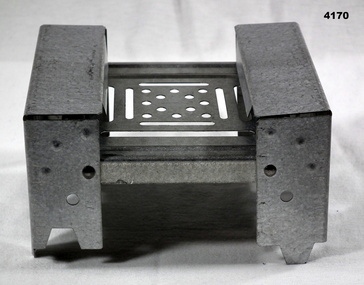
Equipment - HEXAMINE STOVE
... When item is closed it can house a packet of HEXAMINE tablets....When item is closed it can house a packet of HEXAMINE tablets. Stove Hexamine Made of galvanised coated tin in a box shape that opens out to support a cooking/heating vessel Equipment HEXAMINE STOVE ...Commonly just called a “Hexy Stove”. When item is closed it can house a packet of HEXAMINE tablets.Made of galvanised coated tin in a box shape that opens out to support a cooking/heating vesselstove, hexamine -
 Kyneton RSL Sub Branch
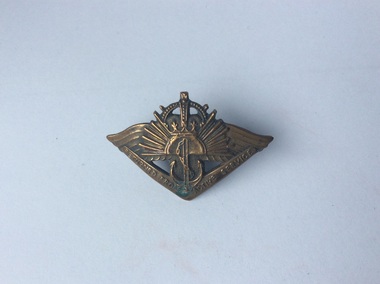
Returned from Active Service badge
... Issued to returned service personnel following WW2. This badge can be worn on the left lapel in civilian clothes....Issued to returned service personnel following WW2. This badge can be worn on the left lapel in civilian clothes. returned service badge Around base: Returned From Active Service. ...Issued to returned service personnel following WW2. This badge can be worn on the left lapel in civilian clothes.Brass badge in shape of a diamond. Each of the services are represented in the badge, Wings of Airforce, anchor for Navy & rising-sun for Army, with a crown in the centre.Around base: Returned From Active Service. Reverse side: A 1506returned service, badge -
 Alfred Hospital Nurses League - Nursing History Collection
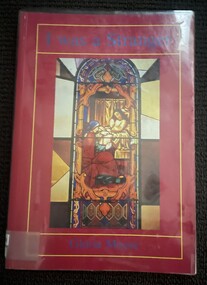
Book - Paperback book, Gloria Moore, I was a stranger and you welcomed me, 1994
... This book shows how interesting history can become when the emphasis is on people rather than the institution....This book shows how interesting history can become when the emphasis is on people rather than the institution. ...A history of nurse training at the Alfred Hospital. based on oral history, diaries, letters and papers written by nurses.Paperback book, with red cover. Tile and authors name on front cover and spine. Coloured photo of stained glass widow in Alfred Hospital chapel on front cover. Photos on back cover of author, and sculptures that now stand on the site of Coronado.non-fictionA history of nurse training at the Alfred Hospital. based on oral history, diaries, letters and papers written by nurses.alfred hospital, nursing history, ahnl, hospitals-victoria-history -
 City of Ballarat Libraries
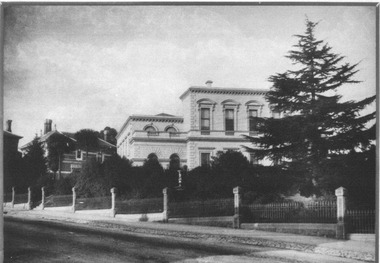
Photograph, East Ballarat Town Hall & Court House circa 1890s
... The East Ballarat Town Hall & Court House stood in Barkly Street. The library can be seen in the background....The East Ballarat Town Hall & Court House stood in Barkly Street. The library can be seen in the background. East Ballarat Town Hall Barkly Street Library Buildings East Ballarat Town Hall & Court House circa 1890s. ...The East Ballarat Town Hall & Court House stood in Barkly Street. The library can be seen in the background.east ballarat town hall, barkly street, library, buildings -
 City of Ballarat Libraries
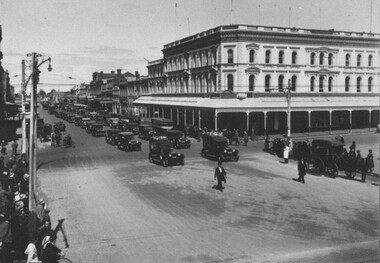
Card Box Photographs, Funeral Procession along Armstrong Street North, Ballarat circa 1920s
... Evans & Sons Undertakers. The Myer building can be seen in the background....Evans & Sons Undertakers. The Myer building can be seen in the background. ballarat armstrong street north sturt street funeral vehicles myer building H.Evans Funeral Procession along Armstrong Street North, Ballarat circa 1920s. ...Double funeral motorcade conducted by H. Evans & Sons Undertakers. The Myer building can be seen in the background.ballarat, armstrong street north, sturt street, funeral, vehicles, myer building, h.evans -
 City of Ballarat Libraries
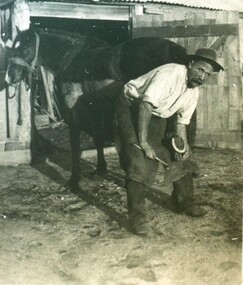
Photograph - Card Box Photographs, W.J. Perkins shoeing a horse, Ballarat circa 1930
... A stable brand can be seen on the horse. Mr Perkins was shoeing the horse at stables at the rear of Creswick Road....A stable brand can be seen on the horse. Mr Perkins was shoeing the horse at stables at the rear of Creswick Road. ...A stable brand can be seen on the horse. Mr Perkins was shoeing the horse at stables at the rear of Creswick Road.w.j. perkins, creswick road, ballarat, horses, farrier -
 City of Ballarat Libraries
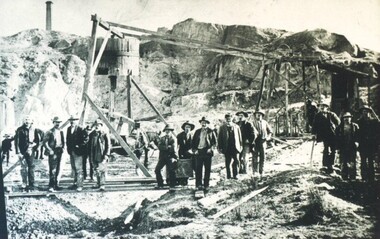
Photograph - Card Box Photographs, Miners at Black Hill, Ballarat circa 1908
... A Chilean Horse Whim can be seen in the background....A Chilean Horse Whim can be seen in the background. Black Hill Mining Blue Ribband Mine Horse Whim People Miners Miners at Black Hill, Ballarat circa 1908. ...Group of 16 miners possibly at the Blue Ribband Mine. A Chilean Horse Whim can be seen in the background.black hill, mining, blue ribband mine, horse whim, people, miners -
 City of Ballarat Libraries
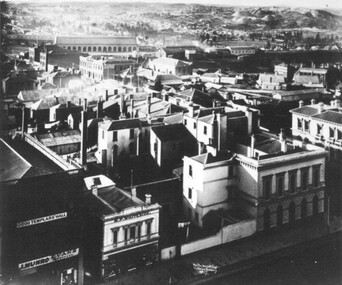
Photograph - Card Box Photographs, View north east from Ballarat Town Hall tower 1876
... The railway buildings and Black Hill can be seen in the background....The railway buildings and Black Hill can be seen in the background. Ballarat Town Hall Buildings Commerical View north east from Ballarat Town Hall tower 1876. ...Shows the Good Templars Hall and Whitesides in the foreground. The railway buildings and Black Hill can be seen in the background.ballarat town hall, buildings, commerical -
Emerald Museum & Nobelius Heritage Park
Photograph - Emerald Drapery, Unknown photographer, 1980s - 1990s
... The Emerald Drapery can be seen as a place for customers to come together and shop for a range of different apparel items....The Emerald Drapery can be seen as a place for customers to come together and shop for a range of different apparel items. ...The Emerald Drapery can be seen as a place for customers to come together and shop for a range of different apparel items.This photograph is socially significant for the Emerald Drapery as it showed customers shopping and interacting with one another as well as providing a place for customers to buy goods.Black and white rectangular photograph printed on matte photographic paper. The black and white photo depicts three woman in the Emerald Drapery. They are each holding a garment, while standing with a rack of clothes to their backs, and a rack of clothes in front of their person.emerald, victoria, australia, store, clothing, drapery -
 Federation University Historical Collection
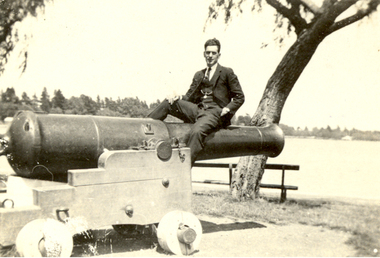
Photograph, Vernon Holt, Frank Wright on the Canon at View Point, Lake Wendouree, 3/2/1922
... Black and white photograph of a man dressed in a three piece suit sitting on a canon which is located in a park overlooking a lake. Trees and houses can be seen on the other side of the lake. ...Photo by Vernon Holt 3/2/22 Black and white photograph of a man dressed in a three piece suit sitting on a canon which is located in a park overlooking a lake. Trees and houses can be seen on the other side of the lake. ...Frank Wright was a renown resident of Smeaton, where he was born. He lived at Laura Villa, and attended Smeaton State School. His father William was a gold miner and his mother's name was Sarah. Their family won many singing and instrumental awards. Frank was tutored by Percy Code and was awarded a gold medal for the highest marks in the ALCM examinations in the British Colonies at the age of seventeen years. He became the Australian Open Cornet Champion by the age of eighteen. A year later, Frank conducted the City of Ballarat Band, and later the Ballarat Soldiers’ Memorial Band. He formed the Frank Wright Frisco Band and Frank Wright and his Coliseum Orchestra. These bands won many South Street awards, and Frank as conductor won many awards in the Australian Band Championship contest. In 1933 Frank Wright sailed to England to conduct the famous St Hilda’s Band and was later appointed Musical Director of the London County Council, where he organized many amazing concerts in parks, in and around the London district. He was made Professor of Brass and Military Band Scoring and conducted at the Guildhall of Music and Drama. Frank was often invited to adjudicate Brass Band Championships around Europe, in Australia, including South Street and in New Zealand. The Frank Wright Medal at the Royal South Street competition is awarded to an individual recognized as making an outstanding contribution to brass music in Australia.Black and white photograph of a man dressed in a three piece suit sitting on a canon which is located in a park overlooking a lake. Trees and houses can be seen on the other side of the lake. The man is Frank Wright and the place is "View Point", Lake Wendouree, Ballarat.Written in pen on back - Frank Wright - on canon at "View Point", Lake Wendouree, Ballarat. Photo by Vernon Holt 3/2/22frank wright, vernon holt, lake wendouree, ballarat, canon -
 Blacksmith's Cottage and Forge
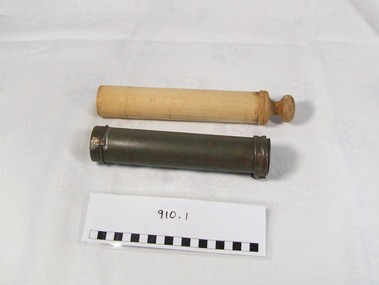
Biscuit Forcer
... Tin/metal outer cylinder/case/open one end, lid other end, with star pattern (can be removed for washing). Inner wooden pin or forcer, knob on end to be pushed into metal cylinder to force dough out through patterned disc....Representative of kitchen utensils in common use in working class kitchens in 20th century prior to the common availability of packaged biscuits. domestic kitchen food technology biscuit forcer baking woman s work appliances Tin/metal outer cylinder/case/open one end, lid other end, with star pattern (can be removed for washing). Inner wooden pin or forcer, knob on end to be pushed into metal cylinder to force dough out through patterned disc. ...Dough was put in forcer/case/cylinder and wooden pin pressed down to force dough out as a star-shaped biscuit. In use in a working-class home in the mid 20th century.Representative of kitchen utensils in common use in working class kitchens in 20th century prior to the common availability of packaged biscuits. Tin/metal outer cylinder/case/open one end, lid other end, with star pattern (can be removed for washing). Inner wooden pin or forcer, knob on end to be pushed into metal cylinder to force dough out through patterned disc.domestic, kitchen, food, technology, biscuit, forcer, baking, woman s, work, appliances -
Glenelg Shire Council Cultural Collection
Photograph - Photograph -Bridge, n.d
... Erosion of creek sides can be seen. Sign at bridge ' Bridge Load Limit 5 t gross'? ...Erosion of creek sides can be seen. Sign at bridge ' Bridge Load Limit 5 t gross'? ...Sourced from Casterton Town Hall (former Shire of Glenelg)Coloured photograph. Unmade road between paddocks. Photo taken close to bridge with wooden railings. Erosion of creek sides can be seen. Sign at bridge ' Bridge Load Limit 5 t gross'? Same bridge as 7301, taken at different time. -
 Orbost & District Historical Society
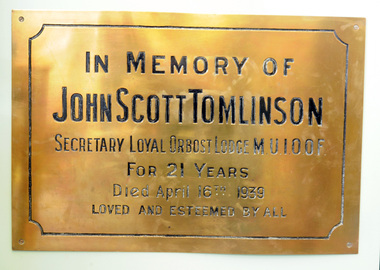
brass plaque, 1939
... A rectangular brass plaque which can be screwed to a wall with screws at each corner. ...A rectangular brass plaque which can be screwed to a wall with screws at each corner. ...This is a memorial plaque for John Scott Tomlinson, a member of Tomlinson family who were amongst the first settlers in the Lake Curlip/Tabbara area, along with the Richardsons.A rectangular brass plaque which can be screwed to a wall with screws at each corner. Written on the plaque are the words IN MEMORY OF JOHN SCOTT TOMLINSON. SECRETARY OF LOYAL ORBOST LODGE M.U.I.O.O.F. FOR 21 YEARS. DIED APRIL 16TH 1938. LOVED AND ESTEEMED BY ALL. as above.memorial-plaque john-tomlinson-plaque m.u.i.o.o.f.-lodge -
 Orbost & District Historical Society
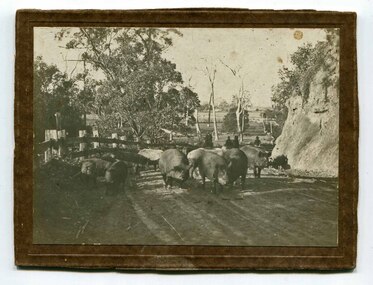
black and white photograph, C1900
... The pigs are on a gravel road with a fence on one side and and the Orbost flats can be seen in the background....The pigs are on a gravel road with a fence on one side and and the Orbost flats can be seen in the background. black and white photograph ...Pigs were taken to Bairnsdale by coaxing them with maize thrown from a wagonette . From Bairnsdale they were freighted to market by train. The journey to Bairnsdale took about five days . This method of transport continued until the rail line to Orbost was opened in 1916.This photograph is a pictorial record of farming practices in the early 20th century.A black / white photograph on a brown buff card showing pigs being taken to market. The photograph shows the pigs close up with men on horseback behind them. The pigs are on a gravel road with a fence on one side and and the Orbost flats can be seen in the background.on back - "Pigs being driven from Orbost to Bairnsdale. M.Gilbert, Orbost"agriculture farming-orbost pigs -
 Flagstaff Hill Maritime Museum and Village
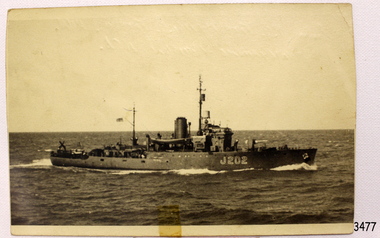
Photograph - Vessel, Steam Ship, H.M.A.S. Warrnambool J202, Between 1941-1947
... A lifeboat is suspended near the centre of the ship. Figures can be seen on deck. Hand written inscription on the reverse side. ...A lifeboat is suspended near the centre of the ship. Figures can be seen on deck. Hand written inscription on the reverse side. ...This photograph is connected to the first HMAS Warrnambool (J202), which was one of 60 Bathurst class corvette vessels built during World War II by Mort's Dock & Engineering Co Ltd of Sydney under the commission of the Royal Australian Navy (RAN). It was the namesake of the City of Warrnambool in Victoria. The armed minesweeper was 57 metres long and could had a complement of 85 personnel. Its armament included 1 × 4 inch Mk XIX gun, 1 × 40 mm Bofors AA gun (installed later), 3 × 20 mm Oerlikon guns (1 later removed), machine guns and depth charge chutes and throwers. It was launched in Sydney in May, 1941. The HMAS Warrnambool began service with patrols off Bass Strait in 1941. In December the ship docked in Warrnambool Harbour and the crew marched in a parade along Timor Street. The ship’s crew received a donation of 110 books from the Warrnambool Patriotic Fund, and a plaque of the City of Warrnambool’s Coat of Arms presented by the Mayor, Cr. John R Astbury. In September 1942 a Dutch East Indies family, Samuel and Annie Jacob and seven of their eight children, was rescued by the HMAS Warrnambool and evacuated to Darwin. The family settled in Melbourne, then in 1944 Samuel tragically died. After the war ended the family was threatened with deportation under Australia’s Immigration Restriction Act 1901 (known also as the White Australia policy). Annie married her landlord, John O’Keefe but was still issued a deportation order in 1949. The family appealed to the High Court and the case became famous for being the first successful legal challenge to the Act. The HMAS Warrnambool was in Darwin during the time it was bombed, attacked by the Japanese while rescuing 73 crew from a merchant vessel that had also been attacked. The ship was involved in several other rescues and carried troops to New Guinea. Other events included escort and patrol duties on Australia's east coast, then at Fremantle and back to Darwin. When the Japanese surrendered on September 11, 1945, at the end of World War II, the ship was at Timor. It performed mine clearance work around the Solomon Islands and New Guinea after the war. On 13th September 1947 the ship was sent to lead a flotilla at the Great Barrier Reef, off the Queensland coast. The mission was to clear the defensive British mines that were laid during1941-43 to protect Australia’s boarders. The HMAS Warrnambool hit a mine near Cockburn Reef, exploded and sank shortly afterwards. One of the 70 or so men on board was killed at the time and thirty-two men were badly injured; three of these also lost their lives. The four deceased were Victorian seamen. The wounded men were transferred by boats to the nearby HMAS Swan II, where the Swan’s and the Warrnambool’s doctors cared for them. The HMAS Swan II took the survivors to Cairns, and from there the men were flown by RAAF to either Brisbane or Sydney hospitals. The HMAS Warrnambool was the only RAN ship to be sunk by a mine, and the four who lost their livers were the last naval casualties from World War II. The ship’s wartime service was recognised by three honours. In May 1948 a number of items were recovered by Navy divers from the wreck of HMAS Warrnambool. The items included the ship’s bell (inscribed HMAS Warrnambool 1941) and the round plaque with the Seal of the Warrnambool City Council. In 1949 the plaque was returned to the Council, and the bell was donated to the Australian War Memorial. Further objects were recovered by the new owners of the wreck, Southern Cross Diving and Salvage, in 1972-75. A memorial plaque, honouring the memories of all those who served on the HMAS Warrnambool until is sunk on September 13 1947, was erected in Warrnambool on September 13, 1995. NOTE: (1)- The second HMAS Warrnambool (FCPB204), also the namesake of the City of Warrnambool, was built in 1980 in Cairns, one of fifteen Fremantle Class Patrol Boats ordered by the RAN. It was just over 41 metres long with a compliment of 22 personnel. It patrolled Australia’s northern waters for illegal fishing vessels. This vessel was decommissioned in 2005. (2)- There was also a steam and sail ship named the S.S. Warrnambool, built in 1892 in London and broken up in 1926.This photograph is significant for its association with Royal Australian Navy and its vessel, HMAS Warrnambool (j202). The HMAS Warrnambool played a nationally significant role in overturning Australia’s Immigration Restriction Act 1901 (colloquially known as the White Australia policy). The ship rescued, and brought to Australia, Samuel and Annie Jacob and their family after they evacuated Dutch East India. The family was threatened with deportation and made the first successful appeal to High Court regarding that Act. The HMAS Warrnambool has - Local significance for being the namesake of the City of Warrnambool - Local significance, having docked in Warrnambool Harbour - Local significance, the crew having paraded in Timor Street, Warrnambool - State significance for its first patrol being in Bass Strait. - National significance, being present in Timor at the Japanese surrender - National significance as part of Australia’s defence force history, being one of only four Bathurst class corvettes lost while in Australian service, the only Bathurst class corvette lost after World War II, the only RAN vessel to be sunk by a mine, and associated with the last four Navy deaths of WWIIBlack and white photograph of vessel H.M.A.S. Warrnambool J202 on an open sea. The identifying number is painted on the hull. The ship is flying a white ensign. A lifeboat is suspended near the centre of the ship. Figures can be seen on deck. Hand written inscription on the reverse side. On ship's hull "J202" On reverse of photo "From P.O. FRED MATTHEWS. 23378. R.A.N." "MARIBYRNONG MAIDSTON RSL" "H.M.A.S. WARRNAMBOOL"flagstaff hill, warrnambool, shipwrecked-coast, flagstaff-hill, flagstaff-hill-maritime-museum, maritime-museum, shipwreck-coast, flagstaff-hill-maritime-village, photograph, h.m.a.s. warrnambool, maritime village, maritime museum, shipwreck coast, mort's dock & engineering co ltd, hmas warrnambool, hmas warrnambool i, hmas warrnambool j202, hmas swan ii, j202, world war ii, bathurst class corvette, royal australian navy, ran, sydney built ship, bass strait patrol, sea mine patrol, mine sweeper, mine clearance, navy divers, great barrier reef, cockburn reef, southern cross diving and salvage, warrnambool city council, cr j r astbury, mayor j r astbury, warrnambool patriotic fund, seal, coat of arms, ship’s bell, hmas warrnambool 1941, shipwreck by sea mine 1947, sea rescue, life saving, lifesaving, sinking ship, sunk ship, immigration restrictions act 1901, white australia policy, samuel and annie jacob, john o'keere, minesweeper -
 Halls Gap & Grampians Historical Society
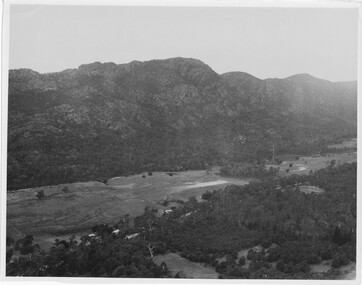
Photograph
... A road and some buildings can be seen where the cleared land meets the treed area....A road and some buildings can be seen where the cleared land meets the treed area. ...Photo depicts Fyans Valley. The road is The Grampians/ Dunkeld Road, leading to Dunkeld towards the right or Halls Gap travelling towards the left. Fyans Creek is visible in parts at the foot of the range (middle of Photo). Photo appears to have been taken from Bellfield Pk area. Photo is typical of those taken by Forests Commission of Victoria in the 1960sPhoto shows a mountain range in the background with a valley. The Valley has a band of a mostly cleared grassy section (middle of photo) with a fairly dense treed area in the foreground. A road and some buildings can be seen where the cleared land meets the treed area.scenery, fyans valley -
 Orbost & District Historical Society
chalkboard ccompass, 1960's
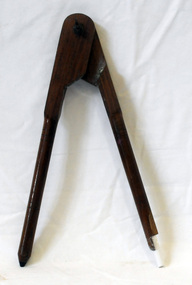
... Two wooden pieces which are joined by a wingnut so that it can be opened or closed and held in position. ...This item is an example of an item commonly used in schools before the 21st century. education chalkboard compass St-Joseph's-Orbost Noreen Cuthbertson Two wooden pieces which are joined by a wingnut so that it can be opened or closed and held in position. ...This compass as used by Noreen Cuthbertson when she was teaching at St Joseph's Catholic School ,in Orbost. These blackboard accessories were common in the classroom in a time before whiteboards became the norm.This item is an example of an item commonly used in schools before the 21st century.Two wooden pieces which are joined by a wingnut so that it can be opened or closed and held in position. It functions as a chalkboard compass and was used by schoolteachers. One end holds a piece of chalk. The other has a black pointed tip to mark the centre of the circle to be drawn.Noreen Cuthbertsoneducation chalkboard compass st-joseph's-orbost -
 Orbost & District Historical Society
model, Hodge, Chris, 2006
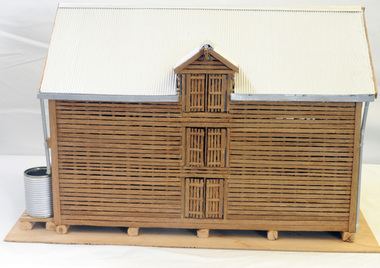
... The waater tank is a tin can covered with corrugated cardboard. The down pipes are made from drinking straws. ...The waater tank is a tin can covered with corrugated cardboard. The down pipes are made from drinking straws. ...This model was inspired by the Morgan barn on the Marlo Road, Orbost. It was built by Chris Hodge for the launch of the book, "Barns of the Snowy River" ( Reg. No.2138)The slatted barns are unique to the Orbost district.A wooden model of a three-storeyed slatted barn. The scale is approximately 30:1.The roof is corrugated cardboard painted silver. The waater tank is a tin can covered with corrugated cardboard. The down pipes are made from drinking straws. It stands on ply board.model handcraft woodwork barn -
 Bendigo Military Museum
Equipment - DUFFLE BAG, 1953
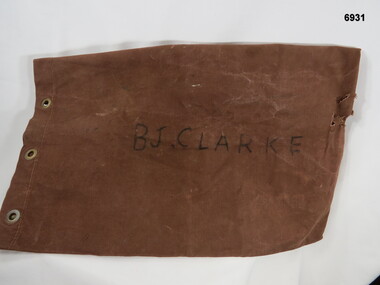
... There are a series of brass eyelets around the top opening, The cord when closed can be used as a carrying device....There are a series of brass eyelets around the top opening, The cord when closed can be used as a carrying device. Equipment DUFFLE BAG ...Dark brown duffle bag, long and narrow, made of heavy cotton and is used for carrying personal items. The bag is missing the top drawn cord. There are a series of brass eyelets around the top opening, The cord when closed can be used as a carrying device."B J CLARKE 3/?58104 BJC", "MI? D^D 1953".passchendaele barracks trust, equipment, duffle bag -
 Bendigo Military Museum
Equipment - DUFFLE BAG, Unknown
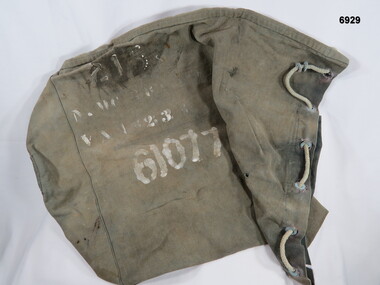
... The draw cord when closed can be used as a carrying device....The draw cord when closed can be used as a carrying device. Equipment DUFFLE BAG ...Unable to locate by either name or number.Faded army green long narrow heavy cotton duffle bag, used for carrying personal items. It has a top draw cord which threads through a series of brass eyelets. The draw cord when closed can be used as a carrying device."216 N. MC GR--OR?" = 3 red lines, "VX18238 61077". On base, "VX18238 61077". passchendaele barracks trust, duffle bag, equipment -
 Bendigo Military Museum
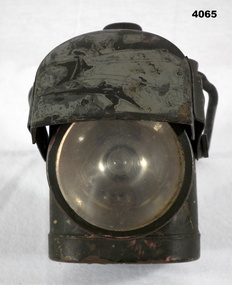
Equipment - LAMP
... Front has globe & reflector with glass front and blackout cover which can be lowered over light. A belt clip is attached to back of lamp....Front has globe & reflector with glass front and blackout cover which can be lowered over light. A belt clip is attached to back of lamp. ...Khaki painted metal casing with space for battery. Carry handle on top with on & off switch also on top. Front has globe & reflector with glass front and blackout cover which can be lowered over light. A belt clip is attached to back of lamp.Stamped on belt clip D↑ most wording unreadable ----No-------Thorne - 44lamp, army equipment -
 Royal Australian and New Zealand College of Obstetricians & Gynaecologists (RANZCOG)
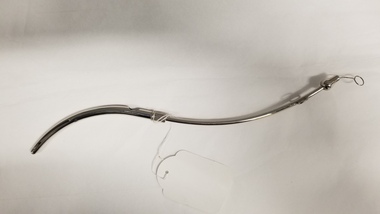
Tool - Uterine catheter used by Dr Fritz Duras
... A loop at one end is attached to a wire which can be slid in and out of the device. There are two small round attachments at the thinner end of the device which function as grips. ...A loop at one end is attached to a wire which can be slid in and out of the device. There are two small round attachments at the thinner end of the device which function as grips. ...This instrument was used by Dr Fritz Duras (1896-1965), who moved to Australia from Germany in 1937. As his father was Jewish, Duras was forced to leave Germany , and came to Australia to take up a post as director of physical education at Melbourne University. Metal catheter with internal wire. Catheter is in a vague 's' shape, with a thinner and thicker section. A loop at one end is attached to a wire which can be slid in and out of the device. There are two small round attachments at the thinner end of the device which function as grips. obstetrics -
 Bendigo Historical Society Inc.
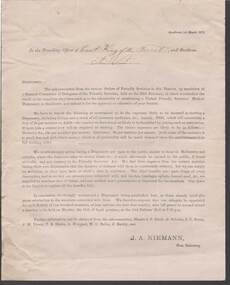
Document - ANCIENT ORDER OF FORESTERS NO. 3770 COLLECTION: CORRESPONDENCE
... Mentioned in the letter are the costs to members and shat can be supplied. A meeting was held on Monday, 15 April, at the Odd Fellows' Hall at 7.30 p.m....Mentioned in the letter are the costs to members and shat can be supplied. A meeting was held on Monday, 15 April, at the Odd Fellows' Hall at 7.30 p.m. ...Printed letter dated 1 March, 1872 re the establishment of a United Friendly Societies' Medical Dispensary in Sandhurst. Mentioned in the letter are the costs to members and shat can be supplied. A meeting was held on Monday, 15 April, at the Odd Fellows' Hall at 7.30 p.m.societies, aof, correspondence, ancient order of foresters no. 3770 collection - correspondence, court king of the forest, friendly societies' act, j s black, g schutze, j c doran, j w dyson, t r slarke, a huggard, w c bailey, j barkly, j a niemann -
 Bendigo Historical Society Inc.
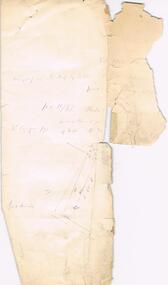
Document - H. A. & S. R. WILKINSON COLLECTION: PIECE OF PAPER WITH NAME SCHROEDER ON THE BACK
... The dates of 11 September 90 or possibly 00 and 5th August 91 can be read other words are very difficult to read, the numbers 11797 possibly a title No. and a design of a block of land are on this paper. ...The dates of 11 September 90 or possibly 00 and 5th August 91 can be read other words are very difficult to read, the numbers 11797 possibly a title No. and a design of a block of land are on this paper. ...Very damaged piece of paper. The dates of 11 September 90 or possibly 00 and 5th August 91 can be read other words are very difficult to read, the numbers 11797 possibly a title No. and a design of a block of land are on this paper. The name Schroeder on the back.organization, business, h.a. & s.r wilkinson real estate -
 Bendigo Historical Society Inc.
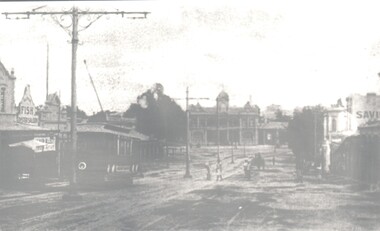
Photograph - HARRY BIGGS COLLECTION: EAGLEHAWK RD, EAGLEHAWK
... Tram in foreground. Some people can be seen crossing the tram tracks. One shop sign is Fish oyster saloon. ...Tram in foreground. Some people can be seen crossing the tram tracks. One shop sign is Fish oyster saloon. ...Photograph. Harry Biggs Collection. Very dark black & white photo of main street, Eaglehawk. Tram in foreground. Some people can be seen crossing the tram tracks. One shop sign is Fish oyster saloon. Very ornate power pole.photograph, streetscape, eaglehawk, harry biggs collection, eaglehawk rd., eaglehawk -
 Bendigo Historical Society Inc.
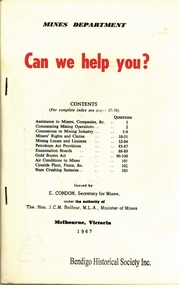
Book - CAN WE HELP YOU, 1967
... Can We Help You? Produced by the Mines Department Victoria 38-page booklet. ...There is also a summary of certain provisions of the Mines Act as at 1st January 1964. Book CAN WE HELP YOU ...Can We Help You? Produced by the Mines Department Victoria 38-page booklet. This booklet is an attempt to supply useful and necessary information on the laws relating to mining in the State of Victoria. There is also a summary of certain provisions of the Mines Act as at 1st January 1964.Mines Department.goldfields, mining laws, mining, miner's rights, mining laws victoria, gold mining, miner's rights. -
 Bendigo Historical Society Inc.
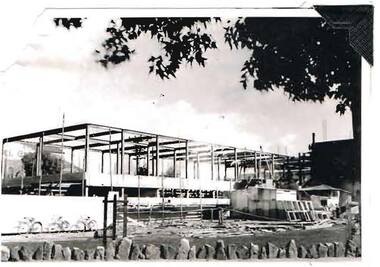
Photograph - S.E.C. VICTORIA, 1939
... Laurel Café' building can just been seen in the background of the picture. ...Laurel Café' building can just been seen in the background of the picture. ...Photograph - black and white. The new SEC Victoria building under construction, back view. Steel girders and framework being erected.'Laurel Café' building can just been seen in the background of the picture. Trademan's bikes are pictured in the bottom left of the picture.organization, public utility, electricity company, s.e.c. victoria. 1939. bendigo.
