
Showing 553 items matching " side table"
-
 Bendigo Historical Society Inc.
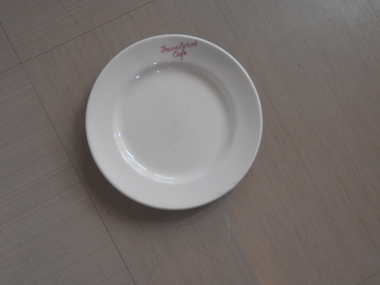
Domestic Object - FAVALORO COLLECTION: SANDWICH PLATES, 1940's -1960's
... DOMESTIC EQUIPMENT Table setting ceramic sandwich plates on under side of plate ''Duraline'' Super Vitrified Gringley Hoteware of England, Lotus Moran Pty Ltd Melbourne 9-61 Object. ...Object. Cream coloured ceramic sandwich plates ''Favaloro's Cafe'' printed on the edge of the plates in red, - twenty plates.on under side of plate ''Duraline'' Super Vitrified Gringley Hoteware of England, Lotus Moran Pty Ltd Melbourne 9-61domestic equipment, table setting, ceramic sandwich plates -
 Bendigo Historical Society Inc.
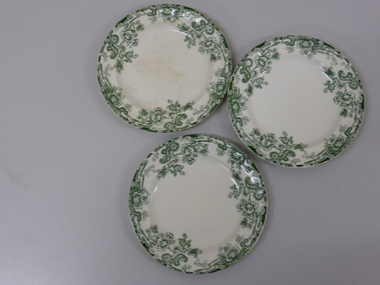
Domestic Object - SIDE PLATES X 3
... DOMESTIC EQUIPMENT Table setting plate Tokio 1790 K&Co B late Mayers Three white china side plates part of dinner set decorated with green flowers and vines. ...Three white china side plates part of dinner set decorated with green flowers and vines.Tokio 1790 K&Co B late Mayersdomestic equipment, table setting, plate -
 Bendigo Historical Society Inc.
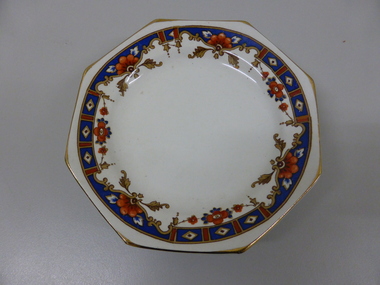
Domestic Object - FIVE CHINA SIDE PLATES
... DOMESTIC EQUIPMENT Table setting plate Phoenix Ware Made in England T.F & S.L.Ltd Five octagonal shaped side plates with floral and geometric patterns and gilding on rim. ...Five octagonal shaped side plates with floral and geometric patterns and gilding on rim.Phoenix Ware Made in England T.F & S.L.Ltddomestic equipment, table setting, plate -
 Bendigo Historical Society Inc.
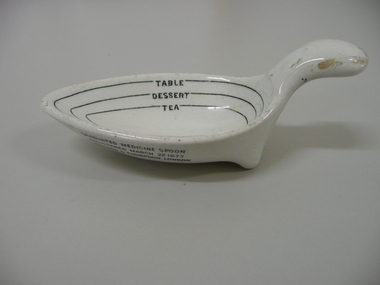
Domestic Object - GRADUATED MEDICINE SPOON
... White china graduated medicine spoon marked with black rings, table, dessert, tea, with handle & 2 small legs. Printed on side, Graduated Medicine Spoon Registered March 22 1873 S Maw. ...Son & Thompson London White china graduated medicine spoon marked with black rings, table, dessert, tea, with handle & 2 small legs. Printed on side, Graduated Medicine Spoon Registered March 22 1873 S Maw. ...White china graduated medicine spoon marked with black rings, table, dessert, tea, with handle & 2 small legs. Printed on side, Graduated Medicine Spoon Registered March 22 1873 S Maw. Son & Thompson London.S Maw. Son & Thompson Londonmedicine, first aid, measuring spoon -
 Bendigo Historical Society Inc.
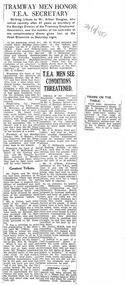
Newspaper - BASIL MILLER COLLECTION: TWO NEWSPAPER ARTICLES - ARTHUR DOUGLAS RETIREMENT, 1951
... Headlines: 'Trams on the Table' and 'Tramway Men Honour T.E.A Secretary'. Handwritten on side '29.9.1951'...Headlines: 'Trams on the Table' and 'Tramway Men Honour T.E.A Secretary'. Handwritten on side '29.9.1951' Newspaper BASIL MILLER COLLECTION: TWO NEWSPAPER ARTICLES - ARTHUR DOUGLAS RETIREMENT ...Arthur Douglas was the secretary of the Bendigo Division of the Tramway Employees Association for 30 years.Two newspaper articles reporting on Mr Arthur Douglas's Retirement Dinner. Headlines: 'Trams on the Table' and 'Tramway Men Honour T.E.A Secretary'. Handwritten on side '29.9.1951'Written in blue ink - 29/9/51cottage, miners -
 Bendigo Historical Society Inc.
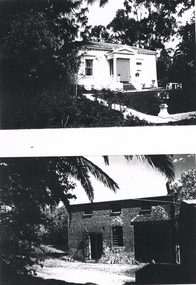
Photograph - LONG GULLY HISTORY GROUP COLLECTION: TWO HOUSES
... side. A vase with a flower and a statue on the corner of the path. there is a table and chairs beside the house. ...side. A vase with a flower and a statue on the corner of the path. there is a table and chairs beside the house. ...Photos of two houses on a piece of paper. The top photo is a white house with a portico and steps at the front door, a window at each side and a striped blind at the edge of the portico. Decorative brick work at spout level. A concrete path is along the front of the house and leads out to the front and side. A vase with a flower and a statue on the corner of the path. there is a table and chairs beside the house. The garden is very black. The lower photo is a brick house with a door, a tall window that is rounded at the top and three small windows just below the spout line. There are some plants in front of the house and trees around it. parts of the garden are dark.bendigo, history, long gully history group, the long gully history group - two houses -
 Bendigo Historical Society Inc.
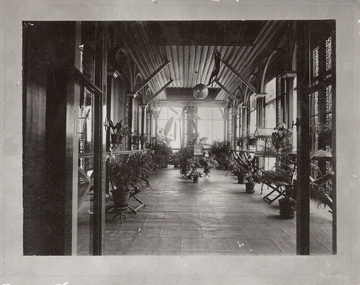
Photograph - FORTUNA COLLECTION: CONSERVATORY, FORTUNA VILLA
... side. Decorative windows, potted plants, folding chairs, tables, stone? ...side. Decorative windows, potted plants, folding chairs, tables, stone? ...Black and white photograph. Large room board lined ceiling. Arch openings each side. Decorative windows, potted plants, folding chairs, tables, stone? Floor. History of object: James Lerk 2000 'Fortuna ville' conservatory with its Venetian glass windows. The glass has recently been re-furbished and re-set in the frames. Phtoograph by W Ninnis'. Photographed for Bendigo Advertiser 11.1.2001W Ninnisbuildings, residential, fortuna villa -
 Bendigo Historical Society Inc.
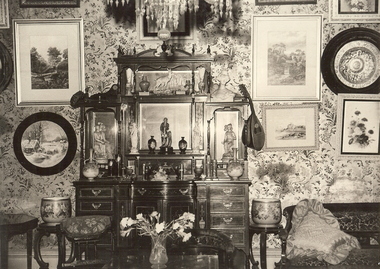
Photograph - LANCEWOOD HOUSE, MCLAREN ST., BENDIGO
... side board. Vases, ornaments, jareniers, and lute haning on the right. Two elephant occasional tables on either side with jardenieres. ...side board. Vases, ornaments, jareniers, and lute haning on the right. Two elephant occasional tables on either side with jardenieres. ...black and white photo ; Lancewood House, home of late Ernest Mueller and family. Interior of sitting room with wall paper patterned with flower and plant motifes. Many pictures on the wall around a large mirrored edwardian side board. Vases, ornaments, jareniers, and lute haning on the right. Two elephant occasional tables on either side with jardenieres. A small couch on the right against the wall. Drops of a chandelier visible at the top. On front bottom right margin ' UI 589.7 'buildings, fittings & materials, lancewood house -
 Bendigo Historical Society Inc.
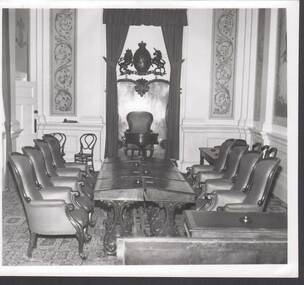
Photograph - COUNCIL CHAMBER, FORMER COUNCIL OFFICES, TOWN HALL, BENDIGO
... At rear of table, one chair surrounded on either side by drapes. Royal Coat of arms above.- crown above a shield , rampant Lion and Unicorn .There is also a wooden gavell and block...At rear of table, one chair surrounded on either side by drapes. Royal Coat of arms above.- crown above a shield , rampant Lion and Unicorn .There is also a wooden gavell and block Photograph COUNCIL CHAMBER, FORMER COUNCIL OFFICES, TOWN HALL, BENDIGO ...COUNCIL CHAMBER, FORMER COUNCIL OFFICES, TOWN HALL, BENDIGO -black and white copy : in centre of image : eight polished wooden desks with ornate iron legs, ink wells , surrounded by eight upholstered chairs. At rear of table, one chair surrounded on either side by drapes. Royal Coat of arms above.- crown above a shield , rampant Lion and Unicorn .There is also a wooden gavell and blockbuildings, town hall, bendigo, bendigo, town hall, council -
 Bendigo Historical Society Inc.
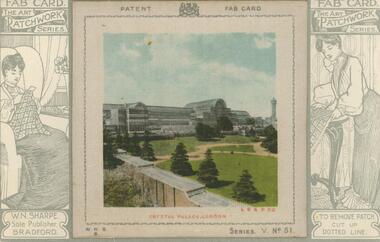
Postcard - GLADYS DEAN COLLECTION: POSTCARD, 1906 - 1908
... side of the image. Printed drawings of a woman seated sewing and standing placing a cloth on a table appear either side of the image. ...side of the image. Printed drawings of a woman seated sewing and standing placing a cloth on a table appear either side of the image. ...Postcard with raised 8.5cm x 8.5cm coloured image of Crystal Palace London. Image has printed words 'Patent' and 'Fab Card' either side of a printed coat of arms at the top and letters W.N.S.B. bottom left corner and 'Series V No 51' bottom right corner. Image is attached to printed 14cm x 9cm black and white printed card. The words 'Fab Card' and 'The Art Patchwork Series' appear on the card either side of the image. Printed drawings of a woman seated sewing and standing placing a cloth on a table appear either side of the image. On reverse card is addressed to Miss Dean McKenzie Street Golden Square Victoria Australia. 1 penny stamp attached.W.N. Sharpe Sole Publisher Bradfordpostcard -
 Bendigo Historical Society Inc.
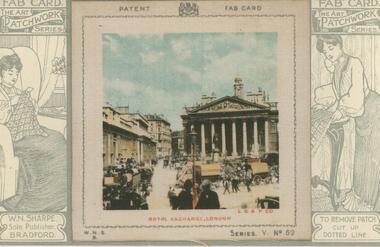
Postcard - GLADYS DEAN COLLECTION: POSTCARD, 1906 - 1908
... side of the image. Printed drawings of a woman seated sewing and standing placing a cloth on a table appear either side of the image. ...side of the image. Printed drawings of a woman seated sewing and standing placing a cloth on a table appear either side of the image. ...Postcard with raised 8.5cm x 8.5cm coloured image of Royal Exchange London. Image has printed words 'Patent' and 'Fab Card' either side of a printed coat of arms at the top and letters W.N.S.B. bottom left corner and 'Series V No 52' bottom right corner. Image is attached to printed 14cm x 9cm black and white printed card. The words 'Fab Card' and 'The Art Patchwork Series' appear on the card either side of the image. Printed drawings of a woman seated sewing and standing placing a cloth on a table appear either side of the image. On reverse card is addressed to Miss Dean Golden Square Victoria Australia. 1 penny stamp attached and postmarked Johannesburg.W.N. Sharpe Sole Publisher Bradfordpostcard -
 Bendigo Historical Society Inc.
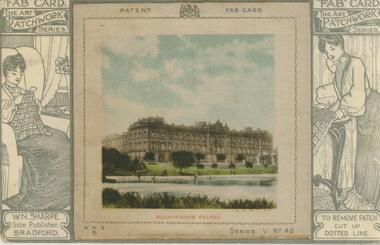
Postcard - GLADYS DEAN COLLECTION: POSTCARD, 1906 - 1908
... side of the image. Printed drawings of a woman seated sewing and standing placing a cloth on a table appear either side of the image. ...side of the image. Printed drawings of a woman seated sewing and standing placing a cloth on a table appear either side of the image. ...Postcard with raised 8.5cm x 8.5cm coloured image of Buckingham Palace. Image has printed words 'Patent' and 'Fab Card' either side of a printed coat of arms at the top and letters W.N.S.B. bottom left corner and 'Series V No 43' bottom right corner. Image is attached to printed 14cm x 9cm black and white printed card. The words 'Fab Card' and 'The Art Patchwork Series' appear on the card either side of the image. Printed drawings of a woman seated sewing and standing placing a cloth on a table appear either side of the image. On reverse card is addressed to Miss G Dean Golden Square Victoria Australia. 1 penny stamp attached.W.N. Sharpe Sole Publisher Bradfordpostcard -
 Bendigo Historical Society Inc.
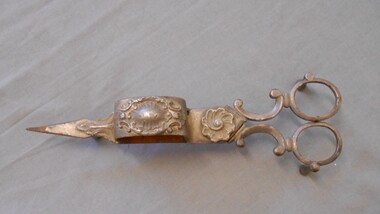
Domestic Object - MAGGIE BARBER COLLECTION: SILVER CANDLE-SNUFFER, Mid 1880-1900's
... DOMESTIC EQUIPMENT Table setting silver candle-snuffer Object. pointed at one end, with a 1.7 cm ''foot'' under the point. The Ushaped snuffer to one side below the point, This has a medallion shaped decorative medallion on the side. ...Object. pointed at one end, with a 1.7 cm ''foot'' under the point. The Ushaped snuffer to one side below the point, This has a medallion shaped decorative medallion on the side. The interior scissors action snuffer-- which moves in a sideways action is hallmarked: WH &S followed by an indistinguishable mark. Two oval shaped loops form the handles, and each has a 1.7 cm ''foot''.domestic equipment, table setting, silver candle-snuffer -
 Bendigo Historical Society Inc.
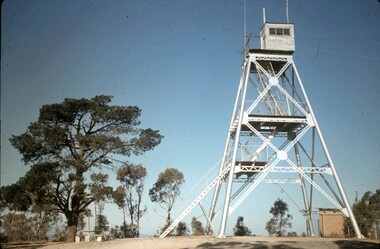
Slide - PETER ELLIS COLLECTION: SLIDE, May 1970 - Jan 1972
... side. There are two aerials and a wooden building on the top platform. A tree with a picnic table and chairs at the bottom is on the right hand side....side. There are two aerials and a wooden building on the top platform. A tree with a picnic table and chairs at the bottom is on the right hand side. ...Coloured slide transparency. Image is of a tall metal tower on top of a hill. The tower is white and a ladder is visible on the right hand side. There are two aerials and a wooden building on the top platform. A tree with a picnic table and chairs at the bottom is on the right hand side.Kodachrome Transparencyslide, bendigo, bendigo institute of technology -
 Bendigo Historical Society Inc.
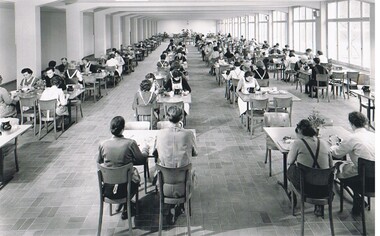
Photograph - HANRO COLLECTION: DINING ROOM
... It is a long room with 4 rows of tables across it, floor to ceiling windows run the full length of the room on the right hand side of the photo. ...It is a long room with 4 rows of tables across it, floor to ceiling windows run the full length of the room on the right hand side of the photo. ...Black and white photograph of the dining room at the Handschin and Ronus factory in Switzerland.. It is a long room with 4 rows of tables across it, floor to ceiling windows run the full length of the room on the right hand side of the photo. There are perhaps 40 or 50 people seated at the tables, which could accommodate several hundredorganization, business, hanro, clothing manufacture, hanro, handschin and ronus, lunch room -
 Bendigo Historical Society Inc.
Postcard - PORTRAIT 3 YOUNG CHILDREN
... A girl sitting on a wooden chair, wearing a white dress, white ribbon tied to the side of her dark colour hair, wearing long black socks and black shoes, bow tired. A boy standing arm leaning on a two tier table, wearing long black socks and black shoes with 3 straps buttoned, bow tie, striped and button shirt. ...A girl sitting on a wooden chair, wearing a white dress, white ribbon tied to the side of her dark colour hair, wearing long black socks and black shoes, bow tired. A boy standing arm leaning on a two tier table, wearing long black socks and black shoes with 3 straps buttoned, bow tie, striped and button shirt. ...Postcard : Sepia portrait of 3 young children. A girl sitting on a wooden chair, wearing a white dress, white ribbon tied to the side of her dark colour hair, wearing long black socks and black shoes, bow tired. A boy standing arm leaning on a two tier table, wearing long black socks and black shoes with 3 straps buttoned, bow tie, striped and button shirt. The 3rd child sitting high on table, holding a Union Jack flag, wearing a dress that looks like a coat. On front of postcard reads Bendigo, on back it reads Kalna Bendigo.Kalna Bendigophoto, group, 3 young children, postcard, photograph, portrait, 3 young children. -
 Bendigo Historical Society Inc.
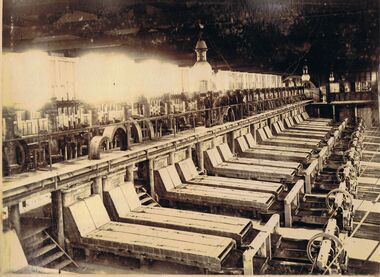
Photograph - GOLD TABLES IN STAMPER ROOM
... Image shows large room in gold mine. 18 gold tables are arranged down centre, wheels/pulleys on LH side. Large electric lights hanging from ceiling. ...Image shows large room in gold mine. 18 gold tables are arranged down centre, wheels/pulleys on LH side. Large electric lights hanging from ceiling. ...Sepia image mounted on board. Image shows large room in gold mine. 18 gold tables are arranged down centre, wheels/pulleys on LH side. Large electric lights hanging from ceiling. Goldmine unknown.bendigo, mining, gold tables, bendigo, sandhurst, goldmining, gold, tables -
 Otway Districts Historical Society
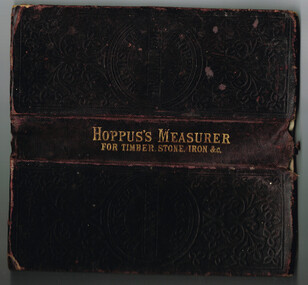
Book, Hoppus's Practical Measurer
... Hoppus the Hoppus's Practical Measurer, or measuring made easy by a new set of tables which show by looking the solid content of any piece of timber, stone, etc, either square, round or unequally sided, and the value at any price of cubic feet. ...Hoppus the Hoppus's Practical Measurer, or measuring made easy by a new set of tables which show by looking the solid content of any piece of timber, stone, etc, either square, round or unequally sided, and the value at any price of cubic feet. ...Manufactured by E. Hoppus the Hoppus's Practical Measurer, or measuring made easy by a new set of tables which show by looking the solid content of any piece of timber, stone, etc, either square, round or unequally sided, and the value at any price of cubic feet. The book also gives the superficial comtent of boards, glass, painting and plastering with explanations of the uses and applications of the tables. The contents are given in feet, inches, quarters and twelfth parts of an inch. It includes the measurment of timber by several dimensions together with tables showing the weight of iron by measure.Hoppus's Practical Measurer; or, Measuring made easy by a new set of tables, which show, at sight, the solid content of any piece of timber, stone, &c. W. Nicholson & Sons; London; nd. 238 p. Hard cover.e. hoppus; measurment; timber; stone; boards; glass; painting; plastering, iron; -
 Alfred Hospital Nurses League - Nursing History Collection
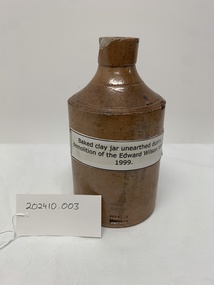
Ceramic - Stoneware bottle, Doulton Lambeth, Baked clay jar unearthed during demolition of the Edward Wilson Wing 1999, ca.1870 - 1890
... table wares and decorative items. An early utilitarian stoneware item made by a well-known company that specialised in making salt-glazed items that later earned a reputation for making stoneware art objects. AHNL Edward Wilson Wing Alfred Hospital baked clay jar Doulton Lambeth stamp base of front - makers mark. label -paper label taped to front -Baked clay jar unearthed during demolition of the Edward Wilson Wing 1999 brown glazed earthenware bottle, circular grooves at throat of bottle x 3, cylindrical shape, narrow neck, makers stamp on side, large chip at opening, multiple small chips on sides. no stopper. paper label taped to front -Baked clay jar unearthed during demolition of the Edward Wilson Wing 1999 Baked clay jar unearthed during demolition of the Edward Wilson Wing 1999 Ceramic Stoneware bottle, Doulton Lambeth ...The business was specialised in making salt-glazed stoneware articles, including utilitarian or decorative bottles, jugs and jars, much of it intended for inns and pubs. The backbone of the business was a wide range of utilitarian wares, mostly stone wares, including storage jars, tankards and the like, and later extending to pipes for drains, lavatories and other bathroom ceramics. From 1853 to 1902 its wares were marked Doulton & Co., then from 1902, when a royal warrant was given, Royal Doulton. The company always made some more decorative items, initially still mostly stoneware, and from the 1860s the firm made considerable efforts to get a reputation for design, in which it was largely successful, as one of the first British makers of art pottery. Initially, this was done through artistic stoneware's made in Lambeth, but in 1882 the firm bought a Burslem factory, which was mainly intended for making bone china table wares and decorative items. An early utilitarian stoneware item made by a well-known company that specialised in making salt-glazed items that later earned a reputation for making stoneware art objects. brown glazed earthenware bottle, circular grooves at throat of bottle x 3, cylindrical shape, narrow neck, makers stamp on side, large chip at opening, multiple small chips on sides. no stopper. paper label taped to front -Baked clay jar unearthed during demolition of the Edward Wilson Wing 1999 Doulton Lambeth stamp base of front - makers mark. label -paper label taped to front -Baked clay jar unearthed during demolition of the Edward Wilson Wing 1999ahnl, edward wilson wing alfred hospital, baked clay jar -
 Ithacan Historical Society
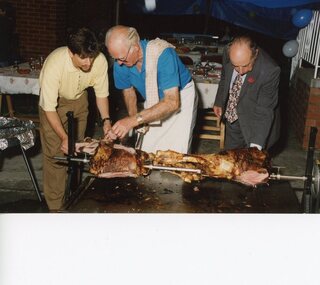
Photograph, Ithacan Club New Year's barbeque, 1 January 1996
... The tables are set up for the guests and Jim Kandiliotis is carving the meat with help from Nick Lourantos and Stathi Raftopoulos looks to be sampling the fare. Cooking meat on a spit is popular fare in Greek celebrations. A coloured photograph of three men cooking a side ...The photo is taken at the home of Jim and Leah Kandiliotis in 1996 during the preparations for an Ithacan New Years Eve barbeque function. The tables are set up for the guests and Jim Kandiliotis is carving the meat with help from Nick Lourantos and Stathi Raftopoulos looks to be sampling the fare.Cooking meat on a spit is popular fare in Greek celebrations. A coloured photograph of three men cooking a side of lamb on a spit which is on a patio. -
 Ithacan Historical Society
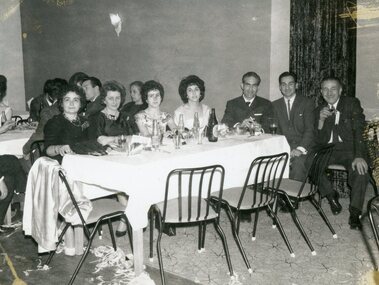
Photograph, Social function, 7 July 1962
... sides. The image is of four ladies and three men seated around a table at a social function. ...sides. The image is of four ladies and three men seated around a table at a social function. ...Pictured at an Ithacan social function are from L to R, Artemis Sikiotis, unknown, Leah Kandiliotis, Rita Varigos, Jim Kandiliotis, Dennis Varigos and Sotiri Sikiotis. A black and white photograph with a white border with crinkled edges on two sides. The image is of four ladies and three men seated around a table at a social function. -
 Ithacan Historical Society
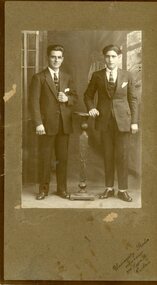
Photograph, Millie Whelan Universal Studios, Paizis brothers, c early 1930s
... A sepia photograph mounted on board of two smartly men standing on either side of a small round table in a photographer's studio....A sepia photograph mounted on board of two smartly men standing on either side of a small round table in a photographer's studio. ...The men in the photograph are Nicholas ands Alkinos Paizis who migrated to Australia from Kioni. Alkinos Paizis was a past president of the IPS.A sepia photograph mounted on board of two smartly men standing on either side of a small round table in a photographer's studio. -
 National Vietnam Veterans Museum (NVVM)
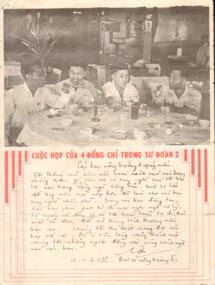
Pamphlet, Propaganda Leaflet
... table and enjoying a meal. Under the photo in red writing is the title of the flyer with black writing under this All the information is written in Vietnamese. Down both side...table and enjoying a meal. Under the photo in red writing is the title of the flyer with black writing under this All the information is written in Vietnamese. Down both side ...A propaganda flyer that depicts four men sitting at a table and enjoying a meal. Under the photo in red writing is the title of the flyer with black writing under this All the information is written in Vietnamese. Down both side of the information there are red stripes and lines. The reverse side of the flyer shows photographs of three men in black ink with information in Vietnamese beside each photograph. propaganda, vietnamese, lloyd, thomas peter, peter thomas lloyd, royal australian infantry corps, national service, 1 australian reinforcement unit, 2nd battalion, the royal australian regiment -
 National Vietnam Veterans Museum (NVVM)
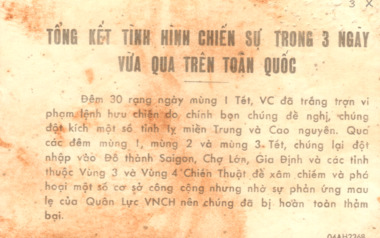
Pamphlet, A Summary of the War Situation in the country over the past days
... TONG KET TINH HINH CHIEN SU TRON 3 NGAY - VUA QUA TREN TOAN QUOC - A Summary of the war situation in the country over the past days: On one side there is information in Vietnamese and on the reverse side the information is in a table format....Pamphlet Psycological Warfare Propaganda NVA/VC Viet Cong 7th Battalion 1st Battalion The Royal Australian Regiment Terry Michael Collie 2790361 Lunar New Year Central Vietnam Saigon Gia Dinh Cho Lon TONG KET TINH HINH CHIEN SU TRON 3 NGAY - VUA QUA TREN TOAN QUOC - A Summary of the war situation in the country over the past days: On one side there is information in Vietnamese and on the reverse side the information is in a table format. A Summary of the War Situation in the country over the past days. ...From the 30th to the 1st day of Tet (Lunar New Year), the VC have shamelessly violated the truce that they themselves proposed. The have attacked a number of town in Central Vietnam and in the Highlands. On the nights of the 1st, 2nd, and 3rd of Tet, they have taken advantage to infiltrate into the capital, Saigon - and into Gia Dinh and Cho Lon. They have also attacked in the provinces of the 3rd and the 4th Tactical Zones to destroy infrastructure and public utilities. However, thanks to the rapid reaction of the Republic of Vietnam Armed Forces, they have been completely and humiliatingly defeated. (1968) On the reverse side reads: Herewith are the casualty rates of us and the enemy: Period: 30-01-68 - Our causalities 282 killed and wounded. Enemy 2,338 killed on the spot, 182 captured. Period 1-02-68 - Our soldiers: 203 killed and wounded. Enemy 2,617 killed, 198 captured. Period 2-02-68 to 12 midday: Our soldiers 211 killed and wounded. enemy 2,112 killed, 119 captured. Summary: Our casualties: 706, Enemy casualties 7,561. Enemy weapons captured: 144 crew-served weapon; 2,253 individual weapons.TONG KET TINH HINH CHIEN SU TRON 3 NGAY - VUA QUA TREN TOAN QUOC - A Summary of the war situation in the country over the past days: On one side there is information in Vietnamese and on the reverse side the information is in a table format.pamphlet, psycological warfare, propaganda, nva/vc, viet cong, 7th battalion, 1st battalion, the royal australian regiment, terry michael collie, 2790361, lunar new year, central vietnam, saigon, gia dinh, cho lon -
 Wangaratta Urban Fire Brigade
1987 presentation dinner, photographs
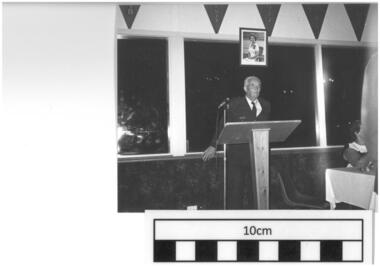
... table - Stewart Marshall S/O, Jan Marshall, Tracey Collier, Dianne Mills, ??? (standing), ???, Brendan Collier??, Gayle Humphreys, Brian Humphreys S/O .44 - L to R S/O Stewart Marshall, S/O Brian Humpreys, Jan Marshall (sitting with her head back laughing) .45 - all 3 standing side by side L to R Craige Musselwhite (reserve fireman of the year), Peter Bell (fireman of the year - holding the perpetual trophy shield), Trevor Poulter (runner up fireman of the year) .46 - Steven Poulter and wife .47- A. ...table - Stewart Marshall S/O, Jan Marshall, Tracey Collier, Dianne Mills, ??? (standing), ???, Brendan Collier??, Gayle Humphreys, Brian Humphreys S/O .44 - L to R S/O Stewart Marshall, S/O Brian Humpreys, Jan Marshall (sitting with her head back laughing) .45 - all 3 standing side by side L to R Craige Musselwhite (reserve fireman of the year), Peter Bell (fireman of the year - holding the perpetual trophy shield), Trevor Poulter (runner up fireman of the year) .46 - Steven Poulter and wife .47- A. ...All photographs taken at the 1997 presentation dinner at the Wangaratta Rovers football club. Wangaratta Brigade members and partners and guests from other brigades and their partners along with 'guests' were always invited. .1 - Trevor Poulter (Chairman) .2 - L - R - ???, Arthur Haynes (regional officer), Tess Haynes .4 - L-R - ???, Trevor Poulter, David Allen (representing council) .5 - L-R - David Allen (representing council, Allan Mills .6 L-R - Brian Potter, Cyril Davidson .7 L-R - Kevin Howard, Brian Humphries (station officer) .8 L-R - Brian Potter, Cyril Davidson .9 L-R - June Poulter, Trevor Poulter, Jack Prendegast, Heinz Baytala .10 L-R - Brian Potter, Pat Briese .11 L-R - Jack Prendegast, Craig Musselwhite (junior) .12 L-R - Barrie Sanders, Brian Potter (giving award to Barrie) .13 L-R - John Rosser, Brian Potter, (35 yr long service medal to John) (Band members in background) .14 L-R - Peter Bell (when was a volunteer), Brian Potter .15 L-R - Jack Prendegast, Craig Musslewhite .16 L-R - Joan Rosser, Gail Humphries .17 L-R - Barrie Sanders (speaking), Brian Potter .18 L-R - Jack Prendergast, Heinz Baytala (winner of the reserve fireman) .19, .20, .21, Members and guests doing the 'progressive barn dance' .22, .23, .24, .25, .26, .27 Wangaratta running team members (end of competition season) - L-R - Eric Lawn, ???, Ron Webb, To Philp, ??? .28, .29 L-R - Aileen Sanders (12yr badge), Elaine Graham (20yr badge) .30 Jon Briese 35yrs and Cyril Davidson 40 and John Kerr 25yrs - long service awards .31 - S. Poulter + wife posing for the camera whilst on the dance floor, with several other people and part of the band in the background .32 - T.Poulter (brigade chairman) standing at the lecturn/microphone speaking - there are 2 others (1 male, 1 female) seated to the right of him at a table .33 - Front L- R - Dorothy Wise (with her back to us), ?, T Poulter. Back L-R - Fire officer(unknown), Dianne Mills .34 - Alex Carmody and wife Judy Carmody .35 - Front R around table to front L - ? , ? , Dianne Mills, Angie Sheetz, Ron Webb, ? , Maxine Webb, Steve Allan .36 - Chief Officer Brian Potter (speaking at lecturn), Arthur Haynes and wife Tess Haynes (seated in background) .37 - L to R around table - Cyril Davidson, Alec Carmody, Judy Carmody, Margaret Howard, Kevin Howard .38 - L to R Rhonda Allan, Jan Marshall (back to us), Stewart Marshall, Steve Allan .39 - L to R Tess Haynes, Arthur Haynes(standing), (Pat Rooks - a guest from Whitfield??), Trevor Poulter, June Poulter, Val Gleeson, Kevin Gleeson (mayor of Wangaratta at the time), Aileen Sanders, Elaine Graham 40 - a 'head and shoulders' photo of S/O Brian Humpfreys. In the photo is also a lady standing on his right - but her head is cut off so cant be identified .41 - Jan Marshall kissing Stewart Marshall S/O (various other members , guest and band in background) .42 - Back L - R - Trevour Poulter, Craig Mussellwhite, Brian Potter (Chief officer), Middle - Elaine Graham, Aileen Sanders Front L - R- Peter Bell, John Briese, Cyril Davidson .43 - L -R around table - Stewart Marshall S/O, Jan Marshall, Tracey Collier, Dianne Mills, ??? (standing), ???, Brendan Collier??, Gayle Humphreys, Brian Humphreys S/O .44 - L to R S/O Stewart Marshall, S/O Brian Humpreys, Jan Marshall (sitting with her head back laughing) .45 - all 3 standing side by side L to R Craige Musselwhite (reserve fireman of the year), Peter Bell (fireman of the year - holding the perpetual trophy shield), Trevor Poulter (runner up fireman of the year) .46 - Steven Poulter and wife .47- A. Hynes standing at lecturn speaking. 47 various photographs from the 1987 presentation dinner at Rovers.1- Nov 1987 Presentation Dinner Chairman Trevor Poulter .2- Nov 1987 Presentation Dinner .3 - Nov 1987 Presentation Dinner L to R S/O Allan S/O Grenfell Chairman Trevor Poulter .29- Nov 1987 Presentation Dinner .30 - Nov 1987 Presentation Dinner L to R FIREMAN JOHN BREEZE, CIRIL DAVIDSON JOHN KERR .31 - Nov 1987 Presentation Dinner S. Poulter + missus .32 - Nov 1987 Presentation Dinner T. Poulter chairman .33 - Presentation Dinner 1987 .34 - Nov 1987 Presentation Dinner .35 - Nov 1987 Presentation Dinner .36 - Nov 1987 Presentation Dinner .37 - Nov 1987 Presentation Dinner .38 - Nov 1987 Presentation Dinner .39 - Nov 1987 Presentation Dinner .40- Nov 1987 Presentation Dinner .41 - Presentation Dinner 1987 Nov S/O Stewart Marshall .42 - Presentation Dinner 1987 Nov S/O Brian Humpreys .44 - Nov 1987 Presentation dinner L to R S/O Stewart Marshal, " Brian Humpreys Jan Marshal .45 - Nov 1987 Presention dinner L to R Craige Musselwhite (reserve fireman of the year) Peter Bell (fireman of the year) Trevor Poulter (runner up) .46 - 1987 Nov. Presentation Dinner Steven Poulter and wife .47 - Nov 1987 Presentation Dinner A.C.O A. Hynesaileen sanders, elaine graham, eric lawn, ron webb, tom philp, jack prendergast, heinz baytala, barrie sanders, brian potter, joan rosser, gail humphries, craig musselwhite, peter bell, john rosser, pat briese, june poulter, trevor poulter, cyril davidson, kevin howard, brian humphries, david allen, allen mills, arthur haynes, tess haynes, john jerr, stephen poulter, alex carmody, judy carmody, dianne mills, angie sheetz, maxine webb, steve allan, jan marshall, a. hynes, margaret howard, rhonda allan, stewart marshall, val gleeson, kevin gleeson, john briese, tracey collier, brendan collier -
Port Melbourne Historical & Preservation Society
Document - Presentation kit, 150th Anniversary M&HB Railway, Victorian Department of Infrastructure, Aug 2004
... Kit presented to attendees at celebratory breakfast for 150th Anniversary of the M&HB railway, in pink & copper. .02: Invitation to the breakfast .03: Badge '150 Victoria' gold coloured .04: Set of 4 railway postcards ('maximum cards') .05: Fridge magnet from PROV (grey & black) .06: Card designating table 16, where 9 PMH&PS members sat .07: "Sandridge Railway Trail" - DL tour guide .08: "Making Tracks" - DL brochure about RHSV exhibition .09: "Stampspotting" - DL exhibition brochure (Aust Post) .10: "Rebuilding Regional Rail" - A4 brochure re new developments in Vic Rail .11: "Celebrating the 150th Anniversary of Victorin Railways" - double-sided A4 fact sheet, copper & pink .12: Seven related media releases from various auhorities .13 RHSV form for telling railway stories. ...Transport - Railways Piers and Wharves - Station Pier Piers and Wharves - Railway Pier Peter Batchelor Department of Infrastructure Melbourne & Hobsons Bay Railway Kit presented to attendees at celebratory breakfast for 150th Anniversary of the M&HB railway, in pink & copper. .02: Invitation to the breakfast .03: Badge '150 Victoria' gold coloured .04: Set of 4 railway postcards ('maximum cards') .05: Fridge magnet from PROV (grey & black) .06: Card designating table 16, where 9 PMH&PS members sat .07: "Sandridge Railway Trail" - DL tour guide .08: "Making Tracks" - DL brochure about RHSV exhibition .09: "Stampspotting" - DL exhibition brochure (Aust Post) .10: "Rebuilding Regional Rail" - A4 brochure re new developments in Vic Rail .11: "Celebrating the 150th Anniversary of Victorin Railways" - double-sided A4 fact sheet, copper & pink .12: Seven related media releases from various auhorities .13 RHSV form for telling railway stories. ...Kit presented to attendees at celebratory breakfast for 150th Anniversary of the M&HB railway, in pink & copper. .02: Invitation to the breakfast .03: Badge '150 Victoria' gold coloured .04: Set of 4 railway postcards ('maximum cards') .05: Fridge magnet from PROV (grey & black) .06: Card designating table 16, where 9 PMH&PS members sat .07: "Sandridge Railway Trail" - DL tour guide .08: "Making Tracks" - DL brochure about RHSV exhibition .09: "Stampspotting" - DL exhibition brochure (Aust Post) .10: "Rebuilding Regional Rail" - A4 brochure re new developments in Vic Rail .11: "Celebrating the 150th Anniversary of Victorin Railways" - double-sided A4 fact sheet, copper & pink .12: Seven related media releases from various auhorities .13 RHSV form for telling railway stories. (May be missing August 2013)transport - railways, piers and wharves - station pier, piers and wharves - railway pier, peter batchelor, department of infrastructure, melbourne & hobsons bay railway -
 Narre Warren and District Family History Group
Book, Narre Warren & District Family History Group Inc, Casey Cardinia Collection - Pakenham Information File - Volume 3, 2024
... table of contents and various newspaper clippings and other information pertaining to the Pakenham area Volume 3. The date the articles were published, and title of articles are listed below. 28 May 2008 Hounds’ Bloodline Runs Way, Way Back 18 Jul 2012 The Only Job for Her - Kerri Bolch 25 Jan 2023 Two Lives are Celebrated - Ian Thomas 19 Jan 2023 My Life in Newspapers - Ian Thomas 18 Jan 2023 An All-Round Good Sport - Ian’s Talents Lie the Other Side of the Boundary Fence - Ian Thomas 18 Jan 2023 Tributes Stream in for Ian - Ian Thomas 18 Jan 2023 Putting Family First, At Last - Ian Thomas 18 Jan 2023 The Editor's Desk - Ian Thomas 19 Jan 2023 Went the Way he Wanted - Ian Thomas 18 Jan 2023 Historic Ties to Society - Ian Thomas 18 Jan 2023 Death and Funeral Notices - Ian Thomas 18 Jan 2023 Tributes Flow - Ian Thomas 18 Jan 2023 Departed with his Boots on - Ian Thomas 7 Nov 2018 War Tragedies Bring High Flying Family Down to Earth 21 Dec 2022 Tree Treasure - David Ferrier 1 May 2019 Pakenham Remembers 24 Apr 2019 Flying the Flag 24 Apr 2019 The Combined Pakenham & District Roll of Honour 1914-1918 24 Apr 2019 Artie Stopped a Few Slugs in his Time - Artie Paternoster 24 Apr 2019 Farmer Took a Bullet - Francis Hornby 24 Apr 2019 Pakenham Butcher Shipwrecked on the Way to War - Andy Webster 24 Apr 2019 Len Serves on Home Soil - Len Cook 24 Apr 2019 A Face of Anzac From Centenary Website - Albert Nye 24 Apr 2019 Bill a Giant of Pakenham - Bill Stone 1 June 2016 Customers Came First - Margaret Pursell 1 June 2016 Ken had a Passion for Life - Kenneth Aldred 1 June 2016 Politics, Education and Industry Were Bob’s Legacy - Bob Charles 30 Oct 2024 Darby Won the Cup - Ray (Darby) Webster 10 Apr 2024 Mural Unveiled for Pakenham Girl Guides Hall 4 Sep 2024 Remembering the Generosity of Carol - Carol Clay 2 Oct 2024 Norma Deeply Loved - Norma Jackson 2 Oct 2024 The Last of her Generation - Margaret Maher 23 Oct 2024 Celebrating a Proud 95 Years - Pakenham CFA 23 Oct 2024 Class of ‘74 Marks 50 Years - Pakenham High School 23 Oct 2024 Commemorating 45 Years of Service - David W Bull Funerals 23 Oct 2024 Riding High at Pakenham 4 Sep 2024 When You Could Buy Cattle and a Car 21 Aug 2024 Honora Fields Name Choice 28 Aug 2024 A Business Pioneer - Oscar Smith 28 Aug 2024 St Pat’s Blessed with Reno 14 Aug 2024 Historic Milking Shed Gone 14 Aug 2024 Frank’s Wooden Wonders - Frank Lindsay 31 July 2024 How the Pioneers Settled on IYU Estate 20 Mar 2024 Life Memberships Awarded - Pakenham Racing Club 27 Mar 2024 Magical Day for the Lions - Lions Netball Club 20 Mar 2024 Tennis Club’s Call to Arms - Pakenham Tennis Club 20 Mar 2024 Timeline of a Tennis Club - Pakenham Tennis Club 17 Jul 2024 Honest and Committed Man - Ian Bell 17 Jul 2024 Pakenham Loses Devoted Supporter Thelma Young 22 May 2024 Our Quiet Achiever - Cheryl Trimmings 17 July 2024 A True Pakenham Pioneer - Meryl Waterhouse 10 Apr 2024 Names for Paky East - When Pakenham Used to be “Pakenham East” 15 May 2024 Stories Behind the Names 28 Aug 2024 The Work Behind the Horse - Jackson Pope 22 May 2024 Farming Pioneer Name Proposed for Pakenham East 10 July 2024 Mystery Surrounds Shield 19 Apr 2017 In Their Footsteps - Lachlan Smith 20 July 2016 24 Hours of Carnage Battle of Fromelles 12 Nov 2025 Hospital is Taking Shape 12 Nov 2025 Back to School, 50 Years On - Pakenham High School 12 Nov 2025 A Century of Loving Life - Emily Joyce Taylor 12 Nov 2025 Much-Loved Local Ngaire - Ngaire Bennett 9 Oct 2025 Spotlight on History for Book Launch 16 Jul 2025 Lyn’s Memory Lives On - Lynette Stephenson 1 Oct 2025 Robbie Was Always En Route - Robbie MacGregor 16 May 2025 Life Full of Love and Humour - Max Jeavons 21 Jan 2026 Decades of Cheese-Making - Interlandi family 21 Jan 2026 Opening a Grand Affair - Pakenham Bush Nursing Hospital 21 Jan 2026 A Century of Medical Care - Pakenham Community Hospital 21 Jan 2026 Mary Travelled Far and Wide to Provide Medical Care 21 May 2025 The Humble Veteran Hero - Matthew Moore 14 Jan 2026 Racing Towards the Future - Pakenham Racing Club 17 Dec 2025 Pakenham Farewells Lefty - Kelvin Rees 17 Dec 2025 Norm Smith, The Bus Driver Who Moved the Community 10 Sep 2025 What Will the Future Hold? ...table of contents and various newspaper clippings and other information pertaining to the Pakenham area Volume 3. The date the articles were published, and title of articles are listed below. 28 May 2008 Hounds’ Bloodline Runs Way, Way Back 18 Jul 2012 The Only Job for Her - Kerri Bolch 25 Jan 2023 Two Lives are Celebrated - Ian Thomas 19 Jan 2023 My Life in Newspapers - Ian Thomas 18 Jan 2023 An All-Round Good Sport - Ian’s Talents Lie the Other Side of the Boundary Fence - Ian Thomas 18 Jan 2023 Tributes Stream in for Ian - Ian Thomas 18 Jan 2023 Putting Family First, At Last - Ian Thomas 18 Jan 2023 The Editor's Desk - Ian Thomas 19 Jan 2023 Went the Way he Wanted - Ian Thomas 18 Jan 2023 Historic Ties to Society - Ian Thomas 18 Jan 2023 Death and Funeral Notices - Ian Thomas 18 Jan 2023 Tributes Flow - Ian Thomas 18 Jan 2023 Departed with his Boots on - Ian Thomas 7 Nov 2018 War Tragedies Bring High Flying Family Down to Earth 21 Dec 2022 Tree Treasure - David Ferrier 1 May 2019 Pakenham Remembers 24 Apr 2019 Flying the Flag 24 Apr 2019 The Combined Pakenham & District Roll of Honour 1914-1918 24 Apr 2019 Artie Stopped a Few Slugs in his Time - Artie Paternoster 24 Apr 2019 Farmer Took a Bullet - Francis Hornby 24 Apr 2019 Pakenham Butcher Shipwrecked on the Way to War - Andy Webster 24 Apr 2019 Len Serves on Home Soil - Len Cook 24 Apr 2019 A Face of Anzac From Centenary Website - Albert Nye 24 Apr 2019 Bill a Giant of Pakenham - Bill Stone 1 June 2016 Customers Came First - Margaret Pursell 1 June 2016 Ken had a Passion for Life - Kenneth Aldred 1 June 2016 Politics, Education and Industry Were Bob’s Legacy - Bob Charles 30 Oct 2024 Darby Won the Cup - Ray (Darby) Webster 10 Apr 2024 Mural Unveiled for Pakenham Girl Guides Hall 4 Sep 2024 Remembering the Generosity of Carol - Carol Clay 2 Oct 2024 Norma Deeply Loved - Norma Jackson 2 Oct 2024 The Last of her Generation - Margaret Maher 23 Oct 2024 Celebrating a Proud 95 Years - Pakenham CFA 23 Oct 2024 Class of ‘74 Marks 50 Years - Pakenham High School 23 Oct 2024 Commemorating 45 Years of Service - David W Bull Funerals 23 Oct 2024 Riding High at Pakenham 4 Sep 2024 When You Could Buy Cattle and a Car 21 Aug 2024 Honora Fields Name Choice 28 Aug 2024 A Business Pioneer - Oscar Smith 28 Aug 2024 St Pat’s Blessed with Reno 14 Aug 2024 Historic Milking Shed Gone 14 Aug 2024 Frank’s Wooden Wonders - Frank Lindsay 31 July 2024 How the Pioneers Settled on IYU Estate 20 Mar 2024 Life Memberships Awarded - Pakenham Racing Club 27 Mar 2024 Magical Day for the Lions - Lions Netball Club 20 Mar 2024 Tennis Club’s Call to Arms - Pakenham Tennis Club 20 Mar 2024 Timeline of a Tennis Club - Pakenham Tennis Club 17 Jul 2024 Honest and Committed Man - Ian Bell 17 Jul 2024 Pakenham Loses Devoted Supporter Thelma Young 22 May 2024 Our Quiet Achiever - Cheryl Trimmings 17 July 2024 A True Pakenham Pioneer - Meryl Waterhouse 10 Apr 2024 Names for Paky East - When Pakenham Used to be “Pakenham East” 15 May 2024 Stories Behind the Names 28 Aug 2024 The Work Behind the Horse - Jackson Pope 22 May 2024 Farming Pioneer Name Proposed for Pakenham East 10 July 2024 Mystery Surrounds Shield 19 Apr 2017 In Their Footsteps - Lachlan Smith 20 July 2016 24 Hours of Carnage Battle of Fromelles 12 Nov 2025 Hospital is Taking Shape 12 Nov 2025 Back to School, 50 Years On - Pakenham High School 12 Nov 2025 A Century of Loving Life - Emily Joyce Taylor 12 Nov 2025 Much-Loved Local Ngaire - Ngaire Bennett 9 Oct 2025 Spotlight on History for Book Launch 16 Jul 2025 Lyn’s Memory Lives On - Lynette Stephenson 1 Oct 2025 Robbie Was Always En Route - Robbie MacGregor 16 May 2025 Life Full of Love and Humour - Max Jeavons 21 Jan 2026 Decades of Cheese-Making - Interlandi family 21 Jan 2026 Opening a Grand Affair - Pakenham Bush Nursing Hospital 21 Jan 2026 A Century of Medical Care - Pakenham Community Hospital 21 Jan 2026 Mary Travelled Far and Wide to Provide Medical Care 21 May 2025 The Humble Veteran Hero - Matthew Moore 14 Jan 2026 Racing Towards the Future - Pakenham Racing Club 17 Dec 2025 Pakenham Farewells Lefty - Kelvin Rees 17 Dec 2025 Norm Smith, The Bus Driver Who Moved the Community 10 Sep 2025 What Will the Future Hold? ...Folder containing a table of contents and various newspaper clippings and other information pertaining to the Pakenham area Volume 3. The date the articles were published, and title of articles are listed below. 28 May 2008 Hounds’ Bloodline Runs Way, Way Back 18 Jul 2012 The Only Job for Her - Kerri Bolch 25 Jan 2023 Two Lives are Celebrated - Ian Thomas 19 Jan 2023 My Life in Newspapers - Ian Thomas 18 Jan 2023 An All-Round Good Sport - Ian’s Talents Lie the Other Side of the Boundary Fence - Ian Thomas 18 Jan 2023 Tributes Stream in for Ian - Ian Thomas 18 Jan 2023 Putting Family First, At Last - Ian Thomas 18 Jan 2023 The Editor's Desk - Ian Thomas 19 Jan 2023 Went the Way he Wanted - Ian Thomas 18 Jan 2023 Historic Ties to Society - Ian Thomas 18 Jan 2023 Death and Funeral Notices - Ian Thomas 18 Jan 2023 Tributes Flow - Ian Thomas 18 Jan 2023 Departed with his Boots on - Ian Thomas 7 Nov 2018 War Tragedies Bring High Flying Family Down to Earth 21 Dec 2022 Tree Treasure - David Ferrier 1 May 2019 Pakenham Remembers 24 Apr 2019 Flying the Flag 24 Apr 2019 The Combined Pakenham & District Roll of Honour 1914-1918 24 Apr 2019 Artie Stopped a Few Slugs in his Time - Artie Paternoster 24 Apr 2019 Farmer Took a Bullet - Francis Hornby 24 Apr 2019 Pakenham Butcher Shipwrecked on the Way to War - Andy Webster 24 Apr 2019 Len Serves on Home Soil - Len Cook 24 Apr 2019 A Face of Anzac From Centenary Website - Albert Nye 24 Apr 2019 Bill a Giant of Pakenham - Bill Stone 1 June 2016 Customers Came First - Margaret Pursell 1 June 2016 Ken had a Passion for Life - Kenneth Aldred 1 June 2016 Politics, Education and Industry Were Bob’s Legacy - Bob Charles 30 Oct 2024 Darby Won the Cup - Ray (Darby) Webster 10 Apr 2024 Mural Unveiled for Pakenham Girl Guides Hall 4 Sep 2024 Remembering the Generosity of Carol - Carol Clay 2 Oct 2024 Norma Deeply Loved - Norma Jackson 2 Oct 2024 The Last of her Generation - Margaret Maher 23 Oct 2024 Celebrating a Proud 95 Years - Pakenham CFA 23 Oct 2024 Class of ‘74 Marks 50 Years - Pakenham High School 23 Oct 2024 Commemorating 45 Years of Service - David W Bull Funerals 23 Oct 2024 Riding High at Pakenham 4 Sep 2024 When You Could Buy Cattle and a Car 21 Aug 2024 Honora Fields Name Choice 28 Aug 2024 A Business Pioneer - Oscar Smith 28 Aug 2024 St Pat’s Blessed with Reno 14 Aug 2024 Historic Milking Shed Gone 14 Aug 2024 Frank’s Wooden Wonders - Frank Lindsay 31 July 2024 How the Pioneers Settled on IYU Estate 20 Mar 2024 Life Memberships Awarded - Pakenham Racing Club 27 Mar 2024 Magical Day for the Lions - Lions Netball Club 20 Mar 2024 Tennis Club’s Call to Arms - Pakenham Tennis Club 20 Mar 2024 Timeline of a Tennis Club - Pakenham Tennis Club 17 Jul 2024 Honest and Committed Man - Ian Bell 17 Jul 2024 Pakenham Loses Devoted Supporter Thelma Young 22 May 2024 Our Quiet Achiever - Cheryl Trimmings 17 July 2024 A True Pakenham Pioneer - Meryl Waterhouse 10 Apr 2024 Names for Paky East - When Pakenham Used to be “Pakenham East” 15 May 2024 Stories Behind the Names 28 Aug 2024 The Work Behind the Horse - Jackson Pope 22 May 2024 Farming Pioneer Name Proposed for Pakenham East 10 July 2024 Mystery Surrounds Shield 19 Apr 2017 In Their Footsteps - Lachlan Smith 20 July 2016 24 Hours of Carnage Battle of Fromelles 12 Nov 2025 Hospital is Taking Shape 12 Nov 2025 Back to School, 50 Years On - Pakenham High School 12 Nov 2025 A Century of Loving Life - Emily Joyce Taylor 12 Nov 2025 Much-Loved Local Ngaire - Ngaire Bennett 9 Oct 2025 Spotlight on History for Book Launch 16 Jul 2025 Lyn’s Memory Lives On - Lynette Stephenson 1 Oct 2025 Robbie Was Always En Route - Robbie MacGregor 16 May 2025 Life Full of Love and Humour - Max Jeavons 21 Jan 2026 Decades of Cheese-Making - Interlandi family 21 Jan 2026 Opening a Grand Affair - Pakenham Bush Nursing Hospital 21 Jan 2026 A Century of Medical Care - Pakenham Community Hospital 21 Jan 2026 Mary Travelled Far and Wide to Provide Medical Care 21 May 2025 The Humble Veteran Hero - Matthew Moore 14 Jan 2026 Racing Towards the Future - Pakenham Racing Club 17 Dec 2025 Pakenham Farewells Lefty - Kelvin Rees 17 Dec 2025 Norm Smith, The Bus Driver Who Moved the Community 10 Sep 2025 What Will the Future Hold? - Pakenham Golf Course 17 Sep 2025 80 Years of Pottery - Robert Gordon Pottery 9 Jul 2025 Farewell to a True Pioneer - Douglas Wyatt 9 Jul 2025 New Bid Starts Swinging 9 Jul 2025 Golf Land was Hailed as a Groundbreaker 4 Feb 2026 Farewell After a Full Life - Ray Cross 7 May 2025 Local Legend Remembered - David W Bull 15 Oct 2025 Remembering a Legend - Robbie MacGregor 19 Nov 2025 On Your Mark, Tunnel Set, Go - Mark Godden 28 May 2025 Surprise Honour for Geoff - Geoff Young 11 Jun 2025 Survivor’s Amazing Journey - Colin Tidball 11 Feb 2026 Yakkerboo Toasts 50 Years 17 Sep 2025 Final Bell for Buildings 9 Apr 2025 Fourth Generation Members Keep Family History Rolling On 16 Apr 2025 End of an Era at Pakenham as Jumps Racing Comes to a Close 11 Feb 2026 Council Refuse Demolition 15 Oct 2025 Army Home People in Focus 11 Sep 2025 History Shake Upnon-fictionpakenham (vic.) -
 Narre Warren and District Family History Group
Book, Narre Warren & District Family History Group Inc, Casey Cardinia Collection - Cockatoo Information File, 2024
... table of contents and various newspaper clippings and other information pertaining to the Cockatoo area. The date the articles were published, and title of articles are listed below. 27 Jan 2016 Bright Future is in Store 23 Aug 2023 Cockatoo Pays Respects 8 Feb 2023 Refuge on Ash Wednesday 20 July 2023 Wrong Side of the Tracks 5 Mar 2008 Dot Hits the Spot - Dot Griffin 23 Oct 2024 When Charles Visited as Prince 1 May 2024 Jerry’s Memory Lives On - Jerry the railway dog...table of contents and various newspaper clippings and other information pertaining to the Cockatoo area. The date the articles were published, and title of articles are listed below. 27 Jan 2016 Bright Future is in Store 23 Aug 2023 Cockatoo Pays Respects 8 Feb 2023 Refuge on Ash Wednesday 20 July 2023 Wrong Side of the Tracks 5 Mar 2008 Dot Hits the Spot - Dot Griffin 23 Oct 2024 When Charles Visited as Prince 1 May 2024 Jerry’s Memory Lives On - Jerry the railway dog Casey Cardinia Collection - Cockatoo Information File Book Narre Warren & District Family History Group Inc. ...Folder containing a table of contents and various newspaper clippings and other information pertaining to the Cockatoo area. The date the articles were published, and title of articles are listed below. 27 Jan 2016 Bright Future is in Store 23 Aug 2023 Cockatoo Pays Respects 8 Feb 2023 Refuge on Ash Wednesday 20 July 2023 Wrong Side of the Tracks 5 Mar 2008 Dot Hits the Spot - Dot Griffin 23 Oct 2024 When Charles Visited as Prince 1 May 2024 Jerry’s Memory Lives On - Jerry the railway dognon-fictioncockatoo (vic.), dot griffin -
 Coal Creek Community Park & Museum
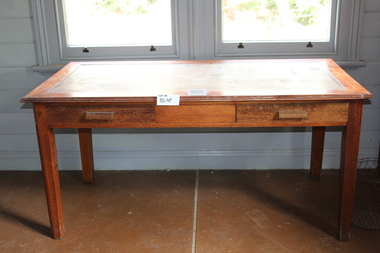
Desk
... 8670.1 - Wood table/desk with two draws either side. 8670.2 - Wood draw with curved wooden handle. 8670.3 - Wood draw with curved wooden handle....8670.1 - Wood table/desk with two draws either side. 8670.2 - Wood draw with curved wooden handle. 8670.3 - Wood draw with curved wooden handle. ...8670.1 - Wood table/desk with two draws either side. 8670.2 - Wood draw with curved wooden handle. 8670.3 - Wood draw with curved wooden handle. -
 Ithacan Historical Society
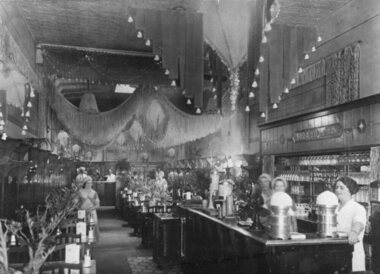
Photograph, Spot Cafe, Mildura, c1925
... There are five waitresses and two waiters; three of the women are behind a counter and the other two are standing beside the tables which are lined up on either side of the restaurant. One of the waiters is at the rear is behind a counter while the other is in the background. ...There are five waitresses and two waiters; three of the women are behind a counter and the other two are standing beside the tables which are lined up on either side of the restaurant. One of the waiters is at the rear is behind a counter while the other is in the background. ...Some Ithacans on arrival in Melbourne moved to the larger regional country towns and opened food vending businesses. John (Ioannis) Raftopoulos (Fiakas) was one such Ithacan who established himself in Mildura. He opened the Sport Cafe in Langtree Avenue. The Spot was an elegant and sophisticated establishment and as well as serving meals, also served the latest sundaes and cool fountain drinks. By the late 1930s he had also opened a milk bar in Mildura’s Astor Theatre. Raftopoulos was a true entrepreneur and ran a number of business in the Mildura and Red Cliffs. John's father, Efstathios Raftopoulos (Levendis) arrived in Australia in 1895 and John soon followed. John's brother-in-law Dimitrios Vlassopoulos arrived from Ithaca in 1922 and opened the Golden Key Café in Red Cliffs. Dimitrios had previously spent about 10 years in America where he gain knowledge and experience in the food and hospitality business. The Golden Key Café shared similarities with the Spot Sundae ‘Parlor’. Ithacan settlement in Mildura area dates back to the early 1900s. A black and white photograph of the interior of a cafe. There are five waitresses and two waiters; three of the women are behind a counter and the other two are standing beside the tables which are lined up on either side of the restaurant. One of the waiters is at the rear is behind a counter while the other is in the background. The restaurant is adorned with Christmas decorations and potted plants.
