
Showing 336 items matching "world war 2 - history"
-
 Melbourne Legacy
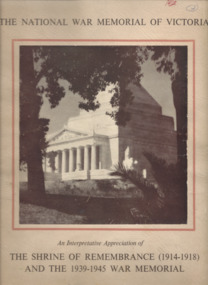
Booklet, The National War Memorial of Victoria (S2) : An interpretive appreciation of The Shrine of Remembrance (1914-1918) and the 1939-1945 War Memorial, c1955
... Its full title mentions the 1939-45 memorial and 'Including a full description of the many features of the Memorial together with its history and thirty six photographs.' The exact date is unknown but was after the Queen dedicated the World War 2 memorial in 1954. ...Its full title mentions the 1939-45 memorial and 'Including a full description of the many features of the Memorial together with its history and thirty six photographs.' The exact date is unknown but was after the Queen dedicated the World War 2 memorial in 1954. ...A booklet produced about the Shrine of Remembrance. Its full title mentions the 1939-45 memorial and 'Including a full description of the many features of the Memorial together with its history and thirty six photographs.' The exact date is unknown but was after the Queen dedicated the World War 2 memorial in 1954. Item was with other photos and programmes from different items relating to the Shrine of Remembrance - including discussions on its location and design. Labelled 'Shrine of Remembrance S1 - S14' it was part of an old archive numbering system, that showed there has been efforts in the past to collect, order and save items of Legacy's history. (01181 - 01190, 01206 - 01211, 01649, 01650).Details of the Shrine of Remembrance published for the public. It is important to note it mentions that Legacy had an important role in promoting the construction of the original design over alternate proposals (of a civic square or a hospital). There was an effort to record historical events for the "Archive Committee" which collected this and other documents relating to the Shrine together in a file (see items 01181 - 01190, 01206 - 01211, 01649).A 40 page of booklet describing the Shrine, buff paper in a cream cover with black and white photos and black print.Handwritten on top right corner of the cover is S2 in red pen, part of an original numbering system.memorial, shrine of remembrance -
 Melbourne Legacy
Book, Hobart Legacy . . . a story of remembrance, 199
... history published by Hobart Legacy. The author is not named. It starts with the Remembrance Club that was started by Sir Gellibrand and later became Legacy. It was written in the late 1990s as it mentions the 1995 commemorations of the 50th anniversary of the end of World War 2....history published by Hobart Legacy. The author is not named. It starts with the Remembrance Club that was started by Sir Gellibrand and later became Legacy. It was written in the late 1990s as it mentions the 1995 commemorations of the 50th anniversary of the end of World War 2. ...The history of Hobart Legacy.Pale blue coloured cover book of stapled A4 paper folded over about Hobart Legacy.non-fictionThe history of Hobart Legacy.history, hobart legacy, remembrance club -
 Melbourne Legacy
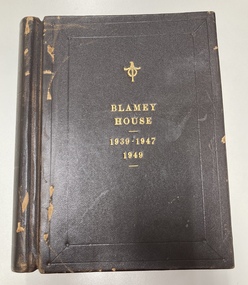
Book, Blamey House 1939-1947 1949, 194
... history and significance of the name Blamey House. Then it is like an honour roll and has pages to be inscribed with the name of each Junior Legatee that lives in the home plus their fathers name and service. There is a list of approximately 72 children in the book that lived in a Legacy home called Blamey House at some stage. The name Blamey House was transferred to three different homes run by Legacy until 1980. Blamey House was originally the name of a hostel set up in World War 2...history and significance of the name Blamey House. Then it is like an honour roll and has pages to be inscribed with the name of each Junior Legatee that lives in the home plus their fathers name and service. There is a list of approximately 72 children in the book that lived in a Legacy home called Blamey House at some stage. The name Blamey House was transferred to three different homes run by Legacy until 1980. Blamey House was originally the name of a hostel set up in World War 2 ...Blamey House was one of the residences used by Legacy as a home for Junior Legatees. The first few pages of this book explains the history and significance of the name Blamey House. Then it is like an honour roll and has pages to be inscribed with the name of each Junior Legatee that lives in the home plus their fathers name and service. There is a list of approximately 72 children in the book that lived in a Legacy home called Blamey House at some stage. The name Blamey House was transferred to three different homes run by Legacy until 1980. Blamey House was originally the name of a hostel set up in World War 2 for servicemen that needed short term accommodation and food. It was originally situated in Melbourne CBD on the corner of King and Collins Streets in the Robbs Building (since demolished). When the hostel was no longer required after the war, the trustees of Blamey House donated money - almost 20,000 pounds, to Legacy for a children and toddlers' home which was established in Balcombe Road Beaumaris. The condition of donation was that the name Blamey House be used and when the Balcombe Road property was sold in 1956 the name was transferred to Holmbush, another Legacy residence. When it was sold in 1977 the name transferred to Harelands until Legacy sold it in 1980.An ornate record of the home provided by Legacy to children in need and how the money to establish the home was acquired.Dark brown leather book with details of Blamey House.Gold embossed title on cover and spineresidences, blamey house, blamey, hostel, honour roll -
 Melbourne Legacy
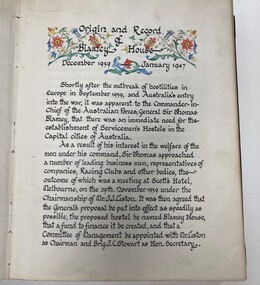
Document, Origin and Record of Blamey House December 1939 - January 1947, 1987
... The first few pages of the book (item 02298) explains the history and significance of the name Blamey House - which was photocopied and sent to Mr Crouch. Blamey House was originally the name of a hostel set up in World War 2 for servicemen that needed short term accommodation and food. ...The first few pages of the book (item 02298) explains the history and significance of the name Blamey House - which was photocopied and sent to Mr Crouch. Blamey House was originally the name of a hostel set up in World War 2 for servicemen that needed short term accommodation and food. ...Copies of correspondence with Mr K Crouch asking for the history of Blamey House. Plus a photocopy of the history pages from the Blamey House roll that is kept in glass display cabinets at Legacy House. Blamey House was one of the residences used by Legacy as a home for Junior Legatees. The first few pages of the book (item 02298) explains the history and significance of the name Blamey House - which was photocopied and sent to Mr Crouch. Blamey House was originally the name of a hostel set up in World War 2 for servicemen that needed short term accommodation and food. It was originally situated in Melbourne CBD on the corner of King and Collins Streets in the Robbs Building (since demolished). When the hostel was no longer required after the war, the trustees of Blamey House donated money - almost 20,000 pounds, to Legacy for a children and toddlers' home which was established in Balcombe Road Beaumaris. The condition of donation was that the name Blamey House be used and when the Balcombe Road property was sold in 1956 the name was transferred to Holmbush, another Legacy residence. When it was sold in 1977 the name transferred to Harelands until Legacy sold it in 1980.A record of the history known about the donation made to Legacy to establish Blamey House in 1947.Black and white A4 photocopy x 12 pages on history of Blamey House, part of it copied from the Blamey House roll and some of correspondence between K Crouch and Legacy.blamey house, blamey, residences, hostel -
 Wodonga & District Historical Society Inc
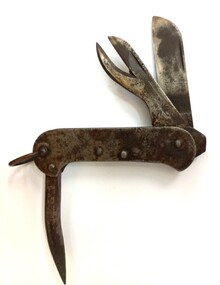
Functional object - Australian Army Issue Clasp Knife
... World War 2. He also designed and built manufacturing equipment for General Motors Holden. He died at Murray Bridge (SA) in 1956. This item is significance because it was donated by a member of the community of Wodonga which has a strong connection to Australian military history. ...Australian manufactured clasp knives were a standard issue to Australian Military Forces during World War 2. The most commonly encountered knife was an all metal model with a canoe shaped body. This knife was a Whittingslowe first pattern clasp knife which included a blade, a tin opener and a marline spike as well as screw driver and shackle to attach the knife to a lanyard or belt clip. These knives were given a dull Nickel plating to protect them. William Thomas Whittingslowe was born in Wales in 1888, he was educated in England and at 18 migrated to Canada and then to Australia, arriving in about 1912. After working in various states, he settled in South Australia and in the 1920s set up his own business, Whittingslowe Engineers Limited. He specialised in ironworking and knife manufacturing. His firm produced a large amount of blade ware during World War 2. He also designed and built manufacturing equipment for General Motors Holden. He died at Murray Bridge (SA) in 1956.This item is significance because it was donated by a member of the community of Wodonga which has a strong connection to Australian military history.A clasp knife made completely from metal with nickel plating. The accessories all fold into a canoe-shaped body. It included a knife, can opener and marlin spike.On knife blade: WE over a broad arrow/I\australian army equipment ww2, thomas whittingslowe, australian army -
 Wodonga & District Historical Society Inc
Photograph - Members of the Bethanga Light Horse Troop
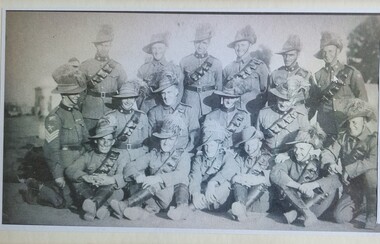
... This photo represents a group of Bethanga men who committed to service during World War 2 Indi Light Horse Bethanga Light Horse troop Bethanga History Back row (left to right), Troopers Keith Cadman, Arthur "Friday" Dower, Bert Sommer, Norm Martin, Andy Mitchell, Tom Pearce; Middle row (left to right). ...The 8th Light Horse was initially raised from companies of the colonial Victorian Mounted Rifles located in North-east Victoria following Federation. In 1912 a major reorganisation of the Australian military forces resulted in the regiment being renumbered 16th Light Horse. The Regiment was disbanded in 1919 but soon after was re-raised as the 8th (Indi) Light Horse in the Citizen Military Forces, with the territorial title Indi Light Horse. The Indi Light Horse consisted of 3 squadrons. A squadron consisted of troops in Corryong, Walwa, Tallangatta, Eskdale and Wodonga. After an extensive recruiting campaign in January 1939 a new troop was raised in Bethanga, Victoria. In December 1941, the regiment converted from horse to mechanised, initially as 8th Reconnaissance Battalion then in July 1942 it became 8th Cavalry Regiment and served in Northern Territory. As Japanese threat to the mainland declined the regiment was disbanded.This photo represents a group of Bethanga men who committed to service during World War 2A framed Black and white photograph of Bethanga members of the Australian Light Horse in uniformBack row (left to right), Troopers Keith Cadman, Arthur "Friday" Dower, Bert Sommer, Norm Martin, Andy Mitchell, Tom Pearce; Middle row (left to right). Troop Leader Sergeant Edward "Ted"Davies, Troopers Jack Mortlock, Albert "Ab" Bohun, Aub Cadman, Les Freyer Front row (left to right), Troopers Henry Trenchard, A."Ed" Hertzog, Doug Dower, Nelson "Manny" Green, Eric Wheller, J. Parker.indi light horse, bethanga light horse troop, bethanga history -
 Wodonga & District Historical Society Inc
Certificate - Hamilton-Smith Collection St John Ambulance First Aid Certificate c1939
... history of Wodonga, including handmade needlework, books, photographs, a wedding dress, maps, and material relating to the world wars. This item has well documented provenance and a known owner. It forms part of a significant and representative historical collection which reflects the local history of Wodonga. It contributes to our understanding of social and family life in early twentieth century Wodonga, as well as providing interpretative capacity for themes including local history and social history. hamilton-smith collection hamilton-smith ellwood first aid st john ambulance charity volunteer voluntering nursing ww2 world war two world war 2 A printed certificate with black text and red bordering, and hand written inscriptions. ...The Hamilton-Smith collection was donated by the children of Grace Mary Hamilton-Smith nee Ellwood (1911-2004) and John Hamilton-Smith (1909-1984) who settled in Wodonga in the 1940s. The Ellwood family had lived in north-east Victoria since the late 1800s. Grace’s mother, Rosina Ellwood nee Smale, was the first teacher at Baranduda in 1888, and a foundation member of the C.W.A. Rosina and her husband Mark retired to Wodonga in 1934. Grace and John married at St. David’s Church, Albury in 1941. John was a grazier, and actively involved in Agricultural Societies. The collection contains significant items which reflect the local history of Wodonga, including handmade needlework, books, photographs, a wedding dress, maps, and material relating to the world wars. This item has well documented provenance and a known owner. It forms part of a significant and representative historical collection which reflects the local history of Wodonga. It contributes to our understanding of social and family life in early twentieth century Wodonga, as well as providing interpretative capacity for themes including local history and social history. A printed certificate with black text and red bordering, and hand written inscriptions.hamilton-smith collection, hamilton-smith, ellwood, first aid, st john ambulance, charity, volunteer, voluntering, nursing, ww2, world war two, world war 2 -
 Wodonga & District Historical Society Inc
Certificate - Hamilton-Smith St John Ambulance Home Nursing Certificate c1939
... history of Wodonga, including handmade needlework, books, photographs, a wedding dress, maps, and material relating to the world wars. This item has well documented provenance and a known owner. It forms part of a significant and representative historical collection which reflects the local history of Wodonga. It contributes to our understanding of social and family life in early twentieth century Wodonga, as well as providing interpretative capacity for themes including local history and social history. hamilton-smith collection hamilton-smith ellwood first aid st john ambulance charity volunteer voluntering nursing ww2 world war two world war 2 A printed certificate with black text and red bordering, and hand written inscriptions. ...The Hamilton-Smith collection was donated by the children of Grace Mary Hamilton-Smith nee Ellwood (1911-2004) and John Hamilton-Smith (1909-1984) who settled in Wodonga in the 1940s. The Ellwood family had lived in north-east Victoria since the late 1800s. Grace’s mother, Rosina Ellwood nee Smale, was the first teacher at Baranduda in 1888, and a foundation member of the C.W.A. Rosina and her husband Mark retired to Wodonga in 1934. Grace and John married at St. David’s Church, Albury in 1941. John was a grazier, and actively involved in Agricultural Societies. The collection contains significant items which reflect the local history of Wodonga, including handmade needlework, books, photographs, a wedding dress, maps, and material relating to the world wars. This item has well documented provenance and a known owner. It forms part of a significant and representative historical collection which reflects the local history of Wodonga. It contributes to our understanding of social and family life in early twentieth century Wodonga, as well as providing interpretative capacity for themes including local history and social history. A printed certificate with black text and red bordering, and hand written inscriptions.hamilton-smith collection, hamilton-smith, ellwood, first aid, st john ambulance, charity, volunteer, voluntering, nursing, ww2, world war two, world war 2 -
 Wodonga & District Historical Society Inc
Certificate - Hamilton-Smith Collection Red Cross WW2 Service Certificate c1940s
... history of Wodonga, including handmade needlework, books, photographs, a wedding dress, maps, and material relating to the world wars. This item is unique, handmade and has a known owner. It forms part of a significant and representative historical collection which reflects the local history of Wodonga. It contributes to our understanding of social and family life in early twentieth century Wodonga, as well as providing interpretative capacity for themes including local history, social history and women’s history. hamilton-smith collection hamilton-smith ellwood first aid charity volunteer voluntering nursing ww2 world war two world war 2 red cross red cross society wodonga A printed certificate with black text and a black line border, and hand written inscriptions Hamilton-Smith Collection Red Cross WW2 Service Certificate c1940s Certificate Hamilton-Smith Collection Red Cross WW2 Service Certificate c1940s ...The Hamilton-Smith collection was donated by the children of Grace Mary Hamilton-Smith nee Ellwood (1911-2004) and John Hamilton-Smith (1909-1984) who settled in Wodonga in the 1940s. The Ellwood family had lived in north-east Victoria since the late 1800s. Grace’s mother, Rosina Ellwood nee Smale, was the first teacher at Baranduda in 1888, and a foundation member of the C.W.A. Rosina and her husband Mark retired to Wodonga in 1934. Grace and John married at St. David’s Church, Albury in 1941. John was a grazier, and actively involved in Agricultural Societies. The collection contains significant items which reflect the local history of Wodonga, including handmade needlework, books, photographs, a wedding dress, maps, and material relating to the world wars. This item is unique, handmade and has a known owner. It forms part of a significant and representative historical collection which reflects the local history of Wodonga. It contributes to our understanding of social and family life in early twentieth century Wodonga, as well as providing interpretative capacity for themes including local history, social history and women’s history.A printed certificate with black text and a black line border, and hand written inscriptionshamilton-smith collection, hamilton-smith, ellwood, first aid, charity, volunteer, voluntering, nursing, ww2, world war two, world war 2, red cross, red cross society, wodonga -
 Kew Historical Society Inc
Certificate, Australian Red Cross: Certificate of Service 1939-45, c. 1945
... history that she produced for suburban newspapers. Most of the photographs in the collection include detailed annotations in her hand. The Rogers Collection provides a comprehensive insight into the working habits of a historian in the 1960s and 1970s. Together it forms the largest privately-donated collection within the archives of the Kew Historical Society. australian red cross elsie may richardson - ormiston world war 2 1939-1945 An illuminated certificate presented to Elsie May Richardson - Ormiston by the Australian Red Cross Society in recognition of faithful service during the Second World War. ...This work forms part of the collection assembled by the historian Dorothy Rogers, that was donated to the Kew Historical Society by her son John Rogers in 2015. The manuscripts, photographs, maps, and documents were sourced by her from both family and local collections or produced as references for her print publications. Many were directly used by Rogers in writing ‘Lovely Old Homes of Kew’ (1961) and 'A History of Kew' (1973), or the numerous articles on local history that she produced for suburban newspapers. Most of the photographs in the collection include detailed annotations in her hand. The Rogers Collection provides a comprehensive insight into the working habits of a historian in the 1960s and 1970s. Together it forms the largest privately-donated collection within the archives of the Kew Historical Society.An illuminated certificate presented to Elsie May Richardson - Ormiston by the Australian Red Cross Society in recognition of faithful service during the Second World War. Elsie Richardson was the sister of the historian Dorothy Rogers (nee Richardson).australian red cross, elsie may richardson - ormiston, world war 2 1939-1945 -
 Kew Historical Society Inc
Journal, The Kewriosity Sheet Vol.3 No.12 : July 1982
... The Kewriosity Sheet is an invaluable resource for community researchers investigating the history of Kew in the period 1979-1983. community publications --- kew (vic.) the kewriosity sheet newsletters - kew (vic.) Introducing your Central Ward Councillors - Cr J. Leaman, Cr M. Sartori, Cr G. Quinn / p1. Scrabble Scrabble Scrabble / p1. Black out blinds [World War 2 ...Introducing your Central Ward Councillors - Cr J. Leaman, Cr M. Sartori, Cr G. Quinn / p1. Scrabble Scrabble Scrabble / p1. Black out blinds [World War 2; East Kew Baptist Church] / p2. What's doing in Kew for July / p2&3. Guide dogs speak out [Guide Dogs Toastmasters Club] / p3. Always fancied a block in Studley Park [Yarra Bend Park; Kew Garden Club] / p3. Citizen's Advice Bureau / p3. Probus Club of Hawthorn / p3. Kew Garden Club / p3. Native Plant Group / p3. Hyde Park Fellowship [Hyde Park Uniting Church] / p4. History in houses / Barbara Giles p4. Beat the Boneseed [Studley Park] / p4The Kewriosity Sheet (1979-83) was first published in the City of Kew (Victoria) in June 1979 as a two-sided 'community newssheet'. It aimed to: 'share news about Kew happenings and Kew people, and to exchange ideas about living in Kew'. Later issues gradually evolved into a 4-page, quarto sized publication. The Kewriosity Sheet was superseded by the Kew Council publication 'Kewriosity' (1983-1994).non-fictionIntroducing your Central Ward Councillors - Cr J. Leaman, Cr M. Sartori, Cr G. Quinn / p1. Scrabble Scrabble Scrabble / p1. Black out blinds [World War 2; East Kew Baptist Church] / p2. What's doing in Kew for July / p2&3. Guide dogs speak out [Guide Dogs Toastmasters Club] / p3. Always fancied a block in Studley Park [Yarra Bend Park; Kew Garden Club] / p3. Citizen's Advice Bureau / p3. Probus Club of Hawthorn / p3. Kew Garden Club / p3. Native Plant Group / p3. Hyde Park Fellowship [Hyde Park Uniting Church] / p4. History in houses / Barbara Giles p4. Beat the Boneseed [Studley Park] / p4community publications --- kew (vic.), the kewriosity sheet, newsletters - kew (vic.) -
 Kew Historical Society Inc
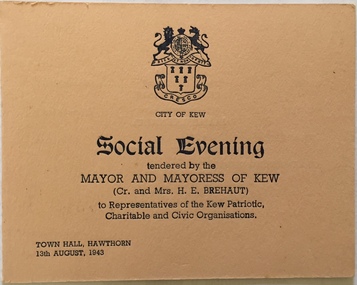
Document (item) - Programme, City of Kew, Social Evening, 1943
... As a continuous record, ranging across most decades of the Twentieth Century, they reveal changing tastes in design, values and relationships in the history of local government in Victoria. civic programmes mayors of kew hawthorn town hall cr h e brehaut world war 2 - home front world war 2 -- kew (vic.) ...The Municipality of Kew (1860-1863), the Borough of Kew (1863-1910), the Town of Kew (1910-1921) and the City of Kew (1921-1994) were local government instrumentalities in the State of Victoria. In 1994, the City of Kew was amalgamated, together with the former Cities of Camberwell and Hawthorn, into the new City of Boroondara (1994- ). Like other local government entities of the period, Kew was administered by town clerks. The two notable town clerks in Kew's history were H. H. (Henry Hirst) Harrison (1868-1955) and W. D. (William Dickie) Birrell (1899-1974). Harrison was appointed to the position in 1901 and retired in 1938 after 37 years. Birrell, appointed Acting Town Clerk in 1921, became Town Clerk in 1938, following Harrison's retirement. He continued in this role until his retirement in 1966.This card is part of an historically significant civic collection, containing hundreds of separate invitations, documents, greeting cards, programmes and tickets issued and/or collected by successive town clerks. Items in the collection illuminate the political, social and cultural history of the district. As a continuous record, ranging across most decades of the Twentieth Century, they reveal changing tastes in design, values and relationships in the history of local government in Victoria.civic programmes, mayors of kew, hawthorn town hall, cr h e brehaut, world war 2 - home front, world war 2 -- kew (vic.) -
 Kew Historical Society Inc
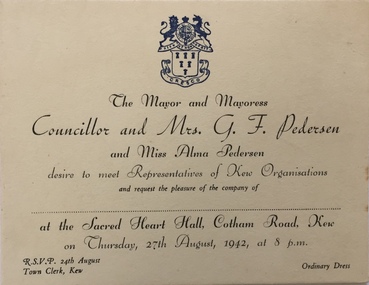
Document (item) - Invitation, City of Kew, Meeting with Representatives of Kew Organisations, 1942
... As a continuous record, ranging across most decades of the Twentieth Century, they reveal changing tastes in design, values and relationships in the history of local government in Victoria. civic programmes mayors of kew world war 2 - home front world war 2 -- kew (vic.) sacred heart hall -- cotham road -- kew (vic.) cr g f pedersen Single sided invitation to an event held by the City of Kew where representatives of Kew Organisations could meet the Mayor and Mayoress of Kew, Cr and Mrs G F Pedersen, at the Sacred Heart Hall on 27 August 1942 Meeting with Representatives of Kew Organisations Document Invitation City of Kew ...The Municipality of Kew (1860-1863), the Borough of Kew (1863-1910), the Town of Kew (1910-1921) and the City of Kew (1921-1994) were local government instrumentalities in the State of Victoria. In 1994, the City of Kew was amalgamated, together with the former Cities of Camberwell and Hawthorn, into the new City of Boroondara (1994- ). Like other local government entities of the period, Kew was administered by town clerks. The two notable town clerks in Kew's history were H. H. (Henry Hirst) Harrison (1868-1955) and W. D. (William Dickie) Birrell (1899-1974). Harrison was appointed to the position in 1901 and retired in 1938 after 37 years. Birrell, appointed Acting Town Clerk in 1921, became Town Clerk in 1938, following Harrison's retirement. He continued in this role until his retirement in 1966.This card is part of an historically significant civic collection, containing hundreds of separate invitations, documents, greeting cards, programmes and tickets issued and/or collected by successive town clerks. Items in the collection illuminate the political, social and cultural history of the district. As a continuous record, ranging across most decades of the Twentieth Century, they reveal changing tastes in design, values and relationships in the history of local government in Victoria.civic programmes, mayors of kew, world war 2 - home front, world war 2 -- kew (vic.), sacred heart hall -- cotham road -- kew (vic.), cr g f pedersen -
 Kew Historical Society Inc
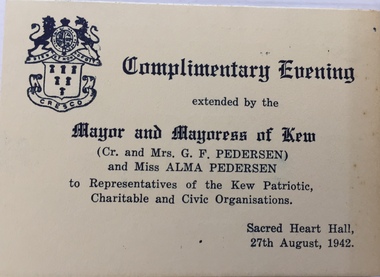
Document (item) - Programme, City of Kew, Complimentary Evening, 1942
... As a continuous record, ranging across most decades of the Twentieth Century, they reveal changing tastes in design, values and relationships in the history of local government in Victoria. civic programmes mayors of kew world war 2 - home front world war 2 -- kew (vic.) sacred heart hall -- cotham road -- kew (vic.) cr g f pedersen Invitation to an event held by the City of Kew where representatives of Kew Patriotic, Charitable and Civic Organisations could meet the Mayor and Mayoress of Kew, Cr and Mrs G F Pedersen, at the Sacred Heart Hall on 27 August 1942. ...The Municipality of Kew (1860-1863), the Borough of Kew (1863-1910), the Town of Kew (1910-1921) and the City of Kew (1921-1994) were local government instrumentalities in the State of Victoria. In 1994, the City of Kew was amalgamated, together with the former Cities of Camberwell and Hawthorn, into the new City of Boroondara (1994- ). Like other local government entities of the period, Kew was administered by town clerks. The two notable town clerks in Kew's history were H. H. (Henry Hirst) Harrison (1868-1955) and W. D. (William Dickie) Birrell (1899-1974). Harrison was appointed to the position in 1901 and retired in 1938 after 37 years. Birrell, appointed Acting Town Clerk in 1921, became Town Clerk in 1938, following Harrison's retirement. He continued in this role until his retirement in 1966.This card is part of an historically significant civic collection, containing hundreds of separate invitations, documents, greeting cards, programmes and tickets issued and/or collected by successive town clerks. Items in the collection illuminate the political, social and cultural history of the district. As a continuous record, ranging across most decades of the Twentieth Century, they reveal changing tastes in design, values and relationships in the history of local government in Victoria.civic programmes, mayors of kew, world war 2 - home front, world war 2 -- kew (vic.), sacred heart hall -- cotham road -- kew (vic.), cr g f pedersen -
 Melbourne Tram Museum
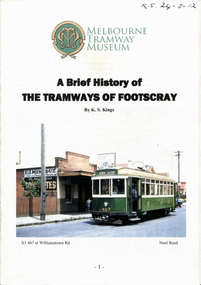
Book, Melbourne Tramway Museum, "A brief history of the Tramways of Footscray", Mar. 2012
... Trams tramways FTT Footscray X1 class X2 class World War 2 Closure "KS 24-3-62" on top right hand corner in ink. Book - 16 A4 pages, centre stapled, to A5, titled "A brief history of the Tramways of Footscray", by Keith Kings, based on an original article published in Electric Traction June 1962. ...Book - 16 A4 pages, centre stapled, to A5, titled "A brief history of the Tramways of Footscray", by Keith Kings, based on an original article published in Electric Traction June 1962. Published by the "Melbourne Tramway Museum" TMSV, 2012. Covers the formation of the FTT, includes a map by Liam Davies, economics, trams used, the WW1, Post Way years, traffic, photos, the declining years, closure, references."KS 24-3-62" on top right hand corner in ink.trams, tramways, ftt, footscray, x1 class, x2 class, world war 2, closure -
 Charlton RSL Sub Branch
Japanese Flag, World War 2 Japanese Flag
... Card attached giving history of object. Japanese flag mounted on wooden display board World War 2 Japanese Flag Japanese Flag ...Japanese flag mounted on wooden display boardCard attached giving history of object. -
Friends of Ballarat Botanical Gardens History Group
Work on paper - Victoria Park, Ballarat, A Brief History, Unknown
... World War American servicemen. Gardens Ballarat John Garner Collection None 2 pages of mainly short paragraphs. p.1 is blank, 2/3 of the page down. A Brief History ...Little has been researched or written about Victoria Park, by comparison with the Ballarat Botanical Gardens and Lake Wendouree.Based on the information given here, the author's conclusion is that Victoria Park is, in many ways, "the poor relation of the Botanical Gardens."2 pages of mainly short paragraphs. p.1 is blank, 2/3 of the page down.Nonejohn garner, doctor john garner, ballarat botanical gardens, friends of ballarat botanical gardens, victoria park, george longley, city night soil, the mulloch heap, trees, 2nd world war, american servicemen., gardens, ballarat, john garner collection -
Friends of Ballarat Botanical Gardens History Group
Work on paper - List of Trees Grown in Victoria Park. VPRS, Box 109. 5/1/1916. To the Town Clerk from the Hospital for the Insane, 21 Different Trees grown in Victoria Park in the early twentieth century, Unknown
... history from the nineteenth century. Victoria Park is a significant recreation area in Ballarat although the Ballarat Botanical Gardens and Lake Wendouree appear to have been seen as the pre-eminent garden areas over the years. John Garner Doctor John Garner Ballarat Botanical Gardens Victoria Park Friends of Ballarat Botanical Gardens Trees World War 2 ...Victoria Park featured in Ballarat's history from the nineteenth century.Victoria Park is a significant recreation area in Ballarat although the Ballarat Botanical Gardens and Lake Wendouree appear to have been seen as the pre-eminent garden areas over the years. 1 page with a list of names and numbers beside each. Reference at the bottom of the page.Written in black biro, beside the list, "List of Trees Grown in Victoria Park,1915.john garner, doctor john garner, ballarat botanical gardens, victoria park, friends of ballarat botanical gardens, trees, world war 2, american troops, john garner collection, gardens, ballarat -
 Mrs Aeneas Gunn Memorial Library
Book, Edward Arnold, Gallipoli diary vol.2, 1920
... A history of the Gallipoli campaign World War 1914-1918 -Campaigns - Gallipoli Sir Ian Hamilton - Diaries A history of the Gallipoli campaign Index, ill,maps, p.337. Gallipoli diary vol.2 ...A history of the Gallipoli campaignIndex, ill,maps, p.337.non-fictionA history of the Gallipoli campaignworld war 1914-1918 -campaigns - gallipoli, sir ian hamilton - diaries -
 Mrs Aeneas Gunn Memorial Library
Book, Jasper H. Stembridge, The Oxford war atlas: v.2. 1 Sept. 1941 to 1 Jan 1943, 1943
... World war 1939-1945 - Atlases World War 1939-1945 - History An atlas illustrating the war up to January 1943 Maps, p.47. The Oxford war atlas: v.2 ...An atlas illustrating the war up to January 1943Maps, p.47.non-fictionAn atlas illustrating the war up to January 1943world war 1939-1945 - atlases, world war 1939-1945 - history -
 Melbourne Tram Museum
Poster, "History of Tramway Conductresses"
... World War, including pay rates, training, sports, and working on the trams. Names included are: Lurline (Laurie) Meehan, Corporal O'Brien, Roma Gill, Laurie O'Brien, Jean Kirkham, Carl Jeffries, and the coach of the Basketball team, Percy Blacham - Depot Starter at Hanna St. Yields some information about the Conductresses at Hanna St depot and their working history. tramways Staff Photo conductresses sports Hanna St World War 2 ...The poster compiled with the association of Joan Paul, Conductress of Hanna St depot 1942 to 1944, tells the story of Melbourne tram conductresses during the Second World War, including pay rates, training, sports, and working on the trams. Names included are: Lurline (Laurie) Meehan, Corporal O'Brien, Roma Gill, Laurie O'Brien, Jean Kirkham, Carl Jeffries, and the coach of the Basketball team, Percy Blacham - Depot Starter at Hanna St.Yields some information about the Conductresses at Hanna St depot and their working history.Set of four photographs and text mounted onto manufactured wooden board.tramways, staff photo, conductresses, sports, hanna st, world war 2 -
Returned Nurses RSL Sub-branch
Document - Photocopy of pages from unknown publication, Mark Alcock, '2/2nd Australian General Hospital', unknown
... history of the 2/2nd Australian General Hospital during WWII. Including timeline, locations, key officers, infrastructure and hospital operations. WWII WW2 World War ...Pages give a brief history of the 2/2nd Australian General Hospital during WWII. Including timeline, locations, key officers, infrastructure and hospital operations.A black and white photocopied article from an unknown publication over two pages, single sided. It is a mixture of text and photos.'RE: QUERY ON 2/2ND / FROM KEITH R.' [blue ink top of first page] [on second page, final paragraph is circled and a scribbled line under final line in blue ink]wwii, ww2, world war two, 2/2 australian general hospital -
 Returned Nurses RSL Sub-branch
Book - Hardcover book, Rupert Goodman et al, Hospital ships
... Hospital ships Medical care World War I WWI WWII World War 2 Tracing the history of hospital ships from the Spanish Armada to the Gulf War, but with special and detailed reference to the Australian hospital ships in World War II: Manunda, Wanganella, Centaur and Oranje. ...Tracing the history of hospital ships from the Spanish Armada to the Gulf War, but with special and detailed reference to the Australian hospital ships in World War II: Manunda, Wanganella, Centaur and Oranje. [Trove]Gloss hard cover, no book jacket with illustration of ships under attacknon-fictionTracing the history of hospital ships from the Spanish Armada to the Gulf War, but with special and detailed reference to the Australian hospital ships in World War II: Manunda, Wanganella, Centaur and Oranje. [Trove]hospital ships, medical care, world war i, wwi, wwii, world war 2 -
 Returned Nurses RSL Sub-branch
Newspaper - Newspaper clipping, History's anti-war message, [July 31.1990]
... World War Two Bangka Island 'SUN JULY 31.1990' Three column article with feature photograph. Photograph captioned 'Australian nurses...many were killed by the Japanese during World War 2.' Article written by Ron Wells, West Heidelberg. History's ...Article [or letter to the editor] about the Bangka Island massacre.Three column article with feature photograph. Photograph captioned 'Australian nurses...many were killed by the Japanese during World War 2.' Article written by Ron Wells, West Heidelberg.'SUN JULY 31.1990'wwii, world war two, bangka island -
 Returned Nurses RSL Sub-branch
Newspaper - Newspaper clipping, The West Australian, Key to history gets a new keeper, Saturday, November 12, 1988
... Vivian Bullwinkel Vivian Statham Bangka Island World War 2 WWII WW2 Sir George Bedbrook Clipping has masthead and article with long photograph of older man and woman standing infront of an obelisk shaped memorial and one column of text. Key to history ...Article about war veteran Vivan Statham [neé Bullwinkel] being appointed the warden of the West Australian State War Memorial and the accompanying duties.Clipping has masthead and article with long photograph of older man and woman standing infront of an obelisk shaped memorial and one column of text.vivian bullwinkel, vivian statham, bangka island, world war 2, wwii, ww2, sir george bedbrook -
 Returned Nurses RSL Sub-branch
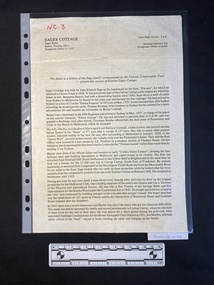
Document - Printed document, Victorian Conservation Trust, Sages Cottage : The below is a history of the Sage fanily commisioned by the Victoria Conservathin Trust - present day owners of Eurutta/Sages Cottage, [2004]
... war service she was awarded the Florence Nightingale medal (1947) by the International Red Cross. In 1951 she was appointed Commander of the Most Excellent Order of the British Empire (CBE).] After Annie's death in 1969 the cottage and land went to a nephew and two nieces, before being purchased in 1976 by the Victoria Conservation Trust as an example of early settlement history. WWII World War 2 ...Information page detailing the history of Sages Cottage from building in 1853/56 as a homestead, to being purchased in 1976 by the Victoria Conservation Trust. John Edward Sage built the cottage as the homestead for his farm "Eurutta" in 1856. John lived in the cottage with his wife and children up until his death in 1908 with his wife, Maria Sage (nee Baxter) continuing to live there until her death in 1927. Their youngest son, Thomas Holden Sage, and three daughters, Fanny Martha, Annie Agususta and Ellen Amynta continued to live there until their deaths. Thomas died in 1960 but gifted the remaining block of land with the cottage to his [niece?] Annie Moriah Sage a year before his death. Annie was Matron of the Australian Military Forces (AMF) in WW2. [Annie was born in 1895 as the fifth child to Edward Arthur and Mary Anne Sage. She trained in nursing, obtaining her nursing certificate in 1926. 1940 saw Annie join the Australian Army Nursing Service (AANS), Australian Imperial Force (AIF). During WWII Annie served as matron for the 2nd/2nd Australian General Hospital in the Middle East. She was made matron-in-chief, AIF (Middle East) in 1940, and was appointed a member of the Red Cross in 1942. Returning to Australia in 1942, she was elevated to deputy matron-in-chief, AMF in February 1943, and sub-sequentially promoted to colonel in March. Her duties included organising the AANS for duty in the South-West Pacific Area and oversaw the training scheme for the Australian Army Medical Women's Service (AAMWS). In September 1945 Annie flew to Sumatra to assist with the repatriation of the twenty four Australian nurses imprisoned by the Japanese. For her war service she was awarded the Florence Nightingale medal (1947) by the International Red Cross. In 1951 she was appointed Commander of the Most Excellent Order of the British Empire (CBE).] After Annie's death in 1969 the cottage and land went to a nephew and two nieces, before being purchased in 1976 by the Victoria Conservation Trust as an example of early settlement history.A printed information document in black ink on white paper, with an address in the upper left and opening times and refreshments available in the upper right. Below and over the page is full width text.'NC.3' [red ink top left hand corner of front page] '059 7111 3577 [?] Alastair Herbert / & / [?] Camilla [Hapfor]' [blue ink, top if second page]wwii, world war 2 -
 Greensborough Historical Society
Article - Memoir, Roberts family, 2011
... Records an era when Greensborough was starting to attract more outside people and the things people did during the war years to get by. world war 2 roberts family drakeford family grimshaw street greensborough Pencil notes on top of first page. Three page handwritten document outlining a brief history of the Roberts family in Greensborough during the 1939-45 war. ...Outlines the Roberts family's arrival in Greensborough, their early activities and mentions their childhood activities. Written by Elaine Drakeford (nee Roberts).Records an era when Greensborough was starting to attract more outside people and the things people did during the war years to get by.Three page handwritten document outlining a brief history of the Roberts family in Greensborough during the 1939-45 war.Pencil notes on top of first page.world war 2, roberts family, drakeford family, grimshaw street greensborough -
 Sunshine and District Historical Society Incorporated
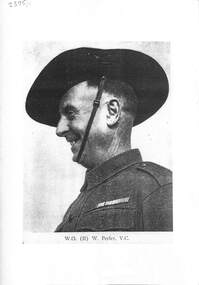
Archive - Walter Peeler VC
... 2396.01 - Photograph Walter Peeler VC 2396.02 - Extract History of Walter Peeler includes Family Background World War One then Enter War Period and World War Two then Post World War Two and Addresses and Recreations and Decorations and The Victoria Cross and Citation for Walter Peelers Victoria Cross then The Victoria Cross for Australia and Walters Childrens Service History 2396.03 - Extract of War Records for Walter Peeler|2396.04 - Extract of Casualty Form Active Service 2396.05 - Extract of Rank and Unit at time of award for Walter Peeler 23 November 1917 2396.06 - Notes of Walter Peeler 2396.07 - Typed notes Walter Peeler and extracts from Australian Dictionary of Biography 2396.08 - Extract from the Story of the 2/2nd Australian Pioneer Battalion by EF Aitken 2396.09 - Walter Peeler - They Dared Mightily Extract Front Cover Photo 01.jpg 2396.09 - Walter Peeler - They Dared Mightily Extract Page 105 Photo 02.jpg 2396.09 - Walter Peeler - They Dared Mightily Extract Page 106 Photo 03.jpg...Walter Peeler Victorian Cross World War 1914 - 1918 World War 1939 - 1945 2396.01 - Photograph Walter Peeler VC 2396.02 - Extract History of Walter Peeler includes Family Background World War One then Enter War Period and World War Two then Post World War Two and Addresses and Recreations and Decorations and The Victoria Cross and Citation for Walter Peelers Victoria Cross then The Victoria Cross for Australia and Walters Childrens Service History 2396.03 - Extract of War Records for Walter Peeler|2396.04 - Extract of Casualty Form Active Service 2396.05 - Extract of Rank and Unit at time of award for Walter Peeler 23 November 1917 2396.06 - Notes of Walter Peeler 2396.07 - Typed notes Walter Peeler and extracts from Australian Dictionary of Biography 2396.08 - Extract from the Story of the 2/2nd Australian Pioneer Battalion by EF Aitken 2396.09 - Walter Peeler - They Dared Mightily Extract Front Cover Photo 01.jpg 2396.09 - Walter Peeler - They Dared Mightily Extract Page 105 Photo 02.jpg 2396.09 - Walter Peeler - They Dared Mightily Extract Page 106 Photo 03.jpg Collection of documents on Walter Peeler VC Archive Walter Peeler VC ...2396.01 - Photograph Walter Peeler VC 2396.02 - Extract History of Walter Peeler includes Family Background World War One then Enter War Period and World War Two then Post World War Two and Addresses and Recreations and Decorations and The Victoria Cross and Citation for Walter Peelers Victoria Cross then The Victoria Cross for Australia and Walters Childrens Service History 2396.03 - Extract of War Records for Walter Peeler|2396.04 - Extract of Casualty Form Active Service 2396.05 - Extract of Rank and Unit at time of award for Walter Peeler 23 November 1917 2396.06 - Notes of Walter Peeler 2396.07 - Typed notes Walter Peeler and extracts from Australian Dictionary of Biography 2396.08 - Extract from the Story of the 2/2nd Australian Pioneer Battalion by EF Aitken 2396.09 - Walter Peeler - They Dared Mightily Extract Front Cover Photo 01.jpg 2396.09 - Walter Peeler - They Dared Mightily Extract Page 105 Photo 02.jpg 2396.09 - Walter Peeler - They Dared Mightily Extract Page 106 Photo 03.jpgwalter peeler, victorian cross, world war 1914 - 1918, world war 1939 - 1945 -
 Wodonga & District Historical Society Inc
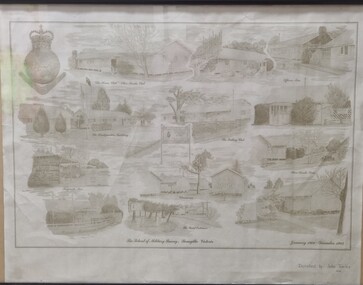
Artwork, other - Sketch - The School of Military Survey, Bonegilla, 1982
... history. It was raised as a unit of the Permanent Military Forces on July 1st 1915. Of the three officers and 17 other ranks who constituted the Survey Corps in 1915, all but three enlisted in the AIF and saw service in France, Belgium, Egypt or Palestine. The Corps entered World War 2...history. It was raised as a unit of the Permanent Military Forces on July 1st 1915. Of the three officers and 17 other ranks who constituted the Survey Corps in 1915, all but three enlisted in the AIF and saw service in France, Belgium, Egypt or Palestine. The Corps entered World War 2 ...The Army School of Survey was formed at Balcombe, Victoria in 1943 but later relocated to Bonegilla near Wodonga. The Australian Survey Corps had a proud history. It was raised as a unit of the Permanent Military Forces on July 1st 1915. Of the three officers and 17 other ranks who constituted the Survey Corps in 1915, all but three enlisted in the AIF and saw service in France, Belgium, Egypt or Palestine. The Corps entered World War 2 with nine officers and forty one other ranks. Its total strength reached a peak of 1,700 personnel with 5,500 men and women being engaged on mapping tasks during the war period. In 1948 the Australian Survey Corps was granted the prefix ‘Royal’ in recognition of its service during World War II. From the 1950s until its disbandment in 1996, members of the Corps undertook extensive geodetic surveys and mapping operations in all mainland states of Australia as part of the National Mapping Program as well as in Papua New Guinea. This included important work with the establishment of the Snowy River Hydro Scheme and the Woomera rocket range, The School of Military Survey moved to Bonegilla in 1965 when it also adopted ‘Wandering the Kings Highway’ as the Corps marching song. The School was responsible for training all RASVY personnel in Topographical Surveying, Cartography, Photography, Printing and Illustration. The School also trained Service and Civilian personnel from other agencies and countries, as part of Defence Co-operation Programmes The School moved into the newly developed Latchford Barracks in November 1982. Due to some military restructuring some of the roles of played by the Corps were taken over by civilian organisations or reverted to the Royal Australian Engineers and on the 1st July 1996 the Royal Australian Survey Corps was disbanded.This item is significant because it captures images of Bonegilla near Wodonga and the important role it played in both the history of migration to Australia and also the Australian military.A framed sketch depicting a variety of buildings at Bonegilla when it housed the School of Military Survey.Titles beneath different images At bottom - The School of Military Survey, Bonegilla, Victoria January 1933 - December 1982army at bonegilla, australian school of miltary survey -
 Returned Nurses RSL Sub-branch
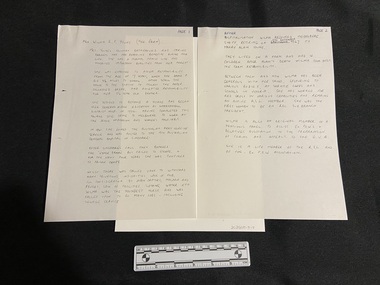
Document - Photocopy of brief history, Mrs Wilma E F Young (nee Oram), unknown
... Brief history of Wilma E F Young (nee Oram) World War Two WW2 WWII Australian Army Nurses Wilma Oram Wilma Elizabeth Forster Young (nee Oram) Vyner Brooke Ex-prisoners of war Returned Services League (RSL) 'PAGE 1' [handwritten in blue ink, top right of first page] 'PAGE 2' [handwritten in blue ink, top right of second page] Two pages, single-sided A4 paper, photocopied handwritten text in black ink. ...Brief history of Wilma E F Young (nee Oram)Two pages, single-sided A4 paper, photocopied handwritten text in black ink.'PAGE 1' [handwritten in blue ink, top right of first page] 'PAGE 2' [handwritten in blue ink, top right of second page]world war two, ww2, wwii, australian army nurses, wilma oram, wilma elizabeth forster young (nee oram), vyner brooke, ex-prisoners of war, returned services league (rsl)
