
Showing 3046 items matching "bell-cote"
-
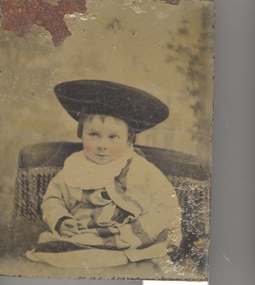 Federation University Historical Collection
Photograph - Photograph - Little Gem tintype, Possibly American Studio, Portrait of a child
... George's Hall, 209 Bourke St, Melbourne; - Bell's Gem Portrait Studio, 57 Bourke St East, Melbourne; - R. ...George's Hall, 209 Bourke St, Melbourne; - Bell's Gem Portrait Studio, 57 Bourke St East, Melbourne; - R. ...The tintype (or ferrotype or Melainotype) was produced on metallic sheet (not, actually, tin) instead of glass. The plate was coated with collodion and sensitized just before use. It was introduced by Adolphe Alexandre Martin in 1853. The most common size was about the same as the carte-de-visite, 5.5cm x 9.0cm, but both larger and smaller ferrotypes were made. The smallest were "Little Gem" tintypes, about the size of a postage-stamp, made simultaneously on a single plate in a camera with 12 or 16 lenses. They were often produced by travelling photographers, and were cheaper than Ambrotypes so made photography available to working classes, not just to the more well-to-do. The print would come out laterally reversed (as one sees oneself in a mirror). Being quite rugged, tintypes could be sent by post. Tintypes were eventually superseded by gelatin emulsion dry plates in the 1880s, though street photographers in various parts of the world continued with this process until the 1950s. (Above information abridged from http://www.rleggat.com/photohistory/history/tintype.htm) The firm of Gove and Allen opened in Sydney in 1880 and were responsible for the belated popularizing of the gem tintype in Australia. The firm traded as both The American Gem Studio and The American Studio. Others franchises were opened in Melbourne, Ballarat and Sandhurst (Bendigo). The Sandhurst branch closed in 1882 and Adelaide in 1884. All Gove and Allen studios had ceased trading by 1885. The studio addresses were: 23 King William St, Adelaide; 324 George St, Sydney; 95 Swanston St, Melbourne; Howard Place, Sandhurst; 7 Queen St, Brisbane; The card mounts used in Gove and Allen studios in Australia are identical to those used in America. They were initially made of plain white card with embossing around the oval image opening in the mount while some also had simple geometric and floral printed designs as well. Although Gove and Allen studios produced the majority of gem tintypes in Australia, other studios offered them including: - London, American & Sydney Photo Company, 328 George St, Sydney; - David Edelsten, 55 & 57 Bourke St, Melbourne; - Burman's Portrait Rooms, St. George's Hall, 209 Bourke St, Melbourne; - Bell's Gem Portrait Studio, 57 Bourke St East, Melbourne; - R. H. Kenny, Bridge St, Ballarat; - Marinus W. Bent, Sandhurst (Bendigo); - George Fisher, Victoria; - Anson Brothers, Hobart Town. (Abridged information from http://members.ozemail.com.au/~msafier/photos/tintypes.html) A tintype portrait of a child, attached to a card. little gem, child, hat -
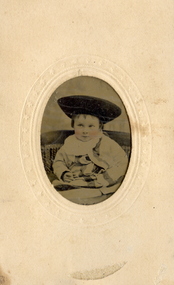 Federation University Historical Collection
Photograph - Photo - Little Gem tintype, Possibly American Studio, Portrait of a child
... George's Hall, 209 Bourke St, Melbourne; - Bell's Gem Portrait Studio, 57 Bourke St East, Melbourne; - R. ...George's Hall, 209 Bourke St, Melbourne; - Bell's Gem Portrait Studio, 57 Bourke St East, Melbourne; - R. ...The tintype (or ferrotype or Melainotype) was produced on metallic sheet (not, actually, tin) instead of glass. The plate was coated with collodion and sensitized just before use. It was introduced by Adolphe Alexandre Martin in 1853. The most common size was about the same as the carte-de-visite, 5.5cm x 9.0cm, but both larger and smaller ferrotypes were made. The smallest were "Little Gem" tintypes, about the size of a postage-stamp, made simultaneously on a single plate in a camera with 12 or 16 lenses. They were often produced by travelling photographers, and were cheaper than Ambrotypes so made photography available to working classes, not just to the more well-to-do. The print would come out laterally reversed (as one sees oneself in a mirror). Being quite rugged, tintypes could be sent by post. Tintypes were eventually superseded by gelatin emulsion dry plates in the 1880s, though street photographers in various parts of the world continued with this process until the 1950s. (Above information abridged from http://www.rleggat.com/photohistory/history/tintype.htm) The firm of Gove and Allen opened in Sydney in 1880 and were responsible for the belated popularizing of the gem tintype in Australia. The firm traded as both The American Gem Studio and The American Studio. Others franchises were opened in Melbourne, Ballarat and Sandhurst (Bendigo). The Sandhurst branch closed in 1882 and Adelaide in 1884. All Gove and Allen studios had ceased trading by 1885. The studio addresses were: 23 King William St, Adelaide; 324 George St, Sydney; 95 Swanston St, Melbourne; Howard Place, Sandhurst; 7 Queen St, Brisbane; The card mounts used in Gove and Allen studios in Australia are identical to those used in America. They were initially made of plain white card with embossing around the oval image opening in the mount while some also had simple geometric and floral printed designs as well. Although Gove and Allen studios produced the majority of gem tintypes in Australia, other studios offered them including: - London, American & Sydney Photo Company, 328 George St, Sydney; - David Edelsten, 55 & 57 Bourke St, Melbourne; - Burman's Portrait Rooms, St. George's Hall, 209 Bourke St, Melbourne; - Bell's Gem Portrait Studio, 57 Bourke St East, Melbourne; - R. H. Kenny, Bridge St, Ballarat; - Marinus W. Bent, Sandhurst (Bendigo); - George Fisher, Victoria; - Anson Brothers, Hobart Town. (Abridged information from http://members.ozemail.com.au/~msafier/photos/tintypes.html) .5) A tintype portrait of a child, attached to a card. little gem, photography, child, portrait -
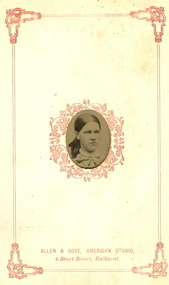 Federation University Historical Collection
Photograph - Photograph - Little Gem tintype, American Studio, Portrait of a Woman
... George's Hall, 209 Bourke St, Melbourne; - Bell's Gem Portrait Studio, 57 Bourke St East, Melbourne; - R. ...George's Hall, 209 Bourke St, Melbourne; - Bell's Gem Portrait Studio, 57 Bourke St East, Melbourne; - R. ...The tintype (or ferrotype or Melainotype) was produced on metallic sheet (not, actually, tin) instead of glass. The plate was coated with collodion and sensitized just before use. It was introduced by Adolphe Alexandre Martin in 1853. The most common size was about the same as the carte-de-visite, 5.5cm x 9.0cm, but both larger and smaller ferrotypes were made. The smallest were "Little Gem" tintypes, about the size of a postage-stamp, made simultaneously on a single plate in a camera with 12 or 16 lenses. They were often produced by travelling photographers, and were cheaper than Ambrotypes so made photography available to working classes, not just to the more well-to-do. The print would come out laterally reversed (as one sees oneself in a mirror). Being quite rugged, tintypes could be sent by post. Tintypes were eventually superseded by gelatin emulsion dry plates in the 1880s, though street photographers in various parts of the world continued with this process until the 1950s. (Above information abridged from http://www.rleggat.com/photohistory/history/tintype.htm) The firm of Gove and Allen opened in Sydney in 1880 and were responsible for the belated popularizing of the gem tintype in Australia. The firm traded as both The American Gem Studio and The American Studio. Others franchises were opened in Melbourne, 6 Sturt St Ballarat and Sandhurst (Bendigo). The Sandhurst branch closed in 1882 and Adelaide in 1884. All Gove and Allen studios had ceased trading by 1885. The studio addresses were: 23 King William St, Adelaide; 324 George St, Sydney; 95 Swanston St, Melbourne; Howard Place, Sandhurst; 7 Queen St, Brisbane; The card mounts used in Gove and Allen studios in Australia are identical to those used in America. They were initially made of plain white card with embossing around the oval image opening in the mount while some also had simple geometric and floral printed designs as well. Although Gove and Allen studios produced the majority of gem tintypes in Australia, other studios offered them including: - London, American & Sydney Photo Company, 328 George St, Sydney; - David Edelsten, 55 & 57 Bourke St, Melbourne; - Burman's Portrait Rooms, St. George's Hall, 209 Bourke St, Melbourne; - Bell's Gem Portrait Studio, 57 Bourke St East, Melbourne; - R. H. Kenny, Bridge St, Ballarat; - Marinus W. Bent, Sandhurst (Bendigo); - George Fisher, Victoria; - Anson Brothers, Hobart Town. (Abridged information from http://members.ozemail.com.au/~msafier/photos/tintypes.html) A tintype portrait of a woman's head, attached to a card. Printed on the lower edge of the card "Allen & Gove, American Studion, 6 Sturt St, Ballarat"ballarat, american studio, little gem, allen gove, tintype, woman, unidentified woman, photography -
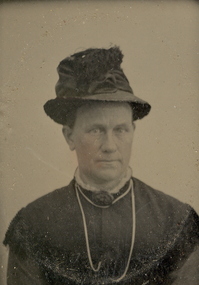 Federation University Historical Collection
Photograph - Little Gem tintype, Portrait of a Woman in a hat
... George's Hall, 209 Bourke St, Melbourne; - Bell's Gem Portrait Studio, 57 Bourke St East, Melbourne; - R. ...George's Hall, 209 Bourke St, Melbourne; - Bell's Gem Portrait Studio, 57 Bourke St East, Melbourne; - R. ...The tintype (or ferrotype or Melainotype) was produced on metallic sheet (not, actually, tin) instead of glass. The plate was coated with collodion and sensitized just before use. It was introduced by Adolphe Alexandre Martin in 1853. The most common size was about the same as the carte-de-visite, 5.5cm x 9.0cm, but both larger and smaller ferrotypes were made. The smallest were "Little Gem" tintypes, about the size of a postage-stamp, made simultaneously on a single plate in a camera with 12 or 16 lenses. They were often produced by travelling photographers, and were cheaper than Ambrotypes so made photography available to working classes, not just to the more well-to-do. The print would come out laterally reversed (as one sees oneself in a mirror). Being quite rugged, tintypes could be sent by post. Tintypes were eventually superseded by gelatin emulsion dry plates in the 1880s, though street photographers in various parts of the world continued with this process until the 1950s. (Above information abridged from http://www.rleggat.com/photohistory/history/tintype.htm) The firm of Gove and Allen opened in Sydney in 1880 and were responsible for the belated popularizing of the gem tintype in Australia. The firm traded as both The American Gem Studio and The American Studio. Others franchises were opened in Melbourne, Ballarat and Sandhurst (Bendigo). The Sandhurst branch closed in 1882 and Adelaide in 1884. All Gove and Allen studios had ceased trading by 1885. The studio addresses were: 23 King William St, Adelaide; 324 George St, Sydney; 95 Swanston St, Melbourne; Howard Place, Sandhurst; 7 Queen St, Brisbane; The card mounts used in Gove and Allen studios in Australia are identical to those used in America. They were initially made of plain white card with embossing around the oval image opening in the mount while some also had simple geometric and floral printed designs as well. Although Gove and Allen studios produced the majority of gem tintypes in Australia, other studios offered them including: - London, American & Sydney Photo Company, 328 George St, Sydney; - David Edelsten, 55 & 57 Bourke St, Melbourne; - Burman's Portrait Rooms, St. George's Hall, 209 Bourke St, Melbourne; - Bell's Gem Portrait Studio, 57 Bourke St East, Melbourne; - R. H. Kenny, Bridge St, 6 Sturt St Ballarat; - Marinus W. Bent, Sandhurst (Bendigo); - George Fisher, Victoria; - Anson Brothers, Hobart Town. (Abridged information from http://members.ozemail.com.au/~msafier/photos/tintypes.html) .9) A tintype portrait of a woman's head, attached to a card. The cheeks have been hand coloured.little gem, woman, unidentified woman, women, photography -
 Federation University Historical Collection
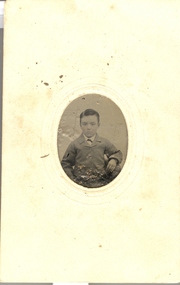
Photograph - Little Gem tintype, Possibly American Studio, Portrait of a Boy
... George's Hall, 209 Bourke St, Melbourne; - Bell's Gem Portrait Studio, 57 Bourke St East, Melbourne; - R. ...George's Hall, 209 Bourke St, Melbourne; - Bell's Gem Portrait Studio, 57 Bourke St East, Melbourne; - R. ...The tintype (or ferrotype or Melainotype) was produced on metallic sheet (not, actually, tin) instead of glass. The plate was coated with collodion and sensitized just before use. It was introduced by Adolphe Alexandre Martin in 1853. The most common size was about the same as the carte-de-visite, 5.5cm x 9.0cm, but both larger and smaller ferrotypes were made. The smallest were "Little Gem" tintypes, about the size of a postage-stamp, made simultaneously on a single plate in a camera with 12 or 16 lenses. They were often produced by travelling photographers, and were cheaper than Ambrotypes so made photography available to working classes, not just to the more well-to-do. The print would come out laterally reversed (as one sees oneself in a mirror). Being quite rugged, tintypes could be sent by post. Tintypes were eventually superseded by gelatin emulsion dry plates in the 1880s, though street photographers in various parts of the world continued with this process until the 1950s. (Above information abridged from http://www.rleggat.com/photohistory/history/tintype.htm) The firm of Gove and Allen opened in Sydney in 1880 and were responsible for the belated popularizing of the gem tintype in Australia. The firm traded as both The American Gem Studio and The American Studio. Others franchises were opened in Melbourne, Ballarat and Sandhurst (Bendigo). The Sandhurst branch closed in 1882 and Adelaide in 1884. All Gove and Allen studios had ceased trading by 1885. The studio addresses were: 23 King William St, Adelaide; 324 George St, Sydney; 95 Swanston St, Melbourne; Howard Place, Sandhurst; 7 Queen St, Brisbane; The card mounts used in Gove and Allen studios in Australia are identical to those used in America. They were initially made of plain white card with embossing around the oval image opening in the mount while some also had simple geometric and floral printed designs as well. Although Gove and Allen studios produced the majority of gem tintypes in Australia, other studios offered them including: - London, American & Sydney Photo Company, 328 George St, Sydney; - David Edelsten, 55 & 57 Bourke St, Melbourne; - Burman's Portrait Rooms, St. George's Hall, 209 Bourke St, Melbourne; - Bell's Gem Portrait Studio, 57 Bourke St East, Melbourne; - R. H. Kenny, Bridge St, 6 Sturt St Ballarat; - Marinus W. Bent, Sandhurst (Bendigo); - George Fisher, Victoria; - Anson Brothers, Hobart Town. (Abridged information from http://members.ozemail.com.au/~msafier/photos/tintypes.html) .9) A tintype portrait of a child's head and torso, attached to a card. The boy is wearing a suit and the cheeks have been hand coloured.little gem -
 Federation University Historical Collection
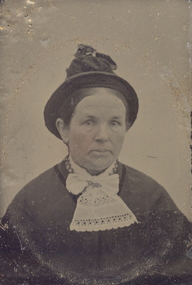
Photograph - Little Gem tintype, Portrait of a Woman in a Hat
... George's Hall, 209 Bourke St, Melbourne; - Bell's Gem Portrait Studio, 57 Bourke St East, Melbourne; - R. ...George's Hall, 209 Bourke St, Melbourne; - Bell's Gem Portrait Studio, 57 Bourke St East, Melbourne; - R. ...The tintype (or ferrotype or Melainotype) was produced on metallic sheet (not, actually, tin) instead of glass. The plate was coated with collodion and sensitized just before use. It was introduced by Adolphe Alexandre Martin in 1853. The most common size was about the same as the carte-de-visite, 5.5cm x 9.0cm, but both larger and smaller ferrotypes were made. The smallest were "Little Gem" tintypes, about the size of a postage-stamp, made simultaneously on a single plate in a camera with 12 or 16 lenses. They were often produced by travelling photographers, and were cheaper than Ambrotypes so made photography available to working classes, not just to the more well-to-do. The print would come out laterally reversed (as one sees oneself in a mirror). Being quite rugged, tintypes could be sent by post. Tintypes were eventually superseded by gelatin emulsion dry plates in the 1880s, though street photographers in various parts of the world continued with this process until the 1950s. (Above information abridged from http://www.rleggat.com/photohistory/history/tintype.htm) The firm of Gove and Allen opened in Sydney in 1880 and were responsible for the belated popularizing of the gem tintype in Australia. The firm traded as both The American Gem Studio and The American Studio. Others franchises were opened in Melbourne, Ballarat and Sandhurst (Bendigo). The Sandhurst branch closed in 1882 and Adelaide in 1884. All Gove and Allen studios had ceased trading by 1885. The studio addresses were: 23 King William St, Adelaide; 324 George St, Sydney; 95 Swanston St, Melbourne; Howard Place, Sandhurst; 7 Queen St, Brisbane; The card mounts used in Gove and Allen studios in Australia are identical to those used in America. They were initially made of plain white card with embossing around the oval image opening in the mount while some also had simple geometric and floral printed designs as well. Although Gove and Allen studios produced the majority of gem tintypes in Australia, other studios offered them including: - London, American & Sydney Photo Company, 328 George St, Sydney; - David Edelsten, 55 & 57 Bourke St, Melbourne; - Burman's Portrait Rooms, St. George's Hall, 209 Bourke St, Melbourne; - Bell's Gem Portrait Studio, 57 Bourke St East, Melbourne; - R. H. Kenny, Bridge St, 6 Sturt St Ballarat; - Marinus W. Bent, Sandhurst (Bendigo); - George Fisher, Victoria; - Anson Brothers, Hobart Town. (Abridged information from http://members.ozemail.com.au/~msafier/photos/tintypes.html) A tintype portrait of a woman's head and shoulders, attached to a card. The cheeks have been hand coloured.little gem, woman, unidentified woman, women, photography -
 Flagstaff Hill Maritime Museum and Village
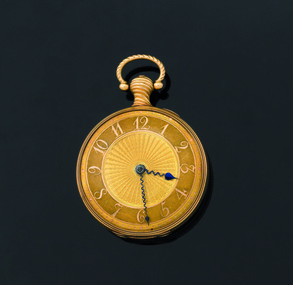
Instrument - Fob watch, 1814
... James McCabe immigrated to London in 1775 and established his business in Bells Building, Fleet Street, on 2nd April 1781. ...James McCabe immigrated to London in 1775 and established his business in Bells Building, Fleet Street, on 2nd April 1781. ...Watchmaker History: James McCabe was born in 1748. He was the son of Patrick McCabe, a notable watchmaker from Lurgan in County Armagh, Ireland. James McCabe immigrated to London in 1775 and established his business in Bells Building, Fleet Street, on 2nd April 1781. He was made an Honorary Freeman of the Clockmakers Company. The House of McCabe was renowned for the sheer variety of its designs, and the creativity and prestige of its manufacture were celebrated and revered by owners worldwide. These pieces remain highly collectable today and fetch increasingly higher prices at auction houses worldwide. Watch association with the Loch Ard: The watch was saved from the sea when discovered on the body of Mrs Rebecca Carmichael from Dublin and handed to Eva Carmichael, the only family member to survive the fatal wreck of the Loch Ard on 1st June 1878. Eva gifted the watch to her husband, Thomas Achilles Townsend when they married in 1884; his name is engraved on the rear movement cover. The watch was held by the family until 2011 when they decided to bring the watch, to Australia for auction. At this time the watch was in the possession of Eva Carmichael's grandson, Robert Townsend. Given its connection with the Loch Ard shipwreck, it was purchased at auction by Flagstaff Hill Maritime Village on 25th October 2011 to add to its Loch Ard collection and is currently referred to as the Carmichael watch. It is now on display alongside the Minton Peacock, which also survived the Loch Ard shipwreck, and other artefacts from the collection. James McCabe was originally a Belfast watchmaker who had moved his business to London. At the time James McCabe was much esteemed for producing fine watches and clocks, especially for export to India. Only the best watches were inscribed “James McCabe” and many with highly decorated cases were intended for the Indian market. Contemporary newspaper accounts of the watch's discovery echoed a Carmichael family tradition that the watch had been intended as a gift from the City of Dublin to King George IV to mark his planned visit to the city in 1821, however, there is no evidence to support this theory. Dr Evory Carmichael, according to some accounts, bought this watch from a nobleman for about £100 at some point and so it travelled with him on his final fateful journey to Australia. Today we can only guess at the actions of Mrs Carmichael in the chaos and darkness of the pre-dawn shipwreck. Perhaps the two items that were found on her body, the watch and a locket, were items that reminded her of those she held most dear, her husband and her family. When Mrs Carmichael's body was washed ashore the watch was found secreted in the waistband of her dress. In its own right the watch is of artistic and monetary value and is a rare and beautiful object depicting watch making in the early 19th century. It is a historically significant object in it’s own right and there is additional importance, surviving a significant event in the maritime history of Victoria. The wreck of the Loch Ard, Victoria's greatest maritime disaster has also been declared an event of National Significance because of its strong connection to Australia's immigration and maritime history. The watch, together with the Loch Ard Peacock, make up the two most significant shipwreck artefacts in Australia. Both of these items are of great social significance to not only local people but the wider Australian community. Funding for the watches purchase came from six local trusts and one anonymous citizen and is now on permanent display. Both these artefacts symbolise and helps to interpret the stories of survival along the Shipwreck Coast. Fob Watch, known as the "Carmichael Watch" or the "Loch Ard Watch". 1814 fob pocket watch belonging to the Carmichael family, recovered from the wreck of the Loch Ard. Fob watch (or pocket watch)and winding key, made by James McCabe and Son, of Cornhill, London. The watch is in excellent condition and its design is decorative and intricate. The gold face is covered by glass. The gold rear cover is hinged over a silver inner cover that includes the winding hole. The watch has a knob with a swinging ring from which it can be hung. The dial of the gold watch face is textured and has raised Arabic numerals and every minute is marked around the perimeter by a dot, with the 5-minute dots slightly larger. The numerals and dots are a different coloured gold than the rest of the face. The centre of the face has a wavy pattern fanning out to the base of the numerals. The hour and minute hands are of a dark colour. The stems of the hands are a wavy shape and finish with spade shaped tips; the tip of the hour hand is larger than that of the minute hand. The hour hand reaches to the base of the numerals and the minute hand is long enough to rest between the minute dots. The back of the watch is decorated with a detailed design on a textured gold background. The design is embossed in coloured metals; gold, silver, greenish-gold and pink. In the centre is a dove resting on leaves of a pot plant that sits on a silver circular base. Another dove is flying above it, and their beaks touch together. On the right of the base of the pot plant is a dog resting on its hind legs, body facing away from the plant and head twisted around to look at the birds. On the sides of this design and meeting at the base are sprigs of leaves and buds. Around this central design is a rope-like border. Around the perimeter of the case is a border of leaves and budding stems. The inside of this cover has embossed hallmarks, numbers and etched markings indicating that the watch is 18 carat gold, made by James McCabe, assayed in London in 1814 and the case may have been made by Daniel Willmott, case maker. The silver inner workings cover has a full name beautifully engraved on it. There is a winding hole that accesses a square-ended lever for the key to fit over. The handle of the watch is a twisted gold knob with a hollow ‘D’-shaped swinging ring attached to the end of it. This knob also has a hallmark.On the silver inner workings cover “Thomas Achilles Townshend” is engraved, underscored by a thin, delicately decorated line. On the gold handle is the logo of a crown with “18”’ next to it. Inside the gold rear case is stamped “DW’. Under that is etched “JAN 77 II”. Underneath this are 3 logos; a logo “leopard, crowned”’, a logo “ crown on top of 18”, and a logo “T”. Under these 3 symbols is part of a stamp that could possibly be “IMC”. Under this is “ ’ 5 9 4 ”. Other numbers, symbols and letters are etched into this case including “15001”, “2/5/19”. Others are difficult to read.warrnambool, shipwrecked coast, shipwreck coast, flagstaff hill, flagstaff hill maritime museum, flagstaff hill maritime village, maritime museum, shipwrecked artefact, shipwreck artefact, carmichael, townshend, townsend, carmichael watch, loch ard watch, pocket watch, loch ard, 1st june 1878, james mccabe, thomas walker, robert townshend, loch ard gorge, great ocean road, victoria., memorial headstone -
 Eltham District Historical Society Inc
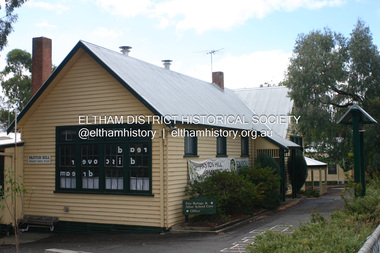
Photograph - Digital Photograph, Alan King, Panton Hill Primary School, 27 March 2008
... From 1922 each school day began with the ringing of the bell, which is still in its stand, and is an unusually old memorial of this kind. ...From 1922 each school day began with the ringing of the bell, which is still in its stand, and is an unusually old memorial of this kind. ...The Panton Hill Primary School building, which has served the community since 1889, was not the area's first. Kingston School (an early name for Panton Hill) opened in May 1865. This was replaced in 1871 when the Panton Hill School number 1134 opened and in 1874 the school moved to its current location [September 2023] where many additions and renovations have taken place to meet the needs of local children in the 21st century. Covered under Heritage Overlay, Nillumbik Planning Scheme. Published: Nillumbik Now and Then / Marguerite Marshall 2008; photographs Alan King with Marguerite Marshall.; p63 The Panton Hill Primary School building, which has served the community since 1889, was not the area’s first. In 1871 Henry Edelman opened a Common School in a paling-clad hut, replacing the Kingstown No 786 school. The two-acre (0.8ha) site of crown land had previously been held under Miners Right. In 1875 the Education Department bought a building on the main road for State School No 1134, for £200 and remodelled it as a school.4 Panton Hill had as one of its teachers, Frank Tate, who was to become one of Victoria’s most influential educational reformers. It was his first school, when he began teaching on January 22, 1884, as a 20 year old.5 The following month Robert J Harris was appointed to the school and remained as head teacher until his death in 1887. His son R C Harris was apprenticed to Mr Rossiter, editor of the first local paper. The Evelyn Observer, first published in 1873. Harris later bought the newspaper which remained a family business until the 1920s. J Hughes of Cherry Tree Road succeeded Harris as teacher at Panton Hill and sold his land for the school site. Though now unrecognisable, the school building includes the classroom of the last Smiths Gully State School No 1737, which was built in 1882, and moved to Panton Hill in 1894. From 1922 each school day began with the ringing of the bell, which is still in its stand, and is an unusually old memorial of this kind. To accommodate the growing population, the building was remodelled, with additions in 1923 and classrooms were added in 1955, 1963 and 1970. The former teacher’s residence is the only surviving 19th century dwelling in the centre of Panton Hill, and is now used as part of the school. The residence was originally rectangular but is now L-shaped. Similar weatherboard State School buildings in the shire from this period are the Kangaroo Ground and the St Andrews Primary Schools. All were standard Education Department/Public Works Department designs.This collection of almost 130 photos about places and people within the Shire of Nillumbik, an urban and rural municipality in Melbourne's north, contributes to an understanding of the history of the Shire. Published in 2008 immediately prior to the Black Saturday bushfires of February 7, 2009, it documents sites that were impacted, and in some cases destroyed by the fires. It includes photographs taken especially for the publication, creating a unique time capsule representing the Shire in the early 21st century. It remains the most recent comprehenesive publication devoted to the Shire's history connecting local residents to the past. nillumbik now and then (marshall-king) collection, panton hill primary school -
 Bendigo Military Museum
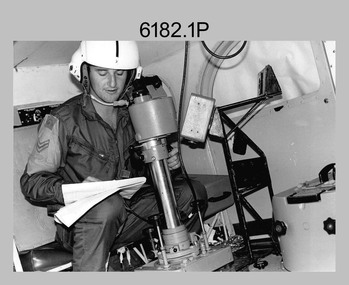
Photograph - Royal Australian Survey Corps Aerial Surveys, c1980
... Introduced in 1974–1975, the Magnavox AN/PRR-14 portable Doppler satellite (US Navy Navigation Satellite System – TRANSIT) receivers and computing system provided independent three-dimensional point positions anywhere in the world, anytime, in any weather accurate to about 1.5metres with precise satellite ephemerides. The Bell OH-58 Kiowa LOH was a family of military helicopters used for observation, utility, and direct fire support. ...Introduced in 1974–1975, the Magnavox AN/PRR-14 portable Doppler satellite (US Navy Navigation Satellite System – TRANSIT) receivers and computing system provided independent three-dimensional point positions anywhere in the world, anytime, in any weather accurate to about 1.5metres with precise satellite ephemerides. The Bell OH-58 Kiowa LOH was a family of military helicopters used for observation, utility, and direct fire support. ...This is a set of nine photographs of technicians from the Royal Australian Survey Corps operating aerial surveys equipment c1980s. In photo .1P, CPL Steve Gloster was operating a RC10 air survey camera mounted in an Australian Army Pilatus Porter aircraft. The Wild RC10 super wide-angle air survey cameras were first introduced in 1971, were equipped with virtual distortion free lenses for supplementary, spot and special photography. In photo .2P, Roger Rees was operating Air Profile Recorder (APR) equipment. it was possibly taken during OP NERVOSE 84, sometime between June – August 1984 when based in Ngukurr, Northern Territory. The APR was operated at this time in unison with an RC10 camera. In 1963 the Royal Australian Survey Corps introduced the radar airborne profile recorder (Canadian Applied Research Ltd, Mark V, Airborne Profiler Recorder) was introduced for 1:100,000 mapping to replace terrain heighting by aneroid barometry. Later in 1974-1975, the Australian developed WREMAPS II airborne laser terrain profile recorder was introduced. In photo .3P, Neil Jones appears at the door of Airsearch Beechcraft Queen Air aircraft, Registration / Serial VH-MWX. This aircraft was typically used by RA Svy on air survey operations flying mission with Aerodist, APR and RC10 camera equipment. The Australian Army’s Pilatus Porter (short take-off and landing turbo propeller) was also equipped with a Wild RC10 aerial mapping camera for identification photography. The Pilatus Porter was also used on RA Svy’s map field checking operations. Photo .9P was taken at a survey station at an unknown location. In this photo an Australian Army Kiowa Light Observation Helicopter (LOH) is supporting a field survey party undertaking Magnavox AN/PRR-14 portable Doppler satellite observations. The satellite receiver’s antenna is plumbed over the survey ground mark surrounded by white plastic panels. The panels were used to identify the survey station on aerial photography. Introduced in 1974–1975, the Magnavox AN/PRR-14 portable Doppler satellite (US Navy Navigation Satellite System – TRANSIT) receivers and computing system provided independent three-dimensional point positions anywhere in the world, anytime, in any weather accurate to about 1.5metres with precise satellite ephemerides. The Bell OH-58 Kiowa LOH was a family of military helicopters used for observation, utility, and direct fire support. It was identified by RA Svy in the mid-1970s that considerable time was lost in replacing unserviceable remote equipment by road. Therefore Aerodist operations (pre-dating satellite receiver operations) were fully supported by Army’s Kiowa LOH aircraft. This is a set of nine photographs of technicians from the Royal Australian Survey Corps operating aerial surveys equipment c1980s. .1P to .3P, .5P to .9P - Colour and black and white photos on photographic paper and scanned at 300 dpi. .4P - Colour photo on 35mm slide film and scanned at 96 dpi. .1) & .2) - Photo, black & white, c1980s, CPL Steve Gloster operating an RC10 air camera. .3) - Photo, colour, 1984, Roger Rees operating Air Profile Recorder (APR) equipment. .4) - Photo, colour, c1980s, Neil Jones at the door of an Airsearch Beechcraft Queen Air aircraft, typically used by RA Svy on air survey operations. .5) - Photo, colour, c1980s. A Beechcraft King Air aircraft, also used by RA Svy on air survey operations. .6) - Photo, colour, c1980s. An Australian Army Pilatus Porter, used by RA Svy on air survey and map field checking operations. SGT Peter Mustart is possibly in the foreground. .7) to .8) - Photo, colour, c1980s. An Australian Army Pilatus Porter and unidentified personnel, used by RA Svy on air survey and map field checking operations. .9) - Photo, colour, c1980s. An Australian Army Kiowa helicopter supporting a field survey party undertaking Magnavox AN/PRR-14 portable Doppler satellite observations. There are biro marks on photos .4P to .9Proyal australian survey corps, rasvy, army survey regiment, asr, fortuna, aerial surveys -
 Peterborough History Group
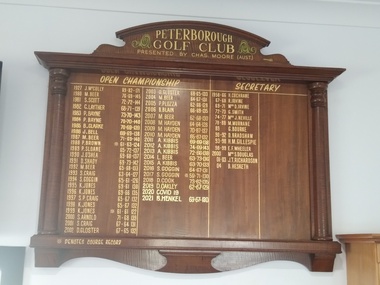
Memorabilia - Peterborough Golf Club Open Championship
... Hayden 65.67-132 1986 J. Bell 69.69-138 2011 A. Kibbis 69.69-138 1987 M. ...Hayden 65.67-132 1986 J. Bell 69.69-138 2011 A. Kibbis 69.69-138 1987 M. ...The honour board records the names and scores of the Mens Open Championship winners and the name and dates of the Secretary. Chas Moore was the proprietor of Moore's Stores and a regular visitor to Peterborough, and donor of the Honour Board. The Mervyn Murnane Memorial Trophy also records the winners names. OPEN CHAMPIONSHIP 1927 J. McCully 89.82-171 2004 M. Beer 64.67-131 1980 M. Beer 76.69-145 2005 P. Plozza 62.66-128 1981 S. Scott 72.72-144 2006 B. Blain 66.69-135 1982 G. Layther 68.71-139 2007 M. Beer 62.68-130 1983 P. Bayne 73.70-143 2008 M. Hayden 64.64-128 1984 P. Bayne 70.70-140 2009 M. Hayden 70.67-137 1985 B. Clarke 70.69-139 2010 M. Hayden 65.67-132 1986 J. Bell 69.69-138 2011 A. Kibbis 69.69-138 1987 M. Beer 71.69-140 2012 A. Kibbis 74.69-138 1988 P. Brown * 61.63-124 2013 A. Kibbis 72.66-138 1989 P. Sloane 65.72-137 2014 L. Beer 63.73-136 1990 J. O’Shea 69.68-137 2015 A. Kibbis 63.70-133 1991 D. Shady 69.73-142 2016 S. Goggin 64.67-131 1992 M. Beer 65.68-133 2017 S. Goggin * 59.71-130 1993 S. Craig 63.64-127 2018 D. Cook 73.62-135 1994 S. Goggin 65-61-126 2019 D. Oakley 62.67-129 1995 K. Jones 69.61-130 2020 Covid 19 1996 K. Jones 69.66-135 2021 B. Henkel 63.67-130 1997 S.P. Craig 65.67-132 1998 K. Jones 65.67-132 1999 K. Jones * 61.61-122 * Denotes Course Record 2000 S. Arnold 71.68-139 2001 S. Craig 67.64-131 SECRETARY 1958 – 66 H. Cochrane 1967 – 68 R. Irvine 1969 – 71 Mrs, D, Irvine 1972 – 73 G. Smith 1974 – 77 Mrs. J. Neville 1978 – 88 M. Murnane 1989 G. Bourke 1990 – 92 D. Bradshaw 1993 – 98 H. M. Gillespie 1998 – 99 E. F. Wheeler 2000 Mrs. S. Douglas 2001 – 03 J. T. Richardson 2004 B. Hesketh Significant as it records the names and scores of the winners. It also has one odd record - 1927 J McCully, then skips to 1980. The story behind that is that a cup appeared at the Golf Club (its unknown where it came from) which was inscribed with 1927 J. McCully Peterborough Golf club Open Champion. It was probably not referring to this Peterborough but this club did not hold an Open Championship at that time, so it was decided that they would. The first Open championship was held in 1980 but the record from 1927 was included as it was impetus behind the decision to hold the Open Championship, which continues to this day. Polished timber honour board with upper lintel and doric columns on eihe side.Inscribed with the winners of the Open Championships from 1980 and the name of the Secretary from 1958. Also inscribed with: Presented by Chas. Moore (Aust)peterborough, golf, sporting honour boards, peterborough golf club -
 Mission to Seafarers Victoria
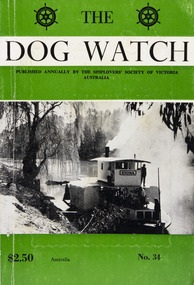
Journal (item) - Periodicals-Annual, Shiplovers' Society of Victoria, The Annual Dog Watch
... Loney - 104 The End Of The "Antiope" - Captain Bruce Bell - 106 The "Great Britain" - C. E. Bonwick - 108 Search The Coast To Shark Bay - Rear-Admiral Charles Adair U.S.N. - 110 The "Polly Woodside" Family - Rev. ...Loney - 104 The End Of The "Antiope" - Captain Bruce Bell - 106 The "Great Britain" - C. E. Bonwick - 108 Search The Coast To Shark Bay - Rear-Admiral Charles Adair U.S.N. - 110 The "Polly Woodside" Family - Rev. ...This journal provides the reader with glimpses of the adventures and hardships of a seaman's life. Many of the stories are of sailing ships. PS Etona was built in 1898 at Milang, South Australia as a missionary church steamer for the Church of England. The Etona's run was from Mannum, South Australia, where she was based up to Renmark. As churches were built in river tower she was no longer required and in 1912 she was sold to Captain Arch Conner who used her as a fishing steamer at Boundary Bend for many years. She was brought out of retirement during the 1956 floods to do trips up the Murrumbidgee River. She was eventually bought by interest in Echuca and restoration was commenced in 1962. The Etona, now fully restored with her original steam engine can now be seen moored along side the historic wharf at Echuca.Contributes to our knowledge of the importance of shipping and places on record those stories of the sea which would otherwise be lost.Contents Foreword - G. F. Tilley - 5 The "Etona" - H. Vaughan Evans - 6 Editorial - Russell Hemingway - 11 The Old Lady Of The River - Captain J. Gaby - 19 "Takapuna" Interlude On A Moonless Night - E. Harper - 31 Maritime Museum of Tasmania - J. Miller - 34 The Confederate Raiders "Florida" and "Alabama" - A. R. Osmond - 36 "Ease After War . . . Doth Greatly Please" - Captain W. J. Cowling - 44 Mutiny At Sea - P. R. Wilkins - 49 War Service In The Indian Ocean - H. Mossman - 51 Cape Horn - Captain Eino Koivistoinen - 57 "Tragedy of Loss" - Jonathan john - 61 The End of The "Queen Elizabeth" - Bradley J. Newell - 62 London Could Cope With Him - Dr. Stanislaw Bernatt - 68 Three Ships Canals - N. S. Smith - 69 The Loss Of The "Eyoshi Maru" - Captain M. B. Glasier - 77 A Small Consignment But Valuable - J. B. Hodgson - 85 Lowden and The "Candida" - D. R. Rickard - 87 "Lauriston" Sails On - F. W. Rudd - 89 Confusion of Identities, "Young Australian", "Young Australia" and "Carl" - J. M. MacKenzie - 93 Rescue from "Clarissa", 1957 - Captain Leif Asklund - 97 Journey Home - Captain W. E. Eastoe - 100 Disaster At Blanket Bay - J. K. Loney - 104 The End Of The "Antiope" - Captain Bruce Bell - 106 The "Great Britain" - C. E. Bonwick - 108 Search The Coast To Shark Bay - Rear-Admiral Charles Adair U.S.N. - 110 The "Polly Woodside" Family - Rev. H. W. Coffey - 121 Book Reviews - 123sailing ships, steamships, shipping, seafaring life, shiplovers' society of victoria, dog watch, murray river, paddlesteamers, echuca, etona, ps etona -
 Moorabbin Air Museum
Photograph (series) - (SP) Lindsay Walker collection of photographs, slides and documents. Various aircraft as described in Context. Many Ansett historic items
... Aircraft a. Ansett Bell Jetranger helicopter, VH-AND, 65. Tullamarine Airport, 29-8-78 66. ...Aircraft a. Ansett Bell Jetranger helicopter, VH-AND, 65. Tullamarine Airport, 29-8-78 66. ... -
Federation University Historical Collection
Document - Class Roll, Ballarat School of Mines Class Roll, 1893-1896
... Ewart, M. Haiwood, M. Bell, A. Deeble, E. Dunstan, H. Seeley, W. ...Ewart, M. Haiwood, M. Bell, A. Deeble, E. Dunstan, H. Seeley, W. ....1 1896 [Practical Mining (Williamson, Fleckwood, Food, Bailey, Coombs, Norton, Hillingston) Lecturer John Rowe Practical Mining (Williamson, Phillipson, Fleckwood, Food, Bailey, Coombs, Ultuwatt, Barnard) Lecturer John Rowe Practical Mining (Williamson, Coombs, Barnard, Curry, Walley, Phillipson) Lecturer John Rowe Practical Mining (Williamson, Barnard, Coyte, Curry, Bailey, Walley, Phillipson, Booth, Rogers) Lecturer John Rowe .2 1894 Practical Mining (G. Williams, Paul, E.W. Weston. J.A. Elthwatt)) Lecturer John Rowe 1894 Mathematics (Action, Flegeltaub, Wittkowski, Collinar, H. Murphy, H. Brickhill, J. Uthwatt, C. Remschel, M. Marks, W. Reid, E. Weston, Radcliff, J. Black, J. Richardson) Lecturer E. Bennett .3 . 1893 Practical Physics (H.W. Wright, J. Cardiff, J. Nicol.W. Nicholls, R. Roberts, E. Emery, J. Paisley, H. McKenzie, H. Seiley, W. Jasper, W. Johns, R. Ingles, W. Lambert, E. Munro, J. Ewart, M. Haiwood, M. Bell, A. Deeble, E. Dunstan, H. Seeley, W. Wisherdon, Cardiff)) Lecturer Daniel Walker 1893 Physics (L. Harvey, J. Barr, S. Harrison, H. Hardy, D. Macwilliam, J. Grenfell, Prat, Barker. Wingrave)) Lecturer Daniel Walker 1893 Physics (H. Imrey, W. Hines, H. Sheeran, E. Pillios, H. Franklin, A. Older, H. Franklin, J. Foresight, W. Gilbert, J. Lawson. W. Latimer. P. Williams, R. Inglis, D. Hin, Florence Boylenas, J. Attenborough, Elsie Rail) Lecturer Daniel Walker) 1893 Physics (E. Hudson, Eva Corlett, Emily Slater, A. Dixon, A. Potts, H. Wyatt, Merlin, H. Martill, F. seal, E. Geddise, M. Preston, P. Spielvogel, A. Flegeltaub, Morris, Bradford) Lecturer Daniel Walker) .4 1895 Practical Mining (Solly, Clark, Flegeltaub, Harvey, Cressey) Lecturer John Roweballarat school of mines, mining, physics, practical mining, john rowe, daniel walker, e. bennett, class list, a. flegeltaub, p. spielvogel, eva corlett, florence boyle, emily slater, women, e. hudson, a. dixon, a. potts, h. wyatt, merlin, h. martill, f. seal, e. geddise, m. preston, morris, h. imrey, w. hines, h. sheeran, e. pillios, h. franklin, a. older, j. foresight, w. gilbert, j. lawson. w. latimer. p. williams, r. inglis, d. hin, florence boylenas, j. attenborough, elsie rail, bradford, williamson, fleckwood, food, bailey, coombs, norton, hillingston, solly, clark, flegeltaub, harvey, cressey -
 Buninyong & District Historical Society
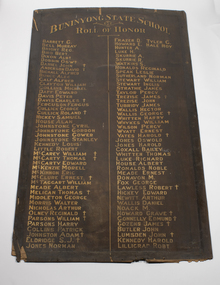
Honour Board - Timber World War I honour board, Original roll of honour made for Buninyong State School at end of WWI, Unknown
... On front of honour board- "Buninyong State School Roll of Honor Barrett G. Bell Murray Bright Reg. Bird Bert. Dixon Albt. ...Buninyong State School Honour Board World War 1 On front of honour board- "Buninyong State School Roll of Honor Barrett G. Bell Murray Bright Reg. Bird Bert. Dixon Albt. ...The World War I Memorial Honour board was made for Buninyong State School. It was inscribed on its rear on 3/3/1916 and in 1942 while being renovated.The honour board is of historic significance, listing local soldiers who served in World War I.Timber plywood honour board, painted with honour roll of World War I soldiers' names.On front of honour board- "Buninyong State School Roll of Honor Barrett G. Bell Murray Bright Reg. Bird Bert. Dixon Albt. Dobbin Oswd. Daniel John + Anderson David + Bignall Alfred Bunce Alec Calf Alfred Clayton William Collins Michael Daff Edward Davis Peter Davis Charles + Ferguson Fergus Gullick George Gullick Roland + Hickey Samuel House Alan Johnstone Cyril Johnstone Gordon Johnstone Gower Johnstone Stanley Kennedy Louis Little Robert McCarey William + McCarty Thomas + McCarty Edward McKenzie Morell McKinnon Eric McClure Ernest + McTaggart William Meade Albert Melican Thomas + Middleton George Morris Walter Nicholas Arthur Olney Reginald + Parsons William + Parsons Harry Collins Patrick Johnston Adam + Eldridge S.J. + Jones Norman Frazer D. Tyler G. Howard E. Hale Roy Hunter A. Luke H. Skurrie A. Skurrie R. Watkins S. Ronalds Reginald Speak Leslie Sutherland Norman Stewart William Stewart Inglis Strathie James Taylor Percy Tresize James + Tresize John Tubridy James Wallis Hector Wallis George + Whitten Harry Whykes William Wilson Percy Wyatt Ernest Yates Harold + Jones Oswald Jones Harold Coxall Bailey Whitten Thomas Luke Richard House Albert Ronalds Noble Meade Ernest Donavon M. Fox George Lawless Robert + Hickey Edward Newitt Arthur Wallis Daniel Noack M. Howard Grave + Connelly Edmund + Cozens James + Butler John Lumsden John + Kennedy Harold Lillicrap Robert" On rear of honour board- "L. Lay, Ballan, 1942, J. Stevens, Ballan, 1942, Renovating" "Leslie McGrath" "McGrath & Sons, Buninyong, 3/3/16"buninyong state school, honour board, world war 1 -
Ringwood and District Historical Society
Legal record - Real Estate & Stock Institute of Victoria Contract of Sale (C.E.Carter of Ringwood - Agent), Vendor: Eleanor Florence BELLCHAMBERS. Purchaser: Harold Wildridge SUTHERLAND - June, 1946
... Attached is also a 1923 contract showing that the same land had previously been sold to Lena (Eleanor) F. Bell Chambers for £90 under instalment terms through agents Keogh & King, with detailed conditions about fencing, quarrying restrictions, instalments, and plan registration. ...Attached is also a 1923 contract showing that the same land had previously been sold to Lena (Eleanor) F. Bell Chambers for £90 under instalment terms through agents Keogh & King, with detailed conditions about fencing, quarrying restrictions, instalments, and plan registration. ...Copy of contract and correspondence with covering typewritten summary - Lot 114, Plan of Subdivision 7884, Part of Crown Allotment 29, Parish of Warrandyte, Certificate of Title Volume 6749, Folio 1349666AI Summary using CoPilot (29/8/2026): "These papers relate to the 1946 sale of Lot 114, Plan of Subdivision 7884, part of Crown Allotment 29 in Warrandyte Parish, owned by Mrs Eleanor Florence Bellchambers of Munro Street, Ringwood, and sold to Mr Harold Wildridge Sutherland, a soldier living in Hawthorn. The contract, prepared by C.E. Carter, set the price at £90, with a £5 deposit and the balance payable within 14 days of receiving Commonwealth Treasury consent, which was required under wartime National Security regulations. The contract followed the 1946 Real Estate Institute conditions and included the usual clauses about title, easements, tax adjustments, and government approval. Attached is also a 1923 contract showing that the same land had previously been sold to Lena (Eleanor) F. Bell Chambers for £90 under instalment terms through agents Keogh & King, with detailed conditions about fencing, quarrying restrictions, instalments, and plan registration. The 1946 correspondence shows the administrative steps for the new sale: Godfrey Stewart & Co., solicitors for Sutherland, returned the executed contracts and requested the vendor’s signature, valuation certificate, and Form 5 for Treasury consent. They also noted a discrepancy in the spelling of Bellchambers’ Christian names on the title versus the contract and asked whether she wished them to act for her. Carter forwarded the required forms and confirmed that Mr Bellchambers had no solicitor. Shortly afterwards, both Mr and Mrs Bellchambers instructed Stewart & Co. to act for them and confirmed that their names should match the title. The final document is Carter’s account sales statement to Mrs Bellchambers, showing the £5 deposit, the purchaser’s cheque for £81 8s, Carter’s commission of £4 10s, a valuation fee of £1 1s, and a net amount of £80 17s 8d remitted to her. -
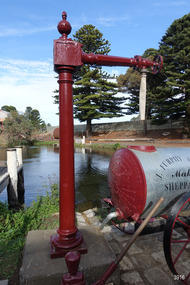 Flagstaff Hill Maritime Museum and Village
Functional object - Water standpipe, Langlands Bros. & Co, 1880-1893
... The company made the first cast bell, the first lamp posts in the colony, and the boiler for the first Australian train. ...The company made the first cast bell, the first lamp posts in the colony, and the boiler for the first Australian train. ...This water standpipe is believed to be the only one of its kind in working order. It was originally located in Warrnambool, on the hillside at the corner of Mickle Crescent and Banyan Street, providing water for the Chinese Market Gardens below, on the flats. It was removed from this location on May 2nd, 1979, with the intention to relocate it at the new Flagstaff Hill Maritime Museum & Village. The standpipe lay in storage for years until the Warrnambool Company, Chemblast, offered to restore it for use as a working display. The display was officially opened on March 31, 2014. The water from the adjacent lake is drawn out with a hand operated water pump, and goes up into the standpipe, where flows through the canvas hose and into the top of the Furphy Farm Water Cart. The display is a visual acknowledgement of the years served by Flagstaff Hill volunteer and Friends of Flagstaff Hill Chairperson, Bob Crossman. Warrnambool’s early settlers had no water supply prior to the mid-1850s. They relied on rain water tanks, domestic wells and springs. The town experienced a huge, destructive fire in William Bateman Jnr. & Co.’s large produce store in November 1856, which highlighted the need for both a fire brigade and a good supply of water. In 1863 a volunteer fire brigade was established. In August 1880 the town celebrated the installation of its first water standpipe on the corner of Liebig and Timor streets. The water was pumped from springs at Cannon Hill through the connected pipeline to the standpipe, then distributed to households via horse and cart. Each of the licenced cart drivers were compelled by Council regulations to keep their carts full from sunset to sunrise, ready to cart water to outbreaks of fire. They received a fee for this service. In 1893 the town installed a water supply, sourced from the Merri River, stored in a reservoir basin and tower in north Liebig Street, and distributed throughout the town in a system of pipes. By late 1939 a reticulated supply was installed, with the water piped in under the Otway Scheme. Standpipes are still used in modern times in rural and remote areas for homes, farms, stock, agriculture and firefighting. Many commercial or government owned standpipes are metered, charging a fee for the quantities of water supplied. This water standpipe was made by Langlands Foundry Co. Limited, Melbourne, which was establish in 1842. It was Melbourne’s first foundry and iron shipbuilder, and one of the largest employers in Victoria at the time. Langlands was known for its high quality workmanship and wide range of goods for mining, engineering, marine, railway and other industrial uses. The company made the first cast bell, the first lamp posts in the colony, and the boiler for the first Australian train. In the 1860s it produced cast iron pipes for the Board of Works, which laid the pipes for Melbourne’s first reticulated water supply. The firm was bought by Austral Otis Co. in 1897.This water standpipe is significant historically as it is believed to be the only one of its type in working condition. The standpipe is significant for being manufactured by early colonial firm Langlands Foundry of Melbourne, which was known for high quality, cast iron products. The firm made the boiler for the first Australian train, assembled the first Australian paddle steamer and made the first Australian cast bell and lamp posts. Langlands was one of the largest employers in Victoria at the time. The standpipe is significant historically as it represents the evolution of water supply services in Australia. Standpipe; vertical cast iron water pipe, painted crimson, fixed in position, tapering inward from the round base to the rectangular joint near the finial on top. A hexagonal pipe extends at right angles from the joint, with an outlet fitting and flow-controlling wheel on the end. A length of canvas hose hangs from the outlet fitting. Inscriptions are on one face of the joint. The standpipe was made by Langlands Foundry Company of Melbourne. Embossed “LANGLANDS FOUNDRY CO. / LIMITED / ENGINEERS / MELBOURNE”warrnambool, flagstaff hill maritime museum, maritime museum, shipwreck coast, flagstaff hill maritime village, great ocean road, flagstaff hill, standpipe, stand-pipe, water standpipe, fire standpipe, firefighting equipment, water supply equipment, chinese market gardens, banyan street, liebig street, water tower, bateman’s fire, working display, water supply, town water, rural water, reticulated water, cannon hill spring, merri river, otway water, water carters, horse and cart water supply, volunteer fire brigade, langlands foundry, early melbourne, iron works, bob crossman, late 19th century water supply -
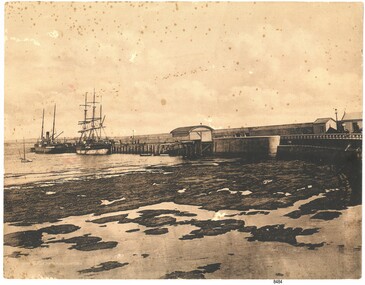 Flagstaff Hill Maritime Museum and Village
Photograph - Coastal Scene, Joseph Jordan Photographic Studio, Lady Bay and Breakwater, Warrnambool, circa 1907
... For almost one hundred years the lifeboat and rocket crews, mostly local volunteers, trained regularly to maintain and improve their skills, summoned when needed by alarms, gunshots, ringing bells and foghorns. Some became local heroes but all served an important role. ...For almost one hundred years the lifeboat and rocket crews, mostly local volunteers, trained regularly to maintain and improve their skills, summoned when needed by alarms, gunshots, ringing bells and foghorns. Some became local heroes but all served an important role. ...The Port of Warrnambool - In the early years the Port of Warrnambool was a busy port. Steamships and sailing ships were frequent visitors to the port. Steam navigation companies were plentiful, carrying passengers and freighting cargo such as coal, timber, food, livestock, furniture, hardware and haberdashery between Melbourne and the ports along the southwest coast of Victoria, including Warrnambool. The carts would take their loads into the township for distribution. The Breakwater was built (using 32 ton blocks of concrete) between 1874 and 1890 to provide ships with greater protection from the Southern Ocean. The Lifeboat and Rocket House - The coastline of South West Victoria has had over 600 shipwrecks and many lost lives; even in Warrnambool’s Lady Bay there were around 16 known shipwrecks between 1850 and 1905, with eight lives lost. In 1859 the first Government-built lifeboat arrived at Warrnambool Harbour and a shed was soon built to house it, followed in 1864 by a rocket house to safely store the Rocket Rescue equipment. In 1878 the buildings were moved to the Breakwater area, and in 1910 the new Lifeboat Warrnambool arrived with its ‘self-righting’ design. For almost one hundred years the lifeboat and rocket crews, mostly local volunteers, trained regularly to maintain and improve their skills, summoned when needed by alarms, gunshots, ringing bells and foghorns. Some became local heroes but all served an important role. By the end of the 1950s the lifeboat and rescue equipment had become obsolete. Joseph Jordan - Joseph Jordan was born in 1841 in Leicester England. When he was 16 he joined the 7th Queen's Own Hussars and was sent to India at the outbreak of the mutiny. He took part in the relief of Lucknow and remained in India for eleven years. It was during this time, he became interested in photography. He was posted to New Zealand and later came to Victoria, becoming a sergeant major of the Mounted Rifles. In the mid 1880s he came to the Western district where he was responsible for establishing units of the Mounted Rifles in various country towns such as Dunkeld, Mortlake, Panmure, Bushfield, Koroit etc. He resigned from the army in 1889 and set up a professional photography studio in Liebig Street, Warrnambool. He became very well known in the Western District for family photographs, official photographs of local councillors and groups as well as views of local scenery. In 1891 he photographed the wrecked barque "Fiji" at "Wrecks Beach" near Princetown. His business was taken over by his son Arthur around 1917. Joseph was a keen rifle shot and in 1924 he donated the "Jordan Shield" as a prize to the Victorian Rifle Association. He was made a "Life Honorary Member" of the Warrnambool Returned Soldiers League and in 1933 he was recognised as being the oldest living soldier in Victoria. Joseph died in 1935 aged 95.This photograph is significant for its association with the Port of Warrnambool and the Warrnambool Breakwater as it shows a point in time when shipping activities were an important part of Warrnambool's commerce and social development. It is also a record of the Warrnambool Lifeboat and Rocket house which was important in aiding ordinary citizens, harbour employees and the volunteer boat and rescue crew in saving the lives of sailors and passengers due to the high number of shipwrecks that occurred along the coastline. Joseph Jordan is a significant figure in Warrnambool history as he helped to establish early units of the Mounted Rifles (G Company) in local towns during the late 1880's and later, photographed local scenes, groups and citizens of early Warrnambool. Sepia photograph showing the beach and the Breakwater in Lady Bay Warrnambool, two ships (a steamship and a barque), a small sailboat, and the Lifeboat and Rocket House plus two smaller sheds.Front of photo - BREAKWATER, WARRNAMBOOL, VICTORIA Back of photo - "From: P Gregory / 365 Beach Road / BLACK ROCK 3193"flagstaff hill, flagstaff hill maritime museum, warrnambool, warrnambool harbour, port of warrnambool, tramway jetty, breakwater, lifeboat and rocket shed, steamship, barque, photograph of lady bay, rocket house, shipping, joseph jordan, lady bay, views of warrnambool, jordan photography -
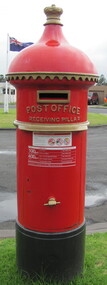 Flagstaff Hill Maritime Museum and Village
Functional object - Post Office Receiving Pillar, 1885
... Early Victoria Mail was originally collected by ‘letter carriers’, first appointed in Melbourne in 1841, equipped with leather bag and hand bell. He wore a red coat with brass buttons and a black top hat! ...Early Victoria Mail was originally collected by ‘letter carriers’, first appointed in Melbourne in 1841, equipped with leather bag and hand bell. He wore a red coat with brass buttons and a black top hat! ...This Post Office Receiving Pillar was restored in 1980 and is now a fully operational Australia Post mailbox. In early August 1980 Prime Minister Mr. Fraser posted Warrnambool’s first commemorative envelope into this restored Post Office Receiving Pillar at Flagstaff Hill Maritime Village. The special limited edition envelopes are numbered 1 – 7000. When posted, the envelopes would have the Flagstaff Hill Logo and Flagstaff Hill Maritime Village’s own postmark of a ship’s steering wheel surrounding a lighthouse and a sailing ship, and were dated August 3 on the First Day Cover. Amongst Flagstaff Hill’s collection is that very first letter posted by Prime Minister Fraser. HISTORY OF POST OFFICE RECEIVING PILLARS In 1851 ‘pillar boxes’ were installed at roadside locations in the island of Jersey, England; they had already been successful in several European countries. The use of new prepaid, adhesive postage stamps as well as the roadside pillar boxes meant there was no need for the public to take a trip to the Post Office just to post a letter. By 1855 London had installed its first six Pillar Boxes. In 1856 the pillar boxes were first introduced in Sydney. These were circular with a crown on the dome, supported by leaves. Early Victoria Mail was originally collected by ‘letter carriers’, first appointed in Melbourne in 1841, equipped with leather bag and hand bell. He wore a red coat with brass buttons and a black top hat! In 1844 two wooden receiving boxes were erected in Melbourne. The first cast iron boxes were installed in South Melbourne (Emerald Hill) and were still in service until 1967. They were a fluted circular design and made in England. In the early 1860’s the ‘low door round’ design posting box was introduced, being circular and surrounded by a crown, with two broad embossed bands around its circumference. The clearance door was in front of the box and low down. These were made in Australia. In the early 1870’s square boxes with a tapering top were being used. These too were made in Australia by different manufacturers with slight variations on style such as the orientation and number of slots. Next came the circular boxes again, similar to the ‘low door round’ but with the clearance door extending to just below the posting slot, often referred to as ‘high door round’. These boxes did not have embossed bands. In 1887 small cast iron boxes were introduced, attached to posts and poles and called ‘lamp post receivers’. Around 1930 a ‘London’ model was used in Victoria. It was copied from the flat-domed type in London but made in Tasmania. [References: Flagstaff Hill Maritime Village records, The Warrnambool Standard, August 1st, 1980, “Stamps.Au” http://www.stampsau.com, 4th April 2011 (Extracted from “Australian Street Posting Boxes” by Ken Sparks – out of print)] Post Office Receiving Pillar, or letterbox.1885 “High Door Round” design. Tall cast iron cylinder with decorative dome cap with crown on top. Side has a slot and a hinged door with handle shaped as a fist. Painted red with gold trim. “POST OFFICE / RECEIVING PILLAR” lettering cast into cylinder. Restored in 1980 and once again operating as an Australia Post mailbox. Commemorative plague on pillar.“POST OFFICE / RECEIVING PILLAR” lettering cast into cylinder. Flagstaff Hill Maritime Museum – Port of Warrnambool. This letter receiver was officially commissioned on 3rd August 1980 by the Prime Minister of Australia, the Right Honourable Malcolm Fraser M.P. on completion of 25 years’ service as the Federal Minister for Wannon.”flagstaff hill, warrnambool, shipwrecked coast, flagstaff hill maritime museum, maritime museum, shipwreck coast, flagstaff hill maritime village, great ocean road, post office receiving pillar, letterbox, mailbox, australia post -
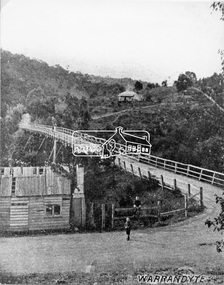 Eltham District Historical Society Inc
Negative - Photograph, Warrandyte Bridge over River Yarra, c.1910
... The chair was taken by the president of the Eltham shire (Mr. John Bell) and the vice chair by Mr. Kent, a member of the Bulleen council. ...The chair was taken by the president of the Eltham shire (Mr. John Bell) and the vice chair by Mr. Kent, a member of the Bulleen council. ...View of the 1875 timber trestle bridge over the Yarra River reproduced from a newsprint image. Also known as Anderson's Creek (Road) Bridge A contract was accepted for William Elliot to erect a bridge over the Yarra River at Warrandyte on Anderson's Creek Road and other improvements for £1,331.6.2 - Gazette No. 143. Tuesday, November 13th 1860 - http://gazette.slv.vic.gov.au/view.cgi?year=1860&class=general&page_num=2161&state=V&classNum=G143&id=). The bridge was washed away by floods in 1863. It was replaced with a taller timber trestle structure in October 1875, designed and built by C.S. Wingrove, Shire Clerk, Engineer and Surveyor for Eltham Shire Council. A replacement for this bridge was commenced in 1955 to cope with increasing traffic and this structure was widened in 2018 to meet further traffic demands. Argus (Melbourne, Vic. : 1848 - 1957), Thursday 23 September 1875, page 7 ________________________________________ THE WARRANDYTE BRIDGE. The ceremony of formally opening the newly erected bridge over the Yarra at Ander-son's Creek was performed on Monday last, in the presence of the members of the Eltham and Bulleen shire councils whose territories it joins, and a goodly number of the residents of the district. The task was delegated to Mr. Cameron, M.L.A., who, after a few introductory remarks declared the bridge to be opened, and christened it the " Warrandyte Bridge." The party then adjourned to Grant's Hotel, where a cold collation had been prepared. The chair was taken by the president of the Eltham shire (Mr. John Bell) and the vice chair by Mr. Kent, a member of the Bulleen council. Mr Robert Williamson proposed "Success to the bridge," coupling with it the name of Mr. Cameron, to whose exertions was in the main to be attributed the erection of that structure which was an ornament to the district and would prove of great service to both sides of the river. Mr. Cameron, in responding, alluded to the great difficulties, mainly of a pecuniary nature, that had been encountered in carrying out the project, and which had only been got over by their united efforts and by the liberal spirit in which the late Commissioner of Roads had dealt with the case. The healths of the contractor and the engineer were also drunk. The bridge is a trussed timber one, resting on yellow box piles sunk into the solid rock, each pier being weighted with 50 tons of stone. The abutments consist of dry stone walls, 6ft. thick at the base, and tapering to 3ft. on the top, the face of the work having a batter of 1 to 1. The length of the bridge is 308ft., there being four openings in the centre of 66ft. each, and two at the ends of 20ft. each. The width in the clear is 9½ft., and the height from the bed of the river about 33ft. The approaches comprise 1,100 cubic yards of earthwork, and the formation of 48 chains of sideling, the whole cost of the work, which was carried out under the direction of the engineer to the Eltham Shire Council, being £1,413.This photo forms part of a collection of photographs gathered by the Shire of Eltham for their centenary project book,"Pioneers and Painters: 100 years of the Shire of Eltham" by Alan Marshall (1971). The collection of over 500 images is held in partnership between Eltham District Historical Society and Yarra Plenty Regional Library (Eltham Library) and is now formally known as the 'The Shire of Eltham Pioneers Photograph Collection.' It is significant in being the first community sourced collection representing the places and people of the Shire's first one hundred years.Digital image 4 x 5 inch B&W Neg B&W Print 12.5 x 9 cmsepp, shire of eltham pioneers photograph collection, warrandyte, bridge -
 Eltham District Historical Society Inc
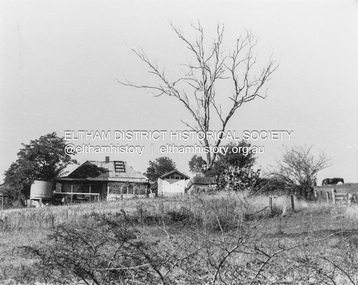
Photograph (Item) - Print, Karen Hynes, The House With Half A Red Roof, 1988
... Original West family home, Fabbro's farm, Bell Street, Eltham Karen Hynes 1988 Entrant No. 10 No negative SHIRE OF ELTHAM COMMUNITY PHOTOGRAPHIC SURVEY Photography is an artform which many of us practice, sometimes purely for artistic pursuit, sometimes to record the people and events in our lives. ...Original West family home, Fabbro's farm, Bell Street, Eltham Karen Hynes 1988 Entrant No. 10 No negative SHIRE OF ELTHAM COMMUNITY PHOTOGRAPHIC SURVEY Photography is an artform which many of us practice, sometimes purely for artistic pursuit, sometimes to record the people and events in our lives. ...Original West family home, Fabbro's farm, Bell Street, Eltham Karen Hynes 1988 Entrant No. 10 No negative SHIRE OF ELTHAM COMMUNITY PHOTOGRAPHIC SURVEY Photography is an artform which many of us practice, sometimes purely for artistic pursuit, sometimes to record the people and events in our lives. In 1988, as part of a local Bicentennial project, the Shire of Eltham conducted the Eltham Community Photographic Survey. Up to 100 entries were to be selected by a panel of photographers for entry into the Eltham Photographic Survey Exhibition. Entries had to be submitted by May 13, 1988. Entrants whose images were selected for the exhibition were contacted and requested to further submit an entry form providing entrant’s name, area of residence, age, and proposed captions. These details were then used to produce labels for the exhibition mounts. Where negatives had not been supplied, these were requested to support the display of printed enlargements mounted on 10” x 8” cardboard. The mounted prints were made available post exhibition for sale at $8.50 each for colour prints and $7.00 for B&W prints. Residents in the Shire were invited to collect a free roll of film and take a photograph of what they either liked or did not like about the area. A total of 160 entrants submitted multiple entries for the exhibition. Of those selected for exhibition, entrants ranged in age from 9 to 70 years. All custom colour and black and white printing for the exhibition was completed by Wattle Studios of Eltham. The Eltham Photographic Survey was jointly auspiced by the Shire of Eltham and Wattle Studios, of 953 Main Road, Eltham. The project was greatly assisted by: • David McRitchie, Media Studies Lecturer Victoria College, Rusden Campus. • Ian and Annette Toohill of Wattle Studios • Tracy Naughton, Eltham Community Arts Officer • Neville Emerson Pty. Ltd. • Superior Press, Eltham • Kodak Australasia Pty. Ltd. • Agfa Gevaert Ltd. • Townsend Colourtech Pty. Ltd. • The Australian Bicentennial Authority • Eleanor Bowers, Secretary, Eltham Arts Council The exhibition was placed on display in the Woolworths Arcade, Eltham between Monday June 6th and Saturday June 11, 1988. It was also intended to hold the exhibition at a venue in the Shire’s North Riding from Monday, June 20 to Friday June 24. It was then displayed at the Were Street Theatre, Montmorency from Friday, June 24 to Thursday, July 7. Series 34: Eltham Community Photographic Survey 1988 - Prints & Documentation Series consists of 117 photographs of Shire scenes taken by members of the community. Items I - 41 are larger photographs mounted on card, which were exhibited. Items 42 - 117 are unmounted copies, alternative takes and other entries. Corresponding negatives contained in Series 35: Eltham Community Photographic Survey 1988 – Negatives which consists of 267 colour and B&W negatives and one colour slide of Shire scenes taken by members of the community. The negatives are arranged by the entrant number of the photographer. The Eltham Community Photographic Survey collection is significant to the local community as it was curated by the local community - ordinary people of all ages - representing what they liked and did not like in the area where they lived. It represents an unfiltered representation of the Shire of Eltham as it was in 1988. It also represents one of many projects as part of the national programme of events and celebrations to commemorate the bicentenary. It is a time capsule of life in the 1980s of this urban and rural municipality in Melbourne's north. Front: Entrant No. and name on printed label Rear: Entrant No., name and address on printed label; also 'Series 34' and the 'Item No.' in pencilshire of eltham archives, bicentennial project, eltham, eltham community photographic survey, eltham photographic survey exhibition, series 34, series 35, scan - 35mm negative, fabbro's farm, karen hynes, west house -
 Vision Australia
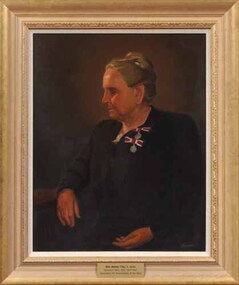
Painting - Artwork, Portrait of Tilly Aston, 1990
... Her legacy continues through the work Vision Australia which provides services for thousands of blind Australians. A memorial bell dedicated to her is also situated in the King Domain Gardens. ...Her legacy continues through the work Vision Australia which provides services for thousands of blind Australians. A memorial bell dedicated to her is also situated in the King Domain Gardens. association for the advancement of the blind association for the blind tilly aston The plaque at the base of the painting reads 'Miss Matilda (Tilly) A. ...Framed portrait of Tilly Aston who began the Association for the Advancement of the Blind, a forerunner to the Association for the Blind. It is part of a series of paintings commissioned by the AFB Board to commemorate the work of past presidents of the organisation. Tilly sits with one hand resting against a table, and the other in her lap. She is wearing a black collared dress with a white lace neck ruff held with an opal pin. Two medals (the Jubilee medal and Coronation medal) are pinned to the chest, each consisting of a red and white bowtie with a brass medallion. Tilly Aston was born in Carisbrook, Victoria, in 1873. When she was very young her parents noticed she was having problems with her vision. They took her to a doctor who diagnosed her with no sight in her right eye and the prognosis of loss of vision in the left eye. As a result of this she was totally blind by the age of 7. Despite this her parents endeavoured to give Tilly as many of life’s advantages that their limited means could supply. From an early age she was taught singing, music, poetry, arithmetic, encouraged to read and observe the natural world around her and be independent. At the age of 8 she was sent to the Asylum and School for the Blind (later called the Royal Victorian Institute for the Blind). She excelled in a wide range of subjects and matriculated in 1889. With the help of a public fund was able to attend Melbourne University, being the first blind Australian to do so. Unfortunately the lack of Braille text books made it impossible for Tilly to continue her studies and she left in second year. Tilly was determined that other blind people would not have the same negative experience she had had. In 1894 she organised a meeting to form the Victorian Association of Braille Writers with the aim of producing and supplying Braille to blind Victorians. Braille was produced by trained volunteers with ? recruited in the first six month. Other rights and services for blind people remained very limited. In 1895 Tilly organised a meeting, which formed the Association for the Advancement of the Blind (now Vision Australia). The Association was instrumental in obtaining many benefits for blind people including a blind pension, voting rights and transport concessions. It also established the first nursing homes for blind people, at a time when many blind people were homeless and destitute. Tilly went on to be Australia’s first blind teacher. She was also a very talented musician, author of seven books and was very gifted at arts and crafts. She knew Esperanto and corresponded with people all around the world including Helen Keller. Tilly passed away on November 1st 1947. Her legacy continues through the work Vision Australia which provides services for thousands of blind Australians. A memorial bell dedicated to her is also situated in the King Domain Gardens. 1 art original in gold frameThe plaque at the base of the painting reads 'Miss Matilda (Tilly) A. Aston / President 1904, 1910, 1943 to 1947/ Association for Advancement of the Blind'. association for the advancement of the blind, association for the blind, tilly aston -
 Melbourne Legacy
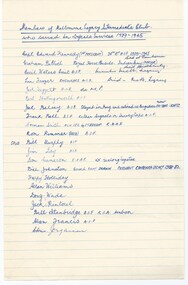
Document, Members of the Melbourne Intermediate Legacy Club who served in the Defence Services 1939-1945
... List included: Edward Kennedy Graham Billiet, Cecil Waters, Len Frazer, Jack Suggett, Bert Hollingsworth, Jack Belsey, Frank Bell, Norman Smith, Ron Rimmer, Bill (Spud) Murphy, Jim Day, Don Cameron, Bill Johnston, Frank 'Happy' Holliday, Alan Williams, Doug Wade, Jack Rintoul, Bill Stanbridge, Alan Francis, Chris Jorgenson...List included: Edward Kennedy Graham Billiet, Cecil Waters, Len Frazer, Jack Suggett, Bert Hollingsworth, Jack Belsey, Frank Bell, Norman Smith, Ron Rimmer, Bill (Spud) Murphy, Jim Day, Don Cameron, Bill Johnston, Frank 'Happy' Holliday, Alan Williams, Doug Wade, Jack Rintoul, Bill Stanbridge, Alan Francis, Chris Jorgenson A record of where the ILC members served in world war two and some of the ranks they attained. ...A list of 22 members of the ILC who had served in the second world war and their details if known. A second note mentions that of 42 ILC members, there were 33 that served in the second world war. 12 in the AIF, 12 in the AMF, 8 in the RAAF, and 1 in the Indian Army. The balance were in reserved occupations or had ill health. Ranks held included 2 Majors, 2 Captains, 2 Lieutenants, and 1 pilot officer. Also noted was that 2 became POWs and one in the RAAF served in the No 10 Squadron. Background: The ILC was formed in 1929. The idea of the club sprang from those boys who had outgrown the Junior Legacy Club. In the early days it fielded a lacrosse team and it was this that mainly held the members together. Enthusiasm wained after a few years as it lacked a solid objective. The answer came from one of its members and in 1938 they founded the Don Esses Club. This was a club for the children of incapacitated ex-servicemen which met every Thursday night at 7.30 run by the ILC members. The name came from the signallers' code Disabled Servicemen's Sons. During the second world war 80% of the members of the ILC enlisted in the services. Leaving only 8 members that could not join due to ill health or reserved occupations. They continued the Don Esses and whatever aid they could to Legacy. ILC members had always helped Legacy where possible including being camp leaders or camp staff, with the annual demonstrations, and coffee stalls at the ANZAC dawn service. Post second world war some ILC members were nominated into Legacy, others drifted away in civil occupations. It was found difficult to recruit new blood into the ILC and eventually membership waned when the boys from the Don Esses clubs found other youth activities to join. The ILC ceased to meet regularly in the mid fifties. However a strong comradeship still existed between members and they would meet in one anothers homes. Members were always ready to help the senior Legacy Club in any way in their power and still helped at Christmas parties and summer camps. ILC was a service rendering organisation and was self governing. Non-sectarian and non-political, the members were ex-junior legatees over 18 years of age. After serving in World War 2 members were eligible to become members of Legacy. Was in a folder of material collated about the ILC by an early archive committee. List included: Edward Kennedy Graham Billiet, Cecil Waters, Len Frazer, Jack Suggett, Bert Hollingsworth, Jack Belsey, Frank Bell, Norman Smith, Ron Rimmer, Bill (Spud) Murphy, Jim Day, Don Cameron, Bill Johnston, Frank 'Happy' Holliday, Alan Williams, Doug Wade, Jack Rintoul, Bill Stanbridge, Alan Francis, Chris JorgensonA record of where the ILC members served in world war two and some of the ranks they attained. The ILC was active from 1929 to 1974.White lined note paper with handwritten list of members who served in World War 2.ilc, membership, junior legatee -
 Melbourne Tram Museum
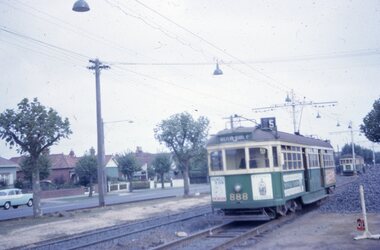
Album - Robert Thomson Slide Collection, "Melbourne AETA 1964"
... RT207 Y1 611 Batman Ave 4-4-64 - "Wattle Park Elgar Rd" RT208 Hawthorn Depot 25-3-64 - trams 582 & 841 RT209 L 105 City Swanston St 25-3-64 route 4B RT210 SW6 853 Chapel St Richmond 25-3-64 -"Prahran" - route 77 RT211 L 102 City Swanston St 25-3-64 - "Carnegie" - route 4 RT212 27-4-62 - tram 495 - "Camberwell" - route 7 & tram 334 RT213 tram 11 - "Special" Flinders St RT214 March 1964 - tram 779 - "West Coburg via William St" - route 55 RT215 March 1964 W7 Collins St - tram 1024 - "Northcote via St Georges Rd" - route 9A RT216 March 1964 Victoria Parade - tram 892 - "City" - route 42 RT217 March 1964 Spring St - tram 1034 - "East Preston" - route 88 RT218 March 1964 Essendon Terminus - tram 741 - "City" - route 59 RT219 1964 AETA Convention - tram 672 - "City" RT220 1964 AETA Convention - tram 672 - "West Coburg Bell St" RT221 1964 AETA Convention - tram 676 - "Leura Grove" RT222 1964 AETA Convention - tram 672 - "Special" tram bridge RT223 1964 AETA Convention - tram 672 - "Special" RT224 1964 AETA Convention - tram 676 - "Burwood" RT225 1964 AETA Convention - tram 672 - "City" - route 59 RT226 1964 AETA Convention - tram 672 - "Special" RT227 1964 AETA Convention - tram 469 - "Special" & tram 895 - "City" - route 2A RT228 1964 AETA Convention - tram south melb depot works yard ...RT207 Y1 611 Batman Ave 4-4-64 - "Wattle Park Elgar Rd" RT208 Hawthorn Depot 25-3-64 - trams 582 & 841 RT209 L 105 City Swanston St 25-3-64 route 4B RT210 SW6 853 Chapel St Richmond 25-3-64 -"Prahran" - route 77 RT211 L 102 City Swanston St 25-3-64 - "Carnegie" - route 4 RT212 27-4-62 - tram 495 - "Camberwell" - route 7 & tram 334 RT213 tram 11 - "Special" Flinders St RT214 March 1964 - tram 779 - "West Coburg via William St" - route 55 RT215 March 1964 W7 Collins St - tram 1024 - "Northcote via St Georges Rd" - route 9A RT216 March 1964 Victoria Parade - tram 892 - "City" - route 42 RT217 March 1964 Spring St - tram 1034 - "East Preston" - route 88 RT218 March 1964 Essendon Terminus - tram 741 - "City" - route 59 RT219 1964 AETA Convention - tram 672 - "City" RT220 1964 AETA Convention - tram 672 - "West Coburg Bell St" RT221 1964 AETA Convention - tram 676 - "Leura Grove" RT222 1964 AETA Convention - tram 672 - "Special" tram bridge RT223 1964 AETA Convention - tram 672 - "Special" RT224 1964 AETA Convention - tram 676 - "Burwood" RT225 1964 AETA Convention - tram 672 - "City" - route 59 RT226 1964 AETA Convention - tram 672 - "Special" RT227 1964 AETA Convention - tram 469 - "Special" & tram 895 - "City" - route 2A RT228 1964 AETA Convention - tram south melb depot works yard Demonstrates the work of Robert Thomson in photography, collection and/or production of slides Melbourne tramways trams MMTB Hawthorn Depot SW6 class W2 class W3 class W4 class W5 class W7 class Y class Y1 class X2 class SW5 class L class South Melbourne Per-way Yard tram 11 tram 3 tram 9 tram 485 tram 676 tram 672 tram 1024 tram 1034 tram 841 tram 469 tram 611 tram 612 tram 101 tram 102 tram 105 tram 826 tram 779 tram 741 tram 655 tram 467 tram 552 tram 582 tram 495 tram 334 tram 888 tram 951 tram 853 tram 892 tram 895 Route 59 Route 2A Route 88 Route 42 Route 9A Route 55 Route 7 Route 4 Route 77 Route 4B Route 1 Route 69 Route 64 Route 5 Assembled album in a black presentation folder of 31 colour slides, collected or produced by Robert Thomson. ...Photo - see pdf file for further information. Number Brief Description RT198 SW6 888 Dandenong Rd 1-4-64 - "Malvern Rd Burke Rd" - route 5 RT199 W2 552 Dandenong Rd 1-4-64 - "City" - route 5 RT200 W3 655 Dandenong Rd 1-4-64 - "City" - route 64 RT201 SW6 951 St Kilda Beach 1-4-64 - "Kew Cotham Rd" - route 69 RT202 10 W3 667 East Coburg 1-4-64 - "South Melb Beach" - route 1 RT203 W5 826 top of Latrobe St (?) 1-4-64 - "City via La Trobe St" - RT204 L 105 Carnegie 1-4-64 -"city" - route 4 RT205 L 101 Carnegie 1-4-64 - "University" - route 4 RT206 tram 612 - "Burwood" - Batman Ave (?) RT207 Y1 611 Batman Ave 4-4-64 - "Wattle Park Elgar Rd" RT208 Hawthorn Depot 25-3-64 - trams 582 & 841 RT209 L 105 City Swanston St 25-3-64 route 4B RT210 SW6 853 Chapel St Richmond 25-3-64 -"Prahran" - route 77 RT211 L 102 City Swanston St 25-3-64 - "Carnegie" - route 4 RT212 27-4-62 - tram 495 - "Camberwell" - route 7 & tram 334 RT213 tram 11 - "Special" Flinders St RT214 March 1964 - tram 779 - "West Coburg via William St" - route 55 RT215 March 1964 W7 Collins St - tram 1024 - "Northcote via St Georges Rd" - route 9A RT216 March 1964 Victoria Parade - tram 892 - "City" - route 42 RT217 March 1964 Spring St - tram 1034 - "East Preston" - route 88 RT218 March 1964 Essendon Terminus - tram 741 - "City" - route 59 RT219 1964 AETA Convention - tram 672 - "City" RT220 1964 AETA Convention - tram 672 - "West Coburg Bell St" RT221 1964 AETA Convention - tram 676 - "Leura Grove" RT222 1964 AETA Convention - tram 672 - "Special" tram bridge RT223 1964 AETA Convention - tram 672 - "Special" RT224 1964 AETA Convention - tram 676 - "Burwood" RT225 1964 AETA Convention - tram 672 - "City" - route 59 RT226 1964 AETA Convention - tram 672 - "Special" RT227 1964 AETA Convention - tram 469 - "Special" & tram 895 - "City" - route 2A RT228 1964 AETA Convention - tram south melb depot works yard Demonstrates the work of Robert Thomson in photography, collection and/or production of slidesAssembled album in a black presentation folder of 31 colour slides, collected or produced by Robert Thomson. All photographs have been scanned and placed on the Museum's G drive. A list of all photographs with details has been compiled. melbourne, tramways, trams, mmtb, hawthorn depot, sw6 class, w2 class, w3 class, w4 class, w5 class, w7 class, y class, y1 class, x2 class, sw5 class, l class, south melbourne per-way yard, tram 11, tram 3, tram 9, tram 485, tram 676, tram 672, tram 1024, tram 1034, tram 841, tram 469, tram 611, tram 612, tram 101, tram 102, tram 105, tram 826, tram 779, tram 741, tram 655, tram 467, tram 552, tram 582, tram 495, tram 334, tram 888, tram 951, tram 853, tram 892, tram 895, route 59, route 2a, route 88, route 42, route 9a, route 55, route 7, route 4, route 77, route 4b, route 1, route 69, route 64, route 5 -
Bendigo Historical Society Inc.
Document - TOWN HALL, CALISTHENICS AND GYMNASTICS, 15 September, 1928
... Programme. 1-Action Song (3rd Grade and under). 2-Physical Drill (Boys, 6th Grade and Under). 3-Singing Games (6th Grade and Under). 4-Free Exercises (Girls under 14). 5-Gigure Marching (12 yrs and over). 6-Maypole Dance. 7-Free Exercises (Gentlemen). 8-Gigure Marching (12yrs and under).9-Folk Dance (6th Grade and under). 10-Physical Drill (Girls, 7th & 8th Grade). 11-Court Dance (any age). 12-Physical Drill (6th Grade & under). 13-Dancing Steps (7th & 8th Grades). 14-Folk Dance (7th & 8th Grades). 15-Rythmic Interpretations. 16-Action Song (Girls 14yrs & under). 17-Dancing Steps (6th Grade & under). 18-Free Exercises (Ladies, 14 & over).19-Maypole Dance. 20-Rod Exercises (Girls, 12 yrs & under). 21-Country Dance (Girls under 14yrs). 22-Dumb Bells (Girls under 14yrs). 23-Best Type of Physical Culture Girl. 24-Country Dancing Ladies 14 & over). 25-Physical Drill (Boys 7th & 8th Grades). 26-Maypole. 27-Rod Exercises (Girls, 14yrs & over). 28-Action Song (Girls, 14 yrs & over). 29-Plastic Exercises (Girls 14 yrs & over). 30-Sining Games (Open). ...Programme. 1-Action Song (3rd Grade and under). 2-Physical Drill (Boys, 6th Grade and Under). 3-Singing Games (6th Grade and Under). 4-Free Exercises (Girls under 14). 5-Gigure Marching (12 yrs and over). 6-Maypole Dance. 7-Free Exercises (Gentlemen). 8-Gigure Marching (12yrs and under).9-Folk Dance (6th Grade and under). 10-Physical Drill (Girls, 7th & 8th Grade). 11-Court Dance (any age). 12-Physical Drill (6th Grade & under). 13-Dancing Steps (7th & 8th Grades). 14-Folk Dance (7th & 8th Grades). 15-Rythmic Interpretations. 16-Action Song (Girls 14yrs & under). 17-Dancing Steps (6th Grade & under). 18-Free Exercises (Ladies, 14 & over).19-Maypole Dance. 20-Rod Exercises (Girls, 12 yrs & under). 21-Country Dance (Girls under 14yrs). 22-Dumb Bells (Girls under 14yrs). 23-Best Type of Physical Culture Girl. 24-Country Dancing Ladies 14 & over). 25-Physical Drill (Boys 7th & 8th Grades). 26-Maypole. 27-Rod Exercises (Girls, 14yrs & over). 28-Action Song (Girls, 14 yrs & over). 29-Plastic Exercises (Girls 14 yrs & over). 30-Sining Games (Open). ...Town Hall, Bendigo Compactions, Calisthenics and Gymnastics, Display by prize Winners. Saturday, September 15th, 1928. Pres. Cr. W H Taylor, Sec. W C Thomas, 22 View St., Bendigo. Programme. 1-Action Song (3rd Grade and under). 2-Physical Drill (Boys, 6th Grade and Under). 3-Singing Games (6th Grade and Under). 4-Free Exercises (Girls under 14). 5-Gigure Marching (12 yrs and over). 6-Maypole Dance. 7-Free Exercises (Gentlemen). 8-Gigure Marching (12yrs and under).9-Folk Dance (6th Grade and under). 10-Physical Drill (Girls, 7th & 8th Grade). 11-Court Dance (any age). 12-Physical Drill (6th Grade & under). 13-Dancing Steps (7th & 8th Grades). 14-Folk Dance (7th & 8th Grades). 15-Rythmic Interpretations. 16-Action Song (Girls 14yrs & under). 17-Dancing Steps (6th Grade & under). 18-Free Exercises (Ladies, 14 & over).19-Maypole Dance. 20-Rod Exercises (Girls, 12 yrs & under). 21-Country Dance (Girls under 14yrs). 22-Dumb Bells (Girls under 14yrs). 23-Best Type of Physical Culture Girl. 24-Country Dancing Ladies 14 & over). 25-Physical Drill (Boys 7th & 8th Grades). 26-Maypole. 27-Rod Exercises (Girls, 14yrs & over). 28-Action Song (Girls, 14 yrs & over). 29-Plastic Exercises (Girls 14 yrs & over). 30-Sining Games (Open). Participants: Quarry Hill State School, Gravel Hill State School, Forest Street Girls Guild, Clifton Calisthenics College, Eaglehawk School, Kangaroo Flat Young Men's Club, St. Andrews Girl's Guild, Quarry Hill School, Higher Elementary School, Violet Street School, St. Paul's Girl's Guild, Golden City Ballarat, Violet Street State School, Violet Street State School, Forest Street Girl's Guild, Miss E McCormack.Cambridge Press, Bendigoevent, entertainment, calisthenics and gymnastics, town hall, bendigo compactions, calisthenics and gymnastics, display by prize winners. saturday, september 15th, 1928. pres. cr. w h taylor, sec. w c thomas, 22 view st., bendigo. programme. 1-action song. 2-physical drill. 3-singing games. 4-free exercises. 5-gigure marching. 6-maypole dance. 7-free exercises. 8-gigure marching.9-folk dance. 10-physical drill. 11-court dance. 12-physical drill. 13-dancing steps. 14-folk dance. 15-rythmic interpretations. 16-action song. 17-dancing steps. 18-free exercises.19-maypole dance. 20-rod exercises. 21-country dance. 22-dumb . 23-best type of physical culture. 24-country dancing. 25-physical drill. 26-maypole. 27-rod exercises. 28-action song. 29-plastic exercises (girls 14 yrs & over). 30-sining games (open). participants: quarry hill state school, gravel hill state school, forest street girls guild, clifton calisthenics college, eaglehawk school, kangaroo flat young men's club, st. andrews girl's guild, quarry hill school, higher elementary school, violet street school, st. paul's girl's guild, golden city ballarat, violet street state school, violet street state school, forest street girl's guild, miss e mccormack. -
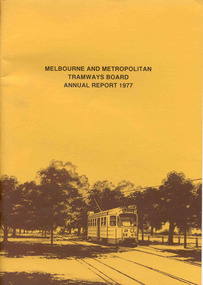 Ballarat Tramway Museum
Document - Report, Melbourne and Metropolitan Tramways Board (MMTB), MMTB Annual Reports 1977 to 1979, 1977 to 1979
... Photos include bus lane on Eastern Freeway, construction of Burwood Extension, first tram to Warragul Road, opening of Burwood tramway (1916), Volvo bus Bell St, upgraded computer installation, Volvo bus chassis, Z class bogie. ...Photos include bus lane on Eastern Freeway, construction of Burwood Extension, first tram to Warragul Road, opening of Burwood tramway (1916), Volvo bus Bell St, upgraded computer installation, Volvo bus chassis, Z class bogie. ...Three copies of the Annual report of the MMTB for the years end 1977 to 1979. 3952.1 - "MMTB Annual Report 1977", brown card cover with a drawing of Z24 on the front cover, 24 pages, white paper, giving details of the MMTB Board, Officers, Introduction, Financial, Engineering, Industrial, Balance sheet, Summary of Income and Expenditure, Schedule of Debentures and Inscribed stock, auditors report, Schedule of tram and bus routes, and record of annual traffic receipts, passengers etc.. Photos include Z's in Bourke ST, after a heavy storm, new Volvo bus, display/advertising tram, Dandenong Rd, Route map board and Cathy Pacific advertisement. Printed by McCarron Bird. 3952.2 - "MMTB Annual Report 1978", gloss cover with a photo of Z18 in Wellington Parade on the front cover, 24 pages, white paper, giving details of the MMTB Board, Officers, Introduction, Financial, Engineering, Industrial, historical highlights, Balance sheet, Summary of Income and Expenditure, Schedule of Debentures and Inscribed stock, auditors report, Service Statistics, Schedule of tram and bus routes, and on inside back cover, route map. On back cover is a photo of Z20 in Wellington Parade. Photos include bus lane on Eastern Freeway, construction of Burwood Extension, first tram to Warragul Road, opening of Burwood tramway (1916), Volvo bus Bell St, upgraded computer installation, Volvo bus chassis, Z class bogie. Printed by McCarron Bird. 3952.3 - "MMTB Annual Report 1978-79", gloss card cover with a photo of Z 116 on the front cover, 24 pages, white paper, giving details of the MMTB Board, Officers, Introduction, Financial, Engineering, Industrial, historical highlights, Balance sheet, Summary of Income and Expenditure, Schedule of Debentures and Inscribed stock, auditors report, Service Statistics, Schedule of tram and bus routes, and on inside back cover, route map. On back cover is a photo of Z73, Nicholson St, Fitzroy. Photos include first tram on Burwood Extension, Volvo bus Westgate freeway, K. J. Brennan, map of Bundoora extension, Box Hill tram, V214, vintage trams day 1979, MAN Bus, Swanston St at dusk and montage of painted W2's. Printed by McCarron Bird.trams, tramways, mmtb, melbourne, annual reports, operations, trackwork -
 Ballarat Tramway Museum
Film - Movie Film & Box, Kodak, 1960s
... Synopsis: based on time - Colour film Title "Ballarat trams specials" 0:00 No. 41 and two other bogie trams loading passengers outside the Ballarat railway station. 0:12 Image of R class loco and K class as 2nd loco at the station and train 0:18 Inside a bogie tram looking through saloon door showing the HTT logo. 0:23 From the front of a tram, or 39 turning from Lydiard St Nth into Sturt St and then proceeding along Sturt St. 0:31 Short sequence inside the tram with some passengers in the view 0:39 No. 21, showing Special in Sturt St West and then the two bogie trams following. 1:08 21 turning from Sturt St West into Hamilton Ave, followed by 41, 35 and 37 and then loading photographers. 1:58 As above north of Gardens Loop in Wendouree Parade. 2:07 Interior view of tram moving at speed, then Forest St corner showing church, and Wendouree Parade. 2:24 Drummond St Sth, crossing two trams at Bell St loop 2:29 Sebastopol line, from the window, heading towards the terminus. 2:44 No. 32 at Sebastopol terminus with the pole being turned. 3:01 Single trucker climbing Sturt St hill towards Lydiard St Nth. 3:17 No. 21 turning from Lydiard St Nth into Sturt St 3:31 Bogie tram climbing Sturt St hill towards Lydiard St Nth 3:55 Crossing the railway level crossing in Lydiard St Nth from the window of the tram. 4:02 Train departing from station – very poor sequence – appears to be a K class locomotive. 4:15 end Placed in a blue cardboard box specially made for the item 30/08/2010....Trams tramways Ballarat Vintage Train Bell St Level Crossings Lydiard St Nth Sturt St West tram 41 tram 39 tram 21 tram 35 tram 37 tram 32 Movie film - 8mm, approx. 4.14 mins, with white leader strip on a plastic reel, within a Kodak movie yellow plastic container. ...Yields information in movie film format of Ballarat trams in 1971 at the time of one of the closure tours and, a enthusiast tour, how the system operated and was used by people., Yields information in movie film format of Ballarat trams in 1971 at the time of one of the closure tours and, a enthusiast tour, how the system operated and was used by people.Movie film - 8mm, approx. 4.14 mins, with white leader strip on a plastic reel, within a Kodak movie yellow plastic container. Has been transferred to DVD - see Reg item 4100 as Segment No. 4. Filmed and made by an unknown person. Synopsis: based on time - Colour film Title "Ballarat trams specials" 0:00 No. 41 and two other bogie trams loading passengers outside the Ballarat railway station. 0:12 Image of R class loco and K class as 2nd loco at the station and train 0:18 Inside a bogie tram looking through saloon door showing the HTT logo. 0:23 From the front of a tram, or 39 turning from Lydiard St Nth into Sturt St and then proceeding along Sturt St. 0:31 Short sequence inside the tram with some passengers in the view 0:39 No. 21, showing Special in Sturt St West and then the two bogie trams following. 1:08 21 turning from Sturt St West into Hamilton Ave, followed by 41, 35 and 37 and then loading photographers. 1:58 As above north of Gardens Loop in Wendouree Parade. 2:07 Interior view of tram moving at speed, then Forest St corner showing church, and Wendouree Parade. 2:24 Drummond St Sth, crossing two trams at Bell St loop 2:29 Sebastopol line, from the window, heading towards the terminus. 2:44 No. 32 at Sebastopol terminus with the pole being turned. 3:01 Single trucker climbing Sturt St hill towards Lydiard St Nth. 3:17 No. 21 turning from Lydiard St Nth into Sturt St 3:31 Bogie tram climbing Sturt St hill towards Lydiard St Nth 3:55 Crossing the railway level crossing in Lydiard St Nth from the window of the tram. 4:02 Train departing from station – very poor sequence – appears to be a K class locomotive. 4:15 end Placed in a blue cardboard box specially made for the item 30/08/2010.trams, tramways, ballarat, vintage train, bell st, level crossings, lydiard st nth, sturt st west, tram 41, tram 39, tram 21, tram 35, tram 37, tram 32 -
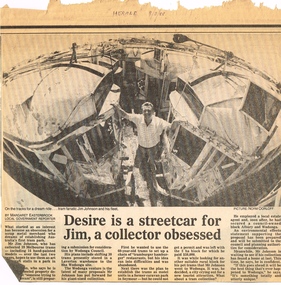 Melbourne Tram Museum
Newspaper, The Herald, The Sun, The Age, Sunday Press, Desire is a streetcar for Jim, March 1988 to March 1989
... Reports on proposals that Jim has had for the trams, including a arts and craft in Wodonga. .2 - "Bell tolls for tram lovers obsession", The Herald, 12/4/1988, features a photo of the trams from street, including a person standing on top. ...Reports on proposals that Jim has had for the trams, including a arts and craft in Wodonga. .2 - "Bell tolls for tram lovers obsession", The Herald, 12/4/1988, features a photo of the trams from street, including a person standing on top. ...Set of 7 newspaper clippings concerning the fate of some 39 ex Melbourne W2's, including 14 Transporting Art trams, purchased by Laverton scrap merchant Jim Johnson. .1 - "Desire is a streetcar for Jim, a collector obsessed, The Herald, 8/3/1988 - features a photo of Jim standing on a bumper bar. Reported by Margaret Easterbrook, Photo Norm Oorloff. Reports on proposals that Jim has had for the trams, including a arts and craft in Wodonga. .2 - "Bell tolls for tram lovers obsession", The Herald, 12/4/1988, features a photo of the trams from street, including a person standing on top. Reported by Nick Richardson, Photo Leigh Henningham. Reports on the failure of the Wodonga proposal. .3 - "Jim's decent obsession is derailed...yet again", The Herald 12/4/1988 - as for .2, but headline changed. .4 - Public Notice, The Sun, 16/4/1988, by Jim Johnson, advertising his tram collection for sale Gives contact details etc. .5 -"The end of the line for a scrap dealer's tram-park dream", The Age, 17/8/1988, features a photo of Jim Johnson standing with two trams in the background. Reported by David Porter, Photo James McEwan, reporting on another failure proposal, this time at Myrtleford. Seeking buyers. .6 - "The end of the line for a private tram fleet", The Herald, 28/3/1989. Features a photo of Jim sitting holding his head with five trams in the background. Reported by Evelyn Tsitas, Photo Bruce Howard. .7 - "Jim's tram plan clangs to a halt", The Sun, 29/3/1989. Reported by Kirsten Hill, with Jim standing in front of the trams, he is still trying to sell or use. .8 - "Jim's tram park idea leaps the rails" - photocopy of article in the Sunday Press 24/7/1988 story by John Lethlean, photo by James Boddington - of Jim with a W2 in the background. Item .8 added 29-11-2015 - photocopy supplied by Rod Atkins 28-11-2015. See also Reg Item 1184.3 for the Tramburger concept! See also Reg item 2781 for colour photographs.trams, tramways, transporting art, decorated trams, auctions, tram disposal, laverton -
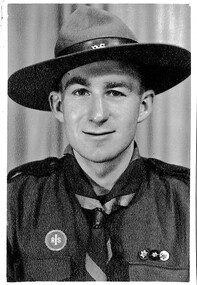 Sunshine and District Historical Society Incorporated
Photograph - 1st Sunshine Scouts Christmas 1947, 1919 - 1957
... Photograph Jim Learmonth 1st Sunshine Group Scout Master He married a Guide and had 3 children who became Cubs Brownies Guides and Scouts|Photograph Roy Paton Tich Stephens Bill Rohner Don Gray Ian Tighe Jim Learmonth Peter Learmonth The Long Haul First Sunshine Scouts Christmas 1947 Big Pats Creek Camp site on the McLean Property at the bridge|Photograph 1st Sunshine Scouts Back row Ron Doubleday Kevin Harvey Ian Bell Front row Chas Stonehouse Jim Learmonth RL Bill Morris John Drewer|Photograph 1st Sunshine Scouts Jim Learmonth|Photograph Madame Tussards London Jim Learmonth Next to the Scouts founder Lord Baden Powell of Galwell|Photographs of McLean's Haven after the great flood and the one that didnt get away|Photographs Parents Day Big Pats Creek and Scouts own Sunshine Gardens|The only photograph of the original Sunshine Scouts behind Bushy Thompsons one Satuday 1919 to 1920 Top Row Jack Emslie Unknown Peter Barlett C Drewerman Jim Garde 2nd Row Lance Clemson Fred Imple Glyn Gleneson Allan McRae Mousey Hill Unknown 3rd Row Unknown Jim Caithness Unknown John Souter Bob Andews Bill Butcher Thomas 4th row P McKay Reg Bult 5th Row F Bennett Bill Hebb Unknown Unknown Original scoutmasters Charlie Saws Arch Mounsey Arch Snaith?...Scouts Scouting Learmonth Photograph Jim Learmonth 1st Sunshine Group Scout Master He married a Guide and had 3 children who became Cubs Brownies Guides and Scouts|Photograph Roy Paton Tich Stephens Bill Rohner Don Gray Ian Tighe Jim Learmonth Peter Learmonth The Long Haul First Sunshine Scouts Christmas 1947 Big Pats Creek Camp site on the McLean Property at the bridge|Photograph 1st Sunshine Scouts Back row Ron Doubleday Kevin Harvey Ian Bell Front row Chas Stonehouse Jim Learmonth RL Bill Morris John Drewer|Photograph 1st Sunshine Scouts Jim Learmonth|Photograph Madame Tussards London Jim Learmonth Next to the Scouts founder Lord Baden Powell of Galwell|Photographs of McLean's Haven after the great flood and the one that didnt get away|Photographs Parents Day Big Pats Creek and Scouts own Sunshine Gardens|The only photograph of the original Sunshine Scouts behind Bushy Thompsons one Satuday 1919 to 1920 Top Row Jack Emslie Unknown Peter Barlett C Drewerman Jim Garde 2nd Row Lance Clemson Fred Imple Glyn Gleneson Allan McRae Mousey Hill Unknown 3rd Row Unknown Jim Caithness Unknown John Souter Bob Andews Bill Butcher Thomas 4th row P McKay Reg Bult 5th Row F Bennett Bill Hebb Unknown Unknown Original scoutmasters Charlie Saws Arch Mounsey Arch Snaith? ...Photograph Jim Learmonth 1st Sunshine Group Scout Master He married a Guide and had 3 children who became Cubs Brownies Guides and Scouts|Photograph Roy Paton Tich Stephens Bill Rohner Don Gray Ian Tighe Jim Learmonth Peter Learmonth The Long Haul First Sunshine Scouts Christmas 1947 Big Pats Creek Camp site on the McLean Property at the bridge|Photograph 1st Sunshine Scouts Back row Ron Doubleday Kevin Harvey Ian Bell Front row Chas Stonehouse Jim Learmonth RL Bill Morris John Drewer|Photograph 1st Sunshine Scouts Jim Learmonth|Photograph Madame Tussards London Jim Learmonth Next to the Scouts founder Lord Baden Powell of Galwell|Photographs of McLean's Haven after the great flood and the one that didnt get away|Photographs Parents Day Big Pats Creek and Scouts own Sunshine Gardens|The only photograph of the original Sunshine Scouts behind Bushy Thompsons one Satuday 1919 to 1920 Top Row Jack Emslie Unknown Peter Barlett C Drewerman Jim Garde 2nd Row Lance Clemson Fred Imple Glyn Gleneson Allan McRae Mousey Hill Unknown 3rd Row Unknown Jim Caithness Unknown John Souter Bob Andews Bill Butcher Thomas 4th row P McKay Reg Bult 5th Row F Bennett Bill Hebb Unknown Unknown Original scoutmasters Charlie Saws Arch Mounsey Arch Snaith?|Photographs Kim District Commissioner Sir Edmund Herrings presentation of the Silver Wolf bush Scene Warburton Bike Hike Melton Bruce Smith with Bill Morris Building Rover Chalet Warburton Where we slept|Photographs A close shave Boys of the old brigade Group photograph Gaooubess at Big Pats Creek Camp site Big Pats Creek 4 group photographs no descriptionsscouts, scouting, learmonth -
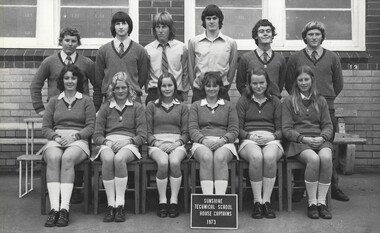 Sunshine and District Historical Society Incorporated
Photograph - Sunshine Technical School 1973 Class Photographs Album
... 3480.01 - Sunshine Technical School 1973 House Captains 3480.02 - Sunshine Technical School 1973 Form 1A Back Back Row Robert Wright Alan Townson Grant Sullivan Mario Theophanidies Dominic Parker Keith Hamann Michael Barrow Rocco DiMieri David Siddall Tony Sproule Middle Row Paul Loney Tony Darcy John Dalli Peter Bell Craig Kimpton Manko Rebic John Diquattro Peter Michaelides Roy McClean Front Row Debra Ledgard Anna Piaquadio Toni Hawkins Joanne Arends Jean Clarke Monica Azzopardi Lesley Meale Debra Knight 3480.03 - Sunshine Technical School 1973 Form 1A 3480.04 - Sunshine Technical School 1973 Form 1B Back Back Row Andrew Esposito Moratio Tony Xavier Malcolm Henderson Peter Rohner Stephen Reddie Colin MacPherson Robert Bese Steven Schuliga Middle Row Stellios Ambelas Tommy Johns Drago Recek Andrew Lyons Edward Gauci Darren Holman Leonard Wells Robert Rudd Front Row Leanner Reeve Kerri Oldaker Unknown Karen Fowler Jackie Connolly Kerri Huntley Elspeth Bell Ljilja Jocinovic Doris Attard 3480.05 - Sunshine Technical School 1973 Form 1B 3480.06 - Sunshine Technical School 1973 Form 1C 3480.07 - Sunshine Technical School 1973 Form 1D 3480.08 - Sunshine Technical School 1973 Form 1E 3480.09 - Sunshine Technical School 1973 Form 1F Back Back Row Graham Hilton Tony Tedesco Silvo Camenzuli Andrew Ellis Joseph Talent Bernie Hyett 2nd Row Mary Duhaq Haydn Young Steven Kiss Richard Busutill Emanuel Pulis Mark Spiteri Carmelo Spiteri Sharon Wadley 3rd Row Peter Murphy Unknown Steven Arnott Michael Winch Raymond Vella Peter Webb Mario Abela Front Row Debra Murray Sharon Kaylerr-Thompson Unknown Kaylene Shoobert Beverly Haslett Robin Skelton Kerry Trice Julie Harvey 3480.10 - Sunshine Technical School 1973 Form 1F 3480.11 - Sunshine Technical School 1973 Form 1G 3480.12 - Sunshine Technical School 1973 Form 1H 3480.13 - Sunshine Technical School 1973 Form 2A 3480.14 - Sunshine Technical School 1973 Form 2B 3480.15 - Sunshine Technical School 1973 Form 2C 3480.16 - Sunshine Technical School 1973 Form 2D 3480.17 - Sunshine Technical School 1973 Form 2E 3480.18 - Sunshine Technical School 1973 Form 2F 3480.19 - Sunshine Technical School 1973 Form 2G 3480.20 - Sunshine Technical School 1973 Form 2H 3480.21 - Sunshine Technical School 1973 Form 3AA 3480.22 - Sunshine Technical School 1973 Form 3AB 3480.23 - Sunshine Technical School 1973 Form 3BC 3480.24 - Sunshine Technical School 1973 Form 3CC 3480.25 - Sunshine Technical School 1973 Form 3DD 3480.26 - Sunshine Technical School 1973 Form 3DE 3480.27 - Sunshine Technical School 1973 Form 3EF 3480.28 - Sunshine Technical School 1973 Form 3FF 3480.29 - Sunshine Technical School 1973 Form 3GG 3480.30 - Sunshine Technical School 1973 Form 3GH 3480.31 - Sunshine Technical School 1973 Form 5A 3480.32 - Sunshine Technical School 1973 Form 4A 3480.33 - Sunshine Technical School 1973 Form 4B 3480.34 - Sunshine Technical School 1973 Form 4C 3480.35 - Sunshine Technical School 1973 Form 4D 3480.36 - Sunshine Technical School 1973 Form 4E 3480.37 - Sunshine Technical School 1973 Form 5B 3480.38 - Sunshine Technical School 1973 Form 5C...Sunshine Technical School Technical School Class Photographs 3480.01 - Sunshine Technical School 1973 House Captains 3480.02 - Sunshine Technical School 1973 Form 1A Back Back Row Robert Wright Alan Townson Grant Sullivan Mario Theophanidies Dominic Parker Keith Hamann Michael Barrow Rocco DiMieri David Siddall Tony Sproule Middle Row Paul Loney Tony Darcy John Dalli Peter Bell Craig Kimpton Manko Rebic John Diquattro Peter Michaelides Roy McClean Front Row Debra Ledgard Anna Piaquadio Toni Hawkins Joanne Arends Jean Clarke Monica Azzopardi Lesley Meale Debra Knight 3480.03 - Sunshine Technical School 1973 Form 1A 3480.04 - Sunshine Technical School 1973 Form 1B Back Back Row Andrew Esposito Moratio Tony Xavier Malcolm Henderson Peter Rohner Stephen Reddie Colin MacPherson Robert Bese Steven Schuliga Middle Row Stellios Ambelas Tommy Johns Drago Recek Andrew Lyons Edward Gauci Darren Holman Leonard Wells Robert Rudd Front Row Leanner Reeve Kerri Oldaker Unknown Karen Fowler Jackie Connolly Kerri Huntley Elspeth Bell Ljilja Jocinovic Doris Attard 3480.05 - Sunshine Technical School 1973 Form 1B 3480.06 - Sunshine Technical School 1973 Form 1C 3480.07 - Sunshine Technical School 1973 Form 1D 3480.08 - Sunshine Technical School 1973 Form 1E 3480.09 - Sunshine Technical School 1973 Form 1F Back Back Row Graham Hilton Tony Tedesco Silvo Camenzuli Andrew Ellis Joseph Talent Bernie Hyett 2nd Row Mary Duhaq Haydn Young Steven Kiss Richard Busutill Emanuel Pulis Mark Spiteri Carmelo Spiteri Sharon Wadley 3rd Row Peter Murphy Unknown Steven Arnott Michael Winch Raymond Vella Peter Webb Mario Abela Front Row Debra Murray Sharon Kaylerr-Thompson Unknown Kaylene Shoobert Beverly Haslett Robin Skelton Kerry Trice Julie Harvey 3480.10 - Sunshine Technical School 1973 Form 1F 3480.11 - Sunshine Technical School 1973 Form 1G 3480.12 - Sunshine Technical School 1973 Form 1H 3480.13 - Sunshine Technical School 1973 Form 2A 3480.14 - Sunshine Technical School 1973 Form 2B 3480.15 - Sunshine Technical School 1973 Form 2C 3480.16 - Sunshine Technical School 1973 Form 2D 3480.17 - Sunshine Technical School 1973 Form 2E 3480.18 - Sunshine Technical School 1973 Form 2F 3480.19 - Sunshine Technical School 1973 Form 2G 3480.20 - Sunshine Technical School 1973 Form 2H 3480.21 - Sunshine Technical School 1973 Form 3AA 3480.22 - Sunshine Technical School 1973 Form 3AB 3480.23 - Sunshine Technical School 1973 Form 3BC 3480.24 - Sunshine Technical School 1973 Form 3CC 3480.25 - Sunshine Technical School 1973 Form 3DD 3480.26 - Sunshine Technical School 1973 Form 3DE 3480.27 - Sunshine Technical School 1973 Form 3EF 3480.28 - Sunshine Technical School 1973 Form 3FF 3480.29 - Sunshine Technical School 1973 Form 3GG 3480.30 - Sunshine Technical School 1973 Form 3GH 3480.31 - Sunshine Technical School 1973 Form 5A 3480.32 - Sunshine Technical School 1973 Form 4A 3480.33 - Sunshine Technical School 1973 Form 4B 3480.34 - Sunshine Technical School 1973 Form 4C 3480.35 - Sunshine Technical School 1973 Form 4D 3480.36 - Sunshine Technical School 1973 Form 4E 3480.37 - Sunshine Technical School 1973 Form 5B 3480.38 - Sunshine Technical School 1973 Form 5C A4 bound laminated photograph album containing 36 pages with black and white class photographs 1973 Photograph Sunshine Technical School 1973 Class Photographs Album ...3480.01 - Sunshine Technical School 1973 House Captains 3480.02 - Sunshine Technical School 1973 Form 1A Back Back Row Robert Wright Alan Townson Grant Sullivan Mario Theophanidies Dominic Parker Keith Hamann Michael Barrow Rocco DiMieri David Siddall Tony Sproule Middle Row Paul Loney Tony Darcy John Dalli Peter Bell Craig Kimpton Manko Rebic John Diquattro Peter Michaelides Roy McClean Front Row Debra Ledgard Anna Piaquadio Toni Hawkins Joanne Arends Jean Clarke Monica Azzopardi Lesley Meale Debra Knight 3480.03 - Sunshine Technical School 1973 Form 1A 3480.04 - Sunshine Technical School 1973 Form 1B Back Back Row Andrew Esposito Moratio Tony Xavier Malcolm Henderson Peter Rohner Stephen Reddie Colin MacPherson Robert Bese Steven Schuliga Middle Row Stellios Ambelas Tommy Johns Drago Recek Andrew Lyons Edward Gauci Darren Holman Leonard Wells Robert Rudd Front Row Leanner Reeve Kerri Oldaker Unknown Karen Fowler Jackie Connolly Kerri Huntley Elspeth Bell Ljilja Jocinovic Doris Attard 3480.05 - Sunshine Technical School 1973 Form 1B 3480.06 - Sunshine Technical School 1973 Form 1C 3480.07 - Sunshine Technical School 1973 Form 1D 3480.08 - Sunshine Technical School 1973 Form 1E 3480.09 - Sunshine Technical School 1973 Form 1F Back Back Row Graham Hilton Tony Tedesco Silvo Camenzuli Andrew Ellis Joseph Talent Bernie Hyett 2nd Row Mary Duhaq Haydn Young Steven Kiss Richard Busutill Emanuel Pulis Mark Spiteri Carmelo Spiteri Sharon Wadley 3rd Row Peter Murphy Unknown Steven Arnott Michael Winch Raymond Vella Peter Webb Mario Abela Front Row Debra Murray Sharon Kaylerr-Thompson Unknown Kaylene Shoobert Beverly Haslett Robin Skelton Kerry Trice Julie Harvey 3480.10 - Sunshine Technical School 1973 Form 1F 3480.11 - Sunshine Technical School 1973 Form 1G 3480.12 - Sunshine Technical School 1973 Form 1H 3480.13 - Sunshine Technical School 1973 Form 2A 3480.14 - Sunshine Technical School 1973 Form 2B 3480.15 - Sunshine Technical School 1973 Form 2C 3480.16 - Sunshine Technical School 1973 Form 2D 3480.17 - Sunshine Technical School 1973 Form 2E 3480.18 - Sunshine Technical School 1973 Form 2F 3480.19 - Sunshine Technical School 1973 Form 2G 3480.20 - Sunshine Technical School 1973 Form 2H 3480.21 - Sunshine Technical School 1973 Form 3AA 3480.22 - Sunshine Technical School 1973 Form 3AB 3480.23 - Sunshine Technical School 1973 Form 3BC 3480.24 - Sunshine Technical School 1973 Form 3CC 3480.25 - Sunshine Technical School 1973 Form 3DD 3480.26 - Sunshine Technical School 1973 Form 3DE 3480.27 - Sunshine Technical School 1973 Form 3EF 3480.28 - Sunshine Technical School 1973 Form 3FF 3480.29 - Sunshine Technical School 1973 Form 3GG 3480.30 - Sunshine Technical School 1973 Form 3GH 3480.31 - Sunshine Technical School 1973 Form 5A 3480.32 - Sunshine Technical School 1973 Form 4A 3480.33 - Sunshine Technical School 1973 Form 4B 3480.34 - Sunshine Technical School 1973 Form 4C 3480.35 - Sunshine Technical School 1973 Form 4D 3480.36 - Sunshine Technical School 1973 Form 4E 3480.37 - Sunshine Technical School 1973 Form 5B 3480.38 - Sunshine Technical School 1973 Form 5Csunshine technical school, technical school, class photographs -
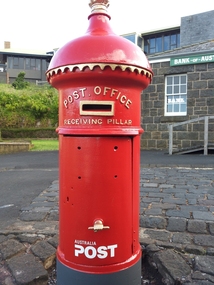 Flagstaff Hill Maritime Museum and Village
Functional object - Post Office Receiving Pillar, 1885
... Early Victoria Mail was originally collected by ‘letter carriers’, first appointed in Melbourne in 1841, equipped with leather bag and hand bell. He wore a red coat with brass buttons and a black top hat! ...Early Victoria Mail was originally collected by ‘letter carriers’, first appointed in Melbourne in 1841, equipped with leather bag and hand bell. He wore a red coat with brass buttons and a black top hat! ...Post Office Receiving Pillar was Collected from Warrnambool City Council’s Scott Street Depot and transported to Flagstaff Hill, stored in the Barracks area Friends of Flagstaff Hill began the project of restoring the Post Office Receiving Pillar in early 2011. The replacement dome required a pattern to be made from paper, then timber, then someone to manufacture it. The cast iron body required sand blasting and undercoating. The pillar was installed in Flagstaff Hill Maritime Village in March 2014. A specialist visited the Village and painted the pillar with 7 coats of ‘post office red’ then completed the job with gold paint on the details. In 2015 an information plate of brass was fitted to the Pillar in the position that would have originally announced the clearing times. It was originally manufactured by G Couch, Engineer, Alliance Iron Works, Melbourne. Gordon Couch passed away in June 1896 and his Works were offered for auction in November 1897. HISTORY OF POST OFFICE RECEIVING PILLARS In 1851 ‘pillar boxes’ were installed at roadside locations in the island of Jersey, England; they had already been successful in several European countries. The use of new prepaid, adhesive postage stamps as well as the roadside pillar boxes meant there was no need for the public to take a trip to the Post Office just to post a letter. By 1855 London had installed its first six Pillar Boxes. In 1856 the pillar boxes were first introduced in Sydney. These were circular with a crown on the dome, supported by leaves. Early Victoria Mail was originally collected by ‘letter carriers’, first appointed in Melbourne in 1841, equipped with leather bag and hand bell. He wore a red coat with brass buttons and a black top hat! In 1844 two wooden receiving boxes were erected in Melbourne. The first cast iron boxes were installed in South Melbourne (Emerald Hill) and were still in service until 1967. They were a fluted circular design and made in England. In the early 1860’s the ‘low door round’ design posting box was introduced, being circular and surrounded by a crown, with two broad embossed bands around its circumference. The clearance door was in front of the box and low down. These were made in Australia. In the early 1870’s square boxes with a tapering top were being used. These too were made in Australia by different manufacturers with slight variations on style such as the orientation and number of slots. Next came the circular boxes again, similar to the ‘low door round’ but with the clearance door extending to just below the posting slot, often referred to as ‘high door round’. These boxes did not have embossed bands. In 1887 small cast iron boxes were introduced, attached to posts and poles and called ‘lamp post receivers’. Around 1930 a ‘London’ model was used in Victoria. It was copied from the flat-domed type in London but made in Tasmania. … [References: Flagstaff Hill Maritime Village records, The Argus, 11th April, 1890, The Argus, 2nd July, 1896, The Argus, 30th Nov. 1897, “Stamps.Au” http://www.stampsau.com, 4th April 2011 (Extracted from “Australian Street Posting Boxes” by Ken Sparks – out of print)] Post Office Receiving Pillar, or letterbox.1885 "High Door Round" design, restored 2014 Tall cast iron sylinder with decorative dome cap, slot in side, hinged door with handle shaped as a fist. Painted red with gold trip..Reconditioned barrel, reconstructed dome. Restored by Friends of Flagstaff Hill, 2014. Now a working letterbox. Made in Melbourne.Oval maker's plate “ - G. COUCH - / ENGINEER / ALLIANCE IRON / WORKS / MELBOURNE”flagstaff hill, warrnambool, shipwrecked coast, flagstaff hill maritime museum, maritime museum, shipwreck coast, flagstaff hill maritime village, great ocean road, post office receiving pillar, letterbox, mailbox, australia post
