
Showing 305 items matching " master street"
-
 Whitehorse Historical Society Inc.
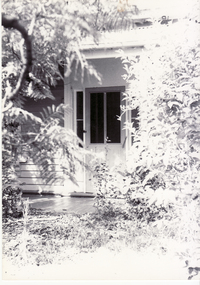
Photograph - Black and white photograph, Station Master's House, Mitcham
... Black and white photo of Station Master's House, Mitcham. House at southern end of Station Street - on eastern side - adjacent to railway line. ...jones shirley Black and white photo of Station Master's House, Mitcham. House at southern end of Station Street - on eastern side - adjacent to railway line. ...Black and white photo of Station Master's House, Mitcham. House at southern end of Station Street - on eastern side - adjacent to railway line. House has been demolished and replaced with car parkingjones, shirley -
 Whitehorse Historical Society Inc.
Document, History of Blackburn South Primary School 4035, 1968
... street dunn michael lyttle edgar paul alexander edmondson john a. neilson roy h. wuff charles r. corr james f. rafferty arthur g. lawson ivor dwyer phillip t. maccallum g.s. History of Blackburn South Primary School, opened on 19/9/1920, in Church of England Hall, Middleborough Road. History of Blackburn South Primary School, opened on 19/9/1920, in Church of England Hall, Middleborough Road. After a fire the school moved to a Salvation Army Hall (now Inala Village). Michael Dunn was first Head Master ...History of Blackburn South Primary School, opened on 19/9/1920, in Church of England Hall, Middleborough Road.History of Blackburn South Primary School, opened on 19/9/1920, in Church of England Hall, Middleborough Road. After a fire the school moved to a Salvation Army Hall (now Inala Village). Michael Dunn was first Head Master, followed later that year by Edgar Lyttle. 1923 land acquired in Canterbury Road.History of Blackburn South Primary School, opened on 19/9/1920, in Church of England Hall, Middleborough Road. primary schools, blackburn south primary school, no. 4035, middleborough road, blackburn south, perth street, dunn, michael, lyttle, edgar, paul, alexander, edmondson, john a., neilson, roy h., wuff, charles r., corr, james f., rafferty, arthur g., lawson, ivor, dwyer, phillip t., maccallum, g.s. -
 Kew Historical Society Inc
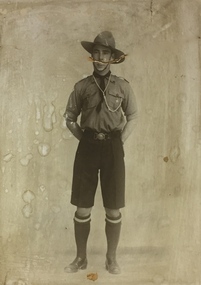
Photograph, 1st Kew Scout Master, circa 1920, c.1920
... Street, Kew until it was demolished in 1993. Still operating (in 2020) from their new Scout Hall on the corner of Kilby Road and Kellett Grove, Kew. 1st kew scouts scout master 1920s scout master in uniform 1920s Large sepia photograph of a 1st Kew Scout in uniform. ...The 1st Kew Scouts was one of the first Scout Troops in Victoria, being formed in 1909. From 1927 they met in a magnificent Scout Hall in Disraeli Street, Kew until it was demolished in 1993. Still operating (in 2020) from their new Scout Hall on the corner of Kilby Road and Kellett Grove, Kew.Large sepia photograph of a 1st Kew Scout in uniform. Given that it is a large-sized studio photograph that had been framed and kept for decades, it is likely to be one of the founders of the Scout Troop, perhaps Captain Peowrie. Like many of the early Scout Troops, a man with a military background initially led 1st Kew. Having joined the Scout Troop in 1911 or early 1912, Captain Peowrie went on to serve in the Army during the First World War, rejoining the Scout Troop at war’s end. He went on to be the Scout Leader and later Group Leader up until 1930, whilst also serving as acting District Commissioner for Kew and Deputy Chief Commissioner of Victoria.1st kew scouts, scout master 1920s, scout master in uniform 1920s -
Kew Historical Society Inc
Journal, Kewriosity : June 1989
... Commentary / Cr Allen Martin p3. Master plan to beautify streets / p3. Service Review for St George's [Hospital] / p2. ...First step before school [Kew Kindergartens] / p1. Hard garbage, hard time / p1. Dates for June / p2. Holiday programs for Kew youngsters / p2. Kids skills for Kew [Kew Recreation Centre] / p2. Commentary / Cr Allen Martin p3. Master plan to beautify streets / p3. Service Review for St George's [Hospital] / p2. Temporary move for Hawthorn Library / p2. Notices / p4. Council elections / p4. Local College plays host to interstate sports [MLC] / p4. Learning for leisure [Kew Recreation Centre] / p4. Mother's Day gift for Kew's older mums / p5. Disability no barrier to water fun / p5. Easter treat for senior locals / p5. A day in the life of Community House / p6. Environment queries to Science Shop shows community cares / p6. Outward bound [Kew Arthritis Self Help Group] / p6. Xavier Chapel story features in new book / p7. Green Spot - An alternative way to shop / p7. Boroondara Bushwalkers / p8. Teenage Holiday Program / p8. Footy News [Kew Football Club] / p8. [Neighbourhood Watch] Meetings for June / p8. Keeping you informed [Citizens Advice Bureaux] / p8.Kewriosity was a local newsletter combining Kew Council and community news. It was published between November 1983 and June 1994, replacing an earlier Kewriosity [broad] Sheet (1979-84). In producing Kewriosity, Council aimed to provide a range of interesting and informative articles covering its deliberations and decision making, together with items of general interest and importance to the Kew community and information not generally available through daily media outlets.non-fictionFirst step before school [Kew Kindergartens] / p1. Hard garbage, hard time / p1. Dates for June / p2. Holiday programs for Kew youngsters / p2. Kids skills for Kew [Kew Recreation Centre] / p2. Commentary / Cr Allen Martin p3. Master plan to beautify streets / p3. Service Review for St George's [Hospital] / p2. Temporary move for Hawthorn Library / p2. Notices / p4. Council elections / p4. Local College plays host to interstate sports [MLC] / p4. Learning for leisure [Kew Recreation Centre] / p4. Mother's Day gift for Kew's older mums / p5. Disability no barrier to water fun / p5. Easter treat for senior locals / p5. A day in the life of Community House / p6. Environment queries to Science Shop shows community cares / p6. Outward bound [Kew Arthritis Self Help Group] / p6. Xavier Chapel story features in new book / p7. Green Spot - An alternative way to shop / p7. Boroondara Bushwalkers / p8. Teenage Holiday Program / p8. Footy News [Kew Football Club] / p8. [Neighbourhood Watch] Meetings for June / p8. Keeping you informed [Citizens Advice Bureaux] / p8.publications -- city of kew (vic.), kewriosity, council newsletters, community newsletters -
University of Melbourne, Burnley Campus Archives
Plan - Student Work, Grey Street Residence, December 2013
... Street Residence. 1. Hand-drawn coloured plan by B.Terry from 3 Generations. Scale 1:100, Job No. 1-2013 Master Plan. 2. ...Street Residence. 1. Hand-drawn coloured plan by B.Terry from 3 Generations. Scale 1:100, Job No. 1-2013 Master Plan. 2. ...student work, assignment, landscape design, st kilda, b. terry, 3 generations -
 Tarnagulla History Archive
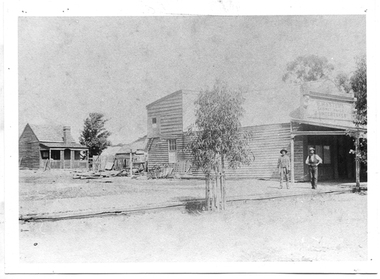
Photograph of P. Master's premises, Tarnagulla, P. Master's premises, Tarnagulla, Late 19th Century
... Copy probably made by Murray Comrie in the 1970s. tarnagulla commerce shops stores masters p. masters funerals commercial road main street Monochrome photograph depicting a building with shopfront, two men standing in front. ...Murray Comrie Collection. Information collated by Murray Comrie: Premises of P. Masters, cabinet-maker and funeral undertaker in Commercial Road, next to Cheetham's on the north side. Phillip Masters' Store was located in Commercial Road, opposite and south of the Victoria Theatre. This photograph is a reasonable copy created from an older original. Copy probably made by Murray Comrie in the 1970s. Monochrome photograph depicting a building with shopfront, two men standing in front. View past building to a small cottage in background.tarnagulla, commerce, shops, stores, masters, p. masters, funerals, commercial road, main street -
 MYLI My Community Library
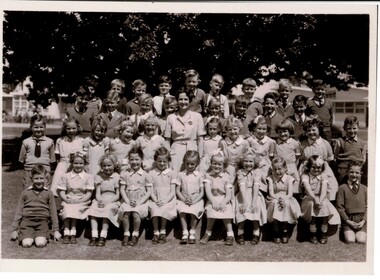
Photograph - Pakenham Consolidated School Grade Two Class Photo, 1953
... The original Pakenham School had opened on a site near the Toomuc Creek in January 1875 and it moved to the Main Street site in 1891. The first Head Master was Charles Hicks. ...The original Pakenham School had opened on a site near the Toomuc Creek in January 1875 and it moved to the Main Street site in 1891. The first Head Master was Charles Hicks. ...Grade 2 of Pakenham Consolidated School in 1953 with their teacher Mrs Joyce Hosking. Back row L to R: Paul Manestar or Bill Vallender, Bernie Carter, (?), Norman Whitelaw, Richard Shelton, Rodney Shallard, Ian Reid (Reidy?) or Duncan Beard (Reidy), Ken Jarred, Glen Jolly. 2nd back row L to R: Keith Crofts, Peter Johnstone, Kevin Lewis, Robert Tulloch (Bones), Nipper Reid, Duncan Beard(?), Bruce Weatherhead, Peter Hobson (Hobbo). 2nd row from front L to R: David Langley, Kath Mauger, Jill Peck, Rosamund Hunt, Beth Schilling, Roslyn Smith, Lynne Tuena, Pat Stone, Joy Higgins, Lynette Wheeler, Grif Fearon or Kevin McInnis. Front row L to R: Ken McCaffrey, Marion Butcher, Helen Stephens, Mary Lou Walsh, Glenis Tuena, Dawn Hillderbrick/ Hillbrick(?), Marion Hansford, Kaye Wollard, Beverley Payne (Payney), Edna Sinclair(?), Paul Braemar. In the 1940s and 1950s there was a movement to consolidate small rural schools into one larger school. This was partly a response to a shortage of teachers, due to many male teachers enlisting during the Second World War. The War also caused a shortage of materials and labour and many Schools fell into disrepair. The Education Department decided that Pakenham would be one of the first six Consolidated Schools to be established and that all schools within 8 kms or 5 miles would be closed. The Pakenham Consolidated School was officially opened on May 29, 1951, on the site of the Pakenham State School, No.1359, in Main Street. The original Pakenham School had opened on a site near the Toomuc Creek in January 1875 and it moved to the Main Street site in 1891. The first Head Master was Charles Hicks. The School offered classes up to Year 10 (Form 4). The schools that formed the Consolidated School were Pakenham Upper No. 2155 (closed January 1952), Pakenham South No. 3755 (closed September 1951), Toomuc Valley No. 3034 (closed September 1951), Army Road No. 3847 (closed April 1947), Mount Burnett No. 4506 (closed October 1949), Tynong No. 2854 (closed April 1951), Tynong North No.4464 (closed December 1951), Nar Nar Goon North No. 2914 (closed October 1951), Nar Nar Goon South No. 4554 (closed May 1951), Rythdale No. 4231 (closed September 1951), Officedale No. 4242 (closed May 1951), Cora Lynn No. 3502 (closed May 1951) and Koo-Wee-Rup North (Five Mile) No. 3198 (closed November 1959). The School consisted of new buildings, which at the time cost one hundred thousand pounds, and many of the old School buildings. Some towns did not realise that their School buildings would be removed from the sites and transferred to Pakenham. The Pakenham Consolidated School moved from its original location in Main Street to its current location in Rundell, Way in 1997.This photograph is of historic and social significance. Pakenham Consolidated School was one of the first six Consolidated Schools established by the Education Department, and was born out of shortages of teachers, labour, and materials during World War II. The school can be used more broadly to reflect on the evolution of education in the state of Victoria, as the school can trace its origins all the way back to 1875, when the original Pakenham School was opened near Toomuc Creek. The photograph is also of social significance to many community groups, including Cardinia Shire, past and current students and teachers, allowing various groups to reflect on and share intangible memories of times spent at Pakenham Consolidated School.Copy of a rectangular black and white photograph on matte photographic paperpakenham consolidated school, primary school, class photo, grade two, grade 2, pakenham, school, photo -
 Port Fairy Historical Society Museum and Archives
Photograph
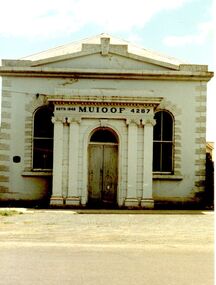
... Masters made by John Gallin that now resides in the Historical Society Rooms. The Trustees bought another building which occupied the land now occupied by the National Australia Bank on the corner of Sackville and Cox Streets but it was not suitable so they decided to re-instate the building whose ruins in the meantime had been used by Cobb and Co. ...Masters made by John Gallin that now resides in the Historical Society Rooms. The Trustees bought another building which occupied the land now occupied by the National Australia Bank on the corner of Sackville and Cox Streets but it was not suitable so they decided to re-instate the building whose ruins in the meantime had been used by Cobb and Co. ...This building is the second of the Manchester Unity Independent Order of Oddfellows rooms the first built in 1862 and opened in that year on the fifteenth anniversary of the foundation of the Lodge in Belfast/Port Fairy. In 1872 a 35foot addition was added to the back and in 1873 the grand porch was added. The hall was destroyed by fire in 1875 and the only item saved was the cedar Dispensation frame of the past Grand Masters made by John Gallin that now resides in the Historical Society Rooms. The Trustees bought another building which occupied the land now occupied by the National Australia Bank on the corner of Sackville and Cox Streets but it was not suitable so they decided to re-instate the building whose ruins in the meantime had been used by Cobb and Co. This new building was designed by Charles Neylon an architect and built by Robert Ireland. The completed building was re-opened in December 1888 with four front rooms, a mezzanine floor and a hall measuring 32' by 26' and capable of holding 200. The Trustees of the Loyal Prince Albert Lodge sold the building in 1978 and is now a private home.Coloured photograph of Imposing M.U.i.O.O.F. Society building with a faux columned portico, double door entry two large windows either sideinstitution, loyal prince albert lodge, m.u.i.o.o.f., manchester unity independent order of oddfellows, society, muioof hall pt fairy -
Port Fairy Historical Society Museum and Archives
Photograph
... street, next door to the grand Bank of Australasia. The hotel seems to have been the favourite meeting place for many of the sporting organisations of the time , including the Football, Rowing, Athletic and Gymnastics clubs . The second licensee was Thomas Pearson, who came to Belfast in 1855, working first for the Harbour master...street, next door to the grand Bank of Australasia. The hotel seems to have been the favourite meeting place for many of the sporting organisations of the time , including the Football, Rowing, Athletic and Gymnastics clubs . The second licensee was Thomas Pearson, who came to Belfast in 1855, working first for the Harbour master ...In 1858 Hugh Wallace , undertaker and cabinet maker, moved from the Assembly Rooms at the corner of Gipps street, and opened his new Bank Hotel in Sackville street, next door to the grand Bank of Australasia. The hotel seems to have been the favourite meeting place for many of the sporting organisations of the time , including the Football, Rowing, Athletic and Gymnastics clubs . The second licensee was Thomas Pearson, who came to Belfast in 1855, working first for the Harbour master Capt. John Mills , then as the first Assistant Lighthouse keeper when it was built in 1859 . He was promoted to Lighthouse keeper 2 years later. The hotel continued in business with a further 8 licensees until it closed in 1918. Since which it has housed a diverse number of businesses, collecting a veranda along the way. It is still in use in Sackville street today. Quite a few of the Licensees of Belfast seem to have also had an interest in the Funeral business. Possibly, it was a good commercial undertaking, the same people providing them with a living selling spirituous liquor, and when they died of the effects , paid again for their burial. Early photograph Black and white photograph of Black and white photograph of double storied rendered detached building with doors at either end and two arched windows and door in centrehotel, building, sackville street, bank hotel, inn, business, commercial -
 Port Fairy Historical Society Museum and Archives
Photograph
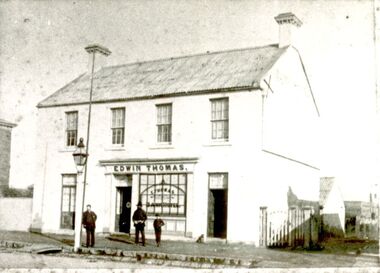
... street, next door to the grand Bank of Australasia. The hotel seems to have been the favourite meeting place for many of the sporting organisations of the time , including the Football, Rowing, Athletic and Gymnastics clubs . The second licensee was Thomas Pearson, who came to Belfast in 1855, working first for the Harbour master...street, next door to the grand Bank of Australasia. The hotel seems to have been the favourite meeting place for many of the sporting organisations of the time , including the Football, Rowing, Athletic and Gymnastics clubs . The second licensee was Thomas Pearson, who came to Belfast in 1855, working first for the Harbour master ...In 1858 Hugh Wallace , undertaker and cabinet maker, moved from the Assembly Rooms at the corner of Gipps street, and opened his new Bank Hotel in Sackville street, next door to the grand Bank of Australasia. The hotel seems to have been the favourite meeting place for many of the sporting organisations of the time , including the Football, Rowing, Athletic and Gymnastics clubs . The second licensee was Thomas Pearson, who came to Belfast in 1855, working first for the Harbour master Capt. John Mills , then as the first Assistant Lighthouse keeper when it was built in 1859 . He was promoted to Lighthouse keeper 2 years later. The hotel continued in business with a further 8 licensees until it closed in 1918. Since which it has housed a diverse number of businesses, collecting a veranda along the way. It is still in use in Sackville street today. Quite a few of the Licensees of Belfast seem to have also had an interest in the Funeral business. Possibly, it was a good commercial undertaking, the same people providing them with a living selling spirituous liquor, and when they died of the effects , paid again for their burial. Image of a hotel that no longer exists in this formBlack and white photograph of Two story hotel with multi panel window two men and a boy posing on footpathhotel, building, hugh wallace, bank of australasia, thomas pearson, sackville street -
 Linton and District Historical Society Inc
Photograph, Baker's Cart Driving Along Avenue of Honour, Linton, circa 1950
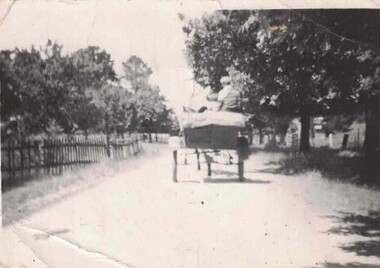
... master's house was. Baker's delivery cart Ted Cheeseman Evan Lancaster Avenue of Honour Linton Digital copy of a small photograph which shows the rear view of a horse and cart driving along what is now Denison Street, Linton. ...Image lent for scanning by Evan Lancaster in 2019. The original photograph shows Teddy Cheeseman and Evan Lancaster (child) in Ted Cheeseman's baker's cart. Picket fence on left is possibly where station master's house was.Digital copy of a small photograph which shows the rear view of a horse and cart driving along what is now Denison Street, Linton. A man and a small child are in the cart.baker's delivery cart, ted cheeseman, evan lancaster, avenue of honour linton -
 Linton and District Historical Society Inc
Photograph, Elizabeth Lock and Nanette Hunt, circa 1937
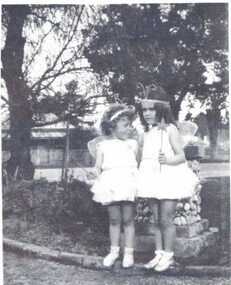
... Street to a cottage on the other side of the road. Elizabeth Lock's aunt and uncle, Vera and James Johnson, bought the house from the Donaldson family in the mid 1930s. Elizabeth Lock, b.1934, often stayed for extended periods with her aunt and uncle and briefly attended school at Linton in 1941. Nanette Hunt, b.1931, was the daughter of William George Hunt, Postmaster at Linton in the 1930s. Elizabeth Lock Nanette Hunt On reverse: "L - Beth Watson, age 3 / R - Nanette Hunt / (Post Master's ...The girls are Elizabeth Lock and Nanette Hunt. The photograph was taken in the garden at the former Donaldson family home in Sussex Street, Linton. Unfortunately, the house is not shown - the view is across Sussex Street to a cottage on the other side of the road. Elizabeth Lock's aunt and uncle, Vera and James Johnson, bought the house from the Donaldson family in the mid 1930s. Elizabeth Lock, b.1934, often stayed for extended periods with her aunt and uncle and briefly attended school at Linton in 1941. Nanette Hunt, b.1931, was the daughter of William George Hunt, Postmaster at Linton in the 1930s.Black and white copy of original photograph which shows two small girls dressed in fairy or butterfly costumes. They are standing underneath trees in a garden. A cottage with a verandah can be seen in the background.On reverse: "L - Beth Watson, age 3 / R - Nanette Hunt / (Post Master's daughter) / Front garden, / Dr. Donaldson's / circa 1937".elizabeth lock, nanette hunt -
 Linton and District Historical Society Inc
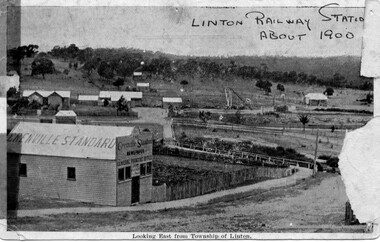
Photograph, Grenville Standard and Linton Railway Station buildings, c.1900
... Street in Linton township. 'Grenville Standard' building prominent in foreground, railway buildings and machinery, and station-master's house, in middle ground. ...Master's House Linton "Linton Railway station about 1900" hand printed across top of photograph. "Looking East from Township of Linton" printed beneath picture. Black and white postcard photograph of view looking east from Clyde Street ...The 'Grenville Standard' was Linton's newspaper from 1895-1941. The railway arrived at Linton in 1891. Black and white postcard photograph of view looking east from Clyde Street in Linton township. 'Grenville Standard' building prominent in foreground, railway buildings and machinery, and station-master's house, in middle ground. Hills rising behind, with two or three cottages, and trees."Linton Railway station about 1900" hand printed across top of photograph. "Looking East from Township of Linton" printed beneath picture.grenville standard [newspaper], linton railway station, buildings, station master's house linton -
 Linton and District Historical Society Inc
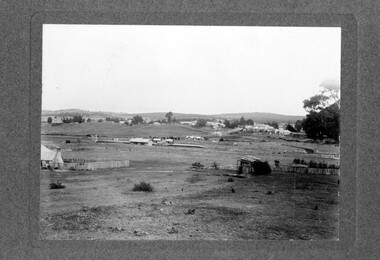
Photograph, Linton Township from Slaughterhouse Hill, circa 1920s, 1920
... master's house. The Grenville Standard building is visible in Clyde Street, and the Post Office and Bank of NSW buildings can be seen near the corner of Clyde and Sussex Streets. ...master's house. The Grenville Standard building is visible in Clyde Street, and the Post Office and Bank of NSW buildings can be seen near the corner of Clyde and Sussex Streets. ...Slaughterhouse Hill was so named because Bennett's butchers had a slaughterhouse there.A view of Linton taken from Slaughterhouse Hill to the north-east of the town. Numerous buildings are identifiable in the photograph. In the middle foreground are the railway station, platform and station-master's house. The Grenville Standard building is visible in Clyde Street, and the Post Office and Bank of NSW buildings can be seen near the corner of Clyde and Sussex Streets. In the distance (along Sussex Street) the Royal Standard Hotel and the Shire Offices (original building) can be seen. St Paul's Church of England is on the far left of the photograph."Esther Cluff, Linton".linton township, slaughterhouse hill -
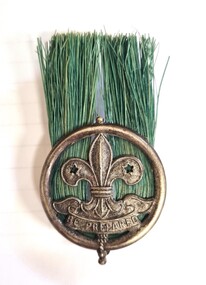 Wodonga & District Historical Society Inc
Uniform - Scout Master's Hat Badge, Whistle and Gilwell Woggle
... Street, Wodonga to secure a permanent home. These items were donated by a former member of the 1st Wodonga Scout Group who shared positive memories of the leadership of David Mann and the lessons learned in the Scouting Movement. These items are significant because they are representative of an important local, national and international organisation. Wodonga Scouts 1st Wodonga Scouts Scouting equipment David Mann On badge" Scout Symbol above "BE PREPARED" Engraved on Whistle - Fleur de Lis symbol A set of Scout uniform equipment including a Scout Master's ...These items were regular elements of a Scout Master's equipment. The hat badge and the woggle were specifically part of the Leader's uniform and differed from similar uniform items of younger or more junior scouts. The first proposal to form a Scouts Corps in Wodonga was raised at a public meeting in Wodonga in November 1909. One of their earliest activities in January 1910 was a march from Wodonga to Bright and return with Scouts from Albury. This first Troop was probably called the 1st Belvoir Scouts. Several other attempts were made to form Scout Troops in Wodonga over the ensuing years. In 1929 the Boy Scout Movement was taken up seriously at Wodonga by approximately 40 boys, together with 30 Cubs (juniors). However this was short-lived. Over the following decade several Scout Troops were formed but lapsed and several Wodonga boys joined the Albury Scout Troop. In 1939 Mr Ray Foster, with eight members put the Scouts on a more enduring basis. Their meeting place was a room below the Water Tower. During the early 1940s the 1st Wodonga Scouts struggled for Leaders to run the activities because so many people were caught up in the Second World War (either overseas or domestically). Mr David Mann gathered together all the small scouting groups in the Wodonga area and turned them from disorganised and disconnected groups into one scouting unit. He led the Scouts in their formative years and went on to become the 1st Wodonga Scouts first King's Scout. He had a long association with the 1st Wodonga Scouts and all the district scouting troops over the following decades. David Mann was also instrumental in the late 1940s in working for a Scout Hall to be built in Reid Street, Wodonga to secure a permanent home. These items were donated by a former member of the 1st Wodonga Scout Group who shared positive memories of the leadership of David Mann and the lessons learned in the Scouting Movement.These items are significant because they are representative of an important local, national and international organisation.A set of Scout uniform equipment including a Scout Master's Hat Badge, a whistle and a knotted leather woggle.On badge" Scout Symbol above "BE PREPARED" Engraved on Whistle - Fleur de Lis symbolwodonga scouts, 1st wodonga scouts, scouting equipment, david mann -
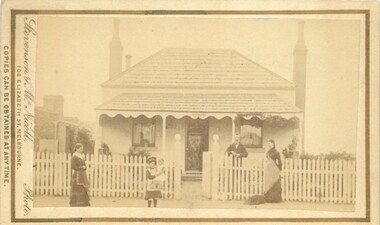 Bacchus Marsh & District Historical Society
Photograph, White Cottage Young Street Bacchus Marsh 1883
... This is possibly Mr Joseph Voysey, Head Master of Bacchus Marsh Primary School 1879-1888, who purchased this cottage in 1882, the year before this photo was taken. Two women, one with a dog at her feet, stand on the footpath with a young girl holding a doll. This cottage still stands in Young Street...This is possibly Mr Joseph Voysey, Head Master of Bacchus Marsh Primary School 1879-1888, who purchased this cottage in 1882, the year before this photo was taken. Two women, one with a dog at her feet, stand on the footpath with a young girl holding a doll. This cottage still stands in Young Street ...This four roomed cottage with a detached kitchen was built for a Mr Elam, c. 1867. Occupants of this house among others have been Sir George Farmer, Christopher Crisp, Joseph Voysey, E. Simpson, J.R. Crook and H. Condon. It is located in Young Street and is opposite the site where the original Bacchus Marsh Mechanics Institute stood until about 1995.Small sepia unframed photograph on card with gold border framing photograph. Housed in the album, 'Photographs of Bacchus Marsh and District in 1883 by Stevenson and McNicoll'. The photograph is of a neat Georgian-style, double-fronted cottage. The hip roof and verandah are roofed with wooden shingles. Two tall chimneys stand, one at either side of the cottage, while a smaller chimney can be seen at the rear. The front verandah is decorated with carved barge boards. A white picket fence runs along the front, the entry posts featuring a carved globe-shaped finial. Standing inside the front fence is a smartly dressed gentleman, leaning on the fence. This is possibly Mr Joseph Voysey, Head Master of Bacchus Marsh Primary School 1879-1888, who purchased this cottage in 1882, the year before this photo was taken. Two women, one with a dog at her feet, stand on the footpath with a young girl holding a doll. This cottage still stands in Young Street, Bacchus Marsh.On the front: Stevenson & McNicoll. Photo. 108 Elizabeth St. Melbourne. COPIES CAN BE OBTAINED AT ANY TIME. On the back: LIGHT & TRUTH inscribed on a banner surmounted by a representation of the rising sun. Copies of this Portrait can be had at any time by sending the Name and Post Office Money Order or Stamps for the amount of order to STEVENSON & McNICOLL LATE BENSON & STEVENSON, Photographers. 108 Elizabeth Street, MELBOURNE houses bacchus marsh, stevenson and mcnicoll 1883 photographs of bacchus marsh and district -
 Bacchus Marsh & District Historical Society
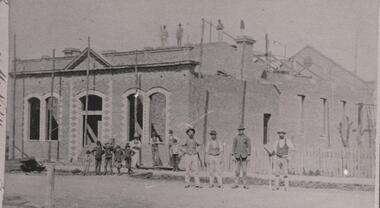
Photograph, Mechanics Institute and Hall 205-209 Main Street, Bacchus Marsh 1883
... master craftsmen. One of these men holds a tool of his trade, a hod, a v-shaped trough on a pole used for carrying bricks. Six boys can be seen, four in a rather jaunty pose. In an indication of its public significance, the four front windows and door are arched and have decorative stone work in the side panels. A picket fence marks the boundary of the adjacent block. Mechanics Institute and Hall 205-209 Main Street ...A Mechanics Institute in Bacchus Marsh dates from sometime in the 1850s. The first Mechanics Institute Hall was erected in 1858 in Young Street.(Victorian Collections no.659.) In 1883 a new and larger Mechanics Institute Hall was built in Main Street. The new hall cost 2,000 pounds to construct. It was opened by Sir William Clarke on 21 November 1883. The Mechanics Institute Library and rooms at the front of the hall were removed when the building was renovated in 1971. The building still stands and is used as a public hall.Small black and white 'carte de viste' style unframed photograph on card with gold border framing photograph. Housed in the Jeremeas Family Album which contains photographs of Bacchus Marsh and District in 1883 by the photographers Stevenson and McNicoll. The photo is of a substantial brick building under construction. Scaffolding support poles line the front and also can be seen on the top and back of the building. On the rooftop stand three workmen, with a further seven men standing at the front. Three men lean or stand casually at the front in casual poses. Four men stand in a line in another group on the roadway, perhaps indicating that they are master craftsmen. One of these men holds a tool of his trade, a hod, a v-shaped trough on a pole used for carrying bricks. Six boys can be seen, four in a rather jaunty pose. In an indication of its public significance, the four front windows and door are arched and have decorative stone work in the side panels. A picket fence marks the boundary of the adjacent block.Printed On the front: Stevenson & McNicoll. Photo. 108 Elizabeth St. Melbourne. COPIES CAN BE OBTAINED AT ANY TIME. On the back: LIGHT & TRUTH inscribed on a banner surmounted by a representation of the rising sun. Copies of this Portrait can be had at any time by sending the Name and Post Office Money Order or Stamps for the amount of order to STEVENSON & McNICOLL LATE BENSON & STEVENSON, Photographers. 108 Elizabeth Street, MELBOURNE. stevenson and mcnicoll 1883 photographs of bacchus marsh and district, mechanics institutes, halls, bacchus marsh mechanics institute -
 Kew Historical Society Inc
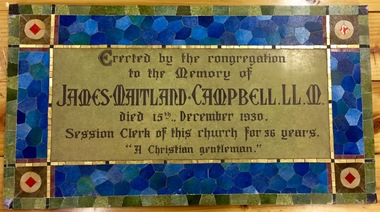
Plaque, Kew Presbyterian Church, James Maitland Campbell LL.M, 1931
... Master of Laws, and eventually became a partner in the legal firm of Davies and Campbell. When he first came to Melbourne Mr Campbell attended Chalmers Church, East Melbourne, and married Miss Annie Harper, daughter of Robert Harper, a merchant and a sister of Professor Andrew Harper. In March 1875 the young couple settled in Pakington Street...Master of Laws, and eventually became a partner in the legal firm of Davies and Campbell. When he first came to Melbourne Mr Campbell attended Chalmers Church, East Melbourne, and married Miss Annie Harper, daughter of Robert Harper, a merchant and a sister of Professor Andrew Harper. In March 1875 the young couple settled in Pakington Street ...Extracts from The Church on the Hill: Presbyterianism in Kew 1874-1974 by John A. O’Neill (Mullaya, Canterbury (Vic), 1974, pp.58-60. “An outstanding family which gave devoted service to the Church was the Campbell family of which James Maitland was the “head”. He died at “Ramornie” on the afternoon of Monday 15 December 1930. … “James Maitland Campbell was born in 1847 in Melrose, Scotland, where his father, the Rev. A. J. Campbell D.D., was the Minister of the Kirk. The Rev. Dr. and Mrs. A. J. Campbell, with their family, came to Australia in 1861 and settled in St. George’s Church, Geelong, where he was the first Minister. James Maitland, after completing his secondary education at Geelong College, entered the Melbourne University where he graduated Master of Arts and Master of Laws, and eventually became a partner in the legal firm of Davies and Campbell. When he first came to Melbourne Mr Campbell attended Chalmers Church, East Melbourne, and married Miss Annie Harper, daughter of Robert Harper, a merchant and a sister of Professor Andrew Harper. In March 1875 the young couple settled in Pakington Street, Kew. After the induction of the Rev. Maxwell and the formation of a Board of Management, Mr. Campbell was elected its first Secretary. David Beath, James Maitland Campbell and Duncan Robert McGregor were the first Trustees of our Church. Mr. and Mrs. Campbell joined the Church Choir, and Mr. Campbell became Choir Leader. Members of their family, Bessie, Mary, Nellie and Lewis also sang in the Choir. Mary became a famed teacher of singing in Melbourne. She taught singing to members of the Choir, and gave lessons in voice production to students for the Ministry. In 1879 Mr. Campbell became Superintendent of the Sabbath School, a position he occupied for 27 years. In 1887 he was elected an Elder, and the Session Clerk for 37 years. In 1924 Mr. Campbell compiled a very complete Jubilee History of the Kew Presbyterian Church. Mr. J. M. Campbell saw our existing Church and the Old Manse erected, the Villa purchased, and, with the help of the Kew Congregation, the Charges of West Hawthorn, East Kew and Deepdene established. In the General Assembly of Australia and the General Assembly of Victoria he occupied the important position of Law Agent, and was a member of numerous Church Committees and Councils. … At the Annual Congregational Meeting on Wednesday 28 October 1931, it was decided to erect a tablet in the Church to the memory of the late Mr. J. M. Campbell to record his service to the Church. The tablet was unveiled at the morning service on 13 December by Mr. Legge. The Preacher was Rev. J. Barnaby.”James Maitland Campbell (1847-1930) the owner of “Ramornie” in Pakington Street was an important contributor to the community of Kew in the 19th and early 20th centuries. A Councillor of the Borough of Kew, he was to be elected Mayor on three occasions: 1889-90, 1890-91 and 1892-93. In addition to his political roles, he was the first Secretary of the Kew Presbyterian Church, being actively involved in the life of the Church until his death in 1930. The Kew Historical Society has a small collection of items once belonging to the Campbell family, including a series of invitations issued to Mr. and Mrs. J. M. Campbell for the festivities organised to commemorate the opening of the first Australian Parliament in Melbourne in 1901. Memorial Tablet to James Maitland Campbell (1847-1930) that was originally erected in the Kew Presbyterian Church in Cotham Road. The tablet is comprised of iridescent ceramic tiles.“Erected by the congregation to the Memory of James Maitland Campbell. LL.M. died 15th., December 1930. Session Clerk of this church for 36 years. “A Christian gentleman.”james maitland campbell (1847-1930), kew presbyterian church, ramornie (pakington street), campbell collection -
 Kew Historical Society Inc
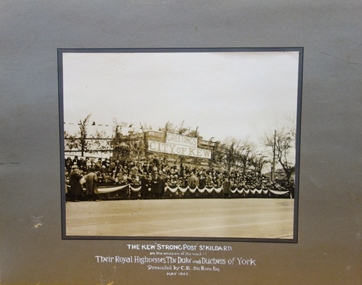
Photograph, Kodak (Australasia), The Kew "Strong Post" St Kilda Road, 1927, 1927
... master of the Kent Lodge, Melbourne, and a member of the Travellers' Washington Lodge. The burial will take place at the Boroondara Cemetery Kew, this afternoon. Arrangements are by Le Pine and Son Ltd." The photograph is of historic and social significance for what it tells of popular civic values in the interwar period in Melbourne and Australia which manifested itself on occasions such as Royal Visits. royal visit (1927) duke and duchess of york the kew "strong post" 1927 st kilda road kodak australasia pty ltd charles richard du rieu -- wonder view -- 57 pakington street Caption: "The Kew "Strong Post" St Kilda Rd., / on the occasion of the visit of / Their Royal Highnesses the Duke and Duchess of York / presented by C.R. ...Apart from the photograph being of local interest to the history of Kew, it is also of interest as it was donated to the Kew City Council by Mr. C. R. du Rieu. Mr du Rieu was closely associated with the Kodak factory which purchased land in East Kew for a factory the plans for which were ultimately rejected by Council. In 1936, nine years after he donated the photograph to Council. Mr du Rieu died. A report in the Melbourne Age on 7 October 1936, p. 14 stated that: "Mr. Charles Richard du Rieu, of "Wonder View." 57 Pakington-street, Kew, formerly manager of the mount department of Kodak (Australasia) Pty. Ltd., died at his home on Tuesday morning at the age of 72 years. Born at Adelaide, Mr. du Rieu was the son of the late Mr. and Mrs. H. L. du Rieu. He is survived by his widow. For 43 years he had been associated with the late Mr. Thomas Baker, at the Kodak works. He retired from the firm in 1928. Among his charitable interests were the orthopoedic section of the Children's Hospital at Frankston, Eye and Ear Hospital, and the Fitzroy Ladies Work Association. He was president of the North Kew Progress Association, and a member of the Kew Bowling Club. In masonic circles he was a past master of the Kent Lodge, Melbourne, and a member of the Travellers' Washington Lodge. The burial will take place at the Boroondara Cemetery Kew, this afternoon. Arrangements are by Le Pine and Son Ltd."The photograph is of historic and social significance for what it tells of popular civic values in the interwar period in Melbourne and Australia which manifested itself on occasions such as Royal Visits.An unframed, mounted sepia photograph of the Kew "Strong Post" on St Kilda Road on the occasion of the Royal Visit of 1927.Caption: "The Kew "Strong Post" St Kilda Rd., / on the occasion of the visit of / Their Royal Highnesses the Duke and Duchess of York / presented by C.R. Du Rieu Esq / May 1927royal visit (1927), duke and duchess of york, the kew "strong post" 1927, st kilda road, kodak australasia pty ltd, charles richard du rieu -- wonder view -- 57 pakington street -
 Kew Historical Society Inc
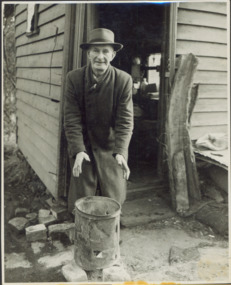
Photograph - William John Lamb : Station Master, East Kew Railway Station
... Street, Kew, with his daughter. This was possibly his family home. He died in 1958 aged 80. The Outer Circle Railway on which he worked as station master at East Kew connected the Oakleigh and Fairfield Park Stations. ...Street, Kew, with his daughter. This was possibly his family home. He died in 1958 aged 80. The Outer Circle Railway on which he worked as station master at East Kew connected the Oakleigh and Fairfield Park Stations. ...William John Lamb (1878-1958) was born in Ballarat, the second oldest of eight children. His father was born in Scotland and had later migrated to Australia. William Lamb lived in Bright Street, Kew, with his daughter. This was possibly his family home. He died in 1958 aged 80. The Outer Circle Railway on which he worked as station master at East Kew connected the Oakleigh and Fairfield Park Stations. The East Kew Station was on the northern end of Harp Road, Kew, near the junction of High Street and Harp Road.outer circle railway, east kew railway station, station masters - outer circle railway -
![Schoolmaster's house, Pakington Street [Kew]](/media/collectors/550653872162f11fb04854aa/items/658f92059239cf6fd4375312/item-media/658f92439239cf6fd43754a9/item-fit-380x285.jpg?cb=6) Kew Historical Society Inc
Kew Historical Society IncPhotograph - Schoolmaster's house, Pakington Street [Kew], c. 1965
... Inscribed verso: "ca. 1860 home of the 1st state school master (back of house only seen from Peel Street now)"....The Rogers Collection provides a comprehensive insight into the working habits of a historian from the 1960s to the 1970s. dorothy rogers Houses -- Pakington Street (Kew) Inscribed verso: "ca. 1860 home of the 1st state school master (back of house only seen from Peel Street now)". ...This work forms part of the collection assembled by the historian Dorothy Rogers (1905-1973), donated to the Kew Historical Society by her son in 2015. The manuscripts, photographs, maps, and documents were sourced by her from both family and local collections or produced as references for her print publications. Many were directly used by Rogers in writing ‘Lovely Old Homes of Kew’ (1961) and 'A History of Kew' (1973), or the numerous articles on local history that she produced for suburban newspapers. Most of the photographs in the collection include detailed annotations in her hand. The Rogers Collection provides a comprehensive insight into the working habits of a historian from the 1960s to the 1970s. Original monochrome photograph of the exterior of a polychrome brick Victorian villa in Pakington Street, Kew. The villa has a slate roof, two bay windows and a verandah.Inscribed verso: "ca. 1860 home of the 1st state school master (back of house only seen from Peel Street now)".dorothy rogers, houses -- pakington street (kew) -
 Melbourne Tram Museum
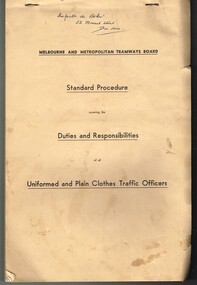
Document - Instruction, Melbourne & Metropolitan Tramways Board (MMTB), "Standard Procedure covering the duties and responsibilities of all Uniformed and Plain Clothes Traffic Officers", late 1950's
... Trams tramways MMTB Traffic Officers Traffic Staff Inspectors District Inspectors Ticket Inspectors Revenue Clerks Depot Masters Signalmen On the top of the cover in ink "Inspector de Dohse 52 Monash Street Box Hill" Book or folder, printed card cover set of instructions titled "Standard Procedure covering the duties and responsibilities of all Uniformed and Plain Clothes Traffic Officers". ...Book or folder, printed card cover set of instructions titled "Standard Procedure covering the duties and responsibilities of all Uniformed and Plain Clothes Traffic Officers". Printed by the MMTB mid to late 1950's. Comprises: 1 - two pages of introduction and a fold out sheet showing the details of the Traffic Manager's department; 2 - Card divider labelled "District Inspectors" - 29 sheets listing duties and arrangements. Divisional Superintendents R. C. Drummond and J. H. Ritchie. 3 - Card divider labelled "Traffic Inspectors" - 19 sheets 4 - Card divider labelled "Revenue Inspectors" - 16 sheets 5 - Card divider labelled "Depot Starters" - 12 sheets 6 - Card divider labelled "Staff Signalmen" - 12 sheets 7 - Heavy card backing board. see item 9591 for the Dec. 1992 version. All sheets stapled at the top with two heavy staples.On the top of the cover in ink "Inspector de Dohse 52 Monash Street Box Hill"trams, tramways, mmtb, traffic officers, traffic staff, inspectors, district inspectors, ticket inspectors, revenue clerks, depot masters, signalmen -
 Melbourne Tram Museum
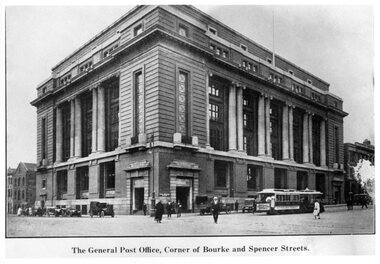
Photograph - Black and White - Mail Exchange Spencer and Bourke Streets c1920
... street...post office...Post Master...Master Generals Department. This building was completed in 1917 to replace the mail sorting functions of the GPO on the corner of Bourke and Elizabeth St. It had tunnels that connected with Spencer Street...Tramways trams cable cars bourke street spencer street post office Post Master General mail exchange Photograph - Black and White - Mail Exchange Spencer and Bourke Streets c1920 Photograph Black and White - Mail Exchange Spencer and Bourke Streets c1920 ...Photo of the Mail Exchange Building with a cable tram loading prior to departure and a number of motor vehicles. The photo shows the monumental construction for the then Post Master Generals Department. This building was completed in 1917 to replace the mail sorting functions of the GPO on the corner of Bourke and Elizabeth St. It had tunnels that connected with Spencer Street Railway station opposite and was designed for the sorting and transporting of mail.Yields information about the Mail Exchange building.Photograph - Black and White - Mail Exchange Spencer and Bourke Streets c1920tramways, trams, cable cars, bourke street, spencer street, post office, post master general, mail exchange -
 Melbourne Tram Museum
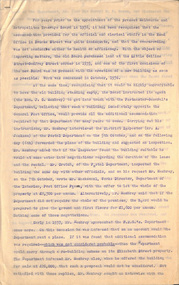
Document - Report, J. G. Membrey & Co., Melbourne and Metropolitan Tramways Board, "Leasing of former MMTB Head Office", Oct. 1940
... Set of two reports regarding the difficulties of leasing the former MMTB head office building at 673 Bourke St following the move into the Little Collins Street building in 1936. .1 - Six page typed, part carbon copy, report (note the fist page has the carbon copy of another page in the report on the rear) Notes the extensive discussions with the Post Masters General Department, problems with discussions with the Board's agent, Mr. ...Trams tramways MMTB Head Office Bourke St Lease Agreement Real Estate PMG Set of two reports regarding the difficulties of leasing the former MMTB head office building at 673 Bourke St following the move into the Little Collins Street building in 1936. .1 - Six page typed, part carbon copy, report (note the fist page has the carbon copy of another page in the report on the rear) Notes the extensive discussions with the Post Masters General Department, problems with discussions with the Board's agent, Mr. ...Set of two reports regarding the difficulties of leasing the former MMTB head office building at 673 Bourke St following the move into the Little Collins Street building in 1936. .1 - Six page typed, part carbon copy, report (note the fist page has the carbon copy of another page in the report on the rear) Notes the extensive discussions with the Post Masters General Department, problems with discussions with the Board's agent, Mr. J. G. Membrey, possible sale of the building, issues within the PMG over leasing buildings, discussions with Bushell's Tea Company, lease to the RSL, then the RSSILA, through a Mr Bett, who then was in talks with the PMG to sub-lease the building, discussions with the Chairman, Mr. Cameron, which occurred. What a mess! .2 - two page carbon copy of report from Mr. J. G. Membrey to the MMTB discussion the issues with the lease, PMG, Mr. Bell and part occupied by the Radio Times. Also involves discussions with Mr. McGrath Deputy Chairmen when Mr. Bell was overseas. Report dated 19/10/1940. Two copies held.trams, tramways, mmtb, head office, bourke st, lease agreement, real estate, pmg -
 Melbourne Tram Museum
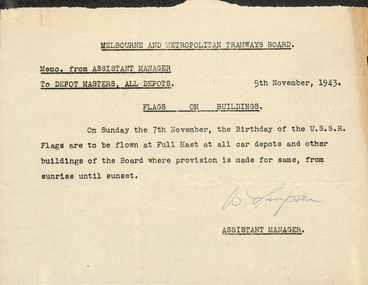
Document - Memorandum, Melbourne & Metropolitan Tramways Board (MMTB), Procession of Australia - Soviet Friendship League, Nov. 1943
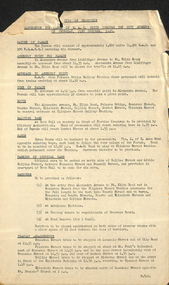
... Masters about flying flags on depots and other buildings. Letter from HS Wootton, Town Clerk, City of Melbourne, about the procession of ATC Cadets through city streets. 5 memos from JM Harry, Dist Traffic Supt SS regarding tram arrangements to various inspectors. ...Masters about flying flags on depots and other buildings. Letter from HS Wootton, Town Clerk, City of Melbourne, about the procession of ATC Cadets through city streets. 5 memos from JM Harry, Dist Traffic Supt SS regarding tram arrangements to various inspectors. ..."Procession of Australia - Soviet Friendship League Sunday 7 November 1943 Memo from Assistant Manager to Depot Masters about flying flags on depots and other buildings. Letter from HS Wootton, Town Clerk, City of Melbourne, about the procession of ATC Cadets through city streets. 5 memos from JM Harry, Dist Traffic Supt SS regarding tram arrangements to various inspectors. Memos dated November 1943.Notations written in pencil on several memos.trams, tramways, procession, soviet friendship league, events -
 Melbourne Tram Museum
Letter, Melbourne & Metropolitan Tramways Board (MMTB), Parade of RAN personnel through city streets, Thursday 21 October 1943, Oct. 1943
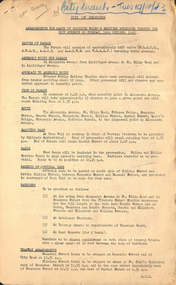
... Parade of RAN personnel through city streets, Thursday 21 October 1943 Letter from GJ Dean, Acting Town Clerk, City of Melbourne, describing arrangements for the parade. Dated 9th October 1943. 2 memos from JM Harry, Dist Traffic Supt SS regarding tram arrangements to Mr Bell, Asst Per Way Engineer and Depot Masters. ...Trams tramways Events YMCA St Kilda Rd Sturt St Notations written in blue pencil on letter., "City March - Thurs 21/10/43" written in red pencil Parade of RAN personnel through city streets, Thursday 21 October 1943 Letter from GJ Dean, Acting Town Clerk, City of Melbourne, describing arrangements for the parade. Dated 9th October 1943. 2 memos from JM Harry, Dist Traffic Supt SS regarding tram arrangements to Mr Bell, Asst Per Way Engineer and Depot Masters. ...Parade of RAN personnel through city streets, Thursday 21 October 1943 Letter from GJ Dean, Acting Town Clerk, City of Melbourne, describing arrangements for the parade. Dated 9th October 1943. 2 memos from JM Harry, Dist Traffic Supt SS regarding tram arrangements to Mr Bell, Asst Per Way Engineer and Depot Masters. Memo from JM Harry, Dist Traffic Supt SS to Assistant Manager regarding shunting operations. Memos dated 18th & 19th October 1943.Notations written in blue pencil on letter., "City March - Thurs 21/10/43" written in red penciltrams, tramways, events, ymca, st kilda rd, sturt st -
 Melbourne Tram Museum
Document - Memorandum, Melbourne & Metropolitan Tramways Board (MMTB), Parade of Combined Women's Services (Navy, Army & Air Force), Oct. 1943
... Streets, Tuesday 19th October 1943 2 copies of letter from GJ Dean, Acting Town Clerk, City of Melbourne regarding arrangements for parade. Letter dated 9 October 1943. 2 copies of memo from Simpson, Assistant Manager to officers concerned regarding tram and bus arrangements. Memo dated 13 October 1943 Memos from Dist Traffic Supt SS, JM Harry to Assistant Manager, Mr Bell and depot masters...Streets, Tuesday 19th October 1943 2 copies of letter from GJ Dean, Acting Town Clerk, City of Melbourne regarding arrangements for parade. Letter dated 9 October 1943. 2 copies of memo from Simpson, Assistant Manager to officers concerned regarding tram and bus arrangements. Memo dated 13 October 1943 Memos from Dist Traffic Supt SS, JM Harry to Assistant Manager, Mr Bell and depot masters ...Parade of Combined Women's Services (Navy, Army & Air Force) Through City Streets, Tuesday 19th October 1943 2 copies of letter from GJ Dean, Acting Town Clerk, City of Melbourne regarding arrangements for parade. Letter dated 9 October 1943. 2 copies of memo from Simpson, Assistant Manager to officers concerned regarding tram and bus arrangements. Memo dated 13 October 1943 Memos from Dist Traffic Supt SS, JM Harry to Assistant Manager, Mr Bell and depot masters and inspectors. Memos dated 18 October 1943"City March - Tues 19/10/43" written in blue pencil across top of letter and in red pencil across one memo.trams, tramways, letters, instructions, events, world war i -
 City of Greater Bendigo - Civic Collection
Slide - Series of 16 slides taken at the 1962 Bendigo Easter Parade, Sandner Family, Easter Float 1962, 1962
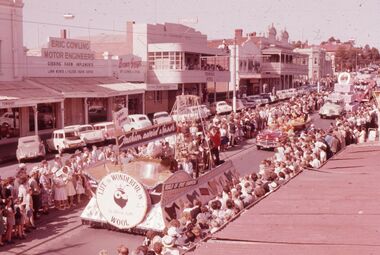
... Images have been taken from a second story vantage point, diagonally opposite the Terminus Hotel which stood at 126 Mitchell Street Bendigo. Floats include S.E.C., Post Master Generals Office, Greyhound Racing, YMCA, the wool industry and Bendigo ALP Women's Association. ...Images have been taken from a second story vantage point, diagonally opposite the Terminus Hotel which stood at 126 Mitchell Street Bendigo. Floats include S.E.C., Post Master Generals Office, Greyhound Racing, YMCA, the wool industry and Bendigo ALP Women's Association. ...The first Bendigo Easter Fair was held on April 10th and 11th 1871 and remains one of Australia’s longest running annual community events taking place over the Easter long weekend. The Bendigo Easter Fair features events throughout the City of Greater Bendigo and celebrations culminate in a parade through the streets on Easter Sunday. The parade features a variety of commercial and community groups. In 1892, large processional dragons became an integral part of the annual parade. The three principal golden dragons are Loong (1892–1970), Sun Loong (1970–2019) and Dai Gum Loong (2019–present), housed at the Golden Dragon Museum in Bendigo. The Bendigo Easter Fair Society is custodian of the Bendigo Easter Fair and continues to support the City of Greater Bendigo’s largest festival. Series of 16 colour 35mm Ektachrome slide transparency of parade floats and community groups as they pass along Mitchel Street. Images have been taken from a second story vantage point, diagonally opposite the Terminus Hotel which stood at 126 Mitchell Street Bendigo. Floats include S.E.C., Post Master Generals Office, Greyhound Racing, YMCA, the wool industry and Bendigo ALP Women's Association. sandner collection, mayor sandner, city of greater bendigo easter fair, city of greater bendigo tourism, city of greater bendigo events -
 City of Greater Bendigo - Civic Collection
Memorabilia - Invitation, Joint Installation of Bros. R.O. Henderson & T. L. Sargeant, 1906
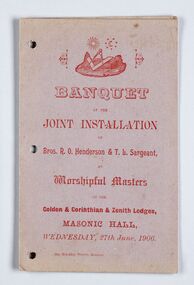
... street level into the basement, the other from the public entry hall. Bendigo Masonic Hall Capital Theatre Bendigo Milburn Catering Bendigo Making a Nation exhibition Brockley Printers Bendigo Bendigo Masonic Lodge City of Greater Bendigo Community Groups Front cover: Banquet / at the / Joint Installation / of / Brox, R. O Henderson & T. L. Sargeant / as / Worshipful Masters ...Freemasonary or Masonry has its beginnings in local guilds of stonemasons who from the end of 13th century regulated the qualification of stonemasons. Modern Freemasonry uses scriptures which include ritual practices and ethical conduct as part of its foundation and every member must profess a belief in a Supreme Being. Women are not allowed to be admitted and discussion of religion and politics is not to take place within the lodge. Freemasons meet in local Lodges which are supervised at a regional level by a Grand Lodge. The degrees of Freemasonry retain the three grades of medieval craft guilds, those of Entered Apprentice, Journeyman or fellow (now called Fellowcraft), and Master Mason. The candidate of these three degrees is progressively taught the meanings of the symbols of Freemasonry and entrusted with grips, signs, and words to signify to other members that he has been so initiated. The degrees are part allegorical morality play and part lecture. Candidates for Freemasonry will usually have met the most active members of the Lodge they are joining before being elected for initiation. (https://en.wikipedia.org/wiki/Freemasonry) The Golden Lodge of Sandhurst was established as the first Masonic Lodge in Bendigo in 1854. Many prominent men including City Councilors were lodge members at it was a popular way for men to socialise. As the masonic movement expanded further lodges were established in Bendigo and the surrounding Boroughs and Shires. The Golden and Corinthian Lodges purchasing two blocks of land in a prominent position in View Street in 1866 with the intention of erecting a new temple and after amalgamating in 1872 appointed architects Vahland and Getzschmann to design the building. The Bendigo Masonic Hall (now the Capital Theatre) was built in 1873 -74 for both public and private use and contained lodge rooms, a public tavern anda concert hall. The Masonic section occupied the northern side of the building at ground floor level and included a lodge room at the rear, a library and reading room, and other affiliated rooms. Walls of the entry hall and lodge room were decorated with classical columns and panels ornamented with Masonic emblems. The upper level of the building contained a large hall with balcony at the north end and removable stage at the south end. Elaborately decorated with Masonic emblems, this hall was used for Masonic purposes as well as being available to the wider community for social events. The tavern, which became known as the Masonic Hotel, occupied the basement and the ground floor of the southern side of the building and included a sitting room, parlours, billiard room, bedrooms, kitchen, cellars and servants' rooms. It appears that two public entrances were provided for this section, one directly from street level into the basement, the other from the public entry hall. Invitation for the Installation of Brothers Henderson and Sargeant. Half fold printed in red ink on grey / mauve coloured card with plain edging. Menu listed inside on left, toasts listed on inside right. Front cover: Banquet / at the / Joint Installation / of / Brox, R. O Henderson & T. L. Sargeant / as / Worshipful Masters / of the / Golden and Corinthian & Zenith Lodges / Masonic Hall / Wednesday, 27th June 1906 bendigo masonic hall, capital theatre bendigo, milburn catering bendigo, making a nation exhibition, brockley printers bendigo, bendigo masonic lodge, city of greater bendigo community groups -
Linton Mechanics Institute and Free Library Collection
Book - Short stories, Jolly, Emily, A wife's story and other tales by the author of "Caste", "Safely married", &c., &c. : in three volumes : Vol. I, 1875
... Fiction Emily Jolly Short stories Volume I contains three stories: 'A wife's story' ; My first and last novel ; 'Annie and her master' Book plate pasted to front cover indicating book was previously part of another collection: "Mullens' Library, Collins Street East, Melbourne". ...Volume I contains three stories: 'A wife's story' ; My first and last novel ; 'Annie and her master'312 p. : includes preface with letters written by Charles Dickens. Plain green coverfictionVolume I contains three stories: 'A wife's story' ; My first and last novel ; 'Annie and her master'fiction, emily jolly, short stories
