
Showing 290 items matching ""kookaburra""
-
 Tatura Irrigation & Wartime Camps Museum
Currency - Coin, Australian Kookaburra Coin, 2005
... Australian Kookaburra Coin...One of not more than 10,000 of these gilded Kookaburra silver coins minted at Perth Mint, Western Australia. ...1 gilded silver coin depicting a Kookaburra on the front. Queen Elizabeth on reverse. 99.9 % silver coin. ...The Australian Kookaburra Gil...Coin No. 03077 contained in box coin australian kookaburra walker b tatura currency numismatics Australian Currency The Australian Kookaburra Gil 1 gilded silver coin depicting a Kookaburra on the front. ...One of not more than 10,000 of these gilded Kookaburra silver coins minted at Perth Mint, Western Australia. Certificate of Authenticity. Coin No. 03077 contained in box1 gilded silver coin depicting a Kookaburra on the front. Queen Elizabeth on reverse. 99.9 % silver coin. Weighs 1 oz. Coin is in a plastic coin holder which is displayed in a padded display case with hinged lid. This is contained in a silver box. Certificate of Authenticity is inside case.The Australian Kookaburra Gilcoin, australian kookaburra, walker b, tatura, currency, numismatics, australian currency -
 Tatura Irrigation & Wartime Camps Museum
Sculpture - Kookaburra, 1940's
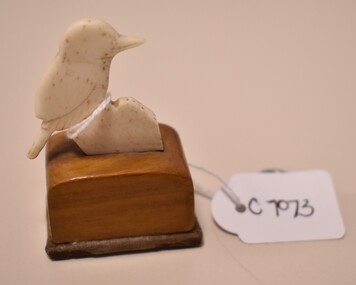
... Kookaburra ...Kookaburra...kookaburra...Handcarved bone kookaburra mounted on a block of polished wood...Made by internee at Camp 3, Tatura kookaburra bone camp 3 tatura ww2 camp 3 ornaments Handcarved bone kookaburra mounted on a block of polished wood Kookaburra Sculpture Kookaburra ...Made by internee at Camp 3, TaturaHandcarved bone kookaburra mounted on a block of polished woodkookaburra, bone, camp 3, tatura, ww2 camp 3, ornaments -
 Kew Historical Society Inc
Magazine, E J Gay, Kookaburra, Magazine of the Kew Troop, Volume 1- No.2, 1925, 1925
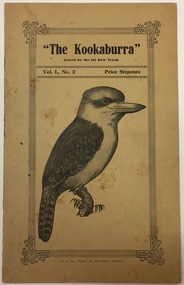
... Kookaburra, Magazine of the Kew Troop, Volume 1- No.2, 1925...The Kookaburra Magazine of the First Kew Troop was mostly written by and for the Scouts themselves, with details of troop and patrol camps and activities, jokes, poems, etc. ...16-page magazine with a kookaburra on the front cover. The Kookaburra Magazine of the First Kew Troop was mostly written by and for the Scouts themselves, with details of troop and patrol camps and activities, jokes, poems, etc. ...The Kookaburra Magazine of the First Kew Troop was mostly written by and for the Scouts themselves, with details of troop and patrol camps and activities, jokes, poems, etc. ...The Kookaburra Magazine of the First Kew Troop was mostly written by and for the Scouts themselves, with details of troop and patrol camps and activities, jokes, poems, etc. The magazine was roneoed locally.16-page magazine with a kookaburra on the front cover. The Kookaburra Magazine of the First Kew Troop was mostly written by and for the Scouts themselves, with details of troop and patrol camps and activities, jokes, poems, etc. The magazine was roneoed locally.scouts - kew, 1st kew scouts, scout magazine -
 The Beechworth Burke Museum
Animal specimen - Kookaburra, Trustees of the Australian Museum, 1860-1880
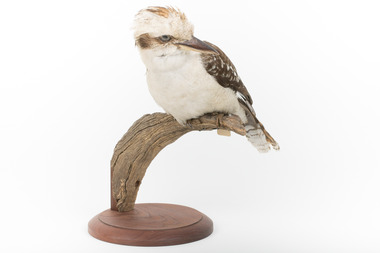
... Kookaburra......kookaburra...The Kookaburra is a sociable bird commonly seen in small flocks. ...This Kookaburra has a predominantly white body. The back, wings and tail are a light shade of brown. ...The Kookaburra is a sociable bird commonly seen in small flocks. ...The Kookaburra is a sociable bird commonly seen in small flocks. These flocks mainly consist of family members. If not in flocks, these birds are commonly seen in pairs. They have a distinct appearance with brown wings, back and brown around the eyes, with majority of the plumage being white. This species reside in woodlands and open forests, however they can be seen in parks, wetlands, farms and any other space that is open with grass. This native Australian bird can mainly be found across the eastern Australia, however they have been introduced Tasmania, South-west Western Australia and New Zealand. Although this is a taxidermy mount, it looks exactly like a Kookaburra in real life. This specimen is part of a collection of almost 200 animal specimens that were originally acquired as skins from various institutions across Australia, including the Australian Museum in Sydney and the National Museum of Victoria (known as Museums Victoria since 1983), as well as individuals such as amateur anthropologist Reynell Eveleigh Johns between 1860-1880. These skins were then mounted by members of the Burke Museum Committee and put-on display in the formal space of the Museum’s original exhibition hall where they continue to be on display. This display of taxidermy mounts initially served to instruct visitors to the Burke Museum of the natural world around them, today it serves as an insight into the collecting habits of the 19th century.This specimen is part of a significant and rare taxidermy mount collection in the Burke Museum. This collection is scientifically and culturally important for reminding us of how science continues to shape our understanding of the modern world. They demonstrate a capacity to hold evidence of how Australia’s fauna history existed in the past and are potentially important for future environmental research. This collection continues to be on display in the Museum and has become a key part to interpreting the collecting habits of the 19th century.This Kookaburra has a predominantly white body. The back, wings and tail are a light shade of brown. There is a strip of brown going across the eyes. This specimen stands upon a wooden branch and has an identification tag ties around its leg. This bird is stout in shape and has a medium length tail and a broad bill. This bill is darker on top and lighter in colour on the bottom.W8083 / taxidermy mount, taxidermy, animalia, burke museum, beechworth, australian museum, skin, reynell eveleigh johns, bird, kookaburra, australian birds, laughing kookaburra -
 Kew Historical Society Inc
Magazine, Kew Advertiser, The Kookaburra, Magazine of the 1st Kew Troop, Vol 1, No. 7, October 1927, 1927
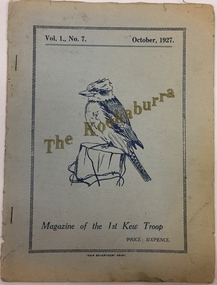
... The Kookaburra, Magazine of the 1st Kew Troop, Vol 1, No. 7, October 1927...This edition of the Kookaburra Magazine featured a new style cover and was printed by the ‘Kew Advertiser’ newspaper....20-page magazine with a kookaburra on the front cover. ...This edition of the Kookaburra Magazine featured a new style cover and was printed by the ‘Kew Advertiser’ newspaper. 1st kew scouts scouts - kew (vic) kookaburra magazine 20-page magazine with a kookaburra on the front cover. ...The Kookaburra Magazine of the First Kew Troop was mostly written by and for the Scouts themselves, with details of troop and patrol camps and activities, jokes, poems, etc. This edition of the Kookaburra Magazine featured a new style cover and was printed by the ‘Kew Advertiser’ newspaper.20-page magazine with a kookaburra on the front cover. 1st kew scouts, scouts - kew (vic), kookaburra magazine -
 Wodonga & District Historical Society Inc
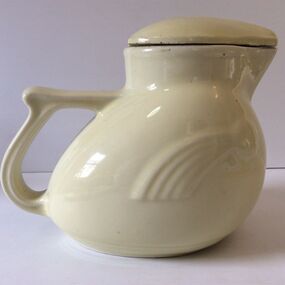
Domestic object - Ceramic KOOKABURRA Electric Jug, Nilsen Porcelain Australia, 1930s
... Ceramic KOOKABURRA Electric Jug...Nilsen Electric Kookaburra Jugs are now regarded as a classic Australian icon prized by collectors. ... Earthernware ceramic jug, moulded in art deco style to represent an Australian kookaburra....Nilsen Electric Kookaburra Jugs are now regarded as a classic Australian icon prized by collectors. ...Electric kettles were invented by the English to speed up tea preparation. In Australia fancy ceramic electric jugs quickly became a status symbol. During the Great Depression era anyone who could offer you a cuppa from a beautiful Electric Kookaburra Jug was considered to be doing well. Made by Nilsen Porcelain Australia in the 193Os, these kettles were unique for their charming art deco bird shape. Nilsen Electric Kookaburra Jugs are now regarded as a classic Australian icon prized by collectors. Oliver John Nilsen was born in Collingwood, Victoria in 1894. In 1916 he began his own electrical business, Oliver J. Nilsen & Co. (later Oliver J. Nilsen (Australia) Ltd). Nilsen's manufactured goods included such diverse products as transformers, bearings, battery chargers, bells, buzzers and gongs, porcelain ware, fuses, insulators and neon signs. Nilsen Porcelain Australia was a smaller company within the Nilsen group. Nilsen still operates as an electro-technology company operating throughout AustraliaThis jug is an excellent example of art deco ceramic appliances of the 1930s to 1950s on both a local and national level. It is also representative of products developed by a major Australian manufacturer. Earthernware ceramic jug, moulded in art deco style to represent an Australian kookaburra.vintage electric kettles, kitchen appliances, nilsen australia -
 Kew Historical Society Inc
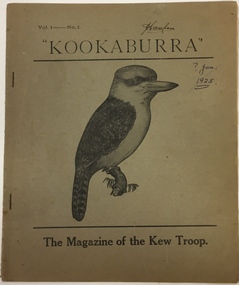
Magazine, 1st Kew Scout Group, Kookaburra, Magazine of the Kew Troop, Volume 1, No.1, 1925
... Kookaburra, Magazine of the Kew Troop, Volume 1, No.1...The Kookaburra Magazine of the First Kew Troop was mostly written by and for the Scouts themselves, with details of troop and patrol camps and activities, jokes, poems, etc. ...14-page magazine with a kookaburra on the front cover. ...Jan 1925" 14-page magazine with a kookaburra on the front cover. Kookaburra, Magazine of the Kew Troop, Volume 1, No.1 Magazine Magazine 1st Kew Scout Group ...The Kookaburra Magazine of the First Kew Troop was mostly written by and for the Scouts themselves, with details of troop and patrol camps and activities, jokes, poems, etc. The magazine was roneoed locally.14-page magazine with a kookaburra on the front cover. Signature [unidentified], "? Jan 1925"scouts - kew (vic), 1st kew scouts, kookaburra magazine -
 Kew Historical Society Inc
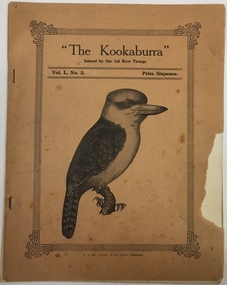
Magazine, E J Gay, Kookaburra, Issued by the 1st Kew Troop, Volume 1-No.3, 1925, 1925
... Kookaburra, Issued by the 1st Kew Troop, Volume 1-No.3, 1925...The Kookaburra Magazine of the First Kew Troop was mostly written by and for the Scouts themselves, with details of troop and patrol camps and activities, jokes, poems, etc. ...20-page magazine with a kookaburra on the front cover. ...The magazine was roneoed locally. scouts - kew 1st kew scouts kookaburra magazine 20-page magazine with a kookaburra on the front cover. ...The Kookaburra Magazine of the First Kew Troop was mostly written by and for the Scouts themselves, with details of troop and patrol camps and activities, jokes, poems, etc. The magazine was roneoed locally.20-page magazine with a kookaburra on the front cover. scouts - kew, 1st kew scouts, kookaburra magazine -
 Kew Historical Society Inc
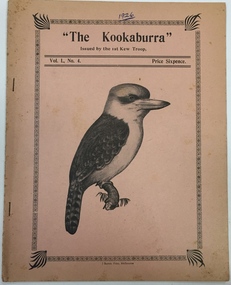
Magazine, 1st Kew Scout Group, The Kookaburra, Issued by the 1st Kew Troop, Vol 1, No. 4, 1926, 1926
... The Kookaburra, Issued by the 1st Kew Troop, Vol 1, No. 4, 1926...The Kookaburra Magazine of the First Kew Troop was mostly written by and for the Scouts themselves, with details of troop and patrol camps and activities, jokes, poems, etc. ...17-page magazine with a kookaburra on the front cover. ...The magazine was roneoed locally. scouts - kew 1st kew scouts kookaburra magazine 17-page magazine with a kookaburra on the front cover. ...The Kookaburra Magazine of the First Kew Troop was mostly written by and for the Scouts themselves, with details of troop and patrol camps and activities, jokes, poems, etc. The magazine was roneoed locally.17-page magazine with a kookaburra on the front cover. scouts - kew, 1st kew scouts, kookaburra magazine -
 Kew Historical Society Inc
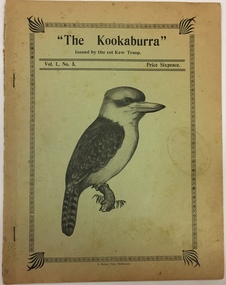
Magazine, J Batten, The Kookaburra, Issued by the 1st Kew Troop, Vol 1, No. 5, 1926, 1926
... The Kookaburra, Issued by the 1st Kew Troop, Vol 1, No. 5, 1926...The Kookaburra Magazine of the First Kew Troop was mostly written by and for the Scouts themselves, with details of troop and patrol camps and activities, jokes, poems, etc. ...20-page magazine with a kookaburra on the front cover. ...The magazine was roneoed locally. 1st kew scouts scouts - kew (vic) kookaburra magazine 20-page magazine with a kookaburra on the front cover. ...The Kookaburra Magazine of the First Kew Troop was mostly written by and for the Scouts themselves, with details of troop and patrol camps and activities, jokes, poems, etc. The magazine was roneoed locally.20-page magazine with a kookaburra on the front cover. 1st kew scouts, scouts - kew (vic), kookaburra magazine -
 Kew Historical Society Inc
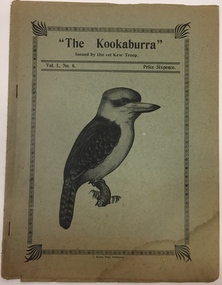
Magazine, J Batten, The Kookaburra, Issued by the 1st Kew Troop, Vol 1, No. 6, 1926, 1926
... The Kookaburra, Issued by the 1st Kew Troop, Vol 1, No. 6, 1926...The Kookaburra Magazine of the First Kew Troop was mostly written by and for the Scouts themselves, with details of troop and patrol camps and activities, jokes, poems, etc. ...20-page magazine with a kookaburra on the front cover. ...The magazine was roneoed locally. 1st kew scouts kookaburra magazine scouts - kew 20-page magazine with a kookaburra on the front cover. ...The Kookaburra Magazine of the First Kew Troop was mostly written by and for the Scouts themselves, with details of troop and patrol camps and activities, jokes, poems, etc. The magazine was roneoed locally.20-page magazine with a kookaburra on the front cover. 1st kew scouts, kookaburra magazine, scouts - kew -
 Hymettus Cottage & Garden Ballarat
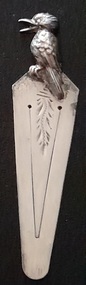
Functional object - Bookmark, Kookaburra Bookmark
... Kookaburra Bookmark......Kookaburra...This silver bookmark with a kookaburra motif is stamped Stg Silver on the reverse. ...This silver bookmark with a kookaburra motif is stamped Stg Silver on the reverse. ...This silver bookmark with a kookaburra motif is stamped Stg Silver on the reverse. A commercial souvenir item as a bookmark from an unknown maker or date but c.1990s.This bookmark is a part of the biggest collection of bookmarks in Australia, these silver bookmarks originally being intended as souvenirs make up the smallest portion of bookmarks in the collection.bookmark, silver, kookaburra, collection -
Moorabbin Air Museum
Book - KOOKABURRA, Pedr Davis, 1980
... KOOKABURRA...KOOKABURRA...KOOKABURRA Book KOOKABURRA Pedr Davis Lansdowne Books ... -
 Kew Historical Society Inc
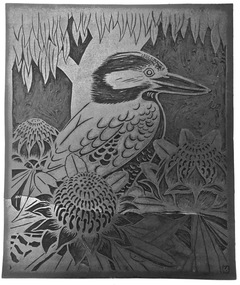
Artwork, other - Linocut Template, Leslie Van Der Sluys, Kookaburra and Waratah, 1982
... Kookaburra and Waratah...Original linoleum block of Kookaburra and Waratah, 1982, by the Melbourne artist Leslie Van Der Sluys. ...Original linocut block of Kookaburra and Waratah, 1982, by the Melbourne artist Leslie Van Der Sluys. ...Leslie van der Sluys (1939-2010), an Australian artist - painter and printmaker - was born in Victoria. He grew up in Mary Street, Kew with his family before moving to Deepdene. His sister Robin Kelly (nee Vandersluys) donated this artists' linocut to the Kew Historical Society as part of a larger collection in 2018.Original linoleum block of Kookaburra and Waratah, 1982, by the Melbourne artist Leslie Van Der Sluys. The block is broken, preventing its use for further editions of the print. The incised linoleum block shows the reverse of the finished print. The design is of a kookaburra, in profile perching on a Waratah with eucalyptus leaves at the top.leslie vandersluys, robin kelly collection -
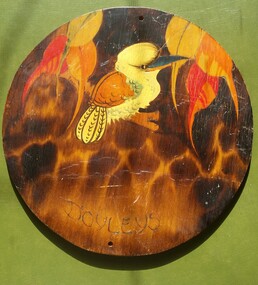 Hymettus Cottage & Garden Ballarat
Doyley Cover, Pokerwork Doyley Cover, circa 1930s
... ...Kookaburra...One of two matching circular pieces of ply, Incised, painted and lacquered with holes top and bottom for ties with image of Kookaburra and leaves. Incised to lower centre of cover 'd'oyleys'....painted and lacquered with image of Kookaburra and leaves and Incised to lower centre of cover 'd'oyleys'....Mary Burke Donald Taffe Ballarat Pokerwork Craft Kookaburra painted and lacquered with image of Kookaburra and leaves and Incised to lower centre of cover 'd'oyleys'. ...Pokerwork was a popular home craft in the 1930s. This small domestic piece using plywood is typical of objects made at home or school in that period.One of two matching circular pieces of ply, Incised, painted and lacquered with holes top and bottom for ties with image of Kookaburra and leaves. Incised to lower centre of cover 'd'oyleys'.painted and lacquered with image of Kookaburra and leaves and Incised to lower centre of cover 'd'oyleys'.mary burke, donald, taffe, ballarat, pokerwork, craft, kookaburra -
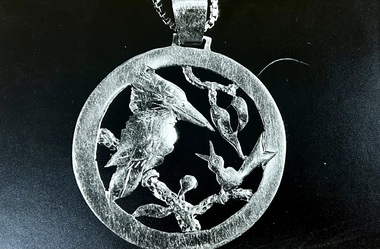 Tatura Irrigation & Wartime Camps Museum
Photograph - Silver Pendant, Kookaburra
... Kookaburra ...A cut-out of a kookaburra and a baby bird with its mouth open sit of a branch. ...Leaves hang from another branch. Kookaburra Photograph Silver Pendant ...The pendant was made for Sister Lorraine Danson by a German interneeBlack and white photograph of a silver pendant made from a silver florin. A cut-out of a kookaburra and a baby bird with its mouth open sit of a branch. Leaves hang from another branch. 28 camp hospital, danson, german internee, pendant, silver, florin, handmade -
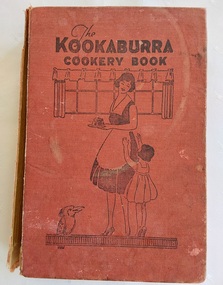 Mont De Lancey
Book, The Lady Victoria Buxton Girls' Club, The Kookaburra Cookery Book of Culinary and Household Recipes and Hints, c 1912
... The Kookaburra Cookery Book of Culinary and Household Recipes and Hints...At the bottom left is a kookaburra. The title page has full details of the collection and arrangements of the recipes, a short Anon poem about cooking and the publisher details. ...Reference books A vintage hardcover Kookaburra Cookery Book first published in 1911 in Adelaide, South Australia, as a charity fundraiser compiled by the Committee of the Lady Victoria Buxton Girls' Club. ...A vintage hardcover Kookaburra Cookery Book first published in 1911 in Adelaide, South Australia, as a charity fundraiser compiled by the Committee of the Lady Victoria Buxton Girls' Club.The red cloth covered front hardcover has the title printed in black lettering and an illustration of a woman wearing an apron holding a dessert with a child beside her. At the bottom left is a kookaburra. The title page has full details of the collection and arrangements of the recipes, a short Anon poem about cooking and the publisher details. The spine has the title printed in black lettering. There is an advertisement opposite the title page for Maize Products Pty. Ltd. Inside is a Foreword, Preface to Second Edition an Editor's Note, several advertisements for cooing related products, Contents, followed by hundreds of recipes. At the back is an Index and a list of The Popular Series Competition Card Games for sale from all stationers. The back cover advertises Agee Preserving Jars. Pp.330.non-fictionA vintage hardcover Kookaburra Cookery Book first published in 1911 in Adelaide, South Australia, as a charity fundraiser compiled by the Committee of the Lady Victoria Buxton Girls' Club. cookbooks, cookery books, domestic objects, p.w.m.u., reference books -
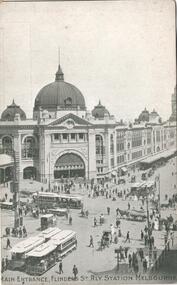 Ballarat Tramway Museum
Postcard, Kookaburra and ?, Flinders St. Railway station
... 334.1 - Kookaburra Series No. 25 postcard, vertical format, view of the Swanston St entrance to Flinders St. ...Kookaburra and ?...Railway station Postcard Kookaburra and ? ...334.1 - Kookaburra Series No. 25 postcard, vertical format, view of the Swanston St entrance to Flinders St. Railway station with five sets of cable trams with horse drawn vehicles and many people. Photo is formally printed using a screen. Title 'Main Entrance, Flinders St. Rly Station Melbourne' along base. On rear in landscape format is areas for address, card number, a kookaburra symbol and saying, publisher notes and areas for address and correspondence. Off white card. c 1910. 334.2 - Photograph as a postcard of the Swanston St. entrance of Flinders St. Railway station from ground level with horse drawn vehicles and pedestrians in view. No motor cars in view or cable cars. c1910. On base in white ink (faded) handwriting 'Railway Station Melbourne'. On rear is name of object and areas for Address and Correspondence and '29'. trams, tramways, melbourne, flinders st. station, cable trams -
 The Beechworth Burke Museum
Animal specimen - Rufous-bellied Kookaburra (female), Trustees of the Australian Museum, 1860-1880
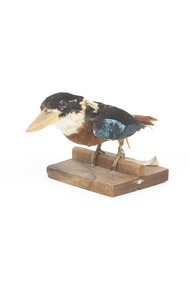
... ...kookaburra...The Rufous-bellied Kookaburra is a large member of the Kingfisher family. ...The Rufous-bellied Kookaburra is a large Kingfisher with a black coloured cap on the head, white collar around the neck, blue feathers on the wings and rump and a rufous belly. ...The Rufous-bellied Kookaburra is a large member of the Kingfisher family. ...The Rufous-bellied Kookaburra is a large member of the Kingfisher family. It commonly resides in the dense rainforests of lowland New Guinea, Saibai Island, Indonesia, Biak, Maluku/Moluccas Islands, Papua New Guinea, Melanesia and Queensland in Australia. This is unlike other species of Kookaburra which commonly prefer to reside in locations of open country. Another aspect which makes this bird unique to other Kookaburra is its tendency to live in pairs and not in family groups which is typical of other Kookaburras. In the case of the Rufous-bellied Kookaburra, both parents incubate and care for the eggs/chicks. This Kookaburra feeds on small mammals, birds, reptiles and insects. The Rufous-bellied Kookaburra was originally named the Gaudichaud's Kookaburra after the French botanist Charles Gaudichaud-Beaupré. This species of Kookaburra is among the most colorful varieties of the Kookaburra alongside the Spangled Kookaburra. This specimen is part of a collection of almost 200 animal specimens that were originally acquired as skins from various institutions across Australia, including the Australian Museum in Sydney and the National Museum of Victoria (known as Museums Victoria since 1983), as well as individuals such as amateur anthropologist Reynell Eveleigh Johns between 1860-1880. These skins were then mounted by members of the Burke Museum Committee and put-on display in the formal space of the Museum’s original exhibition hall where they continue to be on display. This display of taxidermy mounts initially served to instruct visitors to the Burke Museum of the natural world around them, today it serves as an insight into the collecting habits of the 19th century.This specimen is part of a significant and rare taxidermy mount collection in the Burke Museum. This collection is scientifically and culturally important for reminding us of how science continues to shape our understanding of the modern world. They demonstrate a capacity to hold evidence of how Australia’s fauna history existed in the past and are potentially important for future environmental research. This collection continues to be on display in the Museum and has become a key part to interpreting the collecting habits of the 19th century. The Rufous-bellied Kookaburra is a large Kingfisher with a black coloured cap on the head, white collar around the neck, blue feathers on the wings and rump and a rufous belly. The female Kookaburra has a brown/rufous coloured tail, as is the case for this particular specimen which identifies it as female. This bird has a large white bill and pale coloured legs. The head is a large square shape and the body is stocky.Label: National Museum Victoria / 159a /taxidermy mount, taxidermy, animalia, burke museum, beechworth, australian museum, skin, reynell eveleigh johns, bird, australian birds, kingfisher, kookaburra, rufous-bellied kookaburra -
 Wangaratta RSL Sub Branch
Mixed media - Framed photographs, UN Peacekeeping Mission
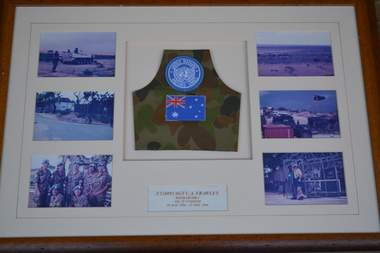
... ...kookaburra...United Nations peace keeping mission - F324093 Sgt C A Frawley 'Kookaburra' ASC IV UNOSOM 19 May 1994 - 25 Nov 1994...F324093 Sgt C A Frawley 'Kookaburra' ASC IV UNOSOM 19 May 1994 - 25 Nov 1994...United Nations peace keeping mission - F324093 Sgt C A Frawley 'Kookaburra' ASC IV UNOSOM 19 May 1994 - 25 Nov 1994 united nations asc iv unosom kookaburra F324093 Sgt C A Frawley 'Kookaburra' ASC IV UNOSOM 19 May 1994 - 25 Nov 1994 brown timber frame with off white mount containing six photographs and camouflage lanyard UN Peacekeeping Mission Mixed media Framed photographs ...United Nations peace keeping mission - F324093 Sgt C A Frawley 'Kookaburra' ASC IV UNOSOM 19 May 1994 - 25 Nov 1994brown timber frame with off white mount containing six photographs and camouflage lanyardF324093 Sgt C A Frawley 'Kookaburra' ASC IV UNOSOM 19 May 1994 - 25 Nov 1994united nations, asc iv unosom, kookaburra -
 Greensborough Historical Society
Photograph - Digital image, Marilyn Smith et al, Janefield Precinct: Looking down toward Kookaburra Bend 1, 27/11/2014
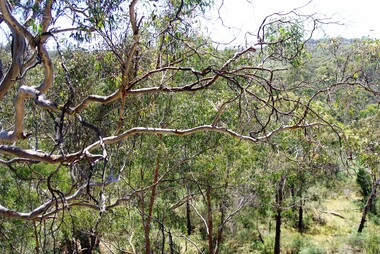
... Janefield Precinct: Looking down toward Kookaburra Bend 1....Looking down toward Kookaburra Bend 1. The remains of this site are between Greensborough and Janefield. ...Looking down toward Kookaburra Bend 1. The remains of this site are between Greensborough and Janefield. ...Looking down toward Kookaburra Bend 1. The remains of this site are between Greensborough and Janefield. A RAAF Hygiene Training Camp was located on the Plenty River, just south of the Janefield community. It was in use from 1944 to 1946. The Camp was constructed from salvaged materials. Instruction included building and maintenance of grease traps, latrines, elementary plumbing and carpentry.Early remains of a WW2 training camp Digital colour photograph. -
 Greensborough Historical Society
Photograph - Digital image, Marilyn Smith et al, Janefield Precinct: Looking down toward Kookaburra Bend 2, 27/11/2014
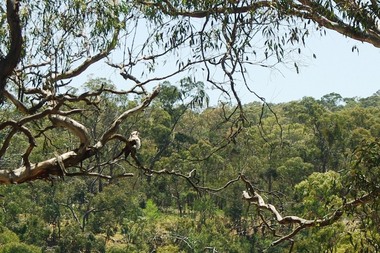
... Janefield Precinct: Looking down toward Kookaburra Bend 2....Looking down toward Kookaburra Bend 2. The remains of this site are between Greensborough and Janefield. ...Looking down toward Kookaburra Bend 2. The remains of this site are between Greensborough and Janefield. ...Looking down toward Kookaburra Bend 2. The remains of this site are between Greensborough and Janefield. A RAAF Hygiene Training Camp was located on the Plenty River, just south of the Janefield community. It was in use from 1944 to 1946. The Camp was constructed from salvaged materials. Instruction included building and maintenance of grease traps, latrines, elementary plumbing and carpentry.Early remains of a WW2 training camp Digital colour photograph. -
 Stawell Historical Society Inc
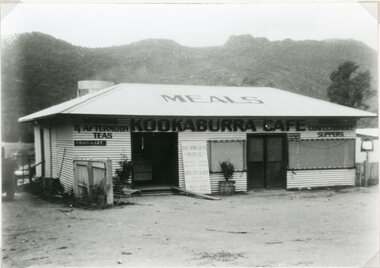
Photograph, "Kookaburra Cafe" in Halls Gap
... "Kookaburra Cafe" in Halls Gap...Halls Gap - Kookaburra Cafe...Halls Gap - Kookaburra Cafe Stawell "Kookaburra Cafe" in Halls Gap Photograph ...Halls Gap - Kookaburra Cafestawell -
 Yarrawonga and Mulwala Pioneer Museum
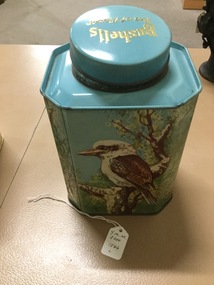
Tea Caddy
... A metal tin tea caddy with a painted kookaburra on the face.Background is blue On the lid is the name Bushells...Bushells Pinted Kookaburra...storage of tea Bushells Pinted Kookaburra A metal tin tea caddy with a painted kookaburra on the face.Background is blue On the lid is the name Bushells Tea Caddy ...storage of teaA metal tin tea caddy with a painted kookaburra on the face.Background is blue On the lid is the name BushellsBushells Pinted Kookaburra -
 Sunshine and District Historical Society Incorporated
Memorabilia - 1st Sunshine Scouting Troup Group Name Plate "Kookaburra"
... Wooden board with Kookaburra painted on front...Kookaburra...This name plate came of the 1st Sunshine Scouting Group Scouting Scouts Kookaburra Wooden board with Kookaburra painted on front Memorabilia 1st Sunshine Scouting Troup Group Name Plate "Kookaburra" ...This name plate came of the 1st Sunshine Scouting GroupWooden board with Kookaburra painted on frontKookaburrascouting, scouts -
 Kew Historical Society Inc
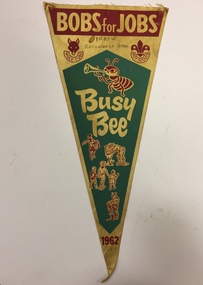
Award, Scout Association of Victoria, Busy Bee Pennant - Bobs for Jobs, 1962
... ‘Busy Bee’ pennant awarded to the 1st Kew Kookaburra Patrol for raising “£5.16.6” during Bobs for Jobs. ...Front: "1st Kew Kookaburra Patrol / £5.16.6"...The award of pennants was used as an incentive. 1st kew scouts memorabilia - pennants scout bobs for jobs Front: "1st Kew Kookaburra Patrol / £5.16.6" ‘Busy Bee’ pennant awarded to the 1st Kew Kookaburra Patrol for raising “£5.16.6” during Bobs for Jobs. ...Bobs for Jobs was a State-run program to support local fundraising. Each Scout was expected to knock on doors seeking jobs, with the money raised going to the local Group, perhaps to buy equipment or pay for camps. The award of pennants was used as an incentive.‘Busy Bee’ pennant awarded to the 1st Kew Kookaburra Patrol for raising “£5.16.6” during Bobs for Jobs. The pennant includes names of the patrol members on the reverse. Front: "1st Kew Kookaburra Patrol / £5.16.6"1st kew scouts, memorabilia - pennants, scout bobs for jobs -
 Whitehorse Historical Society Inc.
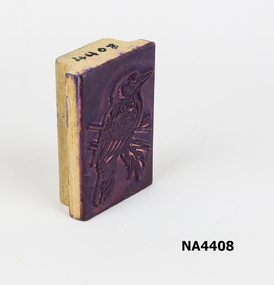
Functional object - Stamp, 1972
... Rubber stamp depicting a Kookaburra...KOOKABURRA...See Ref. 4362 school equipment KOOKABURRA Rubber stamp depicting a Kookaburra Functional object Stamp ...See Ref. 4362Rubber stamp depicting a KookaburraKOOKABURRAschool, equipment -
 Hymettus Cottage & Garden Ballarat
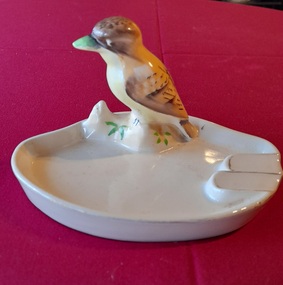
Domestic object - Ashtray, Kookaburra ashtray
... Kookaburra ashtray...Kookaburra...This ashtray belonging to Mary and Michael Taffe has been in the crystal cabinet in the front parlour/lounge at Hymettus since they took up residence in 1945. Kookaburra ceramics porcelain Australian ashtray Nil Kookaburra ashtray Domestic object Ashtray ...This ashtray belonging to Mary and Michael Taffe has been in the crystal cabinet in the front parlour/lounge at Hymettus since they took up residence in 1945.Nilkookaburra, ceramics, porcelain, australian, ashtray -
 Flagstaff Hill Maritime Museum and Village
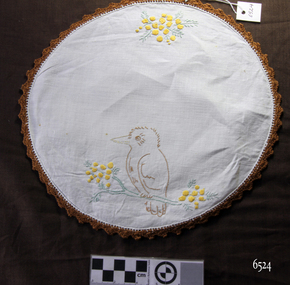
Textile - Doily, c. 1910
... ...kookaburra...The chosen design of Kookaburra and wattle flowers and leaves reflects the creator's interest in Australian flora and fauna. ...Doily, round, white cotton. Embroidered Kookaburra on a branch, wattle flowers and leaves, and edged with brown crochet. ...The chosen design of Kookaburra and wattle flowers and leaves reflects the creator's interest in Australian flora and fauna. ...This doily is typical of items of household linen in popular use in the 19th and early-to-mid 20th centuries. It was a tradition for brides to have a 'glory box' containing linen and embroidered and crocheted articles to take to their new home. The chosen design of Kookaburra and wattle flowers and leaves reflects the creator's interest in Australian flora and fauna. In the Words of donor, Betty Stone, … “These crocheted and embroidered articles cover a period of three generations- ie. Sarah (nee Chamberlain) Lees, Ann (nee Lees) Dale, and Daisy Elvena (nee Dale) Welsh. All three were accomplished needlewomen; also, both Sarah Lees (born 1844) and her daughter, Ann (b 1865) crocheted a wide variety of articles for use in their homes. A few examples of these items have survived the years.” (NOTE: For additional information please refer to my book Pioneer and Places- A History of Three Warrnambool Pioneering Families ie. Chamberlain, Dale and Lees families) This item is associated with the Warrnambool pioneer families of Chamberlain, Dale and Lees. These families are listed in the Pioneers' Register for Warrnambool Township and Shire, 1835-1900, published by A.I.G.S. Warrnambool Branch. The item is a fine example of early 20th-century needlework. It is also significant for its reflection on the new Australian fauna and flora.Doily, round, white cotton. Embroidered Kookaburra on a branch, wattle flowers and leaves, and edged with brown crochet. From the Chamberlain Dale Lees Collectionflagstaff hill, warrnambool, flagstaff hill maritime museum and village, great ocean road, chamberlain family, dale family, lees family, betty stone, warrnambool pioneer, warrnambool genealogy, wangoom, chamberlain dale lees collection, glory box, doily, embroidery, needlework, crochet, handmade, craft, manchester, linen, haberdashery, kookaburra, wattle, australiana -
 Melbourne Legacy
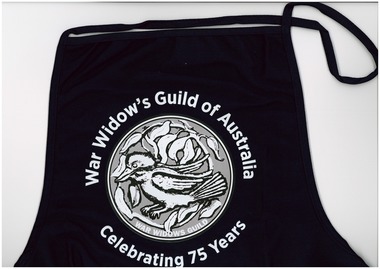
Domestic object, War Widows' Guild Apron, 2020
... An apron made to celebrate 75 years of the War Widows Guild in 2020. The Kookaburra is the symbol of the Guild due to its laugh. ...Dark navy cotton apron with a white stencilled Guild kookaburra logo and text saying 'Celebrating 75 years'....An apron made to celebrate 75 years of the War Widows Guild in 2020. The Kookaburra is the symbol of the Guild due to its laugh. ...An apron made to celebrate 75 years of the War Widows Guild in 2020. The Kookaburra is the symbol of the Guild due to its laugh. From the War Widows' Guild of Australia website: 'the Guild badge would feature the kookaburra, an industrious and cheerful bird who mated for life, was fearless and aggressive in the defence of its young and the area of territory it regarded as its own. The bird also had a unique call, not a song but a laugh; a chortle of rollicking mirth (to bring the widows back to laughter). Also, the kookaburra is a typically and completely Australian symbol, one that could be worn proudly by every widow whatever her creed or ideals. The kookaburra was also the mascot of the 7th Division of the 2nd AIF, commanded by Mrs Vasey’s husband, Major-General Vasey. Mrs J M Vasey was the founder and president of the War Widows Guild. During the second world war she became secretary of the AIF Women's Association, a body which sought to help soldiers' wives. Her work with this body drew her attention to the plight of war widows. After her husband Major-General George Alan Vasey died in an aircraft accident on 5 March 1945 she became a widow herself. At the end of the war Mrs Vasey founded the War Widows Guild, established on 22 November 1945. The Victorian War Widows Guild closed in 2021. Some items, including this apron, were donated to the Legacy archive for preservation. It was possible for a widow to be members of both Legacy and the War Widows Guild. Both organisations helped war widows in various ways.A celebration of the 75 years of work done by Jessie Vasey and the War Widows Guild.Dark navy cotton apron with a white stencilled Guild kookaburra logo and text saying 'Celebrating 75 years'.war widows guild, jessie vasey, wwg
