
Showing 3 items matching " 'the thames' steamer"
-
 Bendigo Historical Society Inc.
Document - MINING REPORTS - MINING RECORD FEB., 1862
... ... 'The Thames' steamer...DOCUMENT Gold Mining Reports Mining Record Feb 1862 Bell's Life Wellington Hotel Botanical Gardens Mitchell Gardens Bird-in-Hand Independent Co Ballarat Co Perserverance Co North Star co All England Co Macleod Co Mather and Co Gold Washing Co Bendigo Valley Co Robey And Co Hobbs and Co Taylor's Lewis and Co Henwood and Co Bullock and Co Davey and Co Webb and Lathlean The Welshman's Bon Accord John Thomas's Caledonian Co Webster Hrdy Bros McEwen and Co The Big Engine Co Epsom Huntly and Ironstone Hill Co 'The Thames' steamer Whitely and Co Cambridge Co Victoria Co Dower M'Intosh and Co Thomas and Davies Aurora Co Brett's Thomas Bros Mitchell Brothers Ballarat Co North Star Co All England Co Mr B G Davies Mr Ramsay Dr Evans Tarrangower Times Mr Humffray Clunes Co Mr Courtin Mr Lawrence Port Phillip and Colonial Gold Mining Co Mr Bland R Brough Smith John S McNair John Mathieson Mr R O Smith Joseph Millen Thomas Kaye John Basset William Cook James Cousley John Hill Robert Hollinger Thomas Houston George Loudon William Manning John Matthews John McEwen Thomas Milligan John Moorhead Robert Moorhead David Murdoch Andrew Murdoch Joseph Nevin Edward O'Malley Wm Newton Paul James Reid Samuel Robinson Jesse Selwood James Shand William Woods Catherine United Claimholders Star Reef Co Sailor's Gully Co Churchill Davidson Wm Wilson John Jervis James Patterson John Carmont George M'Naughten Alexander Wiseman James Houston M'Lennan Clark Thomas Hollick James Alfred Bowles John Lampert Francis Palmetser Nichols Little Pumping Engine Co M'Niely Morrison Waight John Coote Robert Hamilton William Wilson John Jervis Southern Cross Co Ladam's Claim Knobel Bird Philip Ladams James Anderson Cordon Ashley Godwin Burkamp John Lomasney James Bryant Matthew Langridge Benjamin Exley J R Finlayson Wormold McCartney Schrade Schumacher George Barry James Patten Peter Speares Thomas Caley Shadbolt John Lomasney Peat Kenely McGenely Egan Exwell James Winterbottom John Winterbottom William Jury Jonathan Laidman John Pile Simon Howard Peter Morris Bignall Charles Robison Ferguson Thomas Steers Adolphe Witts Albert Berchdolt Richard Urand Thomas Watson Klemm Boyd Abbot Peterson Taylor Henry Day Walter Wallan Brown Grennan Day Young Mr Beckwith Joseph Thomson Nelson Reef Quartz Mining Co Photocopy of pages 2, 3, 4, 6 to 10 of The Mining Record, Feb. 1862. ...Photocopy of pages 2, 3, 4, 6 to 10 of The Mining Record, Feb. 1862. Items mentioned are:- Epsom and Huntly Leads, Pottery Flat, & c, Parliamentary Intelligence, Deep Sinking On Quartz Reefs, The Comet Company (Formerly Cooper's Little Redan), Hustler's Reef Quartz Mining & Drainage Company, Sailors' Gully Quartz Mining Company, Star Reef, Sailor's Gully, Bendigo, Star Reef Quartz Mining Company's Claim, Wilson & Co's Claim, Murdoch and Co's Claim, Hollick and Co.'s Claim, Cook and Co.'s Claim, Coote and Co.'s Claim, Sailor's gully quartz Mining Company's Claim, Garden Gully Reef, Knobel & Co.'s Claim, Ladams and Co.'s Claim, Southern Cross Company, The Rainbow Company, Barry and Co.'s Claim, Union Company's Claim, Winterbottom and Co.s Claim, Jury and Co.'s Claim, Piles and Co.'s Claim, Steers and Co.'s Claim, Watson and Co.'s Claim, Coles and Co.'s Claim, James and Co.'s Claim, Morgan, Kirchner and Co.'s Claim, Boyd and Co.'s Claim, Shanks and Co.'s Claim, Day and Co.'s Claim, Brown and Co.'s Claim, St. Mungo Quartz Mining Company and the Nelson Reef Quartz Mining Company.document, gold, mining reports, mining record feb 1862, bell's life, wellington hotel, botanical gardens, mitchell gardens, bird-in-hand, independent co, ballarat co, perserverance co, north star co, all england co, macleod co, mather and co, gold washing co, bendigo valley co, robey and co, hobbs and co, taylor's, lewis and co, henwood and co, bullock and co, davey and co, webb and lathlean, the welshman's, bon accord, john thomas's, caledonian co, webster, hrdy bros, mcewen and co, the big engine co, epsom huntly and ironstone hill co, 'the thames' steamer, whitely and co, cambridge co, victoria co, dower m'intosh and co, thomas and davies, aurora co, brett's, thomas bros, mitchell brothers, ballarat co, north star co, all england co, mr b g davies, mr ramsay, dr evans, tarrangower times, mr humffray, clunes co, mr courtin, mr lawrence, port phillip and colonial gold mining co, mr bland, r brough smith, john s mcnair, john mathieson, mr r o smith, joseph millen, thomas kaye, john basset, william cook, james cousley, john hill, robert hollinger, thomas houston, george loudon, william manning, john matthews, john mcewen, thomas milligan, john moorhead, robert moorhead, david murdoch, andrew murdoch, joseph nevin, edward o'malley, wm newton paul, james reid, samuel robinson, jesse selwood, james shand, william woods, catherine united claimholders, star reef co, sailor's gully co, churchill davidson, wm wilson, john jervis, james patterson, john carmont, george m'naughten, alexander wiseman, james houston, m'lennan, clark, thomas hollick, james alfred bowles, john lampert, francis palmetser, nichols, little pumping engine co, m'niely, morrison, waight, john coote, robert hamilton, william wilson, john jervis, southern cross co, ladam's claim, knobel, bird, philip ladams, james anderson, cordon, ashley, godwin, burkamp, john lomasney, james bryant, matthew langridge, benjamin exley, j r finlayson, wormold, mccartney, schrade, schumacher, george barry, james patten, peter speares, thomas caley, shadbolt, john lomasney, peat, kenely, mcgenely, egan, exwell, james winterbottom, john winterbottom, william jury, jonathan laidman, john pile, simon howard, peter morris, bignall, charles robison, ferguson, thomas steers, adolphe witts, albert berchdolt, richard urand, thomas watson, klemm, boyd, abbot, peterson, taylor, henry day, walter wallan, brown, grennan, day, young, mr beckwith, joseph thomson, nelson reef quartz mining co -
 Federation University Historical Collection
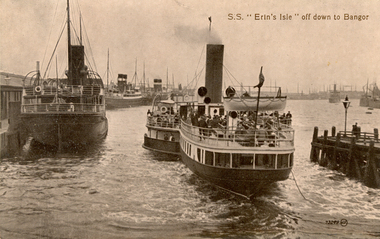
Postcard, S.S. "Erin's Isle" off down to Bangor, 1912
... steamer built in 1912 by Messrs. A. & J. Inglis Pointhouse, Glasgow, for the Belfast and County Down Railway Company. It provided a regular service between Belfast Lough and Bangor, County Down in the summer season. In November 1915 it was requisitioned by the Admiralty, initially for transport purposes, and later as an auxiliary mine sweeper. Surviving World War One, this vessel as lost on 7 February 1919 after hitting a stray mine at the entrance of the Thames...steamer built in 1912 by Messrs. A. & J. Inglis Pointhouse, Glasgow, for the Belfast and County Down Railway Company. It provided a regular service between Belfast Lough and Bangor, County Down in the summer season. In November 1915 it was requisitioned by the Admiralty, initially for transport purposes, and later as an auxiliary mine sweeper. Surviving World War One, this vessel as lost on 7 February 1919 after hitting a stray mine at the entrance of the Thames ...Erin's Isle was a paddle steamer built in 1912 by Messrs. A. & J. Inglis Pointhouse, Glasgow, for the Belfast and County Down Railway Company. It provided a regular service between Belfast Lough and Bangor, County Down in the summer season. In November 1915 it was requisitioned by the Admiralty, initially for transport purposes, and later as an auxiliary mine sweeper. Surviving World War One, this vessel as lost on 7 February 1919 after hitting a stray mine at the entrance of the Thames Estuary and immediately sank. There were 23 lives lost, and 28 survivors. Bangor is a city in Gwynedd Unitary Authority, north west Wales, and one of the smallest cities in Britain. This postcard was sent home to Australia by a six bob a day tourist, and member of the Australian AIF on active service. During leave soldiers often visited tourists sites, family, or towns important to their ancestral heritage.A view of paddle steamer with three moored mail steamers are visible to the left, and a pier and lamp on right. A ship can be seen iin distance on right. S.S Erin's Isle off down to Bangorchatham-holmes family collection, bangor, belfast, mail ships, steam ship, six bob a day tourist -
 City of Melbourne Libraries
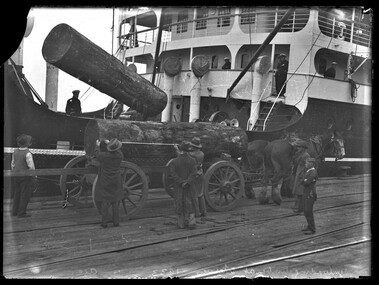
Photograph (item), Bull, Hugh Jones, 1897-1993, Unloading timber at Victoria Dock, 1933
... steamer Hubbuck sailed in to unload 1200 tonnes of cargo in 15 hours. The Argus (February 23, 1893) reported that the ship’s captain, J. R. Brodie, called the Yarra “better than the Thames...steamer Hubbuck sailed in to unload 1200 tonnes of cargo in 15 hours. The Argus (February 23, 1893) reported that the ship’s captain, J. R. Brodie, called the Yarra “better than the Thames ...Photographer notations on slide: "Unloading Timber at Wharves 1933 Age B5" Published: Age (Melbourne, Vic.: 1854- ), Tuesday 15 August 1933 MAHOGANY FROM MANILA. (1933, August 15). The Age (Melbourne, Vic. : 1854 - 1954), p. 11. Retrieved January 16, 2026, from http://nla.gov.au/nla.news-article204377024 Published title: MAHOGANY FROM MANILA Published Caption: Age Tue 15 Aug 1933 Caption: Unloading Mahogany Logs brought from Manila, Philippine Islands, by the steamer Taiping, which berthed yesterday at Victoria Dock. The vessel discharged twenty logs, each weighing three tons, the first shipment of this type of timber landed in Melbourne. Research by Project Volunteer, Louise McKenzie: This photograph in many ways epitomises Melbourne in the 1930s. It is a time of enormous growth, development and change. But before delving into that, the photo itself is very powerful. The huge mahogany logs being unloaded appear to be so heavy that the ship itself seems to list to port as they are craned over the side. They are being levered into a cart to which two large and sturdy Clydesdale horses are hitched. In contrast to the traditional horses, the wharf is crisscrossed with modern railway tracks. Unloading is both mechanical and manual, and the scene is one of intense interest to a young boy bystander. The ship appears to be squat and solid, but the whole image also gives a feeling of movement and intensity. The mahogany being delivered to Melbourne would be intended for high quality furniture. In the 1930s Australia actually had a growing timber industry, but much of the eucalyptus wood was being utilised for mass produced furniture, and much of this furniture would then have had a veneer applied to it. The fact that it was economic to import this timber from the “Philippine Islands” – not a traditional trading market for Australia – reflects a Victorian economy that was strong enough to support a growing demand for good quality furniture Mahogany was described as a classic, strong hardwood, often used for dark opulent furniture. In the 1930s the importation of timber from Manila (Philippines) to Australia was a notable trade, particularly in Philippine Lauan (often referred to as Philippine Mahogany), which was used as a cheaper alternative to other hardwoods. 1930s furniture, dominated by the art deco style, used a mix of luxurious exotic woods like mahogany, macassar and ebony for high-end pieces, often veneered over less expensive woods such as walnut, birch and poplar, and with plywood, chrome and lacquer also popular for more practical, streamlined designs during the Depression era. By the mid 1930s timber mills were being relocated away from the immediate dock area, but the fact that these logs were being transported by horse-drawn cart implies that the load would not have had to be taken too far for milling. 1885 the Melbourne Harbour Trust Commissioners had decided that land in or near the city was far too valuable to be used as timber yards. Furthermore, large stacks of timber posed a fire risk. The Trust asked the Victorian Government to reserve a site on the east side of the Yarra River opposite Yarraville and Spotswood. Here, in 1889, the Trust began building six jetties and a wharf specifically for the landing of timber. Clydesdale horses were initially brought to Victoria from Tasmania in the 1830s, and with the 1850s gold rush they were imported direct from Scotland. Melbourne was from its earliest years an important centre of horse-breeding from both imported and colonial-bred stock, providing the well-built draught horse for pulling heavily loaded wagons, the harness horse for delivery work and drawing coaches, and the saddle-horse used for riding. Stud breeding facilities were advertised from the early 1840s. By the 1870s the horse export trade was thriving, and the Port of Melbourne was the country's busiest exporter of horses to Indian, Asian and New Zealand markets. Kirk's Melbourne Horse and Carriage Bazaar in Bourke Street first advertised for business in 1840, and by the 1850s Bourke Street West was famed for its horse bazaars and saleyards. The Victorian Clydesdale Horse Society reports that Clydesdale working horses were a vital part of Melbourne's infrastructure and agricultural industry in the 1930s, when they reached the peak of their popularity despite the increasing competition from mechanization. Their main roles and usage at this time were: • City Delivery: Clydesdales were a common sight for metropolitan deliveries, particularly for breweries (such as Carlton & United Breweries), milk runs, and bread deliveries. • Industrial Work: They were heavily used for hauling cargo at the docks, in construction, and at specialized sites like the Truganina Explosives Reserve, where they pulled wagons. • Agriculture: In surrounding rural areas, they were the primary power source for ploughing and agricultural machinery. • Specialization: By the 1930s, the Clydesdale was smaller and more compact than the Shire or Percheron breeds, making them ideal for navigation in urban environments. After the 1930s their numbers decreased due to the onset of WWI and mechanisation. Wartime petrol rationing led to a brief revival for the working horse, as suburban tradesmen, now used to motor delivery, took their old jinkers out of mothballs. By 1947, however, only 1.5% of city traffic was horse-drawn. In 1952 the large horse cartage company A. Kellet Pty Ltd sold its 250 horses and converted its Richmond stables to storage. In the 1950s at Station and Princes piers, wharf labourers refused to work with the six draught horses still being used to haul trolleys and which were soon superseded by the fork lift, semi-trailer and mobile crane. Where carefully trained horses had once shunted trains in city goods yards, a few hundred a week were now being killed at the abattoirs for pet and human consumption. The last MCC dray horse was withdrawn from service in 1958, but some of the few remaining working animals are used by the mounted police for crowd control at demonstrations and football games. The death knell had also sounded for the associated trades of farrier, saddler and blacksmith. Our photo, therefore, showing the wharf with both the haulage Clydesdales and the rail lines, is a strong visual summary of the social and economic changes experienced in Victoria in the 1930s and on towards the 1950s. Our photo is located at Victoria Dock (also known as Victoria Harbour) which is still an active component of Melbourne’s port system. In 1892 the West Melbourne Dock (later Victoria Dock) was opened, downstream and immediately west of the Spencer Street railway shunting yards. It contained a swing basin for ships, replacing the one which had been provided on the south side of the river, later to be the Duke and Orr dry dock, west of the Charles Grimes Bridge. Further west was the South Wharf along the river bank. The history of Victoria Dock is extremely well described by Ashley Smith in his 2 March 2022 article in Docklands News, and its accompanying aerial photo of the Dock taken in 1934. He writes: "In the early 1930s Victoria Dock was one of the biggest sites for trade and export in Melbourne. A constant queue of ships sailed in, unloaded their cargo, recharged and reloaded, then left for the next port. Around the time this photo was taken (found in a 1934 photo book), the trapezium-shaped basin had been through some changes since its construction in the 1890s. The 497-metre-long Central Pier, finished in 1919, now featured six sheds to house the ever-increasing volume of cargo. The entrance had also been widened in the 1920s to allow better access. Some of the berths featured three-ton jib electric cranes to help with loading cargo and a rail network connected to the State Railway service. By the time construction was completed, the dock was 39 hectares and hailed as the second-largest dock in the world (behind Cavendish Dock, Barrow-in-Furness). To further save costs, excavations were dug to a more reasonable seven metres below low water, instead of British engineer Sir John Coode’s recommended 8.3 metres. Even then, the costs were still around £900,000. It was envisaged, with the extra wharfage, that around thirty 90-metre ships could berth inside. On March 22, 1892, Victoria Dock was opened by Victoria’s Governor, the Earl of Hopetoun (later Australia’s first Governor-General) who opened the sluice to let the Yarra in. It took six days to fill the basin with The Leader newspaper estimating that it would take another six months to completely fill (March 26, 1892). In the end, it took nearly a year before the first ship was allowed to enter on February 20, 1893, when the steamer Hubbuck sailed in to unload 1200 tonnes of cargo in 15 hours. The Argus (February 23, 1893) reported that the ship’s captain, J. R. Brodie, called the Yarra “better than the Thames”, and compared Victoria Dock favourably to the Albert Dock (Liverpool)." This would be a good time to move our focus on to the Taiping, which is the transporter of these giant mahogany logs. The Taiping was a steel-hulled, single-screw passenger-cargo Chinese steamer, which today has the dubious legacy of being involved in a collision headlined as “The Chinese Titanic”. It was constructed by the Hong Kong and Shampoa Dock Company at its facility in Hong Kong, with completion in 1926 for service under the Australia Oriental Line. Her gross register tonnage measured 4,324 tons, reflecting her design for inter-island and coastal trade routes, accommodating both passengers and freight. She operated routes connecting Australian ports with East Asian destinations. As World War II approached, Taiping continued predominantly working the trade routes between China and Australia, until December 1941, when she evacuated women and children from Hong Kong to Manila just before Japanese forces overran the region. She then safely reached Australia despite enemy air raids. Taiping was then requisitioned by the Royal Navy and repurposed as a victualling stores issuing ship for the Eastern Fleet, supporting logistical needs in the Pacific and Indian oceans. Returned to the Australian Oriental Line in 1947, she underwent refitting and by mid-1948 was chartered to the Shanghai Shipping Company, and modified for greater passenger accommodation – approximately 500 passengers. In 1948/49 the Chinese Civil War took place. The Taiping departed Shanghai on 26 January 1949 as one of the final vessels evacuating civilians from to Keelung Harbour in Taiwan. Reports indicate that the Taiping carried double the rated capacity of passengers i.e. 1000. The ship carried families, military personnel, civilians, carrying personal belongings, gold and valuables in hope of resettlement in Nationalist Taiwan. It also held heavy cargo in the form of silver and gold bullion loaded by the Central Bank of China. Because of the risk of patrols, and to conserve fuel, the Captain took the ship away from the usual open-sea passage, and instead navigated along the coast. He also extinguished navigation lights to avoid detection. Shortly after midnight on 27 January 1949 the Taiping collided with the smaller cargo steamer Chien Yuan in the East China Sea near the Zhoushan Archipelago. The Chien Yuan was also operating in darkness. The subsequent collision was catastrophic. The Chien Yuan sank with in 5 minutes, with the loss of 72 of its 74 crew. The Taiping sustained severe structural compromise from the broadside strike and initially remained afloat, then made a swift descent into the freezing water, with no attempt at an organised evacuation. No formal recovery process was instigated, however a distress signal went out. 32 survivors were picked up by the Australian destroyer HMAS Warramunga (on patrol nearby), a passing US vessel found 2 more, and local Zhoushan fishermen retrieved others. In the end, only 37 people survived. The event is remembered as a poignant moment in the mass migration to Taiwan, with families tragically separated. A memorial to the disaster exists at the Keelung Harbour naval base on Taiwan. With its total of over 1,500 deaths, it constituted one of the worst peacetime maritime losses. It is sometimes referred to as the “Oriental Titanic” because of the similarly large loss of life and speed of demise with the RMS Titanic in 1912. A fictional depiction of this event appears in the John Woo movies “The Crossing (Part 1) (2014), and The Crossing II (2015), known in Chinese as “Taiping Wheel”. The narrative weaves a story around pre-disaster romances and wartime turmoil among passengers, culminating in the ship’s rapid sinking. “The production, a high-budget Sino-Taiwanese-Hong Kong co-effort, portrays the event as a microcosm of the 1940s Sino-Japanese and civil war legacies, though critics noted the melodramatic style prioritizing spectacle over historical precision.” In conclusion, it is nice to return to our photo, and observe the people involved in this moment. The dockworkers are, so typical of the 1930s, dressed in what looks to us like formal clothing – dark suits or coats, white shirts, and black hats. I am particularly drawn to the young boy, bare-headed, arms crossed, and so intent on the unloading process. He too is wearing a white shirt, black trousers and jacket, and black shoes. This is 1933 Melbourne – but the haircut he is sporting is now very “hipster” and modern in 2026 Melbourne. References: MAHOGANY FROM MANILA. (1933, August 15). The Age (Melbourne, Vic. : 1854 - 1954), p. 11. Retrieved January 30, 2026, from http://nla.gov.au/nla.news-article204377024 Wikipedia, Taiping steamer, https://en.wikipedia.org/wiki/Taiping_(steamer) Wikipedia, Victoria Dock, https://en.wikipedia.org/wiki/Victoria_Dock_(Melbourne) Docklands News, Ashley Smith, 2 Mar 2022, https://www.docklandsnews.com.au/victoria-dock/ Living Histories: Heritage Council of Victoria, Jill Barnard, 2008, Jetties and Piers, https://livinghistories.net.au/wp-content/uploads/2015/11/Jetties-ONL-intro_Part-1.pdf eMelbourne, Wharves and Docks, https://www.emelbourne.net.au/biogs/EM01612b.htm Australian Academy of Technological Sciences – Harvesting Wood, https://www.austehc.unimelb.edu.au/tia/225.html Old Treasury Building, On the Water – The Docks, https://tinyurl.com/3wkbk66m Old Treasury Building, On The Road, https://tinyurl.com/dw44yr3t Port of Melbourne, Victorian Places, https://www.victorianplaces.com.au/port-of-melbourne Docklands Heritage Study - Environmental History, https://mvga-prod-files.s3.ap-southeast-4.amazonaws.com/public/2024-05/docklands-heritage-review-thematic-environmental-history-1991.pdf eMelbourne, Horses, https://www.emelbourne.net.au/biogs/EM00723b.htm Victorian Clydesdale Horse Society, https://www.clydesdalesvic.org.au/history The Crossing, https://letterboxd.com/film/the-crossing-i/Photographer notations on slide: "Unloading Timber at Wharves 1933 Age B5"ships, shipping, timber industry, shipwrecks, horses, docks, wharves, 1930-1939, wars, docklands
