
Showing 31 items matching " aberdeen st"
-
 Ballarat Tramway Museum
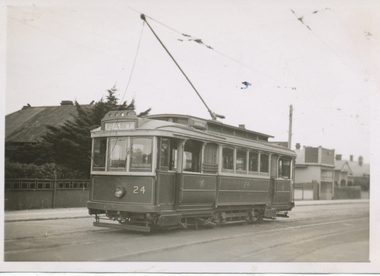
Photograph - SECV Geelong No. 24 in Aberdeen St, Leon Marshall-Wood, 29/03/1948
... SECV Geelong No. 24 in Aberdeen St...... Aberdeen St...Photo of No. 24 in Aberdeen St, 29-3-1948. Wal's album notes that the tram is in the new colour (all green) scheme. ...Has on the rear in ink "Aberdeen St, Geelong 29-3-48" and the L. M. Wood copyright stamp....Yields information about Geelong 24 and Aberdeen St. Trams tramways Geelong Aberdeen St East tram 24 Has on the rear in ink "Aberdeen St, Geelong 29-3-48" and the L. ...Black and White print contained within the Wal Jack Bendigo and Geelong Album, see Reg Item 5003 for more details. Photo of No. 24 in Aberdeen St, 29-3-1948. Wal's album notes that the tram is in the new colour (all green) scheme. Printed on Velox Paper. Tram has the destination of East. Note the "Pay as you enter" sign.Yields information about Geelong 24 and Aberdeen St.Black and white photograph with photographer's notes on the rear.Has on the rear in ink "Aberdeen St, Geelong 29-3-48" and the L. M. Wood copyright stamp.trams, tramways, geelong, aberdeen st, east, tram 24 -
 Ballarat Tramway Museum
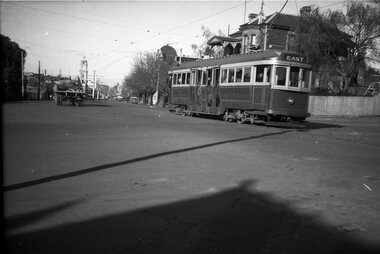
Negative - Geelong bogie 35 turning into Ryrie St from Aberdeen St, Wal Jack, 23-6-1949
... Geelong bogie 35 turning into Ryrie St from Aberdeen St...... Aberdeen St...Geelong bogie 35 turning into Ryrie St from Aberdeen St with the destination of East. Has the Post Office clock tower in the photo. ...Geelong bogie 35 turning into Ryrie St from Aberdeen St with the destination of East. Has the Post Office clock tower in the photo. ...Geelong bogie 35 turning into Ryrie St from Aberdeen St with the destination of East. Has the Post Office clock tower in the photo. Doctor Morton's house in the background. See item 9052 for a photograph print 23-6-1949.Yields information about Geelong 35 and Ryrie St. Negative and Digital images of the Wal Jack Geelong Negative file. trams, tramways, geelong, ryrie st, aberdeen st, tram 35 -
 Ballarat Tramway Museum
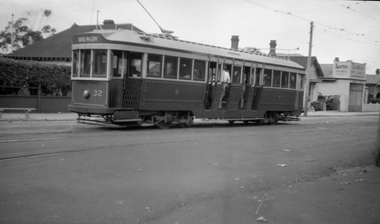
Negative - SECV Geelong 32 in Aberdeen St, Wal Jack, c1950
... SECV Geelong 32 in Aberdeen St...... Aberdeen St...Photo from the Wal Jack Ballarat Negative file of Geelong 32 in Aberdeen St, just after turning from Pakington St. ...Yields information about Geelong 32 and Aberdeen St. Trams tramways Geelong Pakington St Aberdeen St Beach tram 32 Negative and Digital images. ...Photo from the Wal Jack Ballarat Negative file of Geelong 32 in Aberdeen St, just after turning from Pakington St. The tram has the destination of Beach. In the background is a shop advertising Spartan paints. Photo 1949 or 1950.Yields information about Geelong 32 and Aberdeen St.Negative and Digital images.trams, tramways, geelong, pakington st, aberdeen st, beach, tram 32 -
 Ballarat Tramway Museum
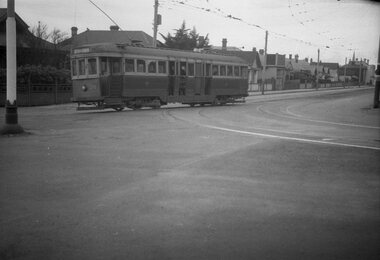
Negative - SECV Geelong 35 - Aberdeen St, Wal Jack, 23/6/1949
... SECV Geelong 35 - Aberdeen St....... Aberdeen St...Negative and Digital images of the Wal Jack Geelong Negative file of Geelong 35 turning from Pakington St into Aberdeen St on its way to the Station - West route. ...Yields information about Geelong tram 35 and Aberdeen St. Trams tramways Geelong Aberdeen St tram 35 Negative Negative SECV Geelong 35 - Aberdeen St. ...Negative and Digital images of the Wal Jack Geelong Negative file of Geelong 35 turning from Pakington St into Aberdeen St on its way to the Station - West route. See also item 4212 for a photo of the same tram at the same location. Photo possibly 23/6/1949.Yields information about Geelong tram 35 and Aberdeen St.Negativetrams, tramways, geelong, aberdeen st, tram 35 -
 Ballarat Tramway Museum
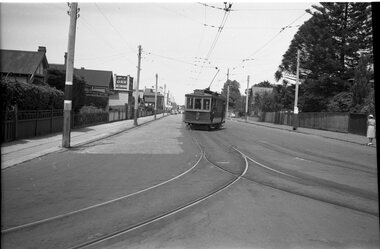
Negative - SECV Geelong 3 in Aberdeen St at junction with Pakington St, Wal Jack, c1945
... SECV Geelong 3 in Aberdeen St at junction with Pakington St...... Aberdeen St...Negative and Digital images from the Wal Jack Geelong Negative file of Geelong No. 3 at the junction in Aberdeen St for trams to turn right into Pakington St and travel to "West". ...Trams tramways Geelong Aberdeen St Pakington St West tram 3 Negative Negative SECV Geelong 3 in Aberdeen St at junction with Pakington St Wal Jack ...Negative and Digital images from the Wal Jack Geelong Negative file of Geelong No. 3 at the junction in Aberdeen St for trams to turn right into Pakington St and travel to "West". The conductress is standing in the doorway after changing the points. In the background is the store of "Wm F Orr Decorator". Photo c1945. Photo shows how trams for West ran "wrong line" for a short distance before turning into Pakington St.Yields information about the junction in Aberdeen St for the Newtown and West lines, tram 3 and the use of conductresses.Negativetrams, tramways, geelong, aberdeen st, pakington st, west, tram 3 -
 Ballarat Tramway Museum
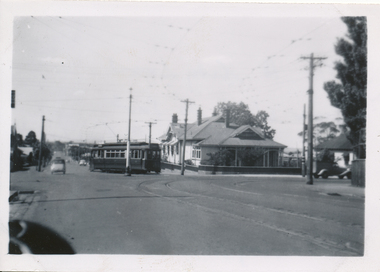
Photograph - SECV Geelong 18 turning from Pakington into Aberdeen St, 8/01/1956
... SECV Geelong 18 turning from Pakington into Aberdeen St....Photo of No. 18 turning out of Pakington St into Aberdeen St, last day of operations 8-1-1956. ...Has written in ink on the rear "No. 18 city bound from West to East, turning from Packington St into Aberdeen St 8/1/56. Next day was buses."...Photo of No. 18 turning out of Pakington St into Aberdeen St, last day of operations 8-1-1956. ...Black and White print contained within the Wal Jack Bendigo and Geelong Album, see Reg Item 5003 for more details. Photo of No. 18 turning out of Pakington St into Aberdeen St, last day of operations 8-1-1956. Photographer unknown - same as 5854. Shows the arrangement of the overhead and curves at this intersection. Yields information about the last day of the operation of the West route and tram 18.Black and white print with photographer's notes on the rear.Has written in ink on the rear "No. 18 city bound from West to East, turning from Packington St into Aberdeen St 8/1/56. Next day was buses."trams, tramways, geelong, east, west, pakington st, tram 18 -
 Ballarat Tramway Museum
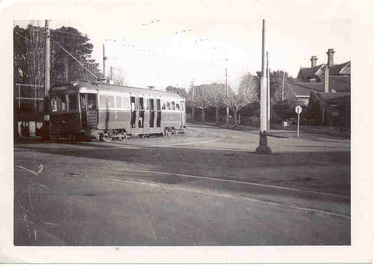
Photograph - SECV Geelong 35 - Aberdeen St, Wal Jack, 23/06/1949
... SECV Geelong 35 - Aberdeen St.... Photograph of Geelong No. 35 turning out of Aberdeen St (Now Hamilton Highway) into Pakington St South, with the destination of Chilwell. ...On rear of print in ink "SEC Geelong Bogie 35 turning out of Aberdeen St into Pakington St south 23-6-49" and in top right hand corner, stamped in purple ink "W. ...Photograph SECV Geelong 35 - Aberdeen St. Wal Jack ...Photograph of Geelong No. 35 turning out of Aberdeen St (Now Hamilton Highway) into Pakington St South, with the destination of Chilwell. Photographed by Wal Jack on 23-6-1949. See also Reg item 2680 for the same photo. i1 - scan of print in the album i2 - rear of image i3 - scan of negative at 3200dpi added 18/6/2020.Yields information about the appearance of one Geelong's bogie trams on its way to the terminus of Chilwell.Black and white photograph and negative.On rear of print in ink "SEC Geelong Bogie 35 turning out of Aberdeen St into Pakington St south 23-6-49" and in top right hand corner, stamped in purple ink "W. Jack No. Copyright" with Number T292 in ink.tramways, trams, geelong, chilwell, pakington st, tram 35 -
 Ballarat Tramway Museum
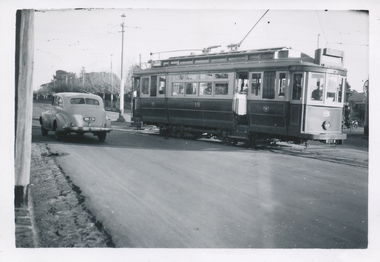
Photograph - SECV Geelong No. 19 turning into Aberdeen St, Wal Jack, 23/06/1949
... SECV Geelong No. 19 turning into Aberdeen St....Photo of No 19, from West, with the destination of Beach, turning out of Pakington St into Aberdeen St. 23-6-1949, photo by Wal Jack. Tow bars have been removed from the tramcar. i1 - scan of print in the album i2 - rear of image i3 - scan of negative at 3200dpi added 18/6/2020....Has the rear in ink "SEC Geelong, No. 19 ex West turning out of Pakington St into Aberdeen St, 23 June '49". Has the Wal Jack copyright stamp on the rear with the number T291 written in....Photograph SECV Geelong No. 19 turning into Aberdeen St. Wal Jack ...Black and White print contained within the Wal Jack Bendigo and Geelong Album, see Reg Item 5003 for more details. Photo of No 19, from West, with the destination of Beach, turning out of Pakington St into Aberdeen St. 23-6-1949, photo by Wal Jack. Tow bars have been removed from the tramcar. i1 - scan of print in the album i2 - rear of image i3 - scan of negative at 3200dpi added 18/6/2020.Yields information about Geelong tram 19 and the intersection of Pakington and Aberdeen Streets.Black and white print with notes on the rear and an associated negative.Has the rear in ink "SEC Geelong, No. 19 ex West turning out of Pakington St into Aberdeen St, 23 June '49". Has the Wal Jack copyright stamp on the rear with the number T291 written in.trams, tramways, geelong, west, pakington st, tram 19 -
 Ballarat Tramway Museum
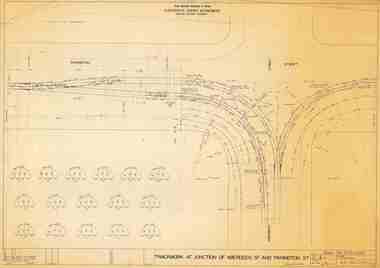
Drawing - GE-T1-6234, State Electricity Commission of Victoria - Electricity Supply Department, Trackwork at Junction of Aberdeen St. and Pakington St, 25/03/1947
... Trackwork at Junction of Aberdeen St. and Pakington St....SEC drawing no GE-T1-6234, "Trackwork at Junction of Aberdeen St. and Pakington St.". Drawn 25/03/1947. ...Trackwork at Junction of Aberdeen St. and Pakington St. Drawing GE-T1-6234 State Electricity Commission of Victoria - Electricity Supply Department ...Produced by the SEC (Geelong Electric Tramways) to document the trackwork at the junction of Aberdeen and Pakington streets in Geelong.Yields information regarding the construction details for the trackwork at the junction of Aberdeen and Pakington streets.SEC drawing no GE-T1-6234, "Trackwork at Junction of Aberdeen St. and Pakington St.". Drawn 25/03/1947. Beige paper copy of original dyeline print. Copy of original.provincial tramways, geelong tramway, state electricity commission of victoria -
 Ballarat Tramway Museum
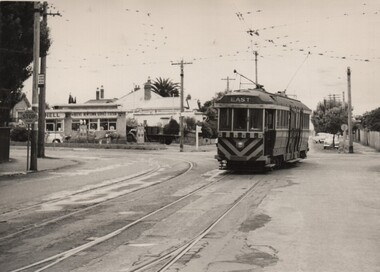
Photograph - Black & White Photograph/s, Charles Craig, mid 1950's
... ... Aberdeen St...Photograph of the intersection of a bogie tram with destination of East and hazard stripes and dash canopy lighting turning from Pakington St (from West) into Aberdeen St at Pakington St junction. In the background is the Shell service station. ...Trams tramways Geelong Aberdeen St East West Tram Stops Photograph of the intersection of a bogie tram with destination of East and hazard stripes and dash canopy lighting turning from Pakington St (from West) into Aberdeen St at Pakington St junction. ...Photograph of the intersection of a bogie tram with destination of East and hazard stripes and dash canopy lighting turning from Pakington St (from West) into Aberdeen St at Pakington St junction. In the background is the Shell service station. Note the metal tram stop sign on the left. Two copies of the print held. trams, tramways, geelong, aberdeen st, east, west, tram stops -
 Ballarat Tramway Museum
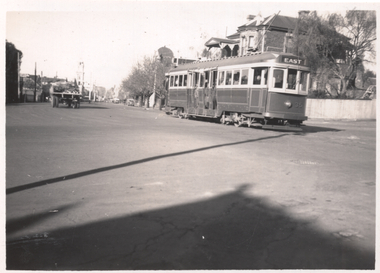
Photograph - Geelong No. 35, Wal Jack, 23-6-1949
... ...aberdeen st...Geelong bogie 35 turning into Ryrie St from Aberdeen St with the destination of East. Has the Town Hall clock tower in the photo. ...Geelong bogie 35 turning into Ryrie St from Aberdeen St with the destination of East. Has the Town Hall clock tower in the photo. ...Geelong bogie 35 turning into Ryrie St from Aberdeen St with the destination of East. Has the Town Hall clock tower in the photo. See item 7817 for the negative. Dated 23-6-1949.Yields information about Geelong 35 and Ryrie St.Black and white photograph, with hand written details on rear.See rear image. tramways, trams, geelong, ryrie st, tram 35, aberdeen st, geelong tramway -
 Ballarat Tramway Museum
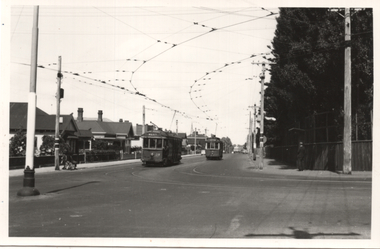
Photograph - Geelong - Aberdeen and Pakington Streets, Keith Kings, 17/12/1955
... ...Aberdeen St...Photograph shows the intersection of Aberdeen St (looking east) at Pakington St Geelong with No. 38 running "bang road" to turn to West route; and No. 16 to Chilwell. ...Photograph shows the intersection of Aberdeen St (looking east) at Pakington St Geelong with No. 38 running "bang road" to turn to West route; and No. 16 to Chilwell. ...Photograph shows the intersection of Aberdeen St (looking east) at Pakington St Geelong with No. 38 running "bang road" to turn to West route; and No. 16 to Chilwell. Note the trolley wire arrangement. Photo by Keith Kings, 17/12/1955, Photo No. Q(m)(6)Yields information about the intersection of Aberdeen and Pakington Streets Geelong and tram operations.Black and White photograph with photographers notes on the rear.See Contexttrams, tramways, geelong, aberdeen st, chilwell, west, tram 38, tram 16, geelong tramway -
 Eltham District Historical Society Inc
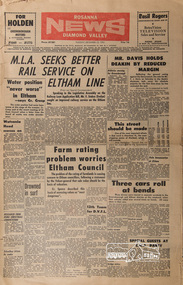
Newspaper, Rosanna Diamond Valley News, 12 Dec 1961, 12 Dec 1961
... MLA seeks better rail service on Eltham Line Water position “never worse” in Eltham Call to seal Aberdeen St, Macleod Farm rating problem at Eltham Council Three cars roll on bends Lower Plenty park P. 3 ...MLA seeks better rail service on Eltham Line Water position “never worse” in Eltham Call to seal Aberdeen St, Macleod Farm rating problem at Eltham Council Three cars roll on bends Lower Plenty park P. 3 newspaper local newspapers rosanna diamond valley news Local newspaper (complete); 12 pages Rosanna Diamond Valley News, 12 Dec 1961 Newspaper ...MLA seeks better rail service on Eltham Line Water position “never worse” in Eltham Call to seal Aberdeen St, Macleod Farm rating problem at Eltham Council Three cars roll on bends Lower Plenty park P. 3 Local newspaper (complete); 12 pagesnewspaper, local newspapers, rosanna diamond valley news -
 Ballarat Tramway Museum
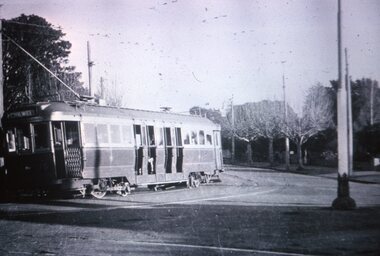
Slide - 35mm slide/s, Wal Jack, 23/6/1949
... Photograph of Geelong No. 35 turning out of Aberdeen St (Now Hamilton Highway) into Pakington St South, with the destination of Chilwell. ...Photograph of Geelong No. 35 turning out of Aberdeen St (Now Hamilton Highway) into Pakington St South, with the destination of Chilwell. ...Photograph of Geelong No. 35 turning out of Aberdeen St (Now Hamilton Highway) into Pakington St South, with the destination of Chilwell. See also Reg item 4212 for the same photo - of Wal Jack dated 23/6/1949. Slide produced by Travis Jeffrey.Yields information about the appearance of one Geelong's bogie trams on its way to the terminus of Chilwell.Agfachrome Professional plastic mount (blue base, white cover) reproduction slide of a black and white photo."G 20" and "1 -20" in pencil.tramways, trams, geelong, chilwell, pakington st, tram 35 -
 Ballarat Tramway Museum
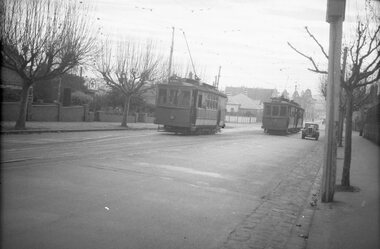
Negative - SECV Geelong trams 2 & 5 in Pakington St, Wal Jack, 1949
... Negative and Digital images from the Wal Jack Geelong Negative file of the Geelong 5 (from Chilwell to East) and 3 (Newtown) and another car following in Pakington St. just south of Aberdeen St. Trams are not fitted with tail lights. ...Negative and Digital images from the Wal Jack Geelong Negative file of the Geelong 5 (from Chilwell to East) and 3 (Newtown) and another car following in Pakington St. just south of Aberdeen St. Trams are not fitted with tail lights. ...Negative and Digital images from the Wal Jack Geelong Negative file of the Geelong 5 (from Chilwell to East) and 3 (Newtown) and another car following in Pakington St. just south of Aberdeen St. Trams are not fitted with tail lights. Photo winter 1949 or 1950.Yields information about Geelong trams 3 and 5 in Pakington St.Negativetrams, tramways, geelong, pakington st, tram 5, tram 3 -
 Ballarat Tramway Museum
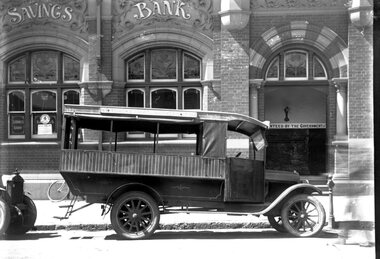
Photograph - Geelong vintage bus
... The tram route via Aberdeen St would have taken considerably longer. 1920s....The tram route via Aberdeen St would have taken considerably longer. 1920s. ...Private bus parked outside the former lavishly signed State Savings Bank in Moorabool St on the SE corner with Corio St. The bus provided a direct route to West Geelong (Church St and possibly to the stockyards west of Pakington St, via Clarence and Elizabeth Sts. The tram route via Aberdeen St would have taken considerably longer. 1920s.Black and white print on paper.GSR710/20/1/14 and 20-14 written on the reverse in pencil. The No. 2 inside a circle written on the reverse in ink.geelong private bus, geelong state savings bank -
 Flagstaff Hill Maritime Museum and Village
Book - Reference Medical/First Aid, James Cantlie, First Aid to the Injured, 1915
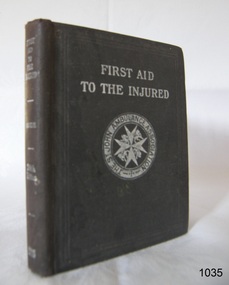
... One reader who inherited a copy from her grandmother described it as a manual to support the teaching of the St John Ambulance Association's first aid course, and, surprisingly, an entertaining read it's full of period detail alongside the actual medical content. The author, James Cantlie (1851–1926), is a genuinely notable figure in medical history, not just a manual writer. He trained at Charing Cross Hospital and graduated from Aberdeen...One reader who inherited a copy from her grandmother described it as a manual to support the teaching of the St John Ambulance Association's first aid course, and, surprisingly, an entertaining read it's full of period detail alongside the actual medical content. The author, James Cantlie (1851–1926), is a genuinely notable figure in medical history, not just a manual writer. He trained at Charing Cross Hospital and graduated from Aberdeen ...First Aid to the Injured was the official training manual of the St John Ambulance Association, arranged to follow the syllabus of their First Aid course. It was written by James Cantlie for the St John Ambulance Association. The volume is a practical instructional text covering anatomy basics, how to treat fractures, dislocations, sprains and strains, circulation and blood loss, the nervous system, poisoning cases, and the organisation of first aid response essentially a comprehensive guide to the principles and practice of First Aid, reflecting the state of medical knowledge at the time.Hard cover book, First Aid to The Injured Author: James Cantlie Publisher: St John Ambulance Association Date: 1915 Further Information: Black colour with white titles and a St Johns icon or logo to front cover.non-fictionFirst Aid to the Injured was the official training manual of the St John Ambulance Association, arranged to follow the syllabus of their First Aid course. It was written by James Cantlie for the St John Ambulance Association. The volume is a practical instructional text covering anatomy basics, how to treat fractures, dislocations, sprains and strains, circulation and blood loss, the nervous system, poisoning cases, and the organisation of first aid response essentially a comprehensive guide to the principles and practice of First Aid, reflecting the state of medical knowledge at the time.flagstaff hill, warrnambool, shipwrecked-coast, flagstaff-hill, flagstaff-hill-maritime-museum, maritime-museum, shipwreck-coast, flagstaff-hill-maritime-village, first aid to the injured, book -
 Flagstaff Hill Maritime Museum and Village
Functional object - Bell, Schomberg 1855, Before 1855
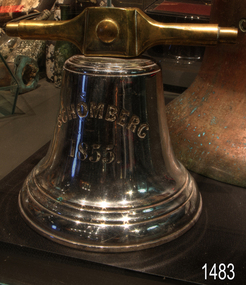
... Flagstaff Hill Flagstaff Hill Maritime Museum and Village Warrnambool Maritime Museum Maritime Village Great Ocean Road Shipwreck Coast Schomberg silver plated bell mess bell bell stands captain ‘bully’ Forbes alexander hall and son James Baines and company Liverpool’s black ball line bell Schomberg bell ship's bell small bell St Joseph's church Briggs Marine John Manning John Logan Warrnambool Museum Briggs Foundry silver bell Bell's front; “SCHOMBERG” with “1855” below. Bell's back “HALL & SONS (crack splits letter “N”) / BUILDERS (in italics) / ABERDEEN” (crack splits letter “B”). ...The Rescue and Journey of the Schomberg Bells: This bell was the smaller of two rescued by the crew of the Schomberg following the ship’s wreck in 1855. While the specific purpose of the smaller bell is unknown, it may have served to assemble the crew or signal mealtimes on board. After surviving the shipwreck, the crew carried both bells as they made their way along the coastline. Their journey eventually led them to the home of settler John Manning, located at Hopkins Point near Warrnambool. Manning took possession of the bells and subsequently presented them to two churches in Warrnambool. The smaller bell went to St Joseph’s Catholic Church, while the larger bell went to St John’s Presbyterian Church. After around a year, the small bell at St Joseph’s developed a crack and became unusable. Thomas Manifold imported a replacement bell for the church, and the damaged bell was stored at his farm. Years later, when the property was sold to John Logan, the discarded bell was donated to the old Warrnambool Museum upon its opening in 1886. The Curator, Joseph Archibald, placed the bell on display in the entry. In 1975, it was transferred from the Warrnambool Art Gallery to Flagstaff Hill. The ’Mystery’ of the small bell solved: Despite numerous attempts by the staff at Flagstaff Hill to restore the bell’s lustre, the bell remained dull and tarnished. In October 1986, Director Peter Ronald decided to send the bell for professional advice. The bell was entrusted to Briggs Marine Products, a renowned brass founder established in 1912. Upon examination, the specialists at Briggs discovered the reason behind the bell’s persistent lack of shine: it had originally been silver-plated, but most of the plating had worn away over time. The experts at Briggs then undertook the task of restoring the bell, successfully returning it to a gleaming silver surface. The Sailing Ship Schomberg: Launched in 1855, the Schomberg was regarded as the “Noblest” ship afloat at the time. Owned by the Black Ball Line, it was built for their passenger fleet by Alexander Hall of Aberdeen at a cost of £43,103. The construction featured three skins: one planked fore and aft and two diagonally planked, all fastened with screw-threaded trunnels (wooden rails). The ship’s First Class accommodation was luxurious, boasting velvet pile carpets, large mirrors, rosewood, birds-eye maple and mahogany timbers, satin damask soft furnishings, and an oak-lined library with a piano. Schomberg had a capacity for 1,000 passengers. The ship’s master, Captain James Nicol Forbes—also known as ‘Bully’ Forbes—was only 34 years old at the launch. He had a reputation for setting and breaking speed records on the Black Ball Line’s Marco Polo and Lightning. In 1852, Forbes completed the London to Melbourne journey on the Marco Polo in 68 days, a record at the time, though 53 passengers died during the voyage. In 1854, he sailed the Lightning to Melbourne in 76 days and returned in only 63 days—a record that stood among sailing ships. Forbes was known for driving his ship and crew to their limits, often prioritising speed over passenger comfort. Determined to set new records, he promised to reach Melbourne in sixty days, declaring he would do so “with or without the help of God.” The Maiden Voyage and the Wreck: Schomberg departed Liverpool on 6th October 1855, flying a banner that read “Sixty Days to Melbourne”. The vessel carried 430 passengers and 3,000 tons of cargo, including materials to build the Melbourne to Geelong Railway and a bridge over the Yarra River. Among the cargo were a cow for fresh milk, pens for fowls and pigs, and 90,000 gallons of water for drinking and washing. Additionally, it transported 17,000 letters and 31,800 newspapers. The ship and cargo were insured for $300,000, a considerable sum for the era. Poor winds while crossing the equator delayed Schomberg’s progress. Land was first sighted on Christmas Day at Cape Bridgewater near Portland. Captain Forbes followed the coastline towards Melbourne, but was reportedly playing cards when the third mate, Henry Keen, reported land only three miles away. The ship ran aground on a sand spit near Curdie’s Inlet (approximately 56 km west of Cape Otway) on 26th December 1855, after 78 days at sea. The sand spit and nearby currents were not marked on Forbes’s map. During the night, the crew launched a lifeboat to search for a safe landing spot for the passengers. The scouting party advised Forbes to wait until morning, as rough seas posed a danger to the lifeboats. At dawn, the ship’s Chief Officer spotted the SS Queen and signalled for help. The master of the Queen brought his vessel alongside, and all passengers and crew disembarked safely. The Black Ball Line’s Melbourne agent sent another steamer to collect the passengers’ baggage, and other steamers assisted with cargo salvage until worsening weather forced operations to cease. Notably, a plunderer later recovered a case of Wellington boots, but all were for the left foot. The wreck and its cargo were sold to local merchants Manifold & Bostock, who did not attempt further salvage. They later sold their interest to a Melbourne businessman and two seafarers. In 1864, after two men drowned in their attempt to reach the Schomberg, salvage efforts were abandoned. By 1870, parts of the ship had washed ashore on New Zealand’s South Island. Today, the wreck is about nine metres below the surface. Although most woodwork has disintegrated, the vessel’s shape remains discernible due to the railway irons, girders, and framework. Various goods and materials from the ship are scattered nearby. The bell is particularly significant in that along with other items from the wreck helped in part to having the legislation changed to protect shipwrecks, with far tighter controls being employed to oversee the salvaging of wreck sites. This bell forms part of the Schomberg collection at Flagstaff Hill maritime museum. The collection as a whole is of historical and archaeological significance at a State level. Flagstaff Hill’s collection of artefacts from the Schomberg is also significant for its association with the Victorian Heritage Registered Schomberg shipwreck (VHR S 612). The collection is of additional significance because of the relationship between the objects salvaged, as together they help us to interpret the story of the Schomberg. The collection as a whole is historically significant for representing aspects of Victoria's maritime history and its potential to interpret social and historical themes from society at the time of the wreck. A small ship’s bell. The silver-plated metal bell bears the ship’s name and year of construction on one side and the name and address of the ship’s builders on the other. These details are deeply engraved into the metal and formed in bold, upper-case lettering. The bell has two bell stands: the left and the right. Both stands have an Iron pipe bent into an inverted ‘Y’ shape, with a hole along its length and feet attached to a rectangular metal plate at the other two ends. Feet are bolted to a timber base that has a hole drilled through the centre for mounting. Bell's front; “SCHOMBERG” with “1855” below. Bell's back “HALL & SONS (crack splits letter “N”) / BUILDERS (in italics) / ABERDEEN” (crack splits letter “B”).flagstaff hill, flagstaff hill maritime museum and village, warrnambool, maritime museum, maritime village, great ocean road, shipwreck coast, schomberg, silver plated bell, mess bell, bell stands, captain ‘bully’ forbes, alexander hall and son, james baines and company, liverpool’s black ball line, bell, schomberg bell, ship's bell, small bell, st joseph's church, briggs marine, john manning, john logan, warrnambool museum, briggs foundry, silver bell -
 Orbost & District Historical Society
plaque, 1918
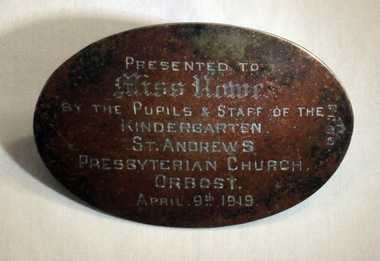
... Jessie Irene ROWE, daughter of John ROWE and Annie (nee PATERSON), married Joseph McKay ABERDEEN (a Technical School teacher) at Orbost in 1918. Her father was one of the first vestrymen of St James Church of England and her mother was a prominent church worker. ...Jessie Irene ROWE, daughter of John ROWE and Annie (nee PATERSON), married Joseph McKay ABERDEEN (a Technical School teacher) at Orbost in 1918. Her father was one of the first vestrymen of St James Church of England and her mother was a prominent church worker. ...Jessie Irene ROWE, daughter of John ROWE and Annie (nee PATERSON), married Joseph McKay ABERDEEN (a Technical School teacher) at Orbost in 1918. Her father was one of the first vestrymen of St James Church of England and her mother was a prominent church worker. It would seem an appropriate time of her marriage for Jessie to receive such a badge at the time of her marriage. John Rowe died 28-9-1920 and it is noted that Annie left Orbost in 1922. (ref. John Phillips) This badge was presented to Miss Rowe by pupils and staff of St Andrew's Church Kindergarten on April 9 1918. Miss Rowe was a Sunday school Teacher and pianist / organist? at the church. The Presbyterian Church in Orbost was officially opened in 1898. For many years the Presbyterian people of Orbost enjoyed the fellowship of the church and the children, in particular, were socially and spiritually involved. This item is reminiscent of that time.An oval shaped badge made of copper metal. It has a square washer and screw on the back.In block letters: Presented to Miss Rowe by the Pupils and Staff of the St Andrew's Presbyterian Church Orbost April 9 1918st-andrew's-church-presbyterian-orbost -
 Phillip Island and District Historical Society Inc.
Book, DOYLE, refugees
... Stamped: The Melbourne Athenaeum Collins St East. refugees Book DOYLE Aberdeen Univ. Pr. ...Labelled: The Melbourne Athenaeum..., Cowes Free Public Library, Phillip Island Historical Society, Cleeland Bequest. Stamped: The Melbourne Athenaeum Collins St East.huguenots -
 Uniting Church Archives - Synod of Victoria
Photograph, Rev. Dr. Francis Macnab
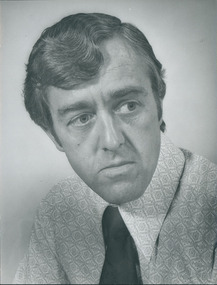
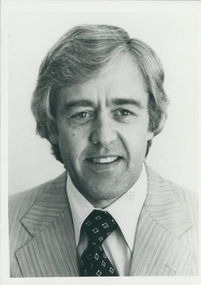
... St Michael's Uniting Church (formerly Collins Street Independent Church) from 1971 to 2016. Macnab was born to J. D. Macnab and Mary Anne Louisa Hughes on 21 June 1931. Macnab married his wife, Sheila, in 1958. They have three children, two daughters and a son. He was made a member of the Order of Australia for his contributions to psychotherapy and religion. Training and psychological work - Macnab holds a Doctor of Divinity degree from the University of Aberdeen...St Michael's Uniting Church (formerly Collins Street Independent Church) from 1971 to 2016. Macnab was born to J. D. Macnab and Mary Anne Louisa Hughes on 21 June 1931. Macnab married his wife, Sheila, in 1958. They have three children, two daughters and a son. He was made a member of the Order of Australia for his contributions to psychotherapy and religion. Training and psychological work - Macnab holds a Doctor of Divinity degree from the University of Aberdeen ...Macnab was the minister of St Michael's Uniting Church (formerly Collins Street Independent Church) from 1971 to 2016. Macnab was born to J. D. Macnab and Mary Anne Louisa Hughes on 21 June 1931. Macnab married his wife, Sheila, in 1958. They have three children, two daughters and a son. He was made a member of the Order of Australia for his contributions to psychotherapy and religion. Training and psychological work - Macnab holds a Doctor of Divinity degree from the University of Aberdeen. He has honorary doctorates from the University of Melbourne and RMIT in psychology and applied science. In 1961, Macnab opened the Cairnmillar Institute, a clinical psychological centre, the largest in Australia, which was for some time the largest training body for psychologists and counsellors in the country. He was its Executive Director. Macnab founded and is director of the Australian Foundation for Aftermath Reactions which provides trauma treatment and training. He is a Fellow of the Australian Psychological Society. Following a ministry at Prahran Presbyterian Church from 1961 to 1970, Macnab became minister of the then Collins Street Congregational Church, now known as "St Michael's on Collins", in 1971. The church became a congregation of the Uniting Church in Australia at its inception in 1977.The three head & shoulders photos show Macnab at three different periods in his life."Rev. Dr. Francis Macnab"macnab, francis, st. michael's uc, cairnmillar institute -
 Uniting Church Archives - Synod of Victoria
Photograph, Rev. Dr Francis Macnab
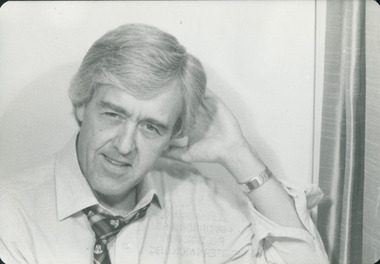
... St Michael's Uniting Church (formerly Collins Street Independent Church) from 1971 to 2016. Macnab was born to J. D. Macnab and Mary Anne Louisa Hughes on 21 June 1931. Macnab married his wife, Sheila, in 1958. They have three children, two daughters and a son. He was made a member of the Order of Australia for his contributions to psychotherapy and religion. Training and psychological work - Macnab holds a Doctor of Divinity degree from the University of Aberdeen...St Michael's Uniting Church (formerly Collins Street Independent Church) from 1971 to 2016. Macnab was born to J. D. Macnab and Mary Anne Louisa Hughes on 21 June 1931. Macnab married his wife, Sheila, in 1958. They have three children, two daughters and a son. He was made a member of the Order of Australia for his contributions to psychotherapy and religion. Training and psychological work - Macnab holds a Doctor of Divinity degree from the University of Aberdeen ...Macnab was the minister of St Michael's Uniting Church (formerly Collins Street Independent Church) from 1971 to 2016. Macnab was born to J. D. Macnab and Mary Anne Louisa Hughes on 21 June 1931. Macnab married his wife, Sheila, in 1958. They have three children, two daughters and a son. He was made a member of the Order of Australia for his contributions to psychotherapy and religion. Training and psychological work - Macnab holds a Doctor of Divinity degree from the University of Aberdeen. He has honorary doctorates from the University of Melbourne and RMIT in psychology and applied science. In 1961, Macnab opened the Cairnmillar Institute, a clinical psychological centre, the largest in Australia, which was for some time the largest training body for psychologists and counsellors in the country. He was its Executive Director. Macnab founded and is director of the Australian Foundation for Aftermath Reactions which provides trauma treatment and training. He is a Fellow of the Australian Psychological Society. Following a ministry at Prahran Presbyterian Church from 1961 to 1970, Macnab became minister of the then Collins Street Congregational Church, now known as "St Michael's on Collins", in 1971. The church became a congregation of the Uniting Church in Australia at its inception in 1977.The three head & shoulders photos show Macnab at three different periods in his life."Rev. Dr Francis Macnab"macnab, francis, st. michael's uc, cairnmillar institute -
 Uniting Church Archives - Synod of Victoria
Photograph, Rev. Dr Francis Macnab
... St Michael's Uniting Church (formerly Collins Street Independent Church) from 1971 to 2016. Macnab was born to J. D. Macnab and Mary Anne Louisa Hughes on 21 June 1931. Macnab married his wife, Sheila, in 1958. They have three children, two daughters and a son. He was made a member of the Order of Australia for his contributions to psychotherapy and religion. Training and psychological work - Macnab holds a Doctor of Divinity degree from the University of Aberdeen...St Michael's Uniting Church (formerly Collins Street Independent Church) from 1971 to 2016. Macnab was born to J. D. Macnab and Mary Anne Louisa Hughes on 21 June 1931. Macnab married his wife, Sheila, in 1958. They have three children, two daughters and a son. He was made a member of the Order of Australia for his contributions to psychotherapy and religion. Training and psychological work - Macnab holds a Doctor of Divinity degree from the University of Aberdeen ...Macnab was the minister of St Michael's Uniting Church (formerly Collins Street Independent Church) from 1971 to 2016. Macnab was born to J. D. Macnab and Mary Anne Louisa Hughes on 21 June 1931. Macnab married his wife, Sheila, in 1958. They have three children, two daughters and a son. He was made a member of the Order of Australia for his contributions to psychotherapy and religion. Training and psychological work - Macnab holds a Doctor of Divinity degree from the University of Aberdeen. He has honorary doctorates from the University of Melbourne and RMIT in psychology and applied science. In 1961, Macnab opened the Cairnmillar Institute, a clinical psychological centre, the largest in Australia, which was for some time the largest training body for psychologists and counsellors in the country. He was its Executive Director. Macnab founded and is director of the Australian Foundation for Aftermath Reactions which provides trauma treatment and training. He is a Fellow of the Australian Psychological Society. Following a ministry at Prahran Presbyterian Church from 1961 to 1970, Macnab became minister of the then Collins Street Congregational Church, now known as "St Michael's on Collins", in 1971. The church became a congregation of the Uniting Church in Australia at its inception in 1977.The three head & shoulders photos show Macnab at three different periods in his life."Rev. Dr Francis Macnab"macnab, francis, st. michael's uc, cairnmillar institute -
 Ballarat Tramway Museum
Photograph - Digital image, Fred Hardie, Sturt St Ballarat, horse tram heading west, 1892
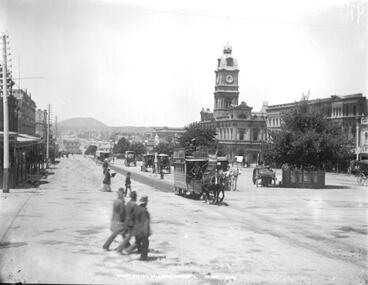
... Digital image from the George Washington Wilson and Co. photographic collection held by the University of Aberdeen - see related documents for information and their website for reproduction permissions. It notes that Fred Hardie was sent to Australia in 1892. There are some 41 Ballarat images available on the website. Sturt St...Yields information about the appearance of Sturt St and the horse trams c1892 Trams tramways Sturt St Horse Trams Horse Cabs Doveton St Digital image from the George Washington Wilson and Co. photographic collection held by the University of Aberdeen - see related documents for information and their website for reproduction permissions. ...Yields information about the appearance of Sturt St and the horse trams c1892Digital image from the George Washington Wilson and Co. photographic collection held by the University of Aberdeen - see related documents for information and their website for reproduction permissions. It notes that Fred Hardie was sent to Australia in 1892. There are some 41 Ballarat images available on the website. Sturt St Ballarat, horse tram heading west, with a number of pedestrians near the tram on the north side of the street with the Town Hall in the background. GB 0231 MS 3792/D1907 - taken at the intersection of Doveton St. Has a number of horse cabs in the background. See: https://www.abdn.ac.uk/special-collections/about-george-washington-wilson-383.php - accessed 29-12-2017.trams, tramways, sturt st, horse trams, horse cabs, doveton st -
 Ballarat Tramway Museum
Photograph - Digital image, Fred Hardie, Sturt St Ballarat, horse tram No. 4 heading west, 1892
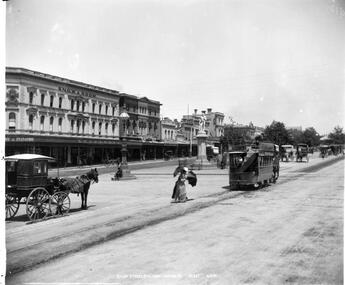
... Digital image from the George Washington Wilson and Co. photographic collection held by the University of Aberdeen - see related documents for information and their website for reproduction permissions. It notes that Fred Hardie was sent to Australia in 1892. There are some 41 Ballarat images available on the website. Sturt St...Yields information about the appearance of Sturt St and the horse trams c1892 Trams tramways Sturt St Horse Trams Horse Cabs Armstrong St tram 4 Digital image from the George Washington Wilson and Co. photographic collection held by the University of Aberdeen - see related documents for information and their website for reproduction permissions. ...Yields information about the appearance of Sturt St and the horse trams c1892Digital image from the George Washington Wilson and Co. photographic collection held by the University of Aberdeen - see related documents for information and their website for reproduction permissions. It notes that Fred Hardie was sent to Australia in 1892. There are some 41 Ballarat images available on the website. Sturt St Ballarat, horse tram No. 4 heading west, with a lady near the tram on the north side of the street with the Snow and Room (Snows) in the background. GB 0231 MS 3792/A0186 - taken at the intersection of Armstrong St. Has a number of horse cabs in the background and one of the large street lights at the intersection. See: https://www.abdn.ac.uk/special-collections/about-george-washington-wilson-383.php - accessed 29-12-2017.trams, tramways, sturt st, horse trams, horse cabs, armstrong st, tram 4 -
 Ballarat Tramway Museum
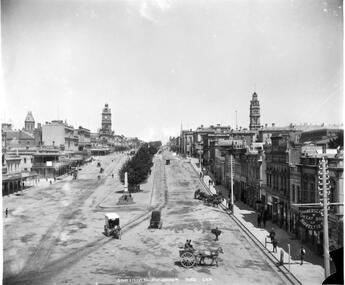
Photograph - Digital image, Fred Hardie, turt St Ballarat, looking west from Grenville, 1892
... Digital image from the George Washington Wilson and Co. photographic collection held by the University of Aberdeen - see related documents for information and their website for reproduction permissions. It notes that Fred Hardie was sent to Australia in 1892. There are some 41 Ballarat images available on the website. Sturt St...Yields information about the appearance of Sturt St and the horse tram track near Grenville St c1892 Trams tramways Sturt St Horse Trams Horse Cabs Grenville St Digital image from the George Washington Wilson and Co. photographic collection held by the University of Aberdeen - see related documents for information and their website for reproduction permissions. ...Yields information about the appearance of Sturt St and the horse tram track near Grenville St c1892Digital image from the George Washington Wilson and Co. photographic collection held by the University of Aberdeen - see related documents for information and their website for reproduction permissions. It notes that Fred Hardie was sent to Australia in 1892. There are some 41 Ballarat images available on the website. Sturt St Ballarat, looking west from Grenville St towards the Post Office and Town Hall. Shows the horse tram track and the median strip - photo number GB 0231 MS 3792/A2811. Has a number of horse cabs in the background, the 8-hour monument. In the bottom right-hand corner, has the "Summerscales Great shop of Novelties". In the centre of the photograph is a horse tram turning from Lydiard St north into Sturt St. See: https://www.abdn.ac.uk/special-collections/about-george-washington-wilson-383.php - accessed 29-12-2017.trams, tramways, sturt st, horse trams, horse cabs, grenville st -
 Ballarat Tramway Museum
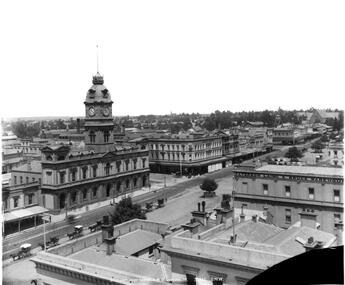
Photograph - Digital image, Fred Hardie, Sturt St Ballarat, looking from the Post Office tower, 1892
... Digital image from the George Washington Wilson and Co. photographic collection held by the University of Aberdeen - see related documents for information and their website for reproduction permissions. It notes that Fred Hardie was sent to Australia in 1892. There are some 41 Ballarat images available on the website. Sturt St...Yields information about the appearance of Sturt St and the Town Hall from the Post Office c1892 Trams tramways Sturt St Horse Cabs Armstrong St Digital image from the George Washington Wilson and Co. photographic collection held by the University of Aberdeen - see related documents for information and their website for reproduction permissions. ...Yields information about the appearance of Sturt St and the Town Hall from the Post Office c1892Digital image from the George Washington Wilson and Co. photographic collection held by the University of Aberdeen - see related documents for information and their website for reproduction permissions. It notes that Fred Hardie was sent to Australia in 1892. There are some 41 Ballarat images available on the website. Sturt St Ballarat, looking from the Post Office tower towards the Town Hall and the intersection of Armstrong St- photo number GB 0231 MS 3792/A1995. Has a number of horse cabs in the background, and various buildings. There are no horse trams in the background. See: https://www.abdn.ac.uk/special-collections/about-george-washington-wilson-383.php - accessed 29-12-2017.trams, tramways, sturt st, horse cabs, armstrong st -
 Ballarat Tramway Museum
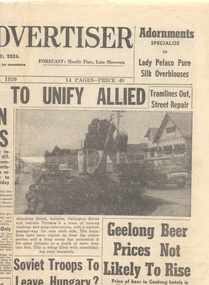
Newspaper, Geelong Advertiser, "Tramlines out, street repair", "Vandal damage tram to become scrap", 27/10/1959 12:00:00 AM
... Page 1 - top right hand corner, article and photograph - "Tramlines out, street repair", of the removal of tram track in Aberdeen Street between Pakington Street and Latrobe St. Page 2 - top right hand corner, article and photograph - "Vandal damage tram to become scrap" - about the decision by the Newtown and Chilwell Council to give the tram in Queens Park to the 3rd Geelong Flinders Pioneers as scrap metal. ...Page 1 - top right hand corner, article and photograph - "Tramlines out, street repair", of the removal of tram track in Aberdeen Street between Pakington Street and Latrobe St. Page 2 - top right hand corner, article and photograph - "Vandal damage tram to become scrap" - about the decision by the Newtown and Chilwell Council to give the tram in Queens Park to the 3rd Geelong Flinders Pioneers as scrap metal. ...Newspaper clipping from the Geelong Advertiser, 27/10/1959. Page 1 - top right hand corner, article and photograph - "Tramlines out, street repair", of the removal of tram track in Aberdeen Street between Pakington Street and Latrobe St. Page 2 - top right hand corner, article and photograph - "Vandal damage tram to become scrap" - about the decision by the Newtown and Chilwell Council to give the tram in Queens Park to the 3rd Geelong Flinders Pioneers as scrap metal. Tram No. 38. Contained originally within Reg Item 5623 at the front of this note book. For items see btm5623 loose items list.pdf.geelong, closure, track removal, preserved trams, queens park -
 Melbourne Tram Museum
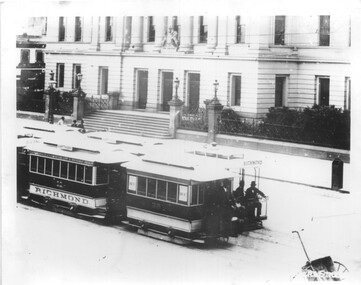
Photograph - Cable trams - Flinders St, Fred Hardie, 1892
... The second car was known as a "Tail Car" and was operated between Spencer St and Flinders St stations before constructing the viaduct that linked both stations. Photo from the George Wilson Washington collection of images held by the University of Aberdeen. ...The second car was known as a "Tail Car" and was operated between Spencer St and Flinders St stations before constructing the viaduct that linked both stations. Photo from the George Wilson Washington collection of images held by the University of Aberdeen. ...The photograph shows two cable car sets, both with an additional trailer passing in Flinders St with the Customs House in the background. Trailer cars 11 - lettered Richmond and short or 6 window trailer, No. 38. The second car was known as a "Tail Car" and was operated between Spencer St and Flinders St stations before constructing the viaduct that linked both stations. Photo from the George Wilson Washington collection of images held by the University of Aberdeen. The collection database notes that Fred Hardie was sent to Australia in 1892.Yields information about cable car operations using an additional trailer during the Black and white photo with notes on the rear.In ink "Melbourne Cable trailers 11-Richmond-38"tramcars, flinders st, customs house, cable trams -
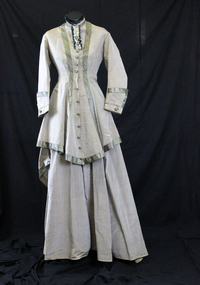 Whitehorse Historical Society Inc.
Clothing - Gown, 1873
... St Kilda on 22 June 1873. Catherine Jane Marden was born in Bacchus Marsh in May 1849 and died in June 1925. William Fraser Grant was born in Aberdeen on October 17, 1845 and died in April 1916. ...St Kilda on 22 June 1873. Catherine Jane Marden was born in Bacchus Marsh in May 1849 and died in June 1925. William Fraser Grant was born in Aberdeen on October 17, 1845 and died in April 1916. ...'Going Away' jacket and skirt worn by Catherine Grant - nee Marden after her wedding at Holy Trinity St Kilda on 22 June 1873. Catherine Jane Marden was born in Bacchus Marsh in May 1849 and died in June 1925. William Fraser Grant was born in Aberdeen on October 17, 1845 and died in April 1916. See Love letter ND3737 and Marriage Certificate ND16671873 Wedding Dress. Mauve-grey silk taffetta skirt and jacket. Jacket has cream lace trim with green ribbon on neckline. Cuffed jacket sleeves have 3 buttons. Jacket front opening has 13 covered material buttons with hook and eye fastenings. Jacket is trimmed with a bow on the waistline at the back and gathered bustle shaping. Skirt has a train.costume, female
