
Showing 4 items matching " anglo-german"
-
 Bendigo Historical Society Inc.
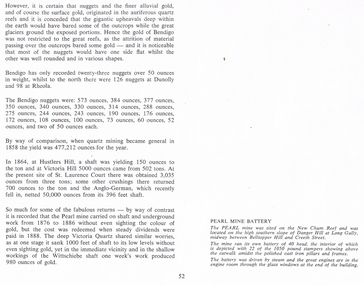
Document - LONG GULLY HISTORY GROUP COLLECTION: GOLD MINING
... ... Anglo-German...BENDIGO History long gully history group The Long Gully History Group - Gold Mining Hustlers Hill Victoria Hill St Laurence Court Anglo-German Pearl Mine Victoria Quartz Wittschiebe Shaft New Chum Reef Danger Hill Belltopper Hill Copy of page 52 from a book. ...Copy of page 52 from a book. Mentioned are nuggets of gold. Some large Bendigo nuggets and their weight in ounces are mentioned, but no names of the nuggets. Some yields from shaft mining are also mentioned. The Pearl Mine and the Victoria Quartz did a lot of work without sighting any gold, while nearby at the Wittschiebe shaft there was a good find. There is also a short piece about the Pearl Mine Battery. It belongs to photo that was on the next page. bendigo, history, long gully history group, the long gully history group - gold mining, hustlers hill, victoria hill, st laurence court, anglo-german, pearl mine, victoria quartz, wittschiebe shaft, new chum reef, danger hill, belltopper hill -
 Flagstaff Hill Maritime Museum and Village
Instrument - Concertina, Lachenal and Co, 1879-1933
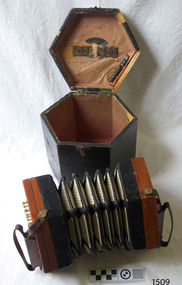
... It was stamped on the right-hand rail (handle) of the Lachenal Anglos, to distinguish them from the German-made ones. It seems that the company ceased business in 1933....It was stamped on the right-hand rail (handle) of the Lachenal Anglos, to distinguish them from the German-made ones. It seems that the company ceased business in 1933. ...Louis Lachenal manufactured concertinas for C Wheatstone & Co. from around 1848-1858 in a combined home and manufactory in Cheswick, England. He then establish up his own business 'Lachenal's' at 8 Little James Street in London. In 1863 the firm began advertising both 'Anglo and English concertinas, which were more expensive. Lachenal passed away in 1861, so his wife Elizabeth took over the business. The firm was sold to a group of five businessmen in about 1873 and in 1874 the firm became ‘Lachenal & Co.’ A Trade Mark application was made by Richard Ballinger on behalf of Lachenal & Co. on 31st August 1878 and the Number 19,555 was published in the Trade Mark Journal January 8, 1879. The symbol was an English-style reed-shoe with the words 'Trade Mark' and 'English Make'. It was stamped on the right-hand rail (handle) of the Lachenal Anglos, to distinguish them from the German-made ones. It seems that the company ceased business in 1933. This concertina, made in the late 19th to early 20th century, represents the portable musical entertainment of the early settlers in the colony of Australia. Concertina, six sided, 21 buttons, with fitted case. Wooden ends have carved cut-outs and leather straps attached to brass buttons. Five-fold bellows have light coloured sides with reinforced edges and corners. Constructed with steel reeds and bone key-buttons. Wooden, black fabric-covered hexagonal case with triangular metal catch, two brass hinges, leather handle and faded red lining. Inscriptions on label inside lid and on wooden ends of bellows. Lachenal, Anglo design, made by Lachenal & Co. of London. Label within oval cut-out "LACHENAL & Co / PATENT CONCERTINA / MANUFACTURERS / LONDON", Label inside lid " - CHENAL -", Impressed into wood STEEL REEDS", "ENGLAND", "TRADE MARK ENGLISH MAKE [reed-shoe symbol]" , (originally marked with Number "98030" ) flagstaff hill, warrnambool, shipwrecked-coast, flagstaff-hill, flagstaff-hill-maritime-museum, maritime-museum, shipwreck-coast, flagstaff-hill-maritime-village, concertina, squeeze box, musical instrument, london, english make, trade mark 15222, english-style reed, richard ballinger, louis lachenal, concertina manufacturer, reed-shoe, lachenal anglo, lachenal & co, lachenal -
 Flagstaff Hill Maritime Museum and Village
Domestic object - Lamp, Valor Co. Ltd, 1920-1936
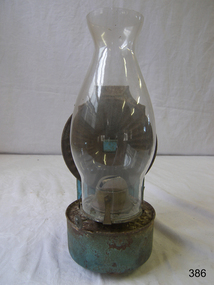
... German. It was used by the lamp makers Veritas Efsca Works in Birmingham, and for a time by Valor Co. Ltd. which took over Veritas. Valor Co. Ltd. was established in Birmingham in 1890 and produced oil containers for the Anglo-American Oil Com. ...German. It was used by the lamp makers Veritas Efsca Works in Birmingham, and for a time by Valor Co. Ltd. which took over Veritas. Valor Co. Ltd. was established in Birmingham in 1890 and produced oil containers for the Anglo-American Oil Com. ...This trade mark (V inside a clover) was German. It was used by the lamp makers Veritas Efsca Works in Birmingham, and for a time by Valor Co. Ltd. which took over Veritas. Valor Co. Ltd. was established in Birmingham in 1890 and produced oil containers for the Anglo-American Oil Com. In 1901 the firm advertised themselves as Stampers And Pieces. Later it was named 'The Valor Co. and was associated with the Aston Brass Co., and advertised as makers of oil lamps and stoves. Valor became a maker of oil heaters cookers and many other products that were fueled by oil. Later it sold gas heaters and ovens. In 1936 Valor Co. Ltd. was made a Public Company and operated under the name The Velor Company Ltd. The company changed names over the years and it was still operating under Velor Fires in January 2002. Oil or kerosene lamps were the means of lighting for homes, farms and industry in the late 19th and early-to-mid 20th centuries. Lamps like these were important as Lighthouse Keepers and Assistant Keepers' equipment. They were in common use in until the lighting was powered by gas and electricity. The reflector at the back of the lamp makes it of greater significance as most lamps don't have this feature. The logo is also interesting as it originated in Germany and was used with permission by a British company and the company that brought it out for a short time. Similar lamps are still available today, usually with gas for fuel. Kerosene lamp; blue painted metal fuel can and metal rear reflector support. and a round corrugated reflector at the rear. The mid-section wick is made of brass. The glass cover or chimney is bulbous in shape. Inscriptions include a trademark "V" inside a clover. It is British-made in Birmingham by either Veritas Efsca Works or Veritas Valor. Trademark; "[clover symbol] surrounding a "V" Stamp: "BRITISH MADE" Marked on adjusting device: "English Made 1 in w" Marked on support of deflector shield - "British Made" and symbol warrnambool, shipwreck coast, flagstaff hill, flagstaff hill maritime museum, flagstaff hill maritime village, oil lamp, table lamp, kerosene lamp, valor co. ltd, v inside a clover, veritas, british made, lamp reflector, lighting, lamp, the valor company ltd -
 Mission to Seafarers Victoria
Book, G. P. Jones, Two Survived, 1941
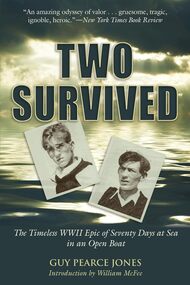
... ww2 survivors german submarines robert tapscott wilbert widdicombe On August 21, 1940, a Nazi raider torpedoed the British merchantman Anglo-Saxon and machine-gunned the survivors as they tried to escape in their lifeboats. ...On August 21, 1940, a Nazi raider torpedoed the British merchantman Anglo-Saxon and machine-gunned the survivors as they tried to escape in their lifeboats. One little boat escaped with seven men. Five of them perished, but Robert Tapscott and Wilbert Widdicombe endured for seventy full days and 2,300 miles to landfall on the other side of the Atlantic. This is the incredible account of their ordeal, one of the most thrilling stories of the sea ever written--and one that almost never came to light. "It has seldom happened," writes William McFee in the introduction, "that a narrative so circumstantial, so entirely stripped of all humbug and false sentiment, has come out of the depths of the sea, to inspire us with admiration for human valor." In the tradition of the Shackleton adventure and Nathaniel Philbrick's In the Heart of the Sea, Two Survived is an unforgettable true story of survival against the very longest odds.non-fiction On August 21, 1940, a Nazi raider torpedoed the British merchantman Anglo-Saxon and machine-gunned the survivors as they tried to escape in their lifeboats. One little boat escaped with seven men. Five of them perished, but Robert Tapscott and Wilbert Widdicombe endured for seventy full days and 2,300 miles to landfall on the other side of the Atlantic. This is the incredible account of their ordeal, one of the most thrilling stories of the sea ever written--and one that almost never came to light. "It has seldom happened," writes William McFee in the introduction, "that a narrative so circumstantial, so entirely stripped of all humbug and false sentiment, has come out of the depths of the sea, to inspire us with admiration for human valor." In the tradition of the Shackleton adventure and Nathaniel Philbrick's In the Heart of the Sea, Two Survived is an unforgettable true story of survival against the very longest odds. ww2, survivors, german submarines, robert tapscott, wilbert widdicombe
