
Showing 23 items matching " another planet"
-
 Women's Art Register
Archive (Collection) - Another Planet Posters Artist Archive
... Another Planet Posters Artist Archive...Activism Community Art Kathy Walters Julia Church Julie Shiels Colin Russell Diana Wells Screenprinting Posters Archive Another Planet Posters Artist Archive ...activism, community art, kathy walters, julia church, julie shiels, colin russell, diana wells, screenprinting, postersactivism, community art, kathy walters, julia church, julie shiels, colin russell, diana wells, screenprinting, posters -
Women's Art Register
Archive (Series) - Another Planet Posters, . Artist File 1
... Another Planet Posters, . Artist File 1...Activism Community Art Kathy Walters Julia Church Julie Shiels Colin Russell Diana Wells Screenprinting Posters Foolscap white archival 4 flap folder or document wallet Archive Another Planet Posters, . Artist File 1 ...Promotional Materialactivism, community art, kathy walters, julia church, julie shiels, colin russell, diana wells, screenprinting, postersactivism, community art, kathy walters, julia church, julie shiels, colin russell, diana wells, screenprinting, posters -
Women's Art Register
Archive (Series) - Another Planet Posters. Slide Kit
... Another Planet Posters. Slide Kit...Screenprinting Posters Activism Community Art Kathy Walters Julia Church Julie Shiels Colin Russell Diana Wells Set of slides in Polypropylene sleeves, within a Polypropyline binder and slipcase. Archive Another Planet Posters. Slide Kit ...screenprinting, posters, activism, community art, kathy walters, julia church, julie shiels, colin russell, diana wellsscreenprinting, posters, activism, community art, kathy walters, julia church, julie shiels, colin russell, diana wells -
Women's Art Register
Archive (Series) - Another Planet Posters, Digitised Slide Kit
... Another Planet Posters, Digitised Slide Kit...Screenprinting Posters Activism Community Art Kathy Walters Julia Church Julie Shiels Colin Russell Diana Wells Archive Another Planet Posters, Digitised Slide Kit ...screenprinting, posters, activism, community art, kathy walters, julia church, julie shiels, colin russell, diana wellsscreenprinting, posters, activism, community art, kathy walters, julia church, julie shiels, colin russell, diana wells -
 Women's Art Register
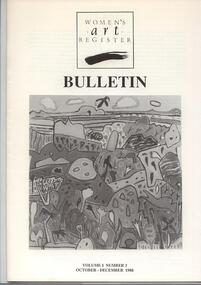
 Bulletin, Women's Art Register, Bulletin, 1988
... ...Another Planet Posters...Meg Benwell Mary Leunig 19th century artists Another Planet Posters Bad Mothers Merrilee Kessler Sue Ferrari Ellis Rowan Kirsty Gorter Eileen Gray Sonja Delaunay Joan Mitchel Elizabeth Ney Dianne Beevers Bulletin Women's Art Register Bulletin Women's Art Register ...meg benwell, mary leunig, 19th century artists, another planet posters, bad mothers, merrilee kessler, sue ferrari, ellis rowan, kirsty gorter, eileen gray, sonja delaunay, joan mitchel, elizabeth ney, dianne beevers -
Women's Art Register
Archive (Collection) - Victoria Castellucci Artist Archive
... Another Planet Posters...1961- Another Planet Posters Sculpture Printmaking Posters Archive Victoria Castellucci Artist Archive ...another planet posters, sculpture, printmaking, postersanother planet posters, sculpture, printmaking, posters -
Women's Art Register
Archive (Collection) - Julia Church Artist Archive
... ... Another Planet...1959- Community Art Another Planet Jill Posters Richmond Stables George Paton Gallery Printmaking Posters Archive Julia Church Artist Archive ...community art, another planet, jill posters, richmond stables, george paton gallery, printmaking, posterscommunity art, another planet, jill posters, richmond stables, george paton gallery, printmaking, posters -
Women's Art Register
Archive (Collection) - Katherine Walters Artist Archive
... ... Another Planet Posters...1958- Printmaking Another Planet Posters Archive Katherine Walters Artist Archive ...printmaking, another planet postersprintmaking, another planet posters -
Women's Art Register
Archive (Collection) - Dianna Wells Artist Archive
... Another Planet Posters...Another Planet Posters Archive Dianna Wells Artist Archive ...another planet postersanother planet posters -
Women's Art Register
Archive (Series) - Walters, Katherine. Artist File 1
... ... Another Planet Posters...Printmaking Another Planet Posters Foolscap white archival 4 flap folder or document wallet Archive Walters, Katherine. ...printmaking, another planet postersprintmaking, another planet posters -
Women's Art Register
Archive (Series) - Wells, Dianna. Artist File 1
... Another Planet Posters...Another Planet Posters Foolscap white archival 4 flap folder or document wallet Archive Wells, Dianna. ...another planet postersanother planet posters -
Women's Art Register
Archive (Series) - Castellucci, Victoria. Artist File 1
... Another Planet Posters...Another Planet Posters Sculpture Printmaking Posters Foolscap white archival 4 flap folder or document wallet Archive Castellucci, Victoria. ...Correspondence, Promotional Material, Artwork Imagesanother planet posters, sculpture, printmaking, postersanother planet posters, sculpture, printmaking, posters -
Women's Art Register
Archive (Series) - Church, Julia. Artist File 1
... ... Another Planet...Community Art Another Planet Jill Posters Richmond Stables George Paton Gallery Printmaking Posters Foolscap white archival 4 flap folder or document wallet Archive Church, Julia. ...Biiography, Newspaper Clippings, Promotional Material, Artist Statement, Artwork Images, Interviews, Newsletterscommunity art, another planet, jill posters, richmond stables, george paton gallery, printmaking, posterscommunity art, another planet, jill posters, richmond stables, george paton gallery, printmaking, posters -
Women's Art Register
Archive (Series) - Julia Church. Duplicate File 1
... ... Another Planet...Printmaking Posters Community Art Another Planet Jill Posters Richmond Stables George Paton Gallery Foolscap manilla file Archive Julia Church. ...Biiography, Newspaper Clippings, Promotional Material, Artist Statement, Artwork Images, Interviews, Newslettersprintmaking, posters, community art, another planet, jill posters, richmond stables, george paton galleryprintmaking, posters, community art, another planet, jill posters, richmond stables, george paton gallery -
Women's Art Register
Archive (Series) - Victoria Castellucci. Duplicate File 1
... ... Another Planet Posters...Sculpture Printmaking Posters Another Planet Posters Foolscap manilla file Archive Victoria Castellucci. ...Correspondence, Promotional Material, Artwork Imagessculpture, printmaking, posters, another planet posterssculpture, printmaking, posters, another planet posters -
Women's Art Register
Archive (Series) - Katherine Walters. Duplicate File 1
... ... Another Planet...Printmaking Another Planet Foolscap manilla file Archive Katherine Walters. ...printmaking, another planetprintmaking, another planet -
Women's Art Register
Archive (Series) - Dianna Wells. Duplicate File 1
... Another Planet Posters...Another Planet Posters Foolscap manilla file Archive Dianna Wells. ...another planet postersanother planet posters -
 Federation University Art Collection
Mixed media, Carole Wilson, 'Heart Mat' by Carole Wilson, 2001
... Her original training was in printmaking and she was a founding member of Jillposters, feminist poster group, in 1983 and worked at Another Planet Posters, Melbourne. For over a decade Carole Wilson has utilised discarded and salvaged materials such as floral carpets, maps and atlases to create works which engage with aspects of botany, garden history, travel and historical ornament. ...Her original training was in printmaking and she was a founding member of Jillposters, feminist poster group, in 1983 and worked at Another Planet Posters, Melbourne. For over a decade Carole Wilson has utilised discarded and salvaged materials such as floral carpets, maps and atlases to create works which engage with aspects of botany, garden history, travel and historical ornament. ...Carole WILSON (1960- ) Born Canberra, Australia Carole Wilson is an artist living and working in Ballarat, Victoria where she is Associate Professor in Visual Arts and Deputy Dean in the School of Arts. Carole studied at both the Canberra School of Art and Philip Institute of Technology, now RMIT, in Melbourne and completed a PhD at the University of Ballarat in 2001. Her original training was in printmaking and she was a founding member of Jillposters, feminist poster group, in 1983 and worked at Another Planet Posters, Melbourne. For over a decade Carole Wilson has utilised discarded and salvaged materials such as floral carpets, maps and atlases to create works which engage with aspects of botany, garden history, travel and historical ornament. In recent years she has undertaken residencies in Italy, the US, Malaysia and The Netherlands which have all had a significant impact on her work. 'Woven Mantra: A Visual Expression of Meditation' is the title of Carole Wilson's thesis undertaken for a PhD - Visual Arts at the University of Ballarat in 2001. The research project examines the links between spiritual practice and visual art. More specifically, the research examines the relationships between repetition of a manta, and repetition of an image. 2010- Senior Lecturer in Visual Arts, Honours and Research Degrees Co-ordinator 2009-2011 Lecturer in Studio Practice and Postgraduate Co-ordinator 1999-2008 Lecturer in Visual Arts (Sessional) This item is part of the Federation University Art Collection. The Art Collection features over 2000 works and was listed as a 'Ballarat Treasure' in 2007.Framed artwork by Carole Wilson.art, artwork, carole wilson, wilson, university of ballarat, doctorate, arts academy, mixed media, monoprint, haberdashery -
Federation University Art Collection
Laser Print, 'Paper Shawl' by Carole Wilson
... Her original training was in printmaking and she was a founding member of Jillposters, feminist poster group, in 1983 and worked at Another Planet Posters, Melbourne. For over a decade Carole Wilson has utilised discarded and salvaged materials such as floral carpets, maps and atlases to create works which engage with aspects of botany, garden history, travel and historical ornament. ...Her original training was in printmaking and she was a founding member of Jillposters, feminist poster group, in 1983 and worked at Another Planet Posters, Melbourne. For over a decade Carole Wilson has utilised discarded and salvaged materials such as floral carpets, maps and atlases to create works which engage with aspects of botany, garden history, travel and historical ornament. ...Carole WILSON (1960- ) Born Canberra, Australia Carole Wilson is an artist living and working in Ballarat, Victoria where she is Associate Professor in Visual Arts and Deputy Dean in the School of Arts. Carole studied at both the Canberra School of Art and Philip Institute of Technology, now RMIT, in Melbourne and completed a PhD at the University of Ballarat in 2001. Her original training was in printmaking and she was a founding member of Jillposters, feminist poster group, in 1983 and worked at Another Planet Posters, Melbourne. For over a decade Carole Wilson has utilised discarded and salvaged materials such as floral carpets, maps and atlases to create works which engage with aspects of botany, garden history, travel and historical ornament. In recent years she has undertaken residencies in Italy, the US, Malaysia and The Netherlands which have all had a significant impact on her work. 'Woven Mantra: A Visual Expression of Meditation' is the title of Carole Wilson's thesis undertaken for a PhD - Visual Arts at the University of Ballarat in 2001. The research project examines the links between spiritual practice and visual art. More specifically, the research examines the relationships between repetition of a manta, and repetition of an image. This item is part of the Federation University Art Collection. The Art Collection features over 2000 works and was listed as a 'Ballarat Treasure' in 2007. Carole Wilson lectures at Federation University Australia: 2010- Senior Lecturer in Visual Arts, Honours and Research Degrees Co-ordinator 2009-2011 Lecturer in Studio Practice and Postgraduate Co-ordinator 1999-2008 Lecturer in Visual Arts (Sessional) art, artwork, carole wilson, alumni -
Federation University Art Collection
Laser Print, 'Kali's Star with Orange Crosses' by Carole Wilson
... Her original training was in printmaking and she was a founding member of Jillposters, feminist poster group, in 1983 and worked at Another Planet Posters, Melbourne. For over a decade Carole Wilson has utilised discarded and salvaged materials such as floral carpets, maps and atlases to create works which engage with aspects of botany, garden history, travel and historical ornament. ...Her original training was in printmaking and she was a founding member of Jillposters, feminist poster group, in 1983 and worked at Another Planet Posters, Melbourne. For over a decade Carole Wilson has utilised discarded and salvaged materials such as floral carpets, maps and atlases to create works which engage with aspects of botany, garden history, travel and historical ornament. ...Carole WILSON (1960- ) Born Canberra, Australia Carole Wilson is an artist living and working in Ballarat, Victoria where she is Associate Professor in Visual Arts and Deputy Dean in the School of Arts. Carole studied at both the Canberra School of Art and Philip Institute of Technology, now RMIT, in Melbourne and completed a PhD at the University of Ballarat in 2001. Her original training was in printmaking and she was a founding member of Jillposters, feminist poster group, in 1983 and worked at Another Planet Posters, Melbourne. For over a decade Carole Wilson has utilised discarded and salvaged materials such as floral carpets, maps and atlases to create works which engage with aspects of botany, garden history, travel and historical ornament. In recent years she has undertaken residencies in Italy, the US, Malaysia and The Netherlands which have all had a significant impact on her work. 'Woven Mantra: A Visual Expression of Meditation' is the title of Carole Wilson's thesis undertaken for a PhD - Visual Arts at the University of Ballarat in 2001. The research project examines the links between spiritual practice and visual art. More specifically, the research examines the relationships between repetition of a manta, and repetition of an image. This item is part of the Federation University Art Collection. The Art Collection features over 2000 works and was listed as a 'Ballarat Treasure' in 2007. Carole Wilson lectures at Federation University Australia: 2010- Senior Lecturer in Visual Arts, Honours and Research Degrees Co-ordinator 2009-2011 Lecturer in Studio Practice and Postgraduate Co-ordinator 1999-2008 Lecturer in Visual Arts (Sessional) art, artwork, carole wilson, printmaking, alumni -
 Flagstaff Hill Maritime Museum and Village
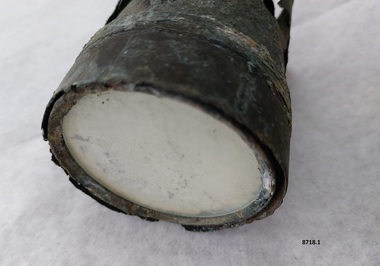
Instrument - Telescope lens, circa 1870's
... planets and stars however they were also used for military and nautical purposes. Telescopes from the mid 1700 onwards consisted of anywhere between two and five brass sections, one sliding inside another to make the instrument's size more manageable when not in use. ...planets and stars however they were also used for military and nautical purposes. Telescopes from the mid 1700 onwards consisted of anywhere between two and five brass sections, one sliding inside another to make the instrument's size more manageable when not in use. ...Telescopes are optical instruments that make distant objects appear larger and closer, thereby extending the range of what the human eye can observe. The development of the telescope was gradual, shaped by a series of important advances in optical science. In 1608, the Dutch spectacle-maker Hans Lippershey discovered that when two lenses were held apart in a particular way, distant objects appeared closer. He applied for a patent for this invention, creating the first documented telescope. In 1668, Isaac Newton produced the first successful reflecting telescope, using a two-inch concave spherical mirror. This marked a major step forward, demonstrating that mirrors could overcome some of the limitations of lenses and greatly improve magnification. Further progress followed in the eighteenth century. In 1729, Chester Moor Hall developed the achromatic lens by combining two types of glass with different refractive properties. This reduced colour distortion and produced a sharper image, although some edge distortion remained. That same year, the Scottish instrument maker James Short developed parabolic and elliptical mirrors that were better suited to reflecting telescopes because they reduced optical distortion. Building on these advances, John Dollond improved the achromatic objective lens by placing a concave flint-glass lens between two convex crown-glass lenses, considerably enhancing image quality. Telescopes were used by astronomers to observe planets and stars however they were also used for military and nautical purposes. Telescopes from the mid 1700 onwards consisted of anywhere between two and five brass sections, one sliding inside another to make the instrument's size more manageable when not in use. The brass tubes were called "draws" because they were drawn out of the main barrel. Our two artefacts appear to be two different sized "draws". It is not possible to say if they belonged to the same telescope or were from different instruments and nor is it possible to identify a maker. Both telescopic "draws" were recovered from the wreck of the Loch Ard, on the southwest coast of Victoria and donated by a friend of the diver. The ship Loch Ard was built on the River Clyde in Scotland in 1873 for the prestigious Loch Line of colonial clipper ships, designed for the Australian run. It sailed from England on 1st March 1878 carrying 37 crew, 17 passengers and a load of cargo. The general cargo reflected the affluence of Melbourne at the time. On board were straw hats, umbrellas, perfumes, clay pipes, pianos, clocks, confectionary, linen and candles, as well as a heavier load of railway irons, cement, lead and copper. There were items included that were intended for display in the Melbourne International Exhibition in 1880 - a diverse general cargo ranging from luxury items to bulk railway iron. On 1 June 1878, emerging from fog and hearing too late the sound of breakers against the tall limestone cliffs, the vessel struck the southern foot of Mutton Bird Island and sank in 23 metres of water. Of the fifty-four people on board only two survived, one young male crewman, Tom Pearce, and one young female passenger, Eva Carmichael. Ten days after the Loch Ard tragedy, salvage rights to the wreck were sold at auction for £2,120. Cargo valued at £3,000 was salvaged and placed on the beach, but most washed back into the sea when another storm developed. The wreck of Loch Ard still lies at the base of Mutton Bird Island. Much of the cargo has now been salvaged and some was washed up into what is now known as Loch Ard Gorge. Cargo and artefacts have also been illegally salvaged over many years before protective legislation was introduced. One of the most unlikely pieces of cargo to have survived the shipwreck was a Minton porcelain peacock - one of only seven in the world. The peacock was destined for the Melbourne International Exhibition in 1880. It had been well packed, which gave it adequate protection during the violent storm. Today, the Minton peacock can be seen at the Flagstaff Hill Maritime Museum in Warrnambool. From Australia's most dramatic shipwreck it has now become Australia's most valuable shipwreck artefact and is one of very few 'objects' on the Victorian State Heritage Register.Flagstaff Hill’s collection of artefacts from LOCH ARD is significant for being one of the largest collections of artefacts from this shipwreck in Victoria. It is significant for its association with the shipwreck, which is on the Victorian Heritage Register (VHR S417). The collection is significant because of the relationship between the objects, as together they have a high potential to interpret the story of the LOCH ARD. The LOCH ARD collection is archaeologically significant as the remains of a large international passenger and cargo ship. The LOCH ARD collection is historically significant for representing aspects of Victoria’s shipping history and its potential to interpret sub-theme 1.5 of Victoria’s Framework of Historical Themes (living with natural processes). The collection is also historically significant for its association with the LOCH ARD, which was one of the worst and best known shipwrecks in Victoria’s history.Two metal (possibly brass) cylinders that appear to be parts of a telescope salvaged from the wreck of the Loch Ard. The larger cylinder 8718.1 has a smaller cylinder sitting inside the larger outer cylinder with a circular piece of opaque glass in one end. The metal on both inner and outer cylinders are very thin, fragile and brittle. The outside has verdigris oxidation. One end has a thin track of fine threads where another part would have been screwed on. The smaller cylinder, 8718.2, is in better condition. It appears to be a brass cylinder with a circular opening (one small and one larger) at each end. Inside the cylinder (about halfway down) is a pane of opaque glass. One end of the cylinder had a slightly flared cap screwed into it. An indistinct "8" appears to be printed in the casing."8"flagstaff hill maritime museum and village, warrnambool, great ocean road, loch ard, wreck of the loch ard, loch ard salvage, telescope, loch ard artefact, telescopic draw -
 City of Moorabbin Historical Society (Operating the Box Cottage Museum)
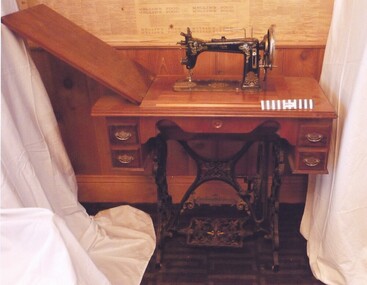
Functional object - Sewing Machine, Melber, Early 20th Century
... another garment. The cottage has both the Receipt, cat 00004.1 and Guarantee, cat 00004.2, for the sewing machine. This machine was possibly built by Wertheim Pty Ltd Hugo Wertheim (1854 – 1919) arrived in Melbourne in 1875. He became a successful agent for sewing machines manufactured by his father’s cousin Joseph Wertheim in Frankfurt, Germany. Hugo married Joseph’s daughter Sophie Emilie and they settled in Richmond Melbourne Australia. Hugo made many trips back to the main factory in Germany and, with extensive advertising, established a thriving business for sewing machines, bicycles, pianos under various ‘brand names’ - Wertheim, Electra, Planet...another garment. The cottage has both the Receipt, cat 00004.1 and Guarantee, cat 00004.2, for the sewing machine. This machine was possibly built by Wertheim Pty Ltd Hugo Wertheim (1854 – 1919) arrived in Melbourne in 1875. He became a successful agent for sewing machines manufactured by his father’s cousin Joseph Wertheim in Frankfurt, Germany. Hugo married Joseph’s daughter Sophie Emilie and they settled in Richmond Melbourne Australia. Hugo made many trips back to the main factory in Germany and, with extensive advertising, established a thriving business for sewing machines, bicycles, pianos under various ‘brand names’ - Wertheim, Electra, Planet ...Melber sewing machines were first sold in Australia in the late 1870s. The 'Box Cottage' Melber Treadle Sewing Machine was owned by Mary Box, nee Kloster / Closter, wife of Alonzo Box , the nephew of William and Elizabeth Box who purchased 'Box Cottage' in 1865 from a pioneer settler The machine was bought in 1909, and is a good example of its kind. This type of sewing machine was widely used in many homes, in an era when hand-made clothes were the “norm.”, and clothes were mended, or ‘re-made’ into another garment. The cottage has both the Receipt, cat 00004.1 and Guarantee, cat 00004.2, for the sewing machine. This machine was possibly built by Wertheim Pty Ltd Hugo Wertheim (1854 – 1919) arrived in Melbourne in 1875. He became a successful agent for sewing machines manufactured by his father’s cousin Joseph Wertheim in Frankfurt, Germany. Hugo married Joseph’s daughter Sophie Emilie and they settled in Richmond Melbourne Australia. Hugo made many trips back to the main factory in Germany and, with extensive advertising, established a thriving business for sewing machines, bicycles, pianos under various ‘brand names’ - Wertheim, Electra, Planet, Griffin, Hapsburg. It has been said that Dame Nellie Melba preferred a Wertheim piano for her performances. In 1908 Hugo opened a large piano factory in Bendigo St Richmond, Victoria and his son Herbert maintained the business until 1935 The sewing machine was donated in 1985 by, a descendant of the Box family. The machine is complete, and in good condition. William and Elizabeth Box purchased 'Box Cottage' in 1865 from a pioneer settler who had bought part of the land noted in Dendy's Special Survey 1841 Brighton. They raised their family there and established a market garden to supply produce to the population of Melbourne. Their nephew Alonzo married Mary Kloster/ Closter in 1918 and she brought with her this 'Melber' sewing machine that she used to provide clothing for the family. 'Melber'Treadle Sewing Machine that was owned by Mary Box, nee Kloster/ Closter. It was bought in 1909, and it is a good example of its kind. This type of sewing machine was widely used in many homes, in an era when hand-made clothes were the “norm.”, and clothes were mended, or ‘re-made’ into another garment. The Box Cottage Museum has both the Receipt, and Guarantee for the sewing machine. 'MELBER' stamped on sewing machine.dendys special survey, treadle sewing machine, box cottage, mary kloster, alonzo box, melber, wertheim hugo, wertheim sewing machine manufacturer, richmond melbourne victoria, -
 Ararat Gallery TAMA
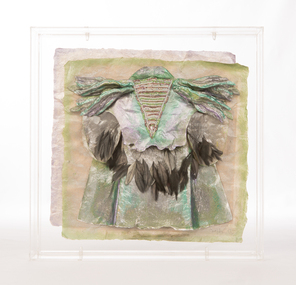
Mixed media, Inga Hunter, Nrat-tuan Boat Leader's Robe, 1986-1989
... another. This robe is worn by the most senior of all. He is the representative of water rights at the great Court of the Imperium. To the Nrat-Tuan it is more a sacrifice than an honour to attend the Court, because none find it easy to stay on still, dry land for extended periods of time. Nrati-Tuan delegates to the Irusaqui Court are rewarded with high honours on their planet...another. This robe is worn by the most senior of all. He is the representative of water rights at the great Court of the Imperium. To the Nrat-Tuan it is more a sacrifice than an honour to attend the Court, because none find it easy to stay on still, dry land for extended periods of time. Nrati-Tuan delegates to the Irusaqui Court are rewarded with high honours on their planet ...“Apart from the vast and sophisticated space fleet, the only forms of transport used by the Nrati-Tuan are boats and rafts. All the inhabitants are more at home in the water than on the land, but some transport is necessary, both for people and freight. Every family has at least two boats and an assortment of rafts. Many thousands live entirely on boats and never set foot on any form of land, even avoiding the floating islands. The Boatleader is really a leading transport official; the top office in a long chain of others, from the smallest boat-boy, to the night boatwatches who keep the waterways safe for traffic. There are several ranks of Boatleader, whose major function is to settle disputes about water rights and water paths. Courts of dispute sit regularly, handling the hundreds of problems which arise about water use, headed by a Boatleader of one rank or another. This robe is worn by the most senior of all. He is the representative of water rights at the great Court of the Imperium. To the Nrat-Tuan it is more a sacrifice than an honour to attend the Court, because none find it easy to stay on still, dry land for extended periods of time. Nrati-Tuan delegates to the Irusaqui Court are rewarded with high honours on their planet, to show public respect and gratitude for their endurance.” -Inga Hunter
