
Showing 10 items matching " anthropomorphic"
-
 Stawell Historical Society Inc
Costume - Apron, Stawell Lamington Festival
... Anthropomorphic Lamington...Anthropomorphic Lamington Cotton Apron Stawell Lamington Festival Costume Apron ...Cotton ApronAnthropomorphic Lamington -
 Flagstaff Hill Maritime Museum and Village
Booklet - Promotional Booklet, Australian Apple and Pear Board, 50 Easy and Interesting Ways for Serving Apples and Pears, 1938-1946
... Paperback booklet. 50 Easy and Interesting Ways for Serving Apples and Pears Author: Various Contributors Publisher: Australian Apple and Pear Board Date: 1938-1946 Further Information: Highly decorated art deco typography and anthropomorphic advertising art of the 1940s period to the front cover. ...It shows how a statutory export body marketed fruit to domestic cooks, with the use of Art Deco typography and anthropomorphic advertising art of the period to promote wartime home economics. ...This is a promotional recipe booklet for home cooks the contents lists various recipes using apples and pears in an effort to promote their use in the home kitchen. There are notes for the beginner in cookery, such as peeling thinly and baking apples in a slow oven. The oven settings are for electric ovens, and the page tags suggest apple sandwiches with nuts or chocolate. This publication points to a wartime-era Australian publication from 1939 to 1946.Paperback booklet. 50 Easy and Interesting Ways for Serving Apples and Pears Author: Various Contributors Publisher: Australian Apple and Pear Board Date: 1938-1946 Further Information: Highly decorated art deco typography and anthropomorphic advertising art of the 1940s period to the front cover. The spine has a Library label with an inscription.non-fictionThis is a promotional recipe booklet for home cooks the contents lists various recipes using apples and pears in an effort to promote their use in the home kitchen. There are notes for the beginner in cookery, such as peeling thinly and baking apples in a slow oven. The oven settings are for electric ovens, and the page tags suggest apple sandwiches with nuts or chocolate. This publication points to a wartime-era Australian publication from 1939 to 1946.warrnambool, shipwrecked-coast, flagstaff-hill, flagstaff-hill-maritime-museum, maritime-museum, shipwreck-coast, flagstaff-hill-maritime-village, shipwrecked-artefact, book, 50 easy and interesting ways for serving apples and pears -
Women's Art Register
Archive (Collection) - Rona Green Artist Archive
... ... Anthropomorphic...Linocut Monotype Screenprinting Anthropomorphic Sociology Printmaking Archive Rona Green Artist Archive ...linocut, monotype, screenprinting, anthropomorphic, sociology, printmakinglinocut, monotype, screenprinting, anthropomorphic, sociology, printmaking -
Women's Art Register
Archive (Series) - Green, Rona. Artist File 1
... ... Anthropomorphic...Linocut Monotype Screenprinting Anthropomorphic Sociology Printmaking Foolscap white archival 4 flap folder or document wallet Archive Green, Rona. ...Newspaper Clippings, Catalogues, Correspondence, Promotional materiallinocut, monotype, screenprinting, anthropomorphic, sociology, printmakinglinocut, monotype, screenprinting, anthropomorphic, sociology, printmaking -
Women's Art Register
Archive (Series) - Rona Green. Duplicate File 1
... ... Anthropomorphic...Printmaking Linocut Monotype Screenprinting Anthropomorphic Sociology Foolscap manilla file Archive Rona Green. ...Newspaper Clippings, Catalogues, Correspondence, Promotional materialprintmaking, linocut, monotype, screenprinting, anthropomorphic, sociologyprintmaking, linocut, monotype, screenprinting, anthropomorphic, sociology -
 Phillip Island Conservation Society Inc.
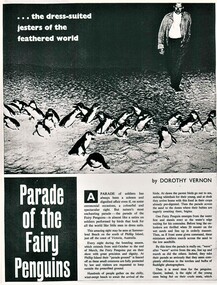
Work on paper - newspaper cutting photocopy, "...the dress-suited jesters of the feathered world/Parade of the Fairy Penguins", unknown
... Articles tended to be a mix of basic penguin behavior information and anthropomorphic descriptions. Accompanying photographs were almost invariably taken by flashlight (now illegal), or of penguins taken from their burrows during daylight hours for photo opportunities. ...Articles tended to be a mix of basic penguin behavior information and anthropomorphic descriptions. Accompanying photographs were almost invariably taken by flashlight (now illegal), or of penguins taken from their burrows during daylight hours for photo opportunities. ...The general public was fascinated by the nightly 'Penguin Parade' on Phillip Island. Many articles have been written about the birds and the Penguin Parade attraction since the 1930s. So many people spent their summer holidays on Phillip Island in one of the many guest houses, then caravan parks and holiday homes and a visit to the Penguin Parade by them and their visitors was very common during their holidays. Articles tended to be a mix of basic penguin behavior information and anthropomorphic descriptions. Accompanying photographs were almost invariably taken by flashlight (now illegal), or of penguins taken from their burrows during daylight hours for photo opportunities. The article provides evidence of the level of knowledge about Phillip Island's Little/Fairy Penguins at this time. (approx 1960?)Photocopy of 2 page magazine article. Black print. Images poor quality due old photocopy.little penguins, fairy penguins, eudyptula minor, phillip island penguin parade, dorothy vernon, penguin rookery, penguin behaviour, phillip island tourist attractions -
 Federation University Historical Collection
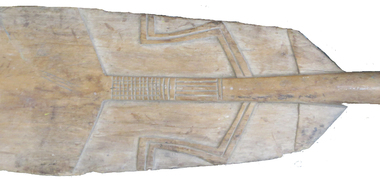
Weapon - Ethnographic Material, Two native weapons, probably South Pacific in origin
... The Alafolo or afui are anthropomorphic clubs found across the island of Malaita. ...The Alafolo or afui are anthropomorphic clubs found across the island of Malaita. ...These items were in the Ballarat School of Mines Museum, and when the museum was closed they were saved from the tip, and returned decades later. The Alafolo or afui are anthropomorphic clubs found across the island of Malaita. As war clubs, blows were struck with the edges of the club, which varied in length from under three to four feet. At least some of these clubs served a largely ceremonial function, particularly those rare examples with shell inlay. Malaitans war clubs are usually made of tooa, a reddish hardwood. Most finished clubs are submerged in mud (saltwater or fresh) for about a month, during which time they acquire a glossy black finish.Two native weapons, probably South Pacific in origin. .1) light coloured timber paddle with carving. Possibly Solomon Islands. .2) A dark coloured Alafolo made with heavy ironwood, with geometric designs from the Solomon Islands with stylized face, carved geometric design at top end; two carved rings with geometric design between them toward bottom end.ballarat school of mines, ballarat school of mines museum, ethnographic, paddle, club, ethnographic material, new number, solomon island, alafolo, malaita, weapons, new guinea -
 Phillip Island Conservation Society Inc.
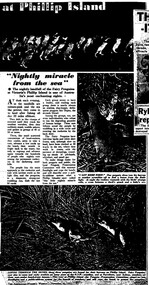
Work on paper - Photocopy of newspaper cutting, (part obscured) "at Phillip Island/Nightly Miracle/from the sea", November 20, 1957
... Articles tended to be a mix of basic penguin behavior information and anthropomorphic descriptions. Accompanying photographs were almost invariably taken by flashlight (now illegal), or of penguins taken from their burrows during daylight hours for photo opportunities. ...Articles tended to be a mix of basic penguin behavior information and anthropomorphic descriptions. Accompanying photographs were almost invariably taken by flashlight (now illegal), or of penguins taken from their burrows during daylight hours for photo opportunities. ...The general public was fascinated by the nightly 'Penguin Parade' on Phillip Island. Many articles have been written about the birds and the Penguin Parade attraction since the 1930s. So many people spent their summer holidays on Phillip Island in one of the many guest houses, then caravan parks and holiday homes and a visit to the Penguin Parade by them and their visitors was very common during their holidays. Articles tended to be a mix of basic penguin behavior information and anthropomorphic descriptions. Accompanying photographs were almost invariably taken by flashlight (now illegal), or of penguins taken from their burrows during daylight hours for photo opportunities. This article, written in the 1950s, describes the management of the Penguin Parade at that time as being run by the Penguin Preservation Committee. This was before the Phillip Island Council took over running the Penguin Parade. The article provides evidence of the level of knowledge about Phillip Island's Little/Fairy Penguins at this time. (1957)single full-page magazine article, black ink on white paper. Photocopied from original, so photos appear as black and white.little penguins, fairy penguins, eudyptula minor, phillip island penguin parade, dorothy vernon, penguin rookery, penguin behaviour, phillip island tourist attractions -
 Merri-bek City Council
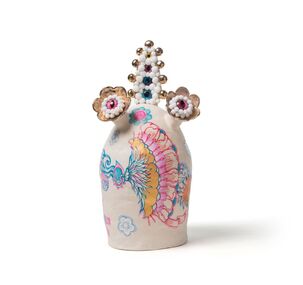
Ceramic - Ceramic, acrylic paint, gold lustre and mix media, Bundit Puangthong et al, FLESH, 2018
... Meanwhile, the ceramic figures are characteristic of Srivilasa’s practice, with gold detailing and anthropomorphic embellishments. Both artists examine the bi-cultural experience of living between Australia and Thailand. ...In creating these pieces, Vipoo Srivilasa initiated the process by sculpting three figures with bare surfaces. Bundit Puangthong then added his artistic touch by painting each sculpture. The artists' conceptual visions harmonized perfectly, especially considering their shared commitment to Buddhist principles, which frequently inspire their respective artistic practices. After Bundit completed his painting, Vipoo enlivened the pieces by adding eyes to the figures. He also embellished the works with pom-poms, lending them a softness that makes them appear both approachable and innocent, despite the weightiness of their themes. Each sculpture embodies a specific teaching from Buddhism: "FLESH" features a golden umbrella, serving as a metaphor for sex. -
 Merri-bek City Council
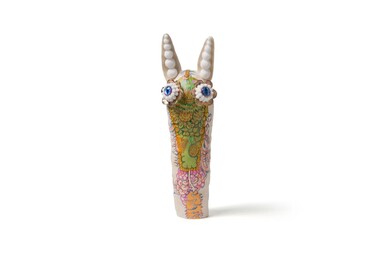
Ceramic - Ceramic, acrylic paint, gold lustre and mix media, Bundit Puangthong et al, FOOD, 2018
... Meanwhile, the ceramic figures are characteristic of Srivilasa’s practice, with gold detailing and anthropomorphic embellishments. Both artists examine the bi-cultural experience of living between Australia and Thailand. ...These captivating pieces are part of a series called "FOOD / FLESH / FAME," a collaborative effort between Melbourne-based Thai artists Bundit Puangthong and Vipoo Srivilasa. Drawing from Buddhist teachings, the series explores the three elements of attachment: Food (consumption), Flesh (sex), and Fame (power). Although these elements are known to cause suffering, they remain persistently alluring, a paradox that the artists intend to explore further in the future. In creating these pieces, Vipoo Srivilasa initiated the process by sculpting three figures with bare surfaces. Bundit Puangthong then added his artistic touch by painting each sculpture. The artists' conceptual visions harmonized perfectly, especially considering their shared commitment to Buddhist principles, which frequently inspire their respective artistic practices. After Bundit completed his painting, Vipoo enlivened the pieces by adding eyes to the figures. He also embellished the works with pom-poms, lending them a softness that makes them appear both approachable and innocent, despite the weightiness of their themes. Each sculpture embodies a specific teaching from Buddhism: "FOOD" depicts a durian, the king of fruits, painted by Bundit Puangthong. He notes, "Despite its pungent aroma, many people still love to eat it."Donated the by the artists
