
Showing 7 items matching " arable"
-
 Sunshine and District Historical Society Incorporated
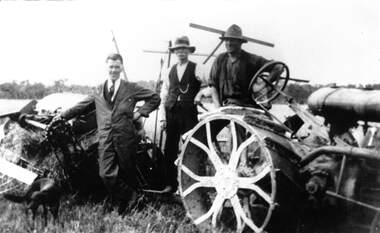
Photograph - Tractor and Binder Photograph 1920's, 1920's
... ... Arable...The man in overalls is Percy Holloway. Tractor Arable Black & white photograph of three men standing beside a tractor & binder. ...Mr. Percy Holloway was employed as an expert by Mackay Massey Harris. His job was to go out to farms to repair the machinery and train the farmers in use of new machinery. The machines in the picture are a Binder and a Fordson Tractor. The man in overalls is Percy Holloway.tractor, arable -
 Dutch Australian Heritage Centre Victoria
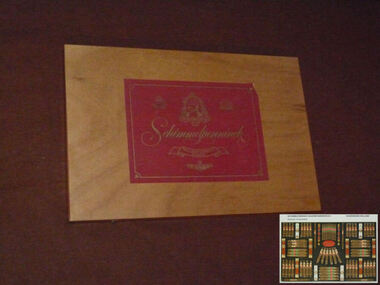
Cigar Box
... The tobacco industry has a long history in this town; in the 17th century one fifth of all arable land around the town was used for tobacco. ...The tobacco industry has a long history in this town; in the 17th century one fifth of all arable land around the town was used for tobacco. ...The Schimmelpenninck factory stood in Wageningen until it finally closed in 2000. The Schimmelpenninck brand started in 1924 when two brothers and an uncle merged their cigar factories into one company. It was called after Rutger Jan Schimmelpenninck, raadspensionaris (kind of a prime minister) of the Batavian Republic in 1805-1806. The tobacco industry has a long history in this town; in the 17th century one fifth of all arable land around the town was used for tobacco. Originally used in pipes and as snuff, the popularity of cigars in the 19th century led to a large expansion of the Dutch tobacco industry. The Schimmelpenninck factory was at its largest just before World war II, 700 employees produced 32 million cigars. Wageningen was heavily damaged during operation Market Garden in 1944, the whole population was evacuated and most of the machines of the Schimmelpenninck factory were stolen or destroyed. After the war, consumption of cigars was much reduced and the firm slowly merged with others. Eventually they became part of Rothmans.This box and the brand name Schimmelpenninck represent several periods of Dutch history between the time of the Republic and the post WWII years. Cigar smoking was very popular in the Netherlands pre-war but less so in the second half of the 20th century partly due to a growing awareness of tobacco's carciogenic properties.Large flat wooden box designed to hold 78 cigars. The lid is attached with brass hinges and two brass clasps enable it to be closed. A large red label with silver script and illustrations is attached to both the outside and the inside of the lid.Schimmelpenninck. Hollands Finest Cigars -
 Bendigo Historical Society Inc.
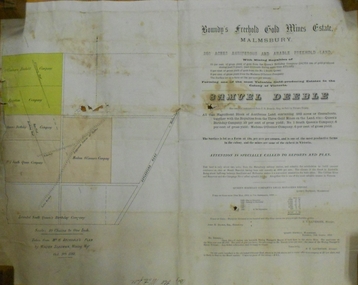
Document - MARKS COLLECTION: BOUNDY'S FREEHOLD GOLD MINES MALMSBURY
... Plan/advertisement 1888 for the sale of the Boundy's Freehold Gold Mines Malmsbury, 260 acres of auriferous and arable freehold land. Document contains map of mines, names include O'Connors Freehold Company, Egyptian Company, Queen's Birthday Company, No.1 South Queen Company, Madam O'Connor's company, Extended South Queen's Birthday Company. ...MINE Gold boundy's freehold gold mine Plan/advertisement 1888 for the sale of the Boundy's Freehold Gold Mines Malmsbury, 260 acres of auriferous and arable freehold land. Document contains map of mines, names include O'Connors Freehold Company, Egyptian Company, Queen's Birthday Company, No.1 South Queen Company, Madam O'Connor's company, Extended South Queen's Birthday Company. ...Plan/advertisement 1888 for the sale of the Boundy's Freehold Gold Mines Malmsbury, 260 acres of auriferous and arable freehold land. Document contains map of mines, names include O'Connors Freehold Company, Egyptian Company, Queen's Birthday Company, No.1 South Queen Company, Madam O'Connor's company, Extended South Queen's Birthday Company. Scale 10 chains to one inch. Taken from Mr. H. Archdale's Plan by Walter Sleeman, Mining Mgr., Oct 9th. 1888. On RH side of map Daylesford Road to Malmsbury marked. The land is only about two miles from the Malmsbury railway station. On back of document letter from Henry Nutman, Mining Manager, Queens Birthday Company; Report on Plan Walter Skleeman, M.M.; letter to S. Deeble, 35 Queen St., Melbourne with report on mine from George Jenkyn and Mining Manager's Report in Argus 24th.October 1888.mine, gold, boundy's freehold gold mine -
 The Beechworth Burke Museum
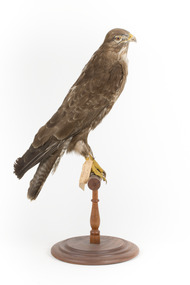
Animal specimen - Common Buzzard, Trustees of the Australian Museum, 1860- 1880
... It lives in a range of habitats, especially woodland, moorland, pasture, scrub, arable land, marsh bog, villages, and sometimes towns and cities. ...It lives in a range of habitats, especially woodland, moorland, pasture, scrub, arable land, marsh bog, villages, and sometimes towns and cities. ...The Common buzzard, a medium-sized raptor, is found across Europe and Asia, and in Africa in the winter months. It is the UK’s commonest bird of prey, found in nearly every county. Due to their large size and their brown color, they are often confused with other species, especially the Red kite and the Golden eagle. They may look the same from a distance, but the Common buzzard has a very distinctive call, like a cat’s mew, and a distinctive flying shape. When soaring and gliding, the tail is fanned and its wings are often held in a shallow 'V'. The colour of individuals varies from dark brown to much lighter, though they all have a finely barred tail and dark wingtips. This species occurs across Europe and Russia, and parts of Northern Africa and Asia in the cooler winter months. It lives in a range of habitats, especially woodland, moorland, pasture, scrub, arable land, marsh bog, villages, and sometimes towns and cities. This particular specimen has been mounted in a correct stylised fashion. This specimen is part of a collection of almost 200 animal specimens that were originally acquired as skins from various institutions across Australia, including the Australian Museum in Sydney and the National Museum of Victoria (known as Museums Victoria since 1983), as well as individuals such as amateur anthropologist Reynell Eveleigh Johns between 1860-1880. These skins were then mounted by members of the Burke Museum Committee and put-on display in the formal space of the Museum’s original exhibition hall where they continue to be on display. This display of taxidermy mounts initially served to instruct visitors to the Burke Museum of the natural world around them, today it serves as an insight into the collecting habits of the 19th century.This specimen is part of a significant and rare taxidermy mount collection in the Burke Museum. This collection is scientifically and culturally important for reminding us of how science continues to shape our understanding of the modern world. They demonstrate a capacity to hold evidence of how Australia’s fauna history existed in the past and are potentially important for future environmental research. This collection continues to be on display in the Museum and has become a key part to interpreting the collecting habits of the 19th century.This Common Buzzard is brown in colour with lighter markings on the chest. It has a white patch of feathers on the back of its head and it has darker wingtips and yellow feet. This specimen stands upon a wooden platform and has an identification tag tied around its leg.Swing tag: 30 / Buzzard / Catalogue page 52. / Metal tag: 4043 /taxidermy mount, taxidermy, animalia, burke museum, beechworth, australian museum, skin, reynell eveleigh johns, bird, common buzzard, bird of prey -
 Flagstaff Hill Maritime Museum and Village
Container - Box for seeds, ca. 1880s
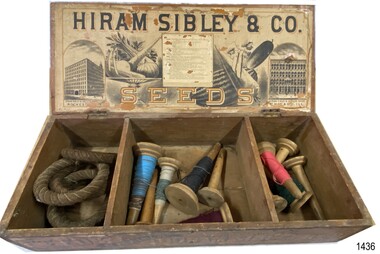
... The text and images of the box are an example of 1880s advertising Flagstaff Hill Warrnambool Maritime Village Maritime Museum Flagstaff Hill Maritime Museum & Village hiram sibley & co rochester n.y. seeds wooden seed box seed box seedsmen arable farming chicargo illinois seed house seed engineering seed distribution seeds by weight and measure Marked "HIRAM SIBLEY & CO / SEEDS", "WAREHOUSE - "ROCHESTER N.Y. ", "SEED HOUSE - CHICARGO, ILL.", "SEEDS BY WEIGHT & MEASURE", "PUT UP BY / HIRAM SIBLEY & CO. / ROCHESTER, N.Y. ...This seed box was made for Hiram Sibley for his seed house business. He sold seeds priced by the weight or the space they took up e.g. bushel. This box allowed for seeds to be divided by type, size or even date. The box was strong and easy to cart and store. It was also a handy item to 'recycle' as a storage container for other items. The Sibley seed box is a desirable collectors' item. A large variety of sizes and shapes are still available today in various stages of condition. Hiram Sibley developed seeds that were strong and the plants that grew from these seeds produced many seeds. Varieties of Sibley seeds and plants are still advertised for sale in modern times. HIRAM SIBLEY (1807-1888) - Hiram Sibley was born in America. He had a natural mechanical ability and became skilled in many trades. He and his partner Don Watson opened a sawmill then a machine shop and foundry. He became involved with Alfred Vale and Samuel Morse and their work on the telegraph. Eventually he became the first president of the Western Union Telegraph Company. Later, after leaving Western Union in the early 1860s, Sibley bought and sold railroads, manufactured sold, ran timber mills, and became involved in farming and seed supply. In this area he used his skills to engineer seeds that were stronger and develop plants that produced more seeds. The production of seeds became his main business. He bought land cheaply and improved to soil so that he could produce seed and grain, and graze herds of cattle. He became the owner of 14 large farms. Hiram Sibley earned the reputation "as the most extensive farmer and seedsman in this country". The business of Hiram Sibley & Co. was conducted his warehouse in Rochester and his seed house in Chicago. One department of the business sold farming equipment, another department imported ornamental plants from overseas countries Sibley went on to invest a large amount of money in a bank, and to be financially involved in the community by making large donations to public services such as a library and a school of music. At one point he was the richest man in Monroe county.This box is significant for its historic connection with Hiram Sibley, who is famous for many reasons, among which is his very profitable business of seed engineering to improve the production of crops. This box also represents the value of containers used for selling products in the 1880s, being re-used for other useful purposes. The box is an example of goods imported for use in Australia. The text and images of the box are an example of 1880s advertisingBox, wooden, with two brass hinges joining lid to base. Base has two wooden partitions, divided into three unequal sized compartments. Lid's underside has label with drawings of buildings and produce, text with maker's name and description of vegetables. Front edge of box has stencilled text and diagrams. Outside lid, and the other three sides, have no inscriptions. Made by Hiram Sibley & Co., USA. (Box is currently used to store quoits 1436.2 and cones of cotton thread 1436.3.)Marked "HIRAM SIBLEY & CO / SEEDS", "WAREHOUSE - "ROCHESTER N.Y. ", "SEED HOUSE - CHICARGO, ILL.", "SEEDS BY WEIGHT & MEASURE", "PUT UP BY / HIRAM SIBLEY & CO. / ROCHESTER, N.Y. AND CHICARGO, ILL."flagstaff hill, warrnambool, maritime village, maritime museum, flagstaff hill maritime museum & village, hiram sibley & co, rochester n.y., seeds, wooden seed box, seed box, seedsmen, arable farming, chicargo illinois, seed house, seed engineering, seed distribution, seeds by weight and measure -
 Flagstaff Hill Maritime Museum and Village
Book - Journal Reference Book/History, Edward John Eyre, Journals of Expeditions of Discovery into Central Australia and Overland From Adelaide to King George Sound. In the years 1840-1 Vol 1, 1845
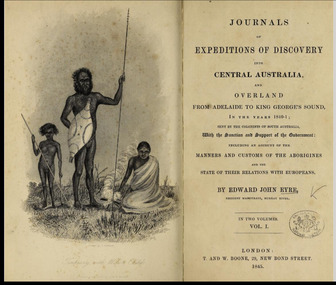
... It helped shape European knowledge of central and western Australian geography and influenced colonial ideas about settlement, transport routes, and the limits of arable land. It is also historically important as a source on early colonial attitudes toward Aboriginal people, though those views are framed through Eyre’s 19th-century perspective rather than a neutral account. ...Journals of Expeditions of Discovery into Central Australia was written by Edward John Eyre. It is Eyre’s 1845 account of his 1840–41 exploration journeys from Adelaide into central Australia and then overland to King George’s Sound. The book is published in two volumes and was first issued in 1845. It blends practical expedition reporting with reflection, so it is both a record of exploration and a statement about the colonial understanding of inland Australia.Journals of Expeditions of Discovery into Central Australia Vol 1 Author: Edward John Eyre Publisher: T and W Boone Date: 1845 non-fictionJournals of Expeditions of Discovery into Central Australia was written by Edward John Eyre. It is Eyre’s 1845 account of his 1840–41 exploration journeys from Adelaide into central Australia and then overland to King George’s Sound. The book is published in two volumes and was first issued in 1845. It blends practical expedition reporting with reflection, so it is both a record of exploration and a statement about the colonial understanding of inland Australia. flagstaff hill, warrnambool, shipwrecked coast, flagstaff hill maritime museum, maritime museum, flagstaff hill maritime village, great ocean road, book, warrnambool library, warrnambool mechanics’ institute, mechanics’ institute library, victorian library board, warrnambool books and records, journals of expeditions of discovery into central australia vol 1, edward john eyre -
 Flagstaff Hill Maritime Museum and Village
Book - Journal Reference Book/History, Edward John Eyre, Journals of Expeditions of Discovery into Central Australia and Overland From Adelaide to King George Sound. In the years 1840-1 Vol 2, 1845
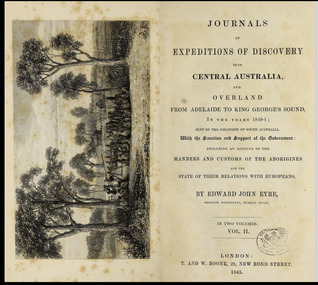
... It helped shape European knowledge of central and western Australian geography and influenced colonial ideas about settlement, transport routes, and the limits of arable land. It is also historically important as a source on early colonial attitudes toward Aboriginal people, though those views are framed through Eyre’s 19th-century perspective rather than a neutral account. ...Journals of Expeditions of Discovery into Central Australia was written by Edward John Eyre. It is Eyre’s 1845 account of his 1840–41 exploration journeys from Adelaide into central Australia and then overland to King George’s Sound. The book is published in two volumes and was first issued in 1845. It blends practical expedition reporting with reflection, so it is both a record of exploration and a statement about the colonial understanding of inland Australia.Journals of Expeditions of Discovery into Central Australia Vol 2 Author: Edward John Eyre Publisher: T and W Boone Date: 1845 non-fictionJournals of Expeditions of Discovery into Central Australia was written by Edward John Eyre. It is Eyre’s 1845 account of his 1840–41 exploration journeys from Adelaide into central Australia and then overland to King George’s Sound. The book is published in two volumes and was first issued in 1845. It blends practical expedition reporting with reflection, so it is both a record of exploration and a statement about the colonial understanding of inland Australia. flagstaff hill, warrnambool, shipwrecked coast, flagstaff hill maritime museum, maritime museum, flagstaff hill maritime village, great ocean road, book, warrnambool library, warrnambool mechanics’ institute, mechanics’ institute library, victorian library board, warrnambool books and records, journals of expeditions of discovery into central australia vol 1, edward john eyre
