
Showing 6 items matching " art house anglesea"
-
 Women's Art Register
Archive (Collection) - Jan Dick Artist Archive
... Art House Anglesea...Art House Anglesea Painting Archive Jan Dick Artist Archive ...art house anglesea, paintingart house anglesea, painting -
Women's Art Register
Archive (Series) - Dick, Jan. Artist File 1
... Art House Anglesea...Art House Anglesea Painting Foolscap white archival 4 flap folder or document wallet Archive Dick, Jan. ...Newspaper Clippingart house anglesea, paintingart house anglesea, painting -
Women's Art Register
Archive (Series) - Jan Dick. Duplicate File 1
... ... Art House Anglesea...Painting Art House Anglesea Foolscap manilla file Archive Jan Dick. ...Newspaper Clippingpainting, art house angleseapainting, art house anglesea -
 National Wool Museum
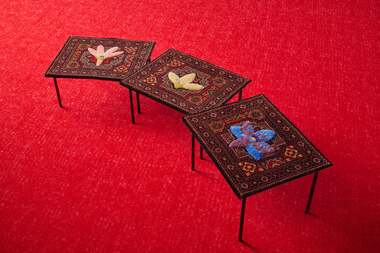
Textile - Orchid Tables, Dowel Jones, 2024
... House Rug...Orchids...Anglesea...Design...Art...Anglesea District', we identified regional orchids. By a process of removal and addition, the original floral medallion was replaced with local species as decorative motif. Ten Year of Dowel Jones presents three altered Manor House Rugs, each with different orchids tufted in wool and placed in the centre of each rug. The rugs have been attached by cotton thread to three table frames at different heights to create the Orchid Tables. Dowel Jones Ten Years of Dowel Jones National Wool Museum Axminster Loom Carpet Manor House Rug Orchids Anglesea Design Art ...The Orchid Tables were on display as part of the Ten Years of Dowel Jones exhibition at the National Wool Museum in 2024. The exhibition label reads: Sitting just outside this exhibition in the National Wool Museum is a 1910 Axminster Jacquard Carpet Loom. This loom was operating at Brintons factory in Geelong from 1960 to 1975, and then at the Melbourne College of Textiles, until it was donated to the museum. In the 1990's the museum commissioned an exclusive pattern called the Manor House Rug. Based on earlier designs from Brintons UK Persian Rug Archive Library, the museum continues to make this rug through the expertise of Loom Technician Michael Farquhar. The Manor House Rug features a central medallion with floral pattern. Working with illustrator Beci Orpin, and referencing Margaret MacDonald & Angair's book 'Orchids of the Anglesea District', we identified regional orchids. By a process of removal and addition, the original floral medallion was replaced with local species as decorative motif. Ten Year of Dowel Jones presents three altered Manor House Rugs, each with different orchids tufted in wool and placed in the centre of each rug. The rugs have been attached by cotton thread to three table frames at different heights to create the Orchid Tables.Three tables consisting of powder coated steel frames, with a woven carpet top. The table tops are made from wool with a jute backing, and feature a red, green, blue, black and cream floral design with an orchid in the centre. Each table is a different height.dowel jones, ten years of dowel jones, national wool museum, axminster loom, carpet, manor house rug, orchids, anglesea, design, art, furniture, beci orpin, brintons, geelong, melbourne college of textiles -
 Surrey Hills Historical Society Collection
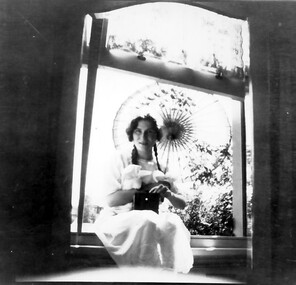
Photograph, Norma Bull portrait
... Art Prize, ‘The Norma Bull Portraiture Scholarship’ which is administered by The Victorian Artist’s Society. She continued to paint landscapes and seascapes in her traditionalist style. She had holiday homes at Anglesea and Bright. After she died in September 1980, 31 of her works were bequeathed to Bright Art Gallery. miss norma bull medlow house ...Norma Bull in a window of 'Medlow', 1920s Her brother (Ronald) Richard was a keen photographer and is believed to have taken the photographs of the family and in the grounds of 'Medlow'. Norma Catherine Bull (7 September 1906 – September 1980) was an Australian painter, printmaker and etcher best known for the paintings and sketches she made in Britain during World War II. Norma was the daughter of Richard Joseph Bull (1874-1927) and Catherine Grace Perrier (1884-1972). Her father was the Director of Bacteriology at Melbourne University. Richard and Catherine had 2 children. Norma was born in Hawthorn in 1906 and her brother Ronald Richard was born in Surrey Hills in 1912, where in 1911 Richard bought a property at 42 Warrigal Road, Surrey Hills developed by Colonel William Cairncross, known as ‘Willcyrus’ and renamed ‘Medlow’ by the Bulls. As a child, Norma was a high achiever both intellectually and artistically. She was educated at Fintona, where she matriculated as Dux of the School and winner of an exhibition in French. She won a scholarship to attend the University of Melbourne where she studied French, Zoology, Philosophy, English and History, leading to a Bachelor of Arts in 1929. Following this she studied painting and drawing at the National Gallery Art School for seven years. Whilst most of the students of the 1930s were inspired by Modernism, Norma followed more traditional styles and became known for her etchings and realistic depiction of urban scenes. Her work was strongly influenced by the conservative nature of the National Gallery Art School under Bernard Hall, and she remained a traditionalist all her life. In 1938, she was awarded the Sir John Longstaff Scholarship in Fine Art. This enabled her to travel to England to study at the Royal Academy in London. She arrived in April 1939 and after the outbreak of war, she worked as a volunteer at a First Aid Clearing Station and applied to become a war artist. In 1941, she was given a sketching permit by the War Artists Advisory Committee to record bomb damage in the Bristol area. In 1947, an exhibition of her 205 wartime works entitled “Two Hemispheres”, opened at Australia House in London. Many were acquired for major collections in England including the Victoria and Albert Museum, the Imperial War Museum and the Royal Collection. The “Two Hemispheres” exhibition toured Australia in 1948 and for over twelve months she followed Wirth’s Circus around the country, painting aspects of circus life. From then on she lived at Medlow’, From 1960 she was secretary of the Fellowship of Australian Artists. She was a finalist in the Archibald Prize on 2 occasions and is remembered through a biennial Art Prize, ‘The Norma Bull Portraiture Scholarship’ which is administered by The Victorian Artist’s Society. She continued to paint landscapes and seascapes in her traditionalist style. She had holiday homes at Anglesea and Bright. After she died in September 1980, 31 of her works were bequeathed to Bright Art Gallery. A black and white photograph of a lady holding a sun umbrella and sitting in a window frame.miss norma bull, medlow, house names, warrigal road, surrey hills, mr ronald richard bull -
 Allan Doney Collection, Bendigo Historical Society Inc.
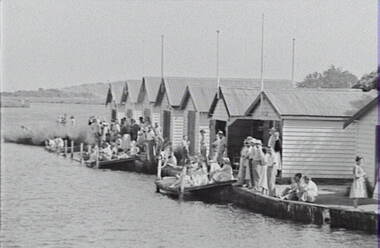
Negative - Anglesea Boat Houses, Allan Doney, 1950 -1970
... Although he travelled to many other places in Northern Victoria and beyond in search of subjects for his art, he seemed to always return to Bendigo for inspiration. Negative Anglesea Boat Houses Allan Doney ...In the years of Allan Doney’s photography, landmark buildings succumbed to fire, neglect and redevelopment. He photographed the grey sand hills from Bendigo’s mining past, the streetscapes, poppet heads, miners’ cottages, gracious homes with ornate verandahs, trams and much more. Above all, his photographs show how much of the city has survived from the 19th century – and how much has not. Through two decades of great change, Allan Doney was there to capture ways people interacted with it. Although he travelled to many other places in Northern Victoria and beyond in search of subjects for his art, he seemed to always return to Bendigo for inspiration.
