
Showing 777 items matching " australian birds"
-
 Bendigo Historical Society Inc.
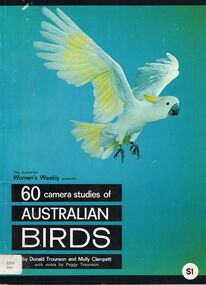
Book - ALEC H CHISHOLM COLLECTION: BOOK ''60 CAMERA STUDIES OF AUSTRALIAN BIRDS''
... ALEC H CHISHOLM COLLECTION: BOOK ''60 CAMERA STUDIES OF AUSTRALIAN BIRDS''...ALEC H CHISHOLM COLLECTION. 64 page soft cover booklet of colour photos of Australian birds by Donald Trounson and Molly Clampett with notes by Peggy Trounson. ...ALEC H CHISHOLM COLLECTION. 64 page soft cover booklet of colour photos of Australian birds by Donald Trounson and Molly Clampett with notes by Peggy Trounson. ...Book. ALEC H CHISHOLM COLLECTION. 64 page soft cover booklet of colour photos of Australian birds by Donald Trounson and Molly Clampett with notes by Peggy Trounson. Printed in 1969 by Conpress Printing Pty Ltd, Sydney for Australian Consolidated Press and the Australian Women's Weekly. Catalogue sticker ''2250 TRO'' on front cover. Handwritten in biro pen on page 1 ''To Chis With much affection Donald & Peggy''Donald Trounson & Molly Clampettbooks, collections, ornithology, alec h chisholm collection, donald trounson, molly clampett, peggy trounson, birds, ornithololgy -
 Victorian Aboriginal Corporation for Languages
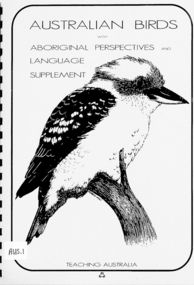
Book, Intechnics, Australian birds : with Aboriginal perspectives and language supplement
... Australian birds : with Aboriginal perspectives and language supplement...Australian birds...Australian birds education primary school education environmental education B&w illustrations, maps, word lists Australian birds : with Aboriginal perspectives and language supplement Book Intechnics ...B&w illustrations, maps, word listsaustralian birds, education, primary school education, environmental education -
 Tatura Irrigation & Wartime Camps Museum
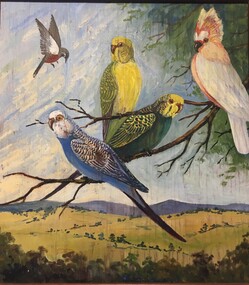
Painting - Painting - Oil, Australian Birds
... Australian Birds......australian birds...Artist unknown major mitchell cockatoo australian birds budgerigars australian landscape Three budgerigars, one blue, one yellow, one green sit on a thin branch of a tree with a Major Mitchell Cockatoo to the right of the picture. ...The painting belonged to the Wied family who were in Camp 3 Tatura. Artist unknownThree budgerigars, one blue, one yellow, one green sit on a thin branch of a tree with a Major Mitchell Cockatoo to the right of the picture. Another bird is in the air attempting to land on the branch. The sky is blue and the landscape is yellow with a tinge of green. A blue mountain range is on the horizon. Painted on board with a brown wooden frame.major mitchell cockatoo, australian birds, budgerigars, australian landscape -
 Bendigo Historical Society Inc.
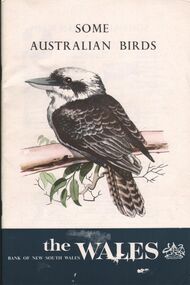
Book - AILEEN AND JOHN ELLISON COLLECTION: SOME AUSTRALIAN BIRDS
... AILEEN AND JOHN ELLISON COLLECTION: SOME AUSTRALIAN BIRDS...Small booklet: Some Australian Birds. On the front cover a Kookaburra. ...BOOKS Natural history birds Small booklet: Some Australian Birds. On the front cover a Kookaburra. ...Small booklet: Some Australian Birds. On the front cover a Kookaburra. Published in April 1957 by the Bank of New South Wales. The booklet has 17 pages. Contents: Foreword - Bell miner - Black Swan - Boobook Owl - Bower Bird - Brolga - Dollar Bird - Fairy Penguin - Jabiru - Kookaburra (inside front cover) - Lyrebird - Pelican - Rifle Bird - Weebill - Whipbird - White Cockatoo - Willie Wagtail - Yellow Robin (inside back cover).books, natural history, birds -
 Bendigo Historical Society Inc.
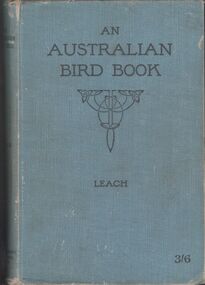
Book - An Australian Bird Book
... Australian birds...Blue hardcover book titled: An Australian bird book by J.A. Leach, published by Whitcombe & Tombs Limited. ...Australian birds Ornithology "John Ellison" inside front cover Blue hardcover book titled: An Australian bird book by J.A. ...Blue hardcover book titled: An Australian bird book by J.A. Leach, published by Whitcombe & Tombs Limited. The book has two hundred pages and is a guide to identify Australian birds. Aileen and john Ellison Collection."John Ellison" inside front coveraustralian birds, ornithology -
 Robin Boyd Foundation
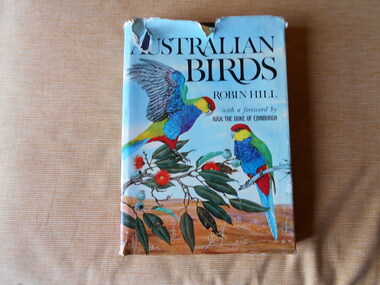
Book, Robin Hill, Australian Birds, 1968
... Australian Birds...Birds... Australia... Australian...Birds Australia Australian nature Walsh St library Hardcover w/ Dust Jacket Australian Birds Book Robin Hill Nelson ...Hardcover w/ Dust Jacketbirds, australia, australian nature, walsh st library -
 Wodonga & District Historical Society Inc
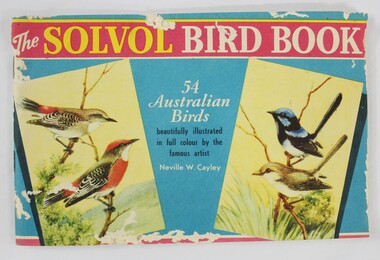
Booklet - Haeusler Collection Australian Bird Book, "The Solvol Bird Book: 54 Australian Birds"
... "The Solvol Bird Book: 54 Australian Birds"..."The Solvol Bird Book: 54 Australian Birds" Booklet Haeusler Collection Australian Bird Book ...The Wodonga Historical Society Haeusler Collection provides invaluable insight into life in late nineteenth and early twentieth century north east Victoria. The collection comprises manuscripts, personal artefacts used by the Haeusler family on their farm in Wodonga, and a set of glass negatives which offer a unique visual snapshot of the domestic and social lives of the Haeusler family and local Wodonga community. The Haeusler family migrated from Prussia (Germany) to South Australia in the 1840s and 1850s, before purchasing 100 acres of Crown Land made available under the Victorian Lands Act 1862 (also known as ‘Duffy’s Land Act’) in 1866 in what is now Wodonga West. The Haeusler family were one of several German families to migrate from South Australia to Wodonga in the 1860s. This item has well documented provenance and a known owner. It forms part of a significant and representative historical collection which reflects the local history of Wodonga. It contributes to our understanding of domestic and family life in early twentieth century Wodonga, as well as providing interpretative capacity for themes including local history and social history.A rectangular book with illustrations of four birds on a blue front cover, with title text. haeusler collection, haeusler, wodonga, bird, birds, bird watching, book, bird book -
 Phillip Island and District Historical Society Inc.
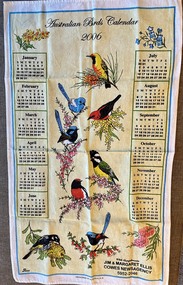
Souvenir, Australian tea towel, About 2005
... Coloured linen tea towel with yearly calendar, drawings of Australian birds and native plants....Australian Birds Calendar 2006. With compliments Jim & Margaret Ellis Cowes Newsagency 5952-2046...Historical Tourism souvenir Jim & Margaret Ellis Australian Birds Calendar 2006. With compliments Jim & Margaret Ellis Cowes Newsagency 5952-2046 Coloured linen tea towel with yearly calendar, drawings of Australian birds and native plants. ...One of the most popular souvenirs bought by tourists from local shops.HistoricalColoured linen tea towel with yearly calendar, drawings of Australian birds and native plants.Australian Birds Calendar 2006. With compliments Jim & Margaret Ellis Cowes Newsagency 5952-2046tourism, souvenir, jim & margaret ellis -
 Kew Historical Society Inc
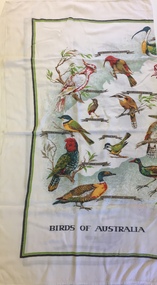
Decorative object, Birds of Australia, 1950s
... ...australian birds...The donation also includes a hand embroidered linen supper cloth and a commercially produced 'birds of Australia' printed table cloth. Most of the collection derives from the 1950s....Linen table cloth with printed images of birds of Australia with a two-tone green border...The donation also includes a hand embroidered linen supper cloth and a commercially produced 'birds of Australia' printed table cloth. Most of the collection derives from the 1950s. lisa sylvan household linen table cloths australiana australian birds Linen table cloth with printed images of birds of Australia with a two-tone green border Birds of Australia Decorative object ...One of a collection of fourteen items of clothing and household textiles donated by Lisa Sylvan, a long-term resident of Kew, Five of the items are homemade aprons made and worn by her mother. Of the seven pinafores, three identical but differently sized pinafores were made in her parents' factory, while the other three are handmade. The handmade aprons and pinafores are representative samples of women's work, often using commercial or patterns using fabrics originally deigned for dresses. Typically the examples, contrasting fabrics and colours were selected to provide visual interest. The donation also includes a hand embroidered linen supper cloth and a commercially produced 'birds of Australia' printed table cloth. Most of the collection derives from the 1950s.Linen table cloth with printed images of birds of Australia with a two-tone green borderlisa sylvan, household linen, table cloths, australiana, australian birds -
 Kiewa Valley Historical Society
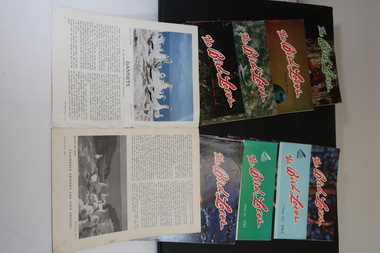
Magazines - "The Bird Lover" 1960 - 1968, The Gould League of Bird Lovers of Victoria Volumes XIII to XXI
... Australian birds...Formed in 1909 and set up to prevent bird egg collecting and to educate for the protection of Australian birds,...Australian birds Gould League of Victoria Bird Lovers 9 soft coloured cover magazines of 31 pages held by 2 staples. ...The Gould League is an independent not-for-profit organisation celebrating 100+ years of environmental and sustainability education. Formed in 1909 and set up to prevent bird egg collecting and to educate for the protection of Australian birds,School children in the Kiewa Valley belonged to the Gould League of Victoria and were educated in not only the conservation of but also the identification and habits of bird species in the area and beyond.9 soft coloured cover magazines of 31 pages held by 2 staples. Each includes coloured and black and white photos.australian birds, gould league of victoria, bird lovers -
 Port Melbourne Historical & Preservation Society
Document - Items relating to the Gould League of Birds at Nott Street Primary School, Allen KEAST, 1982
... The book 'Australian Bird Songs includes a disc with recordings of bird songs. ...Nott Street Primary library copy of 'Australian Birds Songs', a Gould League of Birds newsletter and small yellow banner....The book 'Australian Bird Songs includes a disc with recordings of bird songs. ...The book 'Australian Bird Songs includes a disc with recordings of bird songs. All schools joining The Gould League received a banner & newsletter.Nott Street Primary library copy of 'Australian Birds Songs', a Gould League of Birds newsletter and small yellow banner.education - primary schools, nott street primary school, the gould league of birds -
 Orbost & District Historical Society
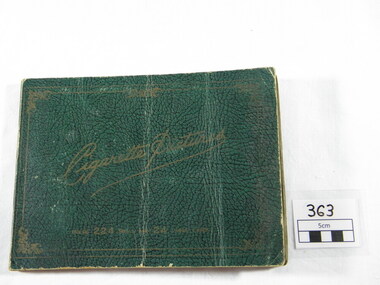
Album, Cigarette Pictures, 1920's-1930's
... ...australian birds...Three pages butterflies in colour. One page Australian birds in colour. Four pages film stars black and white, six to a page,one page of 5, one of 1....Three pages butterflies in colour. One page Australian birds in colour. Four pages film stars black and white, six to a page,one page of 5, one of 1. ...Item donated by Mary Gilbert, headmistress at Orbost High School, a historian who initiated the Orbost Museum.The album contains cigarette cards/swap cards. These were generally collected by schoolchildren and placed in albums made specifically for these cards. Collectors would try to collect the cards for complete teams of footballers, cricketers.Small green-covered album with tile in faded gold on front. Filled with small cigarette cards. Eight cards per page. Cards put into slit corners.Seven pages of footballers in black and white. One page coloured, one with 5 only, coloured.Three page cricketers in black and white. Three pages butterflies in colour. One page Australian birds in colour. Four pages film stars black and white, six to a page,one page of 5, one of 1.Inscription on front cover in centre.Faded gold cursive writing."Cigarette Pictures". At foot of cover in faded gold block letters."HOLDS 224 SMALL AND 24 LARGE CARDS"album, cigarette cards, 1920 1930, football players, cricketers, film stars, australian birds, butterflies, mary gilbert, english cigarette cards -
 The Beechworth Burke Museum
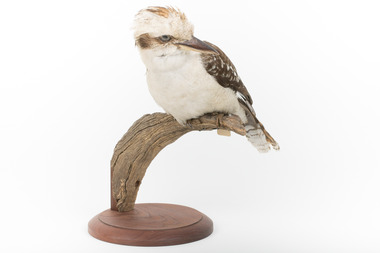
Animal specimen - Kookaburra, Trustees of the Australian Museum, 1860-1880
... ...australian birds...This species reside in woodlands and open forests, however they can be seen in parks, wetlands, farms and any other space that is open with grass. This native Australian bird can mainly be found across the eastern Australia, however they have been introduced Tasmania, South-west Western Australia and New Zealand. ...This collection continues to be on display in the Museum and has become a key part to interpreting the collecting habits of the 19th century. taxidermy mount taxidermy animalia burke museum beechworth australian museum skin reynell eveleigh johns bird kookaburra australian birds laughing kookaburra W8083 / This Kookaburra has a predominantly white body. ...The Kookaburra is a sociable bird commonly seen in small flocks. These flocks mainly consist of family members. If not in flocks, these birds are commonly seen in pairs. They have a distinct appearance with brown wings, back and brown around the eyes, with majority of the plumage being white. This species reside in woodlands and open forests, however they can be seen in parks, wetlands, farms and any other space that is open with grass. This native Australian bird can mainly be found across the eastern Australia, however they have been introduced Tasmania, South-west Western Australia and New Zealand. Although this is a taxidermy mount, it looks exactly like a Kookaburra in real life. This specimen is part of a collection of almost 200 animal specimens that were originally acquired as skins from various institutions across Australia, including the Australian Museum in Sydney and the National Museum of Victoria (known as Museums Victoria since 1983), as well as individuals such as amateur anthropologist Reynell Eveleigh Johns between 1860-1880. These skins were then mounted by members of the Burke Museum Committee and put-on display in the formal space of the Museum’s original exhibition hall where they continue to be on display. This display of taxidermy mounts initially served to instruct visitors to the Burke Museum of the natural world around them, today it serves as an insight into the collecting habits of the 19th century.This specimen is part of a significant and rare taxidermy mount collection in the Burke Museum. This collection is scientifically and culturally important for reminding us of how science continues to shape our understanding of the modern world. They demonstrate a capacity to hold evidence of how Australia’s fauna history existed in the past and are potentially important for future environmental research. This collection continues to be on display in the Museum and has become a key part to interpreting the collecting habits of the 19th century.This Kookaburra has a predominantly white body. The back, wings and tail are a light shade of brown. There is a strip of brown going across the eyes. This specimen stands upon a wooden branch and has an identification tag ties around its leg. This bird is stout in shape and has a medium length tail and a broad bill. This bill is darker on top and lighter in colour on the bottom.W8083 / taxidermy mount, taxidermy, animalia, burke museum, beechworth, australian museum, skin, reynell eveleigh johns, bird, kookaburra, australian birds, laughing kookaburra -
 The Beechworth Burke Museum
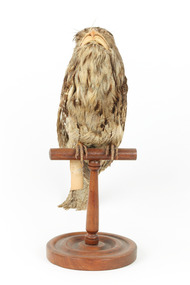
Animal specimen - Tawny Frogmouth, Trustees of the Australian Museum, 1860-1880
... ...australian birds...The Tawny Frogmouth, although often mistaken for an owl, is a nocturnal Australian bird of the Podargidae family that is more closely related to the nightjars. ...The Tawny Frogmouth, although often mistaken for an owl, is a nocturnal Australian bird of the Podargidae family that is more closely related to the nightjars. ...The Tawny Frogmouth, although often mistaken for an owl, is a nocturnal Australian bird of the Podargidae family that is more closely related to the nightjars. They are widespread in terms of distribution and can be found all across mainland Australia and Tasmania in a diverse variety of habitats from woodlands, forests and urban areas. Masters of camouflage, the Tawny Frogmouth sleeps during the day on tree branches in a stiff upward facing position (as with this specimen) to mimic broken tree branches, their feathers assist in this deception as the mottled grey and brown colours blend into the environment seamlessly. This specimen differs in colours from the usual appearance of a Tawny Frogmouth, as the beak is usually a olive-grey to blackish tone and the plumage is generally more dominantly grey all over the bird. This specimen is part of a collection of almost 200 animal specimens that were originally acquired as skins from various institutions across Australia, including the Australian Museum in Sydney and the National Museum of Victoria (known as Museums Victoria since 1983), as well as individuals such as amateur anthropologist Reynell Eveleigh Johns between 1860-1880. These skins were then mounted by members of the Burke Museum Committee and put-on display in the formal space of the Museum’s original exhibition hall where they continue to be on display. This display of taxidermy mounts initially served to instruct visitors to the Burke Museum of the natural world around them, today it serves as an insight into the collecting habits of the 19th century.This specimen is part of a significant and rare taxidermy mount collection in the Burke Museum. This collection is scientifically and culturally important for reminding us of how science continues to shape our understanding of the modern world. They demonstrate a capacity to hold evidence of how Australia’s fauna history existed in the past and are potentially important for future environmental research. This collection continues to be on display in the Museum and has become a key part to interpreting the collecting habits of the 19th century.This Tawny Frogmouth has a broad head and a creamy beige coloured wide triangular beak with a hooked tip. The plumage on the head and back of the bird is a combination of darker and rufous browns, mottled with streaks of cream and grey. The underside of the bird from the bottom of the beak to the tail tip is a lighter cream colour with streaks of rufous-brown. The feet are an orange-brown colour. This specimen is adopting the skyward looking pose associated with the species, mimicking dead tree branches.1a. / More-Park / See Catalogue, page 7 /taxidermy mount, taxidermy, burke museum, beechworth, australian museum, skin, reynell eveleigh johns, bird, australian birds, tawny frogmouth, frogmouth -
 Ringwood and District Historical Society
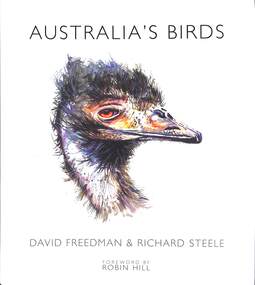
Book, David Freedman, Australia's Birds
... Hard Cover Book Of 150 Australian Birds....Forward By Robin Hill Design By Gavin Fry Hard Cover Book Of 150 Australian Birds. Australia's Birds Book David Freedman Edmund & Alexander, 2021 Adams Print ...Hard Cover Book Of 150 Australian Birds.Forward By Robin Hill Design By Gavin Fry -
 National Wool Museum
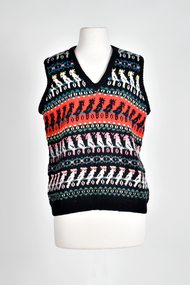
Clothing - Vest, 1980s
... Sleeveless knitted vest with Australian bird motifs....Knitwear Fashion Vest Australiana Birds Fauna 1980s Sleeveless knitted vest with Australian bird motifs. Clothing Vest ...Sleeveless knitted vest with Australian bird motifs.knitwear, fashion, vest, australiana, birds, fauna, 1980s -
 The Beechworth Burke Museum
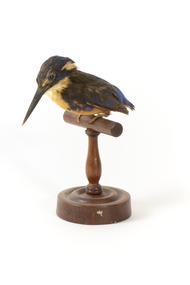
Animal specimen - Azure kingfisher, Trustees of the Australian Museum, 1860-1880
... ...australian birds...They are the smallest kingfisher found in Australia. These birds feed on yabbies and small fish. ...They are the smallest kingfisher found in Australia. These birds feed on yabbies and small fish. ...The Azure kingfisher can be located throughout northern and eastern Australia. It can also been found in parts of Indonesia, New Guinea and surrounding islands. This species frequents the Kimberley region in Western Australia and and the Top End of Queensland. In Victoria, it resides inland near the Murray-Darling Basin. These birds prefer to make their homes near bodies of water such as creeks and rivers. They live in areas with shady vegetation. This particular species of Kingfisher are known for their bright and contrasting colouring and tiny stature. They are the smallest kingfisher found in Australia. These birds feed on yabbies and small fish. This specimen is part of a collection of almost 200 animal specimens that were originally acquired as skins from various institutions across Australia, including the Australian Museum in Sydney and the National Museum of Victoria (known as Museums Victoria since 1983), as well as individuals such as amateur anthropologist Reynell Eveleigh Johns between 1860-1880. These skins were then mounted by members of the Burke Museum Committee and put-on display in the formal space of the Museum’s original exhibition hall where they continue to be on display. This display of taxidermy mounts initially served to instruct visitors to the Burke Museum of the natural world around them, today it serves as an insight into the collecting habits of the 19th century.This specimen is part of a significant and rare taxidermy mount collection in the Burke Museum. This collection is scientifically and culturally important for reminding us of how science continues to shape our understanding of the modern world. They demonstrate a capacity to hold evidence of how Australia’s fauna history existed in the past and are potentially important for future environmental research. This collection continues to be on display in the Museum and has become a key part to interpreting the collecting habits of the 19th century.The Azure kingfisher is stylised perched upon a wooden stand and has a paper identification tag attached to one of its legs. This bird has a combination of blue, yellow/orange and black plumage. The orange colour is located upon its chest while the royal blue is upon the rear of the bird on its back and head. The blue has faded in places due to age. The specimen is a diminutive bird species with a wide torso and a long and slender black bill. It has a short tail and two glass black eyes. The feet are a pale cream colour.11a. / Azure Kingfisher See Catalogue, page 9. /taxidermy mount, taxidermy, animalia, burke museum, beechworth, australian museum, skin, reynell eveleigh johns, bird, australian birds, kingfisher, azure, azure kingfisher, small birds, brightly coloured birds -
 Mission to Seafarers Victoria
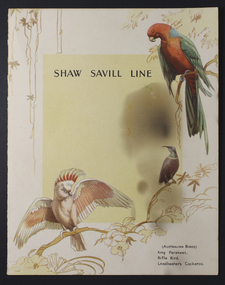
Souvenir - Menu, Shaw Savill Line SS Athenic, Christmas 1948, 25/12/1948
... ...birds, australian...Single fold heavy card menu with colour cover featuring birds of Australia: King parrot, Rifle bird, Leadbetter's cockatoo. ...The memorabilia relates to his career at sea and in particular the role of an engineer, including a handwritten manual of notes and references relating to the mechanical and engineering aspects and areas of responsibility for maintenance. menu birds, australian christmas ss athenic shaw savill line george winfield duncan (1922-2017) ship engineer see images Single fold heavy card menu with colour cover featuring birds of Australia: King parrot, Rifle bird, Leadbetter's cockatoo. ...Included in the G W Duncan collection this item of memorabilia from 1948 may have been acquired quite early in the donor's career as a ship's engineer. The menu provides a glimpse of shipboard diet and especially celebratory food.Mariner Duncan had a particular regard for the Mission to Seafarers. This plate for display on a commissioned new table at the MTSV chapel acknowledges his bequest and the material donated. Collectively the G W Duncan material includes: photographs, professional data memorabilia and written and commercially printed resources. The memorabilia relates to his career at sea and in particular the role of an engineer, including a handwritten manual of notes and references relating to the mechanical and engineering aspects and areas of responsibility for maintenance. Single fold heavy card menu with colour cover featuring birds of Australia: King parrot, Rifle bird, Leadbetter's cockatoo. Inside cover typed sheet of paper with menu listing adhered to card.see imagesmenu, birds, australian, christmas, ss athenic, shaw savill line, george winfield duncan (1922-2017), ship engineer -
 The Beechworth Burke Museum
Animal specimen - Buff-banded rail, Trustees of the Australian Museum, 1860-1880
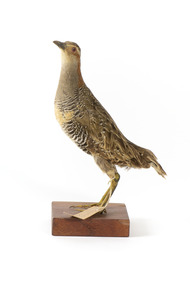
... ...australian birds...bird in the rail family, Rallidae, known for its striking plumage and strong dispersal abilities. This species includes multiple subspecies found across Australasia and the southwest Pacific, with populations in the Philippines, where it is called tikling, and New Guinea, Australia, New Zealand, where it is referred to as the banded rail or moho-pererū in Māori—and various smaller islands. ...This collection continues to be on display in the Museum and has become a key part to interpreting the collecting habits of the 19th century. taxidermy mount taxidermy animalia burke museum beechworth australian museum skin reynell eveleigh johns bird spotted crake crake australian birds australian spotted crake Buff-banded rail 19c Spotted Water Crake. ...The buff-banded rail is a medium-sized bird in the rail family, Rallidae, known for its striking plumage and strong dispersal abilities. This species includes multiple subspecies found across Australasia and the southwest Pacific, with populations in the Philippines, where it is called tikling, and New Guinea, Australia, New Zealand, where it is referred to as the banded rail or moho-pererū in Māori—and various smaller islands. This specimen was misidentified as an Australian Spotted Crake in original catalogue records and is part of a collection of almost 200 animal specimens that were originally acquired as skins from various institutions across Australia, including the Australian Museum and the National Museum of Victoria, as well as individuals such amateur anthropologist Reynell Eveleigh Johns between 1860-1880. These skins were then mounted by members of the Burke Museum Committee and put-on display in the formal space of the Museum’s original exhibition hall where they continue to be on display. This display of taxidermy mounts initially served to instruct visitors to the Burke Museum of the natural world around them, today it serves as an insight into the collecting habits of the 19th century. This specimen is part of a significant and rare taxidermy mount collection in the Burke Museum. This collection is scientifically and culturally important for reminding us of how science continues to shape our understanding of the modern world. They demonstrate a capacity to hold evidence of how Australia’s fauna history existed in the past and are potentially important for future environmental research. This collection continues to be on display in the Museum and has become a key part to interpreting the collecting habits of the 19th century.This specimen is a small, stocky bird with yellow legs and bill. The Buff-banded Rail has grey colouring on its neck and an orange on the nape of its neck. The torso and rear are striped with black and grey/cream colours and have white spots along the rear. The specimen has brown feathers on the wings. It stands on a wooden platform in a standing position with a paper identification tag tied around its left leg. 19c Spotted Water Crake. See Catalogue, Page, 35.taxidermy mount, taxidermy, animalia, burke museum, beechworth, australian museum, skin, reynell eveleigh johns, bird, spotted crake, crake, australian birds, australian spotted crake, buff-banded rail -
 The Beechworth Burke Museum
Animal specimen - Australian White Ibis, Trustees of the Australian Museum, 1860-1880
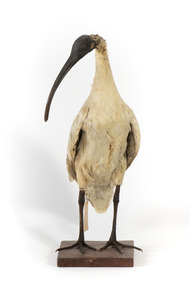
... ...australian birds...This bird is located throughout the wetlands of eastern, northern and south-western Australia. ...This collection continues to be on display in the Museum and has become a key part to interpreting the collecting habits of the 19th century. taxidermy mount taxidermy animalia burke museum beechworth australian museum skin reynell eveleigh johns bird ibis bin chicken white ibis australian birds australian white ibis 5 C. / White Ibis / See catalogue / Page 32 / This Australian White Ibis has white and cream plumage on its body and a black neck, head, bill and legs/feet. ...The Australian White Ibis is commonly known by the colloquial names "bin chicken" and "tip turkey" in Australian culture. These nicknames have arisen based on the presence of this bird at garbage locations where it is often seen rummaging through the waste. The Yindjibarndi people of the central and western Pilbara call this species mardungurra. This bird is located throughout the wetlands of eastern, northern and south-western Australia. Initially, it was not seen in urban areas, however, the species has been able to adapt and reduce fear of humans due to the lure of food found in human garbage. They commonly feed on terrestrial and aquatic invertebrates alongside human scraps. This specimen is part of a collection of almost 200 animal specimens that were originally acquired as skins from various institutions across Australia, including the Australian Museum in Sydney and the National Museum of Victoria (known as Museums Victoria since 1983), as well as individuals such as amateur anthropologist Reynell Eveleigh Johns between 1860-1880. These skins were then mounted by members of the Burke Museum Committee and put-on display in the formal space of the Museum’s original exhibition hall where they continue to be on display. This display of taxidermy mounts initially served to instruct visitors to the Burke Museum of the natural world around them, today it serves as an insight into the collecting habits of the 19th century.This specimen is part of a significant and rare taxidermy mount collection in the Burke Museum. This collection is scientifically and culturally important for reminding us of how science continues to shape our understanding of the modern world. They demonstrate a capacity to hold evidence of how Australia’s fauna history existed in the past and are potentially important for future environmental research. This collection continues to be on display in the Museum and has become a key part to interpreting the collecting habits of the 19th century.This Australian White Ibis has white and cream plumage on its body and a black neck, head, bill and legs/feet. The bill on this particular species has a distinctive long shape which is down-curved. It is a fairly large variety of the Ibis species. This specimen has been stylised in a standing position and is positioned on a wooden platform. 5 C. / White Ibis / See catalogue / Page 32 /taxidermy mount, taxidermy, animalia, burke museum, beechworth, australian museum, skin, reynell eveleigh johns, bird, ibis, bin chicken, white ibis, australian birds, australian white ibis -
 Bendigo Historical Society Inc.
Newspaper - LYDIA CHANCELLOR COLLECTION: WONDERS OF THE OUTBACK
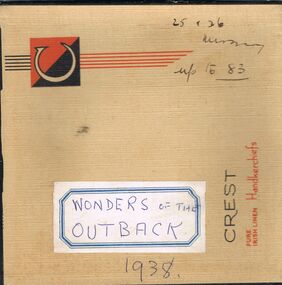
... ... Australian birds...SCIENCES General flora and fauna Lydia Chancellor collection Australian outback outback Australian wildlife wildlife Australian Aborigines Aborigines Australian birds birds Australian rock carvings rock carvings Australian deserts deserts Aboriginal place sciences region Australia plants flora fauna Wonders of the outback 1938. 25 + 26 missing. ...A handkerchief box containing newspaper cuttings from 'The Sun-News Pictorial' dated 1938, 'Wonders Of The Outback' on the beauty of and life in the outback. A series numbered 1 to 83. these clips contain photos and descriptions of Aboriginal/Indigenous People, Flora, Fauna, Lizards, Insects, land formations etc.Wonders of the outback 1938. 25 + 26 missing. Up to 83sciences, general, flora and fauna, lydia chancellor, collection, australian outback, outback, australian wildlife, wildlife, australian aborigines, aborigines, australian birds, birds, australian rock carvings, rock carvings, australian deserts, deserts, aboriginal, place, sciences, region, australia, plants, flora, fauna -
 Mont De Lancey
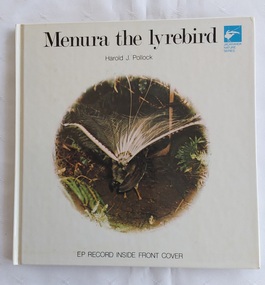
Mixed media - Book and Record, Harold J. Pollock, Menura the Lyrebird, 1979 Metric ed
... ...Australian birds...It is a follow-up to the previously very successful record of Australian Bird songs by Carl and Lise Weismann in 1957 - 58. ...A book and recording of Australian Bush Sounds from the Victorian border to Cape York. It is a follow-up to the previously very successful record of Australian Bird songs by Carl and Lise Weismann in 1957 - 58. All were recorded in their natural surroundings but for the Dingoes which they had to insert the howls of a group in a faunal reserve. The lyrebird was drawn from and excellent sequence by Harold Pollock. The book describes the Sound and Communication in Animals and Insect Sounds.A slim square hardcover book with text by Harold J. Pollock and an EP record inside the front cover - Menura the Lyrebird Australian Bush Sounds. The cover has a photograph of a Black Swan nesting in open wetlands. Inside the left front cover is a pocket with an EP record recorded by Harold j. Pollock. by The book has explanations of the sounds recorded as well as black and white photographs of the lyrebirds featured. Pp.20. There is small gift card included with a coloured illustration on the front of The Mountain Pheasant (Lyrebird) On the back of the card is a description of the artist, R Browne, who was a convict artist of little renown. The card was printed to aid: Victorian Association for Mental Health, Camberwell, Vic.3124. Pp.20. non-fictionA book and recording of Australian Bush Sounds from the Victorian border to Cape York. It is a follow-up to the previously very successful record of Australian Bird songs by Carl and Lise Weismann in 1957 - 58. All were recorded in their natural surroundings but for the Dingoes which they had to insert the howls of a group in a faunal reserve. The lyrebird was drawn from and excellent sequence by Harold Pollock. The book describes the Sound and Communication in Animals and Insect Sounds.animals, australian birds, australian animals, lyrebirds, recording -
 Mont De Lancey
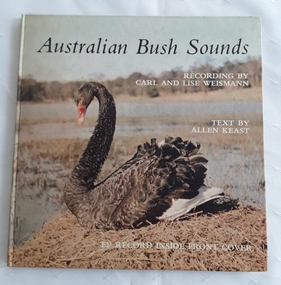
Mixed media - Book and Record, Australian Bush Sounds - book, Australian Bush Sounds, 1968
... ...Australian birds...Animals Insects Mammals Australian birds Australian animals A book and recording of Australian Bush Sounds from the Victorian border to Cape York. ...A book and recording of Australian Bush Sounds from the Victorian border to Cape York. It is a follow-up to the previously very successful record of Australian Bird songs by Carl and Lise Weismann in 1957 - 58. All were recorded in their natural surroundings but for the Dingoes which they had to insert the howls of a group in a faunal reserve. The lyrebird was drawn from and excellent sequence by Harold Pollock. The book describes the Sound and Communication in Animals and Insect Sounds.A slim square hardcover book with text by Allen Keast and a record of Australian Bush Sounds. The cover has a photograph of a Black Swan nesting in open wetlands. Inside the left front cover is a pocket with an EP record by Carl and Lise Weismann. The book has explanations of the sounds recorded as well as black and white photographs of the creatures featured. p.20.non-fictionA book and recording of Australian Bush Sounds from the Victorian border to Cape York. It is a follow-up to the previously very successful record of Australian Bird songs by Carl and Lise Weismann in 1957 - 58. All were recorded in their natural surroundings but for the Dingoes which they had to insert the howls of a group in a faunal reserve. The lyrebird was drawn from and excellent sequence by Harold Pollock. The book describes the Sound and Communication in Animals and Insect Sounds.animals, insects, mammals, australian birds, australian animals -
 Tatura Irrigation & Wartime Camps Museum
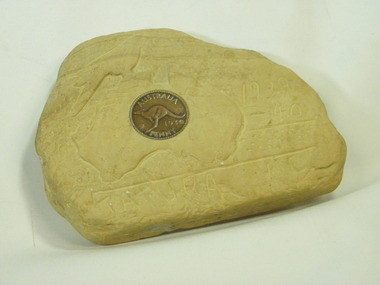
Carving, sandstone, 1940
... "Tatura Vic.1939-40." Map of Australia/Bird...."Tatura Vic.1939-40." Map of Australia/Bird. Sandstone piece with carved map of Austraiia, Tatura 1939-1940, and a 1939 penny inserted in the stone. ...Item carved by a German Internee who was held in Camp 1 in WW2. Came into the possession of one of the guards, whose nephew donated it to Tatura MuseumSandstone piece with carved map of Austraiia, Tatura 1939-1940, and a 1939 penny inserted in the stone."Tatura Vic.1939-40." Map of Australia/Bird.internment camp 1, tatura, german internee.. -
 Federation University Historical Collection
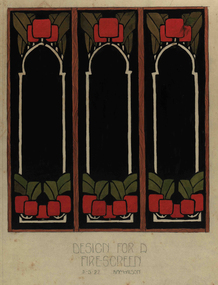
Painting - Ballarat Technical Art School Folio, Ivy Wilson, Artwork by Ivy Wilson, c1920-1922, 1920 - 22 (originals)
... ...Australian birds...Alternatively, given her focus on textile-based arts, she may have been an evening trade student. ballarat school of mines wilson ballarat technical art school dressmaking art Ivy Wilson Stencilling stencil embroidery Australian flora Australian birds A number of digitised images taken from a folder of works by Ivy Wilson undertaken at the Ballarat School of Mines Technical Art School between 1920 and 1922. ...Ivy WILSON (1907-1998) Ballarat | Australia Ivy Wilson lived at 17 Mair Street with her parents while she studied at the Ballarat Technical Art School. Her student folio contains several stencils hand-cut from paper and card. Among them are stylised graphics of correa, waratah, gum, and kangaroo apple as well as kookaburras, cockatoos and a koala. One example of a wreath was subsequently translated into embroidered needlework. Wilson’s folio possibly consists of mostly junior technical work, as she appears to only have sat a single senior Education Department examination, Drawing Plant Forms from Nature. Alternatively, given her focus on textile-based arts, she may have been an evening trade student. A number of digitised images taken from a folder of works by Ivy Wilson undertaken at the Ballarat School of Mines Technical Art School between 1920 and 1922. The folio of work was later donated 'In memory of my mother Ivy Wilson'.ballarat school of mines, wilson, ballarat technical art school, dressmaking, art, ivy wilson, stencilling, stencil, embroidery, australian flora, australian birds -
 The Beechworth Burke Museum
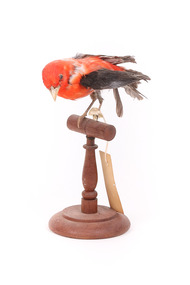
Animal specimen - Scarlet Tanager (male), Trustees of the Australian Museum, 1860-1880
... ...australian birds...birds can also die from collisions with man made objects which includes the TV and radio towers, buildings and cars. They also have high rates of predation and brood parasitism. However, at current the IUCN classifies this species as Least Concern and note that their numbers are stable. This specimen is part of a collection of almost 200 animal specimens that were originally acquired as skins from various institutions across Australia...This collection continues to be on display in the Museum and has become a key part to interpreting the collecting habits of the 19th century. taxidermy mount taxidermy animalia burke museum beechworth australian museum skin reynell eveleigh johns bird australian birds american american birds scarlet tanager tanager medium bird small bird Swing tag: 114a / unnamed / catalogue, page 59 Cotton tag: A.4440 / The Scarlet Tanager specimen stands perched on a wooden platform looking towards the ground. ...The Scarlet Tanager is an American songbird of medium size with bright coloured plumage. They are commonly located in eastern North America and in northwestern South America. They can often be found within woodlands that have oaks. On occasion, the Tanager can be seen in suburban areas including parks and gardens. These birds are sociable and often join with other foraging flocks. They are carnivores (insectivores) and feed on insects including wasps, ants, moths, beetles, butterflies and grasshoppers. The numbers of these birds in America are declining due to exposure and starvation during the colder months. These birds can also die from collisions with man made objects which includes the TV and radio towers, buildings and cars. They also have high rates of predation and brood parasitism. However, at current the IUCN classifies this species as Least Concern and note that their numbers are stable. This specimen is part of a collection of almost 200 animal specimens that were originally acquired as skins from various institutions across Australia, including the Australian Museum in Sydney and the National Museum of Victoria (known as Museums Victoria since 1983), as well as individuals such as amateur anthropologist Reynell Eveleigh Johns between 1860-1880. These skins were then mounted by members of the Burke Museum Committee and put-on display in the formal space of the Museum’s original exhibition hall where they continue to be on display. This display of taxidermy mounts initially served to instruct visitors to the Burke Museum of the natural world around them, today it serves as an insight into the collecting habits of the 19th century.This specimen is part of a significant and rare taxidermy mount collection in the Burke Museum. This collection is scientifically and culturally important for reminding us of how science continues to shape our understanding of the modern world. They demonstrate a capacity to hold evidence of how Australia’s fauna history existed in the past and are potentially important for future environmental research. This collection continues to be on display in the Museum and has become a key part to interpreting the collecting habits of the 19th century.The Scarlet Tanager specimen stands perched on a wooden platform looking towards the ground. It has bright red/orange feathers on the main body and head with dark black feathers on the tail and wings. Overall, whilst retaining a bright appearance the bird has faded in contrast to it's original colouring This particular specimen has disheveled feathers and is missing one leg. The bill is short and pale and the specimen has been provided with glass eyes made in a dark colour. The specimen has two paper identification tags attached to the damaged leg.Swing tag: 114a / unnamed / catalogue, page 59 Cotton tag: A.4440 /taxidermy mount, taxidermy, animalia, burke museum, beechworth, australian museum, skin, reynell eveleigh johns, bird, australian birds, american, american birds, scarlet tanager, tanager, medium bird, small bird -
 The Beechworth Burke Museum
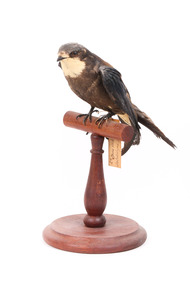
Animal specimen - White-Throated Needletail, Trustees of the Australian Museum, 1860-1880
... ...australian birds...birds of different species. They have a distinctive white throat and undertail. This species is mainly airborne, however they are known to reside in trees when on land. They can mainly be spotted along the north and east parts of Australia...This collection continues to be on display in the Museum and has become a key part to interpreting the collecting habits of the 19th century. taxidermy mount taxidermy burke museum beechworth australian museum skin reynell eveleigh johns bird white-throated needletail australian birds 2a / Spine-Tailed Swift / See catalogue, page 7 This White-Throated Needletail had grey-brown feathers. ...The White-Throated Needletail is a highly sociable bird commonly seen in large flocks containing a hundred plus birds. This species is also known to mingle with birds of different species. They have a distinctive white throat and undertail. This species is mainly airborne, however they are known to reside in trees when on land. They can mainly be spotted along the north and east parts of Australia. This species is listed as vulnerable and threatened in the Australian Capital Territory, Queensland and Victoria. Since this is a taxidermy mount, it is not an accurate depiction of the White-Throated Needletail. The species should have a predominantly grey-brown plumage, with the exception of the throat and undertail which are white. There should also be a green tint to the species feathers. This specimen is part of a collection of almost 200 animal specimens that were originally acquired as skins from various institutions across Australia, including the Australian Museum in Sydney and the National Museum of Victoria (known as Museums Victoria since 1983), as well as individuals such as amateur anthropologist Reynell Eveleigh Johns between 1860-1880. These skins were then mounted by members of the Burke Museum Committee and put-on display in the formal space of the Museum’s original exhibition hall where they continue to be on display. This display of taxidermy mounts initially served to instruct visitors to the Burke Museum of the natural world around them, today it serves as an insight into the collecting habits of the 19th century.This specimen is part of a significant and rare taxidermy mount collection in the Burke Museum. This collection is scientifically and culturally important for reminding us of how science continues to shape our understanding of the modern world. They demonstrate a capacity to hold evidence of how Australia’s fauna history existed in the past and are potentially important for future environmental research. This collection continues to be on display in the Museum and has become a key part to interpreting the collecting habits of the 19th century.This White-Throated Needletail had grey-brown feathers. It has distinctive white patches on its throat and under the tail. The back of the bird is a light brown with a white patch in the center of the back. This specimen stands upon a wooden mount and has an identification tag tied around its leg. The bill is short and the wings are long and pointed. The bird's tail is short and square in shape with protruding feather shafts which give a spiky appearance.2a / Spine-Tailed Swift / See catalogue, page 7taxidermy mount, taxidermy, burke museum, beechworth, australian museum, skin, reynell eveleigh johns, bird, white-throated needletail, australian birds -
 The Beechworth Burke Museum
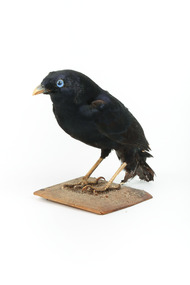
Animal specimen - Satin Bowerbird (male), 1860-1880
... ...australian birds...This collection continues to be on display in the Museum and has become a key part to interpreting the collecting habits of the 19th century. taxidermy mount taxidermy animalia burke museum beechworth australian museum skin reynell eveleigh johns bird australian birds bower bowerbird satin bowerbird Donor - Mr. ...The Satin Bowerbird is commonly located around the eastern and south-eastern coast of Australia. They reside in wetter forests and woodlands, and nearby open areas. They feed mostly on fruits throughout the year but in summer will supplement their food supply with insects and in winter with leaves. The Satin Bowerbird is most commonly known for it's practice of building and decorating it's bower. They will often collect objects of bright blue to decorate the bower including straws, clothes peg, parrot feathers, pens, marble, string, glass and bottle tops. This decoration is done by a male Bowerbird in the effort to attract females. This specimen is part of a collection of almost 200 animal specimens that were originally acquired as skins from various institutions across Australia, including the Australian Museum in Sydney and the National Museum of Victoria (known as Museums Victoria since 1983), as well as individuals such as amateur anthropologist Reynell Eveleigh Johns between 1860-1880. These skins were then mounted by members of the Burke Museum Committee and put-on display in the formal space of the Museum’s original exhibition hall where they continue to be on display. This display of taxidermy mounts initially served to instruct visitors to the Burke Museum of the natural world around them, today it serves as an insight into the collecting habits of the 19th century.This specimen is part of a significant and rare taxidermy mount collection in the Burke Museum. This collection is scientifically and culturally important for reminding us of how science continues to shape our understanding of the modern world. They demonstrate a capacity to hold evidence of how Australia’s fauna history existed in the past and are potentially important for future environmental research. This collection continues to be on display in the Museum and has become a key part to interpreting the collecting habits of the 19th century.This taxidermy Satin Bowerbird specimen has dark black/blue glossy plumage and a pale coloured bill of small size. The bird is of a medium size compared to other species of birds and has pale legs with short talons. The eyes are made of strikingly blue coloured glass which represents the violet-blue iris of this bird while living. The bird has a short tale and has been stylized in a leaning/crouched position with it's back arched upwards and head out long. This specimen stands on a small platform and there is some deterioration to the tail feathers which protrude beyond the platform which may have otherwise provided some protection. Donor - Mr. E.T. / BH. RO. /taxidermy mount, taxidermy, animalia, burke museum, beechworth, australian museum, skin, reynell eveleigh johns, bird, australian birds, bower, bowerbird, satin bowerbird -
 The Beechworth Burke Museum
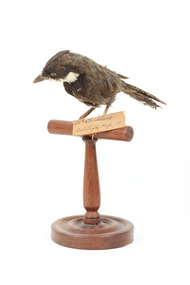
Animal specimen - Eastern Whipbird, Trustees of the Australian Museum, 1860-1880
... ...australian birds...bird. This species generally resides in wet habitats such as wetlands and rainforests, where there is dense vegetation. The Eastern Whipbird can be commonly found along the east coast of Australia. ...This collection continues to be on display in the Museum and has become a key part to interpreting the collecting habits of the 19th century. taxidermy mount taxidermy animalia burke museum beechworth australian museum skin reynell eveleigh johns bird eastern whipbird australian birds 25a / Thickhead / catalogue page 11 This Eastern Whipbird is a small species of bird which has a dramatic stripe of white colouring on either side of the small bill and the crest is black. ...The Eastern Whipbird isusually be found in pairs. They have a distinct white stripe on either side of the beak which helps to identify this bird. This species generally resides in wet habitats such as wetlands and rainforests, where there is dense vegetation. The Eastern Whipbird can be commonly found along the east coast of Australia. Since this is a taxidermy mount, there are a few inconsistencies. The main inconsistency is the colour of the specimen, the plumage should be an olive-green colour. This particular colouring has likely faded due to the taxidermy process and also the age of the specimen. There should also be black plume on top of the head which is missing from this specimen. This specimen is part of a collection of almost 200 animal specimens that were originally acquired as skins from various institutions across Australia, including the Australian Museum in Sydney and the National Museum of Victoria (known as Museums Victoria since 1983), as well as individuals such as amateur anthropologist Reynell Eveleigh Johns between 1860-1880. These skins were then mounted by members of the Burke Museum Committee and put-on display in the formal space of the Museum’s original exhibition hall where they continue to be on display. This display of taxidermy mounts initially served to instruct visitors to the Burke Museum of the natural world around them, today it serves as an insight into the collecting habits of the 19th century.This specimen is part of a significant and rare taxidermy mount collection in the Burke Museum. This collection is scientifically and culturally important for reminding us of how science continues to shape our understanding of the modern world. They demonstrate a capacity to hold evidence of how Australia’s fauna history existed in the past and are potentially important for future environmental research. This collection continues to be on display in the Museum and has become a key part to interpreting the collecting habits of the 19th century.This Eastern Whipbird is a small species of bird which has a dramatic stripe of white colouring on either side of the small bill and the crest is black. The belly and throat are black while the back, wings and tail are dark brown. This specimen stands upon a wooden perch and has an identification tag tied around its leg.25a / Thickhead / catalogue page 11taxidermy mount, taxidermy, animalia, burke museum, beechworth, australian museum, skin, reynell eveleigh johns, bird, eastern whipbird, australian birds -
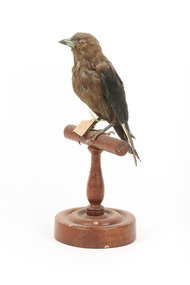 The Beechworth Burke Museum
Animal specimen - Dusky Woodswallow, Trustees of the Australian Museum, 1860-1880
... ...australian birds...Australia. They reside in open forests and woodlands. This species is surprisingly aggressive and may fight with other Woodswallows for territory and nest sights. They will even chase raptors away from their homes. This species flies in flocks of around 10 to 30 birds...This collection continues to be on display in the Museum and has become a key part to interpreting the collecting habits of the 19th century. taxidermy mount taxidermy animalia burke museum beechworth australian museum skin reynell eveleigh johns bird australian birds swallow woodswallow dusky woodswallow [torn] / 9 / The Dusky Woodswallow has largely deep brown colouring with some areas of grey on the head, neck and chest. ...The Dusky Woodswallow is often found in flocks which can be located in two separate populations. The Eastern population if located in Atherton Tableland in Queensland south to Tasmania and west to Eyre Peninsula in South Australia. The other population is found in south-west Western Australia. They reside in open forests and woodlands. This species is surprisingly aggressive and may fight with other Woodswallows for territory and nest sights. They will even chase raptors away from their homes. This species flies in flocks of around 10 to 30 birds which cluster together. In terms of diet, these birds eat insects and nectar from flowers. This specimen is part of a collection of almost 200 animal specimens that were originally acquired as skins from various institutions across Australia, including the Australian Museum in Sydney and the National Museum of Victoria (known as Museums Victoria since 1983), as well as individuals such as amateur anthropologist Reynell Eveleigh Johns between 1860-1880. These skins were then mounted by members of the Burke Museum Committee and put-on display in the formal space of the Museum’s original exhibition hall where they continue to be on display. This display of taxidermy mounts initially served to instruct visitors to the Burke Museum of the natural world around them, today it serves as an insight into the collecting habits of the 19th century.This specimen is part of a significant and rare taxidermy mount collection in the Burke Museum. This collection is scientifically and culturally important for reminding us of how science continues to shape our understanding of the modern world. They demonstrate a capacity to hold evidence of how Australia’s fauna history existed in the past and are potentially important for future environmental research. This collection continues to be on display in the Museum and has become a key part to interpreting the collecting habits of the 19th century.The Dusky Woodswallow has largely deep brown colouring with some areas of grey on the head, neck and chest. There is a deeper brown colouring between the wings on the back of the specimen and the wings are black. This bird has a small curved bill which is grey and white. The legs are dark grey and the bird has long talons with an extra long toe in the centre. The eyes are made of brown glass with a back pupil. The bird is styalised standing on a wooden mount and has a paper identification tag attached to its right leg.[torn] / 9 /taxidermy mount, taxidermy, animalia, burke museum, beechworth, australian museum, skin, reynell eveleigh johns, bird, australian birds, swallow, woodswallow, dusky woodswallow
