
Showing 228 items matching " australian native flora"
-
 Embroiderers Guild, Victoria
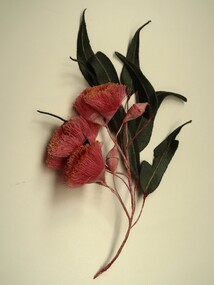
Textile - 3D Botanical Embroidery of Silver Princess Eucalyptus, Lynne Stone, 2025
... Australian native flora...Lynne Stone is a Victorian based textile artist specialising in botanical embroideries of Australian native flora. Lynne has used her technical skills to develop a software program for her sewing machine to automatically stitch some elements of her designs. ...Australian native flora flora Botanical model of Eucalyptus Caesia "Silver Princess" in flower with open flowers, flower buds and leaves. ...Lynne Stone is a Victorian based textile artist specialising in botanical embroideries of Australian native flora. Lynne has used her technical skills to develop a software program for her sewing machine to automatically stitch some elements of her designs. Botanical model of Eucalyptus Caesia "Silver Princess" in flower with open flowers, flower buds and leaves. Embroidered using machine embroidery on an organza base. Wrapped wires and hand embroidered elements, hand coloured.australian native flora, flora -
 Embroiderers Guild, Victoria
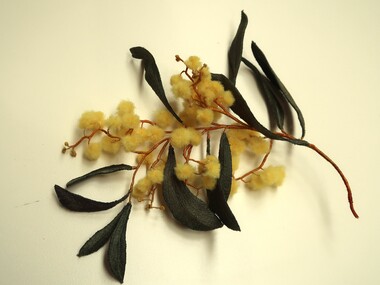
Textile - 3D Botanical Embroidery of Acacia Pycnantha "Golden Wattle", Lynne Stone, 2025
... Australian native flora...Lynne Stone is a Victorian based textile artist specialising in botanical embroideries of Australian native flora. Lynne has used her technical skills to develop a software program for her sewing machine to automatically stitch some elements of her designs. ...Australian native flora flora Botanical model of Acacia Pycnantha "Golden Wattle" in flower with open flowers, flower buds and leaves. ...Lynne Stone is a Victorian based textile artist specialising in botanical embroideries of Australian native flora. Lynne has used her technical skills to develop a software program for her sewing machine to automatically stitch some elements of her designs. Botanical model of Acacia Pycnantha "Golden Wattle" in flower with open flowers, flower buds and leaves. Embroidered using machine embroidery on an organza base. Wrapped wires and hand embroidered elements, hand coloured.australian native flora, flora -
 Federation University Art Collection
Bookplate, ‘Ex Libris Judi Jewell’
... The book plate depicts the flowers of Australian native flora ...The society was instrumental in promoting the art of the bookplate through establishment of the Australian Bookplate Design competition. bookplate printmaking Australian Bookplate Design awards keith Wingrove Memorial Trust Twigden The book plate depicts the flowers of Australian native flora ‘Ex Libris Judi Jewell’ Bookplate ...After a quiet period, interest in bookplates in Australia began to increase in the early 1970s, Entrepreneurial art and book collectors such as Edwin Jewell and others commissioned multiple Bookplate designs from a range of well known fine artists. At a 1997 meeting in Melbourne of the Ephemera Society of Australia Edwin Jewell and others announced the formation of the Australian Bookplate Society. The society was instrumental in promoting the art of the bookplate through establishment of the Australian Bookplate Design competition.The book plate depicts the flowers of Australian native flora Twigdenbookplate, printmaking, australian bookplate design awards, keith wingrove memorial trust -
 Bendigo Historical Society Inc.
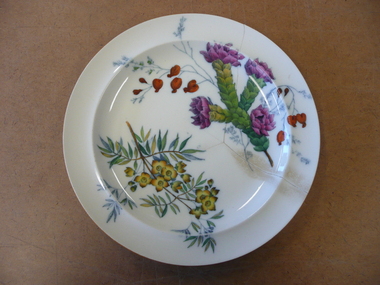
Domestic Object - AUSTRALIAN FLORA PLATE
... Wedgewood china plate decorated with Australian native flora in shades of green, yellow, red & orange....DOMESTIC EQUIPMENT Food consumption plates Wedgewood DM1W A1927 Wedgewood china plate decorated with Australian native flora in shades of green, yellow, red & orange. ...Wedgewood china plate decorated with Australian native flora in shades of green, yellow, red & orange.Wedgewood DM1W A1927domestic equipment, food consumption, plates -
 Embroiderers Guild, Victoria
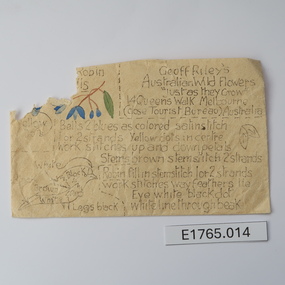
Textile - Geoff Riley embroidery design envelope - Robin red breast & Blue bells, Geoff Riley, 1920's-1956/7
... Australia... Australian native flora...From deceased estate of EGV member Geoff Riley 20th century Australia Australian native flora Australian native fauna See images Printed envelope with pattern and stitch directions -Robin Red breast and Blue bells on front of envelope. ...From deceased estate of EGV memberPrinted envelope with pattern and stitch directions -Robin Red breast and Blue bells on front of envelope. Small bundle of threads inside envelope. Designed and sold by Geoff Riley, water colour artist from his shop "The Wildflower Shop", 14 Queen's Walk, Melbourne from the 1930' to the 1950's. See imagesgeoff riley, 20th century, australia, australian native flora, australian native fauna -
 Embroiderers Guild, Victoria
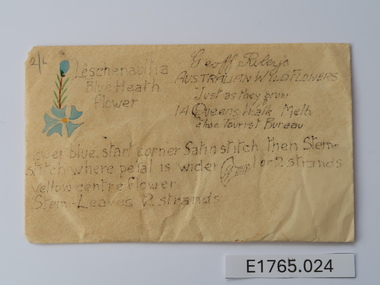
Textile - Geoff Riley embroidery design envelope - Leschenaullia Blue Heath Flower, Geoff Riley, 1920's-1956/7
... Australia... Australian native flora...From deceased estate of EGV member Geoff Riley 20th century Australia Australian native flora Australian native fauna See images Printed envelope with pattern and stitch directions -Leschenaullia Blue Heath Flower. ...From deceased estate of EGV memberPrinted envelope with pattern and stitch directions -Leschenaullia Blue Heath Flower. Bundle of threads inside envelope. Designed and sold by Geoff Riley, water colour artist from his shop "The Wildflower Shop", 14 Queen's Walk, Melbourne from the 1930' to the 1950's. See imagesgeoff riley, 20th century, australia, australian native flora, australian native fauna -
 Embroiderers Guild, Victoria
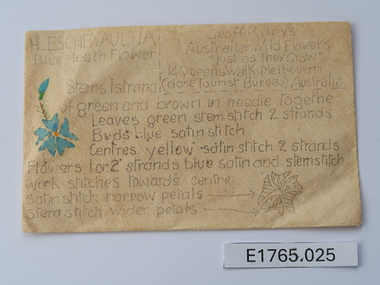
Textile - Geoff Riley embroidery design envelope - Leschenaullia Blue Heath Flower, Geoff Riley, 1920's-1956/7
... Australia... Australian native flora...From deceased estate of EGV member Geoff Riley 20th century Australia Australian native flora Australian native fauna See images Printed envelope with pattern and stitch directions -Leschenaullia Blue Heath Flower. ...From deceased estate of EGV memberPrinted envelope with pattern and stitch directions -Leschenaullia Blue Heath Flower. Bundle of threads inside envelope. Designed and sold by Geoff Riley, water colour artist from his shop "The Wildflower Shop", 14 Queen's Walk, Melbourne from the 1930' to the 1950's. See imagesgeoff riley, 20th century, australia, australian native flora, australian native fauna -
 Embroiderers Guild, Victoria
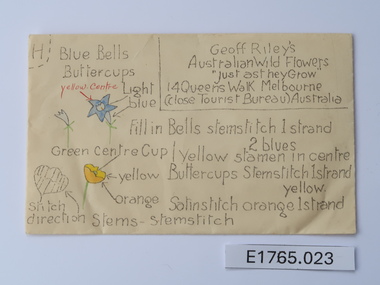
Textile - Geoff Riley embroidery design envelope - Blue bells and buttercups, Geoff Riley, 1920's-1956/7
... Australia... Australian native flora...From deceased estate of EGV member Geoff Riley 20th century Australia Australian native flora Australian native fauna See images Printed envelope with pattern and stitch directions -Blue bells and Buttercups. ...From deceased estate of EGV memberPrinted envelope with pattern and stitch directions -Blue bells and Buttercups. Bundle of threads inside envelope. Designed and sold by Geoff Riley, water colour artist from his shop "The Wildflower Shop", 14 Queen's Walk, Melbourne from the 1930' to the 1950's. See imagesgeoff riley, 20th century, australia, australian native flora, australian native fauna -
 Embroiderers Guild, Victoria
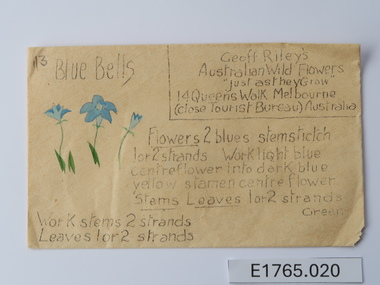
Textile - Geoff Riley embroidery design envelope - Blue bells, Geoff Riley, 1920's-1956/7
... Australia... Australian native flora...From deceased estate of EGV member Geoff Riley 20th century Australia Australian native flora Australian native fauna See images Printed envelope with pattern and stitch directions -Blue bells. ...From deceased estate of EGV memberPrinted envelope with pattern and stitch directions -Blue bells. Bundle of threads inside envelope. Designed and sold by Geoff Riley, water colour artist from his shop "The Wildflower Shop", 14 Queen's Walk, Melbourne from the 1930' to the 1950's. See imagesgeoff riley, 20th century, australia, australian native flora, australian native fauna -
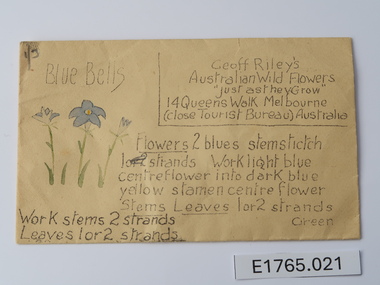 Embroiderers Guild, Victoria
Textile - Geoff Riley embroidery design envelope - Blue bells, Geoff Riley, 1920's-1956/7
... Australia... Australian native flora...From deceased estate of EGV member Geoff Riley 20th century Australia Australian native flora Australian native fauna See images Printed envelope with pattern and stitch directions -Blue bells. ...From deceased estate of EGV memberPrinted envelope with pattern and stitch directions -Blue bells. Bundle of threads inside envelope. Designed and sold by Geoff Riley, water colour artist from his shop "The Wildflower Shop", 14 Queen's Walk, Melbourne from the 1930' to the 1950's. See imagesgeoff riley, 20th century, australia, australian native flora, australian native fauna -
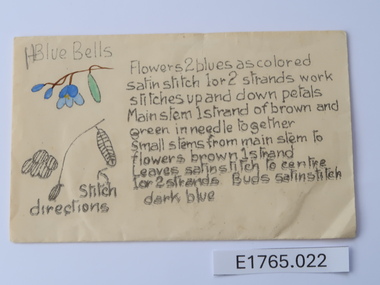 Embroiderers Guild, Victoria
Textile - Geoff Riley embroidery design envelope - Blue bells, Geoff Riley, 1920's-1956/7
... Australia... Australian native flora...From deceased estate of EGV member Geoff Riley 20th century Australia Australian native flora Australian native fauna See images Printed envelope with pattern and stitch directions -Blue bells. ...From deceased estate of EGV memberPrinted envelope with pattern and stitch directions -Blue bells. Bundle of threads inside envelope. Designed and sold by Geoff Riley, water colour artist from his shop "The Wildflower Shop", 14 Queen's Walk, Melbourne from the 1930' to the 1950's. See imagesgeoff riley, 20th century, australia, australian native flora, australian native fauna -
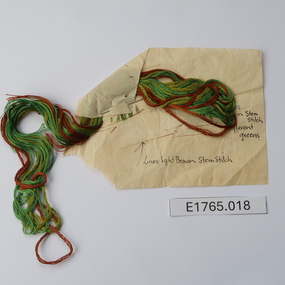 Embroiderers Guild, Victoria
Textile - Geoff Riley embroidery design sheet - grass, Geoff Riley, 1920's-1956/7
... Australia... Australian native flora...From deceased estate of EGV member Geoff Riley 20th century Australia Australian native flora Australian native fauna See images Printed sheet with pattern and stitch directions -grass. ...From deceased estate of EGV memberPrinted sheet with pattern and stitch directions -grass. Bundle of threads pinned under folded corner. Designed and sold by Geoff Riley, water colour artist from his shop "The Wildflower Shop", 14 Queen's Walk, Melbourne from the 1930' to the 1950's. See imagesgeoff riley, 20th century, australia, australian native flora, australian native fauna -
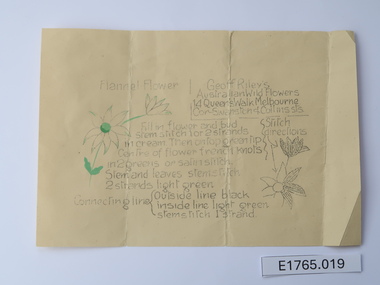 Embroiderers Guild, Victoria
Textile - Geoff Riley embroidery design sheet - Flannel flower, Geoff Riley, 1920's-1956/7
... Australia... Australian native flora...From deceased estate of EGV member Geoff Riley 20th century Australia Australian native flora Australian native fauna See images Printed sheet with pattern and stitch directions -Flannel flower. ...From deceased estate of EGV memberPrinted sheet with pattern and stitch directions -Flannel flower. Designed and sold by Geoff Riley, water colour artist from his shop "The Wildflower Shop", 14 Queen's Walk, Melbourne from the 1930' to the 1950's. See imagesgeoff riley, 20th century, australia, australian native flora, australian native fauna -
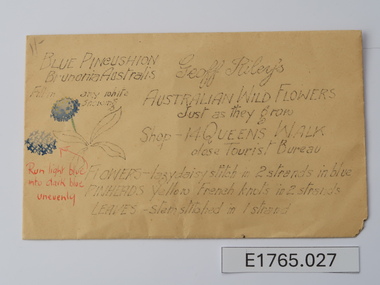 Embroiderers Guild, Victoria
Textile - Geoff Riley embroidery design envelope - Blue Pincushion Brunonia Australis, Geoff Riley, 1920's-1956/7
... Australia... Australian native flora...From deceased estate of EGV member Geoff Riley 20th century Australia Australian native flora Australian native fauna See images Printed envelope with pattern and stitch directions -Blue Pincushion Brunonia Australis. ...From deceased estate of EGV memberPrinted envelope with pattern and stitch directions -Blue Pincushion Brunonia Australis. Bundle of threads inside envelope. Designed and sold by Geoff Riley, water colour artist from his shop "The Wildflower Shop", 14 Queen's Walk, Melbourne from the 1930' to the 1950's. See imagesgeoff riley, 20th century, australia, australian native flora, australian native fauna -
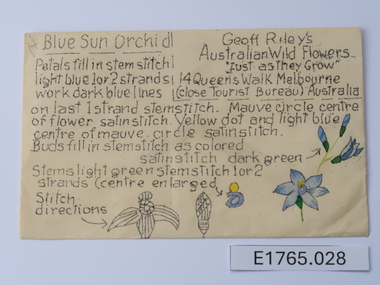 Embroiderers Guild, Victoria
Textile - Geoff Riley embroidery design envelope - Blue Sun Orchid, Geoff Riley, 1920's-1956/7
... Australia... Australian native flora...From deceased estate of EGV member Geoff Riley 20th century Australia Australian native flora Australian native fauna See images Printed envelope with pattern and stitch directions -Blue Sun Orchid. ...From deceased estate of EGV memberPrinted envelope with pattern and stitch directions -Blue Sun Orchid. Bundle of threads inside envelope. Designed and sold by Geoff Riley, water colour artist from his shop "The Wildflower Shop", 14 Queen's Walk, Melbourne from the 1930' to the 1950's. See imagesgeoff riley, 20th century, australia, australian native flora, australian native fauna -
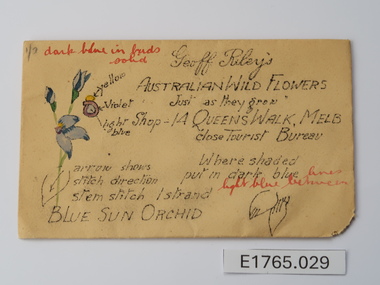 Embroiderers Guild, Victoria
Textile - Geoff Riley embroidery design envelope - Blue Sun Orchid, Geoff Riley, 1920's-1956/7
... Australia... Australian native flora...From deceased estate of EGV member Geoff Riley 20th century Australia Australian native flora Australian native fauna See images Printed envelope with pattern and stitch directions -Blue Sun Orchid. ...From deceased estate of EGV memberPrinted envelope with pattern and stitch directions -Blue Sun Orchid. Bundle of threads inside envelope. Designed and sold by Geoff Riley, water colour artist from his shop "The Wildflower Shop", 14 Queen's Walk, Melbourne from the 1930' to the 1950's. See imagesgeoff riley, 20th century, australia, australian native flora, australian native fauna -
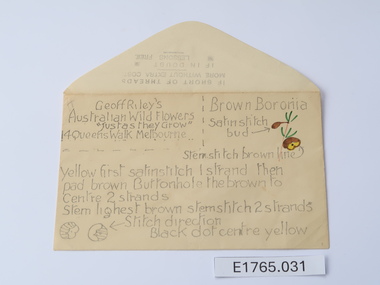 Embroiderers Guild, Victoria
Textile - Geoff Riley embroidery design envelope - Brown Boronia, Geoff Riley, 1920's-1956/7
... Australia... Australian native flora...From deceased estate of EGV member Geoff Riley 20th century Australia Australian native flora Australian native fauna See images Printed envelope with pattern and stitch directions -Brown Boronia. ...From deceased estate of EGV memberPrinted envelope with pattern and stitch directions -Brown Boronia. Bundle of threads in envelope. Designed and sold by Geoff Riley, water colour artist from his shop "The Wildflower Shop", 14 Queen's Walk, Melbourne from the 1930' to the 1950's. See imagesgeoff riley, 20th century, australia, australian native flora, australian native fauna -
 Embroiderers Guild, Victoria
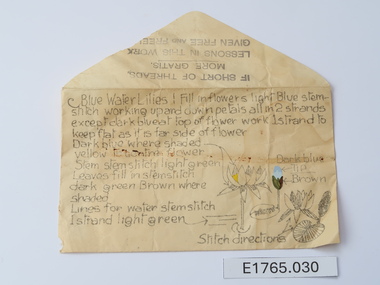
Textile - Geoff Riley embroidery design envelope - Blue Water Lilies, Geoff Riley, 1920's-1956/7
... Australia... Australian native flora...From deceased estate of EGV member Geoff Riley 20th century Australia Australian native flora Australian native fauna See images Printed envelope with pattern and stitch directions -Blue Water Lilies. ...From deceased estate of EGV memberPrinted envelope with pattern and stitch directions -Blue Water Lilies. Designed and sold by Geoff Riley, water colour artist from his shop "The Wildflower Shop", 14 Queen's Walk, Melbourne from the 1930' to the 1950's. See imagesgeoff riley, 20th century, australia, australian native flora, australian native fauna -
 Embroiderers Guild, Victoria
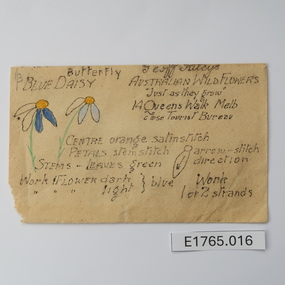
Textile - Geoff Riley embroidery design envelope - Blue daisy and butterfly, Geoff Riley, 1920's-1956/7
... Australia... Australian native flora...From deceased estate of EGV member Geoff Riley 20th century Australia Australian native flora Australian native fauna See images Printed envelope with pattern and stitch directions -Blue daisy on front and butterfly on reverse. ...From deceased estate of EGV memberPrinted envelope with pattern and stitch directions -Blue daisy on front and butterfly on reverse. Bundle of threads inside envelope. Designed and sold by Geoff Riley, water colour artist from his shop "The Wildflower Shop", 14 Queen's Walk, Melbourne from the 1930' to the 1950's. See imagesgeoff riley, 20th century, australia, australian native flora, australian native fauna -
 Embroiderers Guild, Victoria
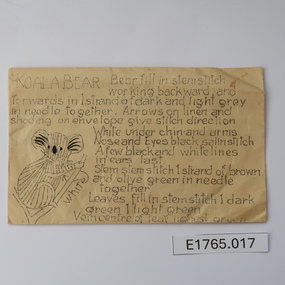
Textile - Geoff Riley embroidery design envelope - Koala bear and Red flowering gum, Geoff Riley, 1920's-1956/7
... Australia... Australian native flora...From deceased estate of EGV member Geoff Riley 20th century Australia Australian native flora Australian native fauna See images Printed envelope with pattern and stitch directions -Blue daisy on front and butterfly on reverse. ...From deceased estate of EGV memberPrinted envelope with pattern and stitch directions -Blue daisy on front and butterfly on reverse. Designed and sold by Geoff Riley, water colour artist from his shop "The Wildflower Shop", 14 Queen's Walk, Melbourne from the 1930' to the 1950's. See imagesgeoff riley, 20th century, australia, australian native flora, australian native fauna -
 Embroiderers Guild, Victoria
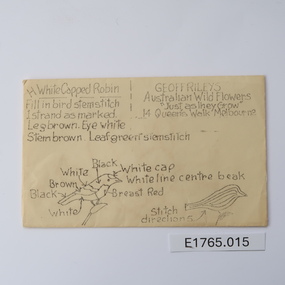
Textile - Geoff Riley embroidery design envelope - White capped robin, Geoff Riley, 1920's-1956/7
... Australia... Australian native flora...From deceased estate of EGV member Geoff Riley 20th century Australia Australian native flora Australian native fauna See images Printed envelope with pattern and stitch directions -White Capped Robin. ...From deceased estate of EGV memberPrinted envelope with pattern and stitch directions -White Capped Robin. Small bundle of threads inside envelope. Designed and sold by Geoff Riley, water colour artist from his shop "The Wildflower Shop", 14 Queen's Walk, Melbourne from the 1930' to the 1950's. See imagesgeoff riley, 20th century, australia, australian native flora, australian native fauna -
 Embroiderers Guild, Victoria
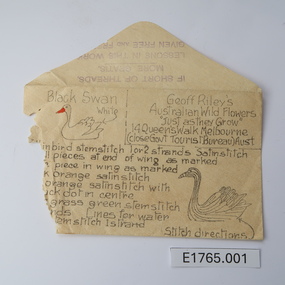
Textile - Geoff Riley embroidery design envelope - Black Swan, Geoff Riley, 1920's-1956/7
... Australia... Australian native flora...From deceased estate of EGV member Geoff Riley 20th century Australia Australian native flora Australian native fauna See images Printed envelope with pattern and stitch directions - Black Swan Designed and sold by Geoff Riley, water colour artist from his shop "The Wildflower Shop", 14 Queen's Walk, Melbourne from the 1930' to the 1950's. ...From deceased estate of EGV memberPrinted envelope with pattern and stitch directions - Black Swan Designed and sold by Geoff Riley, water colour artist from his shop "The Wildflower Shop", 14 Queen's Walk, Melbourne from the 1930' to the 1950's. See imagesgeoff riley, 20th century, australia, australian native flora, australian native fauna -
 Embroiderers Guild, Victoria
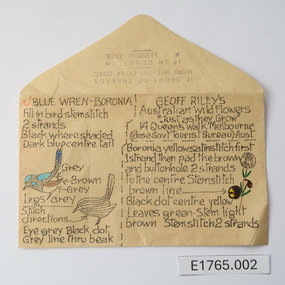
Textile - Geoff Riley embroidery design envelope - Blue Wren-Boronia, Geoff Riley, 1920's-1956/7
... Australia... Australian native flora...From deceased estate of EGV member Geoff Riley 20th century Australia Australian native flora Australian native fauna See images Printed envelope with pattern and stitch directions - Blue wren - Boronia Designed and sold by Geoff Riley, water colour artist from his shop "The Wildflower Shop", 14 Queen's Walk, Melbourne from the 1930' to the 1950's. ...From deceased estate of EGV memberPrinted envelope with pattern and stitch directions - Blue wren - Boronia Designed and sold by Geoff Riley, water colour artist from his shop "The Wildflower Shop", 14 Queen's Walk, Melbourne from the 1930' to the 1950's. See imagesgeoff riley, 20th century, australia, australian native flora, australian native fauna -
 Embroiderers Guild, Victoria
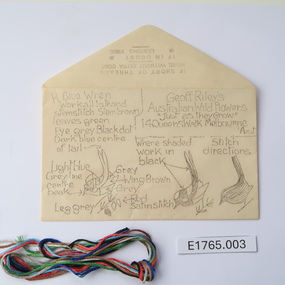
Textile - Geoff Riley embroidery design envelope - Blue Wren, Geoff Riley, 1920's-1956/7
... Australia... Australian native flora...From deceased estate of EGV member Geoff Riley 20th century Australia Australian native flora Australian native fauna See images Printed envelope with pattern and stitch directions - Blue wren Designed and sold by Geoff Riley, water colour artist from his shop "The Wildflower Shop", 14 Queen's Walk, Melbourne from the 1930' to the 1950's. ...From deceased estate of EGV memberPrinted envelope with pattern and stitch directions - Blue wren Designed and sold by Geoff Riley, water colour artist from his shop "The Wildflower Shop", 14 Queen's Walk, Melbourne from the 1930' to the 1950's. See imagesgeoff riley, 20th century, australia, australian native flora, australian native fauna -
 Embroiderers Guild, Victoria
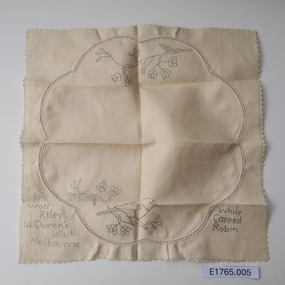
Textile - Geoff Riley embroidery design printed doiley - White capped robin, Geoff Riley, 1920's-1956/7
... Australia... Australian native flora...From deceased estate of EGV member Geoff Riley 20th century Australia Australian native flora Australian native fauna See images Printed envelope with pattern and stitch directions - Blue wren with leaf sprig (type unknown) Designed and sold by Geoff Riley, water colour artist from his shop "The Wildflower Shop", 14 Queen's Walk, Melbourne from the 1930' to the 1950's. ...From deceased estate of EGV memberPrinted envelope with pattern and stitch directions - Blue wren with leaf sprig (type unknown) Designed and sold by Geoff Riley, water colour artist from his shop "The Wildflower Shop", 14 Queen's Walk, Melbourne from the 1930' to the 1950's. See imagesgeoff riley, 20th century, australia, australian native flora, australian native fauna -
 Embroiderers Guild, Victoria
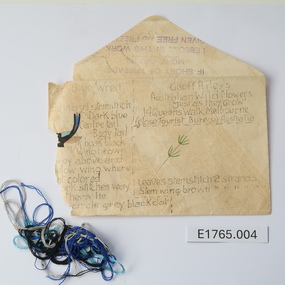
Textile - Geoff Riley embroidery design envelope - Blue Wren with leaf, Geoff Riley, 1920's-1956/7
... Australia... Australian native flora...From deceased estate of EGV member Geoff Riley 20th century Australia Australian native flora Australian native fauna See images Printed envelope with pattern and stitch directions - Blue wren with leaf sprig (type unknown) Designed and sold by Geoff Riley, water colour artist from his shop "The Wildflower Shop", 14 Queen's Walk, Melbourne from the 1930' to the 1950's. ...From deceased estate of EGV memberPrinted envelope with pattern and stitch directions - Blue wren with leaf sprig (type unknown) Designed and sold by Geoff Riley, water colour artist from his shop "The Wildflower Shop", 14 Queen's Walk, Melbourne from the 1930' to the 1950's. See imagesgeoff riley, 20th century, australia, australian native flora, australian native fauna -
 Embroiderers Guild, Victoria
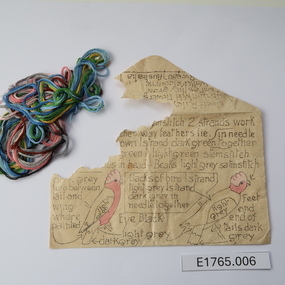
Textile - Geoff Riley embroidery design envelope - Galah & lobelia, Geoff Riley, 1920's-1956/7
... Australia... Australian native flora...From deceased estate of EGV member Geoff Riley 20th century Australia Australian native flora Australian native fauna See images Printed envelope with pattern and stitch directions - Galah on front, Lobelia on reverse Designed and sold by Geoff Riley, water colour artist from his shop "The Wildflower Shop", 14 Queen's Walk, Melbourne from the 1930' to the 1950's. ...From deceased estate of EGV memberPrinted envelope with pattern and stitch directions - Galah on front, Lobelia on reverse Designed and sold by Geoff Riley, water colour artist from his shop "The Wildflower Shop", 14 Queen's Walk, Melbourne from the 1930' to the 1950's. See imagesgeoff riley, 20th century, australia, australian native flora, australian native fauna -
 Embroiderers Guild, Victoria
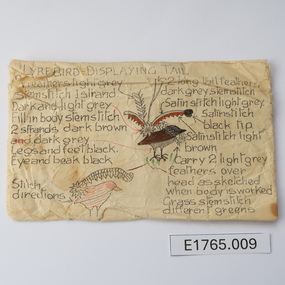
Textile - Geoff Riley embroidery design envelope - Lyre Bird displaying tail and toad stools, Geoff Riley, 1920's-1956/7
... Australia... Australian native flora...From deceased estate of EGV member Geoff Riley 20th century Australia Australian native flora Australian native fauna See images Printed envelope with pattern and stitch directions - Lyre Bird displaying tail on front and toad stools on reverse, knotted hank of black/brown/grey threads Designed and sold by Geoff Riley, water colour artist from his shop "The Wildflower Shop", 14 Queen's Walk, Melbourne from the 1930' to the 1950's. ...From deceased estate of EGV memberPrinted envelope with pattern and stitch directions - Lyre Bird displaying tail on front and toad stools on reverse, knotted hank of black/brown/grey threads Designed and sold by Geoff Riley, water colour artist from his shop "The Wildflower Shop", 14 Queen's Walk, Melbourne from the 1930' to the 1950's. See imagesgeoff riley, 20th century, australia, australian native flora, australian native fauna -
 Embroiderers Guild, Victoria
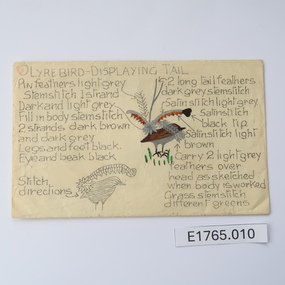
Textile - Geoff Riley embroidery design envelope - Lyre Bird displaying tail and toad stools, Geoff Riley, 1920's-1956/7
... Australia... Australian native flora...From deceased estate of EGV member Geoff Riley 20th century Australia Australian native flora Australian native fauna See images Printed envelope with pattern and stitch directions - Lyre bird displaying tail on front and toad stools on reverse. ...From deceased estate of EGV memberPrinted envelope with pattern and stitch directions - Lyre bird displaying tail on front and toad stools on reverse. Few thread scraps in envelope. Designed and sold by Geoff Riley, water colour artist from his shop "The Wildflower Shop", 14 Queen's Walk, Melbourne from the 1930' to the 1950's. See imagesgeoff riley, 20th century, australia, australian native flora, australian native fauna -
 Embroiderers Guild, Victoria
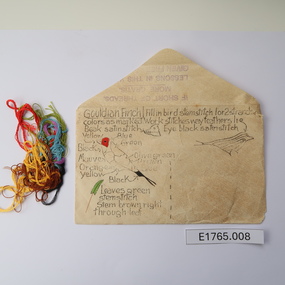
Textile - Geoff Riley embroidery design envelope - Gouldian finch, Geoff Riley, 1920's-1956/7
... Australia... Australian native flora...From deceased estate of EGV member Geoff Riley 20th century Australia Australian native flora Australian native fauna See images Printed envelope with pattern and stitch directions - Gouldian Finch Designed and sold by Geoff Riley, water colour artist from his shop "The Wildflower Shop", 14 Queen's Walk, Melbourne from the 1930' to the 1950's. ...From deceased estate of EGV memberPrinted envelope with pattern and stitch directions - Gouldian Finch Designed and sold by Geoff Riley, water colour artist from his shop "The Wildflower Shop", 14 Queen's Walk, Melbourne from the 1930' to the 1950's. See imagesgeoff riley, 20th century, australia, australian native flora, australian native fauna
