
Showing 87 items matching " bass j."
-
 Glen Eira Historical Society
Letter - MURRUMBEENA FOOTBALL CLUB
... ... Bass J....Lee E. Harris J. Bass J. Denning J. Phillips C. King F. Weatheral N.W. ...This file contains 2 items: 1/A letter to Caulf Historical Society, requesting any history of Murrumbeena Football Club, from R. Gould. Reply from T.J. Hart advising that no information on the club is held by the society. 2/A fifty page book on the history of Murrumbeena Football Club, from foundation in 1927 to 1976. Includes 7 team photocopied photographs and one of the pavilion after completion in 1922, book written by R. Gould.gould ross, murrumbeena football club, football, football clubs, ‘dick’s horse paddock’, butchers, murrumbeena, great dandenong road, murrumbeena road, n.r. cooper, market gardens, orchards, carnegie rovers, oakleigh juniors, oakleigh district junior, football association, committees of management, murrumbeena junior football club, dick r., armstrong j., silverman dr. i., phillips r. cr., mudge les, truman v., bristow l., richardson , truman t., robertson, carnegie rovers, bentleigh, oakleigh juniors, ted pelling’s horse stables, stables, kangaroo road, moore george, armstrong fred, tinsley roy, naylor reg, ward bill, hunter mr., cox mr., scivenor mr., marian mr., wilde mr., townley mr., mudge mr., hay mr , ferguson mr., wilde wal, pelling e., watkins e., giles mr., young mr., paterson mr., reid mr., ross mr., walker mr., lyre mr., cannon mr., ronaldson tom, pearson , hall , collaghan jack, dennis, wlash, cannon, rickets, ferguson, wotes, hay, washbrooke, wilde , phillipson, welch, brown, cox, sharp, thomas, palmer, harris e., dick a., caulfield-dandenong, junior football association, metropolitan amateurs, pavilions, caulfield city council, murrumbeena amateurs, miss football queen, ralph miss, welch vic, emmins ‘titch’ g., bone r., havell, ellis r. (bob), pew t., stock a., riley wal, harris ‘codger’ roy, biddington j., nicholson a., bernes a.c., healey g., riley w., summerfield d., lee e., harris j., bass j., denning j., phillips c., king f., weatheral n.w., stewart s., rolfe h., dalgleish s., malone l., simpson e., kain a., rennie w., sloan a., painter e., bernes c., biddington g., parker c., willmott n., murrumbeena cricket club, corbett, murrumbeena districts, holden ‘rusty’, crundy, dean, taylor, bourke, moore, stewart, hause, clarke, gear, page, rowe bill, mathers alf, awards, farrell r., oakley r., escott l., callaghan t., mathers r., andrew j., halfpenny j., howland w., m -
 Glen Eira Historical Society
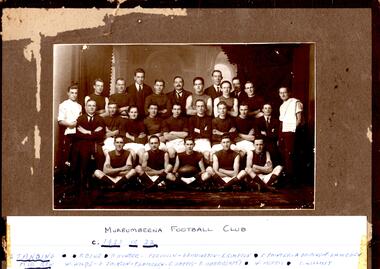
Photograph - MURRUMBEENA FOOTBALL CLUB
... ... Bass J....Rennie W. Healey G. Bass J. Summerfield D. Fitch J. Welch V. Biddington J. ...Two photographs of Murrumbeena Football Club team C 1921/1922 and 1924. Includes names of some officebearers and club mascot.murrumbeena football club, bone r., ferguson, hunter a., bioddington g., simpson e., painter e., bristowe a., lambden f., wilde w., jackson g., lambden p., harris g., harris r., morris w., willmot c., collister w., callagan l., kain a.g., colliers s., stock a., lee e., ilton h., rogers w., denning j., sloan a., wilde g., willmott n., king f., rennie w., healey g., bass j., summerfield d., fitch j., welch v., biddington j., nicholson a., wilde w.j., harris j., ellis r., pew t., barnes a., simpson e., barnes c., rolfe h., lambden f., howell r., coonerty j., barnes r., emmens h., stewart s., ‘kain’, premiership photograph -
Bendigo Historical Society Inc.
Document - ROYAL PRINCESS THEATRE COLLECTION: BENDIGO ORCHESTRAL SOCIETY & YMCA CHOIR. MARITANA, 7 Aug, 1933
... J Houston... Mr G Krost... Mrs S McKinnon... Miss A McKinnon... Miss A McNair... A Sayer... Mrs L Shepherd... A Swift... H Timms. Viola: Mr P Coope. 'Cellos: Miss R Giudice... Mr W S Lake. Bass...Tenors: J Cotton, G English, D Finery, Alec Jones, E Jeffery, D Parker, J Sims. Basses: D Doran, J Finerty, J H Hardie, A B Kirkwood, W L Macauley, S C Powell, R Prigg, W Reed, Les Spencely, Cyril Taylor, Ken Taylor. ...Tenors: J Cotton G English D Finery Alec Jones E Jeffery D Parker J Sims. Basses: D Doran J Finerty J H Hardie A B Kirkwood W L Macauley S C Powell R Prigg W Reed Les Spencely Cyril Taylor Ken Taylor. ...Princess Theatre, Bendigo. Bendigo Orchestral Society & YMCA Choir. Maritana, Souvenir Programme 6d. Mon. Tues. Wed. August 7, 8, 9. Opera Produced by Mr E A Parker. Musical Director, Mr Oscar Flight. Deputy Director, Mr Alfred Sayer. Leader of Orchestra Mrs McKinnon. Chorus trained by Mr Wilfred Taylor. Chairman of Committee, Mr W Spencer Lake. Business Manager, Mr C J Greenhill. Pictures of artists: Miss Paulyne Bindley, Mr E A Parker, Miss Gwen De Ravin, Mr Wilfred Taylor, Miss Alva Stewart, Mr H H Turner, Mr Oscar Flight. Group photo of Ballet dancers. Argument - Maritana, a handsome Gitana, whilst singing to a crowd of people in a square in Madrid, attracts the admiration of the King. Don Jose, and unscrupulous courtier, observing this, determines to satisfy the . . . Characters: Paulyne Bindley, Gwenneth De Ravin, E A Parker, Wilfred Taylor, Lyell Shepherd, J W Smith, H H Turner, Lindsay Wright. Court Ballet: Miss Mercia Wright. Solo Dancer: Miss Fay Drummond. Chorus of Soldiers, Gypsies, and Populace. Deputy Principals: Alva Stewart, Frieda Bertuch, H J Allen. Costumes: Madame Tettrazini, Miss Ada Colton, Mrs E A Parker. Orchestra. Violins: Mrs C Adams, Miss J Anderson, Mr R Bright, Mr O Flight (jnr), Mrs S A Grant Mrs H Hillman, Miss J Houston, Mr G Krost, Mrs S McKinnon, Miss A McKinnon, Miss A McNair, A Sayer, Mrs L Shepherd, A Swift, H Timms. Viola: Mr P Coope. 'Cellos: Miss R Giudice, Mr W S Lake. Bass: Mr J Ditchburn. Flute: Mr A E Sayer. Clarinets: Mr B Smith, Mr P Waterman. Harpiste: Miss Whitelock. Cornets: Mr W Norman, Mr P Smith Mr A Swift, Mr F Taylor. Horns: Mr W Green, Mr N McPherson. Trombones: Mr Les Bishop, Mr E J Meagher. Drums: Me J McLaughlin. Piano: Miss I Benson, Miss E Flight. Chorus. Sopranos: Miss D Broome, S Brown, Mrs R Burland, Miss Betty Cant, E Colclough, E Collins, Bessie Davis, P Dunn, G Farmont, M Heyes, D Hoking, B Harpin, M Kitto, D Kirkwood, E Parker, L Simpson, Ida Stephenson, M Stephenson, L Smalley, Mrs W Taylor, V Thorpe, Miss Myrtle Taylor, Annie Thomas, Mrs C Walk, Miss R Wallent. Contraltos: Miss F Bertuch, Mrs D Campbell, Miss I De Ravin, M Davis, P Elliot, Mrs J Greenhill, Mess N Irving, I James, J Seers, J Shepherd, G Stephens. Tenors: J Cotton, G English, D Finery, Alec Jones, E Jeffery, D Parker, J Sims. Basses: D Doran, J Finerty, J H Hardie, A B Kirkwood, W L Macauley, S C Powell, R Prigg, W Reed, Les Spencely, Cyril Taylor, Ken Taylor. Mr Ron Hovenden, Scenic Artist. Ballet: Misses Clarice Harry, Rita Lansell, Thelma McKenzie, Mena Bailey, Dorothy Roberts, Fay Drummond, Kath Dungey, Jean Wright. Dance Mistress Miss Mercia Wright. Photo of dance group on rear cover. Printed down right side: Mr W. Reed - With Compliments from ''Maritana'' Committee. Sep 5/33. Signed: W Spencer Lake. Very decorative cover. B/ Envelope addressed to Mr W Reed, Lily St, Bendigo. 2 pieces of white tape on left side one top and one at bottom, stamp gone post mark Bendigo.Reed & Co., Printers, Bendigotheatre, opera, bendigo orchestral society:ymca cho, princess theatre. bendigo orchestral society & ymca choir. maritana. august 7, 8, 9. opera by mr e a parker. musical director, mr oscar flight. deputy director, mr alfred sayer. leader of orchestra mrs mckinnon. chorus trained: mr wilfred taylor. chairman of committee, mr w spencer lake. business manager, mr c j greenhill. photos of: miss paulyne bindley, mr e a parker, miss gwen de ravin, mr wilfred taylor, miss alva stewart, mr h h turner, mr oscar flight. group photo of ballet dancers. argument - maritana, a handsome gitana, whilst singing to a crowd of people in a square in madrid, attracts. . . characters: paulyne bindley, gwenneth de ravin, e a parker, wilfred taylor, lyell shepherd, j w smith, h h turner, lindsay wright. court ballet: miss mercia wright. solo dancer: miss fay drummond. chorus of soldiers, gypsies, and populace. deputy principals: alva stewart, frieda bertuch, h j allen. costumes: madame tettrazini, miss ada colton, mrs e a parker. orchestra. violins: mrs c adams, miss j anderson, mr r bright, mr o flight (jnr), mrs s a grant mrs h hillman, miss j houston, mr g krost, mrs s mckinnon, miss a mckinnon, miss a mcnair, a sayer, mrs l shepherd, a swift, h timms. viola: mr p coope. 'cellos: miss r giudice, mr w s lake. bass: mr j ditchburn. flute: mr a e sayer. clarinets: mr b smith, mr p waterman. harpiste: miss whitelock. cornets: mr w norman, mr p smith mr a swift, mr f taylor. horns: mr w green, mr n mcpherson. trombones: mr les bishop, mr e j meagher. drums: me j mclaughlin. piano: miss i benson, miss e flight. chorus. sopranos: miss d broome, s brown, mrs r burland, miss betty cant, e colclough, e collins, bessie davis, p dunn, g farmont, m heyes, d hoking, b harpin, m kitto, d kirkwood, e parker, l simpson, ida stephenson, m stephenson, l smalley, mrs w taylor, v thorpe, miss myrtle taylor, annie thomas, mrs c walk, miss r wallent. contraltos: miss f bertuch, mrs d campbell, miss i de ravin, m davis, p elliot, mrs j greenhill, mess n irving, i james, j seers, j shepherd, g stephens. tenors: j cotton, g english, d finery, alec jones, e jeffery, d parker, j sims. basses: d doran, j finerty, j h hardie, a b kirkwood, w l macauley, s c powell, r prigg, w reed, les spencely, cyril taylor, ken taylor. mr ron hovenden, scenic artist. ballet: misses clarice harry, rita lansell, thelma mckenzie, mena bailey, dorothy roberts, fay drummond, kath dungey, jean wright. dance mistress miss mercia wright. photo of dance group. -
 Ballarat Clarendon College
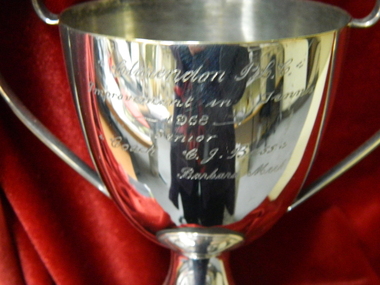
Trophy, Improvement in tennis
... . / Improvement in tennis / 1968 / Senior / Coach C J Bass / Barbara Meek.... / Improvement in tennis / 1968 / Senior / Coach C J Bass / Barbara Meek Medium silver cup wth double handles on silver stem with melamine base; engraved on face of cup. ...Barabara Meek boarded at Clarendon Presbyterian Ladies College 1964 - 1968, passing her Leaving examinations in 1968. Medium silver cup wth double handles on silver stem with melamine base; engraved on face of cup. Engraving on face: Clarendon P.L.C. / Improvement in tennis / 1968 / Senior / Coach C J Bass / Barbara Meekbarbara-meek, 1968, tennis, sports, clarendon-presbyterian-ladies-college -
 Bendigo Historical Society Inc.
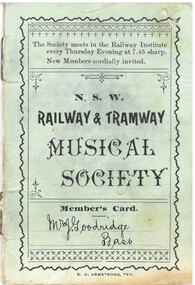
Document - HAMILTON COLLECTION: MEMBERSHIP CARD BOOKLET, Early 1900s
... Name written in ink, ''Mr J. Goodridge''. Bass. Back page missing. Inside page includes Officers and Rules....Name written in ink, ''Mr J. Goodridge''. Bass. Back page missing. Inside page includes Officers and Rules. ...Document. Four page membership card for N.S.W. Railway and Tramway Musical Society. Name written in ink, ''Mr J. Goodridge''. Bass. Back page missing. Inside page includes Officers and Rules.performing arts, elocution, membership card booklet -
Bendigo Historical Society Inc.
Document - HER MAJESTY'S WANGARATTA - VICTORIAN COMMERCIAL TRAVELLER'S CHORAL PARTY, 27 September, c1916
... Smith, Edgar. Oaten, J E V. 1st Basses. Pemberton, J. White, J H. M'Mahon, P A. ...Smith, Edgar. Oaten, J E V. 1st Basses. Pemberton, J. White, J H. M'Mahon, P A. ...Her Majesty's Wangaratta - Victorian Commercial Traveller's Choral Party. Vocalists, Instruments, Entertainers. Wednesday, Sept. 27th. Proceeds in Aid of Wangaratta Hospital. Box Plan at Bickerton's. Charles R Hershchell Musical Director. Walter A Jack, Hon. Sec. PART 1 The Traveller, Mr C Harold Oakley. 2 The Soldier's Chorus, Victorian Commercial Travellers' Choral Party. 3 Sing Me A Song of the South, Mr Horace J Wood. 4 'The Battle Eve', Messrs. W T P Sutton and Harry Pride. 5 'The Highland Brigade Burying Their Dead' Captain Reid, D.S.O. 6 'Doan yer cry, ma Honey,' 'Laugh and Grow Fat,' The C.T. Choral Party. 7 unnamed part by Mr Gill Gliddon. 8 'The Song the Anvil Sings,' Mr E L Jones. 9 'La Reve De Armour,' Mr Charles R Hershell. 10 'Johnathan Jones,' Mr Harry Pride. 11 'March of Israelites,' The C.T. Choral Party. Part 2. 1 Mr C Harold Oakley, his own composition. 2'A Cradle Song,' The bachelors of the Choral Party and married men. 3 Duet for Basses, Mr Vic Porter and Mr Harry Pride. 4 feat of Legerdemain, Captain Reid. 5 'Ma Honolulu Lady,' Mr E L Jones. 6 A slight interruption in the programme while Mr Gill Gliddon amuses himself and possibly the audience. 7 'The Lost Chord' Mr Chas R Herschell. 8 'Blow, Blow, Thou Wintry Wind,' Mr Horace J Wood. 9 'Little Tommy Went a-Fishing,' and 'The Mellow Melon,' C T Choral Party. Baton: Mr Chas R Herchell. Piano: Mr C Harold Oakley. Hon Sec: Mr Walter A Jack. Victorian Commercial Travellers' Choral Party. 1st Tenors. Sutton, W T P. Strode, Geo. Bownas, J C. Ebbott, J. M'Dowell, Geo. 2nd Tenors. Rankine, Hugh. Muirhead, Geo. Jack, W A. Vawdon, F W. Hart, W. Downing, J. Smith, Edgar. Oaten, J E V. 1st Basses. Pemberton, J. White, J H. M'Mahon, P A. Adams, W. Wilson, W J C. Jones, E L. M'Farlane, J. Wilder, D H. Spicer, A. 2nd Basses. Pride, H. Watson, A. Sinclair, P A. Miles, F. Andrews, J. Hopkinson, E R. Porter, V. Director: Chas R Herscell. Pianist: C Harold Oakley.Renwick. Pride. Nuttall, 263a P.O. Place, Melb.program, music, her majesty's wangaratta -
 Bendigo Historical Society Inc.
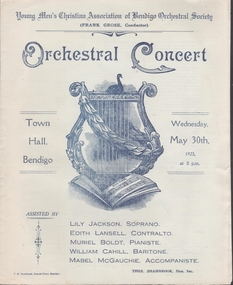
Document - TOWN HALL, YOUNG MEN'S CHRISTIAN ASSOCIATION OF BENDIGO ORCHESTRAL SOCIETY, 30th may, 1923
... J Watts. Cellos: Madame Dorothy Duval, Miss Maisie Field, Mr. E Minotti, W Ellis, G L Verey. Basses...J Watts. Cellos: Madame Dorothy Duval, Miss Maisie Field, Mr. E Minotti, W Ellis, G L Verey. Basses ...Town Hall, Young Men's Christian Association of Bendigo Orchestral Society. Orchestral Concert, Town Hall, Bendigo. Wednesday, 30th, 1923, at 8pm. Conductor: Frank Grose. Assisted by: Lily Jackson, Soprano. Edith Lansell, Contralto. Muriel Boldt, Pianiste. William Cahill, Baritone. Mabel McGauchie, Accompaniste. Orchestral Society. Hon. Sec.: Thos. Shambrook. Pirates of Penzance: Romanza Scenza, Arabesque No. 2, Air De Ballet, Death and the Maiden, Sapphic Ode, Let me Love Thee, Russian Boatman Song. William Tell: O love from Thy Pow'r, Scherzo in Bb Minor, Abide with Me, Rock of Ages, Time was I Roved the Mountains, Eyes that used to Gaze in Mine, Invitation Vocal Valse, Coronation march. Bendigo YMCA Orchestral Society. First Violins: Miss Myrtle Knight, Agnes McNair, Olive Hannaford, Winnie Pithie, Louise Bolton, Louise Downie, Ruth Spier, Alison Smalley. Mrs. Grant, Swift. Second Violins: Mr. J E Fitt, A Richardson, Rex Matthews, Miss Lily Campbell, Elsie Stemmer, Myrtle Phillips, Alma Doxford, Evelyn Miles, Elva Hesse, Winnie Hobson, Master T Challen, J Watts. Cellos: Madame Dorothy Duval, Miss Maisie Field, Mr. E Minotti, W Ellis, G L Verey. Basses: Mr. J H Melrose, J Lavacombe, R Rule, W Jackson. Flutes: Mr. A E Sayer, R Crawford, Dilworth, Moon. Piccolo: Mr A E Sayer. Oboe: A B Challen. Clarinets: Mr. A B Challen, J Bowman, J McEwan. Horns: A Johnston, H Hilderbrande, J Tredinnick, L Rundle. , Trumpets: Mr. B Bowater, P Reed, N Banfield, A Old. Trombones: Mr. D Collier, H Bolton, W Pain. Euphonium: W Ketterer. Tubas: Mr. A Hoking, W Ketterer. Sassoon: Mr. T Francis. Timpani: Mr. J McLoughlin. Percussion: Mr. J Osborne. Organist: Mr. F C Stuart. Pianist: Miss Mabel McGauchie. Conductor: Frank Grose. President: Barkly Hyett. Treasurer: G W Lansell. Librarian: W J Wearne. Honorary Secretary: Thos. Shambrook. Three concerts per year will be given by the society. Next two concerts in August and November 1923. Subscribers Tickets are 1 pound 1 shilling. This ticket entitles holder to two booked seats for each concert. Picture of Harp with music book, laurel and bird on cover. 4 pages.F. H. Sparkman, Arcade Press, Bendigo.program, music, town hall, ymca of bendigo orchestral society. orchestral concert -
 Victorian Interpretive Projects Inc.
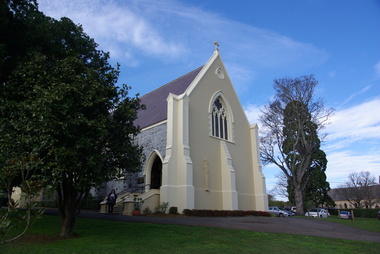
Photograph - colour, Clare Gervasoni, St Peter's Catholic Church, Daylesford, 2015, 14/06/2015
... Guthiel, tenor; Master John Murphy, tenor; James Knox, bass; J. M. Murphy, bass; Mr. Staunton, baritone; Mr. ...Guthiel, tenor; Master John Murphy, tenor; James Knox, bass; J. M. Murphy, bass; Mr. Staunton, baritone; Mr. ..."The fine structure of St. Peter's, with its prettily-decorated interior, which holds crowded congregations at Holy Mass on Sundays, is alone an eloquent testimony of the piety and devotion which permeates the whole parish. Attached to the church is a circulating library, and Catholic papers and other literature are distributed at the church door. Branches of the H.A.C.B. Society and Catholic Federation are doing much good work. (Melbourne Advocate, 17 January 1914) "OPENING AND CONSECRATION OF THE NEW CATHOLIC CHURCH OF ST. PETER’S, DAYLESFORD Cross on St. Peter'sNotwithstanding the inclemency of the weather, the opening of the new Catholic Church of St. Peter’s, yesterday (Sunday), attracted a crowded congregation. Although the rain, which has poured almost incessantly for some days past, had left our roads and streets in the condition for which Daylesford is celebrated in winter weather, and although he storm and rain seemed to increase as the hour announced for the ceremonies approached, the church was filled by a large congregation, comprising all sects and denominations of Christians in and around the district. The beautiful edifice, erected mainly through the zeal, liberality and energy of the respected pastor, presented a most imposing appearance, and reflects infinite credit upon the Rev. Mr. Slattery, and the flock committed to his charge. The church was commenced in November 1863 and has been in the hands of the workmen up to the present time, work being uninterruptedly carried on. On commencing the foundations, it was necessary to excavate until solid clay was reached, which in consequence of the deep rich chocolate soil on the site of the building, had to be carried down to an average depth of 6 feet 6 inches. The foundations were laid with massive stones in courses of 12-inch, and four feet thick, reducing to 3 feet below the floor line. The style of the building is decorated Gothic, and consists of a nave, 80 feet by 30 feet in the clear, and a chancel 18 feet high; from floor line to apex of roof, 47 feet, which is elegantly constructed, consisting of six spans or frames with puncheons resting on carved corbels, low down between the windows. The north side consists of a handsome entrance, near the north-west angle, approached by nine steps of cut stone, and four bays of windows on nave, and a small door on side of chancel, intended as an entry from the sacristy. The south side presents a very handsome view to Victoria street, a beautiful porch entrance giving access to the building on the south-east end of nave; and on the south-west angle a handsome octagonal spire, terminating in an iron cross, with gilt floriations; the height of top of cross, from floor line, is 88 feet. A stone stairs gives access to the organ gallery and the belfry. The whole of the windows are of a handsome geometrical design, and carved in stone, with mullions and tracery, and glazed with amber-tinted glass, the chancel window being 15 feet high, and 8 feet wide. The chancel arch is unusually large, 27 feet St. Peter's interiorhigh and 18 feet wide, and handsomely moulded, and presents a fine appearance from the body of the church. The roof is stained a rich oak, with heavy cornice, and all the walls are smoothly plastered, and colored peach color, giving the amber-tinted glass a beautiful soft cathedral appearance to the interior. The altar is of a very chaste design, the panels being moulded with Gothic heads, and finished in white and gold; the altar rail was not completed, but is intended to be of polished cedar, with carved pillars. The interior fittings will be proceeded with immediately, and to complete the design, an organ gallery, with sittings for about 100 persons besides the choir, will be constructed on the west end. It is intended also to place pillar gaslights on each side of the main entrance, for lighting during vespers in winter. The style of architecture has been strictly carried out, and in the best and most substantial manner. The building has been erected under the superintendence of the architect Mr. John Townsend Brophy, a member of the congregation, and who has discharged his duty with great ability and care. The hour of half-past eleven has scarcely passed when from the sacristy entered His Lordship the Right Rev. Dr. Gould, Bishop of Melbourne, preceded by the Very Rev. Dean Hayes (Sandhurst), the Rev. P. J. Slattery, and a number of boys dressed in white surplices. The Right Reverend Prelate proceeded to the foot of the altar, the Very Rev. the Dean on his right, and the Rev. P. J. Slattery on the left. The prayers usual upon the occasion were read by the Bishop. A procession was then formed, and went around the church in the following order. Several youths bearing wax candles first, next the Very Rev. the Dean, then the Bishop and his train bearers, and following were the Rev. Mr. Slattery and acolytes. Having returned to the altar in the same order, the Deacon (Dean Hayes) and Sub-Deacon (Rev. P. J. Slattery) proceeded to robe his Lordship, who had taken his seat at the epistle side of the altar, for the solemn High Mass, at appropriate times wearing his mitre and bearing his crozier. The mass, which was chanted by the Bishop with touching simplicity and earnestness, was then commenced. The choir, under the direction of Mr. Meunsch, organist, was full and most effective. Mrs. Testar, of Melbourne, having generously offered her valuable services, took the leading soprano solos, and it is scarcely necessary to add, rendered them with exquisite taste and feeling – her beautiful voice being heard with great effect throughout the entire building. The choir consisted of the following ladies and gentlemen who volunteered to aid in the ceremonies upon this most interesting occasion. Ladies: Mrs. Tresar, soprano; Mrs. J.J. McCormick, alto; Miss Julia Conry, soprano; Mrs. Vincent, soprano; Mrs. Aitken, soprano. Gentlemen: H. Guthiel, tenor; Master John Murphy, tenor; James Knox, bass; J. M. Murphy, bass; Mr. Staunton, baritone; Mr. Sourby, alto; Mr. Short, bass. The chant, “Let us adore,” during the procession, was given by Mrs. Vincent with considerable power. The selection of the “Imperial Mass” (Haydn’s No. 3) was felicitous, and the highly artistic and finished manner in which the different parts were sustained, demonstrated that great and persevering care must have been bestowed on the preparation for “the opening day.” The “Kyrie” was given with the full strength and power of the choir. The swelling of the voices in complete harmony, and the pealing of the organ in the midst of incense and prayer, produced a most marked effect upon the congregation. In the “Gloria,” the solos of Mrs. Testar were really beautiful and Mrs. McCormick rendered the alto solos with considerable merit. Mr. Knox sang the part commencing with the words “Qui tolles” with much taste and power. The “Credo” than which we believe there is not a more magnificent piece of sacred music extant, was most successful in its rendering, nor do we ever remember to have heard anything more touching than the manner in which the line “Vetam Venturi in Seculi,” was given by Mrs. Testar. The offertory hymn “Come unto Me all ye that labor,” was given by Mrs. Testar with the most thrilling effect. The “Sanctus” having been sung, in which Mr. Sourby ably rendered an alto solo, the “Agnus Dei” was commenced with a solo by Mrs. McCormick and was given with great taste and feeling, Mrs. Testar, at the conclusion of the “Agnus,” taking up the soprano part. Mass being concluded, the Very Reverend Dean Hayes ascended the altar and proceeded to preach the opening sermon, taking as his text Second Paralipomenon [Chronicles II], 7th chapter and 16th verse – “For I have chosen and have sanctified this place that My hand may be there for ever, and My eyes and My heart may remain there perpetually.” St Peter's manseAt the close of the sermon a collection was made by the very reverend preacher, assisted by John Egan, Esq., Corinella, on behalf of the church, and about fifty pounds were contributed. When it is remembered that 500 tickets had been issues at 10s each, and the inclemency of the weather taken into consideration, the collection may be regarded as a large one. Benediction was sung by the Rev. P. J. Slattery, assisted by Dean Hayes, the choir singing the “O! Salutaris Hostia” and “Laudate.” Handel’s Hallelujah Chorus was sung at the termination of the ceremonies. The vestments issued at Benediction, as well as at the Mass, were of the most gorgeous and beautiful character. When the Benediction was over, the Rev. P. J. Slattery, standing at the front of the altar said– “I wish to say one or two words before the congregation leave. I feel most deeply indebted to all of you who have attended here today for the honor and glory of God, not withstanding the difficulties you had to encounter from this most inclement season. I am truly delighted at such a manifestation of feeling, and will not easily forget it.” The rev. gentleman having disrobed, thanked the members of the choir for their kindness in assisting at the ceremonies, and more especially Mrs. Testar, who had braved all the storm and rain to be present at, and give the advantage of her great musical abilities on, the “opening day.” (Daylesford Mercury, 15 May 1865.)A number of photographs of St Peter's Catholic Church, Daylesford, taken at the 150th anniversary celebration. st peter's catholic church daylesford, decoration, altar decoration, anniversary, daylesford, religion, painting, interior, slattery, gough, d'alton, mcmahon -
 Melbourne Legacy
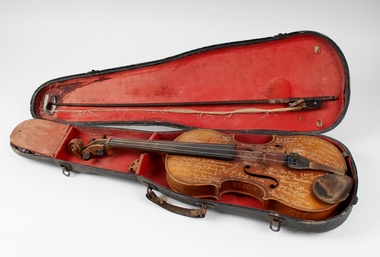
Instrument - Violin, The Changi Violin
... ; E J Bawer (Drums); Clem (Lofty) Relf(Clarinet); Bill Williams (Piano); Ken Luke; Ronald Searle; Charles Dobman “Good Luck”; Dan Harts(”Professor”); Gil Mitchell ( Violinist); John Fitzgerald; E Botor (Tenor Horn); Ronald Lewis; Ronnie Horner; Robin Wilbury; Jack M Wood ( Producer); Denis A S Houghton (Bass); C J Buckingham; Stan Mesurier; E B Dobson USA Concert Camberts Party Don Smith; Owen Baggett; Denis Roland; Stan Willner; Albert “ HAP” Kelley (Trombone); Joe Manella; Charles Kelleher. ...; E J Bawer (Drums); Clem (Lofty) Relf(Clarinet); Bill Williams (Piano); Ken Luke; Ronald Searle; Charles Dobman “Good Luck”; Dan Harts(”Professor”); Gil Mitchell ( Violinist); John Fitzgerald; E Botor (Tenor Horn); Ronald Lewis; Ronnie Horner; Robin Wilbury; Jack M Wood ( Producer); Denis A S Houghton (Bass); C J Buckingham; Stan Mesurier; E B Dobson USA Concert Camberts Party Don Smith; Owen Baggett; Denis Roland; Stan Willner; Albert “ HAP” Kelley (Trombone); Joe Manella; Charles Kelleher. ...This violin was played by VX30301 Dvr Roy Arnel, as a member of the Australian Imperial Force Concert Party, in the Changi POW camp, Singapore from 1942-1945. It is claimed that the violin, in its case was thrown over the wall by a Chinese civilian. Roy Arnel, a South African by birth enlisted on 7 June 1940 at Royal Park, Melbourne and served with 2 AASC Company as a driver. He was captured by the Japanese Imperial Army at the fall of Singapore in February 1942. There was more than one concert party in Changi as indicated on the rear of the violin. The details of the Dutch, British and American Concert Parties scratched in to the varnish. There are the some well known names scratched into the violin including: The English author and cartoonist, Ronald Searle; Australian entertainer, Frank Rich; and Australian Author, Russell Braddon. Mr Arnel died in 1982 and the violin was presented to Melbourne Legacy for preservation, safe keeping and display. Further research found that one of the AIF comedians, Harry Smith, had a catch phrase, 'You'll never get off the Island' which became almost the watchword of the prisoners throughout the captivity. That ties with the phrase etched around the outside of the violin, "We'll never get off the island."A very valuable piece of equipment brought back from World War II now on display in Legacy House function room.Violin (00078.1): Violin case (00078.2): Bow (00078.3): Bag of violin parts (00078.4):Around the edge of the instrument's body: "We'll never get off the island" On the front body of the violin: "AIF concert party"; "P.O.W. camp Singapore" Names inscribed on the front body of the violin in columns from left to right: Ray Tullipan, Fred Stringer, Herb Almond, L Jacques, Keith Harris, Jack Garrett, Dave Goodwin, H Sabin, Fred F Brightfield, Jack Boardman, Ern Warne, Ern Banks, T Hoffman, Roy P Arnel, Harold W Reid, W Middleton, Douglas Matthews, Bob Picken, Harry Smith ('appy Harry), Ted Druitt "VIOLIN PLAYED BY" VX30301, (DVR) R S Arnel AIF Concert Party in POW Camp Selerang and Changi Gaol Singapore 1942-1945; T Mack O.C and Producer Harry Tennall; Jack Smith; Walter W Dains; Keith C Stephens; C E Trotter; W Sullivan, Syd Piddington; John Nibbs; Doug Peart; John Wood; Jack Geoghegan; Berry Barton; Barney Bolton; Tom Hussey; Kim De Grey; Clarrie Barker; Ron Caple; Russ Bradon; Bernard McCaffrey; Bart Galbraith; Charles Wiggins; Stan “ Judy” Garland. Rear of Violin has inscriptions top to bottom, left to right. Hans???en; Dutch Concert Party; H.S. Van der Linden; M Bark; B Freunbusch; F Horguine; H. J. Hurgarden; Lt H. J. Scholer (Violin); H.A.F. Pet; M Van Dyk; W J Witte; G H Fransen; E Ewig; M Ruwart (Hypnotist); A V Korem(Dancer) C N Rob (Violin) C H Kuipers (Guitar); W C Emmenes (Cellist) L H R???? (Violin) British Concert Party Alex????; P Holland ( “ Dutchy” Accordian); Wray Gibson :AH!; E J Bawer (Drums); Clem (Lofty) Relf(Clarinet); Bill Williams (Piano); Ken Luke; Ronald Searle; Charles Dobman “Good Luck”; Dan Harts(”Professor”); Gil Mitchell ( Violinist); John Fitzgerald; E Botor (Tenor Horn); Ronald Lewis; Ronnie Horner; Robin Wilbury; Jack M Wood ( Producer); Denis A S Houghton (Bass); C J Buckingham; Stan Mesurier; E B Dobson USA Concert Camberts Party Don Smith; Owen Baggett; Denis Roland; Stan Willner; Albert “ HAP” Kelley (Trombone); Joe Manella; Charles Kelleher. Internal manufactures tag “ “Excelsior” Brand Specally made for the Tropic and reputed for good ton and workmanship Made in Czechoslovakia”changi violin, pow -
Bendigo Historical Society Inc.
Document - TOWN HALL, YMCA SYMPHONY CONCERT, 17 September, 1924
... Second Violins; Mr James Fitt, Master Tom Challen, Miss Myrtle Phillips, Miss Alma Doxford, Miss J Houston, Miss Evelyn Miles, Miss Elva Hesse, Miss Winnie Hobson, Mr Stanley Kennedy, Mr Albert Richardson, Master L Watts, Miss Lois Streader, Master L Meakin, Master R Trewarn. Violas; Mr P Coope, Mr H R Smith, Miss L Beischer, Miss Eisler Woodward. 'Cellos; Madame Dorothy Duval, Miss Maisie Field, Miss Ethel Crook. Basses...Second Violins; Mr James Fitt Master Tom Challen Miss Myrtle Phillips Miss Alma Doxford Miss J Houston Miss Evelyn Miles Miss Elva Hesse Miss Winnie Hobson Mr Stanley Kennedy Mr Albert Richardson Master L Watts Miss Lois Streader Master L Meakin Master R Trewarn. Violas; Mr P Coope Mr H R Smith Miss L Beischer Miss Eisler Woodward. 'Cellos; Madame Dorothy Duval Miss Maisie Field Miss Ethel Crook. Basses ...Town Hall, YMCA Symphony Concert, Orchestral Society. Frank Grose, Conductor. Sept. 17th 1924. Artists Assisting; Carmen Pascova, George A Chant, Coral Trenerry, Mabel McGauchie. Hon. Treas. G W Lansell. Pres. Barkly Hyett. Programme Les preludes, Like Death's Grim Shadow, O, Pure and Tender Star of Eve, Hejre Kati, O Mio Fernando from La Favorita, The Unfinished, L'heure de pourpore, Le the, Coecilia, Blow Blow Thou Winter Wind, Feu Folley, The Last Hour, The Night Wind, At Dawing, Oh! Didn't it rain!, from La Prophete. Orchestral Society: First Violins; Mrs Harry Hillman, Miss Winnie Pithie, Miss Agnes McNair, Mrs Stanley Gant, Miss Lucille Simpson, Miss Elsie Stemmer, Mrs E Swift, Miss L Downie. Second Violins; Mr James Fitt, Master Tom Challen, Miss Myrtle Phillips, Miss Alma Doxford, Miss J Houston, Miss Evelyn Miles, Miss Elva Hesse, Miss Winnie Hobson, Mr Stanley Kennedy, Mr Albert Richardson, Master L Watts, Miss Lois Streader, Master L Meakin, Master R Trewarn. Violas; Mr P Coope, Mr H R Smith, Miss L Beischer, Miss Eisler Woodward. 'Cellos; Madame Dorothy Duval, Miss Maisie Field, Miss Ethel Crook. Basses; Mr J H Melrose, Mr R Rule, Mr J Ditchburn. Piccolo; Mr A E Sayer. Flute; Mr A E Sayer, Mr W Davidson. Oboes; Mr A B Challen, Mr W Channel. Clarionets; Mr Bowman, Mr W McEwan. Basoons; Mr T Francis, Mr P Reed. Trumpets; Mr A H F Taylor, Mr P Smith, Mr B Bowater, Mr N Banfield. Horns; Mr A Johnson, Mr J Tredinnick. Trombones; Mr D W Collier, Mr H Botten, Mr W Jackson. Tubas; Mr E C Rasmussen, Me A Hocking. Percussion; Mr J Kinder. Tympani; Mr J McLaughlin. Organist; Mr C Cowling. Pianiste; Miss Mabel McGauchie. Am Appeal to every Music Lover on behalf of Bendigo Boys. The Orchestral Society of the Young Men's Christian Association exists for the uplift of Bendigo through the agency of music. In addition to this it dedicates the whole of its profits to the extension of Christ's work among Boys. Surely this two-fold object is sufficient to warrant a large number of subscribers, and yet we regret to say we find it increasingly difficult to finance the Society, and our Association, in one to the greatest provincial cities in Australia. We would like to think that it is only sufficient to mention this matter in order to call for an immediate demand for subscribers tickets for our Orchestral Society; in order to remove the 'Damoclesian sword' of finance which perpetually suspended above our heads, and thereby insure a continuance of our Orchestral Society, and the permanence of out Association, which is in business for the men and boys of this fair City. Subscriber's Tickets may be purchased for 1 pound, 1 shilling, which permits the bearer to book seats for each Tree Concerts. These tickets are obtainable at any period during the year. For Further information apply; Frank Grose, General Secretary.F. H. Sparkman, Printer, Arcade, Bendigo.program, music, ymca of bendigo orchestral society, town hall, ymca symphony concert, orchestral society. frank grose, conductor. sept. 17th 1924. artists assisting; carmen pascova, george a chant, coral trenerry, mabel mcgauchie. hon. treas. g w lansell. pres. barkly hyett. programme les preludes, like death's grim shadow, o, pure and tender star of eve, hejre kati, o mio fernando from la favorita, the unfinished, l'heure de pourpore, le the, coecilia, blow blow thou winter wind, feu folley, the last hour, the night wind, at dawing, oh! didn't it rain!, from la prophete. orchestral society: first violins; mrs harry hillman, miss winnie pithie, miss agnes mcnair, mrs stanley gant, miss lucille simpson, miss elsie stemmer, mrs e swift, miss l downie. second violins; mr james fitt, master tom challen, miss myrtle phillips, miss alma doxford, miss j houston, miss evelyn miles, miss elva hesse, miss winnie hobson, mr stanley kennedy, mr albert richardson, master l watts, miss lois streader, master l meakin, master r trewarn. violas; mr p coope, mr h r smith, miss l beischer, miss eisler woodward. 'cellos; madame dorothy duval, miss maisie field, miss ethel crook. basses; mr j h melrose, mr r rule, mr j ditchburn. piccolo; mr a e sayer. flute; mr a e sayer, mr w davidson. oboes; mr a b challen, mr w channel. clarionets; mr bowman, mr w mcewan. basoons; mr t francis, mr p reed. trumpets; mr a h f taylor, mr p smith, mr b bowater, mr n banfield. horns; mr a johnson, mr j tredinnick. trombones; mr d w collier, mr h botten, mr w jackson. tubas; mr e c rasmussen, me a hocking. percussion; mr j kinder. tympani; mr j mclaughlin. organist; mr c cowling. pianiste; miss mabel mcgauchie. am appeal to every music lover on behalf of bendigo boys. the orchestral society of the young men's christian association exists for the uplift of bendigo through the agency of music. in addition to this it dedicates the whole of its profits to the extension of christ's work among boys. surely this two-fold object is sufficient to warrant a large number of subscribers, and yet we regret to say we find it increasingly difficult to finance the society, and our association, in one to the greatest provincial cities in australia. frank grose, general secretary. -
 Flagstaff Hill Maritime Museum and Village
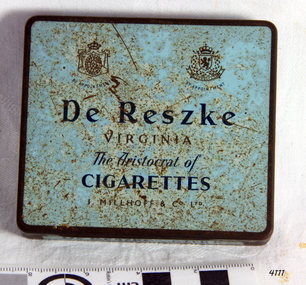
Tin, J Millhoff, 1925-1940
... Édouard de Reszke, was a Polish bass singer from Warsaw, born with an impressive natural voice and equipped with compelling histrionic skills, he became one of the most illustrious opera singers active in Europe and America during the late-Victorian era. De Reszke cigarettes are named after Édouard de Reszke and were advertised as ‘the Aristocrat of Cigarettes’. They were produced by J ...Édouard de Reszke was born into a well-to-do and cultured Polish family in Warsaw, where he first learned to sing. He spent four years in Italy, studying singing first with Stella and Alba in Milan and later the retired baritone Filippo Coletti. He later went to Paris to study with Giovanni Sbriglia, who was also his brother's teacher. Initially, he did not want to become an operatic performer but at the urging of his younger sister, Josephine (Józefina), he accepted an engagement with the Paris Opera. He was chosen by the composer Giuseppe Verdi to make his debut in the first Paris performance of Aida on April the 22nd 1876, appearing under the composer's baton as the King of Egypt. De Reszke's older brother was the renowned lyric dramatic tenor Jean de Reszke (1850–1925), with whom he would sing often in Paris, London and New York City during the next two decades. In 1887, for example, the brothers performed together in the 500th performance of Gounod's Faust at the Paris Opera. Josephine, Eduardo and Jean's sister, also embarked on a career as an opera singer in Paris but she retired early from the stage after marrying an aristocrat while at the height of her powers. Between the start of 1880 and the end of 1900, Édouard de Reszke appeared on more than 300 occasions at the Royal Opera House, Covent Garden, performing a wide range of roles in French, German and Italian operas, including works by Wagner, Verdi, Rossini, Bellini, Donizetti, Ponchielli, Verdi, Rossini, Bellini, Donizetti and Mozart. He was a huge favourite, too, with audiences at New York's Metropolitan Opera during the same era. He also sang in Chicago in 1891 and, in 1879–1881, at La Scala, Milan. In 1903, he retired from the stage after his once superlative voice developed technical difficulties and went into a swift decline. De Reszke taught singing for a while in London before returning to his estate in Poland, where he was adversely affected by the outbreak of World War I in 1914. He was cut off from his brother by the fighting, and died on 25 May 1917 at a house in Garnek, near Częstochowa, Poland. Édouard de Reszke, was a Polish bass singer from Warsaw, born with an impressive natural voice and equipped with compelling histrionic skills, he became one of the most illustrious opera singers active in Europe and America during the late-Victorian era. De Reszke cigarettes are named after Édouard de Reszke and were advertised as ‘the Aristocrat of Cigarettes’. They were produced by J Millhoff, a Russian cigarette maker living in London. He created a special blend of tobacco that it was believed would not damage the famous singer's voice. In gratitude, Millhoff was allowed to sell the blend as 'De Reszke' cigarettes. Cigarette tin, small square, pale aqua color.Marked on lid with two coats of arms in gold, and text in dark blue underneath. 'De Reszke Virginia ‘The Aristocrat of Cigarettes'.flagstaff hill, warrnambool, shipwrecked-coast, flagstaff-hill, flagstaff-hill-maritime-museum, maritime-museum, shipwreck-coast, flagstaff-hill-maritime-village, aristocrat of cigarettes, j millhoff, opera singer -
 Flagstaff Hill Maritime Museum and Village
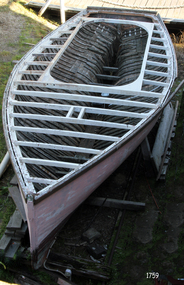
Vehicle - Vessel, Couta boat, Viator, 1890-1920
... bass strait ‘couta boat...“brusher” richards of warrnambool and port fairy...clinker hull boat...‘couta crafted boat c 1890-1905...‘couta fishing boat...erik mikkelsen shipwright...g.j. richards of port fairy...jens “peter” petersen...john lindsay...old mail boat...pivoting centerboard boat...peter watson...single-masted ketch...terry prodmore and wayne moorefield...vessel viator...viator a historical vessel...victorian ‘couta boat...victorian barracoota boat...warrnambool ‘couta boat...western victoria fishing boat...western victoria mail boat...HV000561...Australian Register of Historical Vessels...Erik Mikkelsen...J...It is significant for being used for the fishing trade, for government service, perhaps as a mail boat, and for recreation by local families. flagstaff hill warrnambool shipwrecked coast flagstaff hill maritime museum maritime museum shipwreck coast flagstaff hill maritime village great ocean road arhv hv000561 arthur rogers bass strait ‘couta boat “brusher” richards of warrnambool and port fairy clinker hull boat ‘couta crafted boat c 1890-1905 ‘couta fishing boat erik mikkelsen shipwright g.j. richards of port fairy jens “peter” petersen john lindsay old mail boat pivoting centerboard boat peter watson single-masted ketch terry prodmore and wayne moorefield vessel viator viator a historical vessel victorian ‘couta boat victorian barracoota boat warrnambool ‘couta boat western victoria fishing boat western victoria mail boat HV000561 Australian Register of Historical Vessels Erik Mikkelsen J B Jones J B Jones boat builder Footscray Sturrock Coot Sturrock J R Jones J R Jones boat builder Williamstown Eva Myrl Marked "Viator" Photograph 1759.2: "E. ...The historic Victorian ‘couta boat “Viator” was built by renowned boat builder J.R. Jones of Williamstown in Melbourne, between 1890 and 1920. He was one of the early builders of this design. The features of Viator - carvel planked, open cockpit, vertical stem and straight keel, single mast and a pivoting centreboard - are all characteristics of an early Bass Strait ‘couta boat. This has been confirmed by experienced Victorian ‘couta boat restorer Tim Phillips. Viator served as a ‘couta fishing boat in the Warrnambool area until the mid-1930s, then some say she served as a mail ferry across to Portland. Later it was used as a fishing and recreation boat for local families. For years Viator sat in a paddock in East Warrnambool until purchased in 1975 and donated to Flagstaff Hill. ‘COUTA BOATS - The ‘couta design for vessels is believed to have originated at Port Phillip, Victoria, for the purpose of the Barracouta (‘couta) fishing industry, being both fast and seaworthy. , The 'couta fish was an important food fish in Australian waters, supplying Melbourne with plenty of inexpensive fish. VIATORY’S OWNERS - Some of Viator’s history is known: - 1940, registered Port Fairy and owned by G.J. Richards. - 1941-1945, registered in Port Fairy and owned by Jens “Peter” Petersen. - 1950’s “Brusher” Richards of Warrnambool and Port Fairy used it for fishing. - Peter Watson and his son also went fishing in Viator. - Frank Ferrier, boat builder, was an owner (son of ‘La Bella’ hero, William Ferrier) - Arthur Rogers owned Viator too, then sold it to Terry Pridmore and Wayne Moorefield - The Viator was stored in a paddock, unused, in Fairmont Avenue, Warrnambool, where it was gradually deteriorating. - 1975 Viator was purchase at a very reasonable price from Pridmore, then donated to Flagstaff Hill Maritime Village. RESTORATION - Shipwright Erik Mikkelsen soon started restoration on the Viator after it arrived at Flagstaff Hill in 1975. In 2006 the Maritime Museums of Australia awarded a grant to Flagstaff Hill Maritime Village to assist with the restoration and renovation of the Viator. Its restoration continues today in the care of Flagstaff Hill’s boat builder. J R. JONES - boat builder The photograph of the EVA MYRL shows the builder J R Jones with his team of workers. The other photograph shows a vessel built by J R Jones' son, J B Jones of Footscray, and his team of boat boulders. The photograph of the EVA MYRL was taken by E. A. Dond---. The other photograph is of the Sturrock Coot, taken a Albert Park Lake in St Kilda.The Viator is the most significant boat in the Flagstaff Hill's fleet, being the last remaining local 'couta boat and one of few existing examples of this craft. Viator received Heritage status with the Australian Maritime Museums Council and is listed on the Australian Register of Historical Vessels in 2006 (ARHV Number: HV000561). Viator was built in Victoria in the early days by renowned boat builder J.R. Jones, and sailed by fishermen for many years, both local and on the coastal waters of Victoria, and was possibly used for the mail service. It is significant for being used for the fishing trade, for government service, perhaps as a mail boat, and for recreation by local families.Vessel, the ‘Viator’, an historic Victorian ‘couta boat, handmade by renowned boat builder This J.R. Jones 'couta boat, the Viator, was built in Williamstown, c.1890-1920. The single mast vessel has a Caravel hull built from New Zealand Kauri, blackwood, with a red gum keel and a jarrah stem and stern. It has a pivoting centreboard. Two photographs are included; one of the builder with his team, the other is of his son J B Jones, with his team. Marked "Viator" Photograph 1759.2: "E. A. Dond---" (indecipherable". Handwritten on back "Grandfather / J R Jones / Built" Photograph 1759.3; sign within photograph "J B JONES / BUILDER / FOOTSCRAY", stamped in the card, bottom right " ----- / MELBOURNE" and handwritten on the back "I think this is Mr Abel Sturrock Coot Albert Park Lake"flagstaff hill, warrnambool, shipwrecked coast, flagstaff hill maritime museum, maritime museum, shipwreck coast, flagstaff hill maritime village, great ocean road, arhv hv000561, arthur rogers, bass strait ‘couta boat, “brusher” richards of warrnambool and port fairy, clinker hull boat, ‘couta crafted boat c 1890-1905, ‘couta fishing boat, erik mikkelsen shipwright, g.j. richards of port fairy, jens “peter” petersen, john lindsay, old mail boat, pivoting centerboard boat, peter watson, single-masted ketch, terry prodmore and wayne moorefield, vessel viator, viator a historical vessel, victorian ‘couta boat, victorian barracoota boat, warrnambool ‘couta boat, western victoria fishing boat, western victoria mail boat, hv000561, australian register of historical vessels, erik mikkelsen, j b jones, j b jones boat builder, footscray, sturrock coot, sturrock, j r jones, j r jones boat builder, williamstown, eva myrl -
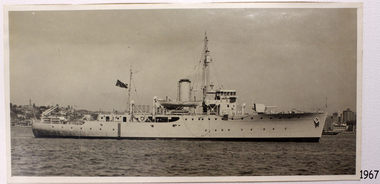 Flagstaff Hill Maritime Museum and Village
Photograph - Vessel, Steam Ship, H.M.A.S. Warrnambool J202, 1941-1947
... Bass Strait patrol...sea mine patrol...Mine sweeper...Mine clearance...Navy divers...Great Barrier Reef...Cockburn Reef...Southern Cross Diving and Salvage...Warrnambool City Council...Cr J...Warrnambool HMAS Warrnambool HMAS Warrnambool I HMAS Warrnambool J202 HMAS Swan II J202 World War II Bathurst class corvette Royal Australian Navy RAN Sydney built ship Bass Strait patrol sea mine patrol Mine sweeper Mine clearance Navy divers Great Barrier Reef Cockburn Reef Southern Cross Diving and Salvage Warrnambool City Council Cr J R Astbury Mayor J R Astbury Warrnambool Patriotic Fund Seal Coat of Arms Ship’s Bell HMAS Warrnambool 1941 Shipwreck by sea mine 1947 Sinking ship Sunk ship Sea rescue life saving Lifesaving minesweeper Photograph, black and white, HMAS Warrnambool J202 in water with land and buildings in background. ...This photograph is connected to the first HMAS Warrnambool J202, which was commissioned by the Royal Australian Navy for use as a minesweeper during World War II. The Bathurst Class Corvette, fitted out with a range of armaments, was launched in Sydney 1941. The ship began service in Bass Strait in 1941. At the end of the year it called into its namesake city, Warrnambool, where the crew paraded for the public marching eastwards along Timor Street. A gift of books for the ship’s personnel and a plaque bearing the City of Warrnambool’s Coat of Arms were presented to the ship. The ship was involved in evacuating a family of nine from the Dutch East Indies that was later successful in its challenge of Australia’s Immigration Restriction Act (White Australia Polity). The ship had many other appointments around Australia. On 13th September 1947 HMAS Warrnambool was leading a flotilla of minesweepers in northern Queensland’s coastal waters, clearing mines previously laid to defend Australia. The ship hit a mine, which exploded and very quickly sunk the ship. Boats from the nearby ships rescued most of the seamen although one was killed at the time. The survivors were taken by the HMAS Swan II to Darwin, and they went from there to hospitals in Brisbane and Sydney. Three of these men later died from their injuries. A number of items were recovered by Navy divers in 1948 including the ship’s bell and a plaque with Warrnambool’s Coat of Arms. In 1972-75 the wreck was sold and other items were salvaged. In 1995 a memorial plaque was erected in Warrnambool near the RSL. NOTE: The RAN built a second HMAS Warrnambool FCPB204, launched in 1981 and decommissioned in 2005. There was also a steam ship SS Warrnambool built in London 1892 and broken up in 1926. [A more detailed history can be found in our Collection Record 3477.] This photograph is significant for its association with Royal Australian Navy and its vessel, HMAS Warrnambool (j202). The HMAS Warrnambool played a nationally significant role in overturning Australia’s Immigration Restriction Act 1901 (colloquially known as the White Australia policy). The ship rescued, and brought to Australia, Samuel and Annie Jacob and their family after they evacuated Dutch East India. The family was threatened with deportation and made the first successful appeal to High Court regarding that Act. The HMAS Warrnambool has - Local significance for being the namesake of the City of Warrnambool - Local significance, having docked in Warrnambool Harbour - Local significance, the crew having paraded in Timor Street, Warrnambool - State significance for its first patrol being in Bass Strait. - National significance, being present in Timor at the Japanese surrender - National significance as part of Australia’s defence force history, being one of only four Bathurst class corvettes lost while in Australian service, the only Bathurst class corvette lost after World War II, the only RAN vessel to be sunk by a mine, and associated with the last four Navy deaths of WWIIPhotograph, black and white, HMAS Warrnambool J202 in water with land and buildings in background. Ship is flying a dark flag with Union Jack in corner and star below it. Lifeboat suspended above deck in centre of ship. Top of funnel has a black band. flagstaff hill, warrnambool, shipwrecked-coast, flagstaff-hill, flagstaff-hill-maritime-museum, maritime-museum, shipwreck-coast, flagstaff-hill-maritime-village, maritime village, maritime museum, shipwreck coast, mort's dock & engineering co ltd, h.m.a.s. warrnambool, hmas warrnambool, hmas warrnambool i, hmas warrnambool j202, hmas swan ii, j202, world war ii, bathurst class corvette, royal australian navy, ran, sydney built ship, bass strait patrol, sea mine patrol, mine sweeper, mine clearance, navy divers, great barrier reef, cockburn reef, southern cross diving and salvage, warrnambool city council, cr j r astbury, mayor j r astbury, warrnambool patriotic fund, seal, coat of arms, ship’s bell, hmas warrnambool 1941, shipwreck by sea mine 1947, sinking ship, sunk ship, sea rescue, life saving, lifesaving, minesweeper -
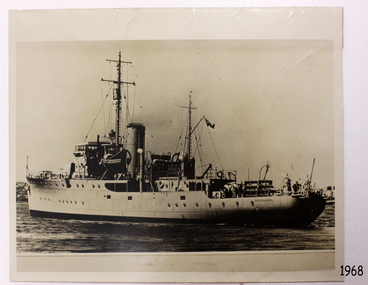 Flagstaff Hill Maritime Museum and Village
Photograph - Vessel, Steam Ship, HMAS Warrnambool J202, Between 1941-1947
... Bass Strait patrol...sea mine patrol...Mine sweeper...Mine clearance...Navy divers...Great Barrier Reef...Cockburn Reef...Southern Cross Diving and Salvage...Warrnambool City Council...Cr J...Warrnambool HMAS Warrnambool HMAS Warrnambool I HMAS Warrnambool J202 HMAS Swan II J202 World War II Bathurst class corvette Royal Australian Navy RAN Sydney built ship Bass Strait patrol sea mine patrol Mine sweeper Mine clearance Navy divers Great Barrier Reef Cockburn Reef Southern Cross Diving and Salvage Warrnambool City Council Cr J R Astbury Mayor J R Astbury Warrnambool Patriotic Fund Seal Coat of Arms Dedicatory plaque HMAS Warrnambool 1941 Shipwreck by sea mine 1947 Sinking ship Sunk ship minesweeper On side of ship "WARRNAMBOOL" Photograph of HMAS Warrnambool near land. ...The photograph shows the vessel HMAS Warrnambool J202, which was commissioned by the Royal Australian Navy for use as a minesweeper during World War II. The Bathurst Class Corvette, fitted out with a range of armaments, was launched in Sydney 1941. The ship began service in Bass Strait in 1941. At the end of the year it called into its namesake city, Warrnambool, where the crew paraded for the public marching eastwards along Timor Street. A gift of books for the ship’s personnel and a plaque bearing the City of Warrnambool’s Coat of Arms were presented to the ship. The ship was involved in evacuating a family of nine from the Dutch East Indies that was later successful in its challenge of Australia’s Immigration Restriction Act (White Australia Polity). The ship had many other appointments around Australia. On 13th September 1947 HMAS Warrnambool was leading a flotilla of minesweepers in northern Queensland’s coastal waters, clearing mines previously laid to defend Australia. The ship hit a mine, which exploded and very quickly sunk the ship. Boats from the nearby ships rescued most of the seamen although one was killed at the time. The survivors were taken by the HMAS Swan II to Darwin, and they went from there to hospitals in Brisbane and Sydney. Three of these men later died from their injuries. A number of items were recovered by Navy divers in 1948 including the ship’s bell and a plaque with Warrnambool’s Coat of Arms. In 1972-75 the wreck was sold and other items were salvaged. In 1995 a memorial plaque was erected in Warrnambool near the RSL. NOTE: The RAN built a second HMAS Warrnambool FCPB204, launched in 1981 and decommissioned in 2005. There was also a steam ship SS Warrnambool built in London 1892 and broken up in 1926. [A more detailed history can be found in our Collection Record 3477.] This photograph of HMAS Warrnambool is significant for its association with Royal Australian Navy and its vessel, HMAS Warrnambool (J202). The HMAS Warrnambool played a nationally significant role in overturning Australia’s Immigration Restriction Act 1901 (colloquially known as the White Australia policy). The ship rescued, and brought to Australia, Samuel and Annie Jacob and their family after they evacuated Dutch East India. The family was threatened with deportation and made the first successful appeal to High Court regarding that Act. The HMAS Warrnambool has - Local significance for being the namesake of the City of Warrnambool - Local significance, having docked in Warrnambool Harbour - Local significance, the crew having paraded in Timor Street, Warrnambool - State significance for its first patrol being in Bass Strait. - National significance, being present in Timor at the Japanese surrender - National significance, shown by the significance of the ship’s bell being curated as Military Heritage and Technology at the Australian War Memorial. - National significance as part of Australia’s defence force history, being one of only four Bathurst class corvettes lost while in Australian service, the only Bathurst class corvette lost after World War II, the only RAN vessel to be sunk by a mine, and associated with the last four Navy deaths of WWIIPhotograph of HMAS Warrnambool near land. Black and white photograph shows a steam and sail vessel in calm water beside land. Figures are standing on board. A flag flies on a mast. The ship's name is on the stern. The light coloured funnel has emitted a small amount of smoke.On side of ship "WARRNAMBOOL"flagstaff hill, maritime village, maritime museum, warrnambool, shipwreck coast, mort's dock & engineering co ltd, h.m.a.s. warrnambool, hmas warrnambool, hmas warrnambool i, hmas warrnambool j202, hmas swan ii, j202, world war ii, bathurst class corvette, royal australian navy, ran, sydney built ship, bass strait patrol, sea mine patrol, mine sweeper, mine clearance, navy divers, great barrier reef, cockburn reef, southern cross diving and salvage, warrnambool city council, cr j r astbury, mayor j r astbury, warrnambool patriotic fund, seal, coat of arms, dedicatory plaque, hmas warrnambool 1941, shipwreck by sea mine 1947, sinking ship, sunk ship, minesweeper -
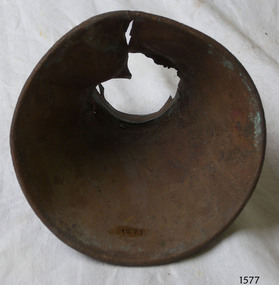 Flagstaff Hill Maritime Museum and Village
Equipment - Speaking Tube, Morts Dock & Engineering Co. Ltd, circa 1941
... Bass Strait patrol...sea mine patrol...Mine sweeper...Mine clearance...Navy divers...Great Barrier Reef...Cockburn Reef...Southern Cross Diving and Salvage...Warrnambool City Council...Cr J...Warrnambool HMAS Warrnambool HMAS Warrnambool I HMAS Warrnambool J202 HMAS Swan II J202 World War II Bathurst class corvette Royal Australian Navy RAN Sydney built ship Bass Strait patrol sea mine patrol Mine sweeper Mine clearance Navy divers Great Barrier Reef Cockburn Reef Southern Cross Diving and Salvage Warrnambool City Council Cr J R Astbury Mayor J R Astbury Warrnambool Patriotic Fund Seal Coat of Arms Ship’s Bell HMAS Warrnambool 1941 Shipwreck by sea mine 1947 Sinking ship Sunk ship Sea rescue life saving Lifesaving speaking tube voice pipe communication on ship marine technology marine equipment minesweeper Speaking tube or voice pipe, brass, conical shape, broken off at base. ...This brass speaking tube or voice pipe was used by the crew to communicate within the ship. It was recovered from the wreck of the Royal Australian Navy vessel, HMAS Warrnambool in 1948. The HMAS Warrnambool J202 was commissioned by the Royal Australian Navy for use as a minesweeper during World War II. The Bathurst Class Corvette, fitted out with a range of armaments, was launched in Sydney 1941 and was. The ship began service in Bass Strait in 1941. At the end of the year it called into its namesake city, Warrnambool, where the crew paraded for the public marching eastwards along Timor Street. A gift of books for the ship’s personnel and a plaque bearing the City of Warrnambool’s Coat of Arms were presented to the ship. The ship was involved in evacuating a family of nine from the Dutch East Indies that was later successful in its challenge of Australia’s Immigration Restriction Act (White Australia Polity). The ship had many other appointments around Australia. On 13th September 1947 HMAS Warrnambool was leading a flotilla of minesweepers in northern Queensland’s coastal waters, clearing mines previously laid to defend Australia. The ship hit a mine, which exploded and very quickly sunk the ship. Boats from the nearby ships rescued most of the seamen although one was killed at the time. The survivors were taken by the HMAS Swan II to Darwin, and they went from there to hospitals in Brisbane and Sydney. Three of these men later died from their injuries. A number of items were recovered by Navy divers in 1948 including the ship’s bell and a plaque with Warrnambool’s Coat of Arms. In 1972-75 the wreck was sold and other items were salvaged. In 1995 a memorial plaque was erected in Warrnambool near the RSL. NOTE: The RAN built a second HMAS Warrnambool FCPB204, launched in 1981 and decommissioned in 2005. There was also a steam ship SS Warrnambool built in London 1892 and broken up in 1926. [A more detailed history can be found in our Collection Record 3477.] This speaking tube is an example of communication used in the mid-1900s on board a vessel. It is significant is significant for its association with Royal Australian Navy and its vessel, HMAS Warrnambool (J202). The HMAS Warrnambool played a nationally significant role in overturning Australia’s Immigration Restriction Act 1901 (colloquially known as the White Australia policy). The ship rescued, and brought to Australia, Samuel and Annie Jacob and their family after they evacuated Dutch East India. The family was threatened with deportation and made the first successful appeal to High Court regarding that Act. The HMAS Warrnambool has - Local significance for being the namesake of the City of Warrnambool - Local significance, having docked in Warrnambool Harbour - Local significance, the crew having paraded in Timor Street, Warrnambool - State significance for its first patrol being in Bass Strait. - National significance, being present in Timor at the Japanese surrender - National significance, shown by the significance of the ship’s bell being curated as Military Heritage and Technology at the Australian War Memorial. - National significance as part of Australia’s defence force history, being one of only four Bathurst class corvettes lost while in Australian service, the only Bathurst class corvette lost after World War II, the only RAN vessel to be sunk by a mine, and associated with the last four Navy deaths of WWIISpeaking tube or voice pipe, brass, conical shape, broken off at base. Wide end has a rolled edge. Recovered from HMAS Warrnambool, sunk on 13-09-1947.flagstaff hill, maritime village, maritime museum, warrnambool, shipwreck coast, mort's dock & engineering co ltd, h.m.a.s. warrnambool, hmas warrnambool, hmas warrnambool i, hmas warrnambool j202, hmas swan ii, j202, world war ii, bathurst class corvette, royal australian navy, ran, sydney built ship, bass strait patrol, sea mine patrol, mine sweeper, mine clearance, navy divers, great barrier reef, cockburn reef, southern cross diving and salvage, warrnambool city council, cr j r astbury, mayor j r astbury, warrnambool patriotic fund, seal, coat of arms, ship’s bell, hmas warrnambool 1941, shipwreck by sea mine 1947, sinking ship, sunk ship, sea rescue, life saving, lifesaving, speaking tube, voice pipe, communication on ship, marine technology, marine equipment, minesweeper -
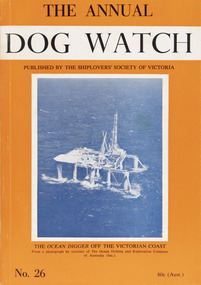 Mission to Seafarers Victoria
Journal (item) - Periodicals-Annual, Shiplovers' Society of Victoria, The Annual Dog Watch, 1969
... Bass Strait - T. E. Goldfinch - 23 Reminiscences in Sai - George Oakes - 27 My First Christmas in the Service - Lt.-Com. H. A. Willian, M.B.E., V.R.D., R.A.N.R. (Ret) - 30 Fortune's Wheel - Captain W. E. Eglen - 34 A Very Near Thing - Ralph Ingram - 37 The Time Charter - Captain Ruben Fogelstrom - 49 Ninety Years Under the Sea - J. ...Bass Strait - T. E. Goldfinch - 23 Reminiscences in Sai - George Oakes - 27 My First Christmas in the Service - Lt.-Com. H. A. Willian, M.B.E., V.R.D., R.A.N.R. (Ret) - 30 Fortune's Wheel - Captain W. E. Eglen - 34 A Very Near Thing - Ralph Ingram - 37 The Time Charter - Captain Ruben Fogelstrom - 49 Ninety Years Under the Sea - J. ...This journal provides the reader with glimpses of the adventures and hardships of a seaman's life. Many of the stories are of sailing ships.Contributes to our knowledge of the importance of shipping and places on record those stories of the sea which would otherwise be lost.Contents Foreword - Commodore Michael Parker, C.V.O. - 8 Editorial - S.A.E.S. - 17 An Unusual Cruise Through Bass Strait - T. E. Goldfinch - 23 Reminiscences in Sai - George Oakes - 27 My First Christmas in the Service - Lt.-Com. H. A. Willian, M.B.E., V.R.D., R.A.N.R. (Ret) - 30 Fortune's Wheel - Captain W. E. Eglen - 34 A Very Near Thing - Ralph Ingram - 37 The Time Charter - Captain Ruben Fogelstrom - 49 Ninety Years Under the Sea - J. M. MacKenzie - 53 Many hogs and Three Serpents - Captain C. E. Parkes - 58 Feathered Navigators - Arthur E. Woodley - 60 Human Radar - T. F. Roberts - 65 The Wreck of the Dutch Ship "Vergulde Draeck" - C. Halls - 67 The Port of Portland -- Victoria - - 78 The Barque "Carrazal" - From the papers of the late Captain J. Bull - 81 Pilots (verse) - C. E. Bonwick - 83 Hazards of Sail - A letter from Commodore John Rodgers, U.S.N. - 84 Dhows - C. W. Hawkins - 88 "Full Astern" Without "Stand-by" - S. F. P. Brown - 98 The "Lightning" Passage - More extracts of the Diary of a Passenger - 103 The "Royal Charter" - J. M. Mackie - 114 More on the "Royal Charter" - Dr. H. Cohen. C.B.E. 115 An Echo of Courage - a letter from J. S. Matthews - 117 A Wartime Passage - T. S. Shoesmith - 120 Book Reviews - - 130sailing ships, steamships, shipping, seafaring life, shiplovers' society of victoria, dog watch -
Federation University Historical Collection
Album, Newspaper Articles about Sutton Employees
... j. batten...j.h. freeman...harry west...j.h jones...j.k.t davis...r. mead...g.w. richardson...w. sack...alfred langlands...reg brigland...maurice claypole inchley...j.d.h. scrivener...alberto zelman...c. bass...Frederic Earp Suttons Pty Ltd Frank braden alexander law william heath james marshall sayer v.v lorimer h. howes r. taylor jack rutland arthur j. orford george miller garry kennedy a.w. humphries charles flowers r.f nicholls craig walker max vermish george mccann j. batten j.h. freeman harry west j.h jones j.k.t davis r. mead g.w. richardson w. sack alfred langlands reg brigland maurice claypole inchley j.d.h. scrivener alberto zelman c. bass david gillam harry davison f.l. bolitho Newspaper Articles about Sutton Employees Album ...frederic earp, suttons pty ltd, frank braden, alexander law, william heath, james marshall sayer, v.v lorimer, h. howes, r. taylor, jack rutland, arthur j. orford, george miller, garry kennedy, a.w. humphries, charles flowers, r.f nicholls, craig walker, max vermish, george mccann, j. batten, j.h. freeman, harry west, j.h jones, j.k.t davis, r. mead, g.w. richardson, w. sack, alfred langlands, reg brigland, maurice claypole inchley, j.d.h. scrivener, alberto zelman, c. bass, david gillam, harry davison, f.l. bolitho -
Federation University Historical Collection
Book - Ledger, Ballarat Technical Art School and Ballarat School of Mines Rough Cash Book, 1896-1901, 1896-1901
... bass...thomas lynch...stanley batten...murial hart...essie herbert...david o. nightingale...george p. hayes...j.a. powell...w. amor...c.f. wilson...bertram g. wheal...thomas wade...h. woodward...v. symons...robert j...The Ballarat Technical Art School was a division of the Ballarat School of Mines ballarat technical art school frank young r. hager g.w. kelly\drawing carpentry smelting treatment assay w. wilson yong treatment of pyrites g.m. vare alfred seely t. trengrove w. pearce c.v. day john heinz m. ditchburn d. ditchburn w. baragwanath g. cornell chemistry w. wardle j.j. carroll julia carroll h. murphy d.m. lenehan joh caley h. fleahy alfred gordon effie dulfer b. lloyd p. papenhager h.j. waller k. malcolm esther daniel john watson harry leggo r. john allan basil reid e. wasley w. richard edgar lamb rita webb sophia mccartney arnold cowdell thomas glover m. hamburger r. allan r.w. holmes a. dobbie a. slade w. pepper r. gilpin w.a. gossman james a. bass w.t. bass thomas lynch stanley batten murial hart essie herbert david o. nightingale george p. hayes j.a. powell w. amor c.f. wilson bertram g. wheal thomas wade h. woodward v. symons robert j. allan thomas woolcock john w. williams r. shand william caldwell charles lyons ruby webb a. trehowan nicholas white thomas commons otto rieglhuth james kidd james bass justus angwin john munro james ronaldson a.b. osborne g.j. boudry john sprague leslie c. langsford john don waller e. hearman j.c. pickford edwinn penn w.g. price thomas mann william brokenshire john blayney arthur mccooey samuel walmsley matilda lees e.w. campbell ernest wiliams william john pearce w.l. bailleu thomas proctor daisy ditchburn maurice hamburger james dando nelson humphrey james pyke james c. pickford john coad george richard pratt ferguson boyce ernest whettle william lamb john cawley christina watson ivor davies percy la gerche norman gaunt william bolte leonard p. seal alex young george penny w. caircross harold frew robert allan james h. holst george green herbert semmens john ronaldson william robinson james paterson walter douglas louisa roberts james swenson austin woods herbert hillman william cairncross harry blyth john craford william h. callister clare gartery daisy batten j. attenborough herbert o'neilk j.f. lynch fred holst a. doepel horace giles john perry samuel morrow thomas hawthorn george britnall alan j. acton jessie cantwell franci a. horsfall william stubbs john sutherland percy russell richard walsh oliver jager garfield bolton thomas vincent james holst j.a. hill william charles hughes a. vale james lonie karl moore A hard covered ledger with marbled cover and brown tape spine. ...The Ballarat Technical Art School was a division of the Ballarat School of MinesA hard covered ledger with marbled cover and brown tape spine. It includes students names. A selection of names can be found in the keywords.ballarat technical art school, frank young, r. hager, g.w. kelly\drawing, carpentry, smelting, treatment, assay, w. wilson yong, treatment of pyrites, g.m. vare, alfred seely, t. trengrove, w. pearce, c.v. day, john heinz, m. ditchburn, d. ditchburn, w. baragwanath, g. cornell, chemistry, w. wardle, j.j. carroll, julia carroll, h. murphy, d.m. lenehan, joh caley, h. fleahy, alfred gordon, effie dulfer, b. lloyd, p. papenhager, h.j. waller, k. malcolm, esther daniel, john watson, harry leggo, r. john allan, basil reid, e. wasley, w. richard, edgar lamb, rita webb, sophia mccartney, arnold cowdell, thomas glover, m. hamburger, r. allan, r.w. holmes, a. dobbie, a. slade, w. pepper, r. gilpin, w.a. gossman, james a. bass, w.t. bass, thomas lynch, stanley batten, murial hart, essie herbert, david o. nightingale, george p. hayes, j.a. powell, w. amor, c.f. wilson, bertram g. wheal, thomas wade, h. woodward, v. symons, robert j. allan, thomas woolcock, john w. williams, r. shand, william caldwell, charles lyons, ruby webb, a. trehowan, nicholas white, thomas commons, otto rieglhuth, james kidd, james bass, justus angwin, john munro, james ronaldson, a.b. osborne, g.j. boudry, john sprague, leslie c. langsford, john don, waller e. hearman, j.c. pickford, edwinn penn, w.g. price, thomas mann, william brokenshire, john blayney, arthur mccooey, samuel walmsley, matilda lees, e.w. campbell, ernest wiliams, william john pearce, w.l. bailleu, thomas proctor, daisy ditchburn, maurice hamburger, james dando, nelson humphrey, james pyke, james c. pickford, john coad, george richard pratt, ferguson boyce, ernest whettle, william lamb, john cawley, christina watson, ivor davies, percy la gerche, norman gaunt, william bolte, leonard p. seal, alex young, george penny, w. caircross, harold frew, robert allan, james h. holst, george green, herbert semmens, john ronaldson, william robinson, james paterson, walter douglas, louisa roberts, james swenson, austin woods, herbert hillman, william cairncross, harry blyth, john craford, william h. callister, clare gartery, daisy batten, j. attenborough, herbert o'neilk, j.f. lynch, fred holst, a. doepel, horace giles, john perry, samuel morrow, thomas hawthorn, george britnall, alan j. acton, jessie cantwell, franci a. horsfall, william stubbs, john sutherland, percy russell, richard walsh, oliver jager, garfield bolton, thomas vincent, james holst, j.a. hill, william charles hughes, a. vale, james lonie, karl moore -
 Flagstaff Hill Maritime Museum and Village
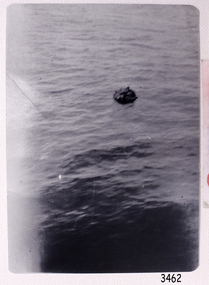
Photograph - Shipwreck rescue, 13-09-1947
... Bass Strait patrol...sea mine patrol...Mine sweeper...Mine clearance...Navy divers...Great Barrier Reef...Cockburn Reef...Southern Cross Diving and Salvage...Warrnambool City Council...Cr J...Warrnambool HMAS Warrnambool HMAS Warrnambool I HMAS Warrnambool J202 HMAS Swan II J202 World War II Bathurst class corvette Royal Australian Navy RAN Sydney built ship Bass Strait patrol sea mine patrol Mine sweeper Mine clearance Navy divers Great Barrier Reef Cockburn Reef Southern Cross Diving and Salvage Warrnambool City Council Cr J R Astbury Mayor J R Astbury Warrnambool Patriotic Fund Seal Coat of Arms Dedicatory plaque HMAS Warrnambool 1941 Shipwreck by sea mine 1947 Sinking ship Sunk ship Sea rescue life saving Lifesaving lifeboat minesweeper Photograph of rescue of crew from H.M.A.S. ...This photograph was taken at the scene of the wreck of the HMAS Warrnambool J202 on September 13th 1947.The photographer has captured the crew in a lifeboat surrounded by sea. The lifeboat is approaching the HMAS Swan II. The HMAS Warrnambool J202 was commissioned by the Royal Australian Navy for use as a minesweeper during World War II. The Bathurst Class Corvette, fitted out with a range of armaments, was launched in Sydney in May 1941. The ship began service in Bass Strait in 1941. At the end of the year it called into its namesake city, Warrnambool, where the crew paraded for the public marching eastwards along Timor Street. A gift of books for the ship’s personnel and a plaque bearing the City of Warrnambool’s Coat of Arms were presented to the ship. The ship was involved in evacuating a family of nine from the Dutch East Indies that was later successful in its challenge of Australia’s Immigration Restriction Act (White Australia Polity). The ship had many other appointments around Australia. On 13th September 1947 HMAS Warrnambool was leading a flotilla of minesweepers in northern Queensland’s coastal waters, clearing mines previously laid to defend Australia. The ship hit a mine, which exploded and very quickly sunk the ship. Boats from the nearby ships rescued most of the seamen although one was killed at the time. The survivors were taken by the HMAS Swan II to Darwin, and they went from there to hospitals in Brisbane and Sydney. Three of these men later died from their injuries. A number of items were recovered by Navy divers in 1948 including the ship’s bell and a plaque with Warrnambool’s Coat of Arms. In 1972-75 the wreck was sold and other items were salvaged. In 1995 a memorial plaque was erected in Warrnambool near the RSL. NOTE: The RAN built a second HMAS Warrnambool FCPB204, launched in 1981 and decommissioned in 2005. There was also a steam ship SS Warrnambool built in London 1892 and broken up in 1926. [A more detailed history can be found in our Collection Record 3477.] This photograph is significant for its association with the lifesaving rescue of the crew and the sinking Royal Australian Navy vessel, HMAS Warrnambool (J202). The HMAS Warrnambool played a nationally significant role in overturning Australia’s Immigration Restriction Act 1901 (colloquially known as the White Australia policy). The ship rescued, and brought to Australia, Samuel and Annie Jacob and their family after they evacuated Dutch East India. The family was threatened with deportation and made the first successful appeal to High Court regarding that Act. The HMAS Warrnambool has - Local significance for being the namesake of the City of Warrnambool - Local significance, having docked in Warrnambool Harbour - Local significance, the crew having paraded in Timor Street, Warrnambool - State significance for its first patrol being in Bass Strait. - National significance, being present in Timor at the Japanese surrender - National significance, shown by the significance of the ship’s bell being curated as Military Heritage and Technology at the Australian War Memorial. - National significance as part of Australia’s defence force history, being one of only four Bathurst class corvettes lost while in Australian service, the only Bathurst class corvette lost after World War II, the only RAN vessel to be sunk by a mine, and associated with the last four Navy deaths of WWII Photograph of rescue of crew from H.M.A.S. Warrnambool, sunk on 13-09-1947. Men in life boat surrounded by water. This black and white photograph is one of a series of photographs taken at that time. flagstaff hill, maritime village, maritime museum, warrnambool, shipwreck coast, mort's dock & engineering co ltd, h.m.a.s. warrnambool, hmas warrnambool, hmas warrnambool i, hmas warrnambool j202, hmas swan ii, j202, world war ii, bathurst class corvette, royal australian navy, ran, sydney built ship, bass strait patrol, sea mine patrol, mine sweeper, mine clearance, navy divers, great barrier reef, cockburn reef, southern cross diving and salvage, warrnambool city council, cr j r astbury, mayor j r astbury, warrnambool patriotic fund, seal, coat of arms, dedicatory plaque, hmas warrnambool 1941, shipwreck by sea mine 1947, sinking ship, sunk ship, sea rescue, life saving, lifesaving, lifeboat, minesweeper -
 Flagstaff Hill Maritime Museum and Village
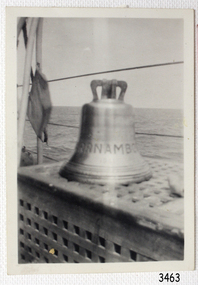
Photograph - Ship's Bell, Royal Australian Navy (RAN), HMAS Warrnambool 1941, 1948
... Bass Strait patrol...sea mine patrol...Mine sweeper...Mine clearance...Navy divers...Great Barrier Reef...Cockburn Reef...Southern Cross Diving and Salvage...Warrnambool City Council...Cr J...Warrnambool HMAS Warrnambool HMAS Warrnambool I HMAS Warrnambool J202 HMAS Swan II J202 World War II Bathurst class corvette Royal Australian Navy RAN Sydney built ship Bass Strait patrol sea mine patrol Mine sweeper Mine clearance Navy divers Great Barrier Reef Cockburn Reef Southern Cross Diving and Salvage Warrnambool City Council Cr J R Astbury Mayor J R Astbury Warrnambool Patriotic Fund Seal Coat of Arms Dedicatory plaque HMAS Warrnambool 1941 Shipwreck by sea mine 1947 Sinking ship Sunk ship Sea rescue life saving Lifesaving HMAS Warrnambool ship’s bell Ship’s Bell minesweeper In photograph, inscription on bell "- ARNAMB-" [WARRNAMBOOL] Photograph of ship bell from shipwreck of HMAS Warrnambool, sunk on 13-09-1947. ...This photograph was taken at the wreck site of the HMAS Warrnambool J202, wrecked on September 13th 1947. The bell was recovered in 1948 by the Royal Australian Navy. The ship's bell has been of great importance to a ship for hundreds of years. The bell is used for the timing of ships watches, for emergencies and many other purposes. It is also a prized possession when a ship is wrecked or broken up, as lasting memorial of the ship's existence. The HMAS Warrnambool J202 was commissioned by the Royal Australian Navy for use as a minesweeper during World War II. The Bathurst Class Corvette, fitted out with a range of armaments, was launched in Sydney 1941 and was. The ship began service in Bass Strait in 1941. At the end of the year it called into its namesake city, Warrnambool, where the crew paraded for the public marching eastwards along Timor Street. A gift of books for the ship’s personnel and a plaque bearing the City of Warrnambool’s Coat of Arms were presented to the ship. The ship was involved in evacuating a family of nine from the Dutch East Indies that was later successful in its challenge of Australia’s Immigration Restriction Act (White Australia Polity). The ship had many other appointments around Australia. On 13th September 1947 HMAS Warrnambool was leading a flotilla of minesweepers in northern Queensland’s coastal waters, clearing mines previously laid to defend Australia. The ship hit a mine, which exploded and very quickly sunk the ship. Boats from the nearby ships rescued most of the seamen although one was killed at the time. The survivors were taken by the HMAS Swan II to Darwin, and they went from there to hospitals in Brisbane and Sydney. Three of these men later died from their injuries. A number of items were recovered by Navy divers in 1948 including the ship’s bell and a plaque with Warrnambool’s Coat of Arms. In 1972-75 the wreck was sold and other items were salvaged. In 1995 a memorial plaque was erected in Warrnambool near the RSL. NOTE: The RAN built a second HMAS Warrnambool FCPB204, launched in 1981 and decommissioned in 2005. There was also a steam ship SS Warrnambool built in London 1892 and broken up in 1926. [A more detailed history can be found in our Collection Record 3477.] This photograph is significant for its association with the lifesaving rescue of the crew and the sinking Royal Australian Navy vessel, HMAS Warrnambool (J202). The HMAS Warrnambool played a nationally significant role in overturning Australia’s Immigration Restriction Act 1901 (colloquially known as the White Australia policy). The ship rescued, and brought to Australia, Samuel and Annie Jacob and their family after they evacuated Dutch East India. The family was threatened with deportation and made the first successful appeal to High Court regarding that Act. The HMAS Warrnambool has - Local significance for being the namesake of the City of Warrnambool - Local significance, having docked in Warrnambool Harbour - Local significance, the crew having paraded in Timor Street, Warrnambool - State significance for its first patrol being in Bass Strait. - National significance, being present in Timor at the Japanese surrender - National significance, shown by the significance of the ship’s bell being curated as Military Heritage and Technology at the Australian War Memorial. - National significance as part of Australia’s defence force history, being one of only four Bathurst class corvettes lost while in Australian service, the only Bathurst class corvette lost after World War II, the only RAN vessel to be sunk by a mine, and associated with the last four Navy deaths of WWII Photograph of ship bell from shipwreck of HMAS Warrnambool, sunk on 13-09-1947. The black and white photograph of the bell shows its inverted 'U' shaped fitting on top and inscribed letters around it. The flared base of the bell has concentric rings as decoration. In photograph, inscription on bell "- ARNAMB-" [WARRNAMBOOL]flagstaff hill, maritime village, maritime museum, warrnambool, shipwreck coast, mort's dock & engineering co ltd, h.m.a.s. warrnambool, hmas warrnambool, hmas warrnambool i, hmas warrnambool j202, hmas swan ii, j202, world war ii, bathurst class corvette, royal australian navy, ran, sydney built ship, bass strait patrol, sea mine patrol, mine sweeper, mine clearance, navy divers, great barrier reef, cockburn reef, southern cross diving and salvage, warrnambool city council, cr j r astbury, mayor j r astbury, warrnambool patriotic fund, seal, coat of arms, dedicatory plaque, hmas warrnambool 1941, shipwreck by sea mine 1947, sinking ship, sunk ship, sea rescue, life saving, lifesaving, hmas warrnambool ship’s bell, ship’s bell, minesweeper -
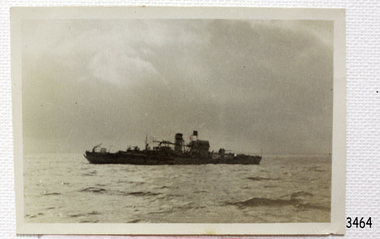 Flagstaff Hill Maritime Museum and Village
Photograph - Shipwreck rescue, Royal Australian Navy (RAN), 13-09-1947
... Bass Strait patrol...sea mine patrol...Mine sweeper...Mine clearance...Navy divers...Great Barrier Reef...Cockburn Reef...Southern Cross Diving and Salvage...Warrnambool City Council...Cr J...Warrnambool HMAS Warrnambool HMAS Warrnambool I HMAS Warrnambool J202 HMAS Swan II J202 World War II Bathurst class corvette Royal Australian Navy RAN Sydney built ship Bass Strait patrol sea mine patrol Mine sweeper Mine clearance Navy divers Great Barrier Reef Cockburn Reef Southern Cross Diving and Salvage Warrnambool City Council Cr J R Astbury Mayor J R Astbury Warrnambool Patriotic Fund Seal Coat of Arms Dedicatory plaque HMAS Warrnambool 1941 Shipwreck by sea mine 1947 Sinking ship Sunk ship minesweeper Photograph of the sinking of the ship HMAS Warrnambool, sunk on 13-09-1947. ...This photograph was taken at the scene of the wreck of the HMAS Warrnambool J202 on September 13th 1947. The photographer has captured the ship as it sinks at sea. The HMAS Warrnambool J202 was commissioned by the Royal Australian Navy for use as a minesweeper during World War II. The Bathurst Class Corvette, fitted out with a range of armaments, was launched in Sydney in 1941. The ship began service in Bass Strait in 1941. At the end of the year it called into its namesake city, Warrnambool, where the crew paraded for the public marching eastwards along Timor Street. A gift of books for the ship’s personnel and a plaque bearing the City of Warrnambool’s Coat of Arms were presented to the ship. The ship was involved in evacuating a family of nine from the Dutch East Indies that was later successful in its challenge of Australia’s Immigration Restriction Act (White Australia Polity). The ship had many other appointments around Australia. On 13th September 1947 HMAS Warrnambool was leading a flotilla of minesweepers in northern Queensland’s coastal waters, clearing mines previously laid to defend Australia. The ship hit a mine, which exploded and very quickly sunk the ship. Boats from the nearby ships rescued most of the seamen although one was killed at the time. The survivors were taken by the HMAS Swan II to Darwin, and they went from there to hospitals in Brisbane and Sydney. Three of these men later died from their injuries. A number of items were recovered by Navy divers in 1948 including the ship’s bell and a plaque with Warrnambool’s Coat of Arms. In 1972-75 the wreck was sold and other items were salvaged. In 1995 a memorial plaque was erected in Warrnambool near the RSL. NOTE: The RAN built a second HMAS Warrnambool FCPB204, launched in 1981 and decommissioned in 2005. There was also a steam ship SS Warrnambool built in London 1892 and broken up in 1926. [A more detailed history can be found in our Collection Record 3477.] This photograph is significant for its association with the lifesaving rescue of the crew and the sinking Royal Australian Navy vessel, HMAS Warrnambool (J202). The HMAS Warrnambool played a nationally significant role in overturning Australia’s Immigration Restriction Act 1901 (colloquially known as the White Australia policy). The ship rescued, and brought to Australia, Samuel and Annie Jacob and their family after they evacuated Dutch East India. The family was threatened with deportation and made the first successful appeal to High Court regarding that Act. The HMAS Warrnambool has - Local significance for being the namesake of the City of Warrnambool - Local significance, having docked in Warrnambool Harbour - Local significance, the crew having paraded in Timor Street, Warrnambool - State significance for its first patrol being in Bass Strait. - National significance, being present in Timor at the Japanese surrender - National significance, shown by the significance of the ship’s bell being curated as Military Heritage and Technology at the Australian War Memorial. - National significance as part of Australia’s defence force history, being one of only four Bathurst class corvettes lost while in Australian service, the only Bathurst class corvette lost after World War II, the only RAN vessel to be sunk by a mine, and associated with the last four Navy deaths of WWII Photograph of the sinking of the ship HMAS Warrnambool, sunk on 13-09-1947. This black and white photograph showing the vessel at sea is one of a series of photographs taken at the time.flagstaff hill, maritime village, maritime museum, warrnambool, shipwreck coast, mort's dock & engineering co ltd, h.m.a.s. warrnambool, hmas warrnambool, hmas warrnambool i, hmas warrnambool j202, hmas swan ii, j202, world war ii, bathurst class corvette, royal australian navy, ran, sydney built ship, bass strait patrol, sea mine patrol, mine sweeper, mine clearance, navy divers, great barrier reef, cockburn reef, southern cross diving and salvage, warrnambool city council, cr j r astbury, mayor j r astbury, warrnambool patriotic fund, seal, coat of arms, dedicatory plaque, hmas warrnambool 1941, shipwreck by sea mine 1947, sinking ship, sunk ship, minesweeper -
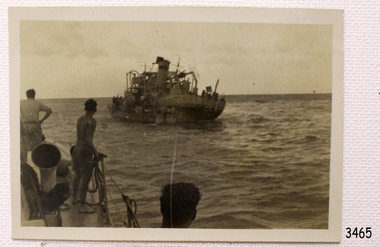 Flagstaff Hill Maritime Museum and Village
Photograph - Shipwreck rescue, Royal Australian Navy (RAN), 13-09-1947
... Bass Strait patrol...sea mine patrol...Mine sweeper...Mine clearance...Navy divers...Great Barrier Reef...Cockburn Reef...Southern Cross Diving and Salvage...Warrnambool City Council...Cr J...Warrnambool HMAS Warrnambool HMAS Warrnambool I HMAS Warrnambool J202 HMAS Swan II J202 World War II Bathurst class corvette Royal Australian Navy RAN Sydney built ship Bass Strait patrol sea mine patrol Mine sweeper Mine clearance Navy divers Great Barrier Reef Cockburn Reef Southern Cross Diving and Salvage Warrnambool City Council Cr J R Astbury Mayor J R Astbury Warrnambool Patriotic Fund Seal Coat of Arms Dedicatory plaque HMAS Warrnambool 1941 Shipwreck by sea mine 1947 Sinking ship Sunk ship Sea rescue life saving Lifesaving minesweeper Photograph of the sinking of the ship HMAS Warrnambool, sunk on 13-09-1947. ...This photograph was taken at the scene of the wreck of the HMAS Warrnambool J202 on September 13th 1947. The photographer has captured the ship as it sinks at sea. The photograph is taken from a nearby vessel, likely to be the HMAS Swan II, which took the survivors onboard. The HMAS Warrnambool J202 was commissioned by the Royal Australian Navy for use as a minesweeper during World War II. The Bathurst Class Corvette, fitted out with a range of armaments, was launched in Sydney in 1941. The ship began service in Bass Strait in 1941. At the end of the year it called into its namesake city, Warrnambool, where the crew paraded for the public marching eastwards along Timor Street. A gift of books for the ship’s personnel and a plaque bearing the City of Warrnambool’s Coat of Arms were presented to the ship. The ship was involved in evacuating a family of nine from the Dutch East Indies that was later successful in its challenge of Australia’s Immigration Restriction Act (White Australia Polity). The ship had many other appointments around Australia. On 13th September 1947 HMAS Warrnambool was leading a flotilla of minesweepers in northern Queensland’s coastal waters, clearing mines previously laid to defend Australia. The ship hit a mine, which exploded and very quickly sunk the ship. Boats from the nearby ships rescued most of the seamen although one was killed at the time. The survivors were taken by the HMAS Swan II to Darwin, and they went from there to hospitals in Brisbane and Sydney. Three of these men later died from their injuries. A number of items were recovered by Navy divers in 1948 including the ship’s bell and a plaque with Warrnambool’s Coat of Arms. In 1972-75 the wreck was sold and other items were salvaged. In 1995 a memorial plaque was erected in Warrnambool near the RSL. NOTE: The RAN built a second HMAS Warrnambool FCPB204, launched in 1981 and decommissioned in 2005. There was also a steam ship SS Warrnambool built in London 1892 and broken up in 1926. [A more detailed history can be found in our Collection Record 3477.] This photograph is significant for its association with the lifesaving rescue of the crew and the sinking Royal Australian Navy vessel, HMAS Warrnambool (J202). The HMAS Warrnambool played a nationally significant role in overturning Australia’s Immigration Restriction Act 1901 (colloquially known as the White Australia policy). The ship rescued, and brought to Australia, Samuel and Annie Jacob and their family after they evacuated Dutch East India. The family was threatened with deportation and made the first successful appeal to High Court regarding that Act. The HMAS Warrnambool has - Local significance for being the namesake of the City of Warrnambool - Local significance, having docked in Warrnambool Harbour - Local significance, the crew having paraded in Timor Street, Warrnambool - State significance for its first patrol being in Bass Strait. - National significance, being present in Timor at the Japanese surrender - National significance, shown by the significance of the ship’s bell being curated as Military Heritage and Technology at the Australian War Memorial. - National significance as part of Australia’s defence force history, being one of only four Bathurst class corvettes lost while in Australian service, the only Bathurst class corvette lost after World War II, the only RAN vessel to be sunk by a mine, and associated with the last four Navy deaths of WWII Photograph of the sinking of the ship HMAS Warrnambool, sunk on 13-09-1947. Figures onboard a vessel are looking towards figures on the sinking vessel. This black and white photograph is one of a series of photographs taken at the time.flagstaff hill, maritime village, maritime museum, warrnambool, shipwreck coast, mort's dock & engineering co ltd, h.m.a.s. warrnambool, hmas warrnambool, hmas warrnambool i, hmas warrnambool j202, hmas swan ii, j202, world war ii, bathurst class corvette, royal australian navy, ran, sydney built ship, bass strait patrol, sea mine patrol, mine sweeper, mine clearance, navy divers, great barrier reef, cockburn reef, southern cross diving and salvage, warrnambool city council, cr j r astbury, mayor j r astbury, warrnambool patriotic fund, seal, coat of arms, dedicatory plaque, hmas warrnambool 1941, shipwreck by sea mine 1947, sinking ship, sunk ship, sea rescue, life saving, lifesaving, minesweeper -
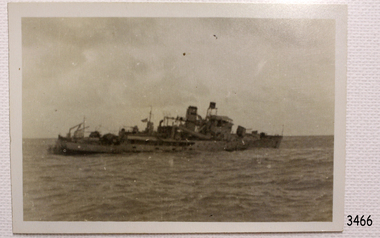 Flagstaff Hill Maritime Museum and Village
Photograph - Shipwreck rescue, Royal Australian Navy (RAN), HMAS Warrnambool J202, 13-09-1947
... Bass Strait patrol...sea mine patrol...Mine sweeper...Mine clearance...Navy divers...Great Barrier Reef...Cockburn Reef...Southern Cross Diving and Salvage...Warrnambool City Council...Cr J...Warrnambool HMAS Warrnambool HMAS Warrnambool I HMAS Warrnambool J202 HMAS Swan II J202 World War II Bathurst class corvette Royal Australian Navy RAN Sydney built ship Bass Strait patrol sea mine patrol Mine sweeper Mine clearance Navy divers Great Barrier Reef Cockburn Reef Southern Cross Diving and Salvage Warrnambool City Council Cr J R Astbury Mayor J R Astbury Warrnambool Patriotic Fund Seal Coat of Arms Dedicatory plaque HMAS Warrnambool 1941 Shipwreck by sea mine 1947 Sinking ship Sunk ship Sea rescue life saving Lifesaving minesweeper Photograph of the starboard side of the sinking ship HMAS Warrnambool, sunk on 13-09-1947. ...This photograph was taken at the scene of the wreck of the HMAS Warrnambool J202 on September 13th 1947. The photographer has captured the ship as it sinks at sea. The HMAS Warrnambool J202 was commissioned by the Royal Australian Navy for use as a minesweeper during World War II. The Bathurst Class Corvette, fitted out with a range of armaments, was launched in Sydney in 1941. The ship began service in Bass Strait in 1941. At the end of the year it called into its namesake city, Warrnambool, where the crew paraded for the public marching eastwards along Timor Street. A gift of books for the ship’s personnel and a plaque bearing the City of Warrnambool’s Coat of Arms were presented to the ship. The ship was involved in evacuating a family of nine from the Dutch East Indies that was later successful in its challenge of Australia’s Immigration Restriction Act (White Australia Polity). The ship had many other appointments around Australia. On 13th September 1947 HMAS Warrnambool was leading a flotilla of minesweepers in northern Queensland’s coastal waters, clearing mines previously laid to defend Australia. The ship hit a mine, which exploded and very quickly sunk the ship. Boats from the nearby ships rescued most of the seamen although one was killed at the time. The survivors were taken by the HMAS Swan II to Darwin, and they went from there to hospitals in Brisbane and Sydney. Three of these men later died from their injuries. A number of items were recovered by Navy divers in 1948 including the ship’s bell and a plaque with Warrnambool’s Coat of Arms. In 1972-75 the wreck was sold and other items were salvaged. In 1995 a memorial plaque was erected in Warrnambool near the RSL. NOTE: The RAN built a second HMAS Warrnambool FCPB204, launched in 1981 and decommissioned in 2005. There was also a steam ship SS Warrnambool built in London 1892 and broken up in 1926. [A more detailed history can be found in our Collection Record 3477.] This photograph is significant for its association with the lifesaving rescue of the crew and the sinking Royal Australian Navy vessel, HMAS Warrnambool (J202). The HMAS Warrnambool played a nationally significant role in overturning Australia’s Immigration Restriction Act 1901 (colloquially known as the White Australia policy). The ship rescued, and brought to Australia, Samuel and Annie Jacob and their family after they evacuated Dutch East India. The family was threatened with deportation and made the first successful appeal to High Court regarding that Act. The HMAS Warrnambool has - Local significance for being the namesake of the City of Warrnambool - Local significance, having docked in Warrnambool Harbour - Local significance, the crew having paraded in Timor Street, Warrnambool - State significance for its first patrol being in Bass Strait. - National significance, being present in Timor at the Japanese surrender - National significance, shown by the significance of the ship’s bell being curated as Military Heritage and Technology at the Australian War Memorial. - National significance as part of Australia’s defence force history, being one of only four Bathurst class corvettes lost while in Australian service, the only Bathurst class corvette lost after World War II, the only RAN vessel to be sunk by a mine, and associated with the last four Navy deaths of WWII Photograph of the starboard side of the sinking ship HMAS Warrnambool, sunk on 13-09-1947. This black and white photograph is one of a series of photographs taken at the time.flagstaff hill, maritime village, maritime museum, warrnambool, shipwreck coast, mort's dock & engineering co ltd, h.m.a.s. warrnambool, hmas warrnambool, hmas warrnambool i, hmas warrnambool j202, hmas swan ii, j202, world war ii, bathurst class corvette, royal australian navy, ran, sydney built ship, bass strait patrol, sea mine patrol, mine sweeper, mine clearance, navy divers, great barrier reef, cockburn reef, southern cross diving and salvage, warrnambool city council, cr j r astbury, mayor j r astbury, warrnambool patriotic fund, seal, coat of arms, dedicatory plaque, hmas warrnambool 1941, shipwreck by sea mine 1947, sinking ship, sunk ship, sea rescue, life saving, lifesaving, minesweeper -
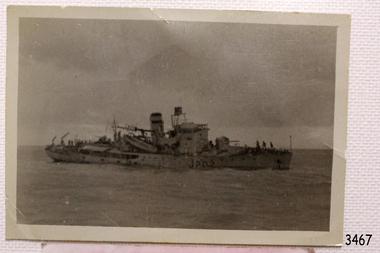 Flagstaff Hill Maritime Museum and Village
Photograph - Shipwreck rescue, Royal Australian Navy (RAN), HMAS Warrnambool J202, 13-09-1947
... Bass Strait patrol...sea mine patrol...Mine sweeper...Mine clearance...Navy divers...Great Barrier Reef...Cockburn Reef...Southern Cross Diving and Salvage...Warrnambool City Council...Cr J...Warrnambool HMAS Warrnambool HMAS Warrnambool I HMAS Warrnambool J202 HMAS Swan II J202 World War II Bathurst class corvette Royal Australian Navy RAN Sydney built ship Bass Strait patrol sea mine patrol Mine sweeper Mine clearance Navy divers Great Barrier Reef Cockburn Reef Southern Cross Diving and Salvage Warrnambool City Council Cr J R Astbury Mayor J R Astbury Warrnambool Patriotic Fund Seal Coat of Arms Dedicatory plaque HMAS Warrnambool 1941 Shipwreck by sea mine 1947 Sinking ship Sunk ship Sea rescue life saving Lifesaving minesweeper Text on side of ship "J202" Photograph of the sinking ship HMAS Warrnambool, sunk on 13-09-1947. ...This photograph was taken at the scene of the wreck of the HMAS Warrnambool J202 on September 13th 1947. The photographer has captured the sinking ship with the crew still onboard. The HMAS Warrnambool J202 was commissioned by the Royal Australian Navy for use as a minesweeper during World War II. The Bathurst Class Corvette, fitted out with a range of armaments, was launched in Sydney in 1941 . The ship began service in Bass Strait in 1941. At the end of the year it called into its namesake city, Warrnambool, where the crew paraded for the public marching eastwards along Timor Street. A gift of books for the ship’s personnel and a plaque bearing the City of Warrnambool’s Coat of Arms were presented to the ship. The ship was involved in evacuating a family of nine from the Dutch East Indies that was later successful in its challenge of Australia’s Immigration Restriction Act (White Australia Polity). The ship had many other appointments around Australia. On 13th September 1947 HMAS Warrnambool was leading a flotilla of minesweepers in northern Queensland’s coastal waters, clearing mines previously laid to defend Australia. The ship hit a mine, which exploded and very quickly sunk the ship. Boats from the nearby ships rescued most of the seamen although one was killed at the time. The survivors were taken by the HMAS Swan II to Darwin, and they went from there to hospitals in Brisbane and Sydney. Three of these men later died from their injuries. A number of items were recovered by Navy divers in 1948 including the ship’s bell and a plaque with Warrnambool’s Coat of Arms. In 1972-75 the wreck was sold and other items were salvaged. In 1995 a memorial plaque was erected in Warrnambool near the RSL. NOTE: The RAN built a second HMAS Warrnambool FCPB204, launched in 1981 and decommissioned in 2005. There was also a steam ship SS Warrnambool built in London 1892 and broken up in 1926. [A more detailed history can be found in our Collection Record 3477.] This photograph is significant for its association with the lifesaving rescue of the crew and the sinking Royal Australian Navy vessel, HMAS Warrnambool (J202). The HMAS Warrnambool played a nationally significant role in overturning Australia’s Immigration Restriction Act 1901 (colloquially known as the White Australia policy). The ship rescued, and brought to Australia, Samuel and Annie Jacob and their family after they evacuated Dutch East India. The family was threatened with deportation and made the first successful appeal to High Court regarding that Act. The HMAS Warrnambool has - Local significance for being the namesake of the City of Warrnambool - Local significance, having docked in Warrnambool Harbour - Local significance, the crew having paraded in Timor Street, Warrnambool - State significance for its first patrol being in Bass Strait. - National significance, being present in Timor at the Japanese surrender - National significance, shown by the significance of the ship’s bell being curated as Military Heritage and Technology at the Australian War Memorial. - National significance as part of Australia’s defence force history, being one of only four Bathurst class corvettes lost while in Australian service, the only Bathurst class corvette lost after World War II, the only RAN vessel to be sunk by a mine, and associated with the last four Navy deaths of WWII Photograph of the sinking ship HMAS Warrnambool, sunk on 13-09-1947. Figures can be seen onboard the damaged vessel. The number of the ship-type is clearly visible on this starboard profile of the ship. This black and white photograph is one of a series of photographs taken at the time.Text on side of ship "J202"flagstaff hill, maritime village, maritime museum, warrnambool, shipwreck coast, mort's dock & engineering co ltd, h.m.a.s. warrnambool, hmas warrnambool, hmas warrnambool i, hmas warrnambool j202, hmas swan ii, j202, world war ii, bathurst class corvette, royal australian navy, ran, sydney built ship, bass strait patrol, sea mine patrol, mine sweeper, mine clearance, navy divers, great barrier reef, cockburn reef, southern cross diving and salvage, warrnambool city council, cr j r astbury, mayor j r astbury, warrnambool patriotic fund, seal, coat of arms, dedicatory plaque, hmas warrnambool 1941, shipwreck by sea mine 1947, sinking ship, sunk ship, sea rescue, life saving, lifesaving, minesweeper -
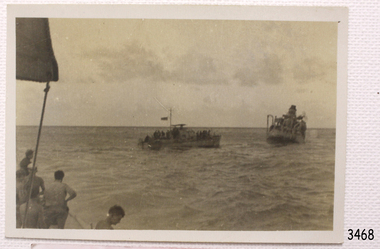 Flagstaff Hill Maritime Museum and Village
Photograph - Shipwreck rescue, Royal Australian Navy (RAN), HMAS Warrnambool J202, 13-09-947
... Bass Strait patrol...sea mine patrol...Mine sweeper...Mine clearance...Navy divers...Great Barrier Reef...Cockburn Reef...Southern Cross Diving and Salvage...Warrnambool City Council...Cr J...Warrnambool HMAS Warrnambool HMAS Warrnambool I HMAS Warrnambool J202 HMAS Swan II J202 World War II Bathurst class corvette Royal Australian Navy RAN Sydney built ship Bass Strait patrol sea mine patrol Mine sweeper Mine clearance Navy divers Great Barrier Reef Cockburn Reef Southern Cross Diving and Salvage Warrnambool City Council Cr J R Astbury Mayor J R Astbury Warrnambool Patriotic Fund Seal Coat of Arms Dedicatory plaque HMAS Warrnambool 1941 Shipwreck by sea mine 1947 Sinking ship Sunk ship Sea rescue life saving Lifesaving minesweeper Photograph of rescue of the crew from shipwreck HMAS Warrnambool, sunk on 13-09-1947. ...This photograph was taken at the scene of the wreck of the HMAS Warrnambool J202 on September 13th 1947. The photographer has captured the rescue boat approaching the sinking ship with the crew onboard. There small boat has several figures onboard. The HMAS Warrnambool J202 was commissioned by the Royal Australian Navy for use as a minesweeper during World War II. The Bathurst Class Corvette, fitted out with a range of armaments, was launched in Sydney in 1941. The ship began service in Bass Strait in 1941. At the end of the year it called into its namesake city, Warrnambool, where the crew paraded for the public marching eastwards along Timor Street. A gift of books for the ship’s personnel and a plaque bearing the City of Warrnambool’s Coat of Arms were presented to the ship. The ship was involved in evacuating a family of nine from the Dutch East Indies that was later successful in its challenge of Australia’s Immigration Restriction Act (White Australia Polity). The ship had many other appointments around Australia. On 13th September 1947 HMAS Warrnambool was leading a flotilla of minesweepers in northern Queensland’s coastal waters, clearing mines previously laid to defend Australia. The ship hit a mine, which exploded and very quickly sunk the ship. Boats from the nearby ships rescued most of the seamen although one was killed at the time. The survivors were taken by the HMAS Swan II to Darwin, and they went from there to hospitals in Brisbane and Sydney. Three of these men later died from their injuries. A number of items were recovered by Navy divers in 1948 including the ship’s bell and a plaque with Warrnambool’s Coat of Arms. In 1972-75 the wreck was sold and other items were salvaged. In 1995 a memorial plaque was erected in Warrnambool near the RSL. NOTE: The RAN built a second HMAS Warrnambool FCPB204, launched in 1981 and decommissioned in 2005. There was also a steam ship SS Warrnambool built in London 1892 and broken up in 1926. [A more detailed history can be found in our Collection Record 3477.] This photograph is significant for its association with the lifesaving rescue of the crew and the sinking Royal Australian Navy vessel, HMAS Warrnambool (J202). The HMAS Warrnambool played a nationally significant role in overturning Australia’s Immigration Restriction Act 1901 (colloquially known as the White Australia policy). The ship rescued, and brought to Australia, Samuel and Annie Jacob and their family after they evacuated Dutch East India. The family was threatened with deportation and made the first successful appeal to High Court regarding that Act. The HMAS Warrnambool has - Local significance for being the namesake of the City of Warrnambool - Local significance, having docked in Warrnambool Harbour - Local significance, the crew having paraded in Timor Street, Warrnambool - State significance for its first patrol being in Bass Strait. - National significance, being present in Timor at the Japanese surrender - National significance, shown by the significance of the ship’s bell being curated as Military Heritage and Technology at the Australian War Memorial. - National significance as part of Australia’s defence force history, being one of only four Bathurst class corvettes lost while in Australian service, the only Bathurst class corvette lost after World War II, the only RAN vessel to be sunk by a mine, and associated with the last four Navy deaths of WWII Photograph of rescue of the crew from shipwreck HMAS Warrnambool, sunk on 13-09-1947. Figures onboard a larger vessel look across at rescue vessel heading towards the sinking ship. This black and white photograph is one of a series of photographs taken at the time.flagstaff hill, maritime village, maritime museum, warrnambool, shipwreck coast, mort's dock & engineering co ltd, h.m.a.s. warrnambool, hmas warrnambool, hmas warrnambool i, hmas warrnambool j202, hmas swan ii, j202, world war ii, bathurst class corvette, royal australian navy, ran, sydney built ship, bass strait patrol, sea mine patrol, mine sweeper, mine clearance, navy divers, great barrier reef, cockburn reef, southern cross diving and salvage, warrnambool city council, cr j r astbury, mayor j r astbury, warrnambool patriotic fund, seal, coat of arms, dedicatory plaque, hmas warrnambool 1941, shipwreck by sea mine 1947, sinking ship, sunk ship, sea rescue, life saving, lifesaving, minesweeper -
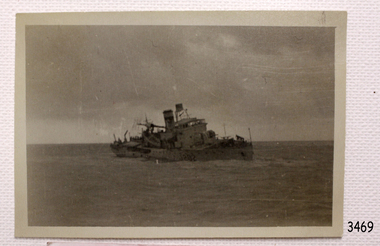 Flagstaff Hill Maritime Museum and Village
Photograph - Shipwreck rescue, Royal Australian Navy (RAN), HMAS Warrnambool J202, 13-09-1947
... Bass Strait patrol...sea mine patrol...Mine sweeper...Mine clearance...Navy divers...Great Barrier Reef...Cockburn Reef...Southern Cross Diving and Salvage...Warrnambool City Council...Cr J...Warrnambool HMAS Warrnambool HMAS Warrnambool I HMAS Warrnambool J202 HMAS Swan II J202 World War II Bathurst class corvette Royal Australian Navy RAN Sydney built ship Bass Strait patrol sea mine patrol Mine sweeper Mine clearance Navy divers Great Barrier Reef Cockburn Reef Southern Cross Diving and Salvage Warrnambool City Council Cr J R Astbury Mayor J R Astbury Warrnambool Patriotic Fund Seal Coat of Arms Dedicatory plaque HMAS Warrnambool 1941 Shipwreck by sea mine 1947 Sinking ship Sunk ship Sea rescue life saving Lifesaving minesweeper Photograph of the sinking ship HMAS Warrnambool, sunk on 13-09-1947. ...This photograph was taken at the scene of the wreck of the HMAS Warrnambool J202 on September 13th 1947. The photographer has captured the ship as it sinks at sea. The HMAS Warrnambool J202 was commissioned by the Royal Australian Navy for use as a minesweeper during World War II. The Bathurst Class Corvette, fitted out with a range of armaments, was launched in Sydney in 1941. The ship began service in Bass Strait in 1941. At the end of the year it called into its namesake city, Warrnambool, where the crew paraded for the public marching eastwards along Timor Street. A gift of books for the ship’s personnel and a plaque bearing the City of Warrnambool’s Coat of Arms were presented to the ship. The ship was involved in evacuating a family of nine from the Dutch East Indies that was later successful in its challenge of Australia’s Immigration Restriction Act (White Australia Polity). The ship had many other appointments around Australia. On 13th September 1947 HMAS Warrnambool was leading a flotilla of minesweepers in northern Queensland’s coastal waters, clearing mines previously laid to defend Australia. The ship hit a mine, which exploded and very quickly sunk the ship. Boats from the nearby ships rescued most of the seamen although one was killed at the time. The survivors were taken by the HMAS Swan II to Darwin, and they went from there to hospitals in Brisbane and Sydney. Three of these men later died from their injuries. A number of items were recovered by Navy divers in 1948 including the ship’s bell and a plaque with Warrnambool’s Coat of Arms. In 1972-75 the wreck was sold and other items were salvaged. In 1995 a memorial plaque was erected in Warrnambool near the RSL. NOTE: The RAN built a second HMAS Warrnambool FCPB204, launched in 1981 and decommissioned in 2005. There was also a steam ship SS Warrnambool built in London 1892 and broken up in 1926. [A more detailed history can be found in our Collection Record 3477.] This photograph is significant for its association with the lifesaving rescue of the crew and the sinking Royal Australian Navy vessel, HMAS Warrnambool (J202). The HMAS Warrnambool played a nationally significant role in overturning Australia’s Immigration Restriction Act 1901 (colloquially known as the White Australia policy). The ship rescued, and brought to Australia, Samuel and Annie Jacob and their family after they evacuated Dutch East India. The family was threatened with deportation and made the first successful appeal to High Court regarding that Act. The HMAS Warrnambool has - Local significance for being the namesake of the City of Warrnambool - Local significance, having docked in Warrnambool Harbour - Local significance, the crew having paraded in Timor Street, Warrnambool - State significance for its first patrol being in Bass Strait. - National significance, being present in Timor at the Japanese surrender - National significance, shown by the significance of the ship’s bell being curated as Military Heritage and Technology at the Australian War Memorial. - National significance as part of Australia’s defence force history, being one of only four Bathurst class corvettes lost while in Australian service, the only Bathurst class corvette lost after World War II, the only RAN vessel to be sunk by a mine, and associated with the last four Navy deaths of WWII Photograph of the sinking ship HMAS Warrnambool, sunk on 13-09-1947. The image shows the damaged ship tilting down on the starboard side. The ship-type number is still mostly visible. This black and white photograph is one of a series of photographs taken at the time.flagstaff hill, maritime village, maritime museum, warrnambool, shipwreck coast, mort's dock & engineering co ltd, h.m.a.s. warrnambool, hmas warrnambool, hmas warrnambool i, hmas warrnambool j202, hmas swan ii, j202, world war ii, bathurst class corvette, royal australian navy, ran, sydney built ship, bass strait patrol, sea mine patrol, mine sweeper, mine clearance, navy divers, great barrier reef, cockburn reef, southern cross diving and salvage, warrnambool city council, cr j r astbury, mayor j r astbury, warrnambool patriotic fund, seal, coat of arms, dedicatory plaque, hmas warrnambool 1941, shipwreck by sea mine 1947, sinking ship, sunk ship, sea rescue, life saving, lifesaving, minesweeper -
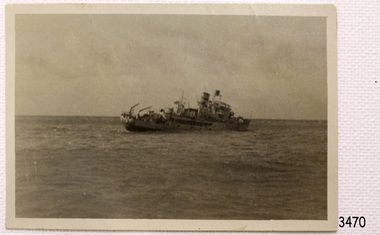 Flagstaff Hill Maritime Museum and Village
Photograph - Shipwreck rescue, Royal Australian Navy (RAN), HMAS Warrnambool J202, 13-09-1947
... Bass Strait patrol...sea mine patrol...Mine sweeper...Mine clearance...Navy divers...Great Barrier Reef...Cockburn Reef...Southern Cross Diving and Salvage...Warrnambool City Council...Cr J...Warrnambool HMAS Warrnambool HMAS Warrnambool I HMAS Warrnambool J202 HMAS Swan II J202 World War II Bathurst class corvette Royal Australian Navy RAN Sydney built ship Bass Strait patrol sea mine patrol Mine sweeper Mine clearance Navy divers Great Barrier Reef Cockburn Reef Southern Cross Diving and Salvage Warrnambool City Council Cr J R Astbury Mayor J R Astbury Warrnambool Patriotic Fund Seal Coat of Arms Dedicatory plaque HMAS Warrnambool 1941 Shipwreck by sea mine 1947 Sinking ship Sunk ship Sea rescue life saving Lifesaving minesweeper Photograph of the sinking ship HMAS Warrnambool, sunk on 13-09-1947. ...This photograph was taken at the scene of the wreck of the HMAS Warrnambool J202 on September 13th 1947. The photographer has captured the ship as it sinks at sea, with, it seems, crew still on board.. The HMAS Warrnambool J202 was commissioned by the Royal Australian Navy for use as a minesweeper during World War II. The Bathurst Class Corvette, fitted out with a range of armaments, was launched in Sydney in 1941. The ship began service in Bass Strait in 1941. At the end of the year it called into its namesake city, Warrnambool, where the crew paraded for the public marching eastwards along Timor Street. A gift of books for the ship’s personnel and a plaque bearing the City of Warrnambool’s Coat of Arms were presented to the ship. The ship was involved in evacuating a family of nine from the Dutch East Indies that was later successful in its challenge of Australia’s Immigration Restriction Act (White Australia Polity). The ship had many other appointments around Australia. On 13th September 1947 HMAS Warrnambool was leading a flotilla of minesweepers in northern Queensland’s coastal waters, clearing mines previously laid to defend Australia. The ship hit a mine, which exploded and very quickly sunk the ship. Boats from the nearby ships rescued most of the seamen although one was killed at the time. The survivors were taken by the HMAS Swan II to Darwin, and they went from there to hospitals in Brisbane and Sydney. Three of these men later died from their injuries. A number of items were recovered by Navy divers in 1948 including the ship’s bell and a plaque with Warrnambool’s Coat of Arms. In 1972-75 the wreck was sold and other items were salvaged. In 1995 a memorial plaque was erected in Warrnambool near the RSL. NOTE: The RAN built a second HMAS Warrnambool FCPB204, launched in 1981 and decommissioned in 2005. There was also a steam ship SS Warrnambool built in London 1892 and broken up in 1926. [A more detailed history can be found in our Collection Record 3477.] This photograph is significant for its association with the lifesaving rescue of the crew and the sinking Royal Australian Navy vessel, HMAS Warrnambool (J202). The HMAS Warrnambool played a nationally significant role in overturning Australia’s Immigration Restriction Act 1901 (colloquially known as the White Australia policy). The ship rescued, and brought to Australia, Samuel and Annie Jacob and their family after they evacuated Dutch East India. The family was threatened with deportation and made the first successful appeal to High Court regarding that Act. The HMAS Warrnambool has - Local significance for being the namesake of the City of Warrnambool - Local significance, having docked in Warrnambool Harbour - Local significance, the crew having paraded in Timor Street, Warrnambool - State significance for its first patrol being in Bass Strait. - National significance, being present in Timor at the Japanese surrender - National significance, shown by the significance of the ship’s bell being curated as Military Heritage and Technology at the Australian War Memorial. - National significance as part of Australia’s defence force history, being one of only four Bathurst class corvettes lost while in Australian service, the only Bathurst class corvette lost after World War II, the only RAN vessel to be sunk by a mine, and associated with the last four Navy deaths of WWII Photograph of the sinking ship HMAS Warrnambool, sunk on 13-09-1947. The image shows the ship leaning at an angle towards the sea. There appears to be figures near the bow. This black and white photograph is one of a series of photographs taken at the time.flagstaff hill, maritime village, maritime museum, warrnambool, shipwreck coast, mort's dock & engineering co ltd, h.m.a.s. warrnambool, hmas warrnambool, hmas warrnambool i, hmas warrnambool j202, hmas swan ii, j202, world war ii, bathurst class corvette, royal australian navy, ran, sydney built ship, bass strait patrol, sea mine patrol, mine sweeper, mine clearance, navy divers, great barrier reef, cockburn reef, southern cross diving and salvage, warrnambool city council, cr j r astbury, mayor j r astbury, warrnambool patriotic fund, seal, coat of arms, dedicatory plaque, hmas warrnambool 1941, shipwreck by sea mine 1947, sinking ship, sunk ship, sea rescue, life saving, lifesaving, minesweeper -
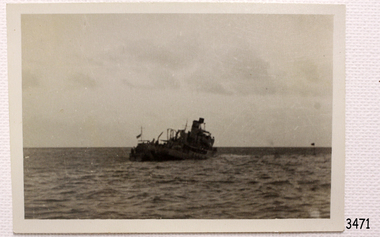 Flagstaff Hill Maritime Museum and Village
Photograph - Shipwreck rescue, Royal Australian Navy (RAN), HMAS Warrnambool J202, 13-09-1947
... Bass Strait patrol...sea mine patrol...Mine sweeper...Mine clearance...Navy divers...Great Barrier Reef...Cockburn Reef...Southern Cross Diving and Salvage...Warrnambool City Council...Cr J...Warrnambool HMAS Warrnambool HMAS Warrnambool I HMAS Warrnambool J202 HMAS Swan II J202 World War II Bathurst class corvette Royal Australian Navy RAN Sydney built ship Bass Strait patrol sea mine patrol Mine sweeper Mine clearance Navy divers Great Barrier Reef Cockburn Reef Southern Cross Diving and Salvage Warrnambool City Council Cr J R Astbury Mayor J R Astbury Warrnambool Patriotic Fund Seal Coat of Arms Dedicatory plaque HMAS Warrnambool 1941 Shipwreck by sea mine 1947 Sinking ship Sunk ship Sea rescue life saving Lifesaving minesweeper Photograph of the sinking ship HMAS Warrnambool, sunk on 13-09-1947. ...This photograph was taken at the scene of the wreck of the HMAS Warrnambool J202 on September 13th 1947. The photographer has captured the ship as it sinks at sea. The HMAS Warrnambool J202 was commissioned by the Royal Australian Navy for use as a minesweeper during World War II. The Bathurst Class Corvette, fitted out with a range of armaments, was launched in Sydney in 1941. The ship began service in Bass Strait in 1941. At the end of the year it called into its namesake city, Warrnambool, where the crew paraded for the public marching eastwards along Timor Street. A gift of books for the ship’s personnel and a plaque bearing the City of Warrnambool’s Coat of Arms were presented to the ship. The ship was involved in evacuating a family of nine from the Dutch East Indies that was later successful in its challenge of Australia’s Immigration Restriction Act (White Australia Polity). The ship had many other appointments around Australia. On 13th September 1947 HMAS Warrnambool was leading a flotilla of minesweepers in northern Queensland’s coastal waters, clearing mines previously laid to defend Australia. The ship hit a mine, which exploded and very quickly sunk the ship. Boats from the nearby ships rescued most of the seamen although one was killed at the time. The survivors were taken by the HMAS Swan II to Darwin, and they went from there to hospitals in Brisbane and Sydney. Three of these men later died from their injuries. A number of items were recovered by Navy divers in 1948 including the ship’s bell and a plaque with Warrnambool’s Coat of Arms. In 1972-75 the wreck was sold and other items were salvaged. In 1995 a memorial plaque was erected in Warrnambool near the RSL. NOTE: The RAN built a second HMAS Warrnambool FCPB204, launched in 1981 and decommissioned in 2005. There was also a steam ship SS Warrnambool built in London 1892 and broken up in 1926. [A more detailed history can be found in our Collection Record 3477.] This photograph is significant for its association with the lifesaving rescue of the crew and the sinking Royal Australian Navy vessel, HMAS Warrnambool (J202). The HMAS Warrnambool played a nationally significant role in overturning Australia’s Immigration Restriction Act 1901 (colloquially known as the White Australia policy). The ship rescued, and brought to Australia, Samuel and Annie Jacob and their family after they evacuated Dutch East India. The family was threatened with deportation and made the first successful appeal to High Court regarding that Act. The HMAS Warrnambool has - Local significance for being the namesake of the City of Warrnambool - Local significance, having docked in Warrnambool Harbour - Local significance, the crew having paraded in Timor Street, Warrnambool - State significance for its first patrol being in Bass Strait. - National significance, being present in Timor at the Japanese surrender - National significance, shown by the significance of the ship’s bell being curated as Military Heritage and Technology at the Australian War Memorial. - National significance as part of Australia’s defence force history, being one of only four Bathurst class corvettes lost while in Australian service, the only Bathurst class corvette lost after World War II, the only RAN vessel to be sunk by a mine, and associated with the last four Navy deaths of WWII Photograph of the sinking ship HMAS Warrnambool, sunk on 13-09-1947. The image shows the ship tilting towards port side and the bow dipping. This black and white photograph is one of a series of photographs taken at the time.flagstaff hill, maritime village, maritime museum, warrnambool, shipwreck coast, mort's dock & engineering co ltd, h.m.a.s. warrnambool, hmas warrnambool, hmas warrnambool i, hmas warrnambool j202, hmas swan ii, j202, world war ii, bathurst class corvette, royal australian navy, ran, sydney built ship, bass strait patrol, sea mine patrol, mine sweeper, mine clearance, navy divers, great barrier reef, cockburn reef, southern cross diving and salvage, warrnambool city council, cr j r astbury, mayor j r astbury, warrnambool patriotic fund, seal, coat of arms, dedicatory plaque, hmas warrnambool 1941, shipwreck by sea mine 1947, sinking ship, sunk ship, sea rescue, life saving, lifesaving, minesweeper -
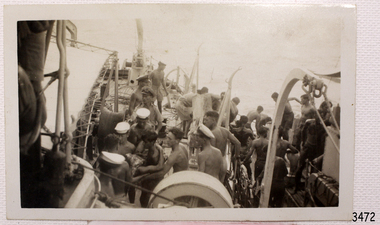 Flagstaff Hill Maritime Museum and Village
Photograph - Shipwreck rescue, Royal Australian Navy (RAN), 13-09-1947
... Bass Strait patrol...sea mine patrol...Mine sweeper...Mine clearance...Navy divers...Great Barrier Reef...Cockburn Reef...Southern Cross Diving and Salvage...Warrnambool City Council...Cr J...Warrnambool HMAS Warrnambool HMAS Warrnambool I HMAS Warrnambool J202 HMAS Swan II J202 World War II Bathurst class corvette Royal Australian Navy RAN Sydney built ship Bass Strait patrol sea mine patrol Mine sweeper Mine clearance Navy divers Great Barrier Reef Cockburn Reef Southern Cross Diving and Salvage Warrnambool City Council Cr J R Astbury Mayor J R Astbury Warrnambool Patriotic Fund Seal Coat of Arms Dedicatory plaque HMAS Warrnambool 1941 Shipwreck by sea mine 1947 Sinking ship Sunk ship Sea rescue life saving Lifesaving minesweeper Photograph of the rescue of the crew from shipwreck HMAS Warrnambool, sunk on 13-09-1947. ...This photograph was taken at the scene of the wreck of the HMAS Warrnambool J202 on September 13th 1947. The photographer has captured the crew being rescued, transferring from one vessel to another, which is likely to be the HMAS Swan II. The HMAS Warrnambool J202 was commissioned by the Royal Australian Navy for use as a minesweeper during World War II. The Bathurst Class Corvette, fitted out with a range of armaments, was launched in Sydney 1941. The ship began service in Bass Strait in 1941. At the end of the year it called into its namesake city, Warrnambool, where the crew paraded for the public marching eastwards along Timor Street. A gift of books for the ship’s personnel and a plaque bearing the City of Warrnambool’s Coat of Arms were presented to the ship. The ship was involved in evacuating a family of nine from the Dutch East Indies that was later successful in its challenge of Australia’s Immigration Restriction Act (White Australia Polity). The ship had many other appointments around Australia. On 13th September 1947 HMAS Warrnambool was leading a flotilla of minesweepers in northern Queensland’s coastal waters, clearing mines previously laid to defend Australia. The ship hit a mine, which exploded and very quickly sunk the ship. Boats from the nearby ships rescued most of the seamen although one was killed at the time. The survivors were taken by the HMAS Swan II to Darwin, and they went from there to hospitals in Brisbane and Sydney. Three of these men later died from their injuries. A number of items were recovered by Navy divers in 1948 including the ship’s bell and a plaque with Warrnambool’s Coat of Arms. In 1972-75 the wreck was sold and other items were salvaged. In 1995 a memorial plaque was erected in Warrnambool near the RSL. NOTE: The RAN built a second HMAS Warrnambool FCPB204, launched in 1981 and decommissioned in 2005. There was also a steam ship SS Warrnambool built in London 1892 and broken up in 1926. [A more detailed history can be found in our Collection Record 3477.] This photograph is significant for its association with the lifesaving rescue of the crew and the sinking Royal Australian Navy vessel, HMAS Warrnambool (J202). The HMAS Warrnambool played a nationally significant role in overturning Australia’s Immigration Restriction Act 1901 (colloquially known as the White Australia policy). The ship rescued, and brought to Australia, Samuel and Annie Jacob and their family after they evacuated Dutch East India. The family was threatened with deportation and made the first successful appeal to High Court regarding that Act. The HMAS Warrnambool has - Local significance for being the namesake of the City of Warrnambool - Local significance, having docked in Warrnambool Harbour - Local significance, the crew having paraded in Timor Street, Warrnambool - State significance for its first patrol being in Bass Strait. - National significance, being present in Timor at the Japanese surrender - National significance, shown by the significance of the ship’s bell being curated as Military Heritage and Technology at the Australian War Memorial. - National significance as part of Australia’s defence force history, being one of only four Bathurst class corvettes lost while in Australian service, the only Bathurst class corvette lost after World War II, the only RAN vessel to be sunk by a mine, and associated with the last four Navy deaths of WWII Photograph of the rescue of the crew from shipwreck HMAS Warrnambool, sunk on 13-09-1947. Survivors are helped from one vessel to another by seamen. This black and white photograph is one of a series of photographs taken at the time.flagstaff hill, maritime village, maritime museum, warrnambool, shipwreck coast, mort's dock & engineering co ltd, h.m.a.s. warrnambool, hmas warrnambool, hmas warrnambool i, hmas warrnambool j202, hmas swan ii, j202, world war ii, bathurst class corvette, royal australian navy, ran, sydney built ship, bass strait patrol, sea mine patrol, mine sweeper, mine clearance, navy divers, great barrier reef, cockburn reef, southern cross diving and salvage, warrnambool city council, cr j r astbury, mayor j r astbury, warrnambool patriotic fund, seal, coat of arms, dedicatory plaque, hmas warrnambool 1941, shipwreck by sea mine 1947, sinking ship, sunk ship, sea rescue, life saving, lifesaving, minesweeper -
 Flagstaff Hill Maritime Museum and Village
Photograph - Shipwreck rescue, Royal Australian Navy (RAN), 13-09-1947
... Bass Strait patrol...sea mine patrol...Mine sweeper...Mine clearance...Navy divers...Great Barrier Reef...Cockburn Reef...Southern Cross Diving and Salvage...Warrnambool City Council...Cr J...Warrnambool HMAS Warrnambool HMAS Warrnambool I HMAS Warrnambool J202 HMAS Swan II J202 World War II Bathurst class corvette Royal Australian Navy RAN Sydney built ship Bass Strait patrol sea mine patrol Mine sweeper Mine clearance Navy divers Great Barrier Reef Cockburn Reef Southern Cross Diving and Salvage Warrnambool City Council Cr J R Astbury Mayor J R Astbury Warrnambool Patriotic Fund Seal Coat of Arms Dedicatory plaque HMAS Warrnambool 1941 Shipwreck by sea mine 1947 Sinking ship Sunk ship Sea rescue life saving Lifesaving minesweeper Photograph of the rescue of the crew from shipwreck HMAS Warrnambool, sunk on 13-09-1947. ...This photograph was taken at the scene of the wreck of the HMAS Warrnambool J202 on September 13th 1947. The photographer has captured the crew being rescued. The HMAS Warrnambool J202 was commissioned by the Royal Australian Navy for use as a minesweeper during World War II. The Bathurst Class Corvette, fitted out with a range of armaments, was launched in Sydney, 1941. The ship began service in Bass Strait in 1941. At the end of the year it called into its namesake city, Warrnambool, where the crew paraded for the public marching eastwards along Timor Street. A gift of books for the ship’s personnel and a plaque bearing the City of Warrnambool’s Coat of Arms were presented to the ship. The ship was involved in evacuating a family of nine from the Dutch East Indies that was later successful in its challenge of Australia’s Immigration Restriction Act (White Australia Polity). The ship had many other appointments around Australia. On 13th September 1947 HMAS Warrnambool was leading a flotilla of minesweepers in northern Queensland’s coastal waters, clearing mines previously laid to defend Australia. The ship hit a mine, which exploded and very quickly sunk the ship. Boats from the nearby ships rescued most of the seamen although one was killed at the time. The survivors were taken by the HMAS Swan II to Darwin, and they went from there to hospitals in Brisbane and Sydney. Three of these men later died from their injuries. A number of items were recovered by Navy divers in 1948 including the ship’s bell and a plaque with Warrnambool’s Coat of Arms. In 1972-75 the wreck was sold and other items were salvaged. In 1995 a memorial plaque was erected in Warrnambool near the RSL. NOTE: The RAN built a second HMAS Warrnambool FCPB204, launched in 1981 and decommissioned in 2005. There was also a steam ship SS Warrnambool built in London 1892 and broken up in 1926. [A more detailed history can be found in our Collection Record 3477.] This photograph is significant for its association with the lifesaving rescue of the crew and the sinking Royal Australian Navy vessel, HMAS Warrnambool (J202). The HMAS Warrnambool played a nationally significant role in overturning Australia’s Immigration Restriction Act 1901 (colloquially known as the White Australia policy). The ship rescued, and brought to Australia, Samuel and Annie Jacob and their family after they evacuated Dutch East India. The family was threatened with deportation and made the first successful appeal to High Court regarding that Act. The HMAS Warrnambool has - Local significance for being the namesake of the City of Warrnambool - Local significance, having docked in Warrnambool Harbour - Local significance, the crew having paraded in Timor Street, Warrnambool - State significance for its first patrol being in Bass Strait. - National significance, being present in Timor at the Japanese surrender - National significance, shown by the significance of the ship’s bell being curated as Military Heritage and Technology at the Australian War Memorial. - National significance as part of Australia’s defence force history, being one of only four Bathurst class corvettes lost while in Australian service, the only Bathurst class corvette lost after World War II, the only RAN vessel to be sunk by a mine, and associated with the last four Navy deaths of WWII Photograph of the rescue of the crew from shipwreck HMAS Warrnambool, sunk on 13-09-1947. The image shows injured men being assisted onboard a vessel at sea. This black and white photograph is one of a series of photographs taken at the time.flagstaff hill, maritime village, maritime museum, warrnambool, shipwreck coast, mort's dock & engineering co ltd, h.m.a.s. warrnambool, hmas warrnambool, hmas warrnambool i, hmas warrnambool j202, hmas swan ii, j202, world war ii, bathurst class corvette, royal australian navy, ran, sydney built ship, bass strait patrol, sea mine patrol, mine sweeper, mine clearance, navy divers, great barrier reef, cockburn reef, southern cross diving and salvage, warrnambool city council, cr j r astbury, mayor j r astbury, warrnambool patriotic fund, seal, coat of arms, dedicatory plaque, hmas warrnambool 1941, shipwreck by sea mine 1947, sinking ship, sunk ship, sea rescue, life saving, lifesaving, minesweeper
