
Showing 26 items matching " batsman"
-
 Glenelg Shire Council Cultural Collection
Souvenir - Glass Beer Mugs, n.d
... 2 Glass beer mugs with Gorae portland logo, in gold. Bowler and batsman either side of logo. Bowler and batsman either side of logo. ...Glenelg Shire Council Cultural Collection History House Cliff Street Portland great-ocean-road Portland souvenir souvenir of Portland Gorae glass mug domestic item Front: Both - 9.8 x 10.2 x Diam 7.3 2 Glass beer mugs with Gorae portland logo, in gold. Bowler and batsman either side of logo. Bowler and batsman either side of logo. ...2 Glass beer mugs with Gorae portland logo, in gold. Bowler and batsman either side of logo. Bowler and batsman either side of logo. 'Man of the Match' in gold lettering, beneath log. Gold rim.Front: Both - 9.8 x 10.2 x Diam 7.3portland souvenir, souvenir of portland, gorae, glass mug, domestic item -
 Bendigo Historical Society Inc.
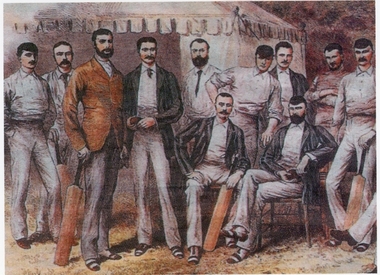
Photograph - AUSTRALIAN ASHES TEAM 1882
... Players:- Harry Boyle (Bendigo local)- Medium pace bowler Murdoch - RH batsman Chalmers - Rh batsman & medium bowler Blackham - wicket keeper Bonner - RH batsman, big hitter Garrett - fast medium bowler Giffen - middle order all-rounder Horan - middle order batsman Jones - fast medium bowler and all-rounder Massie - opening batsman. 55 runs in 57 minutes off 60 balls. ...Players:- Harry Boyle (Bendigo local)- Medium pace bowler Murdoch - RH batsman Chalmers - Rh batsman & medium bowler Blackham - wicket keeper Bonner - RH batsman, big hitter Garrett - fast medium bowler Giffen - middle order all-rounder Horan - middle order batsman Jones - fast medium bowler and all-rounder Massie - opening batsman. 55 runs in 57 minutes off 60 balls. ...At the time this match was listed as a 1st grade match but was later seen as the first Ashes match although Australia had toured England twice before. Despite a 1st innings collapse, Australia eventually won by 7 runs, largely due to the efforts of Australian fast bowler Spofforth who finished the match with 14 for 90. Players:- Harry Boyle (Bendigo local)- Medium pace bowler Murdoch - RH batsman Chalmers - Rh batsman & medium bowler Blackham - wicket keeper Bonner - RH batsman, big hitter Garrett - fast medium bowler Giffen - middle order all-rounder Horan - middle order batsman Jones - fast medium bowler and all-rounder Massie - opening batsman. 55 runs in 57 minutes off 60 balls. McDonnell - opening batsman Palmer - off-break bowler Spofforth - fast bowlerCopy of a drawing published in an English newspaper. Australian Ashes Team, 1882, image shows group of men attired in cricket clothing, standing in front of tent. Original drawing has thirteen cricketers. This copy is missing two people on the RHS. Cricketers listed in Image Title.clubs, cricket, australian cricket team 1882, australian ashes team -
Glenelg Shire Council Cultural Collection
Souvenir - Glass Beer Mug - Colts Cricket Club Portland, n.d
... Glass beer mug with Colts Cricket Club logo in gold, batsman and bowler in gold, either side of logo. ...Glenelg Shire Council Cultural Collection History House Cliff Street Portland great-ocean-road Glass beer mug with Colts Cricket Club logo in gold, batsman and bowler in gold, either side of logo. ...Glass beer mug with Colts Cricket Club logo in gold, batsman and bowler in gold, either side of logo. Gold rim. -
 Blackburn Cricket Club
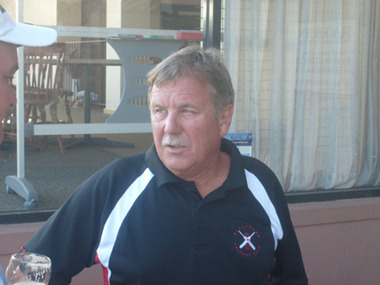
Tom Cullen
... Tom is Blackburn's best ever batsman and is a life member, team of the century player and ex-President....Tom is Blackburn's best ever batsman and is a life member, team of the century player and ex-President. ...Club legend Tom Cullen. Tom is Blackburn's best ever batsman and is a life member, team of the century player and ex-President. -
 Kew Historical Society Inc
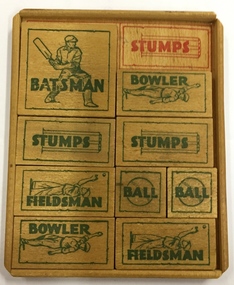
Leisure object - Puzzle, Cricket Puzzle, 1935-1955
... Nine individual tiles stamped in coloured ink with terms such as Batsman, Stumps, Bowler, Fieldsman, Ball....Nine individual tiles stamped in coloured ink with terms such as Batsman, Stumps, Bowler, Fieldsman, Ball. Cricket Puzzle Leisure object Puzzle ...The Kew Historical Society’s collection includes a wide range of leisure objects. Many of the items are European-made, generally of British origin, however there are a number that were made for the Australian market by Australian manufacturers. There were clearly a huge range of toys produced for the Australian and International children’s market in the Nineteenth and Twentieth centuries. The examples of toys in the collection include examples of alphabet toys, arcade toys, baby toys, construction toys, dolls, doll accessories, educational toys, soft toys, tin toys, toy animals, toy blocks, toy machines, toy typewriters, etc. Cricket puzzle. Made of wood. Nine individual tiles stamped in coloured ink with terms such as Batsman, Stumps, Bowler, Fieldsman, Ball.cricket puzzle, games and puzzles -
 Phillip Island and District Historical Society Inc.
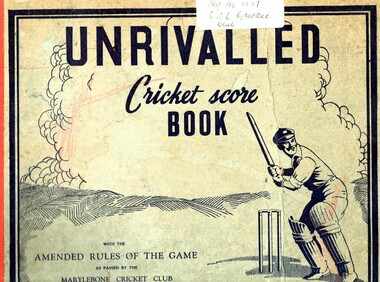
Book, RSL Cricket Club score book 1954-1955
... The cover has a drawing of a batsman....The cover has a drawing of a batsman. RSL Cricket Club score book 1954-1955 Book ...Provides details of local clubs, grounds and players for the 1954-1955 season. Clubs include Ventnor, Ventnor Maroons, Old Rovers, Colts, Rhyll. Player names include eq. Grayden, Harris, De La Haye, Fullerton, Luke. Betts, Murdoch, Jeffrey, Dixon, Niven, Justice, McRaeHistoricalLarge rectangular, light brown cardboard covered book with orange binding. It contains match details of teams, dates, location, runs and bowling. The cover has a drawing of a batsman.Unrivalled Cricket Score Booksport, cricket, rhyll, ventnor, returned services league -
 Bright & District Historical Society operating the Bright Museum
Cup, siver trophy, 1896
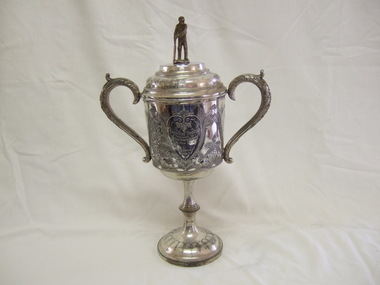
... Two ornate handles on the cup.The lid is surmounted by a cricket batsman 65mm.high....Two ornate handles on the cup.The lid is surmounted by a cricket batsman 65mm.high. Cup, siver trophy ...Silver plated inscribed trophy cup with lid. Highly decorated with etched leaves, hearts, and floral patterning. Two ornate handles on the cup.The lid is surmounted by a cricket batsman 65mm.high.Lager Bier Trophy / Presented By / Victoria Brewery Melbourne / Won By / / Season 1896-7cup, trophy, cricket, lagerbier, silver -
 Bright & District Historical Society operating the Bright Museum
Cup, Trophy, Circa 1896
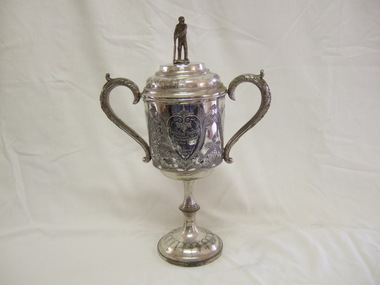
... The lid is surmounted by a cricket batsman 65mm. high....The lid is surmounted by a cricket batsman 65mm. high. Cup, Trophy ...Silver plate,inscribed trophy cup with lid. Highly decorated with etched leaves, hearts, and floral patterning. Two ornate handles on the cup. The lid is surmounted by a cricket batsman 65mm. high.Lager Bier Trophy / Presented by / Victoria Brewery Melbourne / Won by / / Season 1896 - 7trophy, silver, cup, cricket, lagerbier, victoriabrewerymelbourne -
 Bright & District Historical Society operating the Bright Museum
Cup, Trophy, 1897
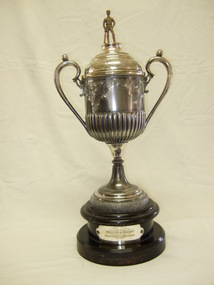
... The lid is surmounted by a cricket batsman 80mm high....The lid is surmounted by a cricket batsman 80mm high. Cup, Trophy ...Silver plate inscribed trophy cup,with two handles and a lid. Mounted on wooden base, with presentation plate attached. Very ornate decorations. The lid is surmounted by a cricket batsman 80mm high.Presented \ by the \ Bright Brewery Compy. \ to the \ Cricket Clubs in the Bright Shire \ 97-98cup, trophy, cricket, silver, bright brewery, sport, recreation -
 National Vietnam Veterans Museum (NVVM)
Photograph, Gibbons, Denis, Clothesline
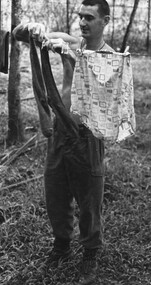
... A black and white photograph of Private Jack Higgins combat batsman to his company commander Maj Jake O'Donnell A Comapny, 7 RAR hangs out his boss' washing on a telephone wire clothesline...Photograph A Coy 7 RAR Pte Jack Higgins Maj Jake O'Donnell Gibbons Collection Catalogue The Distinguished Service Order (DSO) 235141 Military Cross Denis Gibbons A black and white photograph of Private Jack Higgins combat batsman to his company commander Maj Jake O'Donnell A Comapny, 7 RAR hangs out his boss' washing on a telephone wire clothesline Clothesline Photograph Gibbons, Denis ...Denis Gibbons (1937 – 2011) Trained with the Australian Army, before travelling to Vietnam in January 1966, Denis stayed with the 1st Australian Task Force in Nui Dat working as a photographer. For almost five years Gibbons toured with nine Australian infantry battalions, posting compelling war images from within many combat zones before being flown out in late November 1970 after sustaining injuries. The images held within the National Vietnam Veterans Museum make up the Gibbons Collection. A black and white photograph of Private Jack Higgins combat batsman to his company commander Maj Jake O'Donnell A Comapny, 7 RAR hangs out his boss' washing on a telephone wire clotheslinephotograph, a coy, 7 rar, pte jack higgins, maj jake o'donnell, gibbons collection catalogue, the distinguished service order (dso), 235141, military cross, denis gibbons -
 Blackburn Cricket Club
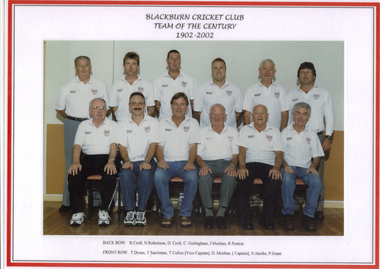
Blackburn Cricket Club Team of the Century
... Peter Grant - Right hand opening batsman. Five premierships in 3 decades of playing (1950s, 1960s and 1970s). 2. ...Tom Cullen (Vice Captain) - The most talented batsman to represent the club. He was a captain-coach. ...The team of the Century was selected in 2002.. The Selection Committee comprised Michael Long, Andrew Smith, Terry Dynes and Neville Jacobs. The Team of the Century are: Peter Grant, Darren Croft, Terry Sacristani, Tom Cullen (VC), Terry Dynes, Don Meehan (C), Griag Gislingham, Russell Punton, Neville Jacobs, Neil Robertson, Ivan Meehan and Robert Croft.This is Blackburn Team of the CenturyBlackburn Cricket Club team of the century 1902 - 2002. Selection Committee The selection committee comprised four life members whose experience and knowledge of Blackburn 1st XI cricket covered as many years from 1902 -2002: Michael Long (1966 - 1992) Chair Andrew Smith (1977 - 2003) Terry Dynes (1957 - 1986) Neville Jacobs (1943 - 1978) 1. Peter Grant - Right hand opening batsman. Five premierships in 3 decades of playing (1950s, 1960s and 1970s). 2. Darren Croft - Darren (Crofty) was a right hand opening batsman. He is a dual premiership player and been the clubs captain and coach. He made a century in a gutsy partnership to win the 1993-94 Grand Final. 3. Terry Sacristani - Right hand upper order batsman. Won five batting trophies and four prestigious Neville Jacobs trophies. Playing from 1979 - 1990. 4. Tom Cullen (Vice Captain) - The most talented batsman to represent the club. He was a captain-coach. He scored a triple century to win the Under 16 premiership. Tom played district cricket for Fitzroy and was selected to play Sheffield Shield for Victoria. Tom captained-coached Box Hill in the sub-districts and returned to Blackburn in 1987-88 until 1994-95 where he won one 1st XI premiership. He won four batting trophies and seven Neville Jacobs trophies in eight seasons. team, team of the century, century -
 Orbost & District Historical Society
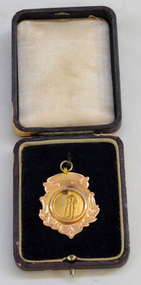
medal, 1928
... In the centre is an embossed picture of a batsman at the wicket. This is inside a circle. ...In the centre is an embossed picture of a batsman at the wicket. This is inside a circle. ...This medal was presented to J.G.Ralston by the Orbost Cricket Club in 1929 for Fielding. John Gavin Ralston was born 26 July 1914 at Eden, N.S.W. and came to Orbost in the early 1920's, with his parents and siblings. They lived at the corner of Tennyson and Salisbury Streets. Jack was educated at Orbost Higher Elementary School before being apprenticed to William Ross at the Snowy River Mail as a lino-type operator. He married Jean Cameron. After WW11 when he served overseas in the islands) He resumed his trade at the Snowy River Mail until 1949 when began J.G.& J.M. Ralston, Seed & Produce Merchants. Jack Ralston was very involved in the Orbost sporting community, the Presbyterian Church and the Orbost Municipal Band. He also served in the Orbost sub-branch of the R.S.L. He died on April 15 1967. (ref. Margaret Smith O.D.H.S. Newsletter)John Ralston was a prominent Orbost citizen.A 9 ct gold shield-shaped medal with a small hanging hoop. In the centre is an embossed picture of a batsman at the wicket. This is inside a circle. The bottom edge is decorated with leaves. The medal is inside a thin leather look wooden box which is hinged and has a push button metal latch. The box is brown and the inside lid is padded.on back - OCC At bottom - 9 ct Presented to J.G. Ralston Fielding Trophy 1928-1929cricket-orbost sport ralston-john-gavin medal -
4th/19th Prince of Wales's Light Horse Regiment Unit History Room
Trophy, 1982
... On base section is mounted a decorative depiction of cricket batsman in full swing. Something was affixed to the top but there is now only a screw hole showing where it was. ...On base section is mounted a decorative depiction of cricket batsman in full swing. Something was affixed to the top but there is now only a screw hole showing where it was. ...Both the Officers and Sergeants Messes of the Regiment have now been closed.Wooden trophy on base with vertical backing piece mounting small shields -1982, 1983, 1984, 1985, 1990 all Sergeants Mess. Other 5 are blank. On base section is mounted a decorative depiction of cricket batsman in full swing. Something was affixed to the top but there is now only a screw hole showing where it was. It had a 35 mm diameter.Annual Inter Mess Sports Competition. Officers Mess Versus Sergeants Mess -
 Port Melbourne Historical & Preservation Society
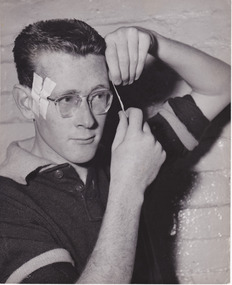
Photograph - Dan MANSON, 1960s
... Taped glasses obvious. .03 - as wicketkeeper behind the stumps to "batsman" Winifred ATWELL, famous honky tonk pianist...Taped glasses obvious. .03 - as wicketkeeper behind the stumps to "batsman" Winifred ATWELL, famous honky tonk pianist Photograph Dan MANSON ...Three (3) black and white photos of Dan MANSON. Footballer/cricketer. Played 3 games for Port Melbourne Football Club in 1959 but played many years for Port Colts. .01 - preparing for a football match by taping his glasses to his head .02 - training on the ground. Taped glasses obvious. .03 - as wicketkeeper behind the stumps to "batsman" Winifred ATWELL, famous honky tonk pianistsport - australian rules football, arts and entertainment, dan manson, winifred atwell -
 Dandenong/Cranbourne RSL Sub Branch
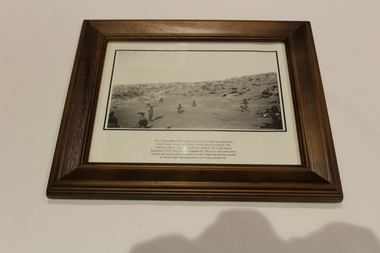
Print - Wooden framed picture
... Inscription below picture is as follows. " On 17 December 1915,a famous game of cricket was played at Shell Green,Anzac,as Turkish shells passed overhead. The batsman, Major George MacArthur Onslow, 7th Light Horse Regiment NSW,has just been caught out. ...Dandenong/Cranbourne RSL Sub Branch 44 – 50 Clow Street Dandenong melbourne Inscription below picture is as follows. " On 17 December 1915,a famous game of cricket was played at Shell Green,Anzac,as Turkish shells passed overhead. The batsman, Major George MacArthur Onslow, 7th Light Horse Regiment NSW,has just been caught out. ...Small wooden framed copy of photograph under glass.Inscription below picture is as follows. " On 17 December 1915,a famous game of cricket was played at Shell Green,Anzac,as Turkish shells passed overhead. The batsman, Major George MacArthur Onslow, 7th Light Horse Regiment NSW,has just been caught out. The game was part of the various deceptions planned to deceive the Turks that all was normal at Anzac while the evacuation was being carried out". Shell Green was the only piece of flat ground for the game to be played on. -
 Federation University Historical Collection
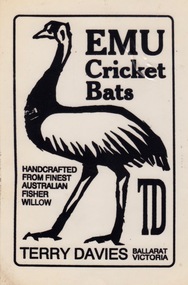
Article - Article - Advertising sticker, ZILLES COLLECTION: Sticker advertising Emu Cricket Bats by Terry Davies, Ballarat
... ...batsman...Terry was named in the Northern Roosters Cricket Club Legends Team of the Century 1920-2000. zilles printers ballarat sir rowland hill adhesive paper santo avery avery labels self-adhesive label terry davies batsman melbourne country week northern roosters cricket club legends team of the century 1920-2000 Name of bat and name of maker TD. - Emu Cricket Bats, handcrafted from finest Australian Fisher Willow. ...Zilles Printers was begun by Lewis Zilles in the early 1930s. It was in McKenzie Street Ballarat. His son Jeffrey also became a printer - letterpress, offset and screen printer. The business became Zilles Printers/Graphics and was in Armstrong Street and later Bell Street Ballarat. A form of sticker began in 1839 when Sir Rowland Hill invented adhesive paper. The first self-adhesive label was invented in 1935 by Stanton Avery - Avery Labels. The sticker was used on the bats as advertisement. Terry Davies was one of the top batsmen in Ballarat during the 1970s. He played from 1971-71 to 1982-83, a total of 151 games. He captained Ballarat in Melbourne Country Week as well as being Captain-Coach of the club. Terry was named in the Northern Roosters Cricket Club Legends Team of the Century 1920-2000.Cream colour card backing a clear sticker with black print.Name of bat and name of maker TD. - Emu Cricket Bats, handcrafted from finest Australian Fisher Willow. Terry Davies, Ballarat Victoria.zilles printers, ballarat, sir rowland hill, adhesive paper, santo avery, avery labels, self-adhesive label, terry davies, batsman, melbourne country week, northern roosters cricket club, legends team of the century 1920-2000 -
 City of Melbourne Libraries
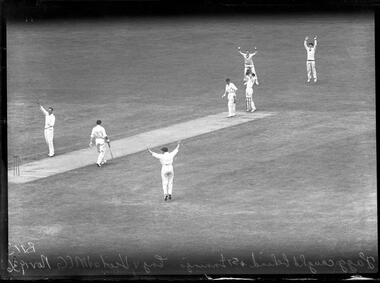
Photograph, Bull, Hugh Jones, 1897-1993, Fagg caught behind 1ST Innings. Eng v Vict at MCG Nov 1936
... Victorian batsman IAN LEE cuts a ball through a full slips cordon, bagging one of nine boundaries during his innings of 160 runs The attacking field placements of four slips, a gully and a point indicate that midway through Victoria’s innings, the MCC bowlers continued to believe they could deceive Ian Lee the batsmen with flight through the air, or movement off the pitch, causing a snick behind the bat. ...City of Melbourne Libraries 122 George Street East Melbourne melbourne Victorian batsman IAN LEE cuts a ball through a full slips cordon, bagging one of nine boundaries during his innings of 160 runs The attacking field placements of four slips, a gully and a point indicate that midway through Victoria’s innings, the MCC bowlers continued to believe they could deceive Ian Lee the batsmen with flight through the air, or movement off the pitch, causing a snick behind the bat. ...Victorian batsman IAN LEE cuts a ball through a full slips cordon, bagging one of nine boundaries during his innings of 160 runs The attacking field placements of four slips, a gully and a point indicate that midway through Victoria’s innings, the MCC bowlers continued to believe they could deceive Ian Lee the batsmen with flight through the air, or movement off the pitch, causing a snick behind the bat. This task was made all the more difficult, because Lee was left-handed, and his partner Gregory was a right-hander. Lee and Gregory’s record 4th wicket partnership of 262 runs in just over 180 minutes indicates the MCC did not succeed. Featured in "Newsworthy: Melbourne in photographs 1933-1936" exhibition at East Melbourne Library, October to December 2023. Exhibition caption by project volunteer Ernie Ward. Photographer notations on slide: "Fagg caught behind 1ST Innings. Eng v Vict at MCG Nov 1936 B113".cricket, 1930-1939 -
 Kew Historical Society Inc
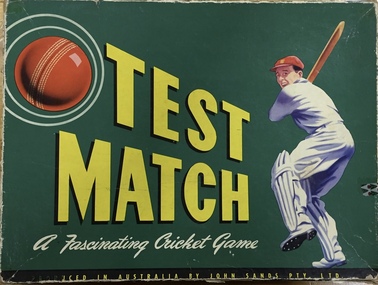
Leisure object - Board game, Test Match: A fascinating cricket game, 1955
... The packaging includes a green cardboard box with lid, which has an image of a batsman and a red cricket ball....The packaging includes a green cardboard box with lid, which has an image of a batsman and a red cricket ball. Test Match: A fascinating cricket game Leisure object Board game John Sands Pty Ltd ...'Test Cricket' was one of the most popular board games in the pre television era. John Sands Pty Ltd, the publisher, was an Australian bookseller and stationer founded in 1837 and produced board games from 1929-78.Board game consisting of a rectangular cardboard piece illustrated with a cricket ground, players and a scoreboard. Two semi-circles have been cut away from the background and are used to control the progress of the game. The right hand game control is moved to 'ball' position (1-8) and back to start which indicates the type of delivery shown in the window. The left hand control is moved to 'type of delivery bowled' and back to the start which reveals the number of runs scored or method of dismissal which is shown in the window. The scoreboard is operated by three circular wheels that show the result of runs and wickets. An oval handle is at the upper centre. The packaging includes a green cardboard box with lid, which has an image of a batsman and a red cricket ball.board games, john sands pty ltd, cricket -
 Bendigo Historical Society Inc.
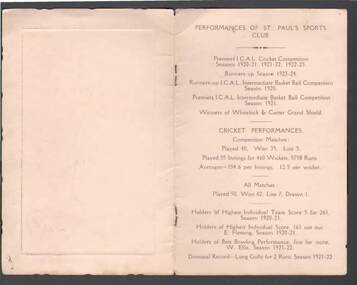
Document - JOHN JONES COLLECTION: ST PAUL'S CRICKET CLUB ANNUAL BANQUET CARD, Wednesday 27th August
... Front of the card is printed in red with a batsman at the top. On the inside printed in brown are the performances for basketball and cricket. ...Front of the card is printed in red with a batsman at the top. On the inside printed in brown are the performances for basketball and cricket. ...White folded St. Paul's Cricket Club, Bendigo Annual Banquet Card for the Annual Banquet held on Wed., Aug 27th. 1924. Front of the card is printed in red with a batsman at the top. On the inside printed in brown are the performances for basketball and cricket. Autographs written on the back. Names are: J Malloy, J Jorgenson, J Jones, W C Ellis, O Jorgenson, H Roper, R Read, J Doble, M Ollson, Lamb, Kenley, M Wright, A Ripper, Bruechert, E J Brockley, S C Field, N J Campbell, Amy Brown, E ?uger, J Ward, G Thomas, Fred H Bush, Langley, Paul Jones, R Moore, F Gill, H W Kenley.Cambridge Press, Bendigoevent, sports, st paul's cricket club, john jones collection - st paul's cricket club annual banquet card, d batchelder, st paul's school hall, st paul's sports club, whitelock & carter grand shield, e fleming, w ellis, j malloy, j jorgenson, j jones, w c ellis, o jorgenson, h roper, r read, j doble, m ollson, lamb, kenley, m wright, a ripper, bruechert, e j brockley, s c field, n j campbell, amy brown, e ?uger, j ward, g thomas, fredh bush, langley, paul jones, r moore, f gill, h w kenley, cambridge press -
 Musculoskeletal Health Australia (now held by the Glen Eira Historical Society)
Photograph - Solo photo
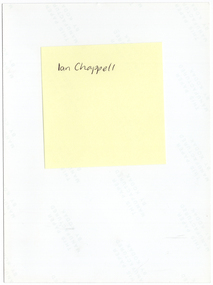
... ... batsman...He is also a prolific author and speaker. arthritis foundation of victoria afv ian chappell chapelli australian cricketer captain world series cricket batsman spin bowler sledging sports journalist cricket commentator sports media author sport australia hall of fame australian cricket hall of fame fica cricket hall of fame icc cricket hall of fame [On a yellow sticky note, handwritten in black ink] Ian Chappell B&W portrait of a man wearing a checked shirt with a plain collar, a checked suit jacket, and a dark coloured tie. ...Portrait of Australian cricketer, Ian Chappell (1943-). This publicity photo was most likely presented to the Arthritis Foundation of Victoria for inclusion in one of our newsletters or for other promotional activities. Chappell was named the 1976 Wisden Cricketer of the Year. He was inducted into the Sport Australia Hall of Fame in 1986, the FICA Cricket Hall of Fame in 2000, the Australian Cricket Hall of Fame in 2003, and the International Cricket Council Hall of Fame in 2009. He is also a prolific author and speaker.B&W portrait of a man wearing a checked shirt with a plain collar, a checked suit jacket, and a dark coloured tie.[On a yellow sticky note, handwritten in black ink] Ian Chappellarthritis foundation of victoria, afv, ian chappell, chapelli, australian cricketer, captain, world series cricket, batsman, spin bowler, sledging, sports journalist, cricket commentator, sports media, author, sport australia hall of fame, australian cricket hall of fame, fica cricket hall of fame, icc cricket hall of fame -
 City of Melbourne Libraries
Photograph, Bull, Hugh Jones, 1897-1993, Lee (Vict) bats against England
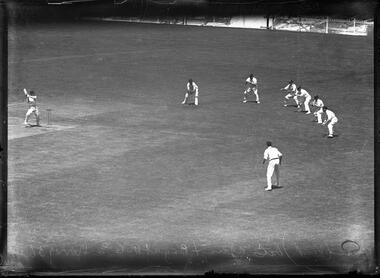
... Lee, the left handed Victorian batsman, plays a cut shot. The ball is visible. ...Lee, the left handed Victorian batsman, plays a cut shot. The ball is visible. ...Published: The Age, 10 November 1936, p. 13. Published title: CENTURY MAKERS AT THE M.C.G. Published caption: In spite of an impressive cordon in the slips. Lee (Vic.) cuts a ball through a gap and scores four in the match against England yesterday. Lee was eventually bowled by Farnes after making 160 run. Trove article identifier: http://nla.gov.au/nla.news-article205939431 Cricket: Victoria vs. England at the Melbourne Cricket Ground, November 1936. Lee, the left handed Victorian batsman, plays a cut shot. The ball is visible. Victorian ROSS GREGORY scores one of his 11 boundaries, on his way to making a game-saving 128 runs. The bowler is MCC all-rounder, Jim Sims. During a chanceless time at the crease, ROSS GREGORY was in command of a full range of shots, dealing with short balls by hooking proficiently and demonstrating a perfect pull shot technique. Sadly this shot was also his downfall, as he pulled a short one from paceman Ken Farnes onto his stumps, ending his innings. After publishing the full photo the next day, The Age used this cropped action photo of Gregory twice more to accompany future stories about him. Featured in "Newsworthy : Melbourne in photographs 1933-1936", an exhibition held at East Melbourne Library from October to December 2023. Exhibition caption by project volunteer, Ernie Ward. Photographer notations on slide: "Lee (Vict) bats against Eng at MCG Nov 1936".cricket, 1930-1939 -
 Vision Australia
Award - Object, Wicker cricket ball, 1928
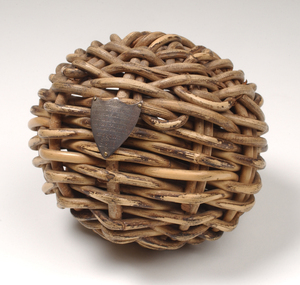
... The stumps also had bells attached so fielders knew when the batsman was out. Blind cricket was invented in Melbourne in 1922 when two blind factory workers started playing a game using a tin can containing rocks. ...The stumps also had bells attached so fielders knew when the batsman was out. Blind cricket was invented in Melbourne in 1922 when two blind factory workers started playing a game using a tin can containing rocks. ...This cricket ball is made of cane wicker and was used in cricket games with visually impaired players by people who lived or were educated at the Royal Victorian Institute for the Blind from the 1920's through till 1972. It is a circular shape made of plaited strips of woven natural cane and is lighter than a conventional cricket ball. The hollow center of the ball contains pieces of twisted metal pieces which rattle as the ball is moved to aid players in tracking the ball's movement. The stumps also had bells attached so fielders knew when the batsman was out. Blind cricket was invented in Melbourne in 1922 when two blind factory workers started playing a game using a tin can containing rocks. The game soon gained popularity and the Victorian Blind Cricketers' Association was formed. Mr William Paterson, a volunteer worker and advocate for blind people for over 60 years, was instrumental in acquiring and developing the sports ground and clubhouse in Glenferrie Road Kooyong, Victoria on behalf of the Association for the Advancement of the Blind (now called Vision Australia). In 1928 play began on the world's first sports ground for blind cricketers, in the first official blind cricket match. Blind cricket is now played internationally. This particular cricket ball was awarded to William Paterson Esq in 1928 in recognition of his support in establishing the world's first blind cricket ground in Kooyong. On the front of this ball is attached a small metal crest with an inscription: 'Presented to W.H. Paterson, Esq as a token of esteem for his interest in Blind cricket being the first ball bowled on the cricket ground for Blind Kooyong 7. 4.28'.1 wicker cricket ball with metal shield attached and metal bells in the hollow centre'Presented to W.H. Paterson, Esq / as a token of esteem for his/ interest in Blind cricket/ being the first ball bowled /on the cricket /ground for Blind /Kooyong / 7. 4.28'. recreation, cricket, awards -
 City of Melbourne Libraries
Photograph, Bull, Hugh Jones, 1897-1993, Groundsmen cover wicket during rain at the MCG match, Victoria v South Australia
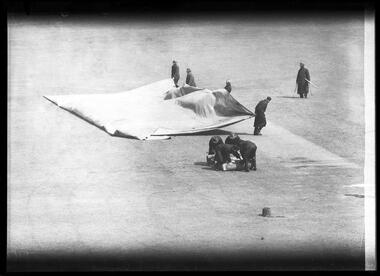
... is the question on everyone’s lips – Will it be a batsman’s nightmare? A bowler’s dream? Will the spectators see a full day’s play or will rain spoil it? ...is the question on everyone’s lips – Will it be a batsman’s nightmare? A bowler’s dream? Will the spectators see a full day’s play or will rain spoil it? ...“How’s the wicket, Bert?” During the 4-Day Victoria v South Australia Sheffield Shield match, held 13-17 November 1936 at the Melbourne Cricket Ground, the play was often interrupted by rain squalls, causing the groundsmen to cover their carefully prepared wicket with tarpaulins to protect it. “How’s the wicket, Bert?” is the question on everyone’s lips – Will it be a batsman’s nightmare? A bowler’s dream? Will the spectators see a full day’s play or will rain spoil it? With a twinkle in his eye, Bert “Maker of Pitches” Luttrell, the MCG curator’s response is: “It’s not the wicket when batsmen get out early, it’s good bowling!” FRC Published: The Age 17 November 1936 Featured in "Newsworthy: Melbourne in photographs 1933-1936" exhibition at East Melbourne Library, October to December 2023. Exhibition caption by project volunteer, Fiona Collyer. Photographer notations on slide: "Covering wicket during Vict v Sth Aust Cricket at M.C.G. Nov 1936 B117" Published: Age (Melbourne, Vic. : 1854 - 1954), Tuesday 17 November 1936, page 13 Published title: SHEFFIELD SHIELD CRICKET. Published caption: Placing the tarpaulin over the wicket during one of the showers. This was done four times during the day. Trove article identifier: http://nla.gov.au/nla.news-article205952141 Description: Nine men wearing black macintoshes and hats drag a tarpaulin over a cricket pitch. There is a bucket containing pegs in the foreground. Research by project volunteer, Fiona Collyer: During the four day Victoria v South Australia Sheffield Shield match, held 13-17 November 1936 at the Melbourne Cricket Ground, the play was often interrupted by rain squalls, causing the groundsmen to cover their carefully prepared wicket with tarpaulins to protect it. “How’s the wicket, Bert?” is the question on everybody’s lips - will it be a batsman’s nightmare? A bowler’s dream? Will the spectators see a full day’s play or will rain spoil it? With a twinkle in his eye, Bert “Maker of Pitches” Luttrell, the MCG curator’s response is: “It’s not the wicket when batsmen get out early, it’s good bowling!” Albert (Bert) John Wesley Luttrell 1875-1951, was born in Geelong and worked as a painter and decorator. He played cricket for Clarendon Cricket Club while helping to prepare the wicket at Kardinia Park. In 1890, Mr Phillip Russell, a wealthy merino sheep breeder of Osborne House, North Geelong, offered Bert the job of curator and cricket player for his team “The Nondescripts”, a social team who played at his private oval at Osborne House. After five years at Osborne House, Bert took up a position at Geelong Grammar School and then in 1900 he was appointed curator of Warehousemen’s Ground, Albert Park (later called Albert Ground). There he prepared the tennis courts for the 1908 Davis Cup - Australia v USA featuring the eventual winner of the tournament, Wimbledon champion Sir Norman Brookes. Following the retirement of the MCG curator, Bert was offered the position there for the 1919/20 season. Sport was resuming at the MCG after the suspension caused by the Great War and the Spanish Influenza pandemic. Cricket grounds and matches are always at the mercy of the weather. Sudden heavy downpours can make the ground unfit for play. In 1933, Bert invented and patented an absorbent roller for soaked pitches. Similar to a lawn mower in appearance, it was fitted with a rubber sponge which sucked up the water and then squeezed it into a tank. The sponge was said to mop up a gallon (3.78 litres) of water in 32 seconds and remove 100 to 120 gallons (378 - 454 litres) of water from any wet sports ground in an hour. Bert worked as a curator of the MCG for nearly 30 years, invariably creating his famous “shirt front” wicket. He retired in 1947 due to ill health. He was married to Emma and they had six children- Albert, Harry, Nell, Lily, Frank and Jack. Bert died at home in South Yarra in 1951 at 76 years of age. References: SHEFFIELD SHIELD CRICKET. ENGLISH FLYING BOAT. VICTORIA DOCK. (1936, November 17). The Age (Melbourne, Vic. : 1854 - 1954), p. 13. Retrieved May 19, 2024, from http://nla.gov.au/nla.news-article205952141 To Dry Grounds (1933, May 13). Sporting Globe (Melbourne, Vic. : 1922 - 1954), p. 3 (Edition2). Retrieved May 20, 2024, from http://nla.gov.au/nla.news-article183038194 No title (1937, February 25). The Age (Melbourne, Vic. : 1854 - 1954), p. 10. Retrieved May 19, 2024, from http://nla.gov.au/nla.news-article206185862 GOSSIP of THE GAME (1937, November 12). The Herald (Melbourne, Vic. : 1861 - 1954), p. 21. Retrieved May 20, 2024, from http://nla.gov.au/nla.news-article244541623Photographer notations on slide: "Covering wicket during Vict v Sth Aust Cricket at M.C.G. Nov 1936 B117".cricket, 1930-1939 -
 City of Melbourne Libraries
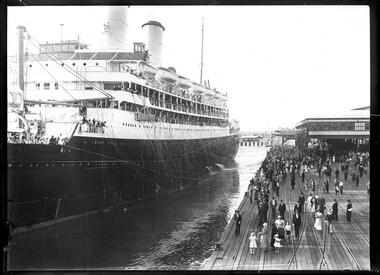
Photograph, Bull, Hugh Jones, 1897-1993, RMS Orford departing from Station Pier, Port Melbourne
... Every day tennis player Harry Hopman and an Australian Press Association reporter radioed through reports on their activities, which included – - Test cricket batsman Len Darling having spend 4 days in his cabin after straining his groin when he slipped over while playing ball tennis in his slippers. - Batsman Bill Brown dancing the fox-trot, displaying footwork similar to the grace he showed at the wicket. - Alluding to the seasickness of Don Bradman and Stan McCabe and how they were making up for meals lost on the Great (very choppy) Australian Bight. - Miss Joan Hartigan discarding her bright blue shorts for brighter blue bathers and being first into the pool. - Bowler Bill O’Reilly being tripped by a passenger on the deck and spending the voyage with bandaged wrists with daily updates of his progress in the press. - Wicketkeeper Ben Barnett’s conjuring tricks and constant whirring movie camera. - Results of the quoits, ball tennis and bridge tournaments. ...Every day tennis player Harry Hopman and an Australian Press Association reporter radioed through reports on their activities, which included – - Test cricket batsman Len Darling having spend 4 days in his cabin after straining his groin when he slipped over while playing ball tennis in his slippers. - Batsman Bill Brown dancing the fox-trot, displaying footwork similar to the grace he showed at the wicket. - Alluding to the seasickness of Don Bradman and Stan McCabe and how they were making up for meals lost on the Great (very choppy) Australian Bight. - Miss Joan Hartigan discarding her bright blue shorts for brighter blue bathers and being first into the pool. - Bowler Bill O’Reilly being tripped by a passenger on the deck and spending the voyage with bandaged wrists with daily updates of his progress in the press. - Wicketkeeper Ben Barnett’s conjuring tricks and constant whirring movie camera. - Results of the quoits, ball tennis and bridge tournaments. ...Published: 21 March 1934 The Age p11 Published title: CROWDED TOURIST SHIP WILL CARRY TEST AND DAVIS CUP TEAMS. Published caption: Carrying an exceptionally large number of tourists, business men and prominent sporting personalities, R.M.S. Orford sailed for London yesterday. Over two hundred passengers embarked at Melbourne, and on leaving the Australian coast there will be two thousand persons on board. The Australian Test team will join the vessel at Fremantle and the remaining two Davis Cup representatives will embark at Adelaide. A picture of the Orford taken just as she moved out from Station Pier, Port Melbourne, under her own steam. Trove article identifier: http://nla.gov.au/nla.news-article203826897 Description: Passenger ship about to depart Station Pier, Port Melbourne. Research by project volunteer, Fiona Collyer: The RMS Orford was built by Vickers-Armstrong Shipyard Barrow-in-Furness, Cumbria, England and launched in 1927 by Lady Ryrie, the wife of Sir Granville Ryrie, the Australian Ambassador to the UK. The Orford was owned by the Orient Steam Navigation Ltd and was designed for the mail and passenger service between England and Australia. She was 20,000 tons, 658 ft long, 75 ft across and 80 ft high from water-line to deck. She had eight decks, a swimming pool and cost more than £1,000,000. She could travel at 20 knots – 480 miles a day, a 5 week voyage between Australia and England. There were enough lifeboats to accommodate every person on board. Promoted as a ship of comfort, luxury, speed and grace with spacious, beautifully decorated lounges, smoking-rooms and writing rooms, the SMH 23/11/1928 review said “sitting-rooms where the furniture recreates the air of quiet, exquisite, safe luxury; suites where you may retire from other people, and on a sea voyage other people, even the most charming other people, often begin to resemble one’s worst enemies towards the end of several weeks sea voyaging together”. “Travel like a human being. This is what the great liners give you today. The Orford dining room is enormous (it seated 350 people) the walls sweep up to a white, cool roof supported on decorative pillars. Panels of grey scagliola and carved designs remove the bleak, comfortless air which used to cling to dining-rooms of ships. Everything about them was so wretchedly temporary that you could not enter them without wishing that you stayed at home. They gave you the creeps and indigestion. This room is gay, bright, sunlit, like a luxurious café overlooking the sea.” “You really feel in here that you are a human being and not a piece of cargo endowed with sensation.” The Orford had the punkah louvre system of ventilation which forced draughts through every part of the ship, ensuring “No Ship Smells!!” and avoiding - “… a mayonnaise of all the unpleasant odours generated under heaven. From the hot oil of the engines, from those overheated, bottomless pits below the water-line, from new paint and food, from people perspiring at work, from rope and tar and grease and fruit and wet clothes and tobacco, rises a deplorable incense that lingers unsettlingly in the nostril long after one has left the ship. Those dreadful odours will never rise to torture the senses of passengers who feel that all is over with them.” The modern electric kitchen had a roll making machine capable of producing 2000 rolls for the table an hour and a bread and butter machine which cut the bread into slices and spread the butter in one operation. (The Week – Brisbane 30/11/1928) On 13/10/1928, the Orford made its first voyage to Australia with 520 first class and 1100 3rd class passengers. The name of the passengers embarking and disembarking and their reason for visiting were published in newspapers and the number of migrants for the New Settlers Scheme and the Dreadnought Boys Co program to promote and assist the migration of British youths willing to become farm workers in Australia 1911-1939 were noted too. On the 19th March 1932, RMS Orford featured in the “Parade of Ships” celebrating the official opening of the Sydney Harbour Bridge. Only country people were allowed to book a ticket as a guest on board. The Post Office issued commemorative postage stamps showing the Orford sailing under the bridge. In March 1934, the Orford sailed from Australia to London, via Colombo, Aden, Port Said, Naples, Villefranche, Toulon, Parma, Gibraltar and Channel Port. Amongst the 2000 passengers on board was the Davis Cup Tennis team, tennis champions Joan Hartigan and Nell Hopman, the Australian Test cricket team and British champion swimmer Joyce Cooper. Every day tennis player Harry Hopman and an Australian Press Association reporter radioed through reports on their activities, which included – - Test cricket batsman Len Darling having spend 4 days in his cabin after straining his groin when he slipped over while playing ball tennis in his slippers. - Batsman Bill Brown dancing the fox-trot, displaying footwork similar to the grace he showed at the wicket. - Alluding to the seasickness of Don Bradman and Stan McCabe and how they were making up for meals lost on the Great (very choppy) Australian Bight. - Miss Joan Hartigan discarding her bright blue shorts for brighter blue bathers and being first into the pool. - Bowler Bill O’Reilly being tripped by a passenger on the deck and spending the voyage with bandaged wrists with daily updates of his progress in the press. - Wicketkeeper Ben Barnett’s conjuring tricks and constant whirring movie camera. - Results of the quoits, ball tennis and bridge tournaments. A fancy dress ball was held one night and the cricketers dressed as sheiks and sang “The Riff Song” from the pre-code 1929 operetta film “The Desert Song” starring John Bates as the Red Shadow and Myrna Lay as a native dancing girl. Alan Kippax’s beard blew overboard! Joan Hartigan dressed as Burlington Bertie from the music hall song and Nell Hopman a doll in a box wearing a crinkled paper dress. On arrival at Southampton, while they waited for the gangway to be lowered, Bradman entertained the team at the piano playing popular tunes while the cricketers sang. . In 1935, RMS Orford’s third class accommodation was converted to tourist class. Her passenger capacity was now 468 First Class, 515 tourist class and 440 crew. First saloon from Sydney fares cost for single £76, £82, £88 and Third Class fares were £21, £23, £25. Less than a penny a mile. . In 1936, the Orford embarked the exiled Emperor of Ethiopia, Haile Selassie at Gibraltar on his way to the UK. In 1939, she was requisitioned for Australian government service and on 7/1/1940 she conveyed the first Australian troops to Egypt and was then used to carry French troops from Tamatave, Madagascar to Marseilles. On 1/6/1940 RMS Orford was bombed and set on fire at Marseilles by German aircraft. 14 crew were killed, 25 wounded. In 1947, the wreck was re-floated and broken up at Savona. . . References: R.M.S. ORFORD. (1928, November 23). The Sydney Morning Herald (NSW : 1842 - 1954), p. 14. Retrieved September 15, 2023, from http://nla.gov.au/nla.news-article16511535 ARRIVAL OF THE ORFORD (1928, November 30). The Week (Brisbane, Qld. : 1876 - 1934), p. 21. Retrieved September 15, 2023, from http://nla.gov.au/nla.news-article181126802 CROWDED TOURIST SHIP WILL CARRY TEST AND DAVIS CUP TEAMS. (1934, March 21). The Age (Melbourne, Vic. : 1854 - 1954), p. 11. Retrieved October 5, 2023, from http://nla.gov.au/nla.news-article203826897 Photographer notations on slide: "B19".tennis, ships -
Glen Eira Historical Society
Ephemera - Caulfield Cricket Club
... Photograph, cutting from Caulfield Port Phillip Leader 05/04/2011 of batsman Matt Lawrence who had announced his retirement, pictured with unnamed wicket-keeper. ...Photograph, cutting from Caulfield Port Phillip Leader 05/04/2011 of batsman Matt Lawrence who had announced his retirement, pictured with unnamed wicket-keeper. ...This file contains two items. A menu and programme for Caulfield Cricket Club. Includes handwritten list of names of office-bearers and printed list of sponsors. Thirty-four newspaper clippings on Caulfield Cricket Club. “Haviland, Pritchard give Caulfield Boost”, cutting from Caulfield Port Phillip Leader, 21/12/2010 on recent match. “Daron Cruickshank Shows His Class” cutting from Caulfield Port Phillip Leader 11/01/2011 on Daron Cruickshank from Trinidad-Tobago who whit 111 not out in recent match for Caulfield against Ormond. “Century Lifts Monds, Another Ton For Hansen” cutting from Caulfield Port Phillip Leader on 01/02/2011 on recent centuries by Michael Hansen of Ormond in matches. “Fields Take Minor Premiership” cutting from Caulfield Port Phillip Leader 08/03/2011 on forthcoming match of Elsternwick against Coburg. “Richo’s Century Puts Caulfield in Driver’s Seat” cutting from Caulfield Port Phillip Leader 15/03/2011 on Shaun Richardson’s 160 for Caulfield against Brunswick in a recent match. “Caulfield Up for Challenge” by Brad Beitzel cutting from Caulfield Port Phillip Leader 22/03/2011 on forthcoming match against Coburg. “Fielders Work For It. Sliver of Hope Going Into Day Two” by Paul Amy, cutting from Caulfield Port Phillip Leader 29/03/2011 on recent match of Caulfield against Malvern. Photograph, cutting from Caulfield Port Phillip Leader 05/04/2011 of batsman Matt Lawrence who had announced his retirement, pictured with unnamed wicket-keeper. “‘Grub’ will be missed” cutting from Caulfield Port Phillip Leader 12/04/2011. Obituary of Tony Sheehan who represented Caulfield in 170 matches. “Caulfield Goes in to Bat Early” cutting from Caulfield Port Phillip Leader 03/05/2011 on recent recruits Adam Warren and Rob Bartlett for forthcoming season. “South Caulfield on Top” cutting from Caulfield Port Phillip Leader 01/11/2011 on prospects of South Caulfield Club and recent matches. “Monds Break Duck” cutting from Caulfield Port Phillip Leader 31/01/2012 on recent win by Ormond Club. “Help To Put Cancer Fund in the Pink” article from the Caulfield Port Phillip Leader dated 07/02/2012 concerning the Caulfield South Cricket Club’s participation in Pink Stumps Day in order to raise funds for cancer research. “Premier Cricket” by Brad Beitzel, cutting from Caulfield Port Phillip Leader 14/02/2012 on recent watches of local clubs. “Damiano’s Three Tons A record” by Brad Beitzel, cutting from Caulfield Port Phillip Leader 28/02/2012 on batting record of Ricky Damiano. “Caulfield Digs In. Baldry Leads Lower Order Fight Against Malvern” by Paul Amy, cutting from Caulfield Port Phillip Leader 13/03/2012 on undefeated season of Caulfield club and future match. “Fields Bound For Glory. Rugged Day for Elsty” by Brad Beitzel cutting from Caulfield Port Phillip Leader 20/03/2012 on success of Caulfield Club. “Fielders Perfect Finish. Golden Summer Capped by Premiership” by Brad Beitzel cutting from Caulfield port Phillip Leader 27/03/2012 on undefeated season of Caulfield Club. “Caulfield Leaders Pay Hospital Visit to Club Stalwart. That Was For ‘Morro’” by Paul Amy cutting from Caulfield Port Phillip Leader 02/03/2012 on visit to ill Brian Morrison. “Caulfield Hearts Heavy After Death of Club Legend ‘Morro’” by Paul Amy cutting from Caulfield Port Phillip Leader 10/04/2012 on death of Brian Morrison. “Big Send Off For Legend ‘Morro’” cutting from Caulfield Port Phillip Leader 17/04/2012 on funeral of Brian Morrison. “Cricket Season to Commence” clipping from unnamed journal or magazine, hand dated 10/12 on new cricket season. “Christiansen Cracks Ton in Elsternwick Victory”, cutting from Glen Eira Port Phillip Leader 30/10/2012 on century by Cam Christiansen in match against Malvern. “Harwood Hits Hard to Set test For Caulfield” by Paul Amy cutting from Glen Eira Port Phillip Leader 13/11/2012 on performance of Shane Harwood in match against Melton. “ ‘Richo’ To The Rescue” by Paul Amy cutting from Glen Eira Port Phillip Leader 11/12/2012 on performance of Shaun Richardson in match against Williamstown. “Victorian Turf Cricket Association South Poised for Outright Win Against Bernies” cutting from Glen Eira Port Phillip Leader 29/01/2013 on match between South Caulfield and St. Bernards. “Tough Chase Awaits Caulfield” cutting from Glen Eira Port Phillip Leader 22/01/2013 on prospects of Caulfield Club. “Stateswide Twenty 20 Cup. South Caulfield Gets The Chance To Play At the MCG” photocopy of article in Glen Eira Port Phillip Leader 12/02/2013 that the team is to play in the MCG in finish of Twenty 20 Competition. “Nurse to the rescue for Wiaks” by Paul Amy cutting from Glen Eira Port Phillip Leader 19/02/2013 on century by Harry Nurse in match against Yarraville. “VTCA South Caulfield Crowned Twenty 20 Champion” cutting from Glen Eira Port Phillip Leader 12/03/2013 on win by South Caulfield in state wide Twenty 20 Cup. “Sub-District Cricket Finals. Caulfield Up Agianst Melton and Weather” cutting from Glen Eira Port Phillip Leader 19/03/2013 on semi-final match between Caulfield and Elsternwick. “Cricket Championship Team” photograph cutting from Glen Eira Port Phillip Leader 09/04/2013 of Championship Caulfield Club with thirteen players named in caption. “Cricket High Hopes for Scholarship Winner” cutting from Glen Eira Port Phillip Leader 16/04/2013 on cricket scholarship for Adam Cosgrove, aged twelve.caulfield cricket club, ormond cricket club, elsternwick cricket club, south caulfield cricket club, north caulfield glenhuntly cricket club, malvern cricket club, sheehan tony, damiano ricky, oakleigh cricket club, morrison brian, little harold, christiansen cam, harwood shane, richardson shaun, murrumbeena cricket club, carnegie cricket club, mcg, melbourne cricket grounds, nurse harry, reilly geoff, shipley colin, jacobs bill, lahiff tommy, haviland james, pritchard heath, cruickshank daron, hansen michael, lawrence matt, warren adam, baldry leigh, vtca, twenty 20 club, cosgrove adam, cricket, cricket clubs, cricketers, sporting clubs, sports -
 City of Melbourne Libraries
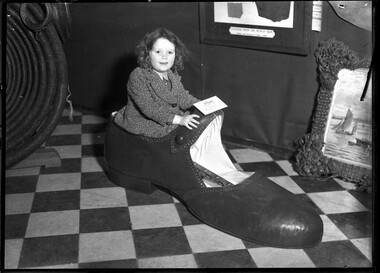
Photograph, Bull, Hugh Jones, 1897-1993, Leather Exhibition, Melbourne Town Hall
... Further variety is given to the exhibition by the display of antique hides, brightly coloured, with punching balls, boxing gloves and batsman's pads. There are crocodile skins and snake skins so cleverly "Worked up" that one could be almost pardoned for betraying an affection for such unpopular creatures.” “ Another wonderful article on this Exhibition, published the same day in one of the opposition daily newspapers, The Argus, is in the weekly article “Women to Women”, entitled “A Great Victorian Industry: Many Uses for Leather”. ...Further variety is given to the exhibition by the display of antique hides, brightly coloured, with punching balls, boxing gloves and batsman's pads. There are crocodile skins and snake skins so cleverly "Worked up" that one could be almost pardoned for betraying an affection for such unpopular creatures.” “ Another wonderful article on this Exhibition, published the same day in one of the opposition daily newspapers, The Argus, is in the weekly article “Women to Women”, entitled “A Great Victorian Industry: Many Uses for Leather”. ...Photographer notations on slide: At the Leather Exhib. at T. Hall Melb 1933 Age Published: Age (Melbourne, Vic.: 1854- ), 1933 THE EXHIBITS. (1933, September 20). The Age (Melbourne, Vic. : 1854 - 1954), p. 16. Retrieved January 25, 2026, from http://nla.gov.au/nla.news-article205109730 Published title: THE EXHIBITS. A COMPREHENSIVE RANGE. Curios, Novelties, Working Displays Published Caption: ONE OF THE NOVELTIES – AN OUTSIZE IN SHOES Research by Project Volunteer, Louise McKenzie: Our photo is dated 20 September 1933, and shows a happy, chubby-faced young girl sitting in a very over-sized girl’s shoe. It is labelled – “Shoe, An Out Size, loaned by Messrs Blackman & Rose”. (1) It is an effective way to capture the attention of the readership and alert them to the Melbourne Leather Show 1933. This show was designed to be a drawcard of extraordinary proportion, and there is no doubt that this leather exhibition was a really big deal for Melbourne. It completely took over the Melbourne Town Hall, and was open from 10.30 am until 10.30 pm. It seemed to contain something for everyone – the military, the man about town, the home handyman, the housewife, the child, the sporting types, the domestic workers, the outdoor enthusiasts, the horseracing fans, car enthusiasts, those wishing to show off the latest fashion – both men and women - and those just intrigued by a lot of fascinating and wide ranging exhibits. One of the most comprehensive descriptions of the Exhibition accompanies the photograph, and is worth quoting in full: “PROMINENT among exhibits which first attract attention in the foyer of the Town Hall is a comprehensive display of leather articles used by the defence forces. A conspicuous legend states that leather plays an important part in national defence, being used for saddlery, tool containers, holdalls, range-finding, surveying and signalling equipment, explosives factories, harness accoutrement, bandsmen's equipment and clothing. Three models of horses and several figures of soldiers wearing leather equipment illustrate the lesson, and a great range of leather goods used in military training and work variegate the display. Nearby are Texas cowboy, buckjumping and breaking-in saddles; whips, a walking stick, made of leather and numerous other curios. The general exhibition occupies the whole floor space of the main Town Hall, and is subdivided by partitions running most of the length of the hall. A bewildering variety, of leather goods presses for close and leisured inspection. Here and there operatives in charge of working machinery give practical demonstrations of factory processes in the production of footwear. Polishing materials are well represented. One attractive exhibit includes two bush huts constructed of leather, with wattle bark for roofing. Opossums, rosellas and a kookaburra add touches of bush realism. Adjacent exhibits include bags, fishing boots, leggings, leather covers in all colours. Factory Processes. One exhibitor has installed an automatic cinema apparatus and screen, which projects various factory processes in making a shoe, the operator being shown at work. Elsewhere an interesting exhibit depicts the five stages in the manufacture of sole leather, and the tanning materials employed. "Very handsome effects are achieved in the interior appointments of motor cars, which are attended by figures of smart chauffeurs in leather coats. Motor-trimming leather is said to be more durable and hygienic than fabric materials, and cheaper. The neat finish of the material, its excellent appearance, certainly make a very favourable impression. It takes the hides of three beasts to cover the cushions, squabs and door panels of a full-sized sedan, while to finish the entire interior, including quarter-panels and head linings would take four or even five. Special Exhibits. Amongst the special sections the display arranged by the handicrafts and home industries- committee of the Country Women's Association of Victoria is a notable one. In all there are about 130 entries which are in four classifications, viz., hand-tooled or embossed leathers, suede, hand-made gloves and undecorated leather. The glove section attracted the most numerous entries, a number being the work of members and craft subscribers of the Country Women's Association. In the leathercraft competition, organised by the Country Women's Association, the judges yesterday awarded the first prize for bookbinding (the only prize given in this division) to Miss M. Alston, of South Yarra. There is also a creditable display of exhibits submitted by boys of the orthopaedic section of the Children's Hospital at Frankston. Amongst the novelties on view in other portions of the exhibition were the following: — Leather coats worn by Sir C. Kingsford Smith on his Atlantic flight. Model Wellington boot, Phar Lap's saddle. Melbourne Cup winner's saddle. Longest whip in world, 108 feet long. (33 metres) [See our photo, to left of Girl in Shoe] Diminutive shoes. Pair of shoes 65 years old. Pair of men's working boots 75 years old. Larwood's, Tate’s and Pataudi’s cricket boots. [Three internationally revered cricketers of the day] (2) Picture frame made of leather bought 63 years ago. [See our photo, to right of Girl in Shoe] Leather frame, powder bowl, &c. Saddle used by world's champion buckjumper in U.S.A. Mexican cowboy outfit. Miniature saddle and bridle. A fireman's helmet made of sole leather. (3) Sample of the leather hat worn by porters at the Billingsgate Fish Market, London. (4) From South Australia there have been obtained sets of harness for donkeys, goats and camels, the equipment being displayed to good advantage on stuffed representations of the animals mentioned. Close to the platform is a glass case containing snow shoes and coats which have been used in Antarctic exploration work. Trade Display. Amongst the trade exhibits may be seen in operation a slipper turn shoe sewing machine, with heeling and channelling facilities, and the various stages in the production of ladies' sandals are shown. There is a wide contrast between sole leather of varying degrees of thickness on view in one stall and the choice samples of ladies' footwear in another — footwear, by the way, which could almost be used as ornaments, so dainty in colour and production are they. Again, there are displays of upholstering leathers of such soft texture that they could he readily mistaken for some of the finest cloth. Those who may be particularly interested in the production of chamois leather may gain an insight into the materials and chemicals used in the "working up” of this variety of leather. Supplies of glace kid (5) are tastefully arranged, and there may also be seen bags of all shapes and sizes, including satchels, suit cases and "sporting" cases, and bags for tennis players and golfers. Further variety is given to the exhibition by the display of antique hides, brightly coloured, with punching balls, boxing gloves and batsman's pads. There are crocodile skins and snake skins so cleverly "Worked up" that one could be almost pardoned for betraying an affection for such unpopular creatures.” “ Another wonderful article on this Exhibition, published the same day in one of the opposition daily newspapers, The Argus, is in the weekly article “Women to Women”, entitled “A Great Victorian Industry: Many Uses for Leather”. This weekly column was penned by Vesta, and she writes, with much purpose: “Yesterday afternoon I paid a hurried visit to the Leather Exhibition now being held in the Melbourne Town Hall and I was disappointed to find that the early visitors to the main exhibition were almost all men. Women, I think, should make a point of seeing every exhibition of our great industries, for women are the buyers of household requisites and goods for their own use and their tastes, and opinion influence also, to a large extent, the purchases of men. So, the welfare of industries is more or less in their hands and it becomes a duty for them to inform themselves fully of the extent and the quality of the manufacturing that is done here. The value of the output of the Australian boot and shoe factories alone was in 1930-31, the latest year for which the figures are given, Stg 3,750,000. Fully two thirds of that amount must have been spent by women on boots and shoes for themselves and their children. In a host of other directions, in the purchase of handbags, travelling bags, belts and straps, cushions, furniture coverings, purses, notebooks, spectacle cases, their annual expenditure must be very high. Their interest, therefore, in this industry is practical, and their support of it should be governed by knowledge of comparable values and qualities of the goods they buy. From the point of view of women, however, the exhibition itself is rather disappointing. There is an amazing collection of good stuff on show, but most of it is not displayed in a fashion that attracts attention. I was surprised, for example, at the range and quality of the leathers displayed, the suppleness of the finer qualities, and the varied range of colours and designs. But they are shown in such a fashion that if one set out deliberately to look for them it would be quite easy to miss most of them.” …It was surprising, too, that no one seemed to have taken advantage of the present fashion of wearing coloured gloves, or the cult of glove making, which the Country Women’s Association has fostered so successfully. Outside the collection of chamois leathers I saw no skins which were suitable to glove making. (6) However, it is perhaps a little unfair to be highly critical of the exhibition, inasmuch as it is the first of its kind. The material is there, undoubtedly, for a splendid show of every phase of this enterprising industry, and I am confident that experience will prove to those concerned that it will be worth while next time to devote a great deal of attention of the method of display.” With further research, it transpires that “Vera” is in fact NZ born Stella May Allen (nee Henderson) (1871-1962), a journalist, the first woman in NZ to begin a law course, in 1890-91). She later worked at a law firm while she completed her degree. Study of the law had always been open to women in NZ, but its practice was still barred to them. Her case “…led to amending legislation in 1896 allowing women to practise as barristers or solicitors. However, on gaining her LL.B. in November 1897 she did not apply for admission to the Bar. Instead, she became the Wellington-based correspondent and leader-writer for the Lyttelton Times. Her appointment, the first for a woman, was not welcomed by the all-male Press Gallery, and special permission had to be obtained from a subcommittee of the House before her presence was accepted. In 1900 she married Edwin Allen, a senior leader-writer for the Wellington Evening Post, and they moved to Australia in 1903 when Edwin Allen took up the post of foreign affairs leader-writer and parliamentary man for the Melbourne Argus. As Patricia Keep notes in her excellent entry of Stella Allan in the Australian Dictionary of Biography: “In 1907 The Argus commissioned her to write a series of articles on the first Australian Women's Work Exhibition held in October. They aroused much interest and next year The Argus invited her to join its full-time staff and begin a weekly section on the particular interests of women. She adopted the nom de plume 'Vesta' and called the column 'Women to Women'. Her work was unique in an Australian daily paper at that time. Her pages extended to cover every aspect of women's affairs, children's interests and community welfare, and 'Vesta' became a household word for authoritative information and advice on such matters. An excellent needlewoman and first-rate cook herself, she thoroughly tutored her staff in the work and needs of women in both country and city, as well as providing the usual training for cadet journalists. She conducted interviews and also visited the country to see at first hand the results of bushfires, mouse plagues, droughts and floods. In 1910 she was one of three women foundation members of the Australian Journalists' Association. “…she found time to become deeply involved in community affairs. She was an original committee-member of the Victorian Association of Crèches and of the Free Kindergarten Union of Victoria, and had much to do with the early days of the Victorian Bush Nursing Association, the Baby Health Centres Association and the Queen Victoria Hospital. She was a member of the National Council of Women, first in New Zealand and then in Melbourne, and of the Country Women's Association from its inception. … in 1924 she was appointed substitute delegate for Australia to the fifth assembly of the League of Nations at Geneva and was a delegate to the second Pan Pacific Women's Conference in Hawaii in 1930. A meeting held in the Melbourne Town Hall in 1938 by representatives of all the main Victorian women's organizations paid special tribute to her work and influence. She retired next year to England where she continued to write for the Argus, contributing articles on the experiences of women and children in wartime.” It is little wonder that “Vesta” was unafraid to take to task both the women of Victoria, and those who created the exhibition! One item which appears to have gone unnoticed, or at least unreported, is a framed article in the background of the photo of the chubby girl in the shoe. The display frame is labelled “Leather from the Human Skin, Tanned and Dressed by French artists.” The exhibition was certainly a cabinet of curiosities! A charming article in The Argus is a nice note on which to end. It gives a quick history and overview of the Australian leather industry and its unprecedented, and possibly unexpected, development and success, and states with pride: “Though Victoria is the largest leather producer in the Commonwealth all tanners in the Commonwealth can look back with pride on the long march of progress.” Footnotes: (1) “Blackman and Rose”. Messrs Blackman and Rose were shoe manufacturers, from 1927 located at 200 Noone Street, Clifton Hill. The Melbourne Circle describes their building as a “fine-looking building in the Federation ‘blood and bandage’ style.” It was built around 1912 for Puttifoot and Bloom, boot manufacturers, and today the building is apartments. (2) These cricketers were household names in the day: Tate: Maurice Tate, “English cricketer of the 1920s and 1930s, and leader of England’s Test bowling attack for a long time during this period. The founder of modern seam bowling. “ Larwood: Harold Larwood, “English right-arm fast bowler and the main exponent of the bowling style known as “bodyline”. Used to considerable effect in the 1932-33 Test series in Australia. Pataudi: Iftikhar A K Pataudi, “an Indian prince who in the 1930s played Test cricket for England, and in the 1940s played Test cricket for India (as Captain) – the only test cricketer to have played for both India and England. (3) “sole” leather “… is the thickest and most resistant material existing in the tanning industry … made from vegetable tanned leathers, usually bovine butts, processed in a special way to make them the hardest type of leather in existence.” (4) The hats worn by porters at Billingsgate Fish Market were also known as a “Bobbin” and look quite squat and rather unsophisticated. They were made of wood and tarred leather, with a “flat, hardened top designed to support large rectangular boxes of fish. The upturned brim protected the porter’s head against fish juice draining from the boxes of fish which would be carried on top of the hat. Some hats featured a small drain hole at the rear to allow this collected juice to drain down the back of the carrier. The hats were made using the ‘cuir bouilli’ technique. The leather was immersed in water which was heated until the leather began to shrink. It was then removed and put on a wooden former. The leather was stitched together to make the hat while still wet, and then held in place until dry.” (See article and photo on the London Museum website) (5) Glace kid – described on the Boston Museum of Fine Arts’ Cameo database as “A smooth glossy leather originally prepared from goat or sheepskin. Early glace kid had a shiny surface that was originally prepared by tawing the skin in a mixture of alum, table salt, flour, and egg yolk. Today, glace kid is prepared from many types of vegetable or chrome tanned leathers. The smooth polished surface is obtained mechanically by shaving, glazing, ironing, and/or rolling the dry leather.” (6) In the 1930s, Melbourne’s glovemaking industry was characterised by local manufacturing, with key producers like Simpson’s Gloves Pty Ltd in Richmond and the Stagg Glove Company in Clifton Hill leading the market. These factories produced high-quality leather gloves, handbags, and specialty gear, often employing a clear gendered division of labour and training young, local women. Museum Victoria holds the Simpson’s Gloves Collection, comprising over 1200 items, and the University of Melbourne Archives holds the company’s business records. References: THE EXHIBITS. (1933, September 20). The Age (Melbourne, Vic. : 1854 - 1954), p. 16. Retrieved January 25, 2026, from http://nla.gov.au/nla.news-article205109730 EXPORT LEATHER. (1929, September 17). The Argus (Melbourne, Vic. : 1848 - 1957), p. 17. Retrieved January 19, 2026, from http://nla.gov.au/nla.news-article4037647 LEATHER EXHIBITION (1933, September 18). The Argus (Melbourne, Vic. : 1848 - 1957), p. 10. Retrieved January 19, 2026, from http://nla.gov.au/nla.news-article11693362 (1933, September 23). The Argus (Melbourne, Vic. : 1848 - 1957), p. 21. Retrieved January 19, 2026, from http://nla.gov.au/nla.news-page522766 WOMEN TO WOMEN (1933, September 20). The Argus (Melbourne, Vic. : 1848 - 1957), p. 13. Retrieved January 19, 2026, from http://nla.gov.au/nla.news-article11694034 Australian Dictionary of Biography, Stella May Allan (1871–1962) https://adb.anu.edu.au/biography/allan-stella-may-4998 WOMEN TO WOMEN (1930, January 22). The Argus (Melbourne, Vic. : 1848 - 1957), p. 13. Retrieved January 19, 2026, from http://nla.gov.au/nla.news-article4063888 Museums Victoria, Simpson’s Gloves, 486-496 Victoria Street, North Richmond, VIC, Australia https://collections.museumsvictoria.com.au/articles/2702 The Argus. (1927, October 31). The Argus (Melbourne, Vic. : 1848 - 1957), p. 20. Retrieved February 7, 2026, from http://nla.gov.au/nla.news-article3888451 Melbourne Circle: stories from the suburbs: “Boots and all in Clifton Hill” https://melbournecircle.net/2015/11/20/bootmakers-of-clifton-hill/ Wikipedia, Maurice Tate, https://en.wikipedia.org/wiki/Maurice_Tate Wikipedia, Harold Larwood, https://en.wikipedia.org/wiki/Harold_Larwood Wikipedia, Iftikhar Ali Khan Pataudi, https://en.wikipedia.org/wiki/Iftikhar_Ali_Khan_Pataudi Buy Leather Online Italy, Sole leather: https://buyleatheronline.com/en/blog/outsole-and-insole-leather-n7 London Museum, Porters hats, https://www.londonmuseum.org.uk/collections/v/object-731122/hat-porters-hat/ Cameo Database, Museum of Fine Arts, Boston, Glace Kid, https://cameo.mfa.org/wiki/Glac%C3%A9_kid VICTORIAN LEATHER HAS WON RENOWN (1937, September 22). The Argus (Melbourne, Vic. : 1848 - 1957), p. 31 (March of Progress Supplement). Retrieved February 7, 2026, from http://nla.gov.au/nla.news-article1108704 Photographer notations on slide: "At the Leather Exhib. at T. Hall Melb 1933 Age B5".displays, melbourne town hall, leather, children, shoes, 1930-1939, industry, hats, gloves
