Showing 3 items matching " canadian red cross hospital"
-
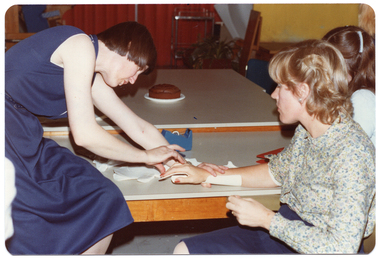
Musculoskeletal Health Australia (now held by the Glen Eira Historical Society)Photograph - Group photo, 25/04/1982
... ... canadian red cross hospital...Head Occupational Therapist at the Canadian Red Cross Hospital in Taplow UK, Sheila Lawton, was the third speaker at the meeting. ...Head Occupational Therapist at the Canadian Red Cross Hospital in Taplow UK, Sheila Lawton, was the third speaker at the meeting. ...On Sunday the 25th of April, 1982, a Public Meeting on Juvenile Chronic Arthritis was held at the Royal Children's Hospital. Head Occupational Therapist at the Canadian Red Cross Hospital in Taplow UK, Sheila Lawton, was the third speaker at the meeting. This photo appears on page 2 of the Vol 26, September 1982 issue of the quarterly newsletter of the Rheumatism and Arthritis Association of Victoria (RAAV), News Review. It accompanies a detailed article on the benefits of splinting and its applications. The photo is captioned: "Miss Sheila Lawton demonstrating a splint during a workshop."Colour photo of one woman fitting an orthopaedic splint onto another woman's hand, wrist, and arm. Another person (partially obscured) is looking on. There is a chocolate cake on a table in the background.[Handwritten in blue ink] N.R. Dec. ['Dec' has been crossed out] Sep. 82 [Printed on a long piece of tape adhered to the photo ] APR. 82 APR. 82rheumatism and arthritis association of victoria, raav, splinting workshop, public meeting on juvenile chronic arthritis, royal children’s hospital, rch, sheila lawton, head occupational therapist, ot, canadian red cross hospital, taplow, united kingdom, uk, guest speaker, news review, 1982 -
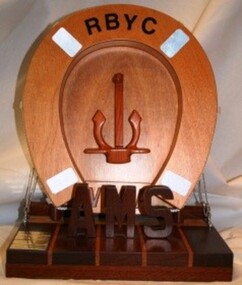
Royal Brighton Yacht ClubLife Ring, Vega Trophy (Mounted Wooden Life Ring)
... hospital, all this complying with Hitler’s orders to ensure that the Channel Islands would never again be part of Britain. Many requests by the Jersey authorities for Red Cross assistance were rejected, but finally in December 1944 they agreed and on 30th December the Red Cross vessel “Vega” (Swedish Registry) arrived and delivered parcels to the civilian population. These parcels contained a variety of foodstuffs supplied mainly by Canadian...hospital, all this complying with Hitler’s orders to ensure that the Channel Islands would never again be part of Britain. Many requests by the Jersey authorities for Red Cross assistance were rejected, but finally in December 1944 they agreed and on 30th December the Red Cross vessel “Vega” (Swedish Registry) arrived and delivered parcels to the civilian population. These parcels contained a variety of foodstuffs supplied mainly by Canadian ...Vega Trophy (Mounted Wooden Life Ring) Donor: Graham Noel During World War II when the Germans occupied the Channel Islands the local people went through very severe food rationing and were on the verge of starvation. Near the end of the war, the Swedish ship Vega was allowed by the Germans to deliver several shipments of food to the civilian population, easing the critical shortages of food on the islands. Further background detail can be found below. Graham Noel was born on the Islands and lived there during this harsh period. The trophy is awarded to the winner of the Combined Division AMS Aggregate Series. First Winner: Under Capricorn, P. Bedlington 2005/06 Vega – Further historical background Early in the Second World War Jersey was declared “unarmed” and the German military took over, taking quite a few lives in the process, through strafing the main harbour and a few other places which they needlessly considered threatening. A considerable number of locals evacuated to England before the Germans arrived, but more than 60% of the population remained and endured 5 years of very strict and difficult conditions. Not only was the population unable to contact relatives in the UK or elsewhere, but very quickly they found themselves subject to harsh curfews, strictly rationed foodstuffs, no fuel for vehicles, radios confiscated, and homes and hotels commandeered by the military. The military demanded first pick of all foodstuffs and kept meticulous records of all livestock forcing farmers even to show newborn calves and piglets to them, then claiming the new arrivals for their dinner tables. However there are many stories of farmers outwitting their masters when twin calves or suchlike arrived! Lawbreakers were quickly dealt with, mostly with lengthy prison terms in Jersey, but the more serious crimes were punished by being sent to some horrible French prisons, or even some of the notorious German concentration camps. All local Jews were dispatched to concentration camps, and even English born families were similarly shipped through France and on to Germany. Sadly, a considerable number of those deported did not make it back safely to Jersey. In June 1944 the locals were delighted to hear that the Allies had invaded Normandy and very soon they could hear the battles as the Allies worked their way along the French coast. Little did they know they would still have to wait another 11 months for freedom, having to put up with a very demanding German occupation force which was still determined to obey Hitler’s order to “Defend the Channel Islands to the death”. Now that France was in Allied Hands the local military commanders were unable to supplement their food supplies from France and even harsher demands were made on the local population to ensure that all branches of their still very substantial military force were reasonably well fed. As well as the military, Jersey farmers had to provide food for the Allied POWs and the many “forced labourers”, mainly of Russian, Polish and Italian backgrounds who had been directed to the island to build all the concrete bunkers. This included an underground hospital, all this complying with Hitler’s orders to ensure that the Channel Islands would never again be part of Britain. Many requests by the Jersey authorities for Red Cross assistance were rejected, but finally in December 1944 they agreed and on 30th December the Red Cross vessel “Vega” (Swedish Registry) arrived and delivered parcels to the civilian population. These parcels contained a variety of foodstuffs supplied mainly by Canadian authorities, desperately needed medical supplies, flour, oils and soaps, as well as tobacco from New Zealand. Vega made a further 3 or 4 trips and most certainly eased the desperate situation being faced by the locals. In fact, it resulted in the locals having slightly better food supplies than the military and many local farmers tell stories of having to protect their stock from marauding soldiers. Understandably Churchill was reluctant to send in an invading force to retake the Channel Islands, but by May 1945 it was clear that the Third Reich was finished and on May 9th the German Military surrendered, without a fight, to a large British landing force. On a slightly lighter note … in January 1945 Jersey stonemasons were seen in the main town square repairing flagstones … the Germans had never noticed that the name “Vega” had been formed in those flagstones! As a side note Vega is the name of the brightest star in the universe. Furthermore, throughout the occupation, despite German law that demanded confiscation of all radio sets, punishable by long prison terms or deportation to Germany, there were still many sets being listened to. The locals had a well refined news system for the dissemination of news of what was happening in the outside world. vega, graham noel, ams, combined division, aggregate -

Returned Nurses RSL Sub-branchMedal - Court-mounted set of miniature medals: Royal Red Cross, Australian Service Medal 1945-75 with PNG clasp, Elizabeth II Silver Jubilee Medal 1977, Defence Force Service Medal, National Medal and Australian Defence Medal, [unknown]
... Hospital that she decided to become a nurse, beginning her training in December 1948 and becoming a Registered Nurse in 1952, and a qualified midwife two years later. In 1959, in search of something different, Vines applied for a civilian nursing role at HMAS Cerberus, Flinders Naval Depot where she was employed until leaving to travel to New Zealand, Canada and the United States in 1962." "Commander Vines was presented with a Royal Red Cross...Hospital that she decided to become a nurse, beginning her training in December 1948 and becoming a Registered Nurse in 1952, and a qualified midwife two years later. In 1959, in search of something different, Vines applied for a civilian nursing role at HMAS Cerberus, Flinders Naval Depot where she was employed until leaving to travel to New Zealand, Canada and the United States in 1962." "Commander Vines was presented with a Royal Red Cross ...These medals were awarded to Patricia Catherine Vines of the Australian Navy and Royal Australian Navy Nursing Service (RANNS). Extracts from Sea Power Centre website (listed in references): "Patricia Catherine Vines was born in Fairfield, Melbourne on 5 September 1925. Educated at the Catholic Ladies College, East Melbourne, on completion of her Intermediate Certificate, Vines undertook secretarial training before working at the Department of Aircraft Productions and then the Gun Turret Factory at Fairfield where she was still working when World War II ended in 1945. It was while she was working in the X-Ray Department at St Vincent’s Hospital that she decided to become a nurse, beginning her training in December 1948 and becoming a Registered Nurse in 1952, and a qualified midwife two years later. In 1959, in search of something different, Vines applied for a civilian nursing role at HMAS Cerberus, Flinders Naval Depot where she was employed until leaving to travel to New Zealand, Canada and the United States in 1962." "Commander Vines was presented with a Royal Red Cross in early 1972. The medal, presented by the Governor of Victoria, Sir Rohan Delacombe, was awarded for ‘exceptional competence and devotion to duty’. Also awarded were Sergeant Leslie Bending of the Naval Police (left) who received the British Empire Medal for dedicated service, and Lieutenant Commander Winston James (right) who received the Distinguished Service Cross in recognition of outstanding leadership and bravery while serving as commander of the RAN Helicopter Flight in Vietnam. During that time (1971-1980) she was also appointed an Honorary Nursing Sister to Queen Elizabeth II. In 1972 Patricia was awarded a Royal Red Cross (RRC) 2nd Class in the New Year Honours List and in January 1981 this was upgraded to a Royal Red Cross 1st class. The awards officially recognised her exceptional devotion and competency in performance of nursing duties in the RAN." "Following a 16-year career in the Navy and having reached retirement age, Patricia Vines retired from the RAN in 1980 and ran her own nursing business in Melbourne until 1995. Patricia Catherine Vines passed away in Melbourne on 15 February 2010, aged 85 years." Vines was a consistent paid member of the Returned Nurses Club (Returned Nurses Sub Branch RSL Victoria) from 1989 to her passing.A mounted set of six miniature medals (approximately a quarter of the size of the medals they represent) of various coloured metals with ribbons of many colours. The Royal Red Cross miniature medal is in the "shape of a golden cross... the obverse enamelled red, with a circular medallion, bearing an effigy of the reigning monarch [Queen Elizabeth II] at its centre. The words "Faith", "Hope" and "Charity" are inscribed on the upper limbs of the cross, with the year "1883" in the lower limb. The reverse is plain except a circular medallion bearing the royal cypher of the reigning monarch" [Wikipedia - see References], on this miniature medal the initials are ER. The ribbon is a dark blue stripe between crimson edge stripes and forms a landscape oriented bow that the medal hangs from the middle. The Australian Service Medal 1945-75 is "nickel-silver with the Australian Coat of Arms surrounded by the words The Australian Service Medal 1945-1975 on the obverse. The reverse has a Federation Star... The ribbon has central stripes of yellow and green, flanked by navy blue, khaki and light blue stripes from the Australia Service Medal 1939-45. A nickel-silver clasp with the name of the theatre or action for which the award is made is presented with the medal." [Australian Government Defence website - see References] This miniature has the PNG clasp and the navy blue stripe has faded to look more purple in colour. The Elizabeth II Silver Jubilee Medal 1977 comprises a "silver disc with, on the obverse, the words ELIZABETH II DEI GRA. REGINA FID. DEF. (Latin abbreviation for "Elizabeth II, by the Grace of God, Queen, Defender of the Faith") surrounding an effigy of Queen Elizabeth II, symbolising her role as fount of honour.[6] On the reverse is a crown atop a wreath that contains the words THE 25th YEAR OF THE REIGN OF QUEEN ELIZABETH II 6 February 1977 in six lines... The ribbon is white with cardinal red bands along the edges...and a... garter blue stripe down the centre, bisected by another... line of cardinal red" [Wikipedia - see References] The Defence Force Service Medal is a "cupro-nickel circular chamfered medal. The obverse has the Joint Service emblem. The reverse is inscribed For Efficient Service In The Permanent Forces around the circumference. The ribbon has 3 equal stripes of gold and azure-blue edged with azure-blue. The colours were the national colours of Australia at the time of introduction." [Australian Government Defence website - see References] the blue stripes have faded to look more purple in colour. The National Medal is "bronze. The obverse shows the Arms of the Commonwealth of Australia within a rim carrying the inscription The National Medal For Service. The reverse is plain. The ribbon has 15 alternating gold and blue stripes. The colours were the national colours of Australia at the time of introduction." [Australian Government Defence website - see References] Again, blue has faded to purple on the ribbon. The Australian Defence Medal is "cupronickel. The obverse has a stylised version of the Commonwealth Coat of Arms as used on the Australia Service Medal 1939-45. This is surrounded by the inscription The Australian Defence Medal above a sprig of wattle. The reverse has the inscription For Service below the Crown of St Edward surrounded by 2 sprays of wattle leaves and blossom. The ribbon is red with black edges, the colours of the Flanders poppy that represent the Anzac spirit of the Australian armed forces. The white stripes divide the ribbon into 3 to denote the three Services and represent service contributing to the peace of Australia." [Australian Government Defence website - see References] The miniature medals are court-mounted on a rigid backing with a long pin and the backing covered with a full size strip of ribbon in the Royal Red Cross medal colours.royal red cross, royal australian naval nursing service, royal australian navy, ranns, ran, papua new guinea, medals