
Showing 234 items matching " cast iron work"
-
 Glen Eira Historical Society
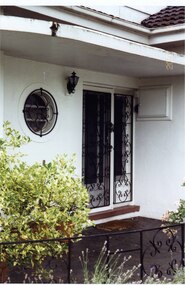
Photograph, Beauville Avenue, 9, Murrumbeena, 2001
... ...cast iron work...Colour photograph of the front entrance to a white rendered house featuring a porthole style window with a decorative cast iron work grid, a wall light, double cast iron work doors in front of the double glass doors and a meter box. ...The estate is distinguished by its aesthetic values, as is the earlier and comparable Hillcrest Estate, which are formed by a combination of restrained diversity in house styles, with the exception of no. 30 in the emerging International style, and by a landscaped garden environment. murrumbeena houses beauville avenue architectural styles 1930's inter war style a.v. jennings av jennings jennings brick houses beauville estate porches sir albert victor jennings a v jennings construction co beauville estate heritage area glen eira city council architectural features jennings group limited land subdivision gardens beauville historic area porthole windows double doors cast iron work lights glass doors Colour photograph of the front entrance to a white rendered house featuring a porthole style window with a decorative cast iron work grid, a wall light, double cast iron work doors in front of the double glass doors and a meter box. ...Originally labelled "Beauville Estate, Established 1936, Still Thriving 65 years on, 10th March 2001", the Beauville Estate Album contains colour photographs of houses in the Estate. They were taken around the time of the Beauville Estate’s 65th Heritage Celebration held on 10/03/2001 and donated to the Caulfield Historical Society shortly afterwards. Photographer Bev Baxter. See also 2104A-11 and 2104A-12.City of Glen Eira’s Heritage Management Plan Vol 2 p79 (this is p84 of the pdf version) – HO12 Beauville Estate and environs, Murrumbeena: The Beauville Historic Area is important at the State level as the first large housing estate undertaken by the AV Jennings Construction Co, later Jennings Group Limited, Victoria’s largest home builder. It is important also as a very early estate development incorporating a range of features other than houses and including made roads, shops and recreation facilities. In this respect it was the forerunner of the comprehensively planned housing estate of the post war era. The estate is distinguished by its aesthetic values, as is the earlier and comparable Hillcrest Estate, which are formed by a combination of restrained diversity in house styles, with the exception of no. 30 in the emerging International style, and by a landscaped garden environment. Colour photograph of the front entrance to a white rendered house featuring a porthole style window with a decorative cast iron work grid, a wall light, double cast iron work doors in front of the double glass doors and a meter box. Wrought iron balustrading can also be seen edging the porch in the foreground. murrumbeena, houses, beauville avenue, architectural styles, 1930's, inter war style, a.v. jennings, av jennings, jennings, brick houses, beauville estate, porches, sir albert victor jennings, a v jennings construction co, beauville estate heritage area, glen eira city council, architectural features, jennings group limited, land subdivision, gardens, beauville historic area, porthole windows, double doors, cast iron work, lights, glass doors -
 Glen Eira Historical Society
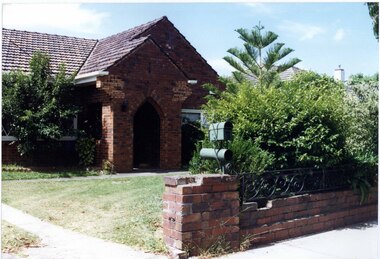
Photograph, Dalny Road, 11, Murrumbeena, 2001
... ...cast iron work...Other features include tiled roof, enclosed porch with an arched entrance and black metal lantern and open window on the left side , garden, drive and a low slightly damaged unpainted brick fence with cast iron work railing in the foreground with a cast iron work letterbox on top....Other features include tiled roof, enclosed porch with an arched entrance and black metal lantern and open window on the left side , garden, drive and a low slightly damaged unpainted brick fence with cast iron work railing in the foreground with a cast iron work letterbox on top. ...Originally labelled "Beauville Estate, Established 1936, Still Thriving 65 years on, 10th March 2001", the Beauville Estate Album contains colour photographs of houses in the Estate. They were taken around the time of the Beauville Estate’s 65th Heritage Celebration held on 10/03/2001 and donated to the Caulfield Historical Society shortly afterwards. Photographer unknown. City of Glen Eira’s Heritage Management Plan Vol 2 p79 (this is p84 of the pdf version) – HO12 Beauville Estate and environs, Murrumbeena: The Beauville Historic Area is important at the State level as the first large housing estate undertaken by the AV Jennings Construction Co, later Jennings Group Limited, Victoria’s largest home builder. It is important also as a very early estate development incorporating a range of features other than houses and including made roads, shops and recreation facilities. In this respect it was the forerunner of the comprehensively planned housing estate of the post war era. The estate is distinguished by its aesthetic values, as is the earlier and comparable Hillcrest Estate, which are formed by a combination of restrained diversity in house styles, with the exception of no. 30 in the emerging International style, and by a landscaped garden environment. Colour photograph of an unpainted variegated brown brick house with decorative brickwork. Other features include tiled roof, enclosed porch with an arched entrance and black metal lantern and open window on the left side , garden, drive and a low slightly damaged unpainted brick fence with cast iron work railing in the foreground with a cast iron work letterbox on top.11murrumbeena, houses, architectural styles, 1930's, inter war style, a.v. jennings, av jennings, jennings, brick houses, beauville estate, dalny road, porches, sir albert victor jennings, a v jennings construction co, beauville estate heritage area, glen eira city council, architectural features, jennings group limited, land subdivision, gardens, beauville historic area, brick features, arches, cast iron work, letterboxes, brick walls -
 Glen Eira Historical Society
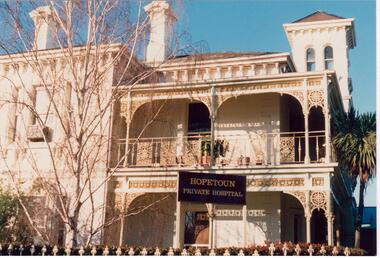
Photograph - Hopetoun, Hopetoun Street, 2, Elsternwick
... ... Cast iron work...The photograph shows the hospital tower and cast iron work of the verandah....The photograph shows the hospital tower and cast iron work of the verandah. Hopetoun Private Hospital Hospitals Towers Mansions Architectural styles Elsternwick Hopetoun Street Cast iron work Photograph Hopetoun, Hopetoun Street, 2, Elsternwick ...A coloured photograph of the exterior of Hopetoun Private Hospital, date of photograph and photographer unknown. The photograph shows the hospital tower and cast iron work of the verandah.hopetoun private hospital, hospitals, towers, mansions, architectural styles, elsternwick, hopetoun street, cast iron work -
 Glen Eira Historical Society
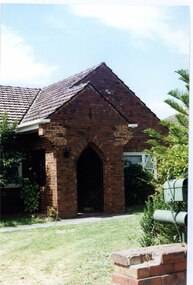
Photograph, Dalny Road, 11, Murrumbeena, 2001
... ...cast iron work...Other features include tiled roof, enclosed porch with an arched entrance and black metal lantern, garden and a low unpainted brick fence in the foreground with a cast iron work letterbox on top....Other features include tiled roof, enclosed porch with an arched entrance and black metal lantern, garden and a low unpainted brick fence in the foreground with a cast iron work letterbox on top. Dalny Road, 11, Murrumbeena Photograph Photograph ...Originally labelled "Beauville Estate, Established 1936, Still Thriving 65 years on, 10th March 2001", the Beauville Estate Album contains colour photographs of houses in the Estate. They were taken around the time of the Beauville Estate’s 65th Heritage Celebration held on 10/03/2001 and donated to the Caulfield Historical Society shortly afterwards. Photographer unknown. City of Glen Eira’s Heritage Management Plan Vol 2 p79 (this is p84 of the pdf version) – HO12 Beauville Estate and environs, Murrumbeena: The Beauville Historic Area is important at the State level as the first large housing estate undertaken by the AV Jennings Construction Co, later Jennings Group Limited, Victoria’s largest home builder. It is important also as a very early estate development incorporating a range of features other than houses and including made roads, shops and recreation facilities. In this respect it was the forerunner of the comprehensively planned housing estate of the post war era. The estate is distinguished by its aesthetic values, as is the earlier and comparable Hillcrest Estate, which are formed by a combination of restrained diversity in house styles, with the exception of no. 30 in the emerging International style, and by a landscaped garden environment. Colour photograph of an unpainted variegated brown brick house with decorative brickwork. Other features include tiled roof, enclosed porch with an arched entrance and black metal lantern, garden and a low unpainted brick fence in the foreground with a cast iron work letterbox on top.murrumbeena, houses, architectural styles, 1930's, inter war style, a.v. jennings, av jennings, jennings, brick houses, beauville estate, dalny road, porches, sir albert victor jennings, a v jennings construction co, beauville estate heritage area, glen eira city council, architectural features, jennings group limited, land subdivision, gardens, beauville historic area, brick features, brick fences, arches, cast iron work, letterboxes -
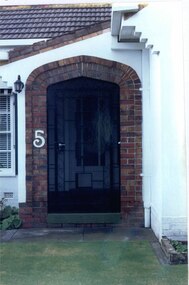 Glen Eira Historical Society
Photograph, Beauville Avenue, 5, Murrumbeena, 2001
... ...cast iron work gates...The entrance features unpainted brick edging with number "5" on the arched entrance with a black mesh and cast iron work gate. Other features include a tiled roof and stepped brick edging under the eaves....The entrance features unpainted brick edging with number "5" on the arched entrance with a black mesh and cast iron work gate. Other features include a tiled roof and stepped brick edging under the eaves. ...Originally labelled "Beauville Estate, Established 1936, Still Thriving 65 years on, 10th March 2001", the Beauville Estate Album contains colour photographs of houses in the Estate. They were taken around the time of the Beauville Estate’s 65th Heritage Celebration held on 10/03/2001 and donated to the Caulfield Historical Society shortly afterwards. Photographer Bev Baxter. See also 2104A-05.City of Glen Eira’s Heritage Management Plan Vol 2 p79 (this is p84 of the pdf version) – HO12 Beauville Estate and environs, Murrumbeena: The Beauville Historic Area is important at the State level as the first large housing estate undertaken by the AV Jennings Construction Co, later Jennings Group Limited, Victoria’s largest home builder. It is important also as a very early estate development incorporating a range of features other than houses and including made roads, shops and recreation facilities. In this respect it was the forerunner of the comprehensively planned housing estate of the post war era. The estate is distinguished by its aesthetic values, as is the earlier and comparable Hillcrest Estate, which are formed by a combination of restrained diversity in house styles, with the exception of no. 30 in the emerging International style, and by a landscaped garden environment.Colour photograph of the entrance to the enclosed porch of a white rendered, brick house. The entrance features unpainted brick edging with number "5" on the arched entrance with a black mesh and cast iron work gate. Other features include a tiled roof and stepped brick edging under the eaves.murrumbeena, houses, beauville avenue, architectural styles, 1930's, inter war style, a.v. jennings, av jennings, jennings, brick houses, beauville estate, arches, sir albert victor jennings, a v jennings construction co, beauville estate heritage area, glen eira city council, architectural features, jennings group limited, land subdivision, gardens, beauville historic area, porches, lamps, cast iron work gates -
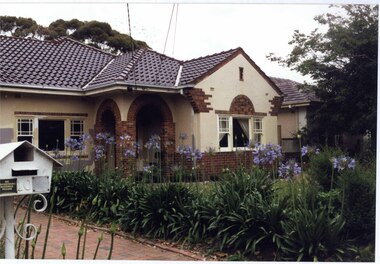 Glen Eira Historical Society
Photograph, Beauville Avenue, 10, Murrumbeena, 2001
... ...cast iron work...Other features include a porch with two decorative open arches, tiled roof, 2 sets of matching double sashed windows with large square pane within each set, agapanthus lining the brick paved driveway and a cast iron work metal letterbox with number "10" on it. ...Other features include a porch with two decorative open arches, tiled roof, 2 sets of matching double sashed windows with large square pane within each set, agapanthus lining the brick paved driveway and a cast iron work metal letterbox with number "10" on it. ...Originally labelled "Beauville Estate, Established 1936, Still Thriving 65 years on, 10th March 2001", the Beauville Estate Album contains colour photographs of houses in the Estate. They were taken around the time of the Beauville Estate’s 65th Heritage Celebration held on 10/03/2001 and donated to the Caulfield Historical Society shortly afterwards. Photographer Bev Baxter. From Glen Eira’s Heritage Management Plan by Andrew Ward (1996) Vol 2 p63: The inclusion of shops in Murrumbeena Road and a common parkland developed at the rear of the properties were complemented by the construction of a gas display home at No. 10 Beauville Avenue.City of Glen Eira’s Heritage Management Plan Vol 2 p79 (this is p84 of the pdf version) – HO12 Beauville Estate and environs, Murrumbeena: The Beauville Historic Area is important at the State level as the first large housing estate undertaken by the AV Jennings Construction Co, later Jennings Group Limited, Victoria’s largest home builder. It is important also as a very early estate development incorporating a range of features other than houses and including made roads, shops and recreation facilities. In this respect it was the forerunner of the comprehensively planned housing estate of the post war era. The estate is distinguished by its aesthetic values, as is the earlier and comparable Hillcrest Estate, which are formed by a combination of restrained diversity in house styles, with the exception of no. 30 in the emerging International style, and by a landscaped garden environment. Colour photograph of cream rendered house with decorative unpainted brown brick features. Other features include a porch with two decorative open arches, tiled roof, 2 sets of matching double sashed windows with large square pane within each set, agapanthus lining the brick paved driveway and a cast iron work metal letterbox with number "10" on it. murrumbeena, houses, beauville avenue, architectural styles, 1930's, inter war style, a.v. jennings, av jennings, jennings, brick houses, beauville estate, porches, arches, sir albert victor jennings, a v jennings construction co, beauville estate heritage area, glen eira city council, architectural features, jennings group limited, land subdivision, gardens, beauville historic area, brick features, sash windows, paved drives, cast iron work, letter boxes, gas display houses -
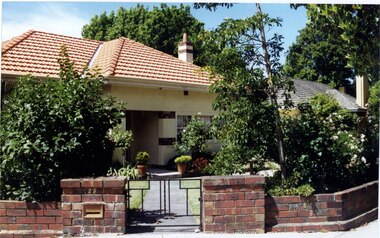 Glen Eira Historical Society
Photograph, Dalny Road, 23, Murrumbeena, 2001
... ...cast iron work gates...Other features include tiled roof, sash windows, concrete path, garden pots, established garden and a low unpainted lighter variegated brown brick fence in the foreground with '23' on the left hand pillar beside the black cast iron work gate. ...Other features include tiled roof, sash windows, concrete path, garden pots, established garden and a low unpainted lighter variegated brown brick fence in the foreground with '23' on the left hand pillar beside the black cast iron work gate. Dalny Road, 23, Murrumbeena Photograph Photograph ...Originally labelled "Beauville Estate, Established 1936, Still Thriving 65 years on, 10th March 2001", the Beauville Estate Album contains colour photographs of houses in the Estate. They were taken around the time of the Beauville Estate’s 65th Heritage Celebration held on 10/03/2001 and donated to the Caulfield Historical Society shortly afterwards. Photographer unknown. City of Glen Eira’s Heritage Management Plan Vol 2 p79 (this is p84 of the pdf version) – HO12 Beauville Estate and environs, Murrumbeena: The Beauville Historic Area is important at the State level as the first large housing estate undertaken by the AV Jennings Construction Co, later Jennings Group Limited, Victoria’s largest home builder. It is important also as a very early estate development incorporating a range of features other than houses and including made roads, shops and recreation facilities. In this respect it was the forerunner of the comprehensively planned housing estate of the post war era. The estate is distinguished by its aesthetic values, as is the earlier and comparable Hillcrest Estate, which are formed by a combination of restrained diversity in house styles, with the exception of no. 30 in the emerging International style, and by a landscaped garden environment. Colour photograph of a cream rendered brick house with unpainted decorative variegated brown brick features including on the porch and chimney. Other features include tiled roof, sash windows, concrete path, garden pots, established garden and a low unpainted lighter variegated brown brick fence in the foreground with '23' on the left hand pillar beside the black cast iron work gate. 23murrumbeena, houses, architectural styles, 1930's, inter war style, a.v. jennings, av jennings, jennings, brick houses, beauville estate, dalny road, porches, brick features, sir albert victor jennings, a v jennings construction co, beauville estate heritage area, glen eira city council, architectural features, jennings group limited, land subdivision, gardens, beauville historic area, chimneys, sash windows, brick fences, cast iron work gates, rendered houses -
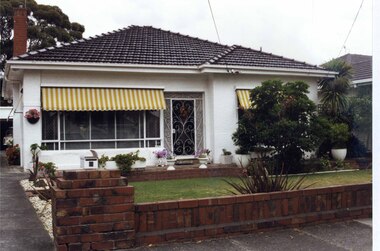 Glen Eira Historical Society
Photograph, Beauville Avenue, 6, Murrumbeena, 2001
... ...cast iron work gates...Other features include a tiled roof, a cast iron work front porch door, garden urns in front of the house and a low unpainted brick fence in the foreground with a car in its garage down the drive to the left. ...Other features include a tiled roof, a cast iron work front porch door, garden urns in front of the house and a low unpainted brick fence in the foreground with a car in its garage down the drive to the left. ...Originally labelled "Beauville Estate, Established 1936, Still Thriving 65 years on, 10th March 2001", the Beauville Estate Album contains colour photographs of houses in the Estate. They were taken around the time of the Beauville Estate’s 65th Heritage Celebration held on 10/03/2001 and donated to the Caulfield Historical Society shortly afterwards. Photographer Bev Baxter. City of Glen Eira’s Heritage Management Plan Vol 2 p79 (this is p84 of the pdf version) – HO12 Beauville Estate and environs, Murrumbeena: The Beauville Historic Area is important at the State level as the first large housing estate undertaken by the AV Jennings Construction Co, later Jennings Group Limited, Victoria’s largest home builder. It is important also as a very early estate development incorporating a range of features other than houses and including made roads, shops and recreation facilities. In this respect it was the forerunner of the comprehensively planned housing estate of the post war era. The estate is distinguished by its aesthetic values, as is the earlier and comparable Hillcrest Estate, which are formed by a combination of restrained diversity in house styles, with the exception of no. 30 in the emerging International style, and by a landscaped garden environment. Colour photograph of a white rendered house with striped yellow and white window awnings. Other features include a tiled roof, a cast iron work front porch door, garden urns in front of the house and a low unpainted brick fence in the foreground with a car in its garage down the drive to the left. The garden beds are also supported by walls of the same unpainted bricks with plants including a palm and succulents.murrumbeena, houses, beauville avenue, architectural styles, 1930's, inter war style, a.v. jennings, av jennings, jennings, brick houses, beauville estate, porches, sir albert victor jennings, a v jennings construction co, beauville estate heritage area, glen eira city council, architectural features, jennings group limited, land subdivision, gardens, beauville historic area, cast iron work gates, striped awnings, outdoor ornaments, brick fences, drives, cars, garages (private), palm trees, brick chimneys -
 Glen Eira Historical Society
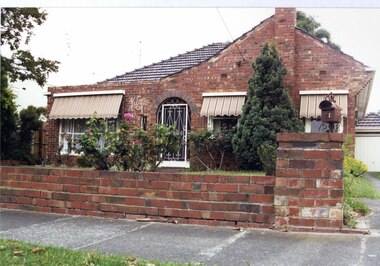
Photograph, Beauville Avenue, 28, Murrumbeena, 2001
... ...cast iron work...Colour photograph of unpainted variegated brown brick house with "Kileen 28" in cast iron on the front wall. Other features include a porch with white cast iron work door, tiled roof, chimney, striped window awnings and low unpainted brick fence with a brown metal letterbox in the foreground beside the driveway. ...Other features include a porch with white cast iron work door, tiled roof, chimney, striped window awnings and low unpainted brick fence with a brown metal letterbox in the foreground beside the driveway. ...Originally labelled "Beauville Estate, Established 1936, Still Thriving 65 years on, 10th March 2001", the Beauville Estate Album contains colour photographs of houses in the Estate. They were taken around the time of the Beauville Estate’s 65th Heritage Celebration held on 10/03/2001 and donated to the Caulfield Historical Society shortly afterwards. Photographer unknown.City of Glen Eira’s Heritage Management Plan Vol 2 p79 (this is p84 of the pdf version) – HO12 Beauville Estate and environs, Murrumbeena: The Beauville Historic Area is important at the State level as the first large housing estate undertaken by the AV Jennings Construction Co, later Jennings Group Limited, Victoria’s largest home builder. It is important also as a very early estate development incorporating a range of features other than houses and including made roads, shops and recreation facilities. In this respect it was the forerunner of the comprehensively planned housing estate of the post war era. The estate is distinguished by its aesthetic values, as is the earlier and comparable Hillcrest Estate, which are formed by a combination of restrained diversity in house styles, with the exception of no. 30 in the emerging International style, and by a landscaped garden environment. See Significance Statement in Glen Eira’s Heritage Management Plan by Andrew Ward (1996) Vol 2 p.79. Available from https://www.gleneira.vic.gov.au/media/4779/heritage_management_plan_volume_2.pdf (Note see p.84 of pdf)Colour photograph of unpainted variegated brown brick house with "Kileen 28" in cast iron on the front wall. Other features include a porch with white cast iron work door, tiled roof, chimney, striped window awnings and low unpainted brick fence with a brown metal letterbox in the foreground beside the driveway. The house has an unusual pitched roof with timber eave on the right side of the house.Kileen / 28murrumbeena, houses, beauville avenue, architectural styles, 1930's, inter war style, a.v. jennings, av jennings, jennings, brick houses, beauville estate, porches, arches, letterboxes, sir albert victor jennings, a v jennings construction co, beauville estate heritage area, glen eira city council, architectural features, jennings group limited, land subdivision, gardens, beauville historic area, cast iron work, house names, kileen, brick features, brick chimneys, striped awnings, brick fences, metal letterboxes, roofs -
 Glen Eira Historical Society
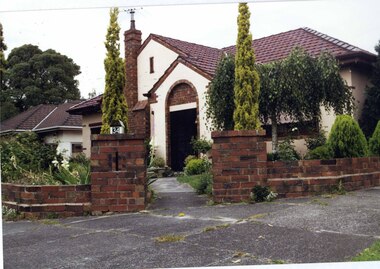
Photograph, Beauville Avenue, 34, Murrumbeena, 2001
... ...cast iron work door...Other features include a wide arched porch, tiled roof, tall brick chimney, cast iron work black porch door, window awnings and low unpainted matching brick fence in the foreground with "34" on the white metal letterbox on top of the right brick pillar beside the concrete pathway leading to the porch. ...Other features include a wide arched porch, tiled roof, tall brick chimney, cast iron work black porch door, window awnings and low unpainted matching brick fence in the foreground with "34" on the white metal letterbox on top of the right brick pillar beside the concrete pathway leading to the porch. ...Originally labelled "Beauville Estate, Established 1936, Still Thriving 65 years on, 10th March 2001", the Beauville Estate Album contains colour photographs of houses in the Estate. They were taken around the time of the Beauville Estate’s 65th Heritage Celebration held on 10/03/2001 and donated to the Caulfield Historical Society shortly afterwards. Photographer unknown.City of Glen Eira’s Heritage Management Plan Vol 2 p79 (this is p84 of the pdf version) – HO12 Beauville Estate and environs, Murrumbeena: The Beauville Historic Area is important at the State level as the first large housing estate undertaken by the AV Jennings Construction Co, later Jennings Group Limited, Victoria’s largest home builder. It is important also as a very early estate development incorporating a range of features other than houses and including made roads, shops and recreation facilities. In this respect it was the forerunner of the comprehensively planned housing estate of the post war era. The estate is distinguished by its aesthetic values, as is the earlier and comparable Hillcrest Estate, which are formed by a combination of restrained diversity in house styles, with the exception of no. 30 in the emerging International style, and by a landscaped garden environment. Colour photograph of white rendered, corner house with unpainted variegated brown brick features. Other features include a wide arched porch, tiled roof, tall brick chimney, cast iron work black porch door, window awnings and low unpainted matching brick fence in the foreground with "34" on the white metal letterbox on top of the right brick pillar beside the concrete pathway leading to the porch. Well-established garden including 2 matching pencil pines.murrumbeena, houses, beauville avenue, architectural styles, 1930's, inter war style, a.v. jennings, av jennings, jennings, brick houses, beauville estate, porches, sir albert victor jennings, a v jennings construction co, beauville estate heritage area, glen eira city council, architectural features, jennings group limited, land subdivision, gardens, beauville historic area, rendered houses, corner houses, brick features, awnings, brick fences, metal letterboxes, trees, cast iron work door -
 Glen Eira Historical Society
Article - Archibald Street,|4,|Elsternwick
... ... Cast Iron Work...Article has two coloured photographs and gives brief details regarding home renovation, includes leadlight windows, cast iron fence, slate roof, cast iron lace work and tessellated tiles....Hooker Leadlight Cast Iron Work Plaster Moulds Article Archibald Street,|4,|Elsternwick ...Newspaper article, giving details of forthcoming sale of property at 4 Archibald Street, Elsternwick. It includes a small coloured photograph dated 18/02/05. Two Melbourne Weekly articles on the forthcoming sale of 4 Archibald Street. Details renovation details and reproduced Victorian additions, including modern state of the art facilities. Dated 22/02/06 and 15/02/06. Property Review Weekly dated 10/02/2006, on 4 Archibald Street, Elsternwick. Article has two coloured photographs and gives brief details regarding home renovation, includes leadlight windows, cast iron fence, slate roof, cast iron lace work and tessellated tiles.michelson’s, estate agents, archibald st, elsternwick, timber houses, victorian style, flamm alex, michelson mike, architectural features, penama developments, rossini, flamm oren, l.j. hooker, leadlight, cast iron work, plaster moulds -
 Glen Eira Historical Society
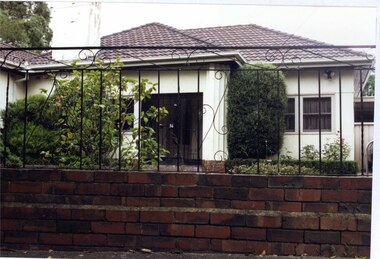
Photograph, Beauville Avenue, 36, Murrumbeena, 2001
... ...cast iron work doors...The estate is distinguished by its aesthetic values, as is the earlier and comparable Hillcrest Estate, which are formed by a combination of restrained diversity in house styles, with the exception of no. 30 in the emerging International style, and by a landscaped garden environment. murrumbeena houses beauville avenue architectural styles 1930's inter war style a.v. jennings av jennings jennings brick houses beauville estate porches sir albert victor jennings a v jennings construction co beauville estate heritage area glen eira city council architectural features jennings group limited land subdivision gardens beauville historic area arches rendered houses cast iron work doors chimneys cast iron work fences Colour photograph of white rendered house with a wide porch gated by a black cast iron decorative door and a column feature to the right, chimney, tiled roof and a low unpainted brick fence topped by a black cast iron decorative fence in the foreground. ...Originally labelled "Beauville Estate, Established 1936, Still Thriving 65 years on, 10th March 2001", the Beauville Estate Album contains colour photographs of houses in the Estate. They were taken around the time of the Beauville Estate’s 65th Heritage Celebration held on 10/03/2001 and donated to the Caulfield Historical Society shortly afterwards. Photographer unknown.City of Glen Eira’s Heritage Management Plan Vol 2 p79 (this is p84 of the pdf version) – HO12 Beauville Estate and environs, Murrumbeena: The Beauville Historic Area is important at the State level as the first large housing estate undertaken by the AV Jennings Construction Co, later Jennings Group Limited, Victoria’s largest home builder. It is important also as a very early estate development incorporating a range of features other than houses and including made roads, shops and recreation facilities. In this respect it was the forerunner of the comprehensively planned housing estate of the post war era. The estate is distinguished by its aesthetic values, as is the earlier and comparable Hillcrest Estate, which are formed by a combination of restrained diversity in house styles, with the exception of no. 30 in the emerging International style, and by a landscaped garden environment. Colour photograph of white rendered house with a wide porch gated by a black cast iron decorative door and a column feature to the right, chimney, tiled roof and a low unpainted brick fence topped by a black cast iron decorative fence in the foreground. murrumbeena, houses, beauville avenue, architectural styles, 1930's, inter war style, a.v. jennings, av jennings, jennings, brick houses, beauville estate, porches, sir albert victor jennings, a v jennings construction co, beauville estate heritage area, glen eira city council, architectural features, jennings group limited, land subdivision, gardens, beauville historic area, arches, rendered houses, cast iron work doors, chimneys, cast iron work fences -
 Glen Eira Historical Society
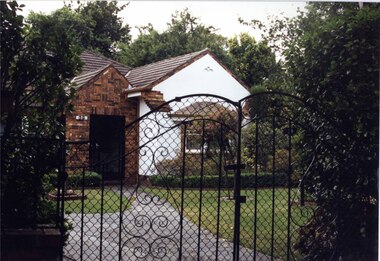
Photograph, Beauville Avenue, 39, Murrumbeena, 2001
... ...cast iron work door...The estate is distinguished by its aesthetic values, as is the earlier and comparable Hillcrest Estate, which are formed by a combination of restrained diversity in house styles, with the exception of no. 30 in the emerging International style, and by a landscaped garden environment. murrumbeena houses beauville avenue architectural styles 1930's inter war style a.v. jennings av jennings jennings brick houses beauville estate porches sir albert victor jennings a v jennings construction co beauville estate heritage area glen eira city council architectural features jennings group limited land subdivision gardens beauville historic area rendered houses brick features cast iron work door cast iron work gates Colour photograph of white rendered house with unpainted variegated brown brick features. ...Originally labelled "Beauville Estate, Established 1936, Still Thriving 65 years on, 10th March 2001", the Beauville Estate Album contains colour photographs of houses in the Estate. They were taken around the time of the Beauville Estate’s 65th Heritage Celebration held on 10/03/2001 and donated to the Caulfield Historical Society shortly afterwards. Photographer unknown.City of Glen Eira’s Heritage Management Plan Vol 2 p79 (this is p84 of the pdf version) – HO12 Beauville Estate and environs, Murrumbeena: The Beauville Historic Area is important at the State level as the first large housing estate undertaken by the AV Jennings Construction Co, later Jennings Group Limited, Victoria’s largest home builder. It is important also as a very early estate development incorporating a range of features other than houses and including made roads, shops and recreation facilities. In this respect it was the forerunner of the comprehensively planned housing estate of the post war era. The estate is distinguished by its aesthetic values, as is the earlier and comparable Hillcrest Estate, which are formed by a combination of restrained diversity in house styles, with the exception of no. 30 in the emerging International style, and by a landscaped garden environment. Colour photograph of white rendered house with unpainted variegated brown brick features. Features include a large brick porch with decorative cast iron door, tiled roof and decorative cast iron entrance gates.murrumbeena, houses, beauville avenue, architectural styles, 1930's, inter war style, a.v. jennings, av jennings, jennings, brick houses, beauville estate, porches, sir albert victor jennings, a v jennings construction co, beauville estate heritage area, glen eira city council, architectural features, jennings group limited, land subdivision, gardens, beauville historic area, rendered houses, brick features, cast iron work door, cast iron work gates -
 Glen Eira Historical Society
Letter - Orrong Crescent, 84, Caulfield North
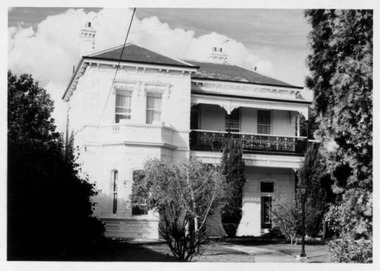
... ... Cast iron work...Chesterfield HC North Caulfield Cast iron work Birch S R Architectural styles City of Caulfield Orrong Crescent Architectural features Hart Trevor Houses Filbert Street Verandahs House names 'Bonhurst' 'Historical Caulfield to 1972' Letter Orrong Crescent, 84, Caulfield North ...Two items abut this property: 1/Copy of letter from S R Birch of National Trust Of Australia that acknowledges 84 Orrong Crescent Caulfield North built 1889 has been recorded by the National Trust. Letter sent to owner H C Chesterfield dated 30/01/1974 with cc's to the Town Clerk, City Of Caulfield and Trevor Hart. Address was formerly numbered 120. 2/Data image of one of two black and white photos for GEHS-held photo album 'Historical Caulfield to 1972' p152. Hand noted as 'Bonhurst'.chesterfield hc, north caulfield, cast iron work, birch s r, architectural styles, city of caulfield, orrong crescent, architectural features, hart trevor, houses, filbert street, verandahs, house names, 'bonhurst', 'historical caulfield to 1972' -
Glen Eira Historical Society
Article - Regent Street, 12, Elsternwick
... ... Cast Iron Work...Regent Street Verandahs Cast Iron Work Builders Paterson Christine Elsternwick Tosin Paul Giannaris Christine Biggin and Scott Real estate agents 'Windsor' House names Stavrakis Bill Hoos George Slate tiles Denning Ethel Victorian style Paterson Greg Makvshev E. ...Three documents about this property: 1/A newspaper ad, dated 02/11/2005, gives a description of the home; 2/History of home as a run-down property and on current home owners, and the reasons for the renovations they did are covered in domain article of 09-15/11/2005; 3/Additional information included from Sands and McDougalls lists residents in 1923, 1948, 1960 and 1970 (in Claire Barton's handwriting as researcher).regent street, verandahs, cast iron work, builders, paterson christine, elsternwick, tosin paul, giannaris christine, biggin and scott, real estate agents, 'windsor', house names, stavrakis bill, hoos george, slate tiles, denning ethel, victorian style, paterson greg, makvshev e. -
Glen Eira Historical Society
Document - Regent Street, 17, Elsternwick
... ... Cast Iron Work...Miss Victorian Style Glenhuntly Road Cast Iron Work Smith Herbert R. Windows Mc Namara Wm. ...Two documents about this property: 1/A newspaper article, dated 2009, includes photo and brief description of home’s Victorian features for forthcoming sale. 2/Additional information from Sands and McDougalls, editions 1911, 1913, 1923, 1948, 1960 and 1970 of former occupants of home.elsternwick, stefanis angelos, finney edward. c., regent street, stavrakis bill, gloz i.o. miss, victorian style, glenhuntly road, cast iron work, smith herbert r., windows, mc namara wm. -
 Glen Eira Historical Society
Regent Street, 78, Elsternwick
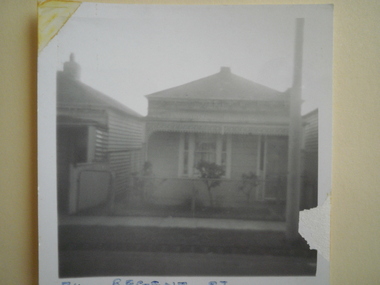
... ...Cast iron work...Regent Street Elsternwick Victorian style Williams Kharla Stavrakis Bill Buxton Real Estate Real estate agents Altman Romana Cheeseman A N Elliott W M C Cope Chas Evans Hy T Evans E Cast iron work Verandahs Three items on 78 Regent Street, Elsternwick., Newspaper advertisement from the Bayside Weekly, 03/2009 for the sale of 78 Regent Street. ...Three items on 78 Regent Street, Elsternwick., Newspaper advertisement from the Bayside Weekly, 03/2009 for the sale of 78 Regent Street. Gives brief description of the house’s interior and exterior features. Includes one colour photograph of the house exterior and two colour photographs of the house interior., Newspaper advertisement dated 08/09/2001, source unknown, advertising the sale of 78 Regent Street. Gives brief details of the house interior. Includes a colour photograph of the house exterior and a colour photograph of the Elsternwick Plaza area., A research note by Claire Barton, dated 03/07/2012, referencing Sands and McDougall editions 1911, 1913, 1923, 1948, 1960 and 1970, giving names of previous occupants of 78 Regent Street.regent street, elsternwick, victorian style, williams, kharla, stavrakis, bill, buxton real estate, real estate agents, altman, romana, cheeseman, a n, elliott, w m c, cope, chas, evans hy t, evans, e, cast iron work, verandahs -
Glen Eira Historical Society
Article - Shoobra Road, 61, Elsternwick
... ... Cast iron work...Shoobra Road Elsternwick Timber houses Biggin & Scott Victorian Style Verandahs Architectural features House names Relough McLean BH Mrs Elsworthy Henry Hastings Dora Mrs German Robert Cast iron work Real Estate Agents Hannaford JC Article Shoobra Road, 61, Elsternwick ...Three documents about this property: Two unattributed newspaper items dated 12/12/2001 and 5/12/2002 includes interior features of interest for forthcoming auction by Biggin and Scott. Handwritten research by Claire Barton via Sands and McDougalls that No. 61 was probably called Relough in 1910 and the name seems to have disappeared by 1923 and 1942 editions.shoobra road, elsternwick, timber houses, biggin & scott, victorian style, verandahs, architectural features, house names, relough, mclean bh mrs, elsworthy henry, hastings dora mrs, german robert, cast iron work, real estate agents, hannaford jc -
Glen Eira Historical Society
Article - SHOOBRA ROAD, 62, ELSTERNWICK
... ... Cast iron work...Victorian style Elsternwick Shoobra Road Fireplaces Ceiling roses Cast iron work Hastings Geo.T. Hastings Mary Mrs Verandahs Biggin and Scott Real Estate Agents Water tanks Article SHOOBRA ROAD, 62, ELSTERNWICK ...Three items on Shoobra Road; 1/Newspaper article dated 02/02/2011, from Melbourne Weekly Bayside, includes three coloured photographs showing renovated home interior and exterior facade. Article notes renovated features and garden highlights, selling agents Biggin and Scott. 2/Handwritten research from Sands and McDougalls edition 1923, 1942, and 1948 giving occupier details, by Claire Barton. 3/Forthcoming auction flyer for 62 Shoobra Road, Elsternwick. Auction date 30/05/2015. Property sold for approximately $2,000,000 by auctioneers HockingStuart.victorian style, elsternwick, shoobra road, fireplaces, ceiling roses, cast iron work, hastings geo.t., hastings mary mrs, verandahs, biggin and scott, real estate agents, water tanks -
Glen Eira Historical Society
Article - Shoobra Road, 53, Elsternwick, 'Linbrae'
... ... Cast Iron Work...Shoobra Road Elsternwick 'Linbrae' Biggin Scott Williams Kharla Stavrakis Bill Architectural Features Architectural Styles Cast Iron Work Real Estate Agents Bryant Samuel Rev. ...Three articles on 53 Shoobra Road: Melbourne Weekly Bayside magazine auction features dated 06/10/2010 and 20/10/2010 giving brief details of interior features and external extras. Articles include four and seven photographs respectively of house interior and exterior. Handwritten research by Claire Barton taken from Sands and MacDougalls editions 1910, 1913, 1923, 1942, 1948 and 1960 dated 30/09/2011.shoobra road, elsternwick, 'linbrae', biggin scott, williams kharla, stavrakis bill, architectural features, architectural styles, cast iron work, real estate agents, bryant samuel rev., bay windows, hestia, house names, appleton bv miss, victorian style, marble, fireplaces -
Glen Eira Historical Society
Document - St. Georges Road, 68, Elsternwick
... ... Cast Iron Work...Belle Vue Young Stephen Locksley Cutts Herbert Robertson David Robertson Ada Edwards Joseph Cording William Rybajzen Jeko Szaul Bullock Hilary Landells Rosalind Brighton Historical Society Architectural Features Houses Land Values Furnishings Brick Houses Verandahs Cast Iron Work Edwards Mrs Document St. Georges Road, 68, Elsternwick ...Two documents about the history and features of this property. A typed report about the ownership and occupancy from 1906 to 1978 of 68 St. Georges Road dated 21/07/1987 researched by Hailary Bullock and Rosalind Landells with handwritten working notes. Two evaluations, one for the house dated 05/05/1954, and one for the furnishings inside the house.st. georges road, george road, elsternwick, frederick sargood estate, sargood f., ripponlea, ring c., wrigley leslie j., belle vue, young stephen, locksley, cutts herbert, robertson david, robertson ada, edwards joseph, cording william, rybajzen jeko szaul, bullock hilary, landells rosalind, brighton historical society, architectural features, houses, land values, furnishings, brick houses, verandahs, cast iron work, edwards mrs -
Glen Eira Historical Society
Document - Roseneath, Nepean Highway, 31, Elsternwick
... ... Cast Iron Work...Kilda Riding Historic Buildings Register National Trust Register National Estate Register Italianate Style Architectural Styles Architectural Features Mansions Brick Houses Verandahs Cast Iron Work Bluestone Bay Windows Land Subdivisions Merchants Judges Leases Councillors Document Roseneath, Nepean Highway, 31, Elsternwick ...A photocopy of a Caulfield Conservation Study conducted in January 1995 by historian Andrew Ward of the house Roseneath named thus by 1904. The document includes a photocopied photograph of the front façade, although the features are unclear. The document, which includes a bibliography, details the history of Roseneath, including owners and occupiers, as well as the architectural features of significance and historical value.ward andrew, millar william, boyle andrew, worthington george, tulloch annie, cross anastasia, meek alex, caulfield, roseneath, elsternwick, nepean highway, mcmillan street, point nepean road, rusden street, cumbernauld, hawthorn road, glenmoore, st. georges road, caulfield south, shire of caulfield, east st. kilda riding, historic buildings register, national trust register, national estate register, italianate style, architectural styles, architectural features, mansions, brick houses, verandahs, cast iron work, bluestone, bay windows, land subdivisions, merchants, judges, leases, councillors -
Glen Eira Historical Society
Article - Shoobra Road, 63, Elsternwick
... ... Cast iron work...Shoobra Road Real Estate Agents House names Elsternwick Wymswold Verandahs Street Charles Fireplaces Architectural features Cast iron work Marble Gary Peer & Associates Stables Bay windows Carports Article Shoobra Road, 63, Elsternwick ...3 items on 63 Shoobra Road: 1/An advertising article dated 19/03/2004, from Property Review Weekly, giving details of original features and renovations done to 63 Shoobra Road, for forthcoming auction by Gary Peer. 2/Handwritten research by Claire Barton on 63 Shoobra Road giving house name in the 1910 Sands & McDougalls and owner/tenant, dated 30/09/2011. 3/An auction advertisement for 63 Shoobra Road on 06/12/2014 (newspaper add hand-dated as 11/11/2014).shoobra road, real estate agents, house names, elsternwick, wymswold, verandahs, street charles, fireplaces, architectural features, cast iron work, marble, gary peer & associates, stables, bay windows, carports -
 Glen Eira Historical Society
Article - Tram Shelter, Balaclava Road
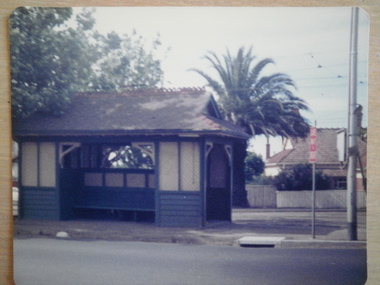
... ... Cast Iron Work...Article from the Trust News, June 2000 on history of Melbourne Tram shelters, various architectural design and features and where they were built and who designed them Balaclava Road Orrong Road Tram Shelters Street Furniture Cast Iron Work Verandahs Edwardian Style The Prahran and Malvern Tramways Trust Ward Andrew Historic Buildings Dandenong Road Caulfield North Glenhuntly Road Green Robert Article Tram Shelter, Balaclava Road ...Caulfield Conservation study by Andrew Ward dated October 1994 on Tram Shelter, corner of Balaclava Road and Orrong Road with a brief history and a statement of significance from the National Trust of Australia. Four black and white photos of Balaclava Road tram shelter. National Trust classification report giving detail of shelter and others on the tramway routes of Melbourne. Includes history of cable car system and reasons for tramways amalgamations. It includes architectural features. Article from the Trust News, June 2000 on history of Melbourne Tram shelters, various architectural design and features and where they were built and who designed thembalaclava road, orrong road, tram shelters, street furniture, cast iron work, verandahs, edwardian style, the prahran and malvern tramways trust, ward andrew, historic buildings, dandenong road, caulfield north, glenhuntly road, green robert -
Glen Eira Historical Society
Document - Westbank, Neerim Road, 37, Caulfield
... ... Cast Iron Work...Neerim Road Edenkillie Westbank Jowett Frederick House Names Caulfield Brick Houses Black Elizabeth Verandahs Cast Iron Work Glen Huntly Solomon G. Victorian Style Document Westbank, Neerim Road, 37, Caulfield ...Photocopy of 37 Neerim Road Caulfield Property Conservation Study by Andrew Ward 1995, giving a brief description of the house with photo and details of owners and residents from 1889 to 1927.neerim road, edenkillie, westbank, jowett frederick, house names, caulfield, brick houses, black elizabeth, verandahs, cast iron work, glen huntly, solomon g., victorian style -
Glen Eira Historical Society
Drawing - Woodbine
... ... Cast Iron Work...Real Estate Agents Mantle Pieces Lead Lights Ceiling Roses Cast Iron Work Verandahs Brick Houses Fireplaces Drawing Woodbine ...Real Estate flyer dated 21/11/1991 from Templeton’s Pty Ltd. On Woodbine, 18 Adelaide Street Murrumbeena giving detailed description of house features including sketch of property.murrumbeena, adelaide street, woodbine, house names, victorian style, sholl denis, templeton’s pty ltd., real estate agents, mantle pieces, lead lights, ceiling roses, cast iron work, verandahs, brick houses, fireplaces -
Glen Eira Historical Society
Article - Regent Street, 50, Elsternwick
... ... Cast iron work...Elsternwick Regent Street Cottages Cast iron work Tosin Paul Stavrakis Bill Real estate agents Herbert Ralph Capuano Chas M Eldred C M Eldred M Smith Regd T Article Regent Street, 50, Elsternwick ...Two items about this property: Newspaper advertisement dated 02/11/2005, source unknown, advertising the forthcoming 19/11/2005 auction of 50 Regent Street, Elsternwick. Gives brief details on the property interior and exterior. Research note by Claire Barton, dated 06/06/2012, referencing Sands and McDougall editions, 1913, 1923, 1948, 1960 and 1970, giving names of previous tenants at 50 Regent Street.elsternwick, regent street, cottages, cast iron work, tosin paul, stavrakis bill, real estate agents, herbert ralph, capuano chas m, eldred c m, eldred m, smith regd t -
Glen Eira Historical Society
Article - Regent Street, 57, Elsternwick
... ... Cast iron work...Peer Gary Elsternwick Regent Street Verandahs Cast iron work Plaster moulds Ceiling roses Real estate agents Victorian style Boyd K Williamson Chas G Lalas X Mrs Prividenic A Article Regent Street, 57, Elsternwick ...Three items about this property: 1/Feature article from a newspaper with date noted as 16/03/2001 detailing the period features and other property information. One exterior and one interior black and white photos. 2/One newspaper advertisement dated 16/03/2001, source unknown, advertising the forthcoming auction on 24/03/2001 of 57 Regent Street, Elsternwick. Gives details of house interior and exterior. Includes photograph of the house exterior. Also an advertising postcard with the same details. 3/Research note by Claire Barton, dated 12/06/2012, referencing Sands and McDougall editions, 1923, 1948, 1960 and 1970, giving names of previous tenants at 57 Regent Street.peer gary, elsternwick, regent street, verandahs, cast iron work, plaster moulds, ceiling roses, real estate agents, victorian style, boyd k, williamson chas g, lalas x mrs, prividenic a -
Glen Eira Historical Society
Document - Regent Street, 84, Elsternwick
... ... Cast iron work...Elsternwick Regent Street Buxton Real Estate Real estate agents Victorian style Altman Romana Stavrakis Bill Cast iron work Cottages Rohrs Cath Mrs Richardson Eric H Richardson L M Mrs Verandahs Document Regent Street, 84, Elsternwick ...Two documents about this property: 1/Newspaper advertisement, source unknown, dated 04/05/2002, for the auction of 84 Regent Street. Gives brief details of interior and exterior features. Includes one colour photograph of the house and two colour photographs of the house exterior. Research note by Claire Barton, dated 06/06/2012, referencing Sands and McDougall editions 1923, 1948, 1960 and 1970, giving names of previous occupants of 84 Regent Street.elsternwick, regent street, buxton real estate, real estate agents, victorian style, altman romana, stavrakis bill, cast iron work, cottages, rohrs cath mrs, richardson eric h, richardson l m mrs, verandahs -
Glen Eira Historical Society
Document - Shoobra Road, 41, Elsternwick
... ... Cast iron work...Shoobra Road Elsternwick Shoobra House Mansion Architectural styles Biggin and Scott Real estate agents Stefanis Angelos Stavrakis Bill Buxtoms Ione House names Neville Jas F Neville E I miss Ackland H L Neville James Cast iron work Glen Huntly Road Document Shoobra Road, 41, Elsternwick ...Two items about this property. 1) Three unattributed newspaper articles on 41 Shoobra Road Elsternwick, dated 03/11/2004 and 27/01/2001 and 2011. Includes seven coloured photographs showing façade and interior rooms for upcoming sale. 2) Researched notes by Claire Barton, dated 22/06/2012, on residents/owners at 41 Shoobra Road, from Sands and McDougall editions 1910, 1913, 1923, 1942, 194 and 1960.shoobra road, elsternwick, shoobra house, mansion, architectural styles, biggin and scott, real estate agents, stefanis angelos, stavrakis bill, buxtoms, ione, house names, neville jas f, neville e i miss, ackland h l, neville james, cast iron work, glen huntly road
