
Showing 89 items matching " ceremonial clothing"
-
 Glenelg Shire Council Cultural Collection
Photograph - Photograph - Syd Cuffe, Portland Town Crier in Regalia, 19/11/1984
... ... ceremonial clothing...The items relate to his town crying activities and community work across the Shire and further afield. Syd Cuffe ceremonial clothing Back: black stamp ' Peter Morris - Photographer, 68 Commercial St. ...Syd Cuffe was the Portland Town Crier from 1983 to 2013. The role of Town Crier was created for Syd Cuffe in 1983 in the lead up to Portland’s 150th anniversary celebrations held in 1984-85. 200 items from Mr. Cuffe’s estate were donated to the Glenelg Shire Cultural Collection. The items relate to his town crying activities and community work across the Shire and further afield.Black and white photo. Syd Cuffe in Town Crier regalia, outside History House, Portland's 150th Anniversary celebrationsBack: black stamp ' Peter Morris - Photographer, 68 Commercial St. East, MT GAMBIER 5290 PHONE 251270syd cuffe, ceremonial clothing -
Glenelg Shire Council Cultural Collection
Clothing - Town Crier's Bow Tie - Syd Cuffe, n.d
... ... ceremonial clothing...Syd Cuffe Portland Town Crier ceremonial clothing Black bowtie, part of Syd Cuffe's Town Crier's outfit Clothing Town Crier's Bow Tie - Syd Cuffe ...Syd Cuffe was the Portland Town Crier from 1983 to 2013. The role of Town Crier was created for Syd Cuffe in 1983 in the lead up to Portland’s 150th anniversary celebrations held in 1984-85. 200 items from Mr. Cuffe’s estate were donated to the Glenelg Shire Cultural Collection. The items relate to his town crying activities and community work across the Shire and further afield.Black bowtie, part of Syd Cuffe's Town Crier's outfitsyd cuffe, portland town crier, ceremonial clothing -
 Glenelg Shire Council Cultural Collection
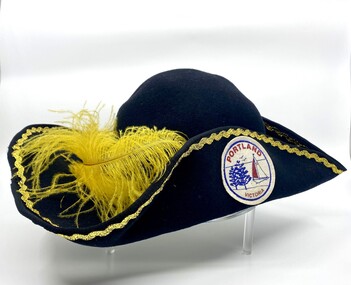
Headwear - Town Crier's Hat - Syd Cuffe, 1988-1995
... ... ceremonial clothing...Syd Cuffe headwear ceremonial clothing town crier Syd Cuffe's Town crier's hat. ...Syd Cuffe was the Portland Town Crier from 1983 to 2013. The role of Town Crier was created for Syd Cuffe in 1983 in the lead up to Portland’s 150th anniversary celebrations held in 1984-85. 200 items from Mr. Cuffe’s estate were donated to the Glenelg Shire Cultural Collection. The items relate to his town crying activities and community work across the Shire and further afield.Syd Cuffe's Town crier's hat. Black felt, sides turned up with point in brim at front, trimmed in gold braid, gold feather, round white felt Portland souvenir, cloth patch on one side of turned-up brim, printed in red and blue with image of beach, tree and yachtsyd cuffe, headwear, ceremonial clothing, town crier -
 Flagstaff Hill Maritime Museum and Village
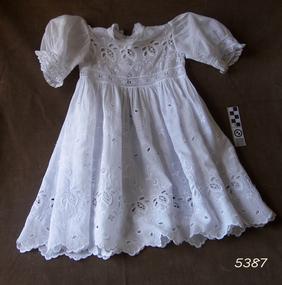
Clothing - Christening Gown, c. 1911
... ...ceremonial clothing...This item is representative of christening gowns in the early 1910s. flagstaff hill warrnambool shipwrecked coast flagstaff hill maritime museum maritime museum shipwreck coast flagstaff hill maritime village great ocean road mrs w.n. barnard w.n. barnard of portland victoria robert barnard child’s clothing c 1911 broderie anglaise christening gown ceremonial gown ceremonial clothing religious clothing Child's white broderie anglaise christening gown, hand sewn, three button closure, short sleeves, c. ...This child's white broderie anglaise christening gown was worn by Robert Barnard, son of Mrs W N Barnard of Portland, when he was a young child, circa 1911.This item is representative of christening gowns in the early 1910s. Child's white broderie anglaise christening gown, hand sewn, three button closure, short sleeves, c. Circa 1911. Worn by Robert Barnard son of Mrs W N Barnard of Portland.flagstaff hill, warrnambool, shipwrecked coast, flagstaff hill maritime museum, maritime museum, shipwreck coast, flagstaff hill maritime village, great ocean road, mrs w.n. barnard, w.n. barnard of portland victoria, robert barnard, child’s clothing c 1911, broderie anglaise, christening gown, ceremonial gown, ceremonial clothing, religious clothing -
 Kew Historical Society Inc
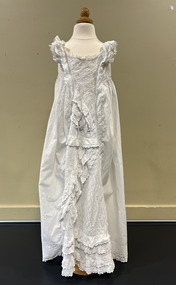
Clothing - Christening Gown, 1899-1910
... ...Ceremonial clothing...Christening gowns Ceremonial clothing children's wear baptismal clothing victorian historical themes — 8.6 marking the phases of life Nil Long, white cotton christening gown. ...In the early 19th century, infant gowns were modelled on dresses worn by adult women. Gowns were typically made of fine white linen or cotton, and often trimmed with tucks, lace, whitework embroidery, and other handwork. The Kew Historical Society's collection includes over twenty-five gowns dating from the 19th and 20th centuries. This christening gown was worn by one or more of the Weir children.This is one of ten items of clothing, worn by infants in the Weir family of Broken Hill between 1899 and 1910. They are part of the larger Weir Family collection of clothing, documents and photographs gifted to the Kew Historical Society by their descendants. Due to their known provenence, the gowns are historically and aesthetically significant in that they can be accurately dated to an 11-year-period, allowing other comparable items of infant's and children's clothing to be dated to an earlier, silmilar or later period. They also exemplify the styles and decorative techniques used for christening gowns, infant's and children's clothing of the period.Long, white cotton christening gown. The high-necked, short-sleeved bodice has a number of decorative elements. This includes an extesive use of lace in diagonal panels at the front above four horizontal layers of the same lace. There are two layers of lace forming the sleeves. Nilchristening gowns, ceremonial clothing, children's wear, baptismal clothing, victorian historical themes — 8.6 marking the phases of life -
 Kew Historical Society Inc
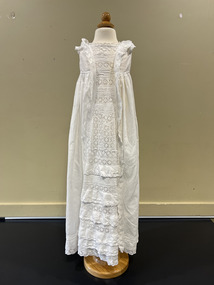
Clothing - Christening Gown, 1891-1910
... ...Ceremonial clothing...Christening gowns Ceremonial clothing children's wear baptismal clothing victorian historical themes — 8.6 marking the phases of life Nil Long, white cotton christening gown. ...In the early 19th century, infant gowns were modelled on dresses worn by adult women. Gowns were typically made of fine white linen or cotton, and often trimmed with tucks, lace, whitework embroidery, and other handwork. The Kew Historical Society's collection includes over twenty-five gowns dating from the 19th and 20th centuries. This christening gown was worn by one or more of the Weir children.This is one of ten items of clothing, worn by infants in the Weir family of Broken Hill between 1899 and 1910. They are part of the larger Weir Family collection of clothing, documents and photographs gifted to the Kew Historical Society by their descendants. Due to their known provenence, the gowns are historically and aesthetically significant in that they can be accurately dated to an 11-year-period, allowing other comparable items of infant's and children's clothing to be dated to an earlier, silmilar or later period. They also exemplify the styles and decorative techniques used for christening gowns, infant's and children's clothing of the period.Long, white cotton christening gown. The high-necked, short-sleeved bodice has a number of decorative elements. These include an extesive use of lace in horizontal and triangular panels of various styles at the front. Two long bands of lace frame this central panel.Nilchristening gowns, ceremonial clothing, children's wear, baptismal clothing, victorian historical themes — 8.6 marking the phases of life -
 Kew Historical Society Inc
Clothing - Christening Gown, 1891-1910
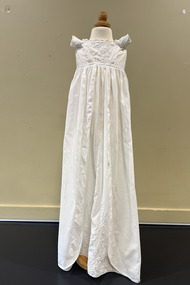
... Ceremonial clothing...They also exemplify the styles and decorative techniques used for christening gowns, infant's and children's clothing of the period. Ceremonial clothing children's wear baptismal clothing victorian historical themes — 8.6 marking the phases of life christening gown Nil Long, fine white cotton christening gown. ...In the early 19th century, infant gowns were modelled on dresses worn by adult women. Gowns were typically made of fine white linen or cotton, and often trimmed with tucks, lace, whitework embroidery, and other handwork. The Kew Historical Society's collection includes over twenty-five gowns dating from the 19th and 20th centuries. This christening gown was worn by one or more of the Weir children.This is one of ten items of clothing, worn by infants in the Weir family of Broken Hill between 1891 and 1910. They are part of the larger Weir Family collection of clothing, documents and photographs gifted to the Kew Historical Society by their descendants. Due to their known provenence, the gowns are historically and aesthetically significant in that they can be accurately dated to an 19-year-period, allowing other comparable items of infant's and children's clothing to be dated to an earlier, silmilar or later period. They also exemplify the styles and decorative techniques used for christening gowns, infant's and children's clothing of the period.Long, fine white cotton christening gown. The high-necked, short-sleeved bodice has a number of decorative elements. These include an extesive use of white work on the sleeves, bodice and gown. Tight ruching at the waist allows a central panel of white work to be framed by the larger panel which acts as a polonnaise. This contains the finest workmanship of the christening gowns and infants clothing in the Weir Collection and may date to 1891.Nilceremonial clothing, children's wear, baptismal clothing, victorian historical themes — 8.6 marking the phases of life, christening gown -
 Mont De Lancey
Ceremonial Military Sash
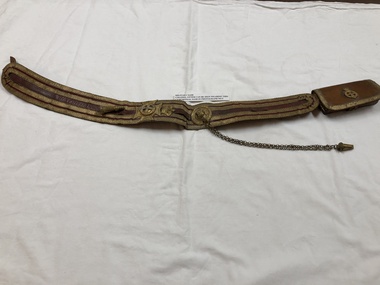
... ...Ceremonial clothing...Military decorations Military uniforms Ceremonial clothing Pouch: Crown Crest Sash: Pro Deo Et Patria. ...Belonged to Colonel Otter.Heavily decorated leather ceremonial Military sash, with pouch and brass whistle and chain. Pouch decorated with gold and burgundy braid, and metal leaf pattern on ends.Pouch: Crown Crest Sash: Pro Deo Et Patria. Cross with star and crown edging.military decorations, military uniforms, ceremonial clothing -
 Kew Historical Society Inc
Clothing - Christening Gown
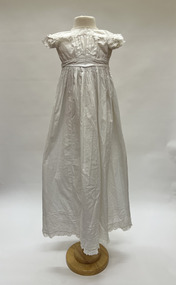
... ...Ceremonial clothing...Christening gowns Ceremonial clothing children's wear baptismal clothing victorian historical themes — 8.6 marking the phases of life Long, white cotton christening gown. ...In the early 19th century, infant baptismal gowns were modelled on dresses worn by adult women. Gowns were typically made of fine white linen or cotton, and often trimmed with tucks, lace, whitework embroidery, and other handwork. The Kew Historical Society's collection includes over fifteen christening gowns dating from the 19th and 20th centuries.Long, white cotton christening gown. Handmade featuring lace on the layered short sleeves, as well as at the neckline. The gown has a tie above the waist. The bodice is designed to form a number of horizontal and vertical panels, most prominently including tapered pleating at the front. The fabric comprising the skirt is gathered at the waist, allowing the full skirt to flare towards the hem. The lower part of the dress features a scalloped double hemline above which are four bands of folded fabric.christening gowns, ceremonial clothing, children's wear, baptismal clothing, victorian historical themes — 8.6 marking the phases of life -
 Kew Historical Society Inc
Clothing - Christening Gown
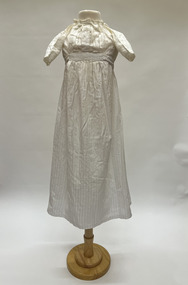
... ...Ceremonial clothing...Christening gowns Ceremonial clothing children's wear baptismal clothing victorian historical themes — 8.6 marking the phases of life A sturdy white cotton christening gown that confirms to a number of conventional design rules. ...In the early 19th century, infant baptismal gowns were modelled on dresses worn by adult women. Gowns were typically made of fine white linen or cotton, and often trimmed with tucks, lace, whitework embroidery, and other handwork. The Kew Historical Society's collection includes over fifteen christening gowns dating from the 19th and 20th centuries.A sturdy white cotton christening gown that confirms to a number of conventional design rules. These include pleating on the bodice and at the front of the skirt. The width of the pleats below the waist would indicate a later rather than earlier manufacture. Lace is used in a vertical band at centre front, on the neck and at the waist. christening gowns, ceremonial clothing, children's wear, baptismal clothing, victorian historical themes — 8.6 marking the phases of life -
 Kew Historical Society Inc
Clothing - Christening gown
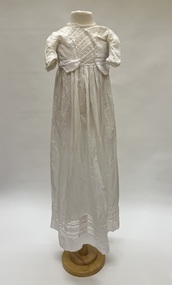
... ...Ceremonial clothing...Christening gowns Ceremonial clothing children's wear baptismal clothing victorian historical themes — 8.6 marking the phases of life Long, white cotton christening gown featuring an elaborate hand-worked bodice. ...In the early 19th century, infant baptismal gowns were modelled on dresses worn by adult women. Gowns were typically made of fine white linen or cotton, and often trimmed with tucks, lace, whitework embroidery, and other handwork. The Kew Historical Society's collection includes over fifteen christening gowns dating from the 19th and 20th centuries.Long, white cotton christening gown featuring an elaborate hand-worked bodice. The bodice has diagonal bands of lace as well as sections of fabric that imitate the effect of a bolero. These, as well as the sleeves are also hand embroidered and bordered with tatted lace. The fabric is finely gathered below the waist. The lower part of the gown includes inserted bands of different kinds of lace. The longer sleeves might indicate that the gown was made for an older infant. christening gowns, ceremonial clothing, children's wear, baptismal clothing, victorian historical themes — 8.6 marking the phases of life -
 Kew Historical Society Inc
Clothing - Christening Gown
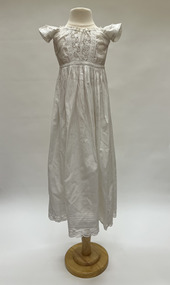
... ...Ceremonial clothing...Christening gowns Ceremonial clothing children's wear Baptismal clothing victorian historical themes — 8.6 marking the phases of life Long, white cotton christening gown. ...In the early 19th century, infant baptismal gowns were modelled on dresses worn by adult women. Gowns were typically made of fine white linen or cotton, and often trimmed with tucks, lace, whitework embroidery, and other handwork. The Kew Historical Society's collection includes over fifteen christening gowns dating from the 19th and 20th centuries.Long, white cotton christening gown. The bodice includes a number of pieces of lace, most notably a panel of broderie anglais at the centre of the bodice. Bands of lace are also used at the neck and on the sleeves. The skirt is gathered below the waist allowing the fabric to form folds.The lower section of the skirt five pleated bands and a hem also created from broderie anglais.christening gowns, ceremonial clothing, children's wear, baptismal clothing, victorian historical themes — 8.6 marking the phases of life -
 Kew Historical Society Inc
Clothing - Christening Gown
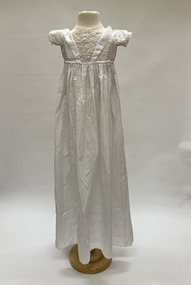
... ...Ceremonial clothing...Christening gowns Ceremonial clothing children's wear baptismal clothing victorian historical themes — 8.6 marking the phases of life Very long, white cotton christening gown. ...In the early 19th century, infant baptismal gowns were modelled on dresses worn by adult women. Gowns were typically made of fine white linen or cotton, and often trimmed with tucks, lace, whitework embroidery, and other handwork. The Kew Historical Society's collection includes over fifteen christening gowns dating from the 19th and 20th centuries.Very long, white cotton christening gown. The bodice is distinguished by an intricate panel of handmade lace that forms a semi-circle at the neck. On either side of the lace insert are folded lapels, each bordered with lace. The short sleeves are constructed of two overlapping pieces of fabric. Below the waist the fabric is pleated to allow for the large amount of fabric in the skirt to flare outwards. The extraordinary detail within the gown is extended to the lower section of the skirt where the maker has created five pleated bands, each comprising four layers. The hem also features a band of lace. christening gowns, ceremonial clothing, children's wear, baptismal clothing, victorian historical themes — 8.6 marking the phases of life -
 Kew Historical Society Inc
Clothing - Christening Gown
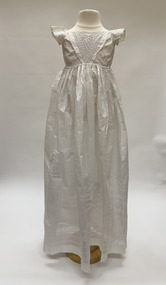
... ...Ceremonial clothing...Christening gowns Ceremonial clothing children's wear baptismal clothing victorian historical themes — 8.6 marking the phases of life Long, white cotton christening gown, ornamented with a v-shaped panel of lace on the bodice. ...In the early 19th century, infant baptismal gowns were modelled on dresses worn by adult women. Gowns were typically made of fine white linen or cotton, and often trimmed with tucks, lace, whitework embroidery, and other handwork. The Kew Historical Society's collection includes over fifteen christening gowns dating from the 19th and 20th centuries.Long, white cotton christening gown, ornamented with a v-shaped panel of lace on the bodice. Lace is also used on the upper part of the short sleeves and on the neckline. The fabric of the skirt is gathered below the waist.christening gowns, ceremonial clothing, children's wear, baptismal clothing, victorian historical themes — 8.6 marking the phases of life -
 Kew Historical Society Inc
Clothing - Christening Gown
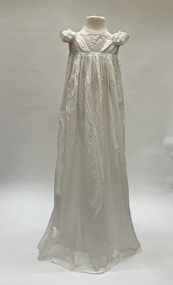
... ...Ceremonial clothing...Christening gowns Ceremonial clothing children's wear baptismal clothing victorian historical themes — 8.6 marking the phases of life Long, fine white cotton christening gown. ...In the early 19th century, infant baptismal gowns were modelled on dresses worn by adult women. Gowns were typically made of fine white linen or cotton, and often trimmed with tucks, lace, whitework embroidery, and other handwork. The Kew Historical Society's collection includes over fifteen christening gowns dating from the 19th and 20th centuries.Long, fine white cotton christening gown. The short bodice includes a v-shaped lace insert bordered by a scalloped collar. Lace is also used on the neckline, short sleeves, and hem. The lace on the sleeves is attached in rows of overlapping fabric. The fabric below the high waistline is gathered to produce a full long skirt.christening gowns, ceremonial clothing, children's wear, baptismal clothing, victorian historical themes — 8.6 marking the phases of life -
 Kew Historical Society Inc
Clothing - Christening Gown
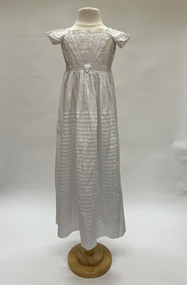
... ...Ceremonial clothing...Christening gowns Ceremonial clothing children's wear baptismal clothing victorian historical themes — 8.6 marking the phases of life A long, white cotton christening gown designed and made using a number of decorative elements. ...In the early 19th century, infant baptismal gowns were modelled on dresses worn by adult women. Gowns were typically made of fine white linen or cotton, and often trimmed with tucks, lace, whitework embroidery, and other handwork. The Kew Historical Society's collection includes over fifteen christening gowns dating from the 19th and 20th centuries.A long, white cotton christening gown designed and made using a number of decorative elements. These include an embroidered lace v-shaped insert at the front of the bodice that extends below the waist. Bands and layers of lace are also used at the neck and on the double-panelled sleeves. A broad band of lace has been used to form the waist, below which the fabric of the skirt is very finely gathered. The front of the skirt includes thirty-two horizontal pleated bands. christening gowns, ceremonial clothing, children's wear, baptismal clothing, victorian historical themes — 8.6 marking the phases of life -
 Kew Historical Society Inc
Clothing - Petticoat of a Christening Gown
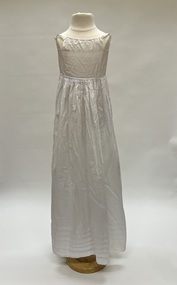
... ...Ceremonial clothing...Christening gowns Ceremonial clothing children's wear baptismal clothing victorian historical themes — 8.6 marking the phases of life Simple fine, white cotton petticoat used underneath an outer christening gown. ...In the early 19th century, infant baptismal gowns were modelled on dresses worn by adult women. Gowns were typically made of fine white linen or cotton, and often trimmed with tucks, lace, whitework embroidery, and other handwork. The Kew Historical Society's collection includes over fifteen christening gowns dating from the 19th and 20th centuries.Simple fine, white cotton petticoat used underneath an outer christening gown. The petticoat uses the same silhouette as the gown. The sleeveless bodice is held up by shoestring straps at the shoulder. Gathered fabric at the waist creates volume as an undergarment. Six bands of decorative horizontal pleating are used in the lowest section of the skirt as well as a scalloped hem.christening gowns, ceremonial clothing, children's wear, baptismal clothing, victorian historical themes — 8.6 marking the phases of life -
 Kew Historical Society Inc
Clothing - Christening Gown
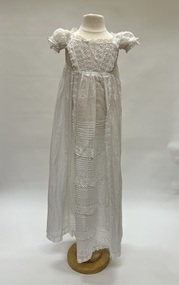
... ...Ceremonial clothing...Christening gowns Ceremonial clothing children's wear baptismal clothing victorian historical themes — 8.6 marking the phases of life Long, white muslin christening gown. ...In the early 19th century, infant baptismal gowns were modelled on dresses worn by adult women. Gowns were typically made of fine white linen or cotton, and often trimmed with tucks, lace, whitework embroidery, and other handwork. The Kew Historical Society's collection includes over fifteen christening gowns dating from the 19th and 20th centuries.Long, white muslin christening gown. The gown features lace on the front of the bodice, neck, and on the short, puffed sleeves. The skirt at the front has pleating separated with inserts of lace and horizontal hanging scalloped bands of lace christening gowns, ceremonial clothing, children's wear, baptismal clothing, victorian historical themes — 8.6 marking the phases of life -
 Kew Historical Society Inc
Clothing - Christening Gown
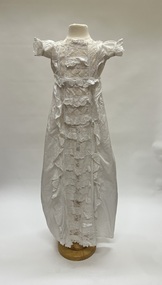
... ...Ceremonial clothing...Christening gowns Ceremonial clothing children's wear baptismal clothing victorian historical themes — 8.6 marking the phases of life A white cotton and lace christening gown. ...In the early 19th century, infant baptismal gowns were modelled on dresses worn by adult women. Gowns were typically made of fine white linen or cotton, and often trimmed with tucks, lace, whitework embroidery, and other handwork. The Kew Historical Society's collection includes over fifteen christening gowns dating from the 19th and 20th centuries.A white cotton and lace christening gown. The primary decorative elements of the gown are at the front which includes multiple layers of lace on net that extend from the neck to the hemline, which are then bordered with ruffles of the same lace. The bodice has a high neck, bordered with lace, and two short sleeves.christening gowns, ceremonial clothing, children's wear, baptismal clothing, victorian historical themes — 8.6 marking the phases of life -
 Kew Historical Society Inc
Clothing - Christening Gown, 1931
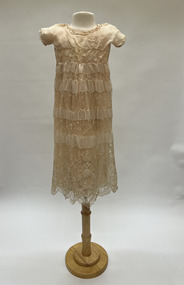
... ...Ceremonial clothing...Christening gowns Ceremonial clothing children's wear baptismal clothing victorian historical themes — 8.6 marking the phases of life McIntyre Collection Dione McIntyre The christening gown of Dione McIntyre, local architect and life member of the Kew Historical Society. ...In the early 19th century, infant baptismal gowns were modelled on dresses worn by adult women. Gowns were typically made of fine white linen or cotton, and often trimmed with tucks, lace, whitework embroidery, and other handwork. The Kew Historical Society's collection includes over fifteen christening gowns dating from the 19th and 20th centuries.The christening gown of Dione McIntyre, local architect and life member of the Kew Historical Society. The colour and fabrics used in the gown were recycled from Ilma Diamond's [her mother's sister] wedding dress, when she was christened in 1931. As the smallest of the christening gowns in the collection, this would indicate that she was baptised at a very early age. The fragile baptismal gown is made from a silk slip, above which is an outer layer of embroidered net separated by bands of chiffon. The lace at the hem is also scalloped.christening gowns, ceremonial clothing, children's wear, baptismal clothing, victorian historical themes — 8.6 marking the phases of life, mcintyre collection, dione mcintyre -
 Kew Historical Society Inc
Clothing - Christening Gown
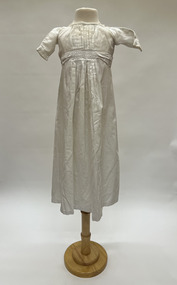
... ...Ceremonial clothing...Christening gowns Ceremonial clothing children's wear baptismal clothing victorian historical themes — 8.6 marking the phases of life A handmade, sturdy white cotton christening gown. ...In the early 19th century, infant baptismal gowns were modelled on dresses worn by adult women. Gowns were typically made of fine white linen or cotton, and often trimmed with tucks, lace, whitework embroidery, and other handwork. The Kew Historical Society's collection includes over fifteen christening gowns dating from the 19th and 20th centuries.A handmade, sturdy white cotton christening gown. The bodice is made from a number of separate pieces of fabric. At the front there is a flat, pleated panel that extends well below the waist. The longer half-length sleeves are attached to the neckline rather than from a shoulder. Each sleeve is bordered with crocheted lace. Crocheting is also used as a decorative element on the front of the tie. The skirt is simply hemmed. christening gowns, ceremonial clothing, children's wear, baptismal clothing, victorian historical themes — 8.6 marking the phases of life -
 Kew Historical Society Inc
Clothing - Christening Gown
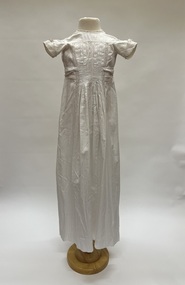
... ...Ceremonial clothing...Christening gowns Ceremonial clothing children's wear baptismal clothing victorian historical themes — 8.6 marking the phases of life Long, white cotton christening gown. ...In the early 19th century, infant baptismal gowns were modelled on dresses worn by adult women. Gowns were typically made of fine white linen or cotton, and often trimmed with tucks, lace, whitework embroidery, and other handwork. The Kew Historical Society's collection includes over fifteen christening gowns dating from the 19th and 20th centuries.Long, white cotton christening gown. The high necked, short sleeved bodice has a number of decorative elements. These include two panels of fabric, the lower of which includes pleating, and inserts of lace that extend beyond the waist. Ties extend from the front to the back of the bodice. Lace is also used on the neckline and on the edge of the folded sleeves. The skirt is pleated at the front extending to the hem.christening gowns, ceremonial clothing, children's wear, baptismal clothing, victorian historical themes — 8.6 marking the phases of life -
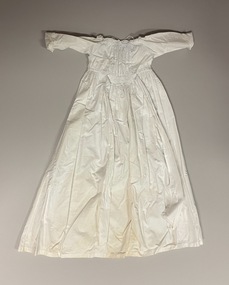 Kew Historical Society Inc
Clothing - Christening gown, 1850-9
... ...Ceremonial clothing...Christening gowns Ceremonial clothing children's wear Baptismal clothing victorian historical themes — 8.6 marking the phases of life A mid-nineteenth century christening (baptismal) gown, constructed of sturdy white cotton featuring a long skirt, high neck and long sleeves. ...In the early 19th century, infant baptismal gowns worn by male and female infants began to be modelled on dresses worn by adult women. Gowns were typically made of fine white linen or cotton, and often trimmed with tucks, lace, whitework embroidery, and other handwork. The Kew Historical Society's collection includes over fifteen christening gowns dating from the 19th and 20th centuries.A mid-nineteenth century christening (baptismal) gown, constructed of sturdy white cotton featuring a long skirt, high neck and long sleeves. The gown is constructed by hand, and there is evidence of home-finished needlework, The bodice is loosely pleated with gathering at the high waist, A later cotton tie was attached at the centre waist and commercial lace added to the neckline and cuffs.christening gowns, ceremonial clothing, children's wear, baptismal clothing, victorian historical themes — 8.6 marking the phases of life -
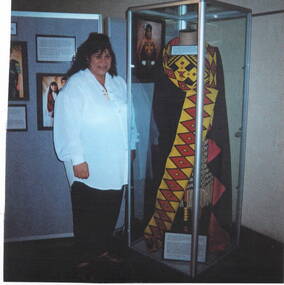 Sunbury Family History and Heritage Society Inc.
Photograph, C Late 1990s
... The exhibition featured a variety of ceremonial clothing worn by a variety of ethnic groups who lived within the Hume City area....The exhibition featured a variety of ceremonial clothing worn by a variety of ethnic groups who lived within the Hume City area. ...The lady was standing beside a glass case, that was displaying an Aboriginal Ceremonial dress at the 'Wear This' exhibition that was mounted at the George Evans Museum in Sunbury in the late 1990s. The exhibition featured a variety of ceremonial clothing worn by a variety of ethnic groups who lived within the Hume City area.The variety of ceremonial dress displayed at the exhibition showed the number of diverse groups that reside within the City of Hume.A copy of a non-digital coloured photograph of a lady standing next to a glass display case where a ceremonial dress is exhibited. An information board is in the background.'wear this exhibition', hume city council, george evans museum, sunbury -
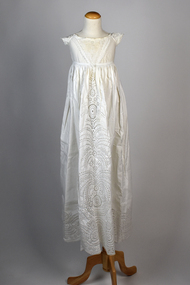 National Wool Museum
Clothing - Christening Gown, Eliza Lynon, 19th century
... clothing...ceremonial...Irish linen Christening Religion Children's clothing ceremonial church geelong red jacket ship Enniskillen Christ Church Geelong northern ireland Irish linen Christening gown with cutwork anglais. ...19th century Irish linen Christening gown and matching petticoat donated by Ruth Starkey. The Christening gown and petticoat have been in the family for around 170 years, passed to generations. They were sewn by Eliza Lynon in Enniskillen, Northern Ireland. The following history has been provided by Ruth Starkey: • Town of origin is Enniskillen, Northern Ireland, sewn by Eliza Lynon. • The gown came to Australia with Eliza Lynon on the Red Jacket in 1855. • Eliza married Joseph Dobbyn (who was a member of the Royal Inniskilling Fusiliers Regiment) at Christ Church Geelong. • They built a home at 150 McKillop St, Geelong. Melrose was the name of the home. • Family name Dobbyn - Joseph Wilson Dobbyn b. 07/04/1844 - d 12/10/1892 and Elizabeth (Eliza b 12/03/1847 d 26/08/1934) and passed to Eliza Jane, Jessie Victoria Mary and Lucy Ellen Dobbyn (sisters). • Lucy Ellen nee Dobbyn, married Herbert Blunt, Boatbuilder Geelong at Christ Church Geelong • All lived at 150 McKillop St Geelong over the years • Passed to Marjorie May Fearn born nee Blunt who was baptized at Christ Church Geelong 29/5/1915 • Passed to Ann Rosemary Starkey nee Fearn • Passed to Ruth Norelle Starkey (me) I was baptized at Christ Church Geelong. • I am the great- great granddaughter of Joseph and Eliza and the great granddaughter of Herbert and Lucy.Irish linen Christening gown with cutwork anglais. Cutwork along hem is scalloped with a central motif going down the centre front of the body. Bodice is embroidered in a v shape at the front and has cutwork embroidered sleeves. Skirt is attached to the bodice with cartridge pleats.irish linen, christening, religion, children's clothing, ceremonial, church, geelong, red jacket ship, enniskillen, christ church geelong, northern ireland -
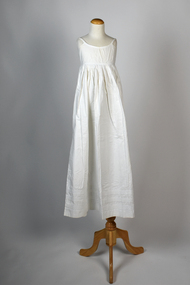 National Wool Museum
Clothing - Petticoat, Eliza Lynon, 19th century
... clothing...ceremonial...Irish linen Christening Religion Children's clothing ceremonial church geelong red jacket ship Enniskillen Christ Church Geelong northern ireland White Irish linen bodiced petticoat with three sets of three pin tucks at hem. ...19th century Irish linen Christening gown and matching petticoat donated by Ruth Starkey. The Christening gown and petticoat have been in the family for around 170 years, passed to generations. They were sewn by Eliza Lynon in Enniskillen, Northern Ireland. The following history has been provided by Ruth Starkey: • Town of origin is Enniskillen, Northern Ireland, sewn by Eliza Lynon. • The gown came to Australia with Eliza Lynon on the Red Jacket in 1855. • Eliza married Joseph Dobbyn (who was a member of the Royal Inniskilling Fusiliers Regiment) at Christ Church Geelong. • They built a home at 150 McKillop St, Geelong. Melrose was the name of the home. • Family name Dobbyn - Joseph Wilson Dobbyn b. 07/04/1844 - d 12/10/1892 and Elizabeth (Eliza b 12/03/1847 d 26/08/1934) and passed to Eliza Jane, Jessie Victoria Mary and Lucy Ellen Dobbyn (sisters). • Lucy Ellen nee Dobbyn, married Herbert Blunt, Boatbuilder Geelong at Christ Church Geelong • All lived at 150 McKillop St Geelong over the years • Passed to Marjorie May Fearn born nee Blunt who was baptized at Christ Church Geelong 29/5/1915 • Passed to Ann Rosemary Starkey nee Fearn • Passed to Ruth Norelle Starkey (me) I was baptized at Christ Church Geelong. • I am the great- great granddaughter of Joseph and Eliza and the great granddaughter of Herbert and Lucy.White Irish linen bodiced petticoat with three sets of three pin tucks at hem. Skirt is attached with cartridge pleating and constructed with French seams. The bodice ties at the back with drawstrings at the neck and waist.irish linen, christening, religion, children's clothing, ceremonial, church, geelong, red jacket ship, enniskillen, christ church geelong, northern ireland -
 Federation University Historical Collection
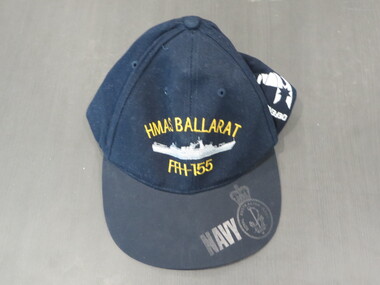
Clothing, HMAS Ballarat cap, 2006
... Ceremonial badge on the left side which refers to the events of the Eureka Stockade (Ballarat, 1854) and is embroidered in white.. Hook-and-loop adjustment at the back. On the front of the cap the words HMAS Ballarat & FFH-155 are embroidered in gold and an embroidered representation of the ship is in white. Stamped into the brim is the word Navy and the Royal Australian Navy Emblem. HMAS Ballarat cap Clothing ...Collected by Lisa Gervasoni when she visited the ship as part of the City of Ballarat's delegation to the ship on the 9th December 2006. HMAS Ballarat (FFH 155) is an Anzac-class frigate of the Royal Australian Navy (RAN). The frigate was laid down in 2000 and commissioned into the RAN in mid-2004. Since entering service, Ballarat has been involved in border protection as part of Operation Relex II, was deployed to the Gulf for Operation Catalyst, and was one of the two ships involved in the Operation Northern Trident 2009 round-the-world voyage. Ballarat has undergone the Anti-Ship Missile Defence (ASMD) upgrade, completing in 2015. (https://en.wikipedia.org/wiki/HMAS_Ballarat_(FFH_155)Navy blue cap of heavy brushed cotton with the Navy Ceremonial badge on the left side which refers to the events of the Eureka Stockade (Ballarat, 1854) and is embroidered in white.. Hook-and-loop adjustment at the back. On the front of the cap the words HMAS Ballarat & FFH-155 are embroidered in gold and an embroidered representation of the ship is in white. Stamped into the brim is the word Navy and the Royal Australian Navy Emblem. On the outside of the cap - HMAS Ballarat FFH-155, Navy, Defend the Flag Inside label - Oakwood (03) 97986278hmas ballarat, ffh-155, royal australian navy, lisa gervasoni, navy cap -
Glenelg Shire Council Cultural Collection
Clothing - Town Crier's Coat - Syd Cuffe, 1888-1995
... ceremonial regalia coat Syd Cuffe's Town Crier's coat. Navy blue, pure wool, trimmed with gold ribbon and braid on collar, cuffs and lower front pockets, gold diagonal stripes on front, gold buttons (Australian Military Force) Clothing Town Crier's Coat - Syd Cuffe ...Syd Cuffe was the Portland Town Crier from 1983 to 2013. The role of Town Crier was created for Syd Cuffe in 1983 in the lead up to Portland’s 150th anniversary celebrations held in 1984-85. 200 items from Mr. Cuffe’s estate were donated to the Glenelg Shire Cultural Collection. The items relate to his town crying activities and community work across the Shire and further afield.Syd Cuffe's Town Crier's coat. Navy blue, pure wool, trimmed with gold ribbon and braid on collar, cuffs and lower front pockets, gold diagonal stripes on front, gold buttons (Australian Military Force)syd cuffe, portland town crier, ceremonial regalia, coat -
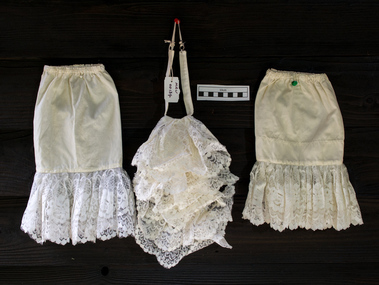 City of Moorabbin Historical Society (Operating the Box Cottage Museum)
Ceremonial object - Clothing, 'Jabot' style collar and cuffs Moorabbin City Council Mayoral Robes, c1960
... November 2018 At the request of the Mayor Cr Steve Staikos this Jabot Collar and Cuffs is now on display with the Mayoral Robes at Kingston City Council Offices Nepean Highway Cheltenham . clothing collars ornamental collars civic robes mayoral robes moorabbin cheltenham bentleigh lacework dressmaking fashion formal wear city of moorabbin. moorabbin shire moorabbin roads board brownlees ron city of glen eira city of ikngston A detachable , white, nylon, 'Jabot' style, standing collar with a pleated, ruffled, and lace-trimmed frill down the front and 2 matching cuffs that was part of the City of Moorabbin Mayoral Robes c1960 - 94 It has a tear in corner. Ceremonial ...In clothing, a collar is the part of a shirt, dress, coat or blouse that fastens around or frames the neck and may be permanently attached to the main body of the garment (e.g. by stitching) or detachable. Today's shirt collars descend from the ruffle created by the drawstring at the neck of the medieval chemise, through the Elizabethan ruff and its successors, the whisk collar and falling band. Separate collars exist alongside attached collars since the mid-16th century, usually to allow starching and other fine finishing. Jabots made of lace and hanging loose from the neck were an essential component of upper class, male fashion in the baroque period. During the Edwardian period, and sporadically thereafter, ornamental collars were worn as a form of jewellery. Names for specific styles of collars vary with the vagaries of fashion. Jabots survive in the present days as components of various official costumes, as are those worn by judges and counsel throughout Australian courts and town mayors. 2018 Kingston City Council Mayor Steve Staikos asked CMHS to loan the Former Moorabbin Mayoral Robes and Jabot for display at KCC Office Cheltenham. These Moorabbin Mayoral Robe with Jabot are now displayed along with those of the former City of Chelsea Robe and the former City of Mordialloc Robe at Cheltenham . KCC possesses the original Mayoral Chains of each former Council and they are displayed on each Robe for the annual Opening Meeting of KCC in February. This set of a 'Jabot' style collar and cuffs was part of the ceremonial Mayoral Robes c1960- 94 for the City of Moorabbin 1934-94. This is the last City of Moorabbin Mayoral Robe and was worn by Mayor Ron Brownlees, (prior to amalgamation with the City of Glen Eira and City of Kingston in 1994), and donated to the City of Moorabbin Historical Society in February 2007 by the City of Kingston. The City of Moorabbin developed from the Moorabbin Roads Board of 1862, becoming The Shire of Moorabbin in 1871 and the City of Moorabbin in 1934. November 2018 At the request of the Mayor Cr Steve Staikos this Jabot Collar and Cuffs is now on display with the Mayoral Robes at Kingston City Council Offices Nepean Highway Cheltenham . A detachable , white, nylon, 'Jabot' style, standing collar with a pleated, ruffled, and lace-trimmed frill down the front and 2 matching cuffs that was part of the City of Moorabbin Mayoral Robes c1960 - 94 It has a tear in corner. clothing, collars, ornamental collars, civic robes, mayoral robes, moorabbin, cheltenham, bentleigh, lacework, dressmaking, fashion, formal wear, city of moorabbin. moorabbin shire, moorabbin roads board, brownlees ron, city of glen eira, city of ikngston -
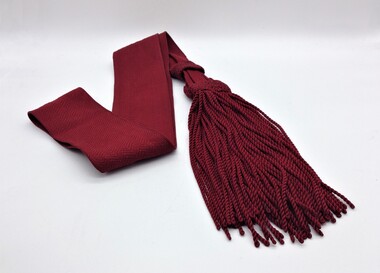 Montmorency–Eltham RSL Sub Branch
Uniform - Red Ceremonial Sash
... Part of the Cordwell collection from the family of past President of the Sub-Branch. clothing Nil Red cotton sash Red Ceremonial Sash Uniform Red Ceremonial Sash ...Worn by Colour Sgt Cordwell, grandfather of John Cordwell past President of the Sub-Branch. Part of the Cordwell collection from the family of past President of the Sub-Branch.Red cotton sashNilclothing
