
Showing 112 items matching " davis family"
-
 Port Melbourne Historical & Preservation Society
Photograph - Items related to the Davis family, c.1935
... Items related to the Davis family....Digital information on the Davis family of Station Street, Port Melbourne. ...Photograph Items related to the Davis family. ...Frank, Lil, Nora, Muriel, Mandy & Ted DAVIS lived in Station Street, Port Melbourne in the 1930'3.Digital information on the Davis family of Station Street, Port Melbourne. Includes World War 1 Certificate.frank davis, lil davis, muriel davis, mandy davis, ted davis, station street, nora hopley (davis) -
Port Melbourne Historical & Preservation Society
Letter - Carl DAVIS to Pat GRAINGER re Davis family history, 6 Mar 2013
... Carl DAVIS to Pat GRAINGER re Davis family history...Letter dated 06.03.2013 addressed to Pat GRAINGER from Carl DAVIS describing some Davis family history including his great grandfather's garage on the corner of Princes and Graham Streets, and other Port Melbourne people....Letter Carl DAVIS to Pat GRAINGER re Davis family history ...Letter dated 06.03.2013 addressed to Pat GRAINGER from Carl DAVIS describing some Davis family history including his great grandfather's garage on the corner of Princes and Graham Streets, and other Port Melbourne people.families, communication - radio, business and traders, george marcus (mark) davis, george washington davis, carl davis, tommy lahiff, vern hookey -
 Federation University Historical Collection
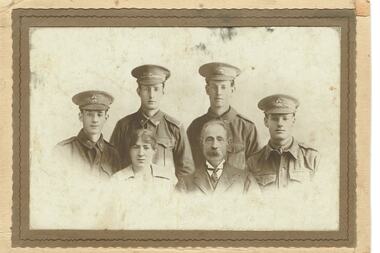
Photograph - Black and White, The Davis Family
... The Davis Family... Back L-R: Francis Gordon Davis 1899-1919, Alfred Ernest Davis 1891-1968, Herbert Arthur Davis 1892-1964, Edward Henry Davis 1896-1958 Front L-R: Violet Isabel Davis 1894-1962, Alfred Ernest Davis 1858-1933 Copied courtesy of the Davis Family....Francis Gordon Davis is the only student from the Ballarat Junior Technical School who died during World War One. francis davis aif australian infantry force alfred ernest davis herbert arthur davis edward henry davis violet isabel davis Back L-R: Francis Gordon Davis 1899-1919, Alfred Ernest Davis 1891-1968, Herbert Arthur Davis 1892-1964, Edward Henry Davis 1896-1958 Front L-R: Violet Isabel Davis 1894-1962, Alfred Ernest Davis 1858-1933 Copied courtesy of the Davis Family. The Davis Family Photograph - Black and White ...Francis Gordon Davis is the only student from the Ballarat Junior Technical School who died during World War One. Back L-R: Francis Gordon Davis 1899-1919, Alfred Ernest Davis 1891-1968, Herbert Arthur Davis 1892-1964, Edward Henry Davis 1896-1958 Front L-R: Violet Isabel Davis 1894-1962, Alfred Ernest Davis 1858-1933 Copied courtesy of the Davis Family.francis davis, aif, australian infantry force, alfred ernest davis, herbert arthur davis, edward henry davis, violet isabel davis -
Port Melbourne Historical & Preservation Society
Photograph - Davis/Russell family at a picnic, 1921
... Davis/Russell family at a picnic...Photo taken at picnic approx 1921 Davis/Russell family...Social Activities Bill DAVIS Snr Bill DAVIS Jnr Jessie Russell HILL Lil DAVIS Gwen RUSSELL Jim RUSSELL Jean RUSSELL Bessie DAVIS Photo taken at picnic approx 1921 Davis/Russell family Photograph Davis/Russell family at a picnic ...Photo taken at picnic approx 1921 Davis/Russell familysocial activities, bill davis snr, bill davis jnr, jessie russell hill, lil davis, gwen russell, jim russell, jean russell, bessie davis -
 Hume City Civic Collection
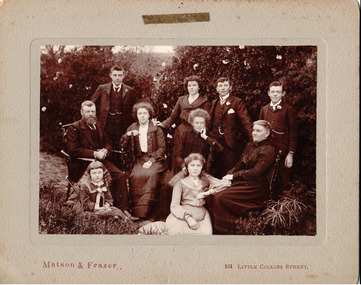
Photograph
... davis family...The Davis family are the group in the photograph. The two young boys standing in the back row are identified as Alfred Davis and Percival Davis on RHS....The Davis family are the group in the photograph. The two young boys standing in the back row are identified as Alfred Davis and Percival Davis on RHS. davis family davis alfred percival george evans collection Matson and Frazer 264 Collins Street Back cover: Eric Boardman Collection A photo of a family posed in a garden setting. ...The Davis family are the group in the photograph. The two young boys standing in the back row are identified as Alfred Davis and Percival Davis on RHS.A photo of a family posed in a garden setting. The group comprises a man & woman, 3 young women, 3 young men & 2 girls. The dress is consistent with the late 19th century.The photo is mounted on a grey cardboard matt with areas of foxing, 2 top central pin holes and an area of residual staining from sticking tape.Matson and Frazer 264 Collins Street Back cover: Eric Boardman Collectiondavis family, davis, alfred, percival, george evans collection -
Stawell Historical Society Inc
Archive - CD/DVD, O'Brien Pratt Davis Trewhella Buzza family histories. Researched and collated by Jim O'Brien, 2005
... O'Brien Pratt Davis Trewhella Buzza family histories. Researched and collated by Jim O'Brien...Stawell O'Brien Pratt Davis Trewhella Buzza family histories. Researched and collated by Jim O'Brien Archive CD/DVD ...stawell -
Glen Eira Historical Society
Document - Ontario Street Methodist Church
... ... Davis Family...Trivett Family Denmead Family Davis Family Kinderman Family Clarke Family Light Family Dark Family Brown Family Salmon Family Andrewatha Family 2 Phillip Families Cunnington Family Kennedy Family Geer Family Peterson Family William Family Watkins Family Jones Family Lambden Family Stafford E.R. ...Brief printed history of Ontarios Street Methodist Church compiled by Gwenda Mann from minute books at Uniting Church Archives. Period covered 1921 to 1975. Printed memories of Ontario Street, compiled by Gwen Stafford around 1989-1990 covering the period 1928-1987.methodist church, lempriere street, ontario street, caulfield north, davies j., pettitson mr., denmead mr., ponsford mr., shannon r., mclellan john, alday t. rev., overend h. a. rev., burns h.m. rev., mccallum dr., mccure r. mr., choirs, josephs p., palmer phillips h. rev., petterson c.m., davies jack, cartwright w.b., halls, architects, browning mr., bladen mr., alday mrs., gyngell mrs., eskdale road, kurl mrs., roberts n. mrs., butler j. mrs., williams g., morey m. mrs., williams miss, salmon mr., turner mrs., salmon mrs., hefford mrs., williams c., marsden miss, briaris miss, orrong road methodist church, harris s.s., griffith t.r., wilson a.r., warfe j.e., mclean r.c., mckay h.g., mann gwenda, stafford gwen, choirs, ladies guild, halls, sunday schools, women’s australian and overseas mission, elsternwick – st.kilda circuit, palamountain rev., barnes mr., sunday school, trivett mr., stafford evan, hauser geoff, hauser betty, hauser connie, austin keith, cunnington fred, peterson reg, tregear rev., trivett family, denmead family, davis family, kinderman family, clarke family, light family, dark family, brown family, salmon family, andrewatha family, 2 phillip families, cunnington family, kennedy family, geer family, peterson family, william family, watkins family, jones family, lambden family, stafford e.r., stafford ray, watts family, bearson family, redman family, youren family, hill family, pullen family, walters family, weber family, boness family, allen family, cowlishaw family, davies j., kinderman r., trivett w., brown f., brown r., salmon f., wedlock w., boness j., stafford e.r., denman c., walters c., harris selwyn rev., wilson ray rev., mclean roy rev., warfe john rev., griffen tom rev., mckay harry rev., kinder gardens, king dorothy, ritchie clarice, balchin, phillips lila, geer keith, atkinson mrs., beason gwen, tennis clubs, beason tas mr., choirs, watkins clarrie, williams ray rev., butler rev., haynes fred rev., wilson gus rev., jones barry, waldron glen, yeatman john dr., kooyong road church, halls, stafford gwen -
Glen Eira Historical Society
Letter - ‘MOOD KEE’
... ... Davis Family...Pennington Harold Caulfield Council’s meeting room Harcourt Avenue Caulfield Town Hall ‘Rosecraddock’ Caulfield Davies Sydney Langdon family ‘Mood Kee’ fonts ‘Yerangle’ House names St Mary’s Church of England Johnstone Brid. Gen. Subdivisions Swagmen Johnstone Mrs Davis Sydney R.S.L Club ‘Ripley’ Slaney family ‘Sylverly’ ‘Belton’ Davis Family Glen Eira ‘Garrell’ Greenwood Family ‘Sanquar’ Kooyong Road Bell Family ‘Royston’ Slatter Family ‘Hengar’ Glen Eira Road Langdon Family Joynes Gwen Davis Gwen Mosley G Mrs Davies Mrs Mudge Mrs Slate tiles Verandahs Weatherboard buildings Brick houses Bluestone Board and Shire Offices Letter ‘MOOD KEE’ ...Three items about this property, two of which were provided by Peter R Murray (author of ‘From sand, swamp and heath...’. 1/A handwritten letter to P Murray from ex resident Gwen Joynes giving some history on people and places, possibly to help with his book on Caulfield’s past. Dated 08/12/1976. 2/A handwritten letter to Mr Murray from Gwen Joynes with details about accompanying photograph of ‘Moodkee’ and people in photograph; photograph presumably returned as requested. Dated 24/03/1977 3/A photocopied photo of Mood Kee and some written research from Sand Swamp and Heath. Photo likely to be that referred to above.pennington harold, caulfield council’s meeting room, harcourt avenue, caulfield town hall, ‘rosecraddock’, caulfield, davies sydney, langdon family, ‘mood kee’, fonts, ‘yerangle’, house names, st mary’s church of england, johnstone brid. gen., subdivisions, swagmen, johnstone mrs, davis sydney, r.s.l club, ‘ripley’, slaney family, ‘sylverly’, ‘belton’, davis family, glen eira, ‘garrell’, greenwood family, ‘sanquar’, kooyong road, bell family, ‘royston’, slatter family, ‘hengar’, glen eira road, langdon family, joynes gwen, davis gwen, mosley g mrs, davies mrs, mudge mrs, slate tiles, verandahs, weatherboard buildings, brick houses, bluestone, board and shire offices -
Glen Eira Historical Society
Letter - HUNT, WILLIAM HOGARTH
... ... Davis Family...East Bentleigh Bowling Clubs Tucker Road Tennis clubs Centre Road Murrumbeena Road Larman Mr Hollway Street Nurseries Parker Street Lyle Marshall Burr Mr Solicitors Builders Bones Nursery ‘Burr’s Gunoil’ Glenhuntly Methodist Church Carnegie Smith Alf Ezard family Clemens family Noy family Noy Clarrie Dickie family Storey family Storey George Davis Family Joss house Chinese community Wattle Avenue Grange Road Glenhuntly Amateur Football Club Football clubs Glenhuntly Athletic Club Athletic clubs Glen Huntly Junior Football Club Carnegie Oval Koornang Park Glenhuntly Oval Victorian Amateur Turf Club Glenhuntly Aerodome Glenhuntly State School Geary Mr. ...Two sets of this man's handwritten memories: 1/Five pages of handwritten personal memories, written by William Hogarth Hunt 13/07/1977. He outlines his family, their travels and settlement in 1908 at Glenhuntly: a detailed account of residents, shop owners, land sales and identities, Murray Ross, Mr Burr of Burr’s Gun Oil and Mr Zarman. Also details Glenhuntly Methodist Church, football, athletics, Glenhuntly Aerodrome and an extensive list of local residents and their stories. 2/Two pages of handwritten personal memories, written by William Hogarth Hunt 02/09/1977. A detailed account of residents, shop owners, identities, athletes, local policemen and their stories in the Glen Huntly area.personal memories, hunt william hogarth, glenhuntly, grange road, trams, plumber, stone mary ann, neerim road, wanalta road, schurme mrs, private hospital, hospitals, watson grove, hunt jessie, hunt alfred, hunt charles, smith mr, fisher mr, smith mrs, jockeys, dore george, ‘willis’, builders, house names, mernda, roseberry grove, el nido, neerim road, glenhuntly post office, mrs fielder’s sweetshop, mrs beer’s sweet shop, paddocks, confectionery, fielder fred, maroona road, murrumbeena, grocers, callister dave, carnegie state school, hay and corn store, james street, woodyard, hillards chemist, hughes body works, chemists, davidson’s, glenhuntly printing, hay and corn stores, railway gates, anz bank, fox mr, martin jack, fox mrs, clothing stores, steam rollers, radio and tv shop, beasley j, delicatessen/ham and beef shop, butchers, schurme’s private hospital, gellatley george, tailors, commonwealth banks, watson grove, banks, preston peter, e.j. & h. amos, hardware stores, estate agents, glenhuntly picture theatre, whittle mr, theatres, newsagency, cooper and cooke, station street, f.j. long and co, jennings a.v, timber yards, builders, ‘the estate’, hillcrest estate, grange road, marara road, rosedale avenue, hobart jack, mackie road, confectionery stores, ross murray, glenhuntly athletic club, godfrey evelyn, athletics clubs, railways, glenhuntly junior football club, elsternwick, princess park, carnegie oval, booran road, koornang park, ormond oval – ee. gunn reserve, glenhuntly oval, oakleigh road, victorian amateur turf club, koornang road, glenhuntly aerodrome, neville street, glenhuntly state school, rosslyn street, geary mr, lauriston tennis courts, bakers, carnegie r.s.l., east bentleigh, bowling clubs, tucker road, tennis clubs, centre road, murrumbeena road, larman mr, hollway street, nurseries, parker street, lyle marshall, burr mr, solicitors, builders, bones nursery, ‘burr’s gunoil’, glenhuntly methodist church, carnegie, smith alf, ezard family, clemens family, noy family, noy clarrie, dickie family, storey family, storey george, davis family, joss house, chinese community, wattle avenue, grange road, glenhuntly amateur football club, football clubs, glenhuntly athletic club, athletic clubs, glen huntly junior football club, carnegie oval, koornang park, glenhuntly oval, victorian amateur turf club, glenhuntly aerodome, glenhuntly state school, geary mr., bakers, east bentleigh, tucker road, centre road, larman mr, nurseries, lyle marshall, solicitors, bones nursery, carnegie, "the estate", royal avenue, mckay avenue, dumsday bertha miss, love family, gilmour family, waratah ave, sinclair mr, tuckpointers, bricks, donegan mr, plumbers, frazer mr, frazer and jenkinson printers, frazer arthur, ezard manufacturing, jewellers, private hospital, maroona road, o'carroll mr, beattie mr, horse trainer, morton tom, lord harry, estate agents, ormond, councillors, taylor mr, builders, gibson family, westley alf, o'carroll j (jack) d, glenhuntly athletics club, athletes, jack page's bakery and cake shop, nay clarrie, hunt william h., hunt alf, page jack, armstrong jack, manchester grove, morgan advertising, cusdin sid, farrier, glenhuntly cricket club, caulfield racecourse, neerim road, hoffman's plumbing, emma street, st. agnes school, st. agnes church hall, jenkin 'boss' mr, teachers, hawthorn miss, quinn miss, chitty charlie, chitty's timber, crystal palace picture theatre, theatres, marsh bill, hardware shops, watson arthur w, j.s. kidd and company, marshes hardware, kidd's hardware, bruce ivy, 'belgrave', house names, belgrave road, dandenong road, hunter 'pud', police officers, hunt jess, kangaroo road, murrumbeena, glen huntly -
 Greensborough Historical Society
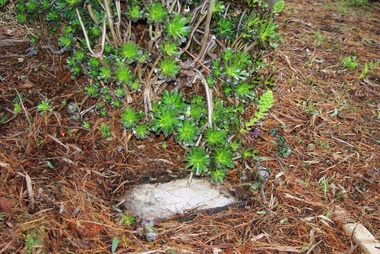
Photograph - Digital Image, George S Davis, Greensborough Cemetery, 30/06/1942
... Grave of George S Davis (died 30/06/1942) in Plot# Q19 Greensborough Cemetery. The Davis family lived in Britnell's Road, Briar Hill....Grave of George S Davis (died 30/06/1942) in Plot# Q19 Greensborough Cemetery. The Davis family lived in Britnell's Road, Briar Hill. ...Grave of George S Davis (died 30/06/1942) in Plot# Q19 Greensborough Cemetery. The Davis family lived in Britnell's Road, Briar Hill.Greensborough Cemetery was created when land was given for the cemetery by Mr William Poulter, a local settler, about 1864. The cemetery holds the graves of many early settlers in the district. Links: 01859.01936 Digital copy of colour photograph of grave/headstone.george s davis, greensborough cemetery -
 Greensborough Historical Society
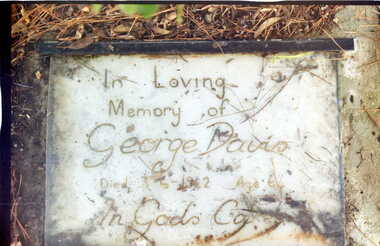
Photograph - Digital Image, Grave of George S Davis, Greensborough Cemetery, 03/06/1942
... Photograph taken by Noel Withers 30/07/2009. The Davis family lived in Britnell's Road, Briar Hill....Photograph taken by Noel Withers 30/07/2009. The Davis family lived in Britnell's Road, Briar Hill. ...Grave of George S Davis (died 3/6/1942) in Plot# Q19 Greensborough Cemetery. Photograph taken by Noel Withers 30/07/2009. The Davis family lived in Britnell's Road, Briar Hill.Greensborough Cemetery was created when land was given for the cemetery by Mr William Poulter, a local settler, about 1864. The cemetery holds the graves of many of the early settlers in the district. The cemetery holds approximately 250 grave sites with 350 people buried there.Digital copy of colour photograph of grave/headstone.george s davis, greensborough cemetery -
Canterbury History Group
Photograph - Arthur Davis on Tuppence
... ... Caffin Family... Davis...Davis on Tuppy at the old Stable, 1920. Note the hitching rail and post and wires on windows to deflect bees(?) - flying objects. Part of a set of 15 Black & White photographs from Lyle Caffin re her family at Winson Green Road, Canterbury. ...Canterbury Winson Green Road Caffin Family Davis> Arthur Horses Stables Arthur Davis on Tuppy at the old Stable, 1920. ...Arthur Davis on Tuppy at the old Stable, 1920. Note the hitching rail and post and wires on windows to deflect bees(?) - flying objects. Part of a set of 15 Black & White photographs from Lyle Caffin re her family at Winson Green Road, Canterbury. Copied by Jan Pigot, 1991.canterbury, winson green road, caffin family, davis> arthur, horses, stables -
Surrey Hills Historical Society Collection
Work on paper - Bakeries in Surrey Hills
... ...Rowe family...Davis...Rowe family information, 2004 (1 page). 13. ‘New ways for cake fillings and frostings’ compiled by Davis Gelatine (Australia) Pty. ...bakeries recipes 118 Union Road 108 Union Road Lisa Gave M F Conlon 410-412 Canterbury Road Eileen Conlon G I Garner Conlon's bakery Russell Slavin Joseph Baker and sons Rowe family Davis Gelatine (Australia) Pty. Ltd Victorian Master Pastrycooks’ Association D H Rowe Edible Oil Industries Pty Ltd Casely's ice block mixes Imperial Margarine Digest Nycander & Co Pty Ltd Terry Seaman Pure Bread Bakery A vertical file with the following items: 1. ...A vertical file with the following items: 1. Bakers in Surrey Hills from Sands and Mac’s directories 1885-1960s (1 page). 2. Bakers in Surrey Hills at 108 and 118 Union Road, 1900-1950 (1 page). 3. M.F. Conlan’s new bakery, Box Hill Reporter, 3.1.1930 (1 page). 4. M.F. Conlan – bakery 410-412 Canterbury Road, note from Miss E. Conlan (undated) (1 page). 5. 108 Union Road history, prepared by Lisa Gave, March, 1997 (2 pages). 6. Bakery – Slavin: undated notes on G.I. Garner & M. Conlan by Mrs. E. Sneddon (1 page). 7. ‘Conlan’s bakery’ by Eileen Conlan for a talk at S.H Neighbourhood Centre, 1985, (2 pages with 3rd answers to questions). 8. Advertisement ‘Conlan’s bread’, The Argus, 24.2.1933 (NLA) (1 page). 9. Bakery 118 Union Road various notes 1890-1980 (1 typed and 1 handwritten page). 10. Russell Slavin death notice, 31.1.2001 (1 page). 11. 2 photos, back to back, of baking equipment made by Joseph Baker and sons (unknown newspaper) (1 page). 12. Rowe family information, 2004 (1 page). 13. ‘New ways for cake fillings and frostings’ compiled by Davis Gelatine (Australia) Pty. Ltd. (undated) (1 page folded into booklet). 14. ‘Diabetic recipes’ compiled by Davis Gelatine (undated) (32 page booklet & covers). 15. Catering competition held by the Victorian Master Pastrycooks’ Association: prize awarded to D.H. Rowe July, 1938 (1 page). 16. 2 photocopies of no. 11 (2 pages). 17. Edible Oil Industries Pty. Ltd. Bakery service department 14 recipes (undated) (14 pages). 18. The E.O.I. bakery service Kaykee 10 minute mixing method (undated) (1 page). 19. Casely’s ice block mixes (undated) (15 page booklet & cover). 20. Imperial Margarine Digest, October, 1942, W. Angliss & Co. (Aust.) Pty. Ltd. (1 page). 21. Imperial Margarine Digest, July, 1942, W. Angliss & Co. (Aust.) Pty. Ltd. (1 page). 22. Nycander & Co. Pty. Ltd. Bun recipes, (3 page booklet). 23. ’Bakery focal point of festival’, Progress Press, 12.4.1999 (1 page). 24. Pure Bread Bakery – business card for Terry Seaman (undated) (1 page). bakeries, recipes, 118 union road, 108 union road, lisa gave, m f conlon, 410-412 canterbury road, eileen conlon, g i garner, conlon's bakery, russell slavin, joseph baker and sons, rowe family, davis gelatine (australia) pty. ltd, victorian master pastrycooks’ association, d h rowe, edible oil industries pty ltd, casely's ice block mixes, imperial margarine digest, nycander & co pty ltd, terry seaman, pure bread bakery -
 Geelong RSL Sub Branch
Badge - 500 Ewart W Davis, Early 20th Century
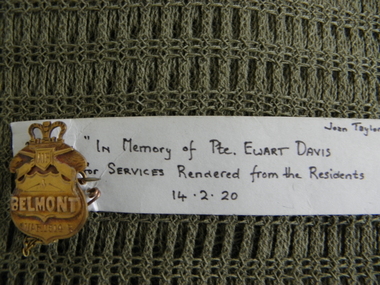
... This badge was presented to Pte Davis' family by the Residents of Belmont on 14 February 1920....This badge was presented to Pte Davis' family by the Residents of Belmont on 14 February 1920. ...500 Pte Ewart W Davis enlisted in the AIF on 06 March 1915 and was posted to 22 Battalion, Pte Davis was Killed in Action on the Gallipoli Peninsula 17 October 1915. This badge was presented to Pte Davis' family by the Residents of Belmont on 14 February 1920.This badge is the original that was presented to 500 Pte E W Davis family on 14 February 1920 - 500 Pte E W Davis lived in Geelong and enlisted in the AIF on 06 March 1915 and was Killed in Action at Gallipoli Peninsula on 17 October 1915.Gold colour, metal Badge. The badge has crossed rifles on the top front and a crown on the top of the badge.On the front of the badge - AIF, in large print BELMONT, War 1914-5. On the back of the badge - "In memory of Pte Ewart Davis for services rendered from the Residents, 14-2-20.aif, 500 pte e w davis, kia, gallipoli, ww1, belmont -
 Ballarat Tramway Museum
Photograph - B&W print of donated negative - set of 9, Ron E. Fluck
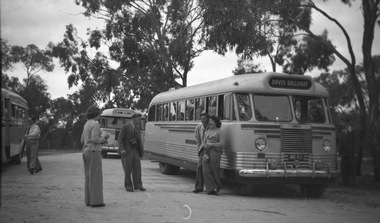
... Various photos taken by Ron Fluck or other members of the Fluck family of Davis Buses while on tour during the late 1940's or the early 1950's. 885.1 - Davis bus MO 031 and bus owned by R.Dunn of Clunes - two Bedford buses at Sister Rocks Stawell, 1-10-1950. 885.2 - Davis bus MO 031by Shell petrol bowser, Halls Gap, Grampians - 1-10-1950. 885.3 - Davis bus RL726, Ford, at Casterton with Glenelg Hotel in background, 29-1-1951 885.4 - Davis bus NK 023, Cadillac bus, with Ron Fluck driver - photo by J.A.Fluck - at Queenscliff - 4-1-1953. 885.5 - Davis bus NK 023, as above, with J.A.Fluck standing in doorway. - 4-1-1953. 885.6 - Davis bus RL726, Ford, at Nelson, Vic. 28-1-1951. 885.7 - No entry 885.8 - Davis bus, NK023, Cadillac - Mt Dandenong, 27-8-1950 885.9 - Davis bus NK023, Cadillac - Sassafras - 27-8-1950. ...tramways trams Davis Bus Lines Ron Fluck Casterton Sassafras Black and white print of a donated negatives. Print made 8/1998. Various photos taken by Ron Fluck or other members of the Fluck family of Davis Buses while on tour during the late 1940's or the early 1950's. 885.1 - Davis bus MO 031 and bus owned by R.Dunn of Clunes - two Bedford buses at Sister Rocks Stawell, 1-10-1950. 885.2 - Davis bus MO 031by Shell petrol bowser, Halls Gap, Grampians - 1-10-1950. 885.3 - Davis bus RL726, Ford, at Casterton with Glenelg Hotel in background, 29-1-1951 885.4 - Davis bus NK 023, Cadillac bus, with Ron Fluck driver - photo by J.A.Fluck - at Queenscliff - 4-1-1953. 885.5 - Davis bus NK 023, as above, with J.A.Fluck standing in doorway. - 4-1-1953. 885.6 - Davis bus RL726, Ford, at Nelson, Vic. 28-1-1951. 885.7 - No entry 885.8 - Davis bus, NK023, Cadillac - Mt Dandenong, 27-8-1950 885.9 - Davis bus NK023, Cadillac - Sassafras - 27-8-1950. ...Black and white print of a donated negatives. Print made 8/1998. Various photos taken by Ron Fluck or other members of the Fluck family of Davis Buses while on tour during the late 1940's or the early 1950's. 885.1 - Davis bus MO 031 and bus owned by R.Dunn of Clunes - two Bedford buses at Sister Rocks Stawell, 1-10-1950. 885.2 - Davis bus MO 031by Shell petrol bowser, Halls Gap, Grampians - 1-10-1950. 885.3 - Davis bus RL726, Ford, at Casterton with Glenelg Hotel in background, 29-1-1951 885.4 - Davis bus NK 023, Cadillac bus, with Ron Fluck driver - photo by J.A.Fluck - at Queenscliff - 4-1-1953. 885.5 - Davis bus NK 023, as above, with J.A.Fluck standing in doorway. - 4-1-1953. 885.6 - Davis bus RL726, Ford, at Nelson, Vic. 28-1-1951. 885.7 - No entry 885.8 - Davis bus, NK023, Cadillac - Mt Dandenong, 27-8-1950 885.9 - Davis bus NK023, Cadillac - Sassafras - 27-8-1950. All images replaced by high res scan of the negatives 18/1/2019/tramways, trams, davis bus lines, ron fluck, casterton, sassafras -
 Flagstaff Hill Maritime Museum and Village
Letter
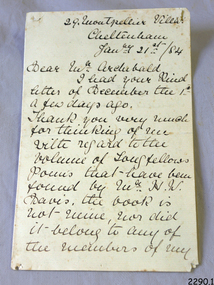
... She writes, “Thank you very much for thinking of me with regard to the volume of Longfellows Poems that have been found by Mr HW Davis [at Loch Ard Gorge], the book is not mine, nor did it belong to any members of my family. ...She writes, “Thank you very much for thinking of me with regard to the volume of Longfellows Poems that have been found by Mr HW Davis [at Loch Ard Gorge], the book is not mine, nor did it belong to any members of my family. ...This original letter was handwritten and dated 21 January 1884. The author is Eveline V. Carmichael, of 29 Montpellier Villa, Cheltenham. Eva Carmichael was the only woman survivor of the iron clipper LOCH ARD, which was wrecked on 1 June 1878, at the subsequently named Loch Ard Gorge near Port Campbell. The letter was written to Mr J Archibald, first curator of the Warrnambool Mechanics Institute Museum, and was in response to a letter he wrote to Miss Carmichael on 1 December 1883. A complete transcript of Eva’s letter is attached as a Hard Copy Supplementary File. The letter first addressed the subject of her reply. She writes, “Thank you very much for thinking of me with regard to the volume of Longfellows Poems that have been found by Mr HW Davis [at Loch Ard Gorge], the book is not mine, nor did it belong to any members of my family. We had a ‘Longfellows’, but our book had a green cover.” The rescued book is on display at Flagstaff Hill (541) and has a blue cover. Another interesting aspect to her letter is its reference to the only other survivor from the LOCH ARD. As a postscript she writes, “You will be glad to hear that Tom Pearce is now on board the HMS Solvent. I heard from him last month he wrote from the West-Indies and seemed well and in good spirits. I have not seen him since we parted in Melbourne. I believe he is to be married next year, or perhaps this, but I do not know the young lady.” Tom Pearce was the young, male, able seaman who had risked his life to save her. In the months after the shipwreck, an excited public press speculated of a romantic connection between the two survivors, but this was clearly not the case. HISTORY OF THE LOCH ARD The LOCH ARD belonged to the famous Loch Line which sailed many ships from England to Australia. Built in Glasgow by Barclay, Curdle and Co. in 1873, the LOCH ARD was a three-masted square rigged iron sailing ship. The ship measured 262ft 7" (79.87m) in length, 38ft (11.58m) in width, 23ft (7m) in depth and had a gross tonnage of 1693 tons. The LOCH ARD's main mast measured a massive 150ft (45.7m) in height. LOCH ARD made three trips to Australia and one trip to Calcutta before its final voyage. LOCH ARD left England on March 2, 1878, under the command of Captain Gibbs, a newly married, 29 year old. She was bound for Melbourne with a crew of 37, plus 17 passengers and a load of cargo. The general cargo reflected the affluence of Melbourne at the time. On board were straw hats, umbrella, perfumes, clay pipes, pianos, clocks, confectionary, linen and candles, as well as a heavier load of railway irons, cement, lead and copper. There were items included that intended for display in the Melbourne International Exhibition in 1880. The voyage to Port Phillip was long but uneventful. At 3am on June 1, 1878, Captain Gibbs was expecting to see land and the passengers were becoming excited as they prepared to view their new homeland in the early morning. But LOCH ARD was running into a fog which greatly reduced visibility. Captain Gibbs was becoming anxious as there was no sign of land or the Cape Otway lighthouse. At 4am the fog lifted. A man aloft announced that he could see breakers. The sheer cliffs of Victoria's west coast came into view, and Captain Gibbs realised that the ship was much closer to them than expected. He ordered as much sail to be set as time would permit and then attempted to steer the vessel out to sea. On coming head on into the wind, the ship lost momentum, the sails fell limp and LOCH ARD's bow swung back. Gibbs then ordered the anchors to be released in an attempt to hold its position. The anchors sank some 50 fathoms - but did not hold. By this time LOCH ARD was among the breakers and the tall cliffs of Mutton Bird Island rose behind the ship. Just half a mile from the coast, the ship's bow was suddenly pulled around by the anchor. The captain tried to tack out to sea, but the ship struck a reef at the base of Mutton Bird Island, near Port Campbell. Waves broke over the ship and the top deck was loosened from the hull. The masts and rigging came crashing down knocking passengers and crew overboard. When a lifeboat was finally launched, it crashed into the side of LOCH ARD and capsized. Tom Pearce, who had launched the boat, managed to cling to its overturned hull and shelter beneath it. He drifted out to sea and then on the flood tide came into what is now known as LOCH ARD Gorge. He swam to shore, bruised and dazed, and found a cave in which to shelter. Some of the crew stayed below deck to shelter from the falling rigging but drowned when the ship slipped off the reef into deeper water. Eva Carmichael had raced onto deck to find out what was happening only to be confronted by towering cliffs looming above the stricken ship. In all the chaos, Captain Gibbs grabbed Eva and said, "If you are saved Eva, let my dear wife know that I died like a sailor". That was the last Eva Carmichael saw of the captain. She was swept off the ship by a huge wave. Eva saw Tom Pearce on a small rocky beach and yelled to attract his attention. He dived in and swam to the exhausted woman and dragged her to shore. He took her to the cave and broke open case of brandy which had washed up on the beach. He opened a bottle to revive the unconscious woman. A few hours later Tom scaled a cliff in search of help. He followed hoof prints and came by chance upon two men from nearby Glenample Station three and a half miles away. In a state of exhaustion, he told the men of the tragedy. Tom returned to the gorge while the two men rode back to the station to get help. By the time they reached LOCH ARD Gorge, it was cold and dark. The two shipwreck survivors were taken to Glenample Station to recover. Eva stayed at the station for six weeks before returning to Ireland, this time by steamship. In Melbourne, Tom Pearce received a hero's welcome. He was presented with the first gold medal of the Royal Humane Society of Victoria and a £1000 cheque from the Victorian Government. Concerts were performed to honour the young man's bravery and to raise money for those who lost family in the LOCH ARD disaster. Of the 54 crew members and passengers on board, only two survived: the apprentice, Tom Pearce and the young woman passenger, Eva Carmichael, who lost all of her family in the tragedy. Ten days after the LOCH ARD tragedy, salvage rights to the wreck were sold at auction for £2,120. Cargo valued at £3,000 was salvaged and placed on the beach, but most washed back into the sea when another storm developed. The wreck of LOCH ARD still lies at the base of Mutton Bird Island. Much of the cargo has now been salvaged and some was washed up into what is now known as LOCH ARD Gorge. Cargo and artefacts have also been illegally salvaged over many years before protective legislation was introduced. One of the most unlikely pieces of cargo to have survived the shipwreck was a Minton porcelain peacock - one of only nine in the world. The peacock was destined for the Melbourne International Exhibition in 1880. It had been well packed, which gave it adequate protection during the violent storm. Today, the Minton peacock can be seen at the Flagstaff Hill Maritime Museum in Warrnambool. From Australia's most dramatic shipwreck it has now become Australia's most valuable shipwreck artefact and is one of very few 'objects' on the Victorian State Heritage Register. The LOCH ARD shipwreck is of State significance – Victorian Heritage Number S417 Flagstaff Hill’s collection of artefacts from LOCH ARD is significant for being one of the largest collections of artefacts from this shipwreck in Victoria. It is significant for its association with the shipwreck, which is on the Victorian Heritage Register (VHR S417). The collection is significant because of the relationship between the objects, as together they have a high potential to interpret the story of the LOCH ARD. The LOCH ARD collection is archaeologically significant as the remains of a large international passenger and cargo ship. The LOCH ARD collection is historically significant for representing aspects of Victoria’s shipping history and its potential to interpret sub-theme 1.5 of Victoria’s Framework of Historical Themes (living with natural processes). The collection is also historically significant for its association with the LOCH ARD, which was one of the worst and best known shipwrecks in Victoria’s history. A photocopy of a letter, handwritten in ink on both sides of 4 small sheets of thick, light blue paper. The letter is in neat cursive script. The writing originally covered 7 sides of the note paper and has been reproduced as 7 separate pages. It is dated 21 January 1884, five and a half years after the LOCH ARD shipwreck. The letter is from Eva Carmichael, one of only 2 survivors from that disaster, and is addressed to J. Archibald, first curator of the Warrnambool Mechanics Institute Museum. The copies include the reproduction of a typed index card which accompanies the original letter. The card states: “Photographic copy of the letter written by Eva Carmichael to Mr J Archibald, first Curator of the Warrnambool Museum. The original letter is kept with other documents, but the writing being on both sides of the note-paper it was not possible to read in its entireity when on display”.flagstaff hill, warrnambool, shipwrecked coast, flagstaff hill maritime museum, maritime museum, shipwreck coast, flagstaff hill maritime village, great ocean road, loch line, loch ard, captain gibbs, eva carmichael, tom pearce, glenample station, mutton bird island, loch ard gorge, loch ard, survivor’s letter, eva carmichael, longfellow’s poems, warrnambool mechanics institute museum, joseph archibald, henry davis -
 Flagstaff Hill Maritime Museum and Village
Machine - Diving Compressor, Siebe Gorman & Co. Ltd, 1880-1890
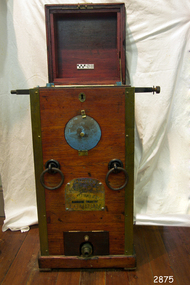
... Davis increasingly ran the company until the surviving partner (W.A. Gorman) died in 1904. The firm was disposed of to the Vickers (armaments) family, and a new company, Siebe Gorman & Co. ...Davis increasingly ran the company until the surviving partner (W.A. Gorman) died in 1904. The firm was disposed of to the Vickers (armaments) family, and a new company, Siebe Gorman & Co. ...This compressor was part of the E.G. Ward Collection. It is connected to the diving suit and boots, also in our collection. Siebe Gorman & Company Ltd was a British company that developed diving equipment and breathing equipment and worked on commercial diving and marine salvage projects. The company advertised itself as 'Submarine Engineers'. It was founded by Augustus Siebe, a German-born British engineer chiefly known for his contributions to diving equipment. Siebe Gorman traded as an engineering firm for over 180 years, from 1819 to 1999. The early success of the business was due to its founder, the Prussian immigrant Christian 'Augustus' Siebe (1788-1872). For business reasons, he applied for and was granted British citizenship in 1856. He was a gifted engineer who was able to translate theoretical problems into practical, working products. During the industrial Victorian period, the business traded as 'A. Siebe's at 145 High Street, Holborn, London, but in 1828, new premises were acquired at 5 Denmark Street, Soho. The family firm produced a wide range of manufactured goods, including paper-making machinery, measuring machinery, water-pumps, refrigeration equipment and diving apparatus. Augustus Siebe specialised in submarine engineering early on, and the company gained a reputation for the manufacture of safe, reliable diving apparatus. Augustus Siebe is best remembered for the development and manufacture of the ‘closed’ Diving Dress based on the ideas of Charles and John Deane, George Edwards and Charles Pasley. Apart from some small modifications to valves and diver communications, the basic 12 bolt ‘closed’ diving dress remained relatively unchanged after the 1870s. Later company successes were also based on innovation, with new products that could be successfully developed and manufactured to high standards. This was largely attributed to the inventive nature, foresight, engineering and entrepreneurial skills of Robert Henry Davis (1870-1965). In 1882, RH Davis joined the company of 'Siebe & Gorman' as a young 11-year-old office boy, and he was to remain with the company until he died in 1965. Augustus Siebe retired in 1869 and handed over the company to a new partnership of Henry H. Siebe (1830-1885) and William A. O'Gorman (1834-1904). The new firm traded as 'Siebe & Gorman' (1870-1879) from premises in and around Mason Street, Westminster Bridge Road, Lambeth, London. The two partners soon recognised the potential of R.H. Davis, and in 1894, aged 24, he became General Manager of Siebe & Gorman. Davis increasingly ran the company until the surviving partner (W.A. Gorman) died in 1904. The firm was disposed of to the Vickers (armaments) family, and a new company, Siebe Gorman & Co. Ltd. (1905-1998) was formed. Under the chairmanship of Albert Vickers, R.H. Davis was kept on as Managing Director, and the company forged ahead. However, after WW1, the Great Depression caused manufacturing output and share prices to slump. In 1924, Robert Davis made a deal with the Vickers Board and acquired control of the company through majority shares. Under his leadership, the Siebe Gorman Company flourished, and in time, four of his sons also joined the firm. The company gained a worldwide reputation for the manufacture of diving apparatus, decompression and observation chambers, and safety breathing apparatus of all types for use on the land, in the air and under the sea (including mine rescue, tunnelling, aircraft, diving, submarine escape and in other hazardous environments). Close research and development links with the MOD (especially the Admiralty), also provided a lucrative outlet for the company's products. In 1932, Robert Davis was knighted by King George V, principally for his invention of the ‘Davis Submerged Escape Apparatus’ (D.S.E.A.). Siebe Gorman essentially remained a family firm from the beginning (under A Siebe) until it became a public company for the first time in 1952. However, following WW2, British manufacturing stagnated through stifled investment and post-war austerity, and there was little innovation. Siebe Gorman's fortunes began to decline as an ageing Sir Robert Davis failed to invest or change the company's business and management practices. In 1959, Siebe Gorman was acquired by the “Fairy Group” and the ailing Sir Robert was made Life President. Consequently, nothing changed, and the slow decline continued until Sir Robert's death in March 1965. Around 1960, Siebe Gorman acquired the diving apparatus manufacturer C E Heinke, and for a brief period, it manufactured some diving equipment under the combined name of Siebe Heinke. Around 1964, Mr E. 'Barry' Stephens was appointed as the new Managing Director to modernise Siebe Gorman. Changes were made, including a move to a new factory in Wales in 1975. The new company concentrated on firefighting breathing apparatus and escape equipment, and the move coincided with the loss of many of the older, traditional craft skills. Between 1985 and 1998, Siebe expanded through acquisitions, and several other companies were acquired. The Siebe Gorman (diving apparatus) company has therefore traded as A. Siebe (1819-1870); Siebe & Gorman (1870-1879); Siebe Gorman & Co (1880-1904); Siebe Gorman & Co. Ltd (1905-1998).The diving compressor, along with associated equipment in the Flagstaff Hill collection, represents a highly significant snapshot of marine history. These items are particularly important in understanding the evolution of diving equipment, with a special focus on their use in salvage operations before and throughout the Second World War. Manufactured by a company renowned for its inventions, development, and innovation in marine engineering, the equipment demonstrates the progression of technology in deep-sea diving. Early helmets and related items produced by this company remain highly sought after by collectors worldwide, highlighting their historical and technological value. The presence of these items within the Flagstaff Hill Maritime Museum allows for a unique insight into the working conditions and methods employed by divers. It also illustrates the considerable dangers they faced while performing such essential and hazardous work, underscoring the critical role played by these professionals in maritime history.A single cylinder divers' pump by Siebe Gorman & Co Ltd, London, eccentric hand cranked in brass, brass-mounted mahogany case with instructions to the underside of the lid, brass-covered pressure gauge and air outlet, brass maker's plaque to the front, water inlet and outlet to the rear, green-painted lifting rings. Machinery has some blue-painted areas on the metal. This compressor is part of the E.G. Ward Collection.Plate on the back 'WATER SUPPLY" "WATER OVERFLOW" "WATER DRAIN-IN" Pressure gauge dial "BOURDON'S PRESSURE GAUGE" STEBE GORMAN & CO. LONDON", "LBS PRESSURE" "FEET OF SALT WATER" Plate on the front " PATENT, Siebe Gorman & Co Ltd Submarine Engineers" below emblem (Lion, Crown, Horse)flagstaff hill, warrnambool, flagstaff-hill, maritime-museum, diving compressor, london, siebe gorman & co ltd, marine technology, life saving, deep sea diving, maritime museum, maritime village, manine history, maritime history, marine engineers, marine diving, deep-sea diving, e g ward, vintage diving compressor, e. g. ward, e.g. ward, edward ward, ted ward -
 Flagstaff Hill Maritime Museum and Village
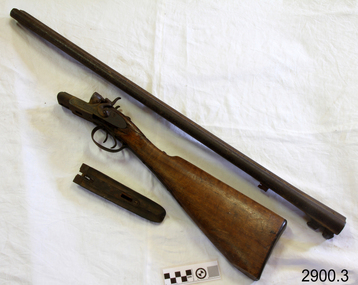
Weapon - Shotgun, Early 20th Century
... Davis' business. Even then, they worked together particularly about the design and manufacture of percussion revolvers. Philip Webley was recorded in the 1851 census as a 38-year-old gun and pistol implement manufacturer living at 84 Weaman Street with his wife Caroline they had four sons and one daughter Thomas William, Emma, and Philip Jnr, and two other sons, James, and Henry and Philip's cousin, also lived with the family probably as a nurse, Sarah Haywood. ...Davis' business. Even then, they worked together particularly about the design and manufacture of percussion revolvers. Philip Webley was recorded in the 1851 census as a 38-year-old gun and pistol implement manufacturer living at 84 Weaman Street with his wife Caroline they had four sons and one daughter Thomas William, Emma, and Philip Jnr, and two other sons, James, and Henry and Philip's cousin, also lived with the family probably as a nurse, Sarah Haywood. ...Philip Webley was born in 1813, he was the younger brother of James Webley who was born in 1807. Both were born in Birmingham. Towards the end of the 1800s, the firm claimed establishment in 1790, this must have been the date James and Philip's father or grandfather originally established a bullet or gun implement making business. It was not, as is often stated, the date William Davis established his business. Philip Webley was apprenticed in 1827 to Benjamin Watson. James Webley also seems to have been apprenticed but to who is not known. In 1834 James and Philip established their partnership as percussioners, lock filers and gun makers at 7 Weaman Street,Birmingham which was William Davis' old premises Davis, a gun implement maker, mould and toolmaker, died in 1831 and his wife Sarah inherited the business at 84 Weaman Street which she ran with her daughter, Caroline. On 5 January 1838 Philip Webley married Caroline. Philip was recorded at 84 Weaman Street from 1838 as a gun percussioner, lock filer and gun maker and this is when the partnership was last recorded, but the brothers apparently continued to co-operate until 1845 when Philip reportedly sold his interest to James and used the money to purchase Sarah Davis' business. Even then, they worked together particularly about the design and manufacture of percussion revolvers. Philip Webley was recorded in the 1851 census as a 38-year-old gun and pistol implement manufacturer living at 84 Weaman Street with his wife Caroline they had four sons and one daughter Thomas William, Emma, and Philip Jnr, and two other sons, James, and Henry and Philip's cousin, also lived with the family probably as a nurse, Sarah Haywood. On 4 February 1853 Philip Webley registered patent No. 335 for a hinged revolver and on 14 September 1853 he registered patent No. 2127 for improvement for the first muzzle-loading percussion cap and ball revolver which became known as the "Longspur". In 1859 Philips son Thomas William, aged 21, was made a partner in the firm, which then changed its name to P Webley & Son and described itself as "Gun and Pistol Makers and Patent Revolving Pistol Makers", probably exploiting Philip Webley's patent No. 305 of February 1853 for a revolver frame and lock, and its improvement under patent No. 2127 of September 1853. Thomas later went on to managed the shotgun side of the business. From about 1863 up to the First World War, the firm made rook rifles for Holland & Holland. From the 1890s they supplied magazine rifles. In 1863 and 1864 the firm's address was given as 83-84 Weaman Street, but from late 1864 to 1875 their address was 84 Weaman Street. By 1874 the firm had a showroom in London at an unknown address. In 1875 the firm expanded into 82-84 and 88-89 Weaman Street. The shotgun is not in very good condition is unusable as a firearm and is not very significant historically or valuable, although made by a well known and respected manufacturer of firearms there are many better examples of shotguns made by P Webley and Son in collections and for sale. This particular example is of a standard pattern for utilitarian use of which many were made. Pin fire double barrel cartridge loading shotgun, the stock is of varnished walnut, the shotgun is in a wooden box, box has hinged lid and dovetail joints. Raised inscription on butt has an image of "dog carrying a bird in his mouth" and another image of a "anchor and chain". Inscribed to both sides of the locks "P Webley and Son", Maker's mark and proof marks for black powder shotguns on undersides of both barrels. Proof marks used are for Birmingham. flagstaff hill, warrnambool, shipwrecked-coast, flagstaff-hill, flagstaff-hill-maritime-museum, maritime-museum, shipwreck-coast, flagstaff-hill-maritime-village, shotgun double barrel, double barrel, bird dog and bird, anchor and chain, webley & scott, pin fire, cartridge, philip webley -
 Flagstaff Hill Maritime Museum and Village
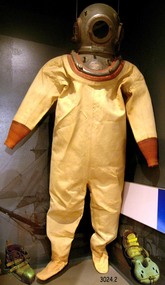
Functional object - Diving Suit, boots and weight, Early-to-mid 20th century
... Davis increasingly ran the company until the surviving partner (W.A. Gorman) died in 1904. The firm was disposed of to the Vickers (armaments) family and a new company 'Siebe Gorman & Co. ...Davis increasingly ran the company until the surviving partner (W.A. Gorman) died in 1904. The firm was disposed of to the Vickers (armaments) family and a new company 'Siebe Gorman & Co. ...This diving suit with helmet, boots and weight is part of the E. G.Ward collection, along with the diving compressor and a photograph of a diver in this equipment. Siebe Gorman & Company Ltd was a British company that developed diving equipment and breathing equipment and worked on commercial diving and marine salvage projects. The company advertised itself as 'Submarine Engineers'. It was founded by Augustus Siebe, a German-born British engineer chiefly known for his contributions to diving equipment. Siebe Gorman traded as an engineering firm for over 180 years from 1819 to 1999. The early success of the business was due to its founder, the Prussian immigrant Christian 'Augustus' Siebe (1788-1872). For business reasons, he applied for and was granted British citizenship in 1856. He was a gifted engineer who was able to translate theoretical problems into practical, working products. During the industrial Victorian period, the business traded as 'A. Siebe' at 145 High Street Holborn London, but in 1828 new premises were acquired at 5 Denmark Street, Soho. The family firm produced a wide range of manufactured goods including paper-making machinery, measuring machinery, water pumps, refrigeration equipment and diving apparatus. Augustus Siebe specialised in submarine engineering early on and the company gained a reputation for the manufacture of safe, reliable diving apparatus. Augustus Siebe is best remembered for the development and manufacture of the ‘closed’ Diving Dress based on the ideas of Charles and John Deane, George Edwards and Charles Pasley. Apart from some small modifications to valves and diver communications, the basic 12-bolt ‘closed’ diving dress remained relatively unchanged after the 1870s. Later company successes were also based on innovation, with new products that could be successfully developed and manufactured to high standards. This was largely attributed to the inventive nature, foresight, engineering and entrepreneurial skills of Robert Henry Davis (1870-1965). In 1882, RH Davis joined the company of 'Siebe & Gorman' as a young 11-year-old office boy and he was to remain with the company until he died in 1965. Augustus Siebe retired in 1869 and handed over the company to a new partnership of Henry H. Siebe (1830-1885) and William A. O'Gorman (1834-1904). The new firm traded as 'Siebe & Gorman' (1870-1879) from premises in and around Mason Street, Westminster Bridge Road, Lambeth, London. The two partners soon recognised the potential of R.H. Davis and in 1894, aged 24, he became General Manager of Siebe & Gorman. Davis increasingly ran the company until the surviving partner (W.A. Gorman) died in 1904. The firm was disposed of to the Vickers (armaments) family and a new company 'Siebe Gorman & Co. Ltd.' (1905-1998) was formed. Under the chairmanship of Albert Vickers, R.H. Davis was kept on as Managing Director, and the company forged ahead. However, after WW1, the Great Depression caused manufacturing output and share prices to slump. In 1924 Robert Davis made a deal with the Vickers Board and acquired control of the company through majority shares. Under his leadership, the Siebe Gorman Company flourished and within time, four of his sons also joined the firm. The company gained a worldwide reputation for the manufacture of diving apparatus, decompression and observation chambers, and safety breathing apparatus of all types for use on the land, in the air and under the sea (including mine rescue, tunnelling, aircraft, diving, submarine escape and in other hazardous environments). Close research and development links with the MOD (especially the Admiralty), also provided a lucrative outlet for the company products. In 1932, Robert Davis was knighted by King George V, principally for his invention of the ‘Davis Submerged Escape Apparatus’ (D.S.E.A.). Siebe Gorman essentially remained a family firm from the beginning (under A.Siebe) until it became a public company for the first time in 1952. However, following WW2, British manufacturing stagnated through stifled investment and post-war austerity, and there was little innovation. Siebe Gorman fortunes began to decline as an ageing Sir Robert Davis failed to invest, or change the company business and management practices. In 1959, Siebe Gorman was acquired by the “Fairy Group” and the ailing Sir Robert was made Life President. Consequently, nothing changed and the slow decline continued until Sir Robert's death in March 1965. Around 1960, Siebe Gorman acquired the diving apparatus manufacturer C E Heinke, and for a brief period, it manufactured some diving equipment under the combined name of Siebe Heinke. Around 1964, Mr E. 'Barry' Stephens was appointed as the new Managing Director to modernise Siebe Gorman. Changes were made, including a move to a new factory in Wales in 1975. The new company concentrated on fire-fighting breathing apparatus and escape equipment, and the move coincided with the loss of many of the older, traditional craft skills. Between 1985 and 1998, Siebe expanded through acquisitions, and several other companies were acquired. The Siebe Gorman (diving apparatus) company has therefore traded as A. Siebe (1819-1870); Siebe & Gorman (1870-1879); Siebe Gorman & Co (1880-1904); Siebe Gorman & Co. Ltd (1905-1998).The diving suit, helmet, boots, and weights, along with associated equipment in the Flagstaff Hill collection, represent a highly significant snapshot of marine history. These items are particularly important in understanding the evolution of diving equipment, with a special focus on their use in salvage operations before and throughout the Second World War. Manufactured by a company renowned for its inventions, development, and innovation in marine engineering, the equipment demonstrates the progression of technology in deep-sea diving. Early helmets and related items produced by this company remain highly sought after by collectors worldwide, highlighting their historical and technological value. The presence of these items within the Flagstaff Hill Maritime Museum allows for a unique insight into the working conditions and methods employed by divers. It also illustrates the considerable dangers they faced while performing such essential and hazardous work, underscoring the critical role played by these professionals in maritime history.Diving suit including helmet, boots and a weight. Diving suit is made of canvas with knitted cuffs. The helmet is metal. The boots have a thick sole and thick leather upper that is held on with leather straps and buckles. The toe of the boot is heavy metal. The weight is worn next to the trunk of the diver and it has an inscription to mark the front. It is worn with straps and buckles holding it in place. Royal Navy Admiralty Pattern 6 bolt No 3 light Siebe Gorman light diving helmet circa 1960, used by the Royal Navy before and after World War 2. This equipment is part of the E. G. Ward Collection."Siebe Gorman & Co Ltd Marine Engineers London. Patent" with "E G Ward" on front and back plate. On weight "FRONT"flagstaff hill, warrnambool, diving suit, siebe gorman and co ltd., siebe gorman and co ltd marine engineers london, marine engineers, diving helmet, diving boots, diving weight, marine diving, maritimemuseum, maritime village, maritime history, marine technology, life saving, deep sea diving, maritime museum, siebe gorman and co ltd., siebe gorman and co ltd, london, deep-sea diving, e. g. ward, e g ward, e.g. ward, edward ward, ted ward -
 Flagstaff Hill Maritime Museum and Village
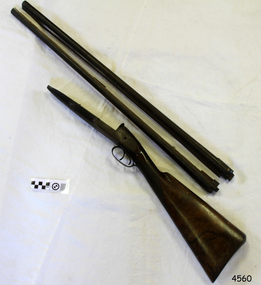
Weapon - Double Barrel Shotgun, Mid to late 19th Century
... Davis' business. Even then, they worked together particularly about the design and manufacture of percussion revolvers. Philip Webley was recorded in the 1851 census as a 38-year-old gun and pistol implement manufacturer living at 84 Weaman Street with his wife Caroline they had four sons and one daughter Thomas William, Emma, and Philip Jnr, and two other sons, James, and Henry and Philip's cousin, also lived with the family probably as a nurse, Sarah Haywood. ...Davis' business. Even then, they worked together particularly about the design and manufacture of percussion revolvers. Philip Webley was recorded in the 1851 census as a 38-year-old gun and pistol implement manufacturer living at 84 Weaman Street with his wife Caroline they had four sons and one daughter Thomas William, Emma, and Philip Jnr, and two other sons, James, and Henry and Philip's cousin, also lived with the family probably as a nurse, Sarah Haywood. ...Philip Webley was born in 1813, he was the younger brother of James Webley who was born in 1807. Both were born in Birmingham. Towards the end of the 1800s, the firm claimed establishment in 1790, this must have been the date James and Philip's father or grandfather originally established a bullet or gun implement making business. It was not, as is often stated, the date William Davis established his business. Philip Webley was apprenticed in 1827 to Benjamin Watson. James Webley also seems to have been apprenticed but to who is not known. In 1834 James and Philip established their partnership as percussioners, lock filers and gun makers at 7 Weaman Street,Birmingham which was William Davis' old premises Davis, a gun implement maker, mould and toolmaker, died in 1831 and his wife Sarah inherited the business at 84 Weaman Street which she ran with her daughter, Caroline. On 5 January 1838 Philip Webley married Caroline. Philip was recorded at 84 Weaman Street from 1838 as a gun percussioner, lock filer and gun maker and this is when the partnership was last recorded, but the brothers apparently continued to co-operate until 1845 when Philip reportedly sold his interest to James and used the money to purchase Sarah Davis' business. Even then, they worked together particularly about the design and manufacture of percussion revolvers. Philip Webley was recorded in the 1851 census as a 38-year-old gun and pistol implement manufacturer living at 84 Weaman Street with his wife Caroline they had four sons and one daughter Thomas William, Emma, and Philip Jnr, and two other sons, James, and Henry and Philip's cousin, also lived with the family probably as a nurse, Sarah Haywood. On 4 February 1853 Philip Webley registered patent No. 335 for a hinged revolver and on 14 September 1853 he registered patent No. 2127 for improvement for the first muzzle-loading percussion cap and ball revolver which became known as the "Longspur". In 1859 Philips son Thomas William, aged 21, was made a partner in the firm, which then changed its name to P Webley & Son and described itself as "Gun and Pistol Makers and Patent Revolving Pistol Makers", probably exploiting Philip Webley's patent No. 305 of February 1853 for a revolver frame and lock, and its improvement under patent No. 2127 of September 1853. Thomas later went on to managed the shotgun side of the business. From about 1863 up to the First World War, the firm made rook rifles for Holland & Holland. From the 1890s they supplied magazine rifles. In 1863 and 1864 the firm's address was given as 83-84 Weaman Street, but from late 1864 to 1875 their address was 84 Weaman Street. By 1874 the firm had a showroom in London at an unknown address. In 1875 the firm expanded into 82-84 and 88-89 Weaman Street. The item is an early muzzle loading sporting shotgun not in very good condition and is unusable as a firearm and not very significant historically or valuable, although made by a well known and respected manufacturer of firearms there are many better examples of shotguns made by P Webley and Son in collections and for sale. This particular example is of a standard pattern for utilitarian use of which many were made. Shotgun, black powder, muzzle Loading, double barrel, percussion cap. P Webley & Son maker on left and right lock and P Webley & Son James St London on top of barrel. Barrel split in two. Has 14 stamped under each barrel with Birmingham proof marks for black powder shotguns. on undersides of both barrels. Proof marks used are early metal parts have decorative engravings of a gun dog flushing a birdwarrnambool, shipwrecked-coast, flagstaff-hill, flagstaff-hill-maritime-museum, shipwreck-coast, flagstaff-hill-maritime-village, gun, shotgun, double-barrel shotgun, firearm, muzzel loading shotgun, philip webley, black powder, percussion cap, hunting weapon, birmingham gun manufactures, w & c scott & son -
 Federation University Historical Collection
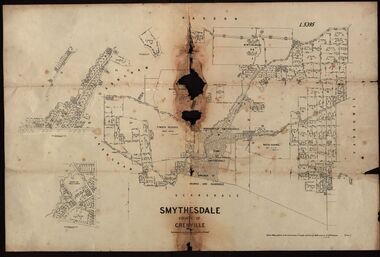
Plan, Smythesdale, County of Grenville, 01/12/1892
... Gift of the Squire Family smythesdale scarsdale browns yarrowee carngham samuel barlett sheridan wrigley p. land r. simpson d. davis nintingbool mclachlan a. mclachlan c. taylor w. c. smith d. davies w. williams m. jones t. mcgurk r. selkirk a. mooney A plan showing the Borough of Smythesdale, Smythesdale, Browns and Scarsdale, allotments, water reserve, Timber reserve, Nintingbool Pre-emptive Right, Reserve for public gardens, Reserve for Cricket Ground, Reserve for Reservoir Smythesdale, County of Grenville Plan Department of Lands and Survey T.F. ...This plan is associated with former Ballarat School of Mines Student Richard Squire (1875-1876). Gift of the Squire FamilyA plan showing the Borough of Smythesdale, Smythesdale, Browns and Scarsdale, allotments, water reserve, Timber reserve, Nintingbool Pre-emptive Right, Reserve for public gardens, Reserve for Cricket Ground, Reserve for Reservoirsmythesdale, scarsdale, browns, yarrowee, carngham, samuel barlett, sheridan, wrigley, p. land, r. simpson, d. davis, nintingbool, mclachlan, a. mclachlan, c. taylor, w. c. smith, d. davies, w. williams, m. jones, t. mcgurk, r. selkirk, a. mooney -
 Federation University Historical Collection
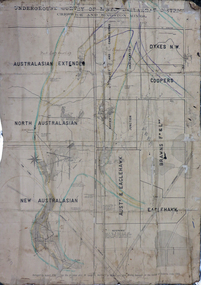
Plan, Underground Survey of Mines, Ballarat District, Creswick and Kingston Mines, 1888, 06/1888
... Gift of the Squire Family creswick kingston berry australasian plan mining robert allen richard squire Written above Australian Extended "West Berry Consols Coy" Written near Davis' and Charlesons Amalgamated "West Berry Consols Coy" A paper plan on linen showing the following mines: Australasian Extended, North Australasian, Davis and Charlesons Amalgamated, Davies Junction, Dykes N.W., Coopers, F & L Holding, New Australasian, Australasian and Eaglehawk, Brawns Underground Survey of Mines, Ballarat District, Creswick and Kingston Mines, 1888 Plan Robert Allan ...This plan is associated with former Ballarat School of Mines Student Richard Squire (1875-1876). Gift of the Squire FamilyA paper plan on linen showing the following mines: Australasian Extended, North Australasian, Davis and Charlesons Amalgamated, Davies Junction, Dykes N.W., Coopers, F & L Holding, New Australasian, Australasian and Eaglehawk, BrawnsWritten above Australian Extended "West Berry Consols Coy" Written near Davis' and Charlesons Amalgamated "West Berry Consols Coy"creswick, kingston, berry, australasian, plan, mining, robert allen, richard squire -
 Federation University Historical Collection
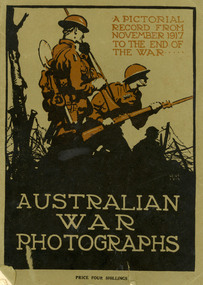
Book, Cassell and Company, Ltd, Australian War Photographs, 1917
... Family Archive Photographic history of Australians during World War One 129 page book with soft beige, brown and black cover depicting three soldiers at the front during World War One. The book includes many photographs and artwork of Australians at the French front from November 1917 until the end of the war. Photographers include Frank Hurley, E. Brooks, H.F. Baldwin and G.H. Wilkins. Artists include Crozier, W.L. King, Alan Lewis, Lothian, John Davis ...Photographic history of Australians during World War One129 page book with soft beige, brown and black cover depicting three soldiers at the front during World War One. The book includes many photographs and artwork of Australians at the French front from November 1917 until the end of the war. Photographers include Frank Hurley, E. Brooks, H.F. Baldwin and G.H. Wilkins. Artists include Crozier, W.L. King, Alan Lewis, Lothian, John Davis, S. Perks, I. Picking, Daryl Lindsay, Alf Saville, L.H. Howie, Stuart Shaw, P. Huthnance, Stiggo, S. Perks, C.H. Gould, Ted Canon, Bernie Bragg, S. Shaw, Will Dyson, An introduction is written by W. Birdwood, France, 28 September 1917. A number of pages have written notes on them by someone who had obviously been on the French Front. (These pages have been scanned and uploaded onto Victorian Collections. non-fictionPhotographic history of Australians during World War Onechatham family collection, chatham, world war one, world war 1, world war i, france, trenches, front line, birdwood, mark ridgeay, harold williamson, flanders, poziers, somme, becourt, mouquet farm, rupert whiteley, ypres, montauban, field cooker, gueudecourt, band, bapaume, bullecourt, h. murray, hindernburg wire, messines, howitzer, w. holmes. canon, ted canon, hill 60, gas masks, siege battery, menin road, ambulance, dressing station, glencorse wood, prisoners, pigeons, australian commonwealth military forces, sgs, chatham - holmes family archive -
 Flagstaff Hill Maritime Museum and Village
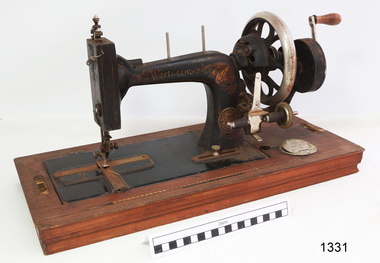
Domestic object - Sewing Machine, 1903
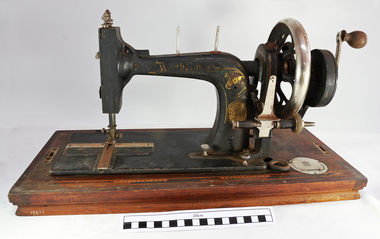
... Davis Cup matches against Czechoslovakia in 1922. The piano factory closed in 1935, becoming a Heinz food processing plant and in 1955, GTV Channel 9 studios and offices. Early Australians had to be self-reliant in regards to making and mending their clothes and utensils. This sewing machine was one of many items used that exhibit the skill and craftsmanship of the women in these early families ...Hugo Wertheim (1854-1919), was a merchant and manufacturer and was born on the 12th July 1854 at Lispenhausen, in the German electorate of Hesse-Kassel, son of Meyer Wertheim and his wife Minna, née Heinemann. Hugo reached Melbourne in October 1875. He soon began advertising, from premises at 39 Flinders Lane East, as agent for his father's cousin Joseph Wertheim, a well-established manufacturer of sewing machines. Hugo returned to Germany where he married Joseph Wertheim's daughter Sophie Emilie (1864-1953) on 30 August 1885 at Frankfurt. the couple then came to Melbourne. In a short time, with extensive advertising, Hugo established a substantial business, selling sewing machines, bicycles, pianos and other mechanical devices, under brands such as Wertheim, Electra, Planet, Griffin and Hapsburg. He also mounted elaborate displays at agricultural shows and in 1901 at the Pan American Exposition, Buffalo, United States of America. O. C. Beale worked with him before setting up his own piano business in New South Wales. Hugo continued to own 25 per cent of one of Beale's companies, which became Wertheim's Queensland business. In 1908 Wertheim opened a large, innovative piano factory at Richmond, Melbourne, intending to produce 2000 pianos and player pianos annually, predominantly using Australian materials. In laying the foundation stone, Prime Minister Alfred Deakin observed that “few men with such opportunities for a life of ease would have embarked on such an enterprise” Hugo died of chronic hepatitis on 11 July 1919 at his home at South Yarra, his wife, two daughters and three sons survived him; Herbert Joseph (1886-1972), the eldest, continued the business. Rupert became a share broker and went on to represent Victoria in inter-State tennis in 1913-27 and Australia in Davis Cup matches against Czechoslovakia in 1922. The piano factory closed in 1935, becoming a Heinz food processing plant and in 1955, GTV Channel 9 studios and offices.Early Australians had to be self-reliant in regards to making and mending their clothes and utensils. This sewing machine was one of many items used that exhibit the skill and craftsmanship of the women in these early families. A sewing machine was a necessary part of each home and this item demonstrates how women of the time managed had to become self-reliant in the repair and making of their families clothes to make their household budgets go further.Wertheim sewing machine in carry case, hand operated with two spindles, handle with locking pin, which turns lever between spokes of main handle, hand brake. The machine is table-mounted with a Turkish walnut base. The base can be attached to a cast iron table with a foot treadle as an optional extra. The walnut base has marquetry to the front set out as a measure for material. There is also an accessory box inside the carry case containing 20 additional items for use with the machine. Wertheim brass trademark badge riveted to the body of the machine of a crouching dwarf with a hammer with the name of the company Wertheim and Frankfurt. Gold filigree decoration in gold paint adorns the main body of the machine. flagstaff hill, warrnambool, shipwrecked-coast, flagstaff-hill, flagstaff-hill-maritime-museum, maritime-museum, shipwreck-coast, flagstaff-hill-maritime-village, sewing machine, hand operated sewing machine, crank handle sewing machine, wertheim, dressmaking, taylor, domestic, clothing, hugo wertheim, joseph wertheim -
 Flagstaff Hill Maritime Museum and Village
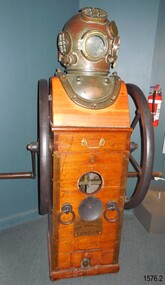
Equipment - Diving compressor and helmet, 1944
... Davis increasingly ran the company until the surviving partner (W.A. Gorman) died in 1904. The firm was disposed of to the Vickers (armaments) family and a new company 'Siebe Gorman & Co. ...Davis increasingly ran the company until the surviving partner (W.A. Gorman) died in 1904. The firm was disposed of to the Vickers (armaments) family and a new company 'Siebe Gorman & Co. ...Siebe Gorman & Company Ltd was a British company that developed diving equipment and breathing equipment and worked on commercial diving and marine salvage projects. The company advertised itself as 'Submarine Engineers'. It was founded by Augustus Siebe, a German-born British engineer chiefly known for his contributions to diving equipment. Siebe Gorman traded as an engineering firm for over 180 years from 1819 to 1999. The early success of the business was due to its founder, the Prussian immigrant Christian 'Augustus' Siebe (1788-1872). For business reasons, he applied for and was granted British citizenship in 1856. He was a gifted engineer who was able to translate theoretical problems into practical, working products. During the industrial Victorian period, the business traded as 'A. Siebe' at 145 High Street Holborn London, but in 1828 new premises were acquired at 5 Denmark Street, Soho. The family firm produced a wide range of manufactured goods including paper-making machinery, measuring machinery, water pumps, refrigeration equipment, and diving apparatus. Augustus Siebe specialised in submarine engineering early on and the company gained a reputation for the manufacture of safe, reliable diving apparatus. Augustus Siebe is best remembered for the development and manufacture of the ‘closed’ Diving Dress based on the ideas of Charles and John Deane, George Edwards, and Charles Pasley. Apart from some small modifications to valves and diver communications, the basic 12 bolt ‘closed’ diving dress remained relatively unchanged after the 1870s. Later company successes were also based on innovation, with new products that could be successfully developed and manufactured to high standards. This was largely attributed to the inventive nature, foresight, engineering, and entrepreneurial skills of Robert Henry Davis (1870-1965). In 1882, RH Davis joined the company of 'Siebe & Gorman' as a young 11-year-old office boy and he was to remain with the company until he died in 1965. Augustus Siebe retired in 1869 and handed over the company to a new partnership of Henry H. Siebe (1830-1885) and William A. O'Gorman (1834-1904). The new firm traded as 'Siebe & Gorman' (1870-1879) from premises in and around Mason Street, Westminster Bridge Road, Lambeth, London. The two partners soon recognised the potential of R.H. Davis and in 1894, aged 24, he became General Manager of Siebe & Gorman. Davis increasingly ran the company until the surviving partner (W.A. Gorman) died in 1904. The firm was disposed of to the Vickers (armaments) family and a new company 'Siebe Gorman & Co. Ltd.' (1905-1998) was formed. Under the chairmanship of Albert Vickers, R.H. Davis was kept on as Managing Director, and the company forged ahead. However, after WW1, the Great Depression caused manufacturing output and share prices to slump. In 1924 Robert Davis made a deal with the Vickers Board and acquired control of the company through majority shares. Under his leadership, the Siebe Gorman Company flourished and within time, four of his sons also joined the firm. The company gained a worldwide reputation for the manufacture of diving apparatus, decompression and observation chambers, and safety breathing apparatus of all types for use on the land, in the air, and under the sea (including mine rescue, tunneling, aircraft, diving, submarine escape and in other hazardous environments). Close research and development links with the MOD (especially the Admiralty), also provided a lucrative outlet for the company products. In 1932, Robert Davis was knighted by King George V, principally for his invention of the ‘Davis Submerged Escape Apparatus’ (D.S.E.A.). Siebe Gorman essentially remained a family firm from the beginning (under A.Siebe) until it became a public company for the first time in 1952. However, following WW2, British manufacturing stagnated through stifled investment and post-war austerity, and there was little innovation. Siebe Gorman's fortunes began to decline as an aging Sir Robert Davis failed to invest, or change the company's business and management practices. In 1959, Siebe Gorman was acquired by the “Fairy Group” and the ailing Sir Robert was made Life President. Consequently, nothing changed and the slow decline continued until Sir Robert's death in March 1965. Around 1960, Siebe Gorman acquired the diving apparatus manufacturer C E Heinke, and for a brief period, it manufactured some diving equipment under the combined name of Siebe Heinke. Around 1964, Mr E. 'Barry' Stephens was appointed as the new Managing Director to modernise Siebe Gorman. Changes were made, including a move to a new factory in Wales in 1975. The new company concentrated on fire-fighting breathing apparatus and escape equipment, and the move coincided with the loss of many of the older, traditional craft skills. Between 1985 and 1998, Siebe expanded through acquisitions, and several other companies were acquired. The Siebe Gorman (diving apparatus) company has therefore traded as A. Siebe (1819-1870); Siebe & Gorman (1870-1879); Siebe Gorman & Co (1880-1904); Siebe Gorman & Co. Ltd (1905-1998). (For information regards the diving helmet & Frank King see Notes Section at the end of this document)The items are very significant as a snapshot into marine history and the development of diving equipment generally especially that used for salvage operations before and during WW2. The company that made the equipment was a leading inventor,developer and innovator of marine equipment with its early helmets and other items eagerly sought after today for collections around the world. The items in the Flagstaff Hill collection give us an insight as to how divers operated and the dangers they faced doing a very necessary and dangerous job. Frank Kings' diving helmet and compressor (communication pipe stored separately). Compressor is hand cranked. US Navy diving helmet, Mark V. Two maker's plates attached. Made in 1944.On rear "WATER SUPPLY" On front 'PATENT" " Logo: Images (Lion, Crown, Horse, Shield within an oval) "SIEBE, GORMAN & Co. Ltd. SUBMARINE ENGINEERS, LONDON.flagstaff hill, warrnambool, maritime museum, great ocean road, us navy diving helmet, commonwealth government salvage, diving helmet, marine salvage, frank king, diver, siebe. gorman & co ltd, submarine equipment, diving equipment, communication under water, hand cranked, diving compressor -
 Flagstaff Hill Maritime Museum and Village
Domestic object - Sewing Machine and case, Joseph Wertheim, late 19th century
... Davis Cup matches against Czechoslovakia in 1922. The piano factory closed in 1935, becoming a Heinz food processing plant and in 1955, GTV Channel 9 studios and offices. Early Australians had to be self-reliant in regards to making and mending their clothes and utensils. This sewing machine was one of many items used that exhibit the skill and craftsmanship of the women in these early families ...Hugo Wertheim (1854-1919), was a merchant and manufacturer and was born on the 12th July 1854 at Lispenhausen, in the German electorate of Hesse-Kassel, son of Meyer Wertheim and his wife Minna, née Heinemann. Hugo reached Melbourne in October 1875. He soon began advertising, from premises at 39 Flinders Lane East, as agent for his father's cousin Joseph Wertheim, a well-established manufacturer of sewing machines. Hugo returned to Germany where he married Joseph Wertheim's daughter Sophie Emilie (1864-1953) on 30 August 1885 at Frankfurt. the couple then came to Melbourne. In a short time, with extensive advertising, Hugo established a substantial business, selling sewing machines, bicycles, pianos and other mechanical devices, under brands such as Wertheim, Electra, Planet, Griffin and Hapsburg. He also mounted elaborate displays at agricultural shows and in 1901 at the Pan American Exposition, Buffalo, United States of America. O. C. Beale worked with him before setting up his own piano business in New South Wales. Hugo continued to own 25 per cent of one of Beale's companies, which became Wertheim's Queensland business. In 1908 Wertheim opened a large, innovative piano factory at Richmond, Melbourne, intending to produce 2000 pianos and player pianos annually, predominantly using Australian materials. In laying the foundation stone, Prime Minister Alfred Deakin observed that “few men with such opportunities for a life of ease would have embarked on such an enterprise” Hugo died of chronic hepatitis on 11 July 1919 at his home at South Yarra, his wife, two daughters and three sons survived him; Herbert Joseph (1886-1972), the eldest, continued the business. Rupert became a share broker and went on to represent Victoria in inter-State tennis in 1913-27 and Australia in Davis Cup matches against Czechoslovakia in 1922. The piano factory closed in 1935, becoming a Heinz food processing plant and in 1955, GTV Channel 9 studios and offices.Early Australians had to be self-reliant in regards to making and mending their clothes and utensils. This sewing machine was one of many items used that exhibit the skill and craftsmanship of the women in these early families. A sewing machine was a necessary part of each home and this item demonstrates how women of the time managed had to become self-reliant in the repair and making of their families clothes to make their household budgets go further.Sewing machine, Wertheim brand “ Syst 182” hand crank operated machine with folding handle, timber case and carry handle. Metal machine is painted black, with remnants of gold, red and green scrolls and floral decoration. Machine has base with inlaid measuring rule across front and 2 holes drilled through the base (perhaps for mounting machine to a bench). Machine tilts open, hinged on one side, after thumb screw is unwound, revealing machine’s workings and serial number. Base has a fitted round, concave, silver metal pin holder with lid that hinges open, and symbol pressed into lid; several pins are inside. Body of machine has brand name transfer across front and oval metal trademark disc on front. Metal sliding covers over footplates have stamped lettering. Timber machine case or cover includes an accessory box with sliding cover and metal hook and eye latch, and inside the box are 23 metal sewing attachments, a disc and a stick of black crayon with maker’s trademark on it paper cover. Workings of machine have seized up. The crayon wrapper has printed on it “For the wonderful Wertheim new family machine made in Germany ‘Syst. 182’”, and the maker’s symbol with “Trademark” beside it. Made for Hugo Wertheim.“WERTHEIM” transfer across front and back of machine body. Cover of pin holder has symbol ‘Wings above a shield’. Maker’s trademark on gold oval disc, “WERTHEIM / FRANCFURT” and picture of a dwarf with a hammer. Left footplate has script “Syst 182”, right footplate has stamp in oval shape “MANUFACTURED IN - - /SPECIALLY FOR / HUGO WERTHEIM” Serial Number “7501”flagstaff hill, warrnambool, shipwrecked-coast, flagstaff-hill, flagstaff-hill-maritime-museum, maritime-museum, shipwreck-coast, flagstaff-hill-maritime-village, sewing machine, hand crank sewing machine, hugo wertheim, wertheim, clothing manufacturer, sewing, syst 182 -
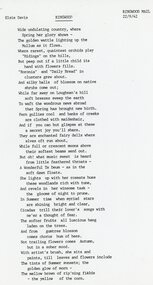 Ringwood and District Historical Society
Document - Family History, Elsie May Davis, Ringwood, Victoria
... Elsie May Davis, Ringwood, Victoria Document Family History ...Two A4 pages typewritten by Elsie Davis addressed to Ringwood Mail newspaper dated 22/9/1942, with poem and autobiographical remarks published in the Ringwood Mail, Thursday September 24, 1942."Miss Elsie Davis was a life time member of the Parish of St.Paul, Ringwood. She was a member of the choir, served as superintendent of the Sunday School, and remembered when the Church was located near the antimony mine. ..." -
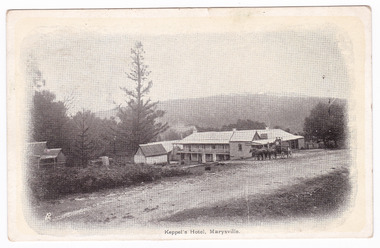 Marysville & District Historical Society
Postcard (item) - Black and white postcard, Keppel's Hotel, Marysville, Unknown
... An early black and white postcard from Keppel's Hotel in Marysville. marysville victoria australia keppel hotel keppel's australian hotel australian hotel keppel family maurice john keppel accommodation postcard Post Card The Address to be written on this side SE 7/ 06/ VICTORIA Miss Davis/ "Bonnie View"/ Upper Maffra West. ...An early black and white postcard from Keppel's Hotel in Marysville. The hotel was originally built and opened by the Keppel Family in 1865. The Keppel's Australian Hotel was the first hotel to be opened in Marysville. The Keppel Family were among Marysville's earliest pioneering families. On the reverse of the postcard is a hand written message and a postage stamp. The postcard was posted on September 7th 1906.An early black and white postcard from Keppel's Hotel in Marysville.Post Card The Address to be written on this side SE 7/ 06/ VICTORIA Miss Davis/ "Bonnie View"/ Upper Maffra West. Wed./ Received your pretty little/ puss. It was so wet here the/ end of last week both/ the Jack + Honey were flooded./ It is lovely today. The/ holidays begin today. None/ of our people went to the Show/ or Exhibition. With love to all/ I have 129 ??? from E.C.marysville, victoria, australia, keppel hotel, keppel's australian hotel, australian hotel, keppel family, maurice john keppel, accommodation, postcard -
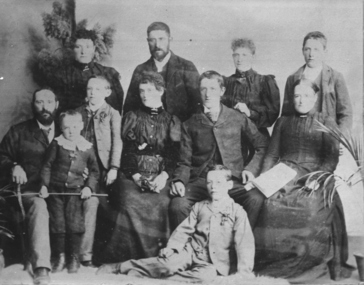 Federation University Historical Collection
Photograph - Photograph and Documents, Anne Beggs Sunter, Latta/Downing Family, Mount Helen
... family...greenhill...e. latta...m. fiscalini...r. wynne...r. nixon...j.u. smith...j. davis...Various items relating to the Federation University Mount Helen Campus, and the early settlers on the land, the Latta Family. .1) Parish Plan, including E. Latta, M. Fiscalini, R. Wynne, R. Nixon, J.U. Smith, J. Davis...The land was purchased by the Ballarat School of Mines for their tertiary division from the Stapleton family. mount helen campus latta family greenhill e. latta m. fiscalini r. wynne r. nixon j.u. smith j. davis parish plan john latta elizabeth latta george downing elezabeth downing green hill pontresina abraham baxter g. dean market gardens jim downing bob thornton j. hateley martin fanning toll keeper anne beggs sunter Various items relating to the Federation University Mount Helen Campus, and the early settlers on the land, the Latta Family. .1) Parish Plan, including E. ...The Federation University Mt Helen Campus was once the farm of John Latta and his wife Elizabeth Ann Dean. The couple married in 1867 and had three children at the time of John Latta's death (Elizabeth Ann b.1870; Mary b.1873; John b.1875). Elizabeth later married George Downing, and had another six children. The house was situated in the vicinity of the current Administration and Caro Conference Centre buildings, surrounded by an orchard, and a well under the current Albert Coates Building (Union Building). The land was purchased by the Ballarat School of Mines for their tertiary division from the Stapleton family.Various items relating to the Federation University Mount Helen Campus, and the early settlers on the land, the Latta Family. .1) Parish Plan, including E. Latta, M. Fiscalini, R. Wynne, R. Nixon, J.U. Smith, J. Davis .2) Part of a 1930s ordinance map showing Ballarat, Buninyong and Greenhill .3) Contour Map with the first two Mt Helen Campus buildings included. .4) Drawing a a proposed campus plan .5) Latta Family negativemount helen campus, latta family, greenhill, e. latta, m. fiscalini, r. wynne, r. nixon, j.u. smith, j. davis, parish plan, john latta, elizabeth latta, george downing, elezabeth downing, green hill, pontresina, abraham baxter, g. dean, market gardens, jim downing, bob thornton, j. hateley, martin fanning, toll keeper, anne beggs sunter -
Federation University Historical Collection
Book, University of Ballarat Annual Research Conference 2000: Abstracts, 08/09/2000
... university of ballarat university research conference bruce armstrong peter arnold adil bagirov beverly blaskett patrice braun maryann brown fred cahir kate callister patricia cartwright john cowley sarah davis briony dow john fisher christopher fox michael gathercole rosemary green julie heron deborah hiskin gavin hurst tariq khan maylene kule lin zheng david manterfield john mcdonald tunde meikle elaine millls ross morgan john morris angela murphy john nicholson pauline nunan dora pearce leeane pitman patrick prevett paula ransom natisha sands simon sim jeff stweart john struhs elizabeth swayn michael tuck margaret zeegers breat cancer diagnosis and prognosis professional reading circles tertiary undergraduate literacy integration program carp gendered communication kidmap agricultural restructure on farm families psychiatric nursing heat pump design mixed species eucalypt foothill forest stawell goldmines heat stress management accessing foucault e-commerce helen hayes indigenous heritage family care-giving 96 page book with research abstracts University of Ballarat Annual Research Conference 2000: Abstracts Book ...96 page book with research abstractsnon-fictionuniversity of ballarat, university research conference, bruce armstrong, peter arnold, adil bagirov, beverly blaskett, patrice braun, maryann brown, fred cahir, kate callister, patricia cartwright, john cowley, sarah davis, briony dow, john fisher, christopher fox, michael gathercole, rosemary green, julie heron, deborah hiskin, gavin hurst, tariq khan, maylene kule, lin zheng, david manterfield, john mcdonald, tunde meikle, elaine millls, ross morgan, john morris, angela murphy, john nicholson, pauline nunan, dora pearce, leeane pitman, patrick prevett, paula ransom, natisha sands, simon sim, jeff stweart, john struhs, elizabeth swayn, michael tuck, margaret zeegers, breat cancer diagnosis and prognosis, professional reading circles, tertiary undergraduate literacy integration program, carp, gendered communication, kidmap, agricultural restructure on farm families, psychiatric nursing, heat pump design, mixed species eucalypt foothill forest, stawell goldmines, heat stress management, accessing foucault, e-commerce, helen hayes, indigenous heritage, family care-giving
